




Abstract
Architecture and methodology development for smart city are still being carried out together in clarifying the scope of smart city. This is because the application of Enterprise Architecture (EA) still does not accommodate its characteristics as a form of System of System. This study discusses the EA research overview on smart city design and the gaps in EA implementation for smart city architecture development. This research is intended to create a smart city architecture development methodology as a System of System for reference architecture with the collaboration of several systems. The system is an element of smart city designed and developed by the leaders of each coordinated system. In the end, this methodology can form the basis for building and coordinating the development of a collaborative smart city by several actors.
Introduction
Smart City, also known as an information city, a digital city, and a virtual city, is expected to overcome the current and future complex challenges in increasing resource efficiency, reducing emissions, sustaining health care services for the aging, empowering youth, and integrating minorities (Clohessy, 2014). The reference architecture has become an essential discipline in the design of Information Technology (IT) systems of the company. The discipline required in the architectural development of the smart city observation approach is to use Enterprise Architecture (EA). In the last few years, several studies on the development of smart city architecture have been published. However, the development of smart city architecture as a reference is still constrained. This is indicated by the continued development of smart city research with the EA and Service-Oriented Architecture (SOA) approaches (Zhang et al., 2007) for references of architecture that should be emphasized in the opportunities and potency of integration and sustainability, which give empowerment to the citizenship (Lubis, Fauzi, et al., 2018; Lubis & Maulana, 2010). Some researchers cite the characteristics of the system in the enterprise and the System on Smart City as different characteristics (Anthopoulos & Vakali, 2012; Skilton, 2016; Sobczak, 2017). The purpose of smart city architecture is architecture in business, IT architecture, data architecture, and performance architecture as well as architectural contexts in the area of service computing. Smart City can be seen as a collection of collaboration and the integration of several systems. Some researchers mentioned that Smart City is a form of System of System (SoS; Elshenawy et al., 2017; Skilton, 2016). Smart City, in an SoS perspective, does not recognize business processes that cross systems but between these systems, which will require service modes with each other. Thus, Smart City needs to be seen as a service-oriented system to fulfill the SoS perspective (Blackstock, 2014; Clement et al., 2017), though there is no formal definition on the proper evolution that should be taken by the initiator for the infrastructure, both physical and digital (Lubis & Maulana, 2010).
To understand the user perception regarding the implementation of Smart City as the requirement of social needs, not just of a political campaign, this study utilizes gap analysis, which is a business management technique that requires an assessment of the difference between the best and actual results of a business effort. It also includes the recommendations for steps that can be taken to fill gaps by measuring the amount of time, money, and resources needed to fulfill potentiality and achieve desired conditions. The main reason that gap analysis is important for government in implementing the smart city concept is the fact that the gap between expectations and user experience causes customer dissatisfaction and distrust. In a coordinated manner, the distance between perception and reality should be narrowed to elevate the user experience to new heights and, thus, increase satisfaction. This study discusses the gap between EA and smart city architecture with the systematic literature review method and the smart city architecture development methodology as a service-oriented SOSs with the meta-analysis method. The approach taken will be influenced by the disciplines of service-oriented architecture, EA, and system engineering. The problem definitions in this study are:
Literature Review
Based on the study of Smart City using the EA approach, which was conducted using the systematic literature review method, the results of research distribution were obtained based on concepts and perspectives. The main concerns of research on EA and Framework EA’s perspective for Smart City are the business and IT domains.
EA Perspective
View is a representation of several things that are considered and what is produced from a perspective (Inversini & Perroud, 2013). Viewpoint (perspective) is the definition from the point of view of the presentation (view) produced (Inversini & Perroud, 2013). There are four perspectives in EA (Land et al., 2009): Business view, IT view, Governance view, and Security view.
Business view
The key features to manage complexity, increase efficiency, reduce operation cost, and enhance quality of life are related to the collaboration between competitiveness, citizen satisfaction, human capital, and sustainability (Kumar & Krishna, 2015), which can be seen from the studies discussed in Table 1.
Business View.

Note. IoT = Internet of things.
The business perspective is influenced by the system that is defined, the solution for which is based on the interaction between components (Endrei et al., 2004). Systems defined in a business perspective are business-oriented systems. Some definitions of the system or systems in Smart City are designated differently in previous research literature. Some of these definitions were as follows:
Smart City as an ecosystem has a need for the involvement and different roles of several stakeholders in shaping processes and services (Lnenicka et al., 2018).
Organization is a combination of several enterprises for resources or activities to achieve goals or multiple objectives (Magalhães & Proper, 2017).
Joint systems and large-scale distributed systems where components are complex (Skilton, 2016).
Ecosystems compose a fragmented market of services that are interrelated (Strasser et al., 2016).
Smart City operates by taking into account differences in coverage of macro-system operations including the same connectivity and functions of city applications (Patrick Rau, 2015).
The system of a system in a digital ecosystem can be a network of devices, networks of objects, relationships, and services that describe the digital world and several other forms of work (Skilton, 2016). This network, if it is intended as a design, can represent each domain needed to describe the system from various perspectives.
Information technology view
The IT domain approach is in application architecture, data architecture, and technology architecture. To have a responsive solution to the trend and demand changes, the integration should balance between profitable and nonprofitable service to increase the agility and reliability (Al-Jaroodi & Mohamed, 2018; Hashemi & Hashemi, 2012). This can be seen in Table 2.
Information Technology View.

Note. IoT = Internet of things; IT = Information technology.
Governance view
Critical infrastructure must effectively connect the physical and digital world to provide self-monitoring and self-response systems to present inspiration, culture sharing, and knowledge motivation (Incki & Aria, 2018; Nam & Pardo, 2011). Research on the development of smart city architecture governance can be seen in Table 3.
Governance View.

Note. IT = Information technology.
Security view
In the security view, the results of research from a security perspective show several studies on cyber security, IoT, and the security requirement. The results can be seen in Table 4. The competitive pressure and advantages have resulted in various organizations becoming more mature and enhancing their decision-making processes, but often neglecting the transparency and security in each phase of the information system (Lubis, Kusumasari, & Hakim, 2018; Oliveira et al., 2012).
Security View.
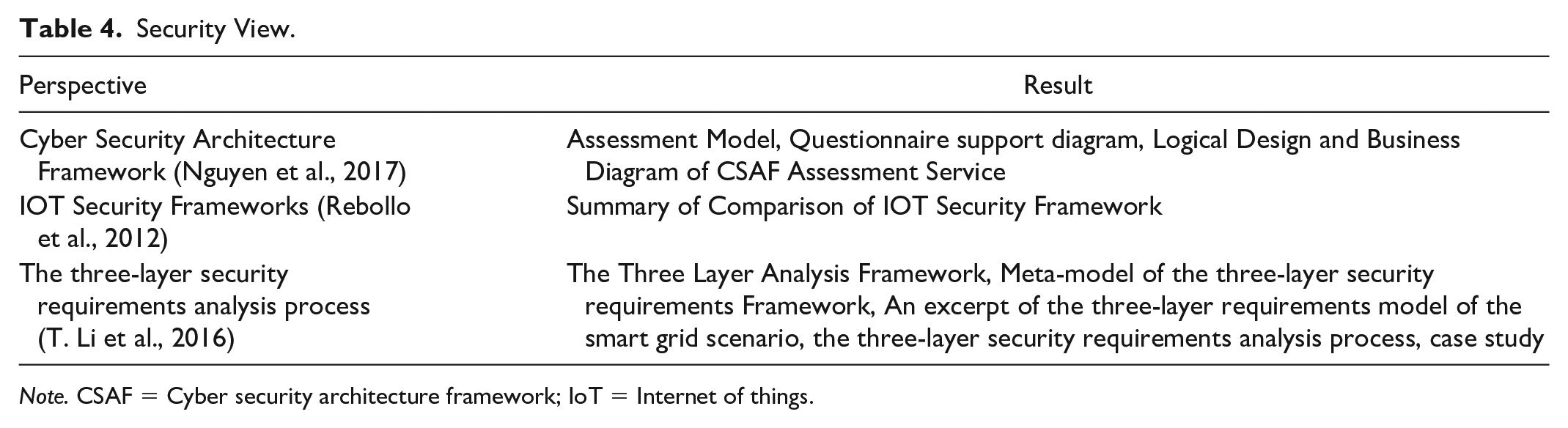
Note. CSAF = Cyber security architecture framework; IoT = Internet of things.
Gap Analysis
For efficient data management, we need to respect the diversity of data provided, most different formats, and the fact that data from billions of devices will contain noise (Incki & Aria, 2018; Schleicher et al., 2016). Gap analysis aims to determine EA capability to meet architectural design needs as a reference in developing Smart City architecture. The analysis is presented in Table 5.
Gap Analysis.

Note. EA = Enterprise architecture; IoT = Internet of things; RFID = Radio frequency identification; GPS = Global positioning system; IT = Information technology; ICT = Information and communication technology.
Based on the results of the analysis, EA needs to be further developed because it does not meet the needs of the engineering framework of the SOSs architecture due to the following:
EA has different characteristics,
EA requires the needs of a service-oriented model,
EA has a broader perspective to IoT infrastructure, and
EA is a collaborative architecture of multisystems as an element of SOSs.
Service-Oriented Architecture–Enterprise Architecture (SOA-EA) Methodology
SOA and EA have the same scope, which is the enterprise scope. This enterprise scope has the same architectural structure. The following is a comparison of the architectural structure of EA and SOA (Table 6).
EA and SOA (Rosen, 2008).

Note. EA = Enterprise architecture; SOA = Service-oriented architecture.
There are fundamental differences between architecture and development (Rosen, 2008), where the architecture team is responsible for understanding the big picture of a system. While the development team is responsible for the implementation and installation of individual services, it also focuses on maximizing SOA’s value in providing enterprise solutions (Rosen, 2008). Technical development aims to provide services in the form of implementing specific business functions efficiently and effectively including from the perspective of IT systems (Rosen, 2008). SOA is the best way to minimize and manage the impact of changes. The modular application of attention to data, applications, technology, and other layers will provide flexibility in managing impacts in the form of isolation and minimization (Rosen, 2008). However, framework is a tool that can be used to obtain data in the form of a consistent structure so that it can be managed and improved. The framework will answer the question of “what?” in the terminology of SOA management practices. The methodology will show “how” in practice terminology (Sweeney, 2010). In general, the process of implementing SOA-EA flow (Sweeney, 2010) is as follows:
Corporate Strategy
Business Unit Planning
SOA Initiation
SOA Project
SOA Implementation.
SoS
The attributes of SoS include a large scale and a distribution network that forms a complex system (Jamshidi, 2009). In other words, the SoS is an integrated system with a large scale that is heterogeneous and stands alone, working with its own operations but working together with others to achieve the same goal. The basic model of the SoS can be seen in Figure 1. Elements in the SoS are independent systems themselves. Each element and the SoS also has its own property, with the most common system elements leading to smart governance, smart living, smart economy, smart mobility, smart people, and smart environment with the highlighted dimension of the rapid advancement of information and communication technology (ITC) to create sustainability of development through innovative ways of communication (Giffinger et al., 2007). Therefore, the implementation of the smart city concept often emerges as the solution in advanced communities that are ready to focus on a digital nervous system, intelligent responsiveness, and optimization of every level of integration as an SoS (Ratti, 2014). Characteristics, architecture, and system dynamics become critical aspects chosen for development methods that must be known and related to each other. Comparison of SoS and non-SoS properties as an elaboration would associate with a centralized methodology or a noncentralized methodology. The methodology will help as an attempt to perform system engineering. Comparison of SoS and non-SoS engineering is shown in Table 7. From the table, it can be seen that SoS engineering requires a different approach in the development of different SOSs (Jamshidi, 2009).

SoS-based model (Jamshidi, 2009).
Difference in Engineering Between Non-SoS and SoS (Jamshidi, 2009).

Note. SoS = System of system.
Synthesis of the Study
In this section, synthesis is carried out to get the results of the research. Our aim was to synthesize the methodology using the SOA, EA, and system engineering approaches. From several studies, the SOA approach was obtained from the SOA Methodology and SOA-EA Methodology. These two methodologies are service-oriented architecture development methodologies. EA uses methodologies with approaches such as The Open Group Architecture Frameworn (TOGAF) and Enterprise Architecture Planning (EAP). These two methodologies are used with consideration of convenience in order to have a higher value of use. The system engineering approach is used to explore the SoS. The three approaches are used to obtain the architecture methodology, which can be seen in Table 8. The results of the formulation are Initiation, Strategy and Goal; Principle; Value Architecture; Organization/Constituent; Service Channel Architecture; Process Domain; Domain Service; Service Integration Architecture; Service Bus; Data Center Architecture; Network Architecture; Sensor Architecture; Security Architecture; and Evaluation.
Mapping SoS SOA Methodology and SoS Domain.

Note. SoS = System of system; EA = Enterprise architecture; SOA = Service-oriented architecture.
Research Methodology
The research methodology used in this study is a systematic literature review and meta-analysis. The systematic literature review methodology has seven stages, namely, (a) problem definition search and framework concepts, (b) selection of work teams, (c) search strategies, (d) search process, (e) conformity and coding, (f) assessment quality, (g) synthesis and exposure. The results of the synthesis carried out are discussed below. Understanding the importance of collecting, storing, and retrieving effective data and providing efficient network resources can provide a high level of architecture for smart cities (Bawany & Shamsi, 2015; Naranjo et al., 2019). However, widespread artificial intelligence, as well as the ownership of personal data within government or private companies, can reduce citizen awareness of the production of negative feedback rings on all systems as a system process (Giffinger et al., 2007). The gap analysis is a method of assessing the difference in performance between business information systems or software applications and the resources to determine whether business requirements are met accordingly.
Discussion
Analysis Design
At this stage, the methodology, which consists of several phase components, is formulated as in the following:
L: Phase
L1: SoS Initiation, Strategy and Goal
L2: Principle
L3: Smart City Model
L4: Organization/Constituent
L5: Service Channel Architecture
L6: Process Domain
L7: Service Domain
L8: Service Integration (Data/Information) Architecture
L9: Service Integration: (Application/Platform) Architecture
L10: Service Bus/Distributed System Architecture
L11: Data Center Architecture
L12: Network Architecture
L13: Sensor Architecture
L14: Security Architecture
L15: Evaluation and Measurement
Previous samples, which discuss the methodology of smart city architecture, have been collected. The results of the study form the basis for the codification in Table 5. The component of the phase relies on the presence or absence of a component based on the existing phase sequence (L1-L15, where L is the number of layers of each publication). The sample column is the code for each publication in the sample. The value of each component is the value at which the phase of architecture is the nominal scale in accordance with the number of phases. Our analysis collected 30 papers as samples to analyze methodological generalizations. This methodology is part of the framework for compiling architecture. This is important because the characteristics of the system as a SOSs have different characteristics from ordinary systems. Service computing systems can be tangible in a single system and SOSs. The methodology needed for the characteristics of the SOSs is predicted to differ from a single system.
In research, the specific methods and procedures used by researchers are systematically reflected in research design, sample design, data collection, data analysis, interpretation of data, and so on. A literature review is a method of strategies and procedures to identify, record, understand, and prove meaning and convey information about topics of interest (Onwuegbuzie & Frels, 2016). In contrast, research questions are the attempts from researchers to answer the phenomenon using search methods of alternative perspective or domain. In most cases, research questions arise from previous literature because they represent a narrowing of goal data, which in turn reflects gaps in the current knowledge base of certain topics. Even when the research questions come from practical experience, it is always best for researchers to study the literature not only to place the research questions in context, but also to examine whether the research questions were not addressed by one or more other researchers (Onwuegbuzie & Frels, 2016).
Given the fact that there is no universally accepted approach to research, the research strategy should include (a) the logic of the research and its various justifications, and (b) specific action plans and problems that must be driven by research (Malthus, 2017). To have a good concept, the definition should be clear and complete, and there must be guidance to lead researchers in delivering the outputs, as well as a comprehensive literature review to provide the framework for the research. Therefore, the boundaries in this research are related to the artifact to be produced, which has been defined as the enterprise architecture utilization from relevant perspectives and evaluation of its implementation (Dawe & Paradice, 2016). In short, we hold SoS as a total holistic approach that allows inter-process and intra-process consisting of government to government, citizen to citizen, and citizen to government in various sectors such as energy and utilities, education, economic development, transportation, public safety, social services, health care, and other ICT-related systems to create unified information and optimize the engagement (Makhdum & Mian, 2012). The Table 9 will be normalized according to the number of layers of each sample with a maximum value of 1. After normalization, L1 to L15 will be the nominal value data for statistical processing.
Codification of Previous Research Results.

Statistical Analysis
We process the data through three type analyses, which are
Reliability analysis, to test the normal distribution of sample data,
Cluster analysis, to group based on the proximity of each phase component, and
Correlation analysis, to find out the correlation of each phase component in a cluster (group).
We show reliability analysis of the data in Table 10, where Cronbach’s alpha is .623, that is, the data above are normally distributed so that they can be tested using parametric testing. Therefore, the execution can take a different direction in terms of the effect due to the large process that should consider a distributed system, personal data protection as the policy compliance as the center point of SoS (G. Li et al., 2010; Lubis & Kartiwi, 2014; Rosmaini et al., 2017).
ANOVA Test Summary.

The following analysis uses clustering analysis with the K-means test. Based on the test results on several iterations, the cluster obtained by all phase components is obtained with two clusters; see Table 11.
Cluster Result.

Note. SoS = System of System.
Because these data are clustered into two, the phase is 2, which is the last analysis that can be done. A correlation analysis is in the form of bivariate correlation analysis. These results are shown in Tables 12 and 13. Thus, the table represents the proximity of the phase components of each cluster. Significant correlation is obtained from the Pearson correlation value at the level of .05 and .01. Significant correlations obtained in Cluster 1 and Cluster 2 are L1-L2, L2-L8, L4-L8, L5-L6, L12-L14, and L13-L14. Significance correlation at level 0.01 in Cluster 1 is L1-L3.
Value of Pearson Correlation Cluster 1.

Correlation is significant at the .05 level (two-tailed). ** Correlation is significant at the .01 level (two-tailed).
Value of Pearson Correlation Cluster 2.
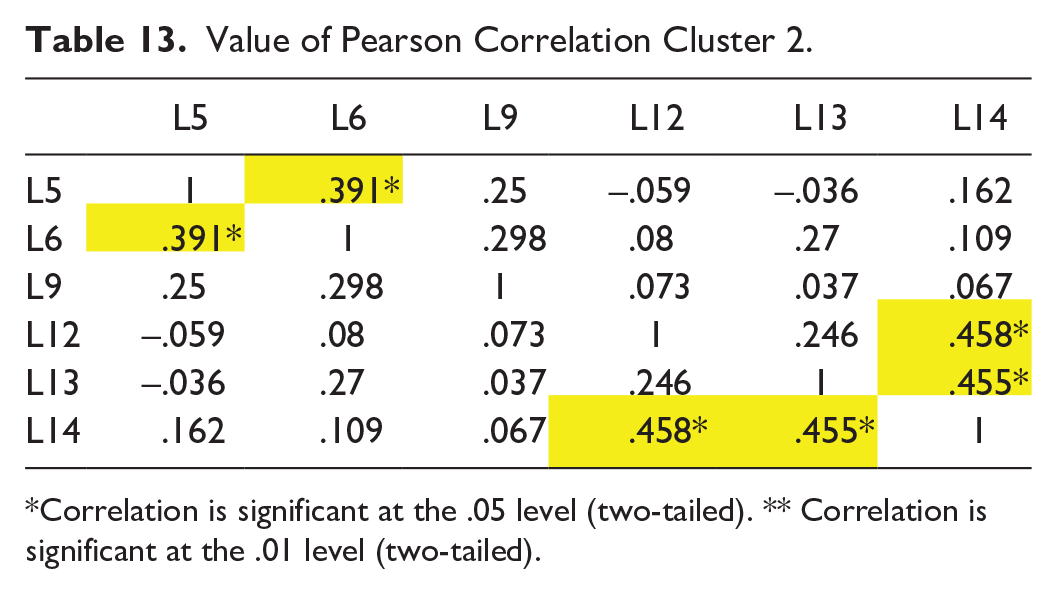
Correlation is significant at the .05 level (two-tailed). ** Correlation is significant at the .01 level (two-tailed).
Phases Explanation.

Interpretation of Results
The results of the interpretation of the above analysis are presented as follows:
Data are normally distributed.
There are two clusters.
The phase does not need to be analyzed for proximity because there are only two clusters in the following order: 2-1.
The correlation seen is to look at the correlation of each component in the cluster to help formulate the meta-model as a service-based computing artifact.
Modeling
Modeling that can be formulated based on statistical analysis consists of three phases, that is,
Data Planning and Architecture,
Infrastructure Architecture (applications, networks, and sensors) and
Security Architecture.
This can be seen in detail in Figure 2.

Definition of architectural development methodology.
The phases and stages are explained as follows:
Providing city services through the concept of smart city in challenging times puts pressures on the application system due to societies in transition, stakeholders in government, and social or economic opportunities as government becomes service provider by aligning business strategy and IT architecture (Giffinger et al., 2007). Relationships based on correlation analysis affect the making of meta-model-based computing services as follows.

Smart city base-model architecture pattern.
The Smart City model is an aggregation of several services provided and used by constituents with physical forms that are data and service channels as constituent interfaces with support for processes, applications/platforms, networks, sensors, and security. Because businesses typically require the use of embedded functions in stand-alone applications that may have been developed over different time periods using different technologies, it is necessary to integrate stand-alone applications (Mehta et al., 2006).
Conclusion
The biggest research area in the implementation of EA in the smart city field is in the development of the framework and perspective for smart city architecture. The gap analysis becomes the fundamental building block due to the importance in identifying the distance between the expectation and the realization of the smart city concept. The statistical analysis used the clustering technique to present the different perspectives in the EA as one concept often utilized by smart city providers in the planning phase to ensure the alignment between strategic planning and the resources or the assets that implementers have. Based on this in-depth study on the Business and IT perspective for smart city architecture, the following conclusions can be made:
There is a need to define the methodology for smart city architecture above the development of EA.
Based on the perspective analysis, there are clear differences in the need for IoT-based architectural levels for service-oriented needs.
The methodology and architecture of EA is currently still not accommodating the development of IoT technology.
Based on the meta-analysis discussed above, the methodology formulation can be used as a development of smart city architecture as a form of SoS. This methodology can be used to create smart city architecture with characteristics of an SoS based on computational services. This methodology accommodates the design of smart city models, data architectures, service bus architectures, data center architectures, service channel architectures, application architectures or platforms, network architectures, and security architectures.
Footnotes
Declaration of Conflicting Interests
The author(s) declared no potential conflicts of interest with respect to the research, authorship, and/or publication of this article.
Funding
The author(s) received no financial support for the research, authorship, and/or publication of this article.
