




Abstract
Founded in 2007, Journal of Informetrics (JOI) is one of the authoritative journals in the research area of computer science, information science and library science. In this study, 1,208 JOI publications published between 2007 and 2023 were retrieved from Web of Science (WoS) for retrospective bibliometric analysis. First, performance analysis based on classic bibliometric indicators is carried out to identify the annual publication trends, citation structures, most cited papers, and leading authors/institutions/countries/territories. Second, the visual co-citation network of JOI generated by VOSviewer is applied to analyze its citation connections. Finally, a new knowledge diffusion trajectory mining method based on the citation network is proposed to discover the knowledge diffusion paths of JOI, while the keyword co-occurrence analysis is conducted to uncover the evolutionary traits of research topics. This study systematically provides a retrospective bibliometric analysis of JOI, and comprehensively explores the potential structure in JOI. Generally, this will help researchers interested in JOI to better understand its development and research patterns.
Keywords
Introduction
Journal of Informetrics (JOI) focuses on bibliometrics, scientometrics, and research evaluation, and is one of the authoritative journals in the research area of computer science, information science and library science. Based on its webpage, it was founded in 2007 and is dedicated to publishing rigorous and high-quality studies on the quantitative aspects of information science. Since its creation, one volume per year with four issues has been published. According to the Web of Science (WoS) 2022 Journal Citation Reports (JCR), it had a 3.7 impact factor and was located in Q2 (the second quartile, indicating a position between the 25th and 50th percentiles) in both of the JCR categories to which it belongs. As JOI has been developed for more than 15 years, this study utilizes bibliometric methods to conduct a systematical and objective retrospective analysis on it in order to uncover its potential structure.
Prior to this study, Egghe (2012) gave an overview of the first 5 years of JOI, analyzing published articles at three levels: co-authors, countries, and topics. To better characterize the local citation relationships of JOI, a map of their local citation environment was presented. Although Egghe (2012) made an attempt to review the development of JOI through some bibliometric indicators, it is not comprehensive enough according to the guidelines for bibliometric analysis (Donthu et al., 2021).
In this study, the latest retrospective analysis of JOI is undertaken using bibliometric methods to examine its development and research patterns based on journal publications published between 2007 and 2023 from the WoS database. First, performance analysis in bibliometrics is carried out using several classic indicators such as TP (Total number of publications), TC (Total number of citations), and TC/TP (Average number of citations per publication) to identify the annual publication trends, citation structures, most cited papers, and leading authors/institutions/countries/territories. Second, the visual co-citation network of the cited authors/sources/references in JOI publications, generated by VOSviewer, is depicted with nodes, links, and link strengths for specific analysis of citation connections. Finally, a new knowledge diffusion trajectory mining method is proposed to discover the knowledge diffusion paths of JOI, while the keyword co-occurrence analysis is conducted in different periods to uncover the evolutionary traits of research topics. The knowledge diffusion trajectory mining method is based on the JOI citation network and utilizes the path search algorithms (J. S. Liu & Lu, 2012) for main path analysis. The keyword co-occurrence analysis examines author keywords in three different periods and provides short-term predictions of future research topics based on high-frequency keywords in the latest period. The main analytical framework of the main body is shown in Figure 1.

Main analytical framework of the main body.
This study systematically provides the latest bibliometric analysis of JOI, and comprehensively explores the potential structure in JOI. Generally, it not only helps researchers interested in JOI to better understand its development and research patterns, but also helps to promote the application of bibliometric methods. The rest of this work is arranged as follows: Section 2 reviews the related work. Section 3 describes the data collection methodology, along with the key research methods and techniques. Section 4 illustrates the proposed retrospective bibliometric analysis and its results, including performance analysis, co-citation network analysis, and knowledge and topic exploration. Section 5 discusses the implications of the study, primarily focusing on the future challenges JOI faces. Section 6 presents the discussion and conclusions of this study.
Related Work
Bibliometrics is an extremely important tool in the world of information and library sciences (Schiuma et al., 2023). Its related research dates back to the early 20th century. The term “Statistical Bibliography” was first mentioned by E. Wyndham Hulme during his lecture at Cambridge University in 1922 (Aria & Cuccurullo, 2017). Since then, an increasing number of scholars have started using statistical methods to uncover the potential characteristics of scientific literature (Snyder, 2019). Subsequently, Pritchard (1969) first proposed using bibliometrics as a substitute for statistical bibliography and expanded the corresponding scope of research from journals to include all bibliographic materials, marking the birth of bibliometrics. Although some scholars have expressed their own opinions on the meaning of bibliometrics over time (Boyce & Kraft, 1985; Broadus, 1987; Fairthorne, 1969), it is indisputable that bibliometric analysis is quantitative in nature (Hood & Wilson, 2001).
As bibliometric techniques and tools continue to be refined, and bibliometric methods have been extensively used in a variety of fields, such as operations research and management science (Merigó & Yang, 2017; Yu, 2015), supply chain finance and management (X. Xu et al., 2018; S. Xu et al., 2020), recommendation systems (Shao et al., 2021), artificial intelligence (Li et al., 2020; Sajovic & Boh Podgornik, 2022), business finance (Goyal & Kumar, 2021; Khan et al., 2022), and live streaming commerce (Mai et al., 2023), among others. In our previous work (Yu, Wang et al., 2017), a multiple-link, mutually reinforced journal-ranking model was proposed to assess the prestige of journals in a certain field.
Some scholars have also used bibliometric methods to examine a particular journal’s knowledge structure by analyzing its publications. Calma and Davies (2016) conducted a citation network analysis of Academy of Management Journal based on all its publications from 1958 to 2014. Specifically, they examined changes in the knowledge structure through keyword analysis. Yu, Xu et al. (2017) and Merigó et al. (2018) both used bibliometric methods to retrospectively analyze publications related to Information Sciences (IS) on the journal’s 50th anniversary. However, the former focuses on identifying the emerging trends in IS, while the latter focuses on summarizing the evolution of citations in IS. Mokhtari et al. (2020) employed bibliometric methods to perform a scientific evaluation of the Journal of Documentation in terms of influential authors, co-authorship patterns, and emerging themes. Zyoud and Zyoud (2021) used bibliometric methods to visualize and map the knowledge and science landscapes in Expert Systems with Applications based on its publications from 1990 to 2019. Schiuma et al. (2023) conducted a collaborative network analysis and a bibliographic coupling analysis of publications in Knowledge Management Research & Practice to identify patterns of collaboration and thematic evolution in the journal.
Besides, as bibliometrics research has become increasingly in-depth and sophisticated, a number of bibliometric indicators have been developed in relation to specific research questions. For example, the H-index (Hirsch, 2005) serves as a hybrid quantitative indicator to evaluate both the quantity and impact of researchers’ scholarly outputs. The Disciplinary Crossing Index (Porter & Rafols, 2009) assesses the interaction between different disciplines in cross-disciplinary research, while the Institutional Global Index (Rafols et al., 2012) measures the interdisciplinarity of institutions. Statistical distribution-based citation counts (Thelwall, 2016) evaluate the impact of large, single-discipline journals, and the Topic Emergence Index (J. Yang et al., 2022) quantifies the degree of emergence of specific research topics. In our previous work (Zhang et al., 2022), an extended Rao-Stirling diversity measure, integrating co-author networks and network similarity measures, was proposed to assess author interdisciplinarity. In our previous work (Z. Yang et al., 2024), a topic emergence index was proposed, which incorporates deep learning methods to predict the emergence of research topics.
Methodology
Data Collection
The use of different databases may lead to differences in the findings of bibliometric analysis (Mongeon & Paul-Hus, 2016). WoS and Scopus have traditionally been the two most commonly used databases for bibliometric analysis, with WoS being more selective in comparison (Singh et al., 2021). In this study, WoS is selected as the source of the dataset. The search strategy employed is as follows: use “Journal of Informetrics” as the publication title, set the publication period from January 1, 2007 to December 2, 2023, choose the WoS Core Collection database, and designate the citation indexes as the Science Citation Index Expanded (SCI-E) and the Social Science Citation Index (SSCI). In total, 1,324 publications were retrieved, which were further reduced to 1,208 publications by removing duplicate publication records and focusing on two types of publications for bibliometric analysis: articles (1,187 publications) and review articles (21 publications). It is worth noting that all articles and review articles were focused for bibliometric analysis after deletion of duplicates, and individual publications with missing information such as author keywords were fixed as far as possible. The retrieval of the dataset for this study was completed on December 2, 2023, and the dataset was finally exported as a plain text file.
Key Research Methods and Techniques
The bibliometric approach used for retrospective analysis of JOI serves as the primary research methodology for the study, aiming to explore its potential structure. Specifically, JOI publications are conducted for bibliometric analysis to examine development and research patterns of JOI. This falls under the application of bibliometric methods for examining a particular journal’s knowledge structure. Notably, a new knowledge diffusion trajectory mining method based on the citation network is proposed to discover the knowledge diffusion paths of JOI.
In this study, JOI publications are analyzed using two types of key bibliometric techniques: performance analysis and science mapping (e.g., co-citation network analysis and keyword co-occurrence analysis). Fundamentally, performance analysis assesses the contributions of research components, whereas science mapping examines the interrelationships among them (Mukherjee et al., 2022). Performance analysis quantifies the performance of different research components (e.g., authors, institutions, countries, and journals) based on bibliometric indicators, which are analyzed descriptively (Donthu et al., 2021). This technique not only indicates the inherently quantitative nature of bibliometric analysis but also highlights the significance of different research components within a given field. Science mapping combines traditional bibliometric analysis with network analysis, and the analysis includes intelligent interactions and structural links between research components, which helps to present the bibliometric and knowledge structure of the research field (Tunger & Eulerich, 2018).
The Retrospective Bibliometric Analysis of JOI
This section presents the proposed retrospective bibliometric analysis and its results based on 1,208 JOI publications. Section 4.1 provides a comprehensive description of JOI’s basic structure from four perspectives through performance analysis. Sections 4.2 gives the visual co-citation network of cited authors/sources/references generated by VOSviewer. Section 4.3 conducts knowledge and topic exploration of JOI through knowledge diffusion path analysis and keyword co-occurrence analysis.
Performance Analysis
Publication and Citation Structure of JOI
JOI has been publishing one volume per year, divided into four issues, since its first volume was published in 2007. A brief overview of JOI publications’ yearly output and citations from 2007 to 2023 is depicted in Figure 2. JOI’s annual publication trends and citation structures are identified by three classic indicators: TP, TC, and TC/TP. Figure 2 shows that the number of JOI publications is about 30 in the first 3 years, and has exceeded 60 each year since 2010, peaking at 95 in 2013. It is worth noting that the 84 JOI publications in 2017 receives the most citations over 5,000, with a general decline each year since then. Similarly, the number of citations per JOI publication has been declining annually since 2017, but the threshold occurs in 2009, when 33 JOI publications has an average of 83 citations.

Yearly output and citations of JOI publications by years, 2007 to 2023.
Table 1 lists the annual statistics of the citation structure of JOI publications. A total of 29 (2.40%) publications have been cited at least 200 times, 64 (5.30%) publications have been cited at least 100 times, and 181 (14.98%) publications have been cited more than 50 times. Over half of the publications have received at least 10 citations, and over 90% of the publications have been cited more than once. Notably, there are 10 years (i.e., 2007, 2008, 2009, 2010, 2011, 2015, 2016, 2017, 2018, 2019) during which all publications are fully cited. Of the remaining 7 years, five (i.e., 2012, 2013, 2014, 2020, 2021) also receive citations for almost all publications, while two (i.e., 2022, 2023) are relatively less universally cited during this period. Among them, the TC/TP value of 2023 is less than 1, indicating that the number of JOI publications in this year exceeds the total number of citations. This is mainly due to the fact that the publications in this year are released within a relatively short period of time, and many of them have not yet been widely read by other researchers. Furthermore, an analysis of JOI publications in some years (i.e., 2007, 2008, 2009, 2010, 2011, 2012, 2014, 2016, 2017, 2018) reveals that approximately half of the total citations received by all publications from that year are attributed to the most cited publications. The number of these most cited publications is approximately the square root of the total number of publications for that year, which essentially conforms to Price’s Law (Egghe & Rousseau, 1986). Therefore, JOI has a mature academic ecosystem that is capable of attracting high-quality research outputs on a stable basis.
Annual Statistics of the Citation Structure of JOI Publications.

Note. TP and TC = total number of publications and citations; TP/TC = average number of citations per publication; ≥200, ≥100, ≥50, ≥20, ≥10, ≥5, ≥1 = number of publications having at least 200, 100, 50, 20, 10, 5, and 1 citations.
Who Pays Attention to JOI?
As one of the globally authoritative journals in the field of bibliometrics, JOI has received a lot of attention. In order to discover its main audience, the sources and authors of the citations for the top 15 most cited publications in JOI according to WoS are statistically analyzed. Table 2 lists the number of publications of the source and the author that cite JOI publications. It is found that the journal most frequently citing JOI publications is the other globally authoritative journal in the field of bibliometrics, Scientometrics. This is followed by another global journal in the field of environmental science, Sustainability, which aptly reflects the interactivity between different disciplines. The authors who cite JOI publications the most are Kumar S, Cobo MJ, and Bornmann L, respectively. Their work (e.g., Bornmann et al., 2010; Goyal & Kumar, 2021) extends beyond the realm of bibliometrics, thereby reflecting the expandability of the discipline’s research.
Numbers of Publications of the Source/Author Citing JOI.

Note. Int J Environ Res Public Health = International Journal of Environmental Research and Public Health; Environ Sci Pollut Res = Enviromental Science and Pollution Research; J Assoc Inf Sci Technol = Journal of the Association for Information Science and Technology.
The Most Cited Papers in JOI
Table 3 lists the top 15 most cited papers in JOI, including their respective titles, authors, publication year (Year), TC, and average number of citations per year since the paper was published (C/Y). Among these 15 papers, 1 paper has a total citation count of over 3,000, and its average annual citation count since it was published in 2017 is as high as 500, while the remaining 14 papers have a total citation count between 300 and 1,000, with only 1 of the 14 papers having an average annual citation count of more than 100. The research themes of these papers mainly cover bibliometric analysis indicators, techniques, tools and applications, methods for the evolution of themes in specific research areas, and systematic comparative analysis between different databases. For example, Aria and Cuccurullo (2017) proposed an R-tool for comprehensive scientific mapping analysis: bibliometrix, and Martín-Martín et al. (2018) conducted a systematic comparison of citation status across three databases: Google Scholar, WoS, and Scopus. These are the two most cited papers on annual average citations among the top 15 most cited papers in JOI, implying they have received relatively widespread attention in a very short time. In addition, a total of three papers here have Waltman L (Leiden University, Netherlands) and Van Eck NJ (Leiden University, Netherlands) as co-authors, a total of two papers have Herrera-Viedma E (University of Granada, Spain) and Herrera F (University of Granada, Spain), and the rest of the papers have multiple authors except for one, which was written solely by Waltman L.
Top 15 Most Cited Papers in JOI According to WoS.

Note. C/Y = average number of citations per year since the paper was published.
Leading Authors, Institutions, and Countries/Territories
Table 4 lists the top 25 authors with the most publications in JOI, all of whom have more than 10 publications in JOI. Bornmann L has the most publications in JOI, with 65 cited a total of 2,970 times, nine of which have been cited at least 50 times each. Following Bornmann L in terms of number of publications are Abramo G and D’Angelo CA, both of whom have been publishing on JOI since 2011 and have approximately 45 publications each. In terms of total citations, Waltman L ranks first, having contributed to 21 publications totaling 4,035 citations since 2008, with an average of around 192 citations for each publication, or more than 260 citations per year. Notably, Van Eck NJ has 11 out of 14 publications published in JOI with more than 50 citations and an average of more than 200 citations per publication, indicating that his TC/TP value is the highest among the top 25 authors with the most publications. It is also clear that Bu Y is the only author who began writing in JOI after 2015, the other 14 began publishing in JOI before 2010, and another 10 between 2010 and 2015.
Most Productive Authors in JOI.

Note.≥50 = number of publications having at least 50 citations.
In depth, the characteristics of the author-paper number distribution of JOI are explored by analyzing the number of publications in JOI by various authors. The author-paper number distribution of JOI does not strictly follow the classical power law distribution, and the power exponent of 0.61 obtained from the fit is significantly lower than the theoretical value of 2 propounded by Lotka’s law (Pao, 1985). This indicates that JOI maintains a relatively balanced pattern of paper output, with a diverse group of authors making contribution rather than depending on a small core of scholars. Furthermore, JOIs high-producing authors exhibit a minimal disparity in the number of papers published and are distributed evenly. This suggests that the journal has a wider academic influence, rather than being dominated by a selected few authors.
Table 5 presents not only the top 20 institutions with the most JOI publications and their countries, but also the number of publications associated with them, the total number of citations, the average number of citations per publication, the citation thresholds, and the most recent QS rankings of the relevant universities. Two Belgian institutions, Katholieke Univ Leuven and Univ Antwerp, have the most publications in JOI, with at least 50. However, the publication with the most citations is Leiden Univ in the Netherlands, whose 38 publications in JOI have received over 5,000 citations in total, averaging out to 131 citations each. It is worth noting that all of its publications are cited, with six of them being cited more than 200 times. Five (i.e., Wuhan Univ, Nanjing Univ, Dalian Univ Technol, Chinese Acad Sci, Zhejiang Univ) of the 20 institutions are from China, and their average number of citations is less than 25. Only one publication from Dalian Univ Technol has more than 200 citations, while two publications from Nanjing Univ have more than 50 citations. Three Italian institutions (i.e., Univ Roma Tor Vergata, Natl Res Council Italy, CNR) also have all of their papers cited at least once, with two (i.e., Univ Roma Tor Vergata, CNR) having publications with more than 100 citations and an average of more than 25 citations. Two US institutions, Indiana Univ and Drexel Univ, have two and one JOI publications with over 200 citations, respectively. The average number of citations per JOI publication at both German institutions (i.e., Max Planck Gesell, Max Planck Inst Solid State Res) exceeds 35. In addition, according to the most recent QS rankings, five universities are in the top 100: Zhejiang Univ, Univ Amsterdam, Katholieke Univ Leuven, Natl Taiwan Univ, and Yonsei Univ.
Most Productive Institutions in JOI.
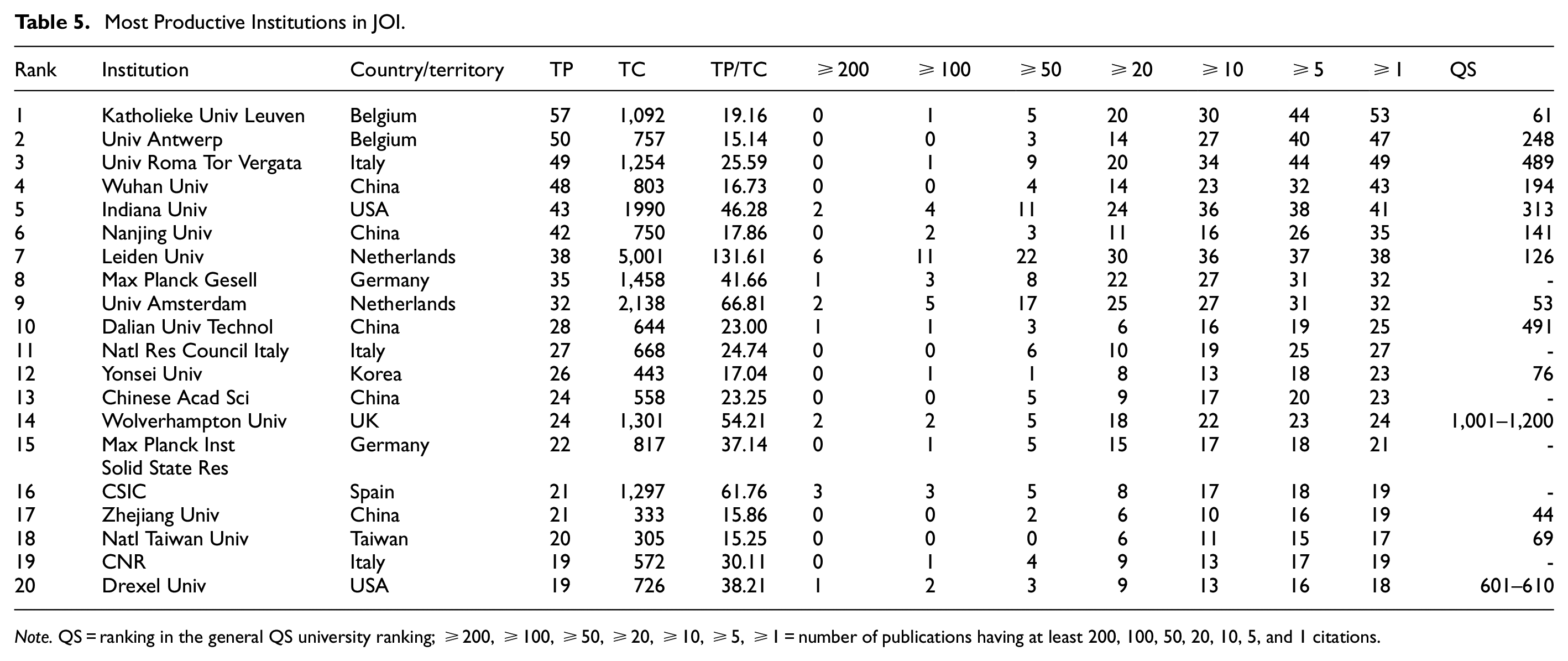
Note. QS = ranking in the general QS university ranking; ≥200, ≥100, ≥50, ≥20, ≥10, ≥5, ≥1 = number of publications having at least 200, 100, 50, 20, 10, 5, and 1 citations.
As can be seen from Table 5, among the top 20 institutions with the most JOI publications, China has the most institutions, followed by Italy, then Belgium, the Netherlands, the USA, and Germany. In Figure 3, the distribution of the number of JOI publications in the world is shown. China has the most JOI publications, with over 300. The USA has over 200 publications, followed by Italy and Spain, each with over 100. However, the statistics also show that, despite having the most publications, China is not ranked first in terms of citations, but rather the Netherlands. In addition, it is noted that the leading contributors to JOI publications in the eastern and western hemispheres are China and the USA, respectively.

Distribution of the number of JOI publications in the world.
Co-Citation Network Analysis
To explore the citation connections deeply, Small (1973) defined co-citation as the frequency at which two documents are co-cited. Co-citation analysis has since been expanded to include authors, journals, and others. This section will present separate co-citation analyses of cited authors, sources, and references in JOI publications. The corresponding co-citation networks are generated and illustrated using VOSviewer, developed by van Eck and Waltman (2010).
Co-Citation Network of Cited Authors
The co-citation network of 254 authors who have been cited at least 25 times by JOI is shown in Figure 4. In the figure, different nodes represent different authors, and the nodes vary in size according to the number of citations the authors have received. The links between the nodes indicate that different authors have been co-cited by JOI, and the links vary in thickness according to the link strength. According to Figure 4, the two largest nodes are Bornmann L and Egghe L, which means that they are most cited by JOI. The thickest link between the two nodes, Bornmann L and Waltman L, indicates that this connection has the strongest link strength and they are most frequently co-cited by JOI. Table 6 provides details on the top 10 largest nodes representing authors, including the total number of citations and links, and the total link strength (TLS). For instance, Bornmann L, the most cited author by JOI, has been cited a total of 1,066 times and has been co-cited with 253 authors for 25,511 times by JOI. Egghe L, the second most cited author by JOI, has been cited a total of 725 times and has been co-cited with 251 authors for 19,357 times by JOI. The subsequent three authors are Leydesdorff L, Waltman L, and Abramo G.

Co-citation network of cited authors.
Most Cited Authors and Sources by JOI.

Note. TLS = total link strength.
Co-Citation Network of Cited Sources
Similarly, Figure 5 shows the co-citation network of sources cited by JOI. The minimum number of citations for a source is set at 25, and 173 out of the 10,356 sources fulfill the criteria. Figure 5 clearly shows that Scientometrics and Journal of Informetrics are the two largest nodes with the thickest link, indicating that they are not only the most cited by JOI but also the most co-cited among the sources co-cited by JOI. It is worth noting that they are both highly authoritative journals in the field of bibliometrics. Likewise, Table 6 also provides detailed information on the top 10 largest nodes representing sources, including the total number of citations and links, and TLS. Scientometrics has been cited by JOI 7,941 times, making it the most cited source by JOI, and it has been co-cited with 172 sources for 276,241 times. The second-ranked JOI has been self-cited 4,659 times, and over 150,000 times when co-cited with 172 sources by itself. In addition, two highly prestigious journals, Science and Nature, which have been cited more than 1000 times and nearly 800 times by JOI, respectively, also appear in the list.

Co-citation network of cited sources.
Co-Citation Network of Cited References
Figure 6 shows the co-citation network of references cited by JOI. The minimum number of citations for a reference is set at 20, and 174 out of the 27,542 references fulfill the criteria. To clearly display the nodes representing references, the nodes representing the same reference that appear due to labeling differences are merged, and the presentation of node labels in the form of references is standardized with first author, publication year, and source. According to Figure 6, Hirsch (2005) is the largest node, indicating that it is the most cited reference by JOI. It is followed by Egghe (2006), which has the thickest link with Hirsch (2005), suggesting that they are the most co-cited by JOI. Table 7 lists the top 10 references cited by JOI, including title, author(s), source, publication year, the total number of citations, links, and TLS. Hirsch (2005) has been co-cited with 169 references over 2,000 times by JOI, followed by Egghe (2006) that has been co-cited with 153 references over 1,000 times by JOI, all of which were published prior to the founding of JOI. The most recent reference is Waltman (2016), which has been co-cited 639 times by JOI along with 158 references. In addition, of the 10 most cited references by JOI, two are from the same conference, and the remaining eight are from four journals, two of which (i.e., Waltman, 2016; Waltman et al., 2011) are from JOI itself.

Co-citation network of cited references.
Most Cited References by JOI.
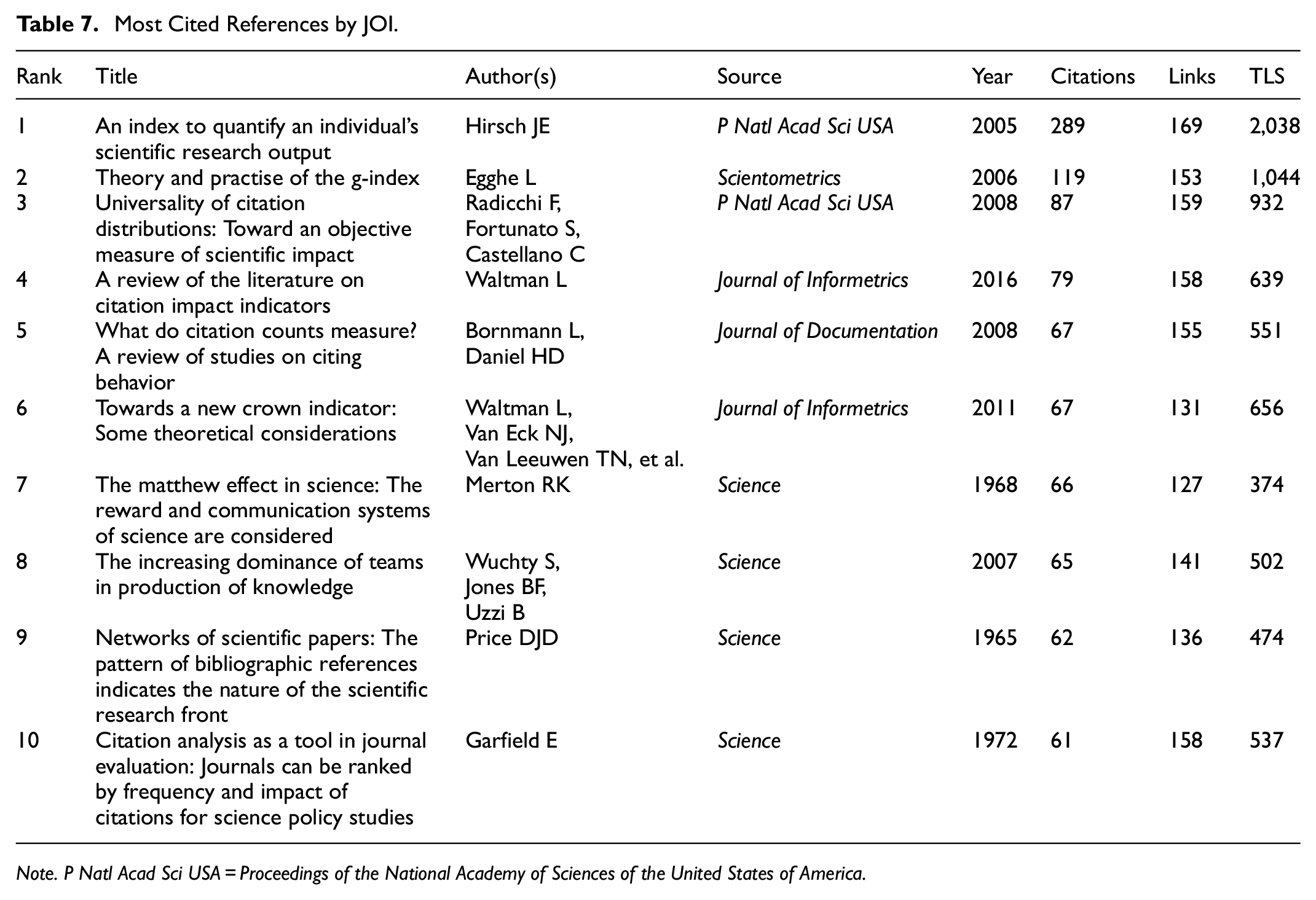
Note. P Natl Acad Sci USA = Proceedings of the National Academy of Sciences of the United States of America.
Knowledge and Topic Exploration
Knowledge Diffusion Path Analysis
Because the JOI citation network represents the knowledge trajectory, in order to discover the knowledge diffusion paths of JOI, a new knowledge diffusion trajectory mining method based on the JOI citation network is proposed. Firstly, based on the JOI citation data sourced from WoS, a citation network consisting of 1,127 nodes that are cited at least once is constructed. Secondly, the largest subnet is extracted from the citation network, and loops are eliminated, resulting in a directed acyclic citation network consisting of 1,032 nodes and 3,509 links. Thirdly, the directed acyclic citation network is weighted using the Search Path Count (SPC) algorithm (Batagelj, 2003). Finally, based on the weighted citation network, the main paths are extracted by utilizing the global standard main path search algorithm and the backward local main path search algorithm (J. S. Liu & Lu, 2012).
Because the latest Pajek software has built-in multiple path search algorithms (Yu & Sheng, 2020), it is used to perform the main path analysis of the JOI citation network in this study. The corresponding results of illustrative main path analysis are shown in Figure 7. The nodes represent publications labeled with the first author and the publication year. The arrow indicates the direction of knowledge diffusion, and the arrow’s thickness corresponds to the link traversal count, with thicker links indicating the greater importance in knowledge diffusion.
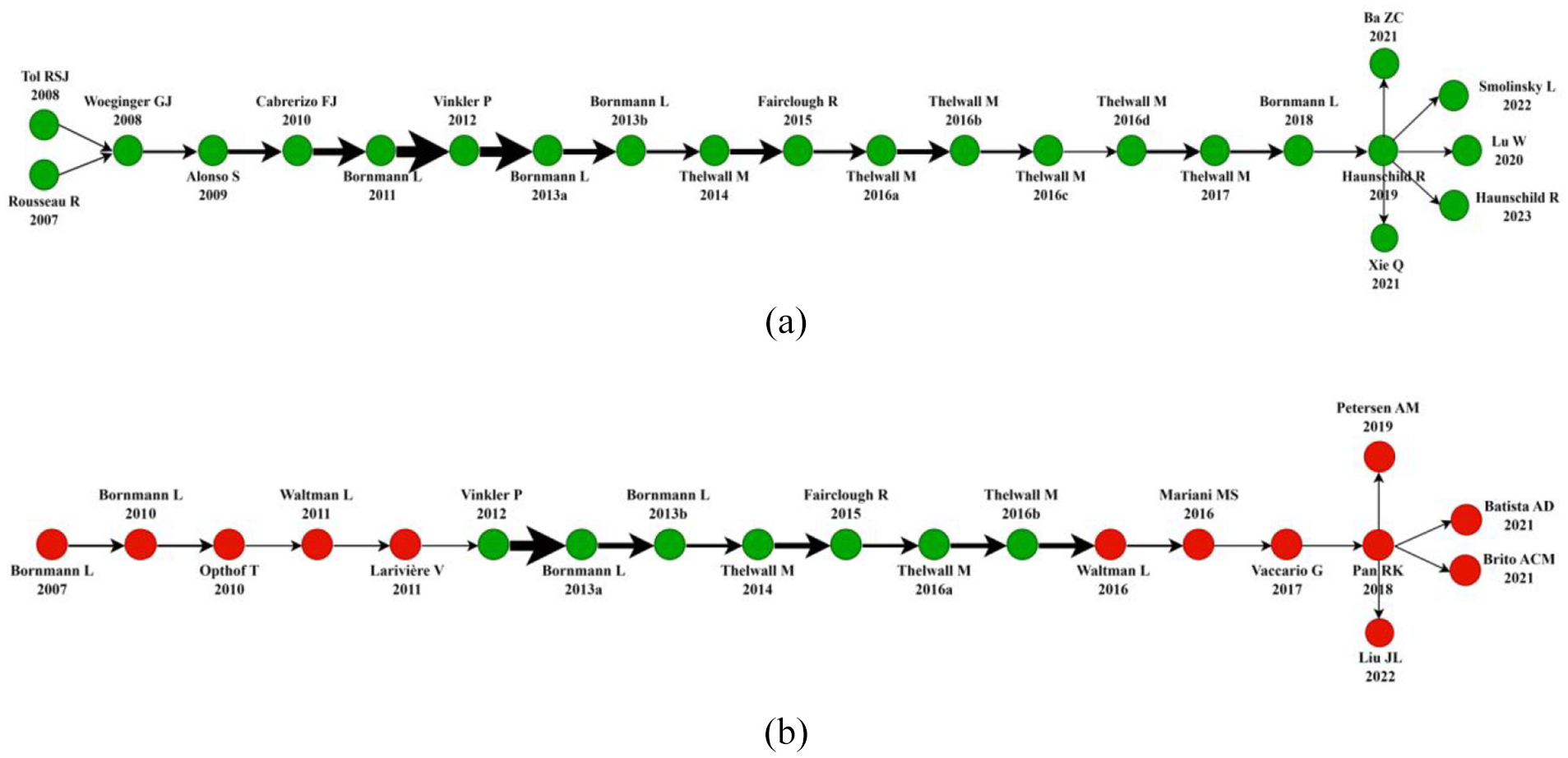
Results of main path analysis: (a) the global standard main path and (b) the backward local main path.
In Figure 7a, the global standard main path (GSMP) contains 23 critical publications. The knowledge in JOI in this main path originates from two studies: Rousseau (2007) and Tol (2008). Rousseau (2007) explored the effect of missing articles and citations on the h-index. Tol (2008) proposed the continuous g-index, which has stronger distinguishing capability than the continuous h-index. The subsequent researches have mainly focused on the h-index or its variants. It can be seen that the link between Bornmann et al. (2011) and Vinkler (2012) is the thickest, which means that the knowledge diffusion between them is the most important in the GSMP. Bornmann et al. (2011) conducted a multi-level meta-analysis of the correlation between the h-index and its 37 different variants, while Vinkler (2012) initiated the study of evaluative bibliometrics. These two publications signify the culmination of previous research paradigms and the inception of novel paradigms. Next, Thelwall and Wilson (2014) evaluated different methods of citation data regression, and some studies (e.g., Fairclough & Thelwall, 2015; Thelwall, 2016) focused on citation impact comparison methods and citation count data distribution. After Thelwall (2017) proposed standardized alternative metrics formulas for research evaluation in three practical areas, the knowledge in JOI has been directed toward altmetrics. As can be seen from Figure 7a, the path bifurcated after Haunschild et al. (2019) indicates that subsequent studies were inspired by this work. For example, Ba and Liang (2021) proposed a knowledge network coupling method to measure science-technology linkage, and Xie et al. (2021) proposed a normalized scholarly academic productivity metric to assess scholar performance.
Figure 7b shows the backward local main path (BLMP), which contains 20 critical publications and complements with GSMP. The red nodes in the path represent publications that differ from the GSMP, specifically at the front and back ends of the BLPM. In the BLMP, although the knowledge in JOI also originates from h-index related research (i.e., Bornmann & Daniel, 2007), Bornmann et al. (2010) started to focus on studying the metrics used to measure research performance. This differs from the change in the theme of knowledge diffusion in the GSMP. Next, Waltman (2016) reviewed citation impact indicators, and the knowledge on citation networks has begun to receive more attention. In particular, Pan et al. (2018) created and evaluated a generative citation network model, inspiring subsequent studies to be pluralistic. For example, Batista-Jr et al. (2021) tested the accuracy of depth and linear regression models in predicting researchers’ scientific ability, and J. Liu et al. (2022) examined the relation between citation behavior and citation impact.
Keyword Co-occurrence Analysis
Keywords serve as a concise summary of a paper (Chen et al., 2023). To uncover the evolutionary traits of research topics in JOI from 2007 to 2023, the co-occurrence analysis to the authors’ keywords of 1,208 publications in different periods is conducted. Figure 8 shows the keyword co-occurrence networks of JOI publications for three different periods. Each node corresponds to a keyword, with the node size indicating how often the keyword occurs. The color of the node signifies the results of clustering, with nodes of identical color sharing a close connection. Links within the network denote the co-occurrence relations among keywords, and the link thickness illustrates the intensity of their co-occurrence. Note that the different forms of keywords that have the same meaning have been merged, such as merging “citations analyses” to “citation analysis.”

Keyword co-occurrence networks of JOI publications for three different periods: (a) 2007 to 2012, (b) 2013 to 2018, and (c) 2019 to 2023.
Figure 8a shows the maximum connectivity subgraph of the keyword co-occurrence network with frequency not less than 2 in 294 publications from 2007 to 2012. It contains a total of 149 nodes, 8 clusters, and 481 links. The largest node is the h-index, and the thickest link appears between the h-index and g-index, indicating that the research topics of JOI during this period are most related to the h-index and its variants.
The maximum connectivity subgraph of the keyword co-occurrence network with frequency not less than 3 in 506 publications from 2013 to 2018 is shown in Figure 8b. It contains a total of 141 nodes, 6 clusters, and 623 links. The largest node is citation analysis, while it is the second largest node in Figure 8a. The thickest link is between bibliometrics and research evaluation. These indicate that JOI’s hot research topics have shifted at this time, with citation analysis-related research dominating the field of information and library sciences, and the bibliometrics in the traditional sense expanding into the evaluative bibliometrics.
From 2019 to 2023, there are 221 keywords that occur more than once in 408 publications. The top 165 keywords based on their total link strength are selected, and the co-occurrence network is presented in Figure 8c. The largest node in the network is bibliometrics, with the two thickest links connecting bibliometrics to citation analysis and altmetrics. This indicates that JOI has established bibliometrics-based mainstream research. Furthermore, based on the indirect link between citation analysis and altmetrics through bibliometrics, it can be predicted that JOI’s research topics in the short-term future will most likely be related to the two keywords of citation analysis and altmetrics, such as discovering new altmetrics or methods for citation analysis.
The Implications of the Study
Though JOI’s annual output has been below 100 since its establishment, its 1,208 publications have been cited for a total of 41,313 times, suggesting that JOI has had an impact despite its low number of annual publications. As research intensifies and new academic journals emerge, JOI may face the challenges in maintaining or enhancing the attention it receives, considering its relatively small annual output compared to the increasing number of publications in the corresponding field during recent years.
Although some of creative JOI publications have been published for a few years, they do not receive the most citations. For example, Tol (2013) firstly proposed the use of quantile kernel regression (Sheather & Marron, 1990) based on the Hirsch index of researchers in different age groups to identify excellent researchers. Although Tol (2013) details the methodology of quantile kernel regression and validates the proposal with illustrative examples, it has not received much attention to this day, with citations in the single digits. Similarly, Wang et al. (2018) investigated the scientific reputations of the most influential physicists by utilizing globally digitized books and papers. This research topic has not attracted significant interest, as evidenced by the fact that it has received only single-digit citations to this day. The lack of attention could be attributed to the possibility that these works are overlooked by other scholars because their topics or methods do not follow the current research trends. Therefore, JOI should consider whether the topic or methodology of a publication aligns with the current research trends in the review process.
In addition, bibliometrics is currently undergoing a rapid development phase (Lyu et al., 2023), and JOI plays an integral role in its development as one of the authoritative journals for bibliometric research. Considering the bifurcation of JOI’s knowledge diffusion paths in recent years, JOI may face further challenges on how to deepen bibliometrics-based mainstream research.
Deepening mainstream bibliometrics-based research does not mean that all studies must focus exclusively on bibliometrics. Rather, bibliometrics should play a dominant role while integrating interdisciplinary methods and emphasizing the diversity of academic research. As mentioned in section 4.1.2 above, following Scientometrics, another journal in the same field as JOI, the main audience of sources for JOI is the journal Sustainability, which focuses on environmental science. This clearly indicates that research in other disciplinary fields is increasingly integrating bibliometric research methods. For example, bibliometric analyses are frequently employed to review research across various disciplines (e.g., Mai et al., 2023; Sajovic & Boh Podgornik, 2022). Furthermore, JOI’s main audience of authors conducts work (e.g., Bornmann et al., 2010; Goyal & Kumar, 2021) extending beyond bibliometrics. This greatly highlights the expandability of bibliometrics research and the potential for interdisciplinary collaboration with other fields. Therefore, besides deepening mainstream bibliometrics-based research, JOI should encourage scholars to integrate bibliometrics into interdisciplinary fields of study through collaboration and other means.
Discussion and Conclusions
Discussion of Main Findings
Prior to this study, Egghe (2012) analyzed published articles in JOI at the levels of co-authors, countries, and topics, outlining the first 5 years of JOI and presenting a map of its local citation environment. However, JOI has been in development for over 15 years, and there is a need to conduct a retrospective analysis in accordance with the guidelines for bibliometric analysis (Donthu et al., 2021) to examine its development and research patterns. In this study, the latest retrospective analysis of JOI is undertaken. Particularly, a new knowledge diffusion trajectory mining method based on the citation network is proposed to discover the knowledge diffusion paths of JOI.
In the performance analysis, it is noteworthy that 84 JOI publications received the highest number of citations, exceeding 5,000, in 2017, followed by a general decline each subsequent year. This trend is largely attributed to the inclusion of the most cited JOI paper (Aria & Cuccurullo, 2017). Aria and Cuccurullo (2017) proposed an R-tool for comprehensive scientific mapping analysis, known as bibliometrix, which is now widely used in bibliometrics. Similarly, the reason why the threshold for the number of citations per JOI publication occurs in 2009 is that 5 of 33 publications from that year have received at least 200 citations, and 2 publications are among the top 15 most cited papers in JOI. In addition, analyzing the citation structure of JOI papers over some years according to Price’s Law reveals that JOI has a mature academic ecosystem. Analyzing the number of publications in JOI by various authors according to Lotka’s Law infers that JOI’s academic influence is more widespread rather than being dominated by a selected few authors.
The co-citation network analysis of cited authors shows that Bornmann L and Egghe L are most frequently cited by JOI. It is important to note that the number of citations (725, as listed in Table 6) for Egghe L by JOI significantly exceeds the total number of citations (191, as listed in Table 4) received by his 21 JOI publications. This indicates that Egghe L has published some articles in other journals related to the research field of JOI and these articles have been widely cited by JOI. The second largest node (Egghe, 2006) in the co-citation network of cited references can exactly reflect this, because the article was published in Scientometrics, which is the most cited journal in the field of bibliometrics by JOI according to the co-citation network analysis of cited sources. This type of contribution, where the same author publishes articles in various journals within similar fields, fosters cooperation and development among journals, thereby promoting a balanced academic ecosystem.
In the knowledge and topic exploration, the knowledge diffusion path analysis shows that the GSMP and the BLMP of JOI are different, specifically at the front and back ends of the main path. Although the two main paths differ at the front, both acknowledge that JOI’s knowledge originates from h-index related research (i.e., Bornmann & Daniel 2007). While the back ends of the two main paths are different, the path structures both exhibit bifurcation, indicating that JOI’s research in recent years demonstrates a trend toward diversification. The keyword co-occurrence network analysis across the three periods indicates that citation analysis has consistently been a hot research topic in JOI. Furthermore, based on the keyword co-occurrence network from the most recent period, JOI has established bibliometrics-based mainstream research. In the future, citation analysis and altmetrics are likely to be further studied together according to the indirect links between citation analysis and altmetrics through bibliometrics. This will help JOI meet the potential challenges on how to deepen bibliometrics-based mainstream research.
Conclusions and Limitations
This study systematically provides the latest retrospective bibliometric analysis of JOI based on its1208 publications published between 2007 and 2023 from the WoS database, and comprehensively explores the potential structure in JOI. Although JOI’s annual output has not topped 100, it has attracted widespread attention. Bornmann L is not only the most productive author in JOI, but also the most cited author by JOI. Waltman L ranks first among all authors contributing to JOI publications in terms of total citations, but is only the third most cited author by JOI. Kumar S is the main audience author for JOI. Scientometrics is the main audience source for JOI, and the most cited source by JOI. China and USA are the main contributors to JOI publications in the Eastern and Western Hemispheres, respectively, and Netherlands received the most citations of all countries contributing JOI publications. Aria and Cuccurullo (2017) is the most cited paper in JOI, and Hirsch (2005) is the most cited reference by JOI.
The main path analysis of the JOI citation network shows that JOI has diversified its research in recent years, but the keyword co-occurrence analysis indicates that a bibliometrics-based mainstream research has been developed. Moreover, based on the indirect links between citation analysis and altmetrics through bibliometrics in the co-occurrence network of authors’ keywords in 2019 to 2023, it can be predicted that JOI’s research topics in the short-term future will most likely be related to the keywords of citation analysis and altmetrics.
However, this study does not cover all types of JOI publications and involves some subjectivity in labeling treatments and making short-term predictions about future research topics, which is worth further investigation. While potential future challenges for JOI have been speculated upon and discussed in relation to maintaining attention and deepening mainstream research, greater specificity in addressing these challenges deserves further consideration.
Footnotes

Ethics Considerations
This article does not contain any studies with human or animal participants.
Funding
The author(s) disclosed receipt of the following financial support for the research, authorship, and/or publication of this article: This work has been supported by Zhejiang Province Science and Technology Leading Talent Plan Project of China (No.2023R5213), and Zhejiang Province “Jianbing” Key R&D Project of China (No.2024C01034).
Declaration of Conflicting Interests
The author(s) declared no potential conflicts of interest with respect to the research, authorship, and/or publication of this article.