




Abstract
This study aims to reveal the bibliometric characteristics of publications on educational research from diverse perspectives, including the level of national-international collaborations, the percentage change in open-access papers, and interactions with other disciplines. Through bibliometric analysis, the data were collected from Web of Science (WoS), “Education and Educational Research (E&ER),”“Psychology, Educational (PE),”“Education, Special (ES)” and “Education Scientific Disciplines (ESD)” categories, during 2011 to 2020. The findings suggest that the number of publications in each category and the percentage of open-access publications have increased regularly. However, it was observed that categories, especially the ES category, were partially falling behind, as compared to the growth in WoS; while the ES and the PE categories were the highest regarding national-international collaborations over time. Both collaboration levels were the highest in the E&ER category. It was concluded that the multi-authorship trend has rapidly increased, the number of references has regularly increased, and specifically, the PE category has been distinguished from others in terms of the references used. Meanwhile, the change over time in the aggregate impact factor, calculated for each category as a measure of the widespread impact of the studies, pointed to inflation. The results show that educational research is becoming more organized and international, while less fragmented. Moreover, the findings support that educational research is interdisciplinary in essence and diverse in content.
Keywords
Introduction
Education is the entirety of the activities undertaken to shape, improve and develop individuals’ thoughts and behaviors to increase their harmony and productivity in line with pre-established goals for the present and the future. The knowledge, skills, and attitudes gained through education, lead to an increase in the awareness of a person, improve the individuals’ personalities, and help to contribute to their value in society (Matheson, 2014). Today, the qualifications expected from the manpower needed by the societies are rapidly changing and this situation directly affects the education systems. Therefore, education systems need to constantly renew and improve themselves in parallel with the developments in information and communication technologies (Rose, 2014).
The search for solutions by analyzing problems with the help of cooperation and collaboration among sciences emerged especially in the 20th century and it is regarded as an accepted model today. In this context, educational sciences are highly significant today both in scientific studies and in the area of practice, in parallel with the developments in the fields of science and technology, as well as with the adoption of interdisciplinary and multidisciplinary science approaches (Goodyear et al., 2009).
“Knowledge,” which has emerged as a result of scientific research from the past to the present, has been the most important resource that ensures the development, change, and transformation of societies; thus, has brought different societies together through various communication channels. The scientific background and accumulation that emerge as a result of knowledge are shared through communication channels, making it possible to discuss different ideas in the scientific literature (Hicks, 2012; Orlikowski, 2002). Therefore, especially academic journals play a primary role among the official communication languages of science in the process of knowledge construction, dissemination, and its use (Abramo, 2018; Hicks, 2012; Nederhof, 2006; Riviera, 2013).
The competitive environment created by the increasing number of academic journals (Fire & Guestrin, 2019) has brought along the “publish or perish!” philosophy among researchers, and thus, the “quality or quantity?” dilemma has arisen in the studies conducted (Civera et al., 2020; McGrail et al., 2006; van Dalen, 2021). Hence, it becomes more and more important each day to follow the publications in academic journals in the field of education, to determine the characteristics of these publications, and to analyze the citation relationship networks among the publications based on various criteria, so that it will be possible to understand the present and to make inferences between the past and the future (Engels et al., 2012; Henriksen, 2016; Larivière et al., 2006; Pajić, 2015; Rowlinson et al., 2015). The introduction of different platforms to follow up on the publications, and to analyze the citation or relationship networks between the publications, has ensured effective access to information and analysis of documents based on various criteria. The bibliometric analysis method, first defined by Pritchard (1969), is one of the methods that can be used for this purpose. Bibliometric studies reveal the current status, orientation, and development of studies in the literature in a specific discipline; and provide the opportunity to analyze the academic journals and articles by mathematical or statistical analysis according to citations, topics, or the distribution of countries. In addition, the bibliometric analysis also demonstrates the change in the interest toward science, the interaction of the specific science field with other disciplines, as well as the level of internationalization in the relevant field (Donthu et al., 2021). Thus, bibliographic databases have grown in importance, as they are the primary sources of publication information and bibliometric indicators, which are widely utilized for both research assessment and daily tasks. Since the data source determines the dependability of these tasks, all database users should be allowed to select the most appropriate one that fits their needs. In today’s academic community, the giants of bibliometric information are the Web of Science (WoS) and Scopus (Pranckutė, 2021).
Currently, the articles published in journals, which are reviewed in citation indexes in the WoS database, are widely accepted in the academic community, and as a result, this database is frequently used in bibliometric analyses (Birkle et al., 2020; Li et al., 2018; Pranckute, 2021). In addition to being an abstract database, WoS is also a citation database, and the citations received by every single paper indexed in the database are calculated. These citations are used to generate several citation indexes; the most popular of which is the journal impact factor. The impact factor is the ratio of the number of citations in the current year received for the journal in question in relation to the number of articles published in the previous 2 years and the total number of scholarly citable items published in those same 2 years in the same journal (Garfield, 1972). In other words, the impact factor reflects the average number of citations expected for an article in a specific journal. Journals that publish educational research are indexed in the WoS database in four different categories in the Social Science Citation Index (SSCI) and the Science Citation Index Expanded (SCIE). Table 1 summarizes these categories and related indexes along with the scope of the categories (Clarivate Analytics, 2021a).
Categories Directly Related to Educational Research, Which are Included in the WoS.

Academic journals have come into prominence more than ever in the dissemination and the use of the knowledge that is generated from research due to the increased interaction between the field of education and other disciplines each passing day, as well as due to their extensive content and internationalization in the field (Hicks, 2012; Huang et al., 2020; Nederhof, 2006). However, research in the field of education focuses more on specific subjects or sub-fields of education (Arbaugh et al., 2016; Dolby & Rahman, 2008; Gierl et al., 2017; Hallinger & Chen, 2015; Huang et al., 2020; Ivanović & Ho, 2019; Joksimović et al., 2018; Merrill et al., 2017; Snodgrass Rangel, 2018; Surr et al., 2017).
Hence, to the best of our knowledge, there is no relevant study that employs a holistic approach to examine questions in regards to how the level of national or international cooperation in educational research has changed over time, which areas the studies interact with at higher levels, the level of productivity of the publications in the field of education, as well as the trend of progressive change in the impact factors, which are accepted as a measure of the widespread impact of the publications. Therefore, such an approach can be interpreted as analysis from a diverse perspective, and not just from a classical bibliometric (Cobo et al., 2011; Martínez et al., 2015). Thus, a gap exists in research that strives to embody the field of education in its entirety.
The Purpose of the Present Study
This study sought answers to the following research questions (RQ) by conducting a bibliometric analysis of the papers published in the field of education during the years 2011 to 2020:
RQ1: What is the change in the number of published papers, the percentage of open access (OA) papers, and the average number of citations used in papers over time?
RQ2: What is the change in the level of national and international collaboration in published papers over time? What level of interaction does each area have with other areas and which countries are the most productive in each area?
RQ3: What is the trend of change in the aggregate impact factor value for each category over time?
Methodology
Study design: Bibliometric analysis was conducted on educational research with diverse perspectives based on a literature database.
Data/Measurement: The WoS database, Journal Citation Reports (JCRs), and InCites Benchmarking & Analytics were utilized to collect data on August 10, 2021, for the time period of 2011 to 2020, by taking into consideration of only “articles” and “reviews,” referred to as “papers” throughout the study. While all the papers in the ES category, as well as 99.44% of the papers in the ESD category, 95.63% of the papers in the E&ER category, and 94.12% of the papers in the PE category, were in English, there were also papers published in different languages such as Spanish, German, Russian, etc., albeit at lower ratios. As the data implies, the language of communication in educational research during the period of the study was predominantly English. van Leeuwen (2006) also concluded that 95% of publications in the SSCI were in English. However, a detailed statistical analysis was not conducted for the publication languages of the studies.
For RQ1, we used the WoS database and JCRs for the determination of the number of papers, the percentage of OA papers, and the average number of citations used in papers over time. For RQ2, we used InCites Benchmarking & Analytics to calculate the level of national and international collaborations. To determine the aggregate impact factor (AIF) for RQ3, we used the JCRs. For a given year (y), the AIF is defined as the ratio of total number of citations received by the papers in the category within the specified year to the number of citable documents in the category in the last 2 years and is calculated as per the equation below (Clarivate Analytics, 2021a):

Findings and Discussion
This section presents the findings regarding the research questions which were discussed in relation to the relevant literature.
Findings and Discussion for RQ1
Figure 1 shows the number of papers published in the field of education for the period of 2011 to 2020 for four categories.

Distribution of papers for educational research during 2011 to 2020.
As can be seen from Figure 1, the E&ER category was the most widely published field since it has a broad spectrum of publications and includes all kinds of educational research (see also Table 1). On the other hand, ES and PE categories were more specific compared to the other two. Holistic analysis of the 2011 to 2020 period demonstrated a certain growth in all educational categories. However, there was a decrease or an excessive increase in the number of publications in some periods. For example, an obvious growth was observed in the E&ER category in 2019 as compared to previous years. This decrease or increase in the number of publications may be related to the addition of new journals to the WoS database by expanding its field, as well as the exclusion of some of the journals from indexing due to violating the WoS review criteria, even though they were previously indexed. Table 2 presents the change in the number of journals in each category during the period under investigation.
The Change in the Number of Journals in the Education Categories During 2011 to 2020.

It should be noted that it is useful to commonly use the logarithmic transformation to see the true magnitude of the trends, since there are large differences between the number of papers in the past years and the number of papers today, as seen in Figure 1. Figure 2 presents the changes in the number of papers under logarithmic transformation using Figure 1 data to display the growth in each category more clearly. To show yearly increase using Pearson correlation coefficient which measures the strength and direction of linear relationships between pairs of continuous variables (George & Mallery, 2010), a significant correlation was found between the period in question and the number of published papers (R2 = .880 for E&ER; R2 = 0.919 for ESD; R2 = 0.945 for PE; R2 = 0.537 for ES), and the growth pattern was represented by a linear model. Meanwhile, it is not surprising that the number of papers in the education field has increased this way. Likewise, Hu et al. (2020) found that the whole WoS database showed an annual increase. In fact, an exponential growth curve was found to provide a better fit, although the increases were not fully linear (over R2 = 0.950). This finding demonstrated that productivity was more limited in the ES category compared to the entire WoS database.

Log-transformed number of papers during 2011 to 2020.
For each category, Figure 3 shows the percentage of change over time in OA papers which means free to read online, either on the publisher’s website or in an OA repository (Piwowar et al., 2018).
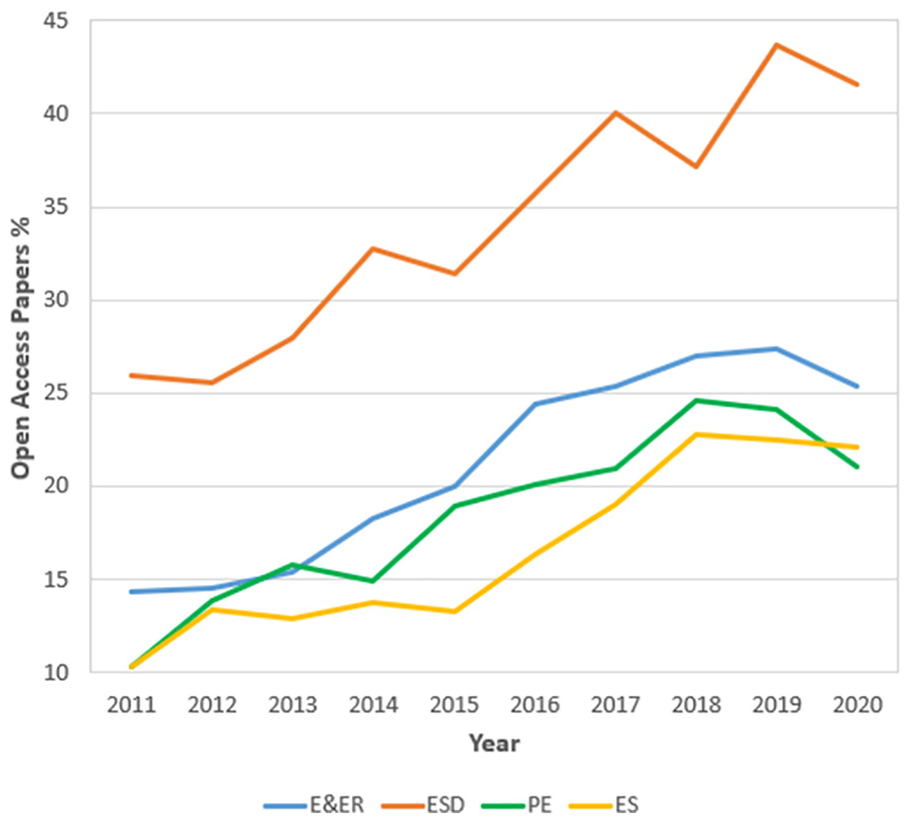
Change of the percentage in open access papers during 2011 to 2020.
The percentage of OA papers showed a tendency to increase in a linear fashion when the period in question was investigated in a holistic manner. Specifically speaking, 4 out of 10 papers published in the ESD category were OA publications, while 2 out of 10 papers were published as OA in the other categories. In general, the percentage of papers published as OA in all fields was found to increase over the years, which is encouraging. It is worth emphasizing that this trend has been observed in virtually all scientific fields in recent years, especially since the recent EU policies, known as Plan S, require researchers who have been funded with EU grants and some external institutions to publish articles in open-access journals to make the articles more publicly accessible (Brainard, 2021; Else, 2018). In addition, OA papers published were naturally read more due to their accessibility, and as a result, received more citations (Piwowar et al., 2018). Piwowar et al. (2019) concluded that 31% of all papers published in journals were available as OA and 52% of the viewed papers were due to their nature as OA in 2019. Based on the existing trends, the researchers concluded that 44% of all papers published in journals would be available as OA and 70% of all viewed papers would be OA by 2025. Therefore, published papers, which play a significant role in the generation, dissemination, and utilization of scientific knowledge, will be more easily accessed by researchers, especially by researchers who have limited access to these resources.
For each category, Figure 4 presents the change in the average number of citations used in the papers over time. The average number of references used in papers published in each category was found to steadily increase by the year. This is actually a natural consequence of the development in the field. At all times, the PE category had the highest average number of references per paper, while the ESD category had the least average number of references. As can be gathered from Table 1, such a trend in the ESD category may be explained by the fact that this field is related to very specific disciplines.

The average number of references cited in the papers published by year.
As it is known, the most important factor that determines the production and use of knowledge in any field is directly related to the characteristics in this field. In other words, whether the information required in the field is current, retrospective, universal, or local, and whether the field is open to teamwork or to individual research directly affects the type and quality of the resources. The knowledge generated in social sciences is particularly influenced by the region where people reside, their personal and social conditions, as well as by their political and cultural systems. Therefore, the production and use of knowledge remain largely limited to the national level (Özenç Uçak & Al, 2008). However, in educational research, the subfield of psychology education differs from other fields in many respects. In this sense, the field of psychology, where the rate of literature aging is the highest, and hence, where current information becomes highly crucial, differs from the other social science fields (Glänzel & Schoepflin, 1999; Özenç Uçak & Al, 2008). Henriksen (2016) explored the change of multi-authorship in journals reviewed in SSCI and concluded that the field of psychology, and accordingly the PE category, differed from other categories in the field of education and other fields of social sciences in many respects, especially regarding multi-authorship.
Findings and Discussion for RQ2
Figure 5 depicts the change in the level of national and international collaborations in the papers published in the field of education over time.

The percentage of national and international collaborations during 2011 to 2020.
National and international collaboration tended to increase linearly in all categories in the field of education field on a regular basis. Figure 5 shows that national collaboration regularly increased from 23.23%; 30.77%; 33.83%; 42.55% in 2011 to 29.86%; 36.89%; 38.91%; 48.03% in 2020; and likewise, international collaboration regularly increased from 11%; 10.9%; 15.98%; 15.17% in 2011 to 19.04%; 15.59%; 22.8%; 15.34% in 2020, for E&ER, ESD, PE, and ES categories, respectively. The PE category, which differs in many aspects within the social sciences, was found to differ from other education categories, especially regarding international collaboration, as seen in Figure 5. Aman and Botte (2017) also concluded that the international collaboration among the 20 most productive European countries in Educational Research (in the WoS database) showed a tendency to increase regularly from 14.1% in 2002 to 21.7% in 2013. As a result, the average number of citations per paper increased over time as a natural consequence of increased international collaboration in educational research (Althouse et al., 2009). Orbay et al. (2021) studied the international collaborations in the top 10 most productive countries in the education research in the period from 2013 to 2018 and established that international collaboration increased to higher levels as compared to the values established in Aman and Botte’s (2017) study; namely, from 20.6% in 2013 to 29.1% in 2018. On the other hand, a study conducted in the field of special education by Örnek et al. (2021) pointed out that the international collaboration rate was almost constant in the period from 2014 to 2018 and that the rate of international collaboration for the 10 most productive countries was 36.96% in 2014, 38.06% in 2015, 38.82% in 2016, 33.77% in 2017, and 36.61% in 2018 (average 36.56% in the period of 2014–2018).
This trend at national and international collaboration levels in educational research reinforces the visibility of research and its interaction with other disciplines (Althouse et al., 2009). This interpretation is in line with the findings in the literature pointing to a recent trend toward multi-authorship in scientific communication (Adams et al., 2019; Henriksen, 2016; Van Noorden, 2015).
The fact that some journals in the WoS database can be indexed in more than one category (in two, three, and even four categories) should be kept in mind. In most cases, these categories are included in the same database, however, there are examples where journals are simultaneously indexed in two separate databases, that is, SCIE and SSCI (Clarivate Analytics, 2021b). In fact, this can be regarded as a level in the relations between the fields (Orbay et al., 2020). In this context, Figure 6 presents the interaction levels of the papers published in each category in the field of education with other categories for the first 10 categories.

The relationship percentages of papers in each category with similar categories.
To make sense of Figure 6, it is important to state that these education categories are in a very close relationship with other disciplines. In particular, three out of every four papers published in the ES category were found to be related to the Rehabilitation category, while these papers also closely interacted with the fields of Psychiatry (15.98%), and Psychology Developmental (15.1%). Hence, the national collaboration approaching 50% for the ES category provided in Figure 5 can be explained in this manner.
Figure 7 provides the 10 most productive countries in education research separately for each category. As Figure 7 shows, the USA is the undisputed leader in all categories of educational research. On the other hand, it is possible to see England, Spain, Canada, Netherlands, China, and Australia in all categories, although they ranked differently among the 10 most productive countries. Thus, it is observed that the Anglo-Saxon and Continental European countries are the most productive countries in educational research.
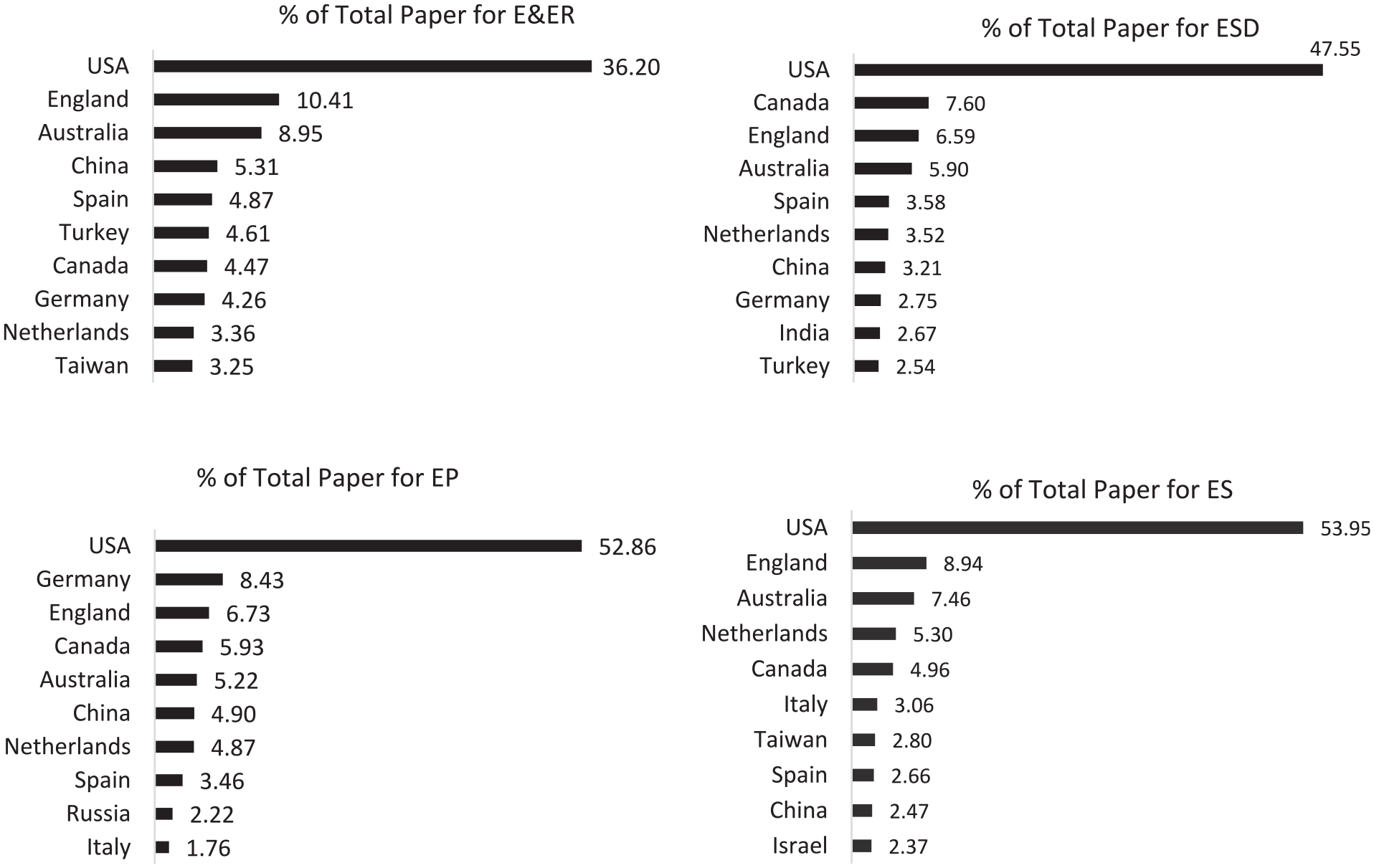
Top 10 most productive countries in the education research during 2011 to 2020.
Findings and Discussion for RQ3
This section has addressed the AIF values instead of journal impact factors since the focus was the educational research categories throughout the study. To give a brief explanation, the aggregate impact factor for a subject category and the journal impact factor for a journal is calculated in the same manner; but the aggregate impact factor takes into account the number of citations in all journals in the category and the number of papers from all journals in the category.
Table 3 provides the aggregate impact factor for each category during the period of 2011 to 2020. According to Table 3, the aggregate impact factor increased from 0.913; 1.583; 1.237; 1.636 to 2.683; 3.123; 2.592; 2.323, respectively for E&ER, PE, ESD, and ES categories for the period of 2011 to 2020 (Clarivate Analytics, 2021c).
The Change in the Aggregate Impact Factor for Each Category During 2011 to 2020.

In fact, the increases in the aggregate impact factors are expected over time. The main reasons for this growth are related to the four contributing components as follows: field growth, the average number of cited items per paper, the fraction of citations to papers published within 2 years, and the fraction of citations to the JCR-listed items (Althouse et al., 2009).
Let us examine this situation, which is given in Table 3 and called impact factor inflation, in more detail for the field of educational research. Table 4 demonstrates the percentages of increase in the components that directly affected the aggregate impact factor by using RQ1 and RQ2 data for each category, in which educational studies were published.
Change in Some of the Components Contributing to the AIF Factor Growth From 2011 to 2020.
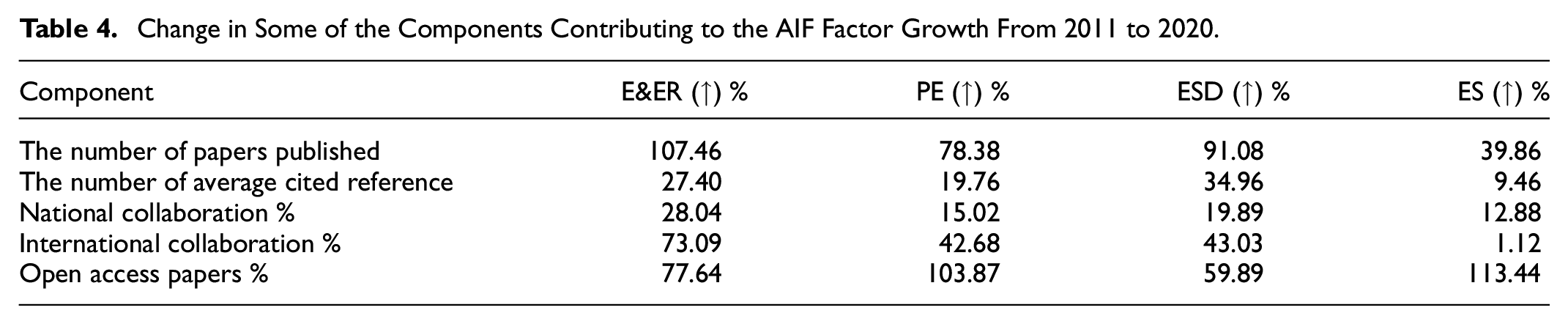
As seen in Table 4, the percentages of increase in the components are actually among the main reasons for the aggregate impact factor inflation. In addition, aggregate impact factor values may increase due to the contribution of other causes such as online citation databases, development in internet technology, and electronic access to the literature. As mentioned in the introduction section, the fact that the impact factor values are no longer only a bibliometric criterion to evaluate journals, may have affected the increases observed in the impact factors. Attention and interest in academic journals in the WoS database are increasing rapidly in relation to the pressure on the academic staff and schools as a result of “publish or perish!” and “quality or quantity” discussions.
So far, this study has analyzed the performance of educational research over time, based on some variables depending on the categories in which they were published. However, comparing the education categories with other categories in the indexes will enable us to reflect on the whole picture more clearly. While there were 56 categories in 2011 in SSCI, which includes E&ER, PE, and SE categories, the number of categories increased to 58 in 2020. Similarly, while there were 176 categories in 2011 in SCIE, which includes the ESD category, this number increased to 178 in 2020. Table 5 presents the ranking of the education categories according to the other categories within the indexes they were included for the 2011-2020 period, which was investigated in the present study, by taking the number of publications, the number of journals, and the aggregate impact factor values into consideration.
The Change in Ranking for Education Categories in SSCI/SCIE From 2011 to 2020.

Table 5 demonstrates that while the E&ER category was stable in SSCI regarding both the number of journals and the number of published papers; on the other hand, its aggregate impact factor, which is the measure of the widespread impact of these publications, increased from 45th to 38th. It can be argued that the increase in the level of national and international collaboration, established in Table 4, was the main reason. On the other hand, the PE category, with a similar situation, had a higher prevalence than the E&ER category, despite the partial decrease in the number of publications. However, the PE category regressed from 20th to 28th in the aggregate impact factor ranking in SSCI. Alternatively, the ES category was found to partially decrease compared to other categories in SSCI regarding both the number of published papers and the number of journals. When the level of national and international collaborations summarized in Table 5 and the limited increase in the number of references used by the papers over time were added to this reduction; the aggregate impact factor, considered to be a measure of the widespread impact of published papers, was naturally affected and regressed from 17th to 46th in the SSCI. The ESD category, on the other hand, maintained its place in the SCIE in terms of both the number of publications and the number of journals, and moreover, displayed a stable appearance regarding the aggregate impact factor.
Conclusions
This paper has focused on the education research published in the WoS database since academic journals have become the primary communication tools among researchers in educational sciences and have taken a central role in generating, disseminating, and using knowledge. Educational research is indexed in the WoS database in four different categories: E&ER, PE, and ES categories in SSCI, and the ESD category in SCIE.
The number of papers published for each category, the percentage of change in OA papers, and the change in the average number of references used in the papers over time were chosen as RQ1. It was concluded that the number of papers in each category tended to increase linearly over time, but this increasing trend was relatively low when compared to the whole WoS database, and was highly slow-paced, especially in the ES category. While the percentage of OA papers increased in all the categories, this rate was found to exceed 40% in the ESD category. This situation is similar to the trend in other fields of science as well. A regular increase was identified in the change in the number of references used in the papers, but the journals in the PE category were found to differ from the other categories in the field of education at this point. These findings are parallel with the results of the previous studies in the literature (Henriksen, 2016; Valderrama-Zurián et al., 2019).
The gradual change in the level of national and international collaboration in published papers over time, the level of interaction of each field with other fields, and the most productive countries in each field were selected for RQ2. It was observed that the level of national and international collaboration in all fields of education increased regularly. Especially in the E&ER category, the increase in national and international collaboration was more rapid compared to the other fields, while this increase was rather limited in the ES category. These findings on national and international collaboration in educational research are in line with the findings in the literature, pointing to a recent trend toward multi-authorship in scientific communication (Adams et al., 2019; Henriksen, 2016; Noorden, 2015). Meanwhile, Aman and Botte (2017) demonstrated that the international collaboration of the 20 most productive European countries in Educational Research (WoS) continuously increased from 14.1% in 2002 to 21.7% in 2013 and explained the average number of citations per article increased as a natural consequence of increasing international cooperation in educational research over time. In another study, Orbay et al. (2021) determined the international collaborations in the top 10 most productive countries in the area in the period 2013 to 2018 and found that the international collaborations have increased even to a higher extent than in the study from Aman and Botte (2017), from 20.6% in 2013 to 29.1% in 2018.
In the examination of 10 categories where each education category is most closely related, it has been observed that the field of education has an extremely multidisciplinary structure. In particular, the ES category was observed to have a very high-level interaction with Rehabilitation (75.47%), Psychiatry (15.98%), and Developmental Psychology (15.1%) categories. Similarly, the PE category was found to interact with E&ER (37.48%), especially with Developmental Psychology (18.6%), and other subfields of psychology.
The USA is indisputably the most productive leader in all four categories of publishing in the field of education. In a review of the 10 most productive countries, Canada, Australia, England, Spain, China, and the Netherlands are represented in all four categories. The Anglo-Saxon and Continental European countries are found to be highly productive in educational research. These findings indicated that small, well-governed countries with a long history of democracy were better at turning economic success into high-quality science, as indicated by Allik et al. (2020), Öner and Orbay (2022), and Sezgin et al. (2022).
This study has focused on education categories and was conducted by taking the impact factors into consideration, which is accepted as a measure of the widespread impact of the studies published in the field of education, instead of the journal impact factor; hence, the change of the aggregate impact factors calculated for each category over time was chosen as RQ3. The analysis showed the existence of aggregate impact factor inflation for each category. While the highest increase was in the E&ER category (193.87%), the lowest increase was observed in the ES category (41.99%). The main reason for this observed inflation was explained by the number of papers, the change in the percentage of OA papers over time as a result of national and international cooperation, and the increase in the average number of papers used by the journals within the categories.
Each of the education categories was subjected to a relative comparison with the other categories in the indexes they were reviewed. The ranking including the education categories according to the number of journals in the category, the number of papers, and the aggregate impact factor values at the starting point of the selected period (2011) was examined at the end of the period (2020) for comparison. While the ES category was found to decrease compared to the other categories, the ESD category maintained its place. However, while the number of papers and the number of journals in the E&ER category did not change over time, they moved in rank in terms of the aggregate impact factor. On the other hand, although the PE category still had a higher impact ranking as compared to the E&ER category, the number of papers fell behind regarding the aggregate impact factor ranking, due to falling behind in the E&ER category, as based on the number of papers and the national and international collaboration levels. Similarly, although the ranking of the E&ER category did not change relatively in the number of journals and published papers, it started to come to the fore in the aggregate impact factor ranking in SSCI.
Finally, since the educational sciences, which can be defined as the discipline at the interface of social sciences and humanities, were usually supported by national studies and publication culture, the citations were limited to the relevant country and the relevant publication language (Andersen, 2000; Diem & Wolter, 2013; Hicks, 1999). Results obtained in this study indicated that educational research is becoming more organized, more international, and less fragmented at the present. Moreover, these findings support that educational research is interdisciplinary in essence and diverse in content (Goodyear et al., 2009), and this trend is playing an important role in the increase of the number of education journals. The results obtained from this study for educational researchers may be useful to enrich the discussion about the journal-based evaluation system.
Research Limitations/Implications
This study has some limitations. The first limitation is related to the selection of bibliometric data only from the WoS, which may have caused overlooking some of the relevant publications in this study. The second limitation is related to examining only the educational research published in SSCI and SCIE, almost all of which were published in English. Thus, significant education studies in other languages (such as German, Chinese, and French) were not included in this study. Finally, the study only analyzed the “articles and reviews” published in the field of educational research. It is believed that this dataset has predominantly represented the industry standard, even though other datasets are emerging. Based on the above limitations, further research might expand the scope of databases to include others, such as Scopus or ERIC.
Footnotes
Acknowledgements
The authors would like to thank the anonymous referees for their useful comments and insightful suggestions, and Dr. Oktay Eser and Dr. Mehmet Kara from Amasya University for their help to improve the English of the paper.
Declaration of Conflicting Interests
The author(s) declared no potential conflicts of interest with respect to the research, authorship, and/or publication of this article.
Funding
The author(s) received no financial support for the research, authorship, and/or publication of this article.
Ethics Statement
This study utilized a literature database; hence, institutional review board approval or informed consent had not been required.
