



Abstract
Online food delivery (OFD) services offer a variety of food options and convenient ways of consuming meals; however, contaminated delivery packaging can gradually cause serious environmental problems owing to its low recycling value. This study explores the factors that drive (un)sustainable OFD consumption and how information-evoked emotions can induce pro-environmental OFD spillover effects. After observations and interviews, an online survey was developed and data was collected in two phases. The findings showed that family and friend norms exerted direct effects on sustainable OFD behaviors of consumers. High-cost pro-environmental habits were positively related to sustainable OFD intentions while low-cost pro-environmental habits were negatively associated. Only internal attribution-dependent emotions strongly predicted pro-environmental OFD spillover effects, especially when consumers attributed responsibility to themselves. To reduce OFD pollution, governments should create pro-environmental educational programs, design options compatible with consumers’ values, establish injunctive norms for OFD consumption, and sanction unsustainable OFD practices.
Introduction
Rapid developments in digital technology have led to changes in food consumption, with consumers increasingly choosing online food delivery (OFD) services over eating out or cooking at home due to their fast-paced lifestyles. OFD services offer a variety of food options and convenient ways for dining (Nguyen & Nguyen, 2024). The rise of OFD has changed dietary behavior worldwide. Since the COVID-19 pandemic, the OFD market has grown rapidly with consumers preferring to avoid human contact at traditional restaurants. China has the largest global OFD market, estimated to be $448.90 billion in 2024 with an annual growth rate of 8.72% (Statista, 2024).
However, negative effects of OFD consumption have emerged. The three main online delivery platforms in China, Meituan, Ele.me, and Baidu, annually generate 0.6 to 1 million tons of OFD plastic waste (Sohu News, 2023). As delivery packaging waste is contaminated with food residue, it has low recycling value, with most waste ending up in sanitary landfills or being incinerated (NBSC, 2020). China’s OFD industry generates 3.26 million metric tons of plastic waste and consumes 5.44 million trees annually (He et al., 2023). Therefore, promoting an environmentally friendly mode of OFD consumption is vital to reduce the environmental burden without disrupting the OFD industry.
Numerous studies have proposed solutions to OFD packaging waste. As “reduce” strategies, some authors have proposed optimal packaging strategies (Goyal et al., 2024; Jang et al., 2023) and drone food delivery services (Hwang et al., 2020). Reusable takeaway containers and shared cutlery have been suggested (Nguyen & Nguyen, 2024; Zhou et al., 2020) as “reuse” strategies. Other researchers have argued that separating waste (Liao et al., 2018a) and using renewable packaging (Goyal et al., 2024) could be effective “recycling” strategies. However, all the approaches mentioned above have been proposed from the supply perspective. According to service-dominant logic theory (Vargo & Lusch, 2004), the value service suppliers claim can only be created if customers willingly participate in green strategies. For example, China’s OFD industry implemented a “no cutlery” policy in 2017 to lower OFD pollution; however, only 17.4% of OFD consumers adhere to the policy (Economic Information Daily, 2023). Efforts should be made to create a sustainability-friendly atmosphere to directly engage citizens in pro-environmental behavior (Wang et al., 2021). In addition to “bottom-up” activities, authorities should focus more on “top-down” efforts (C. Wang et al., 2019) by establishing environmental policies and communications that align consumption and production activities with sustainability goals.
This study analyzes OFD consumers’ (un)sustainable behaviors and offers the following contributions. First, the theory of planned behavior (TPB) is the most frequently applied theory for predicting consumer behavior (Martini et al., 2024). Nevertheless, the attitude–behavioral intention gap in the TPB has been a major challenge to researchers (Jung et al., 2020), likely due to a lack of knowledge about attitudes toward costs (Yamoah & Acquaye, 2019). Conversely, green habits, where cost effectiveness is given less weight, are stronger indicators of sustainable OFD consumption than attitudes (Choi & Kim, 2021; Liu et al., 2020a). Sustainable OFD consumption is difficult to promote due to low value compatibility (Dhir et al., 2021). Therefore, instead of studying psychological factors (Liao et al., 2018b; Liu et al., 2020a; Sarwar et al., 2019), the relationship between intention and behavior might be deconstructed from the perspective of the costs of green habits. Second, drawing on attribution theory, most studies have applied the cognitive (attribution)–emotion–action model (Joslyn & Haider-Markel, 2019; Lee et al., 2021; Pavone et al., 2023; Weiner, 1980; Yan et al., 2024). Accordingly, attribution responsibility is associated with behavioral responses via emotions. However, this framework only explores how emotions affect behavior from a specific attribution (internal or external). As injunctive norms (what people in a group should do) related to sustainable OFD consumption have not yet emerged in Chinese society ( C.Li et al., 2020), consumers’ causal attribution toward OFD pollution might vary. Therefore, this study further advances the moderating role of causal attribution by considering the strength of emotions under both internal and external attribution. In addition to filling this research gap, the findings can help policymakers manipulate these two types of attribution to guide consumers’ sustainable OFD behaviors. As noted above, this study applies the TPB and cognitive (attribution)–emotion–action model to determine the factors that drive people to make (un)sustainable OFD consumption decisions and examine how information-evoked emotions can induce behavioral change.
Literature Review
Effect of Norms and Habits on Pro-Environmental Behavior
Norms are behavioral codes; thus, social norms are expectations of appropriate behavior from significant others such as friends (Morris et al., 2015). Constantino et al. (2022) summarized several reasons individuals follow social norms: mimicry, heuristics, social relationship maintenance, collective benefit achievement, and perceptual and behavioral constraints. Social norms have a more pronounced impact on sustainable policy support in collectivistic than individualistic societies (Wijekoon & Sabri, 2021).
Significant others’ behaviors provide individuals with relevant norms (Martini et al., 2024), while these perceived norms strongly affect their sustainable intentions (Collado et al., 2017). Close social agents, such as parents and peers, act as role models for trustworthy information sources (Wijekoon & Sabri, 2021). Moreover, people whose opinions conflict with policies might shift their attitudes after realizing their beliefs contradict social norms (Todorov & Mandisodza, 2004). Considering e-commerce consumption, social norms for appropriate pro-environmental behavior remain unclear, which may lead to different perceived norms or even conflicts. Information could be lost by measuring norms with a single subjective norm construct. Hence, the following hypotheses are proposed:
H1a: Family norms toward OFD consumption are positively associated with sustainable OFD intentions.
H1b: Friend norms toward OFD consumption are positively associated with sustainable OFD intentions.
H1c: Compatriot norms toward OFD consumption are positively associated with sustainable OFD intentions.
Habits are persistent behaviors acquired by regularly responding to certain contextual cues (Verplanken, 2018). Linder et al. (2022) proposed the “habit loop” to depict a repetitive process. Habits involve gradually developing rewarding associations between specific contexts and behavioral responses in a habit domino-like sequence. Habitual behaviors can be automatically triggered by contextual cues, including features of the physical environment, other individuals, emotions, or preceding actions in a sequence (Wood & Runger, 2016). By contrast, contextual changes such as penalties and economic incentives can end old habits or create new ones (Verplanken et al., 2008).
After reviewing the determinants of pro-environmental behavior from 1987 to 2017, restricted to well-established frameworks such as the TPB, D. Li et al. (2019) concluded that attitudes are a major determinant of pro-environmental behavior. However, some consumers might falsely self-report sustainable attitudes to appear pro-environmental, resulting in a gap between sustainable attitudes and behaviors (Joshi & Rahman, 2015). Green habits, which are triggered automatically by environmental cues rather than through cognitive decision-making, have frequently been used as indicators of sustainable intentions or behaviors (Choi & Kim, 2021; Liu et al., 2020a).
E-commerce consumption offers more choices and the ability to obtain high-quality services under the comprehensive interests of hedonism, frugality, convenience, and time-savings (Dhir et al., 2021). However, environmental protection requires consumers to be highly self-disciplined and increases labor costs, which seemingly conflict with consumer value. Costs and inconvenience usually explain consumers’ failure to translate intentions into actions or to expand from one eco-friendly behavior to another (Arias & Trujillo, 2020; Lanzini & Thøgersen, 2014). Sustainable OFD behaviors require more effort than other green tasks, making habit costs stronger predictors. The following hypotheses are proposed:
H2a: High-cost pro-environmental habits are positively related to sustainable OFD intentions.
H2b: Low-cost pro-environmental habits are negatively related to sustainable OFD intentions.
H3a: High-cost pro-environmental habits are positively related to sustainable OFD behaviors.
H3b: Low-cost pro-environmental habits are negatively related to sustainable OFD behaviors.
Perceived Policy Effectiveness and Sustainable of Intentions and Behaviors
Policy tools can shape people’s behaviors. When people effectively engage in policy measures, they are inclined to conform to the particular behavior (Wan & Shen, 2013). Following the study by Wan & Shen (2013), perceived policy effectiveness has been adopted in research as a direct predictor, moderator, or mediator of behavioral intention (Liao et al., 2018a; McDonald et al., 2014; Xu et al., 2022a). For example, Liao et al. (2018a) surveyed 538 rural residents to investigate the factors influencing the intention to separate waste, finding that perceived policy effectiveness significantly moderated the relationship between determinants and intentions. As behavioral intention is positively related to behavior (Ajzen, 1991), if customers perceive the “disposable cutlery not needed” policy as an effective tool, they transform intention into actual behavior more willingly. Therefore, the following hypotheses are proposed:
H4: Sustainable OFD intentions are positively associated with sustainable OFD behaviors.
H5: Perceived policy effectiveness positively moderates the relationship between sustainable OFD intentions and sustainable OFD behaviors.
Negative Emotions and Spillover Effects
Spillover effects, the effect of one unit’s outcomes on those of a related unit (Xu et al., 2022b), are often used to explain why non-target pro-environmental behavior is affected by target pro-environmental behavior (Maki et al., 2019; Nilsson et al., 2017). In behavioral research, a spillover effect suggests that engaging in one behavior affects the probability of engaging in another. Hence, interventions targeting one behavior can promote non-targeted and future pro-environmental behavior. Conversely, a negative spillover effect indicates that engaging in one pro-environmental behavior prevents or decreases a second (Nilsson et al., 2017).
Emotions are essential activators of spillover effects (Barberá-Tomás et al., 2019; D. Li et al., 2019). Along with external stimuli, some effects arise for subsequent behaviors. Barberá-Tomás et al. (2019) performed a longitudinal study with participants from 700 anti-plastic organizations in 60 countries that explored using visual symbols to motivate target actors to reject using plastic rather than just recycling it. They found that visual symbols and words can trigger participants’ negative emotions through moral shocks, channeling them toward using fewer plastic bags and persuading others to follow suit. Policymakers and educators can thus apply emotional motivators such as cuing and labeling to stimulate positive pro-environmental OFD spillover effects (Nilsson et al., 2017).
A unidimensional emotion scale was used to study spillover effects (Liu et al., 2020b; Sarwar et al., 2019); however, this may simplify the influence of emotions. For example, Zeng et al. (2021) investigated the spillover effects of rewards by assuming that a bidimensional scale of envy (i.e., malicious and benign envy) mediated manufacturers’ rewards and distributors’ commitment. They found that benign envy was a productive mediator, while malicious envy was destructive. Therefore, distinct types of emotions should be considered contextually according to the cognitive appraisal of a situation (Zeng et al., 2021). In the face of environmental hazards, emotions might be triggered from consumers’ different perceptions of the events; hence, multifaceted thinking can help explore the relationships between emotions and behavioral spillover effects in more depth.
To further emphasize the causal relationships between attribution and emotions, Weiner (1986) proposed two types of emotions: attribution-independent (resulting from the outcome of an event) and attribution-dependent (resulting from the cause of an event). Jin et al. (2014) further identified two types of attribution-dependent emotions: external attribution-dependent (EAD; e.g., disgust, contempt, and anger) and internal attribution-dependent (IAD; e.g., embarrassment, guilt, and shame). EAD emotions result from the cause-seeking of negative outcomes, while IAD emotions refer to how individuals feel about those negative outcomes (Jin et al., 2014; Lee et al., 2021). Lee et al. (2021) explored the predictive effect of EAD and IAD emotions but only found a positive effect of IAD emotions on information-seeking intention. The relationship between EAD emotions and behavioral intention was negative and insignificant. Therefore, based on Barberá-Tomás et al.’s (2019) findings and the aforementioned literature, the following hypotheses are proposed:
H6a: EAD emotions are negatively related to pro-environmental OFD spillover effects.
H6b: IAD emotions are positively related to pro-environmental OFD spillover effects.
Attribution Theory, Emotions, and Pro-Environmental Behavior
People understand results by analyzing the cause through attribution. Determining the cause is essential because it may affect the judgment of responsibility, achievement motivation, emotion, and policy attitude (Weiner, 2006). Heider’s (1958) attribution theory states that people’s attribution depends on whether the causal responsibility of a behavior or event is personal (internal), environmental (external), or both. Internal attribution promotes individual pro-environmental behavior because the problem is highly controllable. However, when individuals view the problem as beyond their control, external attribution cognition reduces pro-environmental behavior (Tan & Xu, 2019). People judge environmental messages as having an internal or external locus of control through cognitive and affective reasoning (Heider, 1958). Perceived self-efficacy might subsequently affect individual engagement in pro-environmental actions. This study adopted responsibility attribution as a solution to motivating sustainable OFD consumption.
Responsibility attribution highly affects policy support. Individuals oppose policies when they think other entities or humans can control or prevent undesirable events, and vice versa (Weiner, 1986, 2000). For example, the public can attribute obesity to genetics or lifestyle. Therefore, they oppose discriminatory hiring policies based on weight if they attribute it to genetics. Contrarily, if people deem obesity controllable, they hold a positive attitude toward discriminatory weight-based hiring policies (Joslyn & Haider-Markel, 2019). Moreover, in a socialist society, environmental activities are often more efficient than in an individualist society due to responsibility sharing (Webb et al., 2008). However, citizens’ willing pro-environmental participation may also reduce through government overdependence (Chi et al., 2017). Accordingly, the effect of emotions on pro-environmental behavior may vary due to individuals’ perceptions of responsibility attribution. .
According to the cognitive (attribution)–emotion–action model, responsibility attribution induces emotions and promotes behavioral intention (Lee et al., 2021; Weiner, 1980) and behavioral expectation (Breitsohl & Garrod, 2016; Joslyn & Haider-Markel, 2019; Pavone et al., 2023; Yan et al., 2024). Weiner (1986) argued that attribution-dependent emotions (i.e., EAD and IAD emotions) can coexist. Essentially, no matter how people attribute responsibility, different kinds and levels of emotions may be evoked (Lee et al., 2021). Moreover, Pearce et al. (2021) suggested that external attribution negatively moderates the relationship between victim frame and behavioral intention, whereas internal attribution has a positive moderating effect. Hence, the following two hypotheses are proposed:
H7a: External responsibility attribution leads to a closer relationship between EAD emotions and pro-environmental OFD spillover effects than internal attribution.
H7b: Internal responsibility attribution leads to a closer relationship between IAD emotions and pro-environmental OFD spillover effects than external attribution does.
Considering our hypotheses, Figure 1 illustrates the Stage I model, which indicates how social norms and pro-environmental habits affect sustainable OFD intention and behavior. Additionally, the moderating effect of perceived policy effectiveness on the relationship between sustainable OFD intention and behavior is exhibited. In Figure 2, the Stage II model is used to evaluate the effect of negative emotions on the sustainable OFD spillover effects and examine the change of both effects under distinct responsibility attributions.

Model in Stage I.
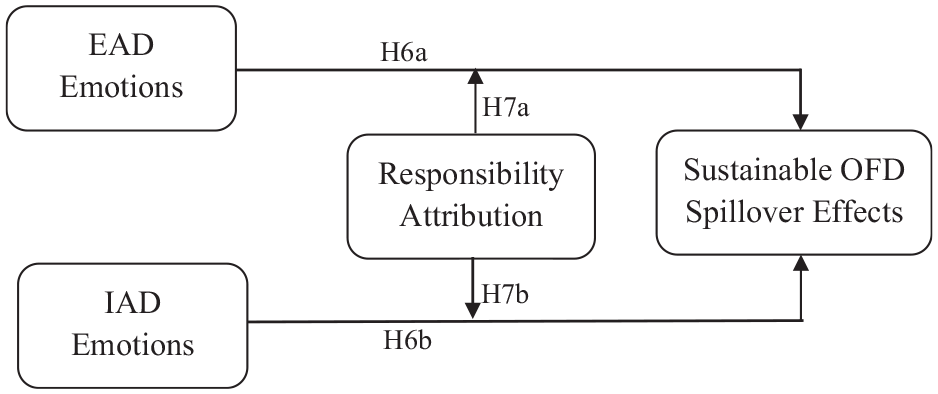
Model in Stage II.
Methods
Pre-Survey Observations and Interviews
Before conducting an online survey to identify pro-environmental behavior in OFD consumption, we checked the relevance of using the “disposable cutlery not needed” option in OFD orders as a proxy. We selected six participants who ordered takeaway meals at least once per week and observed the process of OFD consumption in their homes. If the participants chose the “disposable cutlery not needed” options, they were expected to have their own cutlery and wash it after eating. After we observed and recorded the participants’ behavioral patterns, they were interviewed to understand their main reasons for using OFD. Five thought it convenient and timesaving, three were tired of the food at nearby restaurants and preferred more choices, and one wanted to play videogames alone or perform chores while eating in their room. All six participants were aware of the “disposable cutlery not needed” option and four knew the platforms offered incentives to those using disposable cutlery sparingly. Four participants complained that most OFD suppliers still provided disposable cutlery anyway (i.e., suppliers ignored their sustainable choices). Two participants mentioned that they sometimes had to use disposable cutlery when away from their homes. These observations and interviews reinforced the suitability of using the “disposable cutlery not needed” option in this study to identify sustainable OFD behaviors among a wider group of OFD users.
Online Survey
We employed a professional survey company with over 6.3 million members across China to conduct the online survey. Participants were randomly selected from the company’s database via probability proportion-to-size sampling from East, Central, South, and North China. For structural equation modeling (SEM) analysis, Siddiqui (2013) suggested that at least 15 cases per indicator are needed. This study requires a minimum size of 360 samples as 24 questionnaire items are used. According to Malhotra and Birks (2007), an appropriate sample size for structural equation modeling is between 300 and 500. Therefore, this study planned to recruit 500 participants in the first stage. Finally, 518 members agreed to participate.
First-stage Survey
Of the 518 participants, those who had never ordered OFD or could not stay at home after 5 pm on a designated date were excluded because they were unsuitable for the research context. Finally, 496 participants were recruited.
These participants were invited to join a WeChat group a week before the survey date. On the survey date, the survey team announced on the WeChat group that all the participants had to order a takeaway meal on OFD platforms before 6:30 pm and that their expenses would be reimbursed up to RMB 20 (around $3.10). At 6:30 pm, all the participants were requested to individually send the full screenshots of their food orders to the team. The screenshots showed the participants’ decisions for the “disposable cutlery not needed” option (see the red box in Figure 3). Two questions were set to screen out unqualified participants. As only participants who own cutlery and are aware of the “disposable cutlery not needed” option are likely to check that option during their orders for pro-environmental reasons.

Screenshot of an OFD order.
At 7:30 pm, the questionnaire was uploaded onto the WeChat group. Participants were requested to report their OFD-related attitudes including descriptive norms, pro-environmental habits, sustainable OFD intentions, emotions, and responsibility attribution. Before reporting their emotions, the participants were requested to read news articles with depressing visuals (e.g., a report showing a seal’s neck caught in discarded plastic waste). An article titled, “Can environmental pollution created by takeaway consumption destroy the next generation?” from Sohu News (2018) was provided for review, which referenced sea pollution resulting from anthropogenic causes. The article emphasized that plastic waste had already seriously affected the living environment of marine life, while also endangering human health due to polluted water sources and food contamination. The question that directly followed was “How do you feel about this report?” The participants had to rate their feelings for six emotions. A seven-point scale (1 = “totally disagree” to 7 = “totally agree”) was adopted. Finally, 422 valid responses and screenshots were collected (85.08% response rate).
Second-stage Survey
The second-stage survey was conducted three days later: without notice, the 422 respondents were asked to complete the online questionnaire for a second time. Additionally, they were again requested to provide screenshots of their most recent OFD orders. Finally, 276 valid responses and screenshots were collected (65.40% response rate).
Demographic Characteristics
In the first stage, of the 422 valid responses, 48 selected the “disposable cutlery not needed” option. Furthermore, 52.61% of the participants were women. Altogether, 68.72% of the participants were above 25 years and 27.72% had a Bachelor’s degree or above. Further, 57.82% of the participants were single and most (86.49%) earned below RMB 10,000 monthly. In the second stage, of the 276 valid responses, 124 participants selected the “disposable cutlery not needed” option. The pro-environmental OFD spillover effects were calculated by subtracting the second-stage choice of the “disposable cutlery not needed” option from the first-stage choice. The results showed that between the first and second stages, 96 participants changed from not selecting the “disposable cutlery not needed” option to selecting it, while six participants changed in the opposite direction, leaving 174 participants unchanged.
To avoid non-response bias, the demographic characteristics of the participants of both surveys were compared with those of participants of only the first survey. The results of chi-squared tests showed non-significant differences between the two groups at the 5% level, indicating a negligible effect of non-response bias.
Measures
We adapted the descriptive norms from McDonald et al. (2014). We asked the respondents to rate the extent to which their close social groups (family, friends, and compatriots) engage in pro-environmental OFD consumption. The measure comprised nine items (i.e., three questions for each social group) such as “For the sake of environmental sustainability, my friends create less waste when ordering takeaway food by choosing the ‘disposable cutlery not needed’ option,” “My friends reduce their consumption of takeaways to enhance environmental sustainability,” and “My friends have their own tableware to avoid using disposable cutlery.” A seven-point scale (1 = “totally disagree” to 7 = “totally agree”) was adopted.
Pro-environmental habits were adapted from Gatersleben et al. (2017) and McDonald et al. (2013). The measure comprised six habits such as “I turn off lights when I don’t need them” and “I donate money for environmental protection.” A seven-point scale (1 = “totally disagree” to 7 = “totally agree”) was adopted.
To understand the policy effectiveness of OFD suppliers the following item: “Regardless of selecting the ‘disposable cutlery not needed’ option, OFD suppliers provide disposable cutlery” was measured on a four-point scale (“never,” “seldom,” “usually,” and “always”).
Sustainable OFD intentions were adapted from McDonald et al. (2014). The respondents were asked three questions about their sustainable OFD intentions, such as “For the sake of environmental sustainability, I would select the ‘disposable cutlery not needed’ option when ordering takeaway meals online.” A seven-point scale (1 = “totally disagree” to 7 = “totally agree”) was adopted.
Sustainable OFD behaviors were measured based on whether the respondents checked the “disposable cutlery not needed” option (coded “1” for checked and “0” otherwise).
The scales for negative emotions were adapted from Jin et al. (2014). EAD emotions comprised three items (i.e., disgust, contempt, and anger) and IAD emotions comprised three items (i.e., embarrassment, guilt, and shame).
Responsibility attribution was rated by asking the participants “How do you think we can avoid pollution from takeaway food?” To categorize responsibility attribution into internal and external attribution, all statements were analyzed using thematic content analysis. Two independent coders (i.e., graduate students) assessed the statements and reached consensus on 92% of the assessments (n = 372). Discrepancies in the remaining statements (n=50) were jointly discussed with experts for resolution.
Statistical Analysis
Exploratory factor analysis (EFA) with varimax rotation was used to evaluate the factor dimensions of pro-environmental habits and negative emotions. Before evaluating the model fit, confirmatory factor analysis (CFA) was employed to test the convergent and discriminant validity of the overall model. SEM was then employed to analyze the data due to its ability to measure latent variables and test the causal relationships among them.
Results
EFA
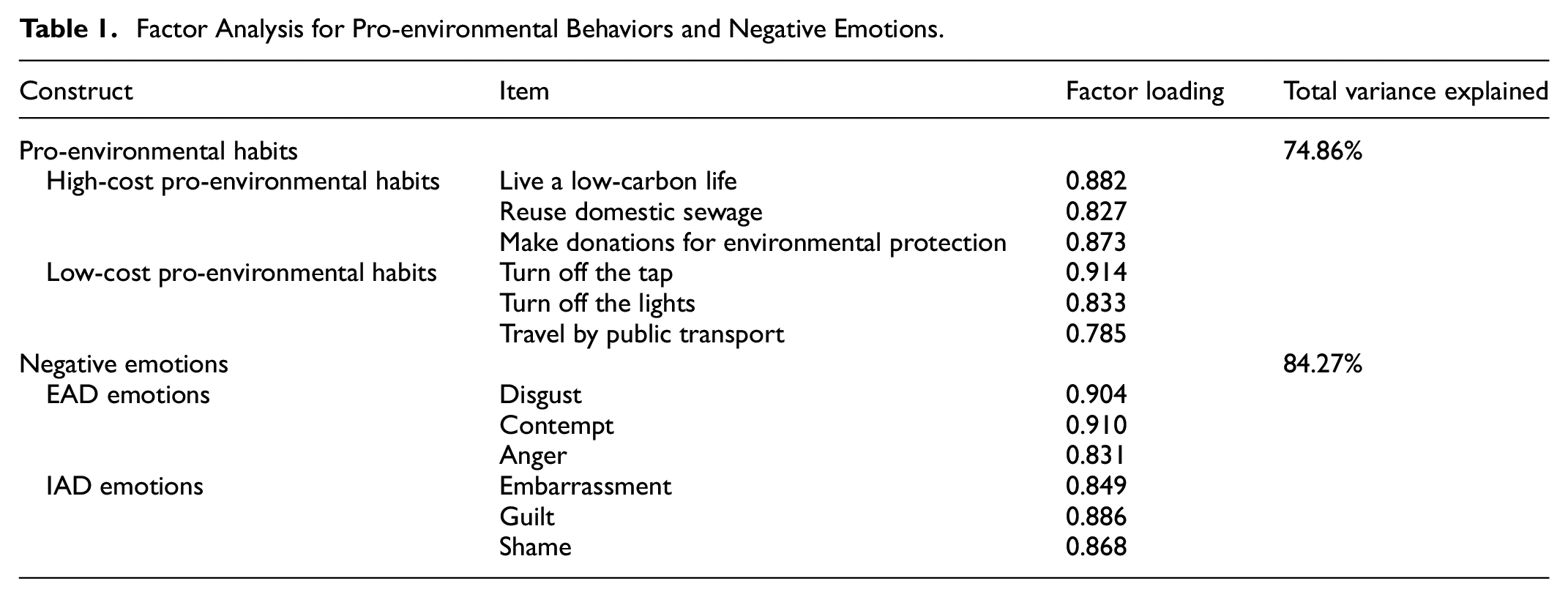
The integrity of the underlying constructs of pro-environmental habits and negative emotions was validated by extracting the salient factors using two EFAs. Factors with eigenvalues above 1 and items with factor loading scores above 0.5 were retained in the model. For pro-environmental habits, two major factors accounted for 74.86% of the variance. Factor 1 included three items such as “turn off the tap” which was titled “low-cost pro-environmental habits.” The remaining three items such as “I donate money for environmental protection” fell into Factor 2, titled “high-cost pro-environmental habits.” For negative emotions, two factors emerged, consistent with the intended constructs. The EFA results revealed that these two factors explained 84.27% of the variance. Factor 1 was named “EAD emotions,” which included disgust, contempt, and anger. Factor 2 was named “IAD emotions,” comprising embarrassment, guilt, and shame. Table 1 presents the results.
Factor Analysis for Pro-environmental Behaviors and Negative Emotions.
Common-method Bias Test
The EFA results indicated that no single latent factor explained more than 50% of the variance, with the first factor constituting only 38.27% and 42.89% in the first-stage and second-stage models, respectively. Therefore, according to Harman’s single-factor test (Harman, 1960), common-method bias was sufficiently controlled in both models. The common latent factor technique was also applied to evaluate bias more comprehensively. After creating a latent factor including common factors for all the observed variables in both models, common method variance was calculated as the square of the path weights before standardization, resulting in 0.31 (0.43) for the first-stage (second-stage) model. As both common method variance values were below the 50% threshold (Eichhorn, 2014), common-method bias was not a major concern in this study.
CFA
CFA was performed to test the model fit of the eight factors. All factor loadings (i.e., standardized coefficients) were above 0.6. The Cronbach’s α and composite ratio of these constructs exceeded 0.7 and their average variance extracted (AVE) met the suggested level of 0.5. These results confirmed the convergent validity and internal consistency of the measurement scales (Fornell & Larcker, 1981; Hair et al., 2010; Tables 2 and 3). Furthermore, discriminant validity was achieved, as the interfactor correlations in the corresponding rows and columns were less than the square roots of the AVE on the main diagonal (Fornell & Larcker, 1981). Moreover, the heterotrait-monotrait ratio values ranged from 0.073 to 0.680, below the threshold (0.85), demonstrating adequate discriminant validity (Henseler et al., 2015; Table 3). Finally, the fit indices exhibited a good overall fit for both models because the chi-square–degrees of freedom ratio (χ2/d.f.) was below 3. The values of the normed fit index (NFI), comparative fit index (CFI), goodness of fit index (GFI), and Tucker–Lewis index (TLI) were above 0.90. The root mean square error of approximation (RMSEA) was below 0.08 (Hair et al., 2010): χ2/d.f. = 1.465, NFI = 0.928, CFI = 0.976, GFI = 0.911, TLI = 0.969, and RMSEA = 0.047 in the first-stage model and χ2/d.f. = 1.697, NFI = 0.968, CFI = 0.986, GFI = 0.959, TLI = 0.976, and RMSEA = 0.071 in the second-stage model.
Confirmatory Factor Analysis.

Fornell and Larcker Discriminant Validity and Heterotrait-monotrait Ratio (HTMT).

Note. Values in parentheses indicate interfactor correlations.
p < .05; **p < .01.
Direct Effects
SEM regression paths were constructed to test the proposed hypotheses of the direct effects in the two research models, as shown in Figures 1 and 2. In the first model, R 2 was 0.520 and 0.281 for sustainable OFD intentions and behaviors, respectively, suggesting that social norms and habits explain 52.0% of sustainable OFD intentions, while sustainable OFD intentions account for 28.1% of sustainable OFD behaviors. Table 4 shows that family and friend norms significantly affected intentions (β = .163, p < .01; β = .275, p < .01), while compatriot norms had no such effect (β = .186, p > .05). Thus, H1a and H1b were supported, but not H1c.
Hypotheses Tests of the Direct Effects.

p < .05; **p < .01; ***p < .001.
Second, high-cost pro-environmental habits were significantly associated with sustainable OFD intentions (β = . 177, p < .05), but not low-cost pro-environmental habits (β = .237, p > .05), supporting H2a and rejecting H2b. High-cost pro-environmental habits exhibited no relationship with sustainable OFD behaviors (β = −.019, p > .05), while low-cost pro-environmental habits were negatively related (β = −.058, p < .05). Hence, H3a was rejected, while H3b was supported. Finally, sustainable OFD intentions were positively related, thus supporting H4.
In the second stage, R 2 was 0.488 for the pro-environmental OFD spillover effects, indicating that negative emotions explained 48.8% of such spillover effects. IAD emotions were positively associated with pro-environmental OFD spillover effects (β = .120, p < .05); however, EAD emotions exhibited no such effects (β = −.077, p > .05). These findings implied that consumers who felt more IAD emotions would promote positive spillover effects from unsustainable to sustainable OFD consumption. Hence, H6b was supported, but H6a was not.
Moderating Effects
First, those who selected “usually” or “always” for the item on perceived policy effectiveness were classified as the “low-perception group” (n = 210), whereas those selecting “never” or “seldom” were labeled as the “high-perception group” (n = 212). The t value was calculated using the formula provided by Keil et al. (2000) to compare the coefficients of the intention–behavior path between these groups.
The coefficients of the low- and high-perception groups from sustainable OFD intentions to sustainable OFD behaviors were β = .015 (p > .05) and β = .114 (p < .000), respectively. Therefore, they were significantly different (t = 33.732, p < .000; Table 5). This implied that perceived policy effectiveness enhanced the relationship between sustainable OFD intentions and behaviors. Hence, H5 was supported.
Hypotheses Tests of the Moderating Effects of the Perception of Sustainable Food Providers.

p < .001.
Similarly, the coefficients between the internal and external attribution groups were analyzed to test the moderating effect of responsibility attribution (Table 6). When the relationships between EAD emotions and pro-environmental OFD spillover effects were considered, both path coefficients were non-significant (internal attribution group, β = −.192, p > .05; external attribution group, β = −.182, p > .05). The difference between the coefficients was also non-significant (t = 0.709, p > .05). Moreover, the relationship between IAD emotions and pro-environmental OFD spillover effects was significantly stronger (t = 6.706, p < .01) in the internal attribution group (β = .136, p < .01) than the external one (β = .033, p > .05). These findings demonstrated that responsibility attribution significantly moderated the relationship between pro-environmental OFD spillover effects and IAD emotions, but not EAD emotions. Therefore, H7b was supported, but not H7a.
Hypotheses Tests of the Moderating Effects of Responsibility Attribution.

p < .01.
Discussion and Conclusion
This study applied the adapted TPB and cognitive (attribution)–emotion–action model to discuss the causes of sustainable/unsustainable OFD behaviors and explored the effects of information-evoked emotions on pro-environmental spillover effects. After observations and interviews, we employed two online surveys to collect data from 422 and 276 participants in China in two stages. CFA and SEM were employed to evaluate the model validity and causal relationships. The findings showed that family and friend norms and high-cost pro-environmental habits were significantly related to sustainable OFD intention. A negative relationship existed between sustainable OFD behaviors and low-cost pro-environmental habits. Moreover, if consumers perceived the green OFD policy as ineffective, their sustainable OFD intention may not transform into a behavior. Finally, IAD emotions had positive behavioral spillovers, especially under internal attribution.
General Discussion
Significant Family and Friend Norms
The findings showed that the sustainable OFD intentions of consumers were affected by their family and friends, but not their compatriots. The results corresponded to those of Collado et al. (2017) and contrasted with those of Huber et al. (2018). Musick et al. (2008) offered a possible explanation for the weak prediction of compatriot norms. As compatriots’ practice of (un)sustainable OFD behaviors is less visible than that of parents and peers, consumers’ beliefs are more easily misperceived as local norms.
Low Perception of Policy Effectiveness Hindering Sustainable OFD Behaviors
Perceived policy effectiveness was shown to enhance the effect of sustainable OFD intentions on sustainable OFD behaviors, congruent with the findings of Wan and Shen (2013). For example, approximately 70% of OFD restaurants habitually deliver disposable cutlery with meals to avoid negative comments, regardless of customer requests (Sohu News, 2024). Hence, despite having sustainable OFD intentions, customers may be uncertain about selecting the “disposable cutlery not needed” option if they think their efforts may be in vain.
Negative Associations between Low-cost Pro-environmental Habits and Pro-environmental Behavior
Only low-cost pro-environmental habits showed a negative relationship with sustainable OFD behaviors. According to Gneezy et al. (2012), costly prosocial behaviors serve as a strong identity for subsequent behavior, whereas low-cost activities signaling weak prosocial identity are likely to reduce prosocial behavior. Furthermore, low-cost actions such as turning off lights are relatively effortless compared to high-cost pro-environmental habits, namely, reusing domestic sewage. Therefore, low-cost pro-environmental habits are negatively associated with sustainable OFD behaviors. Moreover, reported and actual behavior are usually inconsistent, especially for socially desirable behaviors, which explains the non-significant effects of high-cost pro-environmental habits on sustainable OFD behaviors (Nichols, 2014).
Positive Connection between High-cost Pro-environmental Habits and Sustainable OFD Intentions
Only high-cost pro-environmental habits were positively related to sustainable OFD intentions. Caggiano et al. (2021) suggested that green lifestyles are positively associated with the intention to use green technology across several types of goods such as lightbulbs, appliances, and vehicles. However, the relationship between habits and purchase intention decreases with increased costs as low-cost sustainable actions are more easily triggered by external factors than high-cost ones (Suárez-Perales et al., 2021). Forming high-cost pro-environmental habits results from consumers’ low-cost sensitivity to pro-environmental behavior. Hence, consumers practicing costly green habits are generally optimistic about labor-consuming practices such as cleaning dirty cutlery. Conversely, low-cost pro-environmental habits are unconnected to sustainable OFD intentions. Some Chinese participants may express general opinions, instead of negative ones, to meet social norms in a collectivistic society (Hou et al., 2023; Jung et al., 2020), possibly leading to a non-significant association.
IAD Emotions are a Key Factor in the Positive Pro-environmental OFD Spillover Effects
The findings showed that IAD emotions incur positive pro-environmental OFD spillover effects, while EAD emotions exhibit no such effects. As expected, IAD emotions exhibit a strong motivation to develop sustainable behaviors from unsustainable ones (Gendolla, 2017), as also observed by Lee et al. (2021). Moreover, studies have proven that EAD emotions are powerful predictors of behavioral intention (Breitsohl & Garrod, 2016; Joslyn & Haider-Markel, 2019; Yan et al., 2024). However, in this study, they were not associated with behavioral change. Thus, users’ selection of disposable cutlery does not change significantly even after they experience EAD emotions, which might result from their attitude toward responsibility attribution.
IAD Emotions under Internal Attribution Trigger Stronger Pro-environmental OFD Spillover Effects
As expected, consumers attributing the outcome of plastic pollution to themselves were found to have stronger effects of IAD emotions on the pro-environmental OFD spillover effects than external attribution, aligning with the findings of Z. Wang and Jiang (2023). Nevertheless, EAD emotions were not associated with behavioral change in either attributional situation. EAD emotions drive individuals to search for the cause by attributing unexpected outcomes to the environment (Jin et al., 2014; Yan et al., 2024), which suggests norm conflicts. For example, individuals usually use their cutlery to consume OFD meals. However, they perceive that either their friends disregard the “disposable cutlery not needed” policy or OFD suppliers always deliver disposable cutlery, demotivating them to take environmental actions because of the low perceived effectiveness (McDonald et al., 2013). However, the non-significant effect might be attributable to most citizens in China believing that the government can manage environmental issues. Generally, consumers may develop a wait-and-see attitude and rely on government intervention when facing events with a low level of control (Chi et al., 2017). Accordingly, EAD emotions may fail to be related to pro-environmental OFD spillover effects even under external attribution.
Theoretical Implications
First, this study identified relationships among the cost of pro-environmental habits, intentions, and behaviors. Previous studies have shown that habits are strong predictors of pro-environmental intentions and behaviors (Choi & Kim, 2021; Liu et al., 2020a; Ratay et al., 2024; Tavitiyaman et al., 2024). For instance, to address the attitude–behavior gap, Liu et al. (2020a) adopted daily green behavior into the TPB framework and proposed that green habits positively affected pro-environmental intentions and behaviors. In the OFD context, this study broadened their findings by including behavioral costs. The results showed a positive (negative) relationship between high-cost pro-environmental habits and sustainable OFD intentions (sustainable OFD behaviors). In addition to habit costs, actual behavior helped reveal even clearer relationships than self-reported behavior.
Second, our results shed light on the moderating role of responsibility attribution in the relationship between negative emotions and pro-environmental OFD spillover effects. Our findings showed a stronger association between IAD emotions and pro-environmental OFD spillover effects under internal than external attribution. Collocated with internal attribution, IAD emotions induced more markable behavioral intention. This finding partially echoes previous views that negative events are likely to arouse IAD emotions (i.e., shame) under high internal attribution (i.e., competence attribution), in turn evoking behavioral responses (Z. Wang & Jiang, 2023). Based on the cognitive (attribution)–emotion–action model (Weiner, 1980), prior research has mainly addressed the mediating role of emotions (Joslyn & Haider-Markel, 2019; Lee et al., 2021; Pavone et al., 2023; Yan et al., 2024); consequently, the respective direct and indirect effects of emotions and responsibility attribution on behaviors were well explored. This study advanced the model by examining the effects of emotions in controllable/uncontrollable situations, which refers to whether the effects of negative emotions on subsequent behavior are intensified or alleviated under these two types of causal attribution.
Practical Implications
First, regarding OFD behaviors, family and friend norms are more influential than those of compatriots. Our results indicate that environmental education is essential for young people and new parents to establish an atmosphere of sustainable OFD consumption (Collado et al., 2017). School education and policy propaganda via social media could be effective channels to reach the target population. Second, even high-cost pro-environmental habits cannot guarantee sustainable OFD behaviors. However, this does not mean that the cost of sustainable OFD behaviors is higher than those of any other pro-environmental habit. Practically, preparing and washing their own cutlery conflicts with consumers’ value of convenience (Liu & Chen, 2019). Therefore, OFD platforms should design a new OFD consumption mode to increase compatibility with consumers’ values (Dhir et al., 2021). For example, additional options on OFD platforms, such as paying a premium for biodegradable cutlery, could increase the compatibility between consumers’ functional and green values to tacitly engage consumers in sustainable behaviors. Third, IAD emotions can induce positive pro-environmental OFD spillover effects. Concerned governments might publicize the harm that OFD consumers inflict upon living creatures to evoke their IAD emotions. Such information can be placed on the takeout platform or to-go bags to catch OFD consumers’ attention. This could reduce consumers’ overdependence on the government and simultaneously establish societal injunctive norms of OFD consumption. Finally, governments should regulate the OFD industry by imposing sanctions on unsustainable OFD practices such as the unconditional delivery of disposable cutlery to avoid unambiguous judgments from consumers and sellers.
Limitations and Future Research
This study contained certain limitations, which provides prospects for future research. First, this study’s target population was Chinese consumers; other consumers, such as those in individualistic societies, may display different OFD behaviors. Second, forming new habits is difficult. Our study only investigated the pro-environmental OFD spillover effects over three days; how long sustainable OFD behaviors persist is uncertain. Third, this study only manipulated consumers’ green value to evoke their subsequent negative emotions and behavioral change. When deciding on sustainable consumption, buyers always weigh the green value against other perceived values (i.e., functional, social, and conditional) to attain the highest utility (Y. Wang et al., 2018). Hence, future research should focus on different populations, develop a more comprehensive longitudinal study, or consider alternative consumer values.
Footnotes
Acknowledgements
This manuscript was edited by Editage Editing Service.

Funding
The author(s) disclosed receipt of the following financial support for the research, authorship, and/or publication of this article: This work was supported by Fujian Provincial Federation of Social Sciences [grant number FJ2024T012]
Declaration of Conflicting Interests
The author(s) declared no potential conflicts of interest with respect to the research, authorship, and/or publication of this article.
Data Availability Statement
Data sharing not applicable to this article as no datasets were generated or analyzed during the current study.