



Abstract
The role of anxiety in language education has been well established as a significant factor affecting the success or failure of both teachers and students, including student teachers (STs). While there is a substantial body of research examining student-teacher anxiety (STA), particularly within in-person practicum settings, most of these studies have focused on assessing anxiety levels or identifying factors that induce anxiety. However, a dearth of studies remains that address coping strategies, particularly in the context of online classrooms. Therefore, this study aims to investigate anxiety factors and strategies to alleviate anxiety in both online and in-person contexts. Adopting a qualitative approach, the study involved 14 EFL STs whose experiences were documented through reflective journals and in-depth semi-structured interviews. Thematic analysis of the data revealed significant commonalities in factors and strategies across both modalities, highlighting the importance of teacher self-efficacy, student engagement, and mentor support. These findings underscore the need for tailored support mechanisms to alleviate anxiety during practicum experiences. Such mechanisms may involve leveraging diverse resources, including mentorship programs, supportive practicum schools, the integration of theoretical knowledge with practical application, and additional support beyond traditional classroom settings. By implementing these strategies, educators and institutions can better equip STs to navigate and effectively manage anxiety during their practicum experiences.
Keywords
Introduction
Emotions play a significant role in education, as they are involved in nearly all human activities, serving both as motivators and indicators of a person’s ongoing actions (Reeve, 2015). Additionally, they drive behavior and have a substantial impact on health and psychological well-being (Spielberger & Reheiser, 2009). Consequently, emotions such as anxiety, learner beliefs, and motivation have long been acknowledged as critical factors in second or foreign language learning (Zarei et al., 2024). Among these, anxiety holds a prominent position, being the most frequently examined emotion in second language (L2) learning (Dewaele & MacIntyre, 2014). Moreover, anxiety is closely connected to L2 learning and teaching, significantly affecting both areas (M. Liu, 2022). Anxiety is typically defined as “the subjective feeling of tension, apprehension, nervousness, and worry associated with an arousal of the autonomic nervous system” (Spielberger, 1983, p. 15). The essential role of anxiety as an emotional state that influences various behaviors emphasizes the importance of assessing both the intensity and frequency of these emotions (Spielberger & Reheiser, 2009). Defined as “worry and negative emotional reaction aroused when learning or using a second language” (MacIntyre, 1999, p. 27), foreign language anxiety (FLA) represents a unique blend of self-perceptions, beliefs, affective states, and behavioral responses linked to classroom learning, stemming from the distinctive nature of the language learning process (Horwitz et al., 1986). According to Horwitz (2010), anxiety encountered in classrooms is situation-specific, arising from scenarios such as test-taking. It is categorized into three factors: communication apprehension, fear of negative evaluation, and test anxiety (Horwitz et al., 1986). Since then, the significant role of anxiety in language education has been well-established in the literature (e.g., Botes et al., 2020; M. Liu & Jackson, 2008; Zheng & Cheng, 2018).
While much research has examined L2 learners’ anxiety, comparatively less attention has been devoted to L2 teachers, particularly EFL teachers (Mercer, 2018), and even less to preservice EFL teachers (Fan & Xie, 2025). However, follow-up research has also identified anxiety experiences among teachers (Horwitz, 1996; G. Öztürk, 2016). Exploring anxiety within the context of language teaching provides a framework to examine the dynamics of language instructors’ engagement with their professional environment (Fraschini & Park, 2021). Even in instances where teacher anxiety does not directly impact the effectiveness of language instruction, it poses significant challenges to teachers’ mental well-being and job satisfaction (Horwitz, 1996). Since teachers are a core element in the classroom, their well-being is essential for the success of the language teaching and learning process.
Between the studies of students and teachers, STA emerges as an additional area of concern during the practice teaching process for teacher candidates. STA distinguishes itself from student anxiety by originating from concerns related to teaching activities (Gardner & Leak, 1994). It also differs from teacher anxiety in that it stems from a lack of teaching experience and feelings of inadequacy in addressing practical challenges (Li et al., 2023). Additionally, individuals experiencing STA are not yet regarded as fully-fledged educators (Sanjaya et al., 2024). Research on STA has primarily focused on identifying anxiety levels or factors triggering anxiety during the teaching practicum (Ao et al., 2024; Fan & Xie, 2025). Although a limited but growing number of studies have examined foreign language teaching anxiety (FLTA), highlighting its levels and anxiety-provoking sources (Alrashidi, 2022), studies investigating anxiety-reducing strategies remain scarce, particularly within the teaching context. This gap becomes more pronounced in online teaching contexts, which have introduced unique challenges for both learners and teachers. For instance, online learners frequently experience significant levels of language anxiety (Russell, 2020). Despite this, few studies have examined anxiety in online foreign language environments (Durmuş & Kızıltan, 2022), and even fewer have explored teacher anxiety during online teaching (Peng & Hu, 2024). EFL teachers commonly report heightened anxiety levels while teaching online (Peng & Hu, 2024), a phenomenon further exacerbated during emergency remote teaching (ERT) when neither learners nor teachers were prepared for the rapid transition to online modalities (Akbana & Dikilitaş, 2022).
The teaching practicum, already a source of significant stress for preservice teachers (PSTs), likely introduced new types of anxiety during the pandemic (Boonmoh & Kamsa-ard, 2023). However, few studies have investigated the dynamics of anxiety among PSTs in this context (Li et al., 2023), particularly concerning remote teaching anxiety, which remains under-researched (Akbana & Dikilitaş, 2022). In light of these gaps, the present study aims to examine EFL STA in both online and in-person practicum contexts to identify factors that may alleviate anxiety among STs. By uncovering the underlying factors, this study seeks to contribute to teacher education and propose interventions that pave the way for a more enriched teaching experience. To address these objectives, the following research questions guide this study:
What are the key contributors to managing and mitigating anxiety among STs during the practicum?
What commonalities exist among the contributors to anxiety reduction in online and in-person practicum settings?
Theoretical Framework
This study is based on the Affective Filter Hypothesis (Krashen, 1982) and the Transactional Model of Stress and Coping (Lazarus & Folkman, 1984). The Affective Filter Hypothesis posits that emotional factors significantly influence the process of acquiring a second language, with anxiety being a particularly crucial element. For instance, lower levels of anxiety are associated with more favorable outcomes in second language acquisition, regardless of whether the anxiety is experienced personally or within the classroom setting (Krashen, 1982). Although this theory is typically applied to second language learners, it can also affect STs, as they are still in the process of acquiring both language and content knowledge to become language teachers in the future. Therefore, it is crucial to recognize the role of anxiety as either a barrier or a facilitator in language classrooms.
The Transactional Model of Stress and Coping (Lazarus & Folkman, 1984) posits that upon encountering a potentially stressful event, the primary evaluation process is initiated, in which an individual assesses the event concerning their well-being. If the event is perceived as stressful, the secondary evaluation process then scrutinizes the individual’s coping resources and their ability to manage the situation. Subsequently, coping responses are activated. The ultimate psycho-physiological experience of this potentially stressful event depends on the effectiveness of the individual’s cognitive evaluations and coping mechanisms. Although commonly applied in general psychology, this theory also holds relevance in language classrooms. For instance, when STs have their first encounter with students during their practicum, it triggers their primary appraisal. Consequently, students may experience a variety of stimuli during this process, leading to secondary appraisal as they seek available resources to cope with the situation. Coping strategies, such as employing classroom management techniques, may be utilized. However, due to a lack of experience, STs may also undergo psycho-physiological reactions, such as increased heart rate or nervousness, throughout this process. Figure 1 illustrates the operation of the basic model of stress and coping processes, adapted from Lazarus and Folkman (1984).

Operation of the basic model of stress and coping processes adapted from Lazarus and Folkman (1984).
StudentTeacher Anxiety in Online and In-Person Contexts
STA can be viewed as a unique form of anxiety arising from their distinct position, as they are neither entirely teachers nor fully students. In this study, we differentiate between STs and PSTs, highlighting that only STs, or seniors, participate in practicum activities. The teaching practicum serves as a transitional phase into the teaching profession, following theoretical studies, during which STs gradually assume the responsibilities of educators (Danner, 2014) and assist learners in developing their teaching skills (Alpan et al., 2014) throughout the practicum. Besides observation, STs also partake in educational activities such as practice teaching, lesson planning, designing activities, and learning about the inner workings of schools. Each of these activities is likely to induce some degree of apprehension. Hart (1987) was a key figure in STA research, recognizing the presence of STA in classrooms due to various factors, including evaluation anxiety, class control anxiety, teaching practice requirements anxiety, and concerns regarding pupils and professionalism. Their well-known Student Teacher Anxiety Scale (STAS) has become a standard tool for measuring STA in classrooms in subsequent research (e.g., Ao et al., 2024; Eksi & Yakisik, 2016; M. S. Öztürk & Ercan-Demirel, 2024; Zaki & Salsabila, 2024).
Especially following the works of Merç (2010, 2015), another related form of anxiety known as foreign language student teacher anxiety (FLSTA) has gained prominence in STA studies involving pre-service language teachers. This research explores both the general factors that induce anxiety and the anxiety stemming from the inclusion of a language. According to Merç (2010), FLSTA primarily arises from factors such as relationships with mentors, language proficiency, feelings of academic incompetence, feelings of being criticized by peers, fear of what others think, and student effects. Similarly, most studies aim to determine either the level of anxiety or the factors that induce anxiety among STS in STA research. For instance, Djawamara and Listyani (2021) examined six STs to uncover the anxiety experienced during the practicum through interviews. The results revealed that adapting to a new environment, the attitudes of schoolteachers and students, lesson plans and teaching materials, methods of presenting materials, time management, access to audiovisual aids, and monitoring by mentor teachers and supervisors all contributed to STs’ anxiety during the teaching practicum. In a comparable study, research by Osacar and Lafuente-Millan (2021) identified root sources (internal factors such as low proficiency), triggering sources (e.g., speaking before a class), and boosters of anxiety (e.g., large class sizes) as the primary factors inducing anxiety.
Despite the majority of studies on STA focusing on traditional in-person teaching contexts (e. g., Djawamara & Listyani, 2021; İpek, 2016; Merç, 2015; Sanjaya et al., 2024), research has increasingly shifted towards online environments, particularly following the abrupt transition to ERT due to the Covid-19 pandemic. This sudden shift may also create tension for STs, as reports indicate that many language educators have had minimal or no professional development in online language design, development, and delivery (Russell, 2020). In a recent study, Peng and Hu (2024) examined EFL teachers’ anxiety in online classrooms with a substantial participant group, employing both qualitative and quantitative methodologies. The results revealed that EFL teachers frequently experience moderate levels of anxiety while teaching online, stemming from factors such as fear of negative evaluation, technophobia, lack of confidence in online teaching, concerns about teaching outcomes, and feelings of disconnection from students. In a similar study, Akbana and Dikilitaş (2022) explored the perspectives of 96 EFL teachers regarding remote or online teaching to identify sources of ERT anxiety. The findings pinpointed concerns related to digitalization and online pedagogy as the primary sources. Another study conducted by Boonmah and Kamaa-ard (2023) found that 246 PSTs (95. 7%) had no prior experience with online learning. Furthermore, participants exhibited extremely high levels across four factors linked to online teaching: the mode of instruction, the stability of the internet connection during online teaching, their teaching skills in the online mode, and their ability to integrate technological applications into their teaching. Collectively, these studies suggest that anxiety exists during the practicum process for STs, stemming not only from internal factors (e.g., lack of confidence and technophobia) and external factors (e. g., mentors and peers) but also from the mode of instruction, including teaching materials and internet connectivity issues.
Research on Coping Strategies in Online and In-Person Contexts
Research on STA indicated that STs experience anxiety during their practicum, regardless of the modality. Yet, the majority of studies investigating this anxiety have focused on determining the level of anxiety or the factors that induce it, resulting in a lack of research on anxiety mitigation and coping strategies among STs during practicum. In an in-person context, Djawamara and Listyani (2021) explored STA during the practicum process and noted that STs experience anxiety because they teach real students in real classrooms using the school curriculum as their guideline. To cope, they offered a repertoire of strategies including adapting to the new environment, preparing thoroughly before teaching, building a good rapport with teachers and students, creating a conducive learning environment, prioritizing the most crucial teaching elements, and engaging in relaxation techniques. According to Han and Takkaç-Tulgar (2019), before teaching, PSTs primarily experience anxiety related to classroom management. Seeking guidance from mentors and cooperating teachers is the most common coping strategy at this stage. However, during teaching, being observed by mentors becomes the main concern, prompting the development of various coping mechanisms. Negative feedback from mentors decreases self-confidence, leading PSTs to seek further advice. These findings underscore the importance of teacher education programs in preparing PSTs for the challenges of practicum, highlighting the need for effective coping strategies. The implementation of mentoring programs between new and experienced teachers (Dias-Lacy & Guirguis, 2017), along with improved teaching preparation, establishing communication with students, conducting warm-up and ice-breaking activities, and creating study groups (Irhamna & Fithriani, 2023), are additional strategies that can be employed to mitigate anxiety experienced during the practicum process.
The online language learning environment diverges from traditional classroom settings and possesses distinct characteristics, including interaction styles, feedback mechanisms, technological aptitude, self-guided learning, and remote access. Exploring this context is imperative for advancing and enriching language learning experiences (Simsek & Ceylan-Capar, 2024). Yet, in online practicum, similar to in-person contexts, there is also a scarcity of studies addressing coping strategies, particularly due to the recent focus on remote or online teaching following the shift to online learning during the pandemic. Therefore, rather than studies specifically dedicated to revealing coping strategies, several studies provide coping strategies alongside factors inducing anxiety (e.g., Albasin-Lacaba et al., 2022; Lazarevic & Bentz, 2020; Peng & Hu, 2024). For example, Peng and Hu (2024) highlighted the significance of cultivating a culture that promotes supportive evaluation. Moreover, Lazarevic and Bentz (2020) proposed using technology as an effective tool to decrease anxiety. Expanding on the technological aspects, Trotsenko et al. (2020) suggest integrating information and communication technology (ICT) to further alleviate anxiety – a strategy that supports the seamless incorporation of digital tools into teaching practice. This is complemented by F. Liu (2008), who argues for embedding anxiety-reducing elements directly into methods courses to ensure a holistic approach to teacher preparation.
Adding to the diversity of strategies, Yaniafari and Rihardini (2021) demonstrate the benefits of online speaking practice in alleviating anxiety, showcasing the practical application of these theoretical approaches. Similarly, Kennedy and Archambault (2012), along with Kennedy et al. (2013), emphasize the necessity for teacher education programs to proactively prepare STs for the nuances of virtual classrooms, including effective communication with supervising teachers and the ability to adapt to emerging technologies. Collectively, these studies form a cohesive narrative, suggesting that a multifaceted approach, which includes technological integration, skill enhancement, and innovative teaching practices, can effectively alleviate anxiety in online teaching contexts.
Methodology
Design
The primary objective of this study is to explore and understand the intricate experiences of EFL STs as they navigate anxiety during their teaching practice in both online and in-person practicum contexts. To this end, the research design follows qualitative methodology, aligning with Creswell’s (2014) qualitative research framework, to examine the multifaceted dimensions of anxiety within educational contexts. This study highlights themes by adopting an exploratory, emergent approach without presupposed hypotheses (Creswell, 2014; Dörnyei, 2007; Heigham & Croker, 2009).
Context and Participants
The research was conducted at a Turkish university involving senior students majoring in English in an ELT department. The study occurs in the authentic environment of the teaching practicum, where students are required to complete teaching practice courses that involve 6-hr weekly visits to K-12 schools for practical activities and at least four supervised teaching sessions with mentors (MoNE Legislation 2018/25172143). This process is a vital and compulsory phase for students as they acquire practical classroom experience just before becoming professional teachers. Therefore, the research aims to examine and offer solutions to anxiety in both online and face-to-face practicum contexts. The use of these two distinct contexts is guided by the study’s goal to uncover how anxiety is manifested and managed across diverse instructional environments.
Convenience sampling, as outlined by Etikan et al. (2016), was used to select 14 EFL STs for this study, with 6 engaging in face-to-face practicums and 8 in online practicums. Among these participants, 4 were male and 10 were female, all voluntarily participating. The participants, aged between 20 and 24 years, all have a Grade Point Average (GPA) exceeding 3.0 out of 4.0, indicating their academic competence. These selected participants bring diverse perspectives to the study, reflecting various backgrounds and experiences within education. To ensure confidentiality, data analysis employs a coding system that replaces personal identifiers with unique designations, such as Student Teacher 1 (ST 1) and ST 9 to ST 14, safeguarding participant privacy while fostering open communication and candid contributions (Dörnyei, 2007). In summation, this qualitative study examines the experiences of 14 EFL STs during their teaching practicum, focusing on factors conducive to managing anxiety.
Instruments
The present study employed a qualitative research design, incorporating biweekly reflection journals and in-depth semi-structured interviews. Additionally, a demographic information form was used to collect relevant participant details. Further information about these instruments is provided below.
A Personal Information Form (PIF) was developed to collect essential demographic data from participants. This questionnaire gathers key details, including age, gender, grade, Grade Point Average (GPA), and type of practicum school. The researcher designed this form and included it with the first reflective journals to obtain personal information, which is crucial for the in-depth analysis of the qualitative data.
Reflective journals were used to gather valuable insights from STs about their practicum experiences in authentic classroom settings with real learners. These journals required STs to document their practices and experiences during the teaching practicum. Reflections included various elements, such as challenges, accomplishments, feelings, emotions, and encounters within the teaching context. The primary aim was to create a thorough record of their journey throughout the practicum period. Guided by a researcher-designed template, participants were encouraged to reflect on their experiences and emotions after their practicum engagements, with particular focus on their feelings of anxiety and their coping strategies. Each ST was expected to contribute at least four journal entries, offering insights into their emotional experiences during teaching practice.
Semi-structured interviews enabled a comprehensive exploration of STs’ perceptions of anxiety in their practicum across various contexts. These interviews were shaped by a collaborative design process, drawing insights from a thorough review of pertinent literature on STA (Capel, 1997; Hart, 1987; Merç, 2010; Morton et al., 1997). The interview questions prompted participants to share detailed insights into their experiences with anxiety during their teaching practice. Conducted via the virtual conferencing tool Zoom, each semi-structured interview lasted approximately 30 to 45 min, allowing participants ample time to provide detailed input for richer data. Fourteen students took part in the interviews, which were scheduled during their teaching practice period to ensure firsthand experience and relevance.
Procedure
This study was designed just before the COVID-19 pandemic, but its application coincides with earlier pandemic experiences in Turkey, followed by abrupt shifts to ERT classrooms. Firstly, the researcher selected the study group for ease of access, particularly during the pandemic when finding volunteers for a study was challenging. Participants were then informed about the process, the purpose of the study, confidentiality, and the significance of their insights and experiences, not only for the current study and the Turkish context but also for STs beyond. Initially, the researcher, accompanied by two experts in qualitative research, developed a basic template for reflective journals. This template included personal information such as names and the timing of the teaching practice, along with instructions at the top indicating that participants should reflect on their experiences encountered during their teaching practice. They were asked to complete their journals biweekly, immediately after their in-class experiences, to provide fresh and detailed information about their emotions and experiences.
Similarly, the semi-structured interview questions were developed with input and refinement from the aforementioned experts. Before formulating the questions, the researcher conducted a thorough review of STA research to gain insights into the process and its content. To facilitate the interviews, Zoom was utilized for the sessions. Although originally intended to last half an hour, some interviews extended beyond this time due to participants’ willingness to share additional information. The interviews were conducted individually toward the end of the semester during the teaching practicum to ensure that participants had adequate experience in the practicum. Each participant was interviewed once to align the content and compatibility of the data with the current study’s requirements. The same guidelines were applied in the in-person practicum setting to maintain compatibility with online participants. As a result, identical information, reflective journal templates, and interview questions were provided to them as well. Data was collected during their practicum experiences to obtain firsthand, reliable, and immediate data.
Research Ethics
Before commencing the study, we adhered to the ethical principles outlined in the Declaration of Helsinki. Ethical approval was granted by Hacettepe University under protocol number 35853172-300. Participants were thoroughly informed about the study’s purpose, procedures, and voluntary nature of participation. They received detailed instructions on confidentiality measures, the right to withdraw at any time, and potential risks and benefits. As the study focused on their practicum experiences, risks were minimal, and participation encouraged valuable self-reflection on their teaching development. Written informed consent was obtained from all participants before data collection.
Data Analysis
Qualitative data underwent thematic analysis utilizing the structured approach outlined by Braun and Clarke (2006), which consists of six pivotal steps: (1) familiarization with the data, (2) generating initial codes, (3) developing initial themes, (4) reviewing themes, (5) defining and naming themes, and (6) producing the analytical report. To ensure the credibility of the analysis, the researchers conducted consistent consultations with a scholar experienced in qualitative methodologies. Following the preliminary analysis, themes and codes were refined, organized under cohesive headings, and subjected to expert verification to ensure intercoder reliability, as recommended by Miles and Huberman (1994).
Results
The present research focused on identifying factors that moderate and mitigate anxiety in EFL STs in both online and in-person practicum contexts. By doing so, the study aimed to uncover potential strategies to address anxiety-inducing circumstances that STs encounter during their practice teaching experiences, which are part of their graduation requirements. In this section, the qualitative data analysis, conducted through thematic analysis, is presented in detail. Themes, codes, and representative excerpts are provided in tables. Accordingly, the following chapter is organized under three subtitles: anxiety mitigation in online classrooms, anxiety mitigation in in-person classrooms, and common anxiety mitigation strategies employed in both modalities.
Anxiety Mitigation in Online Practicum
The data analysis revealed eight distinct codes related to anxiety moderation within an online practicum context. Table 1 presents a comprehensive breakdown of these themes along with representative sample excerpts.
Anxiety Reduction for EFL STs’ Anxiety in Online Practicum.

As shown in Table 1, nearly all participants shared strategies to reduce anxiety while engaged in practice teaching within practicum environments. The qualitative analysis resulted in a collection of eight distinct codes. Notably, teaching experience combined with positive feedback from mentors (f = 4) emerged as significant contributors to alleviating anxiety. Additionally, students’ active engagement (f = 3), effective lesson planning (f = 2), skilled classroom management (f = 2), a sense of achievement (f = 2), mentor evaluations (f = 1), and a supportive classroom environment (f = 1) were recognized as key factors that help moderate anxiety among STs during their instructional practice.
Anxiety Mitigation in In-Person Practicum
A thorough examination of the qualitative data, using thematic analysis, revealed an additional factor that helps reduce anxiety among EFL STs during their face-to-face practicum. The findings yielded seven distinct codes classified into three primary categories, based on participants’ reflective insights. Table 2 presents a comprehensive exposition and analytical exploration of these factors.
Anxiety Reduction for EFL STs’ Anxiety in Face-to-Face Practicum.
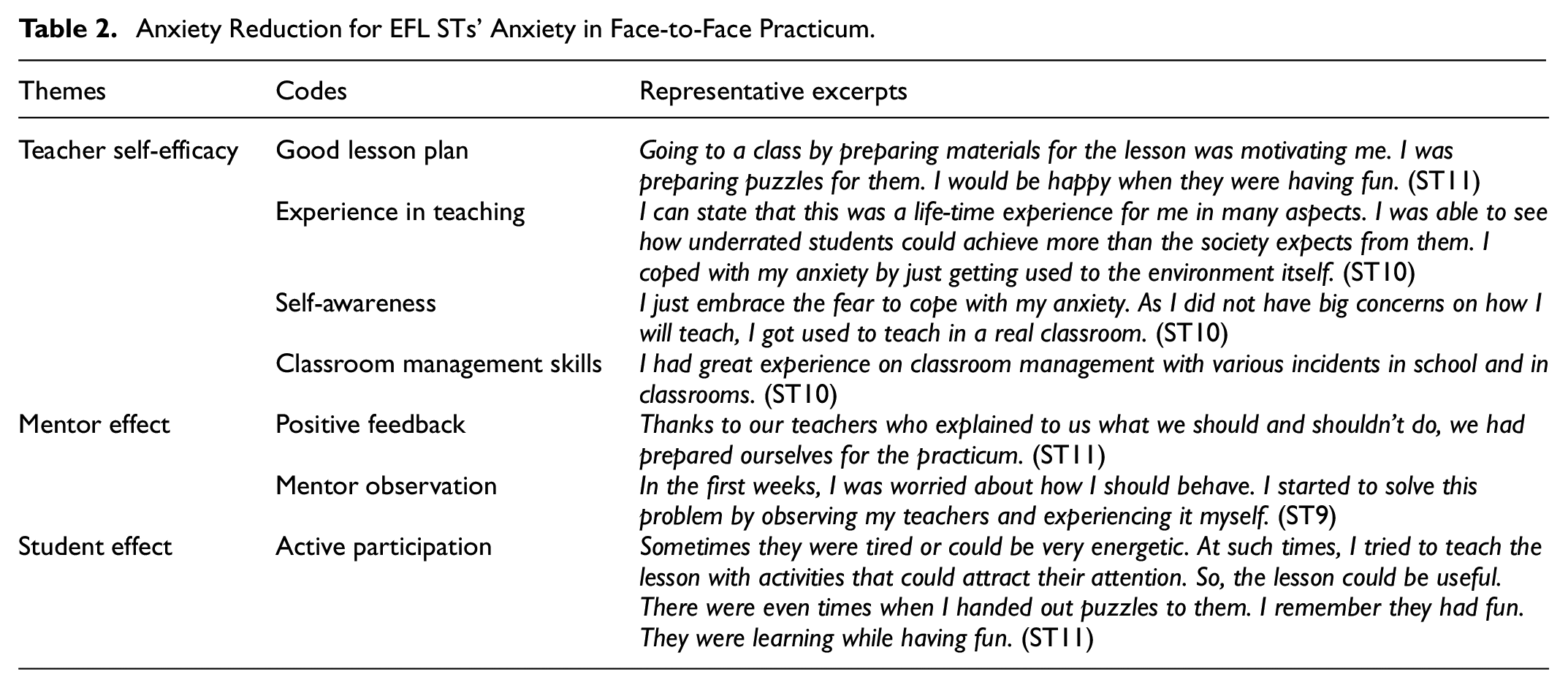
As illustrated in Table 2, teacher self-efficacy (f = 4) is the most prominent category contributing to anxiety reduction. The participants primarily attribute their accumulated experience as the key element in alleviating and managing anxiety related to their instructional practice. Similarly, mentor influence (f = 3) and student influence (f = 3) emerged as additional factors reducing anxiety. Nearly 50% of the participants assign significant importance to mentors and students as crucial determinants in shaping their anxiety levels during teaching practice.
Anxiety Mitigation in Both Modalities
The empirical examination of data derived from distinct practicum cohorts, one engaged in an online modality and the other in a traditional face-to-face setting, has yielded a comprehensive exposition of instances in which anxiety mitigation occurred due to a confluence of diverse determinants. In addition to discerning disparities in the factors underpinning the improvement of anxiety between these two modes, a notable convergence of influential variables has emerged as evident in their respective presentations.
The factors that mitigate STs’ anxiety during practicum are notably significant in both online and face-to-face teaching environments. Combining reports from both groups reveals that a heightened sense of teacher self-efficacy (f = 8) effectively regulates anxiety. Self-efficacy beliefs – including teaching experience, adept lesson planning, classroom management skills, time management, and acute self-awareness of the teaching process – collectively contribute to reducing anxiety among STs during practicum. Mentors (f = 7) emerge as another pivotal factor, with over half of the STs affirming that supportive mentors act as anxiety-reducing agents. Positive mentor feedback and the opportunity to observe mentors in actual classroom scenarios help alleviate anxiety. Lastly, students (f = 6) play a significant role in easing anxiety, as active participation in classroom activities and fostering a positive classroom atmosphere alongside the teacher are instrumental in this regard.
Teacher self-efficacy plays a crucial role in the teaching profession, particularly in alleviating STs’ anxiety related to teaching. Strong self-efficacy beliefs can be vital in helping STs navigate the challenges of teaching. For those aspiring to become teachers, developing effective and interactive lesson plans, gaining real teaching experience, especially in actual classrooms, enhancing self-awareness, and cultivating strong classroom management skills can significantly boost their self-efficacy and reduce anxiety. Reflective narratives from STs illustrate this connection. For instance, ST10 shared, “I can state that this was a lifetime experience for me in many aspects. I was able to see how underrated students can achieve more than society expects from them. I coped with my anxiety by just getting used to the environment itself.” Similarly, ST11 noted, “Going to a class by preparing materials for the lesson was motivating me. I was preparing puzzles for them. I would be happy when they were having fun.” Additionally, ST4 observed, “After seeing that I could manage the class, I think I will not be nervous like this.” These reflections highlight how experiences of classroom success and preparation positively influenced their confidence and alleviated their anxiety.
The role of mentors emerged as another critical factor in mitigating STs’ anxiety during their practicum, significantly shaping the overall experience. While mentors sometimes contributed to anxiety, their constructive feedback and classroom practices were instrumental in fostering a positive learning environment. Observational learning from mentors enabled STs to regulate their anxiety and refine their teaching practices. For example, ST11 stated, “Thanks to our teachers who explained what we should and should not do, we had prepared ourselves for the practicum.” ST9 added, “In the first weeks, I was worried about how I should behave. I started to solve this problem by observing my teachers and experiencing it myself.” These accounts underscore mentors’ dual role as both sources of guidance and models for professional behavior.
Student engagement emerged as a significant factor in moderating STs’ anxiety levels during the practicum. A reciprocal relationship was observed, where active student participation and a positive classroom atmosphere not only enhanced teaching effectiveness but also alleviated the anxiety experienced by STs. As ST14 reflected, “I learned that the motivation is very important, and that the teaching method is changed according to each student to ensure that it passes most efficiently.” ST6 emphasized, “So, the positive atmosphere of the class… helped me a lot to reduce my level of anxiety and gain self-confidence as a pre-service English language teacher.” These reflections highlight the importance of fostering student motivation and engagement, as they contribute to both improved learning outcomes and reduced anxiety for STs.
Discussion
The examination of data unveiled relevant anxiety-mitigating factors employed or perceived by STs during their involvement in online practicum. Distinct categories, including mentor effects, teacher self-efficacy, student effects, and self-confidence, emerged as significant determinants in the realm of anxiety reduction. An overwhelming consensus among STs emphasized the vital role of positive mentor feedback, the acquisition of substantial real-world teaching experience, the formulation of effective lesson plans, and proficient classroom management skills in moderating their anxiety during in-class teaching scenarios. This finding regarding the mentor effect echoes the assertion by Kennedy et al. (2013) that sustained communication with supervisors significantly supports the professional growth of STs. Additionally, establishing a supportive evaluation culture (Peng & Hu, 2024) among mentors and STs can significantly contribute to anxiety alleviation and confidence building. Furthermore, active student participation and the development of a positive classroom atmosphere were identified as crucial components in managing anxiety. This also aligns with Djawamara and Listyani’s (2021) findings, which reiterated that building strong relationships with schoolteachers and students and creating a conducive learning environment is essential for coping with anxiety. The important role of lesson planning and classroom management skills was also highlighted by Albasin-Lacaba et al. (2022), suggesting that more experience with practice teaching and additional training sessions on lesson planning should be included to help STs manage their anxiety. In alignment with these findings, fostering STs’ well-being, encompassing self-assurance and a sense of accomplishment, proved essential for anxiety reduction. Noteworthy is the revelation that online learning could potentially alleviate anxiety among students, a notion reinforced by the works of Bakar et al. (2013) and Rodrigues & Vethamani (2015). Additionally, Yaniafari and Rihardini (2021) provided evidence that students experienced lower anxiety in the context of online learning compared to face-to-face speaking practices. However, other studies such as Simsek and Ceylan-Capar (2024) indicated that students prefer a classroom setting for interaction. Therefore, further studies are required to explore this issue in greater detail.
In-person practicums similarly revealed several factors that helped STs manage and mitigate their anxiety. Teacher self-efficacy, developed through effective lesson planning, teaching experience, self-awareness, and classroom management skills, played a crucial role. Positive feedback from mentors and active student participation were also key in alleviating anxiety. This aligns with the findings of Eksi and Yakışık (2016), which indicate that not only the support personnel of the hosting school but also supervisors could help STs reduce anxiety through their feedback, especially during microteaching. Notably, experience and thorough preparation, particularly in lesson planning, emerged as major anxiety-reducing factors, which aligns with the recommendations of Djawarma and Listyani (2021). STs’ self-awareness and classroom management skills were also significant contributors to anxiety reduction. For instance, Han and Takkaç-Tulgar (2019) suggested that teacher education programs should enhance participants’ awareness of the probable challenges during practicum and equip them with the necessary strategies to address these challenges.
Mentors also played a vital role in this process. The exploration by Kennedy et al. (2013) highlighted that mentors were pivotal in reducing anxiety. Their positive feedback, along with insights gained from observing their teaching techniques, fostered professional development and alleviated anxiety. This synergy of mentorship seamlessly complemented the overarching finding that consistent communication with supervising instructors significantly contributes to the advancement of STs’ overall professional growth. The active participation of students in courses and extracurricular activities was identified as another factor influencing anxiety management. Additionally, Estrella (2022) suggested that incorporating guided discussions and role-playing exercises can effectively mitigate and control anxiety levels among STs. These results are supported by Mosaddaq’s (2016) recommendations for reducing STA, which include cooperation between university and school, mentor training, prior evaluation criteria, connections between theory and practice, and a focus on reflecting on the practicum process. These findings highlight the importance of broad experience encompassing language proficiency, academic skills, teaching ability, and lesson organization.
The comparison of common strategies to alleviate STA during practicum revealed nearly identical patterns in both online and in-person modalities. Thus, teacher educators should ensure a balance between theory and practice, allowing STs to observe experienced educators and participate in diverse practice courses. Mentor support, including assistance from supervisors and coordinating teachers, served as a comforting factor during the practicum. Their guidance, feedback, and motivation fostered a positive learning environment. It was also noted that beginning with microteaching, supervisors should help students refine their course presentations through feedback. Throughout the practicum, approachable mentors should be readily available to support STs (Yetkin & Alagözlü, 2022). Additionally, STs’ self-awareness played a crucial role in managing anxiety. Recognizing their strengths empowered them to teach with confidence. In this context, teacher educators are encouraged to cultivate autonomous learners who are self-aware and confident.
In summary, the findings of this study illuminate essential factors that foster the management and reduction of anxiety among STs during their practicum experiences. Teacher self-efficacy, supported by effective lesson planning, teaching experience, self-awareness, and classroom management skills, emerged as a crucial mechanism for alleviating anxiety. The importance of positive mentor feedback, active student participation, and mentors’ roles in providing guidance and constructive practices cannot be overstated. These insights highlight the value of a well-rounded experience, including language proficiency, academic expertise, teaching competence, and lesson structuring ability. The integration of guided discussions and role-play activities, along with a balanced approach to theory and practice, is recommended to enhance anxiety management strategies. Furthermore, the mentor-ST relationship, alongside the cultivation of self-awareness, emerges as a key aspect in fostering a positive and confident teaching environment. This research emphasizes the importance of a comprehensive approach to teacher education, one that empowers STs to navigate their practicum with resilience and self-assurance.
Conclusions, Limitations, and Future Directions
This study highlights essential factors that contribute to managing and reducing anxiety among STs during their practicum experiences. Teacher self-efficacy, bolstered by effective lesson planning, teaching experience, self-awareness, and classroom management skills, emerged as a crucial mechanism for alleviating anxiety. Positive mentor feedback, active student participation, and mentors’ roles in providing guidance and constructive practices also significantly fostered a supportive teaching environment. These findings underscore the importance of a well-rounded practicum experience, integrating language proficiency, academic expertise, teaching competence, and lesson structuring skills. Moreover, guided discussions, role-play activities, and a balanced approach to theory and practice are recommended to enhance anxiety management strategies. The mentor-ST relationship, along with cultivating self-awareness, emerged as a vital component in creating a positive and confident teaching atmosphere.
Despite these valuable insights, the study has limitations. It involved a small sample size of 14 participants from a single university, which restricts the generalizability of the findings. Additionally, relying solely on qualitative methods may not adequately capture the complexity of STs’ anxiety experiences in various contexts. Future studies should address these limitations by employing a mixed-methods approach, integrating large-scale quantitative data with qualitative insights for a more comprehensive understanding of anxiety-mitigation strategies. Expanding the participant pool to include STs from multiple institutions and cultural settings would further improve the generalizability of the findings. Furthermore, using dynamic measurement tools to examine moment-to-moment fluctuations in anxiety could provide deeper insights into the stability and variability of STs’ experiences during their practicum.
Implications for Teacher Education
The findings of this study have significant implications for the education of future teachers. The results highlight the importance of teacher self-efficacy in alleviating anxiety. Therefore, teacher training programs should focus on building teacher self-confidence. This includes providing essential theoretical information on creating effective lesson plans and implementing them in the classroom. Additionally, ample opportunities for gaining real teaching experience, particularly through various microteaching sessions, are crucial. It is also important to assist future teachers in developing self-awareness and learning classroom management skills through authentic rehearsals and feedback sessions. Together, these skills provide a strong foundation for managing anxiety during teaching practice.
Furthermore, the study reveals that, beyond the influence of supervisors, school types, or the STs themselves, the role of mentors is crucial in the practicum process. Teacher training programs should create opportunities for STs to work closely with experienced mentors who offer guidance, share best practices, and provide ongoing support. Before the practicum, mentors should be informed about the expectations to ensure that the experience provides not just teaching exposure but also real-life classroom experience, along with insight into the workings of the school and the education system. Thus, the supervisor-mentor-student relationship is vital as it helps reduce anxiety among STs and builds their confidence. Actively engaging students in classrooms also lowers anxiety among STs. Therefore, teacher training programs should promote interactive teaching methods and teach how to find, adapt, or create effective and authentic materials and activities that encourage participation and collaboration. This increased participation can enhance student motivation and engagement, as well as benefit the STs. Moreover, these interactive methods and approaches can bolster STs’ confidence and alleviate their anxiety.
Balancing theoretical learning with practical experience is essential. Teacher education programs should ensure that STs observe experienced educators, engage in diverse practical courses, and apply their knowledge. This approach bridges the gap between theory and practice, thus boosting their confidence. In summary, teacher education should adopt a comprehensive strategy that addresses both the practical and emotional dimensions of teaching. By implementing these strategies, we can better prepare future teachers to confidently face the challenges of real classrooms.
Footnotes
Acknowledgements
This paper is derived from the PhD dissertation of the Ramazan Yetkin. The authors express their gratitude to the anonymous reviewers for their insightful suggestions. They also would like to thank all the anonymous participants of this study for their genuine efforts and insights during the study.
Author Note
This research is produced from Ramazan Yetkin’s PhD dissertation titled “English Language Student Teacher Anxiety in Online and Face-To-Face Practicum.”

Ethical Considerations
Before the study commenced, all participants were informed about the study’s objectives and confidentiality measures, in accordance with the Declaration of Helsinki – Ethical Principles. The study was evaluated and approved by the Research Ethics Board of Hacettepe University. All participants received and signed/approved an informed consent form before participating in the study. To ensure confidentiality during data analysis and presentation, STs are assigned codes as Student Teacher 1 (ST 1) to ST 14 (ST1–8 for online participants, ST9–14 for face-to-face participants). Accordingly, ethical approval was granted by Hacettepe University under the protocol number 35853172-300.
Consent to Participate
The author has informed participants of the purpose of the research and explained to them the way the data will be used. Therefore, informed consent was obtained from all participants and/or their legal guardians for participation in the study. Participants’ real names were replaced with pseudonyms to ensure privacy, and informed consent was obtained from each participant.
Author Contributions
Both authors contributed equally to the study. Ramazan Yetkin played a leading role in data collection, writing and structuring the manuscript, while Nuray Alagözlü provided key supervision throughout the research process. They collaborated on conceptualization, data analysis, and revisions, ensuring the quality and integrity of the final work.
Funding
The author(s) received no financial support for the research, authorship, and/or publication of this article.
Declaration of Conflicting Interests
The author(s) declared no potential conflicts of interest with respect to the research, authorship, and/or publication of this article.
Data Availability Statement
Data cannot be shared openly but are available from the corresponding author upon reasonable request.