




Abstract
Most previous studies focused on foreign language learning anxiety, whereas relatively few have ever examined the foreign language teaching anxiety (FLTA), particularly experienced by pre-service EFL (English as a Foreign Language) teachers. By administering the “Foreign Language Teaching Anxiety Scale” (FLTAS) and a semi-structured interview, the current study examined whether the EFL teaching practicum had an influence on FLTA by comparing the differences of FLTA between pre-service EFL teachers who had 4 months of practicum experience and those without the practicum, and explored the potential factors contributing to FLTA. Results of descriptive analyses showed that overall the pre-service teachers had a relatively high level of FLTA. Results of independent sample t-test analyses indicated that the practicum group had significantly higher FLTA compared to the non-practicum group. Furthermore, within the two groups, female teachers consistently showed higher FLTA than the male teachers. Results of the interview content analyses revealed that anxiety-provoking factors primarily originated from fear of negative evaluation, low self-perception of language proficiency, and teaching inexperience. The findings of the current study provide insights of anxiety research in EFL context and implications for teachers to better reduce anxiety in English teaching practice.
Keywords
Introduction
Anxiety, a kind of prevalent emotion, has long been in human lives and is no exception to the teaching-learning process. Language learning anxiety has long been tapped from the viewpoint of learners as it may affect learning effect. Much research has been conducted with respect to foreign language learning anxiety, such as listening, speaking, reading and writing anxiety and its correlation with other factors among second/foreign language learners (e.g., Oxford, 1998; Phillips, 1992; Saito et al., 1999; Thompson & Lee, 2014). However, the anxiety experienced by teachers, particularly pre-service teachers who are in the teaching practicum and who are proactive organizers and participants of teaching activities, is rarely examined. Teaching practicum is the transition period into real teaching profession (after theory learning) in which student teachers gradually assume the responsibilities of an educator (Danner, 2014). Only few studies are found in related domains, which have revealed a potential correlation between foreign language teaching anxiety (FLTA) and poor teaching performance (e.g., İpek, 2016; S. Kim & Kim, 2004; Merc, 2010). Thus, more studies are needed to investigate FLTA and the potential factors that may cause the anxiety.
Pre-service teachers as the reserve force of excellent teachers are prone to experience anxiety, particularly in the teaching practicum since they are lack of teaching experience, and with a sense of inadequacy when facing realistic problems. Teaching anxiety may mislead pre-service teachers into staying in a state of unnecessary panic, apprehension, or even self-doubt (Merc, 2010). It is reported that pre-service teachers’ anxiety is a significant negative predictor of satisfaction with teaching practice (Otanga & Mwangi, 2015). Under such high anxiety context for pre-service teachers, less target-language-intensive classroom teaching is to occur, and more foreign language input avoidance is to emerge (Tum, 2015). What is worse, undue anxiety may become a drain on pre-service teachers’ avid interest and enthusiasm in teaching. The odds are that their determination toward future career is to waver before the commencement of actual teaching work if they are carried with substantial underlying FLTA. Hence, more light should be shed on pre-service EFL teachers, and to great extent, exploring the stressors and ways to lessen their anxiety is of the essence for the teachers themselves and the process of education as well.
Foreign Language Teaching Anxiety (FLTA)
The notion of anxiety, as a psychological concept, was first proposed by Kierkegaard (1844). Thereafter, a wide range of concepts regarding anxiety has been put forward. Spielberger (1983) defines it as a negative emotional condition or state characterized by subjective feelings of nervousness, tension, apprehension, and worry. Thereafter, anxiety in language learning is seen as a distinct complex of affect state, emotions, or self-perceptions, beliefs, feelings, and behaviors related to classroom language learning arising from the uniqueness of the language learning process (Agustiana, 2014; Horwitz et al., 1986; Hu, 2016; Scovel, 1978).
Later on, anxiety in language teaching also attracts attention, especially in foreign language teaching. The concept of Foreign Language Teaching Anxiety (FLTA) is regarded either as a part of teacher’s anxiety or foreign language learning anxiety (Merc, 2010, 2011). Tüfekçi-Can (2018a) defines FLTA as the feeling and perception of being incompetent in teaching and practicing foreign language (FL) as well as performing language professionally and effectively toward real students at an authentic teaching setting. Merc (2010, 2011) delineates it as a confrontation that must be taken into account as a different but related concept to language learning anxiety as well as teaching anxiety. Therefore, FLTA is not only concerned with teachers’ anxiety in the teaching practice, but with the target foreign language they used as an indispensable teaching tool (İpek, 2016). Although the newly emerging concept of FLTA has not yet been well-defined to a widely-accepted consensus in academia, it is commonly acknowledged that FLTA may be construed as a type of negative emotional feeling of agitation, uneasiness, apprehension that perturbs EFL teachers in the process of teaching the target language, particularly when they come into contacting with incompetent domains such as vocabulary, syntax, pronunciation, etc. A few studies have shown that many EFL teachers in all education phases reported relatively high anxiety in their jobs (Su, 2018). For example, Machida (2016) tested Japanese elementary school teachers, and found that 77.4% participants evinced medium-to-high-anxiety toward English. S. Kim and Kim (2004) reported that in Korea a large amount of in-service teachers showed high levels of apprehension at being unable to memorize or utilize some idioms and colloquial expressions in English.
Pre-Service EFL Teacher Anxiety
A pre-service teacher can be seen as a student teacher or a prospective teacher during his or her internship/teaching practicum before being at the educational post (Kazazoğlu, 2020; Merc, 2010). The definition of teacher’s anxiety, according to Gardner and Leak (1994), much highlights a sort of distress that stems from either the preparation and planning for teaching, or the teaching inexperience. Pre-service teacher anxiety can be referred to as a distinct issue that differs from teaching anxiety of in-service teachers, which might jeopardize teacher’s vocational development (S. Kim & Kim, 2004; Merc, 2010). Xiao and Ma (2009) suggest that the concept of pre-service teacher’s anxiety belongs to the superordinate level, which contains a variety of concrete anxieties including class intercourse anxiety and teaching anxiety. More generally, pre-service EFL teacher anxiety may be defined as a kind of subjective emotion experience of tension, apprehension, misgivings, fear, and even neural disorder, that is, insomnia and ulceration that pre-service teachers confronted on account of the uncertainty of the future students, goal achievement, teaching situations, etc. (Xiao & Ma, 2009). Mild teaching anxiety, to some extent, galvanizes teachers into translating teaching pressure into motivation. Yet more often than not, the advent and accumulation of teacher’s anxiety has pernicious effects on their psychological well-being as well as career development. In this regard, the downsides of FLTA outweigh its upsides for pre-service teachers as a whole. To put it more explicitly, pre-service teacher anxiety is associated with anxiety-ridden teachers during their general teaching preparation process, which may impinge on their future vocational beliefs or worse, personal health.
Several previous studies found that pre-service EFL teachers tend to experience FLTA before, during, and after their teaching activities (e.g., Agustiana, 2014; Aydin, 2016). For example, Agustiana (2014) examined the level of FLTA among pre-service EFL teachers who were students of Faculty of Teacher Training and Education from a university in Indonesia. By using a descriptive method, it was found that eight main categories of anxiety were identified from high to low level, that is, class observation by supervisor, lack of teaching experience, the first day of teaching practicum, conducting practicum assessment, having a big class, teaching grammar, when students asking them questions, and catching up students’ attention. Zhao (2019), in addition, investigated 51 postgraduates in an English educational program from a university in China for their teaching anxiety and found that almost all pre-service EFL teachers experienced moderate to high degree of anxiety with regard to the upcoming teaching practicum, yet over half of them reported alleviation or relief after the internship. The main factors causing the anxiety change were thought to include learner variables (e.g., student-teacher relationship, students’ evaluation, students’ interest, classroom performance) and pre-service teacher variables (e.g., lesson preparation/teaching, language proficiency, class management, teachers’ belief). The results of these studies seem to display that the practicum experience unnerves the pre-service teachers.
The aforesaid insidious emotional state of teachers’ anxiety varies with different conditions and may differ in disparate demographic groups. Differences exist in teachers with different problem-solving style, self-perception of professional competence, and so forth (Jiang, 2020). For example, teachers’ anxiety, from a robust of literature, seems to have an overwhelming preference for women teachers. In one such study, for instance, approximately 1,000 student teachers in Canada were tested on education-related anxieties, and the results revealed that female pre-service teachers possessed higher level of anxiety than the male did. Of all the categories of anxiety, class management anxiety was a crucial part of the overall student teachers’ anxiety, as it did not decline after practicing teaching (Morton et al., 1997). Moreover, age also makes a difference. In Ngidi and Sibaya (2003), in order to explore student teachers anxieties in matters of teaching practice, a quantitative research was conducted for 75 participants from South Africa by administering the Student Teacher Anxiety Scale (STAS) and the Eysenck Personality Questionnaire (EPQ). The results revealed that younger pre-service teachers at primary schools experience greater anxiety than the older. Furthermore, personality factors, precisely speaking, neurological personality, underlie much of the anxiety of pre-service teachers. However, it is noteworthy that neither gender differences nor academic level differences in terms of student teachers’ anxiety were found in Danner’s (2014) study, which studied two hundred and seventy-seven undergraduate students of the Faculty of Education in a University from Nigeria. The results suggest that anxiety is a reality student teachers must face during the teaching practicum although individual difference in terms of FLTA remains an undetermined issue. Overall, in modern fast-pace and high-pressure working environment, anxious feelings are not immune to educators but exist among both in-service and pre-service EFL teachers at schools of almost all educational phases.
Potential Factors of FLTA
High existential anxiety may drive teachers into a state of puzzlement and confusion or sink into value skepticism in which they are fed up with the aimless and meaningless teaching environment and gradually weaken the sense of teacher’s identification (Guo et al., 2019). For teachers, anxiety has its root in various factors. It may emanate from objective uncertainty and ambiguity of education reform. It may hinge on subjectively disparate views of teachers toward education reform (Meng & Bao, 2004). It may also occur in teachers as a result of specific traits of learning situations, such as ability to analyze problems of learning, public speaking, etc.(Bilali & Tarusha, 2015), or of improper usage of educational technology in the classroom (Fernández-Batanero et al., 2021; Paker, 2011). More broadly, FLTA sources may be of triple composition, that is, cognitive, affective, and socio-cultural factors (Tüfekçi-Can, 2018a).
As for pre-service EFL teachers, however, some studies (e.g., Otanga & Mwangi, 2015; Paker, 2011) distinguished four main facets of FLTA sources in which evaluation anxiety is ranked as the top factor. Paker (2011) argues that given the feeling of being observed and assessed, student teachers tend to monitor themselves unnecessarily for fear of making mistakes. Merc (2004) concluded that the sources of anxiety among pre-service EFL teachers include anxiety of being unfamiliar with students, anxiety caused by a big class, anxiety caused by supervisor/being observed, and anxiety owing to using a new teaching technique. Except for the working environment, teaching process may also generate anxiety and awful teaching performance. Liang (2018) maintains that pre-service EFL teachers in high school who are beset by serious anxiety tend to be stern and inflexible, characterized by taking full heed of teaching design and teaching mechanically through the activities and tasks they have already prepared. Aside from that, studies have found there is an interplay between foreign language student teacher anxiety and personality factors, such as self-efficacy (Merc, 2015). Mosaddaq (2016) and Kazazoğlu (2020) suggested that classroom management is the predominant factor of anxiety after analyzing student teachers’ teaching diaries. Ekşi and Yakışık (2016), for example, suggested that student teachers have the anxiety increased when thinking about how to tackle disruptive students. A relaxing and an easy working atmosphere, on the contrary, can allay fears, albeit still with anxious feelings (Long, 2019). Some studies have also focused on anxiety coming from problems/difficulties in teaching the target foreign language. A negative correlation has been found between teachers’ foreign language learning and FLTA (e.g., İpek, 2016; H. Kim, 2017). For example, İpek (2016) exerted a qualitative method, testing FLTA of 32 non-native EFL teachers and the results showed that non-native EFL teachers suffered from serious anxiety in the course of teaching the target foreign language, which included five categories of sources, namely making mistakes, feeling inadequate in teaching grammar, using the native language, teaching students at particular language proficiency levels, and fear of failure. Very often, under specific circumstances such as an intensive teacher training situation, anxiety is elicited by scanty speaking proficiency (Maeng, 2008).
More recently, Aydin and colleagues have proposed a more systematic framework of factors contributing to FLTA. Aydin (2016) underscored that the factors spawning FLTA included a unique one for the pre-service teachers, that is, being devoid of teaching experience, which might be the most considerable and frequent element that evokes teaching anxiety, so they are inclined to have qualms about teaching a lesson due to inexperience especially under the teaching observation by their supervisors. Since novice teachers care more about evaluation from other people, they are afraid of negative comments on themselves. Based on a long-term research concerning the underlying factors of FLTA (e.g., Aydın, 2016), Aydin and Ustuk (2020) developed a relatively sufficient FLTA scale, which was composed of 27 items (reflecting specific situations about the foreign language teaching context) on a Likert scale ranging from 1 to 5 (never = 1, rarely = 2, sometimes = 3, often = 4, always = 5). The FLTAS has been tested with a high level of reliability coefficient (.95 in Cronbach’s alpha) and internal consistency. Moreover, the scale identifies five factors contributing to foreign language teaching anxiety, that is, self-perception of language proficiency, teaching inexperience, lack of students’ interest, fear of negative evaluation, and difficulties in time management.
To sum up, anxiety-provoking factors come from both the interior and the exterior. Intrinsic factors of FLTA mainly originate from pre-service teachers themselves, for instance, related to self-perception, language proficiency, inexperience, etc. External factors, from the work environment or others, contain negative evaluations, difficulties of classroom management and technology use, educational reform, and so forth.
The Current Focus
Overall, anxiety pertaining to foreign language learners has been widely tapped and deeply examined in diverse dimensions with participants of both pupils and adults (Ganschow & Sparks, 1996; Matsuda & Gobel, 2004). While on the other hand, from the perspective of teachers, there remains a paucity of studies regarding FLTA among EFL teachers, let alone pre-service EFL teachers. Anxiety as a kind of subjective emotional experience, tend to vary from person to person. Pre-service EFL teachers, particularly those who are in the course of the teaching practicum, may experience FLTA at higher levels compared with those who do not have teaching practicum experience.
In the Chinese context, English is a compulsory subject for different levels of students from primary schools to universities. Across the country, there are more than 160 “Normal” (teacher training) universities or colleges where EFL teachers’ training programs are set up in different levels (Qiu et al., 2021). In the 4-year university programs, the EFL major students are required to finish two main parts of courses: English knowledge/skills and English teaching pedagogical courses/practices. After learning knowledge and theories, students will enter the teaching practicum stage (which lasts 2 months or longer, usually in the third or fourth year), during which they teach middle school students in a real classroom setting. The teaching practicum period has been reported to be helpful for pre-service teachers to shape their teaching belief (Qiu et al., 2021). However, this period may also be critical in arousing their teaching anxiety. In the Chinese context, teaching practicum is an obligatory task for students of Foreign Languages Education Faculty to fulfill their graduation requirement, which is similar to the Teacher Training program in other countries (e.g., Agustiana, 2014; Aydin & Ustuk, 2020; Danner, 2014). In the teaching practicum period, pre-service teachers are assigned to different middle schools. There are required to “work” in the practicum schools, where observing class, getting familiar with school context, teaching English in real class, and collaborating with the school mentors should take place during the practicum. Each student teacher is assigned a mentor from the practicum school and a supervisor from the university faculty to provide support and instructions for the teaching training process. As discussed in the literature, anxiety may increase significantly for pre-service teachers during the practicum because of multiple factors such as lack of teaching experiences, fear of native evaluation, and insufficient language proficiency. We could imagine if anxiety is well resolved after the practicum, the pre-service teachers are more likely to be more confident in their future teaching position, compared with those without the teaching practicum. Therefore, examining the teaching anxiety of this period and its contributing factors are significant in that it not only prepares EFL pre-service teachers’ career development but also promotes the quality of English language teaching.
Research Questions
As discussed above, Chinese EFL pre-service teachers take English as a foreign language. They need to achieve not only a good English proficiency but also a good command of the theories and methods of English language teaching, and more importantly, the practical teaching skills required in an authentic class. Furthermore, in the Chinese cultural context, students seldom have chance to speak English (as a foreign language) in their daily life for communication purpose. Nevertheless, in the traditional Chinese educational context, classes are mostly teacher and test oriented (Wen, 2016). These two backgrounds may work together to increase FLTA once the pre-service teachers are practicing teaching English in the practicum period. Therefore, the current study is generally designed to investigate the current level of FLTA among EFL (English as Foreign Language) pre-service teachers in China and to find out whether the teaching practicum period would bring about higher FLTA. More specifically, three research questions are proposed:
According to the rationale discussed above, we speculate firstly that the FLTA level would be high among the Chinese EFL pre-service teachers; secondly, the EFL practicum pre-service teachers may encounter a higher FLTA compared to the controls without teaching practicum experience, and finally multiple factors may explain the higher FLTA.
Methods
Most previous studies adopted qualitative case studies or quantitative studies without control group design; there are few experimental designs to examine whether or not teaching practicum significantly affects teachers’ FLTA among EFL pre-service teachers (compared with control group). Moreover, the factors contributing to FLTA still remain largely heterogeneous under different contexts. Therefore, the current study adopted both quantitative and qualitative design, which will allow for a more complete understanding of the research questions. For RQ1, a descriptive method was used to find out what level of FLTA the Chinese EFL pre-service teachers would have, by adopting the FLTA scale created by Aydin and Ustuk (2020). For RQ2, based on the results of FLTA scale, the pre-service teachers (the experimental group) who participated in a teaching practicum for 4 months were compared to the pre-service teachers (the control group) who did not take part in the practicum. For RQ3, in order to find out factors contributing to anxiety, besides factors analyses from the FLTA results (quantitative data), qualitative analyses were also conducted as complement according to the results of a semi-structured interview, which was administered to five randomly chosen participants with high anxiety from the experimental group.
Participants
In this study, all participants (N = 72, experimental group = 38, control group = 34, aged = 19–22, 26 males, 46 females) were senior English Education major students recruited from Foreign Languages College of Jiangxi Normal University in China. They were also government-funded pre-service teachers, as they had signed a contract of teaching in local schools (usually in their hometown) after graduation. They took part in the study voluntarily for course credit according to the ethics approved by the Academic Committee of Jiangxi Normal University. All the students had learned English for 13.6 years on average and passed TEM-4, and above 50% of them had passed TEM-8 (Test for English Majors, a national standardized test for English majors in China), which indicated that they had relatively high level of L2 (English) proficiency. They had taken two levels of English courses. The primary level included basic English language courses such as Listening, Speaking, Reading, Writing and courses about British and American culture. The secondary level included language teaching courses such as English Teaching Methodology, English Curriculum Design, Classroom Discourse and Efficient Classroom Teaching, and English Teaching Skills Training. As all the pre-service teachers rotated in taking the practicum, in the same semester some students took the practicum while others did not, which made it perfect for us to compare them. In the current study, the experimental group (n = 48) took part in the 4-month teaching practicum, whereas the control group (n = 34) did not. Both groups were homogeneous in that they came from the same major and received the same courses in the same university, and all the participants reported no formal teaching experience in a real classroom setting.
Instruments
The instruments adopted in the current study are listed in Table 1. In order to measure foreign language teaching anxiety, the current study adopted the “Foreign Language Teaching Anxiety Scale” (FLTAS) developed by Aydin and Ustuk in 2020, which has high reliability and validity. As mentioned above, the FLTAS was developed for pre-service EFL teachers based on their practicum experiences. In the study (Aydin & Ustuk, 2020), the pre-service teachers (undergraduate students of an eight-semester English language Teaching BA program) from a state university in Turkey reported qualitative data so that the sources of teaching anxiety were identified, and then the FLTAS was constituted with 45 items on a Likert scale. Finally, an exploratory factor analysis was carried out by the principal component analysis and the Varimax method to verify the construct validity. After this step, 18 items were removed, leaving 27 items in the final version of FLTAS (Cronbach’s alpha = .950). The scale contains 27 items on a 5-point Likert scale, ranging from 1 to 5, that is, never = 1, rarely = 2, sometimes = 3, often = 4, always = 5. The scale is segmented into five factors/sources of anxiety: self-perception of language proficiency (items 1–12), teaching inexperience (items 13–17), lack of student interest (items 18–21), fear of negative evaluation (items 22–24), and difficulties with time management (items 24–27). Its total score varies between 27 and 135; higher score reflects more anxiety. As the participants from the current study were also pre-service teachers from ELT BA program in a university, it is appropriate to adopt the FLTAS in this context.
Instruments for the Study.

Before administering the scale, for the sake of convenience, it was translated into Chinese by a panel, which was composed of a language teaching professor, a postgraduate, and an undergraduate to make sure the translation was both loyal to its original version and also appropriately phrased for correct understanding in Chinese. The distribution of questionnaires was accomplished online. Respondents were requested to finish all the scale items and report personal background information faithfully and independently under the same instruction.
In order to explore the potential factors contributing to foreign language teaching anxiety, besides the factors identified in the scale, the study adopted a semi-structured interview, which was conducted online via Wechat (the most popular free messaging and calling app in China), to further explore the qualitative data of potential sources of anxiety. Five high anxiety (above 100) participants randomly chosen from the experimental group (practicum group) were invited to share their experiences, with all audio materials recorded (see Table 1 for details). The interview was composed of the following questions:
Did you experience FLTA during the practicum?
If yes, what factors might have caused the FLTA?
Results
For data analyses, quantitative data were analyzed by SPSS, and qualitative data were examined by inductive content analysis. Altogether 85 questionnaires had been dispensed, but 72 valid copies were returned (data of 13 copies were excluded because the participants did not complete all questions), accounting for 84.7%. Then all the valid data were processed via Statistical Package for Social Science (SPSS 26.0), with the Cronbach’s alpha of FLTAS at .964. For the sake of tapping FLTA sources, in-depth content analysis of the interview was conducted inductively by summarizing generic features and categorizing them into different factors.
Overall Level of FLTA
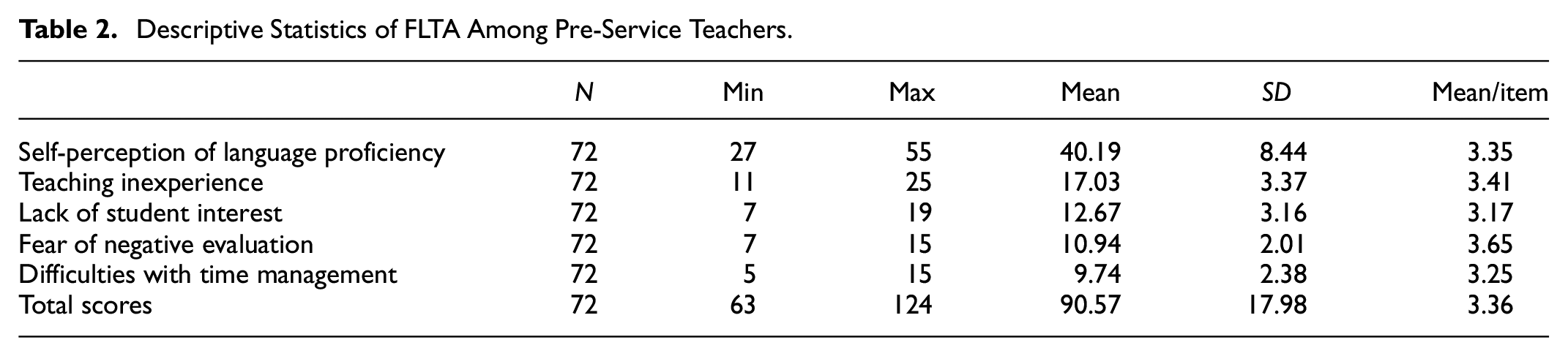
To answer
Descriptive Statistics of FLTA Among Pre-Service Teachers.
FLTA Differences Between Male and Female Pre-Service Teachers.

To sum up, among all the pre-service teachers, the overall score of FLTA was relatively high. Of all the factors/dimensions contributing to FLTA, the pre-service teachers had the highest anxiety in “Fear of Negative Evaluation,” followed respectively by “Teaching Inexperience,” “Self-Perception of Language Proficiency,” “Lack of Student Interest,” and “Difficulties With Time Management.” Furthermore, among all the pre-service teachers, females had higher teaching anxiety compared to males in all the five dimensions and total scores.
FLTA Differences
To answer
FLTA Differences Between Practicum and Non-Practicum Pre-Service Teachers.

As shown in Table 3, there were differences between males and females, so we conducted comparisons between males and females within practicum teachers and non-practicum teachers, and then we conducted further comparisons between males of practicum teachers and those of non-practicum teachers, so did between females. In this way, all participants were divided into four groups: practicum males (N = 12), practicum females (N = 26), non-practicum males (N = 14), and non-practicum females (N = 20). The results of ANOVA analyses revealed that group differences were significant in all the five dimensions and the total scores, with F(3, 68) = 82.362, p < .001 for “Self-Perception of Language Proficiency,” F(3, 68) = 45.624, p < .001 for “Teaching Inexperience,” F(3, 68) = 45.737, p < .001 for “Lack of Student Interest,” F(3, 68) = 29.187, p < .001 for “Fear of Negative Evaluation,”F(3, 68) = 70.886, p < .001 for “Difficulties With Time Management,” and F(3, 68) = 107.318, p < .001 for “Total Score.”
More specifically, females in both the practicum group and the control group had higher anxiety scores than males respectively, and that among the males, practicum teachers experienced much higher teaching anxiety than non-practicum teachers in both the five different dimensions and overall scores. Similarly, among the females, practicum teachers also experienced higher teaching anxiety than the controls in all indicators (see Table 5 and Figure 1). Interestingly, in the dimension of “Fear of Negative Evaluation” there was no group difference between Practicum Males and Non-Practicum Females, p = .144, which indicates that for the females without taking part in the teaching practicum, their anxiety was as high as that of the males who had taken the practicum.
FLTA Gender Differences Between Practicum and Non-Practicum Pre-Service Teachers.

Note. Different superscripts indicate significant differences between groups at p < .05.

FLTA differences across groups.
Factors Contributing to FLTA
Previous studies have shown that various factors play a role in causing the FLTA, such as language proficiency, self-efficacy, fear of negative evaluation, school policy, class management difficulty, new technology, etc (e.g., Aydin, 2016; Aydin & Ustuk, 2020; Fernández-Batanero et al., 2021; Merc, 2015; Paker, 2011). As can be seen from the FLTAS results analyzed above, five factors have been identified in our study, that is, “Self-Perception of Language Proficiency,” “Teaching Inexperience,” “Lack of Student Interest,” “Fear of Negative Evaluation,” and “Difficulties With Time Management.” However, in the current study, the pre-service teachers had the highest anxiety in “Fear of Negative Evaluation” (72.93%), followed respectively by “Teaching Inexperience” (68.12%), “Self-Perception of Language Proficiency” (66.98%), “Difficulties With Time Management” (64.93%), and “Lack of Student Interest” (63.35%). For more information, we also analyzed the qualitative data from the semi-structured interview by conducting in-depth content analyses of the interview, via extracting generic features and categorizing them into different aspects. As described in the method, all the five interview participants experienced high FLTA during the teaching practicum. They reported various factors that might have caused such high anxiety. Below are three major dimensions
Fear of negative evaluation
In the interview, all the five participants pointed out that fear of negative evaluation accounts for the largest part of the sources of FLTA. The two mentors assigned to the practicum teachers in their practicum (one from the college, the other from the practicum school) and the students taught by the practicum teachers were two primary valuators. With the mentors observing in the classroom, those green-hand teachers tended to feel large amount of stress and pressure. For example, T1 pointed out more specifically,
I was extremely stressed-out when my mentor was observing my class and I almost dared not have eye-contact with her as I felt that I was under surveillance.
After observation, mentors would usually give comments to the teaching of the practicum teachers, and they would become extremely nervous if they were given negative remarks. For example, as T2 said,
When my mentor told me that some of my teaching activities were not suitable for the teaching process and my teaching instructions were used improperly, I would feel really frustrated. I did not want to receive too much criticism from my mentor, although I knew it would improve my future teaching. Therefore, excessive critical utterances was of no good use to me but exacerbated my anxiety in foreign language teaching.
It is palpable that the mentors, through class observation and after-class evaluation, may place great apprehension, fear and worry on those practicum teachers, especially when the mentors’ comments were derogatory, thus increasing the anxious level to a certain extent.
Another key stakeholder and main source of evaluation may come from the students taught by the practicum teachers. The students may make negative comments or judgments that concern the practicum teachers. As T3 shared her personal experience and said,
I was doleful when a boy came over to me after class and said he couldn’t catch up with me because I talked too fast and he failed to take in the grammatical points because I didn’t explain well.
Besides, as added by T4 and T5, the practicum teacher’s lecture style, teaching pace, and so forth are also possible reasons inducing negative evaluation among students, which ultimately might have brought about higher teaching anxiety.
Low self-perception of FL proficiency
Self-perception is an individual’s self-knowledge of oneself through behavioral observation. Learners with high self-perception of foreign language usually are competent and successful. In our study, all interviewees reported that low self-perception toward FL was one of the most anxious factors for their teaching anxiety. To mention the most distressing situation in the practicum, T4 recalled:
I got into outright embarrassment when my students interrupted me and tried to correct my pronunciation mistakes, as if they were my teachers instead of my students. I felt very terrible with my spoken English. After that, I tried to avoid using English in class as much as possible.
This a reflection on the fact that pre-service EFL teachers might perceive a relatively low self-perception and confidence while using the target language, since they were afraid of making mistakes in front of students. In addition, it might in turn cause nervousness and tension for the pre-service teachers to use English, or the evasion of using the language. Their low self-perception, in part, derived from inferiority feelings hidden in the inmost recesses of mind, so they might be ashamed of their perceived poor English. T5 noted that,
In my class, there’s a kid whose parents are university professors. They have taken him abroad for several times. His beautiful English accent overshadowed me and I immediately felt ashamed in front of such extraordinary students who could speak English more fluently and naturally than me.
Participants (T1, T2) also added that they were really afraid the students would look down upon them if they make mistakes in the teaching, which would be so damaging for their authority in the class. The pre-service teachers would therefore think that language proficiency matters through the whole teaching process. Speaking the foreign language in the teaching process was a great pressure on the practicum teachers as they were not confident in their language ability. Furthermore, negative feedback on their L2 proficiency from the mentors also posed great stress on the pre-service teachers.
Lack of teaching experience
As described in the participants section, the pre-service teachers in our study did not have any formal classroom teaching experience. This lack of teaching experience was another main reason of high FLTA, which is also a distinctive feature for pre-service teachers from the sophisticated in-service teachers. The practicum teachers’ inexperience might have generated a strong sense of incompetence, tension, and anxiety. As T1 recalled,
During my internship the first time I felt helpless and worried was when onerous teaching duty befell me, I even didn’t know where to start and how to plan lessons. It is really difficult for me to focus on teaching key points and to find out where my students may encounter difficulties, which seems to be a piece of cake for experienced teachers.
As is often the case, destitute of experience gives rise to anxieties in many aspects. Practicum teachers often spend much more time planning lessons but may still fail to fully satisfy students’ needs, curriculum needs, and context needs. Their teaching results tend to be not so good, for they are “insensitive to students’ needs and still unable to construct a sound knowledge framework owing to inexperience” (T3). Other inexperienced aspects such as class time allocation also trigger FLTA. As T4 said,
The most anxious occasion to me is when the bell rings I haven’t finished the preset teaching content. It abruptly disrupts my plan and I don’t know how to make adjustment, which is really annoying.
In this situation, however, experienced teachers may be able to solve these problems with ease, deal with time deficiency tactfully, and handle possible classroom contingencies more subtly.
Participants (T1, T2, and T3) also mentioned occasionally other factors contributing to teaching anxiety, such as learning and teaching environment, students’ discipline problems, and their own personalities. However, all participants consistently listed “fear of negative evaluation, low self-perception of L2 proficiency, and lack of teaching experience” as the major factors, which is exactly consistent with the results of the questionnaire among the practicum teachers.
Discussion
To address the three research questions, the present study investigated FLTA among pre-service English teachers, and analyzed the FLTA differences between non-practicum teachers and practicum teachers and the potential factors leading to the FLTA. The data analyses results revealed that pre-service teachers experienced a relatively high level of FLTA. More specifically, the practicum teachers experienced higher FLTA compared to the non-practicum teachers, and the females had higher FLTA compared to the males. Overall, fear of negative evaluation, self-perception of L2 proficiency, and lack of teaching experience were found to be the main contributors of FLTA. These findings provide insightful understandings of anxiety in teaching foreign language and induce implications for language education policies in real teaching situations for future foreign language teachers.
FLTA Among Chinese Pre-Service EFL Teachers
The major finding in our research is that all pre-service EFL teachers were wreathed in a relatively high FLTA as a whole. On average, the whole level of anxiety was 3.36 (out of five-point scale). The highest dimension of anxiety was “fear of negative evaluation” (3.65), followed by “lack of teaching experience” (3.41), “self-perception of language proficiency” (3.35), “difficulties with time management” (3.25), and “lack of student interest” (3.17). These results are consistent with most previous studies (e.g., Agustiana, 2014; Hammad & Ghali, 2015; Tum, 2015). High level of FLTA is not uncommon within non-native pre-service EFL teachers despite other measuring tools. The reason why they are so anxiety-stricken probably consists in the pressing sense of mission to be an excellent English teacher after the 4-year university studies, but in reality their confidence is low and they are lack of teaching experience. Therefore, when putting theory into practice, they experience high level of anxiety both physically and psychologically. In our study, the participants were government-funded pre-service teachers. As they were still in their university training program, they did not have real teaching experience, their perception of English proficiency might still be relatively low (although all passed TEM 4 and some TEM 8), and their class management skills were still immature. Therefore, without the real teaching experience, pre-service teachers suffered from relatively high level of FLTA. When experience is gained, the anxiety may lower down. For example, in Liu and Wu (2021) the participants were experienced English teachers in college, but the results showed that those college teachers were not worried about their English proficiency and they were confident in speaking English.
However, there are some differences in our study compared with previous literature. The overall anxiety for the pre-service teachers was higher than that of other studies. For example, Aydin and Ustuk (2020) developed and adopted the same FLTAS to investigate teaching anxiety among Turkish pre-service EFL teachers. The results showed that the average mean for each item (27 altogether) was 2.76, whereas in our study it was 3.36, much higher than the Turkish pre-service teachers. Moreover, in their study the highest aspect was lack of student interest (3.03), whereas in our study the highest aspect was fear of negative evaluation (3.65). However, the level of teaching anxiety in our study is similar to that found in Agustiana (2014) investigating FLTA among Indonesian pre-service EFL teachers based on a similar FLTA questionnaire with 5-point Likert scale. Specifically, the mean of teaching anxiety in the dimension “lack of teaching experience” was 3.40 (vs. 3.41 in our study); the mean of teaching anxiety in the dimension “when the cooperative teacher and/or supervisor observe their teaching activity” (which is similar to the dimension “fear of negative evaluation” in our study) was 3.6 (vs. 3.65 in our study). These inconsistent results may be related to different cultural contexts. It is known that Turkish people are honest about their emotions and won’t hold back from expressing them, whereas Chinese people are conservative and usually not willing to show their real emotions and more sensitive (do not want to lose face) in front of others (Ma et al., 2012). Moreover, in the Chinese educational context, English learning is often test-oriented, focusing on grammars and structures (Wen, 2016), thus leading to low ability of communicative competence, which may further increase the level of anxiety in the practicum. However, the partial consistency between our study and Agustiana (2014) may be related to the fact that China and Indonesia are more culturally and ethnically connected.
Differences of FLTA in Pre-Service Teachers
In comparison with the non-practicum pre-service EFL teachers, the practicum teachers who had full engagement in practical teaching exhibited significantly higher FLTA as a whole and on each sub-dimension. The teaching practicum, in this sense, played a pivotal role in causing the anxiety among the pre-service teachers. On average, the practicum experience caused a higher anxiety level of 105.03 (item mean = 3.89), whereas the non-practicum teachers had only 74.41 (item mean = 2.76). In the sub-dimension of “fear of negative evaluation,” the practicum teachers had a mean of 4.05 (vs. 3.20 for the non-practicum teachers), with “self-perception of language proficiency” at 3.91 (vs. 2.72), “teaching inexperience” at 3.88 (vs. 2.88), “difficulties with time management” at 3.86 (vs. 2.56), and “lack of student interest” at 3.74 (vs. 2.53). These results are consistent with previous findings that pre-service teachers do experience high teaching anxiety, particularly during the teaching practicum period (e.g., Aydin, 2016; Tüfekçi-Can, 2018b; Tum, 2015). However, in Merc (2015), the result found that pre-service teachers who were completing practicum had relatively low level of anxiety in general. It is suggested that this low level of anxiety maybe attributed to a high level of self-efficacy for their participants.
Moreover, further analyses of gender and practicum effect revealed that female practicum teachers suffered from the highest FLTA, followed by the practicum males, non-practicum females and non-practicum males. These results are aligned with previous findings that women pre-service EFL teachers are afflicted with higher level of anxiety than their male counterparts (Long, 2019; Merc, 2015; Paker, 2011). This may be plausible that female temperament is often characterized by meticulousness and prudence, and to some degree, imparts sensitivity and susceptibility to their character. The vulnerable female teachers, in consequence, take the brunt of such stress and tension which might be triggered by any negative comments from others, whereas male pre-service teachers, who tend to be more rational relatively speaking, care less about other people’s comments or criticism. Moreover, Ghosh and Roy (2017) discover that female university students are more perfectionists than male. In this regard, female pre-service teachers tend to try their best to be perfect teacher during the practicum in order to gain recognition and praise. Therefore, if there is a gap between the reality and the ideal goal, they are more likely to be haunted by a sense of loss, which may gradually develop into anxiety. Self-reproach and worries about their unsatisfactory teaching performance, for example, certainly intensify FLTA, which less likely happens on male. However, there are also studies that did not find gender differences. For example, in Kobul and Saraçoğlu (2020), there was no anxiety difference between female and male teachers, which included both pre-service and in-service teachers. Different reasons may be behind this inconsistency. For one thing, females may be more likely to express and share their feelings of anxiety while males generally have a tendency to hide their negative feelings. Another thing to note is that this gender difference may come from specific cultural context. For example, in Chinese culture, women are more sensitive to others’ feelings and sentiments, for example, positive and negative stimuli (Davis et al., 2012; Gong et al., 2018). We believe the gender difference should be in further scrutiny in relation to specific linguistic and non-linguistic context.
Underlying Factors of FLTA
According to both the FLTAS results and the content analyses of the interview, multiple factors were identified as the main sources of FLTA. In the questionnaire, five dimensions of factors have been identified, that is, self perception of language proficiency, teaching inexperience, lack of student interest, fear of negative evaluation, and difficulties with time management. However, the highest level of anxiety came from “fear of negative evaluation”(3.65), followed by “teaching inexperience” (3.41), “self-perception of language proficiency” (3.35), “difficulties with time management” (3.25), and “lack of student interest” (3.17). For those who took part in the practicum, they experienced higher anxiety than the controls. The highest level of anxiety was still at “fear of negative evaluation (4.05), followed by “self-perception of language proficiency” (3.91), and “Teaching inexperience” (3.88). These results were further confirmed by the qualitative data from the interview, in which three major factors were discovered, that is, fear of negative evaluation, self-perception of language proficiency, and lack of teaching experience. All these results are due to the fact that the participants went through an English teaching practicum, which is considered a valuable experience during which teachers are burdened by difficult teaching tasks and trivial chores. More specifically, different aspects of the teaching practicum may have caused anxiety in different dimensions.
Firstly, high level of “fear of negative evaluation” indicates that the Chinese participants were really afraid of criticism from others, including both from the mentors and from the students they teach (according to the interview content analyses). However, if we put the results under the Chinese educational and cultural context, it is easier to understand. One of the most significant features of Chinese culture is its emphasis on a harmonious society and the appropriate arrangement of interpersonal relationships (Abbott, 1970), which suggests that usually people do not criticize others openly. Therefore, when the pre-service teachers were under observation by others (e.g., mentors, colleagues, students) and were aware that they might receive criticism from others, they tended to feel great anxiety, which surpassed the worry of “teaching inexperience” itself. Additionally, the qualitative data results showed that the attitude toward the target language, English as a foreign language, might be another reason to give rise to anxiety. For example, as for pre-service teachers, before practicum they tended to be more tolerant with errors and mistakes in using the foreign language. While for pre-service teachers in the practicum, even petty errors might be exaggerated for fear of negative evaluation. These backgrounds at least partially reflect why practicum teachers encountered relatively high anxiety in their English teaching.
In the literature, fear of negative evaluation has been considered one of the greatest anxiety stimuli for pre-service teachers. Oktaviani and Jaelani (2021) classify factors of pre-service EFL teacher anxiety into two types, the cognitive and the affective. The cognitive type comprises such factors in cognitive domain as classroom management, being assessed according to Bloom’s taxonomy, whereas the affective type includes factors dealing with human feelings, values, and appreciation. Fear of negative evaluation falls within the affective domain in this regard. Xiao and Ma (2009) conclude that teacher candidates or cub teachers are easily subject to anxiety from work, such as the fear of failing to attain peer recognition. Instead, the pre-service teachers are desirous of receiving good remarks from their supervisor teachers (Akinsola, 2014). Pre-service teachers might be hit hard by adverse views from mentors or students. Negative comments, therefore, have an ill effect on fledgling teachers, as they are so taut that they teach gingerly under the observation of others. Hart (1987) points out that the appearance of an observer in class would presumably cause evaluation anxiety. Under the stress of authoritative supervisors, pre-service teachers may feel constrained during all teaching activities. Additionally, negative evaluation from students easily engenders FLTA, particularly for those who may have distaste for pre-service teachers’ teaching style, teaching methods, or some other things. In this case, such teaching anxiety is linked with how to accommodate to work environment and how to integrate into students group.
Secondly, teaching anxiety also comes from low self-perception of language proficiency, which has been reported similarly in previous research. Self-perception of language proficiency should be distinguished from real proficiency level. In our study, participants had passed the basic requirement of English majors (TEM-4) and more than half were above (TEM-8), but they also experienced high level of anxiety. For the practicum teachers, the anxiety level was at 3.91, whereas 2.72 for the non-practicum teachers, which indicated that the teaching practicum had significant influence on the participants’ self-perception of language proficiency. This result can also be echoed in the interview, in which participants reported that making mistakes in teaching greatly lowered their self-perception and confidence in the foreign language.
Nevertheless, previous research has discussed how low language proficiency itself may also be significant factor. In an EFL setting, pre-service teachers have to grapple with English language proficiency, which is deemed as one of the hindrances and challenges in their practicum as they themselves are actually language learners too (Kabilan et al., 2020). Inadequacy in EFL competence may undercut the teaching performance of pre-service teachers and undermine the relationship with their students (Gan, 2013). Some studies have shown that practicing language skills, particularly listening and speaking skills, accounts for the sources of pre-service teachers’ anxiety (e.g., Paker, 2011). It is generally acknowledged that having a good command of the target language (i.e., English for EFL teachers) is a necessary and sufficient condition for English language teachers. Therefore, making language mistakes seems to be unbecoming for a competent and qualified EFL teacher, so pre-service teachers tend to lose their composure if that happens, incurring guilt and embarrassment and later into FLTA in the process of teaching. For instance, İpek (2016) suggests that a possible scenario of mispronouncing or misspelling a word seems to bring about FLTA. It is also revealed that such feeling of being tested provokes anxiety to great extent. As a result, the anxious emotions toward foreign language teaching may act as both the result and the cause of FLTA. Chances are that harboring fear and anxiety results from the difficulty of using English, and to make matters worse, it is likely to sink into the mire of diffidence and self-denial with even more serious FLTA. In some cases, pre-service teachers are demanding for native-like fluency (Aydin, 2016). Consequently, beyond reach of that high expectation, FLTA accompanied by low self-efficacy comes into being. Moreover, as indicated in the interview, the pre-service teachers might be dwarfed by some students with overseas experience who could speak the target language more naturally and accurately than the pre-service teachers themselves. In the eyes of the pre-service teachers, this situation certainly debilitates their authority in some ways, which deals a blow to their self-confidence in foreign language teaching.
Thirdly, both the quantitative and the qualitative data showed that our participants had a high level of FLTA in the dimension of “teaching inexperience.” The quantitative data showed that the practicum teachers had a high level of anxiety (3.88 vs. 2.88) in the dimension of “teaching inexperience.” The results of interview analyses also revealed that lack of teaching experience reflected in lesson planning, teaching process, contingency handling, and time management had caused a strong sense of incompetence, tension, and anxiety. These results are generally consistent with previous studies. Before classes, if the pre-service teachers are not fully prepared, FLTA will arise and they tend to flounder (Tüfekçi-Can, 2018b). In Aydin’s (2016) study, being devoid of teaching experience, pre-service EFL teachers is fraught when they begin a lesson. In the course of teaching, they are likely to encounter snags while organizing teaching activities and pushing teaching procedures, or alternatively, to be ignorant of handling possible contingencies in class. Besides, some pre-service teachers tend to keep slow at the teaching schedule as a result of scanty experience. Briefly, for pre-service teachers, little experience of EFL teaching remains one of the major causes of anxiety in real context (Wu, 2012).
To sum up, the three major factors discussed above are consistently identified in both the quantitative and the qualitative results of our study, which have been commonly reported in previous studies. However, the order of these factors is not the same. In some studies, the prior reason for FLTA is lack of experience (e.g., Kazazoğlu, 2020), whereas other studies reported significant correlations with L2 proficiency (e.g., Maeng, 2008), or class management (e.g., Morton et al., 1997; Oktaviani & Jaelani, 2021), or making mistakes (e.g., İpek, 2016). We believe this inconsistency comes from the variety of participants and the heterogeneity of the real context under different cultures, which deserves further clarification in future research. In addition, other variables also play significant roles in causing the teaching anxiety, such as learning and teaching environment, students’ discipline problems, and their own personalities, as reported by the participants in our study.
Limitations and Implications
In the current study, we have explored the foreign language teaching anxiety, which is a relatively new issue, among pre-service teachers; we have also verified that the teaching practicum experience incurred a significantly high level of anxiety, and multiple factors have been identified that have caused the anxiety. However, the current study is not without limitations, which are also further concerns in future studies. Firstly, a larger sample size is preferred if condition allowed in future study, which certainly will present a better picture of this issue. Secondly, a longitudinal research design should be considered for clarifying the cause and effect of practicum and anxiety. Thirdly, a comparison between pre-service teachers and in-service teachers is also suggested in future study to examine how pre-service teachers may differ from in-service teachers in teaching anxiety.
A few implications could be drawn from this study for reducing teaching anxiety. Primarily, develop an amicable relationship between mentors and students and then face up to evaluations. Mentors to pre-service teachers are like a beacon of hope to disoriented vessels in the dark sea. In addition, keeping an open mind about criticism, either from mentors or students, will be more likely to reduce anxiety in the teaching process. Secondly, it is necessary for pre-service EFL teachers to form a strong language basis and have a positive self-perception of their L2 proficiency. For pre-service EFL teachers, they had better grasp the language in order to develop professional competence and teaching skills. Furthermore, to adjust to a positive self-perception, they ought to acknowledge that there is no need for the pursuit of being a perfect English teacher who never makes mistakes in teaching. On the contrary, positive attitude and expectation, to a certain degree, can ameliorate the anxiety. Thirdly, gain teaching experience systematically, which cannot achieve overnight but only through long-term endeavor. Naturally, as teaching experience accumulates, pre-service teachers become more prepared emotionally and are more able to handle contingencies flexibly.
Conclusion
The current study investigated the present level of FLTA, the influence of practicum experience on FLTA, and the potential factors contributing to FLTA among pre-service EFL teachers. The findings are significant in several ways. In the first place, pre-service EFL teachers suffered from moderately high level of FLTA. In the second place, practicum teachers exhibited significantly higher FLTA compared with the non-practicum teachers. Furthermore, female teachers showed significantly higher FLTA than their male counterparts both in the practicum group and the non-practicum group. Lastly, fear of negative evaluation, self-perception of FL proficiency, and teaching inexperience were found to be the main factors contributing to FLTA. Future studies are encouraged to clarify how participants from distinctive backgrounds may manifest different levels of anxiety under different cultural and social contexts.
Footnotes
Declaration of Conflicting Interests
The author(s) declared no potential conflicts of interest with respect to the research, authorship, and/or publication of this article.
Funding
The author(s) received no financial support for the research, authorship, and/or publication of this article.
