




Abstract
The present paper employed instructors’ views to address the facilitating and complicating factors in distance teaching of Turkish. The data were collected through a semi-structured interview form consisting of five questions. The questions were designed by the author and reviewed by two Turkish language teaching specialists. The data were collected through one-on-one online interviews with the participants over Microsoft Teams. To increase the reliability, the participants’ responses, deciphered by the author one Turkish language teaching specialist were explored for interrater consistency. According to the formula proposed by Miles and Huberman, the consistency was found to be 0.94. Accordingly, the difficulties in distance teaching of Turkish were addressed within two themes: technical and teaching-oriented problems. Yet, the participants brought positive remarks on personal, technological, and financial aspects of distance Turkish teaching. Besides, the emerging views regarding educational materials were grouped under distance education platforms and digital tools. The measurement and evaluation problems were also discussed under the reliability of exams and types of language skills assessment. Finally, the recommendations brought by the instructors for distance Turkish teaching were themed under three headings: recommendations for technology, materials, and practice. Overall, future comparative research may employ a larger sample of instructors working in other Turkish language centers and compare the findings. Moreover, further research may seek the attitudes of larger groups of instructors within a quantitative design to suggest more generalizable results. Or, the subject may be addressed by mixed-design research to bring a more comprehensive understanding of the phenomenon.
Introduction
Technological innovations show up in diverse forms in education, as well as in many domains of life. From the past to the present, technological tools, such as television, radio, video player, computer, smartphones, and web tools, have extensively been used in education. Such tools are widely adopted to attract the attention of those with different educational interests, desires, and needs, accomplish the desired academic goals conveniently, and carry out educational activities without time and space boundaries. The use of cutting-edge tools and equipment has peaked worldwide, particularly due to the COVID-19 pandemic, and the pandemic has hurled the concept of “distance education,” coined more than 100 years ago, into our lives.
A substantial body of research on distance education before the pandemic revealed the increasing interest in distance education (Dron & Anderson, 2016). The term, first uttered in the catalog of the University of Wisconsin in 1892, was mentioned by the director of the university, William Lighty, in an article in 1906. The concept began to be discussed widely after the 60s (Adıyaman, 2002). The historical stance of distance education shows that it has actually been practiced through letters, radio, books, or newspapers from the past to the present (Clark, 2020). Accordingly, although it is widely believed that distance education has started to be implemented in recent years, the concept is not newly hatched, but the media where distance education is offered have diversified thanks to advancements in information technologies.
Distance education was initially utilized for people with health problems or those who could not attend face-to-face classes in the USA. The UK preferred distance education for immigrants to facilitate their adaptation processes (Kolyada et al., 2021). Thanks to its wide adoption over time, several definitions have been put forward for distance education. According to a commonly adopted definition, distance education is carrying out learning-teaching activities through technological tools without the necessity of learners-teachers being present in the same physical space (Oral & Ve Yazar, 2017). Uşun (2006) defines distance education as an educational technology application where the source and the receiver are far from each other, and interactions and communications are provided through technical tools with individuality, flexibility, and independence. Distance education is characterized by high educational efficiency and data availability, as well as a constant information transfer rate, regardless of the geographical locations of people (Romanov, 2019). Indeed, distance education has been designated as an alternative to face-to-face education in the case that people cannot participate in face-to-face education due to illness, war, or similar reasons. It was conceptually addressed between 1923 and the 60s in Turkey and became a major educational practice involving many students thanks to cutting-edge information technologies after the 2000s (Bozkurt, 2017).
Nevertheless, distance education is not free of noteworthy adverse aspects; the most prominent one may be poor teacher-student interactions. In addition, poor motivation and attention among students, disruptions in instant feedback, and the lack of the desired efficiency due to technical problems become significant negative aspects of distance education. Financial inadequacies and the inability of students and teachers to use technological opportunities are also among the striking difficulties in distance education. Even though the relevant literature hosts a plethora of studies suggesting comparative analyses of distance and face-to-face education, the findings remain controversial. While some revealed positive and remarkable outcomes of distance education, others pointed out its poor and zero effectiveness (Kamal et al., 2021). Kolyada et al. (2021) claimed that the most prominent disadvantage of distance education in language teaching is the distance between people. Moreover, pointing out the tiring and monotonous nature of distance education, Kolyada et al. (2021) emphasized that learning a foreign language in front of a screen may be quite laborious and challenging.
Distance language teaching has witnessed diverse practices to date. In the 1980s, the National British Program engaged in teaching French through radio and television in England. In this program, in which students engaged in self-study with a workbook supplemented with audio cassettes, instructors received feedback from the students over the phone at certain stages in each unit. Instructors recorded the phone conversations and sent these recordings to students to repeat in their studies. Interestingly, both students and instructors were satisfied with the program (Selman, 1988). In the United States, North Caroline State University developed a Japanese language program for TV broadcasts in the 80s. The broadcasts of live Japanese lessons held at the university were recorded and sent to participants. Students followed the recordings, did the exercises, got the exams, and communicated with their instructors by phone. They completed the process with a final visit of instructors in their offices at the university (Kataoka, 1987 as cited in Adıyaman, 2002). Another example of distance language teaching may be the University of South Africa’s Mandarin Chinese Courses Through Distance Education since 1993. In this program consisting of supplementary audio cassettes, educational letters, assignments, and guidebooks, instructors have also utilized other tools and methods (e.g., teleconference, group work, and slides) to support students (Hau-Yoon, 1994 as cited in Adıyaman, 2002). Moreover, the consortium of the BBC, British Council, Cambridge University, and Longman has designed the Look Ahead series and offered language training in many countries worldwide through audio cassettes, books, and TV broadcasts.
When it comes to distance language teaching in Turkey, the 70s witnessed English, French, and German language teaching programs broadcast via radio. Since the establishment of the Open Education Faculty within Anadolu University in 1982, distance foreign language courses have been carried out through TV broadcasts and books. At the high school level, Open Education High School has been performing educational activities through radio and television broadcasts and supplementary books and brochures since 1992. The School of Foreign Languages of Middle East Technical University (METU) introduced the Language-Distance Interactive Learning Project in 2001 and prepared interactive English courses on the internet for those desiring to improve their English and preparing for the Public Personnel Language Exam, Interuniversity Test of Language, and similar exams. FONO, a profit-seeking organization, operates English language teaching through books and the internet. Besides, teaching Turkish as a foreign language has been shifted to distance education due to COVID-19, primarily through applications such as Advancity, Microsoft Teams, and Zoom. At the time of this study, many institutions were holding their education activities at a distance due to the ongoing pandemic.
Overall, distance education is being increasingly utilized globally, particularly due to the pandemic. Even European governments work on the development of distance education (Kolyada et al., 2021), which may be the most apparent indicator that distance education will be adopted more widely in the near future.
The major concern of the present paper is to discuss language teaching through distance education dating back to a century before and preoccupying human life thanks to the pandemic. The pandemic secluded people in their homes, which led educational institutions to shift to distance education where educational activities were carried out with synchronous or asynchronous classes. Thus, the present study aimed to employ instructors’ views to address the facilitating and complicating factors in distance teaching of Turkish as a foreign language.
Method
Research Design
In this phenomenological research, the participating instructors were recruited for interviews to reveal the overall picture regarding distance teaching of Turkish as a foreign language upon their views and elicit their recommendations to resolve the problems confronted. Phenomenological research focuses on phenomena of which one is well aware but does not have an in-depth and detailed understanding (Yıldırım & Ve Şimşek, 2011).
Sample
The sample consisted of 11 instructors (three males and eight females) employed at the Turkish Teaching Application and Research Center of Akdeniz University to uncover the overall situation regarding distance teaching of Turkish as a foreign language and elicit their recommendations to settle the problems confronted. While male instructors were coded as E1, E2, and E3, female ones were coded as B1, B2, B2… Instructors are shown in Table 1.
Participants’ distribution by gender.

The participants having graduated from faculties of letters were granted teaching formation certificates. Moreover, all participants had the Certificate of Trainers’ Training for Teaching Turkish as a Foreign Language. The distribution of the participants by faculties is given in Table 2.
Participants’ distribution by faculty.

Data Collection Tool and Procedure
The data were collected with a semi-structured interview form. This form was initially designed to include 10 questions and was submitted to the views of two professors of Turkish language teaching. In line with their feedback, five questions were removed. In addition, two non-participating instructors were consulted about the remaining five questions prior to the research. Upon the feedback from these instructions, the form was finalized to include five questions. The participants were totally blinded to these questions before the interviews. The researcher asked these questions to them one by one in the video interviews over Microsoft Teams.
The interview questions are as follows:
What difficulties do you encounter as an instructor in teaching Turkish as a foreign language at a distance?
What do you think are the positive aspects of distance teaching of Turkish as a foreign language?
What tools have you been utilizing in teaching Turkish at a distance? Why? (Zoom, Advancity, Teams, Kahoot, etc.)
What are your thoughts on measurement and evaluation in distance teaching of Turkish as a foreign language?
What may be done to improve distance teaching of Turkish as a foreign language? What are your recommendations?
The one-on-one interviews over Microsoft Teams were recorded, transferred to the computer environment, deciphered, and coded line by line.
Data Analysis
Interviews were intentionally conducted one-on-one to ensure that the participants would be blinded to one another’s interview. In this way, it was attempted to prevent any interview bias. The recorded interviews were transcribed and coded line by line in the computer environment. The codes with common aspects were clustered under categories forming the basis of the findings, called themes. Then, codes under the same themes were interpreted, yielding the findings of the study. Besides, some of the participants’ views were directly quoted to extend the findings.
Validity and Reliability of the Research
For reliability concerns, the researcher and an academic in Turkish language teaching coded the data, and then the researcher sought a consensus on the coding. Accordingly, the formula suggested by Miles and Huberman (2016) was used, and the consensus on the coding, called the intercoder agreement, was determined to be 0.94. The research was all based on voluntary participation; the participating instructors were informed about the research and assured that all their information would be kept confidential and not be shared with other individuals and institutions. The interviews were held and recorded over Microsoft Teams, and the recordings were transcribed and coded.
The opinions of two academics in Turkish language teaching were consulted to ensure the validity of the interview questions. To promote the validity of the study, all relevant research in the literature was reviewed and included in the introduction section. Additionally, for validity concerns, the following criteria were adopted in line with the credibility, transferability, dependability, and confirmability suggested by Lincoln and Guba (1986).
To contribute to the credibility of the study, the previous research was reviewed and included in the introduction section. In addition, revealing the problem situation prompted credibility. Another aspect contributing to the credibility of the study is that the researcher and an academic in Turkish language teaching recorded and transcribed the interviews and coded them within specific themes. Besides, the relevant research design and techniques used to promote the transferability aspect of the study were expounded in detail in the method section. In addition, explaining the data analysis process in detail is thought to contribute to the transferability of the study. Moreover, the data analysis, the themes, and coding were presented to develop the dependability of the research. Finally, to ensure the confirmability of the research, all citations and interpretations in the present study only relied on the interview data.
Results
This section presents the findings of the interviews held to reveal the overall picture of distance teaching of Turkish as a foreign language, the positive-negative aspects confronted by the instructors, and their proposals for resolving the problems, considering their associations with the research questions. The obtained results are shown in Figure 1.
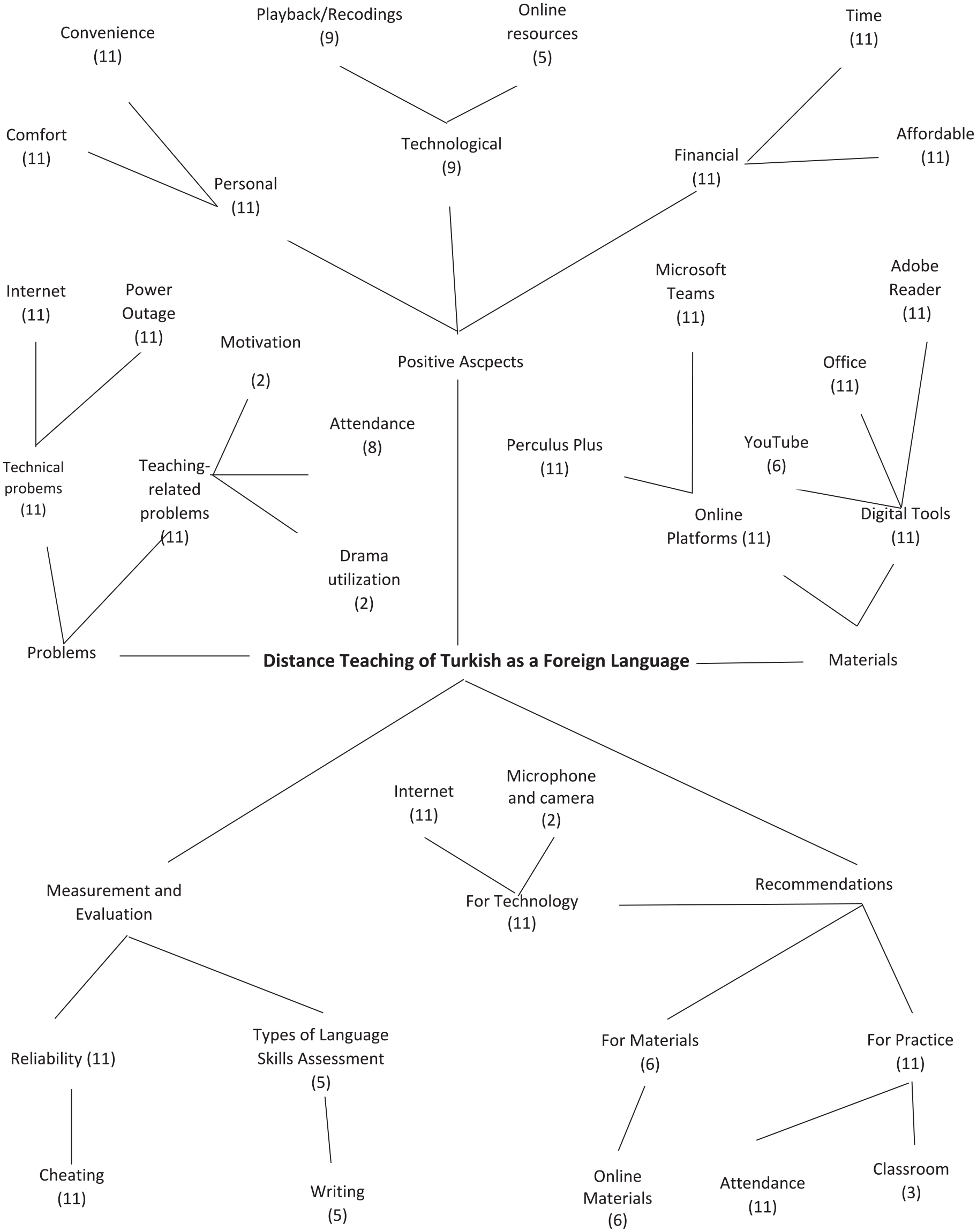
Distance teaching of Turkish as a foreign language.
Problems Confronted in Distance Teaching of Turkish as a Foreign Language
In the light of the data elicited in the interviews, the problems confronted in distance teaching of Turkish as a foreign language were evaluated within two themes: technical problems and teaching-related problems.
Teaching-related Problems
Teaching-related problems emerged as another theme based on the participants’ views. All participants (n = 11) had teaching-related problems while teaching Turkish at a distance. Under this theme, the specific problems (codes) were related to motivation (n = 2), attendance (n = 8), and drama utilization (n = 2). The instructors, complaining that they could not motivate their students in distance education, emphasized that they could not achieve the desired participation and achievement in the classes. In this regard, B4 mentioned the motivation-related problems, “Distance education has become a system where we have had difficulties in motivating students. It is rather challenging to motivate students without sufficient academic awareness; we cannot ensure their motivation from time to time.” The second problem uttered by the instructors was related to attendance. About one-fourth of the participating instructors emphasized that their students had serious issues in attendance and indicated this problem as a serious obstacle to achieving the desired outcomes of the classes. B7 reported, “… Absenteeism appears as the second most significant problem. I think that they behave unrushed since classes are recorded for later use. Unfortunately, distance education is characterized by absenteeism, and we cannot do anything to resolve it.” Another issue touched upon among teaching-related problems is the inability to use drama. The instructors complained that they had difficulties achieving target outcomes in classes due to the inability to use drama in distance education. Accordingly, E3 expressed, “We cannot utilize the drama technique enough. Yet, I think drama is among the most effective techniques in language teaching. Not being able to practice it creates a gap in classes.” Moreover, B5 stated, “There is a need for the elements of body language, such as gestures and facial expressions, in drama to teach Turkish to foreigners. My students may not be able to recognize my body language on their screens, and these become some difficulties we may have in teaching.”
Positive Aspects of Distance Teaching of Turkish as a Foreign Language
The participating instructors’ positive views on distance teaching of Turkish as a foreign language were clustered under its three aspects: personal aspects, technological aspects, and financial aspects.
Materials Used in Distance Teaching of Turkish as a Foreign Language
The emerging views regarding materials used in distance education of Turkish as a foreign language were clustered under two themes: distance education platforms and digital tools.
Measurement and Evaluation in Distance Teaching of Turkish as a Foreign Language
The problems that the instructors confronted in the measurement and evaluation of teaching Turkish at a distance were discussed under two themes: reliability of exams and types of language skills assessment.
Regarding the reliability of exams, another point highlighted by almost all of the participants (n = 10) was objectivity. B8 emphasized, “I don’t think that the exams can be objective since even if students turn on their cameras, I can’t see what’s on their screens. We can detect when students use a translation program, particularly in writing skills. However, we have to grade their assignment as they are since we don’t have any evidence of their cheating, which makes us uneasy.”
Recommendations for Distance Teaching of Turkish as a Foreign Language
Finally, the recommendations brought by the participating instructors were themed under three headings: recommendations for technology, materials, and practice.
Discussion
The pandemic has caught the whole world unprepared. It has also brought severe impacts on and led to the cessation of face-to-face education. Turkey, as well as other countries, has been caught unprepared for the pandemic; therefore, some disruptions and chaos could be appreciated at the very beginning of the pandemic. As a rule of thumb, it has been expected that such disruptions would be eliminated, and the necessary infrastructure improvements would be provided over time. Since educational institutions might not be able to overcome the deficiencies in distance education, the relevant state bodies have been expected to engage in required infrastructure improvements. Regardless of time periods, states have exclusive responsibilities for a successful implementation of distance education and communities’ shifting to distance education both technically and pedagogically (Kolyada et al., 2021).
The present study was carried out to investigate the problems confronted in distance teaching of Turkish as a foreign language. Our findings revealed technical difficulties to be the hottest issue in distance education. Almost all of the participating instructors pointed out internet-related problems and power outages. A study by Güngör et al. (2020) concluded that the majority of the students interviewed emphasized the internet-related problems as among the adverse aspects of distance teaching of Turkish as a foreign language. W. Zhang et al. (2020) also highlighted that infrastructure inadequacies reduce the quality of distance education. Yılmaz İnce and Diler. (2020) determined that technological deficiencies disrupt the quality of distance education. In this regard, Bilgiç and Tüzün (2015) found power outages and internet-related problems to be the leading ones among technical problems in distance education. Hence, the relevant literature significantly points out technical and infrastructure-related issues as the most prominent issues in distance education. Considering that the whole world has quickly switched to distance education to hinder the spread of the virus, it may be appreciated to have experienced such technical and infrastructure-related problems at the beginning. However, it is not prudent to assert that such deficiencies can all be eliminated in a short time. Such problems may occur in almost all countries; thus, it is evident that substantial amounts of investments and a certain period of time are required to eliminate them.
Other problems uttered by the instructors were related to teaching. It was discovered that the common instructional problems in teaching Turkish at a distance were associated with motivation, attendance, and drama utilization. Teachers often experience difficulties in ensuring student motivation in distance education. Although computers seem to provide a familiar setting for instructors and students to hold classes, the lack of sincerity felt in a classroom setting and entirely-disrupted eye contact may generate severe difficulties in providing learning motivation among students. A study by X. Zhang and Cui (2010) also drew attention to this issue, and the scholars claimed the greatest challenge in distance English teaching to be the lack of robust communication between teachers and students. After the transition to distance education due to the pandemic in Turkey, the practice of discretional attendance at many universities and language centers put instructors into trouble. Even some classes are held with a few students, which highly hinders practical teaching activities. Kolyada et al. (2021) discovered that the participating students did not attend classes not requiring compulsory attendance or made excuses for technical problems for not attending classes with compulsory attendance in distance education, which is in parallel with our findings. Compulsory attendance practice or other practices to ensure student attendance may resolve this problem. In addition, teachers have a critical role in ensuring student participation and motivation. In this regard, teachers should carry out different activities to attract and keep the attention of their students throughout classes. Besides, the inability to use the drama technique, often utilized in teaching Turkish as a foreign language, in distance education drew attention as another problem uttered by the participants. Many instructional methods and techniques cannot be utilized effectively in language teaching at a distance, which may be considered the biggest disadvantage of distance education. Since drama, widely adopted in foreign language teaching (Demirel, 2012), cannot be used in distance education, there may be some gaps in achieving learning outcomes. Despite not seeming possible to utilize drama and similar techniques in distance education, it is not impossible either. It should also be noted that providing the regular functioning of cameras, microphones, and similar equipment is essential to ensure students’ active participation in classes.
In the interviews, based on their personal experiences, the participants touched upon the positive aspects of distance teaching of Turkish as a foreign language. Distance education brings substantial comfort and convenience, and it is well expected that the instructors should emphasize such advantages for themselves. These advantages are apparent the most when students have the opportunity to attend classes through a tablet, smartphone, or computer. Additionally, the technological advantages of distance education aired by the participants were all related to being able to playback the recordings of classes and easy access to online resources. The participants pointed out recordings of online classes as a capital convenience for students. Moreover, they showed being able to download and use the resources in the distance education system as one of the biggest technological advantages of the system for students. These facilities are inevitably thought to make significant contributions to active and efficient learning. In their study, Marcum and Kim (2020) emphasized that cutting-edge learning technologies yield excellent outcomes in distance learning, even in areas where online monitoring is complicated. Finally, the participants mentioned the financial advantages of distance Turkish teaching. In particular, the instructors reported that distance education is characterized by its time- and money-saving features. In this regard, Bender et al. (2004) determined that distance education requires much less learning-teaching time than face-to-face education. Similarly, Kolyada et al. (2021) emphasized that distance education provides significant savings in money and time. It is noteworthy that the instructors especially drew attention to “savings.” Moreover, one of them even emphasized that distance education has positive environmental impacts and attributed it to the fact that students cannot leave their homes, do not use vehicles, and, thus, contribute to the decrease in pollution.
The materials used in distance Turkish teaching were grouped under two themes: distance education platforms and digital tools. The instructors reported that while they initially used the Perculus Plus program of Advancity company, they then shifted to Microsoft Teams in the later periods. The sudden emergence of the pandemic put the whole world into trouble, and many countries confronted severe disruptions in education during the initial steps of distance education. For example, Russian educational institutions utilized Zoom when launching distance education in mid-April 2020 and then shifted to Microsoft Teams in the following periods. Similarly, the USA has confronted severe challenges in distance education since the education system was designed for a classroom setting, not a home environment. There were also serious concerns about students’ academic achievement due to the sudden switch to distance education in Europe, particularly in Spain (Kolyada et al., 2021). Upon the participants’ responses, it was concluded that Turkey also experienced some problems in distance education like many countries at the beginning of the pandemic, but that such issues have partially been overcome over time thanks to more professional distance education platforms. Such initial confusion and disruptions in education may be appreciated considering the catastrophic spread of COVID-19. A similar case mentioned above also applies to digital tools utilized by the participants. Those who initially used Microsoft Office and Adobe Reader (for e-books) have also utilized YouTube and similar media platforms later on, which may be conceived of as an adaptation to the pandemic over time.
The problems related to the measurement and evaluation of distance Turkish teaching were grouped under two themes: reliability of exams and types of language skills assessment. It was not interesting that all instructors complained about cheating in the exams. Indeed, it is believed that it is not an easy task to ensure the reliability of exams in distance education since the improvements in technology are always making it easier for students to cheat. For example, students now cheat on some smartphone applications (e.g., WhatsApp and Google Translate) during exams, which severely shatters the objectivity of exams. Although cheating might frequently occur at the beginning of distance education, taking relevant measures to prevent students from cheating during online exams is deemed critical to ensure efficient and objective distance language education. Moreover, the participants reported some other problems with types of language skills assessment. The instructors emphasized having significant problems with writing skills since they could not know whether students were able to complete the given tasks themselves. In general, this situation may be counted among the most likely events encountered in distance education. While other language skills can be assessed and given instant feedback on the screen, writing assignments are assessed within a couple of days after being submitted by students, which may raise concerns that writing assignments may be completed with the help of others or digital tools. Besides, it may asserted that distance education is not rather convenient regarding the assessment of writing skills (Kolyada et al., 2021).
The instructors’ recommendations for distance teaching of Turkish as a foreign language were addressed under three headings: recommendations for technology, materials, and practice. Considering their recommendations for technology, the participants particularly focused on the inadequacy of the internet infrastructure. As previously discussed, it is believed that such a problem occurred globally since many countries were almost unprepared for the COVID-19 outbreak. The unprecedented spread of the virus led many countries to quickly switch to distance education, bringing a heavy burden on the infrastructure of information technologies. Besides, two instructors uttered that their students had problems with the camera and microphone. Students might have experienced such issues for real or misused them as an excuse for not attending the course (Kolyada et al., 2021).
The instructors also brought some recommendations for materials used in distance Turkish teaching. The rapid transition to distance education due to the pandemic caused severe difficulties not only in technological infrastructure but also in teaching materials. Since educational materials oriented to distance education are rather limited, the instructors pointed out the need for designing audio-visual materials for Web 2.0 tools. The problems in accessing suitable materials have become a problem in many countries, just like the difficulties related to technological infrastructure (Konovalenko et al., 2021). Resolving such issues may require substantial investments by the industry of educational technologies (Kokorina et al., 2021).
Among the participants’ recommendations for practice, the most striking one may be that the instructors recommended putting compulsory attendance into practice in distance education. According to the participants, the absence of compulsory attendance leads students not to attend classes; thus, they cannot achieve the desired academic outcomes. Yet, it should be noted that compulsory attendance may not guarantee the active participation of students in distance education since one may get tired quickly in front of the screen and miss the context due to physical fatigue. In this sense, Kolyada et al. (2021) reported that learning a foreign language in front of the screen is quite complex and demanding. Therefore, it is suggested that instructors include exciting activities to keep students’ attention on subjects. Thus, students may not be bored quickly in front of the screen, resulting in a fruitful and interactive class. Another recommendation uttered by the participants was that instructors should be present in a classroom setting while teaching. Classes may be more interactive and engaging thanks to smartboards and similar technological tools.
Conclusion
In this study, the first facilitating factor was found to be that distance education offers students substantial time-related and financial convenience. In this way, it was reported that the relevant costs could be reduced. In addition, another facilitating factor was discovered to be that the recorded classes can be watched over and over again. Overall, the results of the research may be summarized as follows:
In this study, the problems confronted in distance teaching of Turkish as a foreign language were addressed in two themes: technical and teaching-related. While internet disconnections and power outages were highlighted among the technical problems, inability to maintain student motivation, inability to use drama, and attendance problems emerged as the prominent difficulties related to teaching. On the other hand, the facilitating factors were grouped under three themes: personal aspects, technological aspects, and financial aspects of distance teaching of Turkish. These themes were also addressed in two subheadings for each: convenience and comfort (personal aspect), playback and enjoying online resources (technological aspects), and time and financial opportunities (financial aspects). Moreover, distance education platforms and programs were addressed within materials used in the distance teaching of Turkish. It was discovered that the participants utilized Perculus Plus and Microsoft Teams as distance education platforms for interactive online classes and adopted Microsoft Office programs, YouTube, and Adobe Reader as educational programs. When it comes to the problems related to measurement and evaluation, the participants mostly pointed out the reliability of exams and types of language skills assessment. Finally, we concluded the instructors’ recommendations for distance teaching of Turkish emerged in three themes: recommendations for technology, materials, and practice. In general, the participants recommended improving the internet infrastructure and recording systems (technology), preparing online materials (materials), and reintroducing obligation for class attendance and for teachers to hold classes in classrooms (practice).
Implications and Limitations
The ultimate purpose of this study was to reveal the facilitating and complicating factors in distance teaching of Turkish as a foreign language from instructors’ perspectives. The findings revealed that inadequacies in infrastructure due to the COVID-19 outbreak became one of the significant complicating factors for distance education. It mostly emerged as poor internet connections and power outages. The participating instructors also showed the lack of online course materials as another negative aspect during the pandemic, which, thus, mandates significant investments in designing quality course materials for distance education. Another significant aspect of this research is that it uncovered no obligation for class attendance in distance teaching of Turkish and the inability to perform drama in online classes as the most significant practical problems in distance education. In addition, the results pointed out cheating, objectivity, and loose assessment of writing skills as the prime challenges regarding measurement and evaluation in distance education.
On the other hand, the present study is not free of a few limitations. First, the findings are all limited to the views and personal characteristics of the participating instructors employed at the Turkish Teaching Application and Research Center of Akdeniz University. Second, qualitative research attempts to bring an in-depth understanding of phenomena studied with a narrower sample; therefore, the data obtained in this study could not be generalized to border populations. In this regard, further research may utilize an attitude scale and administer it to larger sample groups of instructors serving in other Turkish Teaching Centers; thus, the results to be obtained may reveal generalizable clues about the phenomenon in broader populations.
Footnotes
Declaration of Conflicting Interests
The author(s) declared no potential conflicts of interest with respect to the research, authorship, and/or publication of this article.
Funding
The author(s) received no financial support for the research, authorship, and/or publication of this article.
Ethical Approval
All procedures performed in studies involving human participants were in accordance with the ethical standards of the institutional and/or national research committee and with the 1964 Helsinki declaration and its later amendments or comparable ethical standards.
Informed Consent Informed
Consent was obtained from all participants included in the study
