



Abstract
In an evolving global knowledge economy, many countries are actively implementing policies to recruit and retain foreign students as potential global talents and valuable human resources. This article provides a comprehensive review of the evolution of foreign student employment policy in China. The study finds that foreign student employment policy covers three distinct phases: (1) preparation phase (1949–1978) in which few internships, no employment or startups were allowed; (2) construction phase (1979–2009) in which internships and work-study were allowed with complicated procedures; (3) deepening reform phase (2010 to the present) in which qualified foreign students can take part-time jobs, startup business and even immigrate after graduation. The rationales, guidelines and objectives in each policy phase are identified by inductive document analysis using NVivo qualitative software. Moreover, the result of inductive document analysis is converted into the Multiple Streams Framework (MSF) for further analysis. The MSF analysis shows that domestic demands and overseas competition for global talents in the problem stream, together with advocates in policy community inspired by the Party’s ideology of talent development eventually opens a decision window from the political stream. Lastly, this article proposes a modified MSF to better explain agenda setting and policymaking processes in non-Western contexts like China, and calls for more contributions in the MSF-related research.
Plain Language Summary
In this article, we explore the development of foreign student employment policy in China since 1949, and explain major policy change through the Multiple Streams Framework (MSF). Our research is of great importance because China is speeding up efforts to attract high-level international students so as to build world hubs for talents. Therefore, it is significant to understand the rationales, objectives and strategic priorities in foreign student employment policy. Moreover, the MSF is regarded as a major tool to analyze China’s policy processes and policy changes in our work, though it has rarely been applied in a political system that looks very different from the U.S. political system. Our study finds out that internal appeals for overseas talents, external competition for top-notch personnel in the problem stream, together with advocates who are willing to invest more resources in policy alternatives inspired by President Xi Jinping’s outlook on talent development for China’s modernization drive eventually give rise to a coupling of the three streams. Our article not only provides insight on foreign student employment policy in China, but also highlights limitations of the MSF to explain policymaking processes in Chinese political system. For example, the political stream may take precedence over the others in China’s case. Political institutions and path dependence are lacking from the MSF. We think these promising adaptations are theoretical contributions that can shed light on future MSF-related research. Readers who study on China’s international education, policy processes and policy theories would be interested in it.
Introduction
International student mobility (ISM) is the micro-level of internationalization of higher education (IHE) that has aroused great concern in the past few decades because it closely relates to the recruitment of global talents as human resources (Brown & Tannock, 2009; Portnol et al., 2010). According to human capital theory, ISM is a typical human capital investment made by countries and families, especially the investment in higher education, which has the highest investment costs and the most significant expected benefits (Crossman & Clarke, 2010, p. 602). In this case, international students can be viewed as potential global talents bringing new ideas and perspectives to the host countries and educational institutions.
ISM in a Global Context
Ever since the 21st century, the total number of global mobile students at the tertiary level has been experiencing a drastic rise from 1.6 million students in 2000 to 6.4 million in 2021 (UNESCO, 2023). Under the impact of world academic hegemony, the traditional mode of ISM is from peripheral countries moving to central countries, from developed countries to less developed or developing countries (Altbach et al., 1985, p. 50). This flow pattern brings about the phenomenon of brain gain for hosting countries and brain drain for sending countries respectively. For traditional host countries like the US, the UK and Australia, inbound students as brain gains attribute significantly to the economy of hosting countries in addition to their enormous academic, political and social-cultural values. By far, the US is taking the lead in the global competition for talents, and it also receives the largest number of international students at colleges and universities. The statistics of NAFSA’s latest statistics shows that international students studying at US colleges and universities contributed $40.1 billion and supported 368,333 jobs to the US economy during the 2022 to 2023 academic year (NAFSA, 2023, p. 1). For large sending countries like China and India in contrast, the longstanding loss of highly skilled and knowledgeable talents may result in brain drains under globalization and IHE.
In the post-pandemic era, with the rebounding ISM and continuous expansion of global labor market, attracting more high-quality international students to build a national talents pool is deemed to be one of the strongest incentives and motivations for many countries who have recognized the importance of global talents (Knight, 2018; Martel & Mansukhani, 2022; Whatley & Castiello-Gutiérrez, 2022). Accordingly, the world’s top host countries are taking proactive actions and policy interventions that aim at not only recruiting international students in a short term, but also as building a long-term talents pool. In addition to promoting high-quality education and providing scholarships, the United States, Germany and France are offering jobs related learning and internships while Canada and Australia are easing the pathway to skilled migration somehow for qualified international students. Recent studies (De Wit & Altbach, 2021; German Academic Exchange Service, 2021; Singh & Fan, 2021) have found that the opportunity to gain practical work experience, such as America’s Optional Practice Training (OPT) and Canada’s Post Graduate Work Permit Program (PGWPP), is weighing in importance as a main driven force for international students. Yet the number of international students drops in the UK and Japan following their policies governing international students in certain field of study to work and immigrate (Farrugia & Bhandari, 2018; Japan Student Services Organization, 2021).
International Students as Global Talents in Chinese Context
China, as the world’s largest country that sends growing cohorts of students abroad each year, has undergone long period of brain drain. However, with China’s strategic recruitment policies for high-level overseas students in recent decades, international student enrollment has experienced an unprecedented boom, making China an emerging country for studying abroad. Global talents refer to master scholars, strategists, young and first-class scientists, outstanding engineers and craftsmen, as well as highly-skilled workers who have global perspectives and can engage in global affairs and international competition as defined in Chinese policy text (MOE, 2009). Through China’s interpretation, global talents are not only equipped with high skills and professional knowledge in a specific field but also have innate ability in global affairs, which make them more precious as human resources. In 2023, there are 210,903 international students across over 190 countries and regions studying in Chinese HEIs, accounting for 9% of total global stock of postsecondary international students (Project Atlas, 2023, p. 1). As China has claimed to be the largest student receiver in Asia, and the third largest hosting country in the world, further research focus shall be shifted from “brain drain/gain” to “brain circulation,” promoting the integration of highly-skilled overseas talents into global market to increase benefits for both sending countries and hosting countries (Shin & Choi, 2015, p. 6). Accordingly, there is an urgent demand for more researches on foreign student employment policy in China.
Foreign Student Employment Policy in China
The term “foreign students” rather than “international students” is commonly used in Chinese policy documents. The terms “foreign students” and “international students” are used interchangeably throughout this article. Defined by the Nationality Law of PRC, foreign students are individuals receiving education at Chinese schools but without Chinese nationality (MOE, 2018). “Foreign student employment” is synonymous with “foreign students work” when referring to the behavior of foreign student engagement in social labor and getting payment within Chinese territory. In Chinese policy documents, foreign student employment is included under the umbrella of students’ management or service, referring to foreign student internship, employment and startups. Internship is designed for foreign students who engage in practical work corresponding to their major during the study period. If foreign students get paid for internship, it can also be regarded as employment.
In addition, work-study is a part of internship, which deals with social practice activities organized by HEIs where foreign students spend their spare time obtaining legal remuneration through labor (MOE, 2007). However, work-study programs must be organized and managed by Chinese HEIs. Employment refers to foreign students sign a labor contract or become regular employees after graduation in China. The behavior of foreign students who run a business in China, no matter during the study period or after graduation, is classified as startups. For better understanding, a diagram of foreign students work forms throughout this article is illustrated in Figure 1.

Work forms of foreign students in China.
Although China is accelerating reform in its talent systems and policies, there remains a dearth of research comprehensively reviewing the evolution of foreign student employment policy. In addition, the context and progression of foreign students’ policy changes have not been thoroughly analyzed under theoretical frameworks or from theoretical perspectives. The values and contributions of this article reside in: (1) its comprehensive review and inductive document analysis of foreign student employment policies in China; (2) its application and adaptation of the MSF to explain how internal and external influences, along with policy advocates, interact to open policy windows; (3) its attempt to refine the MSF to better explain agenda setting and policymaking processes in non-Western contexts. This article is valuable for understanding the policy formulation and progression of policy changes in China, for applying theoretical frameworks to practical cases when explaining agenda setting and policymaking process, for critically examining the MSF and proposing a modified framework, and for advancing more MSF-inspired research in the coming years.
Literature Review
Foreign student employment policy consists of policy arrangements formulated and implemented by Chinese government to promote talent development, as well as serve to educational goals. China has relatively short research traditions in ISM compared with in Western developed countries. However, after launching a national strategy called “strengthening the nation on talents” in 2002 (MOE, 2002), higher education in China has witnessed dramatic advancement, for example, the surge of world-class universities and colleges with distinctive features. Thereafter, attracting, cultivating and retaining talents worldwide for China’s economic growth and social development has gained a lot of momentum in the field of IHE.
Foreign student policies in China have established a closely connected system that classified by three distinct phases, namely pre-study, during study and post-study. By far, there is a vast of literature on the pre-study and during study policies for foreign student education, from historical perspectives in particular. For example, B. Liu and Zhang (2018, p. 91) explored the development of international student policies since 1978. They summarized five features in policy changes, namely the transition from politics to education in policy rationale, from expansion development to connotation development in policy orientation, from centralization to decentralization in management system, from differentiation to assimilation in management mode, from the government to the university in educational subject. Zhang (2021, p. 6) conducted research on Chinese quality assurance policy toward foreign student education from policy text analysis perspective. Based on the analysis of 61 quality assurance policies, she argued that the choice of command policy tools is excessive, and the security policy flexibility and long-term planning of capacity-building policy tools are insufficient.
In terms of theoretical applications and adaptations, the recent literature reviews show that the overwhelming majority of empirical MSF applications are case studies, exploring whether the MSF is applicable to other political systems that differ from the US one. For instance, the MSF is applied in parliamentary systems, subnational and international levels. With regard to policy areas, the MSF has been applied widely ranging from energy policy, technology policy, environmental policy, social science policy to economic policy. There also have been remarkable suggestions for the theoretical refinement of the MSF. Some innovative and enlightening findings are summarized in Table 1. The surge in the literature of the past few years makes it clear that the MSF is applicable to various political systems, but it is necessary to adapt the framework to different degrees. In general, the MSF is a promising analytical framework that adds depth to policy process analysis and helps in understanding the complexities of policy formulation in non-US contexts, but more MSF-related research is needed to further advance the theoretical framework, making it capable of explaining policy process to more various contexts.
Researches Applying the MSF to Non-US Contexts.

Despite a limited number of contributions applying the MSF to agenda setting and policy formulation in China, a comprehensive review regarding to foreign student employment policy is lacking. Additionally, theoretical framework in foreign student employment policy is overlooked, which makes it harder to explain the rationale in major policy changes and the complexity of policy formulation. This article aims to fill the research gaps by providing a comprehensive review of China’s employment policy toward foreign students since 1949, identifying rationales, objectives and strategic priorities in each phase drawing on inductive policy document analysis and existing literature. Secondly, this article aims to explore the mechanism of agenda setting and policymaking process by applying the MSF. Lastly, this article aims to examine the MSF in non-Western contexts like China, and to propose a modified framework to make it more applicable to various contexts that differ from the US one.
Research Methodology and Data Sources
Research Method
This article is a comprehensive review on the evolution of foreign student employment policy in China, thus inductive policy document analysis as a qualitative research method is meticulously conducted. Document analysis, according to Bowen (2009, p. 28), is a systematic procedure for reviewing or evaluating documents-both printed and electronic material. As a type of document analysis and a research tool, policy document analysis, defined by Cardno (2018, p. 625), is “a method for investigating the nature of a policy document in order to look at both what lies behind it and within it.” The rationale for choosing policy document analysis lies in its great value in historical research and its rigor in collecting data.
Data Collection
The selection of policy documents was followed a two-step approach. First, we checked the instructions, notices, measures and regulations that are included in official historical materials named The History of Foreign Education in China (1949-1999). Since up to 36 policy documents related to the management of foreign students in China, we found 12 policy documents (Code A1–A12) that met the selection criteria by referring to foreign student work (n = 5), foreign student administration (n = 3), internships and production practice (n = 3) and foreign student study (n = 1). Second, we conducted an online search for policy documents related to foreign student work in databases of the State Council of the PRC, Ministry of Education of the PRC, Ministry of Public Security of the PRC and The People’s Government of Municipality such as Beijing, Shanghai and Shenzhen. After online search and skimming, we found 13 policy documents (Code A13–A25) met the selection criteria by referring to work permits (n = 4), reform and development (n = 4), foreign student administration (n = 3) and exit-entry (n = 2).
A comprehensive overview of 25 selected policy documents is listed in Table 2. To ensure the reliability and objectivity of the research, we selected policy documents by considering multiple governance levels ranging from the Central to the Ministerial and Provincial levels, and adopted the principle of representativeness and typicality. Moreover, concerning the collection of policy documents may be incomplete, we have attempted to overcome the limitation of “biased selectivity” (Yin, 1994, p. 80) by being aware of what is available and what is unavailable and why. When selecting data, the subsidiary documents in the form of regulations, reports, notices and measures were assembled to make the collection as complete as possible.
The Collection of 25 Policy Documents.

Data Analysis
Inductive analysis, defined by Thomas (2006, p. 238), is an approach that primarily uses detailed readings to derive concepts, themes or a model through interpretations made from the raw data. We mainly adopted open coding and axial coding based on NVivo qualitative software of above policies. Frequency check (shown as Reference Number in NVivo) of specific content appear in policy documents was also used in this article. Reference number is similar to frequency of code co-occurrence in ATLAS ti or number of codes emerged in manual coding. The coding process in inductive policy document analysis is illustrated in Figure 2.
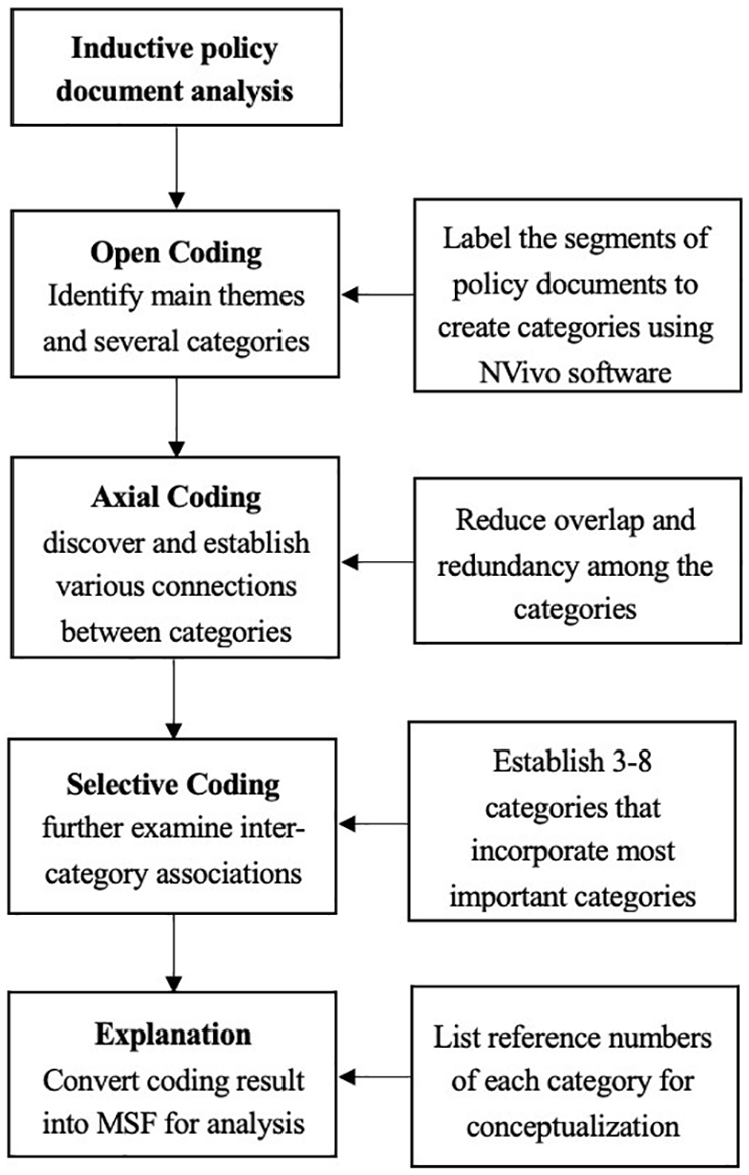
Inductive policy document analysis.
The first step of inductive document analysis is to carry out open coding. The purpose of open coding is to identify several categories that can conclude critical aspects of themes proposed in the raw data (Thomas, 2006, p. 240). We drew upon NVivo software to analyze 25 policy documents word by word, and then labeled the document texts to create categories. Fifty-two critical aspects of main themes and 20 categories are initially formed. Excerpts of open coding analysis are listed in Table 3.
Open Coding Analysis of Policy Documents (Excerpts).
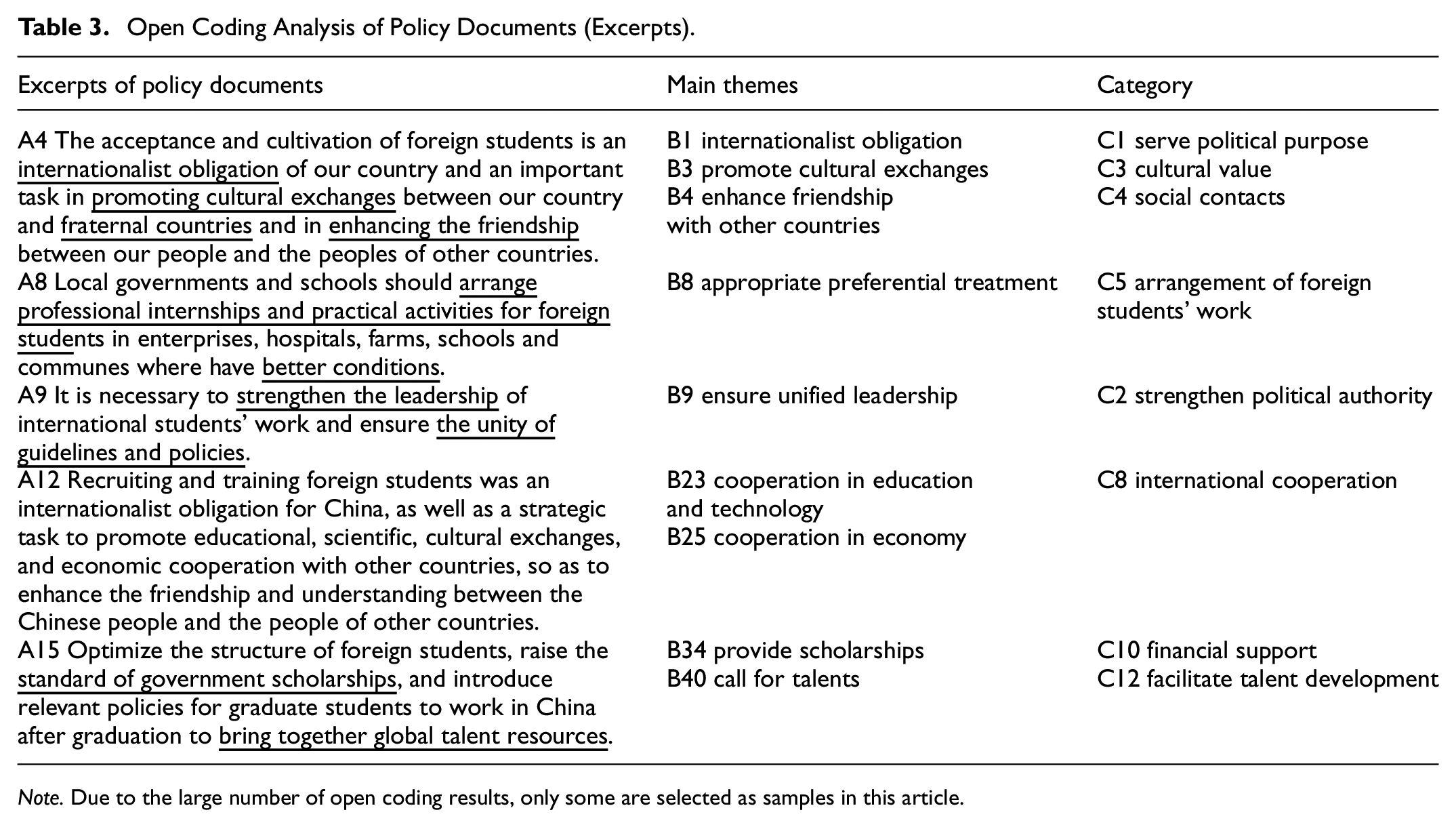
Note. Due to the large number of open coding results, only some are selected as samples in this article.
For the subsequent analysis, we conducted axial coding to reduce overlap or redundancy among the categories on the basis of open coding, and established main categories incorporating most important subcategories. Axial coding analysis yielded 3 main categories and 12 subcategories, as shown in Table 4. Based on opening coding and axial coding results, we conducted selective coding to examine whether there were new categories or inter-category associations emerged from the original data. According to the result of coding analysis, no new categories or redundancy were found in the content of 25 policy documents. Therefore, both subcategories and main categories in the research could be justified.
Axial Coding Analysis of Categories.

MSF: A Major Lens to Explain Policy Processes and Policy Changes
The MSF was originally put forth by John W. Kingdon for the analysis of agenda setting processes. With hundreds of empirical applications and theoretical refinements, the MSF is recognized as a major tool to analyze both policy setting process and many other stages of the policy process (decision-making, implementing, etc.; Weible & Sabatier, 2017, p. 18).
Problem Stream
The starting point of the MSF is the notion of three independent streams called problem stream, policy stream and political stream. The MSF assumes that if these independent streams are brought together at some point, the “policy window” or “window of opportunity” opens (Kingdon, 2011, p. 85). The problem stream is derived from citizens’ or policy issuers’ ideal states and that “are seen as public in the sense that government action is needed to resolve them” (Beland & Michael, 2016, p. 225). Moreover, Kingdon (2011, p. 21) described three specific conditions that receive political attention, namely indicators, focusing events and feedback. As policy makers are only able to deal with limited numbers of issues at any given time, whether a problem can arise policymakers’ attention depends upon which other problems are currently discussed. Thus, the problem stream in the MSF is not simply deemed as objective facts but rather as social constructs. In Chinese context, problems are more associated with political relevant conditions identified by the Party Central Committee (PCC).
Policy Stream
The policy stream refers to policy communities where policy experts, interesting groups, academics, researchers and consultants discuss, modify and recombine policy alternatives to cope with a specific policy problem (Herweg, 2016, p. 23). In this process, various policy alternatives float around in a large primeval soup, but most of which are eventually filtered out through “softening up” (Kingdon, 2011, p. 127). In China’s case, the structure of policy communities is relatively integrated and consensual. For example, education policy communities mainly consist of government officials in the State Council and MOE (under direct leadership of the State Council), and other government ministries sometime. Non-governmental organizations, interest groups and other independent education organizations are less likely to be involved in policy communities, so path dependence is more highlighted in Chinese policy-making process.
Political Stream
The political stream is concerned with the national mood, interest group campaigns and governments and legislatures in the political system (Easton, 1971, p. 129). In the MSF literature, it is quite debatable which element is of utter importance in the political system for a policy change. Nonetheless, given the distinctive feature of centralized government that employs strict state control and supervision governance mode like China, governments and legislatures as the most relevant actors seem plausible to take precedence over others. Under certain conditions, a centralized political system is prone to neglect a reluctant national mood and small interest group campaigns.
Policy Change Through the Coupling of Three Streams
Policy window, as defined by Kingdon (2011, p. 165), is a specific point in time when advocates can push their policy alternatives to certain policy change, and coupling mechanism varies depending on the stream therein opens the window. If a policy window opens in the political stream, the main task of coupling is to pick out a problem to a given solution. However, that is not always the case where a political window opens. If a window opens in the problem stream, the main task of coupling is to work out a feasible solution to a specific problem. Certainly, some policy windows are predicable while many other policy windows are unpredictable, but the main problem with policy window is that it is usually identified ex post rather than ex ante to identify whether an event constitute a policy window for eventually policy change (Zohlnhöfer, 2016, p. 105).
Foreign Student Employment Policy in China Since 1949
This section offers a comprehensive review on the evolution of foreign student employment policy in China post 1949. We explored the rationales, guidelines and objectives that identified in inductive policy document analysis, and converted the collected data into the MSF for further analysis.
Policy Evolution of Foreign Student Employment in China
Studies on the context and reforms of foreign student employment policy, as mentioned in the literature review, are rich and comprehensive. Despite of a slight divergence in the division of policy phases, three historical nodes known as the founding of PRC in 1949, the economic reform in 1978 and the building of socialism since the 21st century, are well acknowledged in the development of foreign student employment policy (Liu & Wang, 2020, p. 69).
Preparation Phase: Few Internships, No Employment or Startups for Foreign Students (1949–1978)
Due to the severe economic hardship and inadequate experience in training foreign students and interns, Chinese government adopted the guideline of “select less, treat separately” in foreign student employment policy. Selected policies in this phase indicated that foreign student education mainly involved signing exchange programs with Eastern countries such as the Czech Republic, Poland, Hungary, Bulgaria and Romania. Accepting and training interns from Korea, Vietnam and Mongolia was regarded as an integral part of economic and technical assistance to “fraternal countries.”The Trial Regulations on Foreign Student Work (Draft) of 1962 was the first legal policy on foreign student employment promulgated by China’s Central Government. According to the Trial Regulations, production labor related to foreign students’ major could be arranged, but foreign students were generally not allowed to participate in any internships unless they insisted on it. For one reason, foreign students were under “appropriate preferential treatment” and “strict management.” For another reason, recruiting and training foreign students from “fraternal countries” was driven by the “foreign policy” of fulfilling “internationalist obligation.” The result of inductive policy document analysis of the Trial Regulation made it clear that politics dominated the rationales in foreign student employment policies, as evidence in “internationalist obligation,” “fraternal countries,” and “foreign assistance.” Reference numbers in Table 5 indicate the number of times a specific term appears in policy documents.
Reference Number of Rationales, Guidelines and Objectives in Trial Regulation of 1962.
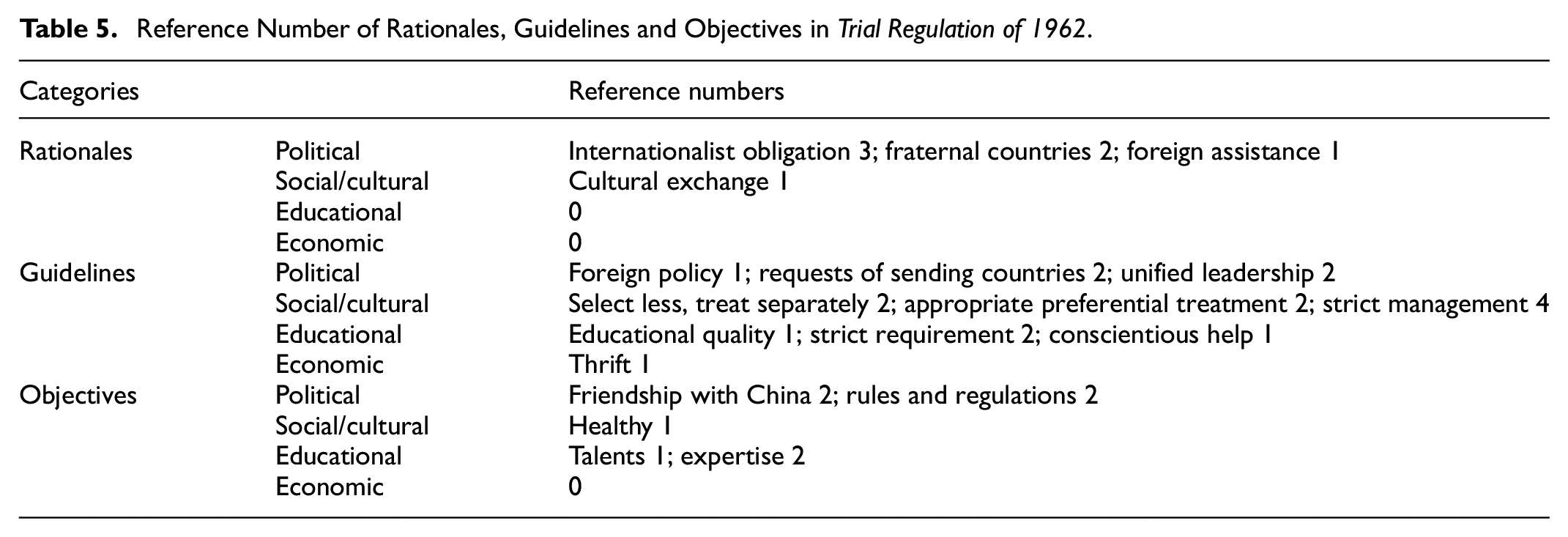
The arrangement of foreign student internships at that time, as mentioned in the Report of the Conference on Foreign Students Work, was extremely difficult owing to the abnormal production in Chinese factories and mines, and poor living supplies in most regions. From 1949 to 1965, there were 7,259 foreign students from more than 70 countries, including 6,591 from socialist countries, accounting for 90.8% of the total (Dong, 2012, p. 44). From 1966 to 1976, foreign student recruitment was forced to suspend on account of the political upheaval.
Overall, foreign student employment policy in this phase was under absolutely unified leadership of the Central Government while local governments and Chinese HEIs merely had any authorities on foreign student management. Noteworthily, production labor and internship were open to foreign students, but without clear policies. Foreign student employment and entrepreneurship were strictly forbidden in China.
Construction Phase (1979–2009): Internships and Work-Study Were Allowed With Complicated Procedures
The launch of economic reform marked a milestone in the evolution of foreign student employment policy. In 1979, Measures on Foreign Student Arrangement of Professional Internships and Practical Activities required local governments and schools to arrange professional internships and practical activities for foreign students in enterprises, hospitals, farms, schools and communes where conditions were better (Li, 2000, pp. 899–900). Foreign students who participated in professional internship shall be authorized by the superior department of the employer and the foreign affairs office of the province, city or autonomous region where they were practicing, and then reported to the Ministry of Public Security and the Ministry of Education. In addition to the strict political examination and complicated application procedures, a list of foreign interns shall be sent in advance to General Political Department. Built on the Trial Regulations of 1962, the Trial Regulations on Foreign Student Work (Revised) of 1979 proclaimed that accepting and training foreign students was for the realization of socialist modernization.
Measures on Foreign Student Administration promulgated by the State Council in 1985 was the first macro policy on foreign student employment after China’s economic reform. The Measures stated that recruiting and training foreign students was an “internationalist obligation,” as well as a strategic task to promote “cultural exchange” and “cooperation in education and technology” with other countries, so as to “enhance the friendship” and understanding between the Chinese people and the people of other countries. Instead of “unified guidelines” on foreign student’s internship and social practice, the Measures enlarged “education administration” of Chinese HEIs on selecting and sending foreign students as interns to non-confidential units. Apparently, this adjustment facilitated the standardization of foreign student employment policy.
Even though politics still dominated the rationale in foreign student employment policy in this phase, Chinese government attached more emphasis on education and social/cultural facets in policy making. From the inductive policy document analysis (see Table 6), it can be seen that the fulfillment of “internationalist obligations,” the promotion of “cultural exchange,” and the “cooperation in education and technology” were strategic priorities in foreign student employment policies. For the purpose of “enhancing friendship with China,” foreign students were treated as guests in line with the “foreign policy,” thus their internships and social practices were carried out under “appropriate preferential treatment” as well as “strict management.”
Reference Number of Rationales, Guidelines and Objectives in Selected Policies.

The Higher Education Law of the PRC in 1998 clarified the independent legal entities of colleges and universities, hence accelerated the transition from centralization to decentralization in Chinese HE (Y. Wang & Liu, 2020, p. 79). Under this context, the three-level of the Central Government, provincial government and university administration on foreign student employment had been gradually established. However, due to China’s strict permanent residency policy and naturalization system for highly skilled immigrants, the policy window for foreign students to obtaining employment or start-up businesses after graduation had not yet been opened. In 1996, Employment Regulations for Foreigners stated that foreigners who studied or practiced in China were not allowed to work. Regulations for Foreign Student Administration on Acceptance by Colleges and Universities in 2000 specified that foreign students were forbade to seek jobs, engage in trade or any other business activities while studying at Chinese HEIs, but can participate in work-study programs.
Deepening Reform Phase (2010 to the Present): Part-Time Jobs, Startups and Immigration Are Open for Qualified Foreign Students
The year 2010 was chosen for the beginning of a new policy phase because Chinese government released numerous macro policies for accepting foreign students that are of strategic and long-term significance. For instance, the Outline of the National Medium- and Long-Term Programme for Education Reform and Development (2010-2020) stipulated that human resources are first resources for economic and social construction, with education is the cornerstone in the accumulation of human capital. Therefore, China shall continue to expand educational openness through recruiting and cultivating even greater number of international talents (MOE, 2010a). The Outline was the very first foreign student employment policy at the Central Government level since the 21st century. However, as an overreaching meta-policy, the Outline is quite abstract without specific objectives or regulations for foreign student employment. To better implement the Outline, the Plan for Study in China announced providing more convenience for foreign student work-study programs, as well as creating more conditions for their social practice and internships. To this end, an integrated talents mechanism/system of foreign student employment must be gradually established (MOE, 2010b).
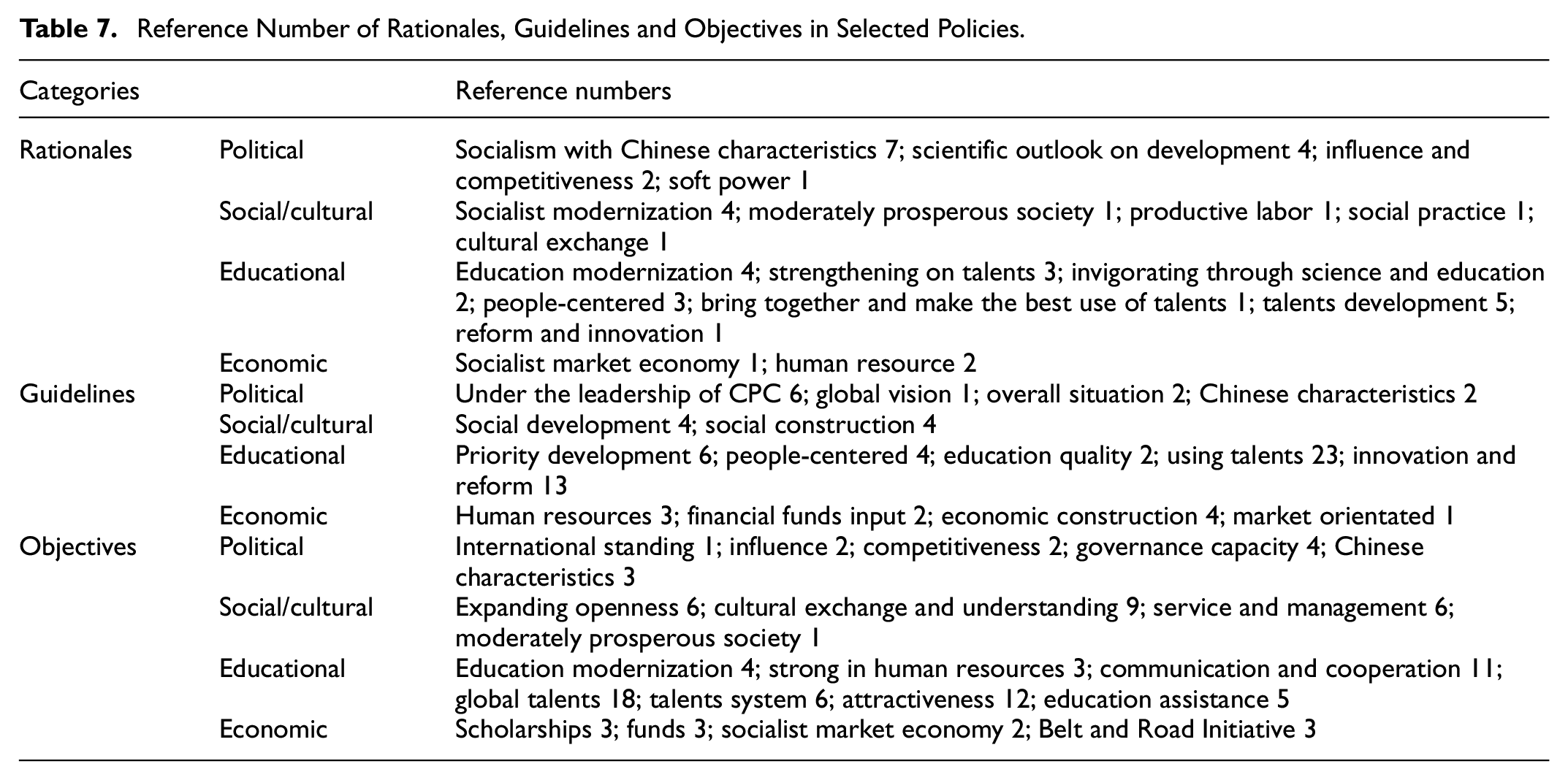
In terms of rationales, the formulation of foreign student employment policies is for accelerating “socialist modernization” and “education modernization.” The political term “internationalist obligation” has been taken placed by educational terms like “strengthening on talents” and “talents development.” With respect to guidelines, there are more educational discourses such as “priority development,” “using talents,” and “innovation and reform” for “social development” and “economic construction,” but must “under the leadership of CPC.” As for strategic goals and objectives, educational and social/cultural terms like attracting “global talents,” promoting “communication and cooperation,” deepening “cultural exchange and understanding” and “expanding openness” are commonly emerged in policies. Thereafter, attracting and making the best use of global talents becomes a top priority in foreign student employment policy.
The strategic guidance of making China a socialist country strong on talents and human resources successfully opened the policy window of foreign student employment (see Table 7). Released in January 2017, the Notice on Allowing Outstanding Foreign University Graduates to Work in China made it clear that foreign students who have obtained Master or above degrees at Chinese HEIs and graduated for more than 1 year, or who have obtained Master or above degrees from well-known overseas universities and graduated less than 1 year can work in China (Ministry of Human Resources and Social Security, 2017). To apply for work permission, foreign graduates must be healthy, have distinctive academic performance with the average score of at least 80 points (100 points system) or above B+/B (grade system), and without bad record during study. It is the very first time that Chinese government put forward detailed regulations in response to foreign student employment after graduation. Released in January 2022, Measures on the Administration of International Student Work-study in Higher Education Institutions allowed qualified international students to take part-time jobs for no more than 8 hr per week and no more than 40 hr per month while studying in Chinese HEIs. During winter and summer vacations, foreign students can work for no more than 16 hr per week and no more than 80 hr per month (MOE, 2022). The Measures marks a significant transition in China’s foreign student employment policy.
Reference Number of Rationales, Guidelines and Objectives in Selected Policies.
To attract more high-level foreign students and enhance international competitiveness of talents, municipal governments of Shanghai and Beijing have actively explored work policies to provide more internship, social practice and employment for foreign students. For example, Shanghai Ministry of Public Security introduced 10 Exit-Entry Policies to make convenience for foreign student employment for the construction of Shanghai Science and Innovation Center. Foreign students studying in Shanghai with the approval of universities and recommendation letter can apply for “business startups” on their study residence permit, and engage in internship or entrepreneurial activities in Shanghai Free Trade Experimental Zone and Zhangjiang High-tech Industrial Development Zone (G. Liu, 2020, p. 133). Additionally, qualified foreign students and graduates from overseas universities can work directly in Shanghai with work permits. Following Shanghai’s experience, the National Immigration Administration of China notified 12 Immigration and Exit-Entry Policies to Promote the Construction of Free Trade Zone Nationwide, allowing high-end foreign talents, doctoral students who have worked in China’s major development regions for at least 4 years to apply for permanent residence (The State Council of PRC, 2019). High-level management and technical talents in the field of innovation and entrepreneurship can also apply for residence permits valid for 5 years.
Explaining Foreign Student Employment Policy Through the MSF
From the above analysis, foreign student internships and study-work programs were carried out under strict procedures after China’s economic reform, but any forms of foreign student employment or entrepreneurship were strictly forbidden before 2017. By contrast, there are numerous policies providing internships, employment, start-ups and even immigration opportunities for foreign graduate students post 2017. Why and how did the policy window open? This section attempts to explain employment policy change through the MSF.
Problem Stream: Growing Demand for Overseas Talents in Job Market
From an international perspective, the vast majority of countries have witnessed the increasing number of top-notch immigrants due to technological, geopolitical and environmental transformations. According to The World Migration Report 2022, the number of globally international migrants was estimated to be 281 million in 2020, with nearly two thirds being labor migrants (IOM, 2022, p. 2). Given social and economic conditions as well as regulations of international immigration, countries with higher level of internationalization have stronger attractiveness to overseas talents. Take Canada as an example, employment-based immigrants accounted for 57.7% of the total number of immigrants in fiscal year 2020. To fill labor market shortages and fuel economy, Canada tabled the 2022–2024 Immigration Levels Plan, which aimed to naturalize 431,645 permanent residents in 2022, 447,055 in 2023 and 451,000 in 2024 (Government of Canada, 2022).
Different from countries with immigration traditions, China is not an immigrant country that has great attractiveness to top-notch overseas talents or treats them as potential labors who can contribute to the domestic economy. This is in accordance with the result of inductive analysis that political and social terms rather than economic terms were more frequently emerged in the first two policy phases. With the economic reform and a more proactive opening strategy in recent years, China has become the world’s second largest economy, and a major trading partner for more than 140 countries and regions. The greater numbers of foreign-funded enterprises, foreign business representatives and foreign language training and education institutions in first-tier cities such as Beijing, Shanghai and Guangzhou, create hundreds of thousands of job positions across all sectors for foreign students who have more competitive edge in cross-cultural communication and human capital.
Despite having attracted nearly half a million foreign students each year, there are still very few of them who actually work or start up local business in China after graduation owing to China’s non-immigration system, rigid employment policies and socialist culture that are very different from immigrant countries. There is a clear sign that China needs to remove both institutional and policy barriers that hinder overseas talents working in China, and to further reform the administration and employment system for foreign students. In fact, the inductive policy document analysis since 2010 revealed economic and educational foci and rationales in accepting foreign students, charting a new path for optimizing the management system of studying in China, and deepening reform on foreign student employment policy. High-level foreign students are no longer treated as guests, but are recognized as potential talents who can make enormous contributions to China’s social/cultural, economic and technological advancement.
Policy Stream: Accelerating Efforts to Reform Foreign Student Employment Policy
As talent attraction and retention has become a prominent issue that calls for urgent policy actions, policy communities ranging from the Central Government to provincial governments, from universities to social organizations put forward policy alternatives with respect to deepening reform on foreign student employment policy. The inductive policy document analysis shows that the rationales in foreign student policies have been largely enriched at educational and social/cultural aspects. “Using talents,” “innovation and reform,” “global talents” and “attractiveness” are highly frequent terms appearing in relevant policy documents. It can be seen that talent development is regarded as a top priority by the Central Government, providing guidance for outstanding foreign students and high-end talents who have both strong desire and capability to work in China. The word “talents” is repeated 81 times in the Outline that can be identified as the key concept and theme. Chinese president Xi Jingping proposed that China shall adopt a more open policy on introducing greater numbers of high-quality overseas talents in all respects. For intensifying the reform on employment system and mechanism, concerted efforts shall be made to remove institutional obstacles, streamline government administration, delegate power in overseas talents retention so as to boost innovation and creativity of talents.
At the provincial government level, the People’s Government of Beijing Municipality formulated a proactive plan for high-end foreign talents, exploring a 1-year work permit to enable the high-grade, top-notch and sought-after foreign students and global talents who are urgently needed for Beijing’s economic and social development (The People’s Government of Beijing Municipality, 2022). Other government officials like Shanghai, Guangzhou and Sichuan have reformed employment systems by helping foreign students with Master or above degrees find local employment and encouraging business startups. Meanwhile, officials from Peking University, Tsinghua University and many other universities and colleges contend that unjustified restrictions on foreign student employment run contrary to the national strategy for innovation-driven and workforce development. They also requested more power granted to the arrangement of work-study programs for foreign students. Western Returned Scholars Association argues that the long-standing problem in employment institutions and barriers impedes the inflow of outstanding foreign students as potential innovative and entrepreneurial talents. Evidently, more effective foreign student employment policies should be designed.
Political Stream: Chinese President’s Outlook on Talent Development
The political stream of foreign student employment policy is closely related to Chinese president’s outlook on talent development. Guided by the philosophy of building a modernized country with higher international standing and greater influence, and a country strong on human resources and talents, Xi proposed China’s Education Modernization 2035, in which charted an ambitious path for the realization of modernization through human resources and innovation. Human resources, according to the result of inductive policy document analysis, remain at the heart of modernization in terms of economy, science and technology. Talents, both at home and abroad, are thereafter valued and natured as primary resources and pillars for modernization. In line with talent development, foreign students are not merely treated like guests or cultural ambassadors, but are recognized as potential talents who have integrity and professional competence to accelerate modernization in all respects. To this end, foreign student employment policy should ensure that outstanding foreign students are valued, attracted and cultivated, and eventually put them to good use.
To address the deep-seated problems in institutional and working systems for overseas talents, China has tabled a broader policy agenda of opening in greater depth, which highlighted the strategic significance of building up employment systems for foreign graduates to make contributions in critical industries and key sectors. It is noted that only by breaking new ground can China’s strength in global talents competition steadily rise. Given the centralized and unified leadership exercised by the Party Central Committee over talent development, a policy window finally came about from the political stream with president’s strong support for a fundamental transformation of foreign student employment policy.
Discussion
By applying policy document analysis as well as the MSF, a more holistic picture of China’s policy change toward foreign student employment is presented. It has been proved that the MSF provides a convincing explanation for policy change, where the three streams converged and opened a policy window for foreign student employment. Seemingly, the MSF can provide fertile theoretical ground for agenda setting and decision making in nondemocratic political systems like China, with some necessary modifications. Based on the above discussion, we proposed a modified framework (see Figure 3) so as to make the original MSF more applicable to explain policy processes in non-US contexts.

A modified MSF.
First of all, the MSF argues that the three streams can be viewed as largely independent and equally important, but it is questionable in other political systems that differ from the US one. In our modified framework, the three streams are fruitfully viewed as interdependent rather than isolated, and the importance of the political stream outweighs the other two throughout policy change in political systems. The modified framework assumes that the political stream even triggers or prevent changes in other two streams in some cases. The analysis of foreign student employment policy has proved that changes of the Party’s ideology in the third policy phase increased the probability of agenda change and finally opened a policy window that allowed qualified foreign students to work in China. But a focusing event in the problem stream, like the outbreak of political upheaval in the first policy phase, may well have an impact on the national mood and the policy community in other two streams. Thus, the modified framework argues that the degree of stream independence varies dramatically in different political systems. Compared to the US presidential system, the political stream in political party system like China and parliamentary systems occupies a more dominant position in the policy agenda that both the problem stream and the policy stream flow interdependently around it.
Second, the modified framework adds “path dependence” and “political institutions” as two new elements into the policy streams that affect policy entrepreneurs in the process of working out alternatives. The inductive policy document analysis has found that when exploring the policy evolution of foreign student employment in the third policy phase, there seems to be a contradictory situation that strong provisions from the Central Government for recruiting global talents and outstanding global students in 2010 did not trigger a timely policy reaction until 2017. Apparently, the original MSF per se may not explain this contradiction as it lacks a critical concept, path dependence. Path dependence is defined as “a property of contingent, non-reversible dynamic processes, including a wide array of biological and social processes that can be described as evolutionary” (David, 2007, p. 93). In the modified framework, path dependence is viewed as a vital criterion of survival that affects whether a proposal turns to be a viable policy alternative or not. With regard to political institutions, it affects the integration of policy communities and determines whose agreement policy entrepreneur shall obtain during the coupling. Contrast to the US political system, under limited conditions of political freedom, policy communities tend to be much smaller and highly centralized in nondemocratic and authoritarian regimes, path dependence in policymaking is probably strong and negative as a consequence. This implies that policymaking process cannot get rid of the constraints of a given institutional pattern or a specific history even the chosen path is somewhat inefficient. The integration of “path dependence” and “political institutions” into the policy system helps to better explain how various policy alternatives are filtered out through “softening up” in the original MSF. In political Party system like China, a major policy change is unlikely to take place unless policy communities work out alternatives match better with the Party ideology.
Lastly, the modified framework confirms the central idea of the original MSF that the coupling of the three streams eventually results in policy change through a policy window, and further clarifies the principle of ambiguity in policy formulation and policy legitimation. Drawn upon the inductive policy document analysis, governments and legislatures are the most relevant actors who ultimately adopt policy change from the political stream. In nondemocratic settings, the Party’s unified, centralized leadership may be somehow influenced, but is unlikely to be weakened by national mood or interest group campaigns. In fact, party ideology could play a much larger role in parliamentary systems compared with in the US one as a Party’s policy experts are often members of the policy community who tend to support proposals that closely attached to Party ideology. Thus, the modified framework places “the Party’s ideology” in the center of the political stream, though the existing MSF literature has not been very explicit about the conditions under which individual element may take precedence over others. Besides, the modified framework assumes that the coupling mechanism in nondemocratic political systems is expected to be doctrinal rather than consequential, which makes it easier for policymakers to couple some problems to a given solution. Opening a policy window from the problem stream would be difficult for policy entrepreneurs, particularly when their proposals are largely deviated from the previous policy path that is favored by the Party.
Conclusion
In conclusion, this article conducts a comprehensive review on foreign student employment policy changes in China. Inductive policy document analysis showed that politics dominated the policy rationale in foreign student employment in the first policy phase. The political upheaval from 1966 to 1976 was a focusing event in the problem stream that confined employment policy change in other two streams. In the second policy phase, politics still dominated the rationale in foreign student policy, but with more emphasis on education and social/cultural perspectives in policymaking, thus internships and work-study programs were permitted, along with some general regulations for foreign student administration. The inductive analysis of guidelines and objectives showed that economic dimensions are less evident in policy documents. This means that policymakers did not define foreign student employment as the most relevant problem in the course of pursuing China’s economic modernization. As a result, no policy alternatives were generated from policy communities.
By applying the MSF, internal appeals and external competition for global talents in the problem stream, together with advocates who were willing to invest more resources in policy alternatives inspired by the outlook on talent development eventually gave rise to a coupling of the three streams. Although the policy window opened in 2010, it was basically impossible to work out a satisfactory solution in a limited period of time on account of China’s political institutions, strong path dependence and socio-cultural attributes. Consequently, it was not until 2017 that Chinese government initially established a foreign student employment system. Even though some provincial governments like Beijing, Shanghai, Guangdong and Sichuan have issued detailed regulations on foreign student employment, entrepreneurship and immigration applications, foreign student employment policy lags far behind the needs of China’s talent development strategy.
Taking foreign student employment policy as an illustration, this article illuminates the possibilities for employing the MSF to agenda setting and policy processes in non-US political system. As what has been discussed, the MSF necessitates some modifications to make it more applicable to policy processes in non-Western contexts. First, our study assumes that the three streams in the MSF is not equally important or completely independent, with the political stream takes precedence over the others especially in nondemocratic and authoritarian regimes. Thus, the likelihood of opening a policy window in the political stream is higher than that of in the problem stream. Second, our study argues that the MSF lacks some elements, of particular relevance in the analysis of agenda setting seem to be “path dependence” and “political institutions.” Alternatively, the modified framework integrates the two elements into the policy stream. Third, the modified framework assumes that policy entrepreneurs may need varied tactics to convince policymakers of their problem definition in political systems like China, primarily because policy communities are even smaller, and the most decisive criterion of survival for a policy alternative is probably getting acquiescence from the Party.
The modified MSF refines the degree of stream independence depending on how much the political system analyzed differs from the US one, and suggests a way to integrate “path independence” and “political institutions” into the MSF, and further clarifies the principle of ambiguity in coupling of the three streams. These promising adaptations are theoretical contributions of our article. Nonetheless, reflecting on our study, three aspects in future MSF-related research deserve particular attention: (1) further refinement of the framework’s key terms for its application to non-US political systems; (2) conduct more case studies and more systematic empirical analysis to strengthen the validity and reliability of the findings; (3) conduct a comparative research on foreign student employment policy in China and other countries using the MSF to observe whether policy processes in the three streams differ from the processes in other political systems.
Footnotes

Funding
The author(s) disclosed receipt of the following financial support for the research, authorship, and/or publication of this article: This research has been granted by the Beijing Office for Education Sciences Planning (Project No.: BACA23119).
Declaration of Conflicting Interests
The author(s) declared no potential conflicts of interest with respect to the research, authorship, and/or publication of this article.
Data Availability Statement
Data sharing not applicable to this article as no datasets were generated or analyzed during the current study.