




Abstract
Municipal consolidation is one of the policies employed to overcome the problems resulting from fragmented political structure in metropolitan regions. Although this policy has technical roots in theory, such as increasing efficiency and effectiveness, it has a political background in practice because boundary changes redefine the distribution of political sources. Consequently, local political actors, in relation with national political actors especially in such countries as Turkey, where there is a strong political connection between national and local political structure due to its unitary system, attempt to shape this redefinition process to maximize their self-interest. The consolidation process, thus, becomes a power struggle between politicians. In addition, local governments are the most obvious performance arena for central governments; therefore, they are indispensable. The primary aim of this study is to show how local political actors attempt to shape this redefinition process to take full advantage of new boundaries. Local political actors attempt to join the winning side, or at least to not to be on the losing side, by taking different positions in the debate. In these matters, losing or winning covers all types of capital, including economic, political, and social. This perception of losing and winning includes not only facts but also expectations. Accordingly, all local actors attempt to redefine or strengthen their positions in the political arena.
Keywords
Politics of Integration
One of the obvious consequences of political integration is changes in boundaries of authorities. This type of change results in not only administrative but also political outcomes. Therefore, power relations especially play a central role in the fate of integration efforts. Other factors that affect the political integration process include integration laws (Martin & Wagner, 1978; Wheeler, 1965), restrictions on local taxations (MacManus, 1981), being a manager or nonmanager city (Dye, 1964), local political conditions (Frisken, 1973; Marando, 1974), interests of local officials (Razin & Rosentraub, 2001), interests of local business (Carr & Feiock, 1999), racial factors (Bollens & Schmandt, 1965; Marando & Whitley, 1972; Zimmerman, 1970), particularities of the proposed organization (Marando & Wanamaker, 1972; Marando & Whitley, 1972), characteristics of the existing organization (Bollens & Schmandt, 1965), characteristics of communities (Marando & Whitley, 1972; Nelson, 1990; Tanguay & Wihry, 2008), income structure of residents (Oates, 1972), expectations of voters (Filer & Kenny, 1980; Tanguay & Wihry, 2008), existence of regional agencies (Sayre & Kaufman, 1960), media and nongovernmental organizations (NGOs; Sayre & Kaufman, 1960), local political party leaders (Sayre & Kaufman, 1960), design of reorganization proposals (the Advisory Commission on Intergovernmental Relations [ACIR], 1962), content of political campaigns (Marando, 1974; Rosenbaum & Henderson, 1973; Savitch & Vogel, 2004), approval process (Marando, 1974), and support of the upper class (Rosenbaum & Henderson, 1973). In addition to these, the attitude of the national state (Facer, 2006; Fowlkes & Hutcheson, 1979) is another factor.
Importance of Boundary Changes
Bennett (1993) argues that scale may be defined as the size in terms of area and population, and in public administration, territory represents scale. No governmental organization exists without a territory. Therefore, redefinition of territory can be used as an instrument of change to adjust governments and their administrations.
The boundaries of a particular local government represent a particular regulation at a given scale at a specific point of time. As time progresses, these boundaries may change. Scale adaptation can be in either direction: enlargement or scaling down. Bennett (1993) notes that The development of administrative geography in Western Europe may be characterized as a clash between two opposite forces: scale enlargement and scale reduction. Scale enlargement is a feature of rationality, of increasing efficiency, effectiveness and control . . . Scale reduction is a feature of territorial democracy and better management . . . Scale reduction is also a feature of decentralization: powers are shared by more units. In some cases, powers may also shift from a higher to a lower level of government. In such a case, autonomy may increase. (p. 126)
Razin and Rosentraub (2001) also argue that boundaries determine who is included within jurisdictions, local arrangements of production and provision of local services, patterns of economic development, and practices of political power. Moreover, boundary changes also cause significant distributional effects because they define whose preferences will be critical in public choice. Because boundaries define costs and benefits that people face, it is inevitable that boundary changes will be a subject of political conflict between different interests. Therefore, the quality and quantity of boundary change can be considered as a product of actors acting within a defined context in terms of settings determining the boundary changes (Razin & Rosentraub, 2001). Similarly, Fowlkes and Hutcheson (1979) note that the changes in jurisdictional boundaries cause alterations in political, social, and economic structure of communities.
Feiock and Carr (2000) suggest that arguments for consolidation traditionally focus on the collective gains from improved service delivery, reductions in duplicative effort and other administrative inefficiencies, and more professional public management. However, collective benefits have limited capacity to explain incentives for boundary changes (Razin & Rosentraub, 2001) because boundary changes are also the subject of individual interests.
Relation Between Power and Political Integration
Consolidation has three key variables that are realigned: territory, management, and political rules. Territoriality is an important factor for consolidation or annexation. Sack (1986) argues that geography’s concern with multiple uses and conceptions of space, and with the historical geographies of different peoples, “presents space as a complex framework in which individuals and groups are situated, through which they interact, and by which they make statements” (p. 25). However, these interconnections between space and behavior rest on territoriality. The space in which we live gives us identity, and the boundaries limiting that space determine how we organize our economic, social, political, and cultural lives (Savitch & Vogel, 2004). Realigning management is important for consolidation efforts because it legitimizes the consolidation (Savitch & Vogel, 2004). Perhaps, the most important is the realignment of political rules. Process of election, mayoral power, legislative prerogatives, and allocation of political resources are all parts of political rule. Changing these rules is directly related to power, but it is unspecified. Changes in political rules reorganize not only internal relations but also external relations. Municipalities use it to strengthen their position within the locality and to enhance their influence on other governmental units.
Agger, Goldrich, and Swanson (1964) argue that a comparative study of a large number of communities, controlled for size, might show a relationship between size and type of regime and power structure. Similarly, Lowndes (2001) concludes that institutional arrangements embody power relations. Sjoquist (1982) mentions that several authors have shown that the equilibrium resulting from the interaction of the median-voter decision and the Tieboutian migration will be Pareto optimal. However, that analysis assumes no strategic behavior. It is possible that when strategic behavior is incorporated, the resulting equilibrium may not be Pareto optimal.
In a similar vein, Dearlove (1979) argues that reorganization may be an overt policy designed to place the control of government in particular hands. The reorganization of local governments is so fundamental to the political world of organized power for particular advantage that it must have consequences for the ongoing struggle to control government. Similarly, Savitch and Vogel (2004) argue that local reorganization changes the political structure because boundary changes affect the sorts of issues that are important to decision makers, as well as the relative power of different groups within boundaries.
It can be argued that most of the theoretically proposed consequences of governmental reorganization do not occur in reality, and thus, there should be another reason behind consolidation efforts. Savitch and Vogel (2004) argue that to think of consolidation in terms of efficiency, equity, growth, or sprawl is a mistake; reorganization is better explained in terms of pragmatic logic that promotes economic and political interests. Similarly, Savitch (1994) emphasizes that changes in organizational structure can be an influential tool for shaping priorities. Schattschneider (1960) argues that partisans of large-size and small-size organizations differ passionately, because the outcome of the political game depends on the scale on which it is played.
Case of Denizli
The policy of municipal consolidation was applied 11 times in different regions of Turkey between July 3, 2007 (approval date of new municipality law) and April 26, 2009. Denizli is one of the places in which consolidation of municipalities was put into practice after the local elections occurred on March 2, 2009.
Denizli has been chosen for this case study for two reasons. First, before the application of the consolidation policy according to Municipality Law (law no. 5393), there was a special law for Denizli (law no. 5026), accomplishing a similar function, enacted by the National Assembly but later on rejected by the President of the Republic as unconstitutional. In other words, Denizli has a historical background regarding the consolidation of surrounding municipalities (Table 1). Second, Denizli is indicated in the rationale of related articles of Municipality Law as an example of the most relevant case for consolidation of municipalities. Accordingly, the case of Denizli is one of the best examples with which the politics of municipal consolidation can be discussed.
Bills Presented to Parliament to Establish Metropolitan Municipalities in Denizli.

Method
Interviews and text analysis are two methods of research employed in this study. The main problem during interviews has been inaccessibility of all proposed interviewees due to lack of time or their rejection. In addition, some interviewees have refused tape recording, so the note-taking technique has been used. Table 2 summarizes the segment of society with which interviews have been accomplished. There are two groups of interviewees. The first one includes people with whom an interview was necessary due to their administrative positions. This group includes heads of villages, mayors or vice mayors, technical staff of municipalities from planning departments, and presidents or general secretaries of NGOs for whom annexation of municipalities is a topic of interest. The second group includes more elected individuals, such as an ex-governor, an ex-Member of Parliament (Ex-MP), an ex-mayor of Denizli Municipality, an ex-member of the general provincial council, an ex-member of the Denizli Municipality Council, academicians from the local university whose area of study is local government, members of the general provincial council, and members of the Denizli Municipality Council. The main criterion for selecting these people was that they were/are an active political element in the development of the current municipal structure or they were/are active in planning and urbanization issues. The interviews included a semistructured questionnaire aiming to obtain information about the history of municipal fragmentation, evaluation of the current condition, and the future of consolidation policy. The interviewees’ responses have been coded under main headings.
Representation of Institutions and Different Segments of Society.

The reason behind the use of texts in addition to interviews is to retrospectively supplement the content of the data. In the text analysis, published materials and materials gathered from Internet searches have been used. Published materials included articles, a meeting report, a press statement, national assembly records, an MS thesis, and court expert reports. The basic strategy for Internet research used certain key words/phrases such as “bütünşehir” (integrated city) and “belediyelerin birleştirilmesi” (consolidation of municipalities). However, only the arguments of local actors have been taken into consideration; this study is not concerned with the interpretations of journalists or informative news articles. Actors, institutions, and sources of texts are tabulated in Table 3. The arguments in the texts have been coded according to interview codes.
Actor, Institution, and Source of Text.

Current Conditions in Denizli Metropolitan Area
Introduction
Akkale, Bağbaşı, Başkarcı, Bereketli, Gökpınar, Göveçlik, Gümüşler, Hallaçlar, Kayhan, Kınıklı, Korucuk, Servergazi, and Üçler municipalities were consolidated into Denizli Municipality according to the 11th article of Municipality Law (law no. 5393) by a shared decree on July 11, 2006 (Figure 1). These municipalities then lost their jurisdictional identity at the election in 2009. Only three of these 13 municipalities (Başkarcı, Gümüşler, and Korucuk) were established before 1994; most were relatively recently established municipalities (Table 4).

Boundaries of Denizli Municipality and surrounding municipalities.
Establishment Years of Municipalities.

Source. www.yerelnet.org
Social and Economic Conditions of Municipalities
After becoming municipalities, these settlements, adjacent to Denizli and on the main roads, were faced with rapid population increase (Table 5). These population increases in the surrounding municipalities were inevitable because, as observed from the above map (Figure 2), Denizli has physical obstacles (rocky mountains) to growth. Therefore, we can argue that these newly established municipalities got their share of population growth in the region.
Population of Municipalities.

Source. www.yerelnet.org

Map of Denizli Municipality and surrounding municipalities.
Similarly, the completion years for new constructions show that the number of buildings rapidly increased in some of the surrounding municipalities, especially between 1990 and 2000 (Table 6). This trend is also in line with the population increase.
Number of Buildings in Municipalities.

Source. Turkish Statistical Institute.
Except for the Gümüşler Municipality, all other surrounding municipalities are dominated by residential buildings (Table 7). Therefore, we can conclude that these municipalities provided mostly housing services to the metropolitan population.
Building Type by Municipality (2000).
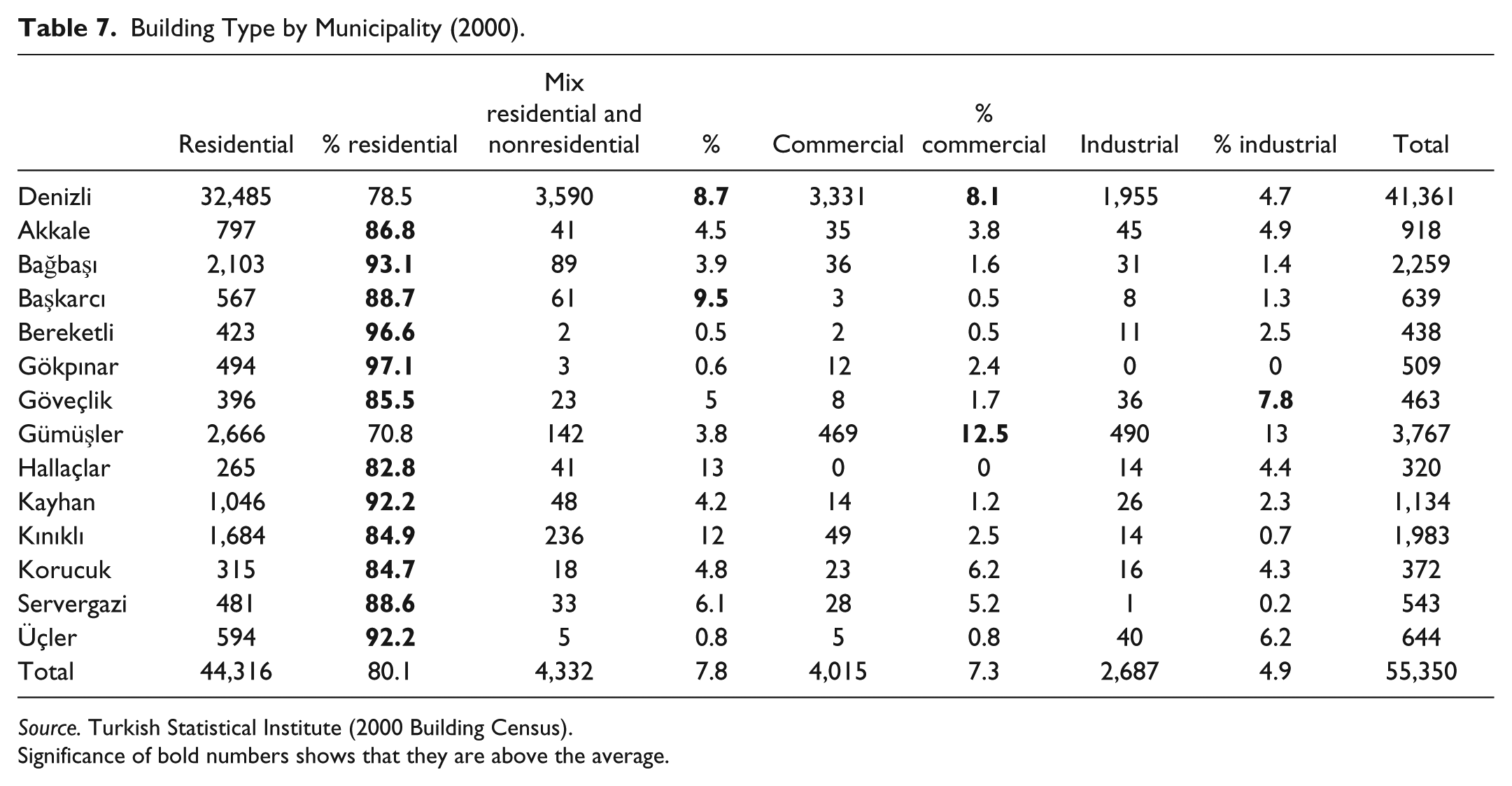
Source. Turkish Statistical Institute (2000 Building Census).
Significance of bold numbers shows that they are above the average.
Politics of Consolidation
Relations Between Local and National Politics
The content and the method of intervention of the central state is the result of interplay between local and national political actors and institutions. Therefore, investigating the actions of all parties can offer invaluable contributions to understanding this relation.
How local politics transmits its desire to national politics, how central government responds to that desire, and the reactions of national and local actors (proponents and opponents) to political outcomes are the main headings under which the relation between local and national politics can be analyzed (Table 8).
Relations Between Local and National Politics.
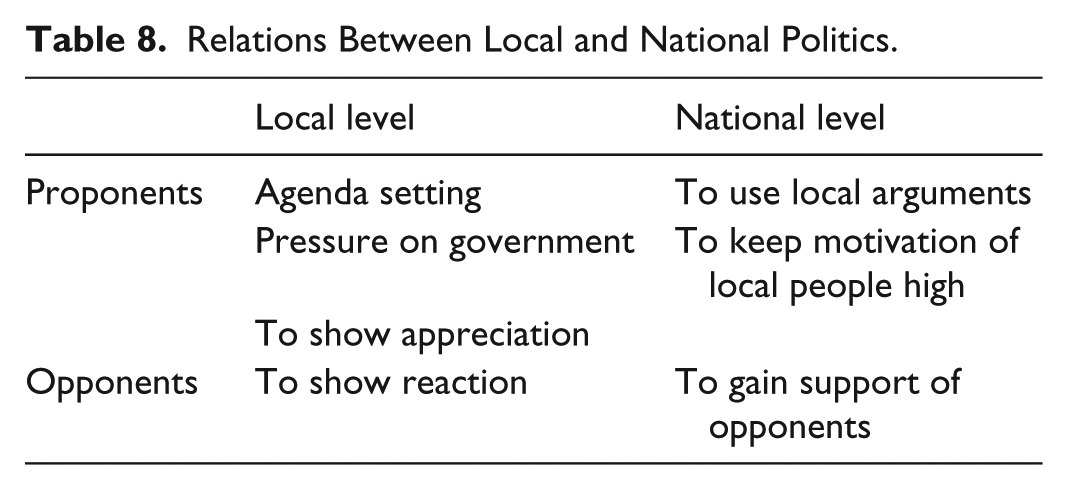
Local desire and reactions
Agenda setting
The efforts for agenda setting are the first step that local actors take to reach the desired end. Although there has been a continuous struggle to be a metropolitan municipality since 1993, Denizli was unable to succeed in this. The so-called “Denizli Integrated-City Law” (law no. 5026), under which 22 municipalities and 25 villages would be annexed to Denizli Municipality, was enacted on December 21, 2003, but the President of the Republic rejected this law because he found it unconstitutional. The decision to consolidate surrounding municipalities to Denizli Municipality was made in August 2006; however, the signs of efforts to put this issue on the government’s agenda began to appear in mid-2005.
Müjdat Keçeci
1
(ex-president of the Denizli Chamber of Industry) said that “We should prepare a well-documented report to attract Turkey’s attention. We should prepare this document with a consensus so that we can have the Denizli Integrated-city Law adopted and come back from Ankara.”
Similarly, Mehmet Yücel
2
(ex-president of the Denizli Chamber of Trade) noted that “We should start a campaign for the Denizli Integrated-city Law. We bring this topic up because remedies to Denizli’s problems lie in that law. We should agree on this and show our determination. We have a chance to get a law special to Denizli adopted, and therefore, we should derive benefit from it.”
Nihat Zeybekçi
3
(ex-mayor of Denizli Municipality from AKP) stated that “We all should do our best to make Denizli an integrated-city. Thus, we can put the topic into the agenda of the national assembly and get results quickly.”
Interviewee 19 says that “I conducted a study on establishing a greater municipality in Denizli. This study was based on the establishment of three or four districts in the Denizli urban area. I conducted this study in 2005 and presented it to everyone, including Denizli MPs, the Governor of Denizli, the Prime Minister, etc. This study was brought to parliament by my brother (he was a Denizli MP at that time).”
Agenda setting is the first step of the process to achieve the desired end. Then, pressure on the government begins to attract a response from the government.
Pressure on the central government
In addition to the efforts to set the agenda, the effort to create pressure on the central government started at the same time, in mid-2005.
Şahin Tin
4
(ex–Denizli Provincial Chairman of AKP) said that “The Denizli Integrated-city Law should be put on the agenda of parliament again. This is one of the problems expressed in the files given to the Ministry of State during their visit to Denizli.”
The Platform of Industrialist, Traders and Businessmen of Denizli
5
declared, after one of its meetings, that “The government and MPs have a historical mission to stop this tendency. A legal regulation is an unavoidable action for the problems of Denizli. The platform states that the law known as the integrated-city law, which consolidates some municipalities and villages to Denizli Municipality, should be revised and enacted again. The platform deserves the support of the central government and the national parliament because the legislation enables the provision of services in an integrated fashion. We hope that the central government and the national parliament will not let Denizli decline.”
Pressure on the government is the second step of the process. The pressure strategy can include both threatening and convincing statements at the same time. According to the central government’s actions, there are two options: People can appreciate it or react negatively.
Appreciation
After the decision to consolidate was made in August 2008, local proponents of consolidation started to show their appreciation for this decision.
Nihat Zeybekçi
6
(ex-mayor of Denizli Municipality from AKP) said that “The decision is a long step in the direction of becoming a metropolitan municipality . . . The Prime Minister and the central government have kept their promise as usual. Denizli gets what it deserves. The fragmented structure of Denizli has come to an end.”
Nihat Zeybekçi
7
(ex-mayor of Denizli Municipality from AKP) spoke to the Prime Minister in a meeting and said that “We know that you have added the related section of the text on the law (law no. 5393) for Denizli. We thank you so much. If you give us a chance to be a metropolitan municipality or give us the opportunities of a metropolitan municipality, we can make Denizli like Zurich.”
Local political actors, whose desire had been accomplished, began to thank national political actors for their positive response to their desires.
Negative reaction
Of course, there were people at the local level who were disappointed with the outcome of the central government’s action. However, these people accused other local actors rather than the central government.
Zekeria Öz
8
(ex-spokesman of mayors and village headmen summit/ex-mayor of Akkale Municipality from MHP) accused the MPs from Denizli of inaction on the law (law no. 5393): “If the Denizli MPs from AKP have power to enact a law, they should make Denizli a metropolitan municipality.”
Interviewee 21 argues that “Some of the municipalities from AKP acted stupidly and did not go to court. If they had gone to court, they would have saved their jurisdictional identity.”
Interviewee 12 complains that “We defend the establishment of a metropolitan municipality based on establishment of three or four districts around Denizli Municipality. The integrity of planning practice will thereby be accomplished and local services will be provided collectivelly. However, population limits have created obstacles. Denizli was rejected due to its population. It has a population of over 500,000, but at that time, the minimum population limit for metropolitan municipalities was increased to 750,000. I relate this issue to the weakness of our MPs. Denizli could not succeed in sending its powerful and influential representatives to the national parliament . . . Politicians from Denizli could not lobby in Ankara. Consequently, the bill submitted to Parliament to create Denizli Greater Municipality became out of date. There is a single party in power, AKP. It is argued that Nihat Zeybekçi (Ex-Mayor of Denizli Municipality) is a close friend of Tayyip Erdoğan (Ex-Prime Minister). Consequently, it is argued that Denizli will get whatever it deserves. However, Denizli has lost this time rather than getting what it deserves. Although there has been a continuous dream of being a metropolitan municipality since the 1990s, this government has ended this dream by the decision to consolidate surrounding municipalities to Denizli Municipality.”
Interviewee 18 demonstrated his negative reaction in a different way: “Although I know that it is illegal, I approve every warrant (building permit, water subscription, etc.) that people request from our municipality because I know that these procedures will be difficult after consolidation. I do this in order to help people. The mayor could not put himself at risk, and he went on holiday. For that reason, I am the responsible person in the municipality now, and I am settling people’s affairs because it is more expensive in Denizli Municipality to get a permit for a water subscription.”
People who see the consolidation decision as the wrong one show their negative reactions to the consolidation decision by targeting other local actors for their ineffectiveness.
National responses
Using local arguments
The central government has used the arguments of the local actors as a means of legitimizing the so-called Denizli Integrated-City Law (law no. 5026). In the legislation process,
9
it was argued that “Ali Aydoğan (Ex-Mayor of Denizli Municipality) says in a report that the municipalities around Denizli Municipality should be annexed to Denizli Municipality due to deficiencies and general problems, including earthquake, air pollution, garbage collection, etc. There are two topics discussed in the meetings with NGOs during the visit of the Prime Minister to Denizli. The first one is the ring road. The second one is that the municipalities surrounding Denizli Municipality hinder the development of Denizli Municipality. Therefore, all of them should be consolidated to Denizli Municipality.”
The government tried to rationalize its decision by referring to arguments of local actors who desired that government action.
Keeping the motivation of local people high
As stated previously, the President of the Republic rejected the law (law no. 5026) because he found it unconstitutional. After the President’s decision, Denizli MPs from the ruling party tried to stop the emergence of any disappointment among local actors and to motivate them again.
Mehmet Yüksektepe
10
(ex-Denizli MP from AKP) said that “The return of the law by the President of the Republic is the end, for the moment. However, we will not discard this law. We will follow up the matter in the next legislative period.”
To stop any disappointment among local people and to maintain their respect after a failure of their attempts, local political actors from the government side tried to motivate people once more. Otherwise, they would lose their popularity among local constituents.
Gaining the support of opponents
The opposition party also provided a message to local actors. It tried to gain the support of opponents of consolidation by constructing a discourse based on their views. During the legislation of the Integrated-City Law
11
(law no. 5026), the Denizli MPs from the opposition party said that “It is true that mayors of these consolidated municipalities did not join the AKP and remained in their own political parties. Therefore, they are being punished by ending their municipalities’ legal identity.”
The opposition party tried to motivate people who were negatively affected to obtain their support against the government.
Relations Between Political Actors
The relations between local and national political actors are particularly important in shaping policies. According to the extent of these relations, government can choose to respond to local demands or not to do so. In addition to that, the content of the responses can change. In the case of Denizli, the old regulation, including annexation of 22 municipalities and 25 villages, could have been revived, or the central government could have enacted a special law as before to establish a metropolitan municipality in Denizli. However, the central government chose none of these options, instead preferring a different regulation including consolidation of 13 municipalities and 10 villages to Denizli.
The relations between political actors can be analyzed as
a struggle between political elites,
a struggle between provinces, and
a clientelist relation.
Struggle between political elites
The efforts to establish a metropolitan municipality in Denizli became a political struggle between powerful local political actors. These political actors have taken positions in national politics according to their local interests.
Interviewee 1 says that “I was in conflict with the Prime Minister (Tayyip Erdoğan) because I thought that instead of the Integrated-city Law (law no. 5026) regulating consolidation of twenty-two municipalities and twenty-five villages to Denizli Municipality, which was rejected by the President of the Republic as unconstitutional, a metropolitan municipality system based on establishment of three district municipalities was a better solution for Denizli. When I insisted on my project, the Prime Minister (Tayyip Erdoğan) berated me. But I did not act on this issue due to party discipline, because the Prime Minister’s word is the final word in the AKP.”
Interviewee 19 argues that “The bill establishing a metropolitan municipality in Denizli, proposed by my brother, became out of date in Parliament. One of the reasons behind this is that Nihat Zeybekçi (Ex-Mayor of Denizli Municipality) did not support this bill because I prepared the bill, and if this bill was enacted by Parliament, the political popularity of this legislation would benefit me. Therefore, I would be the candidate from AKP for the mayoralty of Denizli Municipality in the next election. Nihat Zeybekçi saw the political risk and prevented the emergence of support for the bill in the AKP. It was a betrayal. Denizli lost a big opportunity.”
Interviewee 12 states that “Nihat Zeybekçi (Ex-Mayor of Denizli Municipality) prevented the deputyship of Mehmet Yüksektepe again (Ex-Denizli MP from AKP), because Mehmet Yüksektepe criticized the integrated-city model and insisted on a metropolitan municipality model. Ümmet Kandoğan (Ex-Denizli MP from AKP) criticized Nihat Zeybekçi (Ex-Mayor of Denizli Municipality) because he constructed underground passages for roads before the construction of the ring-road. Because of this, Nihat Zeybekçi also prevented the deputyship of Ümmet Kandoğan again.”
It could, thus, be argued that some public issues can be a topic of competition or struggle between local elites. Although consolidation of municipalities is a public issue, political actors use this for personal political interests by enabling or disabling the process.
Struggle between provinces
Establishment of a metropolitan municipality is not only a local phenomenon, because other metropolitan municipalities will be directly affected by this decision. Therefore, other metropolitan municipalities took a position against Denizli based on their own interests on the national political level.
Interviewee 19 notes that “The bill establishing a metropolitan municipality in Denizli became out of date in Parliament. The second reason was the resistance of existing metropolitan municipalities, because if Denizli became a greater municipality, the amount of money that is dedicated to metropolitan municipalities would be divided into more pieces. Therefore, the share of other metropolitan municipalities would shrink.”
Interviewee 3 argues that “I heard that there is a serious lobby against the establishment of a new metropolitan municipality in Parliament because establishment of a new metropolitan municipality will result in a decrease in shares of other greater municipalities due to dividing the cake into more pieces.”
Other localities arguably take positions in national politics based on the nature of the issues that occur in other localities. Competition among localities is a primary reason for this type of scrutiny between localities.
Clientelist relations
It is argued that the relation between Nihat Zeybekçi (ex-mayor of Denizli Municipality) and Tayyip Erdoğan (ex–prime minister) had determining effects on the fate of Denizli.
Interviewee 14 states that “Due to the close relation between Nihat Zeybekçi (Ex-Mayor of Denizli Municipality) and Tayyip Erdoğan (Ex-Prime Minister), a statement was added to municipality law that the authority for any kind of planning practice was taken away from consolidated municipalities until the next local election, when consolidation would be put into practice.”
Similarly, Interviewee 5 emphasizes that “Nihat Zeybekçi (Ex-mayor of Denizli Municipality) informed the government, and planning authority of surrounding municipalities was restricted until the next election.”
Interviewee 20 says that “Of course, personal relations make communication easier; therefore, the problems of Denizli can be easily explained to the Prime Minister.”
The content of the relation between local and national political actors can have direct effects on policy outcomes. The relation between Nihat Zeybekçi (ex-mayor of Denizli Municipality) and Tayyip Erdoğan (ex–prime minister) is arguably a determining factor in the consolidation of surrounding municipalities to Denizli Municipality. However, it is important to remember that actors act within in a web of relations, and, therefore, they have to consider the effects of their actions on the whole web. In other words, actors try to maintain balance in their relations. This prohibits them from acting completely in favor of someone or something by neglecting other individuals or things.
Attitudes of Actors
Local actors can show different attitudes before, during, and after the annexation process due to their different interests. These attitudes can be grouped into affirming, denouncing, neutralizing, repositioning, persuading, rent-seeking, hopeful, anxious, and conflicting behaviors.
Affirmative behavior
By using affirmative behavior, political actors attempted to increase the legitimacy of the consolidation process. They tried to show that there is a common interest in the annexation of municipalities.
Nihat Zeybekçi
12
(ex-mayor of Denizli Municipality) attempted to say that he had no personal interest in consolidating surrounding municipalities to Denizli Municipality: “The problem of being an integratedcity cannot be seen as a personal problem of Nihat Zeybekçi. This is the problem of Denizli. For that reason, I expect that all important non-governmental organizations will support the Integrated-city Law (law no. 5026).”
During the legislation process of the Denizli Integrated-City Law (law no. 5026), 13 MPs supporting the legislation argued that MPs had no personal interests in annexing surrounding municipalities to Denizli Municipality.
“This is not a personal idea of MPs from Denizli. The issue of making a united spatial development plan of Denizli Municipality and the surrounding municipalities has been discussed in several different local meetings. We, as all the MPs from Denizli, came together then after the President of Pamukkale University joined us. We studied on a map of Denizli and agreed on where the boundaries of Denizli Municipality should be drawn. Then, we got an appointment with the General Directory of Local Governments in Ministry of Internal Affairs. We explained our ideas about Denizli to them, and then we asked for their technical support. They submitted their studies, and we carried that study to the agenda of the National Assembly. However, MPs from Republican People’s Party (CHP- the opposition party) withdrew their support later. This is the story of the proposal.”
Interviewee 32 says that “Mayors and other heads of villages went to protest about the consolidation decision, but I did not. I congratulated Nihat Zeybekçi (Ex-Mayor of Denizli Municipality). We had wanted to be a municipality. But what is the end of this process? You want to be a municipality first and then you desire to be a district and then a province. There is no end to this process . . . Mayors react to the consolidation decision because they have lost every authority they had until now. A person thinks of his own interests first, then his political party’s interests, and then public interests.”
Political actors tried to legitimize the annexation of municipalities with different types of arguments. Some attempted to show that there was no personal interest involved in the annexation; some noted that annexation would create positive developments in their daily life; some stated that some negative consequences of annexation in the short run can be accepted because it would cause improvements in the long run.
Denouncing behavior
By taking a denouncing attitude toward annexation, political actors tried to absolve themselves from the responsibility of the negative consequences of annexation. In doing so, the hope was that they would not be faced with any reactionary response from people living in consolidated municipalities.
During the legislation process of the Denizli Integrated-City Law (5026),
14
MPs opposing the legislation argued that “It is wrong to say that MPs from CHP (the opposition party) understand the proposal of Integrated-city Law to decrease the reactions to it. The participation of the President of Pamukkale University does not show that the content of the regulation is scientific. The President of Pamukkale University has participated in these activities due to his good intent. The AKP has used his name to legitimize this regulation. According to previous law (law no. 5025), we ended the juristic identity of twenty-eight municipalities. Now, we have ended the juristic identity of another twenty-two municipalities. It is a misfortune that there are signatures of MPs from Denizli on these two laws. If the AKP’s MPs from Denizli have power to make a law as such, why did they not make the Denizli Municipality a metropolitan municipality?”
Interviewee 6 says that “Denizli can be a metropolitan municipality with a special law; however, MPs from Denizli were stranded in this issue. They could not put pressure on the government regarding this. They could only accomplish the legislation of integrated-city law (law no. 5026).”
Interviewee 11 argues that “When we consider the power behind the mayor (Nihat Zeybekçi), he could have made Denizli a metropolitan municipality.”
If annexation is considered as a failure, by employing denouncing behavior, political actors tried to shift the responsibility of this failure to other actors.
Neutralizing behavior
By neutralizing the consolidation process, political actors tried to decrease the political tension resulting from the annexation decision. Consequently, they would lose nothing individually at the end of the consolidation process; whereas if they entered into any political conflict with the other party, they would carry the risk of losing any material or moral assets.
Interviewee 24 notes that “How you can object to a decision that is given by a shared decree? We were established with a shared decree in 1998, and we will be consolidated according to a shared decree. When you are established it is good, when you are consolidated it is bad.”
Interviewee 16 argues that “If we examine things through Denizli Municipality’s point of view, it says that “I am surrounded by municipalities and could not grow. I want to construct a ring-road but am faced with problems. I could not do whatever I like, these municipalities encumber me.” If we examine things through our point of view, consolidation is an undesirable thing. However, it is a legal arrangement; therefore there is nothing to be done.”
Some of the political actors tried to legitimize the process of consolidation or consequences of consolidation by making reference to its legal aspects and to neutralize it or its political content.
Repositioning behavior
Some of the political actors tried to clarify their own position in the consolidation process. Some of them attempted to place themselves in another position during the discussions; some of them attempted to calculate the possible outcomes and then to provide alternatives for each.
Gazi Şimşek
15
(ex-governor of Denizli) tried to place himself in another position regarding the consolidation process in Denizli: “I support the legislation. However, my support became an object of political debate. Therefore, I preferred to stand in the background. Actually, everybody wants Denizli be an integrated-city, but just to create opposition, my support was made the subject of political debate.”
Interviewee 23 says that “There are problems in service provision. We cannot provide services without the help of Denizli Municipality. Nihat Zeybekçi (Ex-Mayor of Denizli Municipality from AKP) helps us as much as possible. There are many contributions by Nihat Zeybekçi, he has big projects and makes great efforts . . . . Our municipality will not be consolidated to Denizli Municipality. But Nihat Zeybekçi has not treated us like a step-child in providing services. When we ask for help, he always helps us. Although I was selected from DYP, I am a mayor from AKP now. If I am elected as mayor again, I hope I can provide services with the help of Denizli Municipality. If a party other than AKP wins the election in our municipality, services are not provided here. To whom will the mayor of our municipality ask for any help? However, if the candidate from AKP wins the election, services will be provided here because the mayor of Denizli Municipality will help. I will invite Nihat Zeybekçi, and I will get a promise from him about Denizli Municipality’s help.”
Some political actors tried to take another position in the overall picture by moving from an active role to a passive one, or by moving from an opposing to supporting role in consolidation discussions. Individual interests are the main motivating factors behind these repositionings.
Persuading behavior
Persuasive attitudes are generally shown by political actors before the conflict with opponent parties begin. The main aim is to persuade the other party that consolidation will be beneficial, or that the municipality can recover from the negative effects of annexation.
In Denizli, Denizli Municipality’s attitudes about the benefits of consolidation started even prior to consolidation by helping villages that would be consolidated to Denizli Municipality.
Interviewee 31 argues that he is confused because, although Denizli Municipality has no responsibility to provide services to villages, it has started to do it.
“Some municipal services have been provided prior to consolidation taking place. I do not know the aim of this service provision.”
Interviewee 32 says that “Denizli Municipality has covered the roads with asphalt. I paid 1000 TL for mosquito elimination two years ago. Last year, I asked Nihat Zeybekçi (Ex-Mayor of Denizli Municipality) to eliminate mosquitoes this spring; therefore, we had no problem this summer. Denizli Municipality provides services that a head of a village can never provide. It has covered the garden of the school and market place with asphalt. It has constructed a bridge.”
Persuasive behavior by political actors is based on gifts. In particular, consolidating regions give gifts to consolidated regions to persuade them of the positive gains that will result from consolidation.
Rent-seeking behavior
Some local actors see the annexation as a source of rent. It is argued that after the preparation of spatial development plans by Denizli Municipality, the rent levels of settlements will increase, depending on the construction permit given to particular areas.
Interviewee 28 notes that “We did not reject the help of Denizli Municipality. It has constructed the ring-road. We did not object to the construction of the ring-road because it will enable spatial development plans later, and the rents will increase.”
Interviewee 23 hopes that “If some areas are open to urban development, people will come and build houses. Therefore, the revenues of municipalities will increase. After the next election, Denizli Municipality can change the spatial development plan to open some agricultural areas in just the upper side of settlements for urban development.”
Some political actors see the consolidation as a rent-generating activity, but they know that it depends on the attitude of Denizli Municipality. In other words, if Denizli Municipality removes some restrictions on planning permissions or gives planning permission to areas that were outside of existing development areas, consolidation will bring about increased rents.
Hopeful behavior
Some local actors think that there will be no serious problems after annexation, or that consolidation will bring positive consequences.
Interviewee 6 notes that “I do not think that there will be many problems. There could be some problems in the first three or four months, especially in garbage collection, later everything will get back on the rails.”
Interviewee 32 argues that “Village means poverty. Municipality means the state and power. There is no money in villages. We do not know the consequences of this process, but we have no trouble now.”
Interviewee 7 emphasizes that “I think that annexation of municipalities will be good for urban development, economic development, infrastructure, and the purpose of being a metropolitan municipality. I believe that annexation will have positive consequences. At least there will be a transformation from rural culture to urban culture in the villages that will be consolidated to Denizli Municipality. Even if they continue to deal with husbandry, they will conduct this in a more modernized way. As a consequence of this modernization, people will earn much more money than before. Furthermore, due to using more rentable areas, their income level will also increase. Not only in terms of urbanization but also in terms of economic development, consolidation will contribute to people.”
Interviewee 23 implies that “Denizli has no area to grow. However, it will grow after consolidation. It will make big investments. We heard that a new hospital will be constructed. There is no space in Denizli Municipality. I hope that Denizli Municipality will develop the surrounding municipalities with the help of the Prime Minister. Denizli Municipality has a great power behind it. If you have power behind you, you can do whatever you like. A new infrastructure improvement plan has been started. I believe in Denizli Municipality and the Mayor. The mayor keeps his word.”
Interviewee 3 says that “There will be difficulties in the transitional stage, but I believe that this will be overcome because Denizli Municipality has a developed capacity and a tradition in municipal works. Tradition is important in public institutions. Denizli Municipality will have not any problems in the number of ordinary staff, but may have in skilled staff. However, the number of technical staff can easily be increased by employing new staff.”
There are hopeful expectations among a number of political actors that although there could be problems at the beginning, at the later stages, everything will turn out well. Consolidation will result in positive consequences for all citizens.
Anxious behavior
In particular, some villagers worry about the effects of consolidation on their life. They think that after consolidation, they will be forced to live according to the rules of urban life, and due to these rules, their income-generating activities will be restricted.
Interviewee 29 argues that “To enforce villagers to live according to the rules of urban life could have negative effects on them . . . To survive is difficult here. People cannot afford to pay water costs even though they are relatively cheap. People worry that municipal police will prevent husbandry activities . . . Villagers stand on their own legs, [and they ask] why do they intervene in our life.”
Interviewee 30 states that “The effects of annexation will be negative. It will create problems in every issue, such as construction permits, husbandry, livestock fattening, and chicken farming. It will be very negative. Agricultural activities will be precluded. We want the old system.”
Some villagers are anxious about their lifestyle. They believe that Denizli Municipality will inhibit their agricultural activities. Some villagers said that Denizli Municipality will prevent them from selling their products in Denizli Municipality in the so-called “villager bazaars.” Therefore, they are hesitant about Denizli Municipality.
Conclusion
Marando (1974) argues that metropolitan reorganization, where accepted, has been influenced more by political conditions than the objective of a metropolitan-wide approach to metropolitan-wide problems. Similarly, Rosenbaum and Henderson (1973) note that the ACIR warns urban reformers not to deal so much with the technical and administrative details of consolidation proposals that they pay no attention to the play of vested interests that might determine the outcome of a consolidation process.
In the case of Denizli, there are three points that should be focused on: the relation between national and local politics, the attitudes of political actors about annexation, and the relation between political actors. To scrutinize these issues, the article sheds light on the dynamics of annexation from the point of view of its political aspects.
In terms of the relation between national and local politics, agenda setting and pressure on government about the consolidation of municipalities are the first two steps. When the annexation decision is made, people who support the annexation of municipalities appreciate the government or national actors for their efforts. However, people who oppose annexation demonstrate their negative reaction to other local actors that support the annexation because they can do nothing about the national process, as it is out of their domain. These things occur at the local level. In addition to two opponent sides among local actors, supporting and opposing sides, there are also two sides among national actors. Supporting and opposing national actors use the discourses of supporting and opposing local actors to rationalize their arguments. When the supporting national actors fail in accomplishing annexation decisions, they try to motivate the supporting local actors again; when opponent national actors fail in stopping annexation decisions, they accuse their counterparts, other national actors that support the annexation, to gain the support of local opponents.
When we consider the attitudes of local actors, we observe a wide range of attitudes among local actors, including affirmative, denouncing, neutralizing, relocating, persuasive, rent seeking, hopeful, and anxious. The aim of affirmative behavior is to legitimize the annexation process. By demonstrating critical attitudes toward annexation, political actors try to absolve themselves from the responsibility of annexation. When political actors attempt to decrease the political tension between opposing parties, they neutralize the process. If an actor is unhappy with his or her position regarding a discussion, he tries to clarify his or her position or relocates himself within the framework. Persuasive attitudes are generally shown by political actors after the conflict between opponent parties begins. Some actors behave as rent seekers in the annexation process because they see annexation as a rent-generating activity for their party. Some local actors are more hopeful than others because they think that there will be no serious problems after annexation, or that annexation will bring positive consequences. In particular, some villagers see annexation as a threatening factor for their lifestyle, and they are anxious about that. They think that municipalities will hinder the agricultural activities upon which their life depends.
Unwillingness for annexation results from economic and political factors. In terms of economic factors, if the benefit of annexation is lower than cost of annexation, reluctance against annexation emerges. Similar to the economic dimension, if the political cost of annexation is greater than the political benefits of annexation, there will be opposition to it.
In terms of relations between political actors, first, it can be concluded that some local public issues are topics of political struggle among urban elites. Every political actor wants to use this public issue to maximize his or her interests. Second, it can be stated that each individual locality takes a position at the national level by considering the aims of other individual local units. In particular, competition between localities is a determining factor in this position taking. If localities detect any risk in other localities’ attempts, they will begin to protect themselves by using their local actors on the national scene. Third, it can be concluded that a strong relation between a particular local political actor and a particular national political actor can be influential factors, both on attitudes of other local and national political actors.
To reiterate, political actors define the best way of solution for any particular problem according to their subjective position in the field. However, choices are defined according to available options.
Both negative and positive thinkers about prospective events make predictions on the basis of possible attitudes of the central government, rather than on their own action plans.
As with the emergence of fragmented structure due to the establishment of municipalities, local actors take positions on the consolidation of municipalities according to their short-term interests. For example, as in the case of Denizli, a politician who has taken a position in favor of establishing new municipalities when he is not in power in the central municipality may become a leading proponent of annexing municipalities when he is in power.
In sum, first of all, the policy of municipal annexation is generally applied in provincial centers. These areas are usually where economic, social, and cultural activities are concentrated, and due to these concentrations, urban rents increase. Second, the mayors of all municipalities whose surrounding municipalities will be annexed are from the political parties that are in power. Third, according to the last local election results, after annexation, hypothetically, there is no risk of losing elections because the sum of total votes that the political party in power will receive is sufficient to maintain power. Fourth, it is well known that the technical reasons argued for annexation in these municipalities are also valid for other settlements. However, although the political party in power has mayors in these other settlements, there is the risk of losing power after annexation. Therefore, it cannot be argued that political power intends to solve technical problems that emerge in politically fragmented urban areas. Instead, it can be concluded that the main aim of municipal annexation is to make local agents dominant over a wider area. Therefore, the potential area for manipulation is enlarged because all the planning authority becomes concentrated in one hand. The case of Denizli is a typical example of accomplishing this aim.
Footnotes
Declaration of Conflicting Interests
The author(s) declared no potential conflicts of interest with respect to the research, authorship, and/or publication of this article.
Funding
The author(s) received no financial support for the research, authorship, and/or publication of this article.