



Abstract
Teachers continuously make numerous judgments and engage with various educational stakeholders, whose perspectives are eventually integrated into their judgments. Given the differing viewpoints of these stakeholders, one may ask how receptive teachers are to diverse perspectives. In the present study, a German adaption of the Minson's Receptiveness to Opposing Views scale for German-speaking teachers and non-teachers was introduced as the first German instrument for cross-cultural comparisons. To evaluate the scale, a cross-cultural comparison was conducted (358 US and German teachers). After the validity and reliability of the German version of the Receptiveness to Opposing Views scale were confirmed, English- and German-speaking teachers significant differences between their overall scale results and their results for the subscales of Intellectual Curiosity, Derogation of Opponents, and Taboo Issues were found. A research agenda and its implications for practice, teacher development, and education is presented.
Plain Language Summary
This present study examines how receptive teachers are to different perspectives by adapting the Receptiveness to Opposing Views scale for German-speaking teachers for a cross-cultural comparison. The adapted-scale results of samples of German-speaking teachers and non-teachers were compared to the original-scale results of a sample of US teachers to assess the adapted scale’s reliability. The findings confirm the validity of the adapted scale. Through a cross-cultural comparison, notable differences between English- and German-speaking teachers in areas such as intellectual curiosity, attitudes toward opposing views, and sensitivity to taboo topics were revealed. This article concludes with recommendations for future research and discusses how the study’s findings can inform teacher development and educational practices.
Introduction
Teachers make many judgments during their work days, not only in emerging crisis, such as the COVID-19 pandemic (Lepp et al., 2021). For example, teachers assess students’ competence and motivation and adapt their teaching to improve student learning. They also determine whether any learning progress has been achieved by the changes made in the classroom. To improve teachers’ judgments, the help from and collaboration with different stakeholders in education systems are needed (Kaufmann, 2023; Krolak-Schwerdt et al., 2018; Lai et al., 2025; Shavelson, 1973; Vanlommel et al., 2017). Thus, contemporary schools are striving to become learning organizations (Schön & Argyris, 1996) that emphasize the critical role of collaboration in fostering school development (Schildkamp, 2019), with an overreaching goal of improving student learning.
Needless to say, teachers’ collaboration has the potential to influence the accuracy of teachers’ judgments and students’ achievement (Ronfeldt et al., 2015). However, judgments are often biased (Tversky & Kahneman, 1974), as are teachers (Bonefeld & Dickhäuser, 2018; Dickert & Glock, 2025; Dünnebier et al., 2009; Fiedler et al., 2002; Glock & Kleen, 2023; Glock & Krolak-Schwerdt, 2013; Glock et al., 2013; Strahl et al., 2025; Yendell et al., 2024). Inaccurate judgments warrant attention because they can contribute to social inequality among students. Therefore, judgment and decision-making are essential professional core competencies for teachers and foundational teaching skills (Shavelson, 1973). Thus, they are integral components of teacher education programs, such as in Germany (KMK [Sekretariat der Staändigen Konferenz der Kultusminister der Laänder in der Bundesrepublik Deutschland], 2004).
Due to its importance, several reviews have summarized teachers’ judgment accuracy in various aspects, such as academic achievement (Kaufmann, 2023, 2024; Südkamp et al., 2012), cognitive abilities (Machts et al., 2016), and creativity (Garlewski & Karwowski, 2018) or intelligence (Baudson et al., 2016). There are also reviews that compare these different meta-analyses (Urhahne & Wijnia, 2021). The different overviews show that there is still room to improve teachers’ judgment accuracy.
In general, there are many other factors that influence teachers’ judgments. The lens model framework (Brunswik, 1956; Kaufmann, 2024) summarizes the factors influencing judgment. Based on the lens model framework, the following determinants of teachers’ judgments were identified: teachers and their characteristics (e.g., teaching experience and age), the information available to teachers based on which they can make judgments, such as students’ performance and characteristics (e.g., gender and socioeconomic status), and the evaluation criteria used to assess the accuracy of teachers’ judgments (e.g., teste and opinion of another teacher).
However, in a broader sense, teachers’ judgments are also influenced by cultural factors. For example, Yates et al. (1998) revealed cross-cultural variations in judgment accuracy. There are also cultural differences in learning and teaching (Hofstede, 1986) because teachers and students are embedded within different school systems (see Fend, 2006, for a classification of different school systems or Tatto et al., 2009).
Collaboration to Reduce and Reveal Potential Bias
To enhance the accuracy of teachers’ and other experts’ judgments and to mitigate potential biases, they must scrutinize their judgments and perspectives to identify any inherent biases. Collaboration with other professionals, such as school psychologists, can assist teachers in reducing bias in their judgments. For example, school psychologists demonstrate less bias than teachers regarding students’ migrant backgrounds, as they tend to approach assessments in a more culturally neutral manner (Lanfranchi, 2016). Therefore, being open to opposing views is essential for teachers to assess their judgments effectively and potentially mitigate bias. According to Minson et al. (2020), biases occur at three major stages of information processing: (a) information seeking, (b) information attention, and (c) information evaluation, which co-vary as a function of an individual’s level of receptiveness (Minson & Chen, 2022). They define receptiveness to opposing views as a willingness to access, consider, and evaluate opposing views in an impartial manner and consider these three main information processing stages in this definition. Higher receptiveness to opposing views means less biased information processing, or many cognitive biases stem from a common source: lack of receptiveness (Minson & Chen, 2022). The goal of receptiveness is not to change minds but to check the information process.
Although accepting another point of view is required to productively collaborate and free the information process from bias, it is currently unknown whether teachers’ acceptance of opposing views is given and whether teachers who need to collaborate in their daily business are more prone to greater acceptance of opposing views than non-teachers. As we outlined, a cross-cultural comparison is needed to reveal teachers’ receptiveness to opposing views due to the factors influencing teachers’ judgments. An instrument measuring the acceptance of opposing views has already been successfully developed and evaluated for English-speaking countries, but there is currently no similar instrument for German-speaking countries (e.g., Germany, Switzerland, Austria, Luxembourg and Liechtenstein). Such an instrument is needed for a cross-cultural comparison. In the present study, we translated and evaluated the original English instrument of measuring the acceptance of opposing views developed by Minson et al. (2020) and adapted it to German-speaking countries. We used a teacher sample to evaluate the adapted instrument, providing an evaluated tool for research projects within education science addressing the need to measure teachers’ acceptance of opposing views. To check the validity of the scale, different comparisons were made, beginning with comparison of teachers from different countries. A teacher sample from the United States was used to make it comparable with the US sample used by Minson et al. (2020) to develop the scale and provide information.
First, the evaluation determined whether the Receptiveness to Opposing Views scale also works with a specific group of teachers.
Second, a comparison was made between the US teacher sample and the German-speaking teachers to determine whether scale applied to the latter.
Finally, a German-speaking non-teacher sample was also considered to reveal any differences between teachers and non-teachers in terms of receptiveness to opposing views.
Overall, the German-speaking teachers’ opposing views scale adaption was compared with that of the US teacher sample or the German non-teacher sample to examine the specificity of either speaking in German or being part of a teacher sample as a cross-cultural comparison.
In sum, the overall goal of the present study was to provide a reliable and valid adaption of the original Receptiveness to Opposing Views scale developed by Minson et al. (2020) for German-speaking teachers. The study was also a first step toward the application of the Receptiveness of Opposing Views instrument to a German-speaking non-teacher sample in future research because it also verified the validity of the adapted instrument with a non-teacher sample.
Test Instrument
The self-reporting scale for accepting opposing views consists of a set of 18 items developed by Minson et al. (2020) (Figure 1 in the Supplemental Appendix). Readers interested in the development of the scale may refer to Minson et al. (2020). In this article, we highlight our adaption of the scale to the German context. In the German version of the original scale also consisted of 18 items. These 18 items were statements that participants needed to evaluate on a seven-point Likert scale, ranging from Strongly Disagree (1) to Strongly Agree (7). Six of the items were reverse coded. Moreover, the 18 items are categorized into four factors: (a) Negative Emotions (four items), (b) Intellectual Curiosity (five items), (c) Derogation of Opponents (five items), and (d) Taboo Issues (four items). Negative Emotions tap emotional reactions to incongruent views (e.g., anger, frustration, and disgust). Intellectual Curiosity reflects the desire for greater insight into and information about others’ beliefs. Derogation of opponents considers the negative beliefs of holders of opposing views (e.g., their intelligence and motives). Taboo Issues capture the belief that some topics are off limits and not subject to debate.
Validity and Reliability Evaluation
The Receptiveness to Opposing Views scale has a high overall scale reliability value (α = .87). Each of the four factors is represented by high reliability values (Negative Emotions: α = .86; Intellectual Curiosity α = .85; Derogation of Opponents: α = .80; Taboo issues: α = .78; see Study 1) (Minson et al., 2020). Prior research has demonstrated the internal, convergent, and discriminant validities of the scale and its predictive validity for the US population (Minson et al., 2020). For example, the application of the scale shows that more receptive individuals were more willing to consume information from US senators representing the opposing party, exhibited less mind wandering when viewing a speaker with which they disagreed, or evaluated supporting and opposing policy arguments more impartially. In addition, more receptive liberal voters were more likely to watch President Trump’s first inaugural address, evaluate the address in a more balanced manner, and consider a more heterogeneous selection of relevant news coverage (Minson et al., 2020). Therefore, the scale predicts behavior in both the lab and the field.
Currently, the scale is applied to English-speaking participants. Therefore, in the following, the original scale to German-speaking participants to obtain a suitable scale for research projects in German-speaking countries is adapted and lays the ground work for any cross-country comparison.
Purpose of the Study
To reveal German-speaking teachers’ receptiveness to opposing views, the original instrument developed for US samples was adapted to German samples and validated in the present study. Below are the overall objectives of the present study.
(1) To investigate the back-to-back translation of the original Receptiveness to Opposing View instrument into German to have an available resource for researchers and for the research community measuring receptiveness to opposing views for international comparison;
(2) To evaluate the validity and reliability of the adapted instrument using a large German-speaking sample and a test in German;
(3) To compare the German version of the Receptiveness to Opposing Views instrument with similar constructs to establish convergent validity.
After evaluating the adapted instrument, we compared different countries, regions (the United States vs. Germany), and professions (teachers vs. non-teachers) to reveal country-specific teachers’ receptiveness to opposing views were compared.
Due to the differences between the US and German teacher education systems (Eberle et al., 2016), we expect German teachers to have higher values on the teachers’ Receptiveness to Opposing Views scale than their US counterparts and German students. There are no expectations of whether US teachers show higher values than German students on the teachers’ Receptiveness to Opposing Views scale.
Methods
Sample
For the instrument evaluation in the present study, we considered four different samples. Overall, there were participants with different professions other than teaching, and the participants were working in different countries. To evaluate the profession and country-independency of the instrument, these two different types of samples—whether the participants were teachers (profession: teachers vs. students) and whether they were located in the United States (country: the United States vs. Germany)—were compared with each other.
All data for our study are available at the Open Science Framework (OSF): https://osf.io/26pfr/?view_only=97ab45a3c1be44058a88b3509b5d01e1
Teachers: US and German
Our teacher data collection procedure was associated with a comprehensive research project (for details, see Kaufmann, 2021; Kaufmann & Budescu, 2020).
Our sample consisted of an international teacher sample considering teachers from the United States and from Germany. 1 First, we compared our sample of 88 US teachers to check if the instrument also applies to teachers because the original instrument was not developed explicitly for teachers. When then checked the instrument using the German teacher sample, consisted of teachers and teacher students (preservice-teachers). Table 1 presents the teacher sample characteristics. Aside from the place where they teach, they were also asked about their teaching level and gender. For the US teachers, a mixed sample of middle and high school teachers were available, with the high school teachers being higher in number. Aside from the US teacher sample, also two German samples were considered. Unfortunately, only in one teacher sample consisting of 163 teachers, teachers’ characteristic information is available. Across countries, we had a bi-national teacher sample of 358 teachers in total.
Teachers’ Characteristics of the Three Different Teacher Samples.

For our subsequent analysis and determination of the sample size, we focused on Minson et al. (2020). Hence, the overall sample of 270 German teachers was comparable to the sample size used by Minson et al. (2020) in their evaluation of the scale development (see Minson et al., 2020, sample size in study 1a and 1b, considering 202 and 205 participants, respectively), demonstrating that the scale possessed an appropriate level of internal, convergent, and discriminant validity for the US sample. Thus, in the following section, the two German teacher samples are collapsed and reported together.
Non-teachers
In addition to the teacher samples, there was also a sample also consisting of 160 German non-teachers. The data for the German-speaking non-teacher sample were collected from students from the University of Konstanz, in Germany, who were recruited using a university-specific tool.
After the dataset preparation, three students were excluded because they answered the seriousness check (Aust et al., 2013; Reips 2002, 2021) negatively (see the next section), resulting in 157 student data. In this sample, information on age (m = 22 years) and gender (84% women) was available.
Adapted Instrument
For our German samples, the original instrument of Receptiveness to Opposing Views is adapted, hence, all 18 items were translated to German, and checked by experts. The original instrument of Receptiveness to Opposing views were adapted to an online version, considering the standards for online measures (Birnbaum, 2004; Reips, 2002, 2021). For example, the high-hurdle technique is applied, which aims to exclude less motivated participants through a higher respondent burden (e.g., longer loading time on the first page of a study). As the data collection procedure was embedded in additional research projects, less motivated participants could leave the survey before answering the questions about receptiveness to opposing views. Thus, the previous questions also served as hurdles to the Receptiveness to Opposing Views instrument.
In addition, a seriousness check was considered in the student survey sample (Aust et al., 2013; Reips 2002, 2021). The original answer format option on a seven-point Likert scale were maintained. The adapted online version is presented in Figure 2 in the Appendix.
Analysis Strategy
Scale Evaluation
For the analyses, we used R (2021) and JASP (2023) software. Before conducting any analyses, we checked the data based on descriptive statistics, and we determined whether there was a systematic dropout in specified items revealing by missing values (see Bosnjak & Tuten, 2001). The items were then scored according to Minson et al. (2020): items 6 to 18 were reverse coded and then averaged to calculate the total receptiveness score. The factors were coded according to Minson et al. (2020) as follows:
Factor 1 (Negative Emotions [NE]) comprises items 15–18 (R15_r, R16_r, R17_r, and R18_r).
Factor 2 (Intellectual Curiosity [IC]) comprises items 1–5 (R1, R2, R3, R4, and R5).
Factor 3 (Derogation of Opponents [DO]) comprises items 6, 7, 8, 13, and 14.
Factor 4 (Taboo Issues [TI]) comprises items 9–12.
The key features of the items and the scale depending on the sample (US vs. German, teachers vs. non-teachers) and country were described. The evaluation criterion of Cronbach’s alpha greater than .7 (Kline, 1993) was used.
To compare our scale evaluation results directly with the results of the original scale developed by Minson et al. (2020), we followed their analysis strategy. Hence, in line with Minson et al. (2020) an exploratory factor analysis with varimax rotation (Kaiser, 1958), assuming four factors, was used to check the construct validity of the scale and the four factors for each subsample. Chi-square (χ2) values, root mean square error of approximation (RMSEA), comparative fit index (CFI), and Tucker–Lewis Index (TLI) were applied to evaluate the model fit. CFI/TLI values of .90 or greater (Bentler, 1990) and RMSEA values less than .08 (Browne & Cudeck, 1993; MacCallum et al., 1996) suggested a good model fit. Items with standardized factor loadings over .40 were considered meaningful loadings (Stevens, 2012). To check the results, the analyses were repeated with an oblique rotation to allow factor correlation.
To evaluate the construct validity, we used in line with Minson et al. (2020), the BigFive Personality Test (Rammstedt & Danner, 2016, see also John, 2021; Schmitt et al., 2007).
Cross-Cultural Comparison
After the test evaluation, the newly developed instrument is used to evaluate whether German teachers reached the expected high values in the Receptiveness to Opposing Views instrument. Finally, group comparison analyses were performed to check for differences due to language (United States vs. German-speaking countries) or profession (teachers vs. non-teachers).
Results
Scale Evaluation
Descriptive Item Values
In this section, the item characteristics for each sample is reported separately before combining them. Table 1 in the Appendix shows the item-dependent descriptive characteristics separated by the samples. There is only a small portion of missing values, with two maximal values for all samples. We found no systematic drop-out by any items, revealing the participants’ overall acceptance of the adapted scale. Although the missing values were negligible in the interpretation of the following results, we excluded them from the following analyses (e.g., excluded cases pairwise).
Item 10 had the lowest mean item value (m = 3.03, student sample), and item 3 had the highest mean item value (m = 6.48, first German-speaking teacher sample) and the smallest SD (0.76). Item 12 had the highest SD (2.21, second German-speaking teacher sample). Because these extreme values of the scale were represented by the German-speaking samples, there seemed to be no country-specific differences at first glance.
Reliability and Validity of the Scale
Reliability
The overall reliability was quite high (α = .82), although it was slightly lower than that of the original scale (α = .87; Table 2).
Overall and Dimension-specific Reliability Values of Each and Across Samples.

Note. NE = Negative emotions; IC = Intellectual curiosity; DO = Derogation of opponents; TI = Taboo issues.
Minson et al. (2020, first study).
The region-dependent reliability values were very close to each other (α = .83 for the US sample and α = .82 for all three German-speaking samples), assuming no region-dependent differences or teacher profession differences (.82 for teachers vs. .81 for non-teachers).
Although each of the four dimensions had slightly lower values than the original evaluation by Minson et al. (2020), the overall tendency was similar as the Taboo Issue subscale had the lowest value among the four dimensions in each dataset. However, the reliability value of the Taboo Issue subscale was slightly below a satisfying value, mainly due to the US teacher sample (α = .64) and the German non-teacher sample (α = .54).
Construct Validity: Factor Analysis
The Bartlett test (Bartlett, 1954) showed that the data were suitable for factor analyses (X2(153, N = 515) = 2861, p < .001) because the correlation matrix was not random. The Kaiser–Meyer–Olkin statistic (Kaiser, 1974) was .80, well above the minimum standard for conducting factor analysis. Thus, the correlation matrix was appropriate for factor analysis. As suggested by Minson et al. (2020), the four-factor solution was examined for adequacy using exploratory factor analysis and then confirmed (Supplemental Appendix Table 2a and Figure 3).
The four factors explained 45.7% of the variance: 23.1% for Derogation of Opponents, 10.7% for Intellectual Curiosity, 6.7% for Negative Emotions, and 5.3% for Taboo Issue. The analysis confirmed Minson et al.’s (2020) finding of keeping the Taboo Issue factor even if its Eigenvalue was below 1 (0.95). Our analyses show an RMSEA statistic of 0.05 and a TLI of 0.94, indicating a good model fit and confirming Minson et al.’s (2020) results. The same analysis was rerun for each subsample, and it mostly confirmed our results (Table 2b–g in the Supplemental Appendix), except for the two teacher samples. A three-factor structure with an oblique rotation was conducted (Table 2b, c, g in the Supplemental Appendix). For the US teacher sample, Derogation of Opponents and Taboo Issues were combined into a single factor (Table 2b, g in the Supplemental Appendix). In the first German-speaking teacher sample, Negative Emotions and Derogation of Opponents were recommended to be combined into one factor using oblique rotation (Table 2c, g in the Supplemental Appendix). Given that oblique rotation suggested a three-factor structure for both samples, Derogation of Opponents was not confirmed. Hence, this factor seems to be the most critical, especially in the teacher sample.
Construct Validity: Big Five
Due to missing data on the Big Five scale (Rammstedt & Danner, 2016), our construct validity was limited to the subsample of US teachers and the second German-speaking teacher sample (Table 1). In these two subsamples, the correlation between the overall Receptiveness to Opposing Views scale and their subscales and the Big Five scale are compared. Thus, the construct validity was not yet given for the non-teacher German sample.
As shown in Table 3, the overall scale is largely associated with extraversion and agreeableness but not with the other Big Five measures, such as conscientiousness, emotion reactivity, or openness. Thus, it seems that there is an overlap between the Big Five measures and Receptiveness to Opposing Views, but the latter is considered as a distinct construct (Minson et al., 2020, Table 3).
Correlations Between Receptiveness to Opposing Views and the Big Five measures.
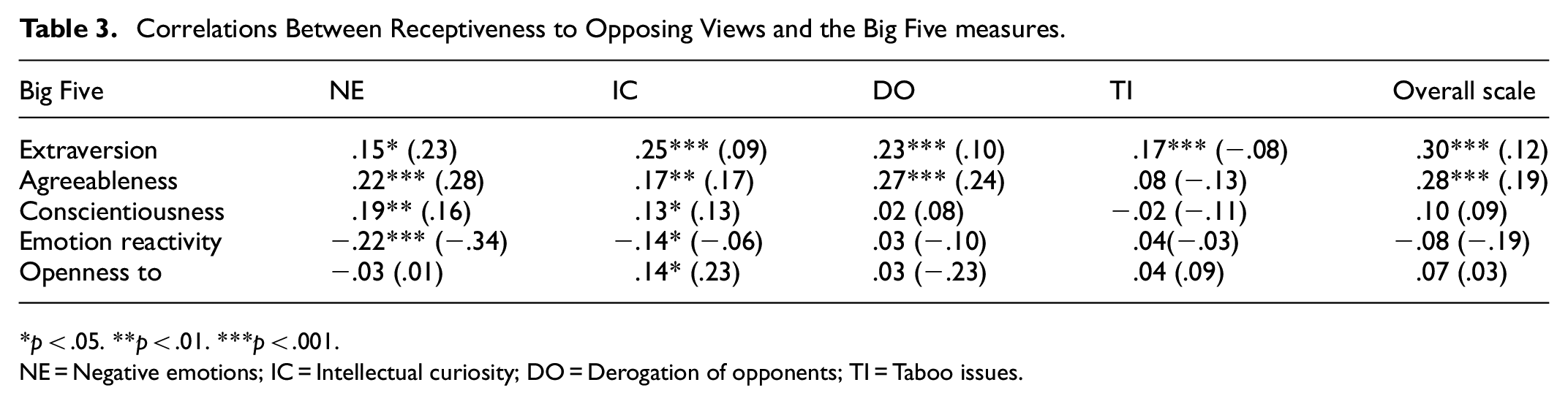
p < .05. **p < .01. ***p < .001.
NE = Negative emotions; IC = Intellectual curiosity; DO = Derogation of opponents; TI = Taboo issues.
Summary
Our comprehensive instrument evaluation shows that our adapted instrument for a German sample is reliable and valid for both a teacher and a non-teacher sample. Due to the validity and reliability of the adapted Receptiveness to Opposing Views instrument in the German sample and the teacher sample, the differences in the sample is checked in the following.
Cross-Cultural Comparison: Comparison of Teachers’ Opposing Views
Table 4 presents the descriptive statistics of the Receptiveness to Opposing Views scale and its subscales for each sample. Figure 4 in the Supplemental Appendix illustrates a plotted visualization of the results, and Figure 5 in the Supplemental Appendix shows the results for each subscale. The intercorrelation of the four subscales is also checked, which were significantly correlated with each other (Figure 6 in the Supplemental Appendix).
Descriptive Values (m, SD) of the Receptiveness to Opposing Views Scale and Their Four Subscales.

NE = Negative emotions; IC = Intellectual curiosity; DO = Derogation of opponents; TI = Taboo issues.
To check for group differences, group comparison analyses on language (English vs. German) and the profession (teacher vs. non-teacher) factors were conducted. Our analyses of the different samples’ Receptiveness to Opposing Views scale results showed significant group differences (F[2, 510] = 13.58, p < .001). In particular, the group difference analyses revealed that although the US teachers (m = 4.5, SD = 0.8) had lower values than the German teachers and non-teachers (m = 4.7, SD = 0.81), this difference was slightly not confirmed as a significant difference by group comparisons (t[511] = −1.81, p = .07), but the US teachers showed significantly lower values than the German teachers (m = 4.81; SD = 0.81, t[356] = -3.17, p = .05). This significant difference was confirmed by three of the four subscales (Intellectual Curiosity (IC) (t[358] = −2.49, p < .05), Derogation of Opponents (DO) (t[356] = −2.08, p < .05), and Taboo Issues (TI) (t[356] = −2.61, p < .001)). There were no differences between the US and German teachers in the Negative Emotions subscale (NE) (t[357] = −0.44, p < .66), implying that the emotional reaction to incongruent views was comparable between the US and German teachers (Figure 1).

Comparison between the US- and German-speaking teacher samples in the Receptiveness to Opposing Views scale and its subscales.
In sum, due to the cross-cultural differences, for example, in their education systems, is expected that the German teachers to show higher values on the teachers’ Receptiveness to Opposing Views scale than their US counterparts and German students. Our analyses showed that the results were in accordance with our expectations. Therefore, it seems that the varying samples differ in terms of their value in the Receptiveness to Opposing Views scale and its subscales, except for the Negative Emotions subscale.
Discussion
Teachers’ receptiveness to opposing views is required in teachers’ daily tasks, such as students’ evaluation, staff or parent meetings, and school development projects. Due to its daily relevance, we adapted and evaluated an instrument for future studies on teachers’ receptiveness to opposing views using a German sample for cross-cultural comparison.
Our study provides a reliable and valid instrument for measuring participants’ opposing views. Our adapted instrument is ideal for future research, especially on school development projects. However, it needs to be mention that in two teacher samples, namely the US sample and the first German sample, the Derogation of Opponents factor was not completely confirmed. Thus, future studies should use it with caution and further explore this factor, especially in a teacher sample.
After evaluating the psychometric properties of the adapted test instrument, we used the scale for a cross-cultural comparison. The results showed differences between teachers in the United States and German-speaking countries in the overall Openness to Opposing Views scale and its subscales, except the Negative Emotion subscale.
These results are surprising. The Swiss education system has the unique learning goal of educating students to develop Swiss civic-economic competency—that is, to become citizens who can face current political and economic challenges as a society (Eberle et al., 2016). This unique goal of the Swiss education system is linked to the right of each Swiss citizen to become a voting citizen at the age of 18 years, as being a citizen of a direct democracy, such as Switzerland, is known for being considerate about people’s opinions. Thus, specifically in the Swiss teacher sample a higher value on the Receptiveness to Opposing Views scale because this was part of their education program is expected. Interestingly, there are significant differences between the samples, leading to the conclusion that teachers could be prone to being more open to opposing views than US teachers, as measured by our adapted instrument. Receptiveness to opposing views does not cover the complete construct of teachers’ civic–economic competency (Holtsch & Eberle, 2018). Thus, future studies should evaluate teachers’ economic-civic competency, consider the adapted instrument, and use multiple measures. Moreover, as the German teacher sample consisted only of Swiss teachers, future studies should also compare teachers from Germany and Austria who also teach in a German-speaking country but in a different education system (see Fend, 2006; Tatto et al., 2009).
We are not aware of any previous studies in which the aforementioned scale was used with teachers or other education professionals. We also see the possibility of using the scale further and evaluating it with the participation of teachers in other countries with different teacher training systems and requirements. Another interesting application could be the evaluation of interdisciplinary educational teams working together on the development of students’ competences (e.g., teachers and headmasters or school counselors). Because of the increased need for teacher collaboration, we see the potential of our adapted scale for use by German-speaking teachers and in further research (see García-Martínez et al., 2021; Sugarman, 2025; Vangrieken et al., 2015). Finally, we highlight that in further cross-cultural projects, teacher characteristics (e.g., age) should also be considered, in part because no benchmark of the original US scale evaluation currently exists.
In addition to the main conclusion of this study, our study also benefits judgment and decision-making research because it provides a more precise picture of teachers’ judgment and decision-making potential. According to Minson and Chen (2022), there is a potential to increase receptiveness through intervention studies, and there should be separate interventions for each of the four components of the Receptiveness to Opposing Views scale. Therefore, our scale adaption can be used in future intervention studies to increase teachers’ receptiveness and awareness of it to reduce biased information processes.
Moreover, future studies should increase receptiveness not only through giving other opinions but also through giving digital advice, which may have another opinion or contradicting advice to teachers’ opinion. Schools face digital changes, and more and more data on students are available, which could ideally be integrated into a digital advice support tool for teachers (Kaufmann & Budescu, 2020; Kaufmann & Wittmann, 2016). Therefore, in future intervention studies, receptiveness may increase the acceptance of digital advice tools, which are mostly not provided by in-service and pre-service teachers (Kaufmann, 2021; Kaufmann & Budescu, 2020) and other experts or non-experts (Burton et al., 2020; Jussupow et al., 2020; Kaufmann et al., 2023; Mahmud et al., 2022). New challenges also arise due to new opportunities, such as in advice interpretation (see Lai & Schildkamp, 2013; Lee et al., 2024; Marsh et al., 2015; Merk et al., 2023) and in checking whether given digital advice given may also impact teachers’ judgment (de-)biasing (see Chacon & Kaufmann, 2025).
Conclusions
Implications for Practice: School Development Projects
For school developments for becoming learning organizations, it is ideal to be open to different views. Therefore, our development approach has practical relevance for school development.
School development is an interplay of the triad of organizational, personnel, and teaching development, and its overarching goal is to increase the learning process of students (Rolff, 2009; Vangrieken et al., 2017). We argue that our adapted instruments may measure and evaluate the potential to launch school development projects as we consider openness to opposing views a precondition for any successful school development. A low value on the Receptiveness to Opposing Views scale may indicate a focus on teachers’ personnel development as a school development project.
Outlook
Our adapted scale is a self-reported instrument that is also prone to several reporting biases, such as social desirability (He et al., 2015; Larson & Bradshaw, 2017), which are not controlled in the outlined studies but require further consideration in future studies. For example, Yeomans et al. (2019) developed a natural language processing algorithm that identifies language features (words, phrases, and syntax) that reliably predict how receptive particular individuals are perceived by their partners, thus overcoming potential reporting bias. This approach provides a means of precisely capturing the nature of the disconnect between people’s evaluations of their own receptiveness and others’ perceptions and should be considered in future research on teachers to evaluate self-reports on opposing views. However, this approach is only available for English-speaking teachers. Future research may initiate such a project for German-speaking teachers or use it for the subgroup of English teachers in German-speaking countries as a further step for a cross-cultural comparison of teachers’ receptiveness to other views.
Supplemental Material
sj-docx-1-sgo-10.1177_21582440251358999 – Supplemental material for Teachers’ Receptiveness to Opposing Views: A Cross-Cultural Scale Adaption and Evaluation
Supplemental material, sj-docx-1-sgo-10.1177_21582440251358999 for Teachers’ Receptiveness to Opposing Views: A Cross-Cultural Scale Adaption and Evaluation by Esther Kaufmann in SAGE Open
Footnotes

Ethical Considerations
Our local ethics committee does not check it because the sample are adults and our study is embedded in a comprehensive research projects. Participants got at the beginning of the online survey an informed consent.
Funding
The author(s) received no financial support for the research, authorship, and/or publication of this article.
Declaration of Conflicting Interests
The author(s) declared no potential conflicts of interest with respect to the research, authorship, and/or publication of this article.
Data Availability Statement
Supplemental Material
Supplemental material for this article is available online.
Notes
References
Supplementary Material
Please find the following supplemental material available below.
For Open Access articles published under a Creative Commons License, all supplemental material carries the same license as the article it is associated with.
For non-Open Access articles published, all supplemental material carries a non-exclusive license, and permission requests for re-use of supplemental material or any part of supplemental material shall be sent directly to the copyright owner as specified in the copyright notice associated with the article.
