




Abstract
This study explores the link between a mentorship program for in-service teachers and their professional development. The participants are under-qualified mathematics, science, and technology teachers employed in junior secondary schools. Using a mixed-method approach, data were collected through a questionnaire responded to by 163 mentees, and semi-structured interviews with 4 in-service teachers. Despite tensions between mentors and mentees, the results show a strong link between mentoring and the professional development of in-service teachers. The majority of the sampled teachers learnt new teaching approaches and improved their content knowledge. The findings are emergent, suggesting that experienced in-service teachers require different models of mentoring relationships between mentors and mentees to those suggested in the literature.
Introduction
The notion of mentoring can be traced to the epic poem, “The Odyssey,” by Homer which chronicled the adventures of Odysseus in the Trojan War and his homebound journey thereafter. During his 10-year absence, his loyal friend, Mentor, provided guidance and advice to his young son, Telemachus. The relationship between the older and wiser Mentor and the younger and naive Telemachus birthed the idea of mentoring.
Based on its Greek roots, a mentoring relationship is characterized by a one-on-one relationship of trust between a willing teacher and a willing learner. Mentorship is now applied in a range of situations and institutions to guide, teach, counsel, and advise on issues like, for example, career mobility (Scandura, 1992), youth outcomes (Van Dam et al., 2018), youth mental health (DeWit et al., 2016), and protégé perceptions (De Tormes Eby et al., 2013). However, to mentor or to be mentored may not always be associated with willingness as it may be a role function expectation to mentor, or a professional development goal imposed on the mentee. In this article, we describe and analyze a professional mentorship development program that was arranged for in-service teachers of Mathematics, Science, and Technology (MST). Unlike the “Odyssey’ situation, this study was a short intervention programme with varying degrees of willingness on the part of mentors and mentees. Furthermore, some mentees were far younger than those they mentored, and from different cultural and geographical backgrounds.
Mentorship has gained traction in recent years as an ideal approach to scaffold professional development as evident in a range of recent studies (Bryant-Shanklin & Brumage, 2011). For example, a study by Hudson (2013) shows that both mentors and mentees experience professional growth. Furthermore, the study by Arnesson and Albinsson (2017) reveals that mentorship has the potential to close the gap between theory and practice when used as a pedagogic tool. Competency development through mentorship programs have also been successful with regard to, for instance, academic language use (Kohnke & Jarvis, 2019), building scholarly confidence, and research mentoring (Hemer, 2012; Young, 2014).
In the aforementioned and other studies (e.g., Hall et al., 2008; Heiney-Smith & Denton, 2015), the mentoring approach presumes that mentors are highly competent individuals and that mentees are motivated and desire mentoring. Premised on the foregoing studies, the notion of mentorship was selected for an intervention program, which was designed to up-skill a cohort of MST in-service junior secondary school teachers. The teachers in the study received their initial teaching qualifications during the apartheid era, more than two decades ago. They were inadequately trained to teach high stakes subjects such asMST, a weakness identified as a significant factor contributing to the poor quality of education in South Africa (Spaull, 2013). Some of the participants were teaching MST subjects without previous exposure to tertiary level education in these subjects. To address the problem of under-qualification and inadequate preparedness, the South African National Department of Education tasked an institution of higher education to offer formal qualification opportunities that would align MST school teachers’ credentials with the minimum necessary for employment.
Mentorship: The Intervention Programme to Upgrade In-Service Teachers
The 203 teachers who participated in the study were enrolled in a formal 2-year, part-time certificate program which required completion of assignments, writing of examinations and a teaching practice component. As these were in-service teachers, the usual teaching practice component needed to be replaced with an alternative which did not interfere with their work as full-time members of staff. Mentorship was selected as the alternative, and for the institution it was a novel and experimental move because the standard practice at the time was to offer workshops for the professional development aspects. Mentorship was chosen as the workshop approach has been severely critiqued for being ineffective, especially the once-off approach (Herman, 2012; Ono & Ferreira, 2010). The focus of this article is on the mentoring component, namely, the pedagogical and content knowledge of MST teachers and its implications for teacher professional development.
The content knowledge component, which included assignment tasks and examinations, was taught by teacher educators at two venues, namely at the university during the school holiday and on Saturdays at learning centers. Mentors provided on-going support to the mentees at their place of employment for the teaching practice component. Trained mentors were expected to guide and coach content and teaching skills during on-site visits over the 2-year period. At least six teaching practice support visits were planned to build “rapport” between in-service teachers and the mentors, premised on the suggestion by Hagen-Hall and Verhaart (2008). However, in practice, mentors observed and interacted with participants only twice a year. The four support sessions were insufficient and compromised the intended aims to develop the professional knowledge and skills of those enrolled in the program. Furthermore, the issues of culture and age were overlooked and resulted in a situation in which the experienced in-service teachers were treated as novice mentees.
Conceptualizing Mentoring in Theory and in Practice
Theoretically, mentoring is an established approach for professional development in teacher education (see, for example, Ambrosetti, 2010; Hudson, 2016; Sundli, 2007). A comprehensive review of the literature by Lai (2005) yielded a triad of interrelated components of mentoring, namely: developmental, relational, and contextual. The first, the relational component, implies the nature of the relationship between mentor and mentee. Collegial relationships are ideal for success. However, relationships are affected by power differentials, particularly in institutional settings where the occupiers of positions of status and higher qualifications can exercise more influence over the character of the mentorship relationship. Feelings of superiority and inferiority in particular, can arise if the differentials are not managed sensitively and, in rare instances, can subvert the aims of mentorship (Straus et al., 2013).
The second, the developmental component, denotes the dynamic nature of mentorship. With the creation of situations that espouse collegial and informal learning, there is an expectation that growth will occur as is apparent in various studies, for example, skills acquisition (Ogbuanya & Chukwuedo, 2017), professional knowledge growth (Peiser et al., 2018), and improved pedagogical practice (Lindenberg et al., 2016). Both mentee and mentor, it should be noted, flourish from the mentorship process (Giles & Wilson, 2004; Hudson, 2013). The dual development benefits, arguably, make mentorship a compelling approach to learning.
The third, the contextual component, describes the cultural features that highlight differences and commonalities like race, class, and worldviews, to name a few. Studies show how cultural aspects influence mentoring (Kent et al., 2013). However, aspects of mentoring that focus on culture, age variations, and complex interpersonal relationships of mentees and mentors are seldom mentioned in the literature; the substantive features of the inquiry at hand.
In practice, mentorship is more complex than the positive outcomes, which dominate the literature. For instance, Hagen-Hall and Verhaart (2008) found a mixed reaction to mentorship. In their study, some students benefited from mentoring, but for a few, it made no difference, perhaps because it was not a voluntary program but a compulsory requirement of the qualification. Furthermore, Long (1997) identified factors that can confound mentorship arrangements like the lack of time for mentoring, poor planning of the mentoring process, unsuccessful matching of mentors and mentees, a lack of understanding about the mentoring process, and in rural schools, lack of access to mentors by mentees. Long (1997) also pointed out that mentoring programs can be hampered by lack of funding and problems associated with the coordination of programs. Nevertheless, he found that a mentoring intervention was necessary to uplift the teaching skills of in-service teachers and that school visits were seen as viable options because they provided support within a relevant context.
Though practical aspects are vital, explicit guidelines as to how mentoring should be done are absent (Hudson, 2004). In other words, how mentoring is or should be practiced. Instead, the literature is replete with descriptions about issues like collegial, interpersonal relationships between mentor and mentee (Hudson & Millwater, 2008). The importance of context, especially as it comprises set of complex social interactions which a mentor and mentee construct and negotiate for a variety of professional purposes and in response to the contextual factors that they encounter (Fairbanks et al., 2000); and a program design that is acceptable to both mentee and mentor (Ragins et al., 2000). The latter mentioned also underscore the necessity of voluntary participation, frequent interaction between mentor and mentee, and careful consideration of rank and departmental differences when making matches to increase the potential for learning, sponsorship, and the development of strong emotional ties (Ragins et al., 2000, p. 1181).
An additional and complex dimension of mentoring is its multifaceted character with many possible roles for the mentor (Hall et al., 2008). The role of a mentor involves both process and relationship aspects (Ambrosetti & Dekkers, 2010). The mentors’ roles are dependent on the context. For example, if a student teacher has given a lesson, the mentor will perform the role of evaluator rather than the role of friend or cheerleader. However, a change of role is not always ideal when viewed from Walkington’s (2005) narrow conception of mentoring, which precludes evaluating mentees because assessment is associated with supervision. Indeed, mentors provide support, advice, empathy, and role modeling to mentees (Hall et al., 2008). In this role, they should have the capacity and desire to empathize, listen or offer other types of psychosocial support when needed to make mentoring a safe environment in which to learn and take risks. However, the separation of roles is complicated when the risks of poor quality learning are high, for example, when supervising and mentoring medical specialists and novice teachers as both roles are vital for professional growth (Mellon & Murdoch-Eaton, 2005).
With respect to mentoring in education, Kammeyer-Mueller and Judge’s (2008) review of mentoring research found that career outcomes ranged from moderate to weak. Furthermore, an analysis of mentorship-based studies in educational settings indicates that only 35.8% of the studies reported positive outcomes (Ehrich et al., 2004, p. 522). One criticism of research on mentoring in an educational context is that it tends to focus on reporting positive outcome studies.
Research Design and Methodology
Mixed methods research, located within the pragmatic paradigm (Creswell, 2014), was the methodology of choice for this study. Mixed-methods research involves “mixing or combining quantitative and qualitative research techniques, methods, approaches, concepts or language into a single study” (Johnson & Onwuegbuzie, 2004, p. 17). The rationale for the choice of methodology was twofold. First, we could gauge the extent of the link between the certificate program and mentoring across the cohort and second, we could gain insights about mentorship and the program from individuals. Moreover, the aim of our inquiry was in alignment with “the goal of mixed methods research [is] to draw on the strengths, and minimise the weaknesses of both types of research” (Connelly, 2009, p. 31). In this study, the quantitative segment comprised of a survey, while the qualitative segment comprised of semi-structured interviews to produce data. Participation in the study was voluntary. The survey conducted first, preceded the semi-structured interviews. No priority of analysis was given to any data source as both mattered and provided insights.
Of the 203 mentees participating in this study, 163 completed the survey, yielding a return rate of 80.3%. The respondents comprised of female and male in-service teachers. Three categories of teachers in terms of qualification status, under-qualified, unqualified a qualified were sampled. Qualified teachers were included because their previous qualifications were not in the MST subjects. Not only were the participants poorly trained teachers, they also occupied the lower, non-leadership ranks.
In contrast, the mentees were of similar age and maturity level or older and with more years of teaching experience than the mentors were. Some mentors were young, subject advisors, while others were old, retired school principals. All the mentors were males, while most of the mentees were females. Furthermore, the mentors were not necessarily knowledgeable about MST. The situation, we acknowledge, was less than ideal for the aims and objectives of the intervention program.
The Research Instruments
For the survey, the items were appropriated from the quality assurance questionnaire of the institution of higher education. The purpose of the questions was to ascertain the link between in-service teacher professional development and the mentoring program. For example, statements specific to the MST program like, “I felt enthusiastic about studying on the MST program” were included in the questionnaire. The questionnaire consisted of a variety of questions on resources, the module content, teaching elements, and the programme design. Participants also had to respond to positively phrased statements on a 5-point Likert-type scale; they could choose: (A) strongly agree, (B) agree, (C) neutral, (D) disagree, and (E) strongly disagree. Data analysis involved assigning a numerical value to each Likert-type item, for example, 1 for strongly disagree and 5 for strongly agree. Data reduction involved aggregation of the responses, for example. A and B were considered to be positive, C was a neutral response, while D and E were negative responses.
A purposive sampling strategy was applied to identify the interview participants for the study. Four in-service teachers, one mentor and a coordinator were chosen for the qualitative aspect of the study. Semi-structured questions from the Aalst and Hill (2006) protocol were adopted and tweaked. For example, the question from Aalst and Hill, “What are the outcomes towards which the programme was directed?” was changed to “What was the role of your mentor in this activity in your classroom?.” The opportunity to elaborate on specific issues and to add information is an advantage of the semi-structured interview as it generates rich, meaningful data. To ensure consistency of the data produced, the same person interviewed those selected for qualitative inputs. The interviews were audiotaped and transcribed to produce texts. Only the interview data from the mentees is used in this article.
Data Analysis
The responses to the questionnaire were captured on an excel spreadsheet. The analysis employed the use of descriptive statistics. In contrast, the interviews were scrutinised through the application of content analysis strategies. An organized set of procedures to analyze, examine, and verify the content of written data exemplifies the content analysis approach (Cohen et al., 2007). The process allows categories and names for categories to flow from the data itself, through researcher immersion in the data, which enables new insights to emerge (Hsieh & Shannon, 2005). Our analysis started with reading all data to get a sense of the whole story. We then derived codes (Creswell, 2008) composed of the exact words from the text that appeared to capture key thoughts. Based on their interrelatedness and linkages, the codes were categorized. The categories were regrouped into meaningful themes.
Findings From the Quantitative and Qualitative Data Sets
In this section, we first present the demographic details derived from the quantitative and qualitative data followed by content analysis.
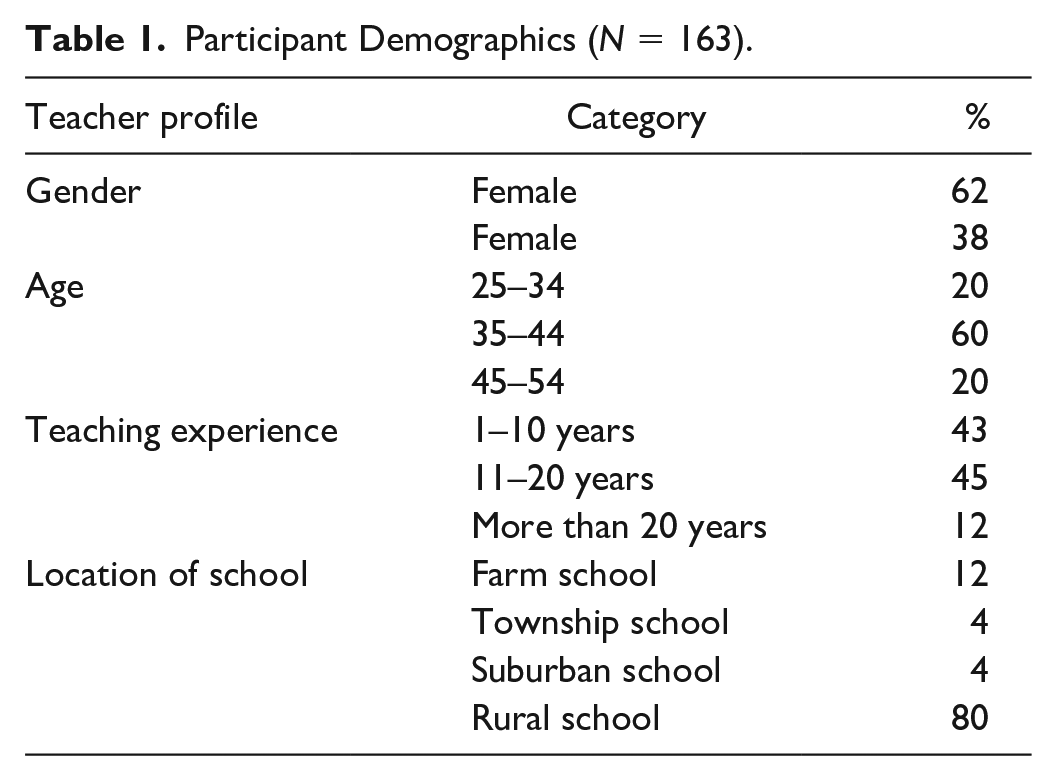
Table 1 provides evidence that the majority of the participants were female (62%), and the average age of the teachers fell in the 35 to 44 year category. Most of the teachers were employed in rural schools. Aggregating the results show that 57% of the participants had more than 10 years teaching experience of MST subjects. The demographic table shows diversity in teaching experience, location of schools, and the age range of the teachers.
Participant Demographics (N = 163).
Professional Teacher Development of In-Service Teachers
The Table 2 data indicate that in-service teachers acknowledge the importance of applying learning gained from the program. Based on the responses, they admit to thinking in new ways (94%), developing intellectually (93%), acquiring problem-solving skills (88%), and having a clearer understanding of concepts (90%). The results indicate that the majority experienced personal growth through participation in the MST program. From the interviews, deeper insights into their professional growth were discerned: I used to tell my learners almost everything, but now I had to change my teaching. I had to let the learners apply or discover things for themselves. So, I think it did help because what I studied now in MST did help me to let the learners apply the knowledge then they touch things for themselves not being forced by me.
The quote above illustrates the ways one of the participant’s changed her teaching approach by shifting from instructing to allowing learners to discover by themselves, and she tested their understanding by setting application tasks. Application tasks are at a higher cognitive level than knowledge and comprehension tasks (Bloom et al., 1956).
In-Service Teachers’ Responses to the Aims of the MST Mentoring Programme.

Note. MST = Mathematics, Science, and Technology.
Another participant gained sufficient confidence to claim and to declare a professional identity as a mathematics teacher. She feels she is adequately competent now to attempt teaching science and technology subjects: The mentoring did wonders for me as I have been trying to explain. By the way, I was not a Math teacher but now as I have been saying I am proudly a Math teacher. Even with Science and Technology, I can approach the subjects.
The above quote in this instance demonstrates that a teacher without the qualifications to teach key subjects like MST can acquire a basic level of competence to teach these subjects with confidence through the participation in a professional development program.
In another interview, the participant expressed the extent to which the mentoring program developed her teaching abilities: I am teaching in a correct way. I am bringing increasing motivation to learners because they have to be motivated. It makes the lesson interesting and, that my role was to actually deliver to the learners. The learners must gain something in that particular lesson. I know what I am doing because you find that teachers that have not been there are coming to you and are asking. And then you realise other schools, they are actually coming and asking. They would come and say things like this, how can I do this . . . And other principals are even phoning my principal and asking for me to go the school, you know what I mean, and teach educators how to do it.
This participant believes she has gained pedagogically because she is now teaching in the “correct way,” meaning that she designs lessons that allow for active engagement by learners supported with positive messages that facilitated the learning process. In addition, she is now a resource and asset to her school, her colleagues, and the surrounding schools. One can infer that the acquisition of effective teaching skills enhanced her reputation to the extent that neighboring schools want her to mentor their teachers. The mentoring program had not only supported her to become a competent teacher; it had turned her into a mentor.
Despite these positive outcomes, it is evident from analysis of the questionnaire data that some of the in-service teachers did not cope with the workload (attending lectures, readings, assignments, and writing of tests). The results show that 17% of the in-service teachers were not satisfied with the workload for this program as exemplified by the following extract regarding the arrangement of conducting lectures during the teachers’ holiday period: We come first day to attend during holidays and you are writing a test the very next day. So that was a little bit, you know, throwing you offside whatever. So, you panic for the test and you want to have a high mark. So, you find that you spend time preparing and you end up not sleeping the one day, so it was challenging. In other words which was good but you know you would like to have more time studying and have like I think that would be the only thing that I would change—about timing and the programme design.
It appears that the part-time mentoring program did not take into account that the in-service teachers were full-time employees, who needed a short break before lectures could commence.
Tensions Between Mentors and Mentees
The interview data show that there were tensions between the mentors and the mentees. The tension arose because the mentors seem to have shifted their focus from mentoring to teaching and telling the mentors what to do from the mentees perspectives. The following quotes illustrate what two of the participants said regarding mentors expectation of lesson plans during classroom support: As an educator this is my 17th year teaching and I tell any mentor please feel free any period walk into my class sit and observe what I do for half an hour. I should not have any fear, qualms, apprehension as an educator because introduction, body and conclusion my lessons need to have some sort of structure. Even if I do not have a written lesson plan put in front of me the lesson plan in the file are covered, I have an idea. The mentor were monitoring of teaching itself, they had to see that I have all the tools that I need in other words I felt like I am being judged like in other way do I have my things in order. I had to show my lesson plans for the day and my HOD would be sitting the classroom with the mentor.
Tensions arose because the roles that the mentors played did not match the expectations of mentees. They were not comfortable with the mentors asking them to follow instructions or observing them in a manner that made them feel judged. As noted in the first quote, after 17 years of experience, she felt she should be exempt from having teaching monitored. It is evident that some teachers resisted the idea of being asked to produce written lesson plans because they felt their experience made it unnecessary.
Mixed Feeling About Mentors
The mentor and mentee relationship did not develop as planned, indicating that the status of mentors played a role in hindering the rapport. Age differences played a role, especially as it related to the health of the mentor: As well as to try and to let the mentor have something to eat, since he was an old person that whilst he was listening to me, he must have some water nearby because I could see that he was diabetic.
For example, in the extract below, the idea that mentors were persons of higher authority and influence than the school leadership is given credence by the ways in which school leaders treated the mentor as a person of importance. The submissiveness displayed by school leaders seems to have affected the development of the mentor–mentee bond as the mentor is recast as an official of the department of education: In my school the HOD and principal chat to mentor for about 10 minutes just to discuss with him what he wants to do with the children and with me and from there the HOD calls me aside and tell me when it is time to get back to the class. The HOD and principal are the ones bringing him back to the class introducing him to the class. They treat him like the person from the department and they like to tell the children to relax, that they must participate and not be scared so HOD and the principal play an important role. The management team from my school, my HOD, my principal and deputy accompany the mentor to my class. I find it so strange that all three of them will come to introduce the mentor.
The quotes are evidence of the unequal relationship between the mentor and mentee setting up an untenable situation for collegiality and amicability.
The in-service teachers were clear about how the presence of the mentors made them uneasy. Despite the unease, the mentors did provide support to the participants and made recommendations to improve their teaching abilities: To me I would say the mentors supported us and I gained something and my learners benefited. Sometimes when the mentor is there and you feel bad that lesson did not go very well. But in future you realise he was not undermining it was like for you supporting you so that in future you are not going to repeat it. You know you spend about twenty minutes in the introduction and you have a thirty-minute lesson, and then ten minutes is for the learners to do something. So, those things are like when being told to you, you feel so bad. Like I did very badly but at the end of the day you are learning something. I need to give more time to the learners and myself. And the other thing the mentor would say you know what, you are off the topic, you know you were not supposed to go up to here or stop there and then from there the learners will get it. So, it is like supporting, in other words, yes you got a little bit mad but you are learning at the end of it. My mentor supported me, because as I have been mentioning that even if I was not reaching a certain standard the mentor used to help me by standing up and adding more points which would help these learners clearly understand what I was trying to teach.
It is apparent that the feelings toward mentors were mixed. Even though they felt uncomfortable when errors were pointed out, they did realize that the intentions of the mentors were noble and that their professional development mattered. It is notable that the mentors were able to identify weaknesses like loss of focus, disproportionate allocation of time spent on the introduction, development, and conclusions aspects of lessons. In other words, the mentors did improve mentees’ knowledge of content and pedagogy. Professional development succeeded when the mentees were able to set aside embarrassment and shame and redirect their thoughts to professional development and the benefits of the support they derived from the mentorship program.
Discussion and Conclusion
The importance of the empirical work presented here is its applicability for developing contexts in the absence of sufficient human capital, inadequate resources, and economic constraints. Though the gains were limited, learning did take place, professional development occurred, and the deeper insights that emerged can serve to guide future structured interventions.
The professional development of in-service teachers is crucial in any education system. The findings indicate that in-service teachers learnt from the program, developed ways of thinking, developed intellectually, acquired problem-solving skills, and improved their understanding of concepts. These results suggest that the experiences of in-service teachers were in accordance with the aim of the MST mentoring program, which was to provide support to in-service teachers so that they could improve their content knowledge and teaching skills. The mentoring resulted in improved teaching abilities and preparedness to learn new things. These findings are similar to those reported by Aslan and Ocal (2012) who found that participant indicated that their classroom management skills were enhanced, and their teaching horizons (implementation of techniques and strategies) improved due to participation in a mentoring program.
It is encouraging to note that only 17% of the participants were not able to cope with the workload required as registered part-time students of a certificate program. This result suggests that the participants found the program to be overwhelming and not easy to manage. These results are not surprising because they have full-time jobs. To state it differently, the program was structured in the same way as for full-time students. The addition of mentors to established norms (lectures, assignments, tasks) was an additional burden. Unfortunately, due to resource constraints (lack of qualified MST specialists and funding), the mentors had to supervise teaching practice as well, which blurred the lines that separated mentorship and supervision. The risks of mentors assuming supervisor roles are highlighted in a number of studies (Ambrosetti & Dekkers, 2010; Hall et al., 2008; Mellon & Murdoch-Eaton, 2005) and is visible in this case too. Furthermore, more than half of the in-service teachers had 10 years or more of teaching experience, which may have given them a false sense of their abilities. Perhaps, they even disregarded on the one hand, the reasons for upgrading their credentials, and on the other hand, discounted the importance of mentors as resources to ensure the acquisition of specialist knowledge of MST subjects.
The positive aspects of school-based mentoring in this study support the idea of its importance for improving classroom practice. The mentees also indicated that their content knowledge and confidence in the teaching of mathematics and physical science at higher phases of school education were enriched. These findings are similar to those observed by Frick et al. (2008), where teachers said they benefited from the mentoring program.
Despite the limited quantity of evidence, it is worth highlighting the possibility of two issues of sensitivity. The first pertains to the ages of mentors and mentees—in many cases, the mentor was much younger than the mentee. The second pertains to the school context of the mentees in contrast to the mentors who worked in urban settings. These differences could imply different worldviews, values, and cultures and are a feature in a number of literature sources (Hagen-Hall & Verhaart, 2008; Long, 1997; Ragins et al., 2000). In this regard, it worth noting the recommendation of the need to involve all parties at the planning stage (Ragins et al., 2000). In the current study, there was not enough time allowed for repeated mentor visits to build viable relationships with mentees. Limited interactions created a lack of communication between a mentor and mentees. These data show that mentees did not like being told what to do even though it was necessary. The latter mentioned finding confirms Geiger-Dumond and Boyle (1995)’s observations that there is a need for improved communication at senior and junior levels if successes of mentoring are to be realized.
There is little doubt that the mentoring enhanced in-service teachers’ teaching skills in the MST subjects. Regardless of their limited MTS subject knowledge, the involvement of mentors did advance the skills and knowledge of in-service teachers, which are similar to the finding by Subotnik et al. (2010). The role-played by the mentors in the development of in-service teachers through reflection was critical in the program. However, a number of issues were reported by mentees when the mentors visited the schools, especially around communication modes, reception by school leaders, and supervision of classroom teaching. It is crucial to look at possible ways of mentoring experienced, underqualified schoolteachers. It is important to stress that mentoring of in-service teachers is different to and cannot be designed around the models used for novice teachers. The issues of workload and time management for mentees, the cultural and age differences between mentor and mentee, and the time needed to develop relationships should be clarified at the beginning of the program and strategies need to be put in place to promote and sustain interactions.
If similar mentorship-based professional development programs are conducted again, in-service teachers’ should not be treated as novice mentees; instead, they should be given a platform to express their expectations at the initial phase of mentoring. This will help both the mentors to treat the in-service teachers as individuals with some baseline knowledge in the subject and the type of relationship desired.
To conclude, it is apparent that Lai’s (2005) conception of mentoring as a triad of three components, namely relational, developmental, and contextual, are strongly suggested in our study. The relations were fraught with tensions that were eventually reflected on amicably. The development goals of the certificate program were achieved, and the link between mentoring and professional development is evident. The contextual differences of age, culture, school type, and gender were present but not teased out and is a limitation of the study.
Footnotes
Declaration of Conflicting Interests
The author(s) declared no potential conflicts of interest with respect to the research, authorship, and/or publication of this article.
Funding
The author(s) received no financial support for the research, authorship, and/or publication of this article.
