




Abstract
The implementation of China’s Education Modernization Plan 2035 has signified the Chinese government’s commitment to advancing the quality of education. Recent studies have shown that the prioritization of instructor continuous professional development (CPD) through the Ministry of Education mandates has positively affected talent development and student achievement at the K12 level; however, examination of the reform’s impact on Chinese higher education is limited. This paper explored the effect academic optimism, institutional policy and support, and instructor self-efficacy had on instructors’ CPD within Chinese higher education institutions. This study collected data from 456 Chinese higher education instructors, employing a structural equation model to examine the relationship between the independent and dependent variables. Findings indicate academic optimism and institutional policy and support have a significant positive effect on CPD, β = .645 and .2, respectively, while instructor self-efficacy has nearly no effect on CPD, β = −.031. Institutional policy and support have a significant, influential effect on academic optimism, β = .652; however, there is nearly zero impact on instructor self-efficacy, β = .032. The implications of the findings indicate that institutional leadership is crucial in developing an academic culture that promotes and supports continuous professional development; however, individual drive to pursue CPD is limited.
Introduction
Rapidly changing economic and social expectations challenge organizations to adapt or perish. Previous outdated notions that education ends after formal education (university or technical school) has been systematically rebuked by academics (Shaw & Green, 1999), with an overwhelming consensus considering professional development as a lifelong requirement to remain relevant in the workforce (Parise & Spillane, 2010). Continuous professional development (CPD) is considered to expand an individual’s skills and expert knowledge to maintain high-quality professional practices that are explicitly and implicitly required (Masoumi et al., 2019). CPD encompasses a wide range of components that reflect the individual and institutional idealization of necessary competencies. L. Evans (2009) categorized CPD into three components: functional development, attitudinal development, and intellectual development. Functional development consists of tasks striving to improve professional performance, attitudinal development focuses on workplace attitudes and behavior, and intellectual development attempts to build stronger workplace knowledge (L. Evans, 2009). CPD is resource intense, requiring considerable time, money, and effort (need identification and program development). Thus, organizational leadership is under significant pressure to deliver adequate professional development opportunities constrained by limited resources (Cheng, 2017). If an organization fails to promote professional development, the prospect of maintaining a competitive advantage declines dramatically.
Higher education institutions (HEIs) require instructors to expand on existing expertise, knowledge, and skills to perform in rapidly changing educational landscapes (J. Zhou, 2014). Numerous HEIs globally have created institutional provisions that directly and indirectly create policies requiring instructor participation, with contract extensions or promotions being tied to specific benchmarks. However, institutions must carefully align their CPD goals with the instructor’s needs, avoiding imposing rigid systems that may stifle individual agency and damage instructor trust in the organization (OFSTED, 2010). Research has shown that institutional policies that promote collaboration and communication (S. Liu et al., 2016; Pan & Chen, 2021) can reduce professional development hesitancy and improves a positive collective culture (S. Liu & Hallinger, 2018). Institutions that engage instructors and strengthen trust with ample support and resources have a significant positive effect on academic optimism (L. Li, Hallinger, & Ko, 2016; P. Liu, 2021; S. Liu et al., 2016).
Academic optimism is grounded in the instructor’s belief in their capacity to overcome obstacles and preserve through failures, making a difference in student academic outcomes and the overall institutional quality (Woolfolk Hoy et al., 2008). Positive academic optimism drives HEI instructors to re-prioritize their personal development to support students and build on their teaching capacity (P. Liu, 2021). Instructor self-efficacy also has been correlated with positive faculty support and communication (K. C. Li & Wong, 2019). An instructor’s self-efficacy is associated with social norms and expectations; instructors that are asked to participate in CPD activities that are uncommon or new may hesitate to engage as they are not familiar with expectations connected to the activity (Tschannen-Moran & Woolfolk Hoy, 2001). Institutions that create positive environments with supportive policies can overcome change anxiety in instructors, leading to substantial instructional quality improvement in the long term (K. C. Li & Wong, 2019).
In 2017, Chinese President Xi Jinping stated at the 19th National Conference; China must develop an education system that corresponds with the hearts and minds of the Chinese people, promoting a nation rejuvenated through an internationally recognized education system (Xi, 2017). An ideological transition was outlined in the ambitious China’s Education Modernization Plan 2035, enacted in 2019. The strategic focus of the policy highlights China’s commitment to advancing the quality of education through talent development, the promotion of lifelong learning, and the priority for instructor professional development and quality performance (Tan, 2019). Although the policy continues to be entrenched in the spirit of Chinese socialist characteristics, instructor professional development will integrate international concepts and innovative practices to further the quality of knowledge and practice (Zhu, 2019). The Chinese Ministry of Education (MOE) has pressured educational institutions to create opportunities for instructors (Ministry of Education of the People’s Republic of China, 2019). This development is conscious and proactive instead of reactive and passive (Huang & Yip, 2021). CPD in Chinese HEIs is often confounding, as numerous institutions and instructors consider professional development a supplement instead of a necessity. Chinese HEI instructors consider publication their primary focus rather than creating optimal learning conditions to promote student achievement or department success (Lee, 2014); therefore, effective teaching is secondary. He and Ho (2017) noted that CPD differs in China due to the traditional educational design and cultural expectations founded in Confucius’s ideologies, a structure the current education reforms are trying to dismantle. The Chinese government’s educational reform initiative has seen a substantial increase in CPD activities at the K12 levels (Tan, 2019; Zheng et al., 2018) but limited success in HEIs. Increasing teaching requirements, assessment workloads, and publication pressure have decreased instructors’ desire to participate in voluntary professional development—even if it would be beneficial (Zhang et al., 2017). Chinese HEI instructors are hesitant toward classroom or subject-oriented CPD, as they consider themselves experts in their fields and the CPD tasks as remedial (Hoque et al., 2020). Chinese HEIs must overcome these barriers toward CPD and cultivate an environment that embraces CPD through productive work and social relationships.
The literature identifies the importance of CPD for HEI success, with academic optimism, institutional policy and support, and instructor self-efficacy as significant factors that impact instructors’ CPD engagement. Chinese reforms additionally highlight the need for the institution to develop instructors’ skills and knowledge to meet the goals set by the Chinese government. This study surveyed 456 Chinese HEI instructors from elite universities in southern China, utilizing a structural equation model (SEM). The findings from this study expand the current understanding of influencing factors on CPD in Chinese education, specifically by integrating Chinese HEIs in the expanded discussion. As China strives for international recognition in the Chinese education sector, a detailed analysis of influential factors on CPD is necessary to formulate an appropriate mechanism to promote academic advancement.
The significance of this study relates to three areas. First, the study contributes to the understanding of the perceptions of Chinese higher education instructors toward their professional development opportunities facilitated through their institution’s policies and support apparatus. Current policies by the central Chinese government to redefine the importance of Chinese HEIs toward creating a stronger international academic identity by strengthening the quality of instruction have pressured universities to adapt and modify existing methods of instructor development. Research investigating institutional policies and support for HEI instructor CPD development is extremely limited in China, with most studies focused on the K12 system. The study contributes to existing theory and literature by identifying the impact institutional policy has on Chinese HEI instructors’ academic optimism and self-efficacy. Finally, this study could inform academic leadership and policy decision-makers of methods to promote an environment that fosters a stronger emphasis on instructor growth through continuous learning development. The focus of this study, specifically on double first-class universities in the Guangdong subset, has long-term implications for other HEIs across China, as successful policies and approaches by these universities will eventually be implemented in both national and provincial level institutions to achieving the Chinese government’s goals of enriching instructors and provide top-quality internationally recognized instruction.
Theoretical Framework
To conceptualize and discuss the effects of academic optimism, institutional policy, and instructor self-efficacy on CPD, the distinction between andragogy (how adults learn) and pedagogy (how teachers lead or how children learn) needs to be emphasized in the theoretical selection. This study incorporates a triadic synergy of theories, Adult Learning Theory (structured from Knowles’ Theory of Andragogy, (Knowles, 1984)), Bandura’s (1977) Social Learning Theory, and Path-Goal Theory (formulated by M. G. Evans, 1970), as its foundation of the analysis. These theories postulate that adults are led by a desire or need to learn based on actual conditions impacting their personal and professional lives (Muneja, 2015). From an education perspective, these theories emphasize instructors-as-learners, promoting a learner-centered approach to professional development that accentuates a higher degree of control in the learning process (Knowles et al., 2014).
Adult learning theory (ALT) promotes a multimodal approach over traditional one-size-fits-all applications commonly employed in instructor-centered learning (Medves et al., 2010). The foundation of ALT is learning is an acquisitional and reflective process based on collaborative social interaction (Fenwick & Tennant, 2004). For instructors, the acquisitional learning process occurs passively through interaction and observation of peers and leadership (Sweller, 1999). Reflective learning is the process of ongoing critical reflection, a tool that evaluates an individual’s current capacity and the necessary actions required for personal growth through a social and experiential lens (Shandomo, 2010). Social Learning Theory (SLT) supports the tenets of acquisitional and reflective learning, stressing that professional growth is rooted in an individual’s environment and professional community. SLT contends academic optimism is connected to positive acquisitional development, driven by a climate promoting trust, collective efficacy, and academic emphasis (Hoy et al., 2006). Bandura (1977, 1997) stated that reflective learning underpins self-efficacy as one must build confidence to correct perceived professional deficiencies and expand their existing knowledge base. Path-Goal Theory diverges from ALT and SLT, as it stresses the role of the leader (institution) in developing a positive environment that promotes growth through a shared vision. Path-Goal Theory contends that leadership requires an acute knowledge of their instructors and the conditions within the institution. M. G. Evans (1970) stressed that leadership needs to be flexible to the needs of the staff, clearly communicating policies that strive to motivate others to grow professionally. Thus, leadership and the institution are highly influential in the attitude of instructors toward professional development opportunities.
Literature Review
Continuous professional development is essential for improving the institution’s capacity and student outcomes through quality instruction (Hattie, 2009). Effective instructor CPD integrates actual professional conditions and challenges instructors encounter, allowing them to develop the tools and knowledge to combat obstacles. CPD has been developed to incorporate various designs and approaches. Instructors can maintain an active or passive approach to CPD engagement. Active formal professional development consists of task-specific courses, workshops, network development, or mentoring and observation. Passive professional development consists of informal discussions and staying up-to-date with literature. Although active professional development is seen as the optimal method of improving instructor knowledge and classroom performance, studies have indicated that the allocation of appropriate resources is often not afforded to instructors to allow prolonged active CPD engagement (Dilshad et al., 2019; Wondimu, 2019). Higher education is often idealized as the most advantageous type of formal CPD for other professions; however, HEIs need to be more receptive to the concept for their faculty (Clegg, 2003). Instructors in HEIs often criticize the limited opportunities, arguing that it lacks the focus, intensity, and necessary follow-ups to be effective (Quan & He, 2016). Instructors and HEIs have differing objectives toward CPD, with instructors prioritizing programs that assist with research while the HEI focuses on classroom teaching quality and student achievement. The dissonance between instructors and HEIs may directly stem from internal performance assessment and promotion criteria, where publications often account for more than 50% of the evaluation (Salaman & Osei-Mensah, 2012).
In the Chinese context, research examining instructor CPD in HEIs is minimal. A systematic review of literature uploaded to Emerald Insight’s and ERIC’s databases after 2016 found a total of 67 quantitative studies examining Chinese or South-East Asian countries. However, only seven studies investigated conditions in HEIs, with two specifically focused on Chinese universities. The limited research indicates a clear literature gap and supports Clegg’s (2003) argument that HEIs are less receptive to CPD integration. According to the literature, institutions that promote academic optimism (Cheng, 2017; Jiang et al., 2021; L. Li, Hallinger, & Ko, 2016; L. Li, Hallinger, & Walker, 2016; P. Liu, 2021; S. Liu et al., 2016; H. Zhou & Tu, 2019), institutional policy and support (Cheng, 2017; L. Li, Hallinger, & Ko, 2016; L. Li, Hallinger, & Walker, 2016; P. Liu, 2021; S. Liu et al., 2016; S. Liu & Hallinger 2018, 2021; Pan & Chen, 2021; Tan, 2019; Zheng et al., 2018), and instructor self-efficacy (K. C. Li & Wong, 2019; S. Liu & Hallinger, 2018, 2021; Tan, 2019; Zheng et al., 2018) all create the enabling conditions that motivate instructors to take a pro-active stance toward CPD. HEI leadership and education policymakers need to develop a shared vision that inspires instructors to continually reflect on their skill and knowledge set and strive to provide relevant quality instruction. The environment promoted by institutional policies determines the academic optimism (trust) instructors have within their faculty, with higher optimism promoting increased active participation in CPD (Cheng, 2017; P. Liu, 2021). Proactive institutional policies toward CPD are argued to improve instructor self-efficacy, with individuals developing a more comprehensive range of practices to engage and inform their students (S. Liu & Hallinger, 2018; 2021; Wondimu, 2019).
Studies have shown that instructor beliefs significantly impact school academic quality and student performance (Hattie, 2009; X. Wang, 2018); thus, institutional leadership should nurture a shared institutional culture. Academic optimism is not an individual instructor’s trait but is forged within the collective elements of the institution’s culture (Hoy et al., 2006). Thus, academic optimism is a property of an instructor’s professional identity, formulating values, beliefs, goals, and professional attitudes that align with their associated organizational culture. Chinese educational institutions are overwhelmed with bureaucratic regulations that rarely incorporate the instructor’s views into their governed policies (Bingqi, 2009). Hierarchical structures have the strategic advantage of defining rules void of emotion (Weber, 1978), creating goals that control instructor efforts to achieve a clear institutional need (Muringani, 2011). Although the bureaucratic top-down mechanism is efficient, it neglects the advantages of forming an organizational culture built on open communication, innovation, and collaboration.
Examining instructor academic optimism within literature concentrates on one or more dimensions defined by Hoy et al. (2006): academic emphasis, collective efficacy, and trust. Chinese studies investigating academic-oriented organizational culture found contradictory findings. Jiang et al. (2021) and P. Liu (2021) found that instructors were concerned with their institution’s strategies of incorporating a one-size-fits-all policy into academic and curriculum policies. Jiang et al. (2021) noted that instructors were dissatisfied with their institution’s ICT integration and the need for up-to-date pedagogical emphasis. P. Liu (2021) found that instructors lacked focus as they were unsatisfied with program arrangements and course objectives. H. Zhou and Tu’s (2019) study of Chinese university instructors determined a higher level of self-sufficiency in their academic emphasis; however, they noted that leadership must allocate sufficient resources (time and money) to maintain satisfaction. Research examining collective efficacy on CPD found a significant positive relationship. Cheng (2017) determined that collective efficacy and strong organizational culture influenced instructor CPD development. P. Liu (2021) supports Cheng’s (2017) findings, noting that a positive collective culture motivates instructors to develop their skills to promote overall group growth. Trust was influential in instructor professional development, with L. Li, Hallinger, and Ko (2016), L. Li, Hallinger, and Walker (2016), and S. Liu et al. (2016) all concluding that instructors who trust the institution’s vision and goals are more likely to engage in CPD.
Academic optimism results from institutional culture development; thus, the attitudes within the organization are correlated with the policies and support the institution provides to its faculty. Institutional leadership that promotes capacity and improvement (S. Liu et al., 2016) creates a stronger bond and trust among the staff. Policies that engage instructors to promote a shared vision for the institution’s future, building a culture that strives together to achieve goals (Hoy & Tschannen-Moran, 1999). Studies investigating the impact institutional leadership has on academic optimism through policy and support have a significant but moderate effect (L. Li, Hallinger, & Ko, 2016; L. Li, Hallinger, & Walker, 2016) to a significantly strong effect (Cheng, 2017; S. Liu et al., 2016). Findings indicate that institutions that incorporate a learning-centric approach, promoting CPD through faculty-engaged policies and support, will create strong cultures of academic optimism (L. Li, Hallinger, & Ko, 2016; Zhang & Pang, 2016). Institutions that assert authoritative hierarchical leadership styles, excluding faculty in policy formation, will negatively impact academic emphasis, collective efficacy, and trust (a dimension of academic optimism; L. Li, Hallinger, & Ko, 2016; Zhang & Pang, 2016).
The centralized structure commonly employed within Chinese HEIs stresses a collective passive engagement in policy formalities and a focus on classroom lecturing (He & Ho, 2017). The significant power distance between institutional leadership and instructors is derived from Confucius’s ideology, which prioritizes risk avoidance and methodical long-term planning (Hwang et al., 2015). The rigidness of the tightly controlled authoritative style significantly impacts the adaptiveness to new strategies by both the institution and the faculty (Bryant & Son, 2001). The power distance stifles innovation and intensifies instructors’ fear of objecting to a system in place, which is likely ineffective (Zhairullah & Zhairullah, 2013). The Chinese government, recognizing the current limitations in the national education structure, is promoting a transition to a Chinese hybrid model that maintains a centralized government model but incorporates a more globalized distributed model at the institutional level. While the government pursues strategies to update the education sector through a globalized lens, it would be imprudent to assume leadership will fully embrace western practices that discard Chinese cultural idiosyncratic beliefs entrenched in social norms. Thus, the selective incorporation of western leadership features may make cross-research comparisons difficult (T. Wang, 2004).
Research examining institutional policy and support often investigates the impact of leadership styles on instructor CPD. L. Li, Hallinger, and Ko (2016) and S. Liu and Hallinger (2018, 2021) explored the impact of instructional leadership on instructor CPD, L. Li, Hallinger, and Ko (2016) and Pan and Chen (2021) studied the impact of learning-centered leadership on CPD. All studies found leadership was a significant factor in instructor CPD, with studies examining learning-centered leadership having the most significant effect. Scrutinizing the findings in more detail reveals that institutions with considerable power distance significantly adversely affect instructor self-efficacy and CPD (S. Liu & Hallinger, 2021). Institutions that promote improved communication (L. Li, Hallinger, & Ko, 2016), shared vision and instructor support (S. Liu et al., 2016; Pan & Chen, 2021), and workload assistance (S. Liu et al., 2016) are all significantly correlated with improved instructor CPD.
Self-efficacy refers to an individual’s belief in his or her capability to manage difficult situations and perform the assigned functions (Bandura, 1997). A task-specific belief regulates choice, effort, and persistence in the face of obstacles. The task-specific focus of self-efficacy distinguishes it from more global concepts such as self-esteem or confidence. Individual efficacy beliefs are built from diverse sources of information that can be conveyed vicariously through social evaluation and direct experience (Bandura, 1986). Instructor self-efficacy can reflect both cognitive and enactive mastery development. Cognitive self-efficacy is achieved through traditional CPD activities, like workshops and conferences, while enactive mastery is driven by the learn-by-doing framework or in-class activities (Palmer, 2006). Each model prioritizes CPD development through an individual’s preferences and confidence within a specific environment. An instructor’s self-efficacy is associated with social norms and expectations; instructors that are asked to participate in CPD activities that are uncommon or new may hesitate to engage as they are not familiar with expectations connected to the activity (Tschannen-Moran & Woolfolk Hoy, 2001). Self-efficacy for Chinese instructors is deeply rooted in the respect they receive from their students and colleagues, the formal training received during university, and their experiences at the institution (Cheung, 2008). Self-efficacy builds with confidence; thus, growth occurs with years of experience; however, Klassen and Chiu (2010) noted that experienced instructors have waning self-efficacy, as they rarely adapt to quickly changing classroom expectations.
Research investigating the impact of instructor self-efficacy on CPD in China is minimal, with the few identified studies examining K12 teachers. Chinese culture promotes social harmony over individualism (Markus & Kitayama, 1991); studies by S. Liu and Hallinger (2018, 2021) have found that Chinese instructors’ self-efficacy is strongly related to CPD engagement. Institutions that maintained a significant power distance reflective of an authoritative leadership model; experienced a noticeable weaken effect on CPD engagement through the self-efficacy pathway (S. Liu & Hallinger, 2021). S. Liu and Hallinger (2018, 2021) indicate that institutions that promote learner-centered collaborative leadership policies with substantial support can overcome tentativeness with classroom reforms. As self-efficacy levels are more related to collaborative culture and supportive leadership, providing CPD opportunities will not encourage instructors (K. C. Li & Wong, 2019; Zheng et al., 2018).
Based on previous findings and literature, this study has developed the following hypotheses:
H1: Instructor academic optimism has a positive effect on instructor CPD
H2: Institutional policy and support has a positive effect on instructor CPD
H3: Instructor self-efficacy has a positive effect on instructor CPD
H4: Institutional policy and support has a positive effect on instructor academic optimism, and
H5: Institutional policy and support has a positive effect on instructor self-efficacy
This study defines continuous professional development as an instructor’s process (passive or active) to expand their professional and social understanding to promote constructive and effective discussion within their faculty or classroom. CPD additionally includes skill development through formal and informal channels, allowing for the positive dissemination of information. This study borrows Woolfolk Hoy et al.’s (2018) definition of academic optimism, where instructors believe they can overcome complications and make a positive difference in their student’s academic outcomes. Academic optimism is grounded in an instructor’s attitude and the level of shared beliefs they maintain with their colleagues, faculty, and institution. Institutional policy and support is defined as the strategies an institution utilizes to facilitate instructor growth and improve in-class quality. Support is further defined by the level a faculty or institution promotes growth through the allocation of resources (time or money), mentorship, or recognition. Instructor self-efficacy incorporates Bandura’s (1997) definition, where instructors believe in their abilities to manage and perform in difficult, unknown, and stressful conditions.
Methodology
Study Design and Sample
This study used a descriptive quantitative design to examine higher education instructors’ CPD development perception. Participants in the study were provided with detailed information on the study’s aim and procedures. All participants were guaranteed anonymity, and participation was completely voluntary. The sample was drawn from four Chinese university instructor forums created within the WeChat platform representing four of the eight double first-class universities based in Guangdong Province. Double first-class universities are institutions accredited by the Chinese government under the Chinese government’s 2015 initiative to develop and expand internationally recognized universities (Li & Xu, 2021). The selected WeChat forums comprised 877 members (126, 407, 251, and 93 members for each respective group) of all levels of instructor rank, experience, and faculty. The WeChat forums represented approximately 12.3% of all academic faculty members affiliated with the selected four universities (7,122 instructors). The creation of the groups pre-dated the development of this study. Although the community names differ, the founding principle of each group is similar; to create an environment for university instructors to communicate about governing policies and news. Membership in each community is free, and no limiting barriers to admission exist outside of being engaged in university-level instruction. The researchers contacted the forum administrators for permission to join each group, outlining the study purpose and process.
The decision to study double first-class universities in Guangdong province relates to the considerable emphasis both the central government and the Ministry of Education have placed on strengthening and expanding internationally recognized universities and programs within Mainland China. The central government’s goal is to tailor and develop institutions that would strengthen the Chinese academic position in a competitive global market, reducing the net outflow of high-quality students and increasing the attractiveness of the Chinese market to international scholars and students (Chinese State Council, 2015). Double first-class universities’ success would also soon create the blueprint for national-level and provincial-level institutions, with current policies acting as a pilot program. Guangdong province was selected because it contains two of the four premier cities in Mainland China (Guangzhou and Shenzhen) and maintains the most prominent provincial GDP and economy (Global Times, 2022). Considerable expenditure is allotted to the higher education sector by the Guangdong provincial and regional governments, with the province comprising the second-largest number of HEIs in China. Due to the large number of HEIs and increasing numbers of double first-class universities (three of the seven additions in 2022; Ministry of Education of the People’s Republic of China, 2022), Guangdong HEIs are providing procedures and steps for how other institutions in Mainland China should operate.
Latip et al.’s (2020) sampling formula was utilized to calculate a minimum appropriate sample size for the study. The sampling formula is represented as:

SS = Sample size
Z2 = Normal distribution level for 95% confidence
p = Probability of questionnaire response (minimum threshold of 50%)
c2 = Significance level
The calculation results in a suggested sample size of 384 respondents, SS = (1.962) × 0.5 × (0.5)/(0.052) = 384. A sample of 384 would exceed the recommended rule of thumb for the structural equation model put forth by Hu and Bentler (1999). Hu and Bentler (1999) examined the sampling number required to ensure statistically accurate tests of model fit indices, determining that samples of less than 250 respondents have an increased likelihood of false rejections of both absolute and relative fit indices.
Instrument, Distribution, and Analysis
A structured questionnaire consisting of 40 items was distributed to the selected respondents. The questionnaire contained 8 demographic questions and 32 items examining three independent variables and a single dependent variable. The instrument consisted of both standard (positive) wording and reverse (negative) wording items, with nearly 20% (six items) being reverse-worded. A 5-point Likert scale was employed for all items, ranging from 1 (strongly disagree) to 5 (strongly agree) for standard-worded questions and 1 (strongly agree) to 5 (strongly disagree) for reverse-worded items. Demographic questions consisted of multiple-choice questions.
The questionnaires were distributed electronically to participants via WeChat. Participants were provided a link that would bring them to a loading page within the WeChat application. The landing page outlined the study aims and ethical considerations. Information entered was confidential, with no personal information (username, location, and IP address) being recorded. The WeChat software additionally had an opt-out function. To ensure data integrity, each person could only use the link once. If the potential respondent closed the window or opted out, they would not be able to re-access the questionnaire. A total of three messages were sent to each group; the first message was an introduction and link to the study’s information page and questionnaire. The second and third messages were reminders, requesting those who had forgotten or had not seen the initial message to participate in the study. As web-based questionnaires suffer from lower response rates (Morton et al., 2012), reminders improve engagement and total response rate. The study also sent the initial message at the start of the week, with the first reminder a week later, to optimize participation The study window for participation was 18 days. The study utilized both IBM’s SPSS V26 and AMOS V26 software for data analysis. SPSS was used to determine descriptive statistics, and reliability and validity testing. The AMOS software calculated path analysis, tested through a series of goodness of fit tests to develop a structural equation model (SEM).
Data Analysis and Results
Study Response Rate
A total of 877 potential participants were contacted through the four identified WeChat communities. After the 18-day window, a total of 456 Chinese university instructors responded. As the questionnaire required each item to be answered before the respondent could continue, all received questionnaires were retained. The 456 responses exceeded Latip et al.’s (2020) and Hu and Bentler’s (1999) suggested minimum sizes with an overall response rate of 52%. The response rate for questionnaires is often a critical indicator of data quality, with higher rates deemed necessary to offset the risk of nonresponse bias in many journals and institutions (Fincham, 2008). The response rate for this study exceeds Babbie’s (1990) recommended threshold of 50%; however, the literature fails to provide a universal rule as numerous factors impact responses beyond poorly constructed questionnaires or sample identification (Table 1).
Construct Items and Coding.
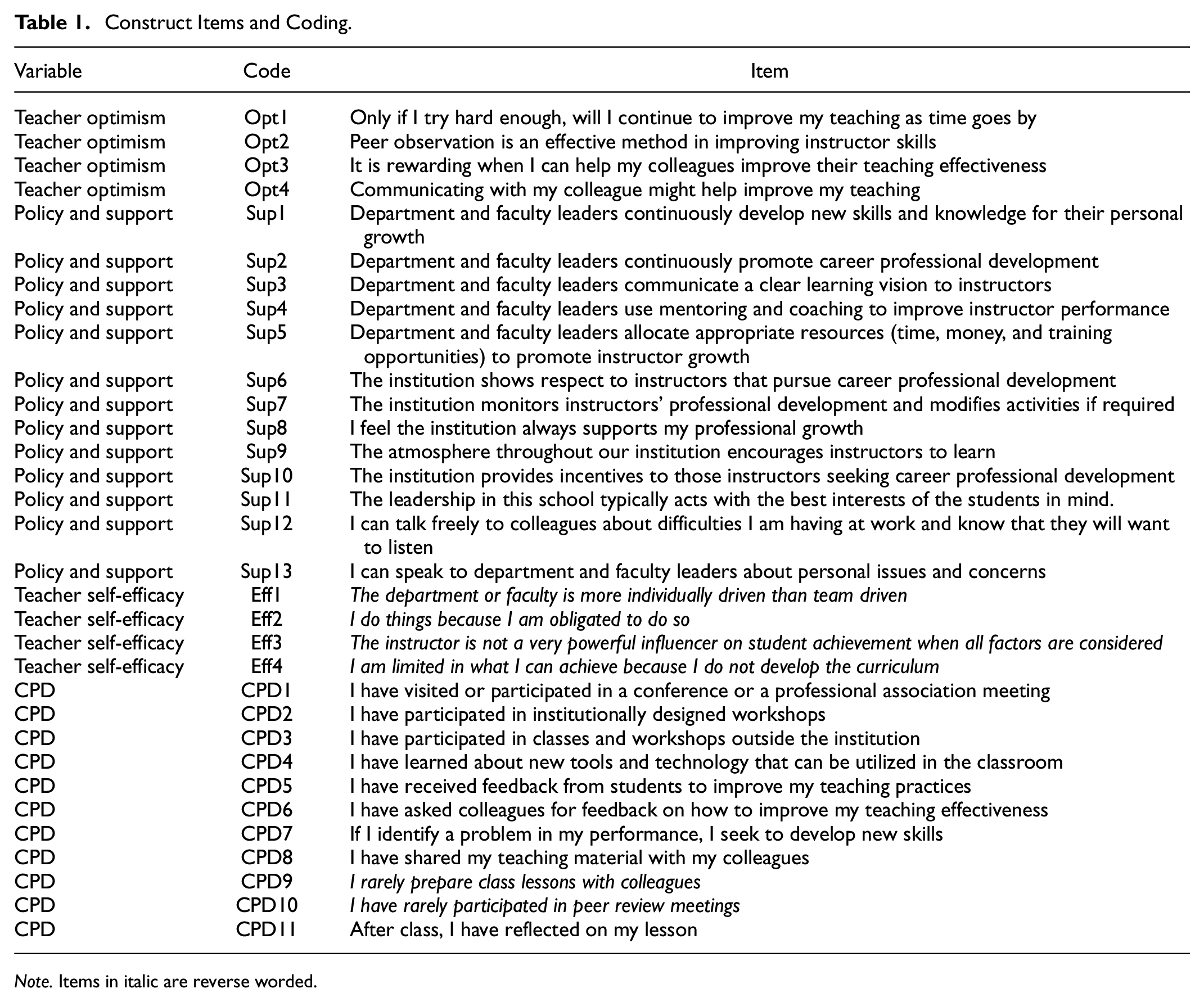
Note. Items in italic are reverse worded.
Demographic Profile
The study’s demographic profile indicated that respondents were skewed toward females (65.8%). Respondents were most likely between the ages of 31 to 40 years old (50.7%), held a master’s degree in their field (52.9%), and currently held the title of lecturer (48%). Experience within the higher education teaching profession was balanced, with 70.8% of respondents working between 0 and 15 years. Most respondents worked in the Arts and Humanities departments (46.3%), while biological and physical sciences only accounted for 5.9% and 2.9%, respectively (Table 2).
Study’s Respondent Demographic Profile.

Normality of Variables
The assumption of normality, when utilizing a parametric approach to statistics, dictates that values are normally distributed across the entire sample according to their means. Robust SEMs’ model fit indices best draw from normally distributed data (Kumar & Upadhaya, 2017); otherwise, non-normal data can inflate results and lead to increased false rejection. Each variable was investigated by skewness and kurtosis to test for normality. The range of acceptability differs considerably among researchers; however, a stricter interpretation by George and Mallery (2020) of ±2 is acceptable, and ±1 is considered excellent was used for statistical analysis. The skewness for the variables ranged from −0.534 to −0.351, resulting in data being relatively symmetrical. The kurtosis values ranged from 0.191 to 1.369 (Table 3), resulting in a reasonably mesokurtic distribution for all variables. Based on the acceptable range of ±2 for skewness and kurtosis, the data meet the normality assumption. To test for multivariate outliers before performing inferential statistical analysis of responses, Mahalanobis Distance was calculated. Outliers were defined as responses with a p < .001 (Tabachnick & Fidell, 2019). The test showed that no multivariate outliers existed; thus, all responses were retained for statistical analysis.
Construct Distribution.
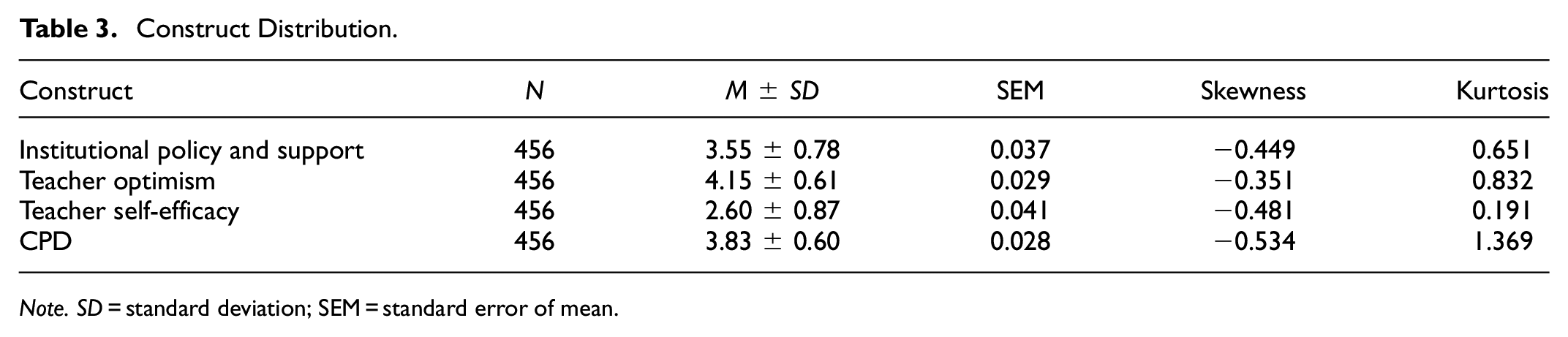
Note. SD = standard deviation; SEM = standard error of mean.
Reliability and Validity Testing
An examination of the common-method-variance (CMV) is recommended to ensure the data accurately reflects the respondents’ thoughts, opinions, and experiences. Common-method bias can occur when employing singular techniques to obtain responses. Podsakoff et al. (2003) noted that CMV could impact the internal consistency and correlation within the constructs, and researchers need to determine the likelihood of bias to ensure reliability. A post-hoc instrument test utilizing Harman’s single-factor test was performed to determine if bias exists. Harman’s single-factor test is limited due to its inability to partial out method effect; however, it still provides a base for researchers to determine if further intervention is required to offset potential bias (Podsakoff et al., 2003). An unadjusted single factor loading within the instrument equated to 40.171%, indicating that a common method bias’s likelihood is statistically limited (Harman, 1976). The total explained variances for all constructs equaled 63.6%, exceeding Hair et al. (2019) recommendation that suggests a minimum of 60% be accounted for to indicate satisfactory model integration levels.
Cronbach’s alpha was performed on each construct and the entire instrument to test internal consistency reliability. While the minimum acceptance threshold varies among researchers and study purpose, .7 is often cited in the literature (Hair et al., 2019). The Cronbach’s alpha ranged from .841 to .955, while the entire instrument was .945. Each construct exceeded the recommended 0.7 benchmarks for internal consistency, allowing for analysis of validity. Convergent validity assesses the strength that two measures within the same concept are mutually related (Hair et al., 2019). Convergent validity can be examined within CFA though composite reliability (CR) analysis and average variance extracted (AVE). Hair et al. (2019) recommended that CR > .7 for internal consistency and validity be achieved for each construct. The CR for the instrument ranged from .83 to .956, surpassing the minimum requirement. AVE represents the average variance explained of a construct through its selected items, with AVE > .5 per construct considered a minimum standard for convergent validity (Hair et al., 2019). The constructs’ AVE ranged from .54 to .65, meeting the AVE > .5 requirements.
Discriminant validity was tested with three measures, maximum shared variance (MSV), average shared variance (ASV), and Fornell-Larcker’s criterion for discriminant validity. Hair et al. (2019) stated that discriminant validity for an instrument could be defined as AVE > MSV > ASV. A construct’s AVE must exceed .5 and be greater than its MSV value while simultaneously having an MSV value larger than its ASV. Table 4 shows that all constructs meet Hair et al.’s (2019) criteria for discriminant validity. Fornell and Larcker (1981) proposed that discriminant validity can be achieved if the square root AVE is larger than all observed construct correlations. If the square root AVE is larger than the observed correlation, an acceptable level of statistical independence among constructs is achieved. Table 4 reveals that all constructs’ squared AVE exceed their related correlations, meeting the requirements for discriminant validity.
Validity and Reliability Tests.

Note. CR = composite reliability; AVE = average variance extracted; MSV = maximum share variance; ASV = average shared variance.
Significant at .01 (two-tailed). Bold and italic represents the AVE square root.
Hypotheses Testing with a Structural Equation Modeling (SEM)
Structural equation modeling (SEM) is an extended form of factor analysis, performing a series of statistical tests to define and model complex relationships between observed and unobserved variables. Byrne (2020) differentiated SEM from exploratory analysis as a series of multivariate techniques that are confirmatory instead of exploring model fit. According to Hoyle (2012), SEM is a statistical technique that tests hypotheses examining relationships between observed and latent variables through a causal model.
Model Fit Indices
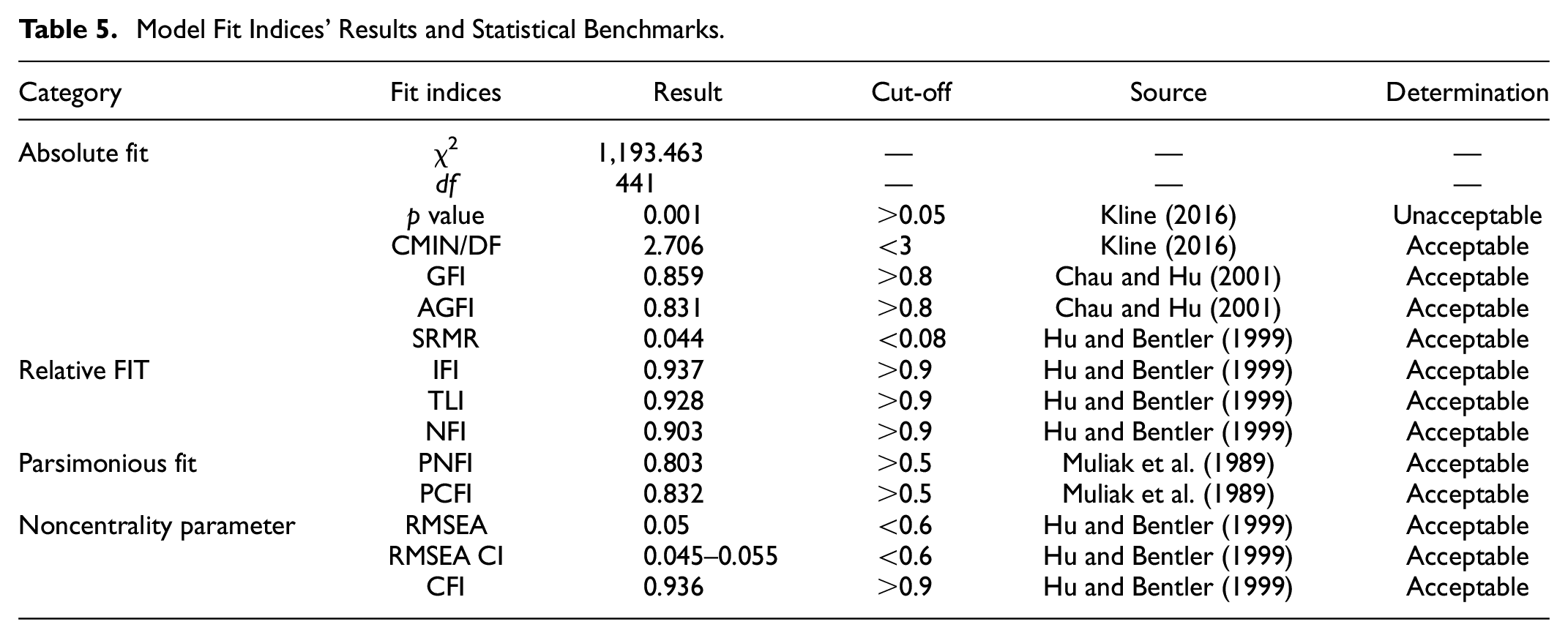
In SEM, a series of model fit tests must occur to determine the model intended on being utilized is acceptable. This study performed numerous model fit tests to determine absolute fit, relative fit, parsimonious fit, and noncentrality-based fit. Table 5 shows the results of all the model fit indices, the statistical benchmarks for acceptance, the source of the statistical benchmark, and then the determination for the study. Except for the chi-squared test, all model fit results meet or exceed the requirements for model acceptability. The failure to achieve the required demands of the chi-square criteria was expected as chi-square rarely fits under practical situations due to the test’s sensitivity to large sample sizes (N > 200; Babyak & Green, 2010). By excluding the interpretation from the chi-square goodness-of-fit, the results of all other model fit tests indicate the designed study model is acceptable. The R-squared assessment of the model indicates a value of R2 = .543 and an adjusted R2 = .54 at p < .001. The findings show that the variables represent 54% of the variance of CPD and the data found is considered signficant. With more than 50% of the variance being explain by the three independent variables, the model can be considered a measurement of CPD.
Model Fit Indices’ Results and Statistical Benchmarks.
Hypotheses Testing
A SEM was developed with IBM AMOS V26 to test hypotheses and examine the relationships between variables. H1 hypothesized that instructor optimism significantly impacts Chinese university instructors’ perception of their CPD opportunities (Figure 1). The findings indicate that optimism significantly impacts the instructor’s CPD perception (β = .645, SE = 0.092, p < .001), supporting hypothesis H1. H2 hypothesized there is a positive impact of institutional policy and support on instructors’ perceived CPD opportunities. Policy and support had a significant positive impact with β = .2, SE = 0.045, p < .001, supporting H2. H3 hypothesized that instructor self-efficacy would positively impact instructors’ CPD perceived opportunities; however, results indicated nearly no impact with β = −.031, SE = 0.028, p = .373. H4 hypothesized the impact institutional policy and support have on instructor optimism. The results indicate β = .652, SE = 0.044, p < .001, resulting in H4 being supported. Institutional policy and support were additionally hypothesized to impact instructors’ self-efficacy. The results indicated no significance between the two variables, with β = .032, SE = 0.053, p = .624, (Table 6). Further analysis of the impact institutional policy has on CPD can be performed through specific and total indirect effect, where institutional support and policy, through the mediator optimism, has a significant positive impact on CPD with β = .358, SE = 0.064, p < .001. The specific indirect effect of support and policy with teacher self-efficacy as a mediator has virtually no impact on CPD with β = −.001, SE = 0.003, p = .526. Therefore, the total indirect effect policy and support had on CPD through the two identified mediators is significant with β = .357, SE = 0.064, p < .001. The total effect policy and support had on CPD is significant with β = .557, SE = 0.062, p < .001.

Pathway analysis of the model (N = 456).
Path Analysis of the SEM for the Total Sample (N = 456).

Significant at the .01 level (two-tailed). Bootstrap (2,000 95% CI)
Demographic Significance
An examination of respondent demographics was performed to determine if a significant difference exists between groupings. For gender, the MANOVA results indicated a significant difference between genders (Wilks’λ = .978; ρ = .041; η2 = .022). Further examination showed that men felt their departments were more individually driven, that tasks were an obligation and that their agency within the classroom was limited when compared to female instructors (F1 = 6.02; ρ = .015, F2 = 7.639; ρ = .006, and F3 = 9.571; ρ = .002, respectively). A MANOVA examination of instructor age indicated significant differences among the groupings (Wilks’λ = .912; ρ = .001; η2 = .03). Follow-up ANOVAs indicated that significance existed within institutional policy and support (F = 4.589; ρ = .004). Younger instructors (under 30 years old) responded the strongest in every question regarding the degree of support afforded by the university, with an overall mean for the support variable of μ = 3.859; standard deviation = ±0.67. The three remaining groups had a mean range of μ = 3.44 to 3.57; SE = 0.69 to 0.084. About 12 of the 13 support indicators showed a significant difference between younger instructors and the remaining three groups. Item 12, I can talk freely to colleagues about difficulties, was the lone item that maintained no significant difference between the age groupings. Excluding the youngest instructor category, no significance exists.
Examining education-level responses indicated a significant difference (Wilks’λ = .914; ρ = .001; η2 = .03). Further analysis indicates that significant differences exist with institutional support (F1 = 5.59; ρ = .001). Instructors with an undergraduate degree felt they were supported significantly higher than those with higher degrees. Individual indicators showed a significant difference in 10 of the 13 items, with the exceptions of item 5 (allocation of resources), item 10 (incentives), and item 13 (speaking openly with leadership). Significant differences additionally existed among the instructor title and years worked (as an instructor) categories (Wilks’λ1 = .927; ρ = .019; η2 = .025 and Wilks’λ2 = .887; ρ = .001; η2 = .029). The difference existed in respondents’ thoughts regarding teacher self-efficacy (F1 = 4.071; ρ = .007 and F2 = 5.817; ρ = .001). Instructors that maintained no formal title indicated they had less overall perceived self-efficacy, resulting in significant respondents feeling the department is individually motivated (item 1). When analyzing the difference in responses by years worked, individuals between 11 and 15 years indicated they perceived they had low self-efficacy compared to the other groups. Compared to individuals with more than 15 years of experience, respondents with 11 to 15 years experience felt significantly less in-class agency (item 4) and a more substantial feeling to complete tasks simply because of obligation (item 2). Responses categorized by years at the respondents’ current institution and based on respondents’ department or faculty showed no significant difference in responses among the variables.
Discussion
The Education Modernization Plan 2035 plan and the preceding policy, China’s National Plan for Medium and Long-Term Education Reform and Development (2010–2020), sparked considerable research into teacher professional development by Chinese academic researchers. However, this study’s systematic review has indicated that most of the research concentrated in K12, with significantly less inquiry into Chinese HEIs. To bridge the literature gap, this study examined instructor optimism, institutional policy and support, and instructor self-efficacy’s effect on CPD in Chinese HEIs. In this section, the article will discuss the study’s limitations, interpret the findings, and place them into context with other studies.
Interpretation of Findings
The questionnaire employed in this study was designed and tested specifically for Asian education systems. The Chinese educational hierarchy, social and cultural norms, and expectations by educational stakeholders differ considerably from international counterparts; thus, examining current conditions with an instrument conceptualized from regionally specific literature may yield more insightful results. As the Chinese education system undergoes significant changes, Chinese HEIs must conform to enacted policies, or institutional leadership could face sanctions (Zhu, 2019), resulting in considerable pressure to perform tasks quickly. Institutions are now challenged by determining the appropriate procedures and policies to meet the governmental agenda while supporting their instructors’ development.
Academic Optimism
The SEM in this study indicates academic optimism has a significant direct positive impact on CPD (β = .645, p < .001). These findings support L. Li, Hallinger, and Ko (2016), L. Li, Hallinger, and Walker (2016), and S. Liu et al. (2016) assertions that academic optimism is significantly influential toward CPD in a Chinese context. The SEM findings indicate that academic optimism is significantly influenced by institutional policy and support (β = .652, p < .001), further supporting findings by L. Li, Hallinger, and Ko (2016), L. Li, Hallinger, and Walker (2016), and S. Liu et al. (2016). The large effect in the study exceeds the indicated impact noted in previous literature, where the effect size ranged from weak to moderate. and S. Liu et al. (2016) finding that learning support significantly affects trust (β = .615, p < .001) is more aligned with the findings in this study. The lower effect found in other studies may be related to the study population, with L. Li, Hallinger, and Ko (2016), L. Li, Hallinger, and Walker (2016), and S. Liu et al. (2016), and P. Liu’s (2021) studies focusing on K12 education.
The extended hierarchical structure in universities may indicate that communication is even more significant in forming trust and faculty efficacy as policies are often through a leadership proxy (Lai et al., 2017). The non-direct flow of policies can create group cognitive dissonance, potentially hindering optimism growth. Zhu and Guo (2021) noted that China’s education system is undergoing dramatic restructuring; thus, leadership must be more active in relying on these directives to ensure success. With changing educational demands at the governmental and institutional level in China, institutions must expand their efforts to communicate new policies to the faculty; otherwise, HEIs may suffer long-term damage to their instructor’s academic optimism, specifically trust and collective efficacy. As this study indicates, policy and support significantly affect academic optimism; academic quality could suffer pronounced declines due to unclear expectations in a rapidly changing environment.
Institutional Policy and Support
In literature, the examination of instructor CPD investigates numerous factors with leadership being the most frequently used. Studies define and examine leadership through various lenses, often trying to measure leadership styles and their effect on CPD. While this study incorporated leadership, the construct of institutional policy and support expanded its influence to include elements of how institutions promote growth through communication, resource allotment, governance, and their encouragement or promotion of CPD. Although the definitions in studies differ, many of the items in the related quantitative studies ask the same questions; thus, statistical comparisons are still relevant. The SEM indicated that institutional policy and support had a direct effect of β = .2, p < .001, which closely resembles L. Li, Hallinger, and Walker (2016) results of β = .146, p < .001. The total effect of institutional policy and support within this study (β = .557, p = .001) exceed the findings by L. Li, Hallinger, and Walker (2016) but mirror findings by L. Li, Hallinger, and Ko (2016), Cheng (2017), and S. Liu and Hallinger (2021). A deconstruction of S. Liu et al.’s (2016) learning-centered leadership construct shows that the sub-constructs of vision, support, and managing programs directly affect CPD like this study’s institutional policy and support with β = .162 to .273.
The indirect effect of academic optimism and instructor self-efficacy plays distinctively contrasting roles in institutional policy and support of CPD. Academic optimism mediates a significantly positive effect β = .358, p < .001. The significantly strong mediation relates to the direct effect institutional policy and support has on an instructor’s academic optimism (β = .652, p < .001). If an institution contributes substantial resources (time and money) to the development of an instructor’s trust, those individuals are more likely seek to build and maintain a collective ideology. These findings correspond with Hoy et al. (2006) assertions that instructor trust will strengthen a collective academic-oriented environment. The findings of both direct policy effects on academic optimism and the mediated effects of institutional policies through academic optimism on CPD support Cheng’s (2017) and P. Liu’s (2021) findings. Although previous studies primarily focused on K12 education, Chinese university instructors build substantial optimism when an institution creates policies and supports instructors directly. The mediating effect of instructor self-efficacy on institutional support toward CPD was not significant, resulting in virtually no indirect effect (β = −.001, p = .375). The non-significant yet negative direct effect of instructor self-efficacy on CPD was a substantial causal effect on the mediating impact. As self-efficacy is connected to the level of perceived agency an instructor has over the curriculum and instruction methodology, an assertive and authoritative leadership design may reduce an instructor’s perception of self-determination (Redacted). This study’s findings support L. Li, Hallinger, and Ko (2016) and S. Liu et al. (2016) that institutional leadership is a significant factor in the development, promotion, and effectiveness of CPD in Chinese universities. Although the institution’s direct effect is considered weak, its strong influence on academic optimism indicates that the overall effectiveness of any directives (especially CPD) is directly connected to the institution’s promotion and support methods. Traditional structures in Chinese organizations may resort to a top-down methodology; however, leadership focuses on collectivistic methods that engage more with soft skills to form stronger alliances (Hallinger & Lu, 2014; S. Liu & Hallinger, 2021). S. Liu and Hallinger (2021) noted that academic leadership could no longer rely on legitimate power to compel instructors to engage in CPD. The blind following of previously employed instructions is less effective nowadays, requiring a realigned power structure and methods of persuasion.
Instructor Self-Efficacy
This study has indicated that institutional policy and support have no significant effect on instructors’ self-efficacy, nor does instructors’ self-efficacy significantly effect CPD. Previous studies examining the relationship with leadership and instructor self-efficacy (S. Liu & Hallinger, 2018, 2021; Zheng et al., 2019) and instructor self-efficacy effect on CPD (S. Liu & Hallinger, 2018, 2021) have asserted that a significant relationship exists, contradicting the findings from this study. However, research is not conclusive, as other studies have shown a weak relationship (Kulophas et al., 2018) to no significant relationship (Hoque et al., 2020; Lehman, 2021; Zheng et al., 2019) between leadership and instructor self-efficacy and self-efficacy toward CPD.
Culture may be another factor that indirectly influences leadership’s significance toward self-efficacy and CPD in Chinese academic institutions. The Chinese culture is linked to a collective community ideology, promoting social harmony and growth over individualistic motivations (Markus & Kitayama, 1991). This socially driven cognitive norming may account for the significances of academic optimism but is not found in the instructor self-efficacy construct. However, this assertion of cultural nuances limiting the individualism of instructors appears marginalized with distributed, instructional, or learning-centered leadership strategies (S. Liu & Hallinger, 2018, 2021).
Lerner (1985) coined the term earned self-efficacy, the development of self-confidence and individual perseverance over numerous years of teaching. Earned self-efficacy can additionally be linked to the instructor’s title, the belief of an individual’s competency through their position. University instructors may oppress their CPD motivations to avoid perceived embarrassment by admitting development is needed, resulting in long-term demotivation or performance decline in the classroom (Hiew & Murray, 2018). Experienced instructors also create management barriers, attempting to reduce scrutiny and evaluation that may question their performance capacity (Hoque et al., 2020; Rahmany et al., 2014). Excessive workloads and work-life complexities may also inhibit an instructor’s desire to seek CPD, as extended professional development hours may hinder job roles or family responsibilities. Finally, decreased funding and the implementation of faculty-wide CPD programs, as a cost-saving strategy, may negatively impact instructor CPD motivation. This study indicated that there was a significant difference based on the years of service and the perceived degree of self-efficacy an instructor maintained. Instructors that were considered mid-term (10–15 years of service) felt significantly more negative in their environment compared to the other respondent groups. Individuals in this service bracket are those often considering career advancement or change, more reflective of the conditions they face and the options available to them. Newer (younger) instructors are significantly more receptive to institional support; however, mid-career Chinese instructors show more frustrated with their options and overall career satisfaction (Jiang et al., 2017). Findings indicated in this study show instructors between 10 and 15 years peform tasks due to obligation rather than being individually motivated. The signficant difference with responses in obligation output rather than self-motivation indicate that mid-career instructor internal process is to maintain collective harmony over growth, reducing perceived CPD need.
Under Knowles’ Theory of Andragogy [ALT] (1984), the needs of instructors drastically change with experience; thus, professional development must relate to varying learning needs. These potential implications do not infer K12 instructors lack the same complications as Chinese HEI instructors; however, environmental conditions and underlying competency expectations may exert differing stressors. The Chinese government has acknowledged in 2020 that experienced HEI instructors are no longer focused on CPD development and are rarely influenced to internalize efficacy from leadership (Zhu & Guo, 2021). The government has since recommended that HEIs realign their CPD strategies, de-emphasizing promotion and rewards through publication, instead CPD is connected to instructor capacity and performance (Zhu & Guo, 2021). These government initiatives seek to promote self-efficacy as the primary motivator for CPD, rather than a strict directive approach currently used.
Limitations of Study
The research had several notable limitations related to the respondent selection, study size, and research design. The convenience sampling of instructors from four e-communities resulted in a skewing of the respondent population toward relatively young, less experienced, female instructors primarily working in the arts and humanities. Secondly, as this study focuses specifically on Chinese HEIs, these findings may not be generalizable for teachers in K12 schools. Thirdly, findings in the study indicate instructor self-efficacy is neither influenced by institutional policy and support nor influences CPD; therefore, further investigation, incorporating qualitative methods, is necessary to determine underlying causes impacting self-efficacy’s significance. Finally, while numerous tests were performed to ensure study validity, redesigning variable paths and mediators could alter the statistical outcomes found in this research, as this study cannot validate causality in the variable relationships.
Conclusion
This study has contributed several elements to existing literature. This study’s examination of Chinese university instructors, an under-analyzed sector in CPD research, adds an essential element to the professional development discussion. Second, this study mapped the effect paths from institutional policy and support, academic optimism, and self-efficacy to CPD. Findings showed that university policy and support have a substantial effect on instructor academic optimism and CPD. Findings contradict literature’s results regarding the influence of institutional policy and support on self-efficacy and the influence of self-efficacy on CPD. This study has proposed numerous potential causes for the dissonance between the study outcome and existing literature, encouraging further investigation.
These findings also have ramifications for educational leaders, policymakers, and university instructors. In the Chinese education system, leadership has long maintained a traditional top-down directive-oriented management style. Experienced instructors, having acclimatized to these conditions, have formed structured collective expectations that others rarely scrutinize. However, changing economic conditions and dramatically shifting government policies have significantly increased instructor anxiety (Zhu, 2019) and instructor resentment toward pronounced monitoring by leadership (Rahmany et al., 2014). If instructors are not encouraged or motivated by leadership’s supervision, as Hoque et al. (2020) noted, the overall implication would be negative. These assertions appear to be supported by this study, indicating that leadership must employ alternative strategies to motivate instructors and facilitate institutional-wide improvements.
The findings from this study suggest that university leadership must develop trust in policies through clear communication, as policy and support are significantly linked to academic optimism. Cultural focus on collective efficacy persuades instructors to develop skills to meet the expectations of faculty groupings rather than individual goals. If the institution builds trust at the group level, organizational change management will be more effective with policy introduction. However, as Hargreaves and Fullan (1992) noted, all gains will be quickly lost if leadership is disingenuous with their intentions. Development programs seeking to build instructor capacity need to integrate multiple approaches instead of a singular policy and method. By creating more task and instructor-specific development programs, the needs of a large group of instructors will be met (Knowles, 1984). The promotion of ideas or vision by leadership and policymakers may be effective in a traditional directive approach according to this study findings; however, the literature suggests that incorporating distributed or instructional-based leadership may strengthen instructor engagement (S. Liu & Hallinger, 2018, 2021). This study demonstrates that by incorporating both direct and indirect management techniques (mediated by optimism), the institution’s influence toward CPD would be more effective than a forced directive approach by leadership.
Although researchers of this study assert that instructor self-efficacy’s limited effect on CPD reflects cultural and social norms in China, the impact of self-efficacy should not be disregarded. School social climates are not static and can change with an effective policy maintained over time. Although established instructors may resist change, creating an environment that encourages personal CPD development and reflection can be developed, as newer instructors are more open to supervision and change (Hoque et al., 2020). If successful CPD programs occur through institutional support, the collectivistic nature of many instructors will eventually lead to broader adoption. Thus, if institutions encourage leadership to form stronger bonds with faculty, promoting policies and vision trusted by instructors, engagement in CPD will likely increase. While this study indicates self-efficacy is not a significant factor influencing CPD, policies that improve work climates may alter hesitancy by experienced faculty. With increased engagement in effective personalized CPD, instructor self-efficacy could increase, creating a back-channel influence that leads to instructors participating in a more active role in their CPD development.
Footnotes
Declaration of Conflicting Interests
The author(s) declared no potential conflicts of interest with respect to the research, authorship, and/or publication of this article.
Funding
The author(s) received no financial support for the research, authorship, and/or publication of this article.
