




Abstract
This research investigates the impact of lecturers’ digital literacy skills on higher education institutions. It explores how technology integration influences teaching, learning, and research while proposing strategies to enhance educational outcomes. The central issue is how lecturers’ digital literacy skills directly affect higher education institutions’ teaching, learning, research, and overall educational experience. Many lecturers need to improve using technology tools, resources, and platforms, which can hinder tertiary institutions’ educational experience and academic outcomes. Employing a mixed-method approach and utilizing t-test analysis and two-way ANOVA, this study aligns with the Technological Pedagogical Content Knowledge (TPACK) framework, emphasizing the integration of technological, pedagogical, and content knowledge for effective technology use in education. The research highlights the importance of equipping lecturers with robust digital literacy skills, enabling them to integrate technology effectively into higher education. It underscores the significance of digital literacy in reshaping the educational landscape. This study contributes to advancing knowledge, information practices, and the sustainable evolution of higher education institutions in the digital age. The findings also have practical implications for tailored professional development and curriculum design. It is important to note that this study acknowledges limitations related to sample size and qualitative focus. Future longitudinal studies can enhance our understanding of the evolving landscape of digital literacy in higher education.
Plain language summary
This plain language summary outlines our research on how university educators utilize technology, such as computers and the internet, in their teaching and research endeavors. We aimed to investigate whether educators proficient in digital tools could facilitate better teaching and foster enhanced student learning outcomes. To delve into this inquiry, we examined educators’ comfort levels with digital tools and their proficiency in integrating them into their teaching methodologies. We also explored the frequency of their usage of digital platforms and their confidence in navigating digital information. Our findings underscored that educators adept in digital tools tend to exhibit more effective teaching practices. They demonstrate greater adaptability in incorporating digital tools into their teaching methodologies, leading to more engaging student learning experiences. Moreover, educators skilled in digital communication showcased effective utilization of online platforms to interact with their students. Furthermore, we delved into how gender and work experience influence educators’ digital skills. Our research revealed that these factors can impact educators’ comfort levels with digital tools, though further investigation is warranted for a deeper understanding. In conclusion, our study underscores the pivotal role of digital literacy for educators in higher education. By enhancing their digital skills, educators can elevate their teaching effectiveness, consequently contributing to improved student learning outcomes. We aim to provide insights that can aid universities in supporting their educators in cultivating these crucial skills essential for the contemporary digital landscape.
Introduction
In today’s digital age, technology is increasingly significant in higher education institutions. Fauzan et al. (2022) highlighted that lecturers must possess adequate digital literacy skills to effectively utilize technological tools, resources, and platforms to enhance teaching, learning, and research. Complementary studies by Fauzan et al. (2022) and Rusydiah et al. (2020) have indicated the existence of various strategies for acquiring these skills and effectively using tools, resources, and technology platforms to elevate educational practices. Higher education institutions should offer regular professional development opportunities and training sessions to support lecturers in developing their digital literacy. These opportunities can include workshops, webinars, and courses on various technologies, software, and online platforms relevant to their respective fields of expertise (Minea-Pic, 2020). By enhancing their digital literacy skills, lecturers can empower themselves to employ interactive and engaging teaching methods.
Tuma (2021) advocates using multimedia elements, interactive simulations, and online discussions to captivate students’ attention and foster active participation. Moreover, lecturers must proactively keep abreast of the latest technological trends and advances in educational technology (Nguyen & Chung, 2020). This proactive approach encourages lecturers to experiment with various technology tools and platforms in a risk-free environment, allowing them to become proficient in their functionality before implementing them in the classroom. Consequently, lecturers often turn to relevant blogs, conferences, and newsletters to learn about new tools and strategies for integrating technology into their teaching. Consequently, lecturers often turn to relevant blogs, conferences, and newsletters to learn about new tools and strategies for integrating technology into their teaching.
This study’s core problem is understanding how lecturers’ digital literacy skills directly influence teaching, learning, and research. Moreover, it seeks to explore how these skills can be effectively developed and integrated to enhance the overall educational experience within higher education institutions (Stehle & Peters-Burton, 2019). Despite the growing importance of digital literacy skills in higher education, many lecturers need further proficiency in utilizing technological tools, resources, and platforms to enrich their teaching, learning, and research practices (Hamidah & Mubarak, 2020). Consequently, the impact of this deficiency on the educational experience and academic outcomes within higher education institutions warrants comprehensive investigation.
The theory proposed by Mishra and Koehler (2006), known as the Technological Pedagogical Content Knowledge (TPACK) framework, underscores the integration of technological knowledge (TK), pedagogical knowledge (PK), and content knowledge (CK) to use technology in teaching effectively. According to this theory, lecturers must possess digital literacy skills (TK) and strategically apply them within their subject-specific teaching practices (PK and CK). Prior research adopting the TPACK framework has demonstrated that lecturers with higher levels of digital literacy and the ability to integrate technology into their pedagogy achieve superior educational outcomes (Koehler et al., 2016). The digital divide, as unveiled by previous research (Soomro et al., 2020), underscores disparities in access to and usage of digital technologies among lecturers in higher education. Lecturers with limited digital literacy skills may need help effectively utilizing technology, resulting in unequal opportunities for student learning (Mardiana, 2020). Therefore, addressing the digital divide and providing adequate training can bridge this gap and enhance the educational experience. Another researcher, Wei (2023), indicated that faculty development and training programs emphasize the significance of continuous support to lecturers in developing their digital literacy skills. Effective training programs that focus on pedagogical approaches, hands-on practice, and opportunities for peer collaboration have shown positive outcomes in enhancing lecturers’ digital literacy and confidence in using technology (Reisoğlu & Çebi, 2020). In addressing this digital divide, adequate training can bridge this gap and enhance the educational experience.
Furthermore, this research delves into the relationship between lecturers’ digital literacy and various demographic factors, including gender, and work experience. By examining these factors alongside digital literacy dimensions, the study aims to comprehensively understand how different factors intersect to shape lecturers’ digital literacy skills in higher education.
Literature Review
The literature review is a critical phase of this research, involving comprehensive searches for relevant articles and studies on lecturers’ digital literacy skills and their impact on higher education institutions. The selected literature is critically analyzed to extract key findings, identify common themes, and address gaps in existing knowledge (Soomro et al., 2020). The review may also propose a theoretical framework and suggest future research directions.
Lecturers face significant challenges in developing and using digital literacy skills, including adapting to rapidly evolving technologies and the potential consequences of failing to keep up with these advancements, such as outdated instructional methods and limited use of innovative tools (Crossley & McNamara, 2016). Therefore, various strategies are employed to address these challenges to improve lecturers’ digital skills and enhance their digital literacy.
Incorporating the Technological Pedagogical Content Knowledge (TPACK) framework (Mishra & Koehler, 2006), the literature review discusses the integration of technological knowledge (TK), pedagogical knowledge (PK), and content knowledge (CK) required for effective technology use in education. This framework offers insights into how lecturers’ digital literacy (technological knowledge) influences their teaching practices (pedagogical knowledge) and subject-specific expertise (content knowledge) (Koehler et al., 2016). The literature review also references previous research that supports the claims made in the study, offering valuable theoretical foundations and empirical evidence.
Previous research by Okoye et al. (2023) on technology integration in higher education and the impact of lecturers’ digital literacy skills on teaching, learning, and research outcomes can provide evidence to support the claims made in the text. Nkomo et al. (2021) indicate that the effectiveness of technology-enhanced teaching methods, the relationship between digital literacy and student engagement or academic achievement, and the challenges lecturers face in developing and utilizing digital skills in their educational practices. Thus, to provide a comprehensive literature review, researchers would need to gather and analyze relevant studies, scholarly articles, and empirical research to establish a strong theoretical foundation and empirical evidence supporting the significance of lecturers’ digital literacy in higher education institutions. According to Haleem et al. (2022) and Nikou et al. (2022), the current issue related to this research is the need for lecturers to possess adequate digital literacy skills to effectively navigate and utilize various technological tools, platforms, and resources in their teaching, learning, and research practices. The digital landscape continues to evolve rapidly, introducing new technologies and educational innovations (UNICEF, 2021). Therefore, lecturers must keep up with these advancements to maintain the quality and effectiveness of their educational delivery. Furthermore, the increased reliance on technology for remote teaching and learning highlights the significance of lecturers’ digital literacy in influencing student engagement, academic performance, and overall institutional success. Lecturers who are proficient in digital literacy can create interactive and dynamic learning environments that cater to diverse student needs, leading to enhanced student outcomes (Coman et al., 2020). However, some challenges must be addressed, including ensuring equal access to technology and digital resources for both students and lecturers, providing comprehensive and ongoing professional development opportunities, and overcoming resistance to change or reluctance to adopt technology in educational practices.
Furthermore, the research gap presents valuable opportunities to contribute to digital literacy in higher education. Reuter et al. (2021) stated that the COVID-19 pandemic has led to a significant shift toward online learning; there needs to be longitudinal studies examining this transition’s long-term effects on student learning outcomes and institutional performance. Longitudinal research could provide valuable insights into the sustained impact of online learning on student engagement, academic achievement, and retention rates over an extended period. Research by Haleem et al. (2022) argued that another research gap lies in exploring the dynamics of faculty-student interaction in digital learning environments. With the increased reliance on technology for teaching and communication, there is a need to investigate how the digital format influences lecturer-student relationships, feedback mechanisms, and overall student support (Timotheou et al., 2023). Understanding the nuances of faculty-student interaction in online and blended learning settings could help identify effective strategies to foster meaningful connections and enhance the learning experience for students.
Purpose and Research Questions
The study aimed to assess lecturers’ digital literacy skills and understand their impact on higher education institutions. It sought to explore how technology integration influences teaching, learning, and research, proposing strategies to enhance educational outcomes and institutional performance. Moreover, the research questions are:
What is the current level of lecturers’ digital literacy skills, and how does it impact teaching and learning in higher education?
What are lecturers’ main challenges in developing and using digital literacy skills, and what strategies can enhance their digital proficiency?
Hypothesis
A higher level of lecturer digital literacy skills correlates with increased teaching effectiveness and learning outcomes in higher education institutions.
There is a challenge for lecturers in developing and leveraging digital literacy skills to benefit from targeted training strategies and programs, leading to improved digital skills and more effective technology integration into their teaching practice.
Methodology
We adopted a mixed-methods research approach to comprehensively investigate the impact of lecturer’s digital literacy on higher education institutions. This combined methodology enabled us to acquire quantitative and qualitative insights, facilitating a thorough exploration of the research topic. We employed SEM PLS to assess quantitative data in the quantitative phase, while the qualitative phase utilized ATLAS.ti. 9 software for analysis.
Instrumentation Digital Literacy Assessment Questionnaire
For the quantitative phase, we distributed structured survey questionnaires to a cohort of 104 lecturers. The questionnaires were disseminated electronically through email or Facebook messages. Participants received a concise overview of the study’s objectives and were invited to participate voluntarily by completing the online survey (Faleiros et al., 2016). Rigorous measures were taken to ensure data privacy and confidentiality, with assurances that responses would remain anonymous and solely used for research purposes.
Descriptive statistics were employed to gauge central tendency mean and standard deviation, providing an overview of digital literacy levels, technology use frequencies, and attitudes (Guetterman, 2019). In addition, inferential statistics, including ANOVA, correlation analysis, and regression analysis, were utilized to explore relationships among variables (Taherdoost, 2018). It connections such as the correlation between digital literacy and teaching effectiveness or student engagement.
Lecturer Digital Literacy Interview Guide
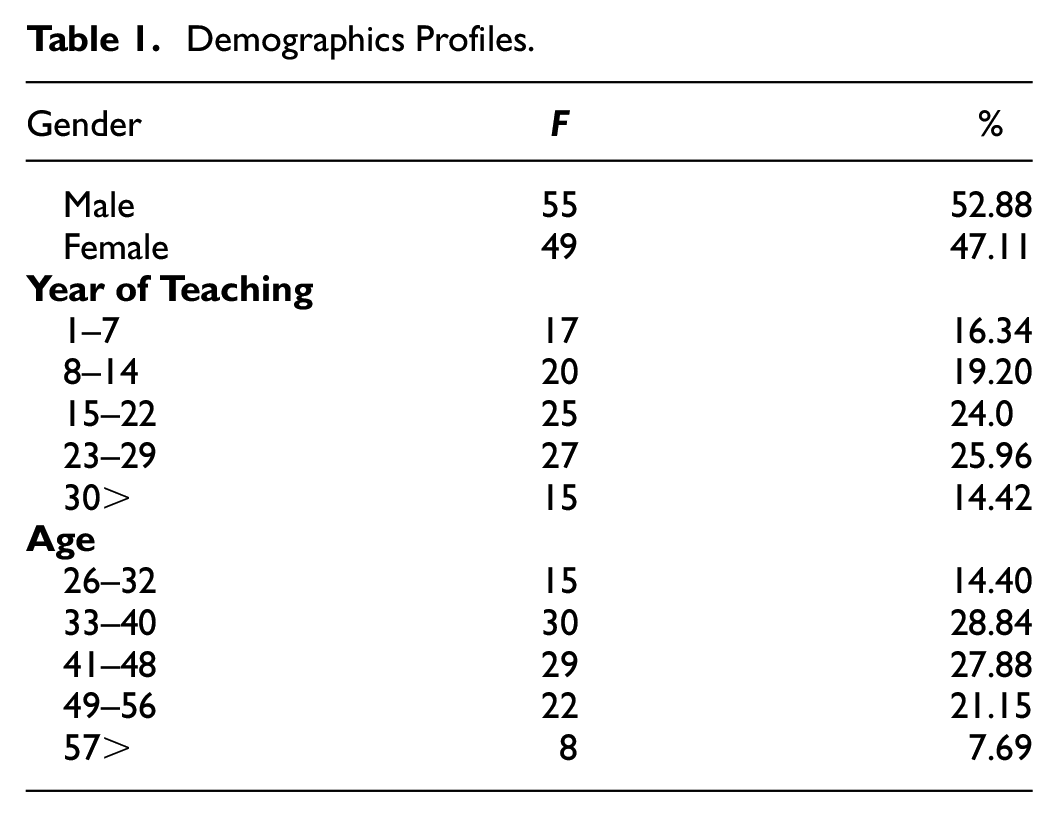
Shifting to the qualitative phase, we adopted a purposive sampling strategy to select a subset of participants from the initial cohort (Gill & Baillie, 2018). Six lecturers, representing diverse academic disciplines and experiences, were deliberately chosen. Individually conducted semi-structured interviews were arranged at mutually convenient times, either in person or via video conferencing. Participants were encouraged to candidly share personal insights, challenges, and strategies associated with digital literacy and technology integration (Flick, 2014). Thorough documentation was maintained during the interviews to capture participants’ perspectives accurately. To facilitate the division of participants, we created a demographic profile shown in Table 1.
Demographics Profiles.
Analysis and Results
In this analysis, we, first ascertain the validity and reliability of the questionnaire data. To ensure the quality and consistency of the data collected in this study, we used Cronbach’s Alpha to check the internal consistency (reliability) and construct validity of the questionnaires. In calculating the internal consistency of the questionnaire items examined using Cronbach’s alpha addition, this study also calculates the reliability value based on each construct’s dimensions (independent and dependent variables). The Cronbach’s alpha value in this study was above .7 and acceptable. Thus, researchers do not want to remove it from this research. The reliability and validity are shown in Table 2:
Data Validity and Reliability.

Next, the researcher calculates the reliability and validity of each dimension used for further research. Table 3 shows the calculation of the reliability and validity of each variable.
Descriptive Statistics of Perceived Impact of Lecturers’ Digital Literacy Skills in Higher Education Institutions.

For dimension proficiency in digital tools, the α is .543, which is below .7; it means that the lectures are inconsistent in filling out the questionnaire for dimension one in digital competence. It can be said that the lecturer ignored in answering the question, or maybe even though the lecturer understood the meaning of the item dimension one digital competence, in the interview, it was stated that some lecturers were not proficient, and some were doubtful. So, the result of these dimensions is 0.543. Likewise, confident in evaluating digital information, with a value of 0.691. In the interview, the lecturer stated that they were not confident in evaluating the information, whether the evaluation was as desired or in answering the item, the lecturer was hesitant in answering the information evaluation.
In measuring descriptive statistics, researchers use frequency and percentage to measure central tendency (mean, median, and mode) dispersion (standard deviation, range), and literacy level descriptions. Table 3 shows these measurements. Of the 104 respondents, 55 male and 49 female, it is described as follows:
The Table 4 presents the descriptive statistics of frequency and percentage for the dimensions of lecturers’ digital literacy and the impact of higher education institutions, offering insights into the distribution and characteristics of the responses provided by the participating lecturers.
Descriptive Statistics of Frequency and Percentage.

In the Digital Competence dimension, lecturers reported a mean proficiency level of 3.39 (on a scale of 1 to 5) in using digital tools effectively. Additionally, around 62.2% of the respondents indicated their comfort with utilizing these tools for teaching and research purposes, with a mean score of 2.99. In the Pedagogical Integration dimension, lecturers demonstrated a mean score of 3.29 for integrating digital technologies into their teaching strategies. Around 60.6% of the participants reported that they were confident in adapting their teaching methods to effectively incorporate digital tools, as reflected by a mean score of 3.37.
Regarding Digital Communication, lecturers’ responses indicate a mean score of 2.42 for the frequency of using digital platforms. Additionally, 57.7% of participants reported being skilled in digital communication tools, representing a mean score of 3.44.
Regarding Information Literacy, lecturers expressed confidence in evaluating digital information, with a mean score of 3.54. Moreover, approximately 53.8% of respondents indicated their proficiency in finding digital resources for teaching materials and research, reflected in a mean score of 3.24.
Turning to The Impact on HEI, lecturers’ self-perceived teaching effectiveness received a mean score of 3.43. Regarding learning outcomes, lecturers reported a mean score of 3.21, which signifies their perceived impact on students’ academic achievements. For the dimension of “Institutional Performance,” relating to teaching and research, the participants reported a mean score of 3.09.
These descriptive statistics provide valuable insights into the distribution of responses across the different dimensions of lecturers’ digital literacy and its impact on higher education institutions, offering a preliminary understanding of lecturers’ perceptions and experiences with various digital literacy aspects in the context of higher education institutions (Kaliyadan & Kulkarni, 2019; Yellapu, 2018).
Table 5, Descriptive Statistics Two-way ANOVA based on Work Experience and Age and Gender, specifically examines the interaction effects of work experience, age, and gender on each dimension of digital literacy lecturers. This analysis helps to understand how these three factors affect the average of the variables investigated.
Descriptive Statistics Two-ways ANOVA Based on Work Experience and Age and Gender.

Within each dimension, the associated “Mean Square,”F-value, and “Sig. (2-Tailed)” value is displayed. The Mean Square measure of variance represents the variability between groups; the F-value is the ratio of the variance between groups to the variance within groups. The value of Sig. (2-Tailed) indicates the statistical significance of the interaction effect.
The value of Sig. (2-Tailed) is below the significance level of .05, and indicates that the interaction effect is statistically significant, suggesting that the combined influence of work experience, age, and gender significantly impacts digital literacy skills as measured in the dimension certain.
Thus, overall, the results obtained in this analysis provide insight into how the interaction of work experience, age, and gender of the study’s participants, contributes to differences in digital literacy skills in various dimensions. The statistically significant effect highlights that these factors do not operate independently but instead interact to influence the observed differences in digital literacy skill suggestions among different groups created by a combination of work experience, age, and gender.
After conducting a two-way ANOVA analysis useful for exploring interactions between factors, the researcher will conduct a quantitative analysis using linear regression analysis to dig deeper into the relationship between key researcher variables. The purpose of linear regression analysis is to examine the specific predictor variables impacting the outcome variables of interest more closely. Thus, researchers will quantitatively assess how much digital literacy skills affect teaching effectiveness, learning outcomes, and institutional performance.
The application of linear regression measured the relationship between predictor variables, such as technological competency, pedagogical integration, digital communication, and information literacy, and the outcome variables were teaching effectiveness, learning outcomes, and institutional performance. As such, this analysis provides insight into the strength and direction of the relationship and offers a quantitative perspective that complements the qualitative findings from the interviews.
By combining an analytical approach between two-way ANOVA that explores interactions and differences between groups, linear regression focuses on understanding the magnitude of the significance of individual relationships. The results of the linear regression analysis are presented and discussed in the next section and provide valuable insights into the role of digital literacy in shaping various aspects of teaching, learning, and institutional performance. This mixed methods approach will thoroughly understand the research question from a quantitative and qualitative perspective.
Table 6 presents the results of the linear regression analysis conducted to explore the relationship between lecturer digital literacy and its impact on tertiary institutions.
Descriptive Statistics Regression Linear Lecturers Digital Literacy and The Impact of Higher Education Institution.
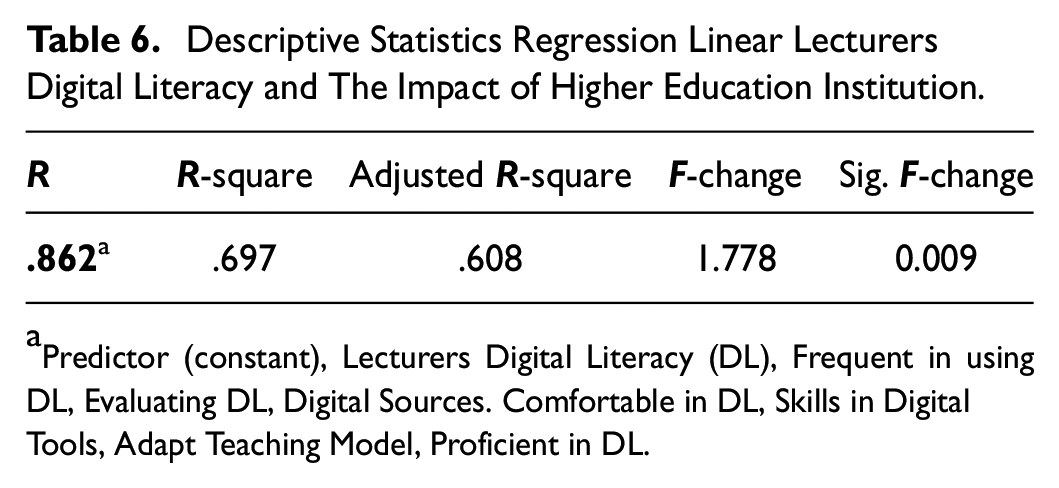
Predictor (constant), Lecturers Digital Literacy (DL), Frequent in using DL, Evaluating DL, Digital Sources. Comfortable in DL, Skills in Digital Tools, Adapt Teaching Model, Proficient in DL.
The coefficient of multiple determination (R) shows the strength of the relationship between the predictor variable (digital literacy dimension) and the outcome variable (impact on tertiary education)—R = .862a, indicating a strong overall relationship between these variables. R-Square = .697 indicates the proportion of variance in the outcome variable that predictor variables can explain. About 69.7% of the variability of the impact on tertiary institutions can be explained by variations in lecturer digital literacy dimensions. Meanwhile, Adjusted R-Square = .608 represents the number of predictor variables and adjustments to R-Square. This value provides a more accurate estimate of the variability proportion while considering the model’s complexity. Then, the F-Change Statistic (1,778) represents the change in the F statistic on the predictor variable added to the model, thereby helping to assess the overall significance of the model. And Sig. F-Change is the significance level associated with the F-Change statistic, which is 0.009 < 0.05. It shows that the model, including the predictor variables, is statistically significant.
In the next section, the qualitative aspects of this research will be explored using Atlas 9 ti, to explore the insights and narratives shared by selected participants. A qualitative approach will provide a deeper understanding of the challenges, strategies, and perceptions related to digital literacy and their impact on higher education. By, by utilizing the Atlas.9 ti, this research effectively analyzes and interprets the interview qualitative data, which then generates the findings of this study.
Six informants were interviewed in qualitative research according to their experiences and perspectives. These questions are:

And this is the diagram of the qualitative result.

The diagram of the qualitative result (Giang 2022; Plantin Ewe, 2020).
Qualitative results on integrating digital tools into teaching show that some participants expressed challenges in integrating digital tools into teaching practice. For example, “Of course. I often have trouble. However, my colleagues help me a lot. Thank you for that.” Another participant indicated this sentiment: “This is the most difficult. Sometimes, I don’t get the right tools to integrate digital tools into my teaching. I don’t even know how to use them. Students know more than I do.” This response highlights the struggles of lecturers in adapting digital tools for teaching purposes. This qualitative data sheds light on the complexity of the challenges and the reliance on peer support to overcome them.
Many participants experienced technical problems or difficulties when using digital tools, such as software glitches or connectivity issues. With this problem, participants experience frustration and disrupted learning experiences. Furthermore, some participants believed there was a need for more training to improve professional development in using digital devices effectively. Participants need more preparation to integrate digital tools effectively into teaching due to inadequate training opportunities or very short training times. Furthermore, many participants experienced resistance to change, in which case they hesitated to adopt new technologies in favor of traditional teaching methods.
Some participants expressed concerns about integrating digital devices into their teaching. For example, participant A, a lecturer with moderate digital literacy skills, stated, “I’ve been teaching in a certain way for many years, and it’s hard for me to suddenly switch to using digital tools, and I’m worried that it might affect the quality of my teaching.”
Participant B, another participant with low digital literacy, echoed a similar sentiment, “I feel comfortable with current teaching methods, and I worry that using technology might complicate things because it is easier to stick to what I know.”
This statement from the participants underlined the reluctance of some participants to get out of their comfort zone and explore new teaching methods involving digital devices. They experience fear of the potential negative impact on teaching quality, and student involvement is most evident in their fear. Resistance to change is common, especially among those who have established teaching practices over time. According to Giang (2022), the qualitative findings provide insight into student expertise and offer participants’ reflections on their implications. Teachers view student expertise as an opportunity for collaborative learning, where lecturers and students can share knowledge and skills (Plantin Ewe, 2020). Some examples above exist where participants admit they feel a little vulnerable because they depend on student assistance in digital matters.
This research is very interesting because the qualitative findings align with the quantitative data collected from the survey, which showed variations in participants’ responses regarding their comfort and proficiency with digital tools. This alignment between qualitative and quantitative reinforces the credibility of research findings showing that student engagement in digital literacy is not an isolated incident but an important trend in the educational landscape.
Discussion
This research aligns with the theoretical framework proposed by Mishra and Koehler (2006), the Technological Pedagogical Content Knowledge (TPACK) framework. This research finds resonance in the basic principles of this framework, which emphasize the important role of integrating technological knowledge, pedagogical knowledge, and content knowledge for the effective use of technology in education (Mishra & Koehler, 2006). Within the TPACK framework, the investigation offers a lens to understand the complex interactions of lecturers’ digital literacy (technological knowledge) and the profound impact on their teaching practice (pedagogical knowledge) and domain-specific skills (content knowledge) (Koehler et al., 2016). The findings obtained in this study underscore the importance of equipping lecturers with strong digital literacy skills, which in turn make it possible to integrate technology into the higher education environment (US Department of Education, 2017). This integration facilitates increased student engagement, academic achievement, and overall institutional performance (Muslimin et al., 2023). In doing so, our research contribution to advancing theoretical understanding in disciplines aligns with the core principles of the TPACK framework. It broadens its application in the context of lecturer digital literacy and technology integration.
In hypothesis 1, the researcher postulates that increasing lecturer digital literacy competence will positively correlate with increased teaching efficacy and learning outcomes in tertiary institutions. In hypothesis 2, the researcher argues that lecturers facing obstacles in honing and applying digital literacy skills can take advantage of specific strategies and targeted training initiatives. Both hypotheses lead to increased demonstrable digital competence, facilitating more efficient assimilation of technology into their pedagogical practice.
Quantitative results of Cronbach Alpha dimension proficiency in digital tools found that dimension proficiency in digital tools is 0.543, and dimension confidence in evaluating digital information is 0.691, which is below 0.7; When the participants filled out the questionnaires, the digital competence dimensional proficiency in digital tools and information literacy (dimensional confidence in evaluating digital information) were inconsistent. It is stated that the lecturers were reluctant to answer the question, even though they understood the meaning of the item dimension “proficiency in digital tools” in variable digital competence and the dimension “confident in evaluating the information” in information literacy. The interview stated that some lecturers needed to be more proficient, and some were doubtful. In the qualitative research method, the participants indicated they got stressed when using digital tools, especially for research.
Moreover, they must improve and keep up with the latest teaching trends, tools, and practices. Plantin Ewe (2020) stated that participants’ every action or lack of action showed frustration and correlated with their effectiveness. Lecturers lack self-confidence and are likelier to give up in difficult relationships with digital competencies. In addition, lecturers need to develop their knowledge in digital competence and feel that using digital technology hinders them from teaching (Almulla, 2020). Therefore, with this foundation, lecturers need knowledge development, explanation, mutual support, and order or conduct adaptive training to expel related cognitive processes.
The descriptive frequency is fine because the frequency level in using digital literacy shows a good value. The average value of each variable and dimension shows a positive value. Nikou & Aavakare (2021) states that a positive frequency value means that the event or phenomenon being measured has occurred or is in the data set, and this positive frequency value means that certain events have been counted or observed many times. It is a common concept in statistics and data analysis, where frequency is used to quantify how often certain events or values appear in a dataset (Freund et al., 2010).
In Table 4, this study uses a two-way ANOVA approach based on work experience, age, and gender yang mana key statistical indicators, including Mean Square, F-score, and level of significance (Sig. or p-value) that are below the conventional threshold (<0.05) indicate strong statistical significance. Thus, the combined influence of work experience, age, and gender significantly shapes digital literacy skills across all dimensions. Table 5 shows the relationship between the key variables, and this study uses linear regression analysis. The quantitative method thoroughly explores the impact of specific predictor variables on various outcome variables to provide an understanding of digital literacy skills that influence teaching effectiveness, learning outcomes, and institutional performance (Freund et al., 2010; Yellapu, 2018). We effectively address this research question by integrating two-way ANOVA and linear regression methodologies and adopting a mixed methods approach.
The combined approach not only uncovers the complex interplay between various factors but offers a multidimensional view of the role of digital literacy in shaping various aspects of teaching, learning, and institutional performance. The synthesis of quantitative and qualitative methods allows us to gain a holistic understanding of the aims of our research, providing a thorough exploration of the topic (Dawadi et al., 2021).
Conclusion
In conclusion, this research has examined the complex interplay between lecturers’ digital literacy skills and their impact on higher education institutions. A comprehensive mix of quantitative and qualitative methodologies can reveal multifaceted insights that contribute to theoretical understanding and practical implications.
In a quantitative analysis, this research highlights the variation in digital competency levels among lecturers, shedding light on the complex landscape of digital literacy in higher education. Findings that harmonize quantitatively and qualitatively offer rich context, lending depth and, color to statistical trends. This integration validates the quantitative results and expands the understanding of the setting for the manifestation of digital literacy skills in diverse instructional settings.
This exploration aligns with robust theoretical frameworks, especially the technology pedagogical content knowledge framework (TPACK). This alignment underscores the integral relationship between technological, pedagogical, and content knowledge, which forms the effective integration of technology in education. By leveraging the TPACK framework, educational institutions can empower their education to use technology proficiently, fostering student engagement, academic achievement, and institutional excellence.
This research underscores the importance of digital literacy in reshaping the educational landscape. With quantitative rigor and qualitative depth, this research provides a holistic understanding that contributes to advancing knowledge, information practices, and the sustainable evolution of higher education institutions in the digital age.
Practical Implications, Limitations, and Future Research
Our research findings carry significant implications for various aspects of education. Armed with insights from our research, lecturers can adapt professional development programs to meet the specific challenges and needs of lecturers seeking to improve their digital literacy skills. Policymakers and institutions can also leverage the strategies highlighted in our research to design curricula that foster digital literacy among educators and students, thereby enhancing the overall educational experience.
By recognizing the importance of transparency, researchers have certain intrinsic limitations. Our sample size limits the wider applicability of our findings. In addition, qualitative insights contribute depth, although they do not capture the overall experience of lecturers related to digital literacy.
For the future, our research’s harmonious blend of quantitative and qualitative data leads to interesting paths to explore in the future. Future research can investigate pedagogical interventions targeted at increasing digital literacy competencies. Additionally, longitudinal research can reveal the effects of digital proficiency on various educational outcomes and offer an enriched understanding of the evolving world of literacy in the higher education landscape.
Footnotes
Acknowledgements
I would like to sincerely thank Dr. Eng, Ir. Amin Suyitno, M.Eng., Dean of the Faculty of Science and Technology, Buddhi Dharma University, for his invaluable support, guidance, and assistance during this research. I extend my heartfelt appreciation to my colleagues and peers for their greatly influencing this study’s progress. Lastly, I am indebted to all the participants who generously shared their time and insights, without whom this research would not have been possible.
Declaration of Conflicting Interests
The author declared no potential conflicts of interest concerning the research, authorship, and/or publication of this article.
Funding
The author received no financial support for the research, authorship, and/or publication of this article.

Data Availability Statement
Data sharing not applicable to this article as no datasets were generated or analyzed during the current study.