




Abstract
With the adoption of new technologies accelerating, smart home security has emerged as a critical topic in the household market. This study aims to ascertain consumers’ intentions regarding smart home security technology. Smart home security adoption intention was studied using the Technology Readiness and Technology Acceptance Model. The research survey gathered data from 303 respondents for analysis. The model’s statistical test for hypotheses testing was analyzed using Confirmatory Factor Analysis and a Structural Equation Model. All hypotheses were supported. Optimism has a strong effect on perceived security while innovativeness has a positive effect on perceived ease of use. Discomfort has a positive effect on perceived usefulness but has a negative effect on perceived ease of use. Insecurity has a negative effect on perceived usefulness. Also, perceived ease of use significantly affects perceived usefulness and attitudes towards using smart home security. Perceived security has a positive effect on attitudes towards using smart home security. Finally, the consumer’s perceived usefulness and attitudes towards using smart home security have a sizable influence on the consumer’s intention to use smart home security technology. The research illustrates several implications for understanding consumer behavioral intentions regarding the use of smart home security technology.
Plain language summary
By outlining the relationships between various factors, such as the positive and negative feelings that influence how consumers perceive the usefulness and ease of a product, this research aims to present the consumer intention to use smart home security systems and assist innovation developers and business sectors in effectively responding to consumers’ needs.
Introduction
A house is a secure place that should be safeguarded against unfavorable events or accidents, and it is also one of the first places where people look for security (Surantha & Wicaksono, 2018). As a result, the concept of home security systems becomes mandatory to ensure the residents’ safety (Chitnis, Deshpande, & Shaligram, 2016). Since the 1970s, the concept of home automation, including security systems, has been a source of concern. Throughout the advancement of technology, home automation and security have always sought to improve operating systems to make them more convenient, efficient, and secure. The role of home security has always been critical. Installing smart home security systems may be an alternative solution to deter criminals (Chitnis, Deshpande, & Shaligram, 2016). To ensure the security of smart homes, producers of smart home devices must apply the most appropriate security solutions, and users must embrace the best security practices (Hammi et al., 2022).
Smart home security is a subset of the greater landscape of new technologies aimed at enhancing the comfort, safety, and energy efficiency of residences. Smart homes have enormous potential to change the future of living, the market is maturing, and prominent technology services are related to home security to improve quality of life (Li et al., 2021). It focuses on technology and gadgets intended to safeguard homes and their residents from security threats. Several specialized technologies play a crucial role within the field of smart home security, and they have a substantial impact on contemporary household markets. For example, smart security cameras include motion detection, night vision, and mobile app-based remote access (Bhavani et al., 2016). They allow homeowners to monitor their property in real-time and provide evidence in case of a security breach. A smart doorbell security system allows homeowners to interact with and view guests remotely (Chaudhari et al., 2020). It enhances home security by discouraging potential intruders and documenting front-door activities. By enabling remote locking and unlocking of doors via a smartphone app, smart locks and intelligent doors increase access control (Sreelakshmy et al., 2023). The value of these technologies in the present residential market lies in their ability to give homeowners greater security control and increase user convenience and accessibility. As security concerns continue to rise in a world that is becoming increasingly digital and networked, smart home security systems provide safety and privacy alternatives.
In the previous era, the effects of a traditional home security solution were insufficient to provide additional security (Surantha & Wicaksono, 2018). At the moment, smart home security has benefited from new technology that has improved the quality and functionality of the system, such as Internet-of-Things (IoT) technology. IoT is intelligent internetwork; it enhances systems’ capacity to connect to the internet directly (Batalla & Gonciarz, 2019). IoT refers to devices and objects that collect data, store it, and analyze it using technical product components and domestic electronics to support rapid societal revolutions (Srinivas et al., 2021). Consumers can now manage and monitor their homes remotely, and the systems can also communicate with other devices such as a smartphone. Smart home security was developed to be more efficient, improve the overall quality of safety in the home environment, and meet consumers’ needs in the digital era. Technologies have evolved into a means of enhancing users’ quality of life. The smart home market has grown in popularity and importance due to the popularity and importance of smart home automation and home security and is expected to be worth more than 200,000 million USD globally by 2025 (Hubert et al., 2018). It is a massive sum, indicating that the smart home security market is becoming a hot topic.
As a subset of smart home technologies, smart home security devices demonstrate a distinct adoption pattern compared to other technologies due to a number of important considerations. By 2033, the connected home security market is projected to reach roughly US$ 52.52 billion, and it is projected to be worth $9.84 billion in 2023 and to grow at a CAGR of 18.2% between 2023 and 2033 (Global News Wire, 2023). The increased emphasis on security and privacy is one of the leading drivers. Businesses in the smart home industry constantly promote the consumer benefits of smart home technologies, such as ease, cost savings, and home security (Cannizzaro et al., 2020). Smart home security equipment is considered as a protection against actual threats. Enforcing privacy and security in smart home environments has been regarded as the most significant hurdles a smart home application can overcome (Abdullah et al., 2019). Moreover, purchasing smart home security devices frequently requires a great deal of research and planning because customers do not automatically adopt new technology into their homes and lifestyles; rather, learning and acceptance must occur (Sovacool & Del Rio, 2020). People are more likely to carefully evaluate their options, including factors like compatibility, reliability, and customer reviews. Moreover, smart home security technology is quite new aiming to improve residential quality by introducing new services and enhancing functionality (Sovacool & Del Rio, 2020). This requires research into consumer adoption intention regarding applications of these technologies.
Many smart home security studies focus on technological engineering, such as IoT layers (Touqeer et al., 2021), and the design of an IoT-based home security system (Hoque & Davidson, 2019). Previous literature provides insights into designing smart home security devices and applications to enhance the benefit of smart home security system, based on technology creation perceptions. On the other hand, previous studies on smart home applications adoption focus on different views on smart home technology regarding consumer perceptions such as gender (Nikou, 2019), older adults (Ghorayeb et al., 2021), and household use (Mulcahy et al., 2022). There are few studies conducted research on smart home security user adoptions. For instance, a study on the adoption of smart home sensors by older persons demonstrates that several elements are involved in the decision-making process and that not all of these factors could be completely analyzed in a single study (Cao et al., 2022). Also, Philip et al. (2023) found that individual’s positive feelings, such as pleasure, accomplishment, and fulfillment about implementing controls to safeguard their smart home network, are a predictor of cost-benefit analysis and intention. A study from George et al. (2021) mentioned that IoT home security systems are viewed by the public as potential sources of personal data leaks or as enablers of privacy infringements. The consumers’ adoption of smart home security equipment is distinctive and requires investigation for a number of compelling reasons, as factors influencing the adoption of smart home technology services by households remain an understudied field (Li et al., 2021). Also, as security concerns continue to rise, it is anticipated that the smart home security market will develop considerably. Although, as mentioned previously, people are increasingly focusing their attention on smart home security and demand has steadily increased, there is still a shortage of research on the consumer market for smart home security.
As a result, this study means to close this gap and expand on the concept of smart home security from the perspective of consumers. The purpose of this study is to ascertain consumer intention regarding the purchase of smart home security products by identifying critical factors using the Technology Readiness (TR) and Technology Acceptance Model (TAM). The objectives of this study are to (1) examine the acceptance of smart home security systems by consumers, and (2) positive and negative factors influencing the users’ adoption intention. The current study adopts the Technology Readiness (TR) and Technology Acceptance Model (TAM) as core research theories. TAM is considered a comprehensive framework for comprehending performance-focused technology acceptance in numerous fields, and it explains individual or organizational technology-related behavior with utilitarian motives (Chang, & Chen, 2021). On the other hand, to understand user psychology, Parasuraman (2000) introduced the concept of TR and described it as an individual’s inclination to adopt and utilize new technologies, based on both positive (favorable) and negative (unfavorable) impressions and emotions. Moreover, recent studies applied these theories to understand new technologies acceptance such as smart health wearable devices (Jeng et al., 2022), e-health and m-health technologies (Leung, & Chen, 2019), and smart shops (Chang & Chen, 2021). The combination of TR and TAM is utilized in previous research in the field of technology adoption (e.g., Kampa, 2023; Lai, & Lee, 2020).
The current study attempts to integrate TAM and TR to examine the adoption of smart home security devices, primarily because it provides a thorough picture of consumer behavior and their tendency to accept new technologies. Here are the reasons why this combination is appropriate for this investigation. First, in situations where the deployment of new technology is not mandated by organizational goals, the integrated model may be a more suitable way for monitoring technology acceptance and use (Kampa, 2023). Second, the combination of TR and TAM provides a comprehensive view of the adoption process. TAM utilizes system-specific perceptions to explain technology acceptance, whereas TR exploits the general preferences of individuals (Yi et al., 2003). In the case of smart home security equipment, it is crucial to comprehend both the psychological preparedness and the practical acceptance elements that influence adoption.
Literature Review
Technology Readiness
As suggested by Parasuraman (2000), TR is referred to as an individual’s inclination to adopt and utilize new technologies and it can determine if a person is prepared to utilize new technologies. Technology readiness is a term that refers to people’s tendency to embrace and use new technology to accomplish tasks in daily life and at work (Ali et al., 2019) and a significant predictor of an intention to use new technology (Al-ajam, 2013), regardless of their ability to use it (Pradhan et al., 2018). The concept of TR is broad; it is particularly prevalent in business marketing, where the emphasis is on the market segment consumer who is more receptive to new technology (Caison et al., 2008). The technology readiness Index (TRI) is suggested to be the suitable framework for capturing the consumer’s positive and negative dimensions in mental readiness (Flavián et al., 2022). The constructor is made up of four sub-dimensions: optimism and innovativeness, which contribute to technological readiness, and insecurity and discomfort, which act as inhibitors of technological readiness (Buyle et al., 2018).
Optimism
The first dimension of technological readiness is optimism, which can motivate or contribute to technological readiness. Optimism is the perception that technology brings greater control and competency, and innovativeness is the individual predisposition to accept technology at an early stage (Alhammadi et al., 2023). Additionally, it is defined as a person’s positive tendency to use technology and the belief that technology has a beneficial effect on their lives (Ali et al., 2019). Optimistic individuals have an appropriate attitude toward technology acceptance and risk perception (Buyle et al., 2018). In other words, optimism refers to the widespread belief among the public that technology is a positive force. The benefits of smart home security systems include intelligent situation analysis, automatic alerts when a pessimistic scenario is detected, and remote control of the home via a smartphone application (Hoque & Davidson, 2019). Thus, smart home security is a valuable technology that can improve one’s quality of life in terms of safety. Users with more optimistic perspectives are less prone to be worried by technology and are more adapted than the ordinary user (Munyoka & Maharaj, 2019). Thus, optimistic people will accept and trust smart home security technology, and they will perceive security in its operation. In other words, optimism is associated with a sense of security.
H1: Optimism positively affects perceived security.
Innovativeness
Innovativeness refers to a person’s level of enthusiasm for experimenting with technology, being on the cutting edge of efforts to try the latest advanced technology (Nugroho & Andryzal Fajar, 2017), having tendency to embrace technology in its early stages (Alhammadi et al., 2023) before most of their social group (Jarrar et al., 2020) and is a human characteristic that generally indicates a personal characteristic and is not situational (Ali et al., 2019). It is a driving force behind technological readiness (Buyle et al., 2018). Individuals with a high level of innovativeness typically receive a high score. They are typically early adopters, eager to accept and experiment with new technology. In other words, innovativeness refers to an inclination to become a technology innovator (Nugroho & Andryzal Fajar, 2017). Smart technology can be defined as a creative process applied to systems that collect data about their operation to design and analyze intelligent systems capable of proving a more significant advantage (Caison et al., 2008). Individuals who are not part of the smart community or who have a low innovativeness score are aware of the benefits of smart systems. There is an insignificant association between innovation and perceived usefulness in such underdeveloped nations due to a lack of awareness of technology (Ullah et al., 2020). Thus, the research predicts that due to individuals’ innovativeness, people will believe that utilizing smart home security is simple. In other words, perceived ease of use is positively related to innovativeness.
H2: Innovativeness positively impacts perceived ease of use.
Discomfort
Discomfort is a term that refers to a person who lacks control over technology and has a sense of being involved in technology (Blut & Wang, 2020). A technological product with a high level of complexity may affect the product’s evaluation and the user’s learning cost (Buyle et al., 2018) and is the sense of being threatened by or lacking control over technology (Alhammadi et al., 2023). However, Yang et al. (2022) showed no significant effect of discomfort on perceived usefulness and perceived ease of use, such as a study in VR technology. While, some technology might require control and a sense of being overwhelmed which might negatively affect perceived usefulness (Alarafee et al., 2022). Unlike, smart devices are not designed to be simple for everyone due to their complex functions (Pradhan et al., 2018). As a result, those uncomfortable with technology frequently regard it as a complicated issue that is difficult to resolve (Blut & Wang, 2020). However, smart home technologies such as smart home security have continuously evolved to make homes more secure and comfortable to live in (Hoque & Davidson, 2019). The design of systems and functions was enhanced to provide a broader range of services and increase the efficiency of the system’s operation. Additionally, smart home security can assist and enhance the home environment’s safety (Kodali et al., 2017). A person’s level of discomfort reveals their attitude toward using modern technologies. A person’s choice of a certain service or good is often motivated by their emotions (Suhartanto et al., 2020). As a result, this research predicts that individuals who lack a sense of connection with complex technology will have a pessimistic attitude toward adoption. They continue to believe, however, that smart home security is advantageous.
H3: Discomfort negatively affects the perceived ease of use.
H4: Discomfort positively impacts perceived usefulness.
Insecurity
Insecurity is defined as a lack of trust in technology and a belief that it will fail to function appropriately (Nugroho & Andryzal Fajar, 2017). It emphasises an individual’s feelings about how technology operates through products or services (Sophonthummapharn & Tesar, 2007). More insecure individuals frequently tend to perceive the risk associated with new technology (Ali et al., 2019). Although smart home security has several advantages and is extremely useful (Kodali et al., 2017), individuals with a high degree of insecurity are likely to feel uneasy about utilising smart home technology (Ali et al., 2019). The fundamental difficulty lies in the fact that many of the most significant obstacles facing IoT applications in smart cities are related to security (Heidari et al., 2022). However, security features such as when the user needs to download any software should be considered based on its function of it (Rafdinal & Senalasari, 2021). As a result, this research predicts that individuals who have felt unsafe while utilizing technology will negatively perceive smart home security in terms of perceived usefulness.
H5: Insecurity adversely affects perceived usefulness.
Technology Acceptance Model
Regarding the adoption of advanced information technologies, The technology acceptance model (TAM) has been widely used in academic studies for decades (Davis et al., 1989a; Davis et al., 1989b). TAM is a generally used theoretical framework for forecasting and describing user acceptance of new technology (Diop et al., 2019). According to TAM, personality influences an individual’s technology adoption behavior. There are two fundamental factors namely, perceived ease of use and perceived usefulness, playing as antecedents of the intention to embrace technologies (Davis et al., 1989b). Perceived ease of use (PEOU) refers to the extent to which people perceive that using a particular technology can be effortless, while perceived usefulness (PU) refers to the extent to which people believe that employing a particular technology would enhance their performance. PU and PEOU principally influence the attitudes toward particular technology and the actual acceptance of it (Hubert et al., 2018). Additionally, the attitude may influence an individual’s intention to adopt the technology, where intention refers to a person’s perception that they will use the technology (Diop et al., 2019). TAM attends as a conceptual foundation for IS study, has been implemented and expanded across other domains, and is one of the most extensively used theoretical frameworks for explaining technological acceptance such as metaverse (Aburbeian et al., 2022), voice assistance (Acikgoz & Vega, 2022), and AR-supported mobile applications (Oyman et al., 2022). TAM has been shown to be effective in explaining acceptance of IoT such as smart home security however, consumers’ acceptance of innovative technology is closely associated with their individual qualities (Hussin et al., 2023). As a result, perceived usefulness and perceived ease of use are considered factors in consumers’ decision to purchase smart home security.
Perceived Security
Perceived security is a psychological concept that significantly influences users’ technological behavior (Zhang et al., 2019) and is the perceived ability to send sensitive information over the Internet safely (Salisbury et al., 2001). Perceived security, according to this definition, refers to an individual’s view of their capacity to communicate sensitive data over the internet securely. A person with low perceived security has a negative perception of safety. It would affect their decisions and behaviors, as well as their overall quality of life (Mahrous et al., 2018). A house is a location where most people are concerned about home security; they want to ensure that their residence is the safest possible (Surantha & Wicaksono, 2018). As a result, smart home security may be a viable option for mitigating risk and enhancing their perceived security. As a result, if a person has a high likelihood of having security awareness, they can use perceived security as one of the factors affecting their intention to use smart home security. Moreover, there are studies in other technology products like m-payment that show that if a corporation affirms the security and reliability of client data, it will also result in a good attitude from the customer (Laksamana et al., 2023). Additionally, this study predicts that perceived security has a beneficial effect on consumer attitude.
H6: Perceived security positively affects consumers’ attitude towards smart home security.
Perceived Ease of Use
Perceived ease of use is the primary variable in studies about technology adoption, and researchers have discovered a positive correlation between perceived ease of use and technology adoption (Gu et al., 2019). It is not only the primary contributing factor to a technology’s adoption intention but also investigates user behavior directly or indirectly via perceived usefulness (Nouri & Soltani, 2019). Perceived ease of use affects perceived usefulness (Nugroho & Andryzal Fajar, 2017). It also has a beneficial effect via perceived usefulness (Diop et al., 2019). Making a product suitable for the function can start with design and how to make it easy to learn how to use can enhance a sense of happiness in users (Zheng & Shan,2021). Consumers who perceive those products are easy to use are inclined to believe that they can improve their quality of life (Zhang & Liu ,2022).
H7: Perceived ease of use positively affects consumers’ attitude toward smart home security.
H8: Perceived ease of use positively impacts perceived usefulness toward using smart home security.
Perceived Usefulness
Perceived usefulness is defined as a person’s belief that technology will improve their job performance (Davis et al., 1989b). It is regarded as an external incentive for users. Additionally, user intention is influenced by usefulness (Sánchez & Hueros, 2010). Perceived usefulness, directly and indirectly, affect behavioral intention (Wong et al., 2013). It is the primary variable for examining the adoption intention of innovation from the user’s perspective in a study. A previous home service technology study also explained that the likelihood of consumers adopting technology is better if they at least acknowledge that this innovation improves the quality of life (Zhang & Liu ,2022). This study predicts that perceived value will increase a customer’s intention to purchase smart home security. Thus, this research indicates that individuals who believe smart home security is beneficial also have a favorable view of their intention to use smart home security.
H9: Perceived usefulness positively affects consumers’ intention toward using smart home security.
Attitude
Attitude refers to an individual’s persistent psychological tendency toward a particular behavior (Li et al., 2019). It is associated with assessing the possible consequences of an individual’s behavior and will result in different decisions based on their assessments of the behavior (Hua & Wang, 2019). A person’s attitude is any negative or good emotion related to a specific conduct (Hameed, & Nigam, 2023). Thus, to forecast consumer behavior toward the intention to purchase smart home security systems, one can consider attitude as a factor in determining an individual’s intention (Xu et al., 2019). Additionally, prior research indicates that attitude is a significant factor in determining a consumer’s intention to purchase a product (Ahmed et al., 2019).
Intention
Behavioral intention refers to an individual’s motivation and effort to carry out actions (Chin et al., 2018). The intention is thought to encourage the factors that influence behavior. It measures an individual’s willingness, how hard they try, and how much effort they exert to perform the behavior (Collins et al., 2011). Intention presupposes that people will act following their intentions (Nystrand & Olsen, 2020). The relationship between attitude and behavior intention to use specific technology has thus been discovered in empirical research, and a positive association has been discovered (Al-Emran et al., 2022; Alanazi & Soh, 2019; Aldossari & Sidorova, 2020; Maswadi et al., 2022). However, this study utilized a technology acceptance model to forecast an individual’s intention. In the current study, the term “intention to use” refers to a consumer’s intention to use smart home security.
H10: Attitude positively impacts consumers’ intention of using smart home security.
Hypothesis
As illustrated in Figure 1, the researcher proposes the following hypothesis:

Research Conceptual Framework.
Methodology
Sample and Data Collection
This study seeks to ascertain consumers’ intention to use smart home security devices. Two sections are included in the questionnaire survey: demographic data and question items. The item content is prepared, and the questionnaire content is examined using seven scales in accordance with pertinent literature. The questionnaire was first created in the English language based on related studies and later translated in the Thai language, as the native language of the Thai people is the Thai language. The question items are checked for content understanding before launching the questionnaire. Before conducting the questionnaire survey, researchers conducted a pre-test to determine the questionnaire’s clarity. The study used a questionnaire to collect data from a small group of 30 individuals. The pre-test emphasised the importance of changing to increase the questionnaire’s inclusiveness (Tommasetti et al., 2018).
This study used an online questionnaire to elicit data on the key factors influencing consumer intention. The questionnaire was distributed among homeowners in Thai online communities where each homeowner joined to contribute information about their home-related issues. Participation is entirely voluntary. To qualify for this study, respondents needed to be at least 18 years old and have at least one experience with smart home security devices. Finally, there were 304 respondents in total. The structure equation (SEM) model was used to estimate the research hypothesis contained in the questionnaire (Bentler & Weeks, 1980). The sample size should be between 250 and 500 individuals, the maximum number of individuals eligible to apply to the SEM (Bentler & Chou, 1987). This research utilized Covariance-based Structural Equation Modelling (CB-SEM) since the current study aimed to apply TAM and TR theories to the adoption intention for smart home security. If the existing hypothesis needs to be confirmed, covariance-based CB-SEM is the appropriate technique because the inquiry is more confirmatory than exploratory (Hair, Matthews, et al., 2017; Hair, William, et al., 2017).
SPSS statistical package was applied to analyze the data to reveal the questionnaire survey’s reliability. The data was then analyzed using the responses from respondents who completed the survey. The results are shown in Table 1. According to the respondents’ demographics, 35.5% were male, and 64.5% were female. The majority of age respondents (75%) were between the ages of 20 and 35. Additionally, 43.8% of their income was spent on 10,000 to 25,000 Baht. Finally, the accommodation area revealed that urban areas accounted for 78.6% of the total, while rural areas accounted for 21.4%. The majority of respondents in terms of accommodation area is in line with the report from World Bank (2023) that currently, over 56% of the population in the world resides in urban areas and this trend is anticipated to continue, with the urban population more than tripling by 2050. Moreover, the majority of respondents in terms of age is in line with previous research regarding digital natives, including Generation Y and Z, or the Millennials, who have a great interest in new technology and are the first generation to have grown up with Internet and computer access. It is commonly believed that they are more familiar with and aware of innovation than earlier generations and are open to change (Baudier et al., 2020). Therefore, the demographic distribution illustrated in this study is reflective of users of smart home security devices.
The Demographic Data of Respondents.

Reliability Test
To minimize biases and errors in data collection, pilot test was conducted before full scale of data collection. The sample size was greater than 30 and less than 500, which is the most appropriate for studies (Roscoe, 1975). Meanwhile, the sample size or the number of respondents should be ten times the number of observed variables or instrument items (29 questions × 10 = 290) (Hair, Matthews, et al., 2017). As a result, the sample size in this study was adequate, at 303 samples according to both theories. The test reliability of each item was used to determine the questionnaire’s validity, and Cronbach’s alpha coefficient was used to ensure that the questionnaire was acceptable (Fraenkel et al., 2019). Cronbach’s alpha should be between .70 and .99, which is considered acceptable. All questionnaires used in this study had an acceptable Cronbach’s alpha of .90. Additionally, prior to conducting the questionnaire survey, the pre-test questionnaire was validated by an expert in the field. A pilot test with a sample size of 30 was conducted to determine the questionnaire’s validity using Cronbach’s alpha, as shown in Table 2.
Cronbach’s Alpha for the Pilot Test.

Variables and Measurement
The questionnaire structure was adapted from previous literature to collect data on 7-point Likert scale is well-suited for usability questionnaires distributed electronically or without supervision. It is widely recognized in the literature as a standard psychometric scale to gauge responses because it provides a more precise evaluation of a participant’s genuine assessment (Finstad, 2010; Li, 2013). with one representing “strongly disagree” and seven representing “strongly agree.” The questionnaire includes an example of smart home security devices and briefly describes the features of the methods to ensure that respondents have a firm understanding of smart home security devices. The questionnaire items have been adapted in light of prior research as shown in Table 3. The technology readiness constructs were determined by Oukes et al. (2019). There are four factors with 12 items that are used to determine whether a user is innovative and on the cutting edge of technology use. The TAM questionnaire adapted three items based on prior research to assess perceived ease of use (Aslam et al., 2017; Cho & Son, 2019; Hua & Wang, 2019). Perceived usefulness altered four questionnaire items from the preceding study (Hua & Wang, 2019). Then, three items of perceived security are discussed, which were adapted from earlier literature (Aggarwal & Rahul, 2018; Aslam et al., 2017; Ong & Lin, 2015). Attitudes and intentions were adapted from previous literature (Aslam et al., 2017; Hua & Wang, 2019).
Questionnaire Items/References.

Finding and Result
Descriptive statistics
The descriptive statistic table contains the mean and standard deviation values for each construct and item. The range of the average mean for each item is shown in Table 4. The mean is between 4.62 and 6.14. The standard deviation is in the range of 0.72 to 1.37. These consequences described the data distribution and the difference between the observed values and the sample mean.
Descriptive Statistic.

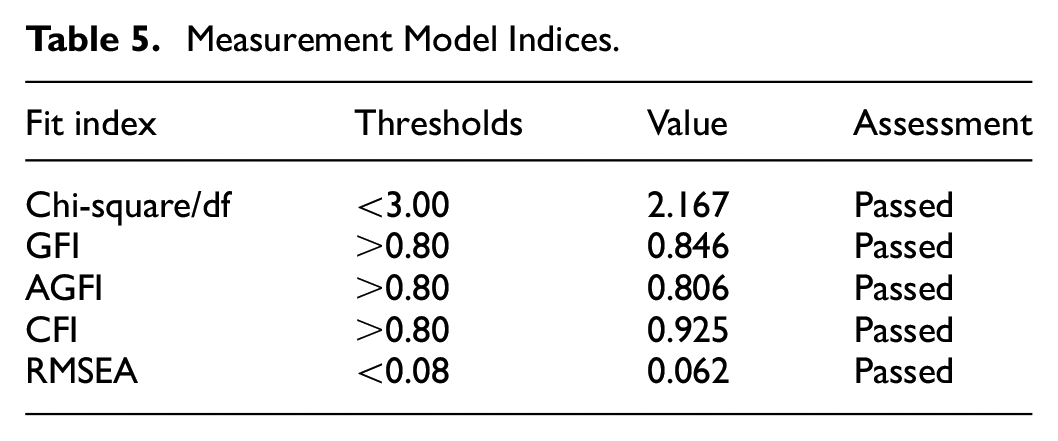
The proposed hypotheses are analyzed in two steps: The Confirmatory Factor Analysis (CFA) and the Structural Equation Modelling (SEM) test. CFA was used to analyze a statistical test for construct validity to ensure the measurement models’ reliability and validity. There are three types of goodness-of-fit indices used to assess model fit: perfect fit, parsimonious fit, and incremental fit. Each type requires the use of at least one sub-index (Asyraf & Afthanorhan, 2013). The goodness-of-fit statistic quantified the model’s fit. RMSEA, GFI, AGFI, CFI, and Chi-square/df were all used in this study. The overall measurement model indices were significant, as shown in Table 5. The chi-square/df value was 2.167 (Passed), the GFI value was 0.846 (Passed), the AGFI value was 0.806 (Passed), the CFI value was 0.925 (Passed), and the RMSEA value was 0.6. (Passed).
Measurement Model Indices.
Convergent Validity
Convergent validity was used to assess the reflective measurement model in this study, which involves evaluating the model’s reliability and validity to ensure their consistency. Consider construct reliability to be composite reliability, reliability is a measurement model used to determine latent constructs’ robustness. In this research, factor loading, average variance extracted (AVE), and composite reliability (CR) were taken during the research analysis. These metrics assist determine the quality and trustworthiness of convergent data. Factor loading scores were utilized to represent the weight and association of each factor. To evaluate structure reliability, Cronbach’s alpha and CR values were computed. Cronbach’s alpha requires a value greater than 0.7 to indicate that the measurement model is reliable. A CR value of .60 to .70 is considered satisfactory; for more advanced research, values between .7 and .9 are reflected as satisfactory (Asyraf & Afthanorhan, 2013). According to Hair et al. (2017), the AVE value should be greater than 0.5, and the CR value should be greater than the AVE value. However, AVE values below .5 are acceptable if other convergent validity reliability criteria are met (Ayaz, & Yanartaş, 2020; Fornell & Larcker, 1981). Convergent validity demonstrated the importance of factor loading, composite reliability (CR), and average variance extracted (AVE) in Table 6. Cronbach’s alpha is (.726–.909) and CR is (.730–.909), exceeding the critical threshold. AVE, on the other hand, is between .476 and .734, and all elements except for OP and DIS earned a value above the critical threshold of 0.5. Consequently, even though the AVE value of OP and DIS factors are less than .5, it can be acceptable because the CR values of these factors are high, and the AVE values of both factors are smaller than the CR value.
Convergent Validity.

Each item’s factor loading value should be greater than 0.5; items with factor loading values less than 0.5 should be removed. The average variance extracted from this section should be 0.5, indicating that the degree of convergent validity is sufficient (Belhekar, 2019). However, when the composite reliability is greater than 0.06 and the average variance extracted is 0.4, the construct's validity is still sufficient (Fornell & Larcker, 1981). As shown in Table 6, each item had a factor loading greater than 0.5 and a composite reliability value greater than 0.7. Additionally, the AVE for all constructs was within a reasonable range. As a result, the construct and its items were validated for validity.
Discriminant Validity
Discriminant validity refers to a measurement construct that is distinct from other constructs in terms of its correlation with other constructs and in which the measured variable demonstrates only this single construct (Hair et al., 2017). The data in Table 7 demonstrate the model's fitness and discriminant validity result indicating that the factor loading for each item was greater than 0.5. (Cabrera-Nguyen, 2010). The AVE from each construct should be greater than the squared correlation between the construct and the other constructs to determine discriminant validity. Alternatively, the discriminant validity value is derived from the AVE square root (Asyraf & Afthanorhan, 2013).
Discriminant Validity Matrix.

Structure Equation Modelling
This research utilized CB-SEM because the objective of the current study is to apply TAM and TR theories to the smart home security adoption intention. SEM is a statistical model that defines the relationship between multiple variables (Hair et al., 2017). To ensure reliability and validity, a structural equation model was used. The path coefficients indicate the degree of influence on the dependent constructs and interpret the conceptual model (Dash & Paul, 2021). Regarding Hair, Matthews, et al. (2017), CB-SEM is employed if the existing theory requires to be checked and confirmed because the investigation is more confirmatory than exploratory. Hence, if the purpose of the research is theory testing and confirmation, then CB-SEM is the right approach (Hair, Matthews, et al., 2017). The CB-SEM is conducted using IBM Amos because it is an appropriate tool based on covariance (Hair, Matthews, et al., 2017).
The hypothesized path’s outcome is shown in Table 8 and Figure 2. A P-value supported each hypothesis expressed as a level of significance. It was demonstrated in the first hypothesis that optimism has a beneficial effect on perceived security (Standard path = 0.645, p-value .001). The outcome of H2 demonstrated that innovativeness has a beneficial effect on perceived ease of use (Standard path = 0.649, p-value .001). In H3 and H4, discomfort has a negative effect on perceived ease of use (Standard path = −0.146, p-value = .024 .05), whereas it has a positive effect on perceived usefulness (Standard path = 0.253, p-value .001). As a result of H5, insecurity has a negative effect on perceived usefulness (Standard path = −0.111, p-value = .0320.005). For H6, the result supports the hypothesis that perceived security has a beneficial effect on attention (Standard path = .261, p-value .001). In H7 and H8, the results indicated that perceived ease of use has a positive effect on perceived usefulness (standard path = 0.682, p-value .001) and attitude (standard path = .347, p-value .001). Perceived usefulness has a positive relationship with intention to purchase; the result indicates that H9 is supported (standard path = 0.253, p-value .001). The final hypothesis, as a result of the results, established that attitude is positively related to purchase intention (standard path = 0.74, p-value .001).
Hypothesized Paths.

Note. p-value <.001 = ***, p-value < .01 = **, p-value < .05 = .*

Structure equation modelling.
Discussion and Conclusion
The purpose of this research is to ascertain the possible factors that influence consumers’ intentions to use smart home security. TR and TAM are extensive concept models for the subject of technology adoption based on existing research (Sophonthummapharn & Tesar, 2007). As a result, these two concepts were applied to the study's fundamental model. Additionally, perceived security was incorporated into the concept model to aid in investigating the research's key factors. The above theoretical model was used to develop the hypothesis in this study. Hence, this study conducted an analysis of individuals’ intention to use smart home security by applying TAM and TR in order to gain a better understanding of how individuals’ views about technology influence their behavioral intentions. The current study’s conclusions provide both theoretical and practical implications.
In TR theory, there are two favorable inhibitors: namely optimism (OP) and innovativeness (INN). To begin, optimism is positively related to perceived security. This finding is consistent with prior research (Ferreira et al., 2014), indicating that optimistic individuals have a positive attitude and are comfortable bringing technology into their daily lives to facilitate and accomplish their goals such as their quality of life in terms of safety. Additionally, they may perceive their security as more approachable. Also, this result is in line with Kim et al. (2020) that customers who are optimistic would improve the connection between perceived performance and attitude. Therefore, it is crucial for providers of smart home security technology to focus more on disseminating sufficient information to provide customers with knowledge and a positive attitude and perception that smart home security technology would provide additional benefits, including perceived security. Based on the respondents in this research, they have a positive perception of new and advanced technology, and they are confident on the features about the security and convenience it offers compared to the current practice.
Second, there is a positive correlation between innovativeness and perceived ease of use. This hypothesis supports the previous review of the literature (Caison et al., 2008). Individuals desire to use new technology because it appears to be more convenient (Nugroho & Andryzal Fajar, 2017). Hence, innovative consumers enjoy the pleasure of investigating smart home security solutions and have positive easy-using perceptions of smart home security technologies. Therefore, it is essential to approach groups of people with a high preference for innovation with up-to-date smart home security technology information. In the meanwhile, it would be effective to illustrate the simple processes application of smart home security systems to encourage customer innovation.
In TR theory, there are two unfavorable inhibitors: namely discomfort (DIS) and Insecurity (INSE). Results from the current study found that discomfort has a significant negative effect on perceived ease of use. On the other hand, the relationship between discomfort and perceived usefulness is positive. Discomfort can be considered a barrier to technological readiness (Blut & Wang, 2019) and dissuades consumers from developing a favorable attitude toward technology-based smart home security and diminishes their perceived ease of use (Ali et al., 2019). The considerable link between discomfort and perceived ease of use in this study suggests that persons with a higher level of discomfort toward technology may not find smart home security solutions easy to use. Even though they have less trust in their ability to control it, individuals with a high level of discomfort may find smart home security useful. Users may recognize the use of the technology since they understand the benefits of intelligent home security solutions. In the instance of home security equipment, this conclusion offers insight to research on technology adoption by suggesting that users may still regard the device as useful even if they lose control over it.
Next, insecurity is the degree to which people with a higher risk perception have doubts about the technology’s operation (Nugroho & Andryzal Fajar, 2017). The result of this study found that insecurity negatively affects perceived usefulness. This result is in line with the study from Pillai et al. (2020). Many consumers are unfamiliar with smart home security solutions, so they may feel insecure when using them for the first time. New users may be apprehensive about insecurity, which may reduce their likelihood of perceiving the usefulness of smart home security technology. Later on, this study found that perceived security positively affects attitudes toward smart security technology. Perceived security plays an intriguing role in consumers' attitudes and intentions, as it inspires consumers’ confidence in the success of all transaction procedures on security protocols. Therefore, the consumers may translate it into trusting the system and have a positive attitude which leads to willingness to use the smart home security system. This study result conforms with previous studies in the area of technology adoption such as mobile food delivery applications (Belanche et al., 2020), mobile wallet (Chawla, & Joshi, 2019), mobile fintech payment services (Lim et al., 2019). According to Batalla and Gonciarz (2019), a concerned person with perceived risk related to their safety has a high chance of using the smart home application to solve their problem. It is consistent with the previous literature (Mahrous et al., 2018), perceived risk influences an individual’s perceived security.
Later, this study confirms that the ease with which smart home security can be used is sufficient to elicit consumer attitudes towards the technologies, which in line with Buyle et al. (2018). Additionally, this study is also in line with previous studies in current technologies such as smart shops (Chang & Chen, 2021), and mobile payment (Li et al., 2019) that perceived ease of use positively affects perceived usefulness as well as attitude towards using specific technologies. Also, this study demonstrated that consumers perceive smart home security to be beneficial in terms of enhancing their safety, in line with Diop et al. (2019) that perceived usefulness is the primary predictor of a consumer's intention to use new technology. As a result, this study confirms a significant relationship between perceived usefulness and intention to use smart home security technologies. Finally, attitudes strongly correlate with the intention to use smart home security. Consumers who have a favorable attitude toward a product/service positively correlate with their intention to use that product or service (Ali et al., 2019). This study demonstrated that perceived ease of use and perceived usefulness have a substantial impact on consumers’ attitudes and intentions to adopt smart home security technologies, indicates that when the smart home security technology is easy to use and the users recognize the technology's considerable benefits for them, they tend to have a positive attitude toward its use and are more inclined to employ it.
Technology becomes a potential assistant tool for humans to improve their quality of life, and most respondents in this study are between the ages of 20 and 35 living in urban area. This group is regarded as having a high degree of digital-native. As a result, they understand how to use smart home security. This finding is consistent with previous research (Ali et al., 2019), indicating that innovativeness is typically associated with a favorable attitude toward technology among residents who have a favorable perception of technology based on smart home security and a favorable attitude toward consuming such products. The demographic characteristics of our respondents certainly shaped their perceived ease of use and usefulness, as they are primarily young adults living in urban regions with high digital proficiency. This group may possess a superior foundational comprehension of technology and exhibit more ease in assimilating smart devices into their lives compared to older populations or individuals in less urbanized regions, both within Thailand and in foreign nations with varying degrees of digital penetration.
Moreover, the main respondents are the Thai population who present the cultural value by Hofstede et al. (2005) to be a high cultural dimension in collectivism and power distance which suggested that users tend to adopt the technology based on subjective norms and unified ingroups, which throughout people’s lifetimes continue to guard them for unquestioning loyalty. This result may imply that in collectivist societies, social norms and the perspectives of close-knit groups exert significant impact. The findings suggest that when one’s social networks endorse or embrace these technologies, it enhances their perceived usefulness and ease of use. On the other hand, Thailand has a high value for avoiding uncertainty, clear rules, and a formal way of living. Therefore, it can be explained that it is likely for them to try to avoid and reduce risks by employing the tools for their security (Phonthanukitithaworn et al., 2015). This implies that countries or societies that prioritize avoiding uncertainty likely reinforce the positive associations between people's sense of security, their perception of the usefulness of smart home security systems, and their intention to implement them. The inclination to mitigate potential risks corresponds effectively with the perceived usefulness of smart home security systems. Conversely, cultures characterized by reduced uncertainty avoidance may demonstrate increased tolerance for ambiguity and reflect diminished concern for security in the adoption of new technology. Consequently, cultures that emphasize privacy may exhibit reluctance in embracing smart home security systems, particularly if they recognize possible threats to personal data. In addition, cultural differences in trust toward technology may additionally affect adoption rates. Societies exhibiting greater trust in technology are more inclined to embrace smart home security systems.
This study enhances the current body of knowledge by using TAM and TR theories to the field of smart home security. The inclusion of perceived security as a mediating variable between TR and TAM provides a more nuanced comprehension of how consumer perceptions of safety and security impact their decisions to adopt. This study also highlights discomfort and fear as factors that obstruct TR, offering vital insights into the psychological obstacles that could hamper its adoption. Furthermore, the study illustrates the correlation between perceived security and positive attitude toward the technology, emphasizing the significance of addressing customer apprehensions around safety and privacy. Lastly, this study enhances comprehension of individual variances in technology adoption by analyzing the significance of optimism and innovativeness in TR. This research makes a significant contribution to the existing body of knowledge by presenting a framework that provides understanding on how consumers adopt smart home security systems.
Implication
Smart home security has dominant functions and features to ensure the safety of people who need protection. Consumers probably seek tools for providing more safety. Besides, security systems and personal insurance are the priority factors that all new users would consider installing smart home security systems. Moreover, the superior quality of product experiment and implementation confirmed that the smart home system product is not harmful to customers regarding personal information data used in the system. Based on the research findings, it is recommended that individuals’ characteristics of technology readiness, such as optimism and innovativeness, may enable consumers to have a positive attitude toward and perceived convenience with smart home security. It would affect their willingness to adopt smart home security in their daily lives. Additionally, this study demonstrated that perceived ease of use, perceived usefulness, and perceived security all contribute to an increase in the attitude and intention to use smart home security. This knowledge could assist businesses in improving their products.
Moreover, marketers and companies in the smart home security market may place a greater emphasis on optimists to contribute to their markets or sales, such as increasing demand for smart home security and increasing consumer awareness of its benefits. The companies involved with these products should emphasize this point and promote the smart home security market. To avoid and minimize discomfort associated with smart home security, marketers may develop awareness or training programs to make consumers more comfortable with smart home technology. However, despite their discomfort, people have a favorable attitude toward perceived usefulness. Smart home security provides numerous benefits, including increased safety in the home environment (Hoque & Davidson, 2019) and systems that enable consumers to maximize their utility efficiency. Thus, among the discomfort group, the advantage of smart home security is that it maintains the consumer’s perception of usefulness. In conclusion, the various aspects from a discomfort perspective have both negative and positive effects. Although discomfort is a deterrent to technology readiness, smart home security successfully got into the discomfort segment. To expand the market segment, the marketer or company may create additional images and awareness to absorb to capture the entire segment quietly. In addition to the benefit, economic situations and economic inequality can also affect consumers’ perceptions of the benefit of smart home security. During periods of economic instability, customers may prioritize essential requirements over non-essential expenditures on technology. Economic inequalities can result in a digital divide and obstruct individuals’ capacity to adopt smart home security. This is due to the cost of devices and installation.
The research findings offer valuable recommendations for practitioners. In terms of product creation, businesses should prioritize the creation of user-friendly interfaces in product design to reduce learning curves. The application with visual indicators and explicit directives can improve user interface accessibility. Furthermore, interoperability is essential for enhancing users’ favorable perceptions. Consequently, firms ought to build products that are interoperable with various devices and platforms to improve convenience. In terms of marketing practices, marketers may launch campaigns to raise awareness and emphasize the importance of refocusing people’s attention away from insecurity and toward smart home security. Businesses and marketing teams may invest in educational media aimed at enlightening consumers regarding the advantages of smart home security systems, correcting misunderstandings, and mitigating potential worries. By demonstrating that a manual and training program are viable options for explaining and guaranteeing that smart home security systems are beneficial and user-friendly, consumers will be more receptive. These materials can be a part of customer service section, to enhance customer support service at the same time. Lastly, the conclusion implies that businesses that provide smart home security systems must ensure that users’ and consumers’ expectations for secure information and transactions are met.
Policy-making should prioritize the enhancement of uniformity within the industry to ensure consumer trust and boost confidence. Furthermore, consistent with other information technology devices, the educational resources and public awareness initiatives offered by IT policy-making institutions to improve public knowledge should be augmented about cybersecurity. The IT policy-making organization can provide a regulatory framework that integrates innovation with consumer protection, addressing concerns such as data privacy, cybersecurity, and emergency response.
Key findings from the current study are as follows. First, perceived security plays a crucial role in influencing consumer attitudes toward smart home security. Also, TAM constructs, including perceived ease of use and perceived usefulness, significantly impact consumer attitudes and intentions. Lastly, TR factors, optimism and innovativeness, positively influence adoption, while discomfort and insecurity hinder it. From the mentioned key findings, there are suggestions for implications as follows. First, marketing and product development departments could emphasize the security benefits of smart home systems to address consumer concerns while design user-friendly interfaces to enhance perceived ease of use. They could also highlight the practical benefits of smart home security to increase perceived usefulness and to target consumers with high levels of optimism and innovativeness. Policy and regulation makers could develop clear guidelines and regulations to address privacy and security concerns. To conclude, this study provides insights into the factors influencing consumer adoption of smart home security systems.
The implications should be emphasized to technology developers to increase technology adaptation. This can be achieved by considering a user-friendly interface, simplified installation, regular feature updates, and cross-device compatibility. Moreover, for policymakers, an essential factor to consider is a data privacy policy to ensure the protection of user data recording. Only the account owner should have access to this information. Lastly, users can also create a community to share their experiences and the usefulness of the smart home security system, which can foster security awareness.
Limitation and Future Research
While the preceding section discusses several implications of this research, several limitations persist. The questionnaire survey was conducted exclusively in Thailand by the sample group. Considering the specific demographic focus, where the majority of respondents are aged between 20 and 35 and reside in urban areas and are likely to be comfortable and familiar with technological adaptation, perceptions of younger individuals might differ from those of older age groups. The researcher suggests further studies to incorporate a multigroup analysis based on demographic factors such as generation and living areas.
However, the external factors influencing consumer behavior such as social class, cultures, sub-cultures, or reference groups have not been studied. Future studies can focus more on the influence of external influences to provide more insights. Further research should be conducted to examine the external variables and cultural aspects. Socioeconomic factors such as income level, education, and age might exert an influence on adoption rates. Furthermore, customer behavior can be influenced by cultural values and attitudes towards technology, while consumer trust can be affected by cultural norms concerning privacy. Additional investigation could involve longitudinal studies to monitor changes in consumer attitudes and behavior over an extended period. Furthermore, it can include cross-cultural analyses to understand the impact of cultural foundations on adoption movements. Also, this study exclusively examines the context of Thailand. Subsequent research may apply the study in several nations or compare findings across diverse cultural contexts. Lastly, future study might arrange the study of emerging technologies to proactively predict upcoming trends and issues in the field of smart home security.
Footnotes
Acknowledgements
The researchers would like to acknowledge all of the anonymous respondents who took the time to complete questionnaires, as well as their colleagues who helped them in completing this study.

Funding
The author(s) received no financial support for the research, authorship, and/or publication of this article.
Declaration of Conflicting Interests
The author(s) declared no potential conflicts of interest with respect to the research, authorship, and/or publication of this article.
Data Availability Statement
Data sharing not applicable to this article as no datasets were generated or analyzed during the current study.