




Abstract
The CoI framework, widely recognized as a leading theoretical model for constructivist-based technology-enhanced learning, has attracted increasing attention from researchers. The abrupt shutdown caused by the pandemic has increased this interest by shifting traditional teaching to online instruction globally, even until now. Scholars in TESL/TEFL have also attempted to implement the CoI framework in teaching to optimize the online learning effects. This review aims to understand the current state of CoI studies in TESL/TEFL and explore how the CoI framework was implemented to inform future pedagogical practices. Following the PRISMA protocol, 34 articles from three scholarly article databases and other sources were included and analyzed systematically. The publication feature analysis highlighted the increasing quantity and quality of CoI publications in TESL/TEFL, with predominant contributions from scholars based in Asia. The content analysis indicated a significant prevalence of studies conducted in higher education contexts and a notable diversity in research methodologies. Blended learning, online remote/distance learning, and flipped classrooms constituted the primary learning environments to support the CoI framework. Subsequently, a detailed analysis of the CoI application was conducted, and the research findings, along with their implications for teaching, were presented.
Keywords
Introduction
The concept of the Community of Inquiry (CoI), which emphasizes the collaborative efforts of individuals working together to solve problems and construct meaning, originates from American philosopher Charles Sanders Peirce in the late 19th century and was further developed by John Dewey and Matthew Lipman (Lipman, 1991). It is also rooted in Vygotsky’s social constructivism, which posits that knowledge is collaboratively constructed within social contexts and learning communities (Prawat & Floden, 1994). However, it was only in 2000 that the CoI framework was introduced into online education by Garrison et al. (2000) to guide and evaluate teaching designs, aiming to achieve meaningful learning experiences. Since then, the seminal article “Critical inquiry in a text-based environment: computer conferencing in higher education model,” in which the CoI framework was initially proposed, has become one of the fundamental studies of the CoI framework and has been cited over 10,000 times, as revealed by Google Scholar in May 2024.
The CoI framework represents the process of creating effective and meaningful learning experiences in online learning environments through the development of three interdependent elements: social presence (SP), teaching presence (TP), and cognitive presence (CP) (Garrison et al., 2000; Swan et al., 2009). It is widely regarded as the predominant model for constructivist-based technology-enabled learning design, attributed to its simplicity and versatility (Anderson, 2016). In recent years, the rapid advancement of information and communication technologies (ICT), along with decreasing Internet costs, has contributed to the rise and widespread acceptance of technology-enhanced learning, further facilitating the emergence of online and blended learning. The sudden outbreak of the pandemic at the end of 2019 significantly accelerated the popularity of online and blended learning approaches. The traditional face-to-face classroom teaching was compelled to shift to emergency remote teaching due to the abrupt shutdowns in many countries. While most teachers grappled with the challenges brought about by this dramatic change, many began exploring effective methods to improve their online teaching. As the most widely used theoretical framework specifically for online learning and distance learning, the CoI framework has garnered unprecedented attention from researchers worldwide across various disciplines.
The CoI framework has been utilized in diverse disciplines as a model to support course design and as a tool to evaluate students’ learning experiences. Although language teaching and learning were among the most studied subject areas where the CoI framework has been applied (Stenbom, 2018), publications related to language learning, especially TESL/TEFL, are still far fewer compared to those related to the CoI framework in general.
It is widely accepted that teaching technologies can facilitate interaction, which is essential for language learning, by enabling online communication. However, these technologies also present significant challenges. The extensive shift to online distance learning during the pandemic has intensified these challenges, making them more evident. Specific challenges include the use of non-customized platforms, material-related issues, pedagogical problems, negative emotions among students, inactive participations, and insufficient interaction (Fakharzadeh & Naderi, 2022; Li, 2022). In such situation, theoretical guidance is both crucial and urgent. The CoI framework is believed to have the potential to enhance learning experiences through increasing student engagement and satisfaction, improving academic performance, and guiding effective instructional design (Garrison et al., 2000). Moreover, many studies have reported that the CoI framework-informed instruction enhances language skills in virtual collaborative learning, including writing (Annamalai, 2017), speaking (Wu et al., 2017), reading (Teng et al., 2024), and integrated learning achievements (Cheng, 2022). Additionally, improvements have been observed in the affective elements of learning, such as confidence (Chen, 2022), and engagement (Smidt et al., 2021).
However, with regard to the effective implementation of the CoI framework in TESL/TEFL practice, there remains a significant lack of practical and specific guidelines. In light of the global rise in online and blended learning in recent years and the increasing amount of research on the application of the CoI framework in the field of TESL/TEFL, it is crucial to map the landscape of relevant CoI publications in this discipline to elucidate its publication characteristics and trends. Furthermore, an in-depth analysis of the implementation of the CoI framework in TESL/TEFL is also necessary to provide insights for advancing pedagogical practices. However, to the authors’ knowledge, no comprehensive and systematic synthesis has examined the research on the implementation of the CoI framework in this field. This highlights the significance of conducting the current review, in which the systematic review method is employed to reveal the current state of the CoI framework’s implementation in TESL/TEFL and further offer pedagogical insights for future online TESL/TEFL practices from the CoI framework perspective. Specifically, this study aims to address the following two questions:
(1) What are the publication features of studies on the application of the CoI framework in TESL/TEFL with respect to its distribution of yearly publications, countries/regions, and sources?
(2) How was the CoI framework applied in TESL/TEFL in terms of research context, research methodology adopted, application of the CoI framework, and research findings and implications?
Literature Review
According to Garrison et al. (2000), the CoI framework is structured around three essential presences: social presence (SP), teaching presence (TP), and cognitive presence (CP). SP refers to participants’ capacity “to identify with a group, communicate purposefully, and develop interpersonal relationships.” It includes the subcategories of open communication, group cohesion, and affective expression. TP is defined as the “design, facilitation, and instruction directed toward creating and sustaining a community of inquiry” (Garrison, 2009, p. 355), and comprises instructional design, discourse facilitation, and direct instruction. CP denotes the extent to which learners can engage in reflective thinking and discourse to construct and validate meaning (Garrison et al., 2000). It encompasses four stages of the practical inquiry process: trigger, exploration, integration, and resolution. By emphasizing the dynamic interaction of the three essential presences, the CoI framework provides a comprehensive structure for cultivating deep and meaningful educational experiences.
The three presences, along with their corresponding subcategories, were compiled into a coding template used to analyze the dynamics of online communication. Interaction transcript analysis had long been the mainstream research method in CoI studies until researchers developed the CoI survey in 2008 (Arbaugh et al., 2008). The CoI survey, structured around the framework’s categories, provides a quantitative perspective for examining CoI practices. Researchers frequently employ it to obtain participants’ perceptions of learning experiences concerning the three presences or to explore the interplay among them and their relationships with other elements, such as learning satisfaction (Mirabolghasemi et al., 2021), attitudes (Teng et al., 2024), and engagement (Chen, 2022). Beyond measuring and evaluating learning experience, researchers increasingly use the CoI framework to guide course design. They believe that the well-organized and meaningfully engaged essential presences encourage meaningful, in-depth learning experience, enhance learning outcomes (Bissessar et al., 2020), and maintain online education quality (Sağlam & Dikilitaş, 2020; R. Zhang, 2020).
Over the past two decades, many researchers have engaged in reviewing the development of the CoI framework, highlighting its progress and suggesting directions for future research. The earliest review, as identified by the authors, was conducted by pioneering scholars Garrison and Arbaugh (2007), who analyzed CoI research prior to 2007. Their review covered studies on the overall framework and those focusing on one specific presence. They called for more quantitative-oriented and cross-disciplinary studies, as well as greater efforts in identifying factors that moderate or extend the relationships between the three presences and online learning outcomes. Later, in 2010, the one-decade retrospective by Garrison et al. (2010) reviewed the evolution of the framework and its associated methodologies. They expected that future studies would explore the predictive role of the CoI framework in learning outcomes, as well as attitudes and participation in lifelong learning. Each of Garrison’s reviews served as a compass for CoI framework research, marking pivotal moments in its trajectory and guiding the direction for future studies.
In 2009, 1 year after the introduction of the CoI survey by Arbaugh et al. (2008), Rourke and Kanuka (2009) reviewed 48 CoI studies published between 2000 and 2008. They questioned the effectiveness of the CoI framework in facilitating deep and meaningful learning and raised concerns about the soundness and validity of the newly-developed measurement. A decade later, Stenbom (2018) conducted a systematic review of 103 journal papers that adopted the CoI survey, validating its reliability and affirming its effectiveness in examining learning experiences and comparing various factors in learning contexts.
More reviews of the CoI framework have emerged in recent years, about two decades following its inception, to describe its landscape and development trends worldwide and across disciplines. Olpak (2022) conducted a bibliometric mapping analysis of CoI research between 2000 and 2020 to reveal its evolution trends. 102 articles published in Social Science Citation Index (SSCI) journals were selected and analyzed using VOSviewer. The findings indicated a predominance of studies in the field of Social Science, primarily based in North America, employing quantitative research methods, and concentrating on higher education. Similarly, Yu and Li (2022) analyzed 885 CoI studies published before 2021 from Web of Science bibliometrically, utilizing science mapping tools CitNetExplorer and VOSviewer. In addition to identifying the top 10 authors, sources, organizations, and countries, their subsequent qualitative analysis expanded the CoI framework by highlighting the importance of metacognition and self-efficacy.
With regard to specific disciplines, Y. Zhang et al. (2023) reviewed 22 studies on the application of the CoI framework in online engineering education in a semi-systematic manner. Results affirmed the framework’s positive roles, not only in evaluating online and blended learning environments, but also in guiding effective online engineering course design. However, they also highlighted the nascent stage of CoI studies in engineering education. To provide insights into kinesiology education, Kim and Gurvitch (2020) conducted a systematic review of all disciplinary online learning research in higher education that adopted the CoI framework. Twenty-three articles published between 2009 and 2019 were included and analyzed, focusing on their instructional strategies and effectiveness. However, the premature focus on kinesiology education during the initial data search stages reflects a limitation in the literature review’s scope. This restriction is evidenced by the exclusive use of databases within Kinesiology or sports science, such as PsycINFO and SPORTDiscus.
Thus far, there have been limited literature reviews regarding the CoI framework’s application in TESL/TEFL. González Miy and Herrera Diaz (2015) tracked CoI practice in TEFL by describing the framework, its theoretical foundation, applications, and potential uses in online language learning environments. Nevertheless, the CoI practice was primarily demonstrated through isolated descriptions of its implementation and findings in individual studies, lacking systematic synthesis from a macroscopic perspective. Additionally, Suharno et al. (2023) reviewed 27 peer-reviewed empirical articles published between 2011 and 2021 on the CoI framework’s implementation in English as a foreign language (EFL) distance learning, aiming to provide implications for secondary education where the CoI framework was rarely applied. However, neither of these reviews qualifies as systematic literature reviews. They lack the rigorous methodology required to comprehensively gather, systematically analyze, and accurately synthesize existing research—processes essential for advancing knowledge, informing practice, and guiding future research.
Methodology
Considering the proactive practices of an increasing number of researchers and educators integrating the CoI framework into TESL/TEFL, together with the research gap concerning the dearth of systematic reviews on the theoretical and practical application of the CoI framework in TESL/TEFL, this study employs the method of systematic review to explore the current landscape of CoI framework research in TESL/TEFL and examine its concrete implementation to inform future pedagogical practice.
A systematic literature review (SLR) employs rigorous and transparent methods to identify, select, evaluate, and synthesize existing research to address clearly formulated questions (MacKenzie et al., 2012). It follows an evidence-based, structured, and predefined protocol to ensure reliability and minimize bias. It has been commonly applied across diverse disciplines, such as medicine, social sciences, and education, to inform decision-making and policy formulation (e.g., Afzaal et al., 2024). In recent years, SLRs have also gained popularity in the fields of e-learning (e.g., Valverde-Berrocoso et al., 2020) and technology-enhanced language learning (e.g., Dehghanzadeh et al., 2023; Guo et al., 2024).
As with many systematic reviews, this study follows the Preferred Reporting Items of Systematic Reviews and Meta-Analyses (PRISMA) framework, with its latest version updated in 2020 (Page et al., 2021), to comprehensively include the relevant studies on the application of the CoI framework in TESL/TEFL. Thereafter, the ultimately included studies will first be examined to identify their publication features and will then be analyzed based on the themes that emerged in the content analysis process.
Preferred Reporting Items of Systematic Reviews and Meta-Analyses
Figure 1 depicts the entire searching and filtering process which contains three stages: identification, screening, and included.

PRISMA flow diagram for literature search and filtration (Page et al., 2021).
Identification
The database search was conducted on 2 May 2024 across three sources: Scopus, Web of Science (WoS) core collection, and Educational Resource Information Center (ERIC), which are common choice for many educational reviews (e.g., Stenbom, 2018). The search items focused on community of inquiry and English language teaching as second/foreign language. The exact search strings for each database and search results appear in Table 1. Initially, 2,843 records from the 3 databases were identified, with all non-English and non-article materials excluded.
Search Strings for Each Database and Results.

To compensate for potential literature omissions from the electronic database search, the authors conducted a manual search. This included articles listed on the CoI website (https://coi.athabascau.ca/publications/coi-papers/) and those discovered by examining the reference lists of articles obtained from the database search and other CoI reviews. Subsequently, 69 records were identified, with articles focusing on individual presence excluded.
Screening
The searched records underwent three rounds of screening. First, duplicate studies were removed manually; second, irrelevant studies were eliminated through title and abstract screening; third, full articles were retrieved for content eligibility assessment. During this stage, articles were screened according to strict inclusion and exclusion criteria, as listed in Table 2. As with most SLRs, the selected articles needed to be peer-reviewed journal articles written in English to ensure quality and readability. Moreover, since the primary purpose of this review article was to examine the practical implementation of the CoI framework in TESL/TEFL to guide future practitioners, the selected articles had to be empirical studies about applying the CoI framework in TESL/TEFL contexts. Therefore, records from non-peer-reviewed journals, articles in languages other than English, non-empirical studies in TESL/TEFL contexts, studies not about the CoI framework, and those not covering all three CoI presences were excluded.
Inclusion and Exclusion Criteria.

Included
After three rounds of rigorous screening, 31 articles from the database search were included. Additionally, three more articles were identified through reference list scanning. No eligible articles were found on the CoI website. In total, 34 peer-reviewed journal articles on the application of the CoI framework in TESL/TEFL contexts were included for further analysis.
Content Analysis and Discussion
Publication Feature Analysis
This section primarily demonstrates the publication characteristics of the ultimately selected 34 articles, focusing on their annual publication trends, geographical distribution across countries/regions, and source journals’ indexing, to address the first research question.
Yearly Publication Trend
The yearly publication trend, displayed in Figure 2, indicates a general increasing tendency in studies applying the CoI framework within the discipline of TESL/TEFL. The number of articles, beginning in 2015, peaked initially in 2017, with six publications. This surge likely occurred because a flipped classroom model, which reverses traditional classroom teaching activities into online instruction at home and meaningful interaction in class, started attracting heightened attention from language educators in TESL/TEFL since 2016 and 2017 (Arslan, 2020). This pedagogical approach, which had gained popularity during that period, might have promoted more CoI implementations. Furthermore, evidence shows that studies applying the CoI framework in TESL/TEFL grew progressively after 2019, with eight articles published in 2022 and seven in 2023 (complete data for 2024 was unavailable before the search date). This trend aligns with the timeline of the global COVID-19 pandemic, which first emerged in late 2019. During the pandemic, online education became the predominant mode of instruction globally because of stringent pandemic control policies. Subsequently, the CoI framework, acknowledged as the most widely accepted theoretical framework for online learning, began receiving increased scholarly attention.

Yearly publication trend.
Country/Region Distribution
The 34 studies reported in this review were conducted in 16 countries or regions across four continents (Figure 3), indicating global interest in the application of the CoI framework in TESL/TEFL. Scholars and educators from Asia, particularly East and Southeast Asia, demonstrated the greatest enthusiasm for exploring innovative and effective methods of implementing the CoI framework in their English teaching practices. Notably, 29 (85%) of the included studies originated from Asian countries or regions. Among these contributions, Mainland China accounted for the highest number (9), followed by Taiwan (4), Iran (4), Malaysia (4), and Korea (2). In contrast to North American countries’ dominant role in conducting general CoI studies, as revealed by some reviews (Olpak, 2022; Stenbom, 2018), countries like the United States and Canada produced only two (6%) CoI studies specifically related to TESL/TEFL within the review period. Italy contributed one related article from Europe, while Chile and Mexico from South America each produced one study. Although the CoI framework was proposed by North American scholars and it has been predominantly tested and validated within the North American educational context, the situation differs markedly regarding TESL/TEFL. This finding is expected and unsurprising because of the focus of the study which is within the context of TESL/TEFL—that is why most of the studies come from non-native English-speaking regions like Asia.

Country/region wise distribution.
Journal Distribution
The decentralized distribution of 34 papers across 32 different journals demonstrates a broad range of journal sources. Besides Interactive Technology and Smart Education and Online Learning, which each produced two related articles within the review period, all other journals published only one article. Table 3 lists the top 10 journals that published the most CoI articles in TESL/TEFL and the most reputable journals, with their index and journal impact factor (JIF) rankings indicated.
Journal Distribution.
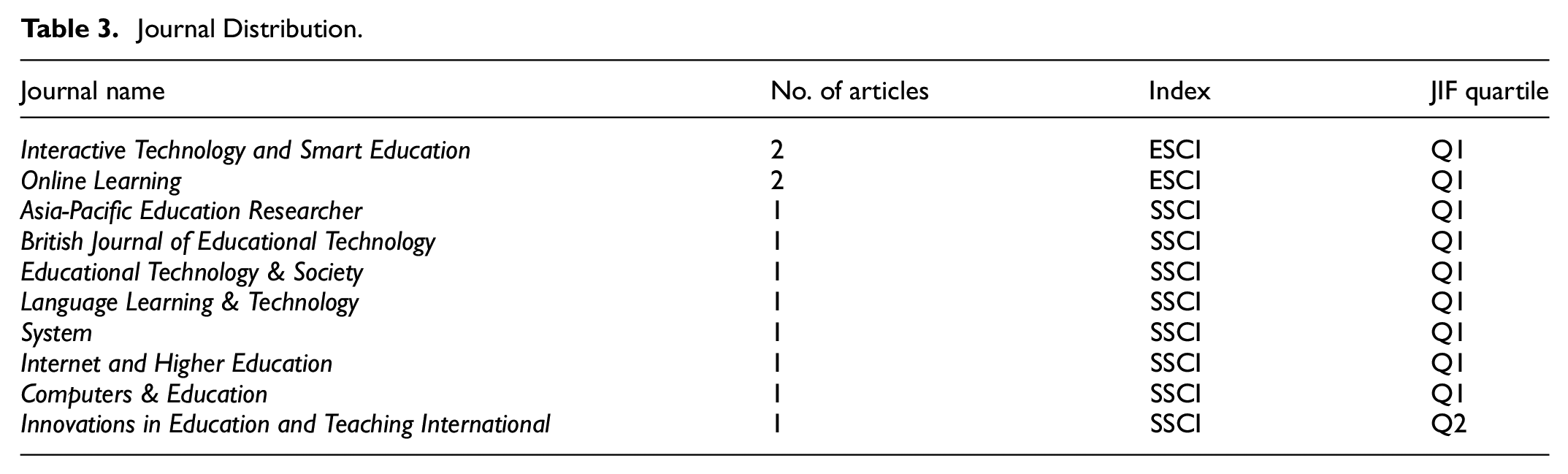
The SSCI and Emerging Science Citation Index (ESCI) journals are both indexed in the Web of Science core collection, which is one of the most reputable and prestigious databases worldwide and is regarded as the “gold standard” for citation analysis due to its highly robust journal-selection criteria and neutrality (Harzing & Alakangas, 2016). Figure 4 shows that 73% of the included articles were published in journals indexed in SSCI and ESCI, with 35% specifically in SSCI-indexed journals. The JIF is widely recognized as an indicator of a journal’s significance, influence, and prestige within its field, with a higher JIF quartile suggesting that the journal’s articles are more frequently cited and potentially more impactful. These findings reveal that research on the CoI framework within TESL/TEFL has been successfully published in top-ranking journals. It is also noteworthy that most articles are not in TESL/TEFL-specific journals, indicating that their findings are relevant and appeal to a broader audience. Their publication in these journals shows that these studies are significant beyond the field of TESL/TEFL alone.

SSCI/ESCI journal distribution.
Content Analysis
Research Context and Participant
With regard to the research context, studies show that, similar to many reviews of CoI studies across various disciplines (Olpak, 2022; Stenbom, 2018), CoI studies in TESL/TEFL primarily focus on higher education context (26, 76%), particularly undergraduates (n = 19). This trend is followed by a significantly smaller focus on secondary school context (4, 12%) (see Figure 5). Three studies classified as “others” comprise one conducted in a volunteering online GRE analytical writing discussion forum (Sun et al., 2017), one in a private language academy (Mirabolghasemi et al., 2021), and one across mainstream education contexts (Fakharzadeh & Naderi, 2022). Only one study represents the primary school context (Wang et al., 2023). When examining broader literature on online learning or e-learning, these findings align with general trends, as higher education remains the most studied level in e-learning, followed by secondary education (Valverde-Berrocoso et al., 2020).
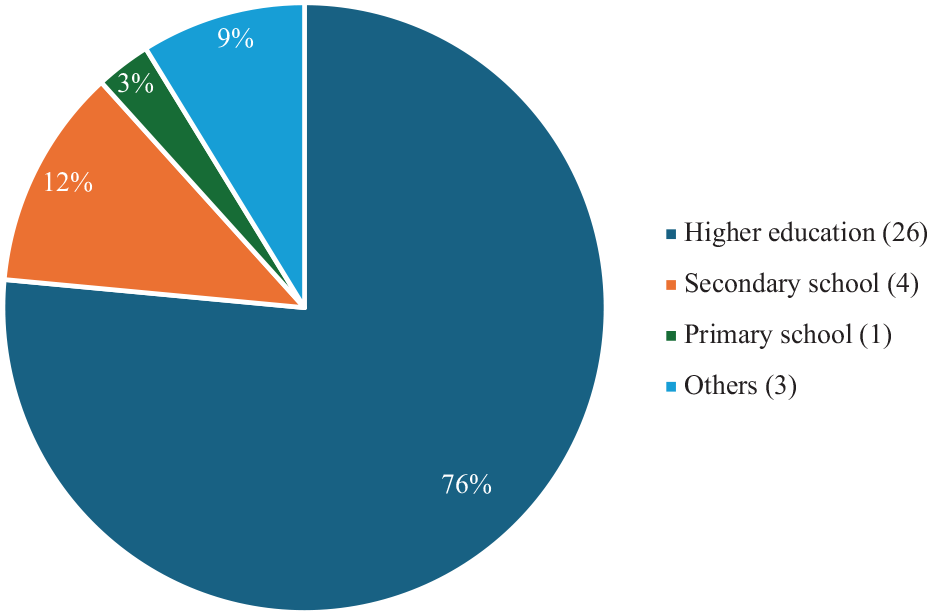
Pie chart of research context distribution.
Figure 6 demonstrates the distribution of research participant types. Beyond the dominant focus on student participants (28, 82%), three studies included teachers as their participants (Chuah & Kabilan, 2021; Fakharzadeh & Naderi, 2022; Muhalim, 2023). Additionally, three studies incorporated both teachers and students as participants (Annamalai, 2017; Annamalai et al., 2015; M.-H. Liu, 2023).

Pie chart of participant type distribution.
Research Methodology
Research methodology is the primary principle and approach that guides researchers in answering research questions using specific research methods (Dawson, 2019). Generally, diverse research methodologies were employed in studies on the application of the CoI framework in TESL/TEFL. Following the general triple categorization by many scholars (Creswell, 2014; Dawson, 2019), the 34 reviewed articles were categorized into qualitative, quantitative, and mixed-methods studies according to their research methodologies. The findings demonstrate a preference for mixed-methods studies (14, 41%), followed by quantitative studies (11, 32%), and qualitative studies (9, 27%). Each study type was then classified into various subcategories, as detailed in Table 4.
Research Methodology Coding Result.

Within these mixed-methods studies, four types of mixed-methods design emerged, with a predominant preference for triangulation design (n = 8) and embedded design (n = 4). Triangulation design refers to the use of multiple complementary methods, both qualitative and quantitative, to study a certain theory or phenomenon for better understanding and more robust, credible findings (Burton & Obel, 2011; Creswell & Clark, 2007). Surveys, online interaction scripts, interviews, and observations were the most commonly utilized data-collection methods in these triangulation studies for more comprehensive understanding of online TESL/TEFL environments and students’ learning experiences. Embedded design refers to the combination of quantitative and qualitative data within a larger design (Creswell, 2014). A more prevalent form of embedded design is the embedded experimental model, in which investigators embed qualitative data into quantitative data to examine the process or mechanisms of an intervention or follow up on experimental results (Creswell & Clark, 2007). In this review, the four studies coded as “embedded” specifically followed an embedded quasi-experimental model within the educational environment. The term “quasi-” is used due to the lack of randomization in participant selection, a limitation inherent in real educational contexts.
Survey design (n = 9) was identified as the most commonly employed design in the reviewed quantitative studies. Interestingly, although survey design and experimental design are regarded as the two pivotal research designs in quantitative studies and are prominently discussed in classical research methodology books (e.g., Creswell, 2014), only one quasi-experimental design was identified here. The findings suggest that quasi-experiment is a popular research design for studying the application of the CoI framework in TESL/TEFL. However, there is a preference for using such an approach in an embedded mixed-method study to provide profound understanding of not only the effectiveness of teaching interventions but also participants’ opinions or perceptions. Additionally, one quantitative action research design (Chen, 2022) utilized surveys as the sole data-collection method following a two-semester-long blended learning teaching activity to investigate its effectiveness on students’ learning performance and engagement.
Within the reviewed qualitative studies, case study (n = 4) was the most frequently employed research design to investigate particular TESL/TEFL cases from the perspective of the CoI framework. In addition to case studies, researchers have employed diverse designs for various research purposes. For instance, Fakharzadeh and Naderi (2022) utilized narrative analysis to investigate the challenges faced by Iranian EFL teachers in the mainstream educational system during the pandemic-induced shift to distance teaching. Similarly, Muhalim (2023) employed digital autoethnography to explore the author’s daily experiences of online English teaching in Indonesia during the pandemic, aiming to offer implications for teachers, students, institutions, and government for improved practices. This method provides new perspectives and deep reflections to understand the complexities of reality, although personal bias remains unavoidable. Furthermore, one action research design (R. Zhang, 2022) was identified in the reviewed qualitative studies. Action research, a frequently used research methodology in educational settings, was also utilized in the field of TESL/TEFL to improve teaching practices guided by the CoI framework. This design can be employed in both quantitative and qualitative studies, depending on the research questions and the data collection and analysis methods used.
Online Learning Environment and Technology Employed
The technology-mediated online teaching/learning environments in which the reviewed CoI studies in TESL/TEFL were conducted typically encompass three models: blended learning (e.g., Chen, 2022; Cheng, 2022; Lin et al., 2016; M.-H. Liu, 2023; X. Liu & Deris, 2022; Teng et al., 2024; R. Zhang, 2020), online remote/distance learning (e.g., Assalahi, 2020; Fakharzadeh & Naderi, 2022; Muhalim, 2023; Nizzolino & Canals, 2023; Taskiran, 2023), and flipped classroom (e.g., Huynh & Nguyen, 2019; Southam et al., 2023; Wu et al., 2017), in descending order by frequency. Although more studies on the emergency online remote education were conducted during the pandemic to reveal its influence on education and offer insights for future improvements, blended learning has continued to show an upward trend. This further evidences that blended learning has become the new educational norm in the post-pandemic era (Megahed & Ghoneim, 2022).
Technologies employed to facilitate online learning communities include learning management systems that support online communication, such as Moodle (Huynh & Nguyen, 2019; McCarroll & Hartwick, 2022), Blackboard (Cancino & Avila, 2021), and Eminus (Herrera Díaz & González Miy, 2017), as well as popular communication tools like social-media platforms, including Facebook (Annamalai, 2017; Annamalai et al., 2015; Duha et al., 2022; Lin et al., 2016), Tencent QQ (Li, 2022), Telegram (Mehri & Izadpanah, 2017), LINE (Wu et al., 2017), and WhatsApp (Solimani et al., 2019). It is evident that mobile social software has begun to attract researchers’ attention and is being integrated into TESL/TEFL education.
The Application of the CoI Framework in TESL/TEFL
Through assessing research questions, purposes, instruments, data collection, and analysis in each study using the inductive approach, four categories emerged regarding the application of the CoI framework in the field of TESL/TEFL.
CoI-Based Content Analysis
The CoI framework was initially developed for descriptive purposes (Garrison et al., 2000). The three essential presences of the framework, its 10 subcategories under these presences, and their corresponding indicators were organized into a template that provides a coding system for analyzing students’ interaction transcripts. It has served as a robust guidance for researchers to understand students’ online collaboration and evaluate learning environments. Among the reviewed studies, the authors observed that online communication between students was the most common material for CoI-based content analysis, including Facebook discussions (Annamalai, 2017; Annamalai et al., 2015) and other discussion board posts (Smidt et al., 2021; Sun et al., 2017). Additionally, other qualitative materials, such as lesson videos, were transcribed and coded according to the three CoI presences in Cheng (2022) to inform effective classroom activities using personally-owned devices in blended classrooms. Notably, the three presences of this coding system are not always implemented simultaneously. Researchers may choose to employ only one presence, depending on their specific research objectives. For instance, McCarroll and Hartwick (2022) analyzed the cognitive presence (CP) aspect of a teaching plan through its four subcategories (triggering event, exploration, integration, and resolution) to better understand how the design and facilitation of the teaching plan influenced student and teacher perceptions of CP.
CoI Survey Quantitative Analysis
It was not until 8 years after the CoI framework was proposed that Arbaugh et al. (2008) developed a 34-item, 5-point Likert-scale CoI survey to measure CoI dimensions. Validated and proven reliable through numerous subsequent studies (Stenbom, 2018), this survey provided researchers with enhanced opportunities to conduct in-depth explorations of teaching designs or learning environments quantitatively. The CoI survey has frequently been used to explore learners’ CoI perceptions of particular learning experiences (Assalahi, 2020; Mo & Lee, 2017) and teacher’s views on specific online teaching environments (Chuah & Kabilan, 2021). Additionally, studies have further analyzed the interrelationships among the three presences and their relationships with other elements, such as learners’ demographic features (Assalahi, 2020), critical thinking (Yang & Mohd, 2020), learning satisfaction (Mirabolghasemi et al., 2021), online participation (Southam et al., 2023), and attitudes (Teng et al., 2024).
Arbaugh et al.’s (2008) original 34-item surve, which covers the 10 categories of the 3 presences, was most frequently adopted in the reviewed studies (e.g., Herrera Díaz & González Miy, 2017; McCarroll & Hartwick, 2022; Taskiran, 2023; Teng et al., 2024; Wu et al., 2017). Some researchers made minor modifications to the original survey, such as changing item expressions, deleting irrelevant items, or adding items related to other elements to better fit specific learning situations (e.g., Huynh & Nguyen, 2019; Sun et al., 2017). Apart from Arbaugh et al.’s (2008) survey, another version of the CoI survey was referenced in Southam et al. (2023). They selected 10 items related to CoI elements from Law et al.’s (2019) 33-item 7-point Likert-scale survey, which encompasses elements such as enrollment, learning motivation, and learning performance, in addition to the three CoI presences. The expanded versions incorporating additional elements typically appeared in survey design studies that explored the interrelationships between the three presences and other elements or outcomes. Translated versions were also adopted to eliminate misunderstandings among participants, such as the Korean version used by Mo and Lee (2017) and the Chinese version employed by Sun et al. (2017). Through these translated versions, researchers gained insights from more diverse groups of students and obtained richer views on the application of the CoI framework in various TESL/TEFL settings.
CoI Framework as Guidance for Course Design
Another application of the CoI framework in TESL/TEFL is to serve as guidance for course design, aiming to improve teaching practices and optimize learning outcomes. For example, in Duha et al. (2022), Facebook discussion activities were designed based on the CoI framework to foster social, teaching, and cognitive presences to enhance students’ speaking performance. Similarly, Chen (2022) utilized the CoI framework as a guideline to design online learning communities, supported by the deliberate practice approach in an EFL blended learning course. Specific learning activities were structured around the 10 indicators of the three CoI presences to promote students’ learning achievement and self-confidence.
CoI Framework as a Lens for Data Interpretation and Discussion
Additionally, the CoI framework has guided the process of data interpretation and discussion. For instance, Muhalim (2023) organized the interpretation of her daily EFL teaching practices during the pandemic using the structure of the three CoI presences, identifying issues and proposing solutions involving stakeholders across all tiers. Fakharzadeh and Naderi (2022) suggested in their discussion the strategy of integrating the CoI framework into future teaching to address current problems. Cancino and Avila (2021) employed the CoI framework to interpret themes arising from student interviews about their perceptions of engagement in a fully online language learning environment.
The CoI framework has primarily been adopted to examine online learning environments or teaching models in TESL/TEFL. This is typically achieved by analyzing participants’ online interactions using the CoI framework coding system or by investigating their CoI perceptions through the CoI survey to determine whether a successful learning community of inquiry has been established. The effectiveness of the established community of inquiry is often tested through pre-and-post-test comparisons of outcome variables or through correlational analyses between CoI presence and various outcome elements. However, despite the general guidance the CoI framework provides for course design, insufficient studies exist on integrating it into actual teaching practices to create and maintain a learning community of inquiry in online learning environments. Moreover, some studies merely introduce the CoI framework in their discussion as one of the interpretative perspectives. Therefore, more practical research is needed on the detailed implementation of the CoI framework to offer pedagogical implications for TESL/TEFL practitioners.
Research Findings and Implications
Although findings vary depending on the specific objectives of each study, an inductive analysis of the results and discussions across the reviewed literature reveals several prominent themes.
Research Findings
Firstly, the effectiveness of various teaching interventions has been clearly demonstrated. This effectiveness was reflected in multiple aspects, such as participants’ high CoI perception, their positive attitudes toward the learning experience, improved learning achievement, and enhanced affective variables like motivation, participation, autonomous learning, and engagement.
Furthermore, the interrelationships among the three CoI presences and their connections to other elements have been tested through correlational and causal-relation analyses, although results may vary across different learning contexts. Statistically significant correlations among the three presences, perceived learning, and learning engagement were found in Chen (2022). It was also found that TP and CP were stronger predictors of students’ perceived learning. R. Zhang (2020) demonstrated the pairwise correlations among SP, TP, and CP, indicating a higher correlation between SP and CP. Conversely, Li (2022) found that TP had a stronger relationship with CP compared to SP, and both SP and CP were strong predictors of learning outcomes. Yang and Mohd’s (2020) study not only revealed the positive influence of SP and TP on CP but also identified critical thinking as a positive mediator between SP and CP, as well as between TP and CP. Mirabolghasemi et al. (2021) found that both TP and CP had a significant relationship with blended learning satisfaction, whereas SP did not. Additionally, Southam et al. (2023) found that CP was positively associated with the number of discussions students created, while SP and TP were not. Despite these findings, there was a prevailing consensus that TP served as the primary factor in maintaining an online community of inquiry, fostering students’ online engagement, and generating a strong sense of satisfaction (Assalahi, 2020; Cancino & Avila, 2021; Li, 2022; X. Liu & Deris, 2022; R. Zhang, 2020). This could be attributed to the fact that most (29, 85%) of the reviewed studies were conducted in Asian contexts, where prevailing cultural norms emphasize teacher authority and view teachers as primary knowledge providers. However, except for two studies exploring the pandemic’s impact on students’ behavioral traits in Italy (Nizzolino & Canals, 2023) and students’ perception of engagement in Chile (Cancino & Avila, 2021), TP was also emphasized in studies conducted in non-Asian contexts such as the U.S. (Jiang, 2023), Mexico (Herrera Díaz & González Miy, 2017), and Canada (McCarroll & Hartwick, 2022).
Implications
The implications of these reviewed studies mostly emphasize the teachers’ role regarding best practices for better ESL/EFL teaching, underpinned by the CoI framework. It is widely believed that teachers bear the primary responsibility not only for establishing robust teaching presence but also for cultivating strong social presence to foster online learning communities, thereby enhancing cognitive presence.
Thoughtful planning and well-organized teaching designs prior to class are highly advisable (Cheng, 2022; Chuah & Kabilan, 2021; Solimani et al., 2019). Teachers should take into account the requirements and expectations of their students while designing authentic tasks and include suitable social and cognitive elements to increase student involvement (Lin et al., 2016). Moreover, teachers must use effective pedagogical strategies, such as well-designed scaffolding strategies in instruction, to regulate students’ learning by promoting social interaction, responsibility and active participation (Chen, 2022). According to Garrison (2011), teaching presence can be distributed among not only teachers but also student participants, teaching assistants, instructional guests, expert volunteers, and other facilitators. Sun et al. (2017) recommend leveraging the distributed expertise of learners through peer feedback, involving students in instructional design and incorporating their individual learning needs into the community of inquiry to encourage active participation. Jiang (2023) highlighted teachers’ responsibility in positively developing students’ social presence. He called for more appropriate facilitation and instruction to help set a welcoming climate for collaboration, build a sense of group cohesion, and elicit reflective thinking and meaningful learning. Several specific best practices were identified and shared by researchers. For example, clear instructions from teachers, along with timely responses and feedback, were highly rated by students as effective teaching practices for encouraging online participation in X. Liu and Deris (2022); the value of asynchronous discussion was highlighted in Li (2022) for its affordance in supporting part-time learners’ communication at their convenience. In addition, group division among students when completing tasks may help create a more conducive learning environment and encourage more active participation, as students tend to be more proactive within smaller groups (Li, 2022).
Some technologies that can support the online learning community have been recommended. Mehri and Izadpanah (2017) concluded that computer-mediated communication (CMC) tools could be utilized to help establish an online community of inquiry by facilitating its three essential elements: social, teaching, and cognitive presence. Additionally, the mobile-assisted online learning community facilitated by social media platforms has been proven to be an effective instructional design because it creates an authentic setting for meaningful student interaction (Wu et al., 2017). However, Cheng (2022) cautioned that the affordance of technology alone could not lead to students’ active learning engagement; the design of learning activities was crucial. Confronted with enormous challenges in the new era of technology-enhanced online learning environments, teachers should be equipped with Technological Pedagogical and Content Knowledge (TPACK) to enhance their capacity to fulfill their new roles and create deep, meaningful online communities of inquiry (Fakharzadeh & Naderi, 2022).
In addition to teachers’ responsibilities, Mo and Lee (2017) emphasized the importance of students’ active participation and interaction with each other to enhance the learning experience in the online communities. Furthermore, providing students with adequate training helps them adapt to instructional technology or learn to use technologies independently, along with ongoing technological support (Huynh & Nguyen, 2019).
Based on the implications derived from the reviewed articles, several recommendations for ESL/EFL teachers and practitioners are proposed. Firstly, prepare lessons thoughtfully before class. Lessons should be student-centered and closely aligned with students’ learning needs. Teachers should involve students in the instructional design process. For instance, design authentic tasks that are socially and cognitively suitable for students’ requirements to stimulate more active participation. Additionally, design classroom activities like peer feedback to involve students in the teaching process and share more responsibilities to encourage proactive, autonomous learning.
Secondly, use effective pedagogical strategies in class to build and sustain an efficient, collaborative learning community. For example, set a welcoming climate for collaboration through clear instructions and group interactive activities, such as ice-breakers, which help build group cohesion among learners; use well-designed scaffolding strategies to regulate and elicit meaningful learning; provide timely responses and feedback to facilitate students’ learning process; and leverage mobile technologies, particularly their asynchronous discussion functions, to support group online collaboration.
Furthermore, continue learning support and self-professional development after class. Through modern technologies, students’ learning can extend beyond class time. Therefore, teachers should provide students with continuous support after class, such as timely feedback and clarification, to reinforce knowledge and encourage reflective learning. Moreover, teachers should provide students with necessary educational technology training to ensure effective learning. Meanwhile, as initiators of teaching activities, teachers should focus on their continuous professional development, particularly in enhancing their TPACK. This enables them to stay current with emerging educational technologies and integrate these technologies into instruction to optimize teaching effects.
Conclusion
The purpose of this study was to acquire an in-depth understanding of the current state of literature regarding the application of the CoI framework in TESL/TEFL and to investigate effective practices to inform future pedagogical activities. This was achieved through a systematic review that involved rigorous, transparent database searches of relevant articles from Scopus, the WoS core collection, and ERIC, supplemented by sources such as the CoI website and the reference lists of pertinent articles and reviews. A total of 34 articles were selected and analyzed.
The publication feature analysis of CoI studies in TESL/TEFL reveals not only a consistent rise in publication quantity, but also an improvement in quality, with significant contributions predominantly originating from Asian countries. The results of the content analysis include: a predominant interest in higher education contexts with undergraduate students as primary participants; diverse research methodologies, with a slight preference for mixed-methods approaches; mainstream online learning, blended learning, and flipped classroom environments; and commonly used technologies to facilitate online learning communities. The specific application of the CoI framework in TESL/TEFL is reflected in four aspects: qualitative content analysis (such as interaction scripts or lesson plans) based on the CoI coding system; quantitative analysis using the CoI survey; utilizing the CoI framework as guidance for course design; and employing it as a lens for data interpretation. Results either demonstrated the effectiveness of teaching designs through improved learning achievements and high CoI perceptions or clarified correlations among each presence and other outcome elements. Finally, implications of best practices useful for building a community of inquiry in TESL/TEFL and specific recommendations for language practitioners were summarized. However, further research is necessary to explore more specific pedagogical strategies for implementing the CoI framework into TESL/TEFL practices to optimize online learning effects. This need is particularly urgent in the post-pandemic era, which features prevalent blended and hybrid learning models, increased use of educational technology, and heightened focus on collaboration and communication.
This systematic review has several limitations. First, despite the authors’ efforts in searching comprehensive studies across multiple databases and other sources, since it covered only three reputable databases, it may miss relevant articles published elsewhere, like Google Scholar. Second, we limited our selection to peer-reviewed journal articles, thereby excluding contributions in other forms, such as distinguished book chapters and unpublished doctoral dissertations, which were nevertheless noteworthy endeavors. Third, the inclusion of English articles only may introduce a language bias, potentially leading to oversight of valuable contributions from beyond the mainstream English academic community. Finally, although this review has centered its examination on the CoI framework within TESL/TEFL, future research should narrow its focus to a specific participant level or particular country/region to provide more nuanced understanding and yield more targeted teaching insights.
Footnotes
Acknowledgements
We would like to express our profound gratitude to the authors of the included articles for their efforts in integrating the CoI framework into TESL/TEFL. Additionally, we are deeply thankful to the reviewers and editors for their thorough review and invaluable feedback, which have greatly improved the quality of this manuscript.

Ethical Considerations
Ethical approval and informed consent were not required in this review article because it did not involve any human or animal participants.
Author Contributions
P.G. was responsible for conceptualization, methodology, data curation and analysis, drafting the original manuscript, and revising it; J.J.J. contributed to the methodology, data validation, manuscript revision, and provided supervision; A.B.R. also contributed to the methodology, data validation, manuscript revision, and provided supervision.
Funding
The author(s) received no financial support for the research, authorship, and/or publication of this article.
Declaration of Conflicting Interests
The author(s) declared no potential conflicts of interest with respect to the research, authorship, and/or publication of this article.
Data Availability Statement
All data generated or analyzed during this study are included in this manuscript.