




Abstract
This current study explores the intention to adopt cryptocurrencies (IACR) within the Arab world. The study is founded on the diffusion of innovation theory and examines the relationship through the mediation of digital technostress and the moderation of ethical issues and government regulations. The study employed a quantitative approach and gathered cross-sectional data from 437 respondents through an online survey. Subsequently, structural equation modeling (SEM) was utilized to test hypotheses. The findings indicated that digital technostress acts as a mediating factor in the relationship between variables such as complexity, observability, compatibility, and the intention to adopt cryptocurrency, while no mediating effect was observed between relative advantage and trialability and the intention to adopt cryptocurrency through digital technostress. Furthermore, the study confirmed the moderating role of ethical issues in the relationship between digital technostress and the intention to adopt cryptocurrency. However, no moderating effects of government regulations on cryptocurrency adoption among Arab investors were identified. Findings highlight the importance of fostering supportive regulatory environments for cryptocurrency investment in the Arab world and affirm the applicability of the diffusion of innovation theory in the context of blockchain and cryptography. Empirical evidence emphasizes the need for further longitudinal investigations in global regions.
Plain Language Summary
This study looks into people's plans to use cryptocurrencies (IACR) in the Arab world. The study is based on the theory of the diffusion of innovations and looks at the connection by looking at how digital stress and ethical concerns and government rules affect it. It uses a quantitative method and gets cross-sectional data from an online poll filled out by These results show that Digital Technostress mediates the relationship between variables like Complexity, Observability, Compatibility, and the intention to adopt cryptocurrency. However, there was no mediating effect seen between Relative Advantage and Trialability and the intention to adopt cryptocurrency through Digital Technostress. The study also shows that Ethical Considerations play a stabilizing role in the link between Digital Technostress and the Intention to Adopt Cryptocurrency. However, it did not find that government regulations had any limiting effects on the use of cryptocurrencies by Arab buyers. Findings show how important it is to create regulatory settings that are friendly to cryptocurrency investment in the Arab world. They also show that the Diffusion of Innovation theory can be used in the context of blockchain and cryptography. The real-world data makes it clear that we need to do more longitudinal studies in different parts of the world.
Keywords
Introduction
The rise of cryptocurrency represents a transformative force within the global financial ecosystem, fundamentally reshaping how individuals and institutions perceive, interact with, and participate in digital finance (Badlani et al., 2023; Tian et al., 2022). Defined as a form of decentralized digital currency that employs cryptographic techniques to secure transactions, cryptocurrency challenges the traditional paradigms of monetary exchange by offering an alternative to centralized financial institutions (Hariguna et al., 2023; Wang et al., 2023; Nabilou 2019, 2020). Since the advent of Bitcoin, the cryptocurrency market has experienced exponential growth, underpinned by promises of enhanced financial autonomy, privacy, and the disintermediation of banking systems (Donmez et al., 2021; Nadeem et al., 2021; Thakre et al., 2022). These technological advancements have introduced new opportunities for economic participation. At the same time, they have generated complex regulatory and ethical challenges, particularly in regions where financial systems are undergoing rapid digital transformation (Abubakar et al., 2019; Alsmadi et al., 2024; Mensah & Premaratne, 2017; Echchabi et al., 2021).
In the context of the Arab world, cryptocurrency adoption has garnered increasing attention, reflecting broader global trends. The region exhibits significant heterogeneity in adoption rates. The United Arab Emirates, for instance, reports one of the highest global cryptocurrency ownership levels at 25.3%, followed by Saudi Arabia (15%), Morocco (3.1%), and Egypt, where approximately 3 million users constitute 2.95% of the population. Other nations, including Tunisia and Jordan, have also demonstrated growing interest in digital currencies (Triple-A, 2024). While comprehensive regional data remains limited, these national indicators underscore the Arab region’s rising engagement in the global cryptocurrency ecosystem. This mirrors the global expansion of cryptocurrency, where user adoption increased by 33% between 2023 and 2024, reaching a total of 562 million users worldwide (Triple-A, 2024). These figures illustrate a shifting financial landscape, with digital assets gaining substantial prominence across diverse economic settings.
Regulatory approaches to blockchain and cryptocurrency within the Arab world vary considerably. While some countries have embraced the underlying technologies to support national digital transformation goals, others have imposed strict prohibitions due to religious, political, and cultural reservations (Ali et al., 2022). For example, the UAE has taken progressive steps by integrating blockchain into its smart city initiatives, yet it still imposes restrictions on using Bitcoin and similar cryptocurrencies (Shetewy et al., 2019). Conversely, nations such as Saudi Arabia, Egypt, and Morocco have issued formal warnings against cryptocurrency trading, citing concerns related to consumer protection, economic stability, and religious compatibility (Abdeldayem & Aldulaimi, 2020; Abou Ali, 2024; Bziker, 2021). Although regulatory developments—such as Bahrain’s cryptocurrency exchange licensing—signal incremental progress, the overall landscape remains fragmented and inconsistent, deterring widespread investor confidence and adoption. This fragmented regulatory environment gives rise to deeper systemic issues.
The absence of cohesive policy frameworks compounds these challenges. Inconsistent legal stances and the lack of enforceable standards elevate the perceived risks of investing in digital assets and hinder market transparency and investor protection (Dabbous & Nassereddine, 2018; Gao et al., 2023; Treiblmaier & Sillaber, 2021). As digital finance becomes increasingly central to economic development strategies, the urgency for comprehensive and harmonized regulatory oversight grows. Developing such frameworks is critical for fostering innovation and addressing fraud, money laundering, and technological misuse concerns. At the same time, innovation in financial technologies continues to accelerate, often outpacing regulatory development.
In particular, advancements in artificial intelligence (AI) and financial technology (FinTech) are reshaping user expectations and financial behaviors globally (Dong & Yu, 2023; Yue et al., 2022; Zhou et al., 2023). However, these technological shifts can exacerbate investor anxiety and amplify risks without synchronized regulatory and institutional responses (Greene, 2020). This dynamic underscores the importance of understanding how digital stressors and ethical concerns intersect with innovation in finance—particularly in regions where digital transformation is occurring alongside regulatory ambiguity.
Amid these dynamics, this study investigates the intricate interplay between technological attributes—observability, trialability, complexity, relative advantage, and compatibility—and individuals’ intention to adopt cryptocurrencies. Central to this inquiry is digital technostress, which reflects the psychological strain individuals experience when interacting with rapidly evolving technologies. Moreover, the study examines how ethical concerns and government regulations moderate this relationship, providing a nuanced understanding of the psychological, regulatory, and cultural barriers to cryptocurrency adoption in the Arab context.
This study contributes novel insights at a critical juncture in the region’s financial transformation. It offers theoretical contributions to innovation diffusion and behavioral finance literature while generating practical insights for policymakers, financial institutions, and developers of blockchain-based solutions. By contextualizing cryptocurrency adoption within the unique socioeconomic and regulatory realities of the Arab world, the study provides a foundation for developing inclusive and ethically grounded financial ecosystems. It is particularly relevant for governments seeking to strike a balance between fostering technological innovation and safeguarding the public interest, as well as for investors navigating a complex and evolving digital landscape.
Theoretical Background and Hypotheses Development
The increasing complexity and ubiquity of digital finance have made cryptocurrency adoption a critical area of inquiry in innovation and behavioral research. This study uses the Diffusion of Innovations (DOI) theory (Rogers, 1995, 2003; Rogers et al. 2014) as its primary theoretical framework to explore the key drivers influencing cryptocurrency adoption among Arab consumers. DOI theory provides a well-established lens to understand how individuals adopt new technologies, emphasizing five core innovation attributes—relative advantage, compatibility, complexity, trialability, and observability—that shape user perceptions and influence adoption behavior.
These attributes are particularly relevant in the context of cryptocurrency, which remains a novel, decentralized, and often misunderstood financial innovation. Although digital currencies promise enhanced financial autonomy, investment potential, and inclusion, their adoption is hindered by perceived complexity, technological uncertainty, and a lack of regulatory clarity, especially in regions experiencing rapid digital transitions. Recent studies (e.g., Alkhwaldi et al., 2023; Mendoza-Tello et al., 2019) indicate that despite growing interest, cryptocurrency adoption rates remain limited, suggesting that innovation attributes alone may not fully explain adoption behavior.
To address this gap, the present study extends DOI theory by integrating the Technostress Theory (Tarafdar et al., 2007) to examine the psychological mechanisms influencing adoption. Specifically, it introduces digital technostress as a mediating variable, capturing the emotional and cognitive strain users experience when engaging with rapidly evolving technologies such as cryptocurrencies. This addition provides a deeper understanding of how innovation perceptions translate into behavioral outcomes, especially under technological complexity and uncertainty.
Furthermore, the model incorporates two contextual moderators—government regulation and ethical concerns—that are theorized to affect the strength of the relationship between technostress and adoption intention. Grounded in the Theory of Planned Behavior (Ajzen, 1991) and Institutional Theory (Scott, 2008), these moderators reflect the broader normative and regulatory environments that shape individual responses to digital stress.
The following subsections elaborate on the core DOI constructs and present hypotheses regarding their impact on digital technostress and adoption intention. The section then introduces digital technostress as a mediating mechanism and discusses the moderating roles of government regulation and ethical concerns.
Diffusion of Innovations Constructs
Relative Advantage
Relative advantage refers to the degree to which an innovation is perceived as better than the idea, product, or method it replaces (Rogers, 1995). In cryptocurrency, relative advantage is often associated with perceived financial gains, enhanced security, transparency, and independence from centralized financial systems. Innovations with a higher perceived relative advantage are adopted more rapidly (Sukumaran et al., 2023). Several studies have supported this notion, indicating that individuals are more likely to adopt cryptocurrencies if they believe doing so will result in tangible economic or operational benefits (Hashimy et al., 2023; Kumar & Rani, 2024).
However, findings have not been entirely consistent. For instance, Bharadwaj and Deka (2021) found that relative advantage did not significantly affect perceived usefulness or ease of use among Indian Generation Z investors. Moreover, Sukumaran et al. (2023) suggest that perceived risk may attenuate the influence of relative advantage in cryptocurrency contexts. Despite these mixed results, relative advantage remains a fundamental construct in DOI theory and is critical in understanding technology adoption behavior.
Compatibility
Compatibility refers to how an innovation aligns with the potential adopter’s values, needs, experiences, and past practices (Rogers, 1995). A technology congruent with an individual's or group’s norms and expectations is more likely to be adopted and integrated into everyday use. Within cryptocurrency contexts, compatibility has been positively linked to adoption intentions, primarily when the technology supports pre-existing financial behaviors or expectations (Sousa et al., 2022; Sukumaran et al., 2022).
Studies indicate that when users perceive cryptocurrency systems as consistent with their prior digital experiences or investment patterns, they are more likely to engage with them (Bharadwaj & Deka, 2021). For retail investors, compatibility may also relate to the perceived ease of integrating cryptocurrency transactions into their usual financial activities. As digital financial tools gain traction in the Arab world, perceived compatibility with local values and cultural norms, including religious or ethical principles, may be particularly influential in adoption decisions.
Complexity
Complexity is the degree to which an innovation is perceived as difficult to understand or use (Rogers, 1995). Technologies seen as too complex can create barriers to adoption, especially in rapidly evolving domains like digital finance. Ease of use is a widely recognized driver of technology adoption (Lim, 2018), with users favoring tools that are intuitive, accessible, and technically uncomplicated (Sagheer et al., 2022).
In cryptocurrency, complexity may manifest in several ways—from the perceived difficulty of setting up digital wallets to understanding blockchain mechanics or navigating volatile market conditions. Shahzad et al. (2024) found that ease of use and usefulness significantly mediate the relationship between awareness and adoption and that trust further strengthens this link. Similarly, Almajali et al. (2022) noted that perceived usefulness and ease of use positively influenced behavioral intentions, whereas perceived risk had the opposite effect.
To foster adoption, technologies must be designed to minimize cognitive overload and maximize accessibility. Reducing complexity encourages first-time use and can reduce technostress—especially relevant in this study’s exploration of psychological barriers to adoption.
Trialability
Trialability refers to the extent to which individuals can experiment with an innovation before fully committing to its use (Rogers, 1995). Testing a new technology on a limited basis allows users to reduce uncertainty, develop familiarity, and form initial attitudes that may support further adoption. In practice, trialability in cryptocurrency may take the form of demo wallets, low-risk micro-investments, or participation in educational simulations replicating trading environments.
Research supports the positive influence of trialability on adoption intentions. Sukumaran et al. (2022) found that investors who had opportunities to experiment with cryptocurrency were more likely to adopt it. They also identified a significant relationship between trialability and perceived complexity, suggesting that increased opportunity to test may mitigate the perceived difficulty of the technology. Silk et al. (2014) argue that trialability fosters experimentation, reduces ambiguity, and builds confidence—particularly in contexts with high perceived risk.
Observability
Observability refers to the extent to which an innovation's outcomes are visible to others (Rogers, 1995; Valente & Rogers, 1995). Innovations that yield observable benefits tend to diffuse more quickly because potential adopters can directly witness their impact. In cryptocurrency, observability is closely linked to the visibility of others’ investment success—whether through public discourse, social media, or community networks.
This construct also overlaps with behavioral phenomena like fear of missing out (FOMO), where individuals feel pressured to act based on others' apparent financial gains. Kala et al. (2023) found that FOMO mediates the relationship between adoption intention and investment behavior, showing that visibility can heighten interest and urgency. Bharadwaj and Deka (2021) also suggest that observability significantly shapes perceptions of ease of use and usefulness.
In this context, observability involves not only seeing others use cryptocurrency but also recognizing the benefits they derive—such as financial returns, convenience, or social prestige.
Digital Technostress as a Mediating Construct
Technostress Theory, conceptualized by Brod (1984) and later expanded by Tarafdar et al. (2007), describes the psychological strain individuals experience when coping with emerging digital technologies. In today’s increasingly digitized environment, digital technostress has gained significant relevance across domains such as education, healthcare, business, and fintech. Technostress manifests in various forms, including techno-overload (feeling pressured to work faster due to technology), techno-invasion (technology intruding into personal life), techno-complexity (difficulty understanding new systems), and techno-uncertainty (rapid changes that demand constant learning) (Li & Wang, 2021; Tarafdar et al., 2020).
In cryptocurrency adoption, digital technostress emerges as a barrier that inhibits user engagement with blockchain systems, digital wallets, and crypto-trading platforms. Users often report heightened anxiety due to the perceived complexity, lack of transparency, and limited trial opportunities in the cryptocurrency ecosystem (Khlaif et al., 2023; Kim & Lee, 2021; Kumar & Chand, 2019). As Chiappetta (2017) and Lee (2021) argue, these stressors can erode trust in digital financial systems and weaken users' motivation to adopt or engage with cryptocurrency tools.
Recent empirical studies support the relevance of technostress in digital finance. Wu et al. (2022) found that e-retailers decisions to use cryptocurrency were significantly shaped by technostress, especially concerning perceived usefulness and usability. Similarly, Putriani and Putriana (2023) highlighted how technostress negatively affects the intention to adopt fintech, while IT mindfulness may buffer these effects. Lee et al. (2021) further demonstrated that subdimensions of technostress (especially complexity and overload) directly reduce intention to use digital financial services, with digital self-efficacy acting as a potential moderator.
Moreover, digital technostress is shaped by perceptions of innovation attributes—making it a meaningful mediator between the Diffusion of Innovations (DOI) factors and adoption intention. For instance:
Complexity can heighten feelings of overload and confusion (Tiwari et al., 2023).
Trialability can reduce technostress by allowing users to experiment and build confidence (Silk et al., 2014).
Observability can create pressure to adopt based on visible success stories, triggering fear of missing out (Kala et al., 2023).
Compatibility and relative advantage, when poorly perceived, can fuel skepticism and distrust–exacerbating technostress (Wu et al., 2022).
This aligns with the Technology Acceptance Model (TAM) (Davis, 1989), which identifies perceived ease of use and usefulness as key antecedents of adoption—both of which are susceptible to the adverse effects of technostress (Atabek, 2020; Ngafeeson et al., 2024). When users experience digital complexity or uncertainty stress, they are less likely to view the technology as usable or beneficial, thus lowering adoption intention.
Building on these theoretical perspectives, this study posits that digital technostress is a key psychological mechanism linking DOI innovation attributes to cryptocurrency adoption intentions. Based on this reasoning, the following hypotheses are proposed:
While digital technostress has been established as a direct inhibitor of adoption (H6), its role as a mediator provides further insight into the psychological mechanisms through which innovation characteristics affect user behavior. Building on the Technostress Theory and the TAM, this study argues that the five innovation attributes proposed by the DOI theory do not operate in isolation but influence adoption intention indirectly by shaping users’ emotional responses—specifically, stress-related reactions to digital technologies.
The literature supports this mediating logic. For example, Tiwari et al. (2023) found that complexity is not only a perceived barrier but also a trigger for technostress, reducing perceived ease of use. Similarly, Kala et al. (2023) noted that social pressure driven by observability can create digital overload, while Silk et al. (2014) demonstrated that trialability reduces uncertainty and stress, thus encouraging adoption. These findings suggest that technostress is not merely a separate outcome but a bridge variable—influenced by DOI attributes and influencing behavioral intention.
Furthermore, as Wu et al. (2022) suggest, compatibility and convenience significantly affect technostress levels, shaping how users evaluate a new financial technology. When innovation attributes are perceived negatively (e.g., low trialability or high complexity), they can trigger stress reactions that reduce users’ cognitive clarity, emotional readiness, and overall willingness to adopt the technology (Putriani & Putriana, 2023; Kim & Lee, 2021).
Accordingly, this study proposes that digital technostress mediates the relationships between the five DOI attributes and the intention to adopt cryptocurrency. These mediation hypotheses allow for a more nuanced understanding of how individual perceptions of innovation features lead to adoption behavior via psychological strain.
These hypotheses extend the existing literature by shifting the focus from solely technical and rational adoption predictors to emotional and cognitive factors that often shape technology adoption outcomes, particularly in high-risk, rapidly evolving domains like cryptocurrency.
Moderating Effects of Government Regulation and Ethical Concerns
While digital technostress serves as a key psychological mechanism mediating the relationship between innovation characteristics and adoption intention, individual behavior is also shaped by external contextual factors. In particular, government regulation and ethical concerns may amplify or buffer technostress’s effects on adoption decisions. Drawing on the Theory of Planned Behavior (Ajzen, 1991) and Institutional Theory (Scott, 2008), this study proposes that the regulatory environment and ethical considerations act as moderating variables, influencing how individuals process and respond to digital stress in the context of cryptocurrency adoption.
Government Regulation as a Moderator
In parallel, perceived regulatory support is a critical factor influencing how users interpret and respond to stress in cryptocurrency contexts. Regulatory uncertainty can exacerbate technostress by fostering fear of legal repercussions, financial risk, or systemic instability (Kumar & Rani, 2024). On the other hand, clear and supportive regulatory frameworks may reduce user anxiety and enhance trust in digital assets (Mensah & Mwakapesa, 2022). As Conti et al. (2018) and Kaushal et al. (2017) note, the decentralized nature of cryptocurrency challenges traditional oversight. However, effective government intervention—through policy, taxation, or investor protection—can create a more secure environment for technology adoption.
Several studies have confirmed the moderating role of regulation. Kala and Chaubey (2023) found that perceived government control significantly influenced users’ intention to continue using cryptocurrencies, especially when technostress was present. Similarly, Mensah and Mwakapesa (2022) demonstrated that regulation moderates the effect of performance expectancy and infrastructure on adoption behavior. These findings support the inclusion of government regulation as a contextual moderator that shapes how technostress influences behavioral intention.
Ethical Concerns as a Moderator
The rapid evolution of blockchain technologies has introduced new ethical challenges, ranging from user privacy and smart contract integrity to the management of digital identities and investment transparency (Koroma et al., 2022). Ethical concerns are particularly salient in cryptocurrency environments, where perceived anonymity, unregulated markets, and the lack of oversight may lead to skepticism or moral unease (Sætra, 2022; Sætra & Danaher, 2022). Research by Koroma et al. (2022) emphasizes that ethical issues play a pivotal role in shaping investor trust and influencing behavioral intention. When ethical ambiguity is high, users may perceive more significant psychological strain, amplifying the effects of technostress on adoption resistance.
Conversely, ethical clarity and alignment with users’ moral values, such as Sharia compliance or transparent governance, may mitigate technostress by enhancing perceived legitimacy and reducing uncertainty. Therefore, this study conceptualizes ethical concerns as a moderator, affecting the strength and direction of the relationship between digital technostress and the intention to adopt cryptocurrency.
Based on this theoretical and empirical foundation, the following hypotheses are proposed:
Conceptual Model and Hypotheses Summary
Bringing together the theoretical insights outlined above, this study proposes a comprehensive conceptual model grounded primarily in the Diffusion of Innovations (DOI) theory (Rogers, 1995), enriched by Technostress Theory (Tarafdar et al., 2007), and supported by complementary perspectives from the Technology Acceptance Model (TAM) (Davis, 1989), the Theory of Planned Behavior (Ajzen, 1991), and Institutional Theory (Scott, 2008). The model posits that five key innovation attributes—relative advantage, compatibility, complexity, trialability, and observability—influence users’ behavioral intention to adopt cryptocurrency.
However, this relationship is not assumed to be direct and linear. Instead, the model introduces digital technostress as a psychological mediating variable that helps explain how users' perceptions of these innovation characteristics translate into behavioral intentions. This mediation perspective acknowledges the emotional and cognitive challenges often accompanying digital adoption, particularly in emerging technologies like cryptocurrency.
Additionally, the model incorporates two contextual moderating variables—ethical concerns and government regulation—which may strengthen or weaken the impact of technostress on adoption intention. These moderators reflect the sociocultural and institutional factors that shape how stress is experienced and processed by users in real-world environments. The resulting model includes thirteen hypotheses:
Figure 1 visually presents this integrative framework, which illustrates the structural relationships among the constructs and provides a foundation for the empirical investigation that follows.

Proposed research model linking innovation attributes, digital technostress, and cryptocurrency adoption.
Methodology
Research Design and Analytical Strategy
This study adopted a quantitative, cross-sectional research design to empirically examine the theoretical framework derived from the Diffusion of Innovations (DOI) theory, Technostress Theory, and related behavioral models. The primary aim was to investigate the direct, mediating, and moderating relationships among innovation attributes, digital technostress, and cryptocurrency adoption intention among Arab participants.
Structural Equation Modeling (SEM) was employed using SmartPLS 4.0 to analyze these complex, multi-path relationships. SEM was selected for its robustness in modeling latent variables and simultaneously testing mediation and moderation. The analysis proceeded in two stages: first, assessing the measurement model to evaluate reliability, convergent validity, and discriminant validity; and second, evaluating the structural model to test the study’s 13 hypotheses.
Measurement of Variables and Survey Design
The research collected data using an online survey featuring a 5-point Likert scale. The questionnaire comprised two main sections: the first gathered personal and general information, and the second included measurements of the research variables. This study employed twelve constructs derived from prior research. The independent variables, observability, trialability, complexity, relative advantage, and compatibility variables, were adapted from Sukumaran et al. (2022).
The moderating variables, government regulations (GR) and ethical issues (EI), were derived from the studies conducted by Mensah and Mwakapesa (2022) and Koroma et al. (2022), respectively. Furthermore, the study included digital technostress (DT) as a mediating variable, characterized as a second-order construct evaluated through four sub-constructs: complexity (CPX), overload (OVL), invasion (IVS), and uncertainty (UCT). The sub-constructs were derived from Putriani and Putriana (2023). The concept of digital technostress was assessed by evaluating these four subdimensions, comprising a total of 13 items. The intentions to adopt cryptocurrency (IACR) measures were adapted from Almajali et al. (2022).
Data Collection and Sampling Technique
A purposive sampling strategy was applied to identify individuals predisposed to cryptocurrency use or actively engaged in cryptocurrency-related communities. Data were collected via an online questionnaire administered in English, distributed between September and December 2023 across 13 Arab-focused cryptocurrency forums and social media groups, chosen for their high concentration of digital finance discussions.
Participants were prescreened to ensure they were interested in or engaged with cryptocurrency topics and had sufficient English proficiency to comprehend the survey. This approach is consistent with prior cryptocurrency adoption research (Soomro, 2022; Sukumaran et al., 2023).
Before participation, informed consent was obtained digitally, and participants were briefed on their right to withdraw, the voluntary nature of the study, and confidentiality measures adopted. Ethical protocols were strictly followed in line with guidance from Mustafa et al. (2019), and no personally identifiable information was collected.
Sample Characteristics and Justification
A total of 437 valid responses were retained for analysis. This included 143 respondents who indicated they had not yet used cryptocurrency, but were actively engaging with crypto-related content. Their inclusion is theoretically grounded: since the DOI model and the adoption literature often emphasize intention to adopt rather than current usage, the perspectives of potential adopters offer valuable insights into the psychological and contextual variables influencing adoption readiness.
To ensure the representativeness of the sample given the vast and decentralized population of cryptocurrency users in the Arab region, Cochran’s formula for infinite population was employed to calculate the minimum required sample size (Suresh & Chandrashekara, 2012). Using a 95% confidence level, a population proportion (

Given that recent regional data indicates over 1,000,000 unique monthly visitors to centralized cryptocurrency exchanges in countries such as the UAE, Saudi Arabia, Egypt, and Morocco (Middle East Crypto Stats, 2024), and in consideration of high platform engagement in decentralized ecosystems, the final sample size of 437 was deemed sufficient and representative.
Results and Analysis
Sample Characteristics
The final sample comprised 437 valid responses from participants across the Arab region. As shown in Table 1, 72.3% of respondents were male, and 27.7% were female, reflecting the gender composition commonly observed in cryptocurrency engagement in the region. Educational backgrounds were diverse, with 47.6% pursuing undergraduate studies, 27.4% with graduate degrees, and 14.9% holding postgraduate qualifications.
Sample Characteristics.

Source. Author’s calculation based on the dataset.
Participants were employed across various sectors: 35.2% were students, 20.8% self-employed, and 23.3% employed in the private sector. Monthly income levels ranged from below $500 (18.8%) to $2,001 to $3,000 (23.5%), offering a balanced socioeconomic representation.
Regarding cryptocurrency engagement, 32.7% of respondents were non-users, while 41.9% used cryptocurrency for investment and transactions. Regarding frequency, 52.7% used it weekly, and 15.0% used it daily, indicating active involvement with digital finance tools. These demographic and behavioral insights contribute to understanding the profiles of current and potential adopters in the region.
Measurement Model Evaluation
Outer Loadings and Indicator Properties
To evaluate indicator reliability, outer loadings for all items were examined. Loadings above the recommended threshold of 0.60 were retained, indicating strong alignment between indicators and their latent constructs. Additionally, each item's mean and standard deviation (SD) were reported to provide descriptive insights. Table 2 summarizes all measurement indicators’ outer loadings, mean scores, and standard deviations. For the complete list of measurement items, please see the annex (Table S2 in the Supplementary Material).
Outer Loadings, Means, and Standard Deviations for Individual Indicators.

Source. Author’s calculation based on the dataset using SmartPLS software.
Collinearity Assessment (VIF)
Before testing structural paths, the Variance Inflation Factor (VIF) scores were assessed to ensure the absence of multicollinearity. All constructs recorded VIF values well below the threshold of 5.0, satisfying Kock’s (2015) guideline and indicating that collinearity does not pose a concern in the structural model (see Table 4, p. 12).
Construct Reliability and Validity
Both Cronbach’s Alpha (CA) and Composite Reliability (CR) were computed to ensure scale consistency. As shown in Table 3, all constructs reported CA and CR values above the 0.70 threshold (Hair et al., 2021), confirming strong internal consistency.
Fornell–Larcker Criterion, HTMT, and Cronbach’s Alpha, Composite Reliability (CR), and Average Variance Extracted (AVE).

Note. Fornell–Larcker Criterion (upper triangle), HTMT (lower triangle), Cronbach’s Alpha, Composite Reliability (CR), and Average Variance Extracted (AVE) as the last three columns.
Source. Author’s calculation based on the dataset using SmartPLS software. The bold value in Table 3 represents the square root of the Average Variance Extracted (AVE) for each construct.
Convergent validity was assessed through Average Variance Extracted (AVE) and outer loadings of the individual indicators. AVE values exceeded the recommended cutoff of 0.50 for all constructs, while all outer loadings ranged from 0.606 to 0.909, further validating item reliability.
These reliability and convergence indices are reported in the leftmost columns of Table 3, which combines reliability, convergent validity, and discriminant validity metrics for holistic interpretation.
To establish discriminant validity, two complementary techniques were employed:
Fornell–Larcker Criterion: The upper triangle of Table 3 presents the square root of each construct’s AVE (diagonal elements), which all exceed their corresponding inter-construct correlations, indicating good discriminant validity (Fornell & Larcker, 1981).
Heterotrait–Monotrait Ratio (HTMT): The lower triangle of Table 3 contains HTMT values, all of which are below the conservative threshold of 0.85, confirming discriminant validity as per Henseler et al. (2015).
This unified matrix provides a compact and robust overview of the measurement model’s psychometric adequacy.
Structural Model Evaluation
After confirming the measurement model’s validity and reliability, the next step involved evaluating the structural model to test the hypothesized relationships among the constructs. The structural model was assessed using three main criteria: path coefficients, coefficient of determination (R2), and predictive relevance (Q2), focusing on the significance and strength of the hypothesized relationships.
Effect Size and Hypothesis Testing
Partial Least Squares Structural Equation Modeling (PLS-SEM) was employed to evaluate the structural paths using a bootstrapping resampling method with 5,000 subsamples, as Hair et al. (2017) recommended. Table 4 presents the path coefficients (β), standard deviations, t-values, p-values, and effect size of structural model paths.
Path Analysis, Effect Size, and Hypothesis Testing.

Source: Author's calculation based on the dataset using SmartPLS software.
The results indicate that Compatibility (β = −.098, t = 2.815, p < .01), Complexity (β = −.288, t = 7.214, p < .001), and Observability (β = −.477, t = 9.346, p < .001) have significant adverse effects on Digital Technostress. These findings empirically support H2, H3, and H5, respectively.
Meanwhile, Relative Advantage (H1) and Trialability (H4) were found to have statistically insignificant effects on Digital Technostress, suggesting that these factors may not be perceived as sources of stress during the cryptocurrency adoption process among Arab users.
Additionally, Digital Technostress negatively influenced the Intention to Adopt Cryptocurrency (β = −.528, t = 8.396, p < .001), supporting H6 and reinforcing the mediating role of psychological stress in technology-related adoption decisions.
The mediating role of Digital Technostress and the indirect effects of innovation attributes on the Intention to Adopt Cryptocurrency reveal that Compatibility (H8), Complexity (H9), and Observability (H11) exert significant indirect effects on adoption intention through Digital Technostress. These results affirm technostress’s mediating role in shaping these innovation attributes’ psychological impact.
In contrast, Relative Advantage (H7) and Trialability (H10) did not show significant indirect effects via technostress, suggesting that their influence on adoption intention may follow alternative psychological or contextual pathways.
The moderation analysis yielded mixed results. The interaction term between Ethical Issues and Digital Technostress was significant (β = −.078, t = 1.983, p < .05), validating H13 and indicating that ethical concerns can buffer the adverse effect of technostress on adoption intentions. In contrast, the interaction term for Government Regulations was insignificant (β = .012, t = .327, p = .744), leading to the rejection of H12.
The effect size (f2) measures the specific impact of each exogenous construct on the endogenous variables. According to Cohen (2013), f 2 values of 0.02, 0.15, and 0.35 represent small, medium, and large effects, respectively. An effect size below 0.02 is typically interpreted as negligible.
As detailed in Table 4, Complexity (f2 = 0.136) and Observability (f2 = 0.297) exert medium-to-small effects on Digital Technostress. While Relative Advantage, Compatibility, Trialability, and the moderator interactions (GR × DTS and EI × DTS) all demonstrated very small or negligible effect sizes. Meanwhile, Digital Technostress exerts a medium effect (f2 = 0.172) on the Intention to Adopt Cryptocurrency, reaffirming its pivotal role in shaping user behavior.
This analysis provides robust empirical support for the proposed model, highlighting the crucial role of digital technostress as a mediating mechanism and the moderating effect of ethical sensitivity. These findings contribute to a deeper understanding of the psychological and regulatory dimensions influencing cryptocurrency adoption in the Arab context.
Coefficient of Determination (R2) and Predictive Relevance (Q2)
Two key metrics were examined to assess the structural model’s explanatory and predictive capabilities: the coefficient of determination (R2) and predictive relevance (Q2). These indicators provide insight into how well the exogenous constructs explain the variance in the endogenous variables and how accurately the model can predict future observations.
The R2 value represents the proportion of variance in the endogenous construct explained by its predictors. Hair et al. (2017) interpret R2 values of 0.25, 0.50, and 0.70 as weak, moderate, and substantial, respectively. Additionally, Falk and Miller (1992) recommend that any acceptable model exhibit R2 values of at least 0.10 to ensure minimum explanatory power.
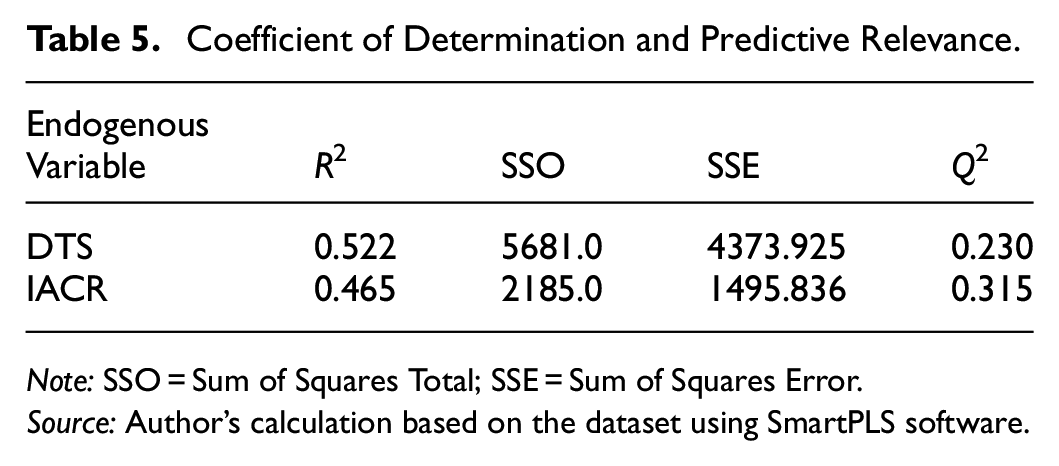
As presented in Table 5, the five innovation attributes—relative advantage, compatibility, complexity, trialability, and observability—collectively explain 52.2% of the variance in Digital Technostress (DTS), indicating a moderately strong explanatory model. Furthermore, Digital Technostress accounts for 46.5% of the variance in the Intention to Adopt Cryptocurrency (IACR), demonstrating a meaningful influence of psychological stress on adoption behavior.
Coefficient of Determination and Predictive Relevance.
Note: SSO = Sum of Squares Total; SSE = Sum of Squares Error.
Source: Author's calculation based on the dataset using SmartPLS software.
The Q2 value, derived through a blindfolding procedure, measures the model’s predictive relevance. A Q2 value greater than zero indicates the model has predictive utility (Chin, 1998; Hair et al., 2014). As shown in Table 5, both DTS (Q2 = 0.230) and IACR (Q2 = 0.315) exceed this threshold, confirming that the model possesses substantial predictive accuracy.
These results collectively support the proposed model's explanatory strength and predictive validity while also identifying the constructs that exert the most meaningful influence on digital technostress and adoption intention within the Arab cryptocurrency context.
Figure 2 below presents the structural model illustrating the relationships between the key constructs: compatibility (CA), complexity (CL), relative advantage (RA), trialability (TR), observability (O), digital technostress (DTS), government regulations (GR), ethical issues (EI), and intention to adopt cryptocurrency (IACR). The figure shows the direct and indirect pathways, including the mediating effect of digital technostress (DTS) and the moderating effects of government regulations and ethical issues on the intention to adopt cryptocurrency.

Structural model.
Discussion
This study sought to investigate the psychological and contextual dynamics influencing the adoption of cryptocurrencies among Arab investors, drawing upon the Diffusion of Innovations (DOI) theory and Technostress Theory. The central focus was to explore how innovation attributes—relative advantage, compatibility, complexity, trialability, and observability—affect digital technostress, and how digital technostress influences the intention to adopt cryptocurrencies. The moderating roles of ethical concerns and government regulations were also examined to provide a more holistic view of behavioral outcomes within a socio-culturally specific context.
The Role of Innovation Attributes in Reducing Technostress
The findings reveal that compatibility, complexity, and observability significantly and negatively impact digital technostress. These results suggest that ensuring alignment with users’ existing financial values and practices (compatibility), simplifying the interface and functionality (complexity), and increasing the visibility of successful cryptocurrency use (observability) can meaningfully reduce psychological strain associated with digital financial tools.
These findings are consistent with prior literature. For instance, Ngafeeson et al. (2024) and Tiwari et al. (2023) affirm that digital overload and usability challenges can deter technology adoption. Similarly, Wu et al. (2022) and Kim and Park (2018) highlight how perceived ease of use and compatibility mitigate the stress induced by technological complexity. This supports the broader theoretical assertions of the Technology Acceptance Model (TAM; Davis et al., 1989), wherein ease of use and usefulness directly shape user attitudes.
In line with this, digital technostress significantly reduced the intention to adopt cryptocurrency among Arab investors, confirming H6. This underlines the emotional and cognitive burden digital finance environments impose on users, particularly in rapidly evolving and poorly regulated markets. These findings align with studies by Lee (2021) and Wu et al. (2022), which show that technostress negatively affects technology adoption, especially when users lack sufficient institutional or technical support.
Mediation Effects of Digital Technostress
Further analysis revealed that digital technostress mediates the relationship between compatibility, complexity, and observability in adopting cryptocurrency. These results confirm H8, H9, and H11, suggesting that reducing stress through socially validated, familiar, and well-designed technologies enhances users’ openness to adoption. This extends the work of Sukumaran et al. (2023) and Kumar and Rani (2024) by demonstrating the indirect psychological mechanisms through which innovation attributes affect adoption behavior in the Arab world.
On the other hand, the non-significant mediating role of technostress in the relationship between relative advantage and trialability with adoption intention (H7 and H10 not supported) was unexpected. While these attributes are traditionally central to DOI, their weak influence on technostress in this context suggests that perceived benefits and experimentation opportunities alone may not alleviate psychological stress associated with cryptocurrency. This could reflect a deeper skepticism or lack of trust in the cryptocurrency ecosystem in Arab markets, where speculative volatility may overshadow perceived advantages.
Government Regulations and Ethical Concerns as Moderators
The results indicate that ethical concerns significantly moderate the relationship between technostress and adoption intention, validating H13. This implies that ethical frameworks, particularly in contexts like the Arab region where Shariah compliance is pivotal, can either buffer or intensify the effects of technostress. Investors who view cryptocurrencies as ethically sound (e.g., transparent, fair, environmentally responsible) are more likely to engage with them, even under conditions of digital overload. This finding aligns with Koroma et al. (2022), who emphasize trust and ethical perceptions as key determinants of cryptocurrency behavior. It also resonates with Ali et al. (2022), who found that investor sentiment and behavior toward Shariah-compliant cryptocurrencies are closely tied to ethical values, especially during periods of crisis such as the COVID-19 pandemic.
Conversely, government regulations were not found to significantly moderate the impact of digital technostress on adoption intention, rejecting H12. This outcome suggests that the absence or ambiguity of clear regulatory frameworks does little to shape stress-related decision-making, particularly in jurisdictions where cryptocurrency is banned or unregulated. Investors seem to perceive technostress as stemming more from the market’s volatility, lack of technical clarity, and digital complexity, rather than from the presence or absence of formal oversight. This insight aligns with behavioral finance literature (Brunnermeier et al., 2022; Kahneman & Tversky, 2013), which emphasizes the dominant role of perceived risk and uncertainty in shaping financial decisions.
This finding also echoes the conclusions of Abou Ali (2024) and Kumar and Rani (2024), who note that regulatory uncertainty contributes to adoption hesitancy but does not directly modulate psychological stress levels. It contrasts with Mensah and Mwakapesa (2022), who observed that government interventions can significantly moderate performance expectations in cryptocurrency adoption. This discrepancy may stem from regional differences, particularly the regulatory fragmentation and legal prohibitions prevalent in the Arab context (Alsmadi et al., 2024; Hajr et al., 2023; Saif Almuraqab, 2020).
Conclusion
This study examined the behavioral determinants of cryptocurrency adoption among Arab investors by applying the Diffusion of Innovations (DOI) theory, integrating it with Technostress Theory, and accounting for contextual moderators—ethical concerns and government regulations. By analyzing how DOI constructs—relative advantage, compatibility, complexity, trialability, and observability—directly and indirectly influence adoption via digital technostress, the research offers a multi-layered view of technology adoption within an underexplored sociocultural context.
The results revealed that observability, compatibility, and reduced complexity are key drivers in minimizing digital technostress. This, in turn, enhances the likelihood of cryptocurrency adoption. Meanwhile, trialability and relative advantage were found to have no significant impact on technostress or intention to adopt. Ethical concerns moderated the relationship between technostress and adoption intention, while government regulations did not, highlighting the importance of cultural and normative values over formal institutional structures in this context.
By integrating emotional, behavioral, and contextual elements into the DOI framework, this study enriches our understanding of how innovation is adopted in emerging digital economies, particularly where ethical norms and regulatory ambiguity coexist.
Theoretical and Practical Contributions
Theoretical Contributions
This research advances the theoretical landscape in three key ways:
Integration of DOI and Technostress Theory: By conceptualizing technostress as a mediating psychological mechanism, the study reveals how emotional responses shape the impact of innovation characteristics on behavioral intention. This is a novel contribution to the innovation diffusion literature, particularly in fintech contexts.
Contextual Extension through Moderators: Incorporating ethical concerns and regulatory perceptions as moderators extends DOI and behavioral finance theories by recognizing the significance of institutional and moral environments, especially relevant in culturally conservative or legally uncertain regions like many Arab countries.
Application to an Understudied Context: Few empirical studies apply these frameworks to Arab financial behavior. This study adds much-needed insight into how regional dynamics, particularly Shariah compliance and informal trust mechanisms, influence innovation diffusion in digital finance.
Practical Implications
For Fintech Developers: The findings highlight the need to design platforms that reduce perceived complexity and technostress. This includes user-friendly interfaces, onboarding tutorials, and multilingual support, especially tailored for culturally diverse users.
For Policymakers: While government regulation did not show a moderating effect, regulatory clarity and consistency remain crucial to reducing overall user anxiety and encouraging long-term investment. Policymakers should focus on clear frameworks supporting ethical finance, including provisions for compliance with Islamic finance.
For Investors and Practitioners: Investors should prioritize platforms that demonstrate ethical transparency, offer educational resources, and ensure regulatory compliance. These features can help mitigate technostress and encourage informed engagement with digital assets.
For Ethical and Religious Institutions: The significant moderating effect of ethical concerns suggests that Shariah advisory boards and ethical fintech advocacy can play a decisive role in shaping trust and adoption. Collaborations between fintech startups and Islamic finance scholars could increase legitimacy and attract a broader user base.
Limitations and Directions for Future Research
Despite its contributions, the study has several limitations. First, while it provides cross-sectional insight into Arab cryptocurrency adoption, it does not address environmental sustainability concerns associated with high-energy crypto assets like Bitcoin. Future studies should explore the role of eco-conscious cryptocurrencies and green blockchain solutions.
Second, while the sample covers several Arab nations, geographic and demographic expansion is necessary to generalize findings across the wider Arab world, particularly North African and Gulf Cooperation Council (GCC) nations with varying legal contexts.
Third, a longitudinal approach would better capture evolving user attitudes in response to regulatory changes, market volatility, or technological innovation.
Finally, future research could benefit from mixed-methods approaches. Combining quantitative scale-based assessments with qualitative interviews or focus groups can yield richer insights into adoption decisions' psychological and cultural underpinnings.
Supplemental Material
sj-docx-1-sgo-10.1177_21582440251357552 – Supplemental material for Diffusion of Cryptocurrency Among Arab Adopters: How Are Digital Technostress, Ethical Concerns, and Government Regulations Interconnected?
Supplemental material, sj-docx-1-sgo-10.1177_21582440251357552 for Diffusion of Cryptocurrency Among Arab Adopters: How Are Digital Technostress, Ethical Concerns, and Government Regulations Interconnected? by Abed Alnaser Nazmi N. Daana and Figen Yeşilada in SAGE Open
Footnotes

Ethical Considerations
This study was approved by the Research Ethics Committee at the authors' affiliated institution. We confirm that all research was conducted in accordance with relevant guidelines and regulations applicable to studies involving human participants.
Consent to Participate
Participants were given written informed consent forms that explained the aim of the study and its significance.
Author Contributions
Abdalnasser Daana: Conceptualization, research design, data collection, data analysis, original draft writing, and final review of the manuscript.
Figen Yeşilada: Contributed to the literature review, assisted with data analysis, manuscript editing, and referencing.
Funding
The author(s) received no financial support for the research, authorship, and/or publication of this article.
Declaration of Conflicting Interests
The author(s) declared no potential conflicts of interest with respect to the research, authorship, and/or publication of this article.
Data Availability Statement
The data used to support the findings of this study are available from the corresponding author upon request.
Supplemental Material
Supplemental material for this article is available online.
References
Supplementary Material
Please find the following supplemental material available below.
For Open Access articles published under a Creative Commons License, all supplemental material carries the same license as the article it is associated with.
For non-Open Access articles published, all supplemental material carries a non-exclusive license, and permission requests for re-use of supplemental material or any part of supplemental material shall be sent directly to the copyright owner as specified in the copyright notice associated with the article.
