




Abstract
With growing numbers of workers relying on the digital workplace to get work done, attention is increasingly focused on the well-being impacts of digital working. This study explored the stress, burnout and mental health implications of employees’ digital workplace experience. Using the Job Demands-Resources model as a theoretical foundation, 142 workers were surveyed about their experiences of dark side of digital working effects (stress, overload, anxiety, and Fear of Missing Out) and well-being (exhaustion and mental health). Results from regression analyses indicated that the fear of missing out on information (IFoMO) is a risk factor for employee mental health and, along with information overload (IO), may lead to greater exhaustion. Additionally, both IFoMO and IO elevate digital workplace stress, further impacting well-being negatively. The results suggest that organizations need to optimize the flow of work-related information in the digital workplace and support employees to leverage information effectively.
Plain language summary
With growing numbers of workers relying on the digital workplace to get work done, attention is increasingly focused on the well-being impacts of digital working. This study explored stress, burnout and mental health issues that can arise for employees as a result of demands they experience when using technology at work. A total of 142 workers were surveyed about stress, overload, anxiety, and Fear of Missing Out relating to technology use. They were also asked about negative well-being impacts namely exhaustion and mental health issues. Results indicated that the fear of missing out on information is a risk factor for employee mental health and, along with information overload, may lead to greater exhaustion. In addition, both of these information related issues were found to elevate digital workplace stress, further impacting well-being negatively. The results suggest that organizations need to optimize the flow of work-related information in the digital workplace and support employees to leverage information effectively.
Keywords
Digital technologies are fundamentally reshaping how work happens in organizations, for example providing greater flexibility and autonomy (Seeber & Erhardt, 2023), but in doing so they potentially impact on the well-being of employees (Dadischeck, 2021). Indeed, such technology-driven changes to the workplace—collectively referred to as the digital workplace—may have negative implications for the mental health of employees (Johnson et al., 2020). Overload and anxiety in relation to the digital workplace can contribute to employee technostress (in other words, stress specifically related to use of technology) and may be detrimental to the psychological well-being of workers, despite the many benefits of the technology (O’Driscoll et al., 2010).
With concerns about employee mental health and burnout exacerbated since the global pandemic (Xie et al., 2023) and hybrid working styles meaning many more employees are reliant on the digital workplace to get work done (Mićić & Mastilo, 2022), the need to understand the impact of digital workplace job demands on well-being appears urgent. This study aims to extend understanding of the relationships between specific dark side effects (overload, Fear of Missing Out and anxiety) and employee well-being in the digital workplace. In addition, it responds to the call to further our knowledge of the associations between the dark side effects of overload, anxiety and stress as well as exploring the pivotal role of technology-related stress (Marsh et al., 2022), and the particular impacts on the mental health of employees (Berg-Beckhoff et al., 2017; CIPD, 2021; Johnson et al., 2020). The findings throw new light on the risk to employees’ mental health posed by their fear of missing out on information in the digital workplace, as well as the sense of exhaustion that can be entailed by feelings of anxiety and overwhelm relating to engaging with large amounts of information. Furthermore, it highlights how such information anxieties may lead to elevated stress and, ultimately, poorer well-being outcomes for workers.
Theoretical Foundation
We investigated the relationships between the constructs using the Job Demands-Resources Model (JD-R; Bakker & Demerouti, 2017) as a theoretical foundation. JD-R theory divides job characteristics into demands (e.g., high workload, poor environmental conditions) and resources (e.g., job autonomy, co-worker support). The former potentially impair health and lead to higher burnout, while the latter can have a motivational effect leading to higher engagement (Krohne, 2002; L. Sun & Bunchapattanasakda, 2019). Where job demands are too high and/or there is a lack of job (and personal) resources, employee well-being may be at risk (Mazzetti et al., 2021), especially where demands are considered as hindrances (i.e., impeding progress towards goals) as opposed to challenges (i.e., heightening employee mastery; Crawford et al., 2010).
JD-R has been used in a number of dark side of digital working studies, providing a basis to investigate aspects such as the impact of e-mail overload on burnout (Reinke & Chamorro-Premuzic, 2014), technostress on employee well-being (Hang et al., 2022) and technology overload and monitoring on turnover (Carlson et al., 2017). In a literature dominated by the Transactional Model of Stress and Coping (Lazarus & Folkman, 1984), its use shows promise as a way to improve theoretical diversity and furnish novel insights on the dark side of digital working (Marsh et al., 2022). Furthermore, Scholze and Hecker (2023) highlight the importance of the ongoing development of JD-R in context of continual evolution of the digital work environment inside of organizations.
Digital Workplace Dark Side Effects
Employees may perceive certain dark side effects related to the digital workplace, (such as overload, anxiety and stress) which can act as job demands which may lead to health impairment. The dark side literature furnishes insights on how these effects manifest and inter-relate in the digital workplace, as well as their impacts on well-being.
Digital Workplace Overload
Seventy six percent of global workers reportedly say that information overload contributes to their daily stress (Ono, 2022). Technostress can be higher where there are multiple digital work applications (Camarena & Fusi, 2022). Rasool et al. (2022) found that technology overload in the workplace affected employees through factors such as too many interruptions, work-life and work-family conflict, and addiction to e-mail and other messaging tools. E-mail is often implicated, with individuals feeling overwhelmed by email and messaging (Grevet et al., 2014) and fatigued and stressed due to communication overload (J. Sun & Lee, 2022). Karr-Wisniewski and Lu (2010) have conceptualized overload as having three dimensions: information, communication and system features. Overload in the digital workplace can lead to elevated stress (e.g., Ayyagari et al., 2012) and impact negatively on employee well-being outcomes such as higher workload stress and psychological strain (Stich et al., 2019), as well as higher exhaustion and poorer performance (A. Chen & Karahanna, 2018). Techno-overload has been identified as a key source of technology-related stress for workers during the global pandemic (Bahamondes-Rosado et al., 2023) and a distinct stressor with negative implications for psychological health (Kaltenegger et al., 2023).
Digital Workplace Anxiety
Employees may experience anxiety in relation to using the digital workplace which may involve feelings of apprehension and worry towards it and physical arousal in response to it (Beckers et al., 2008). At its most extreme, such anxiety may become technophobia, with users potentially refusing to engage with technologies at all (Agogo & Hess, 2018; Sami & Pangannaiah, 2006). As well as relating to the technology itself, digital workplace anxiety may relate to the information that flows through it, for instance, how to find it or understand it (Bawden & Robinson, 2020). Where employees are less competent to use the technology and feel less confident in doing so, anxiety is generally higher (Powell, 2013). Digital workplace anxiety can lead to elevated levels of stress for employees (Parayitam et al., 2010). Indeed, using JD-R theory as a foundation, Salanova et al. (2013) demonstrated anxiety as a key facet of technostrain and contributor to technostress.
Digital Workplace Fear of Missing Out
As well as generalized anxiety regarding the use of digital tools at work, employees may also experience a fear of missing out (FoMO) in the digital workplace (Marsh et al., 2022). In the workplace context, FoMO is conceptualized as anxiety about missing out on both important information and updates, as well as opportunities for relationships and interactions (Budnick et al., 2020). It has been found to contribute to work burnout (Budnick et al., 2020). FoMO is widely studied in relation to social media (e.g., Tanhan et al., 2022) and in this context has been shown as potentially detrimental to mental health (Gupta & Sharma, 2021). Some studies have also shown ways in which it is operative in the digital workplace. For instance, Hoşgör and Hoşgör (2020) found that it contributes to an increase in perceived work overload, while Fridchay and Reizer (2022) found that it could lead to burnout.
Digital Workplace Stress
Employees may experience stress relating to the digital workplace due to the constant need to adapt to new technological developments (Ragu-Nathan et al., 2008), misalignment between the demands of the technology and resources to use it (Salanova et al., 2003), mental and physiological arousal in relation to technology use (Arnetz & Wilholm, 1997), and high level of cognitive demands in relation to lack of control when working digitally (Sellberg & Susi, 2014). Sometimes referred to as “technostress,” the phenomenon has been quite extensively studied in relation to workplace technology and may act as a focal lens through which other dark side effects are transmitted onto employee well-being (Marsh et al., 2022). Overload, anxiety and FoMO have been found to contribute to technostress and burnout (e.g., Galluch et al., 2015; J. Sun & Lee, 2022). Employee well-being has been shown to be negatively affected by technostress via elevated burnout and emotional exhaustion in particular (Marsh et al., 2022) and impacts to mental health (Dragano & Lunau, 2020). Notably, Sharma and Tiwari (2023) show the detrimental impact of technostress as a job demand on burnout and work-life balance using JD-R as a theoretical frame.
Employee Well-Being
Exhaustion
Emotional exhaustion, or a sense of personal resource depletion, is considered the core component of burnout and can result from high job demands (Seidler et al., 2014). It is typically measured using self-report measures such as Maslach’s Burnout Inventory (MBI; Maslach & Jackson, 1986) or the Oldenburg Burnout Inventory (OLBI; Demerouti et al., 2003). Multiple studies in the dark side literature have shown that technology-related stress is associated with elevated employee exhaustion (e.g., Brown et al., 2014; Maier et al., 2015). More evidence is nevertheless needed on the manner in which specific dark side effects transmit their effects onto employee exhaustion (Marsh et al., 2022) especially as technology-induced exhaustion has been found to negatively impact employee work well-being (H. Wang et al., 2023).
Mental Health
Mental health is described by the World Health Organization (2022, p. XIV) as “an integral part of our general health and well-being” that means “we are better able to connect, function, cope and thrive.” While work is usually viewed as a positive contributor to good mental health, certain risk factors in the workplace such as high job demands can increase common mental health problems (Harvey et al., 2017). Indeed, certain types of technostress have been found to be related to poor mental health (Borle et al., 2021; Dragano & Lunau, 2020). Furthermore, a recent review of the evidence linking digital working and mental health found that digital working may amplify certain mental health risk factors (CIPD, 2021). However, it concluded that the evidence for the association between them is as yet “weak and inconclusive” (CIPD, 2021, p. 9). This highlights an important gap in the dark side literature, especially considering heightened concerns about mental health in the post-pandemic workplace (Peters et al., 2022) and emphasis on hybrid work styles to which digital workplace technologies are integral (Mićić & Mastilo, 2022).
Present Study
In light of the research highlights and gaps presented, the present study explores the following hypotheses (Figure 1):
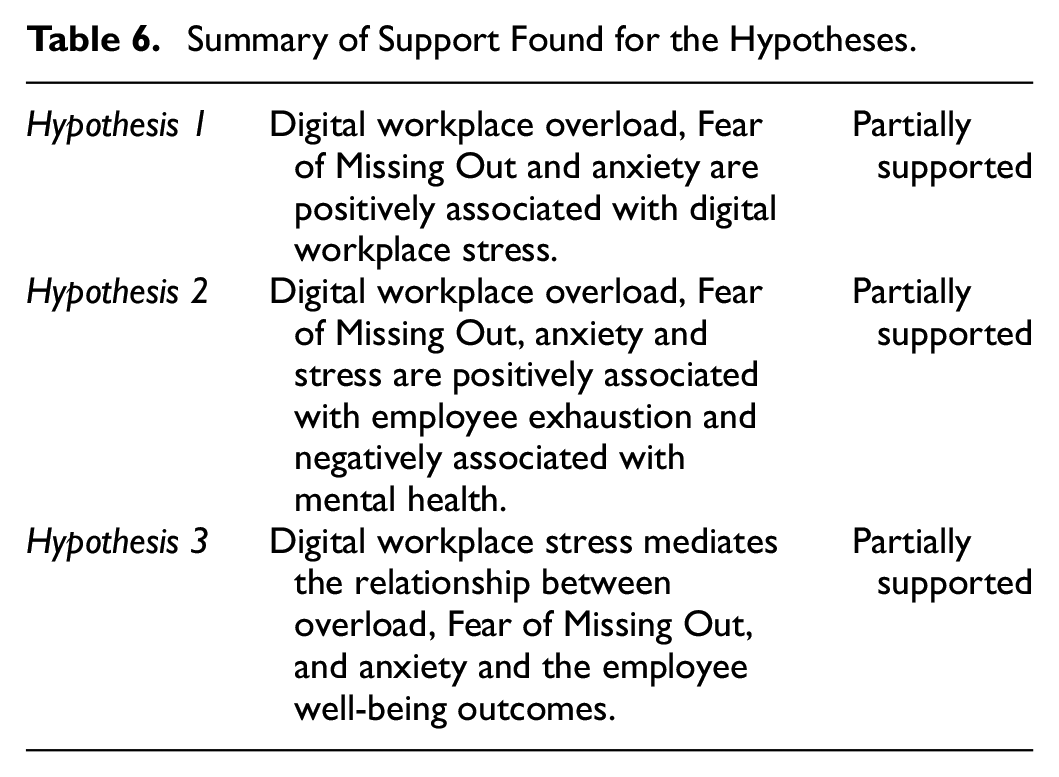
Hypothesis 1. Digital workplace overload, Fear of Missing Out and anxiety are positively associated with digital workplace stress.
Hypothesis 2. Digital workplace overload, Fear of Missing Out, anxiety and stress are positively associated with employee exhaustion and negatively associated with mental health.
Hypothesis 3. Digital workplace stress mediates the relationship between overload, Fear of Missing Out, and anxiety and the employee well-being outcomes.

Research model.
Methodology
The design of the study was cross-sectional and as such investigated relationships between the constructs rather than cause-and-effect relationships. It investigated certain dark side of digital working effects as antecedents, namely: digital workplace overload (information, communication and system feature), anxiety, and Fear of Missing Out (informational and relational). Digital workplace stress, another dark side effect, was included as a mediator variable that would transmit the effects of the antecedents onto employee well-being outcomes of employee exhaustion (a facet of burnout) and mental health. Control variables of age, gender, education and tenure were included.
Participants and Procedure
Following ethical approval by the University Research Ethics Committee at the University of Nottingham, participants were recruited for the study using convenience sampling on the online research platform Prolific (www.prolific.co). A power analysis was performed before the study, using G*Power version 3.1.9.6 (Faul et al., 2007), to indicate the minimum number of participants needed to test the hypotheses. The analysis revealed that to have a 90% chance of detecting a small effect with a significance level of α = .05, a sample size of at least N = 130 was needed for multiple regression involving seven predictors. Therefore, the final sample of N = 140 was determined to be sufficient for testing the hypotheses.
Participants were UK-based working individuals who use technology for work at least once a day. There was a total of 142 survey responses however two were excluded from the dataset because of a failed attention check item. The final sample of 140 was predominantly female (84.3%), university educated (69.3%) and aged between 25 and 44 years (79.3%), with a tenure in their current organization of 1 to 9 years (69.3%).
The survey was conducted in August 2021 using the survey platform Qualtrics (www.qualtrics.com) and took on average 12 minutes for respondents recruited via Prolific to complete. Respondents were paid £7.50/hr. SPSS Version 26 was used to analyze the data, with the Andrew Hayes PROCESS macro for mediation analysis (Hayes, 2017).
The survey also collected data about trait mindfulness, computer self-efficacy, digital workplace addiction, overall burnout and overall health including both mental and physical health. In the present study, the analysis only focuses on specific dimensions of burnout and health, as supported by the literature in the introduction.
Measures
Participants rated items relating to digital workplace dark side effects and employee well-being outcomes. Reliability for all scales was good, with Cronbach’s Alphas of at least .72 for all scales, see Table 1. All constructs were measured on 7-point Likert scales except for stress and mental health which were 6-point. Where necessary, the wording of scale items was adapted to include reference to “digital workplace” which was defined for participants as “the collection of digital technologies available in the workplace that enable work to happen, for example: e-mail, intranet, HR systems, productivity tools, mobile devices (etc.).” See Appendix 1 for measurement items.
Measurement Scales with Cronbach’s Alphas and Sample Items.

Three scales were used to measure the dark side effects that can occur in relation to digital technologies. The Technology Overload Scale (Karr-Wisniewski & Lu, 2010) furnished data on the three overload dimensions: information, communication and system feature. Digital workplace stress and anxiety were measured using items from Venkatesh et al.’s (2003) Unified Theory of Acceptance and Use of Technology. Budnick et al.’s (2020) Fear of Missing Out at work scale provided data relating to both informational and relational FoMO. The employee well-being outcomes were measured using the exhaustion dimension of the Oldenburg Burnout Inventory (Demerouti et al., 2003) and the mental health items from the Short Form 36 Health Survey Questionnaire (Ware & Sherbourne, 1992). We also included measures of demographics (age, gender, education and tenure) as control variables.
Results
The hypotheses were tested using hierarchical regression and mediation analyses in SPSS v26, the latter used the PROCESS v4.0 module (Hayes, 2017). Common method bias was checked using Harman’s single factor test and found not to be a problem in the data set used in this study; 42% total variance extracted by one factor was below the recommended 50% threshold (Podsakoff et al., 2003). Preliminary analyses were conducted to ensure no violations of the assumptions of normality, linearity and homoscedasticity.
Correlations between key variables are shown in Table 2. Digital workplace stress, IO and IFoMO have the strongest correlations with exhaustion and mental health.
Bivariate Correlations for Substantive Variables.

Note. N = 140, with pairwise deletion for missing data.
p < .05. **p < .01.
Digital Workplace Dark Side Effects on Digital Workplace Stress
The impact of the dark side effects (overload, anxiety and FoMO) on digital workplace stress was assessed using hierarchical block-wise regression analysis with pairwise deletion for missing values. Demographics (age, gender, education, tenure) were controlled for at Step 1 of the regression analysis and accounted for 3% of the variance in digital workplace stress (R2 = .03, F (4, 134) = .99, p = .42), although the contribution was not significant. At Step 2, the digital workplace dark side effects were added to the regression model, together explaining an additional significant 28% in variance in digital workplace stress (ΔR2 = .28, F (6, 128) = 8.76, p < .01).
All digital workplace demands had significant positive correlations with digital workplace stress and these correlations were small or moderate (Cohen, 1988). In the regression equation, IO (b = .28, p < .01) and IFoMO (b = .22, p < .05) had statistically significant unique relationships with workplace stress. A summary of results from the regression for digital workplace stress are shown in Table 3. In accordance with these findings, hypothesis 1 (which states that the digital workplace dark side effects are positively associated with digital workplace stress) is partially supported.
Associations Between Digital Workplace Dark Side Effects and Digital Workplace Stress.
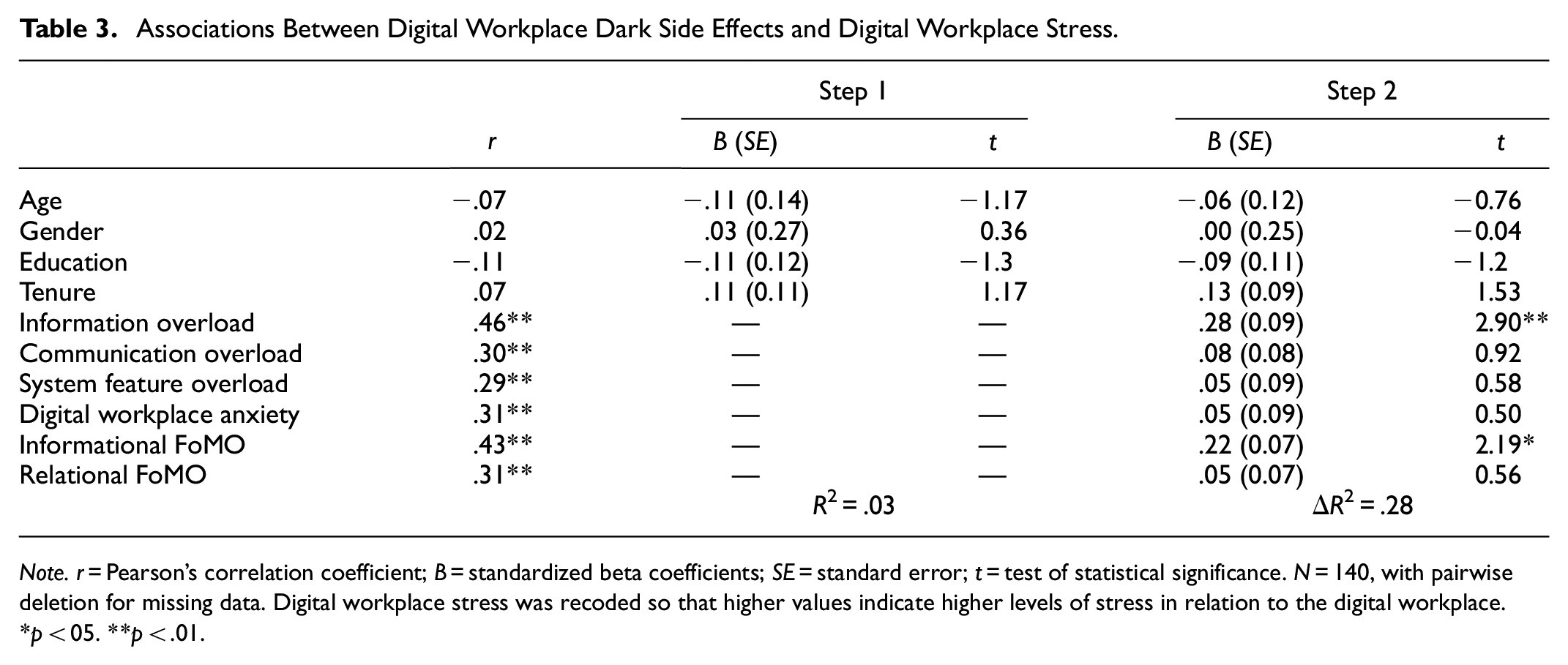
Note. r = Pearson’s correlation coefficient; B = standardized beta coefficients; SE = standard error; t = test of statistical significance. N = 140, with pairwise deletion for missing data. Digital workplace stress was recoded so that higher values indicate higher levels of stress in relation to the digital workplace.
p < 05. **p < .01.
The Effect of the Dark Side Effects (Including Digital Workplace Stress) on Exhaustion and Mental Health
To understand the effect of the dark side effects and digital workplace stress on the employee well-being indicators of exhaustion and mental health, further hierarchical block-wise regression analyses with pairwise deletion for missing values were conducted (see Tables 4 and 5 for a summary of results). Demographics (age, gender, education, and tenure) were again entered at Step 1 for all regression analyses, therefore variance examined is above and beyond that explained by these factors.
Associations Between Digital Workplace Dark Side Effects (Including Stress) and Exhaustion.

Note. r = Pearson’s correlation coefficient; B = standardized beta coefficients; SE = standard error; t = test of statistical significance. N = 140, with pairwise deletion for missing data. Digital workplace stress and exhaustion were recoded so that higher values indicate higher levels of stress and exhaustion, respectively.
p < .05. **p < .01.
Associations Between Digital Workplace Dark Side Effects (Including Stress) and Mental Health.

Note. r = Pearson’s correlation coefficient; B = standardized beta coefficients; SE = standard error; t = test of statistical significance. N = 140, with pairwise deletion for missing data. Digital workplace stress and mental health were recoded so that higher values indicate higher levels of stress and exhaustion, respectively.
p < .05. **p < .01.
Exhaustion
Demographics (age, gender, education, tenure) were controlled for at Step 1 of the regression analysis and accounted for 6% of the variance in exhaustion (R2 = .06, F (4, 134) = 2.17, p = .08), though the contribution was not significant. At Step 2, dark side effects were added to the regression equation, explaining an additional significant 29% in variance of the dependent variable (ΔR2 = .29, F (6, 128) = 9.35, p < .01). IO and IFoMO had significant effects on exhaustion, respectively (b = .22, p < .05) and (b = .29, p < .01). Digital workplace stress was added at Step 3, explaining an additional significant 10% in variance of the dependent variable (ΔR2 = .10, F (1, 127) = 21.72, p < .01). Digital workplace stress had a statistically significant unique effect on employee exhaustion (b = .37, p < .01).
Mental Health
At Step 1 of the regression model, demographics accounted for 10% of the variance in mental health (R2 = .10; F (4, 134) = 3.83, p < .01); age had a significant positive unique effect (b = .26, p < .01). Dark side effects were added to the regression equation at Step 2, explaining an additional 15% of variance in the predictor variable (ΔR2 = .15, F = 4.10, p < .01). IFoMO had a statistically significant negative effect on mental health (b = −.23, p < .05). When digital workplace stress was added to the regression equation at Step 3, a further 2% of variance in employees’ mental health was explained (ΔR2 = .02, F = 4.23, p < .05). Digital workplace stress had a statistically significant negative unique effect (b = −.19, p < .05).
These findings partially support hypothesis 2 (which states that dark side effects including digital workplace stress are positively associated with employee exhaustion and negatively associated with mental health.).
Digital Workplace Stress as a Mediator Between Digital Workplace Dark Side Effects and Exhaustion/Mental Health
As both IO and IFoMO had statistically significant unique effects on digital workplace stress, mediation analyses were conducted using ordinary least squares path analysis, with indirect effects based on 5,000 bootstrap samples, to see whether digital workplace stress would also transmit their effects onto employee exhaustion and mental health.
Exhaustion
An indirect positive effect on exhaustion via digital workplace stress was identified (see Figures 2 and 3) for both IO (b = .21 95% CI [0.13, 0.31]) and IFoMO (b = .19 95% CI [0.11, 0.29]). Demographics (age, gender, education, tenure) were entered into the mediation models as covariates.

Mediation effect of digital workplace stress on the relationship between information overload and exhaustion.

Mediation effect of digital workplace stress on the relationship between informational FoMO and exhaustion.
Mental Health
An indirect negative effect on mental health via digital workplace stress was identified (see Figures 4 and 5) for both IO (b = −.12 95% CI [−0.21, −0.04]) and IFoMO (b = −.10 95% CI [−0.19, −0.02]). Demographics were entered into the mediation models as covariates.

Mediation effect of digital workplace stress on the relationship between information overload and mental health.

Mediation effect of digital workplace stress on the relationship between informational FoMO and mental health.
Hypothesis 3 (which states that digital workplace stress will mediate between digital workplace dark side effects and employee exhaustion/ mental health) is therefore partially supported.
Support found for our hypotheses is summarized in Table 6. We note that there may be some shared variance explained between factors entered in the regressions, evidenced by the non-significance of relationships compared to correlations (although collinearity was not indicated as an issue on examination of VIF levels).
Summary of Support Found for the Hypotheses.
Discussion
The present study aimed to investigate whether employee mental health and exhaustion are impacted by stress, overload, anxiety, and fear of missing out experienced in the digital workplace. It makes a number of contributions to the literature. As well as furnishing novel findings on the detrimental effect of the dark side of digital working on employee mental health, a relatively little studied well-being outcome in this research domain, it also underlines and extends previous findings on the felt sense of exhaustion experienced by employees. This is, to the best of our knowledge, the first study to examine specific dimensions of digital workplace overload (information, communication and system feature) alongside FoMO (informational and relational) in relation to employee burnout and mental health. Indeed, among the dark side effects included in the current analyses, those relating to information—both an overload of it and the fear of missing out on it—proved particularly detrimental for well-being both directly and by elevating overall stress related to digital working.
Workers’ mental health may be at risk from dark side aspects of digital working, but further evidence is needed (CIPD, 2021). Our findings go some way towards addressing this gap. All the dark side effects included in this study (except for communication overload) were significantly and negatively associated with mental health with small to medium effect sizes. This aligns with such evidence as already exists in relation to the digital workplace specifically (e.g., Dragano & Lunau, 2020) as well as findings beyond the workplace context on the impact of the dark side of technology on mental health (Scott et al., 2017). In the present study, these effects explained 17% of the variance in mental health and, while this indicates that other factors are involved, it suggests that the digital employee experience is an important contributing factor to the mental health of the workforce inside modern organizations. Our data showed that mental health was worse for younger workers, and this aligns with prior evidence (e.g., Deloitte, 2022).
Among the dark side effects studied, the fear of missing out on information was indicated as the greatest risk factor for mental health of employees working digitally. In the regression analysis, the informational dimension of FoMO had a direct negative effect on mental health. This novel finding contributes new evidence to the potential employee well-being impacts of workplace FoMO. Although to date, evidence relating to work contexts only extends to burnout (e.g., Fridchay & Reizer, 2022), in wider social media contexts FoMO has been linked to poorer mental health (e.g., Gupta & Sharma, 2021) although these findings relate to maladaptive use of social media and/or smartphones, rather than information specifically. Hayran and Anik (2021) have recently found that the fear of missing out on digital content during the pandemic may have had negative well-being implications. Further research is needed to replicate the present findings and elucidate the mechanisms by which the fear of missing out on information, specifically, may be detrimental to mental well-being.
The potential impact of organizations’ information ecosystems on employee mental health was further highlighted in the mediation analyses. Here, by elevating digital workplace stress, both an overload of information and the fear of missing out on it had a negative indirect effect on mental health. Although evidence is lacking in the dark side literature on the specific impacts of information-related dark side effects on mental health, these findings do align with wider evidence. For example, in a recent review of the information overload literature, Bawden and Robinson (2020) highlight potentially detrimental effects of information overload on mental health. While such findings tend to relate to social media interactions, in a workplace context it is plausible to think that missing out on important work-related information that enables them to do their jobs and manage their careers might be a cause for concern for employees.
Marsh et al. (2022) highlight the felt sense of exhaustion due to the dark side of the digital workplace that is apparent in much of this literature. Overload due to e-mails and other interruptions (Brown et al., 2014; A. Chen & Karahanna, 2018) and strain relating to increased work pace and multi-tasking (Johnson et al., 2020) have been found to contribute to a more exhausted workforce. The present study underlines and extends these findings. All the dark side effects included in this study were significantly and positively associated with exhaustion; digital workplace stress, information overload and fear of missing out on information reached a medium effect size, with the remainder small. Elucidating the specific dimensions of overload and FoMO involved is a novel finding and, as with mental health, points to a crucial role for the organization’s information ecosystem in the extent to which digital workers experience exhaustion. Together, the dark side effects under scrutiny explained 39% of the variance in employee exhaustion in the regression analysis. Thus, while other job demands must be considered, the dark side aspects of the digital workplace may have far-reaching effects in terms of employee exhaustion. This may be attributable to the extensive use of digital workplace technologies to support hybrid work.
As we saw with mental health, dark side effects relating to the organization’s information ecosystem may have an important impact on levels of exhaustion among digital workers. Both information overload and fear of missing out on information made significant positive contributions to exhaustion both directly (in the regression analysis) and indirectly via digital workplace stress (in the mediation analysis). For overload, this aligns with previous studies (see above) and extends our understanding by highlighting the specific dimension of overload that is associated with exhaustion (in other words, information rather than communication or system feature overload). For FoMO, this aligns with previous research (e.g., Fridchay & Reizer, 2022) but provides further clarity by revealing that informational rather than relational aspects of fear of missing out in the digital workplace appear to be associated with exhaustion.
These findings need further validation from future studies but nevertheless indicate that, given the potential for exacerbating anxiety and fatigue among employees, serious and sustained attention should be given to the management of information inside organizations as well as the design and deployment of the digital workplace platforms used to convey it to employees. These findings also find validation in well-established concepts of “information anxiety” and “information fatigue syndrome” both of which have been found to occur in response to an overload of information (Bawden & Robinson, 2020).
Technology-related stress at work appears to be detrimental to employee well-being, however much remains to be understood about its specific effects (Dragano & Lunau, 2020). Findings from the present study add to the growing evidence base in this respect, suggesting that digital workplace stress not only directly impacts employee exhaustion and mental health in a detrimental manner, but also transmits the damaging effects of information-related overload and FoMO. Overload as a dimension of or contributor to technology-related stress is well established in the literature (Marsh et al., 2022) and forms a specific dimension of Tarafdar et al.’s (2007) Technostress Creators Inventory. Our findings suggest that more attention needs to be paid to the specific aspects of overload that might be involved, namely information in the present analyses. As we have already seen, information overload is associated with both information anxiety and fatigue, factors which are well understood as contributing to elevated stress (Bawden & Robinson, 2020). Digital workplace stress appears to act as a lens through which this anxiety and fatigue is focused to produce a detrimental effect on employee well-being.
While the present study cannot determine directional influences, the relationship between information overload and fear of missing out on information is intriguing. It suggests a fruitful direction for further research but also warrants some reflection here. For instance, it is plausible to conceive that workers may worry about missing out on important work-related information because there is such a glut of information flowing through internal digital channels that they cannot keep up with it; but likewise we might infer that workers who are worried about missing out on important updates succumb to information overload as they strive to keep up with e-mail, instant messages, notifications from enterprise social networking sites, corporate news apps and more. A further consideration is the possible effect of the digital divide at work, with digitally hyperconnected workers (e.g., senior managers with mobile phone, tablet and/or laptop access) overloaded with information, while digitally disenfranchised workers (e.g., frontline workers with kiosk or occasional PC access) may experience “information poverty” where individuals are unable to access the information they need (Bawden & Robinson, 2020).
We note that relational FoMO, communication/ feature overload, and anxiety were not significantly related with exhaustion and mental health in the regressions, warranting brief exploration here. Respondents to this study appeared to be less concerned about missing out on the relational aspects of work than those pertaining to information. It is conceivable that this may be due to a step change in adoption and use of real-time communication tools such as Microsoft Teams, Slack and Zoom during and post-pandemic (e.g., Mićić & Mastilo, 2022). Greater employee familiarity and adeptness with communication tools may also be a factor in reducing perceived communication overload, although this finding does not align with previous literature (e.g., J. Sun & Lee, 2022). We also might infer here that the increased use of such tools for communication and collaboration inside organizations may have exacerbated information overload. In relation to this, it is interesting that it was anxiety in relation to information rather than the generalized digital workplace anxiety that we also measured, that had the significant impact on well-being. Worker worries may be more focused on accessing, managing and consuming the high load of information flowing to them in the digital workplace than with using the tools generally, especially if they gained new digital skills during the pandemic (Manco-Chavez et al., 2020). For example, C. Wang et al. (2023) found increased anxiety due to information overload in enterprise social media channels. These non-significant findings need further exploration in future research as the limitations of the present study constrain causal explanation.
From a theoretical standpoint, the study makes several contributions to the Job Demands-Resources Model (Bakker & Demerouti, 2017). Firstly, it extends the JD-R by integrating specific dark side of digital working elements (overload, anxiety and FoMO) as job demands and providing evidence for the value of further investigation of demands that specifically relate to the technological environment of work. Secondly, it adds to the evidence base for the health impairment pathway and shows how the dark side of digital workplace effects may negatively impact on employee burnout (exhaustion) via this pathway. Thirdly, it adds another dimension to our understanding of the negative health impacts in the model through the inclusion of mental health as well as burnout (exhaustion); future longitudinal studies may throw light on the causal relationship between mental health and burnout.
Practical Implications
Our findings also suggest some practical implications for organizations. Firstly, they will be of interest to digital workplace managers and digital communicators who are key arbiters of employees’ digital platform and content experiences inside organizations. By presenting strong evidence for potential detrimental well-being effects of issues with the information ecosystem (which may include corporate news and information, policies, help desk documents, etc.) the current research supports the case for investing in practices that can optimize this environment and which have already been found to improve worker productivity and organizational performance (White, 2012). For instance, information and knowledge management strategy, user-centric content design, personalized and mobile-optimized digital channels, employee involvement in digital workplace transformation (e.g., Attaran et al., 2019; Byström et al., 2019; Johnson et al., 2020). In doing so, it may be valuable to consider both audiences that may be hyperconnected to the digital workplace, as well as those disenfranchised from it (e.g., due to a lack of access or skills).
Secondly, HR and learning personnel may use these findings to consider policies and training options that would support end-users of the digital workplace to better access, manage and consume information in a way that is conducive to well-being as well as productivity. This aligns with evidence that dark side effects of digital working can be mitigated through appropriate training and guidance (e.g., S. Chen et al., 2009; Soucek & Moser, 2010). Improving information literacy among employees may be particularly apt (e.g., Bawden & Robinson, 2020; Elciyar, 2021).
Limitations and Future Research Directions
Although furnishing some novel insights and practical implications, the present findings should be considered in light of certain limitations and future research directions. In particular, the correlational design means that our analyses are unable to determine causality in relation to the examined constructs. We also acknowledge that the quantitative nature of this study means that it is unable to reveal the mechanisms by which employees may be more exhausted and suffer poorer mental health in the digital workplace. Understanding the specific characteristics of individual digital workplace technologies that lead to stress and strain can help reveal further insights in this respect (Johnson et al., 2020).
In relation to the above limitations, the interplay between information overload and fear of missing out on information cannot be causally determined in the current study but certainly warrants further investigation, as does the potential role of the digital divide in the workplace. Future research might consider alternative designs including qualitative, experimental and longitudinal approaches to further elucidate how and why an organization’s information ecosystem effects employee well-being, as well as the interrelationship of the specific dark side effects that relate to it. Employing objective rather than self-report measures, along with multiple data collection points, could enhance the validity of the findings.
In addition, it should be noted that 84% of participants were female and the relative homogeneity of the sample in this respect may affect the generalisability of the findings. In some cases, gender may influence the extent of technostress (e.g., Tarafdar et al., 2011).
Conclusion
This study extends understanding of the dark side of digital working by revealing that employees who are overloaded by information or worried about missing out on it in the digital workplace face risks to their well-being at work. Elevated stress and burnout as well as poorer mental health may ensue. The digital workplace dark side effects examined here explained 39% of the variance in employee exhaustion and 17% of the variance in employee mental health. The findings add more nuanced understanding about the specific aspects of the dark side of the digital workplace that may contribute to these outcomes. For organizations, a clear message emerges: consideration of the digital workplace in work and job design is essential to not only employee productivity but also well-being in modern organizations. Furthermore, developing understanding of how anxiety and stress may arise in response to the nature of the organization’s information ecosystem may be of particular importance. For researchers, a rich vein of exploration is indicated: understanding the impact of information in the digital workplace on employee thriving, including consideration of aspects such as information anxiety and fatigue, information literacy and the digital divide.
Mental health and exhaustion at work have been highlighted as areas of significant concern for organizations during and post-pandemic. Digital employee experiences have the potential to enable positive well-being outcomes for employees (Charalampous et al., 2019) as part of well-designed organizational initiatives focused on worker welfare (Daniels et al., 2017). However, at present they may also be detrimental in certain ways, as attested to by a dark side of digital working literature (Marsh et al., 2022) to which this study contributes. It demonstrates that the fear of missing out on information may contribute to job demands that put employee mental health at risk and, along with information overload, contribute significantly to employee stress and exhaustion. Further exploration of the dark side of the digital workplace is therefore called for, that by doing so the “light side” may be maximized for organizations and individuals.
Footnotes
Appendix 1
Declaration of Conflicting Interests
The author(s) declared no potential conflicts of interest with respect to the research, authorship, and/or publication of this article.
Funding
The author(s) disclosed receipt of the following financial support for the research, authorship, and/or publication of this article: The authors (EM, AS, EPV) acknowledge the support by the Economic and Social Research Council [Grant Number: ES/P000711/1]. AS and EPV acknowledge the support of the UK Research and Innovation (UKRI) Trustworthy Autonomous Systems Hub [EPSRC Project Ref. EP/V00784X/1] and Horizon [EPSRC Project Ref. EP/TO22493/1]. EPV acknowledges the support of the NIHR Biomedical Research Centre.
Ethical Approval
This study was approved by the University Research Ethics Committee at the University of Nottingham (reference: S1356).
Data Availability Statement
This study was pre-registered on Open Science Framework (https://osf.io/f9ymb). The data is available on the UK Data Service, ReShare ( ).
).