




Abstract
The concept of innovation-driven productivity is a crucial factor in fostering high-quality economic development, grounded in economic theories and practices from the past several decades. This study utilizes machine learning to develop an innovation-driven productivity dictionary and conducts text analysis on 390 government work reports from 30 provinces spanning 2011 to 2023. This analysis constructs an indicator of government attention to innovation-driven productivity at the governmental level. The findings indicate that attention to innovation-driven productivity significantly enhances regional innovation performance, a conclusion that remains robust across various tests. Mechanistically, government attention to innovation-driven productivity promotes the development of productive services and increases enterprise innovation investment, thereby boosting regional innovation performance. According to heterogeneity research, western regions see a far greater impact from government attention on fostering innovative performance than do central and eastern regions. In terms of manufacturing levels, regions with lower manufacturing levels experience a greater positive impact from government attention than those with higher manufacturing levels. Regarding the degree of policy intervention, the effects during periods of high intervention are significantly stronger than those observed during periods of low intervention. This study offers useful suggestions for how governments can successfully use innovation-driven productivity to promote regional innovation development in addition to broadening the theoretical framework of the relationship between governmental actions and regional innovation performance.
Plain language summary
Innovation-driven productivity is a key factor in advancing high-quality economic development. This study examines how government attention to innovation impacts regional innovation performance. Using machine learning, we created a dictionary to measure innovation-driven productivity and analyzed 390 government work reports from 30 provinces in China, covering the years 2011 to 2023. Our findings show that government focus on innovation-driven productivity significantly boosts regional innovation performance. The study identifies two main mechanisms: encouraging the growth of productive services and increasing business investment in innovation. The impact of government attention varies across regions and contexts. Western provinces benefit more than central and eastern regions, while areas with less developed manufacturing sectors experience greater gains. Additionally, the effects are stronger during periods of high government policy intervention compared to times of lower intervention.
Keywords
Introduction
Innovation-driven productivity fuels modern economic growth, especially in strategic and future industries. Globally, governments develop policies to boost this productivity, promoting technological innovation and industrial upgrading. The United States has published the report “America Will Lead the Future Industries,” emphasizing the development of five future technology areas including artificial intelligence and quantum information science (T. W. House, 2022). Japan has introduced a series of policy measures centered around the “Society 5.0” vision, supporting technologies such as life health and artificial intelligence. The European Union has prioritized the development of six major areas, including autonomous driving vehicles and hydrogen technology (Japan, 2015). The United Kingdom has identified five future technology combinations through its “Science and Technology Framework” (U. Government, 2024). Germany, through its “High-Tech Strategy 2025,” has proactively planned for artificial intelligence and smart manufacturing (T. F. Government, 2019). In China, innovation-driven productivity is a key focus of national strategies and provincial government work reports. These initiatives underscore the increasingly pivotal role of innovation-driven productivity in global economic competition, highlighting the high level of attention it receives from governments.
Whether government attention to specific fields can translate into actual regional innovation performance has been a core concern in policy-making and academic research. Existing studies indicate that local government attention allocation significantly promotes enterprise innovation activities. For instance, when local governments highlight innovation in their reports, it typically leads to a significant increase in enterprise innovation activities and investments. This enhancement boosts the quality of innovation and fosters strategic, impactful initiatives. However, this focus by the government may also inhibit exploratory innovation. This suggests that while the allocation of government attention promotes innovation, it may selectively influence the type and direction of innovation (Jialin & Jiachang, 2023). Additionally, the establishment of national high-tech zones demonstrates the positive impact of government attention on regional innovation performance. These zones boost regional innovation performance by attracting both talent and capital, creating positive spatial spillover effects on neighboring cities (Jingjing & Jie, 2024). Studies by Zhang and others have also found that government attention to environmental issues effectively promotes regional low-carbon development, primarily through environmental regulation and policy enforcement (Huizhi, 2023). Government attention allocation significantly improves innovation performance. Governments influence enterprise innovation not only through direct economic incentives but also through the policy environment and institutional construction, affecting the entire regional innovation ecosystem. However, whether government attention to innovation-driven productivity can effectively enhance regional innovation performance requires specific analysis based on local conditions.
Although the concept of innovation-driven productivity is relatively new, its core elements—technological innovation, information technology, high-tech, and the internet—have been integral to modern economic development for decades. The essence of innovation-driven productivity lies in driving high-quality economic development through technological progress and innovation. This development model emphasizes qualitative improvement over quantitative increase, focusing more on the quality and efficiency of innovation. From the perspective of innovation-driven productivity, the government is not only a promoter of innovation activities but also a regulator and coordinator. By formulating policies, providing financial support, and constructing innovation platforms, the government fosters the profound integration of technology and industry. Analyzing these long-standing elements helps to better understand the concept of innovation-driven productivity and its impact on innovation performance, offering a broad perspective on how government attention and resource allocation can promote innovation at multiple levels. This not only aids in understanding the actual effects of current government policies but also provides valuable references for future policy adjustments.
This study uses 390 government work reports from 30 provinces between 2011 and 2023 to measure government attention to innovation-driven productivity. It uses a fixed-effects model to investigate the connection between regional innovation success and government focus on innovation-driven productivity. The main findings are as follows: first, government attention to innovation-driven productivity significantly promotes regional innovation performance. Second, this attention enhances regional innovation performance by promoting the development of productive services and increasing enterprise innovation investment. Third, the effect of government focus on innovation-driven productivity on regional innovation performance varies by region.
The following are this study's primary contributions: First of all, it is the first to propose the impact of government attention to innovation-driven productivity on regional innovation performance, an area previously unexplored in the literature. Second, the study employs seed words and neural network models to identify keywords related to innovation-driven productivity. It then quantifies their frequency in annual government work reports, creating an indicator of government focus on this area. This enriches the methodology for constructing indicators of local government attention. Third, the study investigates how government focus on innovation-driven productivity influences regional innovation performance. It examines the mediating effects of enterprise innovation investment and productive services.
Literature Review
The Concept of Innovation-driven Productivity
Innovation-driven productivity refers to advanced productive forces driven by disruptive and cutting-edge technologies in the new era, representing the direction of productivity evolution. This concept reflects the shared goal of nations striving to secure technological and industrial advantages in global competition. Major global economies are actively advancing their strategic deployment in the realm of innovation-driven productivity to secure a competitive edge. In 2018, the U.S. launched the Strategy for American Leadership in Advanced Manufacturing, setting 11 strategic goals in three areas: technologies, workforce development, and supply chain optimization (W. House, 2018). By 2022, the White House released a follow-up, the National Strategy for Advanced Manufacturing, which expanded on earlier goals with more focused actions (National Science and Technology Council, 2022). Similarly, the European Union has intensified its support for innovation-driven productivity. The European Innovation Council’s 2025 work plan indicates an investment of €262 million to fund research teams focusing on forward-looking and breakthrough technological research aimed at achieving critical technological innovations. Additionally, the plan allocates €634 million to support startups and small- and medium-sized enterprises (SMEs) in their innovation development and market expansion efforts, to create new markets or disrupt existing ones (European Innovation Council, 2024). Furthermore, the EU intends to boost funding from 2025 to 2027, targeting a total investment of €900 million. This increase aims to promote broad adoption of strategic technologies across Europe and enhance its global competitiveness in innovation-driven productivity. Through these initiatives, nations strive to merge technology with industry, seeking to spur leapfrog development driven by innovation. This approach addresses global challenges and aims to bolster economic leadership.
Innovation-driven productivity is the most dynamic and revolutionary element driving social progress and is the fundamental measure of social development (Network, 2024). Their core lies in higher-quality laborers, higher technical content in means of labor, and a broader range of labor objects, as well as higher levels of coordination and matching among these elements (China, 2023). A crucial element in shifting away from traditional economic growth and productivity models is innovation-driven productivity. Characterized by high technology, efficiency, and quality, it aligns with the advanced productivity state advocated by the new development philosophy. (News, 2024).
Academic research has also delved into the concept of innovation-driven productivity. Guanqing (2024) examined the scientific connotations and original contributions of innovation-driven productivity from the perspective of Marxist productivity theory, emphasizing their significance in promoting high-quality economic development through technology-intensive emerging industries. Qunhui Huang and Fangfu Sheng (Qunhui & Fangfu, 2024) view innovation-driven productivity from a systems theory perspective, considering it as an “element-structure-function” system composed of interrelated and interacting elements, structures, and functions of productivity. They highlight the characteristics of productivity elements, the modern industrial system supported by structures, and the pursuit of high-quality development and the well-being of the people in functional orientation. Lei Yuan and Chi Zhang (Lei & Chi, 2024) explored the deep meanings and essential methods of enhancing innovation-driven productivity. They highlighted the pivotal role of technological innovation in this process. Guocheng and Zhenfeng (2024); Xie et al. (2024) argued that the emergence of innovation-driven productivity represents a qualitative transformation driven by fundamental changes in production methods. He underlined that the growth of innovation-driven productivity is dependent on technical innovation to encourage the transformation of production processes, resulting in high-quality economic development. These studies collectively provide rich perspectives for understanding the multifaceted connotations and contemporary significance of innovation-driven productivity.
Government Attention
Government work reports summarize national governance and outline future plans, reflecting the government's values, policy directions, and action priorities. Their textual focus indicates the government’s concern and emphasis on specific areas, revealing decision-making preferences and resource allocation strategies. Leah C. Windsor analyzed political texts to uncover challenges and biases in international relations. Her work offers valuable insights into measuring government attention across countries (Windsor, 2022). Jakab Buda employed machine learning techniques to evaluate biases in the Hungarian government’s attention (Nemeth et al., 2023).
Current research on attention in the management field primarily focuses on individual attention and government attention. Some researchers investigate the influence mechanisms from the perspective of individual attention, such as government leaders and corporate managers (Chengju & Chunlai, 2023; Shuangpeng et al., 2023). Others explore attention mechanisms from the perspective of government attention, such as attention allocation (Nan et al., 2023; Yu & Chun, 2023). Jialin and Jiachang (2023) investigated the method by which corporate innovation activities are impacted by the distribution of local government attention, using keyword frequency as a proxy for local government attention.
In terms of government attention, some scholars measure it through policy texts. Niels D. Goet analyzed 6.2 million speech records from the UK House of Commons to examine the polarization of government ideology (Goet, 2019). Chujun Wang et al. (2018) used topics like basic research, technological innovation, and scientific and technological issues to represent the government's macro, meso, and micro attention. They analyzed attention characteristics and trends by extracting keywords and key phrases related to these topics and found that the position of technological innovation topics in titles varied at different stages, reflecting the different value positioning and emphasis of the government on these issues. Zhi and Jianchao (2020) analyzed attention to scientific and technological talents in government work reports. They used the proportion of text related to these talents in the total word count to measure the intensity of attention, and high-frequency words in different periods to represent the focus.
Hypotheses and Theoretical Analysis
Governmental Attention to Innovation-Driven Productivity and Regional Innovation Performance
In the fields of economics and innovation, the government, as the primary policy maker, plays a crucial role in resource allocation and attention distribution, which significantly influences technological innovation and industrial upgrading. The core of government investment strategy is to optimize resource allocation, covering critical factors such as funding, policy support, and talent development, all essential drivers of technological advancement and industrial innovation. For example, the European Union has promoted technological innovation among its member states through the “Horizon 2020” program (Horizon, 2020), while the United States has strongly supported frontier fields such as artificial intelligence and biotechnology through its “National Innovation Strategy” (National Science and Technology Council, 2023). Wang Quanjing et al., using cross-national panel data from 110 countries, highlighted the significant impact of government ideology on national technological innovation (Q. Wang et al., 2019). Furthermore, Wang Jue et al. conducted a comparative analysis of Singapore and Hong Kong. They found that government intervention, especially support for domestic firms' R&D investment, significantly enhances corporate innovation performance (J. Wang, 2018). Studies have shown that local government attention not only promotes enterprise innovation but also improves substantive and strategic innovation outcomes (Jialin & Jiachang, 2023).
Governments can provide financial support for R&D through direct funding projects, which is especially critical for high-risk, high-cost start-up tech enterprises. Additionally, governments may invest in specific high-tech areas like artificial intelligence and biotechnology, concentrating R&D resources and talents to accelerate technological breakthroughs and their commercialization processes. For instance, government focus on environmental issues can significantly enhance regional green technology innovation levels through directive and incentive governance policies (Huizhi, 2023). Moreover, governmental attention can indirectly boost private investment and international cooperation by enhancing the public visibility and appeal of an industry. This expansion increases the scale and depth of innovation activities. According to resource allocation theory, the government's attention distribution directly determines which areas or projects receive more resource support. This directly impacts the intensity and quality of regional innovation activities and consequently enhances specific domain innovation performance. The study makes the following hypothesis in light of this:
Corporate Innovation’s Mediating Function
Governmental attention to innovation-driven productivity enhances corporate innovation input through direct financial support and tax incentives, which in turn boosts regional innovation performance.
On one hand, government attention to technological innovation has promoted an increase in corporate R&D investment (Qinqin et al., 2023). For example, the U.S.‘s R&D tax incentive policies significantly boosted corporate investment in research and development (Dechezleprêtre et al., 2023). Governments provide financial support to businesses through R&D grants and innovation funds, reducing the high risks and costs associated with R&D, especially for projects with long development cycles and high uncertainty. Such support directly increases corporate R&D budgets, allowing businesses to expand the scale and depth of their R&D activities. Government tax breaks, such as R&D tax credits and tax relief for high-tech corporations, reduce the financial burden on businesses, prompting them to engage more in innovation activities. These policies reduce the direct costs of innovation, enhancing corporate willingness and capacity to innovate (Pfeffer & Salancik, 2015). Studies have also shown that the strength and number of regional innovation policies positively affect corporate innovation performance, with corporate innovation input playing a significant mediating role. Besides, government subsidies reinforce the beneficial effects of regional innovation policies on the performance of corporate innovation (Feng et al., 2022).
On the other hand, innovation performance is significantly improved by R&D spending (D. Zhu & Xu, 2022). Studies have shown that the intensity and quantity of regional innovation policies positively affect corporate innovation performance, with corporate innovation investment playing a crucial mediating role. Moreover, government subsidies reinforce the beneficial effects of regional innovation policies on the performance of company innovation (Feng et al., 2022). For example, the Japanese government’s subsidy policies for manufacturing firms have greatly raised their level of technology investment, fostering innovation within these enterprises (Okamuro & Nishimura, 2021). Additionally, the government promotes collaboration and communication between research institutions and enterprises by establishing supportive legal frameworks, developing R&D platforms, and constructing infrastructure such as innovation parks. This synergy provides the necessary support for complex technological innovations (Audretsch & Link, 2019). For example, the European Union's Artificial Intelligence Act, launched in 2024, promises to minimize administrative and financial constraints on businesses while also encouraging research in the field of artificial intelligence (Act, 2024). The following theory is put out in light of the analysis above:
The Mediating Role of the Productive Service Sector
American economist H. Greenfield introduced the concept of producer services in 1966. These services include sectors like R&D, design, information services, and logistics. They offer professional services and technical support, which greatly improve the efficiency and innovation capabilities of manufacturing and other industries (Greenfield, 1966). Government attention not only drives the development of producer services but also improves regional innovation performance through high-value-added, knowledge-intensive service activities.
Firstly, government attention significantly fosters the advancement of producer services. Government support for innovation-driven productivity, such as financial investments and tax incentives, has facilitated the expansion of high-value-added service industries. For instance, policy support in sectors like new energy vehicles and biotechnology has led to a significant upgrade in the high-tech industrial structure within regions (Borrás & Edquist, 2013). According to the smile curve theory, R&D, design, and marketing are examples of high-value-added activities at both ends of the value chain that are essential for fostering innovation and competitiveness. These high-value-added activities are best represented by producer services with a high level of innovative inputs and knowledge content (Gao & Rong, 2023).
Secondly, the development of producer services significantly enhances performance of regional innovation. On the one hand, the expansion of producer services attracts more investment in high-value-added, knowledge-intensive industries. This accelerates regional innovation and technological progress. On the other hand, the growth of producer services creates superior job opportunities and generates technological spillover effects, further driving improvements in regional innovation performance (C. Jiang et al., 2019). Research indicates that government funding for R&D and innovation policies not only significantly strengthens firms’ technological innovation capabilities but also promotes the overall development of producer services (Aghion et al., 2009). Furthermore, producer services effectively improve green innovation efficiency by facilitating knowledge spillover and optimizing resource allocation (Si et al., 2024). Other research, however, has drawn attention to the variation in how various producer service kinds affect innovation success. For example, Yang et al. found that the collaborative agglomeration of information services positively impacts regional technological innovation. In contrast, the collaborative agglomeration of business services shows an inverted U-shaped effect (Yang et al., 2022). The following theory is put out in light of the analysis above:
Research Design
Data Sources
The research sample for this study is drawn from data collected in 30 Chinese regions between 2011 and 2023. Due to missing data, Tibet was not included in the sample. To reduce the effect of outliers on the research results, all continuous variables underwent a two-sided 1% trimming. Provincial-level data mainly originate from sources like the “China Statistical Yearbook,”“China Science and Technology Statistics Yearbook”, “China Torch Statistics Yearbook,”“China Tertiary Industry Statistics Yearbook,” and various provincial economic and social development statistical bulletins. Additionally, keywords related to innovation-driven productivity were collected from 390 provincial government work reports gathered between 2011 and 2023.
Variable Descriptions
Independent Variable
The independent variable is governmental attention to innovation-driven productivity (gov). In this study, we adopted the methodology proposed by Jiaquan et al. (2024) to construct an indicator of government attention to innovation-driven productivity. Initially, a dictionary of innovation-driven productivity terms was established. Subsequently, key terms related to innovation-driven productivity were collected based on this dictionary. The natural logarithm of the count of these key terms plus one was then utilized as the indicator of government attention to innovation-driven productivity. The steps are as follows:
Generation of the Innovation-driven Productivity Dictionary
The generation steps include: first, defining innovation-driven productivity seed keywords based on information published on the National Development and Reform Commission website, which includes 16 seed keywords such as “innovation-driven productivity” and “digital economy.” These keywords cover core characteristics of innovation-driven productivity such as digitalization, intelligentization, and high efficiency. Second, using the determined 16 seed keywords (as shown in Table 1) and employing the Word2Vec neural network model, semantically similar keywords are extracted from news articles about “innovation-driven productivity” published on the Commission for National Development and Reform website from September 2023 to April 2024. To enhance the accuracy of the measurement, the study includes only those keywords with a similarity greater than 0.85 and excludes those unrelated to the theme, such as personal names.
Seed Words.

Constructing the Governmental Attention to Innovation-driven Productivity Indicator
Based on the newly created quality productivity dictionary, the frequency of seed and similar keywords in annual provincial government reports is analyzed. Ultimately, 61 high-frequency keywords related to innovation-driven productivity, including but not limited to “quantum,”“data,”“high efficiency,”“technology innovation,”“low loss,” etc., are identified, as detailed in Table 2. The natural logarithm of the keyword count plus one from each year serves as the indicator of governmental attention to innovation-driven productivity for that year.
Extended Word Set.

Gentzkow et al. (2019) highlighted that in the field of economics when analyzing texts where sentence order is not critical, simply counting words can achieve high analytical accuracy. Hoberg and Maksimovic, as well as Loughran and McDonald, further emphasized that dictionary-based methods significantly enhance the generalizability and replicability of text analysis (Hoberg & Maksimovic, 2015; Loughran & McDonald, 2016). Therefore, this study employs word frequency analysis to accurately characterize the allocation of local government attention to innovation-driven productivity.
Dependent Variable
The dependent variable is regional innovation performance. Most existing studies measure innovation performance from aspects such as domestic invention patent grants, internal R&D expenditures and new product sales (Xue et al., 2021). To comprehensively reflect the characteristics of regional innovation performance, this study, based on existing research, selects indicators from three dimensions: innovation input, output, and efficiency. The selected indicators include internal R&D expenditure (Guan & Chen, 2010), the number of domestic invention patents granted (Li et al., 2020; Rodríguez-Pose & Di Cataldo, 2015), and the internal R&D expenditure alongside sales revenue from new products of industrial businesses larger than a certain size (Li et al., 2020). Using principal component analysis(Kleszcz, 2021), these three indicators' raw data are standardized and dimensionally reduced, ensuring through Bartlett’s test of sphericity and the smc test that the data are suitable for analysis. The selected number of factors is based on the first k main components contribute 80% of the overall variation.
Mediating Variables
(1) Corporate innovation input (rdf). Increased R&D funding for large-scale industrial enterprises directly enhances corporate innovation activities and technological R&D capabilities, thereby enhancing the overall regional innovation performance. This study, following the approach of Lu Jiang and others (L. Jiang et al., 2024), uses the standardized expenditure (in ten thousand yuan) of R&D funding for large-scale industrial enterprises to measure corporate innovation input.
(2) Productive service industry (prs). The main way that the growth in the share of the productive service sector affects regional innovation performance is by encouraging the upgrading and optimization of the industrial structure, which raises the capacity and efficiency of regional innovation. This paper, following the standards of related scholars (Xiaoneng & Mengjie, 2017), measures the productive service sector using the logarithm of the added value of the tertiary sector's productive service industry.
Control Variables
This research takes into account the following control variables: population density, transportation infrastructure, financial development level, marketization degree, and foreign direct investment.
(1) Population density (peo). Higher population density often suggests a stronger concentration of innovation resources, which promotes talent aggregation and knowledge accumulation, resulting in improved regional innovation performance. This study measures population density by the number of permanent residents per square kilometer.
(2) Transportation infrastructure (tra). Regional innovation performance is positively impacted by the degree of regional transportation infrastructure development, which facilitates the movement of personnel and R&D resources between areas. This study quantifies the level of transportation infrastructure by the total mileage of roads per square kilometer.
(3) Financial development level (fin). The development of the financial system provides necessary funding support for innovation, especially during the capital-intensive early stages. This article analyzes the level of financial development using a standardized ratio of financial institution deposit and loan balances to regional GDP.
(4) Marketization degree (mrk). A high degree of marketization in a region effectively reduces the distortion of resource allocation, allowing innovation resources to be allocated according to market signals, consequently improving regional innovation performance. This study reflects the degree of marketization by the proportion of non-state-owned enterprise employees.
(5) Foreign direct investment (fdi). Foreign direct investment positively affects regional innovation performance by increasing the local capital stock and facilitating technology transfer. The percentage of employees at non-state-owned businesses in this study indicates the level of marketization.
Model Design
To test the hypotheses proposed earlier, the basic econometric model constructed examines the direct effect of governmental attention to innovation-driven productivity on regional innovation performance, as follows:

Here,
This formula reflects the direct impact mechanism of governmental attention to innovation-driven productivity on regional innovation performance. To test the potential indirect impact mechanisms of governmental attention to innovation-driven productivity on regional innovation performance, according to the earlier hypotheses, the mediating roles of corporate innovation input and the productive service industry are examined. The specific testing procedures are as follows. Initially, we test the significance of the regression coefficient



Verification of Variable Rationality
Analysis of Characteristic Facts
Since the constructed indicator inherently reflects the level of governmental attention to innovation-driven productivity, it can, to some extent, capture fluctuations in attention triggered by shifts in national major policies. Based on this, two significant events aimed at promoting innovation-driven productivity were selected from policy data as test cases. First, in 2016, China released the 13th Five-Year Plan, which specifically suggested putting in place an innovation-driven development plan. In the same year, the National Innovation-Driven Development Strategy Outline defined a three-stage development goal. By 2020, China aimed to join the ranks of innovative countries. By 2030, it sought to become a global innovation leader. By 2050, the goal was to establish China as a world powerhouse in science and technology innovation. Second, the Guiding Opinions on Deepening the Development of “Internet Plus Advanced Manufacturing” to Promote Industrial Internet were released by the Chinese State Council in 2017. This document sought to advance the manufacturing sector’s intelligence and environmental sustainability by facilitating the deep integration of big data, artificial intelligence, and the internet with the actual economy. It also outlined development goals for 2035 and 2050. In this study, these two major events are regarded as exogenous shocks, which form the basis for constructing the control and treatment groups in the empirical analysis. Provinces and municipalities that included major events in their government work reports for the respective years were classified as the treatment group, as shown in Figure 1. Those that did not were assigned to the control group. This classification aims to determine whether these events significantly increased government focus on innovation-driven productivity.

Trend Chart before and after the Event: (a) Innovation-driven development strategy and (b) Internet plus advanced manufacturing.
Actual Comparative Method
In 2024, China prioritized innovation-driven productivity. Nearly all provinces and cities highlighted it as a major event in their government work reports. We compiled data on the number of normative policy documents released in China in 2024 that focused on innovation-driven productivity as a keyword. Additionally, we compared the trends in these policy documents with the patterns in the government's focus on productivity generated by innovation. As illustrated in Figure 2, both trends are largely consistent. This further validates the appropriateness of the government innovation-driven productivity attention index developed in this study (Kleszcz, 2021).
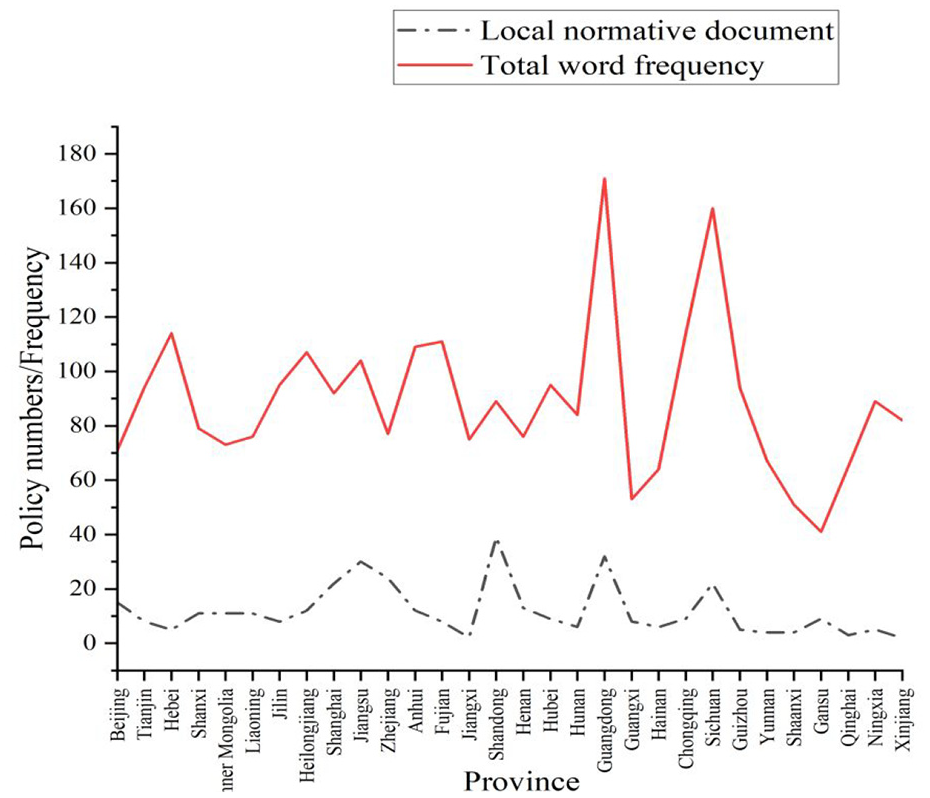
The government’s attention to innovation-driven productivity and the changing trend of the number of innovation-driven productivity normative documents in 30 provinces.
Empirical Results and Discussion
Sample Description
The findings of the descriptive statistical analysis are shown in Table 3. The mean value for regional innovation performance (ino) is 0.405, with a maximum of 1.061, a minimum of 0.000, and a median of 0.330, indicating considerable variation in regional innovation performance across provinces. The average focus of government on innovation-driven productivity (gov) is 46.631, with a minimum value of 10.000, a standard deviation of 25.749, and a median of 39.000, suggesting significant disparities in government attention to innovation-driven productivity among provinces. This provides a solid data foundation for this study. Descriptive statistics for other mediating and control variables are not further elaborated here as similar analyses have been conducted in previous studies.
Variable Descriptive Statistics.

Regression Results of Government Attention to Innovation-Driven Productivity and Regional Innovation Performance
Basic Estimation Results Analysis
After addressing multicollinearity issues in the panel data, a Hausman test was conducted using Stata software, yielding a p-value of 0. For the analysis, a fixed effects model was thus selected. The baseline regression results of the effect of government focus on innovation-driven productivity on regional innovation performance are shown in Table 4. Column (1) demonstrates that the government attention positively affects regional innovation performance, with a coefficient of 0.491, suggesting that enhancing government focus on innovation-driven productivity helps improve regional innovation performance. As population density, transportation infrastructure, financial development, marketization level, and foreign direct investment are progressively included, government attention continues to have a considerable impact on regional innovation performance (coefficient of 0.315), preliminarily validating Hypothesis H1. Column (6) indicates that a 1% increase in government attention to innovation-driven productivity results in a 0.315% improvement in regional innovation performance levels. Similar findings have been observed in other fields, where government attention in a given domain tends to enhance innovation performance in that area (Liu et al., 2024).
Baseline Regression Results.

Robustness Analysis
To guarantee the precision of the findings regarding the impact of government attention to innovation-driven productivity on regional innovation performance, the study conducts robustness checks in three aspects:
(1) Adding control variables: The economic development level of a region, typically measured by per capita GDP (pgdp), influences regional innovation performance. Regions with higher economic development levels generally exhibit better innovation performance (Huizhi & Rufeng, 2023). We employ per capita GDP, standardize accordingly, and proceed with regression analysis. The results are presented in column (1) of Table 5.
(2) Reducing the sample time range: Excluding all samples from 2011 and 2023, only using panel data from 2012 to 2022 for regression results as displayed in Column (2) of Table 5.
(3) Addressing potential endogeneity: The lagged one period of government attention to innovation-driven productivity was used as an instrumental variable for the current government attention, applying a fixed effects 2SLS model for regression, with results shown in Column (3) of Table 5.
(4) Changing the independent variable: To confirm that the regression results are robust, the frequency of keywords related to government attention on innovation-driven productivity was used as an alternative measure. The regression findings are displayed in Column (4) of Table 5 and are significant at the 1% level. This indicates that government attention to innovation-driven productivity contributes to the enhancement of innovation performance, further confirming the robustness of the results.
(5) Replacing the dependent variable: Some scholars have used the number of domestic patents granted to measure innovation performance (Xia & Bing, 2024). Therefore, this study adopts the logarithm of domestic patent grants as a proxy for innovation performance. After changing the dependent variable, the regression results are shown in Column (5) of Table 5 and are still significant at the 1% level. These results are consistent with the previous conclusions, providing further support for Hypothesis 1.
(6) Changing the model: To minimize the influence of estimation methods, the model was reanalyzed using the ordinary least squares (OLS) method. Column (6) of Table 5 shows that the coefficients remain positively significant, further demonstrating the robustness of the findings.
Results of the Robustness Test.

Heterogeneity Analysis
Regional Heterogeneity
Empirical results show significant effects of government attention to innovation-driven productivity in enhancing regional innovation performance. Considering the geographical differences among provinces, the study categorizes 30 provinces into East, Central, and West regions based on standards set by the Statistical Bureau. Regression results from additional research on the connection between regional innovation performance and government attention are displayed in Table 4. The findings show that the promotion effect is greatest in the Western regions (coefficient of 0.317, t-value of 0.038), followed by the Central regions (coefficient of 0.270, t-value of 0.050), and least in the Eastern regions (coefficient of 0.151, t-value of 0.045). This indicates that although government attention universally promotes regional innovation performance, the specific effects vary by region. Western regions show the most significant potential for improvement due to their later focus on innovation-driven productivity.
Manufacturing-level Heterogeneity
To capture differences in manufacturing levels, this study uses robot installation density as a proxy indicator. Based on the median value of robot installation density, the sample is split into two groups—regions with high and low manufacturing levels. Table 6’s columns (4) and (5) display the regression findings. At the 5% level, the coefficient in column (4) is 0.096 and statistically significant, whereas at the 1% level, the coefficient in column (5) is 0.343 and statistically significant. These results show that in areas with smaller amounts of manufacturing, government attention has a more noticeable positive impact on innovation performance.
Analysis of Regional Heterogeneity.

Policy Intervention Heterogeneity
In 2016, China introduced its first national innovation-driven development strategy. Considering that government work reports are usually published at the start of the subsequent year, this research examines how government attention affects innovation performance over various policy intervention periods. Drawing on the methodology proposed by Professor Zhao (Xing, 2022), the sample was divided into periods of low policy intervention (2011–2016) and high policy intervention (2017–2023). Table 6’s columns (6) and (7) display the findings.
The analysis reveals that during the low-intervention period, the coefficient of government attention is not statistically significant. In contrast, during the high-intervention period, the effect of government attention significantly improves at a significance threshold of 1%. This finding indicates that active government intervention has effectively enhanced regional innovation performance.
Mediation Effect Analysis
This article explores the dimensions of corporate innovation investment and productive services, theoretically analyzing how government attention to innovation-driven productivity impacts regional innovation performance, as demonstrated in Table 7. An empirical test was conducted using a mediation effect model. Model (1) is a basic fixed effects model; Models (2) and (3) assess the mediation effect of corporate innovation investment; Models (4) and (5) analyze the mediation role of the productive service industry.
Mediating Effects of Government Innovation-driven Productivity Attention on Regional Innovation Performance.
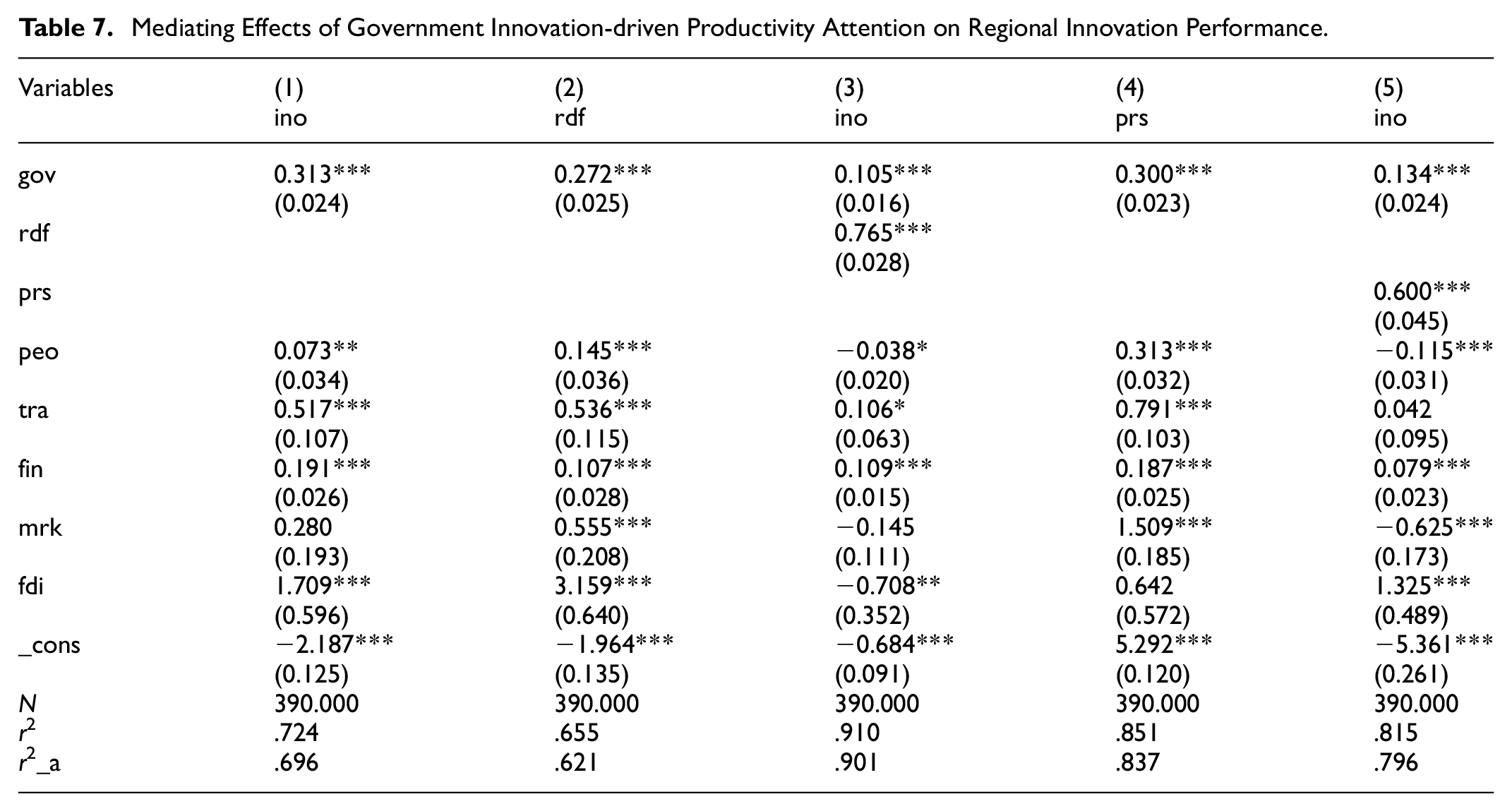
Model (1) reveals a positive link between government support for innovation-driven productivity and regional innovation performance. This finding confirms that government focus on innovation-driven productivity can significantly enhance regional innovation, thus validating Hypothesis 1. Model (2) shows that government attention has a considerable positive impact on corporate innovation investment. Previous research has indicated that government attention to specific sectors can enhance corporate innovation investments (Zhao et al., 2022). Additionally, an analysis of data from multiple countries by Paulo Correa has shown that government support can boost corporate R&D investment (Correa et al., 2013) Further, in Model (3), considering both government attention to innovation-driven productivity and the mediating variable of corporate innovation investment, it was found that corporate innovation investment also has a noteworthy favorable effect on the performance of regional innovation. Moreover, the direct impact of government attention on innovation-driven productivity decreased compared to the baseline model. Specifically, every unit increase in government attention directly enhances regional innovation performance by 0.105 units, indirectly by 0.208 units through increasing corporate innovation investment, totaling an effect of 0.313 units, with indirect effects accounting for 66.45%. These results support Hypothesis 2, indicating that government attention to innovation-driven productivity effectively promotes regional innovation performance by enhancing corporate innovation investment. These findings align with the conclusions of most scholars that there is a positive relationship between innovation input and regional performance, which is widely acknowledged (H. Zhuet al., 2020). At the micro level, innovation input contribute favorably to improving innovation performance (Zhang et al., 2022).
Model (4) goes on to show how government attention has a major positive impact on the service industry's productivity. This is consistent with previous findings. For example, by putting in place suitable human resource policies, the Canadian government can encourage a large influx of trained people, which will draw in or produce high-quality productive services (Coffey & Polèse, 1989). Analysis in Models (4) and (5) reveals that each unit increase in government attention results in a direct enhancement of 0.134 units and an indirect enhancement of 0.180 units in regional innovation performance, totaling an enhancement of 0.314 units. These findings validate Hypothesis 3. This consistency extends to previous research findings. For example, the productive service sector has effectively enhanced urban green innovation efficiency by facilitating knowledge spillovers and optimizing labor allocation (Si et al., 2024). Moreover, a longitudinal study of New York’s scientific instrumentation manufacturing companies over 12 years by Alan Macpherson found that increased investment in productive external services significantly strengthens the linkage with industrial innovation (Macpherson, 2008).
Discussion
The study looks at how regional innovation performance is affected by government attention to innovation, focusing on corporate innovation investment and the productive services sector as potential mediating mechanisms. Specifically, variations in government attention to innovation can influence innovation performance by optimizing resource allocation. Governments can enhance regional innovation performance effectively by encouraging increased corporate innovation investment and raising the proportion of the productive services sector within the economic structure. The empirical analysis conducted in this study validates these hypotheses and aligns with findings from existing research (Coffey & Polèse, 1989; Macpherson, 2008; Si et al., 2024). Previous studies have consistently emphasized that the productive services sector is a critical channel through which government attention to innovation affects regional innovation performance. Moreover, this research corroborates earlier findings that innovation investment serves as a vital mediating mechanism linking government actions and regional innovation performance (Correa et al., 2013; Zhang et al., 2022; Zhao et al., 2022; H. Zhu et al., 2020).
Unlike prior research, this study investigates these mechanisms from the perspective of government attention. Specifically, we developed an indicator to measure government attention to innovation-driven productivity and validated its effectiveness using both the factual characteristic method and the actual comparison method. These efforts provide robust data support and theoretical foundations for further research.
Conclusions and Policy Recommendations
Research Conclusions
China's economic development relies heavily on innovation-driven productivity. This study employs an innovation-driven productivity lexicon constructed through machine learning techniques to analyze 390 government work reports from 30 provinces from 2011 to 2023, thereby establishing an indicator that reflects government attention to innovation-driven productivity. The research focuses on enterprise innovation input and the productive service industry, exploring how government attention impacts regional innovation performance. Key findings include: (a) Government attention to innovation-driven productivity significantly enhances regional innovation performance. Specifically, controlling for other factors, a one-unit increase in government attention results in a 0.313-unit increase in regional innovation performance; (b) Government attention improves regional innovation performance by developing the productive service sector and raising enterprise innovation investment; (c) Heterogeneity analysis shows that government attention has a greater impact on innovation performance in western regions compared to central and eastern regions. The positive effect is significantly stronger in regions with lower manufacturing levels compared to those with higher manufacturing levels. Regarding policy intervention, the effect during the high-intervention period is significantly stronger than during the low-intervention period.
Contributions
Theoretical Contributions
The first contribution of this paper echoes the findings of other researchers (J. Wang, 2018) that government attention to innovation-driven productivity positively influences innovation performance. Government focus can enhance innovation performance by increasing corporate innovation investments.
The second contribution measures government attention from the perspective of innovation-driven productivity and validates the effectiveness of this indicator. Currently, only a few scholars have explored similar methods in other fields. This study is the first to employ machine learning techniques to measure government attention to innovation-driven productivity and has validated the indicator's effectiveness using two different methods. Moreover, it elucidates the underlying mechanisms of its impact.
The third contribution is that government attention can enhance regional innovation performance by increasing the percentage of the productive service sector Additionally, the impact of government attention is more significant in regions with lower manufacturing levels compared to those with higher manufacturing levels.
Practical Contributions
This paper provides specific insights for future government efforts to promote regional innovation development. Firstly, government attention can enhance regional innovation performance by boosting corporate innovation investments. This can be facilitated by establishing special funds, tax incentives, and other measures to encourage corporate innovation input. Furthermore, government attention can promote regional innovation by fostering the development of the productive service sector. This implies that governments could encourage the growth of productive services to boost regional innovation. Moreover, the impact of government attention is greater in regions with lower manufacturing levels, and local policies should be tailored to the specific development realities of each region.
Implications
Currently, the development of China’s innovation-driven productivity remains in its early stages. A comprehensive analysis of regional innovation performance at the national level indicates that governmental attention significantly enhances regional innovation performance. However, regional analysis reveals notable disparities in the impact of governmental attention across eastern, central, and western regions, as well as among areas with varying levels of manufacturing development. These differences lead to varying effects on regional innovation performance. This study makes the following strategic recommendations in light of these findings:
First, the results demonstrate that higher governmental attention contributes positively to enhance the performance of regional innovation. Therefore, the government should intensify its support for policies related to innovation-driven productivity. Additional investigation reveals that the impact of government focus on economically underdeveloped western regions is significantly greater than that on the more developed eastern and central regions. In the future, mechanisms adapted to local conditions should be developed to promote innovation-driven productivity in western regions. This will support high-quality economic development across the country.
Second, the results imply that by boosting enterprise innovation investment, government attention might indirectly improve regional innovation performance. The government should further expand its support for enterprise innovation to enhance regional innovation capabilities. Local governments should increase financial support for enterprise innovation. This will help businesses overcome core technological bottlenecks and frontier challenges. Such efforts can drive the growth of strategic and future industries, enhancing overall regional innovation capacity.
Third, the results indicate that governmental attention can also promote regional innovation performance by increasing the proportion of productive service industries. The government should promote productive service industries and adopt region-specific development strategies. In less developed manufacturing regions, productive service industries show a greater impact. Local policies should align with manufacturing development levels to support regional innovation and improve economic quality and efficiency.
Research Limitations and Prospects
This study focuses on how government attention to innovation-driven productivity can enhance regional innovation performance through enterprise innovation input and the productive service industry. The analysis shows that government attention significantly enhances regional innovation performance. However, the study focuses only on two factors. Future research should investigate additional pathways and mechanisms to provide a more comprehensive framework for understanding these impacts.
Footnotes
Acknowledgements
We thank Dr. Hong Pan for her valuable suggestions for this manuscript.

Ethical Considerations
All procedures performed in this study were in accordance with the ethical standards of the university. Ethical clearance and approval were granted by Chongqing University.
Author Contributions
Heng Yang is responsible for writing the manuscript and analyzing the data. Sheng Chen is responsible for guiding the ideas. Jie Li is responsible for collecting the data.
Funding
The authors disclosed receipt of the following financial support for the research, authorship, and/or publication of this article: This work was supported by the National Natural Science Foundation of China (grant numbers 72274026) and the Fundamental Research Funds for the Central Universities (grant numbers 2020CDJSK01WT07, 2021CDJSKPT05, 2023CDJSKPT04).
Declaration of Conflicting Interests
The authors declared no potential conflicts of interest with respect to the research, authorship, and/or publication of this article.
Data Availability Statement
The data presented in this study are available on request from the corresponding author.