




Abstract
This article explores the educational challenges faced by migrant children in China, examining their experiences in both inflow cities and hometowns. Drawing on 94 in-depth interviews conducted in 2022 with returned migrant children and adults, as well as an empirical survey involving 1,865 returned migrant children and 344 teachers across 8 county-level cities in 4 provinces in 2023, the study reveals significant findings. Migrant children in China exhibit distinct characteristics: they typically arrive in inflow cities during preschool years and return to their hometowns during the transition from primary to middle school. They face dual adaptation challenges as they move from rural to urban schools and back again. These children often experience systemic exclusion in inflow cities and have to return to their hometowns to pursue post-compulsory education. However, they encounter substantial academic adaptation difficulties upon returning, and the most notable of these challenges are academic setbacks, with many teachers expressing pessimism regarding their chances of gaining admission to high school. The plight of migrant children highlights their “double dis-embedded” status within China’s mobility policies, where educational re-migration exacerbates rather than alleviates structural inequalities.
Keywords
Introduction
Since the implementation of China’s reform and opening-up policy in the 1980s, hundreds of millions of rural surplus laborers in China have migrated to developed coastal cities in search of employment, triggering a massive “migrant labor wave.” According to the Migrant Worker Monitoring and Survey report released by the National Bureau of Statistics (2012–2022), the number of migrant workers in China has steadily increased, from 225.42 million in 2008 to 295.62 million in 2022. Under the registered residence system (hukou), which has long been used by the government to control population mobility and allocate public resources across regions, individual’s entitlement to social welfare is determined by the location of their household registration (Cheng & Selden, 1994). As a result, even though rural migrants have lived in cities for many years, they are still denied the civil rights of the cities they reside in. This creates a social and spatial disparity that echoes the metaphor of being a “guest in the sitting room” (Ling, 2017).
China’s education system is closely tied to the household registration system, requiring students to enroll in schools and take entrance examinations in their places of household registration. As China’s Urbanization processes, the number of migrant children has continued to grow, reaching 13.65 million in 2022 (Ministry of Education of China, 2023). To address their educational needs, the central government mandated in 2001 that local governments accept migrant children into public primary and secondary schools. Additionally, it required local governments to implement specific policies allowing migrant children to sit for high schools and college entrance examinations. However, under the current high school enrollment policy in China, only about half of middle school students are admitted to high schools, while the other half students are relegated to secondary vocational schools with limited educational quality and poor employment prospects. Moreover, China’s higher education enrollment follows a “quota by province” model, in which colleges and universities allocate enrollment quotas based on regional distribution. If migrant children were to attend high schools and take the college entrance examination in their localities, they would be competing for local enrollment opportunities, which often leads to fierce opposition from local residents.
Against the backdrop, local governments have set various thresholds that restrict migrant children’s access to further education. After reviewing the policies in different regions, Chu (2015) has found that many migrant children are unable to attend local high schools and take college entrance examination in developed cities. These restrictions are often based on factors such as their parents’ years of social insurance or points accumulated, only allowing them to apply vocational schools. As a result, a large number of migrant children are forced to return to their hometowns for education. For instance, in Beijing, the number and proportion of migrant children have steadily declined from 2013 to 2020. The number of migrant children in primary schools dropped from 370,000 to 254,000 (from 46.9% to 25.5%), in middle schools from 103,000 to 59,000 (from 33.1% to 17.9%), and in high schools from 21,000 to 11,000 (from 11.2% to 6.9%; Hong et al., 2022).
International migration policymakers often view migration as a back-and-forth movement between the “country of origin” and the “host country.” From this perspective, “return” is seen as the resolution of deviance or anomie, as individuals return to where they belong. The host country, in turn, seeks only labor, not “people” (Arslan & Yildiz, 2019). Therefore, in the national migration management policies, “return” is typically valued positively and considered as a “solution” (Scalettaris & Gubert, 2019). Similarly, migrant workers in China are expected to eventually return to their hometowns. The term “return” thus defines the directionality of mobility— not only in the physical sense but also in ethical terms. To return is to reach one’s destiny (Xiang et al., 2013). In this context, Migrant children have to return home if they wish to follow the typical educational path of “attending high school and university.”
So far, the phenomenon of migrant children returning to their hometowns has not received widespread attention from either the government or society, and the returned migrant children remain an invisible group, with no official statistics available. Song’s research team (2021) estimated the number of returned migrant children to be around 10 million using multiple estimation methods. According to the New Citizen Program, a comparison of grade distributions of migrant children revealed that, only 2.71% of migrant children took the college entrance examination in their places of residence in 2021, and a total of 922,000 migrant children returned home. Some researchers have focused on the challenges faced by returned migrant children in adapting to schools (Wei, 2023). Tian (2008) found that some of these children develop poor learning attitudes and experience increased academic pressure due to interrupted education and a lack of adequate supervision from guardians. Differences in teaching styles and curricula between urban and rural schools also contribute to a decline in academic performance (Jiang, 2011; Li et al., 2019; Liu & Zhu, 2011; Zhang, 2012). Additionally, some returned migrant children face ostracism or bullying by teachers or peers (Tan et al., 2014).
While these studies have provided valuable insights into the struggles of returned migrant children, they have not explored their educational experiences in the inflow areas, analyzed the changes that occur before and after their return, or investigated their potential future academic prospects. Moreover, the existing research lack large-scale surveys of the returned migrant children. By examining the educational re-migration experience of migrant children, driven by internal rather than transnational migration, this study seeks to shed light on the perpetuation of structural inequalities from China’s registered residence system, using data from a large-scale field study conducted across eight county-level cities in four provinces in China.
Research Methodology and Data
Methodology
In the data collection and analysis phases, we employed a Mixed Methods Research, which integrated both quantitative and qualitative data sets to generate comprehensive results (Creswell & Creswell, 2018). The central premise of Mixed Methods is that data integration addresses issues that cannot be adequately captured by a single method. Leech and Donovan’s study (2023) confirmed that Mixed Methods Research provides more arguments than a single method. They argued that researchers can utilize all available data without being restricted to either qualitative or quantitative approaches, thus enabling a deeper understanding of complex phenomena. The educational issues faced by migrant children are not confined to the educational system alone, they are inextricably linked to various social, economic and cultural factors. Therefore, the Mixed Methods Research was adopted for the study.
Data Collection and Interview
The data and interview materials were collected through a field survey conducted between 2022 and 2023, focusing on returned migrant children and adults with return migration experiences. Returned migrant children are those who were either born in the inflow areas or who accompanied their parents to live or study there at a young age, before returning to their hometowns to continue their education (Han & Yu, 2020). Interviews with adults who have return migration experiences provide valuable insights into the long-term impact of these experiences on their later lives. Participants were given written consent prior to interviews and questionnaires, were assured of complete anonymity, and could withdraw from the survey at any time.
In 2022, the research team conducted in-depth interviews with 94 respondents in the investigators’ hometowns using a snowballing sampling method. The respondents, aged between 12 and 26, included 44 males and 50 females. Of these, 7 respondents were intra-provincial migrants and 87 respondents were inter-provincial migrants. Each interview was conducted face-to-face and one-on-one in a private place, and was coded using a unique identifier in the format “Number - Outgoing Grade - Returning Grade.” For example, “S1-1-6” indicates that the interviewee had a serial number of 1, was in grade one while in the city and returned grade 6. If the respondent was in preschool (before the age of 6), the middle code is “K.” If the respondent was born in the inflow area, the middle code is “0.” This coding system allows for a more intuitive understanding of each respondent’s background.
In 2023, we conducted a large-scale field survey across eight country-level cities in four provinces in China: Hubei, Yunnan, Sichuan and Guangdong, which represent central and western provinces. Migrant workers in China typically move from the central and western regions to the more developed eastern regions. As a result, returned migrant children are primarily found in central and western provinces. The survey regions were selected to reflect significant geographic and economic disparities, providing a representative sample of the challenges faced by returned migrant children. According to the survey in 2022, the distribution of returned migrant children across schools and classes was highly decentralized, with only a small number of returned migrant children found in rural elementary schools. Consequently, data from elementary schools were used only as a reference. 1 The formal survey focused on middle schools and high schools, using a whole-cluster sampling approach. We surveyed two middle schools and two high schools in each country-level city, yield a total of 1,865 valid samples from 32 schools, 48.3% were boys and 56% were middle school students.
In addition, we interviewed school principals, directors and teachers, as well as approximately five returned migrant children from each school. The serial number for student coding was denoted by “T,” with the coding scheme remaining consistent with that used in 2022. Other personnel were coded with “teacher position, school name,” for example, “a teacher, XH school” for a teacher at XH school. Furthermore, we collected 344 valid teacher questionnaires, 198 from middle schools and 146 from high schools. All data were subjected to basic descriptive analysis using SPSS software.
Learning Situation of Migrant Children Before Returning
Due to limitations in wage earnings, living conditions and social systems, the migrant of families in China does not occur all at once but rather in stages. Typically, one family member migrates first for work, and other family members gradually reunite as conditions permit (Dreby, 2010; Du & Zhang, 2010; Peng, 2020). Among the questionnaire respondents, 27.2% of children were born in the inflow areas, while the proportions of children who arrived in the inflow areas at various stages of their education were as follows: 42.4% during preschool, 13.5% in the first grade of elementary school (age 6 or 7), 14% during intermediate elementary school (age 8–12), and 2.9% in secondary school. It can be seen that most migrant children lived in their hometowns at a young age and joined their parents in the migrant cities before starting elementary school, with very few arriving during adolescence. This pattern is primarily due to the policy exclusions many migrant children faced, resulting from the discretionary power exercised by local governments in implementing national policies (Zhou, 2006). In addition to various required documents, such as a temporary residence permit, parental employment certificate, and proof of social security years, some developed cities only accepted migrant children in the starting grades. Those seeking to enroll in higher levels were required to provide a full academic record from the previous level (Wang & Xu, 2020). As a result, only those who entered the local education system in the first grade of elementary school were eligible for secondary education, significantly limiting the opportunity for migrant children to access education in the cities. If they were unable to join their parents in the cities before elementary school, they effectively lost the chance to reunite with their parents due to the lack of educational opportunities.
Overall, the educational situation for migrant children in the inflow areas was relatively stable, but the quality of education was not high. Apart from regular promotions, 55.4% of the children had never transferred to another school, while 26.4%, 11.7% and 6.4% had transferred once, twice, and three times or more respectively. A majority of 75.1% attended public schools, while 24.9% attended schools specifically for migrant children. This indicates the policy of “inflow area-based and public school-based” has been well implemented. However, in nearly all inflow cities, migrant children were not placed in schools base on the principle of “proximity to the nearest school,” as local students are, but were instead assigned to designated public schools, most of which were under-resourced. As a result, despite the fact that migrant children generally rated their self-assessment positively—17.9% considering themselves top of their class and 67.2% rating themselves at or above the middle level—they were not well-educated. Teachers interviewed generally agreed that most children did not receive rigorous academic training in the inflow cities and did not perform as well academically as their peers in their hometowns.
They can’t get good grades and struggle to the average level. Their focus is not on learning, instead, they engage in early relationships, play online games, and bring down the country kids. (Principal, QS Elementary School) These children thought they were doing okay when they were in the cities, but they realized they were not performing well when they returned. Returned migrant children also differ based on where they came from: those returning from first-tier cities tend to perform well, while those from undeveloped areas, such as Yunnan, Guizhou and Sichuan, tend to struggle academically. (Director, CS Middle School)
By placing migrant children in lower-tier designated schools, local governments effectively shielded them from access to quality education, thus limiting the potential of their academic development. This institutional arrangement aligns with Bourdieu’s theory of educational reproduction, which asserts that education, as a system, serves as a mechanism for class reproduction (Bourdieu & Passeron, 1977).
Overall, more than 20% of migrant children struggled to adjust to schools in the inflow schools. According to the survey data, 75.8% of the children were well-adjusted to school, 19.8% experienced some adjustment problems, and 4.4% faced severe adjustment problems. In terms of interpersonal relationships, 31.9% of the children had difficulty getting along with their teachers, and 21.1% struggled to connect with their classmates. Additionally, 15.3% of the children were occasionally bullied by their classmates, and 1.5% were frequently bullied. The primary reason for the difficulties in adjusting to local schools was that many of them had lived in their hometowns for several years before migrating to the city. The significant differences in language, living environment and educational system between the city and their hometown created identity barriers, making adaptation more challenging.
My hometown is a small village in Henan province, where I lived until I moved to Dongguan in 4th grade to join my parents. In my hometown, my family farmed, and my teacher’s family farmed as well. We would all take vacations during harvest season for wheat, corn or vegetables. When I came to Dongguan, I felt a strong cognitive identity gap. I saw myself as a "countryman" and was too shy to talk to others. All my classmates in Dongguan knew how to use computers, while I had spent my time running around and playing with dirt in the countryside. The English curriculum in Dongguan started earlier than in my hometown, so my English was particularly poor. it was tough to adapt throughout 4th grade. (S1-4-8) I studied in a migrant children’s middle school in Shenzhen, where the relationships between classmates were relatively weak because they had returned at different times. When I arrived in Shenzhen, I was struck by the larger, more prosperous world and the diversity of people. My rented house had only one bedroom, one kitchen and one toilet. In the bedroom, there was just one desk besides the bed, so I slept on the floor. On my way to school, passed through a villa area, with an alley separating the rented house from the villas. This alley divided two very different worlds, two very different classes. I would often reflect on the gap between these two realities and the reasons behind it, which had a very profound impact on me. (S74-8-9)
In addition, segregation policies were implemented within the school, where migrant children were placed in separate classes, often labeled as Adaptation Classes, Enlightenment Classes, or Integration Classes (Simon, 2003). “The first eight classes in our grade were all Shanghai students, and we migrant students were placed in class nine. They nicknamed us ‘Stinking Number Nine’.
2
They didn’t want to play games with us, so we fought back. We were never afraid of fighting—they couldn’t beat us. I didn’t get good grades, and I didn’t like studying. My mom had always planned for me to return to my hometown for education, so I just studied whatever I could in Shanghai, knowing I was going back anyway.” (S46-0-2)
In the middle school grade, there were six classes, the first three classes were for Shanghai students, and the last three classes were for migrant students. They had better grades and were taught in the same way as local students in other schools, although the teaching content and exams were more difficult. My friends were mainly from my class. It’s harder to get in touch with Shanghai students, basically I couldn’t fit in. (S64-K-9)
The experiences of these children before returning reveal that they encountered various forms of implicit or explicit educational exclusion in the inflow areas, making it difficult for them to access the same educational resources and opportunities as local students. While most adapted well in school, they were unable to achieve high academic success. Others suffered from discrimination, struggled to adapt to the school environment, or even developed a sense of “self-abandonment.” Factors such as discrimination, differences in educational systems, and a lack of identification with the inflow society and culture drove migrant children to return, seeking better educational opportunities and a more equal national status (Hazzichristou & Hopf, 1995; Konzett-Smoliner, 2016; Ní Laoire, 2008).
The Return Time of Migrant Children and Their Resettlement
Age of Return for Migrant Children
The timing of return becomes a key consideration when migrant parents decide to send their children back home for education. While perceptions of the “critical age” vary, parents generally aim for a return before adolescence to allow their children enough time to adapt to the new educational environment and to take critical examinations (Vuorenkoski et al., 1998). The results of the questionnaire reveal an “inverted U” distribution of the age of return, with a gradual increase in the proportion of children returning after the age of 10, reaching a peak at the age of 12, followed by the age of 13, with a total of 71.9% before 13 (see Figure 1). In terms of schooling, ages 12 to 13 represent the transition from primary school to middle school. Interviews revealed that most migrant children return at this stage because the textbooks used in their inflow areas differ from those used in their hometowns. If they return later, they would face significant academic adaptation challenges and might not pass the entrance exams for high schools. In some regions, only those who have completed a full 3-year record at the local middle school can eligible for the enrollment allocation quotas of local top high schools. 3 Therefore, to minimize academic maladjustment and increase their chances for further education, migrant children typically return before the start of their first year of middle school. The main reason for children under the age of 10 is that their older siblings have to return for middle school.

The age of migrant children returning home.
Residence and School Attendance of Returned Migrant Children
Most of migrant children returned to their hometown with one or both of their parents. The data shows that half of the children returned with both parents, 11.6% with their fathers, 21.6% with their mothers, and 16.3% returned alone. However, Of the family members currently living together, only 32% were fathers and 50% were mothers, indicating that a significant proportion of parents, especially fathers, have gone back to work, as they bear the primary economic responsibility for the family. As a result, many children became left-behind children. living with their grandparents or other relatives, while others lived alone.
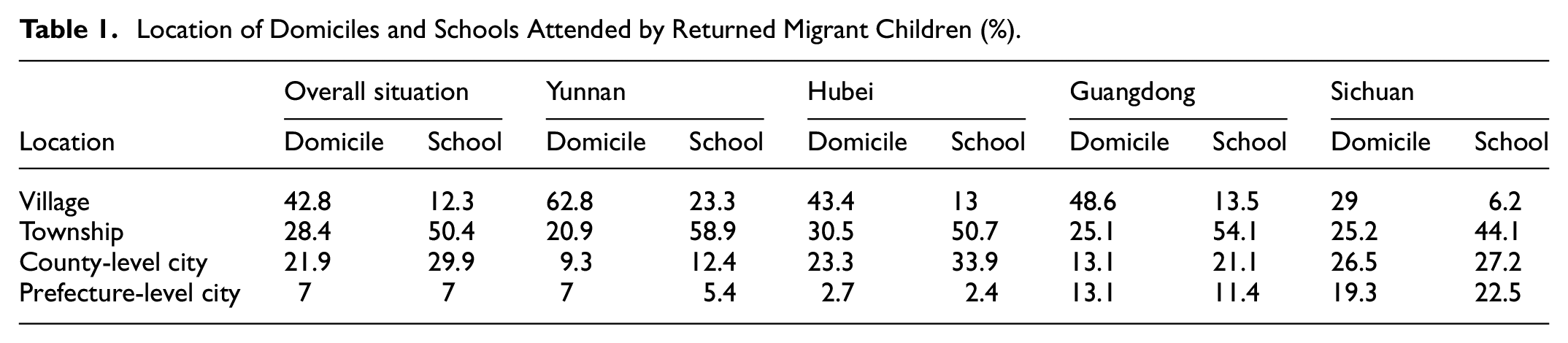
The returned migrant children mainly resided in villages but attended schools in townships. From the perspective of their places of residence (see Table 1), the majority of children returned to villages (42.8%) and townships (28.4%) where they were registered as household members, However, the proportion of returns to villages and townships in Sichuan was much lower than in other provinces. In terms of schools attended, about half of the returned migrant children went to schools in townships, followed by those in county-level cities, with a relatively small proportion attending schools in villages and prefecture cities. The proportion of children attending schools in villages and townships in Sichuan was lower than in other provinces. 4 The primary reason for this gap is that, unlike other provinces which require returned migrant children to attend schools in their registered residence, local governments in Sichuan allowed them to attend schools in county-level cities or even schools in prefecture-level cities. Furthermore, the local governments in Sichuan continued to actively promote the policy of adjusting the layout of primary and secondary schools, which the central government had expressly halted in 2012. The policy involved building or expanding urban schools while closing rural schools or discontinuing the renewal of educational resources for rural schools. For example, in Yilong, a county-level city we surveyed, 7 rural elementary schools and 10 rural middle schools were closed, 8 rural middle schools and 2 high schools suspended the enrollment of new students in 2023 (Science and Technology and Sports Bureau, 2023). Against the backdrop, returned migrant children in Sichuan are compelled to settle and study in cities.
In 1998, There were over 1,000 students at our school, now only 137 students. The number of newborns in the countryside is decreasing, and we are losing students even faster. The county-level city is constantly building new schools, which are attracting many students. Most of our teachers are over 50 years old and lack the motivation to teach effectively, while rural parents do not take education seriously. As a result, only two or three students are admitted to high school every year. (Principal, ZT Rural Middle School in Sichuan)
Location of Domiciles and Schools Attended by Returned Migrant Children (%).
Learning Situation of Migrant Children After Returning
Academic Adaptation of Returned Migrant Children
To fully understand the academic adaptation of returned migrant children, it is essential to first examine their overall school adaptation. This includes four factors: academic adaptation, environmental adaptation, institutional adaptation and relational adaptation. So as to identify which adaptation challenges are temporary and which are enduring, we conducted surveys on school adaptation both at the beginning of the return period (within the first 6 months) and later (after 6 months) to assess the changes over time.
The results show that only 27.5% of returned migrant children had no school adaptation disorders at the initial stage of returning, with this proportion increasing to about 50% after 6 months (see Table 2). At the beginning of the return period, the main adaptation challenges were academics, particularly difficulties in adjusting to teachers’ teaching styles and different versions of textbooks. Environmental barriers, such as unaccustomed accommodation and food, were also significant. By the later stage of the return period, academic adaptation remained the primary challenge, but the proportion of those struggling with teachers’ teaching styles, and textbooks decreased significantly. However, lagging behind in academic performance become the most pressing issue, with the proportion of students facing this problem increasing. There was significant improvement in adaptation to the environment, school systems and relationships. These findings indicate that academic backwardness is the most difficult problem for returned migrant children.
School Adaptation of Returned Migrant Children (%).

In the early stage of their return, teachers’ teaching styles posed the greatest challenge for returned migrant children. The majority of children returned from developed cities, where quality-oriented education is emphasized, to underdeveloped regions that still prioritize exam-oriented education. The essence of the differences in teaching styles is a reflection of the huge regional and urban/rural disparities in education in China. Quality-oriented education aims to cultivate well-rounded talents with innovative thinking and comprehensive development of practical skills, which is closely associated with mainstream urban schools that represent modernization and cater to middle-class families who can afford various extracurricular tutoring (Ling, 2017). In contrast, schools in underdeveloped areas continue to follow the traditional exam-based education model, as this remains the primary path for rural children to gain academic competitiveness in the absence of family resources. In the context, teachers in the two areas adopt vastly different teaching approaches. In the inflow areas, teachers often use multimedia, present rich curriculum content, and create lively classroom environments. In the rural hometowns, however, teachers focus heavily on academic performance, teach in a monotonous way, and tend to be more serious, sometimes even resorting to physical punishment.
Teachers in Guangdong were more friendly, while teachers in my hometown, Hubei, were particularly serious and sometimes even scolded students. In Guangdong, teachers used more advanced courseware, and the school followed a common lesson planning system. Oral English was highly valued in Guangdong, and the winter and summer vacation homework was particularly flexible, involving activities such as making rice wine, outdoor collecting, and hand-drawing maps. In contrast, when I returned to Hubei, every day felt monotonous, focused mainly on reviewing test papers. (S1-4-8)
Regional differences in textbook versions are likewise a reflection of regional disparities in China’s economic development, cultural background, and education system. To better accommodate regional differences and teaching reforms, textbook versions for elementary education are not the uniform across the country. There are variations even within different cities of the same province or across different subjects within the same city. For example, Hubei primarily uses the Renjiao version, where subjects like physics, chemistry, biology and geography are taught separately in middle school, while Guangdong mainly uses the Yuejiao version, Jiangsu uses the Sujiao version, and Zhejiang combines the subjects of physics, chemistry and biology in middle school into a single science course. This regional disparity has created a widespread issue of curricular mismatches for returned migrant children. The later they return, the more knowledge gaps they need to fill, making it increasingly difficult for them to keep up with the teaching schedule in their hometown schools.
I used to learn the Sujiao version in Jiangsu and the Renjiao version when I returned to my hometown in Anhui. Some humanities subjects were particularly challenging, as they required a lot of memorization. For example, I had to memorize many ancient poems that my classmates in Anhui had already learned. Chemistry was also confusing. In Jiangsu, the teacher told us that carbon dioxide is soluble in water, but the teacher in Anhui said it isn’t, according to the Anhui textbook. (S28-0-9)
Language is another challenge faced by many returned migrant children. China is a multi-ethnic country with more than 80 languages grouped into five major language families, with Mandarin (Putonghua) as the national language and nine major dialects in Chinese. Returned migrant children, who primarily spoke Putonghua in their inflow areas, often encounter language barriers when returning to their hometowns. One respondent (S17-K-8) shared, “Although teachers spoke Putonghua, the older teachers' accents was so strong that it didn’t sound like Putonghua at all. My classmates in my hometown spoke dialect after class, as if there was a special sense of superiority in using it. I could not understand or speak it, so they called me ‘foreigner boy’. The Teochew dialect in my hometown was particularly difficult to understand, even harder to learn than English—it was like Morse code, and I felt out of place.” As Bourdieu (1990) explained, a habitus that suddenly enters a field that does not align with itself can create a sense of alienation, like a fish out of water.
However, Habitus is an open system of dispositional tendencies that is continuously evolves in response to experiences, constantly adjusting its structure under the influence of these new experiences (Bourdieu, 1990). The barriers faced by returned migrant children, aside from lagging academic performance, eased over time, which aligns with the previous observations made by hometown teachers. In the inflow areas, migrant children mostly attended public schools of low educational quality or schools specifically for migrant children. Their parents, unlike middle-class families, could not adequately prepare them for success or help improve their academic performance through extracurricular training. Upon returning to their hometowns, they found that their classmates had a solid academic foundation, built through years of exam-oriented education. In contract, their parents could not provide sufficient academic support, nor could they stay together to pursue better employment opportunities. Research indicates that a child’s socioeconomic status (SES) is a significant predictor of their overall cognitive ability and academic achievement (Bradley & Corwyn, 2002). However, these children came from lower SES backgrounds. Of the questionnaire respondents, 93% of fathers and 92.7% of mothers did not have a university degree, 80.9% of fathers and 74.8% of mothers were worked in low-skill jobs, such as farming, industrial work, waitressing, and trading. Additionally, 4% of fathers and 14.9% of mothers were unemployed. These factors limited their ability to select better schools for children or provide the academic counseling needed for success. Improving academic performance was not a task that could be accomplished quickly, and it became one of the most significant obstacles.
The school in the inflow city placed great emphasis on quality-oriented education, with relatively simple learning materials. Teachers typically didn’t go beyond the textbooks or assign too much homework. In contrast, schools in my hometown focused more on learning, with more challenging content, and most students spent much time on learning. I could score 80 or 90 points in the inflow city, but I failed the exams in my hometown. I struggled to keep up with my classmates until 6th grade, and I gradually reached the average level by the second year of middle school. (S27-2-4) Their parents send them back home and then go out to earn money, leaving them to live with their grandparents. There are also parents who leave them at custodial centers, and these children are completely at the mercy of God. (Director, GL Middle School)
Changes in the Academic Performance of Returned Migrant Children
Has the academic performance of the returned migrant children improved after their return? According to the self-assessment responses to the questionnaire (see Table 3), nearly half of the children experienced improvements in their overall academic performance. About one-third of children showed improvement in each of the three main subjects—Chinese, mathematics and English. 17.7% of returned migrant children experienced a decline in their overall performance, with mathematics showing the largest declines, followed by English, and to a lesser extent, Chinese. There were also some children whose performance has remained unchanged or returned to previous levels after a period of decline. These findings suggest that the impact of “return” on academic performance of returned migrant children was heterogeneous. While some children benefited from the return, others showed no significant improvement or even a downward slide. Interviews revealed that the main reason for the improvement in performance for some children was the strong emphasis on learning in their hometown schools, which fostered an exam-oriented education environment. In this atmosphere, they tried to improve by reducing extracurricular activities, increasing time spent in school, and taking exams more frequently, which stimulated their enthusiasm for learning. Besides, some children who returned from provinces with higher-quality of elementary education had a solid academic foundation, which contributed to their relatively high performance after returning. Correspondingly, the decline in academic performance for other children was mainly due to a weak academic foundation in the inflow city and the obstacles to academic adaptation after returning. The quotes from the interviewees reflect their different situations.
I hit a slump since I returned from Fujian, especially in math. The main reason is that the teaching progress in Fujian is slower, so much of the material had already been covered over here, so I couldn’t keep up. (T55-K-8) I didn’t do well in Zhejiang, and there weren’t evening study sessions in middle school, but Hubei does, which means I have to spend most of my time studying after returning. The school in my hometown values learning with more homework and teaching materials, which stresses me out but makes my academic performance better. (T5-1-7) My performance declined sharply when I came back, especially in physics. I barely understand the lessons. The content of physics is quite different, and the curriculum in Hubei is more difficult than Fujian’s. I was above the average before, but now I am below average, sometimes even at the bottom. (S68-4-9)
Academic Performance Changes of Migrant Children After Returning (%).

Teachers’ Predictions of High School Enrollment for Returned Migrant Children
Although some returned migrant children have improved their academic performance, does “returning” help them succeed in the academic competition? As mentioned earlier, only half of students in each city are able to gain admission to an academic high school due to the competitive high school enrollment policy in China. Given the challenges in tracking the actual advancement of returned migrant children, we gathered the information from teachers in their classes about the overall academic performance of returned migrant children and their likelihood of being admitted to high school.
Among the 198 middle school teachers surveyed, the distribution of their assessment of returned migrant children’s overall academic performance was as follows: 2% considered to be top performers, 22.2% above average, 36.4% average, 34.8% below average, and 4.6% at the bottom of the class. This suggest that most returned migrant children fell within the middle and lower-middle ranges, with only a small percentage reaching the top level. In terms of high school enrollment (see Table 4), only 7% of teachers believed that most of them would attend top high schools, while 58.1% of teachers thought no more than half would be able to attend general high schools. Despite some variations in opinion, the vast majority of teachers were not optimistic about the children’s chances of high school admission. From the perspective of returned migrant children themselves, 86.2% expected to attend high schools, 11.5% expected to attend secondary vocational schools, and 2.3% were considering employment. This stark contrast between the teachers’ predictions and the returned migrant children’s expectations indicates that a considerable proportion of returned migrant children could not achieve their educational goals.
These children are not as well-prepared as their counterparts in their hometowns. Their parents don’t pay much attention to them, and majority of parents go out to work again after sending the children back home. Many of them can’t get double-digit scores in math and can only attend secondary technical schools. Only 30% of children can get into an general public high school, and the proportion increases to 50% when private high schools are included. (Principal, GL Middle School) There were over 450 graduates in the 9th grade at my school, and about 250 students were admitted to high schools. The overall performance of returned migrant children was generally poorer except a few outstanding students, who mainly returning from Jiangsu, Zhejiang, and Shanghai. Children returning from Fujian and Guangdong showed little interesting in studying. Children returning at an early age had fewer problems, while those who came back in 8th grade had difficulty in pursuing further education. I also talked several students out of returning in 9th grade. (Principal, S Minority Middle School)
Teachers’ Predictions for Returned Migrant Children to be Admitted to High School.

From the daily teaching experiences of these teachers, it is clear that due to the huge urban-rural and regional differences in China’s education system, returned migrant children are a heterogeneous group. While some are able to achieve academic success, the majority struggle due to a weak academic foundation in the inflow city and various academic adaptation barriers upon returning.
Conclusion
This study revealed the institutional inequality and structural dis-embedding faced by migrant children by examining their educational status before and after returning home. In the inflow areas, migrant children encountered various kinds of institutional exclusion due to the restriction of the household registration system. The governments of the inflow areas determined the eligibility for compulsory education by requiring numerous supporting documents and ranking their parents based on points. Migrant children were shielded from high-quality schools through segregation measures, such as designating lower-level designated schools and separate classes. Furthermore, their opportunities to attend general high schools and take the college entrance examination were restricted through the liberation of vocational schools only and the quota of enrollment. In the context, migrant children seeking upward social identity through higher education often had no choice but to return to their hometowns.
However, returned migrant children generally faced significant barriers to academic adaptation, including difficulties with teachers’ teaching styles, textbook versions, and lower academic performance, all caused by the stark differences in education systems between urban and rural areas and regions. The quality-oriented education in the inflow cities, aligned with mainstream middle-class culture, failed to provide them with a solid academic foundation. This placed them at an even greater disadvantage in the competition with their peers in their hometowns, who had grown up in an environment of long-term exam-based education. Although some returned migrant children saw improvements in their academic performance, most teachers predicted that no more than half of them would pass the high school entrance exam. This revealed the “double dis-embedded” of returned migrant children within China’s mobility politics. The concept of “double dis-embedded,” initially proposed by Chinese scholars in the study of new-generation migrant workers, consists of two dimensions: “traditional dis-embedded” and “institutional dis-embedded.” The former refers to new-generation migrant workers in China are detached from the values and interpersonal relations of their native society during mobility, while the latter highlights the difficulty in securing a stable structural position and institutional security in the inflow cities (Wang & Xu, 2020). For returned migrant children, this “double dis-embedded” manifests in their exclusion from both the education systems in the inflow areas and those in their places of return.
There were also clear group characteristics among returned migrant children: most of them came to the inflow city during the preschool years and returned to their hometowns during the transition from primary school to middle school, experiencing a two-way flow of “countryside-city-countryside.” The experience created double adaptation barriers, resulting from the “double exclusion” of the urban and rural societies. Most children returned to rural schools, which had low educational quality, and there has been no large-scale crowding out of high-quality resources in their hometown cities. A significant proportion of returned migrant children became left-behind children because their parents returned to work. These characteristics pointed to one key outcome: returned migrant children have become one of the most vulnerable groups affected by life on the move. “Return” is not merely a return to one’s hometown, as the hometown itself constantly changes over time, and returned migrants face the challenge of reintegration. For children who grew up in the inflow areas, “Return” carries different meanings than it does for adults, which implies a new move, or even a trip to a completely unfamiliar place (Scalettaris & Gubert, 2019). As children are still in the process of socialization, Bourdieu’s theory of social practice suggest that the various types of social capital or habits they acquired in the inflow areas (e.g., speaking Putonghua) must be activated in specific contexts. However, these capitals may not be effective in the rural social environment and educational system, even have a negative impact.
The practical experiences of migrant children in the study before returning and after returning to their hometowns provide a panoramic perspective on China’s migrant children. The fact that nearly 1 million migrant children return to their hometowns for education each year provides a unique case study of population mobility, social inequality and national governance systems. International experience suggests that mobility and return are a simultaneous process, and China’s migrant population return is particularly shaped by the population management system and the exclusionary urban welfare policies except the economic and family factors. It can be expected that the phenomenon of reverse educational migration will continue in China. However, returned migrant children remain an invisible group that has not received much official or social attention, which presents a significant challenge to China’s future population governance.
The educational challenges faced by migrant children are complex and require a multifaceted approach. First, there must be a comprehensive reform of China’s household registration and enrollment systems, ensuring that migrant children do not have to return to their hometowns after successfully receiving post-compulsory education in the inflow cities. In addition, the governments of inflow cities should expand and build more high schools, and schools should focus on improving the academic performance of migrant children to ensure they receive high-quality education in the cities. Second, policies should be developed specifically for returned migrant children. Local governments should clearly define the management structure, principles of acceptance, funding sources, and integration measures for them, providing a legal framework to facilitate their reintegration into the education system. Schools and teachers in their hometowns should develop specific guidance programs or curricula based on a comprehensive understanding of their educational needs. This may include developing individual learning plans, bridging curricula, reforming teaching methods, and offering psychological counseling and language support to help returnees overcome the barriers to academic adjustment. To ensure the long-term success of these initiatives, a nationwide, shareable migrant children management system should also be established to track and improve the outcomes of their educational journeys. Finally, vocational education institutions are encouraged to continuously improve their quality. Vocational education is a probable trajectory for many of migrant children. Vocational schools should develop curricula in accordance with societal needs, ensure that teaching standards are updated timely, incorporate new technologies, processes, and norms into the curriculum, and foster partnerships with high-quality enterprises, allowing vocational students to gain skills that will enable them to realize their full potential.
There were some regrets and limitations in the research. First, there was no follow-up investigation on the actual enrollment of returned migrant children. Secondly, returned migrant children attending vocational schools and in employment were not included in this study, whose voices would provide a richer picture for the study of returned population. These limitations may suggest potential directions for future research.
Footnotes
Acknowledgements
The author is grateful to the respondents, research assistants and officers of the local education authorities who were involved in the data collection.

Ethical Considerations
This study was approved by the School of Education Ethics Committee at China University of Geosciences (approval no.20220401) on April 1st, 2022. Respondents were given written consent for review and signature before interviews and questionnaires.
Funding
The author(s) disclosed receipt of the following financial support for the research, authorship, and/or publication of this article: This work was supported by grants from the National Education Sciences Planning Foundation of China (NO. BFA210074).
Declaration of Conflicting Interests
The author(s) declared no potential conflicts of interest with respect to the research, authorship, and/or publication of this article.
Data Availability Statement
The data is available on request from the corresponding author.