




Abstract
The aim of this study is to analyze the ethical positions of pre-service teachers in the online ethics education process. The method of the research is embedded mixed design from mixed research methods. Ethical Position Scale and dilemma scenarios were used as pretest and posttest in the study. Data were collected online at the beginning and end of the 2023-spring term. There were 70 volunteers in the quantitative phase of the study and 74 volunteers in the qualitative phase. The online ethics training lasted 14 weeks. According to the pre-test and post-test quantitative findings of the pre-service teachers, a significant difference emerged in the idealism and relativism scales of their ethical positions. In the qualitative findings of the study, a change in pre-service teachers’ ethical judgments was determined. According to the results of the study, online ethics education affected the ethical positions of pre-service teachers and provided the participants with ethical awareness. In the research, it was understood that the personal differences and beliefs of adult participants were effective in the ethical judgment process.
Introduction
Being a biological, psychological and social being from birth, a human learns to be moral in the lifelong education process. When an individual reaches adulthood, the moral beliefs, values and attitudes he/she adopts become an integral part of his/her personality. Therefore, changing the moral beliefs, values and attitudes embedded in the personality of the adult individual is a more troublesome and time-consuming task than in childhood. Because moral progress in adulthood tends to be slow (Schinkel & Ruyter, 2017). On the other hand, adults are willing to learn new ways of thinking and problem-solving about ethical issues (Juujärvi & Myyry, 2022). This understanding makes the effect of teacher professional ethics education, which coincides with adulthood, on ethical thinking a subject of discussion (Jonson et al., 2016) and turns the ethics course process into a research field.
While the effectiveness of ethics education is debatable, it is nevertheless an important component of teacher training programs in many countries worldwide (Campbell, 1997). There are studies on ethics education curriculum structures in higher education (Jeder, 2014), offering ethics education as a separate course or integrated with other courses (Maxwell et al., 2016), providing ethics education face-to-face or hybrid (French, 2006; Todd et al., 2017). Studies show that pre-service teachers need ethics education (Aydın, 2018; Ghiațău, 2015; Revell & Arthur, 2007). Because the most practical approach to equipping teachers with professional ethical awareness is through ethical training. On the other hand, there are also studies emphasizing that ethics education programs have no or minimal effect on individuals’ ethical attitudes (Jewe, 2008; Lampe & Englamen-Lampe, 2012; Mayhew & Murphy, 2009; Todd et al., 2017; Waples et al., 2009). This may be due to other factors affecting individuals’ ethical attitudes and decision-making processes.
Although the existing literature explains the effect of ethical education on ethical decision-making (Drumwright et al., 2015), research results reveal that variables such as gender, age, experience, family, environment, society’s moral structure and cultural life, religious affiliation have an effect on individuals’ ethical perceptions and attitudes (Güğerçin & Ay, 2017; Kohlberg, 1969; Kum-lung & Teck-Chai, 2010; Özyer & Azizoğlu, 2010; Pierce & Sweeney, 2010; Suar & Gochhayat, 2016; Wang & Calvano, 2015; Yamin, 2020). Based on these studies, it can be said that pre-service teachers may have some knowledge, values, beliefs and thoughts that are correct, incorrect, incomplete or different from each other before ethics education. Therefore, pre-service teachers’ personal ethical ideology may become a facilitating or complicating factor in professional ethics education (Kim & Choi, 2003).
The internalization of ethical values represents a challenging process (Sholihin et al., 2020). However, studies indicate that ethical education will positively affect teachers’ future professional lives (Campbell, 1997; Maxwell & Schwimmer, 2016; Singer & Diab, 2021). It is known that teachers with professional ethical principles and values move away from unethical behaviors. It becomes easier to provide quality education in a school environment free from unethical behaviors. Quality teaching is inevitably linked to teachers’ beliefs, values and professional ethics (Boon, 2011). For this reason, teachers and school management, who are responsible for the ethical education of students, have great duties (Haynes, 2014). They can fulfill this responsibility in the best way possible with high professional ethical awareness. Professional ethics for educators are the principles and values that teachers should apply in the fulfilment of their professional responsibilities (Sherpa, 2018). Professional ethics courses in teacher training programs are important to strengthen teachers’ attitudes and values competence (Belinova et al., 2017). However, it is understood from the researches and news reflected in the media that unethical behaviors are sometimes seen in schools (Çetin & Demirkasımoğlu, 2015; Yıldırım et al., 2020). The presence of unethical behaviors can be considered as a lack of ethical education outcomes.
Ethical education is an education that affects the individual’s world of values and moral development. Because education is the only concrete factual plane where ethics can test itself and gain practical effectiveness (Pieper, 2012). As a moral profession, the field of ethics in teaching is robust and challenging (Campbell, 2008). Therefore, in order for ethics to create the desired change in the world of beliefs and values of pre-service teachers, the aims, duration, content, teaching style and evaluation process of ethics education gain importance. This situation has led researchers to investigate the impact of methods (Juujärvi & Myyry, 2022; Singer & Diab, 2021), teaching style (Yamagata-Lynch et al., 2022), and technology (Sholihin et al., 2020) in ethical education. In their research, Bowden and Smythe (2008) defined four goals for ethics education based on the assumption that our ability to strengthen moral behavior through ethics courses is weak and, therefore, we cannot teach people to be ethical. These are to increase moral cognition, to teach the extension and strengthening of ethical practices, to adopt teaching approaches that maximize the learning effect, and to develop individuals’ personal skills in negotiation and persuasion. In light of the objectives of ethics education for educators, it is reasonable to anticipate that ethics courses will influence students’ current ethical positions and modes of thought.
Considering that ethics courses are often given face-to-face in teacher professional education, examining the reflections of online ethics education on the ethical positions of pre-service teachers in this study adds a distinct value to the research. The impact of online courses, which have gained considerable popularity in the wake of the pandemic, is the subject of growing academic scrutiny. Because the literature draws attention to the advantages of online education (Bell & Fedeman, 2013; Gautam, 2020; Noe, 2017; ) as well as some disadvantages (Maatuk et al., 2022). The findings of Todd et al. (2017) indicate that the efficacy of online ethics training courses remains uncertain. It is, therefore, evident that further empirical evidence is required in order to validate the effectiveness of online ethics training. Considering the nature of online education, ethical courses, and adult learners, the current research results are of greater importance.
While supporting the thesis that ethics education positively affects teachers’ professional education, this study investigates the impact of online ethics education on individuals’ ethical ideologies. The research investigates the contribution of online ethics training to the development of ethical awareness, focusing on the change in ethical ideologies among teacher candidates at the beginning and end of the training period. Therefore, this study is of special importance as it contributes to the very limited amount of existing literature on how online ethics education in higher education changes pre-service teachers’ ethical positions and professional ethical decisions. The current research results can be a reference for those researching online ethics education and professional ethics. The mixed data obtained in the research can give ideas to those who will develop an online ethics education process. The questions the current research seeks to answer to better understand the change in pre-service teachers’ ethical positions in the online ethics education process are listed below.
Is there a statistically significant difference between the type and level of pre-service teachers’ ethical positions before and after online ethics training?
How do pre-service teachers report their positions on possible ethical dilemmas in school life before and after online ethics training?
How do pre-service teachers evaluate the ethics education course in terms of developing their ethical skills?
Theoretical Framework
Ethics and Ethics Position Theory
Moral values and rules are abstract principles consisting of cultural values, ideals, religious beliefs, national identities, individual philosophies and motives that guide a society’s behavior. Ethics is a discipline of philosophy that questions these moral values and rules in terms of good and right (Aydın, 2018; Cevizci, 2013; Pieper, 2012). The main purpose of ethics is to set an ideal that will enable people to act instinctively in the right direction better than any advice (Kropotkin, 2007, p.49).
Deontology and teleology are the most common ethical perspectives that come to the fore in the moral judgment of behavior (Ashby, 1950). Focusing on the action, deontology evaluates behavior’s innate rightness or wrongness in line with predetermined ideas. Teleology, on the other hand, examines the consequences of action and its impact on others. These two ethical approaches, whose ability to explain ethical problems has been criticized (Vallentyne, 1987), are similar to the concepts of idealism and relativism proposed by Schlenker and Forsyth (1977). The general and comprehensive philosophical structure of the ethical position theory based on these concepts provides ease of explanation of ethical problems (Cornwell et al., 2005). Ethics position (i.e., ethical ideology) refers to the set of beliefs, attitudes, and values that guide individuals’ ethical decision-making processes (Liu et al., 2021).
The origin of the ethical position theory is based on research conducted by Schlenker and Forsyth (1977). In the research, the factors affecting the ethical reactions of individuals and the difference in their moral judgments were examined. Developing a framework to explain the ethical orientations of individuals, Forsyth (1980) emphasizes that personal characteristics are important in the ethical decision-making process. In the ethical position theory, the different ethical sensitivities that individuals exhibit in the face of events are explained by the dimensions of idealism and relativism. Idealistic individuals avoid behaviors that will harm others and act by considering the welfare of others. When making ethical judgments, individuals with a relativist tendency consider situations and people instead of moral principles and rules (Forsyth, 1992). In other words, idealists think that actions that follow ethical principles, norms, or laws are ethical. Conversely, Relativists believe that sometimes negative consequences may be necessary and acceptable for the greater good (Forsyth, 1980, 1992).
According to the ethical position theory, using two factors, an individual can use one of four ethical perspectives when making an ethical judgment. High levels of idealism and relativism characterize “situationists.” Situationists advocate contextual analysis of morally questionable actions. The opposite extreme of situationists are exceptionalists. “Exceptionalists,” with low idealism and relativism, advocate reconsidering moral rules with a pragmatic tendency in exceptional cases. “Absolutists” with a high level of idealism and a low level of relativism believe in universal moral rules. The opposite end of absolutists, “subjectivists” generally make judgments based on personal values and emotions and care about their interests (Forsyth & Berger, 1982; Forsyth, 2019; Kim & Choi, 2003; O’Boyle & Forsyth, 2021; Yazıcı & Yazıcı, 2010). Absolutists and exceptionalists, who are more similar to the deontological approach in terms of ethical judgment, act more from rules. The second category’s moral judgments of situationists and subjectivists are based more on the situation and event analysis. Forsyth’s taxonomy has been used to describe the effect of individual ethical ideology on ethical attitudes, behavior and judgment in various contexts (Forsyth, 1992; Kim & Choi, 2003; Yazıcı & Yazıcı, 2010).
Ethics Education and Ethical Position Researches
In their research, Forsyth and Berger (1982) suggested that the ethical ideologies of individuals affect their ethical judgments, but ethical ideology may not predict actual moral behavior. The ethical position scale developed by Forsyth has been applied in many countries to groups of different cultures. It has been revealed that individual differences (Kropf & Figueiredo, 2023; Turan & Çekiç, 2023), heterogeneous cultures (Redfern, 2004) and religious orientation (Cornwell et al., 2005; MacNab et al., 2011) have different effects on ethical positions. According to the research results, while individual variables such as culture, religion and gender create individual differences in the ethical judgments of individuals, similarities in the values and beliefs of different cultures support the universal status of ethics.
The limited number of studies examining the ethical positions of educators focus more on the factors that influence teachers’ ethical judgments or the factors influenced by teachers’ ethical ideologies. Liu et al. (2021) examined the ethical position of educators and their ethical judgments in student assessment practices. The study revealed that differences in educators’ ethical positions affect their ethical judgments. Sharkey and Gash (2020) found significant relationships between teachers’ ethical positions and their practices related to constructivist learning environments. Kim and Choi (2003) found that age and personal ethical ideology (idealism and relativism) significantly affect ethical judgment regarding professional ethics. Dukewich and Wood (2016) found that educators often chose the situationist course of action in their responses to dilemmas about students’ demands for specific academic assessment. According to the authors, reflecting on the consequences of past decisions provides real insight into ethical decision-making. According to Yılmaztürk and Serim Yıldız’s (2023) research, psychological counseling students take a situationist approach while making ethical decisions. The authors discovered that there was a significant difference in students’ mindfulness levels depending on their ethical perspective. In his study, Toker Gokce (2016) drew attention to teachers’ behaviors in reporting ethical injustices in schools and examined the relationship between teachers’ ethical ideologies, religiosity and whistleblowing styles (identified and anonymous whistleblowing). The study revealed a positive relationship between ethical ideologies and religiosity with idealism and a negative relationship with relativism, no relationship between ethical ideologies and whistleblowing styles, and a strong positive relationship between religiosity and anonymous whistleblowing. Ceyhan and Şahin (2015) revealed that pre-service science teachers’ ethical decisions on genetics are related to idealism and relativism. As a result, it can be said that individual ethical ideologies have different effects on individuals’ decisions, reactions and professional ethical judgments. The outcomes of ethical education are not concrete, objective, or measurable (Avci, 2017). Therefore, personal ethical ideologies that affect the professional ethical judgments of prospective teachers have a functional role to play in investigations of the impact of ethical education.
There is a positive correlation between teachers’ levels of idealism and their professional ethical behaviors (Göksoy, 2023).This correlation indicates the presence of an idealistic tendency in professional ethics education. Consequently, it is reasonable to hypothesise that ethical education will influence teachers’ ethical ideologies in a direction that is consistent with idealism. Jonson et al. (2016) found that business ethics education impacted students’ ethical positions and decision-making processes. Juujärvi and Myyry (2022), in their study to examine the impact of online interventions on ethical thinking, concluded that online dilemma discussions increase the development of moral reasoning. Singer and Diab (2021) compared active learning and passive learning conditions in ethics education and found that ethics education through active learning positively affected participants’ perceptions of unethical behavior and ethical decision-making behaviors. These studies examining the impact of ethics education courses at university on students’ ethical thinking have revealed changes in students’ ethical positions, ethical judgments, and ethical sensitivity.
Current Study
As stated in the problem statement and the study’s theoretical background, there are studies examining the benefits and effects of ethical education. However, studies examining the impact of online ethics education in terms of pre-service teachers’ ethical positions and judgments are quite limited. Therefore, the current study used an experimental design to determine whether online ethics education would affect pre-service teachers’ ethical positions, their ethical judgments in ethical dilemma situations, and their understanding of professional ethics. It also investigated the following:
Method
Research Design
In this study, embedded mixed research design was used. In this design, where quantitative and qualitative data are intertwined, the information obtained from one type of data increases or supports the information obtained from the other (Creswell & Plano Clark, 2011). This design was preferred to strengthen the accuracy of the research findings and increase the diversity of data. In the quantitative dimension of the research, a one-group pretest-posttest design was used. A basic qualitative research design was used in the qualitative dimension of the research. In order to determine the effect of online ethics training, the ethical position scale was applied to the pre-service teachers at the beginning and end of the 14-week course, and whether there was a difference between their ethical positions was examined. In the qualitative dimension of the study, scenario-based research was conducted to evaluate the impact of ethics training. Trainees were asked what they would do in ethical dilemma situations, and whether there was a change in their reactions was examined. In addition, trainees’ self-reports before and after the course were evaluated to determine the benefit of online ethics training. The mixed data obtained make it easier to interpret the effect of online ethics education on students’ ethical dispositions and awareness from different perspectives.
Participants
The research group comprises 98 third-year students from the Faculty of Education of Atatürk University who took the Ethics Education course in the spring of 2023. Since no other group took an ethics education course in the same semester, all participants who took the course were defined as the research group. The number of volunteer participants who participated in both pre-test and post-test was 70 in the quantitative data collection process and 74 in the qualitative data collection process. The study group was kept large to support the internal consistency of the qualitative data in the online environment. This ensured data depth and breadth. The course was conducted online on a Course Information System (CIS) digital platform for 14 weeks (28 hr total). Qualitative and quantitative data collection tools were made available for limited periods of time. Data were collected online via CIS. The average age of the participants was 22.
Data Collection Tools
The Ethics Position Questionnaire (EPQ) was used as a quantitative data collection tool in the study. Forsyth’s (1980) EPQ was adapted by Yazıcı and Yazıcı (2010), and its validity and reliability were tested. The scale has two dimensions: idealism (10 items) and relativism (10 items). It is a 5-point Likert scale. The scale was used as a pre-test and post-test at the beginning of the semester and at the end of 14 weeks.
The study used semi-structured interview forms and ethical dilemma scenarios to collect qualitative data. In the semi-structured interview form, the participants were asked what they thought about their education at the beginning and end of the semester. Two questions were designed to elicit responses related to the third sub-question of the research. The initial question pertained to the participants’ perceptions and opinions of the ethics course. The second question sought to ascertain students’ views on the benefits of the online ethics course for their professional development. While developing the ethical dilemma scenarios, the Teacher Professional Ethics Training Program Guidelines prepared by the Ministry of Education on ethical dilemmas encountered in schools were used. Six ethical dilemmas were identified, emphasizing the teacher’s relationships with stakeholders and ethical responsibilities at school. The practical reason for limiting the scenarios to 6 is the response time, better response rate and access to a larger study group. Apart from these data collection scenarios, other sample ethical scenarios used for the online course were not included in the data collection process. Ethical dilemmas were briefly scripted, and students were asked what they thought about ethical dilemmas and what they would do. The ethical dilemmas in the six scenarios included in the qualitative data collection tool are as follows:
Whether to raise the grade of the student who missed the certificate of achievement
Whether to accept the parents’ request to remove the student with special needs from the class
Whether or not to accept gifts with high material value brought by students on teacher’s day
Accepting or rejecting a student who is requested to be changed to a different class due to behavioral problems
Whether or not to go out of the classroom to get materials during the lesson
Whether or not to intervene in the case of a student identified as a victim of domestic violence
Research Process and Data Analysis
Necessary ethical permissions were obtained before the research. For the 14-week ethics education course, the researcher prepared lecture notes, videos, reading and research texts and made them available to students on the institutional digital platform (CIS). Online lectures were held every week by the researcher on CIS. Each lecture was recorded; lecture recordings were kept open for access throughout the semester. In the first week of the semester, the course was introduced, and the quantitative and qualitative data used as a pre-test were collected online voluntarily for limited periods of time. The same process was repeated 14 weeks later as a posttest.
The 14-week ethics education course content was in line with the professional ethics education program (2021) determined by the Council of Higher Education and prepared by the Ministry of National Education. The components of the course content were: (a) The relationship between ethics and morality and philosophies of ethical judgment (b) Principles, codes and legislation of professional ethics in teaching (c) Ethical roles and responsibilities of teachers in their relationships with stakeholders (d) Ethical judgment of behavior and justification of unethical behavior (e) Ethical decision-making steps (f) Ethical decision making practices
In the research, confirmatory factor analysis, descriptive statistics, and dependent groups t-tests were performed after the normal distribution of quantitative data was tested. While analyzing the qualitative data, the dilemma situations were determined as a theme and the opinions were coded as pre-test and post-test. Ethical approaches in the coded opinions were categorized around idealism and relativism. While coding, the justifications of the participants’ ethical decisions were examined. The views of the participants who justified their decisions according to professional ethical principles, rules and regulations were included in the idealism category. The opinions of the participants who justified their decisions based on their personal values and the context of the situation were included in the relativism category. The number of participants (f) in each category was determined by pre-test and post-test.
In the study, to reveal the benefits of online ethics education for pre-service teachers, the participants were asked about their opinions and experiences about the course. The collected data were sub-coded as positive and negative opinions at the beginning and end of the semester, and the total number of opinions was determined.
Validity and Reliability
In this study, confirmatory factor analysis (CFA) with the available data confirmed the construct validity of the EPQ. Given the reference values in the literature (Karaman, 2023), it can be said that the two-factor scale structure has an acceptable level of model fit by the CFA results (CMIN/DF: 1.184 < 2; RMSEA: .052 ≤ 0.05; CFI: .902 < .0.95; SRMR: 09 < .10).The factor loadings of the scale items ranged between 0.825 and 0.155 in the idealism dimension and between 0.782 and 0.124 in the relativism dimension. The Kaiser-Meyer–Olkin Test (KMO), a measure of sampling adequacy, was 0.064, and Bartlett’s test of sphericity was significant (p < .001), indicating that the sample (n = 70) was partially adequate for factor analysis (Tabachnick & Fidell, 2019).
For the reliability analysis of the scale, Cronbach’s Alpha (α) and composite reliability (CR), Average Variance Extracted (AVE) values were calculated. The values α = .62, CR = 0.72, AVE = 0.27 for the idealism factor and α = .70, CR = 0.71, AVE = 0.21 for the relativism factor indicate that the scale is reliable. According to the literature, if AVE is lower than 0.5 but CR is higher than 0.6, the convergent validity of the scale structure is still sufficient (Fornell & Larcker, 1981; Shrestha, 2021).
In order to increase the credibility of qualitative data, participant confirmation was obtained, and data depth and breadth were obtained in parallel with the number of participants. In order to ensure the reliability of the research, the data were recorded and analyzed by adhering to the conceptual framework. The data were presented directly in a descriptive way, references were made, and the transferability of the research was increased with a rich and detailed narrative. The researcher maintained his/her impartiality throughout the entire research, and the documents were analyzed objectively. In order to increase credibility, the documents were compared and read repeatedly for long periods of time at every stage of data analysis. In addition, pre-test and post-test qualitative data were analyzed comparatively, and data diversity was ensured. The verifiability of the data analysis was tested by observer consistency (Robson, 2017, p.392). Accordingly, the researcher checked the code, theme and category mappings three times at 25-day intervals. Between the three evaluations, it was determined that there was a consensus in the idealism and relativism categories where similar interpretations were made from the same data.
Limitations of the Study
This research is limited to the effect of online ethics education on pre-service teachers’ ethical positions. The research is also limited to one-group pre-test and post-test data. Since there was no control group, the change in the experimental group could not be controlled. Another limitation is that since hypothetical scenarios were used in the study, participant findings are not based on real-world behaviors and decisions. This limits the generalizability of the results. However, the scenarios increased the internal validity of the findings as they helped standardize the social stimulus across participants. In the study, the subjective perspectives of the participants limit the effect of the online ethics education course on pre-service teachers’ professional ethical sensitivity. The study is based on a relatively small sample, which may limit the generalisability of the findings to larger populations. Nevertheless, the use of mixed data in the research design lends credibility to the findings.
Findings
Pre-test and Post-test Quantitative Findings on Prospective Teachers’ Ethical Positions
The pre-test and post-test averages of pre-service teachers in EPQ sub-dimensions are presented in Table 1.
Statistics of EPQ.

p < .05.
Table 1 shows that the EPQ pre-test averages of pre-service teachers show that their idealism scores are higher than their relativism scores. According to the posttest values of the participants, there is an increase in idealism scores and a decrease in relativism scores. According to the dependent group’s t-test conducted to test the significance of the difference between the participants’ EPQ pre-test and post-test averages, there is a significant difference in favor of the post-test in the idealism dimension and the pre-test in the relativism dimension. Accordingly, it can be said that online ethics education partially affects pre-service teachers’ ethical positions, reinforcing the tendency for idealism and decreasing the tendency for relativism. Based on this finding, it can be concluded that online ethics education affects participants’ ethical positions.
When the values above and below the pre-test and post-test median values of the sub-dimensions of the scale were interpreted as high/low idealism and relativism, it was found that there was a change in the pre-test and post-test ethical positions of the participants. While 43 out of 70 participants’ ethical positions changed according to the post-test data, 27 participants’ ethical positions did not change. The change in the ethical positions of pre-service teachers may mean that their perspectives differed in the ethical education process. The ethical positions of the participants according to the pre-test and post-test scores are given below.
When the data in Table 2 were analyzed, the situationists among the pre-service teachers believed that they should strive to achieve the best results while making ethical judgments and accepted that ethical rules could not be applied to every situation. On the other hand, exceptionalists accepted that ethical rules should guide behaviors and that negative consequences may occur in some exceptional cases. The pre-service teachers in the absolutist group endorsed moral standards for minimizing harm and exhibited stricter judgments. Finally, subjectivists accepted the potential negative consequences of an action and made subjective ethical judgments in ethical evaluations.
Distribution of Participants According to Their Ethical Positions.

Pre-test and Post-test Qualitative Findings of Prospective Teachers on Ethical Dilemmas
Ethical dilemma scenarios were used during the first and last weeks of the semester. The pre-service teachers explained their ethical decisions and justifications in the face of ethical dilemmas. Recorded responses were compared, and changes in responses were analyzed.
Ethical Dilemma 1
In the pre-test and post-test, the opinions of pre-service teachers on the acceptance or rejection of the request to raise the grade of the student who missed the certificate of achievement with few points were grouped around the codes of “I give points,”“I give equal points to everyone,” and “I do not give points” (See Table 3).
Whether or Not to Raise the Grade of the Student Who Missed the Certificate of Achievement by a Few Points.

It is seen that the pre-service teachers who did not see grading as ethically objectionable expressed similar reasons in the pre-test and post-test. The pre-service teachers expressed the opinion that the student should be a popular and successful person, that giving grades would make the student happy and motivated, and that increasing the grade by one or two points would not be harmful. Especially two participants stated that they would give additional points by citing their positive and negative experiences during their student years due to their teachers who gave and did not give them additional points. It may inevitably come to mind that the fact that the participants are also students may affect their answers.
All of the pre-service teachers who argued that everyone should be given the same score expressed the view that it was unfair to give more points to only one person. They believe everyone should be given the same score to ensure justice.
Some of the pre-service teachers stated that they would not give more points. According to them, this is not objective; it means introducing error into the measurement and evaluation process. Giving additional points will negatively affect students’ sense of equality and justice and their academic development and decrease the value of the certificate of achievement. Instead of giving extra points, students should be guided, and their academic development should be supported.
Ethical Dilemma 2
The pre-test and post-test opinions of the prospective teachers about whether the demands of the parents who are uncomfortable with the student with special needs in the class to remove the student from the class should be rejected or not were gathered around the codes of the demand should be rejected and should be accepted (See Table 4).
Whether the Parents Accept the Request to Remove the Student With Special Needs From the Class.

In the pre-test, most of the pre-service teachers (62) stated that they would refuse the request of the parents who were uncomfortable with the students with special needs. On the other hand, pre-service teachers (12) who justified the parents’ request emphasized the need to keep the student away from other students and suggested sending the student to another class or another school. When the same ethical dilemma was posed again in the posttest, most pre-service teachers (56) took a stand in favor of the student with special needs with an inclusive, differentiated and equitable education approach and preferred to persuade the parents. A group of pre-service teachers (16) reported that sending the student with special needs to a special education school suitable for him/her would be more beneficial, citing other students who were harmed and the disrupted classroom environment. Two participants did not answer the question.
Ethical Dilemma 3
The pre-test and post-test opinions of the pre-service teachers on whether or not to accept expensive gifts from students were coded as I would, I would not, I would, but I would return them to their parents (See Table 5).
Whether or Not to Receive Gifts of High Material Value Brought by Students on Teacher’s Day.

The relativist teachers who said they would accept the gift believed that it could be accepted once and that it was important to make the child happy. According to these teachers, refusing a gift is hurtful and bad; there is no big or small gift and giving gifts is a cultural value. The teachers who said that they would not have received the gift stated that this behavior would damage their professional reputation, negatively affect the objectivity of the teacher and the teacher-student relationship, and be contrary to the regulations. The teachers who considered returning the gift said they would avoid upsetting the student and explain the situation to the parents.
Ethical Dilemma 4
The pre-service teachers were asked their opinions on whether they would accept a student the school administration thought would change his/her class due to behavioral problems. The participants’ opinions were coded as I would accept, I would not accept, I would try for a while, I would accept with some conditions, I am undecided in the pre-test and post-test (See Table 6).
Accepting or Not Accepting the Student Who Requested to be Changed to a Different Class Due to Behavioral Problems.
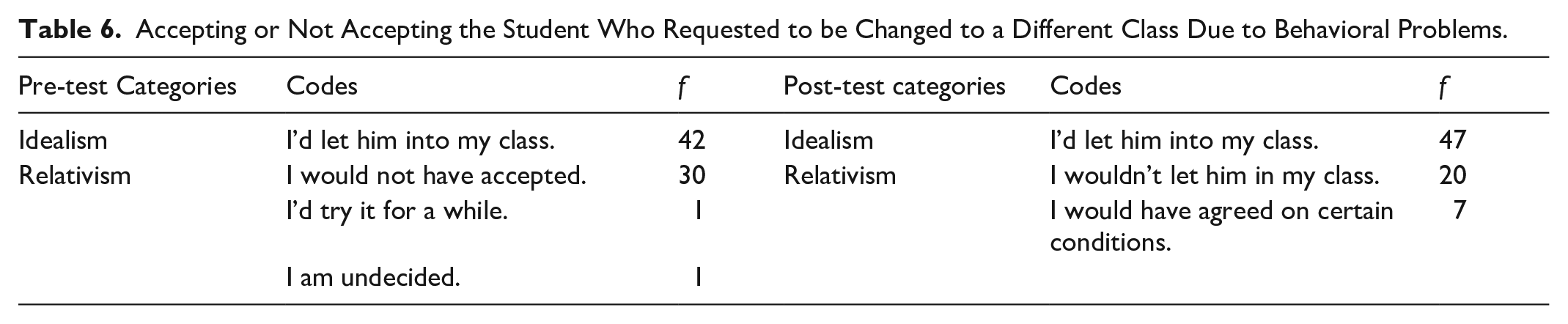
Those who said they would accept the student into their class cited the importance of contributing to the institutional functioning, management, student development and problem-solving, and taking responsibility, and that it was wrong to select students. Other participants justified their beliefs and concerns that the problematic student would disrupt their classroom organization and stated that they did not find changing the class useful and that sending the student to another school was necessary. In the post-test, some participants stated that if similar problems were experienced in their own classrooms, they could take the student into the class on the condition of changing classes again.
Ethical Dilemma 5
The pre-service teachers were asked about their opinions on whether or not to leave the classroom to get materials during the lesson. Participants’ opinions were coded as I leave the class, I do not leave the class, I leave according to the situation, and I ensure the safety of the class (See Table 7).
Whether or Not to Go Out of the Classroom to Get Materials During the Lesson.

The participants who said they would not leave the lesson in the pre-test and post-test frequently stated the following as justification. Going out of the classroom during the lesson endangers student safety and creates problems in terms of time management; it is necessary to benefit from the flexibility of the lesson plan and program; lessons can be taught with different methods without materials, and it is necessary to be more careful when preparing the lesson. The teachers who said they would leave the class generally cited the difficulty of realizing the lesson outcomes without materials and stated that they could easily leave the class after giving the children something to do. In the post-test, it was observed that the participants developed alternative solutions, such as leaving the class to someone else or asking a student or someone else to bring the material.
Ethical Dilemma 6
The pre-service teachers were asked their opinions about whether they would intervene in the situation of the student who was found to be subjected to violence in the family. In the pre-test, the participant opinions were gathered around the codes of I inform the authorities, ask for support, solve the problem myself, and don’t know what I would do. In the post-test, it was observed that all of the participants took a stance in favor of the child who was subjected to violence and explained the procedure to be followed (See Table 8).
Whether or Not to Intervene in the Situation of the Student Who is Found to Have Domestic Violence.

It was observed that the desire to solve the problem was common in the participant responses, but the procedure to be followed regarding the process was not sufficiently explained in the pre-test. In the posttest, it was seen that the participants explained the correct intervention method that would prevent time loss and their roles in the process of providing social-emotional support to the victimized student more courageously.
Prospective Teachers’ Views on Online Ethical Education Course
In order to understand the role of online ethics education in helping pre-service teachers gain ethical sensitivity and develop their ethical skills, participants’ views on the ethics education course were analyzed. In order to reveal their opinions about the ethics education course, pre-service teachers were asked at the beginning and at the end of the semester what they thought about the course and how they evaluated the benefits of the course for their professional development. When the teachers’ opinions were analyzed, it was revealed that at the beginning of the semester, there were negative opinions (55 people) that the course was abstract, limited to theoretical knowledge, based only on the teacher-student relationship, philosophy-based, narrow in scope, difficult, boring, ordinary, monotonous, preaching, inefficient, and unnecessary. The participants associate these negative opinions with their previous experiences or the sensations they received from their peers. Only 19 participants stated that they chose the course at the beginning of the semester because they were curious and thought it would be necessary, useful and fun. As the quotations below show, all of the pre-service teachers stated that their opinions changed positively at the end of the semester, that they enjoyed the course, and that they found the course necessary and useful.
I thought there would be only information transfer in a monotonous way and that it would not contribute much to me. But it developed differently than I expected. For the first time, I participated so much in an online course, and the course was fun for me. It even turned into a course that I followed willingly, not necessarily. It allowed me to see the teaching profession from a different perspective. I think it contributed a lot (A5). Frankly, I thought the course would only consist of theoretical knowledge. However, learning which situations we may encounter while performing the teaching profession and how we should act ethically allowed me to have a positive attitude towards the course (A32).
The positive views of pre-service teachers toward the ethics course that changed at the end of the semester show the traces of learning-teaching processes. The pre-service teachers’ opinions show that the course content and the materials used encourage students to think and question.
The dilemma situations you gave were especially useful. Sometimes, I got into such an insurmountable situation that I thought a lot about it. I said, “What would I do in the face of this situation?” I looked at what my other friends’ reactions were to this situation. Then, I listened to your comments. I criticized myself in some places and said, “I didn’t think to look at it from this point of view.” . . . It both made the lesson fun and offered good ideas about what we can do when we experience these situations since there are examples from life (A15) The questions you asked and the scenarios you presented professionally helped me a lot. We faced many different situations and tried to find solutions to them (A40). I would never have guessed that this course would benefit our profession. Learning how to act in the problem situations you presented gave me a serious advantage before starting my profession (A74). It was a lesson during which I questioned myself, the instructor’s questions, and how we would act in certain situations (A64). The lectures, examples based on lived experiences and case studies had positive results for me (A7).
Although some of the pre-service teachers mentioned the difficulties of online education (connection problems, limited interaction), they all stated that they found the ethics education course very useful in their professional development. They reported that they understood the distinction between morality and ethics, realized the ethical problems that teachers may encounter in their relations with members of the school community, learned the steps and procedures to follow in the face of ethical dilemmas or in ethical decision-making, gained ethical sensitivity, became more curious about the subject, questioned the causality of their actions, and developed positive attitudes and values regarding their professional roles and responsibilities. Here are some of these opinions: This course taught me what I knew wrong (A42). If I had not taken this course, I might have accepted most of the things as normal and applied them in my professional life, saying that there would be no harm. However, after taking the course, I realized that I should pay attention to my behaviors and act by considering whether they are in accordance with ethical rules (A25). This course made me confront my own mistakes and question my own truths. It enabled me to look at my profession within the framework of ethical values (A38) As a pre-service teacher, I learned what I should do when I encounter ethical problems when I become a teacher, how I should behave when there are problems, and how I should behave as a teacher when there are no problems (A17).
Participant views do not provide clear, descriptive data on whether students feel themselves to be idealistic or closer to the relativist position. However, more idealistic statements pointing to the importance of acting by professional ethical rules are frequently found in the end-of-semester teacher opinions.
I did not know that ethical principles were so effective in organizing relationships and questioning some of our moral responsibilities in communication with students, parents, colleagues and administrators, but after taking the course, I realized its importance (A39). Every teacher needs to continuously improve themselves ethically and morally because a teacher who does not improve himself/herself and is content with what he/she knows cannot be a role model (A45). I will make morality and ethics a part of my life, act and behave according to those principles, and not act against these moral and ethical rules no matter my situation (A51). When I start my professional life, I will pay attention to these rules and think I will be a more ethical educator (A42). It improved my sense of justice and made me look at things differently (A36).
Discussion
This study analyzed the effect of online ethics education on pre-service teachers’ ethical positions. The results of the study indicated that the ethics positions of the pre-service teachers differed at the conclusion of the 14-week online ethics training program. It is understood from their responses to the scale and scenarios that teachers’ ethical positions are more idealistic than their initial positions. In particular, pre-service teachers’ responses to the scenarios were more mature than their initial responses. The effect of the ethical position routes that pre-service teachers follow when making and justifying decisions in the face of ethical dilemmas was revealed in the study. The pre-service teachers showed idealistic or relativistic approaches while making ethical judgments. Participants’ behavioral discourse toward the scenarios changed over time, and the decrease in subjectivist judgments can be attributed to online ethics education. The real-world news, article findings, ethical decision-making studies and questioning discussions on ethical dilemmas in the online course about professional ethics may have influenced students’ learning. Participants’ self-reports about the course also support this idea. Singer and Diab (2021) state that online learning modules that support active learning with meaningful learning activities can be effective for ethics education. Juujärvi and Myyry (2022) state in their research that online ethics discussions can improve students’ moral reasoning and effectively gain ethical sensitivity. Waples et al. (2009) state that teaching quality, teaching content, curriculum features and teaching methods play a role in business ethics education.
An individual’s moral philosophy or ethical ideology may be effective in the idealistic and relativistic attitude in pre-service teachers’ ethical decisions toward dilemmas. This result is consistent with Schlenker and Forsyth’s (1977) research results. Research has revealed that personal characteristics, values and beliefs, and ethical ideologies play a role in ethical judgment (Davis et al., 2001; Pan & Sparks, 2012). Kim and Choi (2003) found that age and personal ideology are effective in individuals’ ethical judgments regarding professional ethics and that more idealistic absolutist individuals show strict professional ethical judgments. Considering the factors affecting individuals’ ethical judgments, transforming all pre-service teachers into virtuous individuals through ethics education may not seem realistic (Dudani, 2014). Even if ethics is included in the curriculum, trained teachers are not guaranteed to behave morally correctly (Ulvik et al., 2017). Jonson et al. (2016) showed that ethics education has a limited effect on students’ responses to ethical scenarios, but it supports the idealistic position. Therefore, with professional ethics, it is possible to improve students’ ability to recognize an ethical problem rather than improve their response to it (Gautschi & Jones, 1998). For this purpose, in ethics education courses, it is important to make pre-service teachers think and question professional ethics, develop their ethical abilities, and be aware of the ethical approach behind their decisions. Because it is known that the personal ethical norms that one has when entering the profession determine the level of following professional ethics throughout one’s career (Shamir et al., 1990). In this context, instead of providing intensive philosophical rhetoric in ethics education courses (Knouse & Giacalone, 1996), ethical decision-making practices based on ethical dilemma scenarios that point to the ethical responsibilities of the teacher toward the school community can be designed. The findings of the studies indicated that the case-based teaching model was the most preferred (Avci, 2017). In this context, well-planned online and offline environments, forums, and registries can provide new opportunities to develop individuals’ reasoning skills and influence their ethical ideologies (Cain & Smith, 2009; Juujärvi & Myyry, 2022). For example, online education can give students time to research, prepare and think more about ethical questions. Recorded live lectures and forums can sustain reflective inquiry. This can help overcome one of the obstacles to effective ethics training, namely limited time (Avci, 2017).
In light of the research findings, it is important that all participants alter their negative opinions about online ethics education and perceive the course as beneficial. As evidenced by the participant statements, there was an increase in professional ethical awareness and idealistic tendency among the pre-service teachers at the conclusion of the course. The pre-service teachers shared a common belief and consensus about the course’s contribution and professional ethics. The initial negative attitudes and perceptions of pre-service teachers toward the ethics education course may provide insight into their preparedness for ethical learning. A lack of readiness may limit the efficacy of online ethics education. According to research, online learners’ readiness affects their learning performance, motivation, and the outcome of their courses (Joosten & Cusatis, 2020; Wei & Chou, 2020). Nevertheless, the participants’ self-reports at the end of the semester indicate that online education can play a role in gaining ethical sensitivity, just as traditional education does. In contrast to this result, Todd et al. (2017) found that fully online courses in ethics education are sufficient to provide less complex instructional content but are ineffective in developing ethical decision-making skills. The authors stated that hybrid delivery formats benefit ethics courses the most. Likewise, French (2006) found that hybrid business ethics education planned face-to-face and distance is beneficial. On the other hand, Barak and Green (2020) found that an online ethics education course promotes ethical awareness and understanding based on student views. In their research, the authors proposed an instructional design with collaborative, case-based, and contextual learning components to facilitate active and interactive online ethics education (Barak & Green, 2020).
The scales and scenarios applied in the online ethics course in the current study may have created a catalyst effect that positively affected the ethics education process and encouraged pre-service teachers to think critically. Participant views also support this idea. Paying attention to and discussing ethical dilemmas can develop the practical wisdom necessary to deal with uncertain situations (Ulvik et al., 2017). Critical thinking in ethical education contributes to moral learning by allowing adults to recognize and grapple with moral dilemmas rather than viewing moral issues and decisions as simple or absolute (Joseph, 2016). Ames et al. (2017) revealed that ethical reasoning training impacts student learning. Therefore, ethical dilemma scenarios create opportunities in online ethics education for students to elicit their reactions. Thanks to the scenarios, it was easy to monitor the cognitive and affective reactions of the participants. Hedayati-Mehdiabadi et al. (2019) observed that students’ discussion of an ethical scenario in an asynchronous online format improved their’ ethical thinking. Sholihin et al. (2020) revealed that virtual reality-based learning media contributed to learning an online ethics course and improved students’ ability to cope with ethical dilemmas. In this context, if the ethics education process serves as a mirror for pre-service teachers to recognize their own moral values, beliefs, and norms, and if it succeeds in showing solutions to ethical dilemmas related to their profession, it may be easier for teachers to gain insight.
Conclusion
The study showed that online ethics education affected the ethical positions and judgments of pre-service teachers and promoted ethical awareness. Based on the students’ opinions who took the course, ethical dilemma scenarios in online ethics education led students to think. This study found that the group’s and individuals’ ethical ideology can be important variables in explaining the outcomes of an individual’s ethical decision-making process. It was revealed in the ethical dilemma scenarios that pre-service teachers’ ethical positions were effective in their ethical decisions. The results supported all three hypotheses of the study.
Recommendations
Considering the variety of problems faced by schools today, it is a fact that teachers with high ethical awareness and sensitivity to ethical violations are needed more than yesterday. Training teachers in ethical knowledge, feelings, thoughts, and skills through ethical education is possible. For this purpose, alternative teaching methods such as face-to-face, online, and hybrid teaching should be considered when developing ethics education programs. Other courses in the teacher training curriculum should be strengthened regarding ethics, and the lecturers should be role models.
In ethics education, the place of theory in practice should be shown, and the course should be made meaningful for pre-service teachers. Considering that pre-service teachers’ previous experiences are also effective in their ethical decisions, the ethics course should not be static and should be directly related to pre-service teachers’ internship studies and school life; it should be shaped by student actions such as think, talk, discuss, try, do, write, present. Online courses should be designed to nurture individuals’ critical learning domains and encourage students’ abilities of analysis, imagination, critical synthesis, creative expression, self-awareness, and action (Castro & Tumibay, 2021). Since pre-service teachers’ ethical ideologies are effective in their ethical judgments, if their self-awareness is supported, it may be easier for them to question the thinking behind their reactions. For this purpose, dilemma scenarios specific to teaching ethics education can be used in the courses. For pre-service teachers to improve their ethical decision-making skills and recognize unethical behaviors, the unethicality of the behavior can be evaluated with individual and group discussions using ethical decision-making cards (In no case / in all cases / in some cases / in most cases, it is wrong). Tools such as the ethical position scale can be used as a self-assessment tool to improve individuals’ self-recognition skills.
To nurture pre-service teachers’ thinking, ethical issues and cases should be discussed, not only what works but also the purpose of education (Ulvik et al., 2017). For this purpose, online program designs for ethics education can be made, and implementation results can be monitored. In particular, there is a need to investigate the effect level of different variables on ethics education outcomes. In addition, the ethical dilemma situations and decision-making models that pre-service teachers struggle with in their school internship studies can be examined.
It is possible to raise the virtuous and qualified people of tomorrow with teachers who have adopted ethics as a guide. The future of the society we are a member of will reflect the moral values and beliefs of the teachers we educate today. For this reason, the ethical skills of adults should be developed from an early age, and the widespread effect of ethical education should be increased. In order to increase the permanence of ethical learning of prospective teachers, ethical training should be continued at intervals after they start to work.
Footnotes

Ethical Considerations
Ethical approval was obtained for this research from the Atatürk University Educational Sciences Unit Ethics Committee on March 6, 2023 (Approval No. 03-14).
Consent to Participate
Informed consent was obtained before participation.
Funding
The author received no financial support for the research, authorship, and/or publication of this article.
Declaration of Conflicting Interests
The author declared no potential conflicts of interest with respect to the research, authorship, and/or publication of this article.
Data Availability Statement
The dataset generated and analyzed during the current study is not publicly available because participants were informed during consent that their data would not be shared with third parties.