




Abstract
With the continuous deepening of urbanization, the number of migrant populations in many developing countries has sharply increased. More and more migrant populations choose to bring their children with them. Investigating the impact of children’s migration on the wage income of migrant populations is of significant importance for understanding the reasons behind labor force migration. This paper utilizes the 2017 China Migrants Dynamic Survey (CMDS) to draw the following conclusions: Firstly, employing instrumental variable methods, it is found that children’s migration reduces the wage income of migrant populations by approximately 17%, further confirmed by Rubin’s counterfactual framework. Secondly, children’s migration increases the care burden of migrant populations by reducing working hours and lowering health conditions, and reduces employment stability and migration scope, thereby negatively affecting wage income. The impact of children’s migration on gender wage gap is particularly evident, significantly reducing the wage income of male migrant populations by 14% and female migrant populations by 31%. Thirdly, heterogeneity analysis shows that the negative impact of children’s migration on wage income is greater for females, those with higher education levels, non-agricultural household registrations, and migrant populations with daughters. The research conclusions of this paper have important policy implications for further expanding the supply of urban public services in China and alleviating the burden on migrant families due to care responsibilities.
Plain Language Summary
As cities develop, more people are moving from rural areas to urban centers for work and living, often bringing their children along. We studied the income of these migrants with children in cities using data from a 2017 national survey (CMDS). We found that migrants who bring their children experience an income reduction of about 17% compared to those who do not. Additionally, bringing children imposes extra burdens, such as requiring more time for childcare, potential health decline, decreased job stability, and poorer job matches, all contributing to lower incomes. Importantly, this impact varies by gender: male migrants see a 14% income reduction, while female migrants see a 31% reduction. Different groups are affected to varying degrees; those with higher education, non-agricultural household registrations, and families with daughters experience greater income reductions. This study has significant policy implications for China. To assist these migrant families, the government needs to provide more public services and alleviate their caregiving burdens.
Introduction
With the continuous reform of the household registration system in China, many cities have relaxed the conditions for obtaining household registration. The welfare policies for migrant populations have been continuously optimized, leading to a gradual increase in the number of migrant populations. Data from the seventh national census show that by 2023, the scale of the migrant population had reached 376 million, and in the Yangtze River Delta region, the proportion of migrant populations to the resident population exceeded 40%. The proportion of family migration has also been increasing year by year, and by 2020, it had exceeded 40%. As an important part of the urban labor market, the wage level of migrant populations directly affects families’ economic situation and social stability. Against this background, this paper attempts to examine the impact of children’s migration on the wage income of migrant populations and the mechanisms behind it. Reflecting on the influence of children on the wage income of migrant populations and the choice between wage income, childcare for children, and urban resources is of great significance for understanding labor migration in China.
Children’s migration has a significant positive effect on the family utility level of migrant populations and their sense of integration into the city. C. Wang and Zhang (2017) observed that under the family migration model, migrant workers’ willingness to integrate into the city, their long-term settlement intentions, and their sense of identity are all significantly higher than those of individual migrants. However, children’s migration to some extent increases the living costs of migrant populations and their demand for public services in the destination city, and it also increases the expenses of migrant worker families, especially in education and housing, which are not conducive to wealth accumulation. So, under the current circumstances, does children’s migration affect the wage income of migrant populations? How much specific impact does children’s migration have on the wage income of migrant populations? What mechanisms generate this impact? This paper will analyze these questions using the 2017 Dynamic Monitoring Survey of Migrant Populations data.
The conclusions of this paper can be summarized as follows. Firstly, through baseline regression, it is found that children’s migration reduces the wage income of migrant populations by approximately 1.4%. To address potential endogeneity issues, instrumental variable methods and endogenous switching regression models are employed. Instrumental variable regression results show that children’s migration reduces the wage income of migrant populations by approximately 17%. The endogenous switching regression model finds that for the group with children’s migration, if their children do not migrate, their wage income will increase by 2.9%; while for the group without children’s migration, if their children migrate, their wage income will decrease by 23.7%. Next, this paper examines the impact of children’s migration on the wage income of migrant populations from different aspects such as gender, non-agricultural household registration, and education level. Through mechanism analysis, it is found that children’s migration affects the wage income of migrant populations by influencing their working hours, employment stability, health conditions, and migration scope, and specific gender wage gaps are calculated for each scenario, indicating that children’s migration has a greater negative impact on female migrant populations. Finally, we discuss the possible reasons why migrant populations still choose to let their children migrate despite the reduction in wage income caused by children’s migration.
Literature Review and Research Hypotheses
Literature Review
This study draws upon three streams of literature that collectively inform our understanding of migrant workers’ spatial choices and their economic consequences, particularly regarding child migration decisions.
The first research area explores how migrant workers navigate urban spatial decisions. Traditional studies have examined the geographic aspects of urban choice and employment-residence distribution, but largely overlooked gender dynamics. More recent work has incorporated family and gender considerations into migrant settlement analysis (Gu et al., 2021). Women encounter distinct challenges in spatial planning due to their dual work-family obligations, requiring careful consideration of residential arrangements that accommodate childcare needs (Blau & Winkler, 2018). Advanced spatial equilibrium models now account for the interconnected nature of workplace and residence decisions, providing deeper insights into individual location choices (Kuminoff et al., 2012).
The second area investigates household labor allocation and its consequences for women’s economic outcomes. Gender differences in comparative advantage between domestic and market work shape women’s roles within family structures (Blau & Kahn, 2016). As specialized human capital becomes more valuable, married women often reduce their market labor participation and skill investment (Becker, 1985). This pattern helps explain portions of the gender wage gap. Childcare duties create both immediate reductions in women’s work hours and lasting damage to career advancement prospects (Adda et al., 2017). The structure of modern workplaces penalizes those seeking flexible schedules, preventing women from accessing the wage premiums tied to intensive work arrangements (Goldin, 2014). Cultural norms and social expectations fundamentally shape these gendered patterns, contributing to international variation in maternal economic penalties (Kleven et al., 2019).
The third research stream focuses on temporal flexibility in employment arrangements. Unequal family responsibility distribution combined with varying job flexibility creates persistent income disparities (Goldin, 2014). For migrant women, child migration decisions fundamentally alter family responsibility patterns and subsequently influence employment options. Because caregiving work resists flexible scheduling, mothers often gravitate toward accommodating but lower-paying job arrangements. This flexibility differential across occupations generates systematic income inequalities. Evidence shows that mothers with young or multiple children frequently choose self-employment or part-time arrangements (Joona, 2017). While such flexible work can maintain labor force attachment and partially offset income losses (Kong & Dong, 2023), it typically involves lower overall compensation and represents necessity-driven rather than opportunity-based entrepreneurship.
Research Hypotheses
Existing literature suggests that differences in education levels and access to public services influence the decision of migrant populations regarding children’s migration. Higher education levels and better public services tend to increase the likelihood of migrant populations choosing to have their children migrate with them (Y. Li et al., 2020; Tiebout, 1956). Additionally, the satisfaction of migrant populations with urban life is associated with their willingness to stay, leading to a higher likelihood of choosing children’s migration (Tao et al., 2014). Moreover, if migrant populations receive social support from their places of origin, their desire for children’s migration becomes stronger (Liang, 2011). However, factors restricting children’s migration for migrant populations cannot be ignored. Migrant populations need to consider whether their personal occupational characteristics and job stability facilitate childcare for their children (Yang et al., 2011). Therefore, while migrant populations aspire for better public services and educational opportunities for their families, the high cost of urban living limits the decision of more migrant populations to have their children migrate with them (H. Li et al., 2021). In summary, children’s migration has various impacts on migrant population families.
However, in the literature examining the effects of children’s migration on migrant populations, research specifically addressing its impact on wage income among migrant populations in China is limited and presents inconsistent findings. Yang (2017) found that children’s migration significantly increased the wage levels of male migrant populations, particularly for those with higher education levels. Conversely, other scholars argue that children’s migration affects the job quality, employment stability, and labor participation rates of migrant populations (Wang & Zhai, 2022; Zhu, 2021). Yet, Xing and Zhang (2022), from a spatial equilibrium perspective, discovered a significant negative impact of children’s migration on the hourly wages of migrant populations without delving into the underlying mechanisms. Liang and Zhong (2023), approaching from the perspective of household division of labor and employing a regression discontinuity method, found that children’s migration significantly reduces job quality and working hours of mothers. Based on the aforementioned analyses, this study proposes the following two opposing hypotheses:
Children’s migration will affect the working hours of migrant populations. Due to the presence of maternal penalties and traditional family divisions of labor, children’s migration increases the childcare costs for migrant populations, such as reducing overtime hours and sacrificing rest, with a greater burden falling on female migrant populations, thereby affecting their job quality and wage income (Blau & Kahn, 2016; Kong & Dong, 2023; Liang & Zhong, 2023; H. Zhang et al., 2020). Based on this, this paper proposes the following hypothesis:
Children’s migration will also affect the physical health of migrant populations. Children’s migration may increase the economic pressure on migrant population families (Chindarkar et al., 2022). Migrant populations often engage in low-paying or insecure jobs in urban areas, while the education and living expenses of children require additional expenditure. This economic pressure may lead to a decline in the quality of life for migrant populations, thereby affecting their health status (Xing & Zhang, 2022). Furthermore, children’s migration may increase the psychological pressure on migrant populations. In a new environment, migrant populations need to adapt to new lifestyles and work environments, and the adaptation issues of children may also bring them more psychological stress. Long-term psychological stress may lead to anxiety, depression, and other psychological problems among migrant populations, thus affecting their physical health (Urzúa et al., 2023; Xing & Wei, 2017). Based on this, this paper proposes the following hypothesis:
Although migrant populations can relatively freely choose their places of residence and types of work during migration, due to the particularity of the migrant worker group, they often passively select jobs in their work positions (Xing & Zhang, 2022). This problem will be exacerbated with children’s migration. After children’s migration, migrant populations need to consider the relationship between their places of residence, types of work, and their children, such as whether to enroll in nearby schools and whether the distance of migration will affect their children’s social integration, leading migrant populations with children’s migration to generally choose cities closer to home for migration (C. Wang & Zhang, 2017), and the narrowing of the migration scope reduces the probability of migrant populations finding jobs that match their abilities, thereby negatively affecting wage income (Correll et al., 2007; Song & Dong, 2018; Yang & Li, 2017). Based on this, this paper proposes:
In addition, after children’s migration, migrant populations may voluntarily give up stable jobs in order to obtain more flexible time to accompany their children, while job stability generally ensures the stability of wage income (Hamilton & Scrivener, 2012; Xing & Zhang, 2022). The issue of children’s education may also require frequent adjustments to their work locations to accommodate changes in their children’s schools, further reducing job stability (Castillo et al., 2013; H. Li et al., 2021; Wang et al., 2018), with this negative impact falling more on mothers. Based on this, this paper proposes:
The marginal contributions of this paper mainly focus on three aspects: First, in terms of research perspective, existing studies have focused on the influence of children’s migration on the urban integration and employment situations of migrant populations, while this paper explores the impact of children’s migration on the wage income of migrant populations and examines in detail the effect of children’s migration on the gender wage gap within migrant population families. Second, in terms of research methods, this paper adopts an endogenous switching regression model to address sample self-selection issues and uses Rubin’s counterfactual framework theory to calculate the specific numerical value of the negative impact of children’s migration on the wage income of migrant populations. Third, this paper explores how children’s migration affects the wage levels of migrant populations from the perspectives of weekly working hours, physical health status, job stability, and migration scope, expanding and deepening the mechanism analysis of the relationship between the two, and analyzes the possible reasons why migrant populations still choose children’s migration even when facing a decrease in wage income.
Despite these contributions, this study has certain limitations. First, due to data constraints, we cannot observe the long-term effects of children’s migration on parental wage income and career development trajectories. Second, while our mechanism analysis is comprehensive, it may not exhaust all possible channels through which children’s migration affects parental labor market outcomes. Third, this study is primarily based on the Chinese context, and the applicability of our findings to other countries and regions requires further verification.
This study provides a methodological foundation and research directions for future studies to employ longitudinal data to track long-term dynamic effects of children’s migration, explore additional mechanisms, further investigate the impact of children’s migration on intra-household gender wage gaps, conduct cross-national comparative research, and comprehensively evaluate migrant family decisions from a multidimensional well-being perspective.
The remaining sections of this paper are structured as follows: Section three explains the data sources, defines several core concepts, and describes and explains the variables. Section four introduces the model of this paper in detail and conducts regression analysis and addresses endogeneity issues based on the model. Sections five, six, and seven introduce the heterogeneity analysis, mechanism analysis, and robustness tests of this paper, respectively. Section eight discusses the possible reasons why migrant populations still choose children’s migration despite the decrease in wage income. Section nine presents the research conclusions and offers policy recommendations.
Data Sources and Descriptive Statistics
Data Sources
The data used in this study is sourced from the 2017 China Migrants Dynamic Survey (CMDS), which is a nationwide non-tracking sampling survey conducted since 2009 aimed at understanding the living conditions, migration trends, health status, and access to public healthcare services among migrant populations. Migrant population in the survey is defined as individuals who have resided in the destination area for 1 month or more, have a household registration (hukou) outside the destination area, and were aged 15 years or older in May 2017. The total sample size of the survey is approximately 170,000 individuals.
This paper focuses on the impact of migrant children on the wage income of the migrant population. Therefore, the study initially excludes the migrant population whose employment status is “employer” and “self-employed,” and only retain the migrant population whose employment status is “with fixed employer” and “without fixed employer.” Given the intergenerational relationships and cross-generational effects involved, the study specifically selects married migrant population with children. Furthermore, the study excludes migrant workers with children aged 15 years and above. This decision is based on the fact that children aged 15 and above are mostly in high school or vocational school, some have reached the legal working age or have a stable source of income, and others may have entered boarding schools for their studies, thus reducing their reliance on parents. Therefore, this group is not within the scope of this study.
To summarize, this paper restricts the study sample to the migrant population whose children are aged 0 to 15 years old and whose employment status is employee. After removing outliers and missing values, the study ultimately obtains 38,881 valid samples.
Variable Selection
Dependent Variable: Monthly wage income of the respondents. Since the focus of this study is on the wage income of the parental generation, in conjunction with the CMDS database questionnaire, it is defined as the monthly wage income at the time of the survey (or last employment). The natural logarithm of wage income is taken as the dependent variable in this study. Additionally, due to the large sample size, the logarithm of wage income is truncated at the 1st and 99th percentiles in subsequent analyses.
Core Independent Variable: Migrant children, coded as 1 if yes and 0 otherwise. There is no specific variable indicating “migrant children” in the 2017 CMDS questionnaire. It is inferred by constructing relationships such as “relationship with respondent: son,”“relationship with respondent: daughter,” and “whether current residence is local.”
Controlled Variables: Considering factors other than migrant children that may influence the wage income of migrant workers. There are numerous factors affecting wage income of migrant workers, and the database contains many relevant variables. Therefore, control variables are categorized into four groups: personal factors, family factors, mobility factors and occupational factors.
(i) Personal factors: gender (male, female), age and its square, years of education (0 years for no education, 6 years for primary school, 9 years for junior high school, 12 years for high school, 15 years for vocational school, 16 years for undergraduate, 17 years for graduate and above), ethnicity (Han, other), hukou (agricultural, non-agricultural), political affiliation (CPC member, others), health status (completely healthy, basically healthy, basically unhealthy, completely unhealthy), and current region of residence (the eastern region, the central region, the western region).
(ii) Family factors: whether the spouse is moving with the household, whether the grandparents are moving with the household.
(iii) Mobility factors: number of times of mobility, duration of mobility, region of mobility (inter-provincial mobility, inter-municipal mobility within the province, and inter-county mobility within the city), and willingness to stay (willing to stay, unwilling to stay, undecided).
(iv) Occupational factors: Seven different types of occupations.
Descriptive Statistics
To begin with, by truncating the wage income data, we get that the average monthly wage income of the migrant population is 4,302.64 yuan, with the lowest monthly income being 1,000 yuan and the highest monthly income reaching 18,000 yuan. Among all the married migrant families with children, about two thirds of the migrant population will let their children move with them to live together at the workplaces. Therefore, there is sufficient sample support and comparison for this paper to study the impact of migrant children on their wage income. We proceed to analyze four aspects of the migrant population: personal characteristics, family characteristics, mobility characteristics and work characteristics (Table 1).
Descriptive Statistics of Main Variables.

First, in terms of personal characteristics, males account for 58% of the migrant population, while females make up 42%, indicating a roughly equal gender distribution. However, it’s noteworthy that 78% of the migrant population hold rural hukou (household registration), while urban hukou holders comprise less than 22%. This suggests that China’s rural hukou population is more prone to mobility, aligning with the country’s dual labor market and urbanization process. The average age of married migrants with children is around 34 years old, ranging from a minimum of 18 to a maximum of 77 years old. Regarding political affiliation, the proportion of Communist Party members is relatively small, at around 6%, with the majority being non-party members. In terms of health status, the majority of migrants, accounting for 86%, are in good health, 12% are in generally good health, and 7% are in less than perfect health, indicating that most migrants are healthy enough to sustain their mobility across provinces and cities.
Second, in terms of family characteristics, the proportion of grandparents accompanying migration is relatively small. In addition, 78% of migrant populations choose to migrate with their spouses, while only 22% have one spouse working outside while the other stays home. This also reflects a trend toward family migration in China, gradually replacing individual labor migration.
Third, in terms of mobility characteristics, regarding the intention to settle, 86% of migrants express a willingness to continue residing in cities, while less than 2% indicate a reluctance to do so. Sixty percent of migrants move to eastern regions, with only about 20% moving to central and western regions, indicating that the developed eastern regions still hold great appeal for migrant populations. In terms of mobility scope, over half of migrants choose to move across provinces, while 31% move across cities within the same province, and only 17% move across counties within the same city. The average duration of migration is 5.98 years, ranging from less than 1 year to a maximum of 47 years, indicating a moderate average and considerable variation in migration duration among the population. For migrants, the average number of migrations is 2.15 times, with the highest being 50 cities, indicating that the employment stability of migrant populations remains challenging to secure.
Fourth, in terms of work characteristics, the majority of migrants have a fixed employer, accounting for approximately 86%, while those without a fixed employer make up a small proportion. The average weekly working hours are 52.53 hr, with the highest reaching 99 hr, significantly exceeding the statutory working hours. In terms of occupational types, the majority of migrants are engaged in commerce and service industries, accounting for about 38%, followed by those in production and transportation equipment operation, accounting for about 36%. The proportion of migrants with professional technical skills is about 15%.
Model Setting and Empirical Results
Empirical Model Specification
Ordinary Least Squares Regression Model
The core explanatory variable in this study is the binary dummy variable “whether children migrate with parents.” Based on the classic Mincer wage income equation, the baseline regression model in this study is set as follows:

Two-Stage Least Squares Regression Model
However, the core explanatory variable, migrant children, may be endogenous. The decision of children’s migration with parents not only affects the wage income of migrant workers but may also influence the migration decision of migrant workers’ families. Combining existing literature and past CMDS data, this study selects the rate of migrant children in the destination area (district/county) as an instrumental variable and employs the 2SLS method to re-estimate to address potential endogeneity problems caused by reverse causality. The 2SLS model estimation is divided into two stages. In the first stage, the core explanatory variable is regressed on the instrumental variable to obtain the fitted values of migrant children. In the second stage, the instrumental variable is incorporated into the existing regression model.


Endogenous Switching Regression Model
We employ an endogenous switching regression model as an alternative identification strategy to enhance robustness. This model explicitly accounts for the self-selection process in migration decisions while allowing wage determination to differ between families with and without migrant children. It captures unobserved heterogeneity in treatment effects that may not be fully addressed by instrumental variables, which typically estimate only local average treatment effects (LATE).
For the selection equation of children’s migration, this study uses the probit model to estimate the probability of children’s migration, and then selects the group of children’s migration as the treatment group and the group of children not migrating as the control group.


So,


On this basis, what is more important is to predict the situation of the outcome variable under different conditions. In this study, migrant individuals are either in the treatment group of children’s migration or in the control group of children not migrating, and only one situation of wage income of migrant workers can be observed, without observing the wage income of the same individual under different conditions. By combining the transformation equations of the two types of children’s migration decisions, it is possible to estimate the natural logarithm of wage income of migrant workers under two different conditions of children’s migration and non-migration, thereby further correcting the sample’s self-selection problem and solving endogeneity problems to a greater extent. Combining Rubin’s counterfactual framework, the counterfactual estimation results of whether children migrate can be obtained.


This refers to the conditional expectation of the logarithm of wage income for the group with children’s migration assumed not to occur for their children, and the conditional expectation of the logarithm of wage income for the group with children’s non-migration assumed to occur for their children. Average Treatment Effect on the Treated (ATT), Average Treatment Effect on the Untreated (ATU), and Average Treatment Effect (ATE) are calculated to assess the Average Treatment Effect of the endogenous switching regression model.
Analysis of Empirical Results
Basic Model Regression Results
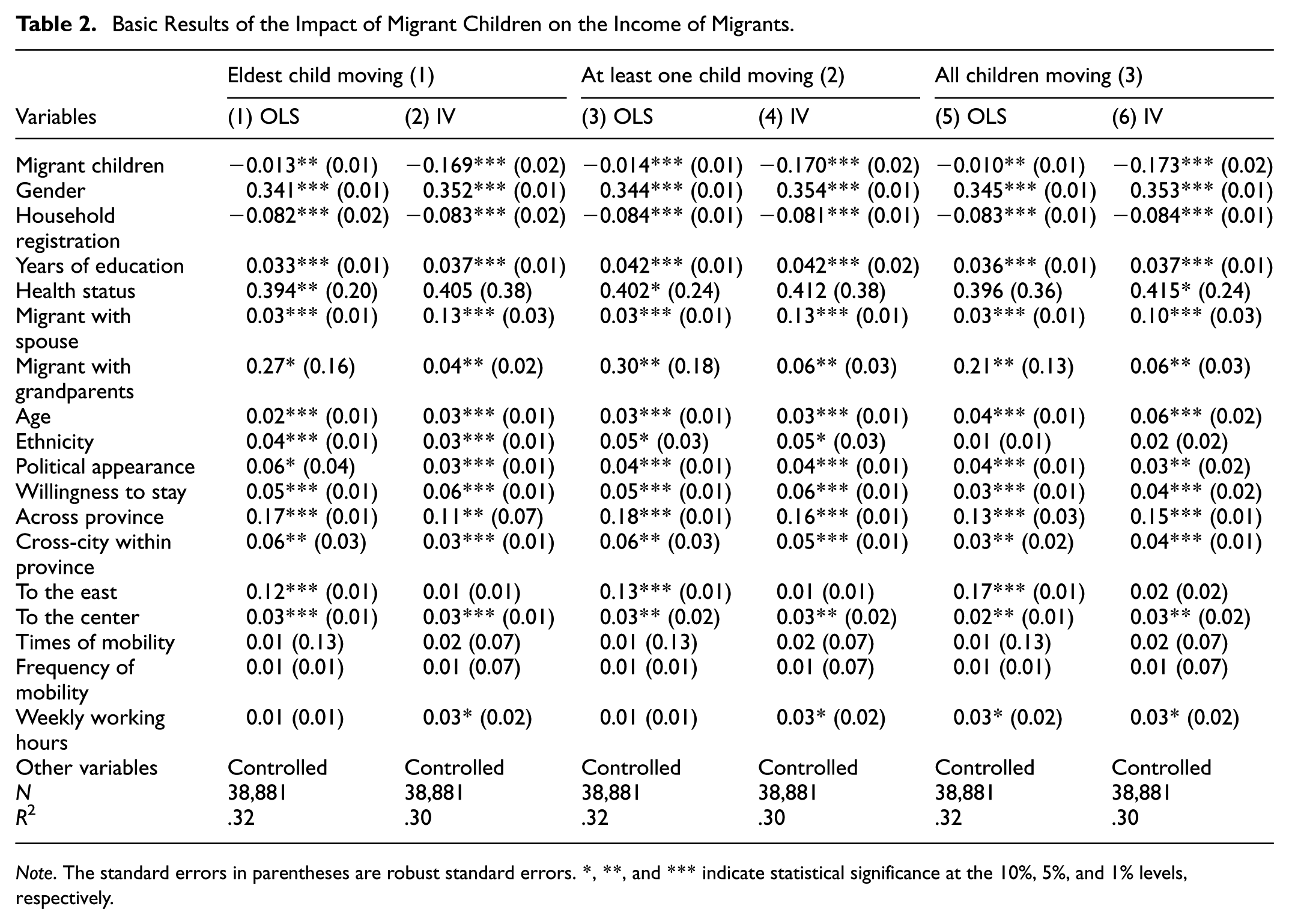
This section primarily employs the Ordinary Least Squares (OLS) method to estimate the model, and the empirical results are shown in Table 2, results (3). According to the regression coefficients, it can be observed that the impact of migrant children on the wage income of migrant population is negative, and under the control of other variables, migrant children can explain approximately 1.4% of the wage income of the migrant population. Table 2 reports all control variables in the four categories of basic features. Among them, unhealthy health condition, undecided intention to stay, intra-city cross-county mobility, western region mobility, no fixed employer work type, and other occupational types of the migrant population are selected as reference groups.
Basic Results of the Impact of Migrant Children on the Income of Migrants.
Note. The standard errors in parentheses are robust standard errors. *, **, and *** indicate statistical significance at the 10%, 5%, and 1% levels, respectively.
Two-Stage Least Squares Estimation
To address potential endogeneity issues, this study, based on existing literature, employs the influx rate of migrant children to the destination as an instrumental variable. The division of the destination is based on the county as the basic unit. For the migrant population, their decision regarding migrant children is influenced by the overall situation of migrant children in the destination area, as well as the inclusiveness and educational resources in that area. However, this influence is relatively localized, and such homophilic effects often do not spread beyond the provincial or municipal levels. Additionally, in practical terms, migrant populations have limited interactions with residents of their destination cities, often only interacting with residents of neighboring communities. Therefore, this study chooses the county as the unit for dividing the influx rate of migrant children to the destination. Furthermore, using the influx rate of migrant children to the destination as a regional indicator does not directly affect the wage income of the migrant population, thus meeting the requirement of instrumental variable exogeneity. From a statistical standpoint, the instrumental variable of the influx rate of migrant children to the destination, divided by county, has passed the exogeneity test.
The regression results are shown in Table 2, result (4). Migrant children still have a significant inhibitory effect on the wage income of the migrant population, with this effect increasing to 17%. This indicates that in the baseline regression model, the impact of migrant children on the wage income of the migrant population has been severely underestimated due to endogeneity issues.
Endogenous Switching Regression Model
While the instrumental variable approach provides robust evidence for the causal effect of child migration on migrant populations’ wage income, we further employ an endogenous switching regression model as an alternative identification strategy to enhance the robustness of our findings. The endogenous switching regression model explicitly accounts for the self-selection process in migration decisions while allowing the wage determination process to differ between families with and without migrant children. This approach is particularly valuable because it can capture unobserved heterogeneity in treatment effects that may not be fully addressed by the instrumental variable method, which typically estimates local average treatment effects (LATE). Since the endogenous switching regression model cannot directly estimate the extent of the impact of migrant children on wage income, we utilize Rubin’s counterfactual framework to calculate the Average Treatment Effects (ATE), Average Treatment Effect on the Treated (ATT), and Average Treatment Effect on the Untreated (ATU). Here, ATT represents the average treatment effect for the treatment group (migrant children group) on wage income, ATU represents the counterfactual estimate of the average treatment effect for the control group (non-migrant children group), and ATE represents the average treatment effect for the entire sample on wage income.
As shown in Table 3, for migrant populations who accompany their children, the decision to migrant children reduces wage income by 2.9% at the 1% significance level. For migrant populations who do not accompany their children, the decision to accompany children reduces wage income by approximately 23.7% at the 1% significance level. For the entire sample, migrant children reduces wage income by about 10.4% compared to not migrant children.
Average Treatment Effect of Migrant Children on Wage.

Note. The standard errors in parentheses are robust standard errors. *, **, and *** indicate statistical significance at the 10%, 5%, and 1% levels, respectively.
Furthermore, based on the sample data, this paper draws the probability density distribution of the actual wage and the counterfactual wage income of the migrant population in the child-movement group and the child-not-movement group. It can be seen in Figure 1 that for the child-migrant group, if they choose their children not to move with them, their wage income will increase significantly; while for the child-not-migrant group, if they choose their children to move with them, their wage income will decrease significantly, and the magnitude of which is much larger than the magnitude of the wage income of the migrant population in the child-migrant group.

Comparative wage profiles: Probability density functions for migrant populations with and without migrant children.
Heterogeneity Analysis
Impact of Migrant Children on the Income of Migrants of Different Genders
To facilitate comparative analysis, the estimated results for the entire sample in the second column of Table 4 are presented in two-stage least squares estimation. The results indicate that migrant children behavior significantly reduces the wage income of male migrant populations by 14% at the 1% significance level, while it reduces the wage income of female migrant populations by 31% at the 1% significance level, a magnitude far greater than that observed in the entire sample.
Impact of Migrant Children on the Wage of Migrant Population by Gender.

Note. The standard errors in parentheses are robust standard errors. *, **, and *** indicate statistical significance at the 10%, 5%, and 1% levels, respectively.
Impact of Migrant Children on the Income of Migrants of Different Household
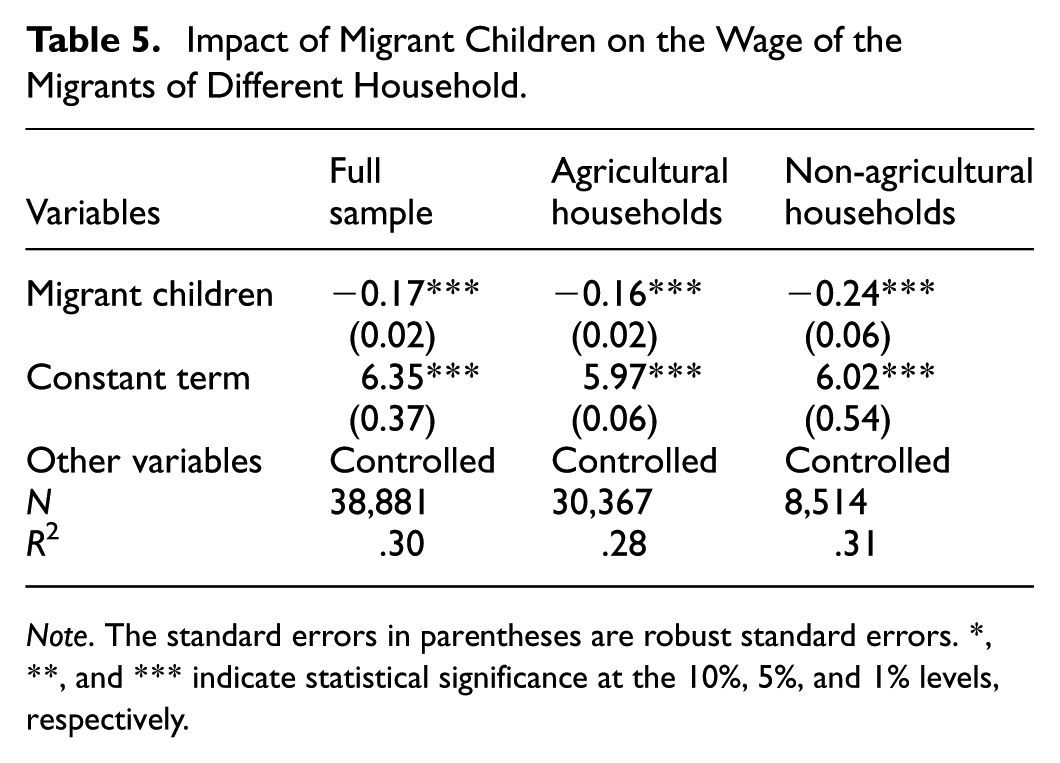
To further explore the impact of migrant children on wage income of migrant populations with different household registrations, this study conducts regression analysis grouped by household registration nature, as shown in Table 5. It can be observed that the effect of migrant children on wage income of migrant populations exhibits significant heterogeneity based on household registration. For migrant populations with agricultural household registration, migrant children significantly reduce wage income levels by approximately 16% at the 1% significance level. For migrant populations with non-agricultural household registration, migrant children behavior significantly reduces wage income levels by approximately 24% at the 1% significance level. This indicates that the impact of migrant children on wage income of migrant populations with non-agricultural household registration is more pronounced. One possible explanation is that migrant populations with agricultural household registration, when faced with job discrimination, need to spend relatively more time on their work, allocate less time to their children, and have a lower emphasis on their children’s education. Hence, the inhibitory effect of migrant children on wage income is relatively smaller for migrant populations with agricultural household registration.
Impact of Migrant Children on the Wage of the Migrants of Different Household.
Note. The standard errors in parentheses are robust standard errors. *, **, and *** indicate statistical significance at the 10%, 5%, and 1% levels, respectively.
Impact of Migrant Children of Different Genders on the Wage Income
Considering the influence of children’s gender on wage income of migrant populations, the results in Table 6 shows that if a son accompanies the migrant, it reduces the wage income of migrant populations by approximately 16.1%. If a daughter accompanies the migrant, it reduces the wage income of migrant populations by approximately 20.3%, the latter being greater than the former, indicating that bringing daughters along has a greater impact on wage income. This reflects reality, as caring for daughters typically requires more time and energy compared to caring for sons, which is also significantly associated with the traditional Chinese belief of “raising a son in poverty and raising a daughter in wealth.”
Impact of Children of Different Genders on the Wage of the Migrants.

Impact of Migrant Children on the Income of Migrants at Different Wages
From the regression results in Table 7, it can be observed that the impact of migrant children on the wage income of migrant populations varies significantly across different income levels. Overall, as the wage income of migrant populations increases, the inhibitory effect of migrant children on their wage income gradually diminishes and eventually turns into a promoting effect. In groups with lower wage income among migrant populations, the inhibitory effect of migrant children on their wage income is more pronounced, with the inhibitory effect becoming stronger as income levels decrease. As income levels continue to rise, the inhibitory effect becomes less apparent.
Impact of Migrant Children on the Income of Migrants at Different Wages.

Note. The standard errors in parentheses are robust standard errors. *, **, and *** indicate statistical significance at the 10%, 5%, and 1% levels, respectively.
Mechanism Analysis
To investigate how migrant children affects the wage income level of migrant populations, we conduct analysis from the following aspects.
Weekly Working Hours of the Migrant Population
In practical terms, when children migrate to the location of their parents’ work, their parents often need to allocate a portion of their original working time to care for them, which may lead to a reduction in the working hours of migrant populations and consequently affect their wage income levels.
Table 8 shows that compared to migrant populations whose children did not migrate, children’s migration reduces the weekly working hours of migrant populations. At a 1% significance level, children’s migration behavior decreases the weekly working hours of migrant populations by approximately 6.5 hr, on average, resulting in migrant populations participating in work 1 hr less per day. An increase in working hours for migrant workers, who predominantly engage in low-income labor, can significantly increase their wage income to some extent.
Impact of Migrant Children on the Weekly Working Hours of the Migrants.

Note. The standard errors in parentheses are robust standard errors. *, **, and *** indicate statistical significance at the 10%, 5%, and 1% levels, respectively.
Through gender-specific mechanism analysis, it is observed that children’s migration reduces the weekly working hours of female migrant populations by approximately 8.94 hr at a 1% significance level, whereas it reduces the weekly working hours of male migrant populations by only 2.8 hr. Thus, it can be inferred that children’s migration constitutes a family decision that sacrifices the mother’s wage income by reducing her working hours. This phenomenon not only perpetuates the traditional division of labor within Chinese families but also represents a typical penalty for motherhood. Childcare is a time-intensive, labor-intensive, and emotionally demanding activity that requires a significant amount of personal effort. Given that China has the highest female labor force participation rate globally, the opportunity cost for women to care for children is higher. Therefore, following children’s migration, female migrant populations may be forced to reduce or interrupt their labor force participation, leading to their withdrawal from the labor market.
Employment Stability of the Migrant Population
Combining existing literature, this study distinguishes the type of employment relationship and employment stability of workers based on the status of labor contract signing. The data on the signing status of labor contracts for migrant populations are used as a measure of employment stability. According to the results in Table 9, it is evident that the employment stability of migrant populations migrant children is poor. Moreover, migrant children behavior significantly reduces the employment stability of migrant populations by 73% at the 1% significance level.
Impact of Migrant Children on Employment Stability of Migrants.

Note. The standard errors in parentheses are robust standard errors. *, **, and *** indicate statistical significance at the 10%, 5%, and 1% levels, respectively.
The group of migrant workers with stable employment has more work experience and higher wage income. The decision to accompany children reduces the employment stability of migrant populations, while stable employment has a positive impact on their wage income. Therefore, migrant children to some extent suppresses the wage income of migrant populations by reducing their employment stability.
Through gender-specific mechanism analysis, it can be observed that migrant children significantly reduces the employment stability of female migrant populations by approximately 77% at the 1% significance level, while reducing the employment stability of male migrant populations by 66%. This indicates that a majority of women in the migrant population choose to sacrifice stable employment in exchange for more flexible working hours to care for their children.
Scope of Mobility of the Migrant Population
For migrant populations, considering their children’s education and adaptation to new environments, they may choose to sacrifice higher wage income in exchange for better educational conditions for their children. Alternatively, they may prioritize family reunification and tend to choose migration within provinces or counties to ensure better family cohesion, thereby affecting their wage levels.
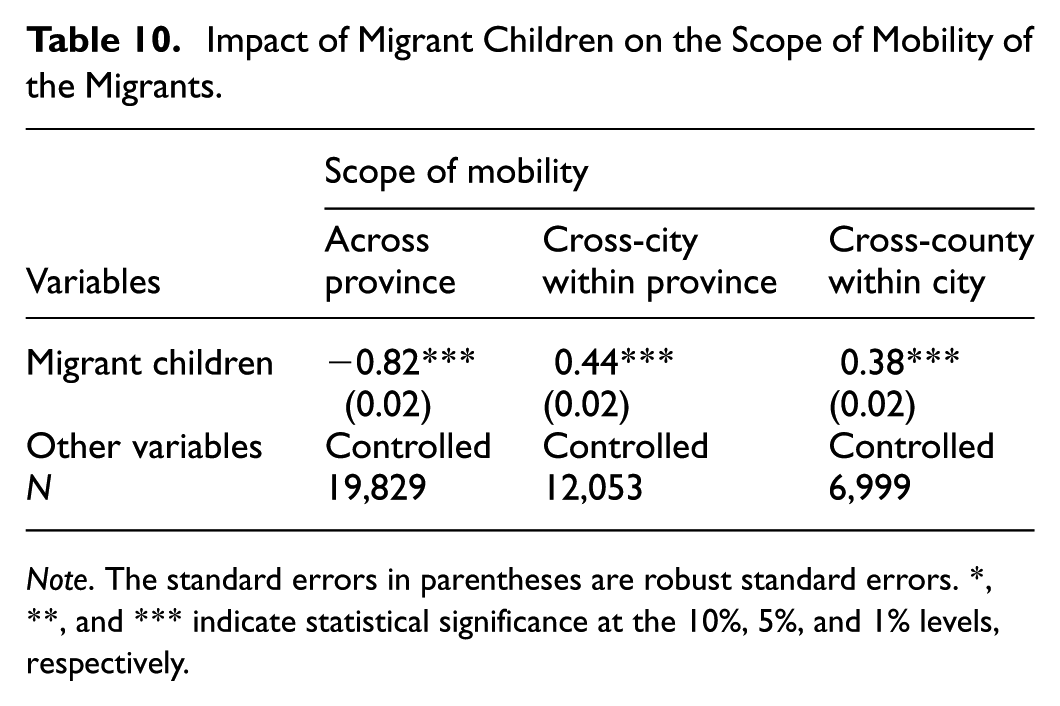
Therefore, we investigate the impact of migrant children on the mobility range of migrant populations. The results are shown in Table 10, indicating that migrant children significantly decrease the likelihood of inter-provincial migration by 82% at the 1% significance level. Conversely, migrant children significantly increase the likelihood of intra-provincial migration by 44% and intra-county migration by 38% at the 1% significance level.
Impact of Migrant Children on the Scope of Mobility of the Migrants.
Note. The standard errors in parentheses are robust standard errors. *, **, and *** indicate statistical significance at the 10%, 5%, and 1% levels, respectively.
As the size of cities increases, migrant populations are subject to less discrimination, leading to higher wage incomes (C. Xing & Zhang, 2022). Additionally, migrant populations experience faster wage growth with a broader mobility range (Y. Chen et al., 2022). Migrant children narrow the geographical area where migrant populations search for employment, resulting in a negative impact on wage income.
Health Status of the Migrant Population
After children’s migration, migrant populations are tasked with both their job responsibilities and the responsibility of caring for their children, undoubtedly having a negative impact on their physical health. According to the results in Table 11, after children’s migration, the health condition of migrant populations decreases by approximately 14%. A decline in health condition leads to a significant decrease in personal wage income, with this impact being more pronounced among the male population. Furthermore, the decrease in wage income due to the decline in health condition is most evident among manual laborers. Possible reasons include the traditional Chinese notion of “men as breadwinners and women as homemakers,” where fathers typically bear the primary responsibility of earning income outside the home. After children’s migration, fathers experience significantly increased psychological and work-related stress, thus adversely affecting their health condition.
Impact of Migrant Children on the Health Status of the Migrants.

Note. The standard errors in parentheses are robust standard errors. *, **, and *** indicate statistical significance at the 10%, 5%, and 1% levels, respectively.
Robustness Test
To further validate the reliability of the empirical results, this study conducts robustness tests using five methods: replacing independent variables, using datasets from different years, limiting the range of independent variables, changing dependent variables, and expanding the range of independent variables.
Replacement of the Independent Variable With the Number of Migration Children
The empirical results in Table 12 show that, as indicated in the first column for the full sample, the number of migrant children significantly affects the wage income of migrant populations at the 1% significance level. For each additional accompanying child, the wage income of migrant populations decreases by approximately 12%. From the second and third columns, it can be observed that the conclusions align with the heterogeneous analysis results of the 2SLS method in the previous sections. Specifically, for male migrant populations, each additional accompanying child leads to a significant decrease of 8% in wage income at the 1% significance level, while for female migrant populations, each additional accompanying child results in a significant decrease of 19% in wage income at the 1% significance level. This once again demonstrates that the responsibility of caring for children is predominantly shouldered by mothers, and the impact of migrant children on mothers’ wage income is greater than that on fathers.’
Impact of the Number of Migrant Children on the Wage Income of Migrants.

Note. The standard errors in parentheses are robust standard errors. *, **, and *** indicate statistical significance at the 10%, 5%, and 1% levels, respectively.
Replacement of the Data With the 2016 CMDS
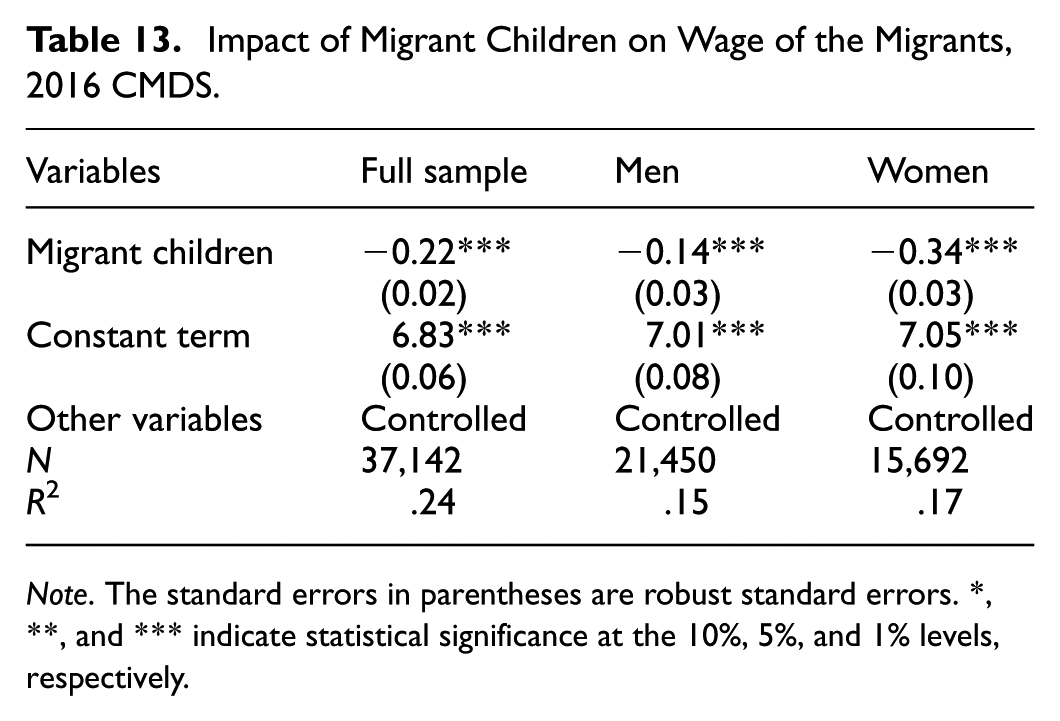
This study employed the 2016 data from CMDS to examine the robustness of the empirical results. Since the CMDS survey is conducted annually, if the effects of migrant children on migrant wage income remain inhibitory in other years’ data, it can to some extent confirm the robustness of this research. As shown in Table 13, the negative impact of migrant children on mothers’ wage income is greater.
Impact of Migrant Children on Wage of the Migrants, 2016 CMDS.
Note. The standard errors in parentheses are robust standard errors. *, **, and *** indicate statistical significance at the 10%, 5%, and 1% levels, respectively.
Restriction of the Independent Variable to Migrant Children Aged 3 to 15 Years Old
Since children aged 0 to 3 years cannot take care of themselves independently, for migrant populations engaged in work, they are generally entrusted to be taken care of by family members such as parents or grandparents, or they may seek specialized nannies or daycare centers in society to take care of their daily lives. This study believes that the impact of migrant children aged 0 to 2 years on parents’ wage income is relatively small. However, for migrant children aged 3 to 15 years, their impact on migrant wage income is significant. Therefore, this study further restricts the age of the independent variable, limiting it from 0 to 15 years to 3 to 15 years old, and examines the empirical results. The results are shown in Table 14. The empirical results indicate that the migrant children aged 3 to 15 years old lead to a significant decrease of approximately 18% in wage income for migrant populations at the 1% significance level. Moreover, the inhibitory effect of migrant children on the wage income of female migrant population is significantly greater than that on male migrant population.
Impact of Migrant Children Aged 3 to 15 Years on the Wage of the Migrants.

Note. The standard errors in parentheses are robust standard errors. *, **, and *** indicate statistical significance at the 10%, 5%, and 1% levels, respectively.
Replacement of the Variable With the Average Monthly Household Wage
The empirical results in Table 15 indicate that migrant children lead to a significant decrease of approximately 30% in the average monthly household wage income of migrant families at the 1% significance level. Furthermore, the results in the second and third columns suggest that the inhibitory effect of migrant children on the wage income of non-agricultural registered households is significantly greater than the impact on the wage income of agricultural registered households.
Impact of Migrant Children on Average Monthly Wage Income of Migrants.

Note. The standard errors in parentheses are robust standard errors. *, **, and *** indicate statistical significance at the 10%, 5%, and 1% levels, respectively.
Expanding the Age Range of Migrant Children to 0 to 18 Years Old
According to Chinese law, teenagers aged 16 to 18 are often unable to participate directly in work. Although to some extent, migrant children in this age group may enter boarding high schools or vocational schools to acquire knowledge or skills, their connection with their families is relatively weak. However, since they do not have the economic foundation and ability to live independently, they still rely on their parents for support. Based on this, this study expands the age range of migrant children to 0 to 18 years old to assess the impact of children’s migration on the wage income of migrant workers. The results are shown in Table 16. For migrant children aged 0 to 18, the migration of children leads to a significant decrease of approximately 17% in the monthly wage income of migrant workers at the 1% significance level. This conclusion is consistent with the earlier research findings of this study, further confirming the robustness of the empirical results.
Impact of Migrant Children on the Income of the Migrants Aged 0 to 18 Years Old.

Note. The standard errors in parentheses are robust standard errors. *, **, and *** indicate statistical significance at the 10%, 5%, and 1% levels, respectively.
Observing Wage Income of Migrant Population Using Discontinuity Regression
In 2014, the rapid development of urbanization led to widespread concerns about issues such as traffic congestion and urban pollution. In response, the central government issued a task in 2013 called the “New Urbanization Plan (2014–2020).” It pointed out that cities with a population of over 5 million in the central urban area (hereinafter referred to as mega-cities) should take action to control their population growth. This plan raised the admission standards for migrant children in public schools.
After analyzing CMDS data from 2011 to 2017, it was found that the proportion of migrant children following their parents decreased by about 4% after 2014. Therefore, this study used the change from migration to staying behind caused by the household registration system in 2014 to construct a discontinuity regression identification strategy to observe changes in the wage income of migrant workers.
Figure 2 the graph reveals that from 2014 to 2015, the proportion of migrant children decreased from approximately 64% to 60%, while the wage income of migrant workers increased from about 2,981 yuan to 3,640 yuan, an increase of approximately 22.1%. Thus, as the probability of children migrating gradually decreases, there is a significant increase in the wage income of migrant workers, with a jump occurring around 2014. Combining the household registration policy in 2014, the discontinuity regression can identify the impact of migrant children on the wage income of migrant workers. This further confirms the conclusion of this study that migrant children will decrease the wage income of migrant workers.

Discontinuity regression identification.
Further Discussion
Despite the decrease in migrant populations’ income due to children’s migration, why are migrant populations still willing to have their children come to the city? This study further investigates the relationship between children’s migration and migrant populations’ investment in education, care for their children, and their children’s cognitive abilities.
To examine whether children’s migration affects migrant populations’ investment in education, care for their children, and their children’s cognitive abilities, this study utilizes data from the China Education Panel Survey (CEPS) due to the lack of relevant variables in the CMDS data. Higher expenditure on children’s education is generally beneficial for their learning in school and acquiring human capital. The results are in Table 17. The first column of results shows that compared to left-behind families, migrant families invest more in their children’s education. The second column of results indicates a positive correlation between children’s migration and their cognitive abilities.
The Impact of Migrant Children on Migrants’ Education Investment, Etc.

Note. The standard errors in parentheses are robust standard errors. *, **, and *** indicate statistical significance at the 10%, 5%, and 1% levels, respectively.
Furthermore, the third column of results reveals that even with a decrease in migrant populations’ income, they are still willing to provide their children with more pocket money, indicating a higher level of care for their children. Lastly, due to variations in the questions asked in CMDS surveys across different years, this study uses 2011 CMDS data to assess migrant populations’ happiness. This question is measured using the Likert scale. The results suggest that migrant populations from families with children’s migration are happier than those from families without children’s migration. This happiness may stem from family reunification, care for their children, and the achievements resulting from investing in their children’s education. Therefore, despite the decrease in migrant populations’ income due to children’s migration, a significant portion of migrant populations are still willing to have their children accompany them in migration.
Conclusions and Policy Recommendations
This study aims to analyze whether the increasingly common family decision of children’s migration contributes to raising the income of migrant populations. Utilizing data from the 2017 Dynamic Monitoring Survey of Migrant Population, a comprehensive empirical examination of whether children’s migration affects the income of migrant populations is conducted using a combination of instrumental variable methods and endogenous switching regression models. The research findings indicate the following: Firstly, children’s migration significantly reduces the income of migrant populations by approximately 17%. Furthermore, employing endogenous switching regression models, the reliability of the study’s conclusions is corroborated after addressing the issue of sample self-selection. Secondly, heterogeneity analysis reveals that children’s migration primarily reduces the income of female migrants, those with non-agricultural household registrations, and those with higher education levels. Moreover, the impact of children’s migration on gender wage gaps is particularly evident, significantly reducing the income of male migrant populations by 14% and female migrant populations by 31%. Thirdly, the mechanism analysis demonstrates that children’s migration significantly reduces the weekly working hours of female migrant populations by approximately 8.94 hr and decreases the employment stability of female migrant populations by about 77%, while the reduction in the weekly working hours of male migrant populations is only 2.8 hr, with a corresponding employment stability decrease of 66%. This indicates that, predominantly, women among migrant populations opt to sacrifice stable employment for more flexible working hours to care for their children after children’s migration. Additionally, children’s migration leads to a decline in the overall health status of migrant populations by approximately 14%, with this negative impact being more pronounced among male migrant populations. Fourthly, robustness analyses, including variable replacement, dataset substitution, dependent variable substitution, and the use of discontinuous regression, consistently confirm that children’s migration reduces the income of migrant populations. Finally, empirical analysis reveals that despite the reduction in migrant populations’ income due to children’s migration, it facilitates further investment in human capital for migrant families, significantly improving the cognitive abilities of migrating children and increasing the level of care provided by migrant populations to their children, thereby enhancing the overall happiness of migrant families.
The research conclusions hold significant policy implications. Relevant policies could focus on promoting the signing of labor contracts by employers, reducing the costs associated with children’s migration, and ensuring that the migration destination, employment stability, and working hours of migrant populations are not constrained by children’s migration. Firstly, considering that children’s migration may reduce weekly working hours and adversely affect the health status of migrant populations, the government should strengthen the provision of urban public services—especially in areas with high concentrations of migrants. This aligns with the objectives of the 2020 hukou reform, which aims to advance urban inclusiveness and reduce barriers to public resource access. Expanding subsidized childcare and educational services for migrant children, along with supporting non-profit organizations focused on this group, can help alleviate care burdens and mitigate negative employment and health effects. Moreover, supporting non-profit organizations aimed at assisting children of migrant populations could alleviate the childcare burden on migrant populations. Secondly, building on the broader efforts to enhance labor protections under the three-child policy—which emphasizes supporting working families—the government should further regulate labor markets by promoting formal labor contracts. Ensuring that employers provide reasonable contracts that protect workers’ rights, offer social insurance coverage, and establish fair wage mechanisms is essential. Legal safeguards for wage stability and paid leave would enhance employment stability for migrant workers, especially those relocating with children. Additionally, increasing housing supply could reduce the cost of children’s migration for migrant populations, enabling them to choose cities farther from their hometowns for work and life, thereby promoting the free movement of migrant populations across regions.
Footnotes

Funding
The authors disclosed receipt of the following financial support for the research, authorship, and/or publication of this article: We would like to thank the financial support from the PRC National Social Science Foundation (Grant 23BJL028).
Declaration of Conflicting Interests
The authors declared no potential conflicts of interest with respect to the research, authorship, and/or publication of this article.
Data Availability Statement
Data sharing not applicable to this article as no datasets were generated or analyzed during the current study.