



Abstract
The complexity and diversity of users’ knowledge-sharing behaviors on crowdsourcing innovation platforms make their decision selection an important subject for scientific research. This article aims to understand decision selection by exploring the factors that influence users’ knowledge-sharing behavior. Based on the Wuli-Shili-Renli (WSR) system approach, this study constructs traditional and network evolutionary game models and compares and analyzes the results through simulations and calculations. The results show that heterogeneous knowledge ratio, knowledge quality, platform service quality, contribution incentive coefficient, and knowledge absorption ability have a positive impact on the evolution depth of knowledge sharing among platform users, while the cost of knowledge contribution (sunk cost) has a negative impact on the evolution depth of knowledge sharing among platform users. In addition, the risk of knowledge contribution does not affect the depth of evolution, but it does have a negative effect on the speed of evolution. Therefore, crowdsourcing innovation platforms should focus on improving knowledge and service quality while providing effective incentives to promote knowledge sharing. Simultaneously, they should reduce the cost of knowledge contribution to avoid negative impacts on sharing behavior. These findings provide theoretical support and practical guidance for platform operators, helping them optimize platform design and promote knowledge sharing among users.
Keywords
Introduction
In the era of digital intelligence, Internet platforms have rapidly risen through the utilization of digital technologies. The emergence of crowdsourcing innovation platforms has become inevitable with the development of knowledge clustering. The crowdsourcing innovation model includes both competitive and collaborative models (Ghezzi et al., 2018), with the Witkey model belonging to the former and open-source and Wiki models belonging to the latter (Taeihagh, 2017). Given the dual-mode nature of crowdsourcing platforms—namely, competitive and collaborative models—this study further contextualizes these strategies. Knowledge contribution and knowledge acquisition together constitute users’ knowledge-sharing behaviors. On competitive crowdsourcing platforms, knowledge contribution typically refers to solution submissions or task responses by participating vendors, while knowledge acquisition represents the knowledge-seeking behaviors of task initiators. On collaborative platforms, knowledge contribution is reflected in behaviors such as initiating posts, commenting, and engaging in dialogs, whereas knowledge acquisition includes activities like reading and searching existing content without contributing new knowledge. Value creation on crowdsourcing innovation platforms is based on users’ knowledge-sharing behaviors. While users obtain benefits and realize their self-worth, the innovation model of enterprises has also changed.
Continuous and efficient knowledge-sharing behavior among platform users is an important factor in promoting the sustainable development of platforms. As a complex decision-making behavior, knowledge sharing is affected by multiple factors. Scholars use game theory to analyze users’ knowledge-sharing decision behavior (Li & Kang, 2019; Xiong et al., 2022); however, additional information is needed to supplement in the above-mentioned research in terms of perspectives and diversity of influencing factors. From a theoretical perspective, existing research focuses on the impact of a specific factor or several factors on knowledge-sharing behavior, rather than covering them under a single theoretical system. Therefore, from the theoretical perspective of Wuli-Shili-Renli (WSR) system methodology, this study determines the factors affecting decision-making behavior in knowledge sharing based on the three aspects of Wuli, Shili, and Renli. Simultaneously, for knowledge-sharing behavior, scholars often build traditional evolutionary game models (Zhang et al., 2021) or focus on incentive mechanism research (L. Lin & Wang, 2019; Xiong et al., 2022). There are few network evolutionary game models. The network evolution game model mainly focuses on the cross-correlation structure and strategy selection paradigm between users, and builds a new research model to analyze and understand the behavioral decisions of groups in complex interactive environments.
The primary objectives of this study are to systematically identify and examine the key determinants influencing knowledge-sharing behavior among Chinese enterprises, and to develop a network evolutionary game model tailored to the context of crowdsourcing innovation platforms. This model aims to simulate and forecast the dynamic evolutionary trajectories of user knowledge-sharing behaviors. Furthermore, the study undertakes a comparative analysis to evaluate how various influencing factors affect both the depth and speed of the evolution of such behaviors. In alignment with these objectives, the research is structured in three main phases. First, a traditional evolutionary game model of knowledge sharing among crowdsourcing platform users is constructed based on evolutionary game theory, and the local stability of user behavior strategies is rigorously analyzed. Second, a network evolutionary game model is developed by integrating complex network theory with evolutionary game theory, thereby enabling the simulation of decision-making processes related to knowledge sharing in interactive network environments. Finally, the study provides theoretical and managerial implications derived from the modeling outcomes, and proposes future research directions to advance the understanding of knowledge-sharing mechanisms on crowdsourcing innovation platforms.
This article consists of the following main sections: section 2 presents the literature review; section 3 describes the construction of traditional evolutionary game model; section 4 analyzes the network evolutionary game model; section 5 presents simulation experiment and the results of the analysis; section 6 provides the discussion and conclusion; and section 7 describes the limitations and future research.
Literature Review
Crowdsourcing Innovation Platform
The concept of crowdsourcing was first proposed by Howe (2006), who posited that crowdsourcing reduces internal human costs by voluntarily assigning tasks to non-specific groups in an enterprise. Crowdsourcing innovation platforms are mainly divided into three categories: virtual labor markets (VLMs), tournament crowdsourcing (TC), and open collaboration (OC; Taeihagh, 2017). Crowdsourcing innovation platforms are either competitive (e.g., VLMs and TC) or collaborative platforms (e.g., OC; Luz et al., 2015). As an open innovation model, crowdsourcing is an important source of knowledge sharing (Garcia Martinez & Walton, 2014).
Research on crowdsourcing innovation includes the connotation of crowdsourcing innovation (Pénin & Helmchen, 2011) and research on crowdsourcing community platforms (Gao et al., 2021; Ye & Kankanhalli, 2017). Crowdsourcing innovation refers to open innovation activities that guide Internet users to participate in enterprises’ innovation processes (Yang & Qi, 2021). Due to the increasing diversity of research objects, interactive innovation in crowdsourcing communities has gradually become a mainstream innovation model. The factors that affect participation behavior in crowdsourcing are mainly divided into two categories: individual psychological motivation and task characteristics. Based on motivation theory, making money (Yang & Qi, 2021), improving skills (Brabham, 2010), and a sense of virtual community are factors that affect problem solvers’ willingness to participate and their behavior on the platform. Task characteristics include task value (Snir & Hitt, 2003), task type (Zheng et al., 2011), simplicity, and analyticity. Research has mainly been conducted through questionnaires and other forms, with less use of evolutionary game methods. In addition, research on crowdsourcing innovation platform mechanisms includes signaling mechanisms (Gao et al., 2021) and open and hidden bidding mechanisms (Hong et al., 2016).
Based on the literature on crowdsourcing innovation, this study explores the influencing factors of knowledge sharing from the perspective of crowdsourcing community platform users to provide suggestions for increasing the stickiness of user platforms and promoting their sustainable development.
WSR System Approach
The WSR system methodology was proposed to solve complex problems in three dimensions, Wuli, Shili, and Renli, to provide practice guidance and optimize decisions to enrich the system engineering theory (Gu & Zhu, 2000). WSR was first used in the field of systems science (Wang & Li, 2019), and with the deepening and enrichment of the theory, some scholars introduced it into the field of knowledge management (X. Lin et al., 2009).
Wuli represents the attribute of knowledge (Gu & Zhu, 2000), including natural and social attributes. Natural attributes represent ease of expression and transmission of information, whereas social attributes represent subjective perceptions. Shili represents the rules within an organization (Zhu, 2000b) that express the mechanism for how to handle problems (Zhu, 2000b). Renli represents the subject of knowledge (Zhu, 2000a) and emphasizes the relationship between subjects (Zhu, 2000a).
In this study, Wuli factors mainly include the user’s total knowledge, knowledge quality, and knowledge heterogeneity; Shili factors include crowdsourcing innovative platform service quality and platform contribution incentives; and Renli factors include the user’s willingness to contribute, ability, absorption ability, contribution cost, risk, and synergy coefficient.
Construction of Traditional Evolutionary Game Model
Methodology Introduction
To investigate the dynamics of users’ knowledge-sharing behaviors on crowdsourcing innovation platforms, this study adopts a traditional evolutionary game theory framework. This analytical approach is well-suited for simulating strategic interactions among platform users and examining how different behavioral patterns emerge, stabilize, or dominate over time. In the context of knowledge sharing, evolutionary game models provide valuable insights into how user behaviors are influenced by various forms of incentives and platform designs, thereby informing effective strategies for promoting sustained engagement and collaboration.
On crowdsourcing platforms, the decision to share knowledge is inherently strategic and shaped by perceived benefits and platform mechanisms. Drawing from existing literature (e.g., Al-Gharaibeh & Ali, 2022; Sanguanpuak et al., 2018), users’ knowledge-sharing behaviors can be broadly categorized into two strategic types: knowledge contribution and knowledge acquisition. Knowledge contribution encompasses proactive behaviors such as posting ideas, providing feedback, and engaging in discussions—activities that drive the collective growth of the platform’s knowledge base. Conversely, knowledge acquisition involves more passive behaviors, including browsing, searching for information, or task posting to absorb knowledge without reciprocating.
By modeling these strategic interactions through traditional evolutionary game theory, this study aims to uncover the underlying mechanisms that facilitate or hinder knowledge sharing. This methodological approach enables a nuanced understanding of how platform design and incentive structures influence user behavior, and ultimately, how knowledge ecosystems within crowdsourcing platforms can be effectively managed and optimized.
Model Building
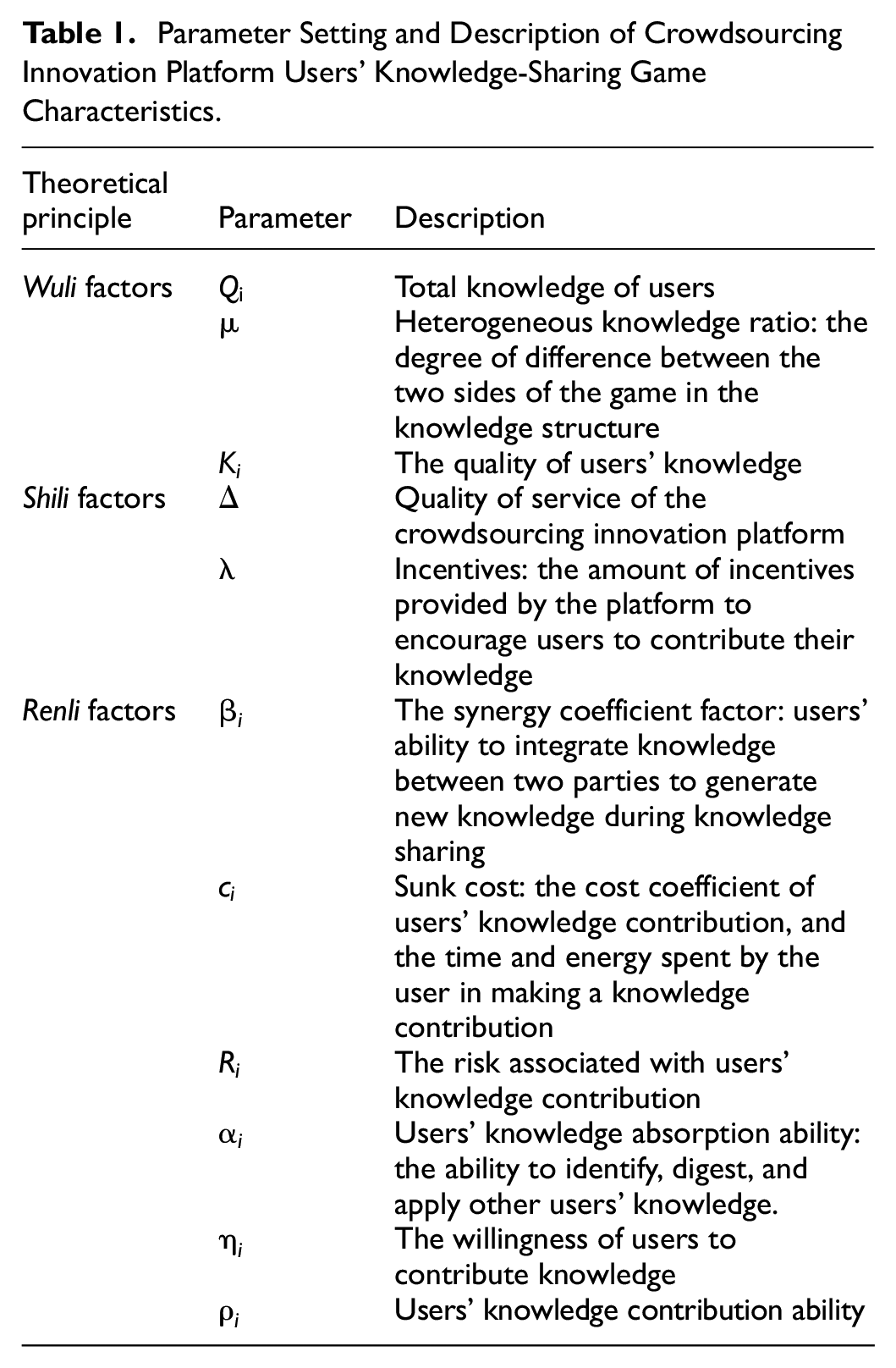
Based on crowdsourcing innovation community users’ knowledge-sharing game characteristics and a review of the literature, we assume the parameters of the game payoff matrix, as shown in Table 1.
Parameter Setting and Description of Crowdsourcing Innovation Platform Users’ Knowledge-Sharing Game Characteristics.
When a user chooses to contribute knowledge, the total amount of knowledge
Users 1 and 2 play games, and the benefits to the two sides are different under different combinations of strategies. The following are analyses of four game situations:
Situation 1 (Knowledge Contribution, Knowledge Contribution)
Users 1 and 2 derive mutual benefits from each other’s knowledge contributions and are incentivized by their own knowledge contribution. This reciprocal exchange fosters a collaborative environment characterized by mutual promotion. Furthermore, the services quality provided by the platform plays a reinforcing role in enhancing users’ knowledge contributions. However, it is important to note that both parties also face certain costs and potential risks associated with the act of knowledge contribution.


Situation 2 (Knowledge Contribution, Knowledge Acquisition)
For user 1, because user 2 does not contribute, user 1 will not be able to benefit from the knowledge of the other party. The two sides will not have a good knowledge atmosphere and are unable to promote each other and get further incentives, because of their unilateral contributions to knowledge. At the same time, they will incur costs and take risks because of their own contributions to knowledge. User 2 will obtain benefits based on user knowledge contribution, but the two sides do not have a suitable knowledge-sharing atmosphere and are unable to promote each other to get further incentives, and because the user 2 does not contribute but acquires knowledge, they do not get the incentives of contributing knowledge and will not incur costs and risks.


Situation 3 (Knowledge Acquisition, Knowledge Contribution)
Similar to Situation 2:


Situation 4 (Knowledge Acquisition, Knowledge Acquisition)
Neither side contributes to knowledge but acquires knowledge. They do not receive any form of incentive for contributing knowledge and do not incur costs or take risks.


To summarize, we establish a knowledge-sharing game payment matrix for any user 1 and 2 on the crowdsourcing innovation platform, as shown in Table 2.
Crowdsourcing Innovative User Knowledge-Sharing Game Payment Matrix.

Solution of Stability Strategy
For user 1, the average benefit of their choice contributes to knowledge is

For user 1, the average benefit of their choice contributes to knowledge is

The evolutionary equilibrium points are (1,1), (1,0), (0,1), (0,0), if

To simplify the expression, let the
The Jacobian matrix is

In this matrix,

The Results of Local Stability: If C < 0, D < 0, A > 0, B > 0.

Note. x* and y* represent the equilibrium points of the variables x and y.
Because the costs and risks of both users contributing knowledge are greater than the incentives received by their contributions, user 1 and user 2 are unwilling to contribute knowledge without knowing whether the other party is willing to contribute knowledge or will choose to acquire knowledge, which (0,0) is the evolutionary equilibrium point. As shown in Figure 1, regardless of the users’ initial decisions, since knowledge contribution does not yield sufficient benefits, the system will ultimately converge to the (0,0) point.

Evolutionary game phase diagram 1.
If
The Results of Local Stability: If C < 0, D < 0, A > 0, B < 0.

Although contributing knowledge can bring positive returns for user 1, for user 2, contributing knowledge may not achieve a positive return, so it is impossible to determine the choice of User 2. Figure 2 shows is no stable convergence point at this time, that is, there is no fixed decision between the user.

Evolutionary game phase diagram 2.
If
The Results of Local Stability: If C < 0, D < 0, A < 0, B > 0.
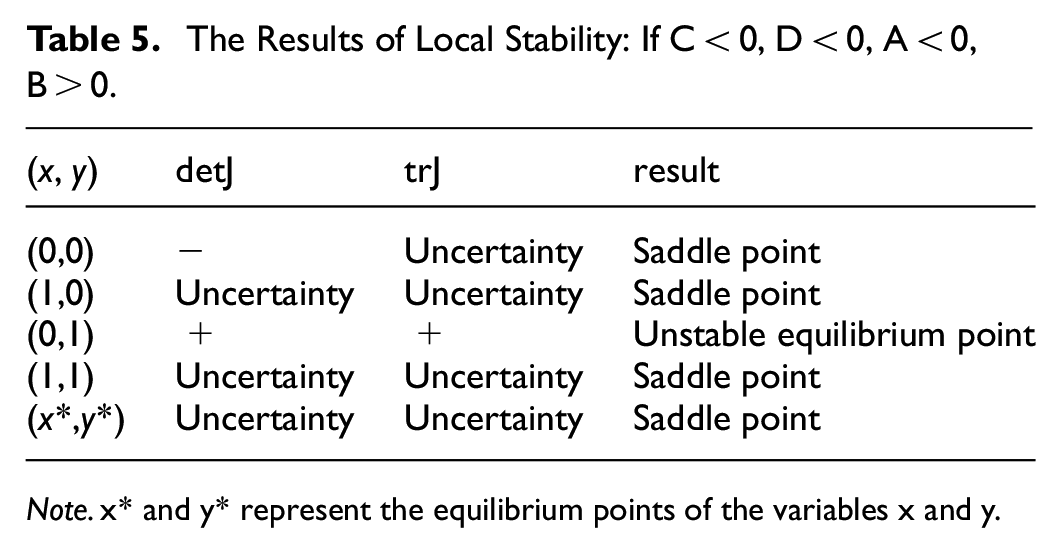
Note. x* and y* represent the equilibrium points of the variables x and y.
Similarly, for User 2, contributing knowledge can bring positive returns, but for User 1, contributing knowledge may not achieve positive return so it is impossible to determine the choice of User 1. Similar to Figure 2, there is no stable convergence point in Figure 3; that is, there is no fixed decision between users.

Evolutionary game phase diagram 3.
If A<0, and B<0, the results of the stability analysis ofthe equilibrium points are shown in Table 6. As shown in Figure 4, for users 1 and 2, if the incentives of contribution when choosing to contribute knowledge is greater than the costs and risks of contribution, then whether the other party adopts contribution knowledge or acquires knowledge, users 1 and 2 will take the decision to contribute knowledge. In this scenario, (0,0) becomes an unstable point, and (1,1) is the evolutionary equilibrium point. Users who initially chose (0,0) will gradually transition to (0,1) or (1,0), and eventually converge at (1,1).
The Results of Local Stability: If C < 0, D < 0, A < 0, B < 0.

Note. x* and y* represent the equilibrium points of the variables x and y.

Evolutionary game phase diagram 4.
Analysis of the Network Evolutionary Game Model
Method Introduction
The network evolutionary game model is an advanced mathematical framework that extends traditional evolutionary game theory by incorporating the complexities of network structures. This model is particularly useful for analyzing users’ knowledge-sharing behaviors in social networks, where the interactions among individuals are influenced by the network topology and the relationships between users.
Most existing studies on evolutionary games primarily examine the decision-making process of crowdsourcing users’ knowledge sharing from a micro-level perspective. However, they often oversimplify the inter-individual relationships by assuming interactions only occur between two independent users. In practice, crowdsourcing innovation platforms involve numerous individuals who, while relatively independent, are also deeply interconnected. An individual’s knowledge-sharing behavior is typically influenced by multiple actors rather than just a single party, and the exchange dynamics are far more complex and variable. To better capture the nonlinear characteristics of this mechanism and the interactive dynamics of competition and cooperation among users, this study integrates complex network theory with evolutionary game theory, utilizing a network evolutionary game model to explore the evolutionary patterns of multi-user knowledge sharing on crowdsourcing innovation platforms.
Complex networks have many topology types. This study adopts scale-free networks to represent the crowdsourcing innovation platform networks, and assumes that the network scale is 200. In each cycle of the game, crowdsourcing innovation platform users play games with their neighboring users and update their own benefits according to the game’s results. At the same time, the game individual also imitates the strategy of the other party in the game and its imitation probability:

Rules for Updating the Total Knowledge of Game Users

Therefore, the total knowledge of individuals change significantly in the process of evolution, leading to changes in the game income matrix related to the total knowledge of individuals, which means that the income matrix of the game is different in each evolutionary cycle.
Simulation Experiment and the Results of the Analysis
Simulation Steps and Initial Parameter Setting
To ensure the accuracy and scientific validity of the model, this paper employs Matlab 2019B software to simulate the evolution process. By conducting a comparative analysis of simulation graphs under various conditions, the study explores the key factors influencing user knowledge sharing. The detailed steps of the simulation experiment are as follows:
Step 1: Given the initialization of the innovative platform network, that is, the scale-free network G (V, E);
Step 2: Randomly assign the first policy to each node and set the parameter values;
Step 3: Conduct a game;
Step 4: The network node randomly selects a neighbor node to compare the benefits and updates the strategy according to the comparison pairing rules; and
Step 5: Return to Step 3 until the predetermined time step is reached.
Referring to past studies, this paper sets the number of nodes of scale-free networks to 200. To reflect individual differences in the simulation process, users are divided into two groups, group 1 and group 2, and parameters are set at
Evolution Simulation Parameter Setting for Crowdsourcing Users’ Knowledge-Sharing Behavior.

Analysis of Simulation Results
Evolution Results of Crowdsourcing Users’ Knowledge-Sharing Networks. Figure 5 shows the evolution of users’ knowledge-sharing levels in four parameter configurations, D1, D2, D3, and D4, on a crowdsourcing innovation platform with a 50-node network scale. If all the users of the crowdsourcing innovation platform receive fewer platform rewards than the sum of the contribution costs and risks incurred, the level of knowledge sharing of the final crowdsourcing innovation platform converges at zero.

Knowledge contribution in network structure - acquisition evolution process 1.
In the evolution of knowledge contribution–acquisition under the four parameters, D1, D2, D3, and D4, it can be seen that for parameter D1, the willingness of the two groups to contribute is low—0.1 and 0.2 respectively, at the same time, the contribution cost is also high, 0.5 and 1.5 respectively, and the contribution incentive coefficient is relatively low at 0.1. From the evolutionary process, it is evident that the benefit of contribution does not outweigh the associated cost and risk, so individuals in the network structure eventually lean toward knowledge acquisition; that is, the probability of choosing knowledge contribution is reduced to 0. For parameter D4, the two groups’ willingness to contribute increased by 0.5 and 0.5 respectively, and the cost of knowledge contribution decreased, 0.5 and 0.1 respectively, and the incentive coefficient of knowledge contribution increased to 0.4. Unlike the D1 curve, the D4 curve quickly converges at 1, and the groups in the network structure tend to contribute to knowledge. For D2 and D3, the contribution parameters corresponding to the D3 curve
This study reduces the knowledge absorption capacity of users to

Knowledge contribution in network structure - acquisition evolution process 2.
It can be seen that the D1 curve quickly converges to 0, and the D2 and D3 parameters also quickly converge to 0. For the D2 and D3 parameters, the knowledge absorption capacity and service quality of users are reduced, which greatly reduces the income of users, and users change from choosing knowledge contribution to knowledge acquisition. At this time, only the D4 parameters maintain convergence at 1, supporting knowledge contribution although the rate of convergence slows down. The results for D2 and D3 are related to high costs and risks, so that users tend to choose strategies to acquire knowledge. Due to the interactions in the platform network, users perceive their neighbors’ strategic tendencies and are affected by pressure and social norms. The sum of the costs and risks paid by users is higher than the platform rewards, and users are more likely to choose strategies to acquire knowledge. The reason for D4 is that the cost coefficient of knowledge contribution decreases. Even if the absorptive capacity of groups 1 and 2 decreases, they prefer to choose knowledge contribution strategies when the platform rewards are higher than the costs and risks incurred.
Furthermore, the proportion of heterogeneous knowledge is reduced to

Knowledge contribution in network structure - acquisition evolution process 3.
All the curves converge at 0; at this point, under the four sets of parameters, all individuals prefer knowledge acquisition. When the proportion of heterogeneous knowledge decreases, no one is willing to take the initiative to learn to contribute knowledge and fall into a “competition that pursues worse” trap, so the society lacks innovation, imitates, and plagiarizes. The root cause lies in the benefits and costs. If knowledge tends to be homogeneous, innovators will find that no matter how hard they work, the results will be the same.
Next, we analyze the impact of knowledge absorption capacity

Knowledge contribution-acquisition evolution process under the network structure changes with knowledge absorption capacity.
To investigate the influence of the cost coefficient

Knowledge contribution-acquisition evolution process under the network structure changes with cost coefficient.
Next, we fix the cost parameters of knowledge contribution in

Knowledge contribution-acquisition evolution process under the network structure changes with knowledge absorption capacity.
Next, we analyze the impact of knowledge quality
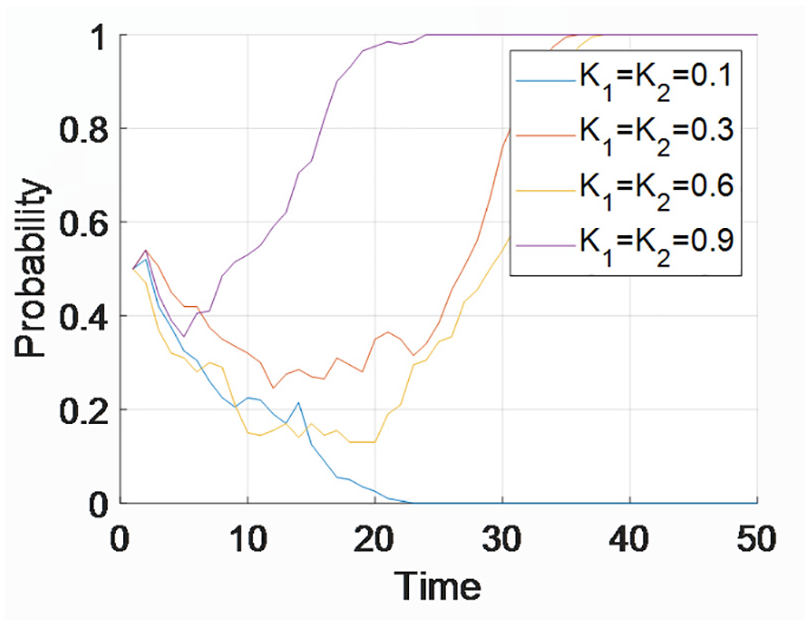
Knowledge contribution-acquisition evolution process under the network structure changes with knowledge quality.
This paper sets the quality of user knowledge
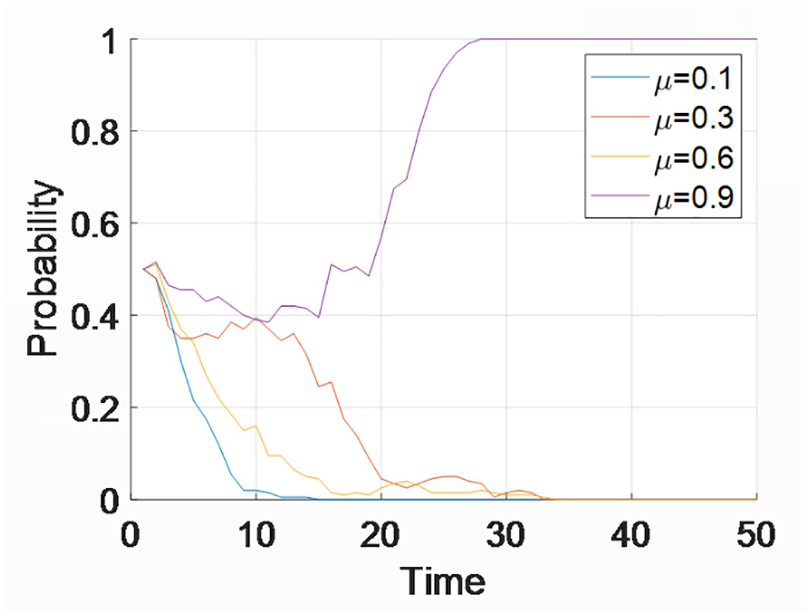
Knowledge contribution-acquisition evolution process under the network structure changes with knowledge ratio.
To further investigate the impact of platform service quality

Knowledge contribution-acquisition evolution process under the network structure changes with the platform service quality.
Finally, this study fixes service quality at 0.1 and investigates the knowledge contribution risk of users, which can be expressed as R = 1, R = 3, R = 5, and R = 7. The results are shown in Figure 14. When the R value increases, the evolution level of knowledge sharing does not change, but there is a time lag in the platform network near the stable value. This shows that the risk of knowledge contribution will affect the propagation speed of the platform’s knowledge contribution–acquisition strategy, but it will not change the evolution level of the platform network. The reason for this phenomenon may be related to the dynamic increase in the overall knowledge of game users, which is assumed by this paper. In other words, it is a dynamic variable; the risk of knowledge contribution is constant, so it is difficult for the risk of knowledge contribution to affect the final evolution level of the platform network. However, the higher the risk of knowledge contribution, the lower the speed at which the platform network approaches the stability value, because the incentive and cost coefficients gradually increase over time. Assuming that users perceive that the sum of knowledge contribution risks and cost coefficients is greater than the reward coefficient, the evolution rate of platform knowledge sharing will steadily decline until it approaches a stable value. In general, the risk of contributing knowledge is not high; otherwise, it would be challenging for crowdsourcing platforms to attract users. Therefore, reducing the risk of knowledge contribution requires coordinated efforts among government regulators, industries, and individuals. Only when privacy protection and knowledge sharing coexist can the risk of knowledge contribution be minimized effectively.
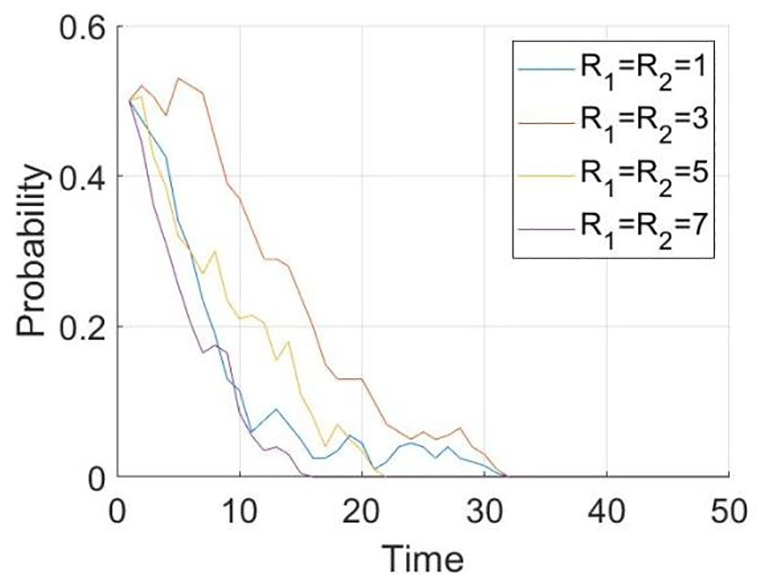
Knowledge contribution-acquisition evolution process under the network structure changes with the knowledge contribution risk.
Discussion and Conclusion
Discussion
This paper focuses on the behavioral impact mechanism of users’ knowledge-sharing decision on crowdsourcing innovation platform. Initially, we analyze the local stability of the evolutionary path by building a traditional evolutionary game model of users’ knowledge-sharing on crowdsourcing innovation platform. Then, by building a network evolutionary game model of users’ knowledge-sharing decision behavior, Matlab software is used to simulate the model to study the evolutionary microscopic mechanism of the network knowledge-sharing behavior of crowdsourcing users. This paper analyzes and summarizes the key factors affecting users’ knowledge-sharing decision behavior. Specifically, the key points of the discussion are elaborated as follows. Firstly, the traditional evolutionary game model is inconsistent with the evolutional equilibrium point of the crowdsourcing innovation platform obtained by the network evolutionary game model, because the traditional evolutionary game model is more idealized, while the network evolutionary game model is more in line with the real situation and the research on knowledge sharing on crowdsourcing innovation platforms. Secondly, heterogeneity knowledge ratio, knowledge quality, platform service quality, contribution incentive coefficient and knowledge absorption ability have a positive impact on the evolution depth of knowledge sharing among users of crowdsourcing innovation platforms (Gao et al., 2021; Xiong et al., 2022), while the cost coefficient of knowledge contribution has a negative impact on the evolution depth of knowledge sharing among platform users. Thirdly, the risk of knowledge contribution does not affect the evolution depth of users’ knowledge-sharing on the crowdsourcing innovation platform, but it will affect the evolution speed of users’ knowledge-sharing on the crowdsourcing innovation platform and have a negative impact.
Conclusion
This paper provides valuable theoretical contributions in three aspects: Firstly, this study introduces the Wuli-Shili-Renli (WSR) system approach to the analysis of users’ knowledge-sharing behavior on crowdsourcing innovation platforms. By doing so, it provides a holistic framework that integrates three aspect factors to better understand the dynamics of decision selection in these environments. The WSR system approach enriches the theoretical foundations of knowledge-sharing research by incorporating comprehensive and multidimensional perspective. Secondly, the construction and comparison of traditional and network evolutionary game models represent a significant advancement in understanding the strategic interactions among users on crowdsourcing innovation platforms. These models allow for a nuanced examination of how different factors influence users’ knowledge-sharing behavior, providing a robust theoretical basis for predicting and analyzing user decisions. Thirdly, by distinguishing between the depth and speed of knowledge-sharing evolution, the research adds a layer of granularity to the theoretical discourse. The finding that the risk of knowledge contribution affects the speed but not the depth of evolution offers a novel perspective on how temporal dynamics and risk perceptions influence users’ knowledge-sharing behavior on crowdsourcing innovation platforms.
Based on the preceding conclusions, our findings carry essential ethical and practical implications in crowdsourcing innovation platform. Firstly, platform managers should optimize their platform structure and divide the crowdsourcing platform into different sections to improve the efficiency of knowledge-sharing. At the same time, each section should ensure that there are some differences in user knowledge and improve the quality of platform services to enhance the platform support for bilateral users from multiple levels, which can promote the knowledge acquisition and knowledge contribution behavior of platform users. A diversified incentive mechanism is established to promote knowledge-sharing among users by combining material and spiritual incentives. Secondly, a knowledge management organization should be established, and a centralized knowledge resource base should be built for the crowdsourcing innovation platform. This would not only reduce the time and energy users spend on knowledge contributions and reduce the cost of knowledge contribution, but also improve the utilization rate of knowledge and enrich users’ external knowledge. Thirdly, the knowledge quality and knowledge absorption capacity of users should be improved to increase the returns from both knowledge contribution and acquisition. This, in turn, will strengthen user engagement and promote the sustainable development of the platform.
Limitations and Future Research
This paper has several inevitable limitations as well. First, the network evolutionary game model constructed in this study simplifies certain real-world complexities, only considered the Wuli, Shili, and Renli factors, omitting other factors that may influence user knowledge-sharing behavior, such as individual user motivations and the dynamic nature of social networks. Second, the simulation data used in this study are primarily based on theoretical assumptions and projections, lacking validation from enterprise data, which may affect the accuracy and feasibility of the research findings. Future studies could collect and analyze quantitative data and use Structural Equation Modeling (SEM) to validate and refine the model, thereby enhancing the accuracy and practical applicability of the findings. Third, the research mainly focuses on crowdsourcing innovation platforms in China. Different countries or other types of innovation platform might have varying influencing factors on knowledge-sharing mechanism, so the generalizability of the results needs further verification. Future studies could include different countries and regions to compare the similarities and differences in user knowledge-sharing behavior across cultural contexts, thereby deriving more universally applicable strategies for promoting knowledge sharing.
Footnotes

Ethical Considerations
This article does not contain any studies with human or animal participants.
Funding
The author disclosed receipt of the following financial support for the research, authorship, and/or publication of this article: This study is supported by the National Social Science Fund of China (24BGL055).
Declaration of Conflicting Interests
The author declared no potential conflicts of interest with respect to the research, authorship, and/or publication of this article.
Data Availability Statement
The data used to support the findings of this study are included within the article.