



Abstract
Academic employment has shifted from focusing primarily on teaching and research to including broader institutional responsibilities. This expansion of roles has impacted academics’ overall well-being, with additional challenges arising from the integration of new technologies. In demanding professional contexts like academia, work passion, intended as an enduring love for a meaningful activity, plays a critical role in shaping motivation, well-being, and work-life balance. This study is grounded in the dualistic model of passion, which distinguishes between two different facets: harmonious passion, internalized and aligned with personal goals, and obsessive passion, driven by compulsive, external factors. This research involved 1,119 Italian academics across 11 universities during the COVID-19 lockdown, investigating the interplay between the two facets of work passion—harmonious and obsessive—and work-family conflict and insomnia, through a multigroup structural equation model. Results revealed that harmonious passion was associated with reduced work-family conflict and insomnia, while the opposite was true for obsessive passion. Moreover, work-family conflict mediated the relationship between passion and insomnia. Notably, female academics reported higher levels of work-family conflict and insomnia compared to their male counterparts. These findings underscored the protective role of harmonious passion in fostering work-family balance and mitigating sleep-related issues, contrasting with the potential adverse outcomes associated with obsessive passion. The implications suggest the need for governmental and organizational efforts to address factors contributing to obsessive behaviors in academia. Moreover, creating a supportive environment that facilitates the positive integration of work passion with other life domains is crucial.
Plain Language Summary
In recent years, academic jobs have changed. They used to focus mainly on teaching and research, but now academics also have a lot of administrative tasks. This shift has affected the well-being of academics, especially with new technologies and the challenges of the COVID-19 pandemic. Passion for work plays a big role in how motivated and balanced academics feel, especially since academia can be demanding. A study looked at 1119 Italian academics from 11 universities during the pandemic. The research studied two types of work passion: harmonious passion, which is when people feel in line with their internal goals, and obsessive passion, which occurs when people are passionate about their work because they are influenced by external factors. The authors found that having a harmonious passion for work is associated with less conflict between work and family life and less trouble sleeping. On the other hand, being obsessively passionate about work was associated with more conflict between work and family, as well as more trouble sleeping. Work-family conflict was also associated with having trouble sleeping. On average, women academics seemed to have more conflict between work and family, and more trouble sleeping, compared to men. Women academics tended to experience more work-family conflict and trouble sleeping. The study suggests that a healthy balance between work passion and other life aspects has a positive is very important for well-being. It also highlights the importance of addressing obsessive work behaviors within academia through governmental and organizational support.
Introduction
Passion at work, intended as an inclination toward a meaningful, valued and loved activity (Curran et al., 2015; Vallerand & Houlfort, 2003), has become an increasingly relevant topic in organizational research. However, it remains underexplored, with limited integration and cross-fertilization (Astakhova et al., 2022). This topic could be particularly valuable in the context of the current “great resignation,” which has also affected academia (Gewin, 2022; Schmiedehaus et al., 2023). Nature’s 2021 annual career survey showed high levels of unhappiness among academics due to high work pressure and limited opportunities to express their authentic identity through meaningful work.
The impact of the COVID-19 Pandemic on faculty resignations, job dissatisfaction and diminished well-being has received considerable attention in the recent literature (Schmiedehaus et al., 2023). For example, the extended period of isolation imposed by stay-at-home orders introduced fully remote work practices under challenging and often highly restrictive conditions. These circumstances may have intensified pre-existing work-related frustrations and increased workload and burnout (Gewin, 2022; Weyandt et al., 2020). During the Pandemic, Work and Organizational Psychology was called upon to address the psychosocial challenges brought about by the health crisis and the restructuring of work, with a specific focus on the psychological well-being of remote workers (Kniffin et al., 2021).
The present study, conducted in Italy during the Pandemic lockdown, examined the role of passion for work in the dynamics of work-family interface among academics, investigating the relationship between the two dimensions of work passion, namely harmonious and obsessive, and both work-family conflict (WFC) and insomnia. The proposed model was tested by comparing women and men. The Pandemic period underscored the persistent gender disparity in childcare and housework, which remain disproportionately borne by women in many cultures. In April 2020, an article by Alessandra Minello titled “The Pandemic and the Female Academic” was published on the Nature website. Through contemporary examples and a touch of irony, the article underlined the idea of a general incompatibility between an academic career—based on quantitative scientific production—and fulfilling parenting responsibilities for women (Minello, 2020). Given these gendered dynamics, we tested our hypotheses separately for men and women to assess whether the relationships between the study variables varied between the two groups.
Literature Review
Once Upon a Time, the Academic Dream Job
Even before the Pandemic, academic work had undergone significant changes compared to the past. Until the 1990s, academia was considered an environment characterized by high recognition and reward coupled with relatively low stress (Kinman, 2014). Today, however, academics must accomplish many tasks of different kinds within a workweek (Bartlett et al., 2021), and their free time is frequently invaded by activities such as research, teaching support, institutional assignments, scientific outreach, dissemination, and technology transfer (Dugas et al., 2020; Siekkinen et al., 2020). They also perform numerous “under the radar” tasks, including mentoring, academic domestic work (which is predominantly performed by women; Heijstra et al., 2017), and bureaucratic maintenance (e.g., managing timesheets, reviewing and editing papers, and participating in scientific committees). The advent of new technologies has further blurred the boundaries between academic work and personal life (Currie & Eveline, 2011; Heijstra & Rafnsdottir, 2010). Work demands are often high, extemporaneous and not properly planned or managed and there are no policies to guarantee the right to disconnect (Ghislieri et al., 2022).
Several authors have identified a set of factors that have increasingly intensified since the 1990s, impacting the quality of life and work for academics (Griffin, 2022; Kivistö et al., 2019). These include the economic crisis that has led to reductions in public funding, the introduction of new public management and neoliberal working conditions (Chandler et al., 2002), the university system reforms, the culture of evaluation and auditing, increased competition for grants, and also individual rivalry stemming from limited career advancement opportunities. In Italy, for example, the Gelmini Reform, enacted by Law No. 240, initiated a profound transformation of the University system (Converso et al., 2019), leading to increased job precarity and competitiveness both within and between universities (Ghislieri et al., 2022).
In the current academic context, professors and researchers face a significant identity challenge (Carter, 2020; Kreber, 2010; Smith et al., 2016; S. Yang et al., 2022) characterized by the intensification and extensification of academic work beyond standard hours, increased fatigue and stress (Berg et al., 2016; Chandler et al., 2002), with critical implications for work-life balance (Griffin, 2022; Martin & Stanfill, 2023). Essentially, academic work is pressured by two forces that overshadow its core contents—research and teaching: the demanding bureaucratic control system and the intense competition that particularly affects early- and mid-career researchers (Bartlett et al., 2021; Woolston, 2021). Academics are constantly engaged in negotiations to balance their daily tasks while managing identity tensions (Shams, 2019; S. Yang et al., 2022).
The Covid-19 Pandemic further exacerbated this situation by negatively affecting academics’ working conditions. Many scientists were unable to conduct their experiments due to work restrictions or the need to care for children following the closure of schools and childcare facilities. In a survey investigating the daily lives of life scientists during the COVID-19 Pandemic, 57% of respondents reported work losses, leading to career and financial setbacks (Korbel & Stegle, 2020). Other studies reported higher levels of demands for the academic staff compared to technical-administrative staff, particularly concerning “extra” work arising from new technologies (Ghislieri et al., 2022). These increased pressures contributed to greater WFC, especially for female academics (Addabbo et al., 2022), who faced the additional burdens of family care alongside professional responsibilities within the same space and time constraints during the lockdown (Adams et al., 2022; Fisher et al., 2020; Power, 2020).
The focus on gender differences is important in studies concerning the work-family interface, particularly when considering the Pandemic lockdowns, a period when pressures on the work-life interface intensified globally (Collins et al., 2021; Heggeness, 2020; Martucci, 2023; Minello et al., 2021). These pressures exacerbated pre-existing disparities between women and men in academia (Rosa, 2022). According to a European Commission Report (Directorate-General for Justice and Consumers, 2023), women disproportionately shouldered the burden of remote teaching, student support, and caregiving responsibilities at home, with negative consequences on scientific productivity, a core component of work identity and professional recognition and affirmation. This aligns with previous findings indicating increased work fatigue due to the disproportionate amount of academic housework undertaken by women (Heijstra et al., 2017). These factors are intricately connected to the broader system of gender inequality prevalent in academia. Although women represent a larger portion of the academic population, significant gender disparities persist, particularly regarding the chosen academic fields: women are predominantly enrolled in the arts, humanities, and social sciences, while male-dominated fields, such as science, technology, engineering and mathematics (STEM) see fewer female enrollments. Additionally, a gender gap is evident in career progression, particularly in securing initial tenure-track positions and full professorship. Despite incremental progress in recent years, women are still less likely to attain these positions compared to their male counterparts (see, e.g., Addabbo et al., 2022; Picardi, 2019 for data on the Italian context). While the gender gap has narrowed over time (Iaria et al., 2024), the asymmetry persists. Given this complex landscape, we formulated our hypotheses following a multi-group approach, comparing men and women to examine significant differences in the mean values of our study variables.
Passion at Work: A Fundamental Motivational Element of Identity
As mentioned above, academics are currently confronted with a high level of demands that challenge their professional identity. Passion, a crucial component of work identity, has gained recognition in psychological literature only in recent decades, mainly thanks to the contributions of Vallerand et al. (2003, 2008).
Among the different theoretical models of passion (Baum & Locke, 2004; Chen et al., 2009; Thorgren & Wincent, 2013), we focused on the dualistic model of passion at work, which categorizes passion into two types, harmonious (HP) and obsessive (OP) (Curran et al., 2015; Pollack et al., 2020; Vallerand et al., 2003; Zito & Colombo, 2017). According to this approach, passion is defined as a “strong inclination toward a personally meaningful and highly valued activity that one loves, finds self-defining and invests considerable time and energy in” (Curran et al., 2015, p. 631). Passion is related to motivation, well-being, and active involvement in tasks; it fosters a sense of purpose in life and supports perceptions of life balance.
The dualistic model of passion is grounded in the organismic integration theory, a sub-theory derived from the self-determination theory (Ryan & Deci, 2002). Both types of passion, HP and OP, are associated with high levels of energy and vitality but differ in terms of the internalizing process and the resulting outcomes. In the case of HP, passion is autonomously internalized, aligning with personal values and goals, and is independent of external constraints or contextual factors. Individuals who experience HP do not feel compelled or coerced; rather, they engage in activities that are driven by a sense of identity and enjoyment. This full behavioral integration is associated with a supportive environment where choices are relatively free and external pressures are minimal.
In contrast, OP results from a partial behavioral integration of activities. This occurs when activities and results conflict with pre-existing values and goals. This partial integration is often influenced by a conditional consideration of imposed environmental factors, whereby behavior is socialized to meet contextual demands to gain acceptance and self-esteem (Deci & Ryan, 1987). Individuals driven by OP demonstrate love for the activities they engage in, while feeling compelled to participate because they need social approval for their passion (Curran et al., 2015).
According to Vallerand et al. (2003, 2008), passion at work involves high levels of psychological energy, effort, and persistence and occurs when activities are self-defining and thus integral to one’s identity. Passion is a motivational rather than an affective construct and refers to meaningful or valuable activities. Furthermore, passion reflects a profound and enduring love for a specific activity and is not a general factor or trait, such as zest (Peterson & Seligman, 2004) or grit (Duckworth et al., 2007). Additionally, passion differs from overcommitment (Siegrist, 2002) and workaholism (Andreassen, 2015; Dalla Rosa & Vianello, 2020), as they do not necessarily include a genuine love for work, and from concepts like engagement, burnout, and flow, which are cognitive and/or affective constructs, connoted as states of mind (Curran et al., 2015).
Scholars have observed different associations between passion and work outcomes. HP acts as a protective factor against negative outcomes such as burnout and rumination and has a positive relationship with positive affect, flow, performance, cognitive-emotional engagement, integrated motivation, learning goals, job satisfaction, deliberate practice, and performance (Curran et al., 2015; Vallerand et al., 2008; Wang et al., 2011; Zito et al., 2022). In contrast, OP fosters addiction and ego-involvement, which is why it is only partially associated with positive outcomes and is mainly related to feelings of insecurity, rumination, excessive worry, negative affect, and other aspects that limit task participation (Curran et al., 2015; Zito & Colombo, 2017).
Regarding passion in academic settings, few studies have investigated its link with well-being and performance, especially when considering the dualistic model of passion. One of the first longitudinal studies applying this model in academia found that HP for teaching predicted increased work satisfaction and decreased burnout symptoms, while OP did not significantly impact these outcomes (Carbonneau et al., 2008). Similarly, Yukhymenko-Lescroart and Sharma (2019) found that HP contributes to faculty members’ overall life satisfaction, subjective happiness, awareness of purpose, and altruistic sense of purpose, while OP was only linked to a sense of purpose without impacting happiness or satisfaction. Passion at work has also been linked to persistence in the academic career, with HP being associated with flexible persistence and in turn with vitality and the intention to continue teaching, while OP was positively associated with rigid persistence and negatively associated with flexible persistence (Ruiz-Alfonso et al., 2023).
Academic Remote Working During the Pandemic: WFC, and Insomnia
Despite criticism, mandatory work-from-home during the Pandemic lockdowns (Kniffin et al., 2021) enabled academic institutions to continue functioning (Aristovnik et al., 2020). The differences between mandatory work-from-home and regular remote working have been addressed in detail in several studies (Gutworth et al., 2024; Kaduk et al., 2019). During the lockdown, people were forced to stay at home and perform multiple tasks simultaneously, relying heavily on information and communication technologies (ICTs). In Italy, few organizations had taken significant steps in this direction before the Pandemic, although the government had previously encouraged the introduction of flexible telework in public administration. Academic staff often lacked the skills and familiarity with technological tools, and universities offered minimal technical support for distance learning. Even during the emergency period, few Italian universities invested in active training for teaching staff (Addabbo et al., 2022); moreover, teaching staff is generally resistant to training initiatives (Deaker et al., 2016). In the rest of the world, the situation was similar: some higher education institutions failed to adequately support and train teaching staff, especially in the early months of 2020, while expecting the same level of performance (Loyola-Hernández et al., 2022). In other cases, efforts to support staff were more substantial, albeit with varying degrees of investment (Leal Filho et al., 2022).
The Pandemic led to the disruption of educational and school services with evident consequences for work-family balance. The main reasons were social isolation, misuse of technology, challenges in delineating life domains, and increased work demands (Chung et al., 2023). This scenario contributed to a higher risk of WFC.
WFC is derived from the role strain hypothesis (Goode, 1960), which posits that managing multiple roles requires a significant amount of time and energy for each, making it difficult to meet the demands of both work and life domains. This incompatibility often results in role conflict (Greenhaus & Beutell, 1985). Work-related demands are the main drivers of WFC, which, in turn, is associated with detrimental effects on well-being, including higher turnover intentions and emotional exhaustion, lower levels of job and life satisfaction, and reduced job performance (Allen et al., 2020; Amstad et al., 2011; Vaziri et al., 2020).
Several studies have shown that the race for scientific productivity negatively impacts the work-life interface (Bartlett et al., 2021; Griffin, 2022). This life imbalance disrupts not only family care but also self-care, social participation and engagement, resulting in negative consequences such as lower productivity and reduced scientific impact (Kinman, 2014).
The hypercompetitive nature of academia, as described above, has normalized overwork in response to both individual and collective pressures, resulting in an increase in psychological problems, particularly concerning work-life balance (Bartlett et al., 2021; Martin & Stanfill, 2023). In this context, the desire to find a balance between work and life is often perceived as a betrayal of the expected “devotion” to academic work, which is traditionally associated with sacrifice and relentless commitment (Ghislieri et al., 2022; Lester, 2015). Furthermore, research in academia highlighted that work-life balance is still largely seen as a women’s issue (Lester, 2015; O'Meara & Campbell, 2011). Despite progress in co-partnership and collaborative caregiving, cultural shifts have been uneven across countries, and the traditional gender role division still exerts significant societal pressure on men to prioritize work over family life (Lester, 2015).
A few studies have investigated WFC in the Italian university context so far, finding that it was higher among teaching and research staff compared to technical-administrative staff. Moreover, autonomy proved to be a crucial resource for regulating WFC, and a negative association between WFC and job satisfaction was observed (Ghislieri et al., 2014). The Italian situation does not appear to be isolated: the higher education sector in other countries has also been significantly affected by neo-liberal thrusts, which have critical consequences for work-life balance, especially for women (Rosa, 2022). These influences act as barriers to equity policies that have been gradually introduced in different contexts. Moreover, the global dimension of the Pandemic has affected different countries in similar ways, prompting the need for informed reflection to address the growing work-life balance needs of academic staff. Studies carried out in different countries regarding gender differences in the work-family interface in academia sometimes confirmed greater challenges for women (O’Laughlin & Bischoff, 2005; Wilton & Ross, 2017), while other studies did not (Akanni & Oduaran, 2017; Johnston et al., 2022). However, the methodologies used, the constructs detected and the cultural contexts, along with social expectations regarding gender roles, vary significantly across these studies.
To the best of our knowledge, there is a gap in the literature concerning the relationship between work-family interface and passion at work, particularly in academia. In a recent study by Jung and Sohn (2022), WFC was found to fully mediate the negative effect of OP on career commitment; however, the study did not mention the relationship between HP and WFC. Based on the dualistic model, which considers passion as a dimension of life balance, we can hypothesize that HP is associated with lower WFC due to its potential as an identity resource; conversely, OP is positively associated with WFC.
Hypothesis 1:a) HP is negatively related to WFC and b) OP is positively related to WFC.
Insomnia is a widespread sleep disorder with varying degrees of severity, and nowadays can be considered a major public health issue (National Institutes of Health, 2005). It has been extensively studied in the organizational literature due to its complex and interrelated relationship with working conditions and work-related outcomes (Bhat & Chokroverty, 2022; Swanson et al., 2011). Research has shown that insomnia is associated with reduced work ability, impaired concentration and decision-making ability (Linton & Bryngelsson, 2000; Swanson et al., 2011), absenteeism, higher risk of accidents, lower job satisfaction and efficiency (Léger et al., 2002, 2006), WFC and work-related stress (B. Yang et al., 2018).
During the COVID-19 Pandemic, several studies focused on changes in sleep quality (Mandelkorn et al., 2021) and found that it deteriorated for many people in several countries. Scholars have observed different patterns in sleep-wake cycles during the lockdown, including sleep fragmentation and nightmares (Bhat & Chokroverty, 2022; Mandelkorn et al., 2021). Increased smartphone use, which has already been linked to sleep problems (Bhat et al., 2018), may be associated with disruptions in restorative sleep.
Based on the established theoretical framework, we hypothesized that passion may influence sleep quality due to its integrated identity dimension and its connection to satisfaction with purpose. Particularly, we expected HP to be negatively associated with insomnia and OP to be positively associated with insomnia. Individuals with high levels of OP tend to experience persistent thoughts about their work, even outside of working hours, making it difficult to mentally detach from it. This cognitive preoccupation leads to increased rumination and worry (Curran et al., 2015; Sonnentag & Fritz, 2015), which in turn increases physiological arousal, such as elevated cortisol levels and autonomic activation, both of which are known to impair the onset and maintenance of sleep (Brosschot et al., 2006). Conversely, HP reflects a more balanced and voluntary engagement in work, in which individuals experience high levels of motivation without feeling compelled to work at the expense of other life domains (Vallerand & Houlfort, 2003). Unlike OP, HP facilitates psychological detachment from work during non-working hours, reducing cognitive arousal and allowing for a smoother transition into rest (Sonnentag & Fritz, 2015). This ability to detach is crucial, as research has shown that work-related rumination is a key predictor of sleep disturbances (Querstret & Cropley, 2012). Additionally, HP is associated with greater emotional regulation and adaptive coping strategies (Lavigne et al., 2012), which help to mitigate stress and its negative impact on sleep.
Hypothesis 2: a) HP is negatively related to insomnia and b) OP is positively related to insomnia.
Building on previous research emphasizing the mediating role of WFC on well-being (Garraio et al., 2023), this study hypothesizes that the influence of passion on insomnia is both direct and indirect through WFC. The work-family interface, particularly its conflictual nature, serves as a critical node in the process under investigation. While some studies have highlighted the relationship between passion and WFC (Jung & Sohn, 2022), others have specifically noted the link between WFC and insomnia (Barnes et al., 2012; Buxton et al., 2016; B. Yang et al., 2018). Individuals who experience OP frequently struggle to establish clear boundaries between work and personal life, leading to excessive work-related behaviors, such as checking emails or working late into the night, which further disrupt sleep patterns (Vallerand et al., 2003). Increased exposure to artificial light from screens, as well as the emotional strain caused by an imbalance between work demands and recovery time, contributes to sleep fragmentation, and reduced restorative sleep (Bhat et al., 2018). In contrast, individuals with HP are more likely to maintain a stable work-life balance, ensuring adequate time for recovery activities such as exercise, social interactions, and relaxation, all of which contribute to better sleep quality.
Hypothesis 3: WFC mediates the relationship between a) HP, b) OP, and insomnia.
The overall theoretical model is shown in Figure 1.

Theoretical model.
Materials and Method
Procedure
This research was an initiative of the National Conference for Equality in Italian Universities, an organization that brings together University Committees to encourage collaboration on gender equality, inclusion, work-life balance, and overall well-being in Italian universities. The Conference designed a survey to assess the academic work context during the Pandemic, which was then proposed to the participating universities. The study was conducted during the second COVID-19 lockdown, which was instituted following the spread of infections in the national territory during October 2020. This marked the reinstatement of the previous containment measures that were partially lifted in June 2020, with the addition of new measures, such as a national curfew.
Considering the large scale of the assessment, the need to gather standardized data quickly, the difficulty in reaching people and the impossibility of hosting in-person events due to the renewed containment measures, the participating universities agreed on utilizing an online, self-report survey. Each institution received the instrument and all the necessary documentation to present the study within their organizations. After the initial presentation, each university proceeded autonomously, sending the survey to all teaching and research staff via institutional e-mail. Participation was voluntary and anonymous.
The anonymized national results were then shared with the involved universities during a dedicated online workshop to facilitate discussions, prospects, and potential interventions. The research was conducted in compliance with the guidelines of the Declaration of Helsinki (World Medical Association, 2013), Italian data protection and privacy regulations (Law 196/2003) and the GDPR and was approved by the University of Turin bioethics committee on 22/10/2020 (Prot. No. 458997).
Participants
Participants completed an online self-report questionnaire through the Limesurvey platform. Data collection spanned from December 2020 to March 2021. The final sample consisted of 1,119 cases from 11 universities with an average response rate of 11.10% (SD = 6.01%; Min = 3.65%, Max = 23.02%).
Participants were mostly men (54.8%; N = 613). The mean age was 50.43 years (SD = 9.53) ranging from 26 to 70 years. As shown in Table 1, most respondents (41.1%) worked at large universities (20,000–40,000 students), followed by medium-sized universities (10,000–20,000 students), Polytechnics, and “mega” universities (more than 40,000 students). Polytechnics are comparable to institutes of technology and were considered separately since they offer only technological and industrial courses and are academically and administratively independent. This is in line with the Italian university rankings, which dedicate a specific category to polytechnics. Most respondents were associate professors (40.6%), followed by tenured and untenured researchers (35.7%) and full professors (23.8%). The average job seniority was 8.80 years (SD = 8.50).
Percentages of Respondents by Universities and Number of Participating Universities.

Note. Medium: 10,000 to 20,000 students; Large: 20,000 to 40,000 students; Mega: more than 40,000 students.
A significant proportion of the sample reported having at least one child (68.6%) and being responsible for the care of children or adults (61.8%). Finally, the average number of days spent working remotely per week was 3.61 (SD = 1.46).
In the men subsample the mean age was 51.14 years (SD = 9.73), ranging from 26 to 70. Most respondents were associate professors (37.5%), followed by researchers (33.5%) and full professors (29%). Average job seniority was 9.59 years (SD = 8.99). Among respondents, the 71% reported having at least one child, with 64.6% declaring that they had care duties. The average number of weekly days spent working remotely was 3.53 (SD = 1.48).
In the women subsample, the mean age was 49.58 years (SD = 9.23), ranging from 27 to 70. Most respondents were associate professors (44.3%), followed by tenured and untenured researchers (38.3%) and full professors (17.4%). Average job seniority was 7.85 years (SD = 7.77). The 66.4% of the subsample stated that they had at least one child, and the 65.8% declared that they had care responsibilities. The average number of weekly days spent working remotely was 3.71 (SD = 1.42).
Data Analysis
We conducted descriptive, correlational, and reliability analyses using IBM SPSS, version 27. We calculated Pearson’s correlation coefficient, specifically employing a point-biserial correlation between the presence of care duties and the other study variables, since the variable was dichotomous. Reliability was assessed by calculating McDonald’s Omega. This coefficient was preferred in place of Cronbach’s Alpha since it is a congeneric reliability coefficient that relies on less restrictive assumptions compared to Cronbach’s Alpha (Goodboy & Martin, 2020) and as such performs better than Alpha or, if all assumptions are met, is identical. We tested the theoretical model through a multigroup full structural equation model in Mplus 8, using maximum likelihood as an estimation method, including preoccupations for being infected by COVID-19 and care duties as covariates in the model. To ensure parsimony, the item parceling technique was applied to HP and OP (Little et al., 2002). Furthermore, we employed a bootstrapping procedure (replications = 2,000) to test the indirect effects.
Models were evaluated based on recommended goodness-of-fit criteria (Bollen & Long, 1993): χ2, Comparative Fit Index (CFI), Tucker Lewis Index (TLI); Root Mean Square Error of Approximation (RMSEA), and Standardized Root Mean Square Residual (SRMR). Values of RMSEA and SRMR lower than 0.08 and values of CFI and TLI greater than .90 indicate an acceptable fit. Additionally, a bootstrapping procedure (Shrout & Bolger, 2002) was employed to test the significance of mediation effects, extracting 2,000 new samples and calculating all direct and indirect parameters of the model.
To address response and common method biases associated with self-report questionnaires, we conducted a confirmatory factor analysis using Harman’s single-factor test (Podsakoff et al., 2003). If a single factor accounts for most of the covariance between the measures, then it is concluded that a substantial proportion of common method variance is present. On the other hand, if a single factor model does not fit the data properly, we can exclude that common method variance is a major problem in these data. Based on the aforementioned criteria, the poor fit of the results indicated that a single factor could not explain the variance in the data [χ2(252) = 10043.05, p < .001, RMSEA = 0.19, CFI = 0.31, TLI = 0.25, SRMR = 0.19]. Thus, common method variance was not a relevant problem in this study. Since we compared two different groups, we tested for measurement invariance and confirmed the partial strict invariance level of comparability, which was achieved by freeing the constraint on one item of insomnia. Results of measurement invariance analysis are available under the request to authors. After confirming the measurement invariance, we calculated independent samples t-tests to compare the means of the study variables between the two groups, reporting Cohen’s d for effect sizes.
Measures
Harmonious and Obsessive Passion for work (HP and OP) were assessed with 14 items (5-point agreement Likert scale) from the Italian version (Zito & Colombo, 2017) of Vallerand et al.’s (2003) scale. The first seven items measure HP (McDonald’s omega = 0.85), while the last seven items measure OP (McDonald’s omega = 0.88). An example item for HP is “This job reflects the qualities I like about myself,” while for OP is “It is hard for me to imagine my life without this job.”
Work-Family Conflict (WFC) was assessed using the Italian adaptation (Colombo & Ghislieri, 2008) of Netemeyer et al.’s (1996) scale. The scale consisted of five items (5-point frequency Likert scale) and McDonald’s omega was 0.84. An example item is “The amount of time my job requires makes it difficult for me to meet my family obligations.”
Insomnia was assessed with three items (5-point frequency Likert scale) from the Minimal Insomnia Scale (Broman et al., 2008). Cronbach’s alpha was .79. An example item is “I have difficulties falling asleep.”
Preoccupation with COVID-19 was measured with an ad-hoc single item (7-point agree Likert scale). The item formulation was “How worried are you about being infected with COVID-19?”.
Results
Table 2 shows correlations among the study variables. Correlations in the women group are reported below the diagonal, while correlations in the men group are reported above the diagonal. All the main significant correlations between the variables were in line with the expected directions in both groups. COVID-19 preoccupation was positively related to WFC in both groups and with insomnia only in the men group. Care duties were positively related to WFC in both groups. The mean score of HP was higher than that of OP in both groups Overall, women reported lower scores of HP, and higher scores in all other variables. Results of the independent samples t-test showed that the differences were statistically significant for WFC [t(1,117) = 3.81, p < .001, d = 0.23] and insomnia [t(1,117) = 3.72, p < .001, d = 0.22].
Means, Standard Deviations, and Correlations in the Men and Women Groups.
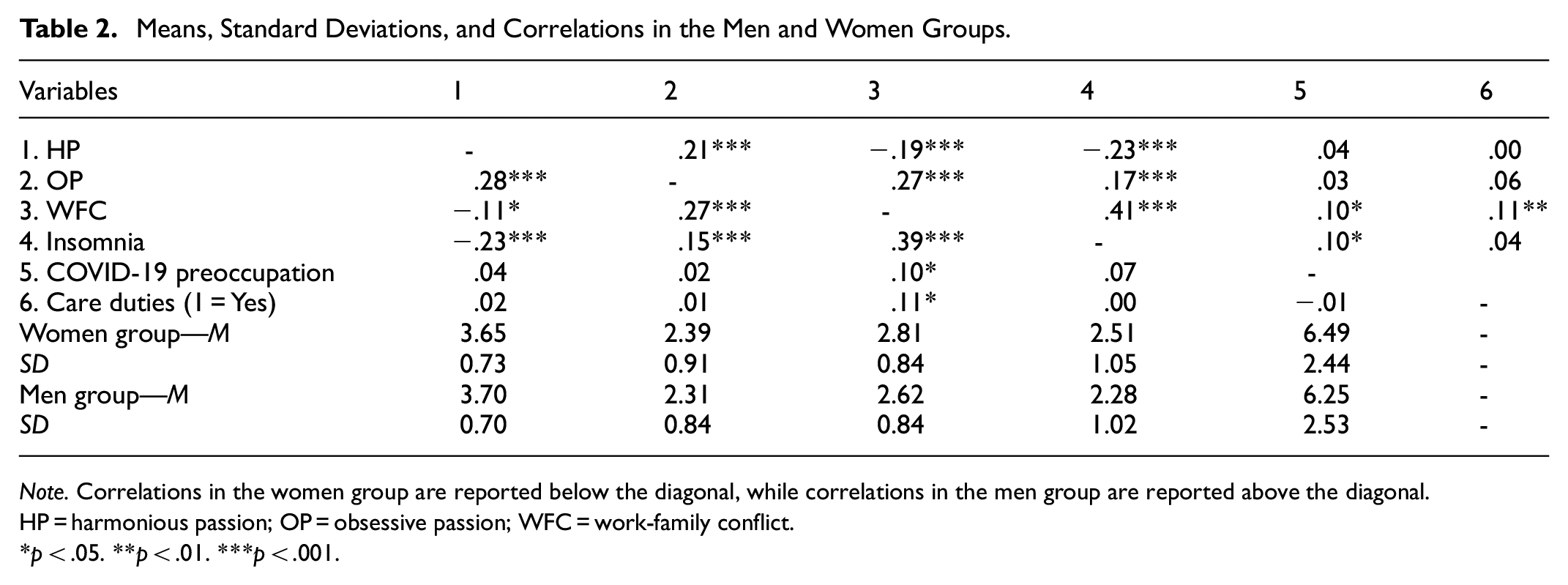
Note. Correlations in the women group are reported below the diagonal, while correlations in the men group are reported above the diagonal. HP = harmonious passion; OP = obsessive passion; WFC = work-family conflict.
p < .05. **p < .01. ***p < .001.
The full structural equation model, depicted in Figure 2, showed adequate goodness-of-fit indexes: χ2(135; 1,016) = 211.40, p < .001, RMSEA = 0.03 (0.02, 0.04), CFI = 0.99, TLI = 0.98, SRMR = 0.03. HP showed a negative association with WFC (H1a), while OP was positively associated with it (H1b). In turn, WFC showed a positive relationship with insomnia (H2). Moreover, HP and OP had a negative and positive association with insomnia, showing that WFC acted as a partial mediator (H3a, H3b). Explained variance was significant and equal to: 0.17 for WFC in both groups; 0.30 for insomnia in the women group; and 0.28 for insomnia in the men group. Allowing the paths to be freely estimated in the two groups did not improve the model fit; Δχ2(9) = 1.81, p = .994, signaling there were no significant differences in the relationship between variables in the two groups. All standardized patch coefficients with their standard errors and p-values are reported in Table 3.
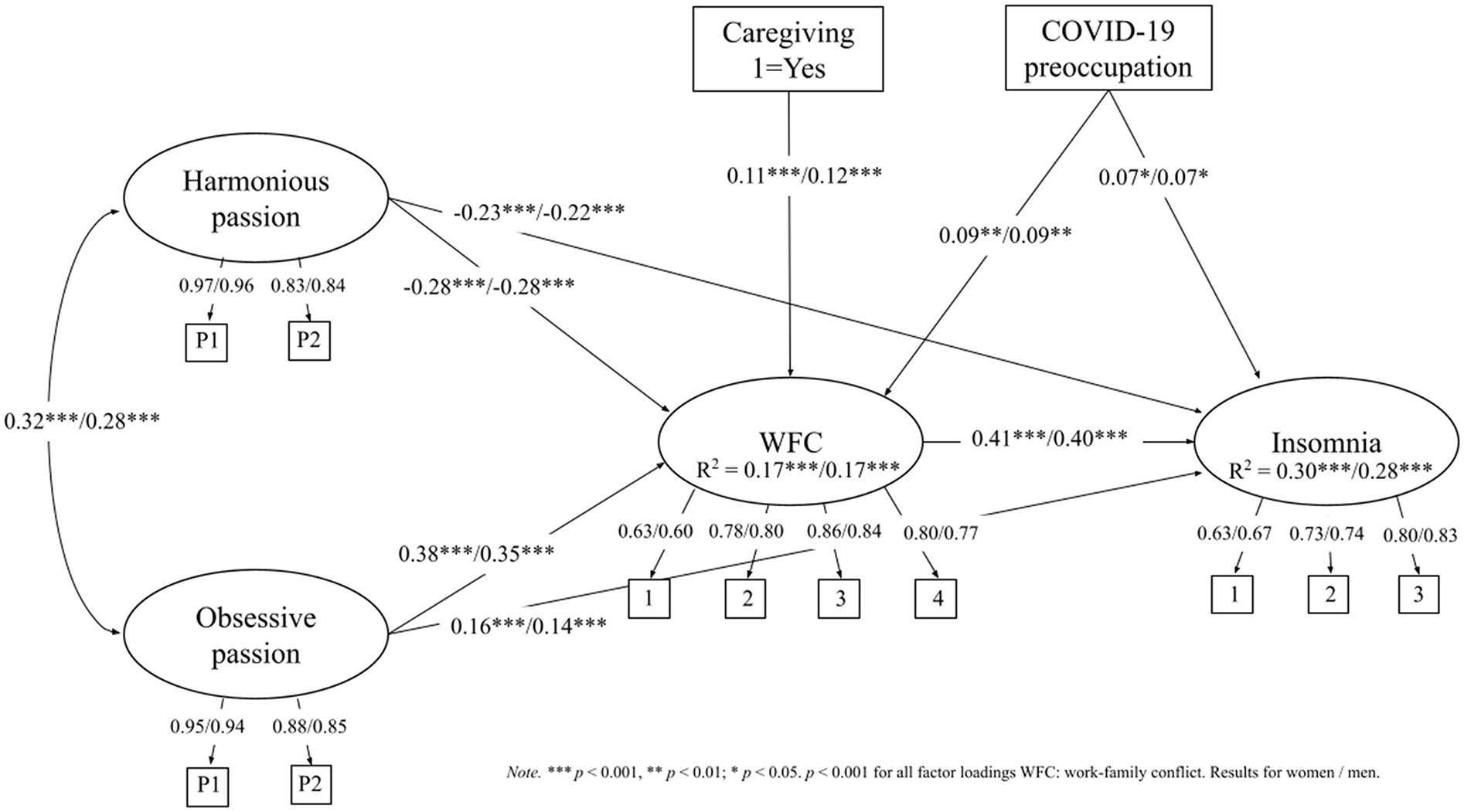
Results of the structural equation model in the two groups (standardized path coefficients).
Standardized path coefficients.

Note. W = women group; M = men group.
The mediating paths and indirect effects were evaluated using a bootstrapping procedure. Results in Table 4 show that, in both groups, all the mediated effects were statistically significant with a positive indirect effect between OP and insomnia and negative indirect effects between HP and insomnia. All the indirect effects were mediated by WFC.
Indirect Effects of the Final Model.

Note. All parameter estimates are presented as standardized coefficients. W = women group; M = men group; CI = confidence interval; HP = harmonious passion; WFC = work-family conflict; OP = obsessive passion.
Discussion
The aim of the present study was to investigate the relationship between passion for work, WFC and insomnia, examining these relationships in a sample of academics during the COVID-19 Pandemic.
Consistent with Hypotheses 1a and 1b, HP was negatively associated with WFC, while OP showed a positive relationship with it. These results supported the notion that HP, characterized by an integrated and valued identity, serves as a potential balancing element in life (Curran et al., 2015), even in academic work. This is noteworthy given the intense and varied demands that challenge individuals’ sense of identity in academia (S. Yang et al., 2022). As regards OP, the results are consistent with previous research by Jung and Sohn (2022) and reflect the partial behavioral integration nature of the obsessive dimension, and the pervasiveness of the activities that make individuals experience conflict with other areas of life (Vallerand et al., 2003).
While the first hypothesis was supported by existing empirical evidence, albeit in different samples, hypotheses 2 and 3 are original and were formulated based on prior findings demonstrating significant relationships between passion and indicators of well-being and illness. The results confirmed hypothesis 2: specifically, HP was negatively related to insomnia, whereas OP was positively related to it. Insomnia is a critical issue within the broader framework of public and occupational health, as it has been linked to various occupational characteristics and outcomes (Bhat & Chokroverty, 2022; Léger et al., 2006; Linton & Bryngelsson, 2000). Although some studies suggested that insomnia is mainly a consequence of work-related factors rather than an antecedent (Vedaa et al., 2016), other contributions highlighted its negative consequences in terms of reduced concentration, irritability, diminished personal resources and impaired performance (Dolce et al., 2024; Kyle et al., 2010). We can therefore glimpse the vicious cycle critically linking the investigated variables, warranting further exploration through longitudinal studies conducted on this specific population.
Given its association with well-being (Yukhymenko-Lescroart & Sharma, 2019; Zito & Colombo, 2017) and its ability to facilitate psychological detachment from work during non-working hours, HP could play a functional role in reducing sleep disturbances and promoting recovery and overall health and well-being (Benitez et al., 2023). Conversely, OP, which is associated with worry and rumination (Curran et al., 2015), appears to have a detrimental impact on sleep. This form of passion does not easily subside during non-work time, thereby interfering with sleep quality.
Both forms of passion showed direct and indirect relationships with insomnia mediated by WFC. Specifically, HP was associated with a reduction in WFC, indirectly decreasing insomnia, while OP increased WFC, thereby exacerbating insomnia. These findings supported hypotheses 3a and 3b. WFC appears to be a crucial mediator in the relationship between factors that promote resource conservation (HP) and those that trigger resource depletion (OP) (Ten Brummelhuis & Bakker, 2012) in relation to sleep disturbances (B. Yang et al., 2018).
Consistent with previous research (Ghislieri et al., 2022; Heijstra et al., 2017) this study supports the gender differences in WFC and insomnia, with women experiencing higher levels of both. The gendered nature of these experiences calls for a more nuanced approach to policy-making in academia, particularly in the context of efforts to reduce the gender gap. The literature suggests that academic institutions, especially in neoliberal environments, often overlook the structural inequalities that exacerbate the gendered distribution of work-family responsibilities. The discourse around work-life balance tends to downplay the complexities of gendered expectations (Martucci, 2023; Rosa, 2022), particularly in times of crisis such as the COVID-19 Pandemic, to which this study refers. Women’s increased caregiving responsibilities, compounded by the blurring of boundaries between work and life during remote working, have brought these issues to the forefront, suggesting that WFC and its impacts on health and productivity cannot be understood without considering the broader gendered dynamics in the academic work environment.
In line with these perspectives, it is crucial to continue monitoring the levels of WFC and insomnia in academic settings, as they have profound implications for both academic productivity and the well-being of individuals. This monitoring should not only focus on individual experiences but also examine the structural and cultural factors that shape these outcomes. National and organizational cultures play a significant role in defining gender-based expectations and work practices, which ultimately influence women’s academic careers and health outcomes. Thus, addressing these issues requires an international, cross-cultural perspective to fully understand how different academic environments either alleviate or exacerbate gendered WFC (Lester, 2015).
Limits
The results of this study are specific to the context of the COVID-19 lockdown, which imposed mandatory remote work. Therefore, the results may not be generalizable to other periods or work arrangements: comparisons with pre-pandemic conditions are not possible as no systematic studies had been conducted on the Italian academic population before the Pandemic. Moreover, this study did not consider the entire population of “precarious researchers,” such as research fellows and PhD students, a crucial segment of the academic community that faces unique challenges and experiences warranting special attention (Nature, 2019).
The main limitation of the study is its cross-sectional nature, which limits the possibility of drawing conclusions about the causality of the relationships found between the variables. Future research conducted outside the Pandemic situation could use longitudinal or diary studies to examine the presence and direction of these associations. In addition, we relied solely on self-report measures, which carries the risk of inflated relationships between variables due to the common method bias (Conway, 2002). However, we provided some evidence that common method variance was not a critical problem in this study. In the future, hetero-evaluations, spillover effects (e.g., among partners), and objective measures of sleep problems should be included in these types of studies. Finally, qualitative studies could offer valuable insight into work passion among academics, particularly by deepening the understanding of the distinctions between harmonious and obsessive passion and their impact on both work and personal life.
Conclusion
The aim of this study was to investigate the relationship between HP and OP, WFC, and insomnia in a large sample of Italian academics during the COVID-19 lockdown. This research was built on previous research highlighting the detrimental effects of WFC and sleep disturbance on individual well-being and work quality. Understanding these dimensions, which represent both personal and organizational costs, is crucial for assessing well-being in the academic context and implementing targeted interventions, such as technology disconnection policies or sleep hygiene courses and programs (Bhat et al., 2018; Olson et al., 2015; Redeker et al., 2019).
To promote both organizational well-being and high-quality research, universities must address factors that can undermine them (Pollack et al., 2020). One of these factors is the excessive control and quantification of academic work. While accountability is fundamental, it should not be overly regulated by rigid deadlines, numerical targets, and constant monitoring, nor should it be distorted by an overemphasis on performative productivity. Research, indeed, suggests the importance of making workers aware of the risks of OP, as it has been depicted as an antecedent of exhaustion (Zito et al., 2022), turnover intentions and absenteeism (Deery et al., 2002). Conversely, fostering HP can serve as a protective factor, leading to positive and optimal experiences at work (Zito et al., 2022). This is often facilitated by the availability of organizational resources (Zito et al., 2015; Salanova et al., 2006), an important element that academic management should prioritize to meet the evolving needs of their workforce.
This study also confirms the importance of promoting policies and practices that facilitate work-life balance. Initiatives such as financial assistance for family caregiving, dedicated leave policies, and assistance upon returning from caregiving responsibilities, should be tailored to the context and targeted to both faculty and technical-administrative staff (Bartlett et al., 2021). Equally important is the role of individuals in leadership positions, who should lead by example (Lester, 2015) by practicing effective technology disconnection on weekends and holidays. Such behaviors could help combat the widespread stigma associated with not being fully dedicated to academic work (Lester, 2015). A work-life balance that includes a balance between meaningful work, necessary detachment from it, and a fulfilling personal life is more beneficial to both well-being and performance than a complete devotion to work.
Policy makers should also address the challenge of rethinking accreditation and evaluation criteria. The Pandemic provided a unique opportunity to collect data on both workforce and students. Although these data are limited to a specific period, they can provide valuable insights for critically reevaluating academic policies and institutional processes to better support sustainable work practices.
Footnotes

Ethical Considerations
The authors declare that the study was approved by the Bioethical Committee of the University of Turin (document no. 150561, April 3, 2020).
Author Contributions
Conceptualization: [Chiara Ghislieri, Monica Molino, Domenico Sanseverino, Paola Spagnoli]; Methodology: [Monica Molino, Domenico Sanseverino, Margherita Zito, Paola Spagnoli, Lara Colombo, Chiara Ghislieri]; Formal analysis: [Monica Molino, Domenico Sanseverino]; Investigation: [Chiara Ghislieri, Paola Spagnoli]; Resources: [Chiara Ghislieri, Monica Molino, Paola Spagnoli, Domenico Sanseverino]; Data curation: [Monica Molino, Domenico Sanseverino, Chiara Ghislieri, Paola Spagnoli]; Writing—original draft preparation: [ Chiara Ghislieri, Monica Molino, Domenico Sanseverino, Margherita Zito]; Writing—review and editing: [Chiara Ghislieri, Monica Molino, Domenico Sanseverino, Margherita Zito, Lara Colombo, Paola Spagnoli]; Visualization: [Monica Molino]; Supervision: [Chiara Ghislieri, Monica Molino]; Project administration: [Chiara Ghislieri, Paola Spagnoli]. All authors have read and agreed to the published version of the manuscript.
Funding
The author(s) received no financial support for the research, authorship, and/or publication of this article.
Declaration of Conflicting Interests
The author(s) declared no potential conflicts of interest with respect to the research, authorship, and/or publication of this article.
Data Availability Statement
The datasets generated and analyzed during the current study are available from the corresponding author on reasonable request.