




Abstract
As the primary and immediate learning context, schools are underrepresented in learner autonomy studies. Scholars’ concerns over the intricate nature of schools lead to inadequate attention on the medium of learner autonomy development. To fill this research gap, a convergent mixed method design included a self-developed questionnaire, and four semi-structured interviews were employed to examine the non-English major sophomores’ learner autonomy during the COVID-19 pandemic. The triangulation of quantitative and qualitative evidence yielded that between a public and a private university, there was a statistically significant difference in English as a foreign language (EFL)s’ motivation for autonomous learning during the COVID-19 lockdown. But other than the degree of motivation, no difference was captured regarding EFLs’ belief and knowledge of autonomous English learning, as well as their metacognitive knowledge. Overall, EFLs were confident about their capacity to do autonomous English learning but engaged in a few systematical autonomous English learning during the COVID-19 pandemic. Based on the results, discussions over Chinese EFLs’ learner autonomy and possible explanations for the motivation differences are included. Pedagogy implications and limitations are elaborated on at the end. Plain Language Summary Using a mixed method design, this study reveals the English as a foreign language (EFL) learner autonomy and the role of schools in differentiating it, during the COVID-19 pandemic. The triangulation of quantitative and qualitative data yielded that despite mainfesting confidence in their capacity for autonomous learning, Chinese EFL learners did not engage in active, systematic autonomous language learning during the lockdowns. The motivation for autonomous English learning differed between universities, with learners from the less prestigious private University Qiu demonstrating more motivation than EFLs from the top public University Nan. The study contributes to understanding EFL learner autonomy during a challenging time of school lockdowns and their motivation issues. It highlights the discrepancy between learners’ self-reported autonomy and engagement in independent language learning. Additionally, it challenges the assumption that learners from prestigious universities would exhibit higher motivation for autonomous learning, showing that motivation can vary depending on the university context.
Plain language summary
Using a mixed method design, this study reveals the English as a foreign language (EFL) learner autonomy and the role of schools in differentiating it, during the COVID-19 pandemic. The triangulation of quantitative and qualitative data yielded that despite mainfesting confidence in their capacity for autonomous learning, Chinese EFL learners did not engage in active, systematic autonomous language learning during the lockdowns. The motivation for autonomous English learning differed between universities, with learners from the less prestigious private University Qiu demonstrating more motivation than EFLs from the top public University Nan. The study contributes to understanding EFL learner autonomy during a challenging time of school lockdowns and their motivation issues. It highlights the discrepancy between learners’ self-reported autonomy and engagement in independent language learning. Additionally, it challenges the assumption that learners from prestigious universities would exhibit higher motivation for autonomous learning, showing that motivation can vary depending on the university context.
Introduction
On May 4, 2023, the World Health Organization (WHO) announced that “COVID-19 no longer constitutes a public health emergency of international concern (PHEIC)” (WHO, 2023). The global pandemic ended, but the research on its massive impact on foreign language acquisition, especially on learner autonomy, proceeds. Benson et al. (2003) proposed that developing learner autonomy is a social-cultural process in which cultural background and learning experiences play a critical role. Therefore, discussing language learners’ post-pandemic learning autonomy without evaluating their previous autonomous learning practices in a specific social context is less effective.
In retrospect, pandemic-derived school lockdowns and unprepared, mandatory online learning have produced memorable learning experiences for English as foreign language learners (EFLs) worldwide. The regular social interaction between EFLs, teachers, and peers was interrupted. With widespread health concerns and learning anxiety, most EFLs could not access linguistic resources as usual. To cope with the challenge, the Ministry of Education of the People’s Republic of China (2020) encouraged institutions at different levels to promote autonomous learning by taking advantage of digital platforms. This official recommendation had a dual impact on fostering learner autonomy. On the one hand, this policy provided EFLs and teachers with flexibility in managing language learning, as classroom settings no longer constrained them during school lockdowns. On the other hand, this policy also left space for institutions to explore, resulting in distinctive interpretations and associated coping strategies for the pandemic. Some institutions offered EFLs varied learning platforms and detailed instructions on engaging in autonomous language learning, whereas some copied and pasted learning activities from offline to online, providing less guidance on independent study (Xie et al., 2020). Owing to the differences, the EFL learner autonomy during the pandemic might differ among schools.
Despite school being crucial in forming EFLs’ autonomous language learning experience during the pandemic, little research has evaluated the impact of a school type on language learner autonomy. Many researchers excluded the school type from the discussion because of its intricate nature and the risks of simplifying it as some cultural stereotype. However, this exclusion could result in a lack of discussion on the immediate and primary learning context in which EFL learners are situated. To fulfill the abovementioned research gap, we employed a mixed-method design to investigate the learner autonomy of two universities during the pandemic. EFLs’ learner autonomy at a reputable public university and a less competitive private college were compared to investigate the relationship between school type and individual autonomous learning practices.
The following is a brief review of the previous research on cultural context and learner autonomy, as well as on the challenge of conceptualizing EFL learner autonomy, leading to an account of this study’s research questions.
Literature Review
The learner-centered language teaching increased the number of scholars who interrogated learner autonomy development during foreign language acquisition. Among them, commonly perceived research inquiries include: culture and language learner autonomy, language learners’ readiness for autonomy-supportive learning, determinants of language learner autonomy (e.g., motivation, or learner identity), and the correlation between language learner autonomy and their academic performances. To answer these research inquiries, some researchers employed case studies (Chan, 2001; Zhong, 2018), whereas some used quantitative approaches or mixed methods (Chen & Pan, 2015; Hardré et al., 2006; Lin & Reinders, 2019; Murray, 2011; Ueki & Takeuchi, 2013). However, due to insufficient attention to the correlation between school type and learner autonomy, our literature review starts with studies that focus on the relationship between culture and EFL learner autonomy development.
Culture and EFL Learner Autonomy
Debates over the promotion of learner autonomy never end (Pennycook, 1997; Schmenk, 2005). However, prior to any new learner autonomy supportive pedagogy implementation, researchers were prone to evaluating the impact of local culture. The culture mentioned here was not exclusive to national culture but also included the culture of a school or any learning community. Scholars argued that fostering learner autonomy without considering the social-cultural context might hinder the language learning of EFLs (Pennycook, 1997; Phan & Hamid, 2017; Schmenk, 2005). Smith (2003) mentioned that cultural background could serve as a resource and a constraint. Cultures that celebrated the independence of language learners and did not perceive learner autonomy as cultural imperialism were usually willing to promote learner autonomy development and encourage pedagogical attempts to differentiate the language learning process (Smith, 2003). Teachers from this culture were also likely to use learning tasks to illustrate autonomous learning strategies and encourage learners’ control over their language learning (Little, 2022; Smith, 2003).
Besides, culture is critical for learner autonomy development because it contributes to forming a new learning identity. Forming a new learner identity received impact from the interaction between the learner and different linguistic resources, language experts, and the social-cultural context (Smith, 2003). For instance, Tsunematsu (2023) argued that international students exhibited vulnerability and struggled to form new learning identities while adapting to a new cultural frame. International students exercised their “agentic autonomy without becoming a ‘cultural fit’ or being subject to unfamiliar culture” (Tsunematsu, 2023, p. 11). The continuing exercise of learner autonomy in a new cultural context assisted international students in forming a new “distinct and positive intercultural identity that represented learners’ conflicts with the unfamiliar culture” (Tsunematsu, 2023, p. 14). The new learning identity would, in turn, influence international students’ ability to exercise agency. For example, international students with new learning identities sought less instructional guidance and displayed confidence in their self-efficacy while working on learning projects that required collaboration with local people in Japan (Tsunematsu, 2023).
Drawing on the above statements, evaluating the impact of culture while analyzing EFL learner autonomy enriched researchers’ comprehension of the concept. However, it is usually challenging to define culture. Palfreyman (2003) proposed three ways to interpret culture: (i) refer to “ethnic or national culture (e.g., Chinese culture); (ii) the value and customary ways of behaving in different communities (e.g., culture of the classroom); (iii) the social-cultural context, as opposed to the learner in isolation” (Palfreyman, 2003, p. 2). These three interpretationes illustrated the sophisticated nature of culture.
In our study, we perceived school type as a manifestation of a learning culture comprising teachers, learners, physical classrooms, stakeholders, teaching strategies, linguistic resources, technology, administration policies, and cognitive activities. Rather than separating each component, we perceive school type as an intricately dynamic unit, coordinating different learning resources. This perception pervades our research design.
EFL Learner Autonomy and Its Conceptualization
In a recent systematic review of literature on learner autonomy, Chong and Reinders (2022) point out a lack of clear conceptualization of learner autonomy in literature, despite its 40-odd-year history. One widespread definition of learner autonomy refers to the capacity to self-monitor one’s learning process to participate actively in culturally accepted ways within a community of practices (Benson, 2013). Benson (2013) suggested that the word “capacity” implied learners’ potential to be involved in autonomous learning, such as setting goals of learning, selecting appropriate learning materials, and conducting reflection (Holec, 1981; Teng, 2019). Benson (2013) concluded that these practices manifested learning management. He further argued that learning management would not be performed unless aligned with learners’ needs. Therefore, learner autonomy is also perceived as the representation of the inherent psychological needs of an individual. Learners are born to pursue autonomy in language acquisition and demand fewer teachers’ presence between stages of learning (Chirkov, 2009; R. Ryan & Deci, 2017; R. M. Ryan & Powelson, 1991). Another frequently cited conceptualization is proposed by O’Leary (2018), who defined learner autonomy as evidence of learners’ control over their cognitive learning process, including attention, task knowledge, reflection, and emotional intelligence.
Despite constantly citing the above conceptualizations and some others (Little, 2004), research on EFL learner autonomy usually included an individualized definition (Chan, 2001; Chen & Pan, 2015; Lenkaitis, 2020; Xu et al., 2004). For example, Chen and Pan (2015) proposed three dimensions to represent foreign language learner autonomy: learner responsibility, the ability to conduct autonomous learning, and different autonomous learning activities. These three dimensions functioned as the basis of their research instrument design—the Learner Autonomy Inventory (Chen & Pan, 2015; Üstünlüoğlu, 2009). In Chen and Pan’s study, the analysis of the learner autonomy inventory responses yielded that although a statistically significant correlation was identified between 130 junior-high-school English learners’ autonomy and the use of learning strategies, English language learners in Taiwan were not effective users of language learning strategies. Alternatively, EFL learner autonomy is low (Chen & Pan, 2015).
However, not every study included a ready framework for conceptualizing EFL learner autonomy. In Chan’s exploratory study, he conceptualized learner autonomy by describing the characteristics that emerged from the qualitative data: “highly motivated; goal-oriented; have an inquisitive mind; hard-working; have initiative……” (Chan, 2001, p. 512). Likewise, Xu et al. (2004) also integrated learner characteristics into the conceptualization. They portrayed autonomous learners as ones that “could understand the learning objectives of teachers, establish the goal and make plans for English learning, use effective English learning strategies, and supervise the application of learning strategies and learning processes” (Xu et al., 2004, p. 64). Although the research concentrations vary, resemblances exist in Chinese language learner autonomy conceptualization across studies.
Overall, most scholars from non-English-speaking countries conceptualized EFL learner autonomy either by borrowing the definitions of learner autonomy from previous literature or by developing their own based on their participants’ traits and associated studies (Chan, 2001; Chen & Pan, 2015; Xu et al., 2004).
Operationalization of Learner Autonomy in This Study
Scholars suggested that in addition to effective learning strategies, learner autonomy development is associated with the learners’ underlying belief regarding independent study (Lai, 2019; Palfreyman, 2003). We advocate that learning beliefs and cognitive activities are situated in a specific social-cultural context, mediated by the interaction between EFL learners and linguistic resources, and influenced by motivations. Therefore, EFL learner autonomy in this study includes four dimensions: EFL learners’ belief in the capacity to take control over different stages of learning, their knowledge of autonomous English learning, metacognitive knowledge, and motivation. This conceptualization served as a foundation on which we developed our research instruments.
Finally, previous studies on learner autonomy were primarily conducted in a stable, specific social-cultural context. Revisiting the concept during the pandemic would enrich the comprehension of EFL learner autonomy development. Moreover, it would address the underrepresentation of learning context, which was due to the parsimonious research attention on the correlation between school type and fostering learner autonomy. To bridge these research gaps, we raised these two questions:
What was the status of non-English major sophomores’ self-reported EFL learner autonomy (as measured by beliefs, knowledge, metacognitive knowledge, and motivation) during the lockdown semester?
Did Chinese college students’ perceived EFL learner autonomy differ from those in public and private universities?
Materials and Methods
This study uses the convergent mixed method design to explore Chinese EFL learners’ autonomy in the Spring semester of 2020. As the data collection was conducted during the pandemic, the primary concern was whether the data were sufficiently rich to reflect EFL learner autonomy during school lockdown. While using alone, both questionnaire and semi-structured interviews presented flaws in capturing the dynamic of learner autonomy during the pandemic. For example, a large-scale questionnaire might neglect some critical features of the context, whereas qualitative data could not depict the general trends of learner autonomy during school lockdowns (Creswell & Clark, 2018). Therefore, rather than depending on a quantitative or qualitative research design exclusively, we employed a convergent mixed method. The convergent mixed method offered a more detailed and trustworthy illustration of EFL learners’ autonomy, as it highlighted the comparison between quantitative and qualitative results (Creswell & Clark, 2018).
The mixed method in our study included a questionnaire and four semi-structured interviews. The questionnaire responses presented the degree of EFL learners’ autonomy and statistically to what extent the university type was associated with EFL learners’ autonomy, while the semi-structured interviews captured the voice of EFLs during the pandemic. By comparing the parallelly collected quantitative and qualitative data for overarching themes, this study could better manage the challenge of the COVID-19 pandemic and answer the research questions appropriately.
Participants
Using purposeful sampling, we recruited non-English major sophomore students from the public university Nan and the private university Qiu in China. As the name indicates, purposeful sampling means “researchers internationally select (or recruit) participants who have experienced the central phenomenon or key concept being explored in the study” (Creswell & Clark, 2018, p. 174). Our study aimed to compare the non-English major EFL learner autonomy between public and private schools. Prior to the data collection, we made two rounds of phone calls with the English instructors of these two universities, focusing on the lesson plan details, instruction strategies, profile of learners, textbooks, supplementary learning materials, and assessments. Based on the instructors’ feedback, we excluded English courses that exclusively emphasized on listening or speaking drills but retained English courses that integrated four language skills. Consent was obtained from the instructors whose students participated in this study. During the data collection, the instructors informed EFL learners that they were not obligated to complete the questionnaire or participate in the semi-structured interviews if they did not wish to.
Among all the non-English major sophomore students, the youngest participant was 16 years old, while the eldest was 23. According to the instructors of both universities, in class participants did not receive any training on how to conduct autonomous language learning. Detailed descriptive statistics of the participants per university are displayed in Tables 1 and 2.
Descriptive Statistic of the Participants.

Frequency Table of the Majors.

We divided all the specific majors into ten different categories. Despite the diversity, our participants mainly comprised EFLs majoring in Social Science, Engineering, and Business. Only 15 EFLs from the Physical major voluntarily participated in this study, compared to 376 EFLs from the Social Science major.
Research Context
Public University Nan is in southeast China, containing one main campus and two satellite campuses. University Nan is a domestic top-tier public university under the supervision of the Ministry of Education of China and the provincial government. Private University Qiu is in the middle of China, with undergraduate majors and specialized subjects for professional training but no graduate programs. University Qiu is a private higher education institution with a less competitive enrollment and moderate academic requirements for graduation than University Nan. Both universities listed English as the required course for non-English major undergraduate students in the curriculum.
Research Instruments
The results of this study are drawn from the analysis of questionnaire responses and semi-structured interviews. The research instrument designs are as follows.
COVID-19 Learning Autonomy Questionnaire
The COVID-19 Learning Autonomy Questionnaire (COVID-19LAQ) is a 5-point-Likert scale (1-Strongly Disagree, 2-Disagree, 3-Neutral, 4-Agree, 5-Strongly Agree), which was developed under Ruel et al.’s (2016) guidelines on survey research. Before drafting the items, established literature and existing tools were critically reviewed. During questionnaire development, we built our items not mainly relying on Benson’s (2013) and O’Leary’s (2018) theoretical interpretation of learner autonomy but also included Chinese EFLs’ learning traits. Four dimensions were proposed to represent EFL learner autonomy in this questionnaire: (a) EFLs’ belief in autonomous learning (9 items); (b) EFLs’ knowledge of autonomous learning strategies (6 items); (c) metacognitive knowledge of EFLs (4 items); (d) motivation for autonomous learning (10 items). Furthermore, the COVID-19LAQ includes questions concerning the participants’ demographic information, such as age, gender, major, years of English learning, standardized language test grades (e.g., TOEFL, IELTS, Chinese College English Test Band 4), and the English course name from the last semester. Finally, COVID-19LAQ was primarily written in Chinese to improve the clarity of the items.
Scale Validation
In finalizing the questionnaire, an expert panel comprising two experienced English instructors and one scholar with a research background in learner autonomy was responsible for providing feedback on the design of questionnaire items. The response process validation was used to boost the validity of the scale items. Ten EFLs from University Nan completed the face validity index (FVI), rating the clarity and comprehension of all scale items (Yusoff, 2019). The degree of clarity and comprehension ranged from “1 = the item is not clear and understandable” to “4 = the item is very clear and understandable” (Yusoff, 2019). Setting the cutoff point at .8 (Yusoff, 2019), four items that failed to reach the face validity index value of .8 were removed from the questionnaire, reducing the number of items from 29 to 25.
Prior to further analysis, an exploratory factor analysis (EFA) using principal component analysis was executed on the dataset of the pre-test and yielded four factors (Eigenvalue > 1). The scree plot supported a four-factor structure as well. Subsequently, we proceeded with a principal axis factor estimator and goemin oblique on the same dataset. Items, that displayed loading less than .4, as well as salient cross-loading, were removed (Watkins, 2018). The results of EFA assisted the researchers in reducing the number of items from 25 to 21. These four-dimension solutions explained 55.6% of the total variance of the dataset.
After exploring the internal structure of the questionnaire, confirmatory factor analysis (CFA) was executed on a different dataset. The results were aligned with the EFA result verifying the four-factor structure (CFI = 0.922, TLI = 0.876, RMSEA = 0.064, SRMR = 0.036). Although the fit indices were imperfect, they were considerably better than the one-, two-, and three-factor solutions indices. The scale validation process determined the factor scores for each construct, and the final structure of each dimension was as follows: (a) EFLs’ belief in autonomous learning (items 1–4); (b) EFLs’ knowledge of autonomous learning strategies (items 6–11); (c) metacognitive knowledge of EFLs (item 12, items 14–15); (d) motivation for autonomous language learning (items 16–20).
Cronbach’s alpha of each improved subscale is .84 for EFL learners’ belief in autonomous learning, .83 for EFL learners’ knowledge of autonomous learning, .70 for metacognitive knowledge, and .79 for motivation. Further, Cronbach’s alpha for the overall scale is .86. All Cronbach alpha analysis results were equal or larger than .70, suggesting that items of each sub-scale formed an acceptable one measuring a specific domain (Gliem & Gliem, 2003).
Semi-Structured Interviews
Four semi-structured interviews were conducted to expand and explain the results of the COVID-19LAQ. Interview questions were originally composed of 16 questions, inquiring about EFL autonomous learning activities, their perceived capacity in doing autonomous learning, previous learning experiences, and motivation. These interview questions were emailed to the research team for feedback. Based on it, two redundant questions were deleted, and six new questions on EFLs’ emotions while doing autonomous English learning, their perception of the ideal autonomous language learner, and their thoughts on the targeted language community were added. These modifications increased the semi-structured interview questions to 20. These interview questions were aimed at assisting interviewees in reconstructing their language learning experiences during the pandemic (Seidman, 2019).
In this study, we employed homogenous sampling—within one university, any participants who had completed the questionnaire were qualified to join in the interview. However, given the complex learning situation during the initial phase of the COVID-19 pandemic, only four EFL learners responded to participate voluntarily. Pseudonyms replaced all participants’ real names to shield their true identities. Two female EFLs (Annie Tong and Sherry Zhang) were from University Nan, whereas two male EFLs (Zen Yu and Eason Li) were from University Qiu. Their majors were non-specified due to interviewees’ wishes. Although these four cases could not represent the entire range of participants’ majors, they were perceived as an alternative way to understand the EFLs’ learner autonomy. Prior to the interview, the study purpose and interview procedure were explained, and oral consent was obtained from the participants. The average interview length was 30 min. All four interviews were transcribed and coded manually.
Data Collection and Analysis
The school lockdown was from mid-Winter break, near the Chinese New Year (around February 22), to the end of the Spring Semester (August 30, 2020). Most Chinese universities permitted students to return to campus at the start of the Fall semester, September 1, 2020. The 800 questionnaires were distributed simultaneously in both universities over the first week of Fall 2020. All participants had to return the questionnaire within 3 weeks. The overall response rate was 87%. The semi-structured interviews were conducted in the fourth week of the Fall semester. Quantitative data were analyzed using IBM SPSS statistic 25 and R with lavaan. Qualitative data underwent two rounds of manual coding. The initial line-by-line coding started with identifying the idea units, followed by the focus coding, which compared the initial codes and sorted, combined, or separated the primary idea units until coherent categories emerged. Finally, the researcher triangulated the interview data with the EFLs’ questionnaire responses.
Results
The EFL Learner Autonomy During the Lockdown Semester in 2020
In response to answering the first research question, we combined the quantitative and qualitative data. Prior to comparing and contrasting, we revisited the conceptualization of learner autonomy in this study. Learner autonomy in this study is represented via the four dimensions: (a) EFLs’ belief in autonomous learning; (b) EFLs’ knowledge of autonomous learning; (c) metacognitive knowledge; (d) motivation for autonomous learning. Although these four dimensions correlate, none of the correlation coefficients yielded in factor analysis have exceeded .8 (Watkins, 2018), suggesting inadequate evidence to perceive it as one latent construct. Therefore, we did not combine the scores of the four dimensions together but analyzed them respectively. Table 3 presents the EFLs’ overall learner autonomy during the school lockdown.
EFLs’ Overall Learner Autonomy During School Lockdown in 2020.

In total, 1,399 non-English major sophomores completed the questionnaire: 716 EFLs were from University Nan, and 683 were from University Qiu. As Table 3 illustrates, the mean score of the EFLs’ belief in autonomous English learning subscale was 3.32, with a standard derivation of 0.75, and the median score was 3.25 (IQ1–IQ3 = 1). When the mean is higher than the median score, the questionnaire result is skewed toward the right (Nardi, 2018). Half the participants rated the belief in autonomous learning items as less than 3.25, while the other rated them as greater than 3.25. EFLs, on average, manifested a moderately positive attitude toward their capacity to conduct autonomous English learning. The following histogram (Figure 1) specifies the distribution of questionnaire responses.

Histogram of EFLs’ rating on the belief in autonomous English learning.
Although manifesting positivity, the most frequent answer is “neither agree nor disagree” (mode = 3). It could be interpreted as either non-English major sophomores’ uncertainty about their independent language learning capacity or their indifference to the questionnaire items (Johns, 2005; Krosnick et al., 2002). According to Chyung et al. (2017), circling the neutral option could be the influence of cognitive effort, ambivalence, and social desirability. Participants would choose the “neither agree nor disagree” if they wished to avoid cognitive investment, feeling ambivalent or socially undesirable about the questionnaire items (Chyung et al., 2017). The same response pattern is also seen in EFLs’ responses to the knowledge of autonomous learning and motivation sub-scale (see Figure 2).

Histogram of EFLs’ rating on the knowledge of autonomous English learning.
Owing to the small differences between the mean and median scores, the histogram of EFLs’ knowledge of autonomous learning was more normally distributed than that of EFLs’ belief in autonomous learning (Mean = 3.14, Median = 3.16). A smaller standard derivation also suggests that the average variation of all the responses was small (Mean = 3.14, SD = 0.67). Forty-five percent of participants were positive about their skills of autonomous English learning (cumulative percentage of rating score over 3 = 45%). However, around one-third of non-English major sophomores displayed a lack of confidence in their autonomous English learning skills during the pandemic (cumulative percentage of rating score less than three = 33%). Alternatively, one in three non-English major sophomores felt less capable of selecting appropriate online or offline learning resources, adjusting their learning pace, or helping peers with English learning problems.
The neutral attitude remains significant (mode = 3). The dispersion of data is not unexpected if we read it together with the statistics of EFLs’ belief in autonomous learning. Without any appropriate training in autonomous English learning, many EFLs would feel uncertain about their knowledge and capacity to learn English autonomously during the pandemic. The following two figures are the histograms of EFLs’ responses to the metacognitive knowledge and motivation items (Figures 3 and 4).

Histogram of EFLs’ rating on the metacognitive knowledge.
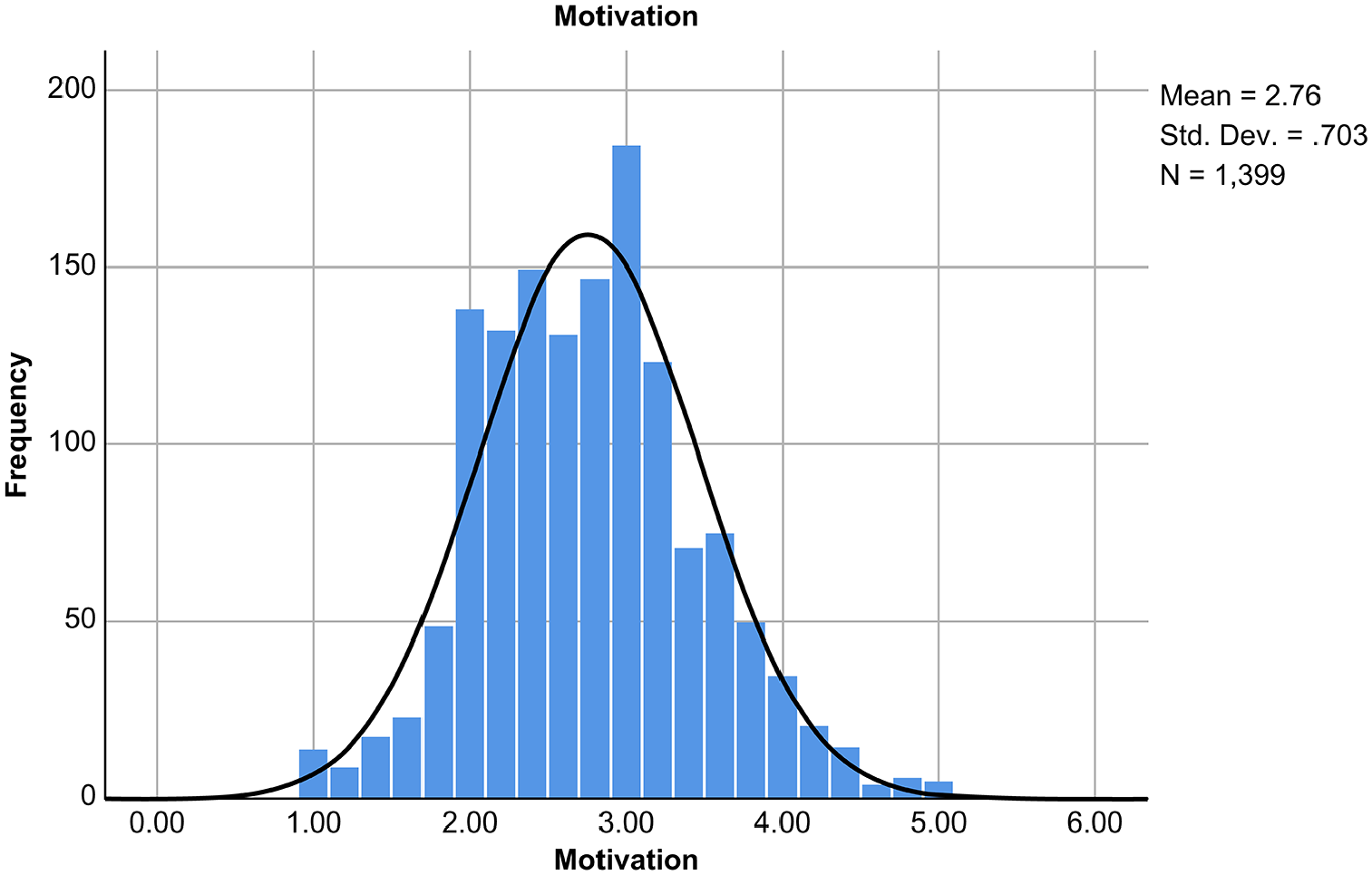
Histogram of EFLs’ rating on the motivation for autonomous English learning.
The mean and median of the metacognitive knowledge sub-scale exceeded the scores of the first two variables (belief and knowledge of autonomous learning), resulting in a more negatively skewed distribution. It highlights that some positive scores distort the questionnaire response dispersion in favor of the positive end (Nardi, 2018). Furthermore, it states that EFLs in our study were affirmative with items depicting their metacognitive knowledge (M = 3.45, SD = 0.70). However, the dispersion of motivation subscale responses is entirely different from the above three; it is a positively skewed distribution. The mean scores of motivations were below the zone of “neutral” (Mean = 11.19, SD = 0.70), indicating that our participants were not highly motivated to engage in independent language learning during the school lockdown in 2020.
Quantitative analysis results presented the trends of EFLs’ attitudes toward autonomous English learning but could not illustrate the autonomous learning activities. To obtain a comprehensive picture, we conducted four semi-structured interviews.
EFL Learners’ Voices
Qualitative evidence of a mixed method enriches the results yielded by quantitative analysis and sheds light on the rationale behind the numbers. Four EFLs consented to participate in the semi-structured interview. After two rounds of coding, two themes emerged from the qualitative data: fragmented autonomous English learning during school lockdown and distinct attitudes toward autonomous English learning.
Fragmented Autonomous English Learning During School Lockdown
Albeit the differences in the course delivery and school requirements during the lockdown, interviewees from both universities displayed confidence in their capacity for autonomous English learning. When inquiring whether they could study English independently during the school lockdown, the answer was unified: Yes. However, their self-perceived confidence was not supported by their elaboration on autonomous English learning during the pandemic. All EFLs had no thorough plan for autonomous English learning. Instead, their autonomous English learning stories mainly comprised fragmented learning activities, such as learning new vocabulary, reading some articles via mobile applications, or watching English news or documentaries.
While asking about the assessments employed during the lockdown, all interviewees agreed that tests and complementary practices of textbooks were the primary and frequently used tools for English learning. Learning reflection was barely mentioned, and when it was, the skills of assessing English proficiency were missing. For example, Sherry from University Nan confessed that she did not know how to assess her language skills other than consulting the performances of the last final. “I would reflect on my English learning. I thought I need to improve my listening because I did not do well in the final of last semester.” (Sherry Zhang, University Nan). According to Teng (2019), few active learning reflections undoubtedly left less room for autonomous learning innovation.
The above learning activities did not belong to any plans for language learning. Instead, they were spontaneous learning choices. The purpose of these autonomous English learning activities was either to fulfill course requirements or prepare for upcoming language tests. For example, vocabulary learning was mentioned repeatedly, but both the vocabulary learning applications and techniques were based on their teachers’ recommendations in class. There was no sign of independent exploration. In addition, our participants did not state any timeline for vocabulary learning during the school lockdowns. Without appropriate knowledge of autonomous learning, any time spent on English learning seemed valid for our participants.
These fragmented learning activities echoed EFLs’ perception of the primary school lockdown in 2020. Annie from University Nan recalled the primary school lockdown by saying, “Lockdown was like an extension to the Winter break, and there was not too much requirement. Some course works, yes, but it is up to you” (Annie Tong, University Nan). This perception explained unsymmetrical autonomous learning to some extent. EFLs conducted casual language learning because they were not ready for the Spring semester 2020, despite the school notifications.
Distinct Attitudes Toward Autonomous English Learning
Although there was conformity in answers to the questions on the intention of learning English independently during the school lockdown, EFLs’ learning attitudes varied. Interviewees from University Nan assigned autonomous English learning with less value than their counterparts from University Qiu. Annie from University Nan confessed that once they passed the critical language tests required for graduation, she subordinated English to the core courses of her major by significantly reducing the time investment. “The time I spend on core courses to that I spend on English is six to one” (Annie Tong, University Nan). Nevertheless, the ratio between core course learning and autonomous English learning was two to one for Zen Yu from University Qiu. The apparent difference in time investment explained the statistical trend of motivation generated by the questionnaire responses.
The last interview questions surrounded the reasons behind the motivation differences. We invited learners to share parents’ expectations, peer influence, school policy, and the intrinsic impulse for language learning. The analysis yielded that parents of EFLs had already ceased to have an impact, whereas peer influence debuted. EFLs communicated and compared their effort in language learning with their friends during the school lockdown. “I will work harder if I know my friend was doing so,” admitted one of our participants (Zen, University Qiu).
Moreover, EFLs’ anxiety toward standardized language tests, such as the College English Band 4 (CET-4) or English for postgraduate admission examination, remained the primary motivation for autonomous English learning during school lockdowns. A significant effort had been put into addressing their concerns over the upcoming high-stakes language tests. In contrast, no one during the interviews mentioned the internal pleasure obtained from autonomous English learning, either prior to the pandemic or during the pandemic. This finding illustrated that although differences were identified in EFLs’ motivation for autonomous learning between the two universities, the needs for language learning were the same: to pass the language exam.
Comparing the qualitative with the quantitative results informed us that EFLs believed that they were able to do autonomous English learning, but the actual exercise proved to contain less learning management and more following teachers’ instructions. The distinct attitudes toward autonomous English learning also were supported by the following quantitative analysis on the correlation between university type and EFLs’ learner autonomy.
Correlation Between University Type and Chinese EFLs’ Learning Autonomy
To determine the relationship between the university type and EFL learner autonomy, we conducted four one-way covariances analyses (ANCOVA). ANCOVA allows us to compare the mean differences of each dimension of EFL learner autonomy between two universities after controlling for the covariates (e.g., English learning experiences, scores of a standard English test, major, and gender). Before the ANCOVA, a covariate correlation test was conducted. The results yielded that the grades of CET-4 were highly related to previous English learning (r = .258 > .08; Salkind & Frey, 2019). However, we eventually decided to use the years of English learning as the covariate, as not all participants had completed the CET-4 by then. Additionally, four homogeneity of variance tests were conducted to ensure that the equal variance assumptions were not violated (Salkind & Frey, 2019).
The dependent variable in each ANCOVA was the factor score of one dimension of learner autonomy (e.g., EFLs’ belief in autonomous learning, EFLs’ knowledge of autonomous learning, metacognitive knowledge, and motivation). The independent variable (IV) was the same in all ANCOVA—the university type—but the covariate varied slightly among analyses. The results of four ANCOVA are displayed in Tables 4 to 7.
ANCOVA With the Dependent Variable as EFLs’ Belief in Autonomous Learning.

Note. Dependent Variable: EFLs’ belief in autonomous learning. Covariates: years of previous English learning and major.
R squared = .023 (Adjusted R Squared = .020).
ANCOVA With the Dependent Variable as EFLs’ Knowledge of Autonomous Learning.
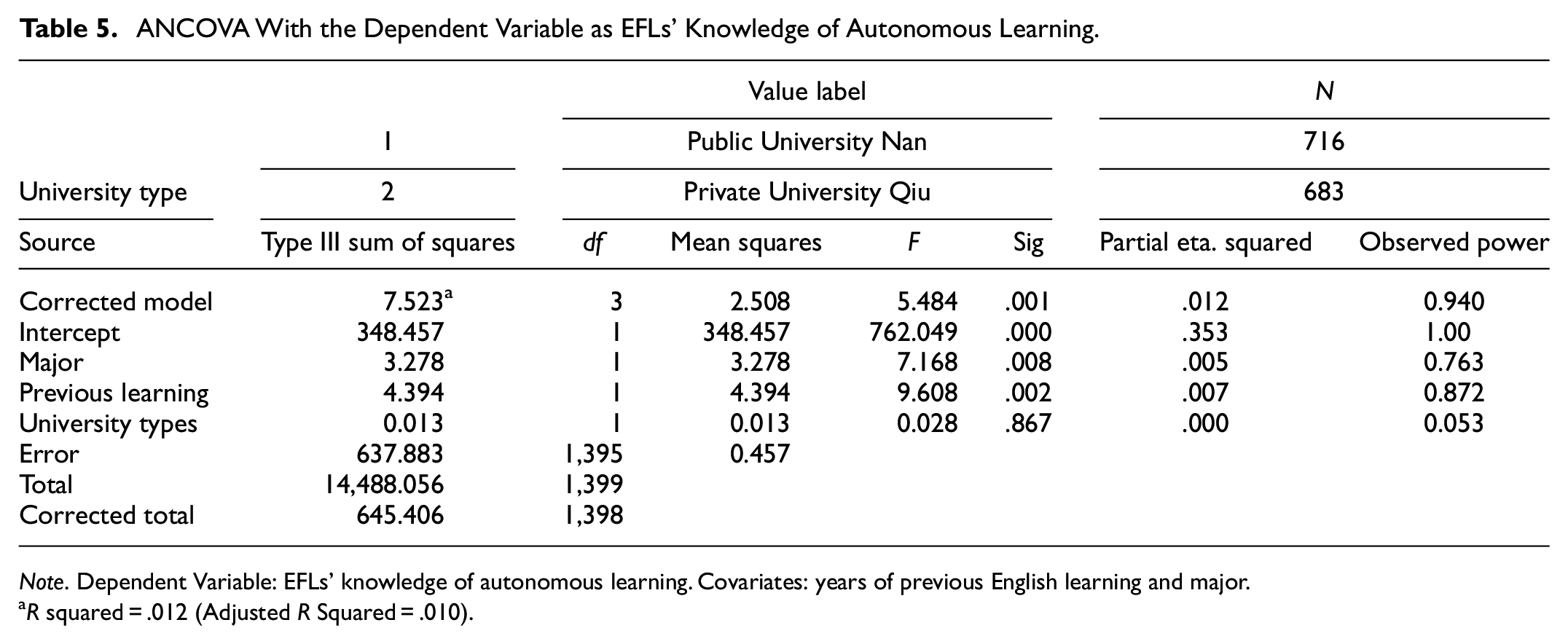
Note. Dependent Variable: EFLs’ knowledge of autonomous learning. Covariates: years of previous English learning and major.
R squared = .012 (Adjusted R Squared = .010).
ANCOVA With the Dependent Variable as EFLs’ Metacognitive Knowledge.

Note. Dependent Variable: EFLs’ metacognitive knowledge. Covariates: gender, years of previous English learning, and major.
R squared = .008 (Adjusted R Squared = .005).
ANCOVA With the Dependent Variable as EFLs’ Motivation for Autonomous Learning.

Note. Dependent Variable: EFLs’ motivation for autonomous learning. Covariates: gender, years of previous English learning, and major.
R squared = .061 (Adjusted R Squared = .058).
Setting the alpha level at .05, the results of the first ANCOVA (F (1, 1,395) = .794, p = .515, effect size = 0.00 SD) indicated that EFLs’ belief in autonomous learning during the school lockdown of 2020 was not significantly different between universities after controlling for their previous years of English learning and major. Furthermore, the observed power of university type suggests that there is only 10% chance of finding a significant difference with our sample size in any particular sample.
Setting the alpha level at .05, the second ANCOVA used the EFLs’ knowledge of autonomous learning as the dependent variable but retained the same independent variable and the covariates. The results point out that, resembling the EFLs’ belief in autonomous learning, there was no statistically significant difference in EFLs’ knowledge of autonomous language learning between the two universities during school lockdown in 2020 (F (1, 1,395) = .044, p = .867, effect size = 0.00 SD). Moreover, the percentage of finding a significant difference using our sample size in another sample is 5.3%.
In addition to the covariates used in the previous two ANCOVA, the third and fourth ANCOVA included gender as another covariate. Although debate existed, previous studies believed that gender significantly affected learners’ metacognition and motivation (Lemieux et al., 2019; Portela-Pino et al., 2019; Veloo et al., 2014). Setting the alpha level at .05, the results showed that after controlling their gender, major, and years of previous English learning, our participants were not manifesting any statistically significant difference in metacognitive knowledge between the two universities (F (1, 1,394) = .816, p = .367, effect size = 0.001 SD). The probability of finding a significant difference in another sample with the same sample size was 14.7%.
The final ANCOVA yielded that after controlling for three covariates, the motivation for autonomous English learning was significantly different between the two universities (F (1, 1,394) = 63.891, p = .00, effect size = 0.04). Compared to Cohen’s guideline, the effect size of university type was small (Partial Eta Squared = 0.044), and it only explained 4.4% variance of the general population (Salkind & Frey, 2019). The results of the ANCOVA were aligned with the descriptive statistics of the EFL learner autonomy per university. The following table compares the EFL learner autonomy between the two universities.
Table 8 displays the EFL learner autonomy of each university. The values of the first three dimensions of EFL learner autonomy between the public and the private university resemble each other. A significant difference is identified regarding the motivation for autonomous learning during the pandemic, with EFLs from the University Qiu manifesting a stronger intention of engaging in autonomous English learning during the pandemic. However, the statistic was unanticipated. Given these two universities’ enrollment rates and the national ranking discrepancy, we assumed that EFLs from the public university, University Nan, had a higher mean score in all four dimensions of learner autonomy. Conversely, except for the knowledge of autonomous language learning, private University Qiu was slightly ahead in the three dimensions scores.
EFLs’ Learner Autonomy During School Lockdown in 2020 per University.

Finally, reflecting on the voices of EFLs regarding autonomous learning during school lockdown, regardless of university type, EFLs in our study demonstrated a similar comprehension of learning autonomy and low motivation in exercising autonomy.
Discussion
The COVID-19 pandemic resulted in widespread school lockdowns and mandatory online teaching, but it did not prevent schools from exerting power over foreign language learning. The radical change inspired researchers to examine the relationship between school and EFL learner autonomy development. Using a mixed method design, this study reveals Chinese EFLs’ learner autonomy during the school lockdown and the role of university type in determining the degree of EFLs’ learner autonomy. The results echo the findings of some previous studies that Chinese EFLs were unprepared for autonomous language learning (Chan, 2001; Chen & Pan, 2015). But it also indicates that during the primary school lockdown in 2020, Chinese EFL learners in both universities displayed confidence in their capacity to conduct autonomous learning and a lack of intention to do it.
Another new finding is that the university type, signified by its acceptance rate, reputation, and national ranking, did not guarantee EFLs’ time investment in English learning after classes. Instead, it differentiated the motivation for autonomous English learning during the pandemic. In our study, the less prestigious private University, Qiu, demonstrated more motivation than the top public University, Nan. These two findings contributed to the comprehension of EFL learner autonomy in the post-pandemic era. The future observation of poor EFL learner autonomy in China could be related to the lack of adequate exercise of autonomy during the school lockdowns, as well as in short of the inner pleasure of being an independent learner.
In addition, the identified differences in motivation between universities imply more about the impact of instrumental motivation. In the following, we start with the problems with EFL learner autonomy generated from the research results and proceed with motivation issues.
Problems With EFLs’ Learning Autonomy During the School Lockdowns
Two problems with EFL learner autonomy during the pandemic were identified in this study. The most significant problem was the conflict between self-reported learner autonomy and actual learning exercises during the school lockdowns. The confidence manifested through the questionnaire responses and in the semi-structured interview did not lead to active, systematical engagement with autonomous language learning. No goal setting, steady time investment, or regular learning reflections were mentioned during the semi-structured interviews. The scenarios of autonomous learning depicted were mainly textbook- oriented, with no one mentioning the independent exploration or experimenting with innovative ways of learning English. Autonomous learning activities during the school lockdowns resembled fulfilling teachers’ requirements.
EFLs’ false confidence in autonomous English learning could be the misinterpretation of their previous learning experiences. Previous success was positively correlated with learners’ self-confidence (Stoel et al., 2003). However, the past achievements might not be the outcomes of autonomous English learning but a combination of multiple reasons (e.g., teachers’ instruction, effective learning strategies, or rich linguistic resources). Therefore, any conclusion regarding individual autonomous learning capacity or metacognitive knowledge based on some test scores or other language achievements might present flaws.
Success in previous language learning is a critical factor in fostering the development of learner identity and active engagement in future autonomous learning practices (Chan, 2001; Teng, 2019). However, without appropriate knowledge of learner autonomy, language achievements might result in a conflict between one’s perceived capacity and the exercise of learner autonomy.
Another critical problem with EFL learner autonomy was the low motivation for autonomous English learning. The low motivation could be the result of the rapid increase of reactive autonomous language learners. Reactive autonomous language learners were those forced to conduct independent learning by institutions and learning situations (Benson & Voller, 2013). In 2020, school lockdowns and national policies during the COVID-19 pandemic left Chinese EFLs with few learning options but relied on the immediate learning situations they had access to. In most situations, the immediate learning situation was individual learners’ homes. Despite being very diverse, home was never proven to be an autonomy-supportive environment, and instead, research indicated that home learning manifested challenges for literacy development (Sikirit, 2020).
Moreover, before the COVID-19 pandemic, researchers had already identified a widespread “unreadiness” for autonomous English learning among EFLs in China (Huang, 2007; Lin & Reinders, 2019). Until now, autonomous language learning remains an innovative concept in China. Most teachers were not equipped with an appropriate belief in autonomous English learning or adequate knowledge of how to foster their learners’ autonomy, let alone create an autonomy-supportive learning context (Xu et al., 2004). The “unreadiness” of both teacher and learners would not transform into “readiness” only because autonomous English learning was encouraged during the school lockdowns. Likewise, homes would not become an autonomy-supportive context automatically during the pandemic.
Another possible explanation for low autonomous learning motivation was the impact of changes in language instruction, such as imperative online teaching. The imperative online teaching during the pandemic aggravated the workload and vulnerability of teachers (Li et al., 2023). Video recordings and teacher-led online meetings were commonly perceived during the school lockdown, and consquently, the meaningful learning activities were reduced significantly. Scholars claimed that controlling teaching strategies would easily trigger learners’ frustration and lead to maladaptive motivational functions (Haerens et al., 2015; Vansteenkiste et al., 2005). Therefore, the low motivation probably not only be due to the loss of interest in autonomous English learning but also be in difference to English learning during the lockdown.
However, teacher-centered teaching alone could not explain the motivation problems in this study. Curriculums of English for non-English major undergraduates need to be considered as well. Before the pandemic, the credit hours of English courses for non-English major learners had been reduced among most Chinese higher education institutions (Feng, 2015). During the interview, Sherry from University Nan justified her learning options by stating that English was no longer a priority despite being a required course. “A few credits were assigned to English courses, not too much,” (Sherry Zhang, University Nan). Probably, the reduction of credits also contributed to the low motivation of non-English major sophomores toward autonomous English learning.
Finally, EFLs’ envision of the target community and their perception of the “ideal L2 self” impact one’s internal impulse toward autonomous language learning (Dörnyei, 2005; Dörnyei & Ushioda, 2009; Kanno & Norton, 2003; Murray, 2011; Tort Calvo, 2015). Through 2020, the COVID-19 pandemic has strained the international relationships, causing formal and informal accusations between the West and China on multiple social platforms, which might prevent EFLs from properly understanding English-speaking countries. During the semi-structured interview, Annie from University Nan said that she did not want to pursue an advanced degree in the United States because it sounded “very dangerous in the news” (Annie Tong, University Nan). Without an appropriate comprehension of the target community, it was more challenging for EFLs to establish an effective learner identity during the COVID-19 pandemic.
Motivation is a multifaceted construct with an intricated nature. The low motivation observed in this study could be the result of a combination of multiple factors. The combination also reflected the complicated learning cultures during the COVID-19 pandemic.
Correlation Between EFL Learners’ Autonomy and University Types
University type in this study is perceived as the representation of a particular culture setting of learning. After controlling for the previous English learning experiences, major, and gender, Chinese EFLs from these two universities presented a similar belief and knowledge of autonomous English learning and metacognitive knowledge during the school lockdown in 2020. Nevertheless, the EFLs’ motivation for autonomous language learning was statistically significantly different from public to private universities. The qualitative evidence yielded that our participants all manifested instrumental motivation. According to Gardner and Lambert (1972), learners who study a new language for a practical purpose, like passing an exam, were usually labeled as having an instrumental motivation. Previous studies agreed that instrumental motivation fostered foreign language acquisition and the development of learner autonomy (Aspuri et al., 2019; Cheng, et.al., 2018; Gardner & MacIntyre, 1991).
However, in our study, the differences in instrumental motivation translated into different learning anxiety toward the upcoming language tests and led to a corresponding change to autonomous English learning. For instance, EFLs from the private University Qiu devoted more time to English learning after online classes because they were more worried about passing the CET-4 than the non-English major sophomore of the public University Nan. Meanwhile, EFLs from public University Nan allotted time in the specialized course of their majors rather than English because they believed English to cease being a core course. We propose that the observed differences in motivation were related to the school type, which differentiated the language proficiency of EFLs by the requirements of the college entrance exam performances. Additionally, in this study, instrumental-motivation-derived learning anxiety affects EFLs’ autonomous learning in a positive way-it: had been translated into autonomous learning investment. Nevertheless, if the learning anxiety continues to aggregate, the correlation between instrumental motivation, learning anxiety, and the development of learner autonomy requires further investigation.
This finding of the differences challenged the stereotype of EFLs from the prestigious university. By glancing at the university names, the general population would assume EFLs from University Nan would have more autonomous language learners during school lockdowns. However, the questionnaire responses suggested that EFLs at University Nan neither “know more” nor “work harder” in the 2020 lockdown semester.
Implications
The post-pandemic era has arrived. Reflecting on the EFL learner autonomy during the pandemic not only validates the “unreadiness” of Chinese EFLs for autonomous language learning but also informs educators and policymakers about EFLs’ exercise of agency beyond the classroom. As for Chinese EFLs, a symmetrical, longitude observation would provide researchers with more information than a large-scale questionnaire alone.
Motivation problems are more challenging to solve. R. M. Ryan and Powelson (1991) stated that the actual learning momentum was self-control of learning, competence in language learning that derived a sense of confidence, and autonomy-supportive social context. Other than providing EFL learner autonomy with adequate opportunity to exercise agency and increasing the chance that EFLs obtain fulfillment from doing autonomous learning, teachers and other stakeholders need to work collaboratively to create a culture that celebrates the independence of EFL learners.
Finally, O’Leary (2014) emphasized the interdependence of learner autonomy by stating, “learners, teachers, learning tasks and context interact and affect each other.” (O’Leary, 2014, p. 17; White, 2003; Williams & Burden, 1997). In the post-pandemic era, we need more than evidence-supported, effective, autonomous learning intervention to foster Chinese EFL learners’ autonomy. Equipping language teachers with appropriate beliefs and knowledge in autonomous learning matters as well. Specifically, language teachers with autonomous learning experiences exhibited a more acute awareness of learners’ needs while teaching them to be responsible for language learning. Besides, a less rigid university curriculum provides teachers with more flexibility in lesson design and decreases teachers’ anxiety accordingly (Phan & Hamid, 2017). Therefore, the English curriculum in college and language teacher training programs should be updated, and language teachers and EFLs need to exercise autonomy more. It would contribute to the development of EFL learner autonomy in the long run.
Limitations and Future Research Orientation
Two limitations were manifested in our research design. One limitation was the number of qualitative cases. As this research was conducted during the pandemic, fewer EFL responded to join our study. Also, no observation of the individual’s autonomous learning activities was available. Due to the lack of diverse data, we could only generate themes based on the recall of EFLs on their autonomous learning during the pandemic, resulting in a thin description of the learning activities. The other limitation is related to the quantitative analysis. In previous studies, scholars avoided including school type as a variable in any causal statistical analysis because of its intricate nature. It was risky to generalize an institution to a “type” because it might lead to the neglect of some crucial representations of learning cultures. In our study, we could not generate any causal correlation between EFLs’ motivation for autonomous learning with school types from our data analysis, but only presented the differences between these two universities.
In the future, we highly suggest that scholars continue with studies on the correlation between learning context and the development of learner autonomy. More comprehensive observation of EFL learner autonomy development and its interactions with the learning context could contribute to a better understanding of the relationship. The negotiation of EFLs and the different components of the learning context also requires more advanced statistical approaches.
Footnotes
Acknowledgements
I am indebted to Dr. Yangting Wang for her brilliant questions inspiring us to improve the research design. This study could not have been written without the support from her.
Authorship
Shikun Li: Conceptualization, Methodology, Software, Data curation, Writing- Original draft preparation, Visualization, Investigation, Writing- Reviewing and Editing. Guofang Li: Supervision.
Declaration of Conflicting Interests
The author(s) declared no potential conflicts of interest with respect to the research, authorship, and/or publication of this article.
Funding
The author(s) received no financial support for the research, authorship, and/or publication of this article.

Data Availability Statement
The quantitative data that support the findings of this study are available from the corresponding author, S. L., upon reasonable request. However, the interviewees did not give written consent for their data to be shared publicly, so qualitative data is not available.