




Abstract
Sustainable development of women’s entrepreneurship (WE) and women empowerment (WEMP), and poverty reduction (PR), are significant challenges, particularly in developing countries like Pakistan. Hence the purpose of this study was to investigate the relationship between women’s entrepreneurship (WE), women empowerment (WEMP), and poverty reduction (PR) through green microfinance (MF), motivation (MOTI), and political factors (PF) in Pakistan’s Sindh Province. Based on the study nature, data were collected from women who were doing their businesses in the Sindh Province of Pakistan. There were 300 questionnaires given in total, with 225 of them returned. A total of 220 questionnaires were included and others were excluded due to incomplete questions. To test the study model and hypothesis, we analyzed data in Smart PLS-V4 with structure equation model techniques to meet the study objectives. The study’s findings reveal a beneficial association between green microfinance and poverty reduction, women’s entrepreneurship, and empowerment. A study also identified political elements that have a good impact on poverty reduction through women’s entrepreneurship and empowerment. Furthermore, when women are driven, it has beneficial impacts on women’s entrepreneurship and empowerment, which helps to decrease poverty. This study suggests that reducing poverty and strengthening women’s entrepreneurship and empowerment are linked to political considerations, motivation, and institutional finance facilities. Furthermore, women’s entrepreneurship and empowerment are key elements to decrease poverty in Pakistan.
Plain Language Summary
This research examined microfinance, political variables, and motivation to enhance women entrepreneurs and empowerment to alleviate poverty in Sindh Pakistan. The study’s findings supported all hypotheses. Microfinance, political issues, and motivation favorably affect women’s entrepreneurship, and empowerment and alleviate poverty. Entrepreneurial women with stronger motivation can be more successful. Motivated women’s work can be better to enhance women’s business and economic success to alleviate poverty. This shows that microfinance variables are interconnected and must be examined. Microfinance, political factors, and motivation affect women’s entrepreneurship and empowerment is rising rapidly to decrease the ratio of poverty through women’s empowerment. Women’s entrepreneurship addresses entrepreneurship and women’s status in society thus it could be fruitful to cut the poverty. This study applies entrepreneurship’s desire for accomplishment theory to microfinance, political considerations, motivation, and women’s entrepreneurship. Motivation improves microfinance’s effect on women’s entrepreneurship and empowerment, while the WE and WEMP play a beneficial role in economic growth to cut poverty. Furthermore, the study revealed family income and standard of life increased to alleviate the poverty ratio in Sindh province of Pakistan. Sindh government should support women’s entrepreneurship and empowerment to enhance economic growth to minimize the poverty ratio through microfinance, political factors, and motivation which could enhance the business system and economic growth system to cut the poverty in Sindh Pakistan.
Keywords
Introduction
Societies seeking widespread development should create chances for women’s growth and prosperity through female entrepreneurship (Ziyae et al., 2021). About half of the population is female globally; there is a greater discrepancy in women’s social position, particularly in the Asian continent (Agarwal & Lenka, 2018). Consequently, a report by the World Bank 2017 shows that growing trends of women entrepreneurship worldwide, there is a dearth of research and practice on female entrepreneurship, particularly in the context of Pakistan (Umar et al., 2022). Based on the World Economic Forum’s-2018 gender gap report, Pakistan ranks 146th out of 149 nations in terms of women’s economic involvement and opportunities (Umar et al., 2022). Government support for women’s entrepreneurship is positively related to economic growth (H. Y. Ali et al., 2019). Government benefits and families have evolved into a system that moves away from the traditional family unit, allowing women to achieve economic independence (Adetiloye et al., 2020). It has been shown that women are a source of entrepreneurial talent and a development tool (Solesvik et al., 2019). The majority of microfinance programs focus on empowering women (Shah & Arif, 2021). Aside from that, despite the development of the 21st century, the position of women in Pakistan is still under consideration (Yousfani et al., 2019). Poverty reduction and employment creation are at the core of the country’s development goals (Al-Shami et al., 2013). Many Microfinance Institutions are now establishing microfinance programs with higher interest rates for women. The Pakistani government established a Microfinance Institution in 2001 (Nawaz et al., 2021). Microfinance is rising as an effective tool for reducing poverty. In growing countries, many governments collaborate with NGO’s have applied programs to empower women economically and socially. Poor people are excluded from the formal monetary system throughout the world. This considers poverty a critical development concern and illustrates why poverty has become an issue, but rather how women are motivated to start enterprises to reduce poverty (Sharma, 2008). Finance is required by businesses for working capital as well as to invest in future growth. Consequently, it is critical to ensure that financial markets work for companies to sustain their economy (Hendratmi & Sukmaningrum, 2018). In Pakistan, micro and small businesses might serve as an appropriate beginning point for developing women’s potential entrepreneurs (Hendratmi & Sukmaningrum, 2018). Microfinance has a significant impact on domestic growth (GDP), and growth has a substantial relationship with microfinance (Sultan & Masih, 2016).
In Pakistan, poverty reduction has been a significant issue that has primarily affected rural areas (Shirazi & Khan, 2009). Pakistan Poverty Alleviation Fund (PPAF) is another initiative the Pakistani government took to promote women entrepreneurs. Several international initiatives support, develop and grow women entrepreneurs in Pakistan by providing financial and technical assistance (Anwar & Rashid, 2012). The World Bank is the primary contributor to the PPAF, which provides microfinance to women entrepreneurs in Pakistan. The World Bank collaborates with its partners on several projects to give financial assistance to women entrepreneurs. It also assists them in obtaining entry into profitable industries (Anwar & Rashid, 2012).
More and more researchers have focused on sustainable women’s entrepreneurship (SWE) in recent years due to the growing number of female entrepreneurs contributing to economic growth (Sajjad et al., 2020). Pakistan needs to reduce inequalities to sustainable women entrepreneurship. In terms of women’s economic activity and opportunities, Pakistan was ranked 132nd out of 134 countries. The position of women in Pakistan is not consistent because of the relationship between sexual orientation and various forms of discrimination in society (A. Khan et al., 2021). Women are forbidden from participating in additional social activities (Zeb et al., 2022). The study “The Relationship between Culture and Entrepreneurship: The Role of Trust” demonstrates that the impact of culture on productive entrepreneurship is intricate. Individualism has a good impact on successful entrepreneurship, whereas power distance and uncertainty avoidance have a negative impact (Kara & Dheer, 2023).
Furthermore, In Pakistan, overall entrepreneurial motivation is low, and women’s entrepreneurial pursuit is even lower, at 3.43%, four times lower than their male partners. Modern social arrangements have made it easier for women to step out of their homes and into public spaces worldwide (Raheem, 2013). However, there are still a few barriers that limit the growth of women in Pakistan. The factors are as follows.
Females are restricted and forbidden from making decisions that might potentially ruin the family’s reputation (Roomi & Harrison, 2010).
A woman’s primary role is to stay at home and take care of her house and children (Goheer & Penksa, 2011).
According to (Roomi & Parrott, 2008), the two most important variables influencing Muslim women’s professional positions are Hijab and Izzat.
Women are forbidden from participating in additional social activities (Zeb et al., 2022).
Although many developing nations, such as Pakistan, agree that women have difficulty getting credit for their startups, the rate at which women contribute to the economy in the private industry is dramatically different from that of their male peers (A. Khan et al., 2021). Hence this study aims to develop a model that helps to enhance women’s entrepreneurship and empowerment to decrease the poverty ratio in Sindh Pakistan. Also, this study research question and model may be helpful to other regions and developing nations too. Hence the study seeks answers to the following research questions:
Background and Hypothesis Development
Microfinance Institutions (MFIs)
The author MFIs serve as a conduit for the distribution of financial assistance to millions of people living in poverty, particularly women (Moser et al., 2016). Being over 50% of the population, women carry out a variety of tasks that are crucial to the nation’s economic development and should not be overlooked (Jehan et al., 2020). However, women in remote parts of developing nations are unable to raise their social standing, and their aspirations to start and grow their enterprises are hampered by the lack of equitable employment possibilities. In contrast, financial institutions, government agencies, additional interested parties, and their friends and family provide support to women in industrialized nations (Khalil et al., 2018; Tasos et al., 2020). On the other hand, women in the country experience criticism more severely, and the viability of their entrepreneurial endeavors is jeopardized by an absence of assistance from regulatory bodies and banking systems. Despite Pakistan’s abundance of microfinance institutions, most of them cater to men compared to women. Nevertheless, women in Indian Punjab are given preferential treatment when it comes to obtaining fast bank loan authorization and monetary support for launching their businesses. Assume that women in every nation are given equal possibilities to launch their businesses. In that scenario, consumers will surely raise their social standing on an individual basis, support the nation’s economic development, and eventually end impoverishment on the national scale (Hameed et al., 2022). Consequently, we put up the following hypothesis:
The Relation Between Microfinance and Women Entrepreneurship
A link between microfinance and the growth of women’s entrepreneurship was found in the study by (Thaher et al., 2021). If microfinance provides loans to women, women can use microloans to get the equipment needed to establish a small company and work for themselves. Women can start businesses with microfinance. It boosts their self-esteem, prestige, and decision-making power, promoting gender equality (Loomba, 2014) Moreover (Kibet et al., 2015), microfinance positively influences women’s entrepreneurial growth, and improved government policies are needed to strengthen Small and Medium Enterprises and provide simple access to microloans. Authors demonstrated that microfinance had a significant role in income generation and that women with high incomes and assets were more empowered than women with fewer incomes and assets (Dutta & Banerjee, 2018). Hence the hypotheses can be proposed:
The Relation Between Political Factors and Women Entrepreneurship
Entrepreneurship and economic growth benefit from government assistance (Acs et al., 2004; Gohar & Abrar, 2016; Hernández, 2010; Kumar & Liu, 2005). Political ties and company investment are moderated by anti-corruption policies (Yu et al., 2019). These external environmental factors may increase risk and cause significant business loss. These can affect the outcome. Businesses must prepare for local and global political outcomes. Politics also affect business. Businesses grow in stable political and commercial systems (Hamed, 1995; Zhou, 2014). Government policies supporting entrepreneurship determine a nation’s entrepreneurial success. Small enterprises benefit from government, political, and traditional backing (Yusuf, 1995). Government initiatives encourage entrepreneurs to invest in enterprises and build their firms (Tende, 2014). The alternative opinion is that the government encourages entrepreneurial culture (Zhang & Lai, 2014) and that a politically connected entrepreneur may succeed in a weaker institutional framework (Ge et al., 2017). Consequently, hypotheses can be proposed;
The Relation Between Motivation and Women Entrepreneurship
Motivation may be stated as a variable that helps people to perform better. The author earlier (Johnson, 1990) defines entrepreneurial motivation as a desire or propensity to arrange and manage groups of people or ideas to start their own business as fast as possible. (Chaudhary & Sharma, 2012), highly motivated people are more productive than less motivated. Entrepreneurial drive may be lowered when the economy’s outlook worsens (Galindo-Martín et al., 2023). Motivation may be related to a sense of achievement that makes women satisfied, resulting in increased performance. A highly motivated woman tries to show that she is responsible for her business. Women who run successful companies will add value to the country. A motivated woman makes a deliberate attempt to reach her objectives in the most efficient way possible (Owusu, 2012). Women who are motivated are more likely to improve their work performance to have economic growth. As a result, efforts can be made to improve work performance by only boosting motivation. The previous study shows that entrepreneurial motivation and the decision to become an entrepreneur have a strong and positive relationship (Collins et al., 2004). Hence the hypotheses can be proposed;
Women Entrepreneurship and Poverty Reduction
In today’s world, inflationary is always rising, each person must make sure they are providing for loved ones financially in order to maintain a high level of life (Faridi et al., 2022; Raiysat & Younas, 2019). Women make up about half of the global population, and they continually strive to improve their families’ and the overall social and economic conditions in every nation. Equal possibilities to raise their social standing, start their own enterprises, and make financial contributions are also desired by Pakistani women (S. N. Khan et al., 2019; Razzaq et al., 2019). More and more job opportunities are made available to other women when women create their own businesses, giving them an opportunity to support their families, elevate their status, and escape poverty (Shaheen et al., 2018). Women in Bangladesh and India receive financial assistance in the form of microloans, which enable them to start their own enterprises, generate income from them, and contribute to the economy (Abdullahi et al., 2021). Therefore, we put up the following theory:
Women’s Empowerment and Poverty Reduction
In poverty reduction, empowerment boosts the resources and skills that enable the poor to manage, negotiate, authority, and hold responsible the institutions that serve them (Narayan, 2002). In contrast to conventional anti-poverty initiatives, an empowering approach acknowledges the disadvantaged as essential development partners (Narayan-Parker, 2005) and lessens injustice through improved distribution of material assets and skills. According to the information that is currently available, vocational education and monetary services are not traditional, and gender-based layout may have more positive economic effects for women (Buvinić & O’Donnell, 2019). According to the empowerment principle, reducing poverty and empowering women are strongly related. Empowerment may alleviate economic and consumption poverty, according to an increasing amount of research (Alsop et al., 2006). In a low-income household, supporting women may empower the whole family. (Gu & Nie, 2021) Demonstrates the beneficial contributions made by empowered women, who raise their standard of living and household income while lowering poverty. Therefore, we put up the following theory (Figure 1).
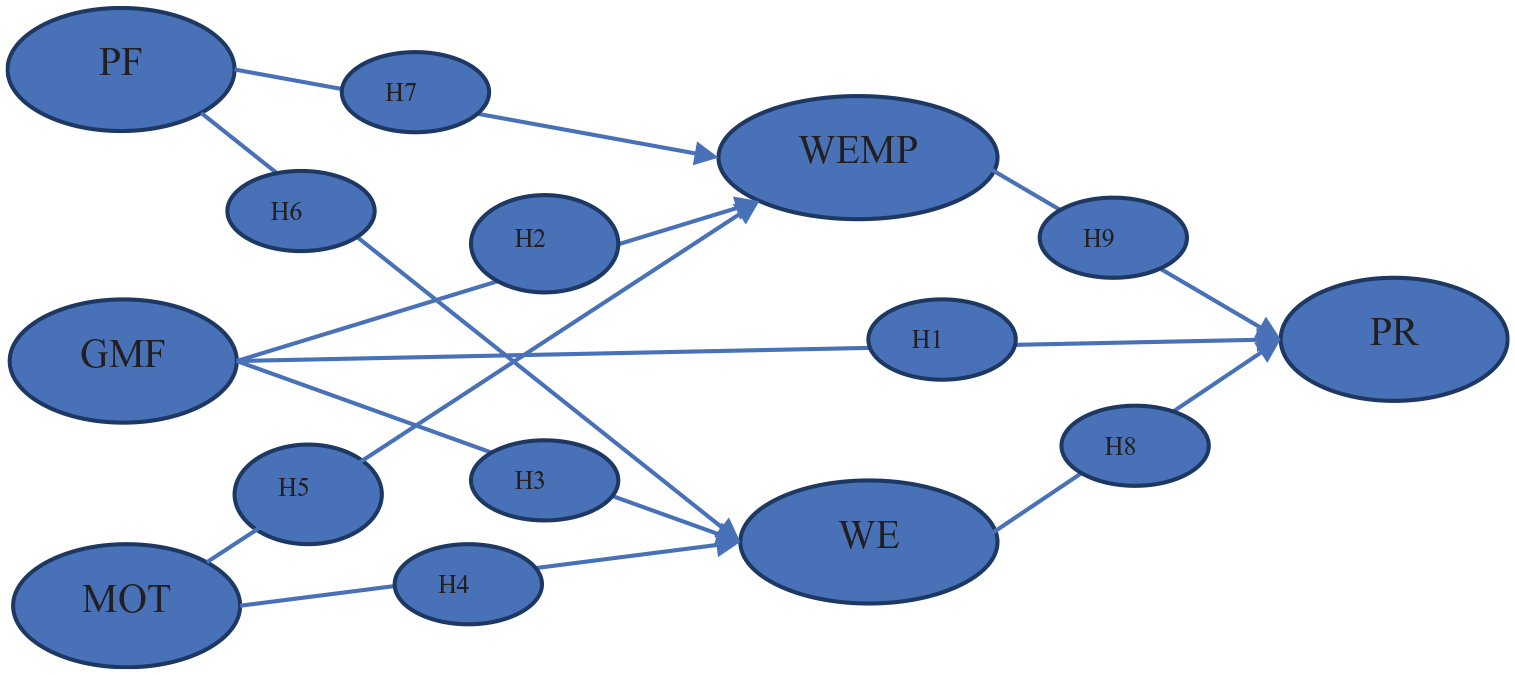
Hypothetical model.
Methods
In this study, we used a cross-sectional descriptive design. The study survey was performed in Sindh Province of Pakistan. This province is the second largest, populated, literate, and economically productive area compared to other provinces. The research was randomly conducted among microfinance banks and women entrepreneurs in the urban area.
Sampling
This study’s population consisted of women who were entrepreneurs in urban areas in the Sindh province of Pakistan. Pakistan Bureau of Statistics (PBS 2023) reports, that Pakistan’s overall population in 2023 is (241,499,431), whereas Sindh province’s total population reached 23.06% (55,696,147), with a total female population of 11.04% (26,677,501). These females are classified into two categories: urban and rural 5.131% (12,393,405) and urban 5.914% (14,284,096). Besides, the list of women entrepreneurs is not registered in the Sindh province of Pakistan. Hence we used non-probability sampling techniques of convenience sampling, a sample of 221 women from various cities in Sindh, Pakistan, was drawn. Furthermore, a sample size of at least 200 observations is needed to get reliable fit measures with structural equation modeling (Tennessen et al., 2012; Wu & Zumbo, 2008). The sample size of the current study is suitable for structure equation modeling, as suggested by the authors. The characteristic of the respondents is shown in Table 1.
Respondent’s Characteristic.

Data Collection
Data were collected by using a survey questionnaire in person. The questionnaires were adopted from the previous studies. In most cases, respondents are asked to fill out and return questionnaires that are delivered in person. The total number of questionnaires delivered was 300 of which 225 were returned. A total of 221 questionnaires were examined while others questionnaires were eliminated owing to incomplete questionnaires. The questionnaire was based on the seven Likert skills (LS) strongly disagree (SD) to strongly agree (SA). The data collecting time took 4 months from July 2023 to October 2023.
Description of the Research Questionnaire
The present study was based on a survey questionnaire. The survey questionnaire was adopted from the previous authors. Microfinance: Microfinance is an independent variable, evaluated through the seven-item questionnaire adopted from a past study (Atahau et al., 2020; Yae, 2019). Political Factor: Government support is an independent variable, evaluated through a six-item questionnaire adopted from a past study by (Zeb et al., 2019). Motivation: Motivation is evaluated through the five-item questionnaire adopted from a past study by (Zhouqiaoqin et al., 2013).Women Entrepreneurship: Women entrepreneurship is a dependent variable, evaluated through the nine-item questionnaire adapted from a past study by (R. U. Khan et al., 2021; S. N. Khan et al., 2022). Women’s empowerment was measured using five items (Atahau et al., 2020). Poverty reduction was measured using three items (Alkire & Foster, 2011).
Analysis
We used Mart-PLS-4 for structural equation modeling. Smart PLSM (Hair et al., 2021) software evaluated the data and established the significance levels for loadings, weights, and path coefficients using a bootstrapping approach. The measurement model’s validity and reliability are evaluated first, per their recommendation, and then the structural relations stated within are evaluated (Hair et al., 2014).
Results
This survey exclusively comprises female respondents. Table 1 presents the demographic attributes of the participants. The majority of participants fell between the age ranges of 30 and 39 years old. Furthermore, the majority of the respondents had obtained a bachelor’s degree. The vast majority of respondents were married in terms of their marital status. In addition, the most favorable responses about loans and funding came from banks that prioritized customer happiness through cheap interest rates, rather than focusing solely on formalities.
Measurement Model
PLS-SEM analysis begins with measurement model evaluation. The goal is to assess how well the questions suit the hypothetical idea (Ab Hamid et al., 2017). We used the reflective measurement model to evaluate item reliability (indicator reliability), internal consistency (Cronbach alpha and composite reliability), latent variable reliability, construct validity (loading and cross-loading), convergent validity (average variance extracted), and discriminant validity (Fornell-Larcker criterion, cross-loading, HTMT criterion; Hair et al., 2014).
Construct Validity and Reliability
A study by (Hair et al., 2017) reports that the test’s construct validity results will help individuals grasp quality measurements. Before assessing model connections, measurement models must be valid and reliable. This research evaluates the model’s constructs for reliability and validity. Validity and reliability are assessed using outer loadings, AVE, discriminant validity, composite reliability, and Cronbach’s values. Cronbach alpha and composite reliability are the most used methods for assessing internal consistency (Ab Hamid et al., 2017). Table 2 reveals that no measurement items were deleted because their outer loading values exceeded 0.70 in the present study. The study results show all the parameters are valid. Such as (Hair et al., 2017) report that the Convergent validity exists when the CR, AVE, and outer loadings exceed 0.50, 0.70, and 0.60, respectively. Convergent validity assesses the consistency of concept indicators. When AVE, CR, and outer loadings are 0 to 1, it is established. Convergent validity requires an AVE value greater than 0.50 (Hair et al., 2017). All of the CR, AVE, and Outer Loadings values are within acceptable parameters in this study.
Constrict Reliability and Validity.

Discriminant Validity – Fornell-Larcker Criterion
The (Fornell & Larcker, 1981) criteria are often used to quantify the model’s latent variables’ shared variance. This criterion may be used to evaluate the measurement model’s convergent validity using AVE and CR. Discriminant validity is measured using Fornell-Larcker and cross-loading. Table 3 shows that off-diagonal values for each construct are less than the square roots of AVE values, meeting the Fornell-Larcker criterion.
Discriminant Validity (Fornell-Larcker Criterion).
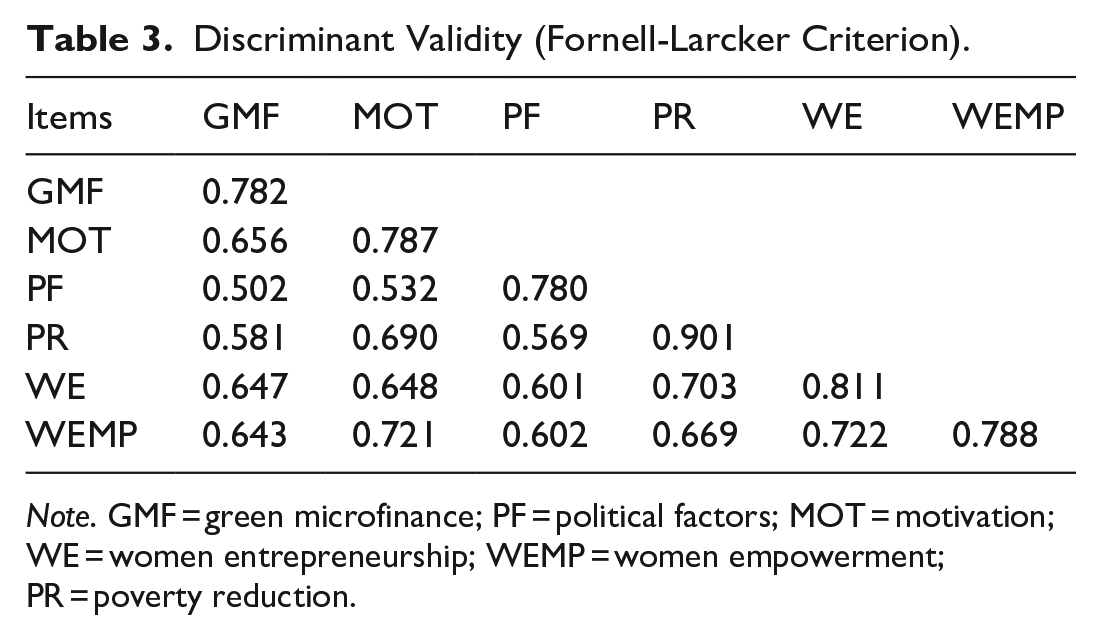
Note. GMF = green microfinance; PF = political factors; MOT = motivation; WE = women entrepreneurship; WEMP = women empowerment; PR = poverty reduction.
Discriminant Validity – Heterotrait-Monotrait Ratio (HTMT)
HTMT correlation ratio measures discriminant validity. The structural model’s discriminant validity ensures that each construct evaluates a separate topic. Authors (Gold et al., 2001) explain the HTMT value should be less than 0.90 to establish discriminant validity. If the HTMT value is more than 0.90, it is argued that discriminant validity is lacking. Table 4 shows the HTMT ratio for all structures is less than 0.90 which funding shows the discriminant validity is valid.
Discriminant Validity Heterotrait-Monotrait Ratio (HTMT).

Coefficient of Determination (R2)
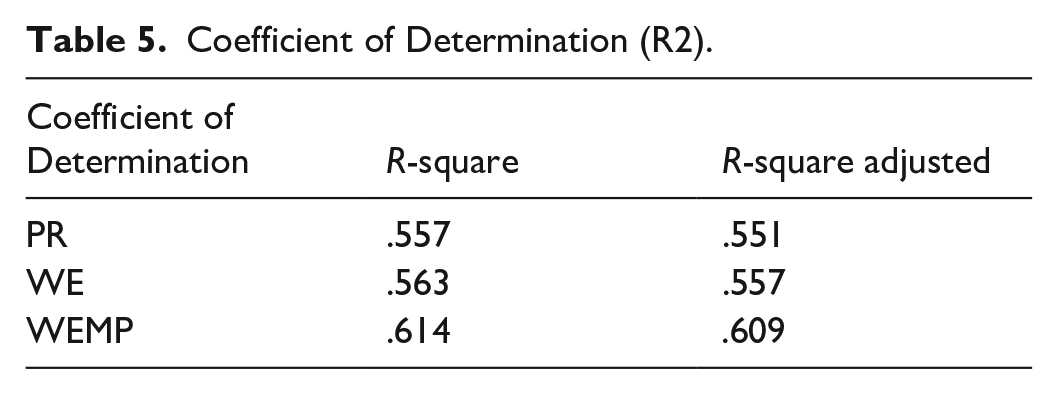
Table 5 displays the overall effect size and variability caused by independent variables, as well as the model’s prediction accuracy as measured by R2. PR R2 is 0.557, showing that the PR accounts for 57% of the variation. Also, WE R2 is 0.563, indicating that 56% of women are entrepreneurs, and WEMP R2 is 0.614, indicating that 61% can be increased with the GMF, PF, and MOT programs. It demonstrates that green microfinance, political issues, and motivation are the most important aspects in promoting women’s business and empowerment, as well as alleviating poverty in Sindh Province Pakistan.
Coefficient of Determination (R2).
Structural Relationships and Hypothesis Testing
Table 6 presents research in which all hypotheses are supported. The study found that GMF had a favorable impact on PR (β = .130, t = 2.111, p-value .035), supporting hypothesis H1. H2 GMF -> WE (β = .312, t = 4.939, p-value .000) is significant, while H3 GMF -> WEMP (β = .230, t = 4.429, p-value > .000) is also supported. We evaluated hypothesis 4 that motivation affects women’s entrepreneurship and found that MOT -> WE had a significant positive impact (β = .288, t = 3.968, and p-value > .000). Our hypothesis (H5) suggests that motivation improves women’s empowerment (β = .434, t = 6.409, p-value > .000). Furthermore, H6 and H7 investigated if political factors had a favorable impact on women’s entrepreneurship and empowerment. The study found a positive link (β = .292, t = 6.258, and p-value > .000) between political factors and WE, as well as a positive relationship (β = .256, t = 5.243, and p-value > .000) between WE and WEMP. Alongside that in our study we H8 and H9 that women entrepreneurship and women empowerment can elevate poverty. The result show positively significant WE -> PR, (β = .409, t = 4.885, and p-value > .000) and WEMP -> PR, (β = .291, t = 3.223, and p-value > .001). Therefore, all of the hypotheses are accepted. The outcomes are shown in Table 5. Microfinance, Political factors, and motivation were found to have significant, highly positive, and direct effects on women’s entrepreneurship and empowerment. Similarly, women’s entrepreneurship and empowerment positively influenced elevated poverty.
Hypothesis Description (Boat Trapping).

Figure 2 depicts the pattern of interactions. It demonstrates that when women entrepreneurs and women’s empowerment have substantial support from the GMF, MOT, and PF, their chances of success increase, hence elevating poverty. Women who are strongly motivated to become entrepreneurs are more likely to seek microfinance loans to start and grow their businesses.

Structure equation model (boat trapping).
Discussion
The majority of poor women in the global South receive services from microfinance institutions, and the majority of quantitative assessments of these initiatives show that women’s economic, social, and political empowerment is a direct result of having access to credit (Dowla, 2006; Ito, 2003; Padia, 2005; Rajivan, 2005). The current study examined the influence of microfinance, motivation, and political factors on women’s entrepreneurship and empowerment, and their potential to alleviate poverty in Sindh, Pakistan. The research established a correlation between microfinance and the promotion of women’s entrepreneurship (Thaher et al., 2021). Women’s entrepreneurship addresses women’s standing and entrepreneurship in society. Microfinance has a notable influence on domestic economic growth, namely on the Gross Domestic Product (GDP). Furthermore, there exists a large correlation between growth and microfinance (Sultan & Masih, 2016). Besides, microfinance variables have a favorable effect on female entrepreneurs (Ekpe et al., 2010). Microfinance provides financial services to individuals who are financially disadvantaged and unable to access traditional banking services such as bank accounts, personal loans, or bank loans. Women have greater opportunities to develop firms when they have access to loans. However, the primary challenge in Pakistan when it comes to starting a business is the lack of financial resources. Women have the ability to initiate entrepreneurial ventures through the utilization of microfinance. It enhances their self-confidence, status, and authority, hence fostering gender parity (Loomba, 2014).
Besides, Political considerations affect women’s entrepreneurship. Government assistance for women’s entrepreneurship boosts the economy (H. Y. Ali et al., 2019). The majority of Pakistan’s rural areas are home to a feudal system that devalues women and denies them the rights guaranteed by the law and the global teachings of Islam (Baig et al., 2018). Women in Sindh generally have a difficult time using their constitutionally guaranteed rights to exercise political influence. The state’s governmental entities must solve this for Sindhi women to participate fully in politics (Memon & Idris, 2018). While women are involved in the Sindh political cabinet thus they may raise their voices for women’s rights likely equal opportunity in all things. Furthermore, Women can become economically independent cheers of government incentives and families’ shift away from traditional families (Adetiloye et al., 2020). Research shows that women are entrepreneurial talent and development tools (Solesvik et al., 2019). Respondents perceive that the government assists women entrepreneurs. The Pakistani government provides financial and emotional support to encourage women entrepreneurs. Government aid plays a beneficial role in fostering entrepreneurship and promoting economic progress (Acs et al., 2004; Gohar & Abrar, 2016; Hernández, 2010; Kumar & Liu, 2005).
Also, motivation (MOT) profoundly affected women’s entrepreneurship. Authors (Chaudhary & Sharma, 2012) state that motivation is an internal factor that energizes employees to act in a certain way. Also, there is a significant and positive correlation between entrepreneurial motivation and the choice to become an entrepreneur (Collins et al., 2004). An ambitious lady strategically pursues her goals with optimal efficiency (Owusu, 2012). Individuals can be intrinsically motivated if they show determination when faced with difficulties and problems, and they will spend more time and attention on completing tasks. Motivation improves professional skills. Motivated people use supervisor feedback to improve. Women’s motivation affects how hard people strive to improve, which helps businesses succeed. This shows that highly motivated people work better. The present study’s findings are consistent with a previous study conducted (A. Y. S. Ali & Mahamud, 2013). Their study found that motivated women start and expand enterprises. Motivating women boosts their performance, which boosts productivity and corporate success. Motivation positively affects women’s entrepreneurship in Pakistan.
Furthermore, in Pakistan, the promotion of women’s entrepreneurship and empowerment aims to alleviate the burden of poverty. The poor situation of women’s financial insertion is caused by several things, including a lack of financial education, entry barriers to formal financial institutions, socio-social obstacles, awareness of finance mobilization, and restricted loan availability, particularly in Sindh’s rural areas (Shakoor et al., 2021). Pakistani women also desire equitable possibilities to elevate their societal standing, develop their enterprises, and make financial contributions (S. N. Khan et al., 2019; Razzaq et al., 2019). When women initiate a company start-up, they generate an increasing number of job prospects for other women, thus paving the way for them to sustain their families, enhance their social standing, and eliminate poverty (Shaheen et al., 2018). Multiple studies indicate that empowerment has the potential to decrease both income and consumption poverty (Alsop et al., 2006). Poverty reduction and employment creation are the key objectives of the country’s development goals, as stated in (Al-Shami et al., 2013). Empirical evidence from a study suggests that women who are empowered make a good impact by augmenting their household income and standard of living, while simultaneously alleviating poverty (Gu & Nie, 2021).
Conclusion
This research examined microfinance, political variables, and motivation to enhance women entrepreneurs and empowerment to alleviate poverty in Sindh Pakistan. The study’s findings supported all hypotheses. Microfinance, political issues, and motivation favorably affect women’s entrepreneurship and empowerment and elevate poverty. Entrepreneurial women with stronger motivation can be more successful. Motivated women’s work can be better to enhance women’s business and economic success to elevate poverty. This shows that microfinance variables are interconnected and must be examined. Microfinance, political factors, and motivation affect women’s entrepreneurship and empowerment is rising rapidly to decrease the ratio of poverty through women’s empowerment. Women’s entrepreneurship addresses entrepreneurship and women’s status in society thus it could be fruitful to cut the poverty. This study applies entrepreneurship’s desire for accomplishment theory to microfinance, political considerations, motivation, and women’s entrepreneurship. Motivation improves microfinance’s effect on women’s entrepreneurship and empowerment, while the WE and WEMP play a beneficial role in economic growth to cut poverty. Furthermore, the study revealed family income and standard of life increased to alleviate the poverty ratio in Sindh province of Pakistan. Sindh government should support women’s entrepreneurship and empowerment to enhance economic growth to minimize the poverty ratio through microfinance, political factors, and motivation which could enhance the business system and economic growth system to cut the poverty in Sindh Pakistan. Furthermore, future studies promoting the culture of women entrepreneurship and comparing between rural and urban regions may be fruitful for organizations, states, and nations.
Implications
Limitations
The research has some limitations as it examines the impact of microfinance political variables and incentives on women entrepreneurs and their empowerment to alleviate poverty.
Footnotes
Acknowledgements
The authors acknowledge the enormous support offered by the National Natural Science Foundation of China; and Jiangsu Outstanding Postdoctoral Program; and thank them for their participation and the reviewers for their suggestions.

Ethical Considerations
The study was conducted according to the guidelines of the Declaration of Helsinki and approved by the Research Ethics Committee School of Management Jiangsu University China.
Consent to Participate
Informed consent was obtained from all study participants.
Author Contributions
Each Author has a significant contribution to this study. The (S) developed the research concept, and wrote the initial draft; (ZM) Funding Sourced and revised paper; (ML) revised and funding sourced; (MQM) collected data and analyzed data; Finally, all authors read and approved the final manuscript.
Funding
The author(s) disclosed receipt of the following financial support for the research, authorship, and/or publication of this article: This study is financed by the Jiangsu Outstanding Postdoctoral Program (2022ZB642) and the National Natural Science Foundation of China grant number (71974082).
Declaration of Conflicting Interests
The author(s) declared no potential conflicts of interest with respect to the research, authorship, and/or publication of this article.
Data Availability Statement
Data for the study is available and will be supplied upon request.