




Abstract
In higher education, writing success is strongly related to writing motivation. Feedback on learners’ written texts significantly contributes to promoting motivation. While some studies have explored feedback sources beyond teachers, such as peer and computer-based feedback, few have examined the combined impact of these two sources on writing motivation. This study investigates whether the integration of peer and computer-based feedback enhances undergraduate students’ motivation to acquire English writing skills. In this quasi-experimental study, data were gathered from 40 Saudi English as a foreign language (EFL) learners enrolled in a bachelor’s degree in English programme. Participants were divided into two groups (experimental, n = 21; control, n = 19). Pre- and post-questionnaires comprising background information, 14 motivational statements (items), and an open-ended section were administered. The study spanned 12 weeks, during which participants received training in providing and receiving peer feedback and utilising a computer-based feedback tool. They engaged in four writing cycles, culminating in multi-draft essays. Wilcoxon signed-rank test assessed the statistical significance of pre- and post-test changes. The findings indicate a high level of motivation among Saudi EFL learners to develop writing skills. Additionally, no significant differences in responses in the post-test were observed. Notably, Saudi EFL learners maintain a close connection with their teachers, considering them the most reliable source of feedback. The study concludes with implications and recommendations for future studies.
Introduction
In some contexts, specific teaching strategies employed by instructors may result in academic underperformance among second language learners (Doiz & Lasagabaster, 2021; Kaivanpanah et al., 2021; Tu & Ego-Ugan, 2024; Waite et al., 2020; H. Wang et al., 2017), potentially limiting their ability to apply foreign language knowledge in real-world situations. In higher education, universities often allocate significant curriculum hours to support and educate second language learners to become proficient writers. A consensus exists among researchers that motivation is an integral aspect of success in writing (Panagiotidis et al., 2023). This suggests that writing instructors should consider theories and innovative practices to stimulate learner motivation. Highly motivated learners may invest greater efforts in skill improvement, extending their efforts beyond the classroom context (Rochovská, 2024).
In current language education, innovation is essential for successful learning, particularly because technological and theoretical advancements have given way to excellence in teaching and learning. Researchers have extensively examined new approaches, techniques, and technological assistive devices to provide learners with better learning experiences in their classrooms. Integrating such technologies into various learning situations can promote learning. Some of these tools can assist in providing feedback formatively on learners’ performance. Feedback is known to be vital in improving learning. However, it can cost learners motivation toward learning if not appropriately delivered. It is argued that constructive feedback can increase English as a foreign language (EFL) students’ motivation and decrease their anxiety (Ahmetovic et al., 2023; Waller & Papi, 2017). Effective feedback provision by teachers can both enhance their students’ performance and elevate their motivation in learning the target language. Peer feedback (PF) technique and computer-based feedback (CBF) are identified as impactful sources of feedback, known for their timely and effective delivery (Alnasser, 2022b; Chang & Windeatt, 2021), thereby promoting writing motivation. Regarding performance, El Ebyary and Windeatt (2010) reported that CBF can improve EFL students’ writing. This study was conducted in an EFL context where students do not get sufficient feedback on their writing due to large classes where teachers do not have enough time to address the shortcomings in the essays written by each student. Duly feedback is important for students in EFL writing classes because it determines their accomplishment in later classes they take in the BA programme and success in their future careers. EFL students’ need to become aware of their mistakes and the ways in which they can improve their writing skills necessitates searching for alternative feedback provided by sources other than the teacher. Hence, the current study investigates the joint impact of PF and CBF on Saudi EFL learners’ motivation to develop writing skills. To achieve this goal, the students’ motivation levels needed to be determined prior to the intervention. Hence, the research questions were formulated as follows:
How motivated are Saudi EFL undergraduate learners to develop their English writing skills?
Does exposure to PF and CBF impact their motivation? If so, how?
Literature Review
Mastering writing skills is crucial for higher education students in order for them to effectively convey their thoughts and meet their course requirements (Alqasham & Al-Ahdal, 2022). Nevertheless, first- and second-language learners commonly show weaknesses in their writing skills (Bailey & Bizzaro, 2022; Cho & Schunn, 2007). According to Khasawneh (2023), some of the writing challenges pertinent to Saudi students include paragraph organisation, cohesion, and writing flow. Addressing these challenges and how can they best be overcome is essential, given that the better an individual becomes at writing, the better they acquire other language skills (Lestuny, 2024; McCutchen, 2011), and those successful in writing may demonstrate their understanding of acquired knowledge in other disciplines (Cho & Schunn, 2007). Success in writing requires fulfilling learners’ needs (e.g. feedback provision) and positively impacting their motivation, which may bring forth the need to use supportive sources of knowledge in the classroom.
Motivation can be defined as a ‘theoretical construct used to explain the initiation, direction, intensity, persistence, and quality of behaviour, especially goal-directed behaviour’ (Brophy, 2004, p. 4). It is integral to learning because it can lead to determination, persistence, and deeper task engagement in learners (Panagiotidis et al., 2023). Motivation is also at the core of the internal and external forces that influence behaviour, cognition, and emotions (Ng, 2023). In learning contexts, motivation driven by innovation may lead to several benefits, such as identity development and autonomy (Panagiotidis et al., 2023). Furthermore, writing motivation—defined as ‘student’s level of interest, values, effort, goal orientation, and outcome attributions as they refer to writing’ (Wilson & Roscoe, 2020, p. 92)—is essential for improving written text quality and can lead to better writing proficiency (Graham et al., 2007). Rochovská (2024) suggested that learners with higher motivation tend to write more text inside and outside the classroom. A principal source of motivation for learners is the feedback received from different sources such as teachers, peers, and computers (Duijnhouwer et al., 2010; Pajares, 2003), which can play a significant role in enhancing learning motivation (Nicol & Macfarlane-Dick, 2006). Several studies demonstrate that CBF use (vs. adopting basic word processors) led to greater writing motivation (Morphy & Graham, 2012; Sadiq, 2023; Warschauer & Grimes, 2008).
Relevant literature shows that success in writing involves feedback provision to learners, as feedback can positively impact their writing skills. Feedback provision is closely related to the concept of scaffolding, especially when two parties provide and receive feedback (William, 2002). The focus on feedback in the learning and teaching of writing emerged around the 1970s when investigations on writing instruction started to focus on learner-centred approaches that included feedback provision at their core (Hyland & Hyland, 2006; Zhang & Hyland, 2022). Providing feedback on students’ texts informs them about their weaknesses and how they can overcome them (Phuwichit, 2016). Moreover, the mode of feedback delivery can significantly affect learners’ motivation to develop linguistic skills (Kuklick & Lindner, 2021; Pearson, 2022; Shang, 2022). According to Van Steendam et al. (2010, p. 319), feedback provision adequacy refers to ‘detailed feedback which addresses global concerns in a text, uses metalanguage to diagnose textual problems, and suggests specific revisions’. Maheshi et al. (2024) and Wabwile et al. (2024) argued that feedback can significantly impact learning objective achievement. Additionally, feedback offered shortly after producing a text can have a great impact on learners’ writing skills (Brown et al., 2006; Rodríguez et al., 2022) and may motivate them to write further. Considering these pieces of evidence in the literature, this study suggests that offering learners timely and adequate feedback may encourage them to become better writers.
Although writing instructors acknowledge feedback as an integral part of learning (Alharbi, 2022), they often face challenges when it comes to providing feedback. Some of these difficulties are due to the increasing number of students participating in higher education every year, all of whom must undertake writing courses as a prerequisite (Huxham, 2007). Furthermore, the nature of writing and its learning process is complex; for example, both global and local writing features must be professionally considered to create a piece of writing that will be revised to produce improved drafts (Min, 2008). Thus, the complexity of the learning process can overwhelm writing instructors in their feedback provision activities and may lead to limited feedback (Grimes & Warschauer, 2010; Lee et al., 2009; Rodríguez et al., 2022). Another challenge pertains to student preferences. In a recent study conducted in the Saudi context, Aldukhail (2023) surveyed the perceptions of 94 undergraduate students regarding their preferred type of feedback. The findings revealed a preference for teacher feedback as opposed to other types such as self-directed feedback and PF.
Extant studies also provide empirical evidence on the positive effects of feedback provision and its various sources on writing learners. For instance, in a study on a sample of 70 Chinese EFL students by Shen et al. (2020), the results of the experimental group showed that peer feedback significantly improved learner autonomy and reduced students’ dependence on writing instructors. The type of feedback provided to students may yield different performance levels, as shown in Latifi et al.’s study on three types of online feedback: scripted, unscripted and guided. The students provided with scripted peer feedback performed better than the students exposed to the two other feedback conditions. Yu (2021) also found that peer feedback helped their sampled postgraduate students with academic writing skills. It has been shown to develop learners’ critical thinking towards written texts, create active learning environments, promote learning self-regulation, and allow for timely feedback provision (Rollinson, 2005). Panadero et al. (2018, p. 411) stated that PF refers ‘to the provision of qualitative information about student performance (e.g., strengths and weaknesses), but without a peer-awarded score or grade’. Considering this definition, PF may be better used formatively than summatively (Zhan et al., 2022). According to the sociocultural theory, PF can be considered a social activity (Hu, 2019), one that involves interactions mediated by discourses and social structures within Vygotsky’s (1978) concept of the zone of proximal development (Villamil & de Guerrero, 2006). Although the reliability of PF can be questioned, such concerns can be mitigated by offering students proper training on peer text evaluation and using the PF formatively rather than summatively (Min, 2008). Considering these studies, we believe that PF holds the potential of allowing each student to receive prompt feedback for every produced text.
The attention of practitioners and researchers has been drawn towards technology integration in the context of language classrooms in recent years because it can improve learning experiences. For example, Burkhart et al. (2020) compared between feedback made by human experts in writing with automated feedback provided by CohViz feedback system to validate the reliability and validity of this software. Their study involved the analysis of 100 texts written by students. The results showed that the two types of feedback showed similarities in concept maps generated by CohViz and the human raters. Chang and Windeatt (2021) investigated the impact of using a writing e-book on students’ academic writing skills. The study was conducted on 80 EFL students at the University of Southern Queensland, Australia. The sampled participants easily adapted to the use of e-books and the blended learning approach in the teaching of academic writing. In a study on the Saudi context, Nasim et al. (2022) investigated the efficacy of the integration of digital technology in the teaching of speaking skills. Their sample, comprising 50 Saudi male EFL students, showed significant differences between the experimental and the control group, in favour of the use of technology to teach pronunciation. The COVID-19 pandemic has also accelerated educators’ valuing of technology integration in learning, as it allows for overcoming possible learning disruptions and enhancing learning experiences (Morgan, 2020; Tanveer et al., 2020). In writing instruction, CBF can help students achieve the zone of proximal development (Alnasser, 2022b; El Ebyary & Windeatt, 2010), as the machine-generated feedback can act as an expert pushing the learner to reach an advanced learning zone.
Although technology employment in writing instruction can be extremely rewarding (Chang & Windeatt, 2021), some researchers hold a more traditional view, claiming that technology integration into writing classrooms may not require students to write using their hands and that technology offers autocorrections of mistakes, limiting the promotion of learners’ critical skills (e.g. Abd Elwahab & Abd Elmajid, 2023; Chen et al., 2011). Nonetheless, there has been a recent and massive shift in research towards advocating for technology use as an integral part of writing classrooms. For example, Alnasser (2018) conducted a ten-week study on a sample of 15 Saudi male students to analyse their perceptions towards replacing teacher feedback with PF in a writing class. The results indicated that students favoured teacher feedback of PF. Yet, the small sample size could have impacted the results. Alnasser (2022b) also conducted a study on 40 Saudi EFL students to investigate their perceptions on CBF after receiving automated feedback on their essays. The sample showed positive attitudes towards this type of feedback (also see Attali, 2004; Burkhart et al., 2020; El Ebyary & Windeatt, 2010; Lachner & Neuburg, 2019; Sherafati & Largani, 2023). Moreover, research on CBF in writing instruction has addressed several areas, such as the impact of automated feedback on written texts. For instance, Coniam (2009) compared the feedback generated by BETSY, a CPF system, with human raters. The study used feedback generated on 900 essays written by Korean EFL students and revealed no major differences between humans’ and BETSY feedback. Similar findings were also found in another empirical study by J. Wang and Brown (2007). They compared auto-generated summative assessment of written texts with the ratings made by human raters and found no significant differences). The classroom-based investigation of the use of CPF in writing classes revealed different practices by EFL teachers in terms of successfully employing this type of feedback, showing the importance raising teachers’ awareness of the importance and CPF and how to best make use of it in EFL teaching (also see Dikli, 2006; Powers et al., 2001 for a critical analysis of CBF authenticity). Notwithstanding, to the best of our knowledge, no study thus far has conducted investigations that combine CBF and PF as feedback sources in writing classrooms, nor have measured their impact on learner motivation. Although one study combined the two sources to explore whether they could replace teacher feedback (Alnasser, 2018), it did not address the motivation component. This study aims to fill this research gap.
The studies cited above show that writing motivation is integral to second-language student writers and that instructors should consider innovative ways to maintain and improve learner motivation. Furthermore, feedback can impact writing motivation if properly delivered. This requires providing learners with sufficient, timely, and adequate feedback from different sources. PF and CBF are two alternative feedback sources that hold the potential to compensate for the lack of teacher feedback while enabling timely and adequate feedback provision. PF can be encouraging to learners to actively give and receive feedback. CBF can also be motivating to learners because it integrates artificial intelligence into their learning. Combining these two sources in an EFL writing classroom and examining how they can jointly impact writers’ motivation form the scope of this study.
Methods and Procedures
This study investigates how Saudi EFL learners’ writing motivation is impacted by integrating CBF and PF into writing classrooms. This study was approved by the appropriate research and ethics committee of the university to which the researchers were affiliated. A quasi-experimental research design was employed because of the non-possibility of randomly assigning students to different sections of the writing course. Specifically, students choose to electronically register in available sections and there is no intervention from the researchers or the university administration in this process. In quasi-experimental designs, participants are not assigned to each group randomly (see Bryman, 2012; Mackey & Gass, 2022).
Research Framework
As detailed in the following subsections, the participants were divided into an experimental and a control group. The motivation levels were measured before and after the experiment. The experimental group also completed a questionnaire investigating their experience with the treatment they received (i.e. PF and CBF). Both quantitative and qualitative data were collected in this study. As for the experiment, it included introducing a CBF and PF treatment while excluding teacher feedback and administering pre- and post-questionnaires. The pre-questionnaire included a background section with four items enquiring about the participants’ writing quality and previous experience with receiving teacher feedback, PF, and CBF. The pre- and post-questionnaires included 14 items measuring motivation before and after exposure to the treatment and an open-ended section, which served to obtain deeper insights into the investigated phenomenon. The items were responded to on a five-point Likert scale ranging from 1 to 5 (5, strongly agree; 1, strongly disagree). The questionnaires were made by the authors and validated by three professors in applied linguistics who are experts in the field. After the validation process, the questionnaires were piloted with 12 undergraduate students affiliated with the same bachelor’s degree programme, and modifications were made to the questionnaires. These 12 students did not partake in the main study. Figure 1 below summarises the research framework of this study.

Research framework.
Study Participants
A nonprobability purposive sampling technique was adopted in this study. Bryman (2012) and Cohen et al. (2011) explain that non-probability sampling enables researchers to select participants who meet the purpose of the study. They claim that this selection can allow for obtaining appropriate data for answering the research questions. The current study investigated Saudi EFL student-writers in a higher education context, which involves experimenting them for several weeks. Therefore, the first author sought to act as the instructor of two sections of a writing course and carried out the investigation, simply because this approach was the only means of reaching the participants and collecting the required data. These two sections were the only writing sections offered at the time of conducting the study and therefore no additional participants were available.
The participants included male Saudi students pursuing a bachelor’s degree in English at a Saudi university. Only male students were included because the educational system of the university segregates male and female students and places them on different campuses. Cultural restrictions prevent male researchers from gaining access to female students. The participants received instruction in English before joining the bachelor’s degree programme. Specifically, they took English courses for 6 years in public schools at the intermediate and secondary levels. During data collection, the participants were in their second year of the bachelor programme and were pursuing an advanced writing course, which was considered suitable for the study because the course syllabus mainly focuses on essay writing. The 40 participants were divided into two groups (control group, n = 19; experimental group, n = 21). The control group was employed to explore the current status of writing motivation in a wider student population.
Procedure
After obtaining approval from programme administrators, the researcher taught two advanced writing sections. In the first session, the researcher explained all study procedures and mentioned that participants had the right to participate, not participate, or withdraw at any time, and that their data would be deleted immediately after withdrawal. Additionally, they were assured that their personal information would not be revealed at any point and that their participation would not impact their course grades or assessments. All students in the two sections consented to participate, and a pre-questionnaire was administered to both groups.
The course was taught following the approved curriculum, which mainly addressed topics relevant to essay writing, such as stages of writing an essay, as well as argumentative and narrative essays. The course comprised three credit hours per week divided into two sessions. In the first 2 weeks, participants in the experimental group read exemplary essays silently, critically analysed and discussed them with the instructor, and developed an essay as practice. In week three, the instructor demonstrated step by step how to provide FB using Min’s (2008) evaluation form and the evaluation criteria proposed by Alhazmi and Schofield (2007). The training session aimed at improving the participants’ ability to provide peer feedback in four main areas: explaining writers’ intentions, spotting problems, clarifying problems, and making recommendations. Subsequently, participants exchanged the essays that they had already developed and practiced PF provision with one another. In week four, the CBF system (Criterion® Online Writing Evaluation service) was introduced, and the instructor demonstrated how participants could enter their texts into the automated system and how to make use of the automated feedback generated by the system. During these 4 weeks, the participants sought clarification and assistance in different areas, and the instructor provided timely assistance. By the end of the fourth week, the participants had acquired knowledge of essay writing, PF provision, CBF system use, and multiple draft development.
In the following weeks, the participants in the experimental group went through four cycles of essay writing. In each cycle, they developed a three-draft essay and received feedback on the essay from CBF and PF, with no teacher feedback. Aside from essay topic variation, all essay writing cycles were identical (see Figure 2). Each cycle was 2 weeks long and encompassed four sessions. In session one (S1), the instructor taught the course material, and the participants developed the first drafts of the essay topic in class, which were then exchanged with their peers. The essays were taken home, evaluated based on the adopted evaluation criteria, and brought them to class in the following session. In session 2 (S2), the participants attended one-to-one conferences in which they discussed their evaluations. At home, the participants were requested to revise the essays according to the PFs received, develop a second draft, and bring it to class in session 3 (S3). In S3, the instructor ensured that the work was performed as planned, and requested participants to type in their revised essays into the automated system at home for CBF generation, and then revise the essay accordingly to develop a third draft, which was then to be submitted in session 4 (S4). The course materials were taught in every session to achieve the intended learning outcomes set out by the programme. The duration of the study was 12 weeks, during which the participants developed four multi-draft essays. Finally, a post-questionnaire was administered to the experimental group, concluding the data collection.

Experimental writing cycle.
Data Analysis
Responses to the questionnaire items were computed using SPSS, and frequencies were calculated for each item. Means and medians were also calculated as they are considered more appropriate for ordinal data analysis. The first research question was responded to by analysing pre-questionnaire data obtained from both groups. To answer the second research question, the experimental group pre- and post-questionnaire data comparisons were conducted using Wilcoxon signed-rank test and mean and median differences. The Wilcoxon test allows for measuring the statistical significance of the differences, if any, between the means of the responses for each item (cf. Kinnear & Gray, 2012; Larson-Hall, 2010). This test is useful when dealing with symmetric data (Meek et al., 2007), but it also yields accurate results with asymmetric data (Doane & Seward, 2007). Since this study compares responses of two small groups to Lickert scale items, where symmetry/asymmetry can change if more participants were available, Wilcoxon signed-rank test was used in the current study. Additionally, the comments in the open-ended section of the pre- and post-questionnaires were analysed.
Results
Regarding student background, most students (n = 31) reported ‘average’ writing skills quality, ‘infrequent’ or ‘rare’ for the frequency of receiving teacher feedback (n = 23), and no previous experience with CBF (n = 33). Over half of the participants reported previous experience with PF in writing classrooms (n = 25) and rarely received this type of feedback (n = 24).
To confirm scale reliability, we measured interrater reliability for the 14 questionnaire items using Cronbach’s alpha. The test outcome was 0.847, indicating adequate reliability (Table 1).
Reliability Test.

Table 2 shows the responses of participants from both groups to the pre-questionnaire items that measured motivation to improve writing skills. These responses reflect the current stance on students’ motivation to learn writing in similar contexts.
Pre-Questionnaire on Motivation Used in the Experimental and Control Groups.

The results showed high motivation on 12 items, with a mean and median range of 4.00 to 4.53 and 4 to 5, respectively. Thus, most participants either strongly agreed or agreed with the questionnaire statements and reportedly had high motivation before treatment exposure. Further analysis of these 12 items showed that the participants strongly agreed with four items (vs. all other items), as follows: Item 2 reflects willingness to expend efforts to learn composition (n = 22); Item 5 suggests prioritising learning writing for English language proficiency development (n = 21); Item 7 reflects determination to overcome difficulties that may be encountered in writing (n = 25); Item 10 displays expending efforts in learning grammar to impact their writing positively (n = 23). These findings suggest that when learners prioritise the learning topic, they demonstrate a strong will and determination to learn. Additionally, their keen interest in focusing on specific aspects, such as learning grammar, can be interpreted as a sign of seriousness about their learning process, which in turn reflects their motivation to succeed.
The means of the other two items, items 1 (I am confident I will push myself to improve my writing skills) and 11 (I read considerably to improve my writing style), were below 4 but higher than 3 (i.e. 3.25 and 3.8, respectively), with a median of 4. More than half of the participants either agreed or strongly agreed with both items. Moreover, these two items were the only ones that had higher frequencies on the negative direction of the scale; that is, nine participants disagreed with item 1, and 10 participants were not sure about item 11. The two items may be considered to be somewhat linked, as both measure the will to expend efforts towards learning writing outside the classroom setting. Thus, several participants did not reflect such will, and the 10 participants who reported not sure might not have seen a clear link between reading and writing development. Overall, the results suggest that Saudi EFL learners are highly motivated to improve their writing skills.
As the post-questionnaire was administered only to the experimental group (n = 21), we analysed the experimental group’s responses to the pre- and post-questionnaires to explore the impact of the treatment. Pre-questionnaire responses of the experimental group (see Table 3) were considerably similar to those of the two groups combined (see Table 2), suggesting participant homogeneity in both groups.
Comparison Between Pre- and Post-Questionnaire Responses in the Experimental Group.
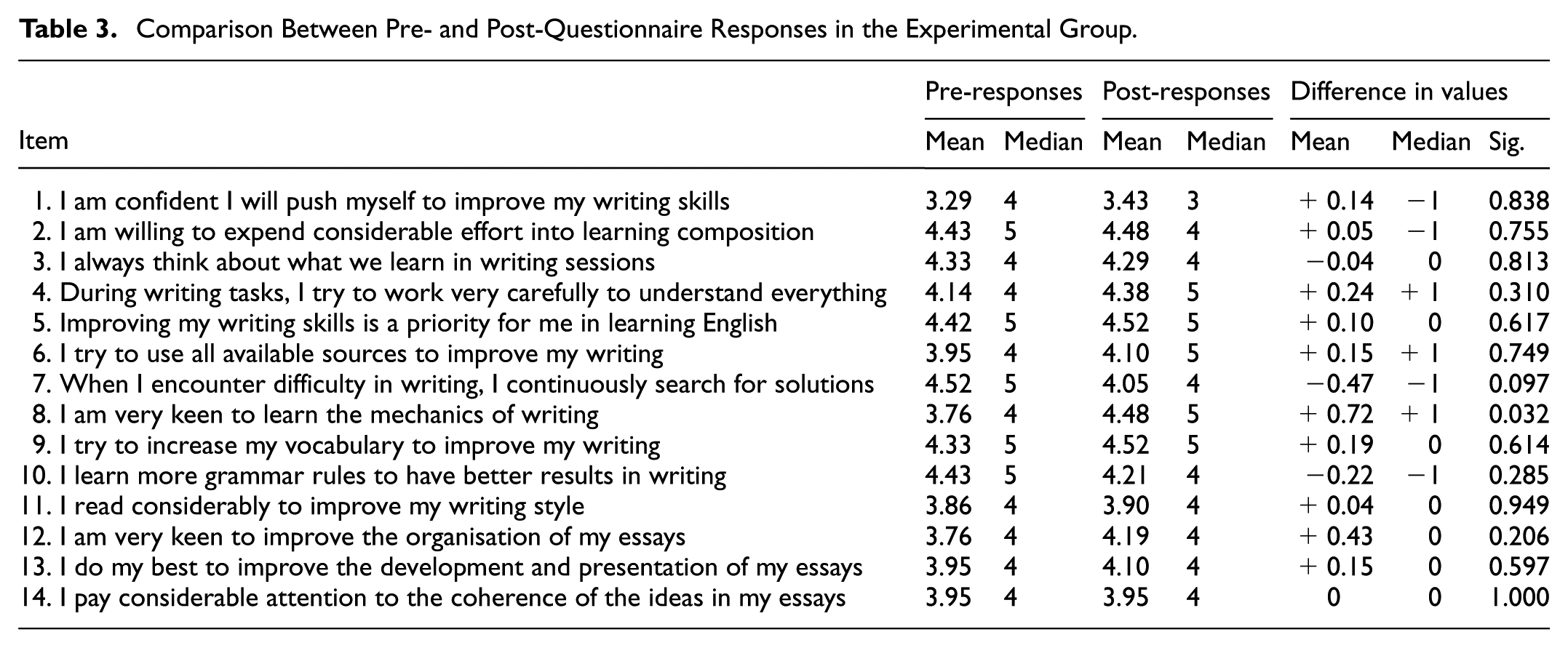
Results of the Wilcoxon signed-rank test (Tables 3 and 4) showed that there was a positive change in responses to 10 items, albeit only item 8 showed a statistically significant positive change (pre-mean = 3.76; post-mean = 4.48; pre-post mean difference = 0.72; p = .032). Item 8 reflects the participants’ keenness to learn the mechanics of writing, and the significant change may suggest that both PF and CBF positively influenced their knowledge of the mechanics of writing (i.e. may have a greater impact on the local-level writing features). The lack of significance in the positive change of the other items may suggest that PF and CBF may contribute to maintaining previously acquired motivation even in the absence of teacher feedback.
Wilcoxon Signed-Rank Test Results for the Experimental Group.
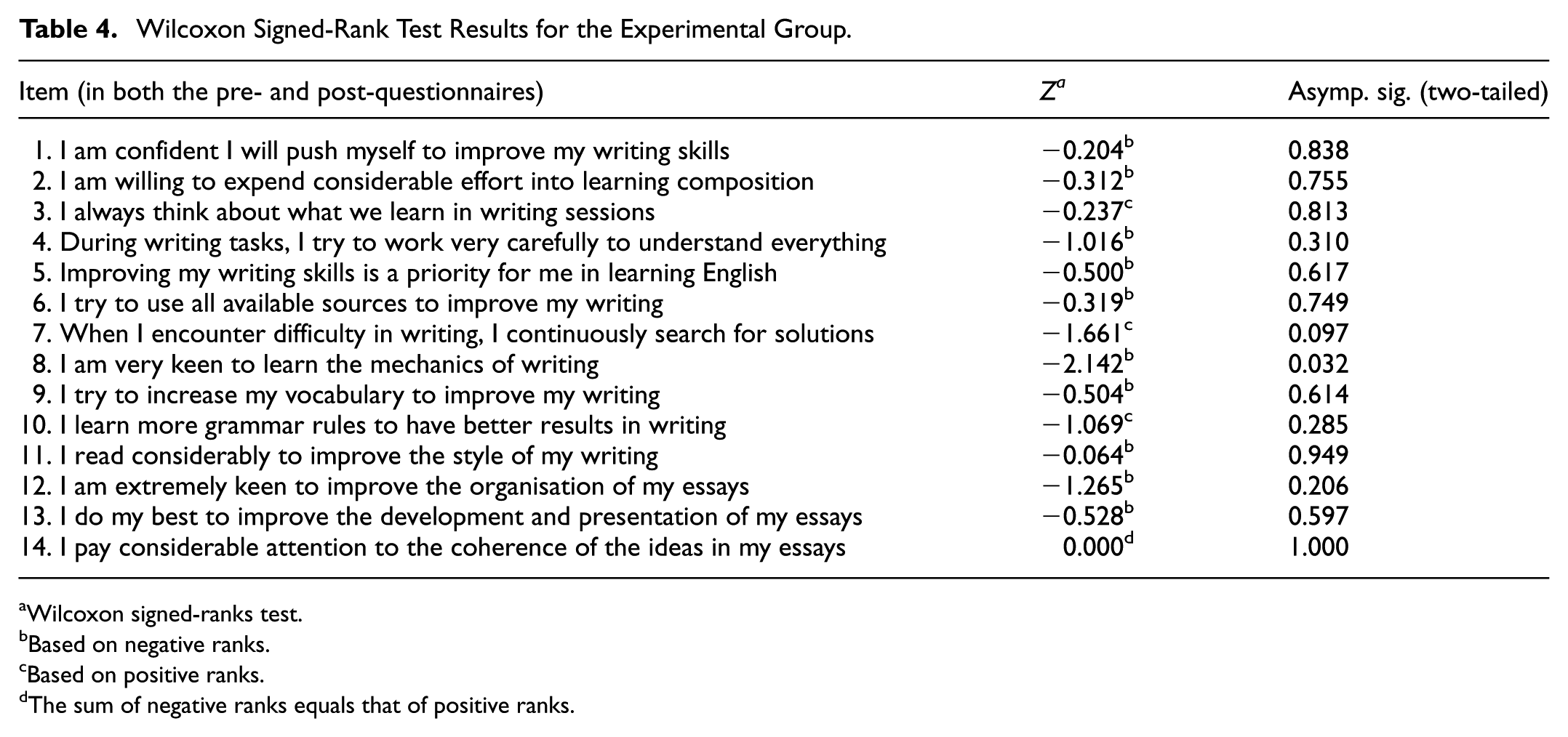
Wilcoxon signed-ranks test.
Based on negative ranks.
Based on positive ranks.
The sum of negative ranks equals that of positive ranks.
Three items (3, 7, and 10) showed a negative change (range: −0.04 and −0.47; Table 3), and one item showed no change (item 14) at the post-test. As only three items showed non-significant negative changes, we may consider that the experiment had a limited negative impact. This negative impact can be attributed to the non-use of teacher feedback during the experiment. The results showed that treatment exposure did not positively impact participants’ motivation at a statistically significant level in all examined aspects. Additionally, the participants were already highly motivated to develop their writing skills before the experiment.
Open-Ended Section
The participants were allowed to provide additional comments relevant to their motivation to develop writing skills in an open-ended section of the questionnaire. As completing this section was not compulsory, not all the participants shared their views. In the pre-questionnaire, 27 participants (in both groups) shared their views. A thematic analysis was performed to analyse their responses into the following three themes (motivated towards writing, neutral, and negative about writing). The majority (n = 22) showed high motivation to improve their writing skills. For example, 12 participants shared that ‘writing is necessary for all courses’. Four participants stated that ‘when I have good writing skills, I can easily express myself’ and that writing proficiently ‘saves time in doing my homework’. Some participants stated that they practiced free writing occasionally (n = 7), others suggested the inclusion of more writing courses in their bachelor programme (n = 5), and two participants described that writing is considered the most important language skill. Three responses fell under the second theme ‘neutrality’, while two respondents showed negativity towards writing. For example, one participant reported that ‘writing is not important and learning writing skills wastes my time. I can write good essays over time because every teacher gives me assignments’. Another participant explained that he had ‘difficulty in learning English, and writing texts is complicated’, indicating a lack of motivation to learn owing to these difficulties.
As aforementioned, the post-questionnaire was administered only to the experimental group (n = 21), half of which provided comments in the open-ended section (n = 11). All the participants showed positivity towards their experience with receiving PF and CBF. For instance, one participant stated that ‘learning English writing can be so easy because I can help my friends fix their essays, and they can do the same for me, and I can use the computer feedback anytime’. Another stated that ‘learning writing now is easy and my writing is evaluated very fast’. These examples show how PF and CBF positively influenced students and offered them alternative sources of feedback, which they may have lacked in the past. Some responses, however, showed some concerns stemming from the students’ lack of learner autonomy. Seven participants stated that teacher feedback was necessary for their writing development, with an example being the following, ‘I like discussing my essays with my classmates. I like the idea of sending my essay to a computer and receiving corrections on my essay. However, I do not like not receiving comments from my teachers. He [the teacher] is the expert who know[s] right from wrong’. This view may indicate reservations regarding PF and CBF reliability, and that teacher feedback is deemed the most reliable and crucial aspect in writing classrooms.
In summary, although most of the sample showed high levels of motivation towards writing, the participants reported in the prequestionnaire that they did not receive feedback on their written texts, and most had infrequent exposure to traditional sources of feedback (i.e. teacher feedback). In the post-questionnaire and the open-ended section, the participants retained their high levels of motivation and showed positivity to CBF and PF albeit not considering them as reliable as teacher feedback.
Discussion and Conclusions
Theoretical and technological advancements provide EFL instructors with various solutions and possibilities to improve their classroom teaching and evaluation (e.g. Panagiotidis et al., 2023). EFL learners normally desire learning practices that steer away from tradition and instead are innovative, which can stimulate their motivation to become better writers. Graham et al. (2007) described that writing motivation ought to be prioritised by instructors, especially in higher education contexts, because it can play a significant role in advancing learners’ studies. Writing is complex; thus, building, polishing, and ensuring the success of writing learners requires tremendous effort. There is a consensus in the literature that learners must receive feedback on their written texts to achieve learning success in writing; indeed, receiving sufficient feedback can positively impact writing motivation and skills (Latifi et al., 2021).
In this study, participants evaluated their writing skills as ‘average’. Prior research shows that this perception could be linked to the infrequent feedback they received in their prior assignments (e.g. Huxham, 2007). Participants in our sample also reported that they rarely used alternative sources of feedback (i.e. other than teacher feedback) for their writing prior to participating in the study. As reported in the Literature Review section, this could be due to the students’ perceptions of the teacher as the best and most reliable source of feedback (Aldukhail, 2023). Although past research offers good practices for effective feedback provision (e.g. PF and CBF), studies conducted with instructors show that students did not seem to utilise these feedback practices and continued to use the traditional teacher feedback (e.g. Alhazmi & Schofield, 2007; Alnasser, 2013). These limitations regarding feedback provision may stem from teachers’ lack of effort to overcome the challenges related to providing alternative feedback (Huxham, 2007; Min, 2008). In turn, the results of this study show that learners may be receiving insufficient feedback, which may contribute to their weak writing skills—as is reported in some prior studies (see Bailey & Bizzaro, 2022; Cho & Schunn, 2007; Khasawneh, 2023). What sets this study apart from previous studies is that it investigated the combined use of PF and CBF, while restricting teacher feedback to the experimental group. Interestingly, before exposure to PF and CBF, most participants in both groups reported high motivation to improve their writing skills. This finding is consistent with those of Al-Mohanna (2017). Moreover, although feedback was rarely offered in the past to our sample, who were likely to have learned in traditional classroom settings, the participants still showed motivation to become better writers. Thus, it may be that past feedback deprivation and the participants’ average writing skills might have increased their desire to improve their writing quality. The findings in the open-ended section of the pre-questionnaire allowed us to link the participants’ motivation to their envisioning of success in their studies, which indicates that most learners have some form of ‘instrumental’ motivation. This finding concurs with the researchers’ expectations, as writing has consistently been described as a crucial skill for academic success (see Alqasham & Al-Ahdal, 2022). For example, one participant explained that ‘I have to write projects every time and I have to become a good writer to get higher marks’, indicating that the motivation for this student is achieving higher marks. The findings also suggest that most students are willing to exert extra effort to develop their writing skills. These descriptions show that our quantitative data reported in the pre-questionnaire items concurred with our qualitative data reported in the open-ended section of the questionnaire, which raises our confidence in the conclusions reached.
After exposure to PF and CBF and not being allowed exposure to teacher feedback, most participants in our sample maintained similar levels of motivation to learn writing skills. Specifically, one item was positively significantly affected, while all other items in the questionnaire showed post-test results that were either slightly higher or lower (vs. pre-test). The hypothesis formulated before the study was conducted was that offering students timely feedback provision, the opportunity to actively engage in the critical evaluation of peer essays, and access to an artificial intelligence software for feedback on each essay would boost student motivation. However, the treatment seems to have had a limited effect on writing motivation. Despite the limited effect, we cannot assume complete treatment failure for two reasons: participants were already highly motivated at the pre-test, and their overall motivation at the post-test did not deteriorate. This raises the question of why the positive changes lacked significance and three items showed negative changes at the post-test. The comments provided by participants in the post-questionnaire offer some insights into these matters. Seven participants indicated that learners valued teacher feedback and did not fully enjoy being completely deprived of such feedback. This finding concurs with those of Alnasser (2018), who concluded that student writers look forward to teacher feedback. Additionally, it has been suggested that teachers are the most reliable sources of feedback (Alnasser, 2022a), and although PF and CBF integration in writing instruction and learning presents several advantages, learners may come to question the reliability of these feedback sources (e.g. Alnasser, 2022a; Dikli, 2006; Hyland, 2003).
Writing classrooms in Saudi higher education continue to use traditional learning and teaching methods, and this may explain students’ writing deficiencies. Moreover, while researchers and practitioners have explored ways to motivate students to write in many EFL learning contexts, our findings show that Saudi EFL learners are already highly motivated to improve their writing skills. Such a finding offers writing instructors an opportunity to make their learners excel in writing development. Unfortunately, instructors may tend to not utilise students’ extant writing motivation to improve learning outcomes, and the available feedback sources are not properly utilised in writing classrooms (cf. Aloud, 2022). Therefore, the learning situations offered to learners are teacher-centred. Numerous studies present the need for learning situations to be centred on the learner instead (e.g. Hyland & Hyland, 2006), and to promote active learning, learning autonomy, and self-regulation (e.g. Orsmond et al., 2002; Rollinson, 2005). This can be made possible by adopting innovative methods in writing instruction and assessment. Writing is an activity that goes beyond the classroom. When students learn to write, they transfer the acquired knowledge and skills to other subjects and other life activities, where needed. Therefore, the better the learners’ writing skills, the more likely they are to achieve better academic and life outcomes. Offering learners alternative feedback solutions, such as PF and CBF, as a means to improve their writing skills suggests that learners can be encouraged to consult their colleagues on their writing and use computer-based feedback software outside of the classroom. These efforts may then encourage them to become better writers.
This study holds significant implications for writing instruction practitioners. First, the finding that teachers provide limited feedback suggests the necessity for increased utilisation of alternative feedback sources, particularly in the face of challenges posed by large class sizes. Teachers are advised to train their students in the use of CBF software, providing and receiving PF, and self-assessing their writing. Introducing assessment rubrics can be a preliminary step towards fostering student autonomy, enabling them to seek more diverse feedback and enhancing their motivation to learn English writing. Second, the study suggests that students may exhibit greater receptiveness to PF and CBF for evaluating local-level writing features, such as grammar and spelling, while demonstrating more reservation in utilising these sources for assessing global-level features, including idea flow and organisation. Learners may perceive PF and CBF to be of higher quality at the local level of writing, potentially causing them to be cautious of accepting feedback for global-level features and to prefer feedback from the teacher, perceived as more reliable by students (Min, 2008; Zhao, 2010). These speculations highlight the need to integrate new techniques and technologies in the classroom. For example, concerns regarding PF reliability can be alleviated through additional training (Min, 2008), and those on CBF can be addressed by ensuring learners have access to suitable functional equipment (Alnasser, 2022b).
In conclusion, this study explored the impact of employing CBF and PF on writing motivation in Saudi higher education writing classrooms. Notably, Saudi EFL learners maintained high motivation levels even after exposure to these alternative feedback sources. While the changes in learner motivation were not statistically significant, our results indicate that motivation did not deteriorate despite the absence of teacher feedback. This underscores the authenticity of their motivation and suggests the positive effects of the introduced treatment. The study emphasises the significance of teacher involvement in feedback provision and acknowledges potential learner scepticism towards new feedback sources, which can be mitigated. These results suggest the need for careful consideration and ongoing evaluation of learning experience in writing classrooms by both instructors and learners.
Limitations of the study arise from cultural considerations, as female students could not be included in the study. Future studies should address this gap, comparing responses between male and female students. Additionally, investigating the impact of teacher feedback using a similar research design could provide valuable insights into EFL learners’ writing motivation and optimal learning environments for writing classrooms.
Footnotes

Ethical Considerations
This study was approved by the appropriate research and ethics committee of the university with which the researchers were affiliated. The research was performed in accordance with all relevant guidelines and the 1964 Helsinki Declaration and its later amendments.
Consent to Participate
All students provided written informed consent before participation.
Funding
The authors disclosed receipt of the following financial support for the research, authorship, and/or publication of this article: Ongoing Research Funding Program, (ORF-2026-788), King Saud University, Riyadh, Saudi Arabia.
Declaration of Conflicting Interests
The authors declared no potential conflicts of interest with respect to the research, authorship, and/or publication of this article.
Data Availability Statement
All used data are provided in this paper.