



Abstract
Managers are generally faced with important decisions; their decisions have a great effect on the success or failure of an organization. However, managers have limited ability and may be affected by several cognitive biases that can cause errors in their judgment and solutions. In this study, 43 biases related to managers’ decision-making are identified and explained. Since it has been tried to recognize all the effective biases in managers’ decision-making in an integrated manner, continue advancing in the literature on this topic is important. The solution proposed in this study to reduce managers’ biases is the collective decision-making method. The study aims to investigate the impact of collective decision-making on reducing 43 identified biases. To do so, 152 managers of Iranian state-run organizations (at different management levels) who know about collective decision-making are surveyed. The analysis of One-sample statistics and t-test statistics shows that collective decision-making can reduce 40 biases in the three parts of judgment, preference, and decision results, but only the “shared information bias” isn’t reduced and we can’t comment on the two biases of “herd behavior” and the “bandwagon effect.” The theoretical implications of this study are the recognition of all the biases that may affect the decisions of a manager, and its managerial implications are the introduction of the collective decision-making method as an effective method to reduce the possible biases of managers’ decisions. It is important to use this method because it is easy and inexpensive and can avoid many damages and mistakes.
Introduction
The real conditions in decisions are completely different from what is imagined for a rational manager (Bagchi et al., 2022). The motivation or goals of decisions are not limited to personal gain and logical relationships and factors such as experience, altruism, loyalty, enmity, and malice can also justify decisions (Chai et al., 2021; Sahu et al., 2020). In addition, managers learn in different ways and this learning affects their decisions and behavior (P. Li & Meng, 2022). Also, a manager’s decisions are influenced by the three factors of cognition, motivation, and emotions. Therefore, managers’ reasoning capacity is limited and is affected by cognitive biases and hidden errors (Tweed et al., 2013). These statements show that managers’ decisions are influenced by various factors and some of these are uncontrollable.
For these reasons, in situations with difficulty and anxiety, a large amount of information can weaken the information-processing capabilities of managers and interfere with their understanding of the problem (Roy, 2016). Managers may pay little attention to signs and consequences when making decisions, and this issue can be caused by various cognitive biases that affect managers (Hristov et al., 2022). Cognitive biases are caused by managers’ incorrect and unwanted use of the ability to simplify complex issues, decision-making with incomplete information, and low cognitive capacity (Tweed et al., 2013).
Therefore, managers are faced with multiple cognitive biases and these biases cause wrong decisions that bring great damages and costs (Jordão et al., 2020). Bias in managers’ decisions can have very harmful consequences for the organization or company (McShane et al., 2013). Making managers aware of decision-making biases can make them more alert and prevent further harm. To reduce these biases and reach the correct decision, a collective decision-making method is suggested. This method can be a low-cost and effective solution and improve the performance of managers. The key idea of this method is to give more importance to the opinions of others and the manager does not make all decisions alone, especially on sensitive and important issues (Jordão et al., 2020). Collective decision-making is a process by which members of a group decide on an action by consensus (De Oca et al., 2011).
The main objective of the research is to investigate the impact of collective decision-making on reducing the decision-making biases of managers, and its main theoretical and business implications are to make managers aware of the types of biases that may make their decisions wrong and cause a lot of damage to the organization. The gap that exists in previous research such as Jordão et al. (2020) is that it limited the research to only examining the impact of a small number of biases on people’s performance. The novelty of this research is that it tries to identify and explain all biases that may compromise managers’ decisions. Also, in the continuation of the research, it evaluates a low-cost method to reduce injuries, and after it is approved, it makes recommendations to the managers.
This study wants to answer the important question of whether using the opinions of others in the form of collective decision-making can reduce decision-making biases in the judgment and presentation of managers’ solutions or not. In this regard, 43 biases related to managers’ decision-making have been identified, and brief explanations related to these biases are provided. To examine the research question, the opinions of 152 managers of Iranian state-run organizations (at different management levels) are collected. These managers are aware of the collective decision-making method or use this method in their work decisions. The data collection tool is a questionnaire and the obtained data is analyzed with SPSS software. Because the Likert scale is used in the questionnaire, data analysis is done using One-Sample Statistics and t-test statistics. This method can be used to confirm or reject the research hypothesis.
In the following, the literature review is explained in two sections, cognitive biases and collective decision-making. Cognitive biases are introduced in three categories, judgment, preference biases, and decision results, and collective decision-making is explained in two parts necessity of process, and applications. In the next section, the methodology is explained and the research findings are reviewed.
Literature Review
Cognitive Biases
Cognitive bias is a term in cognitive science to describe human reasoning errors that lead to repeatable patterns of incorrect judgment (Tweed et al., 2013). Cognitive bias is a type of systematic error in human thinking that affects a manager’s decisions. Managers’ decisions can be influenced and oriented by cognitive biases, and outside observers can often detect the oriented decisions of others (McShane et al., 2013). Biases show that the actual behavior of managers has a systematic deviation compared to the predictions of the laws of classical statistics (Dhami, 2020).
Many problems and failures are caused by wrong decisions due to psychological weaknesses and mental biases (Cherkes & Ryan, 1985; Montibeller & von Winterfeldt, 2015). Now, there is a lot of evidence that cognitive biases can lead to poor decision-making in managers. Judgmental vulnerabilities from these biases can have serious consequences at both the manager and organizational levels. For this reason, it is important to recognize and address them to prevent further effects (Jordão et al., 2020).
Cognitive biases are one of the subjects studied in cognitive science and social psychology. Researchers have divided cognitive biases into different categories. Kahneman and Riepe (1998) classified cognitive biases into three categories judgment, preference, and decision results. Because this classification is appropriate to the decision-making area, it can help the most to classify the cognitive biases identified in this study. According to this classification, the effects of biases can be divided into before, during, and after the decision. Based on this, if we remove the similar and unrelated items biases and add the newly identified biases, all 43 cognitive decision-making biases of managers can be classified as Table 1.
Triple Classification of Cognitive Biases (Kahneman & Riepe, 1998).

In the following, 43 identified cognitive biases according to the classification of Kahneman and Riepe (1998) are explained.
Judgment Biases
Judgment biases are errors or distortions in the way we think, evaluate, and make decisions. These biases can affect our perceptions, interpretations, and judgments of people, events, and information (Anderson & Hope, 2014). Understanding these biases can help us to make more accurate and informed judgments in our personal and professional lives (Bindra et al., 2022). In the following, some common types of judgmental biases are explained.
Overconfidence Bias
This bias expresses the tendency of managers to overestimate their abilities and creativity. Overconfidence comes from social psychology and is defined as a manager’s belief that their knowledge is more accurate than reality. In other words, they assign more weight to their information than to facts (C.-C. Lee et al., 2022). Overconfidence bias means unwarranted faith in one’s cognition, skills, knowledge, experience, and personal characteristics (Boussaidi, 2022). Overconfidence can be attributed to two significant factors. Firstly, unrealistic positive self-evaluation leads individuals, particularly managers, to overestimate their abilities beyond reality. This unwarranted optimism skews their perception of their capabilities. Secondly, unrealistic optimism makes managers overestimate the likelihood of their success, surpassing the actual probability. This distorted perspective on their potential achievements further contributes to their overconfidence (Boussaidi, 2022; Costa et al., 2017; Ul Abdin et al., 2022; Van Der Wege et al., 2021).
Endowment Effect
This effect is defined as a mental process in which a different weight is given to the value of an object. The value of this object depends on whether the manager owns the object and wants to lose it, or whether the manager does not have the object and wants to get it. When managers own something, they value it more than when they want to get it. The endowment effect can be seen with items that have emotional or symbolic significance value for the manager. Research has identified “ownership” and “loss aversion” as the two main psychological reasons that cause the endowment effect (Chuang, 2013; Collard et al., 2020).
Self-Control Bias
This bias is described as the conflict between managers’ desire to exaggerate about themselves (relying too much on one’s ability) and their inability. Studies show that a large number of managers who face this bias ignore their long-term goals to obtain temporary and fleeting satisfaction (Wiesner & Lindner, 2017).
Control Illusion Bias
It is a situation in which managers think that they have control over events, but they do not. In practice, managers with this bias are more likely to make a wrong decision than others (E. W. Lo, 2020). Control illusion bias describes a tendency in humans that causes managers to imagine that they can control or at least influence outcomes and make the same choices. For example, research has shown that investors create concentrated investment positions because they are attracted to companies that they feel they have some control over (Meissner & Wulf, 2017).
Halo Effect
This bias describes an error in thinking in which managers make certain inferences about someone or something based on an attribute or a general perception. When there is a preconceived notion of performance, it leads to prejudice in future analysis (Klinger et al., 2017). The halo effect refers to the tendency for one salient characteristic or our overall perception of a person, company, or product to greatly influence our judgment of other unrelated attributes. The halo effect causes immediate judgment because by considering only one aspect of a manager or thing, we judge other aspects (W. C. Lo & Wei, 2016; Rogers, 2005).
Optimism Bias
Managers’ tendency to believe that they are better than average and the belief that bad luck is more likely to happen to other managers (overestimating the probability of the desired outcome; Chen et al., 2022). An optimistic bias is based on the assumption that I am less at risk than others. Optimistic managers want to see the world as better than it is. Some studies show that for all positive personal characteristics such as driving skills, good looks, longevity, etc., most optimists tend to rate themselves better and above average (Bracha & Brown, 2012; Deekonda & Bernstein, 2011; Kotikalapudi et al., 2022; Liu et al., 2018).
Conservatism Bias (Latency)
It is a type of cognitive bias in which the mind prefers old information and evidence over newly acquired information. In the decision-making and judgment process, when conservatism is created, the mind gives more weight to the data it had in the past and does not care about the new evidence. For example, it took many years for managers to accept that the earth was round because they still insisted on the previous understanding that the earth was flat (Luo, 2013; C.-H. Wu et al., 2009).
Under-reaction Bias
This bias is a mental process that causes managers to stick to their previous views or predictions and ignore new information or react less than necessary. Under-reaction bias can cause managers to maintain their previous ideas and mindsets instead of acting based on updated information (Xie & Hsu, 2016).
Overreaction Bias
This bias can be defined as the tendency of managers to give more importance to some articles, developments, and statements. Therefore, an event is given more importance than it deserves. The cause of this reaction is the law of small numbers, where managers assume that new events and trends will continue (Galizio et al., 1979; Lu, 2022).
Recency Bias
This bias causes managers to remember and focus on recent events and observations significantly more than past events. This bias forces decision-makers to focus on the most recently collected data rather than examining the relevant data set, which often spans a much wider period (C. Li, 2010; Plonsky & Erev, 2017).
Availability Bias (Familiarity)
Usually, managers pay attention to some of its features and characteristics in the initial encounter with different topics. These specifications and features are the available dimensions that first attract the attention of the viewer or listener. Availability bias causes managers to estimate the probability of an outcome based on its prevalence in their lives and experiences because it is more available in their memory (Cheng et al., 2022; Deekonda & Bernstein, 2011).
Framing Bias
Decision-making in a specific situation based on the way (form) of presenting an issue shows different reactions. The impact of framing on the decision makes the mind biased. In framing the basic features of a problem do not change and managers still face the same options and outcomes, what changes is how we think about the problem, which leads to different choices (Benschop et al., 2022; He, 2022).
Self-attributional Bias
It is a type of bias in which the mind attributes success to its ability and failure to external factors. This bias, which is one of the main factors of the self-deception of decision-makers, is caused by the “relativity theory” in psychology. In this theory, managers attribute events that confirm the validity of their actions to their high abilities and events that do not confirm their actions to their bad luck and external factors (Chou et al., 2021; Czaja & Röder, 2020).
Pay Attention to Rumors
One of the common behaviors in society is making decisions based on hearsay and rumors. Sometimes managers make a decision or behavior as soon as they receive news that may lead to wrong judgment or error in behavior. Media can play an effective role in creating rumors and the resulting bias (H. Lee et al., 2022).
Mental Accounting Bias
Managers tend to code, classify, and evaluate economic consequences by summarizing their points in a set of mental accounts. Mental accounting is a type of mental form in which managers categorize the world around them into separate mental accounts. For example, investors are used to paying each of their portfolio items separately. This can lead to inefficient decisions (Gowri & Seetha Ram, 2019).
Small Sample Size Bias
In this bias, a manager’s perception of the frequency or probability of an event is influenced by observable measures of manager experience. Manager experiences bring to mind an example of a particular type of situation, even if it is observable and rare. Small sample size bias can lead to undue certainty in manager experience (Leisen, 2017; McShane et al., 2013).
Blind Spot Bias
In this bias, managers recognize bias in the judgments of others, but not in their judgments. The emergence and occurrence of the blind spot of prejudice are different in managers. Blind spot bias appears to be measurable as a stable manager trait. The incidence of blind spot bias varies among managers but is measurable as a stable manager characteristic. Research shows that almost everyone thinks they are less biased than others, regardless of whether they make good decisions themselves (Chandrashekar et al., 2021; Hagá et al., 2018; Zaleskiewicz & Gasiorowska, 2021).
Fundamental Attribution Error
In this bias in explaining and judging the behavior of others, personality, and inherent characteristics are emphasized too much, and environmental factors and conditions are ignored. In the fundamental attribution error, managers’ actions and behavior reflect their personality, and their mistakes and failures are due to their personality traits (Flick & Schweitzer, 2021; Horstmann & Krämer, 2022).
Ostrich Effect
It is a kind of bias in the mind that wants to ignore some issues constantly and hide. The ostrich effect is defined as the avoidance of apparently risky situations, and ostriches treat risky situations by pretending they don’t exist. An old myth says that whenever ostriches are afraid of something, they hide their heads in the sand and think that they are safe from the enemy (Brown & Kagel, 2009; Karlsson et al., 2009; Ringler et al., 2022).
Selective Perception Bias
It is a type of bias in which the mind receives everything it thinks is right and ignores everything it thinks is wrong. In this process, a manager receives information selectively. In other words, managers see the image as they like it, not as it is (Paquet et al., 2004; Ramicic & Bonarini, 2020).
Survivorship Bias
In this bias, the mind considers only living and successful examples, and as a result makes mistakes in judging the situation. Survivorship bias can lead to exaggerating the chances of success because failures are ignored. This misconception that one should only look at successful managers for success is caused by survivorship. When failure is hidden from view, the difference between failure and success is also hidden (D. Filip, 2014; Waldner & Smith, 2021).
Anchoring Effect
This bias refers to managers’ tendency to rely heavily on the first piece of information (anchor) they receive or focus on when making judgments and decisions (C. Y. Lee & Morewedge, 2022; Rezaei, 2021). When managers are in an ambiguous situation, they often rely on anchors to make decisions (Smith et al., 2010). An anchor is a piece of information such as past sales, a forecast, or simply a personal opinion that focuses one’s mind on a value and then becomes attached to it and prevents correct reasoning (Berger & Daumann, 2021; Selim, 2021).
Narrow Framing Bias
Closed or limited vision of some managers leads to hasty or delayed decisions. This bias, when activated, is so strong that we fail to explore other possibilities, and as a result, managers’ decision-making process becomes limited (Cherkes & Ryan, 1985; do Nascimento Junior et al., 2021).
Representativeness Bias
In this bias, managers make decisions based on stereotypes. Managers classify and estimate the probability of the occurrence of a phenomenon according to the degree of similarity that this event has with previously observed events. When managers encounter a new phenomenon and this phenomenon is incompatible with their pre-made classifications, they try to adapt this phenomenon to their previous classifications with different methods (Chang et al., 2009; Lim & Benbasat, 1997; Wijayanto et al., 2023).
Preferred Bias
Preference biases are a type of cognitive bias where people tend to favor certain options or choices over others, often based on personal preferences or prior experiences. These biases can affect decision-making in various areas of life, such as purchasing products, selecting job candidates, and even choosing loyal partners (Agénor & Jackson, 2022). Managers must be aware of these biases to ensure that their decisions are fair, objective, and based on relevant criteria (Gan et al., 2023). The following are explanations of some common types of preference biases.
Ambiguity Aversion Bias
Faced with an unknown probability distribution, managers do not want to face risk. Generally, managers feel doubtful in ambiguous situations and a tendency is formed in them that avoid ambiguity is preferred over solving the problem (Agliardi et al., 2016; Treich, 2010; White & Perfors, 2023).
Short-sighted Bias
In this bias, managers ignore their strategic goals and lose the long-term vision. This bias motivates managers to spend today instead of saving for tomorrow (Guo & Xu, 2023; Halilova et al., 2022; Zhu et al., 2023).
Confirmation Bias
This bias consists of looking for information that supports one’s opinion and may ignore evidence that contradicts this information. In this bias, ideas that confirm one’s beliefs are emphasized, and everything that contradicts one’s opinions is trivialized (Pfeiffer et al., 2000; Ross et al., 2023; Vogrin et al., 2023).
Cognitive Dissonance Bias
When managers encounter new information that conflicts with their previous perceptions, they often feel a kind of mental discomfort, which is a psychological phenomenon and is called adaptation. Adaptation is a response that takes place in the form of trying to reconcile conflicts and thereby overcome mental discomfort. Most managers try to avoid inconsistent situations (Alfnes et al., 2010; Coen et al., 2022; Friesen & Weller, 2006).
Status Quo Effect
This bias is a feeling that encourages managers to maintain the current situation and not change. The status quo effect refers to the fact that an option seems more desirable when it is designed to maintain the status quo than when it is not designed this way (Bergers, 2022; Gill et al., 2022).
Social Emotional Bias
When participants between two potentially rewarded faces, decide to reward the smiling face (vs. the angry face), they have made a biased choice. This bias may arise because facial expressions evoke positive and negative emotional reactions, which may motivate acceptance and avoidance. Some managers use such emotional images in the media and even during normal social interactions to bias the decisions of others (Borghi et al., 2022; Furl et al., 2012; Mellem et al., 2016).
Illusory Correlation Effect
Refers to the cognitive bias where individuals mistakenly perceive a relationship between two unrelated phenomena, despite there being no actual meaningful connection between them. Illusory correlation occurs when a manager mistakenly relies too much on one result and ignores other results (Bott et al., 2021; Costello & Watts, 2019; Ernst et al., 2019).
Negativity Bias
It is a type of cognitive bias in which the mind gives more weight to negative news and information, even if the proportion of negative and positive information is the same. Negativity has evolutionary roots because the brain must recognize any lurking threat to find a solution and increase the probability of survival, thus reacting quickly to any negative information (Qahri-Saremi & Montazemi, 2023; van der Meer & Hameleers, 2022).
Pro-innovation Bias
In this bias, the manager thinks that the whole society should accept the innovation without any changes. In this case, a manager overvalues the benefits of a new product while ignoring the limitations of that product. Sometimes a newer product is not better even though it has some innovations. But Pro-innovation does not allow a manager to see the limits clearly and always advocates buying the latest model of anything (Karch et al., 2016; Loosemore & Holliday, 2012; Sovacool et al., 2023).
Shared Information Bias
It is a type of bias in which group members tend to talk more about topics that are familiar to everyone, and spend less time on topics that some members are not aware of. In simple terms, shared information bias is the tendency to talk about collective information. Fully informed decisions cannot be expected when group members do not share information that others do not. This bias can have harmful consequences on group decisions (Baker, 2010; Palley & Satopää, 2023; Van Swol, 2007).
Decision Results Biases
Decision result biases refer to the errors or distortions that can occur during the process of making decisions, which can lead to inaccurate or flawed outcomes (Kahneman & Riepe, 1998). These biases can arise due to various factors such as personal beliefs, emotions, cognitive limitations, and social influence. Understanding and addressing these biases is important for managers to make informed and rational decisions (Ecken et al., 2011). Below, you will find explanations of some common types of decision result biases.
Regret Aversion Bias
Managers who avoid regret do not take decisive action, because they fear that the result of their choice will be less than optimal. This bias seeks to prevent the suffering caused by poor decisions. Regret aversion is an emotional phenomenon that causes investors to remain loyal to their unprofitable investment positions for a long time to avoid accepting mistakes and unprofitable investment positions (Agarwal et al., 2022; Wangzhou et al., 2021).
Loss Aversion Bias
The effect of loss is more than the effect of profit, and the tendency of managers to avoid loss is more than their attraction toward gaining profit. Managers’ hatred of uncertainty is not so intense, but they hate losses more than anything else (Collins, 2016; A. M. Filip & Nagy, 2023).
Herd Behavior
Managers who live in the same community usually behave in the same way, one of the reasons for this is the “social influence.” Herd behaviors rely heavily on the opinions of others and make decisions similar to each other due to social influence from others (Bae & Yeu, 2022). When a manager is faced with the same judgment as a large group of his kind, he tends to think that his different answer is probably wrong (Kumar et al., 2023). Herd behavior means following the behavior of others without carefulness and awareness (Qasim et al., 2019). Some studies have considered information infiltration and attention to reputation as the cause of herd behavior (Cao & Wang, 2021; Youssef, 2022).
Bandwagon Effect
It is a type of bias in which a manager acts only because others are doing the same thing. In this case, the manager does not pay much attention to his beliefs and after doing an action, he refers to his beliefs. If the action matches his beliefs, he values his belief, but if it contradicts his belief, he ignores the belief. The tendency to follow the actions and thoughts of others is caused by the tendency to conform, or the only source of information is others. Both reasons are proof of willingness to accompany the congregation. (Anantharaman et al., 2023; Bindra et al., 2022).
Jumping to Conclusions Bias
In this bias, when the mind makes a judgment, instead of considering the entire decision-making process and its quality, it only cares about the results of the decision. Jumping to conclusions causes a manager to remain indifferent to past events ignore the events that lead to an outcome, and emphasize the outcome too much. The opposite of searching for too much information is Jumping to conclusions. A result-oriented manager does not distort previous events but forgets them altogether (McShane et al., 2013; Pytlik et al., 2020; Strube et al., 2022).
Illusion of Validity Bias
This bias describes a person’s adherence to a belief despite evidence to the contrary. In different areas of life, managers may unintentionally fall into the illusion of credibility bias. In various fields, managers may unintentionally fall into the illusion of validity bias. For example, this bias can be found in clinical medicine, where a doctor despite sufficient counter-evidence; refuses to change its defaults, such as repeating experiments or continuing a failed drug trial (AlKhars et al., 2019; McShane et al., 2013).
Disposition Effect
This bias expresses the natural desire to quickly sell profitable stocks and holds too much of losing stocks. Because managers are worried that their profits will be reduced or they want to avoid further losses. The important point is that holding too many losing stocks can cause huge losses (Ahn, 2022; Rotaru et al., 2021).
Choice-supportive Bias
In this bias, the mind tends to attribute positive features to the option it has chosen. When a manager reviews his decision in the past, the mind distorts the memories as if what the manager chose was the best possible option. Therefore, when a manager chooses among options, the mind tends to attribute more positive and less negative qualities to his choices. As a result, a manager feels good about his choice and feels less regret about bad decisions (Kafaee et al., 2021; Zorn et al., 2020).
Hindsight Bias
It is a kind of bias in which the mind thinks it knows about something after it happens. With this bias, managers’ minds tend to consider an event as more predictable than it is. Although it is possible to make guesses about future events, there is no way to determine which prediction is correct. Hindsight bias is different from learning. Under learning, the manager learns to make better judgments about the future. However, under hindsight bias, a manager misperceives his predictions in the past and causes a smaller predictive error (Dhami, 2020; Giroux et al., 2023; Hom, 2022).
Collective Decision-Making
The sections titled Necessity of Collective Decision Making, Process of Collective Decision Making, and Applications of Collective Decision Making provide a conceptual foundation for understanding the importance, dynamics, and practical relevance of collective decision-making in various contexts. These sections build upon and partially overlap with our previous study (Mirbagheri et al., 2023), in which the theoretical underpinnings and empirical implications of collective decision-making were explored in detail. The current manuscript revisits these themes to ensure continuity in the research narrative and to reinforce the analytical framework used in collective decision-making to examine its relationship with cognitive biases.
Necessity of Collective Decision-Making
People face collective decision-making situations everywhere in their daily lives (Veen, 2011). Collective decision-making entails a variety of fields including the behavioral and brain sciences, management, economics, and artificial intelligence, and concentrates specifically on the question of how decision-makers can make optimal choices from multiple options (Hasegawa et al., 2017). The foremost task of groups is to present efficacious solutions to the complex problems they encounter. This is a very pertinent dimension of the behavior of social groups, because “collective wisdom” can go beyond the behavior of individuals as far as quality is concerned (Zafeiris et al., 2017).
Due to the rapid changes in the environment, the decision-maker should have complete mastery of all issues, sciences, and technologies to be able to find the best solution to resolve the problem or make the best use of the situation. However, not many people know everything, have all the qualifications, and master all the sciences and technologies within the framework of their managerial duties. So, collective decision-making can greatly help them find the optimal solution. The social feature of changing the structure of society today is such that without the participation of managers and staff in the process of management decision-making and their implementation procedures, they cannot reach the optimal decision (Prigozhin, 1991).
Having calculated the inevitable variation in the accuracy of individual decision-making, further improvement in collective decision-making is indispensable (Bosel et al., 2017). The study of collective decision-making is necessary for many group or participatory systems along with the development of the internet, electronic communications, knowledge-based economics, and information technology (B. Wu et al., 2017).
Collective decision-making has several benefits and uses. However, it’s essential to analyze carefully the negative aspects associated with it. For example, collective decisions usually take more time, so when there is a time limit, collective decision-making may not be so effective (Karami, 2017). Also, because infiltration is everywhere, it is extant in all structures where personal, social, economic, and political decisions are made. infiltrate among delegates in collective decision-making situations, in which individual delegates must choose between different options, may have a significant impact on collective decision-making and, consequently, on the functioning of the collective performance (Van Deemen & Rusinowska, 2010). Besides, collective decision-making may be made in such a way that several actors play a role, but only one or more actors have the power of final decision-making. In these cases, final decision-makers can be influenced by people who are very conscious and respected, those who have been valid in the past, and especially those who share their positions (Zellner et al., 2014).
The administration and mechanical presence of members in the group are problems in collective decision-making. In this case, members of the group evade participation in the council, and it reduces the effectiveness of collective decision-making. Each decision-maker has their personal goals that reflect the values and level of desire of the individual. Because of personality differences, the outcome of individual decision-making - as opposed to the outcome of the collective decision that the group seeks to agree on - often varies from one decision-maker to another. Thus, if collective members prefer their interests to collective interests, the effectiveness of collective decision-making is reduced (Bui, 1987).
Process of Collective Decision Making
In general, a collective decision-making system can be composed of (1) Situations, goals, beliefs, or preferences of agents, (2) The ability of agents to influence the positions, preferences, and opinions of others, or the result of the final decision, (3) Interpersonal interactions and groups that result from these interactions, and (4) The wider context a group is located in (Mirbagheri et al., 2024; Zellner et al., 2014).
Collective decision-making processes emerge from social feedback networks within a group (Planas-Sitjà et al., 2015). In collective decision-making, individuals usually express their views despite some restrictions and preferences, then one consensus decision is made (Rossi, 2014). In collective decision-making, in addition to people who generally make their decisions in a particular field, competent staff who are generally not directly involved in decision-making, participate on an equal basis (Prigozhin, 1991).
Khaluf et al. (2019) examine the relationship and interaction between two components namely (1) Individual (microscopic) and (2) System-level (macroscopic). To have collective decision-making, two types of important information are stressed that the system needs to obtain, and they are recalled as forgotten parts of the decision process, (I) stimuli, and (II) a set of choices (options) that are accessible for a specific decision. Different features of stimuli and options, such as their amount and distribution, affect the output of the decision-making process (Khaluf et al., 2019).
When groups enjoy a high level of communication and appropriate conditions, participation can swiftly contribute to an agreement at the group level. The group members behavior is also part of the formation of the collective decision-making (Ward et al., 2011). When a collective decision fails to succeed, participants in a “group issue” should start bargaining or negotiating until they reach a consensus (Bui, 1987).
Contextual factors play a significant role in collective decision-making and can be classified into two categories, encouraging factors and deterrent factors (Corbin & Strauss, 2014). Encouraging factors facilitate the decision-making process and speed it up, while deterrent factors act as obstacles that impede progress. Generally, deterrent factors tend to slow down the decision-making process or prevent it from reaching its intended outcome. Encouraging factors include motivation, knowledge, skill, and experience, and deterrent factors include prejudice, infiltration, arrogance, and group coalition (Mirbagheri et al., 2024).
Applications of Collective Decision-Making
Collective decision-making is a significant topic in economics and social choice theory, as well as in communication, computer science, machine learning, game theory, and control theory (Parrondo et al., 2007). One can see it in many organizations including the cabinet, the central bank, etc. (Veen, 2011). Day by day the significance of Collective decision-making is increasing that is mainly because of the increase in many IT-empowered environments where people interact and share information with others (Rossi, 2014). The entry of technology into collective decision-making can also help organizations go across physical, social, and psychological boundaries (Slevin et al., 1998).
Thus, collective decision-making is increasingly playing an important role in today’s societies and organizations. As for advanced technologies, the value of engineers involved in designing a product can be hundreds or even a 1000, which goes far beyond the capacity of any engineer (Dionne et al., 2019). Collective decision-making is seen in a wide range of natural and artificial collective systems (Mirbagheri et al., 2023). In the case of natural systems, individuals in a group need to make collective decisions to get the best solution. In the artificial systems domain, one can consider collective decision-making as a principle for robotic collective behaviors (Prasetyo et al., 2019).
In the same way, as individuals in a group may opt for participation in collective decision-making where all individuals look for agreement on a result or are functionally integrated, this may also be true for a group of social insects (Bonabeau, 1996). Research on other organisms may provide new insights into the basic principles of collective decision-making in social groups (Bosel et al., 2017).
Methodology
To get a comprehensive view of the subject and get familiar with the basic concepts and principles, various references are collected and studied in a library style. To get a comprehensive view of the subject and get to know the basic concepts and principles, various sources regarding the two issues of collective decision-making and cognitive biases are collected and studied using the systematic literature review method. A systematic literature review is a protocol for conducting the literature of a specific research area collects articles based on defined research questions and keywords and integrates selected studies to evaluate applications and their effectiveness (Yang et al., 2020). The systematic literature review protocol includes the five main activities shown in Figure 1.

Systematic literature review protocol (Ruschel et al., 2017 ).
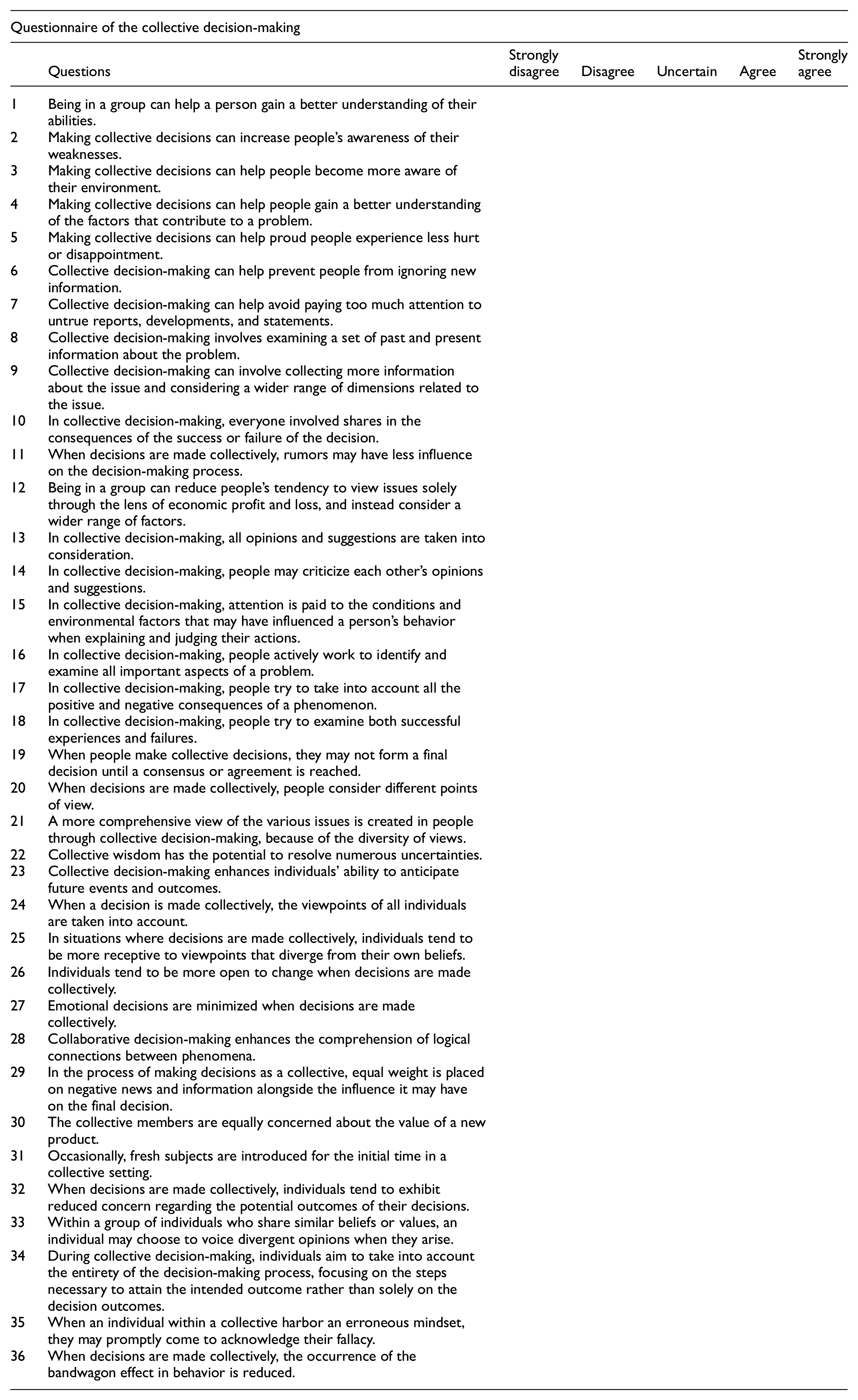
These steps are similar to the protocols presented in the articles (Acciarini et al., 2020; Alabool et al., 2018; de Almeida-Filho et al., 2020; Ruschel et al., 2017). To achieve the goal of the research, a questionnaire is designed regarding the research hypothesis (Appendix). The content validity method is used to calculate the validity of the questionnaire, and Cronbach’s alpha is used to measure the reliability of the questionnaire.
Validity means that the measuring instrument can measure the desired feature and characteristic, and the meaning of reliability is how much the measurement tool gives the same results under similar conditions. Cronbach’s alpha is a statistical formula used to measure the internal consistency between items. According to Tavakol and Dennick (2011), the minimum allowed value under Cronbach’s alpha is .70, and if the value is lower than that, the reliability of the scale (internal consistency) of the model fit is not good (Tobias-Webb et al., 2020).
The questionnaire is designed based on the Likert scale and according to the level of respondents’ agreement with the question, it is adjusted from strongly disagree to strongly agree and they are given values from 1 to 5. The number 1 represents “strongly disagree” and the number 5 represents “strongly agree” (Chen et al., 2022). Likert scale is used as a powerful tool to ask attitudinal questions and get measurable answers from respondents (Kriksciuniene et al., 2019). The Likert scale is suitable for obtaining rating scale data when nonparametric techniques are preferred (Harpe, 2015). Researchers such as Combs et al. (2007), Vinograd et al. (2020), van der Gaag et al. (2013), and Flaskerud (2012) have used this method to check biases. In this study, no pre-test was done and the final data was entered into SPSS software for analysis. Using SPSS software, the demographic variables are determined to familiarize with the characteristics of the statistical sample, the validity and reliability of the questionnaire are calculated to ensure the appropriateness of the questionnaire, the hypothesis test about the community’s average is performed to check the scores of the respondents and One-Sample Test is checked to ensure the effectiveness and significance of the results of the hypothesis test about the community’s average.
Target Population and Sample Size
Due to the specialization of the research subject, purposive sampling is done. The questionnaire is distributed among managers of Iranian state-run organizations (at different management levels) who are aware of collective decision-making or have experience using it. The researchers utilized this particular sample due to their access to government organizations in Iran, which were known to employ collective decision-making in their processes. However, a limitation of this research is the lack of access to other organizations in different countries that also utilize collective decision-making methods. The number of samples is determined based on Cochran’s formula (Damghanian & Ghanbari Ghaleroudkhani, 2022; Song & Wassell, 2003).

n: number of samples
p: the fraction of the population (as a percentage) that displays the attribute
e: desired level of precision, the margin of error
z: the z-value, extracted from a z-table.
The available statistical population is estimated at 300 academic and organizational experts, and according to Morgan’s table, for this number of statistical populations, the sample size should be at least 169 people (Krejcie & Morgan, 1970). Based on this, the questionnaire is distributed among 170 academic and organizational experts. Because some answers were incomplete or did not deliver the answer sheet after checking returned questionnaires, 152 of them were filled and appropriate for statistical analysis.
Demographic Variables
Demographic variables including gender, education level, and age are considered to be control variables in this research. Because it seems that people with different levels of education, genders, and ages use the collective decision-making method in different ways. For example, it seems that people with a high level of education use collective decision-making to a greater extent than people with a lower level, or older people use collective decision-making to a greater extent than younger people. For this reason, it has been tried to use as many different people as possible in this study so that the responses are not affected by demographic characteristics. The demographic information of the statistical sample is shown in Table 2. The results showed that above 90% of the respondents have master’s and doctorate education, and this issue increased the credibility of the research.
Descriptive Statistics of the Sample.

Findings
Validity and Reliability of the Questionnaire
Experts’ opinions are used to measure the validity of the questionnaire. Hence, before distributing the questionnaires, the opinions of 20 university professors and experts in the field of collective decision-making are received and the necessary corrections are applied to the questionnaire. The reliability of the questionnaire is also calculated by Cronbach’s alpha method (α) based on the following formula.

In this formula, “St” is the standard deviation of the entire questionnaire, “Si” is the standard deviation of the “i” question, and “n” is the number of questions in the questionnaire.
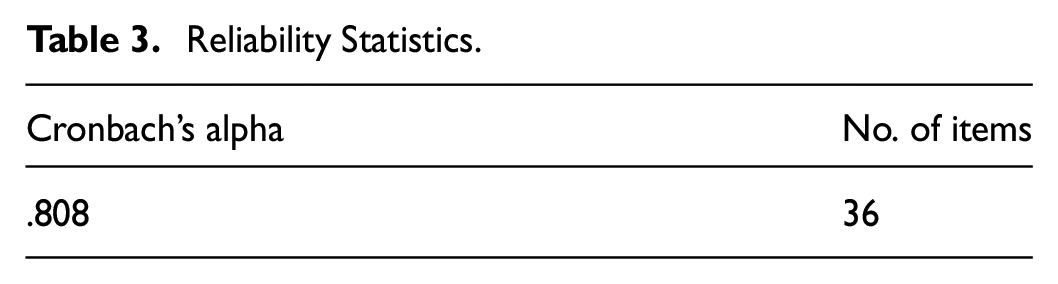
The results of this study (Table 3) show that Cronbach’s alpha values for 36 variables are .808, which is higher than .7 and is within the acceptable range.
Reliability Statistics.
Hypothesis Test About the Community’s Average
The hypothesis test about the community’s average checked whether the average value of the respondents was higher than the average value. In this research, because a 5-point Likert scale is used, the number 3 will be the middle or neutral number. The closer the obtained number is to 5 or 0, the greater the agreement or disagreement with that hypothesis. Because it is supposed to investigate the effect of collective decision-making on reducing or increasing 43 biases, the statistical hypotheses are defined as follows.

In this research, the biases that have a close concept and overlap are evaluated in an integrated manner with an index. For this reason, in the analysis of the findings, the following biases are merged.
The two biases of overconfidence and endowment effect, the two biases of conservatism and underreaction, the two biases of availability and framing, the two biases of regret aversion and loss aversion, the two biases of the illusion of validity and the disposition effect, the two biases of herd behavior and bandwagon effect, and the two biases of choice-supportive and hindsight.
In Table 4 the results of descriptive statistics of the data such as mean and standard deviation (the distance of the data from the average) are presented.
Results of Descriptive Statistics of the Data.

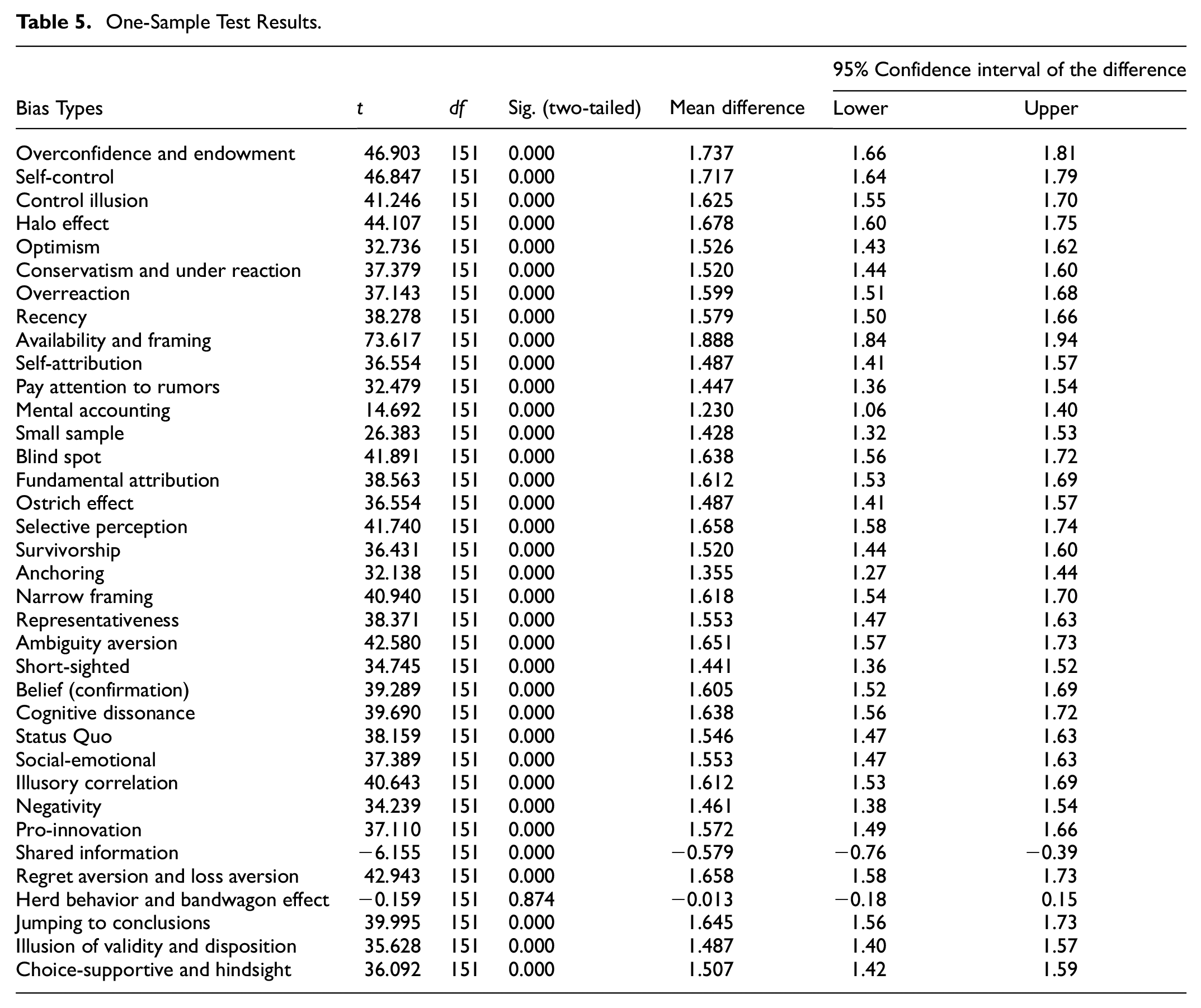
According to the information obtained from the hypothesis test about the community average, the analysis of the results of Table 4 shows that the average value obtained for 40 biases (except for the three biases of “Shared information,”“Herd Behavior,” and “Bandwagon effect”), is greater than 3, which is greater than the middle of the Likert scale, and it seems that collective decision-making is effective on reducing 40 biases. To ensure this effect, the significance value of the observed averages should be checked. To check the significance value of the averages, a one-sample t-test is performed at the 95% confidence level (i.e., with an error of 5%). The significance value is compared with the error level, if the significance value is smaller than the error level, then the observed average is confirmed; But if it is bigger, no comments can be made about the average. The results of the one-sample t-test are shown in Table 5.
One-Sample Test Results.
Based on the analysis of the results of the One-Sample test shown in Table 5, we can conclude.
Regarding the “shared information” bias, a significant value (Sig. two-tailed) of .000 is obtained, which is smaller than .05 (Sig. < .05). The t-test statistic for this bias is −6.155 and it is not in the critical range of t0.05, that is, −0.196 < T < 0.196. Because the lower and upper limits of the confidence interval are −0.76 and −0.39 (Both limits are negative), H0 is not rejected (Kaurav et al., 2021). Therefore, it can be said with 95% certainty that collective decision-making does not reduce the “shared information” bias. Thus, hypothesis H1 concerning this bias has been rejected.
Regarding “herd behavior” and “bandwagon effect,” a significant value of 0.874 is obtained, which is greater than 0.05 (Sig. > 0.05). The t-test statistic for this bias is −0.159 and it is in the critical range of t0.05, that is, −0.196 < T < 0.196. Because the lower and upper limits of the confidence interval are −0.18 and 0.15 (one limit is positive and the other limit is negative), it is not possible to comment and H0 cannot be confirmed or rejected (Loffing, 2022). Therefore, it cannot be said with 95% certainty that collective decision-making reduces or increases the biases of the “herd behavior” and “bandwagon effect.” Thus, hypothesis H1 concerning these biases have been rejected.
Regarding the rest of the biases (such as Overconfidence and Endowment, Self-Control, Control illusion, Halo effect, Optimism, Conservatism and Under reaction, Over reaction, Recency, Availability and Framing, Self-Attribution, Paying attention to rumors, Mental Accounting, Small sample, Blind spot, Fundamental attribution, Ostrich Effect, Selective perception, Survivorship, Anchoring, Narrow Framing, Representativeness, Ambiguity Aversion, Short-sighted, Belief (Confirmation), Cognitive Dissonance, Status Quo, Social Emotional, Illusory correlation, Negativity, Pro-innovation, Regret Aversion, and Loss Aversion, Jumping to conclusions, Illusion of validity and Disposition, Choice-supportive, and Hindsight), a significant value of .000 is obtained, which is smaller than .05 (Sig. < .05). The t-test statistic for these biases is greater than 1.96 and they aren’t in the critical range of t0.05, that is, −0.196 < T < 0.196. Because the upper and lower limits of the confidence interval are greater than zero (Both limits are positive), H0 is rejected (Shaikh et al., 2021). Therefore, it can with 95% confidence be said that collective decision-making reduces 40 cognitive biases. Thus, hypothesis H1 concerning these 40 biases have been accepted.
Discussion
Cognitive science researchers state that several factors influence a manager’s decisions and sometimes decisions become illogical under the influence of cognitive biases (Chen et al., 2022). Ordinary managers may not have information about the factors influencing decisions, and they need to be informed to make the best decisions. Previous studies also showed that decision-making biases have a great impact on reducing the quality of managers’ decisions (Jordão et al., 2020).
The review of previous studies shows that none of them have examined all the biases affecting managers’ decisions, but have only evaluated the effect of a limited number of biases on people’s performance. For example, articles such as H. Lee et al. (2022), Ross et al. (2023), Vogrin et al. (2023), Cherkes and Ryan (1985), Pfeiffer et al. (2000), AlKhars et al. (2019), McShane et al. (2013), Leisen (2017), have investigated only a limited number of biases, and mainly a solution for the reduction of these biases has not been provided. This study tries to cover this gap and tries to first recognizing all the biases affecting managers’ decisions and then examine the effect of collective decision-making on reducing these biases.
We hypothesize that if consultants and stakeholders with a collective decision-making method can recognize potentially biased decisions and create explanatory warnings for managers through collective decision-making, judgment errors caused by some cognitive biases can be reduced (McShane et al., 2013). The analysis in this study proved that the collective decision-making method can reduce 40 managers’ decision bias, but it may increase “shared information bias” or lead to “herd behavior and bandwagon effect.”
Reducing 40 biases in collective decision-making is a good achievement, but care must be taken to control the other three biases. Collective decision-making is affected by “shared information bias” when employees only talk about topics that others are familiar with and less about new topics and ideas (Baker, 2010; Palley & Satopää, 2023). Although one of the benefits of collective decision-making is that group members have access to more information, groups typically spend most of their discussion time examining shared information - information that two or more group members know in common - not unshared information. If something that only a few group members know is very important, and other opinions are not considered, this will bias the shared information and lead to a bad outcome (Reimer et al., 2010). Because, they tend to discuss the (shared) information that most members know, and are biased toward discussing the (unshared) information that one member knows (Palley & Satopää, 2023; Wittenbaum, 2000).
Collective decision-making is influenced by “Herd behavior and bandwagon effect,” when the lobby and the opinions of others influence a person. So, he tries to give an opinion according to their wishes. In this case, a person ignores his knowledge and awareness and follows the decisions of others or the only source of information is others (Bae & Yeu, 2022; Kumar et al., 2023). To control and reduce these biases, group members should express their ideas and opinions without fear and share their knowledge and awareness through discussions. Also, the goal of employees who participate in collective decision-making should be to reach the best decision with the help of the group, not to gain information and gain personal benefits (Cao & Wang, 2021; Youssef, 2022). For this reason, managers should be careful in choosing consultants and employees who participate in decision-making, so that they give opinions without prejudice and with knowledge and freely so that they do not suffer bias.
Since the source of cognitive biases is weak and incomplete reasoning, more information and consultation can often resolve them (McShane et al., 2013). Collective decision-making makes use of collective wisdom increases knowledge and awareness and causes attention to neglected dimensions (Dionne et al., 2019; Khaluf et al., 2019; Mann, 2018; McHugh et al., 2016). The effect of collective decision-making on reducing biases is consistent with previous research such as the study of Jordão et al. (2020). An example of the contributions that collective decision-making makes to reduce biases are shown in Table 6 based on the research background.
Examples of How Collective Decision-Making Helps Reduce Biases.

As shown in Table 6, collective decision-making can help reduce managers’ cognitive biases with methods such as information sharing, consultation, applying collective wisdom, applying a systemic view, etc. The results of this research are aligned with the results of previous studies such as Jordão et al. (2020), Pfeiffer et al. (2000), Ross et al. (2023), Vogrin et al. (2023), Leisen (2017), McShane et al. (2013). However, no research has been conducted regarding the effect of collective decision-making on the three biases of “shared information,”“herd behaviour,” and “bandwagon effect,” which shows that their results are not aligned with the results of this research.
The findings of this research show a low-cost and effective solution for company managers to reduce their mistakes and avoid possible damages. In other words, managers can make decisions more accurately in planning, organizing, evaluating, controlling, etc. by using the collective decision-making method and achieve greater productivity. Also, this research can lead to the advancement of the academic literature in this field, because it has been able to identify all the biases related to managers’ decision-making and explain them in the theoretical literature with extensive referencing. This advantage can allow cognitive science and management researchers to obtain more information quickly.
Conclusion
Managers have to make a variety of decisions in their lives at individual, organizational, and social levels. Managers’ decisions are more sensitive because they are more comprehensive and important. Due to the complexity of the environment, the influence of multiple factors, and dependence on simple heuristics and common arguments, managers’ decisions are susceptible to cognitive biases and therefore they may commit numerous errors. For example, they may be overconfident in their knowledge and skills (Boussaidi, 2022; C.-C. Lee et al., 2022), significantly optimistic about their future (Ul Abdin et al., 2022; Van Der Wege et al., 2021), or rely on anchors in their judgment (C. Y. Lee & Morewedge, 2022; Selim, 2021). Since cognitive biases have a great impact on managers’ decisions, it is important to recognize methods to reduce these biases (Jordão et al., 2020).
In this study, collective decision-making is introduced as one of the potentially important methods to reduce these biases. The theoretical contribution of this study is the identification of 43 biases affecting managers’ decision-making, and its practical contribution is the introduction of collective decision-making as a low-cost and effective way to reduce biases. Hence, to check the effectiveness of this method, 152 managers of state-run organizations (at different management levels) were surveyed using a Likert scale questionnaire. The analysis showed that the questionnaire enjoys good validity and reliability. Also, the findings showed that among the 43 decision-making biases of managers, 40 biases have a significance value of 0.000, which is smaller than 0.05; the t-test statistic for these biases is also higher than the critical value of t0.05, that is, 1.96. Since the average of the answers on the Likert scale is above 3 and the upper and lower limit of the confidence interval is greater than zero, therefore hypothesis H1 regarding these 40 biases is confirmed. Therefore, it can with 95% confidence be concluded that collective decision-making reduces 40 biases, but it does not reduce “shared information” bias, and it is not possible to comment on the biases of “herd behavior” and the “bandwagon effect.” This issue warns that collective decision-making should be done consciously and without lobbying pressure so as not to be influenced by convergence. The findings of this study can motivate managers to use the collective decision-making method to reduce biases and reach an optimal decision.
Limitations and Future Directions
The results of this study have certain limitations. Firstly, the data collection was restricted to a single period due to time constraints. It would have been beneficial to measure the impact of collective decision-making on reducing cognitive bias in various periods through experimentation. The inability to connect with organizations in other countries that employ collective decision-making techniques to mitigate bias is another limitation. Examining data from different countries can increase validity.
Five suggestions are presented for future research. First, a cross-cultural analysis of the acceptance or rejection of collective decision-making methodology among managers in different societies could be studied. Second, researchers could do more research on the outcomes of collective decision-making such as social justice and progress. Third, how external factors (e.g., organizational culture, leadership style) might influence the effectiveness of collective decision-making in mitigating biases. Fourth, it is recommended to consider exploring qualitative methods as a means of gaining a more profound understanding of biases that are not easily measurable through quantitative means. Fifth, to reduce the biases of “shared information” and “herd behavior” through collective decision-making, it is recommended to identify the underlying reasons for ambiguity and indeterminacy and propose solutions to address these discrepancies.
Footnotes
Appendix
| Questionnaire of the collective decision-making | ||||||
|---|---|---|---|---|---|---|
| Questions | Strongly disagree | Disagree | Uncertain | Agree | Strongly agree | |
| 1 | Being in a group can help a person gain a better understanding of their abilities. | |||||
| 2 | Making collective decisions can increase people’s awareness of their weaknesses. | |||||
| 3 | Making collective decisions can help people become more aware of their environment. | |||||
| 4 | Making collective decisions can help people gain a better understanding of the factors that contribute to a problem. | |||||
| 5 | Making collective decisions can help proud people experience less hurt or disappointment. | |||||
| 6 | Collective decision-making can help prevent people from ignoring new information. | |||||
| 7 | Collective decision-making can help avoid paying too much attention to untrue reports, developments, and statements. | |||||
| 8 | Collective decision-making involves examining a set of past and present information about the problem. | |||||
| 9 | Collective decision-making can involve collecting more information about the issue and considering a wider range of dimensions related to the issue. | |||||
| 10 | In collective decision-making, everyone involved shares in the consequences of the success or failure of the decision. | |||||
| 11 | When decisions are made collectively, rumors may have less influence on the decision-making process. | |||||
| 12 | Being in a group can reduce people’s tendency to view issues solely through the lens of economic profit and loss, and instead consider a wider range of factors. | |||||
| 13 | In collective decision-making, all opinions and suggestions are taken into consideration. | |||||
| 14 | In collective decision-making, people may criticize each other’s opinions and suggestions. | |||||
| 15 | In collective decision-making, attention is paid to the conditions and environmental factors that may have influenced a person’s behavior when explaining and judging their actions. | |||||
| 16 | In collective decision-making, people actively work to identify and examine all important aspects of a problem. | |||||
| 17 | In collective decision-making, people try to take into account all the positive and negative consequences of a phenomenon. | |||||
| 18 | In collective decision-making, people try to examine both successful experiences and failures. | |||||
| 19 | When people make collective decisions, they may not form a final decision until a consensus or agreement is reached. | |||||
| 20 | When decisions are made collectively, people consider different points of view. | |||||
| 21 | A more comprehensive view of the various issues is created in people through collective decision-making, because of the diversity of views. | |||||
| 22 | Collective wisdom has the potential to resolve numerous uncertainties. | |||||
| 23 | Collective decision-making enhances individuals’ ability to anticipate future events and outcomes. | |||||
| 24 | When a decision is made collectively, the viewpoints of all individuals are taken into account. | |||||
| 25 | In situations where decisions are made collectively, individuals tend to be more receptive to viewpoints that diverge from their own beliefs. | |||||
| 26 | Individuals tend to be more open to change when decisions are made collectively. | |||||
| 27 | Emotional decisions are minimized when decisions are made collectively. | |||||
| 28 | Collaborative decision-making enhances the comprehension of logical connections between phenomena. | |||||
| 29 | In the process of making decisions as a collective, equal weight is placed on negative news and information alongside the influence it may have on the final decision. | |||||
| 30 | The collective members are equally concerned about the value of a new product. | |||||
| 31 | Occasionally, fresh subjects are introduced for the initial time in a collective setting. | |||||
| 32 | When decisions are made collectively, individuals tend to exhibit reduced concern regarding the potential outcomes of their decisions. | |||||
| 33 | Within a group of individuals who share similar beliefs or values, an individual may choose to voice divergent opinions when they arise. | |||||
| 34 | During collective decision-making, individuals aim to take into account the entirety of the decision-making process, focusing on the steps necessary to attain the intended outcome rather than solely on the decision outcomes. | |||||
| 35 | When an individual within a collective harbor an erroneous mindset, they may promptly come to acknowledge their fallacy. | |||||
| 36 | When decisions are made collectively, the occurrence of the bandwagon effect in behavior is reduced. | |||||

Funding
The author(s) received no financial support for the research, authorship, and/or publication of this article.
Declaration of Conflicting Interests
The author(s) declared no potential conflicts of interest with respect to the research, authorship, and/or publication of this article.
Data Availability Statement
All data included in this study are available upon request by contact with the corresponding author.