




Abstract
China’s labor market, being the largest globally, is facing challenges due to factors such as population aging and polarization of population movements, this study aims to examine the relationship between urban welfare and labor supply among urban residents in China, considering the mediating roles of social interaction and cynicism. OLS regression analysis using STATA16 software was conducted to test the correlations between urban welfare, social interaction, cynicism, and labor supply. The mediation effects were examined through KHB regression, demonstrating the specific roles of social interaction and cynicism as mediators. This study concludes that urban welfare has a significant negative impact on the labor supply of urban residents in China. Social interaction plays a positive mediating role, emphasizing its importance in the relationship between urban welfare and labor supply. Cynicism also plays a negative mediating role, albeit with a minor effect. When both social interaction and cynicism are considered, their joint effect is negative, with social interaction exerting a stronger mediation effect. Furthermore, the study highlights the gender and regional differences in the impact of urban welfare, social interaction, and cynicism on labor supply. These findings provide valuable insights for policymakers to enhance urban welfare programs and promote labor supply in China.
Introduction
According to the World Bank, China’s total labor force will reach 792 million by early 2022, ranking first among all countries and regions in the world and accounting for 22.96% of the world’s total labor force. This large and cheap labor resource has been a key factor in driving China’s rapid economic development over the past 30 years. However, for a long time, the trend of population aging and childlessness has directly led to changes in the quantity and structure of China’s labor force (Hao & Pengfei, 2019).The industrial upgrading brought about by a new generation of technological advancement represented by automation and artificial intelligence has had a crowding out effect on labor supply (Xueqin, 2023), plus the impact of external environmental uncertainties such as sudden public health events on the impact of the individual level of the labor force, this labor dividend based on quantitative advantages urgently needs to be transformed. At the same time, the relaxation of settlement restrictions in developed provinces and cities is gradually turning into a boom, which will further stimulate the concentration of population in large cities. The agricultural labor force has declined sharply (Jin et al., 2021), China is transforming from rural China to rural-urban China (He et al., 2020). Therefore, in the face of the polarization of population mobility in the future, how to protect the rights and interests of workers and promote the healthy development of the labor market will certainly become the core issue of urban management.
Labor supply refers to the amount of time an individual is willing and able to offer for work in a given market environment. It includes both breadth and depth. Breadth refers to the market participation rate of effective labor, and depth represents the productive time of labor contributed by labor (Heckman, 1993). An effective and stable labor supply is crucial to national economic development, social stability, and the realization of individual values. For this reason, a large number of scholars have conducted research on the factors influencing labor supply, and one important area is to explore the relationship between the level of benefits and labor supply.
From the perspective of social security benefits, social pensions may encourage workers to retire early and reduce labor market participation (Louise & Summerfield, 2018). Iskhakov and Keane (2021) used a life-cycle model to assess the impact of pension systems and income tax policies on labor supply, which also confirmed the negative impact of basic pension insurance on labor supply. However, health insurance can make a significant contribution to the labor decisions of the population because it contributes to the improvement of healthy human capital, which improves the health stock and expectations of the population and ultimately increases productive activity (Grossman, 1972). In particular, it increases the labor supply of older people with chronic diseases (Kalwij & Vermeulen, 2008).
From a housing welfare perspective, some scholars have found that a 10% increase in housing prices can make the retirement age three and a half to 5 months earlier than previously expected (Farnham & Sevak, 2016). Chinese panel data also show that every 1% increase in housing prices leads to an average 0.08 percentage point decrease in female labor force participation (Weiping et al., 2016). However, improvements in housing conditions, such as running water, electricity, ventilation, and heating, can increase housing labor supply (Michaels et al., 2021), particularly by freeing up women’s household labor time, helping to free women from tedious household activities, and increasing the opportunities for female labor supply (Franklin, 2020).
From the perspective of economic welfare, labor economics clearly suggests that the increase in wage level has a substitution effect and an income effect on labor supply. In addition, personal income tax relief can also significantly increase the labor participation rate and labor production time of residents, and there are group differences in the impact of such policy changes, that is, the increase in labor supply is more obvious for women and low-income groups (Hua et al., 2022).
Clearly, welfare levels are closely related to individual labor decisions, and different welfare measures and levels may have opposite effects on labor supply. However, most of the existing studies focus on the impact of specific welfare measures on labor supply, lacking a comprehensive consideration of welfare levels and ignoring the differences in welfare across regions. Based on this, this paper takes an urban welfare perspective and uses China, which has the world’s largest labor market, as the object of study. The entropy method is used to evaluate the total value of urban welfare so as to take into account the impact of welfare differences between cities on the labor supply of residents. It is important to note that the level of urban welfare is not the same as the inherent resources, and individuals do not have full control over the urban welfare they possess. In other words, even if two residents of the same city have similar welfare entitlements, it only means that their labor supply decisions are based on the same starting point, not the same outcome of their labor behavior. The efficiency of urban welfare effects will also be influenced by the external environment in which individuals live and by their own personal characteristics. Therefore, based on social cognitive theory, this paper distils two factors, social interaction behavior and cynicism, which are used to represent the environment in which individuals live and the psychological characteristics of individuals, respectively, in order to further explore the role of these two factors in the process of urban welfare level affecting the labor supply of residents.
Research Hypothesis
Based on the above analysis, this section will explain the relationship between urban welfare levels and residential labor supply at a theoretical level, explore the mediating role of residential social networks and cynicism in this process, and formulate corresponding hypotheses.
Urban Welfare and Labor Supply
In the existing literature, scholars have conducted a relatively rich analysis of the factors affecting labor supply, but it is relatively rare to study the issue of resident labor supply from the perspective of urban welfare. Urban welfare, as one of the typical products of urbanization, includes a number of dimensions such as economic, social and environmental (Yinan & Junfu, 2020). It is both an important guarantee for sustainable urban development and a reflection of the extent to which a city meets people’s material and cultural needs. Cities are the starting point of modern social welfare policy and a vehicle for coordinating the harmonious development of man, nature and society. China’s urban welfare has gradually developed after the experience of social assistance and a dualistic welfare system between urban and rural areas. The public service system has become more people-centered. Large cities are favored by capital because of their location, which allows them to increase the level of urban infrastructure and comprehensive protection. At the individual level, the “income effect” of stable prices and disposable income increases the preference for leisure and thus reduces labor hours; pension insurance directly increases income and reduces labor supply (Lalive & Parrotta, 2016; Vere, 2011). While the “health effect” of health insurance increases labor supply, its “security effect” and “economic effect” reduces non-agricultural labor participation (Zhao & Peiyu, 2019); Improved air quality increases labor productivity, which in turn increases marginal compensation and allows workers to reduce labor supply while keeping their income constant (Hongxiang & Wenbin, 2017).
It can be seen that the level of welfare in different dimensions plays a great role and influences the process of residents’ labor supply decisions. Therefore, this paper proposes the following research hypotheses.
H1: Urban welfare has a negative impact on residents’ labor supply.
The Mediating Effect of Social Interaction Behavior
Social cognitive theory suggests that individuals’ cognition and behavior are shaped by the environment in which they live, and are influenced and regulated by changes in that environment. Therefore, urban welfare, which is a combination of economic, social, and environmental characteristics (Jingyi & Qiong, 2014), reflects some extent the environmental conditions in which individuals live and influences the social interaction behavior of residents.
According to social interaction theory, people interact with each other psychologically and behaviorally in the context of certain social relationships. Social interactions, as part of an individual’s social network, can have a significant impact on residents’ labor supply decisions. Existing research suggests that the resources individuals devote to maintaining social relationships crowd out resources for labor force participation and may reduce individual labor supply. At the level of family interactions, individuals, especially women, engage in more family interactions, which can significantly reduce labor supply by crowding out time for job search and work (Hersch & Stratton, 2000; Noonan, 2001). This phenomenon is even more pronounced in China, where, due to traditional Chinese culture, women’s labor force participation is more likely to be constrained by family responsibilities such as marriage, childbirth, and caregiving (Huang & Jin, 2022; Leng & Kang, 2022); At the level of external interactions, social interactions also have a negative impact on labor resources such as time, energy and money crowding out, while inter-individual job comparisons reduce the expected benefits of labor force participation, thus reducing the positive incentives for labor returns (Horváth and Zhang, 2022). It is worth mentioning that some active individuals engage in purposeful social behavior, thus gaining access to more social resources, which ultimately leads to differences in individual labor competitiveness and supply (Xin, 2017). Such social resources include rich job information, reliable relationships, etc., which can improve outcomes such as individuals’ probability of finding a job, wages, and job satisfaction (Ioannides & Soetevent, 2006; Kramarz & Skans, 2014). In summary, this paper proposes the following research hypotheses.
H2: The social interaction behavior of residents plays a mediating role in the impact of urban welfare on resident labor supply.
The Mediating Effect of Cynicism
According to social cognitive theory, human activities are also influenced by individual psychology and cognition. In other words, the effect of urban welfare on residents’ labor supply may be related to residents’ personality traits. Cynicism is the stable tendency of individuals to distrust others and hold negative beliefs about human nature (Jamieson & Hall, 1997; Stavrova & Ehlebracht, 2016). It is often closely associated with fragile interpersonal relationships (Stavrova & Ehlebracht, 2018) and influences individuals’ evaluation processes of external events (Choy et al., 2021). Moreover, this trait usually largely reflects individual differences in the evaluation of benefits (Solom et al., 2017), including the perception of urban welfare. Therefore, this paper introduces cynicism as a mediating variable to further examine the role of individual psychological and cognitive traits in the process of urban welfare’s impact on residential labor supply.
In this paper, we argue that cynicism mitigates the negative relationship between urban welfare and labor supply. Specifically, individuals with high levels of cynicism are naturally skeptical and tend to interpret society from a negative perspective (Jamieson & Hall, 1997; Kramarz & Skans, 2014). This implies that residents with high levels of cynicism are less likely to believe that these profitable behaviors are driven by altruistic motives, as they are more cautious when it comes to obtaining economic, social, and environmental resources for urban welfare, and are more likely to rely on the benefits they receive from their own labor. Therefore, when the level of cynicism is high, the negative relationship between urban welfare and residential labor supply will be broken. In summary, this paper proposes the following research hypothesis:
H3: Cynicism plays a mediating role in the impact of urban welfare on residential labor supply.
Based on the above analysis, this paper proposes a conceptual model as shown in Figure 1.
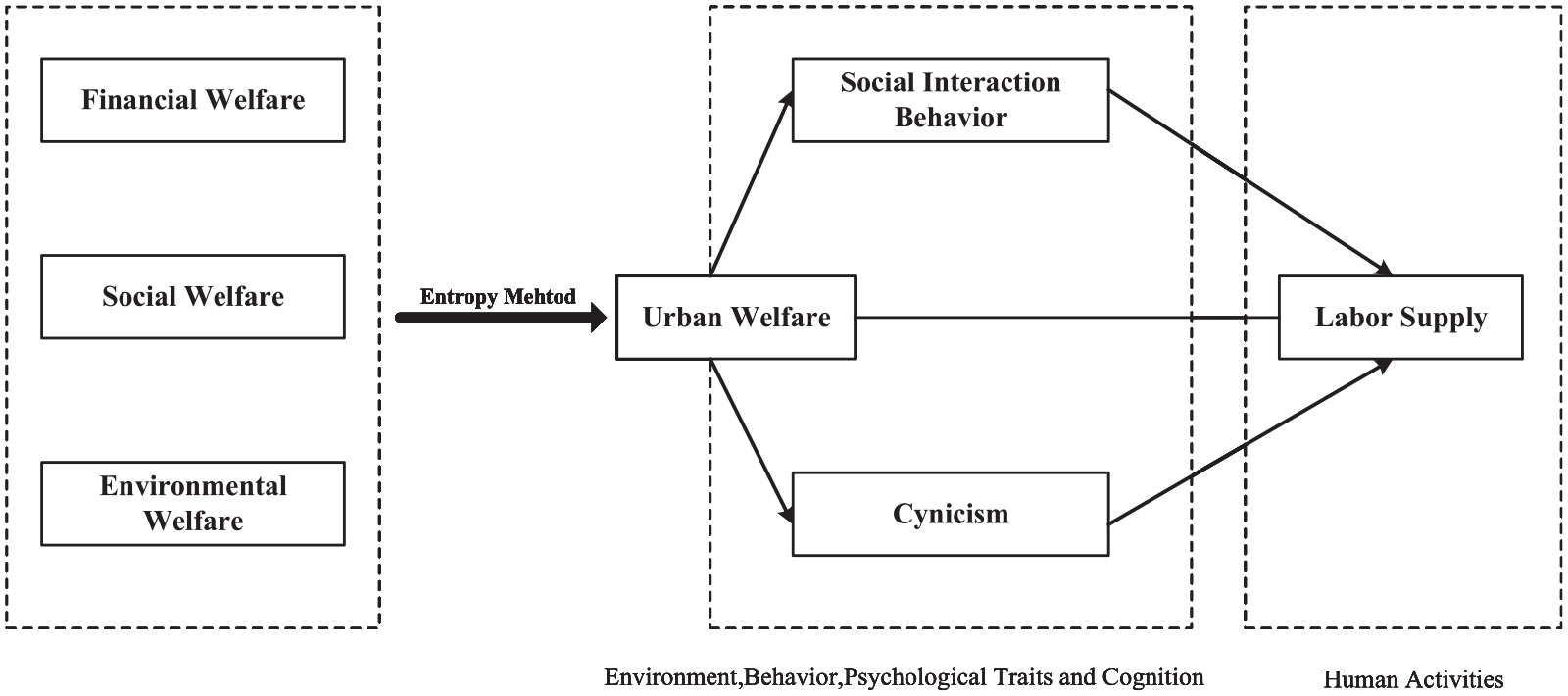
Conceptual model based on social cognitive theory.
Methods
Data Source
The 2018 China Family Panel Studies (CFPS) database was selected to exclude the impact of public health emergencies on the labor supply of the population. The CFPS is a nationwide, comprehensive social survey that focuses on the economic and non-economic welfare of Chinese residents. It not only contains rich information on individual and household characteristics but also allows the matching of micro-level data with city-level data to examine the impact of urban welfare on the labor supply of residents. This paper uses the combined values of data from the three urban economic, social, and environmental dimensions for the corresponding years as a measure of urban welfare. The data were obtained from the 2018 China Urban Statistical Yearbook as well as the statistical yearbooks of the corresponding provinces and cities. In terms of sample data processing, firstly, samples aged 18 to 65 were screened to ensure that the study population was the legal adult labor force, and secondly, microdata were matched with urban data based on the prefecture-level city codes of respondents in the CFPS, and samples with missing key information and outliers were eliminated, resulting in 5,386 labor force samples from 111 prefecture-level cities being retained for empirical analysis.
Variable Explanation
Dependent Variable
The dependent variable in this paper is the labor supply of the population. In conjunction with Heckman’s definition of labor supply, this paper uses the CFPS adult questionnaire “hours worked per week” to define the labor supply of the population. See Table 2 for specific scale designs.
Independent Variable
The independent variable in this paper is urban welfare. Based on existing research, this paper focuses on three dimensions: economic, social and environmental, and selects a set of indicators such as income, consumption, health care, education and infrastructure to measure the functional realization of urban socio-economic development. The entropy value method is used to determine the weights of each dimensional characteristic indicator and calculate the comprehensive welfare score of each city. The specific dimensions and indicators are listed in Table 1.
Dimensions and Specific Indicators for Measuring Urban Welfare.

Denotes negative indicators.
Mediation Variable
First,
Control Variables
Following the existing authoritative literature and taking into account the availability of data, this paper introduces individual characteristics and regional characteristics as control variables. Individual characteristics include age, gender, marital status, educational attainment, confidence in the future, and self-rated health. At the regional level, eastern, central, and western dummy variables were added. The control variables were set as shown in Table 2.
Description of Core Variables.

Models and Methods
Baseline Regression Model
Since residential labor supply is a continuous dependent variable, the following benchmark ordinary least squares regression model was constructed:

In Formula (1), i represents individual residents, α0 is a constant, αi is a coefficient, and ε is random error term, xi represents urban welfare, social interaction, and cynicism.
The Mediation Decomposition Effect of KHB
In this paper, the KHB method is used to estimate the mediating variables of the linear model and a regression model with mediating effects is constructed (Kohler et al., 2011). The mediating effect can be decomposed by establishing the relationship between the dependent variable, the initial independent variable and the mediating variable. Specifically, it consists of three steps:
Step 1: Build a simplified model to test the aggregate effect of different levels of urban welfare on the labor supply of urban residents:

Step 2: Develop a complete model to test the direct effects of mediating variables on urban residential labor supply:

In the third step, the coefficient of variation (βx − γx) can be obtained from the total and direct effects, which is the indirect effect of the independent variable Urban welfare and the mediating role played by the mediating variable. If the coefficient of variation is significantly positive, it indicates that the coefficient of Welfare decreases in response to the mediating variable, that is, the mediating variable has a positive mediating effect on it. If the coefficient of variation is significantly negative, it indicates that the mediating variable has a negative mediating effect on it.
The specific measurements were done using STATA16 software.
Results
Benchmark Regression Analysis Results
As the dependent variable in this paper is a continuous variable, the correlations between urban welfare, social interaction, cynicism, and labor supply were tested through the development of OLS models. The significance level of all five models was 0.000, indicating that the fit was good. The specific regression results are shown in Table 3.
The Impact of Urban Welfare, Social Interaction and Cynicism on Residential Labor Supply.

p < .01. **p < .05. *p < .1.
Model (1-1) is a regression model with only control variables. Models (1-2), (1-3), and (1-4) add the independent variable urban welfare and the mediating variables social interaction and cynicism, respectively, to the control variables. Compared to model (1-1), the R-squared values of all three models increased and were higher than 0.8, indicating that the addition of the independent and mediating variables increased the explanatory power of the models. The results show that urban welfare has a significant negative effect on residents’ labor supply, suggesting that the higher the level of urban welfare, the less labor time residents are willing and able to contribute, as confirmed by H1; and that social interaction has a significant negative relationship with labor supply, while cynicism promotes an increase in labor supply. Both regressions are significant at the 1% and 10% levels. Model (1-5) includes all independent and mediating variables in the regression analysis, and the R-squared values continue to increase, indicating that the model has the strongest explanatory power. At this point, the urban welfare and social interaction coefficients decrease. The cynicism coefficient increases and becomes more significant. This means that the negative effect of urban welfare and social interaction on residential labor supply decreases when they are combined, compared to their separate effects. At the same time, the positive effect of cynicism on the supply of residential labor increases. This change implies the existence of mediating pathways.
In terms of control variables, the age, gender, education level and confidence in the future of the population have a significant impact on the labor supply of the population. First, as age increases, the healthy human capital of the labor force begins to decline. Older residents have less energy and strength to support long working hours. As a result, the labor supply decreases. Second, the labor supply of male residents tends to be stronger than that of females, which, based on previous studies, may be due to the heavier family responsibilities of Chinese women (Wang, 2023; Yang & Yuchen, 2022) and potential discrimination against women in the labor market (Oaxaca, 1973). In addition, the abundance of educational resources in large cities can significantly improve the individual skills and qualifications of the labor force, making it more likely to obtain higher-paying or intellectually oriented jobs and the fact that high-quality labor tends to be more productive, resulting in lower labor hours for residents. Finally, high levels of confidence in the future economic development and stability of social life in the city can encourage residents to view their career development and work rewards positively, encouraging them to increase their labor supply.
Analysis of the Intermediary Mechanism of Social Interaction and Cynicism on Labor Supply
The KHB method was used in this study to test the mediating role of social interaction and cynicism. As shown in Table 4, it can be seen that the total, direct, and indirect effects of all three models are significant at the 10% level and below, indicating that urban welfare can influence residents’ social interaction and cynicism to affect their labor supply.
KHB Test Results of the Social Interaction and Cynicism Mediation Effect.

p < .01. *p < .1.
Specifically, in the model (2-1), the direct and indirect effects are significant at the 1% level and both have the same negative sign, suggesting that social interaction has a partially positive mediating effect, that is, urban welfare can negatively affect their labor supply by affecting social interaction, and hypothesis H2 is confirmed. In this process, social interaction explains 14.02% of the impact of urban welfare on the labor supply of residents.
In model (2-2), the direct and indirect effects are significant at the 1% and 10% levels, respectively, and both values have different signs, indicating that cynicism has a partial negative mediating effect, that is, cynicism is able to reduce the negative impact of urban welfare on labor supply, and hypothesis H3 is confirmed. In the process, cynicism is able to explain −0.8% of the effect of urban welfare on residential labor supply, with a small mediating effect.
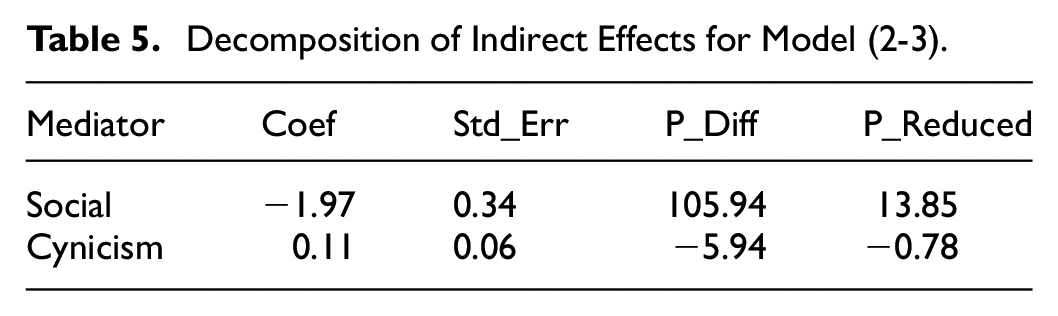
Model (2-3) further examined the overall effect of the mediating variables. The total, direct, and indirect effects are all significant at the 1% level and have negative coefficients, while the indirect effect contributes 13.07%, indicating that social interaction and cynicism have a partially positive overall mediating effect. According to Table 5, the contribution of social interaction and cynicism to the indirect effect is 105.94% and −5.94%, respectively, indicating that the positive mediating effect of social interaction is much greater than the negative mediating effect of cynicism to the extent that they contribute to the overall negative effect of urban prosperity on labor supply.
Decomposition of Indirect Effects for Model (2-3).
Heterogeneity Tests of the Effects of Urban Welfare, Social Interaction and Cynicism on Residential Labor Supply
In addition, because traditional Chinese gender concepts and objective differences in the level of economic development and folk customs between regions may influence the impact of urban welfare, social interaction, and cynicism on residents’ labor supply, this paper groups the sample by gender/region to test for gender and regional differences in the relationship between urban welfare, social interaction, and cynicism and labor supply. The inspection results are shown in Table 6.
Heterogeneity Verification Results.

p < .01. **p < .05. *p < .1.
Models (3-1) and (3-2) are based on the regression results after grouping by gender. The results show that urban affluence ( a = −10.24, p < .01) and social interaction ( a = −8.08, p < .1) have a greater effect on men’s residential labor supply than women’s, while cynicism ( a = 3.25, p < .01) has a greater effect on women’s residential labor supply. The reason for this is that the traditional Chinese social norm of “men dominate outside and women dominate inside” dictates that men are significantly more concerned about the external welfare environment and socialize more frequently than women, and therefore their labor supply is more likely to be constrained by high levels of welfare and crowded out by frequent socializing. Women are also more psychologically sensitive, and their long-term attachment to family interests increases their defensiveness and distrust of the external environment, contributing to the impact of cynicism on women’s labor supply. Models (3-3), (3-4), and (3-5) are the results of regressions based on different regional groupings. The results show that the effect of urban welfare on labor supply decreases from east to west. The effect of social interaction is weaker in the east than in the central region, and social interaction is not significant in the west. Cynicism is not significant in any of the three regions. Due to China’s uncoordinated regional development, the eastern region has a higher level of economic development than the central and western regions, and some cities are able to achieve high levels of urban welfare, resulting in significant differences in welfare across cities and facilitating a more significant impact on labor supply. The benefits of socialization for labor, such as information advantages and the accumulation of contacts, are higher in the eastern regions than in the central regions, which weakens the crowding out of labor by socialization. The generally lower level of welfare and population density in the west weakens the intercity differences, making their impact on labor supply insignificant.
Discussion
This paper defines resident labor supply as the effective labor time that urban residents are willing and able to contribute under certain conditions, reflecting their behavioral choices and value judgments; A research and analysis framework was constructed based on social cognitive theory, an OLS regression model and a KHB mediation test model were used to analyze the impact of urban welfare on the labor supply of urban residents and the mechanism of action. The main findings of the study are: (1) urban welfare, which is an important guarantee for urban development, has a significant inhibiting effect on urban residents’ labor supply by integrating the urban economic environment, social environment and ecological environment; (2) residents’ social interaction behavior plays a positive mediating role in the process of urban welfare influencing labor supply, accounting for 14.02%, indicating that the influence of urban welfare on labor supply is dominated by direct effect is dominant; (3) Cynicism traits play a negative mediating role in the process of urban welfare influencing labor supply, but the effect is small; (4) When resident social interaction and cynicism work together, they collectively play a negative mediating role in the process of urban welfare influencing labor supply, with the effect of social interaction playing a much larger role than cynicism; (5) There are significant gender and regional differences in the effects of urban welfare, social interaction, and cynicism on residents’ labor supply. The effects of urban welfare and social interaction are stronger for men, and the effects of cynicism are stronger for women. The negative effect of urban welfare is stronger for urban residents in the eastern region, and the negative effect of social interaction on labor supply is more pronounced for urban residents in the central region. The findings are consistent with the hypothesis of this study.
The findings of this study corroborate prior research, indicating that effective social public services and policy frameworks can exert a negative influence on the supply of labor in urban areas (Asfaw et al., 2014; Imbert & Papp, 2020) . Although large cities have higher levels of public services and more opportunities for development. This has a strong attraction for mobile populations (Yiran & Ming, 2015), leading to an increase in the population and size of cities, which in turn leads urban residents to become more socially active, with a wider range of social interactions and more complex social relationships. At the same time, higher levels of urban welfare remove basic subsistence concerns and increase the propensity of residents to spend their leisure time, encouraging them to spend more of their free time on social activities. Finally, social interaction crowds out the labor supply of residents. It is worth noting that social behavior itself can have positive effects, such as reducing inequality in employment information and accumulating useful social capital (Chunchao et al., 2015), but the results of the study show that social interaction crowds out labor time and resources, suggesting that the negative effects of social behavior on labor supply are much greater than its positive effects. Simultaneously, we argue that urban welfare is a type of resource and that the more resources an individual possesses, the more likely one is to have a higher sense of defensiveness and thus tend to develop stronger cynical traits. At the same time, a high level of urban prosperity can lead to a high level of subjective expectations, which may be disconnected from the actual level of trust, leading to a “trust deficit” and reinforcing cynicism. Highly cynical residents are reluctant to rely on others, focus on their own interests, and rely more on their own efforts to obtain rewards, thus positively influencing the labor supply.
When examining the impact of macroeconomic factors on labor supply, it is essential to acknowledge the significant role that population structure plays in this context. Currently, China is progressively transitioning into an aging society, the escalating expenses associated with contemporary living and evolving societal attitudes toward marriage have contributed to a decrease in China’s fertility rate (Peiwen, 2022). Population aging and population decline exert a clearly negative effect on the urban labor supply (Tongming, 2019).
This study marks the first time research has been conducted from a meso-level urban perspective. This paper offers a more comprehensive view by developing a welfare measurement system that encompasses the economic, social, and environmental aspects of cities. Additionally, it reveals that individual behavioral factors and psychological traits significantly influence the relationship between urban welfare and individual labor supply, playing various mediating roles. This finding underscores the importance of promoting positive social behavior and focusing on health psychology to enhance labor supply in China.
Limitation
The shortcomings of this paper include the inability to match urban data with China’s ethnic minority concentration areas, which makes the study less dimensional, the use of cross-sectional data from 2018, which makes the data less recent, and the neglect of time-varying trends. In the future, the study will further refine urban welfare and explore the impact of economic, social, and environmental welfare on labor supply, while complementing the impact of the interaction between social interaction and cynicism in this process.
Conclusions
Based on the above research findings, this paper makes the following recommendations: (1) Develop a moderate urban welfare system to activate the vitality of labor market agents. In combination with social needs, moderate urban welfare should be provided, both to compensate for the shortcomings of structural welfare and to prevent the excesses of growth-oriented welfare. Specifically, administrators need to further expand the coverage of urban welfare protection, expand the types of basic welfare programs, lower the threshold of basic welfare protection, and unleash the potential of labor supply for disadvantaged groups such as the elderly, the unemployed, the relatively poor, and special groups such as those employed in new industries. At the same time, in terms of management, city governments need to change the type of welfare relief, establish graduated evaluation criteria for entering and exiting welfare programs, and achieve dynamic adjustment of welfare benefits, so as to avoid the phenomenon of “welfare dependency” and the risks to labor supply caused by high levels of unreasonable urban welfare. Finally, city managers should adapt to the characteristics of the era of negative population growth, move from a “crude” increase of urban welfare to a “refined” control of urban welfare, and establish a “well-structured and moderately protected” urban welfare system; (2) Guiding benign social interactions and building mainstream social values. The government must build a platform for high-quality, humane social interaction, guide benign interactions among city residents, and actively carry out urban activities with the theme of mutual assistance in job seeking, thereby enhancing the informational advantages of social interaction, reducing the crowding-out effect of inefficient social behavior, and stimulating an increase in labor supply. At the same time, city leaders should build a city culture with mainstream values at its core, promote the building of a harmonious society of mutual trust and mutual assistance, enhance the sense of ownership of city residents, and improve their sense of belonging and identity. In this process, society should also take a dialectical view of the psychological trait of cynicism and fully utilize its positive effect on labor supply, instead of excluding it from social identity because of its negative attitude.
Footnotes

Funding
The author(s) disclosed receipt of the following financial support for the research, authorship, and/or publication of this article: This work was supported by the Research on the Mechanism and Governance Path of Strategic Purchase of Medical Insurance Guiding the Sinking of High Quality Medical Resources, National Natural Science Foundation of China, 72474087 and Research on the Level of Social Trust and Governance Strategies for Primary Health Services Based on Value Perception Realization, National Natural Science Foundation of China, 72074098.
Declaration of Conflicting Interests
The author(s) declared no potential conflicts of interest with respect to the research, authorship, and/or publication of this article.
Data Availability Statement
Data sharing not applicable to this article as no datasets were generated or analyzed during the current study.