



Abstract
This article investigates the impact of social interactions on household entrepreneurial behavior using the data of the China Family Finance Survey (CHFS) in 2015. The results show that social interaction has a positive influence on household entrepreneurship. More social interactions are associated with a higher likelihood of participating in both business and agricultural entrepreneurship. Moreover, the positive effect of social interaction on entrepreneurship increases with the relaxation of financial constraints faced by households. Finally, entrepreneurship is more motivated by social interaction for women than men. The results obtained in the benchmark are testified to be reliable after addressing the potential endogeneity of social interactions and using a different regression method.
Introduction
Since the reform and opening-up, China’s economic development has entered a “new normal” stage after nearly 40 years of rapid growth. The fundamental characteristic of this stage is that economic growth shifts from a high-speed model to a high-quality model. Innovation and entrepreneurship become an important driving force to realize economic development and transformation (Baumol, 1990). However, during the transformation process, the economic slowdown may bring about some adverse consequences. For instance, the deceleration of economic development may cause stronger employment pressure with the increasing number of population and college graduates. How to create more jobs is a major challenge for the government in recent years. There is no doubt that cultivating a good employment environment and encouraging entrepreneurship are two important means of addressing unemployment problems.
Since the concept of “Mass Entrepreneurship and Innovation” was proposed by Premier Li Keqiang at the 2014 Summer Davos in Tianjin, lots of efforts including financial support and tax incentives have been put by the Chinese government to upgrade entrepreneurship and innovation to a higher level and wider scope to boost employment, promote technological innovation, and stimulate industrial growth. These efforts have delivered effective results. The number of entrepreneurial teams and innovation-driven companies has achieved fast growth. Statistics from the State Administration for Market Regulation showed that a daily average of 18,000 new businesses have been registered in 2018.
Nevertheless, given the fast economic development and huge employment demand, entrepreneurship in China is insufficient in terms of quantity, quality, and environment. Regarding quantity, according to World Bank WDI Database, the density of newly registered enterprises in China (the number of newly registered enterprises per 1,000 working-age population) is less than 2, which is lower than 28.12 in Hong Kong, 8.04 in Singapore, and 12.16 in Australia. Less than 10% of entrepreneurs can successfully start their businesses, and less than 10% of newly founded enterprises can survive more than 1 year. In addition, the entrepreneurial success rate of Chinese college students is even lower. According to “Employment Report of Chinese College Students 2017,” more than half of the graduates who started their businesses half a year after graduation quit their businesses in 3 years. Even in coastal cities with a better entrepreneurial environment, such as Zhejiang and Guangdong, the entrepreneurial success rate of college students is only about 5%, while the global average success rate is almost 20%.
Moreover, concerning the type of entrepreneurial activity, the proportion of technological entrepreneurship in China is relatively small, which also suggests a low quality of entrepreneurship. According to the Global Entrepreneurship Watch (GEM) 2018/2019 China Report, the proportion of Chinese technology entrepreneurs is 2.66%, which is far behind the top economies such as Australia (13.1%), the United Kingdom (11.27%), and Japan (10.58%). The entrepreneurial activities mainly concentrated in the service industry in China, including wholesale and retail, which accounts for more than 60% of the total entrepreneurial activities. In terms of the entrepreneurial environment, the GEM 2018/2019 China Report also shows that, although the overall score of China’s entrepreneurial environment is 5.0, ranking 6th among G20, China obtained the lowest scores in business and legal infrastructure. Still, there is much room for progress in China’s entrepreneurial environment, especially in entrepreneurship education, R&D transfer, and business and legal infrastructure.
The high importance of entrepreneurship placed by governments brings closer academic attention worldwide to this topic in several directions. More attention is paid to the study of the factors that affecting entrepreneurial activities, including personal traits (Gupta et al. 2009), financing constraints (Liu & Qian, 2018), social capital (Liñán & Santos, 2007), risk-perception (Frijters et al., 2011; Segal et al., 2005), self-efficacy (Yang et al., 2015), entrepreneurship education (Pittaway & Cope, 2007), culture (Freytag & Thurik, 2007; Hayton et al., 2002; X. Y. Zhao et al., 2012), and so on. However, little is known about the impact of social interaction on entrepreneurial activities.
China is well known as a “Guanxi” society, where social interaction regulates how society functions and forms the social structure (J. H. Zhao & Lu, 2009). As an important influencing element of the informal system, social interaction plays an important role in all aspects of people’s economic activities (Sun et al., 2016). Xiong and Bharadwaj (2011) pointed out that as a “Guanxi” society in china, expenditure on social interaction accounts for a big part of total household spending, especially for families preparing to start a business. Moreover, it is significant to obtain more social resources by interacting with one another in the early stage of starting a business. F. Allen et al. (2005) emphasized that due to China’s imperfect financial and legal systems, it is particularly important for private enterprises to establish good social relations with government officials.
With the rapid development of information technology, communication methods and platforms have become more and more abundant, which allows people to communicate without time and space limits, resulting in higher frequency and more convenience of communication between people. To fill the gap of the previous study, this article investigates the relationship between social interaction and household entrepreneurship. The main difference of our study with previous literature is that the proxies this study choose to measure social interaction including gifts payment, dining-out expenses, communication expenditure, and family size are more accurate and relevant. Higher accuracy and relevance of measures guarantee the reliability of the empirical results. What’s more, business entrepreneurship and agricultural entrepreneurship are discussed separately, which allows us to gain more insights into this issue and policy implications. Finally, most relevant studies fail to consider the endogeneity between social interaction and entrepreneurial decision. This article uses instrumental variables to reduce the endogenous bias.
The rest of this article is organized as follows. Section “Literature Review” reviews relevant literature. Section “Data, specification, and variables” introduces the data, specifications, defines and statistically describes the variables. Section “Empirical Results” shows and explains the empirical results including benchmark results, subsample results, and robustness checks. The last section concludes the study and delivers policy implications.
Literature Review
Social interaction refers to the exchange between two or more individuals, which is quite similar to social capital in a broader sense. However, the core difference between them lies in that social interaction focuses more on the decision that constructs the social ties (Beauchamp & Anderson, 2010). Social capital attracts more attention from scholars. The relation between social capital and entrepreneurship is well-documented.
Most of them found that social capital positively affects entrepreneurial activity in terms of both decision and quality (Gedajlovic et al., 2013; Kansikas & Murphy, 2011; Welsh et al., 2021).
Some relevant studies have explored the mechanisms of how social capital affects entrepreneurial activity. At first, social capital can reduce information asymmetry and thereby relax financial constraints for entrepreneurs (Huang, 2021; Kinnan & Townsend, 2012; Ma & Yang, 2011). Second, social capital offers low-cost learning chances for potential entrepreneurs (Chen, 2017; Davidsson & Honig, 2003). Next, social capital may help entrepreneurs to acquire more market opportunities (Grootaert & Bastelaer, 2001; Richardson, 2014; Stuart & Sorenson, 2003). Finally, social capital assists entrepreneurs to establish a closer relationship with the government and acquire some privileges (Sedeh et al., 2020).
Another similar terminology that scholars have discussed intensively in this field is a social network. The basic point of social network theory is that people in social situations think and act similarly because of the ties between them (Bøllingtoft, 2012). Social networking has for quite some time been viewed as a vital stimulus for business enterprise (Lin, 2017; Stuart & Sorenson, 2003). Networks are very useful in numerous ways. First, these can provide business information (Arregle et al., 2015); second, exchange relationships outspread access to required resources (Malecki, 2018); and third, influence ties provide legal rights to the entrepreneurial activities and thus produce barriers to entry (Sequeira et al., 2007).
However, in comparison to social capital and social network, social interaction is less documented by scholars in the study of entrepreneurship. Some studies found a positive relationship between social interaction and entrepreneurship (Lechler, 2001; Leunbach et al., 2020; Manski, 2000). Social interaction is a complex concept, which is difficult to measure accurately. Different studies employ different measures. Lechler (2001) measured social interaction with six dimensions, namely (a) communication, (b) cohesion, (c) work norms, (d) mutual support, (e) coordination, and (f) the balance of member contribution. Yu and Man (2009) measured distinguished social interaction into four key types of social interactions, including the interaction with team members, instructors, school teachers, and business stakeholders. Chen (2017) assessed the social interaction with the frequency of meeting and eating with friends. Neika et al. (2020) considered how social relations can be evaluated based on the resource they provide (e.g., contact frequency), the relationship they stem from (e.g., friends and family size), the strength of the tie (e.g., strong and weak) as well as the means of communication (e.g., offline and online). Li and Chen (2021) used the number of gifts exchanged with relatives and friends, the frequency of dining out, and the communication expenditure to measure social networks.
As an emerging market, the fast growth of entrepreneurship in China triggers the interest of researchers. Chai (2017) pointed out that social interactions enable potential entrepreneurs to acquire advantages in information and finance. Lu and Guo (2018) found that social interactions with officials can help to relax the institutional constraints in China. Hu and Wang (2019) found social interactions have a significant positive effect on both rural and urban entrepreneurial decisions.
Data, Specification, and Variables
Data
This article uses the data of the 2015 China Household Finance Survey (CHFS) collected by the Survey and Research Center for China Household Finance from 29 provinces in China with nearly 40,000 household samples, which is conducted across the country by the China Household Finance Survey (CHFS) and Research Center of Southwestern University of Finance and Economics. The data contain rich and detailed information including demographic characteristics, assets, and debts, insurance and security, expenditures, and incomes. The author filters the data according to the research needs of this article after eliminating missing values and fuzzy values of key variables and obtains a sample with 28,142 households which accounts for 74% of the raw data.
Specification
To study the impact of social interaction on household entrepreneurial behavior, this article adopts four proxy variables including gifts payment, dining-out expenses, communication expenses, and family size to measure social interactions. The reason why this study chooses those four proxies is that they are the costs of social interaction so that they can directly measure social interaction to a maximal extent.
Regarding the dependent variables (DVs), this study distinguishes entrepreneurial activities into business entrepreneurship and agricultural entrepreneurship. In the questionnaire, the item “Is your family engaged in production and operation of industry and commerce, including individual business, leasing, transportation, online stores, and enterprises” is employed to identify business entrepreneurship. So that the DV is a dummy equal 1 if the respondent answers YES, otherwise 0.
It is more difficult to identify agricultural entrepreneurship because the farmers in China are self-employed although the land is not private-owned, and there is no direct item describing the agricultural entrepreneurship in the data set. However, it is well known that entrepreneurs are not only self-employed but also employers. According to these criteria, the item “To which of the following operating types does your family business belong” is adopted to identify agricultural entrepreneurship. Five options are listed including (a) agricultural enterprises, (b) agricultural cooperatives, (c) family farms, (d) leading specialized households, (e) general rural households. The researchers define the former four options as agricultural entrepreneurship. So that the independent variable (IV) of core interest is a dummy equal 1 for respondent belongs to the former four types, otherwise 0. The leading specialized household is a new type of agricultural operating entity. According to the regulations, the households who specialize in planting, breeding, selling, or processing and meet the standards can be defined as leading specialized households.
The researchers establish the following empirical specification to exam the nexus between social interaction and household entrepreneurship. Since the DV in this article is a dummy, probit model is employed to estimate the results. The robust standard errors are used for statistical inference in all regressions.

where the
Variable Definitions.

Table 2 statistically describes all variables involved in the estimation. As shown in this table, the proportion of households engaging in business entrepreneurship in the sample is 16.7%, while this number of agricultural entrepreneurship is 0.768%. The decision of agricultural entrepreneurship is much lower than business entrepreneurship. Several possible reasons may explain this phenomenon. On one hand, the household-based agricultural production model without sufficient labor division has not changed for a long time. Under the model, it is almost impossible for farmers to acquire the skills needed to start a business, such as leadership, team-working, marketing, management, and so on. On the other hand, it is well known that agricultural production and farm products have strong seasonality and periodicity, which suggests a long return period. Needless to say, a long return period is associated with higher market risks. Besides market risks, agricultural entrepreneurship has much higher natural risks caused by natural disasters and other force majeure factors.
Summary Statistics.

Note. SE = standard error.
For demographic characteristics, it is found that the average age of the respondents was about 55. The average education of respondents was between junior high and high school. The gender distribution of interviewees is almost balanced. About 70% of the respondents were a citizen and 84% were married.
Table 3 reports the correlation coefficients between the main variables. It turns out that the correlation between social interactions is positive. Furthermore, social interactions positively relate to entrepreneurial activities. There is a positive relation between other controls and entrepreneurship except for education.
Correlation of Main Variables.

Empirical Results
The Impact of Social Interaction on Business Entrepreneurship
Table 4 shows the estimation results using business entrepreneurship as DVs. As shown in the table, the estimated coefficients of all four core explanatory variables are positive and significant at a 1% level, which suggests that no matter what measurements are used, social interactions have a positive influence on business entrepreneurship. This means that households with more social interaction are more likely to participate in business entrepreneurial activities. Specifically, one unit increase of social interaction will lead to an increase of the business entrepreneurial decision by 0.932%, 4.46%, 20.8%, and 3.4%, respectively. Obviously, among all measurements, communication expenses play the most important role in the likelihood of business entrepreneurship.
Results of Social Interaction on Business Entrepreneurship.

Note. Robust standard deviations in parentheses. *p < .1. **p < .05. ***p < .01.
Concerning the control variables, it is found that gender, marital status, household assets, risk attitude, Hukou, bank loan, private borrowing, and eastern region all have a significant positive effect on the decision of business entrepreneurial activities in the four models. On the contrary, the effects of age, education, and political status on business entrepreneurial willingness are both significantly negative. In other words, householders who are married, male, citizenship, from eastern regions, have a higher risk appetite and lower financial constraints are more likely to be business entrepreneurs. While older, better-educated, and CCP member householders are less likely to start business entrepreneurship.
The Impact of Social Interaction on Agricultural Entrepreneurship
Table 5 presents the estimation results of the impact of social interaction on agricultural entrepreneurship. As demonstrated in this table, the estimated coefficients of gifts payment and communication expenses are both positive and significant at 10% and 5% levels, respectively, indicating that social interactions measured by gifts payment and communication expenses have a positive effect on agricultural entrepreneurship. While the other two agent variables, dining-out expenses, and family size, are not significant, suggesting that they have no significant impact on the agricultural entrepreneurial decision.
Results of Social Interaction on Agricultural Entrepreneurship.

Note. Robust standard deviations in parentheses. *p < .1. **p < .05. ***p < .01.
Regarding the control variables, some results are found to be similar to the last section. The effects of gender, assets, risk attitude, bank loan, and private borrowing are found to be positive and significant, showing that those factors have a positive influence on the agricultural entrepreneurial likelihood. While the coefficients of education and Hukou are found to be negative and significant, which tells us that better-educated and citizen householders are less likely to participate in agricultural entrepreneurial activity. Finally, age and region of householders are found to have no significant effect on agricultural entrepreneurship.
The Mechanism Analysis of Social Interaction and Entrepreneurship
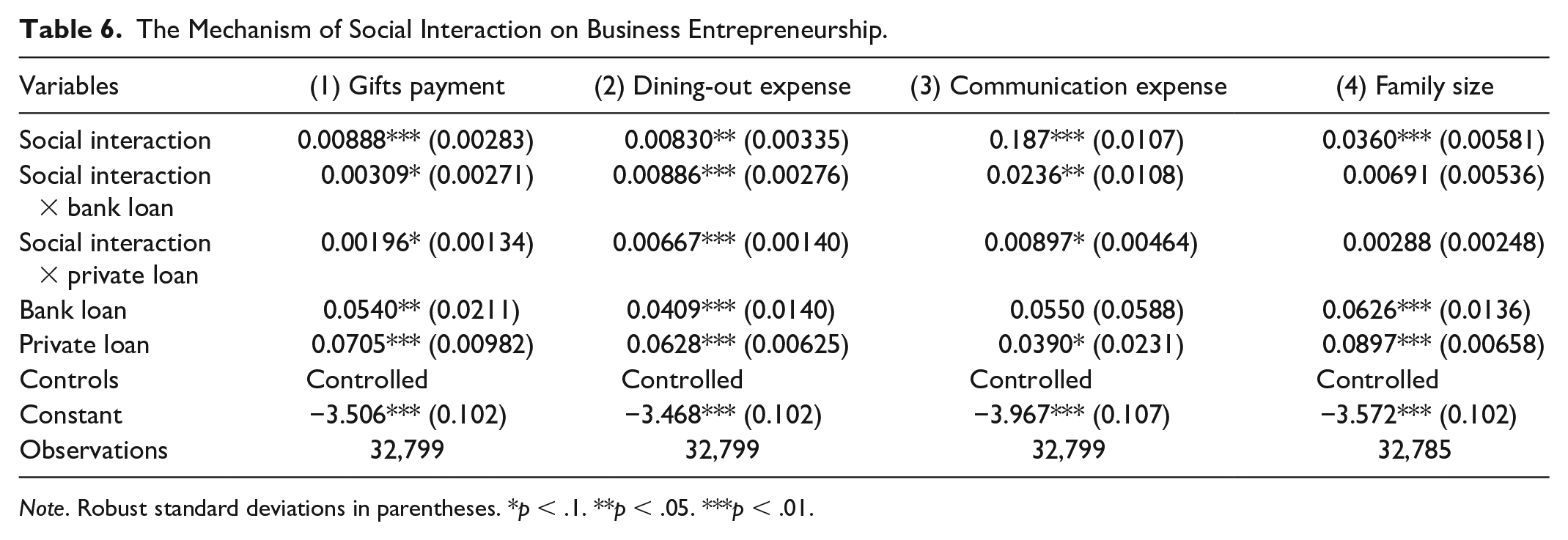
Judging from the above results, this study finds that by and large, more social interactions are associated with a higher likelihood of households participating in business or agricultural entrepreneurship. In this section, the mechanism on how social interaction affects household entrepreneurship is going to be explored. The literature review suggests an important way how social interaction influences entrepreneurship is that social interaction can relax the financial constraints confronted with potential entrepreneurs. Lacking start-up capital is a factor discouraging the willingness to start a business for most potential entrepreneurs (Hurste, 2004). For this reason, this research investigates the moderating effect of financial constraints on the relationship between social interactions and entrepreneurship by introducing the interaction term between loan and social interaction. In this article, the answer to the question “the total amount of loans your family has obtained from private lending channels such as relatives and friends” and “the total amount of loans your family has obtained from formal financial institutions such as banks” in the questionnaire is used to measure the financial constraints. The following specification is established:

It must be pointed out that the IV
Table 6 reports the effect of social interaction on business entrepreneurship after adding the interaction terms. From this table, this study finds that the estimated coefficients of two interaction terms in the specifications of gifts payment (model 1), dining-out expenses (model 2), and communication expenses (model 3) are all found to be positive and significant at a different level, which suggests that the positive effect of social interaction on business entrepreneurship increases with the number of loans no matter what channel is used. It is equivalent to say that the larger amount of bank loans and private loans obtained, the greater role of social interaction plays in promoting the participation of household business entrepreneurship.
The Mechanism of Social Interaction on Business Entrepreneurship.
Note. Robust standard deviations in parentheses. *p < .1. **p < .05. ***p < .01.
Similarly, Table 7 displays the results of the mechanism examination for agricultural entrepreneurship. It can be found from the table that the interaction terms in the former three regressions carry positive and significant coefficients, implying again that the positive effects of social interaction on agricultural entrepreneurship grow with the amount of loans households can raise from bank or privacy. The agricultural entrepreneurial decision will be more strongly motivated by social interaction for households with weaker financial constraints.
The Mechanism of Social Interaction on Agricultural Entrepreneurship.

Note. Standard deviations in parentheses. *p < .1. **p < .05. ***p < .01.
To sum up, the empirical results in this section show that with the increase of the amount of loans available to potential entrepreneurs, social interactions have a greater positive affect on entrepreneurship.
Endogenous Problem
The reliability of the benchmark results may suffer from the endogenous problem induced by social interaction. The endogeneity mainly comes from the reverse causality between social interaction and entrepreneurship. The social interactions are not only a prerequisite for family entrepreneurship but may also be the result of their entrepreneurship. To address the endogeneity, this study selects the lag of the core IVs, which is the observations of social interaction in 2013, as the instrumental variable (IV). This instrument variable was chosen because it meets two conditions that must be met as a good instrument variable including the exogeneity of instrumental variable and the strong correlation between an instrumental variable and endogenous variable. First, the social interaction in 2013 has nothing to do with the current disturbances, so that it meets the requirement of exogeneity. Second, there is a time-series relationship between the social interaction in 2013 and that in 2015, so that they are necessarily related.
In the beginning, the researchers execute Hausman tests to identify the endogeneity of four proxies for social interaction. The rejection of the null hypothesis indicates the existence of endogeneity. It is found through tests that endogenous problems of social interactions exist in two specifications: the regression of business entrepreneurship on dining-out expenses and the regression of business entrepreneurship on communication expenses. The acceptance of the null hypothesis in Hausman tests in the rest regressions suggests no endogeneity of social interaction.
Table 8 reports the estimated results of the two-stage regression using instrumental variables performed with ivprobit command. Since the exogeneity is naturally satisfied when using lagged variables as instrumental variables, the rest to do is the identification of weak instruments. A general rule of thumb requires an F value in the first stage at least 10 to expel the concern of weak instruments (Stock & Yogo, 2005). As exhibited in Table 8, the F values of the first stage is 84.82 and 845.62, respectively, which are much larger than the critical value of 10, suggesting that there is no worry of weak instruments in the regressions.
Results of IV Regressions.

Note. Standard deviations in parentheses, control variables include age, gender, marital status, Hukou, political status, education level, risk attitude, household assets, and region, etc. IV = independent variable. *p < .1. **p < .05. ***p < .01.
The researchers observe from the table that the coefficients of social interactions are all significantly positive, which indicates that social interactions measured with dining-out and communication expenses would promote the possibility of participation in business entrepreneurial activities. After addressing the concern of endogeneity, the results reached are still in line with the benchmark analysis, which corroborates the reliability of the results of our research.
Robustness Checks
From the results obtained from the benchmark and endogeneity study, this article can state that social interaction has a significant positive impact on household entrepreneurship. However, the safety of this finding needs to be further confirmed with more robustness checks. Thus, this article offers some robustness checks to the results including using an alternative regression method-logit model and fulfilling subsample study according to gender and region.
Logit model estimation
Table 9 shows us the results of estimation results using the Logit model. From this table, the researchers found that although using different regression methods, the results remain unchanged. Social interactions have a significant positive effect on the participation of both business and agricultural entrepreneurship.
The Estimation Results by Logit.

Note. Robust standard deviations in parentheses. *p < .1. **p < .05. ***p < .01.
Estimation by gender
Table 10 shows us the estimation results for business entrepreneurship by gender. As shown in this table, the four proxy variables which measure social interaction are associated with positive and significant coefficients for both women and men, which manifests that social interaction can elevate the business entrepreneurial intention not only for men but also for women. Nonetheless, the magnitudes of the coefficients of social interaction are higher for women than men in three specifications except for the case of social interaction measured with communication expenses, which implies that the effects of social interaction on the business entrepreneurial decision are stronger for women than men, and the willingness of starting a business more motivated by social interaction for women. This result may be explained by some reasons. First, in the long history of China, the conception of “the woman stayed at home and the man earned the money” is deeply rooted. Women are discriminated against in the labor market so that they are less likely to be employed in the labor market, which may lead to a higher likelihood for women to start a business to achieve economic independence. Second, women are more involved in social activities and better at social interaction than men due to the underlying individual differences in cognitive and personality traits between men and women (Schmitt et al., 2008; Stark, 2002).
The Estimation Results for Business Entrepreneurship by Gender.

Note. Robust standard deviations in parentheses. *p < .1. **p < .05. ***p < .01.
Table 11 reports the estimation results for agricultural entrepreneurship by gender. Different results from the result for business entrepreneurship are derived from this table. The coefficients of gift payment for females and communication expenses for males are found to be positive and significant. The rest coefficients of social interactions are insignificant. The overall insignificant impact of social interaction on agricultural entrepreneurship may be attributed to the fundamental characteristics of agricultural entrepreneurship. The success of agricultural entrepreneurship relies mostly on the quality of agricultural products so that agricultural entrepreneurs normally put more effort into the improvement of planting or breeding technology. Social interaction is not the determinant factor for the success of agricultural entrepreneurship.
The Estimation Results for Agricultural Entrepreneurship by Gender.

Note. Robust standard deviations in parentheses. *p < .1. **p < .05. ***p < .01.
Estimation by region
Table 12 reports the estimation results of the effect of social interaction on business entrepreneurial participation in different regions by dividing the region into eastern and rest regions. There are seven provinces or provincial-level municipalities in the eastern region of China including Guangdong, Fujian, Zhejiang, Jiangsu, Shandong, Beijing, and Shanghai. As shown in this table, the estimated coefficients of four agent variables of social interactions are found to be positive and significant at 1% level in the eastern region, while in the rest regions, only the estimated coefficients of dining-out expenses and communication expenses are positive and significant. What’s more, the size of the coefficients of social interaction in the eastern region is much larger than that of the rest regions, which indicates that the positive effect of social interaction in the eastern region is much higher than in other regions. The reason why this happens is that the coastal eastern region is more developed in economic development. The entrepreneurial activities cluster in the eastern region due to the better entrepreneurial environment, geographic location, more opportunities, and talents. According to the statistics released by China Statistics Bureau, in 2018, the gross domestic product (GDP) of the eastern region is about 4.8 billion-yuan, accounting for 53% of the national GDP. Guangdong, Jiangsu, and Shandong continue to be the top three provinces in GDP.
The Estimation Results for Business Entrepreneurship by Region.

Note. Robust standard deviations in parentheses. *p < .1. **p < .05. ***p < .01.
Table 13 reports the results of agricultural entrepreneurship by region. From the table, we witness a similar picture. The estimated coefficients of the social interaction measured by gifts payment, dining-out expenses, and communication expenses in the eastern region are found to be significant except for family size. However, the estimated coefficients of social interaction whatever measured are insignificant. Furthermore, the magnitudes of corresponding coefficients in this section are much lower than that of business entrepreneurship. These results can be interpreted as follows. First, social interaction has a significant positive effect on the possibility of engaging in agricultural entrepreneurial activities in the eastern but no significant effect in the rest regions. Second, the effect of social interaction on agricultural entrepreneurship is much weaker than business entrepreneurship.
The Estimation Results for Agricultural Entrepreneurship by Region.

Note. Robust standard deviations in parentheses. *p < .1. **p < .05. ***p < .01.
Conclusions
The purpose of this study is to examine the impact of social interaction on household entrepreneurship. We achieve this goal by running probit regressions in the benchmark analysis using the data of the CHFS in 2015. Moreover, endogeneity, mechanism analysis, robustness checks, and subsample investigation also have been executed in the article.
The empirical results can be summarized as follows. First, social interaction has a positive impact on household entrepreneurial behavior. Households with a higher level of social interaction have a higher likelihood of entrepreneurial participation. Moreover, the positive effect of social interaction on entrepreneurship increases with the relaxation of financial constraints faced by households. Next, the positive effect of social interaction is higher for women than men, which suggests that entrepreneurial willingness is more motivated by social interaction for women. Finally, the results obtained in the benchmark are testified to be reliable after addressing the potential endogeneity and using a different regression method.
Due to the importance of entrepreneurship to economic transformation in China, our study may have some important policy implications. First of all, as revealed in our data, the proportion of households participating in entrepreneurship is relatively low, especially for agricultural entrepreneurship. As a result, the entrepreneurial decision should be motivated and protected through a tax deduction, entrepreneurial subsidies, and entrepreneurial education by the government. In addition, given that the success rate of entrepreneurship in China is low, the entrepreneurial environment should be improved by the government through different measures. For instance, relaxing the market access restrictions, improving the efficiency of government, protecting intellectual property rights, and reducing the communication costs. At last, more favorable policies should be given to women and agricultural entrepreneurship by the government.
This study has some limitations and needs more effort in the following aspects. First, structural equation modeling can be used to simultaneously discuss the influence of the four proxy variables of social interaction on the entrepreneurial decision. Second, the theoretical model between social interaction and entrepreneurship should be established to illustrate their connection clearly. Finally, social interaction can be measured more directly and diversely, which is beneficial to get more reliable results.
Footnotes
Declaration of Conflicting Interests
The author(s) declared no potential conflicts of interest with respect to the research, authorship, and/or publication of this article.
Funding
The author(s) received no financial support for the research and/or authorship of this article.
