




Abstract
The social surroundings in which an individual grows up and spends his or her everyday life have an effect on his or her life chances. Much of the research into this phenomenon focuses on so-called neighborhood effects and has put particular emphasis on the negative effects of growing up in a poor neighborhood. Originating from the sociological study of inner-city problems in the United States, the research has recently been embraced by Scandinavian social scientists, who have generally assessed the phenomenon with reference to social network effects and the lock-in effects of ethnic enclaves. We critique the theoretical assumptions that we find in recent Scandinavian research and argue that a straightforward interpretation of neighborhood effects in terms of network effects is problematic. Our argument is based on an empirical analysis of friendship circles of ninth graders in Stockholm (N = 240). We conclude that the friendship networks of ninth graders extend well beyond the neighborhood, thus casting serious doubt on the network effects assumption of previous research. We also conclude that there is nothing in the reality of these ninth graders that confirms the established concept of the ethnic enclave.
Introduction
Residential segregation and the unequal distribution of life chances that it may engender pose a major challenge for contemporary welfare states because an immigration policy that does not provide equal opportunities to recent and established citizens is a failed one. Social scientists are increasingly interested in trying to establish residential segregation as a fact and investigating its short- and long-term consequences. One highly influential concept in this literature is that of the neighborhood, and particularly that of neighborhood effects. Originally developed in the context of inner cities in the United States, it is increasingly being applied in Scandinavian research as well. In an attempt to argue the underlying mechanisms of neighborhood effects, various analysts have proposed that people’s everyday social interaction is so intrinsically nested within neighborhood that the neighborhood effect can actually be interpreted as a social interaction effect, or even as a social network effect. In this article, we set out to scrutinize this assumption by studying the friendships of ninth graders in three different schools by asking how their circles of close friends are constituted with respect to sex, ethnicity, school class, and neighborhood.
The research question we ask in this study is as follows:
Research Question 1: To what extent is it theoretically and empirically justified to use neighborhood effects as a proxy for social interaction effects or even social networks effects?
The objective is to contribute to a better specification of the underlying mechanisms that bring about neighborhood effects. We do not doubt that neighborhood effects exist and that they are important to study; it is reasonable to assume that neighborhoods sometimes influence people’s life chances substantially, and such effects have been observed empirically. Yet, sociologists should strive to open up the black box of neighborhood effects to determine precisely what in neighborhoods is causing systematic differences in social outcomes (such as schooling and labor-market situation). If they fail to do this, they will only produce explanations of rather low explanatory value (see Boudon, 1998); that is, they can show if neighborhoods have an effect on social outcomes, but not why. If we want to go beyond prediction and also offer sound sociological explanations, this is certainly an unsatisfying situation (Elster, 2007; Hedström, 2005). 1
Neighborhood Effects and Social Networks
Horizontal residential segregation, that is, systematic clustering of people according to socioeconomic resources and/or racial or ethnic characteristics, is a common feature of all industrialized societies. People who grow up in circumstances where most of their neighbors are poor are less likely, for instance, to be successful in school and in their work lives. This situation has led social scientists to ask whether there are specific neighborhood characteristics—going beyond individual and family characteristics—that can explain this phenomenon. The claim is that the social surroundings matter for people’s life chances. This is a sociologically appealing claim that makes a lot of sense intuitively and has inspired considerable research on so-called neighborhood effects, focusing in particular on the inner-city problems in the United States (Sampson, 2008; Sampson, Morenoff, & Gannon-Rowley, 2002; Wilson, 1987).
As is often the case in contemporary empirical social sciences, ideas that drive research debates in the United States are imported and applied by European scholars. Consequently, we see a growing tendency among European social scientists to adapt concepts such as neighborhood, ghetto, ethnic enclave, and the like, to contemporary European societies (e.g., Edin, Fredriksson, & Åslund, 2003; Grönqvist, 2006; Kauppinen, 2008; Lapeyronnie, 2008; van der Klaauw & van Ours, 2003). The fact of segregation poses a serious threat to the egalitarian ideals of the Scandinavian welfare states. Sweden is a case of particular importance given its history of fairly liberal immigration policies. Approximately 16% of the Swedish population is of foreign origin, and Sweden takes in the highest number of refugees in Europe. This has led to pronounced residential segregation by ethnic background, especially in the larger cities. Several studies of the Swedish case have reported neighborhood and school effects for a variety of social outcomes—such as school grades, educational attainment, labor-market standing, and welfare dependency—although these effects are usually rather small when individual and family-specific characteristics have been accounted for, and the effects are generally greater for schools than for neighborhoods (see, for example, Aberg, Hedström, & Kolm, 2003; Andersson & Subramanian, 2006; Åslund & Fredriksson, 2005; Brännström, 2008; Bygren & Szulkin, 2007; Edin et al., 2003; Galster, Andersson, Musterd, & Kauppinen, 2008; Grönqvist, 2006; Szulkin & Jonsson, 2007).
The crucial issue is the precise mechanisms by which the social surrounding, and neighborhoods in particular, matter for social outcomes. Without a clear understanding of the mechanisms that produce the effect, we will only produce sociological explanations of rather low explanatory value. A relatively large number of mechanisms have been proposed, but the most influential ones in the literature have been social ties and interaction effects, norms and collective efficacy, and institutional resources (Sampson et al., 2002). In economic research, spatial mismatch may be considered a fourth mechanism (Edin et al., 2003). Many studies list all or most of these mechanisms as reasons for the demonstrated, or expected, association between explanans and explanadum. However, very few studies actually try to identify these mechanisms empirically and the “black box” still remains largely intact (Mayer & Jencks, 1989), and they remain purely theoretical constructs or assumptions about underlying explanations of observed statistical regularities. Indeed, a general criticism of this literature is the considerable gap between theory and analysis (Hedström & Swedberg, 1998), and it is safe to say that we know very little about the social mechanisms of neighborhood effects.
Unlike the U.S. literature on neighborhood effects, Swedish research has singled out network and interaction effects as the two principal mechanisms. Building on theories of social capital (Coleman, 1988; Portes, 1998), it has emphasized factors such as information (e.g., about jobs, education and future career planning, social allowances), peer pressure, and role models. In short, in neighborhoods with scarce resources, people will have less valuable social capital embedded in their social relations, pressures for conformity will be “downward” rather than “upward,” and because of a lack of role models, people will have lower aspirations. For example, in a recent study that looked specifically at the role of ethnically segregated neighborhoods, our colleagues wrote that
The point of departure for the present empirical analysis is . . . that the social interaction between individuals of the same ethnic background, who live in the same neighbourhood, is relatively strong and that these relations influence the school performance, educational choices, and consequently the future educational career of children growing up there. Such network mechanisms may self-reinforce norms and behaviors and have been found to influence, inter alia, the accumulation of human capital, the probability of being unemployed, and the probability of becoming a recipient of social welfare. (Bygren & Szulkin, 2007, p. 7)
The very same idea, that one can isolate the crucial determinants of an individual’s social network by locating at his or her neighborhood, is similarly expressed in a study of ethnic enclaves where it is said that
The enclave represents a network that increases the opportunities for gainful trade in the labor market . . . Further, the network disseminates valuable information on, e.g., job opportunities . . . The enclave would thus improve labor market outcomes, in particular for recent immigrants and for individuals who have difficulty integrating into the labor market. Of course, the enclave may also provide information on matters that are not conducive to success in the labor market, such as welfare eligibility. (Edin et al., 2003, p. 336)
Other studies that draw on the same assumption can easily be added to these two (e.g., Åslund & Fredriksson, 2005; Grönqvist, 2006; Szulkin & Jonsson, 2007).
We do not take issue with the claim that social networks matter in the ways described above. What we do find potentially problematic, however, is the jump from geographical space to social space, that is, the way in which neighborhood is used as a proxy for social network. The crux of the matter, also expressed by Brännström (2008), is that although studies of neighborhood and school effects in Sweden acknowledge “that it is not self-evident that the observed associations are rooted in neighborhood/schoolmate interactions, the results are often interpreted as if such social interactions have brought about the empirical regularities” 2 (p. 465).
As indicated by the quotations above, research on neighborhood effects in Sweden has increasingly focused on ethnic segregation. The reasons for this are twofold. First, ethnic segregation in Sweden is associated with socioeconomic differences, so that the concentration of immigrants is higher in neighborhoods that are poor in terms of social resources. Second, it is assumed that networks among coethnics are particularly dense, and therefore it is believed that it is more justifiable to use neighborhoods as a proxy for social networks in these cases. For instance, Bygren and Szulkin (2007) stated that their “analyses are based on the assumption that individuals with the same ethnic background influence each other to a greater degree than do individuals with different ethnic backgrounds” (p. 11). And they “assume that a joint ethnic background raises the interaction probability and frequency between the individuals and that persons with the same background represent ‘significant others’ in a social environment” (Bygren & Szulkin, 2007, p. 11).
The theoretical underpinnings of these assumptions are the general tendency toward social homophily—that is, a preference for social interactions with people who are similar to oneself—and increased contact opportunities. It is well established that people mainly tend to become friends with people who are socially similar to themselves (McPherson, Smith-Lovin, & Cook, 2001). Yet despite this fact, there are several reasons to be critical of the assumptions underlying research on “ethnic enclaves” and “ethnic neighborhoods” in a Swedish context. According to a commonly used definition (Åslund & Fredriksson, 2005; Edin et al., 2003; Grönqvist, 2006), “an ethnic neighborhood [is] a neighborhood where the share of the ethnic group residing in the neighborhood is at least twice as large as the share of the ethnic group in the population” (Åslund & Fredriksson, 2005, p. 6). Swedish research on ethnic neighborhoods or ethnic enclaves is highly influenced by studies on highly segregated ethnic neighborhoods in the United States, such as Chinese in New York (Zhou, 1992), Cubans in Miami (Portes, 1987), or Koreans in Los Angeles (Light & Bonacich, 1988). These neighborhoods are fairly well delimitated geographically, and they have a number of characteristics that are usually missing in segregated areas in Sweden. First, they are dominated by one ethnic group. This is very seldom the case in Sweden, where segregated areas are usually populated by immigrants coming from a large numbers of countries. Hence, most segregated areas in Sweden are ethnically very heterogeneous despite the fact that relatively few native Swedes live there (see Brännström, 2008). According to the definition of ethnic neighborhoods provided above, a neighborhood with 2% Iranians, for example, would be called an Iranian neighborhood, if Iranians’ percentage of the population in Sweden is only 1%. This is quite different from Chinatown in New York City. Second, and related, is that in the American ethnic enclaves mentioned above, people can manage their lives pretty well by using only the minority language. And a common minority language goes a long way toward creating social relations. However, because ethnic neighborhoods in Sweden are so heterogeneous, a common language (other than Swedish) is usually lacking. Because of this, we find it problematic to import sociological studies from the United States to the Nordic countries, without first modifying the assumptions.
A Critical Assessment of Assumptions in Previous Research
It is generally assumed in research on neighborhood effects that neighborhood can serve as a proxy for social networks and consequently that we can draw conclusions about network effects from the neighborhood indicator itself. We may call this a jump from geographical space to social space. Is this reasonable? First, as implied in some of the reviewed Swedish studies, there are theoretical reasons for making these assumptions (Aberg et al., 2003). “Foci of activity” play a significant role in the emergence of network ties. Such foci are important as they bring people together in recurrent interaction, thereby organizing their social relations (Feld, 1981). Neighborhoods, schools, workplaces, and civil society organizations (e.g., churches, sport clubs) are examples of such foci. The more these foci overlap (e.g., if your neighbors are also your schoolmates and football teammates), the greater the chance that social interactions will develop into friendship relations. From a theoretical vantage point, it is reasonable to assume that the extent to which foci of activity are locally bounded, and thus overlap more with neighborhood (and one another), varies with age, which means that children’s circles of friends tend to be more concentrated in geographical space than are those of adults. Hence, if a jump from social space to geographical space is reasonable at all, it should in particular be the case for children and adolescents who are still in school. This assumption is supported by a Swedish study that analyzed diaries of 130 children aged between the ages of 11 and 14 (van der Burgt, 2006). A majority of these children (more than 60%) had friends residing in their own neighborhoods. Yet the data clearly indicate that geographical proximity decreases in importance the older the children become: For the youngest children (in fifth grade), 46% had no friends living outside of their neighborhood; for the older children (in the seventh grade) the corresponding figure was only 30%.
Yet in general terms, to use neighborhood as a proxy for social interaction is a rather strong assumption. The assumption that people residing in Neighborhood A interact more with one another than with people in Neighborhood B is intuitively very plausible. However, the assumption that they interact more with one another than with people in Neighborhoods B to Z is considerably less plausible. As the number of people residing outside of one’s neighborhood—even slightly outside—is so much larger than the number of people residing within one’s neighborhood, this assumption is not as self-evident as it is often presented to be. Statistically, there are simply more people outside their neighborhood. And technologically, it is becoming increasingly easy, and common, to maintain close social interactions with people who live far away.
In his discussion of the focused interaction of social life, Feld provided a similar account of why we should hesitate to accept even the theoretical idea that neighborhood can be an approximation of social networks. People who share a focus are likely to share activities as well, according to Feld (1981),
However, all individuals who share a focus do not necessarily interact with each other very much or very often. For foci where everyone is forced to interact much and often (e.g., families), all of the individuals associated with that focus will be tied to each other; but for foci that are less constraining on interaction (e.g., city neighborhoods), only a slightly higher proportion of individuals will be tied than would be tied in the general population. In general, the more constraining a focus, the greater is the likelihood that two individuals associated with that focus will be tied. A focus may involve very little constraint, but where there is no constraint at all, there is no focus‥ . . In general, larger foci will be less constraining, because it is difficult to arrange for many people to have frequent joint activities. However, there may be small foci that involve little constraint and large ones that involve much. (p. 1019)
Furthermore, there is a considerable risk of ecological fallacy in using neighborhoods as a proxy for social networks. The size of this risk depends partly on how neighborhoods are operationalized. Small Area Market Statistics (SAMS) areas are used in the more sophisticated Swedish studies. SAMS, provided by Statistics Sweden, are designed to identify relatively well-delineated socially and spatially homogeneous neighborhoods, and they take account of factors such as housing type and tenure. The SAMS areas are relatively small in size, varying between 100 and 4,000 individuals, with an average of 970 inhabitants (Aberg et al., 2003; Andersson & Subramanian, 2006; Brännström, 2008; Bygren & Szulkin, 2007). Municipalities, that is, large entities with a median of 16,000 inhabitants (Åslund & Fredriksson, 2005; Edin et al., 2003), tend to be used in less sophisticated studies of neighborhood effects. It is our strong contention that only SAMS areas can be assumed to measure neighborhoods in any reasonable sense of the term.
Below we will present empirical data collected from ninth graders in three Stockholm schools that clearly question the tenability of the jump from geographic space to social space that is common in Swedish research on neighborhood effects and school effects.
Data
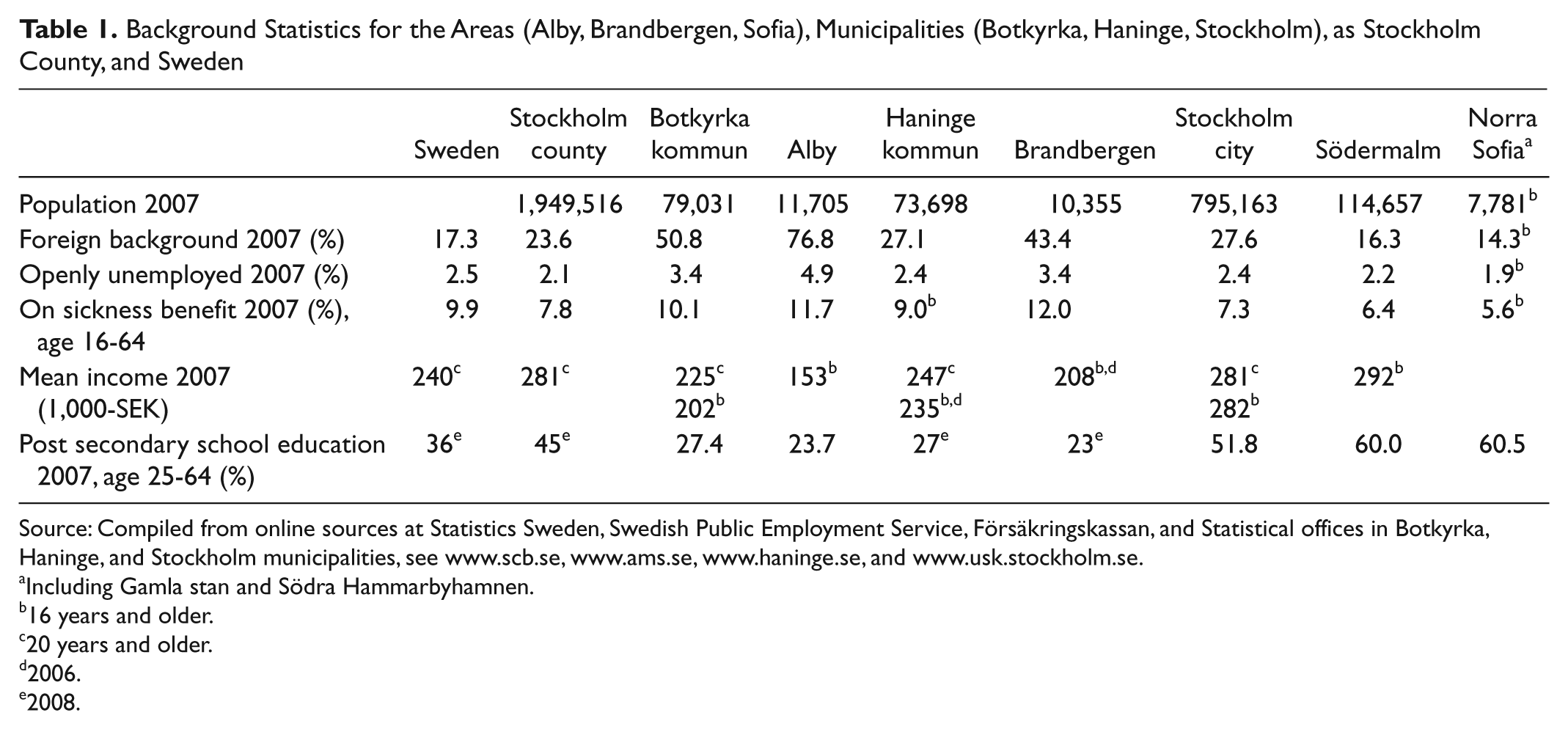
We conducted a survey, “Your life and your future,” from November 2007 through January 2008 by distributing a questionnaire in 13 classes of ninth graders in 3 schools from distinctively different areas in the greater Stockholm area. We selected schools from a list of 15 schools that (a) had a majority of their pupils living in the local area of the school (which is the case for the overwhelming majority of comprehensive schools in Sweden) and (b) were located in one of three types of areas. These areas had to have either predominantly non-Swedish ethnic homogeneity, predominantly Swedish ethnic homogeneity, or a heterogeneous ethnic composition. Schools were contacted in no particular order, and the first school from each category that agreed to participate was selected. Schools included in the sample are located in the three areas Alby, Brandbergen, and Sofia. Some comparative statistics for these areas are provided in Table 1, and some key characteristics are further discussed below. Despite the fact that the sampling procedure was nonrandom, we are fairly confident that the schools we selected are representative, and that the results and conclusions can be generalized to the Stockholm area and beyond.
Background Statistics for the Areas (Alby, Brandbergen, Sofia), Municipalities (Botkyrka, Haninge, Stockholm), as Stockholm County, and Sweden
Source: Compiled from online sources at Statistics Sweden, Swedish Public Employment Service, Försäkringskassan, and Statistical offices in Botkyrka, Haninge, and Stockholm municipalities, see www.scb.se, www.ams.se, www.haninge.se, and www.usk.stockholm.se.
Including Gamla stan and Södra Hammarbyhamnen.
16 years and older.
20 years and older.
2006.
2008.
Alby is part of Botkyrka municipality in south-west metropolitan Stockholm. Alby has about 12,000 inhabitants and is a product of the early 1970s when modern Alby was built and most of the apartment blocks that still house most of its inhabitants were erected. About 77% of the population is of foreign origin, and in 2007, the unemployment rate was just below 5%. Alby has excellent infrastructure; it is close to the major highway and has a subway connection to the city.
Brandbergen is part of Haninge municipality in south metropolitan Stockholm. Brandbergen has about the same population as Alby and is also a product of the early 1970s with large apartment blocks. Brandbergen was given a major overhaul in the early 1990s to come to grips with its social problems. About 43% of the population of Brandbergen is of foreign origin, and about 3.4% were unemployed in late 2007. Brandbergen is geographically a little more isolated than Alby, with bus connections to the commuter rail network. Both Alby and Brandbergen border extensive recreational areas and nature reserves.
Sofia is part of Södermalm in central Stockholm and has a little less than 8,000 inhabitants. About 14% of the population in Sofia is of foreign origin, and unemployment was about 1,9% in 2007. As is suggested in Table 1, Alby and Brandbergen are working-class areas whereas Sofia is an affluent middle-class area. 3
The questionnaires were filled out during class hours with a research assistant present. A total of 241 pupils participated across these 13 classes. As outside observers, we had no control over class absenteeism, and we did not offer any reward for participating. Overall response rate across classrooms was approximately 80%. Boys in Brandbergen and Alby where less willing to participate than girls, which means that boys are underrepresented in the sample. As it turned out, apart from one example, internal nonresponse was not a problem, with only one of the distributed questionnaires handed in with most items blank.
The demographics of the samples in the three schools, displayed in Table 2, mirror the skew distribution of people of foreign origin that we find in the three areas, with 33% of the students in Sofia being of foreign background compared with 41% in Brandbergen, and 98% in Alby. Parents’ country of birth was used to code foreign origin as a binary variable. 4 Because of the small sample size, we are not able to analyze distinct countries or regions. However, the most common regions of origin among those with a non-Swedish background were the Middle East, followed by South America and Latin America, and the three most common countries were Turkey, Chile, and Iraq. But it is important to keep in mind that we analyzed the second generation and that the majority of the ninth graders in our sample were born in Sweden, ranging from 87% in Alby to 97% in Sofia. We had more girls than boys in the sample in both Alby and Brandbergen. We could not control class absenteeism at the data gathering sessions, and girls were simply more willing than boys to participate.
Demographics of Ninth Graders in Three Stockholm Schools (Frequency)

Results
The key question that we asked was whether it is reasonable to use the concept of neighborhood as a proxy for social interaction space. It remains an open question whether the theoretical ideas encapsulated in concepts such as neighborhood, enclave, and ghetto translate at all to Scandinavian reality. However, there is one even greater problem and that is the assumption that neighborhood is also a reasonable proxy for social interaction. That is to say, that people tend to have their socially significant relationships embedded within a well-defined and fairly limited geographic space. In essence, this is a sort of mean field solution that reduces the multidimensionality of social interaction to the bidimensionality of geographical space. If it works, it is an extremely efficient solution. But it is very bold and runs the risk of leading researchers to an ecological fallacy. Thus, the issue needs to be further explored.
The individuals in our data were 15 or 16 years old and were still in school. Theoretically, the likelihood that their circles of friends were locally bounded should be higher than for older persons out of school. Our empirical test of neighborhoods as a proxy for social networks was thus rather conservative, as many of the studies we have cited deal with older individuals.
To measure people’s circle of friends, we asked our respondents to think of, at most, five friends with whom they most often spend time. 5 We further asked the respondents to indicate for each friend his or her sex, age (similar age/younger/older), ethnic background (Swedish/immigrant), family relation (family/nonfamily), 6 whether or not they are in the same class, and whether or not they live in the same neighborhood. 7 Thus, the critical indicator for the present analysis is the number of friends who lived in the same neighborhood. But some of the other aspects of friendship composition will also be part of the analysis. It is potentially problematic to use subjective measures for this research question, 8 and we cannot know for sure how the respondents understood the term in the same neighborhood. However, in an earlier study by Andersson (2001), a sample of people delimited almost SAMS-identical areas on maps when asked about “their neighborhoods,” which indicates that the subjective understanding of neighborhoods corresponds well with some of the more objective classifications.
Almost every respondent (n = 225) produced information on the maximum number of five friends and their characteristics. In the subsequent analyses of friendship composition, we analyze only those who reported five friends. We calculate for each respondent the number of friends of the same sex and the same ethnic background who were in the same class and lived in the same neighborhood. The indicator on same ethnic background is constructed from the distinction between Swedish and non-Swedish. 9 The internal nonresponse for these particular indicators ranged from 7% (same class) to 14% (same background). Each indicator has a straightforward interpretation and takes on a value from 0 to 5, where 5 indicates that all friends are of the same sex, for example.
We use “friendship” and “friendship circle” interchangeably when describing the social interaction space of ninth graders. We refrain from talking about networks because we do not have information on network volume or density, nor on the quality of friendship ties. However, we are confident that the indicators tell us a great deal about the composition of the friendships that define the core of the social interaction space of teenagers.
We go directly to the heart of the matter and display, in Figure 1, the fraction of ninth graders who reported that a majority of their friends live in the same neighborhood as they do. The darker shaded piece of each pie indicates that a majority of friends (i.e., ≥3) lived in the same neighborhood as the respondent. In Alby, 64% of the ninth graders had a majority of their friends in their own neighborhood, which suggests that social interaction is indeed geographically local. However, for Sofia, the corresponding figure is 44%, and in Brandbergen, only 35% of the ninth graders said that a majority of their friends live in the same neighborhood. This means that in two of the three schools that we surveyed, a majority of teenagers had only a minority of their friends in their own neighborhood. This strongly suggests that the friendship circles of ninth graders are not confined to their immediate neighborhood.
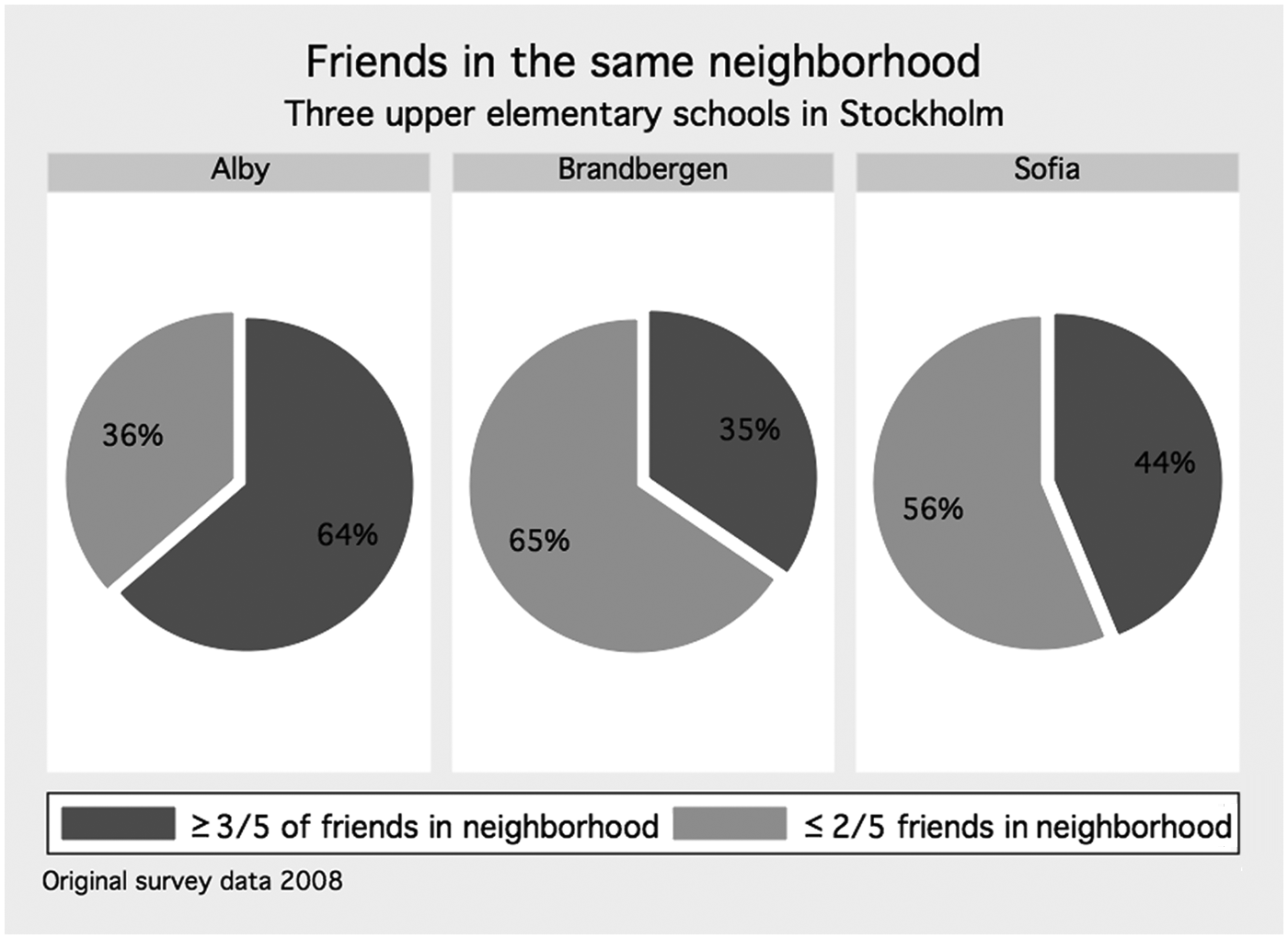
Percentage of ninth graders with a majority of friends in the neighborhood across three Stockholm schools
It seems fair to conclude that without further qualifications, neighborhood is not a reasonable proxy for social interaction space. Overall, we find that a large fraction of the ninth graders we surveyed had a considerable number of friends living in another neighborhood than their own. And even among those ninth graders who had the most confined friendship circles, at least 35% had two thirds of their friends in another neighborhood.
We note a substantial and statistically significant difference between schools with respect to whether ninth graders have friendships within their own neighborhood. With respect to our indicators, schoolchildren in Brandbergen seem to have more diverse friendship circles than schoolchildren in Alby, with Sofia somewhere in between but closer to Brandbergen. Let us further investigate this result by adding information on whether the ninth graders tended to have friends of the same sex and of the same ethnic background who were in the same school class.
In Figure 2, we display for each school the number of friends, from 0 to 5, who share the respondent’s characteristics. Moving clockwise from the upper left corner, we give number of friends of same sex, number of friends of same ethnic background, number of friends living in the same neighborhood, and number of friends in same school class. We note that with respect to sex, there is a strong tendency in all schools for same-sex friendship circles. It is indeed rare (about 7%) for a ninth grader of either sex to have a majority of opposite-sex friends.

Composition of friendship circles of ninth graders in three Stockholm schools
There is a tendency across all three schools for a majority of the friends of a ninth grader to be of the same ethnic background (note that this is a crude indicator that only distinguishes between Swedish and non-Swedish backgrounds). However, this tendency is especially pronounced among the ninth graders in Alby, where as many as 70% said that all of their friends were of the same ethnic background as they, compared with about 38% in the other two schools. For ninth graders in Alby, sharing the same ethnic background means almost without exception that both they and their friends are of non-Swedish origin. The ninth graders in Sofia seem to have had the most diverse friendship circles with respect to ethnic background. But despite the fact that 8% said that all of their friends were of another ethnic background, as many as 75% said that a majority (≥60%) of their friends were of the same ethnic background as them. The comparative figures for Brandbergen are 1% and 80%, respectively.
Let us now approach the key question of whether friendship is spatially structured, but this time focusing on the school. Admittedly, school is much more than a spatial quality, organizing as it does a significant part of most teenagers’ daily life. Nevertheless, schools are also spatially bound, attracting students primarily from the local neighborhoods. This is why we are interested in the number of friends who are in the same class at school (lower left graph in Figure 2). At first, there seems to be no clear tendency in these three distributions. The number of friends in the same class is rather nicely distributed in all three schools around a mode of two to three friends. Thus, while most ninth graders have a balanced mix in and out of class, some tend to have a majority of their friends in their own class, whereas others tend to have only a minority of their friends in the same school class.
However, it is worth paying attention to the tail ends of the distribution of number of friends in the same class. In the Alby school, 3% said that none of their friends were in the same class, and 12% said that all of their friends were in the same class. Compare this with the Sofia school, where not a single teenager had all of his or her friends in same class, and 16% said that none of their friends were in their class. 10 This is a striking difference, which indicates that friendship among ninth graders in Alby was much more determined by the classroom than it was among schoolchildren in the other two schools. The lower right graph in Figure 2 gives the distribution of friends living in the same neighborhood. We learned from Figure 1 that it is premature to assume neighborhood to be an indicator of social interaction space. We provide this graph to allow for a direct comparison with the other friendship composition statistics.
The evidence we have presented clearly suggests that Alby could be a strong case of the type of neighborhood that is intuitively suggested in the literature on neighborhood effects. The vast majority of ninth graders in Alby were of non-Swedish background, they tended to make friends with others who were non-Swedish, their friends also tended to be classmates to a greater extent than in the other schools, and a majority of their friends tended to be in the same neighborhood. Yet, we would strongly dispute that Alby is an ethnic enclave. Unfortunately, our crude binary measure of ethnic background does not allow us to address this question directly. However, we did ask the respondents which language they speak with their friends.
As shown in Table 3, the vast majority, 90%, spoke Swedish with their friends. Among the 125 persons of non-Swedish origin in the sample, only 16% said that they regularly spoke a language other than Swedish with their friends. The rest, 84%, said they spoke Swedish with their friends. Alby is no different in this respect. Despite the fact that 98% of our ninth graders in Alby were of foreign origin, more than 80% said that they spoke Swedish with their friends, reflecting the fact that segregated areas in Stockholm (and in Sweden and Scandinavia) are ethnically highly heterogeneous and that for the young, the natural choice of language becomes that of the “new” country.
Language Spoken With Friends in Three Stockholm Schools (%)

Yet, we do see an “Alby-effect” on spatially bounded friendship, and this effect is further established in Table 4, where we regress the number of friends in the neighborhood on the respondent’s sex, ethnic background, and school. We note statistically significant effects of sex and Alby school on the number of friends living in the same neighborhood. Girls had a tendency to have more friends who did not live in the same neighborhood compared with boys. The “Alby-effect” is also substantial, with ninth graders in Alby tending to have more friends in the neighborhood than ninth graders in both Brandbergen and Sofia. 11
Poisson Regression of Number of Friends in Neighbor-hood on Sex, Ethnic Background, and School (Unstandardized Coefficients)

Note: LR = likelihood ratio.
p < .05. **p < .01.
Based on Figure 2, we feel confident that friendship among Stockholm ninth graders in the early 2000s was highly homogeneous with respect to sex and ethnicity, just as one would expect. Without pursuing this at greater length, it is interesting to note that the ninth graders who said that a majority of their friends were of another ethnic background were themselves mainly of non-Swedish origin. This goes without saying in Alby, where almost everyone in our survey was of non-Swedish background by our definition. But this was true in the other two schools as well. Among the ninth graders in Brandbergen who said that a majority of their friends were of a different ethnic background, 11 out of 14 were of non-Swedish background. The same went for Sofia, where 17 out of 21 of the ninth graders with a majority of friends from another ethnic background were themselves “non-Swedes.” This would be a worthwhile object of future study, as it suggests that the “immigrant kids” could play an important brokering role between Swedes and non-Swedes in Swedish society.
Discussion
Research on the United States has convincingly demonstrated the importance of neighborhood effects on the life chances of the individual. And some studies aiming at replicating these results for Scandinavia have also established small but significant effects of neighborhood for various outcomes. Such effects have been interpreted in terms of network effects, meaning that the driving force between these correlations is micro-level social interaction patterns. Of course, all empirical regularities should be stated in terms of their generating mechanisms (Hedström, 2005), and this line of research is to be applauded for taking explanatory theory serious. However, the micro mechanisms have never been empirically established. And despite the fact that they rest on some fairly strong assumptions about the structure of social interaction, researchers have sometimes provided very lax theoretical support. Because this is highly policy-relevant research, we argue that it is of the utmost importance to further investigate the critical assumption that neighborhood effects can be interpreted in terms of network effects.
Researchers focusing on Sweden have a unique opportunity to use register data to study a large variety of social outcomes. These data are fantastic in many ways, in particular for individual-level analysis, and they usually avoid many of the problems associated with survey data (such as low response rates). Yet the availability of good data does not mean that it should be used for everything. We lack register data for social relations, networks, and interaction patterns, and it is tempting for researchers to use shortcut strategies by using neighborhoods, for which data are available from registers, as a proxy (e.g., Bygren & Szulkin, 2007).
No large-scale data are yet available for social interaction and individual attitudes at the individual level. However, we have taken a first step in looking closer at one critical assumption about micro-level interaction. And we have demonstrated that the reliance on ecological data is an erroneous strategy. It is untenable to use neighborhoods as a proxy for networks. In our study of three schools, only Alby provided some support for the notion that neighborhood captures social interaction at least to some degree. The other two did not. Hence, although there are strong theoretical reasons to assume that network and interaction effects are important factors for understanding social outcomes—such as school grades, educational attainment, labor-market standing, and welfare dependency—the only way to study these effects is to collect network data. We also see it as potentially useful to combine quantitative research with ethnographic studies (e.g., Lapeyronnie, 2008) to better understand important differences between neighborhoods (e.g., between Alby and Brandbergen).
However, that neighborhood is generally a poor proxy for social networks and interactions does not diminish the fact that neighborhoods might be an important factor for explaining various social outcomes in its own respect. Institutional resources and spatial mismatch are two potentially important factors, and these mechanisms would come more to the fore in studies of neighborhood effects if network effects could be accounted for directly. We agree with Brännström (2004) that “the black box of neighborhood effects still needs to be further investigated [if] we want to achieve a better link between the theoretical and the empirical levels” (p. 2534).
Footnotes
Acknowledgements
We extend profound thanks to our survey participants, the ninth graders in Alby, Brandbergen, and Sofia schools, as well as to teachers and staff in those schools who agreed to cooperate with us. Pär Bendz was instrumental in the planning and execution of the survey, and we are more than thankful to him for providing such resourceful and meticulous research assistance.
Declaration of Conflicting Interests
The author(s) declared no potential conflicts of interest with respect to the research, authorship, and/or publication of this article.
Funding
The author(s) disclosed receipt of the following financial support for the research and/or authorship of this article: We gratefully acknowledge financial support from the European Research Council (ERC Starting Grant 263422).