




Abstract
Understanding the contrasting perspectives of Information Technology Professionals (ITPs) and the general public on artificial intelligence (AI) is crucial for responsible AI development and deployment, as these viewpoints can significantly influence its adoption and societal impact. This study investigates how ITPs’ deeper knowledge of Generative AI translates into differing viewpoints on its future impact, particularly on the job market. A quantitative content analysis of over 2,700 online newspaper comments in Vietnam reveals a more polarized perspective among ITPs. While both groups share job displacement concerns, ITPs express a wider range of beliefs, acknowledging both potential benefits and limitations of AI’s influence on the job market. Furthermore, ITP views remain relatively stable over time compared to the public’s increasing negativity toward AI. The analysis also highlights ITPs’ stronger focus on AI-driven efficiency gains alongside a more nuanced awareness of AI’s inherent shortcomings. This study contributes to the understanding of AI perception by highlighting the influence of technical expertise on shaping public opinion and offering insights for tailoring AI communication strategies.
Introduction
Artificial intelligence (AI) applications like ChatGPT and Google Gemini have surged in popularity, igniting public discourse about their potential impact on the future workforce. This discussion, however, is likely influenced by individual experiences and contexts, as Murphy and Medin (1985) noted. Their research suggests that experts and novices may hold differing understandings of AI due to these factors.
Studies consistently highlight differences in how Information Technology Professionals (ITPs) and the public perceive artificial intelligence. Researchers like Fortuna and Gorbaniuk (2022) have observed that professional expertise allows ITPs to dissect AI examples into their structural and functional components, while lay people tend to focus on the actual tasks AI-powered products perform. This suggests that public awareness of AI hinges on the visibility of its applications. For instance, Davies (2020) found that 90% of respondents recognized voice assistants as AI-powered, whereas only a third associated AI with online shopping, streaming services, or social media algorithms (invisible AI).
A crucial question emerges: do these disparities in AI awareness translate into different emotional responses, particularly regarding its impact on jobs? While public enthusiasm seems to be waning, surveys tell a different story for ITPs. Notably, Tyson and Kikuchi (2023) found a dip in American excitement about AI in daily life, with only 10% expressing more excitement than concern, down from 18% in 2021 and 15% in 2022. However, Kochhar (2023) paints a contrasting picture for IT professionals, observing that a significantly higher 32% within the information technology sector anticipate personal benefits from AI, outweighing any perceived harm. This discrepancy highlights the need for further academic research to determine whether this optimistic trend among ITPs is present in other countries or unique to the US context.
This article bridges the above gap in current research by exploring the contrasting Vietnamese perspectives on AI’s impact on the labor market, specifically comparing information technology professionals and public viewpoints. Instead of employing traditional surveys, this paper analyzes 2,700 public comments from VnExpress articles posted between January 2023 and December 2023. As the most widely read online newspaper in Vietnam, VnExpress offers a fertile ground for examining public and ITP discourse on AI, allowing us to capture nuanced differences in sentiment, particularly toward AI’s influence on the job market. Furthermore, the research focuses on a developing country perspective, which may diverge significantly from findings in developed nations, as highlighted by Kochhar (2023). By scrutinizing 2,700 comments across 200 AI-related articles within this crucial time frame, this study sheds valuable light on Vietnamese public and ITP opinions, potentially revealing deviations from developed nation trends. Specifically, this study seeks to answer the following research questions:
How do the views of IT professionals (ITPs) and the general public in Vietnam differ regarding the impact of AI on the job market?
How do the perceptions of ITPs and the general public in Vietnam toward AI evolve over time?
This article is structured as follows. Section 2 lays the theoretical groundwork by examining key perspectives on AI’s influence and highlighting existing research on analyzing public sentiment through social media. Section 3 details our methodology. Section 4 presents the study’s results, while Section 5 discusses their implications and limitations, highlighting how these findings can inform future work.
Literature Review
Knowledge About AI: ITPs Versus Non-iTPs
While experts and the public hold differing views on what constitutes AI, research sheds light on the nature of this divide (Zhang, 2024). On one hand, a 2019 survey of AI specialists revealed a preference for definitions emphasizing technical aspects, like mathematical problem-solving, over comparisons with human intelligence (Krafft et al., 2020). This emphasis on functionality reflects the computer science perspective, which tends to deemphasize anthropomorphization.
However, public perception presents a stark contrast. Surveys conducted in the UK and US paint a picture of AI heavily influenced by human-like qualities. For example, a 2018 UK survey found that 42% of respondents associated AI with machines mimicking human thought processes, while 25% equated it with robots (Cave et al., 2018). Similarly, a US survey from the same year showed a preference for labeling applications involving social interaction (e.g., virtual assistants) as AI, compared to purely technical applications (e.g., search engines; Zhang & Dafoe, 2020).
The disconnect between how experts and the public view AI presents a significant challenge when it comes to trust in this technology (Zhang, 2024). This challenge is further compounded by the “black box” nature of many AI systems, which limits transparency and hinders the public’s ability to understand how AI decisions are made (Mazumdar et al., 2024; Tripathy et al., 2024). Theoretical frameworks for building trustworthy AI systems often lean on socio technical solutions like safety features, fairness algorithms, and transparency measures (Jacovi et al., 2021; Knowles & Richards, 2021). These approaches typically involve technical modifications or institutional oversight mechanisms, such as offering explanations of AI systems, documenting development processes, conducting third-party audits, incentivizing bug discovery, creating accident databases, and enacting regulations.
However, much of the research examining public opinion focuses on a more general and subjective evaluation of AI, rather than specific concerns about its trustworthiness in different contexts. Surveys often ask about people’s overall perceptions of AI’s impact on society or their level of support for its development, which might indirectly capture trust but lack nuance (Zhang, 2024). Notably, these divergent understandings of AI trust also influence how people predict its impact on jobs and society, a central theme of this article.
Perspectives of AI’s Impacts on Employment: ITP Versus Non-iTPs
The first perspective, strongly supported by IT professionals, suggests that AI’s overall impact on employment will be limited. This aligns with theories like “Limits of Automation and the Human Touch” (McAfee & Brynjolfsson, 2017), emphasizing the continued necessity of human skills in non-routine tasks. AI, in this view, excels in handling structured, data-driven work, but cannot fully replicate human strengths such as social intelligence, creativity, and complex problem-solving. Consequently, AI is seen as a tool for augmenting and enhancing human capabilities, rather than a direct replacement. This perspective is further supported by recent research from Georgieff and Hyee (2022), who found no clear relationship between AI exposure and employment growth across 23 OECD countries. Their study suggests that while AI may automate certain tasks, it can also increase productivity and shift occupations toward higher-value activities, potentially mitigating job displacement. This optimism is reflected in Kochhar’s (2023) findings, where IT workers are significantly more likely to believe that AI will personally benefit them.
The second perspective acknowledges the potential for AI-driven job displacement but emphasizes the transformation of tasks rather than outright elimination of jobs. This aligns with the Skill-Biased Technical Change theory (Violante, 2008), highlighting the increasing demand for skilled workers capable of using and adapting to AI. Studies (Chui et al., 2015; West, 2015) underscore an upskilling imperative applicable across various job levels. For instance, Wang (2023) notes that while low-skilled jobs may face greater risks of displacement, high-skilled labor may experience growth due to the demand for new competencies in an AI-driven economy. This pressure extends to ITPs themselves, who must constantly upgrade skills to remain competitive (Gkamas et al., 2021). Organizations, as noted by Wisskirchen et al. (2017), will also need to adapt, freeing human workers from routine tasks to focus on complex thinking and interpersonal roles.
In stark contrast, the third perspective paints a more pessimistic picture, fueled by the fear that AI-driven automation will inevitably lead to widespread job losses and displacement. This aligns with “Technological Unemployment Theory” (Peters, 2020). Concerns raised by Fast and Horvitz (2017) further bolster this outlook, suggesting the possibility of AI ultimately making human work unnecessary. This fear resonates deeply with non-ITPs across industries, as documented in studies like Nam (2019), who grapple with the looming threat of technological unemployment.
Social Media as a Lens on AI Perceptions
Social media platforms offer a remarkably rich and dynamic source of data for understanding public perceptions of AI. The vast amounts of user-generated content – including text, images, and videos – reflect real-time opinions, concerns, and hopes related to the rapid advancement of AI technologies. Researchers have increasingly turned to this data to gage public sentiment, track shifting attitudes, and identify potential societal and ethical implications of AI (Alafwan et al., 2023).
One major area of focus in the literature is sentiment analysis. By employing natural language processing techniques, researchers can analyze the emotional tone and sentiment expressed in social media posts about AI. This helps determine whether the public primarily views AI with optimism, fear, or a mix of emotions (Gao et al., 2020; Garvey & Maskal, 2020). Such studies illuminate the potential acceptance or resistance as AI further integrates into daily life.
Another key theme centers on understanding AI’s perceived impact on the job market. Social media discussions often express a spectrum of views, ranging from excitement about potential new industries and career paths to anxiety over possible job displacement (Grover et al., 2022). Analyzing these discussions can reveal nuances within public opinion and help policymakers anticipate potential areas of economic disruption or the need for retraining programs
The portrayal of AI in social media is another fascinating avenue of study. Content analysis can reveal prevalent narratives and stereotypes associated with AI, such as the image of the helpful robot versus the fear of job-stealing technology (Neri & Cozman, 2020; Ouchchy et al., 2020). These portrayals shed light on emerging public understanding and can influence the way AI is ultimately developed and adopted.
This paper addresses a critical gap in the existing research on social media as a tool for understanding AI perceptions. While prior studies have explored public sentiment, there’s a notable lack of focus on directly comparing the viewpoints of ITPs and the general public, particularly within the unique context of a developing nation. Our study employs content analysis to move beyond simple sentiment classification, systematically categorizing and analyzing comments on Vietnam’s largest e-newspaper. This in-depth methodology allows us to uncover the complexities of both ITP and public perceptions of AI’s impact. By doing so, we aim to illuminate potential differences in understanding, concerns, and levels of optimism between these two key groups.
Method
Study Design and Data Source
This study utilizes a content analysis methodology to investigate and contrast the perspectives of ITPs and non-ITPs regarding the societal and labor market implications of AI. To capture these unique perspectives, we collected data from VnExpress, the most widely read online news source in Vietnam. This choice allows us to tap into a diverse range of public opinions and examine how AI is perceived within a developing nation, where perspectives may differ significantly from those in developed countries. VnExpress, established in 2001, maintains the largest readership base amongst the country’s online newspapers, attracting over 50% of e-newspaper traffic (Most Visited Websites in Vietnam, 2023). This extensive audience makes VnExpress a valuable source for exploring public discourse on this important issue.
We selected VnExpress for two primary reasons:
AI-Centric Focus: VnExpress, published by the technology giant FPT Corporation, places considerable emphasis on AI, and technology-related topics. It routinely publishes articles about AI’s integration into various facets of everyday life. This focus generates substantial commentary from both ITPs and non-ITPs, providing a wealth of data for analyzing public beliefs regarding AI’s reliability and trustworthiness.
Generalizability: VnExpress’s comments section mirrors the key features found in the forums of other prominent Vietnamese online newspapers. These commonalities include requirements for user registration, comment rating mechanisms, content moderation protocols, and the ability to use pseudonyms. This consistency bolsters the potential generalizability of our findings, suggesting that our results may reflect wider public attitudes within Vietnam’s digital news environment.
Data Retrieval and Coding Process
With the assistance of a research assistant, we performed a keyword-based search of the VnExpress database. The search spanned January 1st, 2023, to December 31st, 2023, and targeted articles containing either the term “Trí tuệ nhân tạo” (Vietnamese for “Artificial intelligence”) or its abbreviation “AI.” To ensure a well-structured analysis, we subdivided the retrieval of relevant articles into 12 monthly segments. Articles lacking comments or possessing comments unrelated to the effects of AI were discarded. This filtering yielded a final dataset of 198 articles and 2,716 comments pertinent to our research focus.
Coding Scheme
Article Coding
Each article with qualifying comments was coded according to the following criteria: topic (using VnExpress’s existing categories such as Digitalization, Science, Education, etc.), publication date, and overall comment volume (encompassing both relevant and irrelevant comments).
Comment Coding
To distinguish between ITPs and non-ITPs, we initially coded each comment for the presence or absence of an “ITP” indicator. Since VnExpress doesn’t directly display user careers, we relied on comment content. Comments mentioning work in the information and technology communication (ICT) industry were coded as “ITP.” Following this initial step, we embarked on an open coding process. This involved meticulously examining around 100 comments from both ITPs and non-ITPs. Through iterative refinement, we established five codes capturing the primary perspectives of ITPs and non-ITPs on AI’s societal impact (details in Table 1). These codes were specifically chosen to reflect the key themes identified in the literature and explored further in the discussion section, such as concerns about job displacement, the potential for efficiency gains, and the recognition of AI’s limitations. This approach allows us to directly address the research question and analyze the nuances in how ITPs and non-ITPs perceive AI’s role in society. Notably, the “AIJobView” code has three subcategories (Positive, Negative, and Neutral View) to capture the range of opinions. All other codes were assigned as either present or absent for each comment.
Operational Definitions and Examples of Codes.

Intercoder Reliability
We calculated Cohen’s kappa for a randomly chosen subset of 100 comments to verify coding consistency between the author and research assistant. The kappa values spanned from 0.72 to 0.96 across all variables (Table 1), indicating an acceptable level of reliability.
Results
AI’s Job Impact: ITPs Demonstrate More Polarized Views
The data in Table 2 reveals a clear preference by both ITPs and non-ITPs for commenting on AI-related articles within the “Digitalization” category. This category boasts the highest number of articles (128) and accounts for the largest volume of comments from both groups. This suggests that the “Digitalization” section likely offers the most extensive and continuous coverage of AI-related topics, attracting substantial engagement. Within Digitalization, Khuong Nha’s article “There will be no more programmers in the next 5 years” generates the highest concentration of comments (158). Interestingly, ITPs also demonstrate a significantly higher interest in AI-related business articles, commenting at a rate of 15.5% compared to 4.7% for non-ITPs (χ2 (1, N = 2,716) = 65.0, p < .01).
Comment Counts Across Article Categories.

Table 3 reveals a distinct difference in the distribution of viewpoints on AI’s job impact between ITPs and non-ITPs. While a negative outlook dominates both groups, ITPs diverge significantly by expressing a higher proportion of positive views (34.5% compared to 22.0% for non-ITPs). Additionally, ITPs exhibit a slightly smaller percentage of neutral opinions (23.0% vs. 16.2%). This suggests a reduced level of uncertainty among ITPs compared to non-ITPs. One way to assess polarization is to examine the difference between the most extreme views. In this case, the ITP group shows a smaller difference of 12.5% between positive and negative viewpoints, compared to a 19.8% difference amongst non-ITPs.
ITP Versus Non-ITP Views on AI’s Impact on Jobs.

These findings indicate that ITPs hold a less homogenous perspective on AI’s future impact on the workforce. The presence of a more substantial optimistic minority within the ITP group, alongside a decreased proportion of neutral views, aligns with the concept of polarization. A chi-square test further reinforces this interpretation, demonstrating a statistically significant difference in the distribution of views between the two groups (χ2 (2, N = 2,716) = 50.1, p < .01). This suggests that while both groups share concerns about job displacement, ITPs also recognize potential benefits and hold a wider spectrum of beliefs surrounding AI’s influence on the job market.
Non-iTP Pessimism Increases, ITPs Maintain Balanced Outlook on AI’s Job Impact
Table 4 reveals interesting and statistically significant shifts in the perceptions of both ITPs and non-ITPs regarding AI’s impact on jobs over the two-halves of 2023. Among non-ITPs, negativity increased markedly (58.8%–65.3%), alongside a decline in both positive (22.6%–21.3%) and neutral views (18.6%–13.4%). The chi-square test yielded a statistically significant difference in the distribution of non-ITP views between the two-halves of 2023 (χ2 (2, N = 2,342) = 14.2, p < .01). This suggests a solidifying pessimism within the non-ITP group as the year progressed.
ITP/Non-ITP Views on AI: Comparing 2023 Halves.
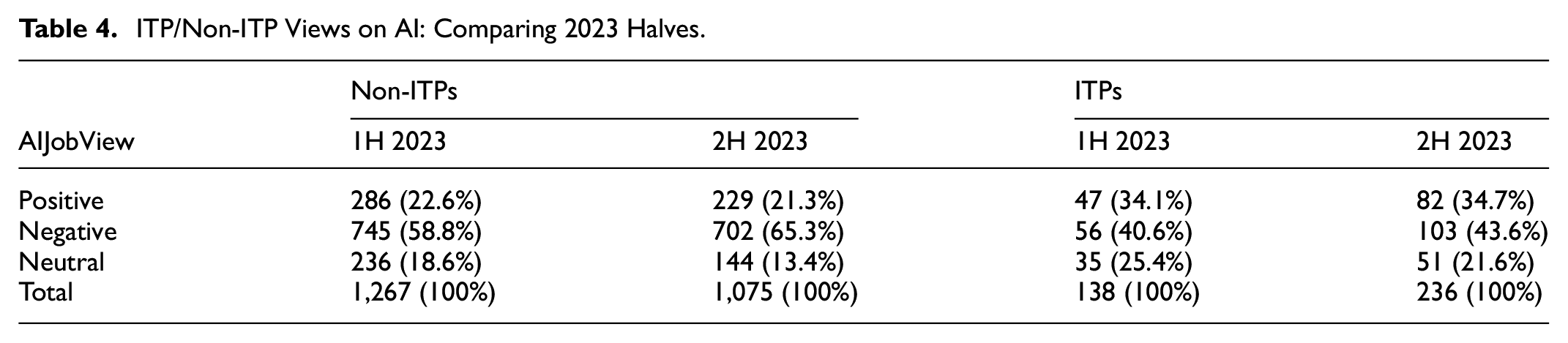
However, ITPs did not experience a statistically significant change in their outlook. While negativity increased slightly (40.6%–43.6%), positive views remained stable (34.1%–34.7%), and neutral opinions decreased (25.4%–21.6%). Statistical analysis (χ2 (2, N = 374) = 0.74, p = .69) reveals no significant change in how ITPs perceive AI’s job impact over the course of 2023. This indicates that ITPs, while more likely to acknowledge potential disruptions, maintain some optimism compared to the increasingly negative outlook of non-ITPs.
ITPs Demonstrate Greater Emphasis on Efficiency, Acknowledge AI Limitations
Table 5 reveals intriguing trends and statistically significant differences in how ITPs and non-ITPs engage with specific themes within AI discourse. A focus on “Efficiency Gains” dominates commentary from both groups, however ITPs express this view at a significantly higher rate (32.1%) than non-ITPs (23.3%). This aligns with expectations, as IT professionals are likely to be more attuned to the potential of AI for streamlining tasks and optimizing processes.
Comment Counts by Code.

Fisher’s exact test was used due to its suitability for small sample sizes, assessing whether ITP and non-ITP proportions of this code significantly differed.
Interestingly, ITPs also express concerns about “AI limitations” at a significantly higher rate (15.8%) compared to non-ITPs (8.7%). This demonstrates that those working directly with AI technologies may possess a more nuanced understanding of both AI’s capabilities and its inherent shortcomings. No significant differences emerge between the two groups in the proportions focusing on “AI-driven Innovation” or “Negative Societal Impacts.” This suggests a shared recognition of AI’s potential to transform industries as well as common concerns associated with its influence on society. Overall, Table 5 highlights that while ITPs and non-ITPs hold some overlapping viewpoints regarding AI, there are also key divergences. Notably, ITPs demonstrate a greater emphasis on practical applications like efficiency, alongside a deeper awareness of AI’s limitations.
Discussion
Theoretical Implications
This study provides compelling insights into the differing perceptions of ITPs and non-ITPs regarding the impact of AI on the job market and society. The findings highlight a complex landscape of public opinion surrounding AI, with significant nuances emerging based on technical expertise and proximity to AI development.
ITPs, Non-iTPs, and AI Coverage
The strong engagement of both ITPs and non-ITPs with AI-related articles, particularly within the “Digitalization” category, underscores the prominence of this theme in contemporary discourse. This aligns with the increasing pervasiveness of AI within technological discussions and news coverage, a trend observed in recent research. Brause et al. (2023) highlight a strong increase in reporting on AI, with a focus on news media coverage and largely positive evaluations, often framed within an economic context. Brennen (2018) found that UK news coverage frequently emphasizes industry perspectives and promotes AI’s value and potential, while Zhai et al. (2020) observed a similar focus on commercial institutions and the integration of science and business in AI reporting. This emphasis on the transformative potential of AI in the media may explain the heightened interest we observe among ITPs in AI-related business articles. This suggests an awareness of how AI can revolutionize industries and disrupt traditional business models (Liu et al., 2020; Vijayakumar, 2021).
However, this awareness of AI’s transformative potential may not necessarily translate into a clear understanding of what AI is and how it manifests in everyday life, particularly for non-ITPs. Indeed, research suggests a significant gap exists between the public’s perceived understanding of AI and their actual knowledge of its applications. Cave et al. (2018) revealed that only 9% of British respondents understood the term “machine learning,” while Maison (2019) reported that Poles spontaneously offered examples like humanoid robots, advanced computers, and self-driving cars. These studies paint a picture of AI being viewed as a distant reality for many, despite a perceived understanding among 81% of Poles. This disconnect is further highlighted by the fact that only 17% of Poles see AI as driving smartphone innovation, indicating a gap between everyday experience and the reality of AI integration.
Polarized Views on AI and the Job Market
The more polarized views on AI’s job impact held by ITPs, compared to the more homogenous pessimism of non-ITPs, highlight a key point of divergence. While negativity dominates both groups, the ITP perspective appears less monolithic, encompassing both concerns about job displacement and a greater degree of optimism. This dynamic aligns with the concept of “Skill-Biased Technical Change,” which posits that technological advancements like AI favor high-skilled workers, potentially widening income inequality (MacCrory et al., 2015; Spitz, 2004). ITPs, with their specialized knowledge and technical abilities, may perceive themselves as potentially benefiting from AI-driven transformations in the workplace. Additionally, their proximity to AI development could foster a more informed understanding of its capabilities. This resonates with optimistic perspectives emphasizing AI’s potential for streamlining routine tasks, enabling human-AI collaboration, and even generating entirely new job categories (Davenport & Miller, 2022; Sowa et al., 2021). However, the persistence of negativity within the ITP group suggests a nuanced outlook – acknowledging the challenges of job displacement while simultaneously recognizing the potential for AI to enhance productivity and create new opportunities.
Shifts Over Time and Growing Public Pessimism
The significant increase in negativity amongst non-ITPs over the course of 2023 is concerning, as it highlights a growing apprehension within the general public regarding the societal and economic consequences of AI. This solidifying pessimism could stem from several factors. Media narratives likely play a significant role, with studies suggesting that news coverage of AI tends to emphasize potential job displacement and ethical risks (Nader et al., 2024; Ouchchy et al., 2020). The absence of direct interaction with AI technology may leave non-ITPs more susceptible to such fear-based messaging, fostering an increasingly bleak outlook. Additionally, economic anxieties or real-world instances of AI-driven job losses could further exacerbate these negative sentiments.
On the other hand, the relative stability of ITP opinion, even amidst a slight uptick in negativity, suggests that direct experience with AI may temper concerns and foster a greater degree of nuance. This could be due to several factors. ITPs may have a more realistic understanding of AI’s current capabilities and limitations, recognizing its potential for both disruption and new opportunities (Fortuna & Gorbaniuk, 2022; Hetland, 2014). Their first-hand involvement in AI development and implementation could provide crucial context, mitigating some of the uncertainty and fear that drives public pessimism.
Thematic Focus: Efficiency, Limitations, and Shared Concerns
Table 5 reveals a shared focus among both groups on the efficiency gains promised by AI, although this theme resonates more strongly with ITPs. This emphasis on practical benefits aligns with wider literature on AI adoption in businesses, such as Monod et al. (2023), which highlights the increasing investment in AI for its potential to improve customer satisfaction and financial performance. However, Monod et al. (2023) also caution against solely technology-centric approaches to AI implementation, emphasizing the importance of considering work practices and potential power shifts within organizations. This resonates with Brause et al. (2023)’s observation that media coverage of AI often focuses on economic framing and positive evaluations, which might overshadow the complexities and potential challenges associated with AI adoption. ITPs’ significantly deeper engagement with the theme of “AI Limitations” is particularly noteworthy in this context. It suggests a grounded understanding of the technology’s current boundaries, even amidst broader discussions of AI’s potential capabilities, perhaps reflecting their firsthand experience with the complexities of AI implementation. The lack of significant differences in views about “AI-driven Innovation” and “Negative Societal Impacts” highlights potential areas of overlapping concern between these groups, suggesting that both ITPs and non-ITPs share an awareness of the broader societal implications of AI.
Practical Implications
This study offers several practical implications for stakeholders involved in AI development, implementation, and communication. Firstly, the findings highlight the importance of recognizing the diverse perspectives on AI within society, particularly between IT professionals and the general public. This understanding is crucial for tailoring communication strategies to address specific concerns and foster greater public trust in AI technologies (Ehsan et al., 2021). For instance, addressing the public’s increasing pessimism toward AI requires clear and accessible communication about its potential benefits, limitations, and ethical considerations.
Secondly, the study underscores the need for educational initiatives that bridge the knowledge gap between IT professionals and the general public regarding AI. By promoting AI literacy and providing opportunities for hands-on experience (Adiguzel et al., 2023), it is possible to demystify the technology and empower individuals to engage in informed discussions about its societal implications. This can help to mitigate fear-mongering and foster a more balanced public discourse on AI.
Thirdly, the findings suggest that organizations implementing AI systems should consider the potential for varying perceptions among their workforces. Clear communication about the intended purpose of AI, its potential impact on job roles, and opportunities for upskilling can help to alleviate anxieties and facilitate a smoother transition. Moreover, actively involving employees in the AI implementation process can foster a sense of ownership and promote a more collaborative approach to AI adoption (Kelley, 2022).
Finally, this research emphasizes the role of media in shaping public perceptions of AI. By providing balanced and nuanced coverage that goes beyond sensationalism and economic framing, media outlets can contribute to a more informed and constructive public discourse on AI (Brause et al., 2023). This includes highlighting both the potential benefits and limitations of AI, showcasing diverse perspectives, and providing context for understanding its societal impact.
Limitations and Future Directions
While this study offers valuable insights into the contrasting perceptions of ITPs and non-ITPs regarding AI’s impact, certain limitations must be acknowledged. One potential limitation lies in the identification method for ITPs. Relying solely on the content of user comments might miss individuals who possess relevant technical expertise but choose to express general views on AI rather than focusing on its specific application within their work domain. This could lead to the underrepresentation of a particular segment of the ITP population and potentially skew the findings related to their views.
Another limitation inherent to social media analysis is the challenge of capturing the full diversity of public opinion. Social media commentary, while a rich source of data, tends to attract a specific user base with pre-existing interest in the platform and potential biases in engagement. To gain a more comprehensive understanding of public perceptions surrounding AI, future studies could incorporate survey methods. Targeted surveys reaching a broader demographic could provide a more representative cross-section of the population’s views on AI’s job impact, societal implications, and potential benefits. Additionally, in-depth qualitative interviews with both ITPs and non-ITPs could offer valuable insights into the underlying factors shaping their attitudes toward AI, unveiling the specific concerns, hopes, and expectations associated with this rapidly evolving technology.
Conclusion
This study examined the contrasting perspectives of IT professionals and the general public in Vietnam on the impact of AI, particularly on the job market. Through a content analysis of online newspaper comments, we found that IT professionals hold a more polarized view, acknowledging both potential benefits and limitations of AI, while the public demonstrates increasing negativity over time. This divergence highlights the influence of technical expertise and proximity to AI development on shaping perceptions.
These findings contribute to the growing body of literature on AI and public opinion, emphasizing the importance of considering diverse perspectives in shaping AI development and communication strategies. Future research could explore these contrasting viewpoints in other cultural contexts and delve deeper into the underlying factors driving the observed trends. Additionally, investigating the impact of targeted interventions, such as educational initiatives and media campaigns, on shaping public perceptions of AI would be valuable. By understanding and addressing the complexities of public opinion, we can foster a more informed and inclusive dialog around AI and its role in society.
Footnotes
Acknowledgements
I would like to express my sincere gratitude to my research assistant, Tien Ngo, for her invaluable assistance throughout this project. Her dedication and meticulous research skills were instrumental to the success of this study.

Ethical Considerations
This article does not contain any studies involving human participants performed by any of the authors.
Funding
The author(s) received no financial support for the research, authorship, and/or publication of this article.
Declaration of Conflicting Interests
The author(s) declared no potential conflicts of interest with respect to the research, authorship, and/or publication of this article.
Data Availability Statement
The data that support the findings of this study are available from the corresponding author upon reasonable request.