




Abstract
The integration of artificial intelligence (AI) tools in educational environments presents creative chances to improve mathematics education in elementary schools. This mixed-method study investigates the use of artificial intelligence tools in elementary mathematics classrooms. Complementing qualitative data from semi-structured interviews, the study had a quasi-experimental design with pre-and post-tests to measure students’ mathematical skills and a survey to explore perceptions about AI-based tool implementation. Following the employment of artificial intelligence tools, quantitative data show a notable increase in learners’ general mathematics performance and problem-solving ability. Qualitative data provide a deep insight of teachers and learners understanding about AI tools utilization in elementary mathematics classrooms and personalized experiences with expectations for learning process. Apart from several advantages, the findings highlighted few reservations about technological issues and ethical privacy concerns. However, the data analysis concludes AI tools implementation visibly enhance elementary mathematics classroom performance with the help of appropriate technology training and reasonable resources. This study advances knowledge on how best to include artificial intelligence into the classroom thereby augmenting instruction and learning support. The findings also lead to future recommendations for further research considering gender differences, bigger sample and different demographic regions.
Introduction
The accelerated development of artificial intelligence (AI) technologies has created new opportunities to improve educational practices, particularly in the field of mathematics (Mimi & Woong, 2023). With the fusion of AI-based tools while planning classroom lessons, teachers may create personalized learning environment convenient for learners (Holstein et al., 2019). The basic objective of elementary mathematics classes is to equip learners with clear fundamental concepts of mathematics, which can be easily acquired through AI implementation.
Vuorikari et al. (2022) has conducted a study showing improved learning outcomes and experiences because of AI adaptive learning systems, which included adjusting content and teaching methods according to individual needs of learners. Furthermore, Luckin et al. (2016) study highlighted that through AI tools, instant feedback may offer students to keep mathematical concepts in mind for longer time and consistency of prompt feedback keep learners indulged in learning process. On the contrary, Hwang et al. (2020) study highlighted some concerns related to technology use while teaching as, access to AI in all classroom settings, lack of training or reliability on data privacy. Additionally, technical issues and resistance to change can hinder the successful adoption of AI tools in classrooms (Baker, 2019).
The findings of the present study incorporate with Personalize learning approach. The education sector is becoming closely connected with modern technical advancements, resulting in a fast-changing landscape. Artificial Intelligence (AI) has become a significant factor in customizing the learning experience and has caused a fundamental change in traditional teaching approaches. It is important to consider the personalized experiences and requirements of individual learner while learning process (Boubker, 2024). At present, the administrators have already been looking into how to improvise technological use while elementary mathematical classrooms because of online classes’ trends which brought forth many difficulties face by both teachers and students.
Artificial intelligence can identify recurring patterns that may indicate the student's preferred learning style or areas of difficulty by analyzing their engagement with an e-learning module (Chen et al., 2018). Customized educational content that is made to the unique requirements of each learner is feasible through the implementation of a data-driven methodology. Additionally, the development of AI-driven chatbots and virtual assistants has facilitated personalized learning. These technologies have the potential to serve as personalized instructors, offering immediate feedback, resolving inquiries, and even suggesting additional resources that align with the student’s learning trajectory (Winkler & Söllner, 2018). In the context of distant learning, AI-driven interventions are particularly relevant, as students may experience isolation due to the absence of in-person interactions. While the potential of AI in personalized learning is undeniable, it also presents obstacles. One of the concerns about AI tools implementation can be data privacy and ethical concerns. This study aims to explore the implementation and impact of AI tools in elementary mathematics classes in elementary schools through a mixed-methods approach. By combining quantitative analysis of student performance with qualitative insights from teachers and students, this research seeks to provide a comprehensive understanding of how AI tools can be integrated into mathematics education effectively. The findings of this study will contribute to the growing body of literature on AI in education, providing practical implications for educators. By identifying the benefits and challenges of AI tool integration, this research aims to offer actionable recommendations for enhancing mathematics education in elementary schools, ultimately preparing students for success in a technologically advanced world
Research Hypothesis
The study has established following hypothesis to test specific beliefs and perceptions about the effect and utility of AI in elementary mathematics classrooms.
H1: The implementation of AI tools in mathematics classrooms has a positive effect on students' mathematical performance.
H0: The implementation of AI tools in mathematics classrooms has no significant effect on students' mathematical performance.
H2: Elementary mathematics teachers have a generally positive perception of the use of AI tools in the classroom, believing they enhance learning engagement and comprehension.
H0: Elementary mathematics teachers have neutral or negative perceptions of AI tools, seeing little to no benefit in their classroom use.
H3: Teachers and students perceive more benefits than challenges with the implementation of AI tools in elementary mathematics settings, particularly in terms of personalized learning and increased engagement.
H0: Teachers and students perceive more challenges than benefits, particularly due to issues like accessibility, complexity, and adaptability to curriculum standards.
Research Questions
The study is based on the three objectives as to investigate the effect of AI tools on learners’ performance in elementary mathematics classrooms. Then to explore what teachers feel about technology integration in their teaching methods. Additionally, what challenges and benefits both teachers and students believe AI tools may bring. The study addresses the following research questions in response to fulfilling the objectives.
Do AI tools implementation effect on students’ mathematical performance?
What are elementary mathematics teachers’ perceptions about the use of AI tools in the classroom?
How do teachers and students perceive the challenges and benefits of AI tools implementation in elementary mathematics classroom settings?
Literature Review
In recent years, there has been significant research focused on incorporating artificial intelligence (AI) capabilities into educational environments (Grassini, 2023) This section provides an overview of the current body of research on the application of artificial intelligence (AI) in education, with a specific focus on its usage in teaching mathematics to students in elementary schools. The review is structured based on core issues, which encompass the efficacy of AI tools in improving learning outcomes, the role of AI in individualized learning, the difficulties linked to AI deployment, and the consequences for teaching methods (Song, 2024). Integrating AI tools into elementary mathematics classes has demonstrated encouraging outcomes in improving teaching and learning experiences. Research has emphasized the utilization of AI-integrated learning environments, the creation of mathematical challenges, and the implementation of AI-based learning platforms in elementary school settings. These studies have highlighted the favorable effects on student engagement and performance (Mimi & Woong, 2023, Wardat et al., 2024). In addition, researchers have investigated the creation of AI literacy guidelines for primary children, with a specific emphasis on constructivist and transformational learning theories. The goal is to maximize the advantages of AI in education (Relmasira et al., 2023). Moreover, the implementation of AI in educational practices for career development in primary schools has shown enhanced motivation and efficacy in equipping students for future professions in AI-related domains (Omae et al., 2023). These findings emphasize the potential of AI technologies to completely transform primary mathematics education by offering new and creative learning possibilities and developing crucial skills for the digital era.
Effectiveness of AI Tools in Enhancing Learning Outcomes
Numerous studies have demonstrated the potential of AI tools to improve student learning outcomes in mathematics. In the context of mathematics education, AI-driven platforms like intelligent tutoring systems and adaptive learning environments are particularly effective. These tools provide immediate feedback and customized learning paths for students to grasp complex mathematical concepts efficiently (Holstein et al., 2019). AI implementation in elementary mathematics classes has a small positive effect on students’ achievement. Moderating variables like grade level and mathematics topics significantly influence AI’s impact (Hwang, 2022).
AI and Personalized Learning
Personalized learning, facilitated by AI technologies, is a key focus in modern educational research. AI tools can analyze large datasets to identify individual learning needs and preferences, thereby creating tailored educational experiences for each student. Pane and Dasopang (2017) highlighted the positive impact of personalized learning environments on student achievement, particularly in subjects like mathematics where students often struggle with one-size-fits-all instructional approaches. Kumar et al. (2020) further emphasized that AI-driven personalized learning systems can adapt in real time to student performance, providing targeted interventions that address specific learning gaps. Rus et al. (2013) posited that ITS, which leverage evidence-based or empirical-evidence backed practices, including the extensive use of cognition and learning models, have ensured the optimal uptake and retention of materials or optimized learning among students.
Challenges of AI Implementation
Despite the promising benefits, the implementation of AI tools in educational settings is fraught with challenges. Technical issues, such as software malfunctions and lack of infrastructure, can impede the effective use of AI in classrooms. Moreover, teachers often face difficulties in integrating AI technologies into their existing pedagogical practices. Roll and Wylie (2016) noted that successful AI implementation requires extensive teacher training and ongoing support. Additionally, Baker (2019) discussed the resistance to change among educators and students, which can hinder the adoption of AI tools. The research explores integrating AI into primary school mathematics education, focusing on differentiated training programs. It discusses enhancing teaching accuracy and scientificity, aiming to improve students’ math levels (Qian et al., 2022). The paper discusses the implementation of an Artificial Intelligence Assisted Learning application in primary school mathematics classes, focusing on usability, gamification, and continuous assessment for student engagement (Alexiei et al., 2019). Teacher readiness to adopt AI tools is an important factor influencing their perceptions. Research suggests that teachers who have prior experience with technology in the classroom are more likely to adopt AI tools positively (Popenici & Kerr, 2017). However, teachers who lack experience or who are apprehensive about technology may be more resistant to the integration of AI. This resistance can be mitigated by providing teachers with comprehensive professional development programs that include both training on the technical aspects of AI tools and guidance on how to integrate these tools into instructional strategies.
Effective professional development is critical in fostering positive perceptions of AI tools. Teachers who receive ongoing support and opportunities to experiment with AI tools in a low-pressure environment are more likely to view them as valuable additions to their teaching practice. Furthermore, collaboration among teachers, where they can share experiences and strategies for using AI tools, can enhance their confidence and improve the overall implementation process.
Implications for Teaching Practices
The introduction of AI tools in education necessitates a reevaluation of traditional teaching practices. The TPACK framework (Technological Pedagogical Content Knowledge) provides a useful lens for understanding how teachers can integrate AI technologies effectively. According to ElSayary (2024), teachers need to develop a deep understanding of how AI tools can enhance pedagogical strategies and improve content delivery. Professional development programs that focus on TPACK can help teachers gain the necessary skills and confidence to incorporate AI into their teaching practices. AI tools, like Zebra AI, were effectively implemented in early childhood math education for children aged 3 to 8, improving math performance and attitudes. The study supports AI integration in elementary math classes (Zhang & Chen, 2022). Figure 1 illustrates the potential of artificial intelligence to enhance educational outcomes and instructors’ instructional methods. AI will have a significant impact on how individuals learn and acquire new abilities. From one perspective, “AIEd” (artificial intelligence in education) can be highly automated and determine the areas where human assistance is most needed in a school (See Figure 1). It might be beneficial for teachers to determine the most effective teaching approaches based on students’ circumstances and educational backgrounds. This software has the capability to automate procedures related to pattern recognition techniques. It can do assessments, grade the results, and generate reports automatically.

Artificial intelligence in mathematical education (Adapted from Qiu et al., 2022).
While the current literature underscores the potential of AI tools to transform mathematics education, several research gaps remain. Most studies focus on short-term outcomes, leaving the long-term effects of AI integration largely unexplored. Furthermore, there is a need for more research on the impact of AI tools on different student populations, including those with diverse learning needs and backgrounds. Future studies should also examine the scalability of AI-driven educational interventions and explore ways to address the challenges associated with their implementation.
The existing body of literature highlights the significant potential of AI tools to enhance mathematics education in elementary schools. These tools can provide personalized learning experiences, improve student engagement, and support teachers in delivering effective instruction. However, the successful integration of AI technologies requires addressing various challenges, including technical issues, teacher training, and resistance to change. By building on the insights from recent research, this study aims to contribute to the ongoing discourse on AI in education and provide practical recommendations for its implementation in mathematics classrooms.
Research Design
This study employs a mixed-methods approach to explore the implementation and impact of AI tools in elementary mathematics classes in schools. By combining quantitative and qualitative methods, the research aims to provide a comprehensive understanding of the effectiveness, perceptions, and challenges associated with AI tool integration in mathematics education (Rasool et al., 2024).
Participants
The study has employed a purposive sample of students from two elementary schools that have implemented AI tools in their mathematics curriculum. Fifteen teachers and 180 elementary school students (101 girls and 79 boys) enrolled in elementary mathematics classes. Participants were recruited from elementary schools that have implemented AI tools in their mathematics curriculum. The participants were aged between 7 and 11 years. Informed consent was obtained from all participants, ensuring ethical standards are maintained. The participants were divided into two groups by analyzing their last mathematics examination results so that in both groups students are divided of equal proficiency level. The experimental group (n = 90) consisted of students who were taught using AI-powered mathematics tools. The control group (n = 90) continued with traditional methods of teaching mathematics, without the use of AI tools. Both groups completed the same mathematics pre-test before the intervention to assess their baseline performance. The post-test, which was conducted after the AI tool implementation, allowed us to measure changes in performance.
Instruments
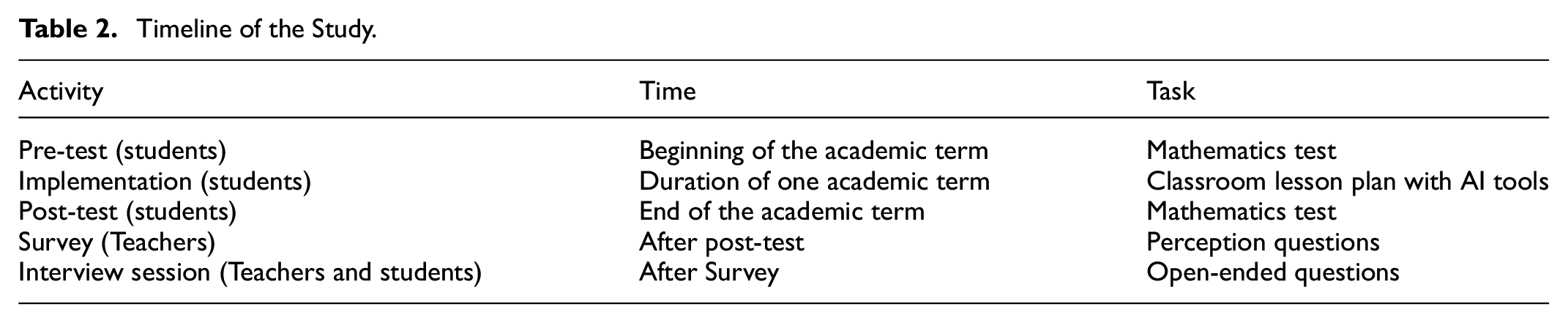
Standardized mathematics tests were administered to students before and after the implementation of AI tools to measure changes in their mathematical performance (See Table 1). These tests included multiple-choice and open-ended questions covering key mathematical concepts. The survey (5-Likert scale) consisted on 15 questions adapted and modified from Pörn et al. (2024). The participants were Semi-structured interviews were conducted with a subset of teachers and students to obtain qualitative insights into their experiences and perceptions. The interviews explored themes such as engagement, challenges, and benefits of using AI tools. The interview is a significant research tool commonly employed in qualitative studies to investigate participants’ perspectives and ideas regarding a phenomenon that is not observable (Creswell, 2015).The study timeline has been presented in Table 2.
Intervention Tests Specifications.

Timeline of the Study.
Data Analysis
The data analysis included both quantitative and qualitative approaches to ensure a comprehensive evaluation of the influence of AI tools on mathematics education, with particular emphasis on individualized learning. Descriptive statistics were employed to survey responses and to examine pre-and post-test scores, providing a concise summary of the average performance and variability in students' mathematical abilities. The investigation involved detecting enhancements in specific areas addressed by personalized learning. For the sake of Inferential statistics, Paired t-tests were used to assess the statistical significance of the discrepancies between the pre-and post-test scores. Additionally, SPSS 26 was employed to assess the impact of AI tools on various student groups, with a particular emphasis on the impact of personalized learning on these outcomes, using ANOVA tests. Data analysis was conducted using NVivo 10, a software specifically designed for qualitative research (Sharma et al., 2022). Initially, substantial codes were discovered without comprehensive categorization. To establish connections between theories and research questions, a comparison was made between these concepts, leading to the identification of second-order themes that hold significant importance and focus. Once promising themes were identified, they were integrated into overarching theoretical aspects.
Findings
To answer the first research question about the impact of AI tools on students’ mathematical performance, the data collected through pre and post-tests has brought forth some significant results. Table 3 shows the paired sample descriptive statistics for the pretest and posttest scores. The pretest scores had a mean of 74.34 with a standard deviation of 14.26, indicating that the scores were moderately spread out around the mean. The standard error of the mean was 1.06, suggesting a relatively precise estimate of the mean. In contrast, the post-test scores had a higher mean of 82.41, with a slightly lower standard deviation of 14.08 and a standard error of 1.05. The increase in the mean score from the pretest to the posttest suggests an overall improvement in performance.
Mean Difference between Pretest and Posttest.

Table 4 presents the paired sample correlation between pretest and posttest scores. With a sample size of 180, the correlation coefficient is 0.928, indicating a very strong positive relationship between the scores before and after the intervention. The significance value (p < .001) confirms that this correlation is statistically significant, meaning that the improvement in posttest scores is highly consistent with the pretest scores across the sample.
Pretest and Posttest Correlations.

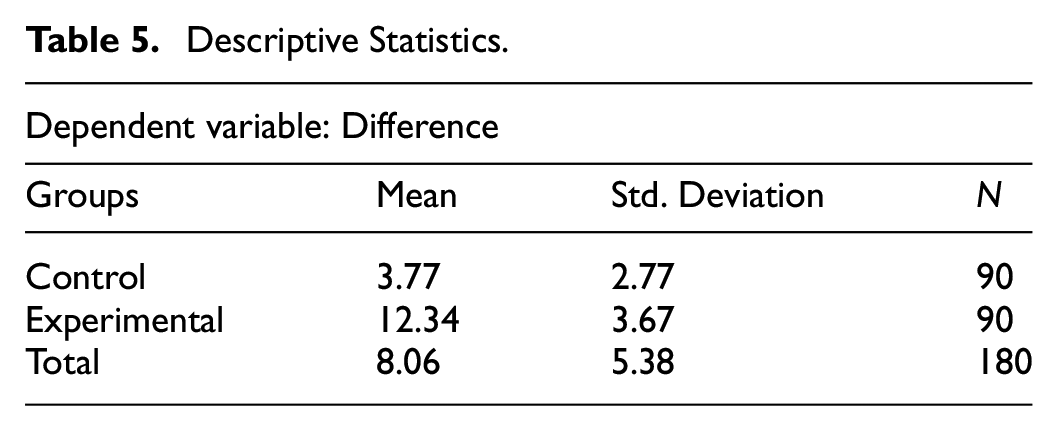
Table 5 describes descriptive statistics of the difference between posttest and pretest scores and shows the mean differences for the two groups. The Control Group had a mean difference of 3.78 with a standard deviation of 2.78, while the Experimental Group had a much larger mean difference of 12.34 with a standard deviation of 3.68. The total mean difference across both groups was 8.06 with a standard deviation of 5.39. These statistics indicate that the Experimental Group experienced a significantly greater improvement in scores compared to the Control Group.
Descriptive Statistics.
Since none of these p-values are below .05, we do not reject the null hypothesis. This means we have no evidence that the variances are significantly different across groups (See Table 6). Therefore, the assumption of equal variances holds for your dependent variable, “Difference,” across the groups in the study. This finding suggests that further analysis can be processed with analyses that assume equal variances across groups, as this assumption appears to be met based on Levene’s Test.
Levene’s Test of Equality of Error Variances.

Note. Tests the null hypothesis that the error variance of the dependent variable is equal across groups.
Table 7 assesses the differences in the dependent variable (difference between posttest and pretest scores) between the groups. The corrected model, which includes the group effect, has a sum of squares of 3302.45 and is highly significant (p < .001), with an F-value of 310.71. The intercept is also significant (p < .001), indicating that the overall mean difference is substantial. The group effect itself is significant (p < .001), confirming that the difference in improvement between the Control Group and the Experimental Group is statistically significant. The error term has a sum of squares of 1891.88 with a mean square of 10.62. The total sum of squares is 16891.00, and the corrected total is 5194.33. These results highlight the significant effect of the group variable on the difference in scores, indicating a strong impact of the intervention or conditions applied to the Experimental Group.
Tests of Between-Subjects Effects.

Survey Analysis
To explore the second research question about teachers’ perceptions of AI tool implementation, the survey responses are analyzed through descriptive analysis, and teachers’ perceptions, concerns, and obstacles faced while using AI tools in mathematics classrooms are presented in this section (See Table 8).
Descriptive Analysis of Perception Questionnaire.

Positive Attitudes Toward AI
Many participants look forward to using AI tools in their teaching, with a mean score of 3.71 (SD = 1.10). Agreement on this statement is relatively high at 78.9%, though there is a notable disagreement at 22.8%. Participants expressed hope for the future with AI, evidenced by a mean score of 4.13 (SD = 0.77). Agreement is high at 73.3%, and disagreement is minimal at 4.4%. There is a strong belief that AI will support and make teachers’ work easier in the future, with a mean score of 4.06 (SD = 0.69) and a high agreement rate of 95%.
Concerns About AI
The use of AI brings worry and fear to some participants, reflected in a lower mean score of 1.91 (SD = 0.77), with a significant disagreement at 87.2%. There are concerns about AI increasing inequality in the classroom, with a mean score of 4.07 (SD = 0.91) and a high agreement rate of 87.2%. Participants also believe that AI can intrude on personal integrity, with a mean score of 3.71 (SD = 1.09) and 70% agreement.
Impact on Employment and Inequality
The perception that AI can make future teachers unemployed is less prevalent, with a mean score of 2.41 (SD = 1.20) and a higher disagreement rate of 73.9%. There is a significant concern about AI increasing inequality in the classroom, with a mean score of 4.07 (SD = 0.91) and a high agreement of 87.2%.
Benefits for Students
The majority of participants believe that AI tools have led to an improvement in their mathematics grades, with a mean score of 4.14 (SD = 0.75) and high agreement at 93.9%. The belief that AI tools can provide new challenges for mathematics students is not widely held, with a mean score of 1.67 (SD = 0.63) and a high disagreement rate of 95.6%. Adaptive and individualized teaching materials are seen as valuable, with a high mean score of 4.30 (SD = 0.60) and agreement at 97.2%.
Technical Issues and Training Needs
Participants frequently encounter technical issues with AI tools, as indicated by a mean score of 4.14 (SD = 0.76) and agreement at 93.9%. There is a significant need for more training to effectively use AI tools, with a mean score of 4.01 (SD = 0.78) and agreement at 92.8%.
Usage and Continuing Education
Many participants regularly use AI tools outside of school, such as Siri and Google Translate, with a mean score of 4.11 (SD = 0.88) and agreement at 90%. A strong majority expressed interest in continuing education and projects focused on AI in schools, with a mean score of 4.01 (SD = 0.78) and agreement at 92.8%.
Assessment and Integrity
AI tools are perceived as unsuitable for the formative assessment of student learning, with a mean score of 4.12 (SD = 0.80) and agreement at 89.4%. There are concerns about AI and data gathering intruding on personal integrity, with a mean score of 3.71 (SD = 1.09) and 70% agreement.
Interview Analysis
The objective of conducting interviews with teachers and students was to gain deep insight into their perceptions and understanding of AI tools in elementary mathematics classes. It is evident from their responses that not only do most of the participants understand the importance of AI tools also; they do strive to learn and employ these tools in their learning process. However, they do have some concerns about technology use and reliability. The interview data responds to research question 3 by highlighting obstacles in AI tool implementations and the facilities these tools may bring. Seventeen initial codes and then nine initial themes were established from the interview transcript. Initial themes were later merged into six main themes.
Students’ Perceptions About AI Tools
Positive Aspects of Using AI Tools
Students appreciate that AI tools provide “instant feedback,” allowing them to learn from mistakes without waiting for teacher grading. These tools make learning “more interactive and engaging with fun,” gamified elements. Personalized learning paths help students learn at their own pace and focus on areas needing more practice. Visual aids and animations make complex concepts easier to understand, and a variety of practice problems keep students engaged. AI tools are accessible outside school hours, “offering more practice opportunities.” Detailed problem-solving guides and adaptive challenges personalized to the student’s skill level are also highly valued.
Challenges Faced While Using AI Tools
Some students face frustration when AI tools fail to understand their input correctly. “Technical glitches and slow internet connectivity” can interrupt learning. The complex interface can be overwhelming due to its many features. Explanations provided by AI can sometimes be too complex, and “instructions may not always be clear.” Students also reported issues with repetitive problems and confusing initial setup, requiring teacher or “technical assistance” to get started.
Suggestions for Improvement
Students suggest simplifying the interface to make it more “intuitive and user-friendly.” More training sessions and detailed tutorials would help students use the tools effectively. Better technical support is needed to quickly resolve issues and minimize learning disruptions. Including more “real-life application problems” would make learning more practical. AI tools should offer feedback on different problem-solving methods and provide more detailed, explanatory feedback. Improving internet connectivity and ensuring the tools are stable and load quickly, as well as offering a greater variety of problems with accurate difficulty adjustments, would enhance the learning experience.
It can be opined that students find AI tools beneficial for instant feedback, personalized learning, and “making learning engaging and fun.” However, they face challenges with technical issues, complex interfaces, and occasional input recognition problems. Simplifying the interface, providing more training, offering better technical support, and ensuring the AI tools are stable and user-friendly would improve the experience.
Teachers’ Perceptions of AI Tools
Benefits of Using AI Tools
Teachers appreciate AI tools for providing personalized learning experiences, allowing lessons to be planned according to individual student needs and paces. Instant feedback helps students correct mistakes in real time, “reinforcing learning.” AI tools save teachers time by automating grading and assessments, enabling more focus on instruction and interaction. The variety of resources keeps students engaged with different activities catering to “various learning styles.” These tools help identify student weaknesses, making it easier for teachers to adjust instruction. Additionally, AI tools offer practice problems and activities that reinforce classroom teaching and provide extra practice outside school hours.
Challenges Faced While Using AI Tools
Teachers face “frequent technical issues” like software glitches and connectivity problems that disrupt learning. The learning curve for using AI tools effectively can be steep, requiring significant time for teachers to become proficient. Not all students have the same access to the technology they need, which makes learning chances uneven. Sometimes, the feedback from AI tools is too generic and not helpful in specific contexts, confusing. Integrating AI tools with the existing curriculum can be challenging and requires careful planning. Some students struggle to navigate AI tools initially and may resist using them due to “discomfort with technology.”
Suggestions for Improvement
Teachers suggest providing comprehensive training programs to help them use AI tools more effectively and confidently. Ensuring AI tools are accessible to all students, regardless of their technological resources, is crucial. Improving the user interface to make AI tools more intuitive and “user-friendly” would benefit both teachers and students. Offering reliable and responsive technical support to quickly resolve issues would enhance the learning experience. Developing feedback mechanisms designed to “individual student needs and specific problems” would make AI tools more effective. Enhancing the reliability and stability of AI software would minimize disruptions and provide a smoother learning experience. Incorporating more features that cater to different learning styles and providing clearer, more detailed feedback would improve the overall impact of AI tools.
From the responses to interview data, it is evident that teachers find AI tools beneficial for personalized learning, “immediate feedback,”“time efficiency,” and engagement through variety. However, they face challenges with technical issues, a steep learning curve, and disparities in access to technology. “Comprehensive training,”“better accessibility,”“enhanced user interfaces,”“improved technical support,” and more contextually relevant feedback would improve the use of AI tools. As evident from Figure 2, the study has explored some deep insight of both teachers and learners’ attitudes and adaptability of AI tools integrating the challenges they face and recommending some solutions to the current scenarios.

Analytical model of the findings.
Discussion
The descriptive statistics reveal a marked difference in improvement between the Experimental Group, which used AI tools, and the Control Group, which did not. The Experimental Group demonstrated a mean difference of 12.34 in their posttest and pretest scores, significantly higher than the Control Group’s mean difference of 3.78. This substantial difference, supported by a low p-value (<.001) and a high F-value (310.71) in the ANOVA results, underscores the significant impact of AI tools on student performance. The intervention applied to the Experimental Group appears to be highly effective, suggesting that AI tools can play a critical role in enhancing mathematics education by providing personalized learning experiences and immediate feedback. These findings are in line with some previous research findings (Hwang, 2022; Nguyen, 2023) proving H1 as supported that the implementation of AI tools in mathematics classrooms has a positive effect on students' mathematical performance
Survey results indicate a generally positive attitude toward AI tools among teachers. Many participants expressed optimism about the future use of AI in their teaching practices, with high agreement rates on the potential of AI to support and simplify their work (Seckel et al., 2023). This positive outlook is crucial for the successful integration of AI in education, as teacher enthusiasm and acceptance are key to the effective adoption of new technologies. One of the key benefits highlighted by the study is the ability of AI tools to offer personalized learning experiences which is in line with some previous research (Soesanto et al., 2022). Qualitative data from semi-structured interviews revealed that teachers and students appreciated the personalized learning opportunities provided by AI, and supported H2 that is elementary mathematics teachers have a generally positive perception of the use of AI tools in the classroom, believing they enhance learning engagement and comprehension. These tools can adapt to individual student needs, offering customized content and feedback that address specific learning gaps and preferences. This personalized approach not only enhances student engagement but also ensures that each student receives the support they need to succeed, thereby fostering a more inclusive and effective learning environment.
Despite the positive attitudes, the study also highlights several concerns. A significant portion of participants expressed fears related to AI, such as its potential to increase inequality in the classroom and intrude on personal integrity. These concerns must be addressed to ensure equitable and ethical implementation of AI tools. Additionally, the study reveals a prevalent need for more training and support for teachers to effectively use AI tools, as well as frequent encounters with technical issues which is supported by a recent study too (Egara & Mosimege, 2024). Providing comprehensive training and robust technical support will be essential in overcoming these barriers and ensuring that AI tools are used effectively and efficiently.
The study also touches on concerns about AI's impact on employment, with a notable portion of participants disagreeing with the notion that AI will make future teachers unemployed. However, there is significant concern about AI increasing inequality within the classroom, highlighting the need for careful implementation strategies that ensure all students benefit equally from AI tools. Ensuring that AI tools are designed and deployed to support inclusive education is paramount.
Teachers believe that AI tools have a positive impact on student performance, with high agreement on the improvement of mathematics grades (Wu, 2021). The belief in the value of adaptive and individualized teaching materials provided by AI further supports the potential of AI tools to enhance learning outcomes. However, the perception that AI tools do not provide new challenges for students suggests a need for AI tools that can offer more dynamic and challenging content to stimulate higher-order thinking skills (Luckin et al., 2022). It is also very important to understand how teachers take the involvement of AI tools in teaching process as their acceptance is very crucial (Choi, 2023). H3 has been supported by these findings which indicates, the teachers and students perceive more benefits than challenges with the implementation of AI tools in elementary mathematics settings, particularly in terms of personalized learning and increased engagement.
The frequent encounters with technical issues and the significant need for more training underscore the challenges associated with the integration of AI tools (Zimmerman, 2018). Addressing these challenges will require ongoing professional development and technical support to ensure that teachers are well-equipped to integrate AI into their teaching practices effectively.
The high level of interest in continuing education and projects focused on AI in schools is encouraging. This interest indicates a willingness among teachers to engage with and learn more about AI, which is essential for the sustained and successful implementation of AI tools in education (Lopez-Caudana et al., 2020).
Finally, concerns about the suitability of AI tools for formative assessment and the intrusion on personal integrity highlight the need for careful consideration of ethical issues related to AI in education. Ensuring transparency, privacy, and fairness in AI-driven assessments will be critical to gaining and maintaining the trust of both teachers and students (Lindner & Berges, 2020).
Future Implications and Recommendations
The findings of this study highlight the significant potential of AI tools to enhance mathematics education in elementary schools. The positive results observed in this study suggest that AI tools can be scaled and integrated across a broader range of educational settings. Future research should explore the scalability of AI tools and their impact in diverse educational contexts, including different age groups, subjects, and socio-economic backgrounds. Long-term studies are needed to assess the sustained impact of AI tools on student learning outcomes. Longitudinal research will provide insights into how continuous use of AI tools influences academic performance, student engagement, and overall educational development over time. There is a need for the ongoing development and refinement of AI tools to ensure they remain effective, user-friendly, and aligned with educational standards. Collaboration between educators, AI developers, and researchers will be crucial in creating tools that address the evolving needs of the classroom.
Effective implementation of AI tools requires comprehensive training programs for teachers. These programs should cover technical skills, pedagogical strategies, and troubleshooting techniques to ensure that teachers are confident and competent in using AI tools. Establishing a robust technical support infrastructure is essential to address the frequent technical issues reported by participants. Schools should have access to dedicated technical support teams and resources to assist teachers and students in resolving technical problems promptly. Addressing concerns about inequality and privacy is paramount. Schools and policymakers should develop guidelines and frameworks to ensure the ethical use of AI tools, focusing on data privacy, transparency, and equity. AI tools should be designed to support all students, particularly those from disadvantaged backgrounds, to prevent exacerbating existing inequalities. The personalized learning capabilities of AI tools should be leveraged to provide tailored educational experiences that meet the diverse needs of students. Future AI tools should incorporate adaptive learning algorithms that can customize content and feedback based on individual student performance and learning styles.
Implementing a system of continuous evaluation and feedback will help monitor the effectiveness of AI tools and identify areas for improvement. Regular assessments and feedback loops involving teachers, students, and administrators will ensure that AI tools remain relevant and effective. Schools and educational institutions should encourage innovation and research in the field of AI in education. Collaborative research projects, pilot programs, and partnerships with technology companies can drive the development of new AI tools and methodologies that enhance teaching and learning.
Conclusion
The study highlights the significant potential of AI tools to enhance mathematics education in elementary schools. The substantial improvement in student performance in the Experimental Group suggests that AI tools can be highly effective in supporting learning. However, the successful implementation of AI tools will require addressing concerns about inequality, technical challenges, and the need for adequate training and support for teachers (Owan et al.,2023). By tackling these challenges and leveraging the positive attitudes and interest among teachers, AI tools can be effectively integrated into elementary mathematics classrooms, ultimately improving educational outcomes for students. This study makes significant contributions by addressing the research gap on the impact of AI tools in elementary mathematics education, a field where empirical data is limited. Unlike previous studies that often focus broadly on AI in education, this research specifically examines AI’s role in improving elementary students’ mathematical performance and problem-solving skills within real classroom settings. By employing a mixed-methods approach that includes both quantitative and qualitative data, this study offers a holistic view of AI’s effectiveness and the perceptions of both teachers and students.
Footnotes
Appendix
Acknowledgements
We would especially like to thank all the teachers and students who participated in the study

Ethical Considerations
The researchers took into account the ethical considerations raised by Creswell (2012). Thus, after notifying the school administration about the goal of the study and obtaining an ethical approval letter, the researchers made sure that participant participation in the data collection was voluntary. We also let them know that the information was solely to be used for research. To maintain participant identity, we employed codes (numbers) for direct quotes throughout the data processing process.
Consent
The participants of the study signed their consent and were assured about their information privacy.
Funding
The author(s) received no financial support for the research, authorship, and/or publication of this article.
Declaration of Conflicting Interests
The author(s) declared no potential conflicts of interest with respect to the research, authorship, and/or publication of this article.
Data Availability Statement
Data sharing is not relevant to this topic because no datasets were created or analyzed during the current study.