




Abstract
The Zhejiang Huzhou Mulberry Base Pond System (HMBPS) is a complex and comprehensive “Globally Important Agricultural Heritage System (GIAHS).” Current research on the conservation of HMBPS predominantly focuses on agriculture, ecology, and land management, while the studies addressing socio-cultural aspects are notably lagging behind, which challenges the preservation of HMBPS. The study of the modernization and dissemination of the HMBPS is of great significance to the preservation and transmission of GIAHS. This paper presents the development of a digital serious game titled “Mulberry Base Pond System World (MBPS),” utilizing the GPS game development model. The game simulates the system elements, characteristics, and operational logic of the HMBPS. Students are invited to use this digital serious game. In this process, we assessed the effects of digital serious game on respondents’ cognitive level, cognitive structure, and interest in learning about HMBPS culture through pre-tests, post-tests, game assessment questionnaires, and semi-structured interviews. The results of the experiment show that the digital serious game improve respondents’ understanding and learning interest in the HMBPS, as well as foster the formation of a positive learning style. In addition, the digital serious game can help respondents better understand how the agricultural system works. Furthermore, combining serious digital games with educational tourism, increasing the interaction between real and virtual environments, developing multiplayer “cooperative games,” could be potential directions to promote cultural dissemination of agricultural heritage.
Keywords
Introduction
The Food and Agriculture Organization of the United Nations (FAO) launched the Globally Important Agricultural Heritage Systems (GIAHS) project in 2002 (Food and Agriculture Organization [FAO], 2018). As of March 2024, the FAO has recognized 86 GIAHS in 26 countries or regions, of which China ranking first with 22 heritages. Over time, aboriginal people have established complex, sustainable patterns of land use and production management in agricultural heritage sites, and have developed a unique agricultural culture (Koohafkan et al., 2012; Qingwen & Yehong, 2009). Examples include Noto’s Satoyama and Satoumi, Japan; Oldonyonokie/Olkeri Maasai Pastoralist Heritage, Kenya; Soave Traditional Vineyards, Italy; Chinampas Agricultural System in Mexico City; Al Ain and Liwa Historical Date Palm Oases, United Arab Emirates, for example (FAO, 2023). These examples illustrate the rich diversity of agricultural heritages found throughout Africa, Asia, Europe, Central Asia, Latin America, and North Africa. The rules for heritage assessment emphasize that sites must “fully embody the concept of sustainable development in harmony with the elements of the system and between human beings and nature” (Qing & Yehong, 2009). GIAHS has a dynamic sustainable development character, and its evaluation system includes local and traditional knowledge systems (Li et al., 2023), food and livelihood security (Su et al., 2018), biodiversity (Agnoletti & Santoro, 2022), culture, value systems, and social organization (Kajihara et al., 2018), and landscape character (Y. Zhang et al., 2017).
Currently, the FAO has not established a strict definition of culture within the context of GIAHS. However, it has been noted that cultural identity and a sense of place are intrinsic to specific agricultural sites. These elements are often expressed through rituals, religious practices, and spiritual experiences, which are integral to the social organizations and practices of these sites. In this context, culture can be pointed to as some of the “experiences” related to the agricultural heritage. It can be argued that the GIAHS treats culture as an intangible value. Therefore, this paper adopts UNESCO’s definition of Intangible Cultural Heritage (ICH) to support its position in the cultural discourse. According to UNESCO, cultural heritage includes traditions or ways of life that are inherited from ancestors and passed on to future generations, such as oral traditions, performing arts, social customs, rituals, festive events, practical knowledge, and knowledge and skills in making traditional handicrafts (Vecco, 2010) . In this paper, the UNESCO definition is followed to discuss culture in GIAHS.
The reality is that the structure of rural landscapes has undergone a significant transformation. Low-yield agricultural systems have been largely abandoned, leading to a shift toward more intensive agricultural practices (Dessart et al., 2019) . This change has resulted in a loss of traditional knowledge, biodiversity, and cultural landscapes (Agnoletti & Santoro, 2015; Dessart et al., 2019; Slamova and Belcáková, 2019). In terms of cultural preservation, Kajihara et al. (2018) and others have studied the GIAHS conservation efforts of Japan, South Korea, and China in terms of “culture, value systems, and social organizations.” The loss of cultural characteristics and the phenomenon of cultural convergence are occurring in these three East Asian countries, of which China, where efforts have been in progress for the longest period, being the most serious. The lack of effective mechanisms for disseminating traditional knowledge, combined with the younger generation’s disinterest in agricultural inheritance and practices, has led to a further loss of traditional knowledge and techniques related to agricultural heritage (Reyes et al., 2020). Consequently, the research for an open, inclusive, and egalitarian approach for cultural transmission to build new educational strategies can help to promote the dissemination of traditional knowledge.
Therefore, this paper is based on the research objective of using digital technologies to build new pedagogical strategies to increase the interest of young people in agricultural heritage. The research team used HMTL5 software to develop a digital serious game based on the HMBPS, invited university students to test the product to explore the possibility of digital serious game to stimulate young people’s interest in agricultural heritage.
Literature Review
Characteristics of the Mulberry Base Pond System and Current Status of Research
The HMBPS is located in Huzhou City, Zhejiang Province, China, was selected as a GIAHS in 2017 (Huzhou Mulberry-Dyke and Fish-Pond System, 2017). The HMBPS, with a history spanning over 2,500 years, is renowned for its unique “depression land use model and ecological and economic model.” This system artfully integrates four sub-systems: the mulberry-silkworm ecosystem, silkworm-fish ecosystem, fishpond ecosystem, and pond-dyke ecosystem, creating a complex and interconnected ecological network (Minger, 2017 The HMBPS cycle operates as follows: Mulberry trees are planted on the dikes, where their root systems help to strengthen these structures. The leaves of these trees are used to feed silkworms (domesticated silkworms), whose waste, in turn, serves as feed for fish in the ponds. The waste from the fish enriches the silt at the pond bottoms, which is then utilized both to construct new dikes and to provide nutrients for the mulberry trees (Figure 1). In addition, the production of mulberries, silk, mulberry leaves, and fish will become food or economic commodity for local farmers (Korn, 1996; Lo, 1996). The HMBPS is seen as an evolving and adaptive socio-ecological system that is constantly adapting and changing, and it is this dynamic development that makes the system sustainable (Min & Lu, 2012). In summary, the HMBPS contains knowledge of agricultural production, biological conservation, hydraulic engineering, nutrient cycling, and business economy, which has important educational significance, dynamic development characteristics and high playability.

Mechanism of operation of HMBPS.
In conclusion, research in the field of HMBPS concerning agriculture, ecology and land management has been quite extensive. However, the literature related to the socio-cultural development and inheritance of HMBPS is relatively lacking. In China, scholars have conducted significant work in collecting and organizing literature on the socio-cultural elements of HMBPS and formed a relatively complete cultural preservation system. However, the applied research on the socio-cultural development and dissemination of HMBPS remains insufficient. Therefore, it is necessary to carry out the applied research on heritage transmission based on the characteristics of HMBPS.
The most extensive research has been carried out on HMBPS agriculture elements. Leng (2020) reviewed the development history of mulberry pond agriculture from 1300 to 2020 and concluded that, due to the subsistence demand of population growth, the support of successive government policies, the development of the commodity economy and the improvement of the management technology systems of mulberry, sheep, fish, water, and soil quality, the “Huzhou mulberry base pond ecological agricultural system” with “crop rotation and replanting” and “intercropping and fixed cropping” was eventually formed. Liu et al. (2018) examined the efficiency of various agricultural cropping patterns in mulberry base pond system and concluded that the current agricultural efficiency of the “mulberry base pond system” is not as good as that of the “oilseed rape base pond system,” and farmers are changing the way they grow. A more recent study assessed the HMBPS from the perspective of agricultural production structure. The results show that the proportion of breeding is higher than planting, which is gradually shrinking. The researchers proposed a scheme to optimize the proportion of agricultural production (Zhou et al., 2023). It can be concluded that, firstly, the sub-systems within the HMBPS are interdependent, exhibiting complex interrelationships. Secondly, the sustainable development of the HMBPS is linked to the sub-systems efficiency and the efficient exchange of resources between the sub-systems.
From an ecological perspective, X. Gu et al. (2022) measured the comprehensive evaluation index of the MBPS consumption process in different periods and concluded that the index of the new MBPS pattern is higher than the traditional one, this indicates that the current ecologically sustainability of the MBPS has decreased compared to that in the Ming and Qing Dynasties. Astudillo et al. (2015) reviewed MBPS greenhouse gas emissions, noting that fertilizer ponds provide 97% of methane emissions and that attention should be paid to greenhouse gas emissions from waste degradation ponds. In addition, Wang et al. (2018) assessed the ecological service value of MBPS from the perspective of ecosystem protection in nine categories: climate regulation, water conservation, soil conservation, product supply, water storage and flood control, recreation and tourism, history, and culture. The results indicate that the overall ecological service value of the MBPS system is higher than that of the “mulberry system” and the “fishpond system,” and that only when the MBPS is regarded as a complete ecosystem can it generate a higher service value and ecological benefits. Consequently, it can be concluded that within the ecological dimension of MBPS, isolated sub-systems may have negative impacts. However, if a complementary relationship is established among the various sub-systems and the MBPS is regarded as an integrated system, its ecological benefits are likely to be significantly enhanced.
In terms of land management, W. Zhang et al. (2021) analyzed the evolution of the area of the MBPS in the “Guangdong-Hong Kong-Macao Greater Bay Area” in China over the past 40 years. The results conclude that the spatial configuration of the MBPS is shifting from a natural random distribution to an artificial distribution, and that the MBPS will continue to shrink due to land use and industrial specialization. The latest study, by Santoro et al. (2022) examined changes in the land area and shape of the HMBPS from 2010 to 2022 after its inclusion in the GIAHS. The study concludes that the negative trend of the HMBPS has not been mitigated by the inclusion in the GIAHS due to the lack of local management and suggests that a combination of the GIAHS conservation program and local management may mitigate this trend. It can therefore be concluded that the usable area of the MBPS is currently shrinking.
The Value of Applying Serious Games and the Current State of Research
Serious games can be used in thematic teaching activities (Gaia et al., 2023) and are viewed as an instructional strategy and are effective in enhancing motivation, knowledge construction, and the learning of advanced skills (Dempsey et al., 2023; Mezentseva et al., 2021) that can help participants accomplish specific knowledge more effectively (Arcagök, 2021). It is now matured for use in mathematics, medicine, computers, and other fields (Balan et al., 2016; Boyle et al., 2016; Lee, 2019; Lopez-Fernandez et al., 2021; Radecki et al., 2020; Vankús, 2021). The purpose of serious games is, firstly, to enable participants to understand the concepts of the subject matter and develop needs more quickly and to help them learn or practice to strengthen specific skills, and secondly, to change participants’ attitudes and help them to build cognitive systems of knowledge or to improve their cognitive level (Amir et al., 2023; Dong et al., 2024; Marinelli et al., 2023) . Serious games use game abstractions to simplify realistic elements and make learning more enjoyable, easier and effective (Hafeez, 2022; Marinelli et al., 2023; Susi et al., 2007). Serious games can be categorized into digital games (Gómez-Cambronero et al., 2023; Govender & Arnedo-Moreno, 2021; Vanden Bempt et al., 2022; Van Bogart et al., 2023.; computer games, console games, mobile games) and non-digital games (Valladares-Rodriguez et al., 2018; Wouters et al., 2013; board games, card games, pen-and-paper games, game accessories) based on the form in which they are presented. Digital serious games contain more additional elements, such as graphical presentations, game characters, soundtrack explanations, and balance controls, which are more conducive to procedural knowledge transfer (Boocock et al., 1973; Camuñas-García et al., 2023; Sitzmann, 2011). At the same time, participants learning in digital serious games can receive instant feedback to enhance the level of interaction between the participant and the system, thus promoting active learning. Digital serious games are increasingly being used to teach procedural knowledge as a learning method for sustainable management of natural resources (Furber et al., 2018; Laterra et al., 2023; Strada et al., 2023; Yun, 2023). Therefore, based on the instructional characteristics and effectiveness that serious games have demonstrated in the educational context, they hold great promise for application in agricultural heritage education.
Digital Serious Games and Preservation of Cultural Heritage
Digital serious games have been widely used in the fields of heritage conservation and management and cultural communication (Dochshanov & Tramonti, 2019b). In the field of heritage conservation and management, digital serious games are used to cultivate people’s psychology of natural disasters prevention, strengthen people’s awareness, and skills of rescuing heritage affected by disasters and professional skills in restoring heritage after disasters (D’Amico et al., 2023; Epifânio & da Silva, 2023; Verwimp et al., 2023). In the field of intangible cultural heritage, digital serious games are used to disseminate or teach heritage culture and skills, with the main aim of helping the public to develop an awareness system for heritage culture or skills (Bontchev et al., 2022; Grammatikopoulou et al., 2019). Digital serious games can be seen as a new form of heritage storage, which providing a large sample of data on heritage that is irreversibly extinguished as well as on heritage that has already been extinguished, offering humanity new ways of recovering its heritage or recalling its history, and contributing to the cultural diversity of human societies (Bakalos et al., 2020; Banfi et al., 2019; Dochshanov & Tramonti, 2019a). In terms of dissemination of heritage culture, digital serious games are increasingly focusing on the improvement of communication methods. including the use of virtual reality, interactive video, advanced game programing, and other technologies to enrich people’s sensory experience of interacting with heritage culture. Additionally, these games employ strategies like “intuitive learning design” to simplify the public’s understanding of heritage culture, thereby sparking greater interest in its study (Ferdani et al., 2020; Koo et al., 2020; Torsi et al., 2020). Therefore, it can be concluded that digital serious games are more mature for heritage preservation, intangible cultural heritage dissemination, and digital retention of heritage and have been proven to enhance public interest in learning.
Digital serious games are well established in the field of cultural heritage preservation, but digital serious game design focusing on agricultural heritage is scarce. In recent years, digital technology has become a popular way of heritage culture transmission (Moreno-Jiménez et al., 2012). The systematic and dynamic characteristics of agricultural heritage are highly compatible with the digital transmission method. The reasonable distribution of resources among agricultural heritage subsystems is dynamic, and there is no fixed ratio. For example, according to the literature, there is a fixed ratio of Mulberry-Dyke and Fish-Pond in the HMBPS, but this is not the case in the actual operation of residents in the heritage site, because agriculture is greatly affected by the climate and pests, and the damage of any one of the elements will cause an imbalance between the elements of the system (X. G. Gu et al., 2018). Consequently, knowledge preserved in textual form has its limitations, especially in conveying the “agricultural experience” that is traditionally passed orally among farmers. Therefore, this study addresses the issue of limited dissemination of the “experiences” associated with the cultural heritage of HMBPS. By leveraging the functional characteristics of digital serious games, a game based on the cultural heritage of HMBPS is developed. This game enables players to learn the “agricultural experience” of the HMBPS through interactive gameplay experiences.
Materials and Methods
The experimental tool is a digital serious game called “MBPS.” The research objective is to disseminate HMBPS culture to the youth. Based on the reality of the aging population and lack of young people near the heritage site, the experimental site for this study was Zhejiang Sci-Tech University, situated in the same city as the heritage site. Most students come from the heritage site. The experimental period is between December 2022 and April 2023. Finally, students from X University were invited to participate in the usability testing of “MBPS.”
Participants
The participants were 332 university students (M = 23 years). Inclusion criteria included normal intelligence and access to a mobile data device. 89% of participants stated that they had an idea of HMBPS but were unable to describe it in detail, while the remaining 11% stated that they did not know HMBPS.
Assessment Tool
GBL (Game-Based Learning Evaluation) is a mature evaluation method (Connolly, 2009) with four dimensions of evaluation content and standards. Specifically, it includes: learner Performance (LP1): focuses on respondents’ knowledge acquisition. Learner Motivation (LM): focuses on the learner’s interest level and motivation for using the game. learner Perceptions (LP2): focuses on respondents’ perceptions of the game. Learner Attitudes (LA): focuses on the learner’s enjoyment of the game and what they have learned.
Based on the pre-test and post-test questionnaires designed by “LP1,” we compare the difference in the respondents’ cognitive level of HMBPS cultural knowledge before and after participating in the game and evaluate the respondents’ performance; based on the game evaluation questionnaire designed by “LM-LP2-LA,” we verify whether digital serious games can increase the respondents’ interest in learning.
A pre-test and a post-test questionnaire were designed based on the LP1 dimensions to assess the respondents’ performance through the difference in their level of knowledge of HMBPS culture before and after participating in the game. These questionnaires included four sub-sections: “mulberry,”“silkworm,”“fishpond", and “ecosystem,” each with standardized answers (Table 1). Respondents’ performance was evaluated based on the number of correct responses. A game assessment questionnaire was designed based on the three dimensions LM-LP2-LA. The questionnaire data were collected to verify whether digital serious games can increase respondents’ interest in learning. To further understand the respondents’ experiences and perceptions of the HMBPS, the study used semi-structured interviews to understand the respondents’ perspectives that are difficult to express through written text. For example, the principles of how the agricultural system works, the experience of the game, the cultural experience, and suggestions for game improvement.
Content of the Post-Test Questionnaire.

Game Learning Process
“MBPS (Mulberry Base Pond System World)” is a simulation game centered around the cultural aspects of the HMBPS. It has been developed using HTML5. Based on the “GPS model” (Djaouti et al., 2011) of serious game classification (Figure 2), the game’s objective is to enable respondents to establish their virtual agricultural system within the game. By aligning resource elements in the game, maintaining resource balance, and constructing a sustainable agricultural system, players engage in a learning experience.

GPS model classification diagram.
This game incorporates the definition of agricultural knowledge levels from research by Xie et al. (2007) and others, with the labor object being the main subject (player). Players, in the role of the labor object, experience the production process of the HMBPS, learning about production technology, agriculture engineering, agricultural branches, and ultimately gaining insights into agricultural environments and regulations. Therefore, the game simulates a comprehensive HMBPS. The game is categorized into six levels based on the production process. respondents can manage different agricultural production stages, obtain various resources, allocate and determine the use of resources, and complete an entire agricultural cycle. The completion of one cycle doesn’t signify the end of the game, instead, it marks the beginning of a new game cycle. Within the game, players must consider the cyclical utilization of material elements and regulate the balance of resource elements in the system to ensure the sustainability of the HMBPS (Figure 3).

“MBPS” game operating mechanism diagram.
The First Stage of the Game
The first stage of the game is the “acquisition” phase, where respondents create their in-game identity and familiarize themselves with the game’s basic content and resources. Upon accessing the interface, the system allocates basic resources such as mulberry seedlings, silkworm eggs, and fish fry. In the subsequent stage, players enter the “Mulberry-Fishpond-Silkworm House” management interface. Here, they can select land, construct buildings, and manage resources (Figure 4). This gameplay draws on principles of mulberry base restoration, fishpond water quality management, and silkworm breeding environment control. Players make decisions about land use, construction, and resource distribution, applying their knowledge of these areas to optimize the agricultural system’s management. The interface enables the practical application of theoretical knowledge within the HMBPS context, thereby enhancing players’ understanding and skills.

“MBPS” game phase 1.
Phase 2 of the Game
In the second phase of the game, “Site - Farming - Harvest,” respondents must maintain the land or site that was originally built, including repairing and consolidating the foundations of the mulberry tree, dredging the fishpond, cleaning, and repairing the silkworm house. They must also manage the organisms of HMBPS, including rearing fish and treating fish diseases in the pond, hatching silkworm eggs, rearing silkworms, and harvesting cocoons in the silkworm room, as well as managing mulberry tree cultivation in the mulberry tree foundation, harvesting mulberry tree leaves and disinsectization. After the crops mature, respondents in the HMBPS can harvest the produced crops. For instance, from the fishponds, they can collect live fish, water chestnuts, silt and clam shells. The silkworm houses yield silk, silkworm excrement, shed silkworm skins and silkworm eggs. Additionally, mulberry leaves and mulberries (berries) can be harvested from mulberry trees planted on the dyke base (Figure 5).
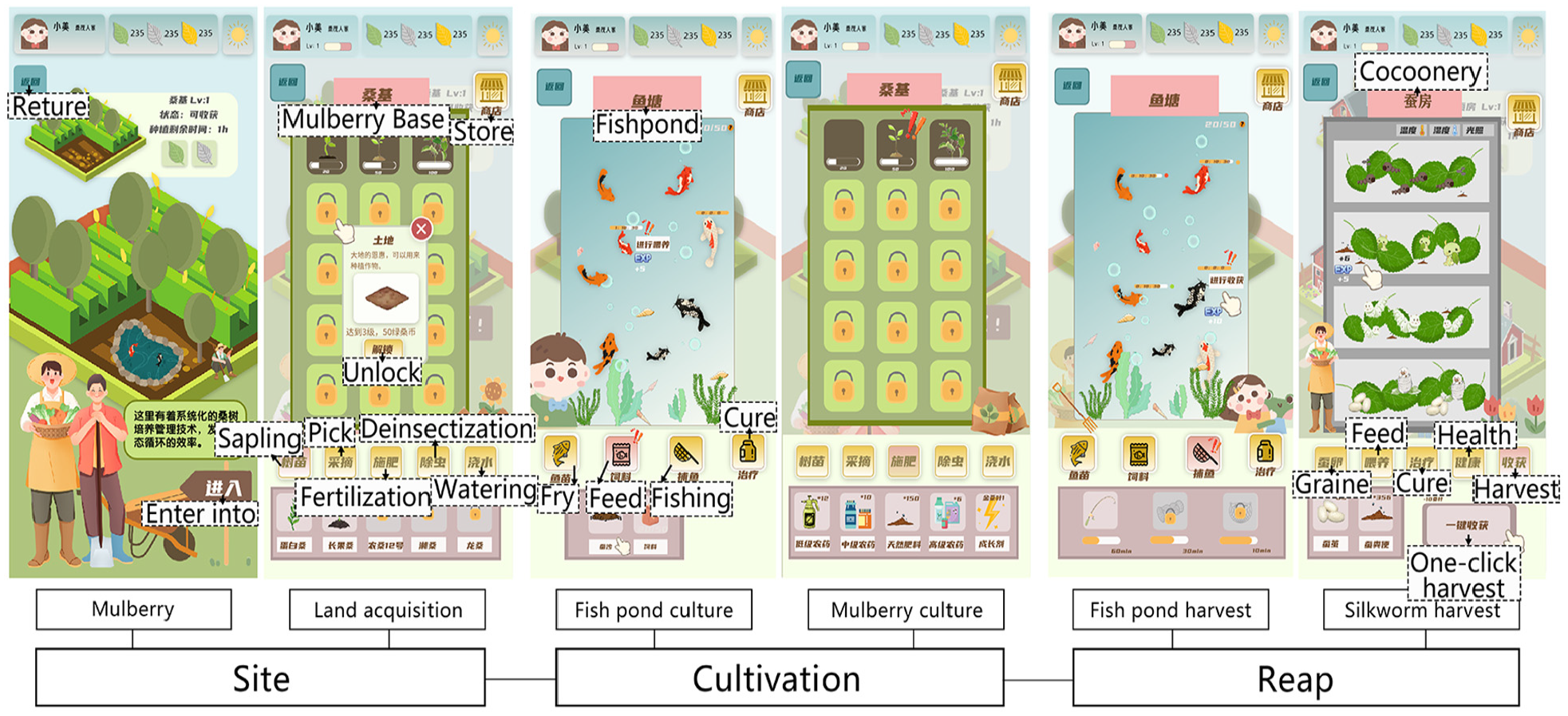
“MBPS” game phase 2.
The key concept of this phase is to make respondents understand the mutual support of the different sub-components of HMBPS. For example, simulating the non-recycling characteristics of HMBPS waste, silkworm faces can be harvested in the silkworm rearing process, which can be used as fish food at the fishpond interface, and fish faces turned into sludge to enrich the mulberry base soil. The mulberry base soil is enriched when the fish feces are turned into sludge. In the second stage, the player uses specific instructions to match the mutually supportive elements of the HMBPS and to address or repair production problems and potential unsustainable risks that the HMBPS may face, in order to maintain the HMBPS stability and harvest virtual agricultural products as game rewards.
Phase 3 of the Game
The third phase of the game is the “Processing-Marketing” phase, during which respondents can process the crops produced in the HMBPS. Fresh fish can be processed into canned fish or cut into fillets, while the cocoon from silkworms is processed into silk. Additionally, silkworm excrement can be used in traditional Chinese medicine, mulberry leaves and berries can be converted into juice or preserved as candied fruit. The processed products are then sold for the game’s common currency, which is used to buy new land. The currency will be used to buy more land and agricultural resources, allowing players to expand the production scale of the mulberry ponds (Figure 6).

“MBPS” game phase 3.
The Game’s Reward System
After completing the three stages of the game, it is possible to unlock the corresponding “Knowledge Library.” Respondents can tap on the corresponding "“Knowledge Library” in the “Museum of Science and Technology” interface to find out more about the scientific knowledge and answers to real-life phenomena that they have unlocked. The central concept of the third stage revolves around the reward mechanism and the deepening of knowledge. This is achieved by enhancing participants’ enthusiasm toward the app through a reward system that unlocks achievements based on their actions. Concurrently, the use of graphical and textual interpretations in tandem with corresponding operations serves to deepen the participants’ understanding of the relevant knowledge areas and their associated procedures (Figure 7).

“MBPS” game reward system diagram.
Experimental Procedure
The results of the questionnaire were used to evaluate whether the digital serious game facilitated respondents’ learning or understanding of HMBPS and whether it increased their interest and motivation.
Before the experiment began, staff ensured that respondents did not know the details of HMBPS. Next, respondents were given a serious statement about completing the questionnaire and an ethical statement to follow, and then the pre-test questionnaire was launched. The respondents then began their respective learning tasks. The experimental group used the serious game learning method for 7 days. To determine the rigor of the learning process, all respondents were informed that they were not allowed to learn anything during the learning period by any means other than the serious game learning method. At the end of the learning task, respondents completed the post-test questionnaire and the post-use evaluation questionnaire. Finally, semi-structured interviews were conducted according to the respondents’ wishes (Figure 8).
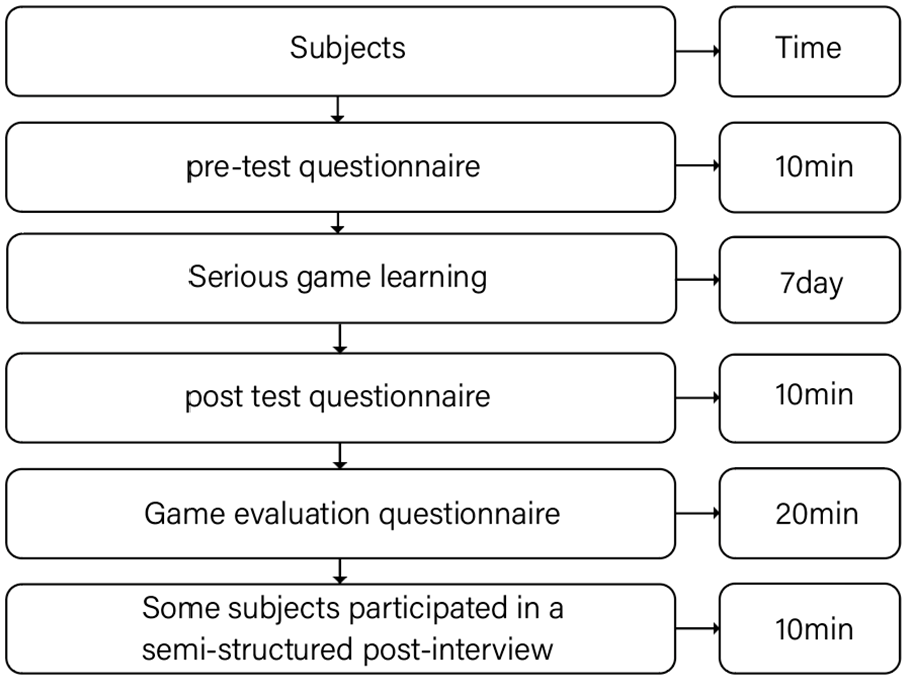
Flow chart of the experiment.
Results
A valid sample was defined by the respondents’ participation in a complete learning cycle of the digital serious game and by the complete completion of the pre-test questionnaire, post-test questionnaire and post-game use evaluation questionnaire. A total of 332 valid samples were collected, divided into 101 men and 231 women, of whom 31 respondents were interviewed in a semi-structured interview, divided into 16 men and 15 women. The game evaluation questionnaire was used to test the reliability and validity of the questionnaire using homogeneous reliability (Cronbach’s coefficient). The results showed that the reliability coefficient of the GBL-based gambling evaluation questionnaire was 0.86 (Cronbach’s α > .8), demonstrating that the questionnaire’s reliability index meets psychometric requirements and has good reliability.
Comparison of Cognitive Levels
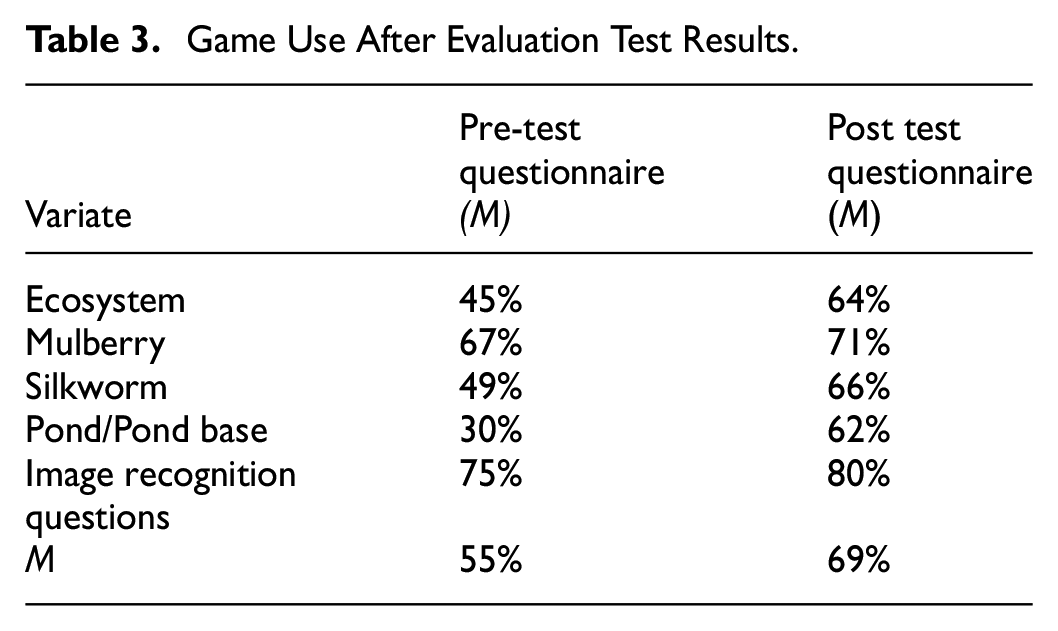
The pre-test and post-test questionnaires assessed respondents’ understanding of HMBPS and learning outcomes. The overall results of the pre-test questionnaire for all respondent’s showed accuracy is 55% (M = 55%) and the overall results of the post-test questionnaire showed accuracy is 69% (M = 69%). It can be concluded that after the completion of game-based learning, respondents’ accuracy rate is significantly increased (Table 2).
Respondents’ Cognitive Test Results.

Evaluation of Learner Motivation Regarding Digital Serious Games
Table 3 shows the results of the evaluation of the digital serious games.
Game Use After Evaluation Test Results.
“LM+” (items 1–4) shows the results of the evaluation of learner motivation. Item 1 shows respondents’ interest in the HMBPS culture (M = 4.00, SD = 0.82), and the data proves that the game is effective in stimulating respondents’ interest in the HMBPS culture. “Item 2” shows the respondents’ evaluation of promoting the HMBPS culture (M = 4.04 SD = 0.87), and the data indicates that the respondents are willing to promote the HMBPS knowledge acquired in the game. “Item 3” shows the respondents’ evaluation of promoting the game (M = 3.90, SD = 0.92), which proves that respondents are positive about sharing the game. Furthermore, “item 4” shows respondents’ willingness to continue using the game (M = 3.84, SD = 0.88), and the mean value indicates that respondents are moderately enthusiastic about continuing to play the game, which may be related to respondents’ ability to master the game in terms of difficulty level and game mastery.
Assessment of Respondents’ Perceptions of Digital Serious Games
“LP2” shows the results of the evaluation of respondents’ perception of the game (items 5–6), with an average score above “Agree” (M > 4, M = 4.37), indicating that respondents have a positive view of the game. The most important item, “item 5,” shows the respondents’ evaluation of the learning of the HMBPS culture in the game (M = 4.4, SD = 0.7), and the data shows that the respondents think that the game has helped them to learn the HMBPS culture positively. “Item 6” shows respondents’ ratings of how the game helped them understand the importance of balancing resources (M = 4.30, SD = 0.76), and the data shows that respondents think the game helped them understand the importance of maintaining a balance of resources in the HMBPS.
Assessment of Respondents’ Attitudes Toward Digital Serious Games
“LA” shows the results of the assessment of respondents’ attitudes (7–10) toward the game, and respondents’ overall favorability rating of the game with a score (M = 3.88), indicating that respondents like the game.
Assessing Respondents’ Cognitive Integrity of the HMBPS
Semi-structured interviews were conducted to further understand respondents’ cognitive structure. Some of the elements mentioned by respondents in the interviews were: “I think the amazing thing about developing Mulberry Base Pond System is that the system requires a balance of resources, for example, I had dead fish in the game because I had more fish and fewer silkworms, so there was no food (silkworm excrement) to feed the fish.” The interviewee briefly described the example of “resource imbalance in the HMBPS”, which is one of the aims of the digital serious game, hoping that respondents can vividly experience the importance of resource balance in the HMBPS. “I feel like this game is very interesting, I used to play similar games where the production efficiency is fixed, whereas you (MBPS) are free to combine, and I also discussed with my friend how to build a faster production system.” The interviewee focused on the concept of improving production efficiency, which demonstrate that the respondent had sufficient awareness of the resource transformation between sub-systems and attempted to build an efficient HMBPS. “I think this game makes a lot of sense. I studied HMBPS in my high school textbooks, but I can not understand the principles. The way you chose to learn (the game) made it easy for me to understand the principles of HMBPS, and I’m sure other beginners do too. I think the game would be great if it could be integrated into the junior high school curriculum to help junior high school students systematically understand HMBPS culture.” As interviewees indicated, the digital serious game relies on interactivity, video demonstration, dynamic simulation, and other techniques to help people better understand the abstract concept of “systematicness” in HMBPS, which reduces the difficulty of learning and enhances the attractiveness of HMBPS.
Validation Analysis of the Game Evaluation Questionnaire
To check the validity of the game evaluation questionnaire, it was subjected to an exploratory factor analysis and a validation factor analysis.
The exploratory factor analysis showed the KMO value was 0.849, the Bartlett’s sphericity test showed the p-value < .05, significance level was presented. This indicates that the questionnaire data is suitable for information extraction. The results of the factor analysis showed that all 10 entries could be retained with a total of three factors. The variance explained for the three factors was 28%, 27.2%, and 17.2%, respectively, and the cumulative variance explained after rotation was 72.5% > 60%. In summary, the information relating to these elements can be extracted efficiently.
The results of the validation factor analysis are shown in Figure 9. The standardized loading coefficients for each factor are all above 0.6, suggesting a strong measurement correlation among the elements. Furthermore, the Composite Reliabilities (CR) for factors 1, 2, and 3 is all above 0.7, indicating that the analyzed data exhibit high construct reliability. The square root of the Average Variance Extracted (AVE) for the three factors exceeds the Pearson correlation coefficients of the other factors, indicating relatively excellent discriminant validity.

Results of the questionnaire validation factor analysis.
The results show that the reliability and validity of the game evaluation questionnaire in this document are good, the questionnaire is valid.
Discussion
The objective of this study is to develop a digital serious game and promote the dissemination of the HMBPS culture among university students. The experimental results show that the digital serious game was well evaluated by the respondents in this experiment, which verifies the feasibility and effectiveness of the game in disseminating the HMBPS culture. The game increased respondents’ interest in learning and helped them to build a systematic knowledge of HMBPS. The respondents were willing to introduce the game to others, which helped to spread the HMBPS culture. Therefore, digital serious games are a feasible way to promote the dissemination of traditional culture and technical knowledge of the HMBPS.
Digital serious games can cultivate respondents’ active learning habits and improve their motivation and interest in learning. Most people choose to avoid or learn passively “systematic knowledge” which is complex and tedious, and if the method of communication does not meet the esthetic tastes and interests of the audience, the acceptance of systematic knowledge will be even worse. The main content of the digital serious game in the text is built based on the culture of the HMBPS, In the game, virtual interaction modules, and interesting gameplay have been added, as well as visual effects more in line with modern esthetics. The “management” game incentivizes respondents to actively learn the HMBPS culture and to explore sustainable resource balance within the HMBPS. Lastly, the introduction of a reward mechanism and a competition mechanism makes it possible to increase respondents’ initiative and interest in learning knowledge. The results of the questionnaire showed that respondents liked the content of the game and the visual presentation of the digital serious game, and they found the game very interesting, which enhanced academics’ interest in learning and cultivated the habit of active learning habits. Therefore, the digital serious game model and research method proposed in this paper can provide a theoretical basis and software support for cultural dissemination of the HMBPS.
The digital serious game helps respondents to better understand how the HMBPS works and to develop a “systematicness” perspective. The FAO stipulates that GIAHS must exhibit systematic features. However, “systematicness” is a complex concept, while traditional declarative learning can elucidate the relationships between individual elements within a system, they struggle to clearly articulate the interconnections among multiple elements, but it is difficult to clearly express the relationship between multiple elements. Digital serious games can break down complex systems into multiple sub-systems and restore the process of how agricultural systems work using digital simulation technology, which will greatly reduce the difficulty for the public to understand the complex HMBPS culture. The game evaluation questionnaire showed that respondents felt the importance of resource balance in HMBPS after playing the digital serious game. The semi-structured interviews showed that the respondents’“systematicness” knowledge of the HMBPS focused on three aspects: the balance of resource factors and the stability of the production system, the balance of resource factors and the efficiency of the production system, and the in-depth understanding of the culture of the HMBPS. It can be shown that the digital serious game can dismantle complex or abstract knowledge with digital simulation technology, which can help the public better understand the principles of farming systems, so that agricultural heritage can be more clearly understood by the public.
The combination of serious games and educational tourism may be a potential way to promote the sustainable development of agricultural heritage. The combination of heritage site, heritage culture and tourism has become a means of promoting the sustainable development of the HMBPS. Well-established heritage education tourism has been developed in the HMBPS, where tourists can engage in practical and theoretical learning in specific cultural and educational experience areas of the HMBPS, such as silkworm feeding, fishing, mulberry planting, mulberry leaf picking, and silk reeling (a silk-making process), among others. Owing to the seasonal nature of the HMBPS, these educational programs are open to visitors exclusively from April to September each year. Given the cyclical nature of agricultural crops, the heritage educational content available during each month is confined to the prevailing agricultural conditions, which leads to incomplete culture transmission of the HMBPS. Digital distribution of serious games and online usage scenarios can overcome the seasonal and time limitations of educational programing. The possible coordination mode is that offline educational programs are accompanied by online serious games, allowing visitors to break the learning time limitation and deepen knowledge of HMBPS. During the months when HMBPS is out of production, visitors can learn about HMBPS culture through the heritage serious game. Therefore, the combination of digital serious games and offline educational tourism has great application potential.
However, there is a potential risk that the results of this study may vary significantly among individual respondents. Analysis of the results in Table 2 shows that the mean value for each question is positive, which reflects the overall positive attitude of the group toward learning the traditional culture and technical knowledge of HMBPS through digital serious game. However, the standard deviation (SD) for the questionnaire is high, which indicates that there is a significant dispersion in the data points. Consequently, there are considerable differences in how individual respondents evaluated each question. This may be due to respondents’ preference for the dissemination and presentation of digital serious games, traditional cultural and technological knowledge of HMBPS, or differences in learning environments, learning time and learner motivation.
Conclusion
Digital serious games can facilitate the dissemination of the HMBPS among university students. Digital technology can replicate heritage characteristics in a virtual environment, deconstruct certain culture with procedural characteristics, or the phenomenon passed on orally and difficult to explain, so that students gain a more intuitive understanding of heritage culture. At the same time, questionnaire data and interviews show that respondents’ acceptance of the HMBPS culture is positive. Consequently, digital serious games can provide technical support for the dissemination of the HMBPS culture.
There are several shortcomings in this study. The respondents were all university students, with a high education level and strong ability to use digital products, which means that the results of this experiment may not be as applicable to young people who lack the ability to use electronic products or have low education level. In the following research, the test should be extended to a variety of populations to demonstrate the effectiveness of the serious game on other groups. Due to the uniqueness of agricultural heritage and the diversity of types of serious games, the combination of different types of serious games and different types of agricultural heritage is worth exploring in the future. Part of the farming activities needs to be accomplished by multiple players, and the agricultural heritage usually coexists with villages, where the local people have constructed social systems with local characteristics. Therefore, digital serious games with multiple players can strengthen the social and cultural elements of heritage sites in games and enhance social attributes of games, which is a potential research direction. Another interesting research avenue is investigating how personal characteristics like age, gender, and education level influence cultural awareness. Lastly, in the context of the explosive growth of AIGC (Artificial Intelligence Generated Content) technology, AI teacher programs (Tlili et al., 2023) built into serious game systems as learning aids are worthy of discussion in the future.
Footnotes
Acknowledgements
The authors gratefully acknowledge, Mr. Yuehua. Wang for his help and advice on the writing of this paper. The authors gratefully acknowledge, Qingyi Fang, Tianyi Liu, Xiaoya Zhuang, Yiyang Shu, Xiaoyang Yang, Fanhao Chen, Menglu Wu, Jiarong Wang, Ruyuan Yang, Zhuodong Sun, for assisting with the production of the installation.

Funding
The author(s) disclosed receipt of the following financial support for the research, authorship, and/or publication of this article: This article is supported by the following funds: Zhejiang Provincial Philosophy and Social Sciences Planning Project (22NDJC080YB), Zhejiang Provincial Higher Education “14th Five-Year Plan” Graduate Teaching Reform Project (JGCG2024178), Zhejiang Sci-Tech University Basic Research Project (24086123-Y).
Declaration of Conflicting Interests
The author(s) declared no potential conflicts of interest with respect to the research, authorship, and/or publication of this article.
Data Availability Statement
Data sharing not applicable to this article as no datasets were generated or analyzed during the current study.