




Abstract
This article explored the capacity of mixed media to elicit meanings from their lookers. A multisensory exhibition of photographs and soundscape was utilized to achieve the objective. The photographs provided the visual stimulus while soundscape accompanied the images to provide an aural map of the area being documented. Both media helped in the meaning-making process. The area documented was the center of Davao City, Philippines—San Pedro Street—as it cradles the center of faith, the seats of power, and the center of commerce. But, with urban decay, this place seemed to lose its former glory. With the visual and aural stimuli, these stories (memories) embedded in the mind of the lookers are culled. This is the meaning-making process.
Keywords
Introduction
With the continuous expansion of urban areas in the Philippines, it is undeniable that what used to be the original heart of the city, the former central business district, gets neglected (Alabado, 2005). Such is the case of Davao City, Philippines. With the various infrastructural developments and plans, it can be observed that the overall development of the city is moving away from its center.
What Is the City’s Center?
Local historians and other residents consider San Pedro Street as the city’s center for several reasons. According to Delgado (2005), the street is home to several social landmarks in the city aside from it being the central business district. These are the San Pedro Cathedral, Davao City Hall, and several parks that provided a busy atmosphere. The design of the whole area was patterned after Spanish Town Plazas as most of the sociocivic institutions were built in this area (Delgado, 2005).
Today, San Pedro Street still has San Pedro Cathedral as the center of Catholic faith, the Sangguniang Panlungsod and the Davao City Hall as seats of power, the commercial establishments owned by old and new families residing in the city, the Osmeña Park, and the Rizal Park. The Museo Dabawenyo, a government-managed venue for art exhibitions for local and visiting artists, is also located near San Pedro Street (Figure 1).
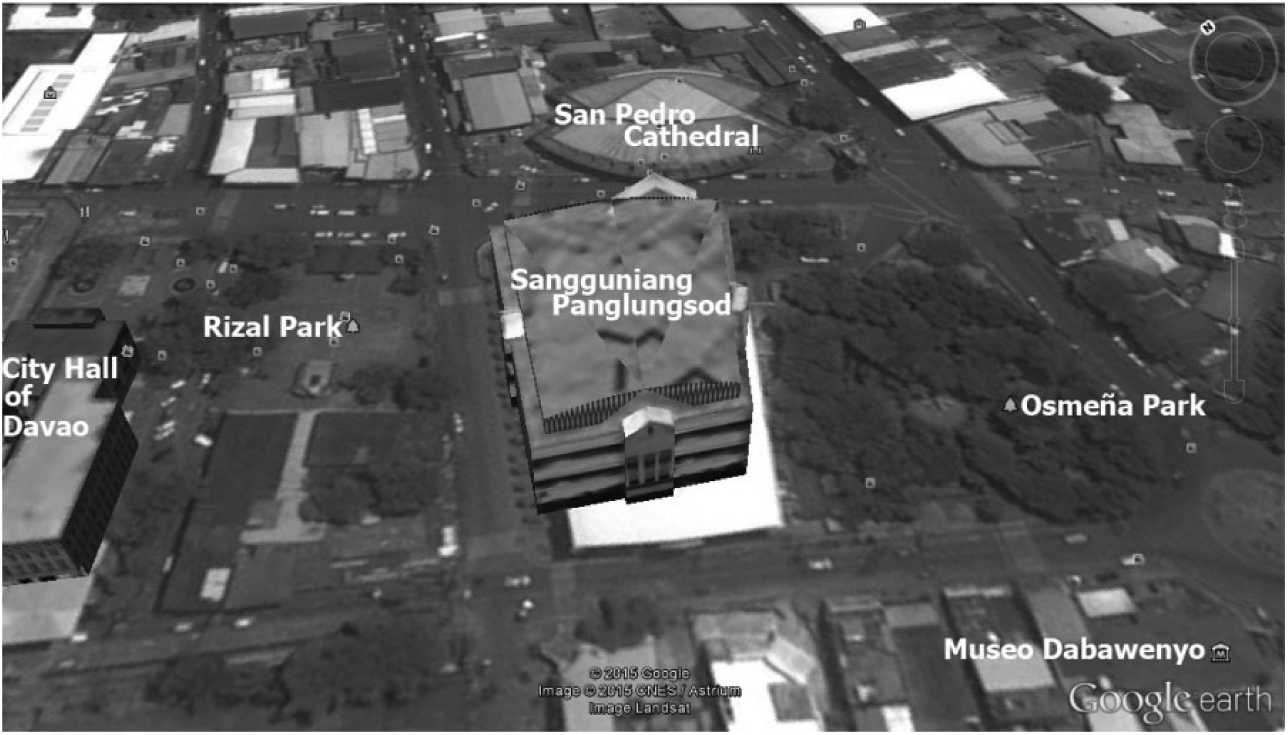
Google Map photo of the area covered by the exhibition.
Aside from that, San Pedro Street is full of irony. Despite the glaring presence of religion and government in the area, it has become a melting pot for illegal trade and some immoral acts. Businesses are sprawling away from this area and infrastructures looked old as well. The younger generation somehow forgot what the historical relevance of this area is. The adults seemed to accept the fact that what remains relevant in this area is purely trade while its other landmarks, those that either carries the seat of power or religion, are becoming less relevant.
Given this scenario, a creative work project was mounted to know the relevance of San Pedro Street to the community. It showcased several photographs with accompanying soundscape to recreate the area. Together with the lookers of the exhibition, the photographer conducted a simultaneous meaning-making activity.
Qualitative meaning-making or reception studies, as opposed to quantitative reception studies that aim to predict, are considered relevant as this will aid in planning as the meanings lookers give can provide planners and policy makers the areas’ relevance to cultural identity.
Theoretical Underpinnings
The theoretical underpinning for this production includes Visual Narrative Theory of Gretchen Barbatsis guided by Aldous Huxley’s The Art of Seeing.
According to Aldous Huxley, the general visual process involves four stages. These are Sense, Select, Perceive, and Remember. Sensing is defined as the detection of any visual stimuli while selecting is the process of focusing on one aspect of the entire visual stimuli detected. Perceiving, on the contrary, is the stage when a looker tries to make sense of the selected visual stimuli. This can be done by retrieving past experiences or knowledge about the selected visual stimuli. After perceiving comes remembering as the perceived meaning of the visual stimuli can be stored and retrieved for future use. This, in general, is the main objective of a visual communicator. It is not merely the creation of images that matters but the creation of powerful images that would make the looker remember its contents (Lester, 2006).
The creation of powerful images is grounded on the story it tells. Ideally, when we talk of stories, it always has a beginning, middle, and end arranged in a manner that one action will trigger a reaction that would lead to its climax and then eventually to its rightful end. In the context of visual narrative, what is important is the balance between pictorial content and pictorial syntax or its descriptive and literal structures. Simplified, the descriptive structure will tell the looker what the story is. It describes what is in the picture. The descriptive structure is the subject matter of the photograph. On the contrary, literal structure includes the rules and conventions of visual elements. This includes spatial relations such as angle and depth of field. Simplified, the literal structure is providing how the story is being told (Barbatsis, 2005).
The theory of Visual Rhetoric of Sonja K. Foss almost posits the same thing. Foss (2005) said that the nature of visual rhetoric has two components: presented and suggested elements. Presented elements include space, media, shapes, and so on, while suggested elements are concepts, ideas, themes, and allusions. The function of the image is to communicate the action and that the perceptions of the lookers are independent from its creator. Foss believes that image should be treated as a form of language and that is the language visual communicators use to be understood.
Creative Methodology/Process
A multisensory exhibit was conducted to document the changes in what is used to be the heart of Davao City—San Pedro Street. It was an exhibit that let the looker See, Hear, and Feel San Pedro Street as they walk through it.
One of the goals of this exhibit was to highlight the street in Davao City that cradles several landmarks—the San Pedro Street. By capturing it in still photographs, lookers may be able to reexamine the details of the place and experience it in a different perspective. By using visual images, this exhibit showed the culture of the people of Davao City and further defined San Pedro Street with the help of the lookers.
Defining San Pedro Street through meaning-making activity was the second goal of this exhibition. It was done because almost always the photographer has the tendency to present a subject according to the photographer’s point of view, moral judgments, and experience forgetting that the lookers carry their own point of view, moral judgments, and experiences as they view an image.
With these goals in mind and with the nature of the exhibition being multisensorial, the photographer planned several memory triggers to help in the meaning-making process. These are images, sounds, and the celebration of Araw ng Dabaw, an annual festival, that commemorates the city’s charterhood.
Finally, the exhibition billed Urban Sights and Sounds: The Stories of San Pedro Street (USAS) was held inside a shopping mall.
On Photography
Photography has been used in documenting many aspects of our life. As Sontag (1973-1977) posited, families with children almost always own a camera.
Today, the same methodology has been used to document the life in the city. Naegele and Baur (2004) documented big and small cities’ public spaces, which are often thought of as mundane and often neglected. This “pictorial archive” tried to capture the “elusive smells and flavours in order to hand them back to the people of the cities and their world.” Kugler (2009), who documented New York City as part of the Megapolis Tour series, presented New York’s “landscape—its architecture, its youth, its feel, its trends and movement” from his own perspective, personal view, and style including blurry images of the Upper and Lower East Side, Grand Central Station, and West Broadway to name a few while Coughlin (1998) documented the same city using sepia-toned images for elegance. Baechtold (2006) took on a new concept of creating a completely visual travel guide of Afghanistan by using maps and photographs. Baechtold’s creative premise lay on his idea that “one good photograph and an address are enough to point the intrepid traveller in the right direction.” (blurb)
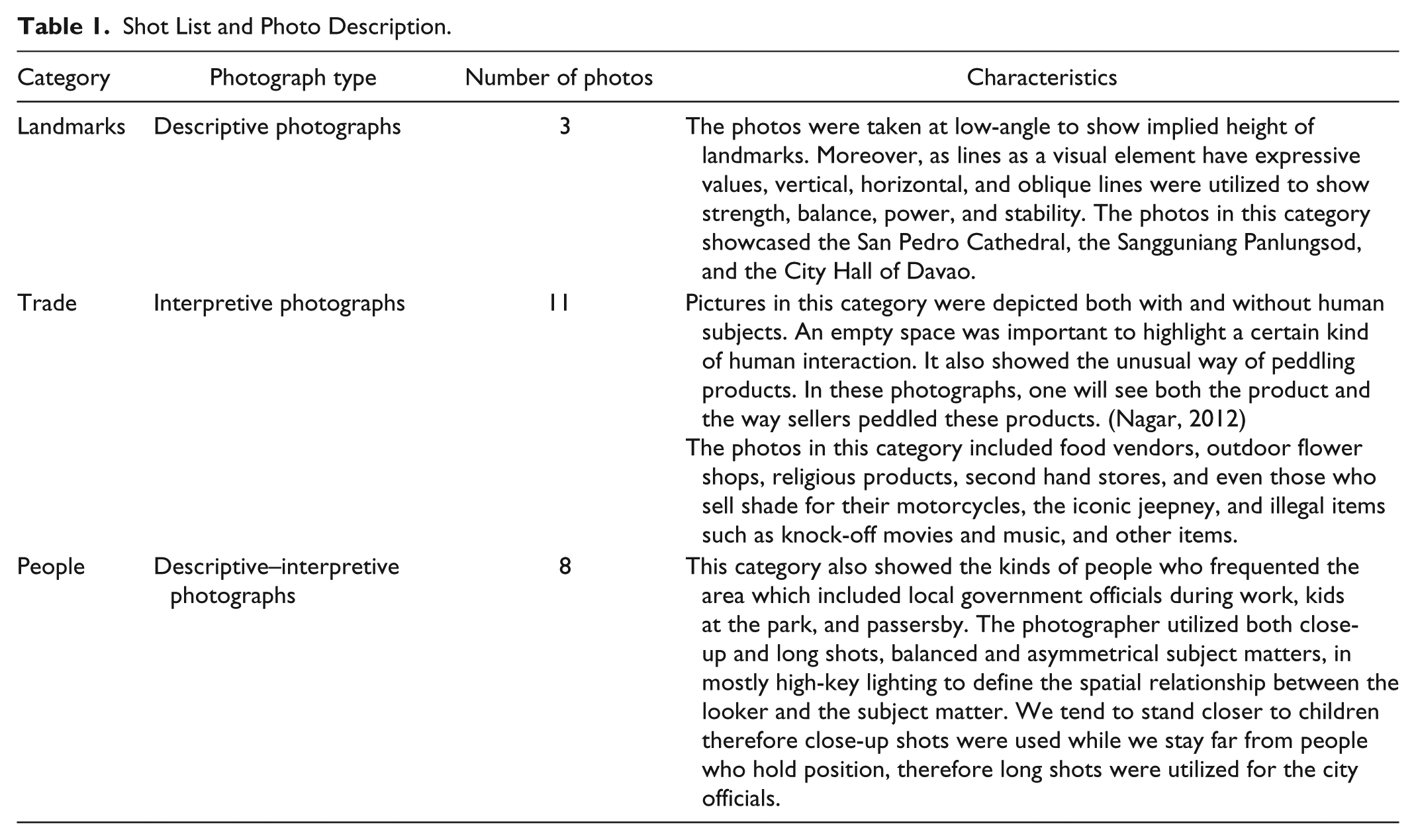
The same idea was used to document San Pedro Street of Davao City, Philippines. The project tried to document the then center of the city as Davao continues to grow outward. It tried to use visual cues (photographs) as stimulus to capture the lookers’ experiences, their personal stories in the former center of the city. This part of the multisensorial exhibition provided the seeing component of USAS. Furthermore, the photographs used in USAS also coincides with Nagar’s (2012) argument that “street is a unique genre of photography” that looks for “expression, beauty, and social interaction in seemingly banal surroundings.” (p. 10) Szarkowski’s five characteristics were considered. Szarkowski as mentioned in Barrett (1990) considered the thing itself, the detail, the frame, time, and vantage point that make photography unique. To achieve this, 22 descriptive–interpretive photographs were used depicting the landmarks, people, and trade of the street. Descriptive photographs, as defined by Barrett, offers “descriptive, visual information, with greater or lesser detail and clarity,” while interpretive photographs try to explain phenomenon in a “personal and subjective” manner (Barrett, 1990, pp. 53, 59).
With these characteristics, photograph type, and categorization, the table below summarizes the shot list and actual number of photographs used in USAS, and its general characteristics.
This process of categorization of photographs followed the tenets of visual narrative theory posited by Gretchen Barbatsis (2005). According to Barbatsis, a visual narrative follows two structures. These are descriptive and literal or discursive structures. Under the descriptive structure, the visual narrative introduces the characters, settings, and actions of the images made whereas the literal structure is more focused on the compositional patterns of spatial relations or the rules and conventions of making images that dictates how an image can be used as a language to communicate.
Using the shower–showee dichotomy of the theory, the shower organizes different visual and pictorial elements (literal structure) into a coherent story so that the showee would be able to come up with a meaning similar or related to the original intention of the shower. One way to achieve this is to use a certain pictorial point of view.
In Table 1, landmarks and trade were taken with an observing point of view. The composition of each scene indicated that the shower is “somewhat omniscient” looking at the subject from the outside. The category on people used “a participating point of view” as the shower was already part of the world of the story. It means that there was a shift of position from “looking at” to “looking into” (Barbatsis, 2005). The shift of position was very literal as most of the photographs under the category people were tightly composed trying to decrease the distance between the shower and the subject leading to a certain level of visual intimacy between the two (see Figures 2 and 3).
Shot List and Photo Description.

Trade.

Landmarks and people.
On Soundscape
Using two of Schafer’s terminologies, the soundscape of USAS featured both sound signals and soundmarks. Sound signals are “foreground sounds intended to attack attention” while the term soundmark is used as an analogy for landmark (Wrightson, 2000).
Wrightson (2000) further discussed that the terminologies coined by Schafer express the identity of a certain community. It does not only showcase its architecture, people, and culture. These three are also packaged in the form of soundscapes. Therefore, soundscapes, as described by Truax cited in Wrightson (2000), acts as “mediator between listener and the environment.”
In the context of USAS, the soundscape created to accompany the photographs tried to stay true to the sound of the old city center without major alterations except adding fade-in and fade-out and a little manipulation on the volume per section. The increase and decrease of volume levels of certain parts in the soundscape can act as a way to attract lookers and at the same time be an unobtrusive background as lookers scan the photographs.
In the creation of the accompanying soundscape of USAS, the goal was to gather different actual soundscapes and then mix them together to create aural chaos during the exhibition. The recreation of the actual chaos followed a careful planned recording that allowed the lookers to retrace their steps as they walked around the exhibition area as if they were actually walking along San Pedro Street.
To achieve this, certain sounds were removed and highlighted through varying lengths and volume to give an aural cue to the looker where he or she was at that moment in San Pedro Street. The noise of traffic was also reduced in the soundscape as it is the most obvious auditory signal you get when you are in the area. Moreover, the curved design of the panel boards representing the street and the low ceiling of the exhibition area also functioned as external resonators of the soundscape. These external resonators amplified the soundscape, which functioned both as sound signals and soundmarks. The sound system used was an assembled speaker sold in the area and it was placed near the panel board intended for the stories gathered. This literal reproduction of existing urban sounds provided the aural context of USAS.
This aural context can be described using Mermoz’s (2004) concept of sonic layering. In Mermoz’s Istanbul Sound Diary, sonic layering was accidental of his own “dialogue with an interviewee with that of other voices, street sounds, and call to prayer.” (pp. 23-25) However, in USAS, its sonic layering was intentional. The actual recording happened on the street and within the halls of the landmarks mentioned. Conversations with people and clips of conversation of other people were included. A council session of the local officials and a celebration of a Catholic mass were also part of the soundscape. Details of the content of the soundscape are presented in Table 2 and the succeeding discussions.
Content of Soundscape Used in USAS.

Note. USAS = Urban Sights and Sounds: The Stories of San Pedro Street.
The intention of the first 9 minutes was to introduce the city aurally through the voice of then Vice Mayor of Davao City and now President of the Republic of the Philippines, Rodrigo R. Duterte. Several details of the City Council session were included in this part of the soundscape. After the usual pleasantries of the Vice Mayor, the session started with a prayer. In the soundscape, three different types of prayers were included. These are ecumenical prayer, Muslim prayer, and Lumad (Indigenous Peoples) prayer. The singing of the City Hymn immediately followed and the presiding officer of the city council called the session to order after the secretary announced that there was a quorum. After the call to order, the Official Exit Call of the head of Task Force Davao followed. The breakdown of the first 9 min is as follows:
Pleasantries of the Vice Mayor 00:00-00:17
Prayer
Ecumenical Prayer 00:18-02:17
Muslim Prayer 02:18-02:35
Lumad Prayer (Indigenous Peoples) 02:36-03:40
Singing of City Hymn 03:41-05:42
Call to Order 05:43-06:34
Task Force Davao Exit Call 06:35-09:28
These were given importance as these are the things that make Davao City one of the safest places to live in the world. The City also protects its culture and its tri-people making sure that they are represented in the highest governing body of the city.
After the first 9 min, a recording of an ongoing celebration of Catholic mass immediately followed. The duration of the introduction of the second landmark—San Pedro Cathedral—was within the time frame 09:29-11:21. After which, the soundscape started introducing the vendors outside the church to “show” through aural cues the trade aspect of the area. Recordings of conversations between vendors and customers were also included. However, in this part of the soundscape, the volume for the Catholic mass and the volume of the vendors were made sure to be at the same level to “show” how close they were to each other.
Also included in the soundscape were sounds of footsteps and the increasing and decreasing volume of certain elements to “show” movement. For instance, in 21:55, the sound of the Catholic mass acted as bed music in low volume while the conversation of food and Ukay-ukay (surplus) vendors was presented in high volume. Then, another series of footsteps were introduced further diminishing the sound of the Catholic mass and the food and ukay-ukay (surplus) vendors but introducing a new product in the area—massage, pedicure, and manicure. With these highlighted soundscape, it brought the lookers to another area in San Pedro Street, which is Rizal Park. Going deeper into the park, the previous sounds then became bed for another product of San Pedro Street—bamboo flute. This time, the sound of the bamboo flute was used as sound signals to get the attention of possible lookers in the exhibit area. This was intentionally done at the high notes of each excerpt of a music piece played.
Furthermore, the photographer’s movement, signified by the sound of footsteps and by decreasing the volume of all previously described soundscapes, introduced a new recreation. At the farthest area of Rizal Park was a kiosk with chessboards. This new sound was introduced at 55:15 up to the end of the entire soundscape.
Finally, another relevant information the sonic layering of soundscapes intended to convey was the varying age bracket of the speakers presented in the audio material. From the San Pedro Cathedral up to the entrance of Rizal Park, you could hear voices of millennials. When you go deeper into the park, you could listen to voices of retirees and senior citizens.
In general, the soundscape used in USAS gave further characterization of San Pedro Street initially provided by the photographs.
On Meaning-Making
The feel part of the exhibition started with how the photos were arranged, the shape of the panel boards used, the ambiance provided by street vendors, the various noises heard, the provision of an actual street sign, and the celebration of the city’s charterhood which elevated the sense of pride of the lookers during the exhibition.
Meaning-making was done by making the exhibition interactive. Two panel boards were used for this purpose in the exhibit area. Lookers were encouraged to post their experiences on the walls provided. Pens, colored papers, pins, and a writing table were also provided for this purpose. Colored papers were intentionally used to make the exhibition visible from afar, aside from the soundscape that captures attention of lookers.
The guide question, Ano ang kwento mo sa daang San Pedro? [What is your story in San Pedro Street?], was also provided for the lookers to answer (see Figure 4).

Panel board for posting of stories with sound system used to recreate the atmosphere of San Pedro Street.
In the process of gathering stories, lookers were able to read other lookers’ stories that somehow brought back memories and urged them to participate in the story sharing as shown in Figure 5. Before the closing date of the exhibition, lookers decided to post their stories directly on the photos (see Figures 6 and 7).

Panel board intended for gathering stories from lookers of the exhibition.
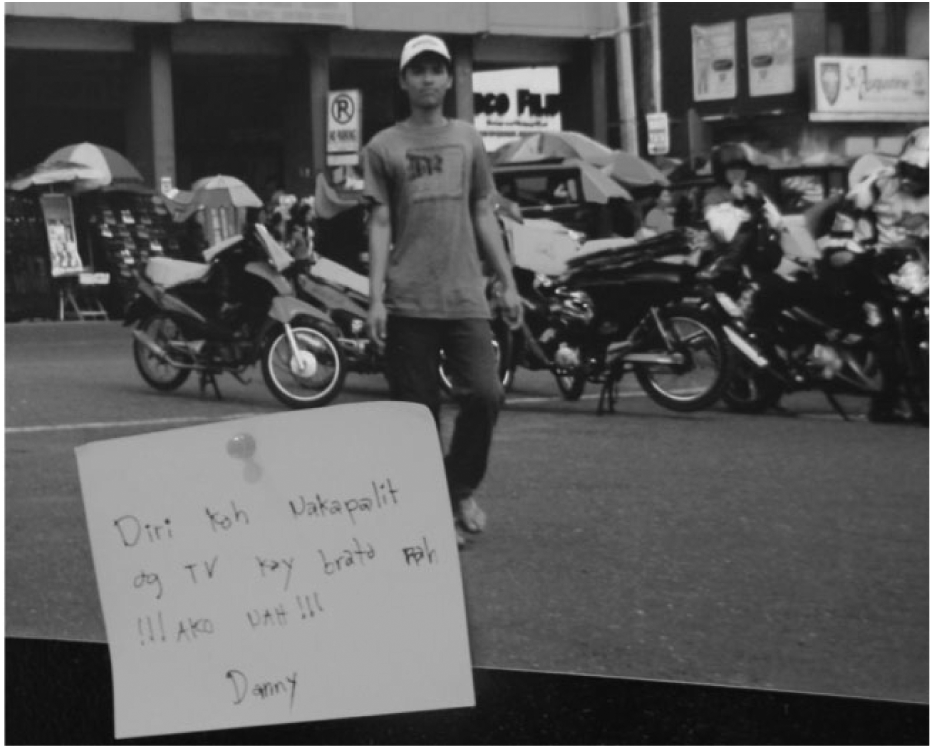
Example of posted stories on the photograph.
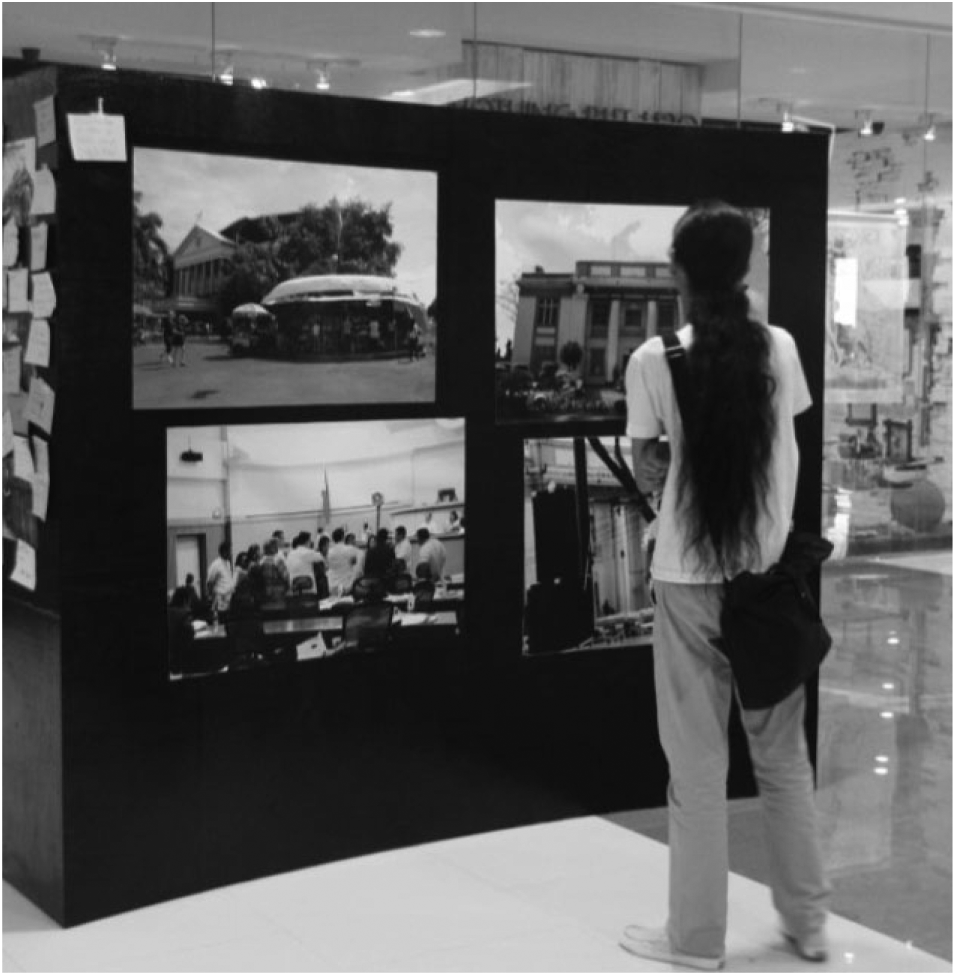
Size of photographs.
Results and Discussion
With men as visual thinkers and women as aural thinkers, the following stories were gathered during the USAS multisensorial exhibition. A total of 281 stories (responses) were gathered during the exhibition. The stories were categorized into three—positive and humor, tragedy, and drama (love)—and all are within the photo categories: trade, landmark, and people.
Out of the 281 stories, 193 did not answer the guide question provided or approximately 68.68% of the responses while 88 or approximately 31.32% of the responses were loyal to the guide question provided.
From the 88 stories, 19 (6.76%) were categorized under negative or tragedy, 18 (6.41%) are categorized under drama and love, while 51 (18.15%) covers positive and humor.
The stories gathered in Table 3 were varied, but there were certain overlaps between trade, landmark, and people. For the purpose of categorization, all stories focusing on the storyteller fall under people while stories focusing on the place rather than the doer of the action fall under landmark. Stories under trade talked about the business rather than the landmark.
Selected Stories Gathered from the Lookers of USAS.

Note. USAS = Urban Sights and Sounds: The Stories of San Pedro Street; PNLE = Philippine Nursing Licensure Exam.
Moreover, positive and humorous stories talk more on the positive things San Pedro Street offered them while the negative or tragic stories range from funny embarrassing moments, buying of knock-off goods and pirated movies, to life threatening situations. Drama and love talk about interpersonal relationships that started and developed within the area.
In this whole exercise of meaning-making through images and sound, San Pedro Street was used as a common setting. It becomes the connection of all plots—happy, hopeful, and sad. These are stories often told from the point of view of the lawmakers and those who disobey the law, the merchants who peddle their goods, and the lost who turn to religion for guidance. In the case of USAS, what is relevant in the meaning-making process is the place where these stories took place rather than focusing only on what narrative theories dictate as essential in storytelling—beginning, middle, and end.
Furthermore, if you look at the gathered stories, you can also see that the interpretations of the lookers are almost the same as those of the photographer. That said, we can say that the images can be treated as a language aside from being an expressive art form. Like symbols, image needs interpretation and reinterpretation from the looker resulting to an inductive exploration of the images focusing on its features, feelings, knowledge, and function. By interpreting and reinterpreting the content of the images, the lookers were able to dissect the presented elements, that is, space, shapes, and so on, from suggested elements, that is, concepts, themes, allusions, and so on (Foss, 2005).
Take for example the openness of the lookers in sharing a negative story (including buying knock-off goods and pirated DVDs) in public can be used as an allusion to the blatant presence of vendors selling knock-off goods and pirated DVDs within the presence of the City Hall, the Sangguniang Panlungsod, and the church. These three institutions defined piracy as stealing and that stealing is against the law of man and God. Yet, it is present. This use of visual imagery, in the context of visual rhetoric, as a way of illustrating, explaining, and investigating the stories told in San Pedro Street, again, does not complete the beginning, middle, and end posited by Barbatsis (2005). Instead, it only provides the setting.
In general, the visual and aural messages served as “fundamental carrier of sense” as what sense-making structure or narrative structure posits. The visual and aural messages even made the lookers act as if they are really in San Pedro Street. It is evident in the number of stories (responses) that did not answer the guide question provided by the photographer. It can also be seen in the way the lookers interacted with the photographs. The actual damage caused by pinning the stories directly in the photo is an example of an act that defies both laws of man and God as seen in the trade and activities in the featured street.
The visual–aural overlap then became a channel that is important in the process of storytelling. As the Theory of Visual Rhetoric points out, the perspective of the lookers will always be independent from its creator. Even if it reaches the same interpretation, the process of interpreting it will be different. Simply put, Jordan et al. as cited in Hochmair (2004) said, “To capture the meaning of a place, the place must, besides its location, also be seen in the context of human action and sensing” (pp. 26-27).
With this, can we infer that more and more people lose interest in this area of the city as implied by the number of stories (responses) gathered that are not related to the topic? Does this also mean that through the years, people define San Pedro Street as an area for cheap knock-off goods? Furthermore, does this mean that the relevance of this area being the center of government and religion, being the assumed meaning of the place, is slowly fading? Finally, can we infer that, just like its dilapidated buildings, its public relevance is also dwindling?
Implications
A city in decay is defined by Kevin Lynch, as cited in Agueda (2010, p. 3), as
one that boomed in the past due to a single economic activity’s growth, in which it was specialized. That is why when the mode of production changed and the industry moved, urban and social structures were not fit to new circumstance.
He further posits that “urban decline can be understood as a lack of adaptation to new conditions . . . as old spatial and social structures have been unable to be transformed and adjusted to new modes of production.” (p. 4) Urban decay, in retrospect, is an evidence of memory loss (Agueda, 2010).
In urban planning, urban decay creates a notion of forgotten realities that might lead to forgotten cultural identities, hence creating the relevance of meaning-making or reception studies. As defined by Pernia (2004), reception studies are concerned with “viewer’s interpretations, decodings, readings, meaning productions, and perceptions or comprehensions of communication and media messages.”(p. 47) Its significance to urban planning will be in the context of heritage conservation as this is an important element in the discussions on “cultural identity and preservation of the past” (Matero, n.d.). Agueda (2010) also reiterated that “urban decay makes memory retrieval a much more urgent issue.”
According to Matero (n.d.), the primary objective of conservation is cultural heritage protection before an area is totally destroyed by urban decay and the lack of cultural and historical relevance to its people. To establish such relevance, planners and policy makers should know the relevance of these areas through meaning-making exercises.
The same argument was raised by Agueda (2009) saying that urban decay is closely linked to “productive reorganization, economic transformations, and changing shifts.” She further posits that to reverse urban decay, “reinstitution of value and lost status” to the area suffering from decay should be made. This is where urban planning and even tourism can come in as these can help in memory retrieval and cultural heritage conservation.
Until today, the focal area for local festivities such as Kadayawan Festival (August) and Araw ng Davao (March) is still the San Pedro Street. Public transport routes from the northern and southern parts of the city converge in San Pedro Street. Therefore, the implication of this meaning-making exercise in planning will be in infrastructural conservation by restoring original building designs around San Pedro Street highlighting its economic value as evidenced by the stories gathered in this article. In one of the stories, a looker emphasized that San Pedro Street was their Abreeza (a high-end mall) during their time. Planning, then, should capitalize on this. San Pedro Street is still considered the central point for all routes of public transport as evidenced by the stories gathered. Therefore, pedestrian movement should be taken into consideration when planning for this area. Moreover, another consideration that planning should look into is to ascertain that no further degradation will happen to San Pedro Street. Recently, improvement of the City Hall façade was observed as beautification projects that include placing electrical and other cables underground.
With these, the implications of this article in heritage conservation can be summarized in the following points:
that infrastructural development should be consistent with how this area will be developed as a heritage site after several meaning-making exercises;
that this area of Davao City, Philippines, should be protected by the local government because of its historical value; and
that this area be treated as tourist attraction by the City Tourism Authority patterned after the old Georgetown Streets in Penang, Malaysia.
Recommendations
Other stories do not necessarily fall under the three types of stories mentioned but these are worth mentioning as it tackles comments on specific photos and at the same time comments on the whole exhibition which the photographer believes to be a call from the lookers to relook at the city and its expansion. The photographer also considers this as recommendation for future creative work exploring other iconic areas of Davao City, Philippines.

Footnotes
Declaration of Conflicting Interests
The author(s) declared no potential conflicts of interest with respect to the research, authorship, and/or publication of this article.
Funding
The author(s) received no financial support for the research, authorship, and/or publication of this article.