




Abstract
This paper develops a theoretical model of political competition in which a lobby group provides financial support to candidates running for election in return for favorable policy outcomes. The lack of a legally binding contract may lead politicians to use campaign funds for their own personal benefit. However, this expropriation occurs entirely unexpected to the lobby group, which is non-strategic in nature. We find that there is a utility-maximizing fraction based on which politicians should allocate contributions between campaigning and private use. This fraction is increasing in the election winning premium and the proximity of the lobby group’s ideal position. It is less obvious, however, how this fraction relates to the relative importance of money for private consumption in the utility function. This fraction is determined by the comparison between the income effect, which pulls money toward personal consumption, and the substitution effect, which takes money away from personal consumption for campaigning.
Plain language summary
We develop a model of political competition in which a lobby group provides financial support to candidates running for election in return for favorable policy outcomes. In the absence of a legally binding contract, politicians may be tempted to use campaign funds for personal purposes. However, this expropriation occurs entirely unexpected to the lobby group that is non-strategic. There is a utility-maximizing fraction based on which politicians should allocate contributions between campaigning and private use. This fraction is increasing in the election winning premium and the proximity of the lobby group’s ideal position. It is less obvious, however, how this fraction relates to the relative importance of money for private consumption in the utility function. This fraction is based on the comparison between the income effect, which pulls money toward personal consumption, and the substitution effect, which takes money away from personal consumption for campaigning.
Introduction
Currently, campaigning for elections is becoming more expensive (see, e.g., Nassmacher, 2019). In the run-up to their next federal election, Australian politicians spent around $3.2 million on YouTube advertisements in 2021, according to a recent report by Google Transparency (https://transparencyreport.google.com/?hl=en). As reported by Harvard Political Review, the amount spent in the 2020 US presidential and congressional elections far surpassed that of the 2016 and 2012 elections. The majority of politicians rely on lobby group contributions to finance their campaign expenditures because of their financial constraints (Hall & Deardorff, 2006). As a result, there is often a deal between a lobby group and a politician. In this arrangement, the lobby group provides a monetary contribution to the politician’s electoral campaign. In exchange, the politician agrees to offer a certain policy concession if they win the election. Throughout history, this has been the most common and most effective means by which lobby groups have influenced policy-making processes (see, for instance, Austen-Smith, 1987; Baron, 1989; Besley & Coate, 2001; Fouirnaies, 2018; Fouirnaies & Hall, 2018; Grossman & Helpman, 1994; Herrnson et al., 2019; Powell & Grimmer, 2016).
Nevertheless, some of the money donated by lobby groups may not be used for campaigning. There have been cases in which politicians are found to misappropriate campaign fund (See Pinto-Duschinsky, 2002 and Senior, 2006 for discussions of publicized cases of malpractice by politicians around the world.). As a donor, do lobby groups always foresee the misappropriation of politicians? And if so, do they stop providing money to politicians? There is no single answer to each of these questions. A different perspective is presented by Acemoglu et al. (2001, 2002) in their studies of the effects of colonial institutions on economic performance in former colonies. They find that economic outcomes are worse in colonies with institutions designed to expropriate wealth. In those countries, a settler’s ability to survive shaped institutional structure. Their research also examine how expropriation strategies lead to institutional stagnation in formerly prosperous regions. Another study was conducted (Caselli & Cunningham, 2009) on how leaders appropriate natural resource revenues for political purposes. They assert that a country with weak institutions is more vulnerable to expropriation, which can lead to lower growth over the long run. In countries where political corruption is rampant, campaign fund misappropriation probably does not come unexpected. According to Solaz et al. (2019), voters, in spite of disliking corruption, may still elect or re-elect corrupt politicians due to the ‘in-group bias’ which makes them prefer supporting their in-group corrupt candidates to those out-group competitors. This means that lobby groups will continue to pay money to politicians to play politics regardless of whether they are able to foresee the corrupt behavior of politicians or not. The difference lies in the presence of strategic calculations of their plan. In fact, there are several situations where a lobby group may not be able to obtain a perfect foresight of the possible misappropriation. For example, the lobby group may be myopic or the lobbied politicians may not be interested in seeking a re-election in the future (If politicians do not seek another term, they may care less about potential consequences of fund misappropriation. As such, they may be more tempted to reward themselves with personal consumption.).
In this paper, we introduce a game theoretic model of menu auction between a lobby group and two politicians. The politicians seek contributions from the lobby group for their campaign funds in exchange for a policy favor. It is assumed that the politicians have a tendency to expropriate part of the contribution for their own use. We consider the situation in which the bad behavior of the politicians is utterly their private information and not at all foreseen by the lobby group. This is a case in which the lobby group is not strategically aligned (i.e., the lobby group is non-strategic). In this framework, we explore how non-strategic lobbying and expropriation of campaign contributions by politicians affect equilibrium policies.
Our model is built on a few existing works dealing with campaign funding expropriation such as those by Le and Yalcin (2018, 2023a, 2023b) and Le et al. (2024) which draw their roots from the menu auction literature (e.g., Austen-Smith, 1987; Baron, 1994; Grossman & Helpman, 1996; Polk et al., 2014). Le and Yalcin (2018, 2023b) are the pioneering research papers that explicitly model politicians’ misappropriation of campaign contributions. In those papers, each politician’s level of misappropriation is assumed to be exogenous but fully observable to lobby groups. Le and Yalcin (2023a) continue to assume that expropriation by politicians is fully observable to the lobby group but make it endogenous in the model instead. By contrast, in this current paper, while the misuse level is endogenously determined by parameters of the model as in Le and Yalcin (2023a), it is a piece of private information and comes entirely unexpected to the lobby group. In other words, the lobby group under consideration is non-strategic. Studies on non-strategic lobbying, which occurs without direct alignment to specific political or economic payoffs, allow us to examine the mechanisms, and contexts. These studies explore how lobbying impacts policy outcomes without providing direct benefits. As a result, the strategy of each politician is to determine the amount of expropriation, the policy platform, and the amount of contributions to maximize their benefit. In contrast, the position of the lobby group is simply to determine the policy platform and contribution amounts in order to maximize its own benefit. Thus, the decision to expropriate funds is revealed at the end of the political game and does not necessarily enter into the lobby groups’ strategic calculations. Across diverse scenarios, a few studies have examined non-strategic lobbying in the existing literature. For example, Grossman and Helpman (2001) analyze how interest groups influence policymakers through non-strategic information provision. They show that it is sometimes possible for interest groups to lobby without having a clear policy target, and instead focus on signaling expertise and legitimacy. In another study, Bertrand et al. (2014) distinguish between informational lobbying and influence peddling in U.S. lobbying. They find that instead of explicitly seeking direct policy favors, firms often lobby to share technical expertise. Lobbying, according to Lohmann (1993), serves as a mechanism of providing credible information for interest groups. He shows that lobbying efforts are non-strategic when they aim to inform policymakers about relevant issues without demanding specific action. Ansolabehere et al. (2003) examine why lobbying expenditures are relatively low in US politics. They claim that rather than influencing immediate policy decisions, lobbying can serve as non-strategic insurance. More recently, de Figueiredo and Richter (2014) emphasize the differences between strategic and non-strategic lobbying efforts as well as empirical methods used to study lobbying. They show that lobbying without a strategic plan is primarily about establishing long-term influence and reputations. In the same vein, Baumgartner et al. (2009) study how lobbying influences policy outcomes over time in the US context. Their findings indicate that lobbying rarely leads to immediate policy changes, suggesting a non-strategic and long-term focus of lobbying activities. In addition, the impact of lobbying depends more on persistence and issue salience than on targeted influence.
Within this theoretical framework, we examine the impact of lobbying on policy-making. Additionally, we analyze how the optimal level of expropriation is determined when the lobby group operates in a non-strategic manner. The lobby group is defined as non-strategic when it does not anticipate any intention on the part of politicians to divert a portion of the contributions for personal purposes. We obtain several interesting results. The lobby group will identify the candidate it wishes to support. It will then reach an agreement with this politician on the policy platform to be implemented and the amount of money to be donated. While the deal maximizes the lobby group’s utility, it leaves the politician at least as well off as in the status quo. However, not all the contribution from the lobby group will be spent on the politician’s campaign. The politician has a proclivity to divert a portion of the funds for personal consumption. Based on our analysis, the politician follows the optimal allocation of funds between campaigning and personal consumption. The optimal level of expropriation is shown to be always increasing in the election winning premium and the lobby group’s ideal policy. It is increasing in the relative importance of expropriated money only when this factor is sufficiently large. In that case, the substitution effect outweighs the income effect. The substitution effect diverts contribution money from personal consumption toward campaigning, while the income effect causes contribution money to be diverted toward personal consumption. The reverse holds true when the utility weight of money for personal consumption is sufficiently small due to the dominance of income effect over its substitution effect counterpart.
While our study is primarily theoretical and contributes to the theoretical literature on lobbying and electoral outcomes, it also aligns with the growing empirical literature examining the impact of campaign contributions on the electoral success of political candidates. As an example, Stratmann (2009) find that campaign spending is productive for both incumbents and challengers in US House of Representatives elections. Similarly, using US county-level data, Bombardini and Trebbi (2011) estimate that each additional vote costs roughly $145 in campaign spending for each political candidate. Similarly, within the context of a developing country, Virananda et al. (2021) observe that campaign money increases the winning probability of political candidates in Indonesia. Specifically, their findings indicate a 5-percentage-point increase in winning probability for every additional IDR 100 million spent on campaign activities. More recently, Wang (2022) and Le et al. (2024) show that campaign contributions exert a positive and significant effect on candidates’ election outcomes in Taiwan and the US, respectively.
The remainder of the paper is organized as follows. Section 2 outlines the basic structure of the model. Section 3 investigates equilibrium policy positions. Section 4 looks into the optimal allocation of contributions between campaigning and personal use. Finally, Section 5 offers some concluding remarks.
The Model
The electorate under consideration has two political parties competing with each other over an election, one lobby group, and a continuum of voters. For simplicity, assume that each party consists of only one politician so party and politician are used interchangeably. The lobby group is assumed to be unsophisticated or non-strategic in the sense that it is unable to foresee all strategic moves of the politicians as described below. Let us consider a political game of multiple stages with the timeline as follows. First, the lobby group reaches out to each politician to negotiate over a menu of policy positions that are linked with monetary contributions, supposed to be used for campaigning purposes. Second, upon observing the menu, each politician chooses the policy position that he or she wishes to pursue. Third, the lobby group pays each politician the corresponding contribution as previously agreed. Fourth, the politicians privately and secretly allocate the received contribution between campaigning and/or personal use. It should be noted that since the lobby group is non-strategic, it has no prediction about the politicians’ expropriation acts when paying the contributions. Fifth, the election takes place with probabilistic voting.
Following Le and Yalcin (2018, 2023a, 2023b), let us begin by defining the two politicians as

In this equation, the mathematical notations are as follows:
For the first component,
With
Assume that expropriation is utterly the politician’s private information so any fund embezzlement can only be revealed at the end of the game.
Note that the representative candidate’s utility defined in Equation 1 is an additive function of two components: winning the election and embezzling money for personal purposes. With
Among all voters of mass 1 in the electorate (we normalize the size of all voters to 1 for simplicity), there are

where

where
Uninformed voters, with a total number of

where
Despite being non-strategic, the lobby group has a well-defined preference over the pliable policy issue (i.e., their ideological policy standpoint). To influence the policy outcomes, the lobby group approaches the politicians, offers them monetary contributions toward their election campaigns. In return, the politicians agree to make some concession, particularly in terms of adopting a policy platform that better serves the needs of the lobby group. The lobby group’s expected utility is given by:

where
Political Equilibrium
In an attempt to find a sub-game perfect Nash equilibrium of the above described political game, we put forward the definition below:
•
•
• Each
• Each
Specifically, these conditions define an equilibrium that is reachable in the negotiation process between the parties and the lobby group as well as in the policy announcement phase.
Suppose that the lobby group offers politician

which is tied to policy platforms negotiated (In fact, the contribution takes the form that

subject to the constraint on the contribution described in Equation 6. Note that in the lobby group’s view, the share of voters supporting party

This maximization problem yields the following result:

Proof. First, consider the assumption that
We now turn to the lobby group’s perspective. The first order necessary condition for the lobby group’s utility maximization is:

Using Equations 6 and 8 to calculate the partial derivatives for

Solving this equation for

which is satisfied for a maximum.
This lemma indicates that in this equilibrium, the lobby group reaches an agreement with the political party of its choice on an implemented policy,
Optimal Allocation of Campaign Contributions
In this section, we examine the politician’s strategy regarding the use of contribution received from the lobby group. As discussed, the politician can spend the money on campaigning and/or other non-campaigning purposes. In making his or her decision, the politician will choose the allocation of funds that maximizes his or her utility. Relevant obtained results are discussed below.

Proof. The politician’s utility maximization problem will be the one of choosing

Using Equation 4 to 8 calculate the partial derivatives of

Upon making use of Equations 6 and 9, we get
The result in Equation 10 indicates that as soon as
This result is similar to the one obtained in Le and Yalcin (2023a) in which funding expropriation by the allied politician is fully observable by the lobby group. Essentially, in the menu auction game between the lobby group and its allied politician, both sides will be able to negotiate with each other over an agreement. In this agreement, the politician is committed to conduct a policy that is as close to the lobby group’s ideal policy as possible if the politician wins the election (For simplicity, assume that the politician does not renege on the announced policy.). In return, the lobby group makes a monetary payment toward the politician’s campaign fund. In the absence of an effective monitoring mechanism, the politician has an incentive to embezzle some of this contribution. In doing so, the politician privately and secretly splits the money between campaigning (to increase his or her chance of winning the election) and personal consumption in order to maximize his or her utility (Strictly speaking, each politician’s strategy is to maximize the number of votes. Given the context of proportional electoral system that we are considering, maximizing the number of votes is equivalent to maximizing the election winning probability.).
With this establishment on the optimal degree of campaign fund devoted to campaigning, we can now move on to examine the effects of a change in some important parameters on this measure. We summarize the key results in the proposition below:
Proof. Consider Equation 10. It is obvious that the second term on the right hand side (RHS) of this equation is decreasing in either
To find the impact of a change in

Taking the natural logarithm of this fraction and differentiating the corresponding logarithmic function with respect to

The sign of this derivative depends on the sign of the numerator of the RHS fraction, which is not immediately clear. To explore this further, we denote the numerator as

This derivative is negative because
This proposition deserves some discussion. Similar to Le and Yalcin (2018, 2023a), we find that the optimal fraction of fund devoted to campaigning,
Unlike Le and Yalcin (2023a), we can establish comparative static result for the election winning premium,
The impact of an increase in
To better visualize the relationship between
The response of
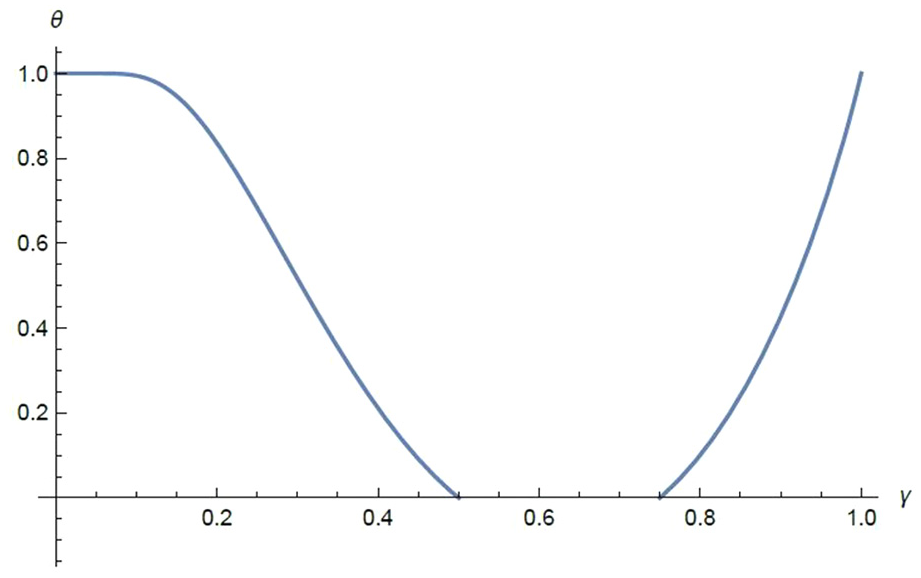
Optimal values of
In summary, the results indicate that political candidates have a strong tendency to expropriate a fraction of campaign funding for their personal use if there is no legally binding contract between the lobby group and its allied party, which specifies that campaign funding can only be used for campaigning. The candidate will use more money for campaigning if the election winning premium is relatively larger and the lobby group has a relatively stronger policy stance point. This will also be the case if, looking that the optimal fraction of campaign spending, the marginal effect of campaign spending outweighs that of the spending on personal use.
Conclusion
In this paper, we have examined how political lobbying influences the policy-making process. We specifically focused on the role of expropriation of campaign contributions by self-interested but financially constrained politicians. Throughout, politicians’ decisions regarding expropriation are assumed to be private information and endogenously determined by parameters of the model. Within this framework, we have shown that in the case of a non-strategic lobby group, the lobby group will be able to reach an agreement on policy platform and associated contributed money with its ideologically aligned party. Since the allied politician tends to divert some part of the contribution for personal use, there is an optimal (i.e., utility-maximizing) allocation of contributions. Beyond this point, monetary contributions can be optimally divided between campaigning and the politician’s personal use. Such an allocation is shown to respond positively to the election winning premium and the lobby group’s ideal policy. However, it is increasing in the relative importance of expropriated money only when this parameter is sufficiently large.
We addressed an important, but largely unexplored, issue in political economy in this paper. Specifically, political corruption in the form of campaign fund expropriation can occur anywhere, even in the world’s finest democracies, provided that politicians can avoid punishment. Due to political sophistication, it is not easy to detect this bad behavior and even more difficult to eradicate it. A strong law and law enforcement system that severely punishes corrupt behavior is necessary to tackle this malpractice.
It seems that the model presented in this paper could be enhanced by the introduction of a legal organization that is capable of detecting and punishing crimes. This extension will affect the strategic behavior of all players in the political game. A number of emerging topics are also being explored in the area of endogenous expropriation. For instance, modern regimes leverage data control to expropriate not just wealth but also information, redefining the concept of traditional expropriation (see, for instance, Zuboff, 2019), or how governments use emergencies (e.g., pandemics, financial crises, conflicts between countries) to justify resource expropriation (see, for instance, Reinhart, 2009). These studies emphasize the relationship between institutions, politicians, and expropriation, showing that strong institutions promote growth and stability by limiting elite exploitation, whereas weak institutions fuel rent-seeking and inequality. These extensions promise to make our future research agenda even more exciting.
Footnotes

Funding
The author(s) disclosed receipt of the following financial support for the research, authorship, and/or publication of this article: This research is funded by National Economics University, Vietnam.
Declaration of Conflicting Interests
The author(s) declared no potential conflicts of interest with respect to the research, authorship, and/or publication of this article.
Data Availability Statement
Data sharing not applicable to this article as no datasets were generated or analyzed during the current study.