




Abstract
Controlling shareholder expropriation is an important issue in corporate governance in emerging economies. The existing literature discusses the effects of minority shareholder legal protection, controlling shareholder ownership, and managerial shareholding on controlling shareholder expropriation, which is mainly empirical research with insufficient attention to the internal relationships among the governance factors. This research builds theoretical models to study the interactive mechanisms between minority shareholder legal protection, controlling shareholders’ initial shareholding ratios, managerial shareholding, controlling shareholder expropriation, and management effort. Furthermore, setting reasonable ranges for parameters, we use MATLAB to conduct numerical simulations and expand the detailed analyses to quantitatively reveal the degrees of influence of the governance factors. Our results show that controlling shareholder expropriation is negatively related to the degree of minority shareholder legal protection and controlling shareholders’ initial shareholding ratios, while the optimal managerial shareholding ratio is positively related to the degree of minority shareholder legal protection and controlling shareholders’ initial shareholding ratios. The findings enrich the literature on the governance of controlling shareholder expropriation and provide new approaches to and theoretical explanations for the governance of controlling shareholder expropriation toward sustainability in emerging economies.
Keywords
Introduction
Controlling shareholder expropriation is a major problem in corporate governance in emerging economies. The problem of corporate governance in traditional British and American countries is mainly the principal-agent issue between management and shareholders. An entity’s manager, acting as the agent, has a conflict of interests with the shareholder, who is the principal. This principal-agent conflict is referred to as the first type of principal-agent conflict, where the manager uses the power of production and capital operations to make decisions that deviate from the goal of maximizing shareholder value (Jensen & Meckling, 1976; Kim et al., 2011; Kothari et al., 2009). This problem stems from the high degree of dispersion in the ownership structure of Anglo-American corporations and the separation of ownership and control. However, the main problem of corporate governance in emerging economies is no longer the issue of the first type of principal-agent conflict, but the conflict of interest between a controlling shareholder and minority shareholders, the principal–principal conflict (Claessens et al., 2000; Cueto, 2012; La Porta et al., 1999; Shleifer & Vishny, 1997; Young et al., 2008), which is referred to as the second type of principal-agent conflict. The prevalent concentration of ownership and absence of effective external governance mechanisms in emerging economies have led to frequent conflicts between controlling and minority shareholders. The conflict of interest between a controlling shareholder and minority shareholders often leads to the controlling shareholder’s expropriation of the interests of minority shareholders (Cheung et al., 2006; Claessens et al., 2000, 2002). Controlling shareholders tend to put their own private interests above those of the company and other shareholders.
From the perspective of double principal-agent conflicts (the conflict of interest between a controlling shareholder and minority shareholders and this between management and shareholders; La Porta et al., 1999), this study builds theoretical models to study the interactive mechanisms between minority shareholders’ legal protection, controlling shareholders’ initial shareholding ratios, ownership concentration, managerial shareholding, controlling shareholder expropriation, and management effort. We consider minority shareholders’ legal protection and a controlling shareholder’s initial shareholding ratio exogenous factors, and ownership concentration and managerial shareholding as endogenous factors in governing controlling shareholder expropriation in emerging economies. This study investigates, in the external governance environment of different legal protection levels for minority shareholders, the choice of optimal combination of internal ownership structure and ownership incentive governance mechanism based on controlling shareholders’ initial shareholding ratios to collaboratively govern controlling shareholder expropriation in emerging economies. The findings enrich the literature on the governance of controlling shareholder expropriation and provide new approaches to and theoretical explanations for the governance of controlling shareholder expropriation toward sustainability in emerging economies.
Literature Review
Emerging economies face different corporate governance issues from those in Western European countries and the United States. Researchers must construct different theoretical models to explain these issues and empirically study them. Research on the governance of controlling shareholder expropriation in emerging economies has become an important topic in the field of corporate governance. The existing literature on the governance of controlling shareholder expropriation mainly focuses on the influence of legal supervision, ownership structure, managerial ownership incentive, board independence, and institutional ownership on controlling shareholder expropriation.
Regarding the impact of minority shareholder legal protection on controlling shareholder expropriation, using their antidirector rights index, La Porta et al. (1997, 1998) found that the higher the degree of legal protection for minority shareholders there was, the lower would be the degree of expropriation by large shareholders. In their study of listed companies in 22 countries outside the United States, Ge et al. (2012) found that legal systems and internal corporate governance mechanisms could reduce the agency risk of controlling shareholder exploitation and increase banks’ willingness to lend. Similarly, Hu and Qi (2020) found that both national laws and a company’s internal supervision had a significant negative correlation with large shareholders’ tunneling of listed companies in China. P. Wang and Zhou (2006), by constructing indicators of investor protection levels in various regions in China, argued that a higher level of investor protection could reduce the capital occupation of large shareholders. According to Zheng et al. (2013), when controlling shareholders are in financial distress, legal supervision as an external governance mechanism can effectively suppress their tunneling behavior. Almaleki et al. (2021) suggested that the distinctive institutional settings in Iran and Iraq might affect the level of quality of public firms’ financial reports in both countries. High-quality financial statements can reduce information asymmetry between minority shareholders and a controlling shareholder.
Among the studies that examine the impact of a controlling shareholder’s shareholding ratio on the extent of expropriation by the shareholder, Claessens et al. (2000), Johnson et al. (2000), and Lemmon and Lins (2003) all found that the higher the shareholding ratio of a large shareholder, the lower the extent of expropriation by the shareholder, and the higher was the company value. Using theoretical models, Wu and Wu (2011) argued that the higher a controlling shareholder’s shareholding ratio, the lower the shareholder’s degree of tunneling tendency and behavior. However, using data on private listed companies in China, Zhao and Yu (2018) found that a high shareholding ratio of the largest shareholder was associated with low corporate investment efficiency and a higher level of tunneling activity by the shareholder. According to Chen et al. (2017), controlling shareholders’ shareholding ratios affect tunneling behavior significantly in China, while the relationship between controlling shareholders’ shareholding ratios and tunneling follows an incline-decline-incline shape. Song (2015) considered differences in the managerial positions of large shareholders in China’s private listed companies. He found that the relationship between large shareholders’ shareholding ratios and company performance followed a U shape if the large shareholders occupied positions in the companies. Song’s (2015) result also shows that large shareholders tunnel small shareholders based on different shareholding ratios.
In the literature on the effect of controlling shareholders’ cash flow and control rights on their expropriation behavior, La Porta et al. (1999) showed that controlling shareholders’ incentive and ability to expropriate were limited by financial incentive. Cash flow rights are an important source of financial incentive for controlling shareholders. Controlling shareholders with high cash flow rights are less motivated to expropriate; because expropriation has a bigger impact on them, it is too expensive for them to expropriate (Claessens et al., 2000). Therefore, high cash flow rights should minimize expropriation and increase firm value (Widyaningsih et al., 2017). Regarding control rights, Shleifer and Vishny (1997) observed that when the private benefits from their control were high, the controlling shareholders would attempt to generate private benefits from misallocating company resources. Claessens et al. (2000, 2002) found that Asian public companies’ controlling shareholders tended to use control rights for personal interests, which decreased firm value. Q. Liu and Tian (2012) conducted a study in a transition economy and found that when controlling shareholders had excess control rights, this resulted in their companies having excess leverage; instead of investing in positive NPV projects, the controlling shareholders utilized the resources for tunneling. According to Yeh et al. (2003), there are two important variables that measure expropriation from minority shareholders: the deviation of cash flow rights from control rights and stock collateralization by controlling shareholders. If corporate mechanisms (e.g., pyramidal structures, cross-shareholdings, or the issuance of various classes of shares) are used, controlling shareholders’ opportunistic behavior will be aggravated considerably, resulting in an uneven relationship between cash flow rights and control rights (Nogueira & Castro, 2020). Claessens et al. (1999) provided empirical evidence of the expropriation possibilities that arose from the separation of cash flow rights from voting rights in Asian companies. K. C. J. Wei and Zhang (2008) conducted an empirical study in eight east Asian economies. Their results showed that the agency conflict between the largest shareholders and minority shareholders worsened overinvestment when the divergence between cash flow rights and control rights grew large. W. Gao et al. (2017) suggested that minority shareholders suffered fewer expropriations from family controlling shareholders when family firms had larger family ownership or less separation between family ownership and family control in China’s family firms. Chemmanur et al. (2021) showed that China’s VC-backed private family firms were more likely to reduce the separation between family cash flow rights and control rights than non-VC-backed private family firms, and hence mitigate the family controlling shareholders’ expropriation from minority shareholders and improve firm performance. However, Widyaningsih et al. (2017) used 83 listed companies in Indonesia as a sample to show that cash flow right leverage did not affect corporate value, although there was some indication of expropriation action perpetrated by controlling shareholders.
In the literature examining the effect of board independence on expropriation by controlling shareholders, according to Bai et al. (2003), an independent board is conducive to the formation of a good governance structure through transparent disclosure, which reduces the potentially dysfunctional behavior of controlling shareholders. Amran et al. (2010) pointed out that non-executive directors provided a balance between dominant and minority shareholders, which served as a safeguard for those with interests in the firm, especially in East Asia. Arosa et al. (2010) argued that independent directors protected shareholders’ interests better than non-independent directors, and thus prevented the expropriation of shareholders’ wealth. Considering related large shareholders in family companies, M. Wei et al. (2013) revealed that the greater the proportion of seats held by related large shareholders in a board of directors, the more serious the behavior of family firms’ related transactions and the greater the loss of firm value. However, Widyaningsih et al. (2017) maintained that the presence of independent directors did not have a significant influence on expropriation action and firm value in Indonesian public firms. Limijaya et al. (2021) showed that audit committee independence weakened the impact of intellectual capital on corporate performance in Indonesian listed companies.
Regarding the impact of institutional ownership on expropriation by controlling shareholders, L. Gao and Kling (2008) analyzed asset appropriation by major shareholders in China. They found that, since investors selected companies with good governance, institutional ownership was endogenous and did not prevent the embezzlement of assets. From an analysis of a sample of the Tehran Stock Exchange public companies during the period 2003 to 2008, Asadi et al. (2011) found that firms with a lower proportion of institutional ownership were more likely to use financial leverage. Furthermore, they predicted that the significantly negative relationship between financial leverage and the proportion of institutional ownership would lead to a reduction in agency costs. The reason is that institutional shareholders play a crucial role in the exchange of information and thus influence company value. Kamaruzaman et al. (2019) found a significant positive relationship between institutional ownership and corporate risk disclosure in Malaysia. This result suggests that institutional investors reduce agency costs by influencing companies to disclose more risk information. Salehi et al. (2021) showed that institutional ownership was negatively and significantly associated with CEO duality on the Tehran Stock Exchange. Arguably, institutional ownership can reduce the possibility of controlling shareholders’ expropriation of minority shareholders’ interests by colluding with management. Chizema et al. (2020) found a U-shaped relationship between mutual fund ownership and controlling shareholders’ tunneling in China. The non-linear relationship indicates that controlling shareholders’ tunneling behavior can be effectively constrained by mutual funds. However, mutual fund ownership is positively correlated with tunneling when the former exceeds a certain level. In that case, to preserve their own interests, mutual funds are more likely to collude with controlling shareholders.
Concerning the impact of managerial ownership incentive on expropriation by controlling shareholders, Chrisostomos and Aydin (2008) used a large sample of UK listed companies to show that managerial ownership was apparently important in mitigating agency costs and could improve corporate performance by reducing two types of agency costs. Similarly, Wan (2021) used panel data on A-share listed firms in China for the period 2016 to 2018 to empirically evaluate the influence of managerial ownership incentive on corporate performance and two types of agency costs. Wan’s (2021) results imply that managerial ownership can significantly improve corporate performance and inhibit the growth of the two types of agency costs, while the agency costs mediate the positive relationship between managerial ownership and corporate performance. Chou et al. (2008) examined the inhibitory effect of managerial ownership incentive on large shareholders’ tunneling in listed companies in China. They found that general managers’ shareholding or equity incentive was conducive to keeping the interests of management consistent with those of small and medium-range shareholders, thus inhibiting expropriation by large shareholders. A controlling shareholder typically expropriates minority shareholders’ interests by colluding with management. This kind of expropriation action decreases company performance. K. Wang and Xiao (2011) pointed out that the implementation of managerial ownership incentive strengthened the relationship between management compensation and company performance, thereby reducing managers’ willingness to collude with controlling shareholders.
The above literature can be divided into two categories: one type of studies assumes that management and controlling shareholders have congruent interests, where the two act in concert; the other type of studies introduces managerial ownership incentive, where the interests of management and controlling shareholders differ. In contrast to the first type of studies on the governance of expropriation by controlling shareholders, the second type considers the inconsistency of interests between management and controlling shareholders. The second type of research explores the impact of managerial shareholding on controlling shareholder expropriation; it is believed that management’s shareholding qualifies them as minority shareholders. Management’s interests tend to be aligned with a company’s long-term interests, which can suppress and counterbalance controlling shareholder expropriation. However, this type of research often ignores the fact that controlling shareholders constitute the main body of the design and implementation of internal corporate governance mechanisms such as incentive contracts. Whether management’s shares are granted and the number thereof are determined by controlling shareholders. When controlling shareholders exercise managerial ownership incentive, they undoubtedly consider the impact of managerial shareholding on their own expropriation. Generally, these two types of studies are mainly empirical research. They treat controlling shareholder expropriation factors as independent variables, whether they are minority shareholder legal protection, controlling shareholder ownership, ownership concentration, or managerial shareholding. In addition, empirical studies have created corporate governance indices by aggregating multiple governance factors (Gompers et al., 2003; Rossi et al., 2015; Salehi et al., 2020). These empirical models do not consider the internal relationships among these independent variables.
In this study, we believe that controlling shareholder expropriation, minority shareholder legal protection, controlling shareholder ownership, and managerial shareholding should be jointly studied. We consider the double principal-agent conflicts (the conflict of interest between controlling shareholders and minority shareholders and this between management and shareholders) in emerging economies as the research background, and conduct theoretical research on the complex relationships among these variables to fill the gaps in the existing literature.
Model Construction and Solution
A company’s management shareholding ratio is determined by the controlling shareholder, and is related to the latter’s initial shareholding ratio. A company’s ownership concentration is the controlling shareholder’s shareholding ratio after management’s shares have been granted. The internal interactions of these governance factors can be simply expressed as follows: First, the degree of legal protection for minority shareholders and the controlling shareholder’s initial shareholding ratio affect the choice of controlling shareholder for ownership concentration and managerial shareholding ratio; ownership concentration and managerial shareholding ratio then affect the decision making of expropriation by the controlling shareholder and management effort; thus, a complex interconnection relationship is formed among minority shareholder legal protection, the controlling shareholder’s initial shares, ownership concentration, managerial shareholding, controlling shareholder expropriation, and management effort. We construct a theoretical model to explore this relationship.
Methods of Model Construction
Following agency theory (Berle & Means, 1932; Coase, 1937; Fama & Jensen, 1983a, 1983b; Grossman & Hart, 1986; Jensen & Meckling, 1976) and research on double principal-agent conflicts (Cheung et al., 2006; Claessens et al., 2000, 2002; Cueto, 2012; Feng, 2004; La Porta et al., 1999; Shleifer & Vishny, 1997; Tirole, 2001; Young et al., 2008), we construct a theoretical model in this study.
The controlling shareholder in the model has a dual identity: the principal in the first type of principal-agent relationship, and the agent in the second type of principal-agent relationship. On the one hand, management, as the agent in the first type of principal-agent relationship, and the controlling shareholder, as the principal in the first type of principal-agent relationship, have a conflict of interests, the first type of principal-agent conflict. According to agency theory, when faced with such principal-agent conflict, a controlling shareholder will motivate management on behalf of all shareholders. The management incentive method discussed in this study introduces managerial ownership incentive into the model. However, there is a conflict of interests, the second type of principal-agent conflict, between a controlling shareholder as the agent in the second type of principal-agent relationship, and minority shareholders as the principal in the second type of principal-agent relationship. A controlling shareholder will use control rights to expropriate minority shareholders’ interests. Therefore, given a certain degree of legal protection for minority shareholders and a certain controlling shareholder’s initial shareholding ratio, a controlling shareholder is faced with the choice between granting management shares (or ownership concentration) and expropriation.
If the controlling shareholder chooses to grant management shares, their expropriation and management effort affect each other. When the expropriation becomes severe, the management will choose to reduce the level of effort. In turn, as the level of management effort decreases, the total output that the controlling shareholder can expropriate decreases, and the benefits from expropriation may not increase, thus affecting the controlling shareholder’s choice to expropriate. In addition, according to agency theory, management will be motivated by managerial shareholding. The controlling shareholder can choose to grant management more shares to incentivize them to exert a higher level of effort. The higher the level of management effort exerted, the greater the company’s output that the controlling shareholder can expropriate, while the benefits from expropriation may not decrease, thus influencing the controlling shareholder’s choice to expropriate. Because of the double principal-agent conflicts, a controlling shareholder who pursues the maximization of self-interests is faced with a trade-off between expropriation and granting management shares (or ownership concentration). This trade-off ultimately depends on the exogenous variables of the degree of minority shareholder legal protection and the controlling shareholder’s initial shareholding ratio. Based on this modeling idea, we propose assumptions and establish the theoretical model in the following.
Model Assumptions
Consider a company under management (M). The ratio of the initial shareholding of the company’s controlling shareholder (L), is
Management observes expropriation by the controlling shareholder and selects an effort level,
The controlling shareholder observes the company’s output produced by management effort and chooses to engage in an expropriation of the interests of minority shareholders,
Management effort,
The management’s effort level,
Management’s expected revenue,
Model Construction
First, given the degree of minority shareholders’ legal protection,
Given the degree of minority shareholders’ legal protection,

where
Assume that
By differentiating
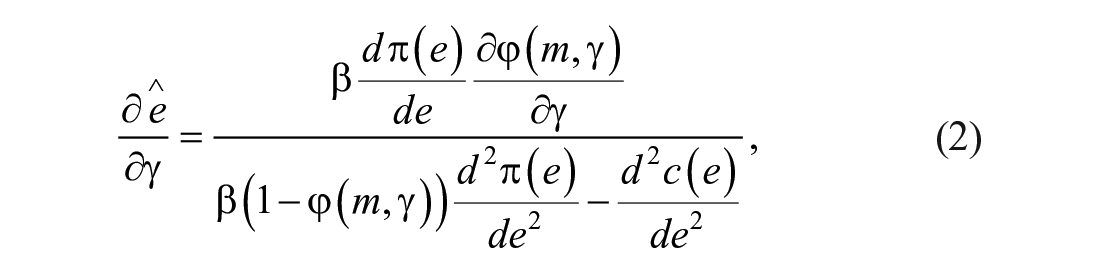

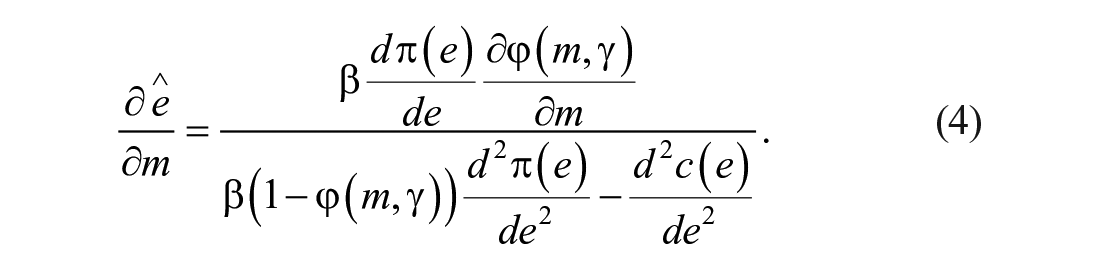
Based on the above assumption, we obtain
Proposition 1: Given managerial shareholding ratio and the controlling shareholder’s expropriation, the level of management effort increases with an increase in the degree of minority shareholders’ legal protection.
Proposition 2: Given the degree of minority shareholders’ legal protection and the controlling shareholder’s expropriation, the level of management effort increases with an increase in managerial shareholding ratio.
Proposition 3: Given the degree of minority shareholders’ legal protection and managerial shareholding ratio, the level of management effort decreases with an increase in the controlling shareholder’s expropriation.
Given the degree of minority shareholders’ legal protection,

The first-order conditional expression of the above formula is given by

where
Assume that
By calculating the partial derivatives of


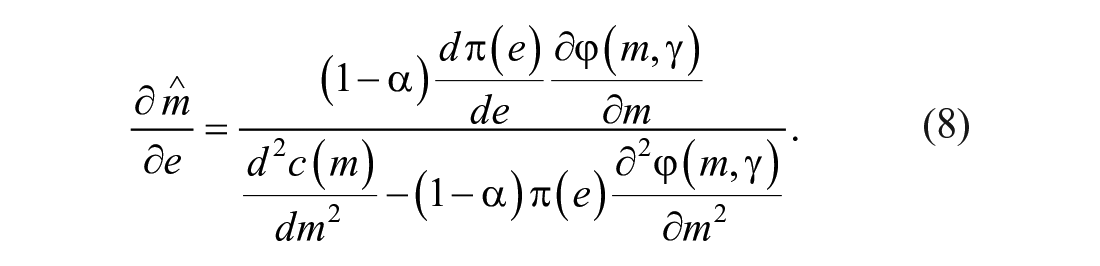
Based on the above assumption, we obtain
Proposition 4: Given the degree of ownership concentration and level of management effort, the controlling shareholder’s expropriation decreases as the degree of minority shareholders’ legal protection increases.
Proposition 5: Given the degree of minority shareholders’ legal protection and the level of management effort, the controlling shareholder’s expropriation decreases as the degree of ownership concentration increases.
Proposition 6: Given the degree of minority shareholders’ legal protection and ownership concentration, the controlling shareholder’s expropriation increases as the level of management effort increases.
Given the degree of minority shareholders’ legal protection,

Since an explicit solution to Formula (9) cannot be obtained, the optimization problem in Formula (9) will be numerically simulated in the following, using the MATLAB software.
Numerical Simulation
Since the model constructed above internalizes the controlling shareholder’s expropriation, management effort, and various influencing factors, it is too complicated for an explicit expression of the solution of the model. Thus, it is necessary to reveal the dominant quantitative relationships among minority shareholder legal protection, the controlling shareholder’s initial shareholding ratio, ownership concentration, managerial shareholding, the controlling shareholder’s expropriation, and management effort, and the economic significance of the model by numerical simulation.
Referring to relevant studies (X. Liu et al., 2015; Yu et al., 2010), we assume, without loss of generality, that
In the numerical simulation, we set parameter ranges for two exogenous variables, minority shareholders’ legal protection degree and the controlling shareholder’s initial shareholding ratio, as follows: for the degree of minority shareholders’ legal protection,
Results and Discussion
The numerical simulation results are shown in Figure 1a to d.

Simulation results of effects of exogenous variables on the controlling shareholder’s expropriation: (a) γ = 0.1, 0.5, and 0.9, relationship between α*, β*, and r; (b) γ = 0.1, 0.5, and 0.9, relationship between m*, e*, and r; (c) γ = 0.1, 0.5, and 0.9, relationship between ϕ* and r; and (d) γ = 0.1, 0.5, and 0.9, relationship between EvM*, EvL*, EvS*, Ev*, and
In our model, minority shareholder legal protection and the controlling shareholder’s initial shareholding ratio are exogenous variables, whereas the other factors are endogenous variables. The results shown in Figure 1a to d can be divided into two types. The first type of results indicates the relationship between the controlling shareholder’s initial shareholding ratio and the other factors when the degree of minority shareholders’ legal protection is fixed; the second type of results indicates the relationship between the degree of minority shareholders’ legal protection and the other factors when the controlling shareholder’s initial shareholding ratio is fixed.
Regarding the first type of results, Figure 1a, b, and d show that when the degree of minority shareholders’ legal protection is fixed, the optimal ownership concentration, optimal managerial shareholding ratio, management effort level, management’s equilibrium expected revenue, controlling shareholder’s equilibrium expected revenue, and equilibrium total shareholder wealth after deducting the management’s income increase with an increase in the controlling shareholder’s initial shareholding ratio. Figure 1b to d show that when the degree of minority shareholders’ legal protection is fixed, the controlling shareholder’s expropriation and expropriation fraction of the company’s output and the minority shareholders’ expected revenue decrease with an increase in the controlling shareholder’s initial shareholding ratio. One of the core variables in these relationships is the controlling shareholder’s initial shareholding ratio. However, most relevant empirical studies concern the ownership concentration or controlling shareholder’s shareholding ratio after the management have been granted shares. Therefore, we additionally discuss the first type of results.
The first type of results indicates that regardless of minority shareholders’ legal protection degree, the higher the controlling shareholder’s initial shareholding ratio, the more willing they are to grant the management more shares, thus incentivizing it to select a higher level of effort. Simultaneously, the controlling shareholder reduces their expropriation and tunneling of the company’s proceeds to maximize their own interests, and finally increase the equilibrium total shareholder wealth. This conclusion shows that under the different external governance environments of minority shareholders’ legal protection levels, regardless of whether the controlling shareholder has absolute or relative control, managerial shareholding as an internal governance mechanism to limit the controlling shareholder’s expropriation is feasible and effective in emerging economies. This finding is consistent with empirical studies by Chrisostomos and Aydin (2008), Chou et al. (2008), and Wan (2021). The result also shows that it is theoretically possible to address the controversial topic in academia of whether the role played by controlling shareholders in a company is that of a “monitor” or a “tunneler.” An increase in a controlling shareholder’s initial shareholding ratio, on the one hand, is likely to lead to the phenomenon of “one share dominates exclusively,” whereby the controlling shareholder can more easily acquire control over an enterprise, thereby increasing their expropriation capacity, which raises their expropriation (tunneling effect). On the other hand, as a controlling shareholder’s initial shareholding ratio increases, their interests and those of minority shareholders tend to be more aligned, thus reducing the controlling shareholder’s motives for expropriation (incentive effect; Claessens et al. 2002; H. Wang et al., 2015). We believe that the key to the theoretical study of “which effect dominates” is the introduction of managerial shareholding. Once the variable of managerial shareholding ratio is introduced into the theoretical model, it can be concluded that the higher the initial shareholding ratio is, the more likely it is that the controlling shareholder will be willing to reduce their expropriation.
The first type of results also indicates that under the different external governance environments of minority shareholders’ legal protection levels, regardless of whether the controlling shareholder has absolute or relative control, the optimal ownership concentration is positively related to the equilibrium total shareholder wealth. This finding is consistent with the empirical study conducted by Bozec and Bozec (2007). They suggested that a large shareholder had less incentive to expropriate but more incentive to ensure that appropriate controls were in place when their ownership rose above 25%. Furthermore, other studies support this result, including Claessens et al. (2000), Johnson et al. (2000), Lemmon and Lins (2003), and Wu and Wu (2011).
Regarding the second type of results, Figure 1a, b, and d show that when the controlling shareholder’s initial shareholding ratio is fixed, the optimal managerial shareholding ratio, management effort level, management’s equilibrium expected revenue, the minority shareholders’ equilibrium expected revenue, and the equilibrium total shareholder wealth after deducting the management’s income increase with an increase in the degree of minority shareholders’ legal protection. Figure 1a to c show that when the controlling shareholder’s initial shareholding ratio is fixed, the optimal ownership concentration and controlling shareholder’s expropriation and expropriation fraction of the company’s output decrease with an increase in the degree of minority shareholders’ legal protection. Figure 1d shows that when the controlling shareholder’s initial shareholding ratio is low, their equilibrium expected revenue decreases with an increase in the degree of minority shareholders’ legal protection; when the controlling shareholder’s initial shareholding ratio is high, their equilibrium expected revenue increases with an increase in the degree of minority shareholders’ legal protection.
The second type of results indicates that regardless of the controlling shareholder’s initial shareholding ratio, the optimal ownership concentration decreases with an increase in the minority shareholders’ legal protection degree, while the optimal managerial shareholding ratio increases with an increase in the minority shareholders’ legal protection degree. This conclusion is consistent with the generally high concentration of equity structure in emerging economies relative to that in Western developed countries such as the UK and the United States, which is in line with Claessens et al. (2000) and Jiang et al. (2010).
The second type of results also indicates that in a company with a low controlling shareholder’s initial shareholding ratio, that is, a company with a low initial ownership concentration, the controlling shareholder’s expected revenue decreases with an increase in minority shareholders’ degree of legal protection; in a company with a high controlling shareholder’s initial shareholding ratio, that is, a company with a high initial ownership concentration, the controlling shareholder’s expected revenue increases with an increase in minority shareholders’ degree of legal protection. This conclusion can be interpreted to mean that when the controlling shareholder’s initial shareholding ratio is low, with an increase in the degree of minority shareholders’ legal protection, the gains obtained by the controlling shareholder from granting more shares to management cannot compensate for the loss due to reduced expropriation; thus, the controlling shareholder’s expected revenue will decrease; when the controlling shareholder’s initial shareholding ratio is high, as minority shareholders’ degree of legal protection increases, the gains obtained by the controlling shareholder from granting more shares to management exceed the loss due to reduced expropriation; thus, the controlling shareholder’s expected revenue will increase.
Conclusions
Based on a perspective of double principal-agent conflicts, this study treats minority shareholders’ legal protection and controlling shareholders’ initial shareholding ratios as exogenous factors, while concentration of ownership and managerial shareholding are treated as endogenous factors that govern controlling shareholder expropriation. We build theoretical models to study the interactions between minority shareholders’ legal protection, controlling shareholders’ initial ownership shares, ownership concentration, managerial shareholding, controlling shareholder expropriation, and management effort. Through numerical simulations, we further quantify the impacts of minority shareholders’ legal protection and controlling shareholders’ initial shareholding ratios on the relevant variables of controlling shareholder expropriation.
Under circumstances of given exogenous factors of minority shareholders’ degree of legal protection and a controlling shareholder’s initial shareholding ratio, the research results show that the controlling shareholder’s expropriation decreases with an increase in the endogenous factor of equity concentration and increases with an increase in managerial shareholding. Furthermore, the exogenous factors of the degree of minority shareholders’ legal protection and a controlling shareholder’s initial shareholding ratio are variable. The results show that regardless of the degree of minority shareholders’ legal protection, the higher the controlling shareholders’ initial shareholding ratios, the more willing they are to grant management more shares, thus incentivizing management to choose a higher level of effort while reducing their own misappropriation of company proceeds to maximize their own interests, finally increasing the equilibrium total shareholder wealth. Regardless of the size of the initial shareholding by a controlling shareholder, the controlling shareholder’s expropriation decreases with an increase in minority shareholders’ legal protection degree, while the level of management effort increases with an increase in minority shareholders’ degree of legal protection. In addition, the result shows that it is theoretically possible to address the controversial topic in academia of whether the role played by the controlling shareholder in a company is that of a “monitor” or a “tunneller.” We believe that the key to the theoretical study of “which effect dominates” is the introduction of managerial ownership. Once the variable of managerial shareholding ratio is introduced into the theoretical model, it can be concluded that the higher the initial shareholding ratio is, the more likely it is that the controlling shareholder will be willing to reduce the expropriation.
Based on the theoretical model constructed and the conclusions obtained in this study, the following policy suggestions are offered: (1) Under the different external governance environments of minority shareholders’ legal protection levels, irrespective of whether controlling shareholders have absolute or relative control, managerial shareholding as an internal governance mechanism to curb the controlling shareholders’ expropriation is feasible and effective in emerging economies. Therefore, the implementation of the equity incentive mechanism in the management of listed companies in emerging economies is conducive to the governance of controlling shareholder expropriation. (2) With an improved external governance environment through minority shareholders’ legal protection, the cost of increasing controlling shareholders’ private benefits through expropriation of their companies’ interests rises; thus, the controlling shareholders will reduce their expropriation. They will choose to increase equity incentives for management to motivate it to choose a higher level of effort and generate greater output. The controlling shareholders will thus benefit from sharing their companies’ greater residual income. Therefore, enhancing the protection of small and medium-range investors and increasing the cost of controlling shareholders’ expropriation is an effective external system to govern controlling shareholder expropriation.
Based on the perspective of double principal-agent conflicts, this research studies the choice of optimal combination of internal ownership structure and equity incentive governance mechanism to collaboratively govern controlling shareholder expropriation; the choice is based on controlling shareholders’ initial shareholding ratios under different external governance environments of minority shareholders’ legal protection in emerging economies. This is the theoretical contribution of this study. Furthermore, the study enriches the research on the governance of controlling shareholder expropriation and provides a new theoretical basis for optimizing it in emerging economies. This is a theoretical study that explores the internal relationships among the governance factors in controlling shareholder expropriation by constructing a theoretical model. The theoretical results need to be further verified. In the forthcoming work, we plan to conduct empirical research on the multi-factor collaborative governance of controlling shareholder expropriation.
Footnotes
Declaration of Conflicting Interests
The author(s) declared no potential conflicts of interest with respect to the research, authorship, and/or publication of this article.
Funding
The author(s) disclosed receipt of the following financial support for the research, authorship, and/or publication of this article: This work was supported by the Humanities and Social Sciences Programs of the Ministry of Education of China (17YJA630088).
