




Abstract
Governments in Sub-Saharan Africa (SSA) are expanding access to high school education, which is a perpetuation of the previous focus on basic education. This study applies qualitative comparative analysis (QCA) using data from seven countries from 2010 to 2020 to examine the potential conditions of fee-free policies at the high school level. Five potential conditions are analyzed. They include the regime type, electoral competition, ideological lineage, economic conditions, and social context. The findings indicate the significant influence of electoral competition and a high level of lower secondary school enrolment for the adoption of fee-free policies. The absence of electoral competition leads to a lack of fee-free policy. The paper explains how elections, one indicator of representative democracy, motivate political leaders to initiate social policies. Additionally, the study challenges the relevance of two important explanations for expansionary social policy in the literature—the partisan theory of policy outcomes, and the economy.
Keywords
Introduction
The global vision of primary and secondary education for all is set to be achieved in 2030 according to the Sustainable Development Goals (SDGs) (United Nations, 2020). Currently, data from the United Nations Educational Social and Cultural Organization (UNESCO) Institute of Statistics (UIS) shows that an average of 60% of youth of high school age are in school on a global basis (UNESCO Institute for Statistics, 2021). High school (formally called upper secondary education) refers to the level three of educational gradation (ISCED: 3); the stage just before tertiary education associated with a theoretical entry age of 14 to 16 and completion age of 17 to 19 (UNESCO Institute for Statistics, 2012). There are great disparities among the individual regions of the world in terms of high school enrolment. For example, in 2018 Arab States reported an average of 61%; Central and Eastern Europe, 105%; South and West Asia, 60%; and Sub-Sharan Africa (SSA), 34%. SSA has the lowest proportion of youth taking part in high school education. This is a social problem. Primary education, and in some countries lower secondary education (basic school), is free and compulsory in many SSA countries, while high school/upper secondary education is not. Consequently, some countries—for example, South Africa, Kenya, Ghana, Namibia, Sierra Leone, Malawi, and Uganda—are implementing specific policies termed cost-elimination policy (popularly called fee-free education policies) at the high school level to increase enrolment to achieve SDG 4.
The provision of fee-free education can be considered a pragmatic social policy approach that responds to the lower rate of school enrolment (Marshall, 1967). This is because it involves direct government spending rather than leaving matters to the market. Although the study of social policies is a growing area of research (Adésínà, 2007; Altman & Castiglioni, 2020; Grebe, 2015; Gumede, 2018; Haggard & Kaufman, 2008; Hunter & Sugiyama, 2009; Mkandawire, 2004), the recent expansion of fee-free policies to the high school level in SSA has not been explored in the field of political science. This paper adds to the body of literature from this perspective. In the social policy literature, several theoretical arguments that attempt to explain the conditions favorable to the adoption of expansionary social policies are explored. The regime type (Dornbusch & Edwards, 1991), electoral competition (Ward et al., 2015), the partisan theory of policy outcome (Huber et al., 2008), size of economy and economic growth (Islam & Clarke, 2002; Sen, 1976), and societal factors are some factors scholars have explored. In the context of SSA, the present paper explores, in relation to the adoption and implementation of fee-free policies at the high school level, what condition(s) prevail in the respective countries and why. In addition, it explores under what condition(s) fee-free policy is not adopted and implemented.
I aim to unravel this complexity and answer these kinds of research questions that are outside the scope of the conventional variable-oriented approach. I employ fuzzy-set Qualitative Comparative Analysis (fsQCA) (Ragin, 2008) that allows for an investigation of the potential conditions (or combination of conditions) that lead to fee-free policies, or otherwise. Therefore, the two outcomes of interest are the presence of a fee-free policy and the absence of a fee-free policy. The paper makes three major contributions. One, through QCA it develops a novel way to account for the adoption or otherwise of fee-free policies in SSA. Two, it explains the potential causal conditions of the popular recent fee-free policies we have witnessed in some SSA countries. Three, it challenges the relevance of two important explanations of the literature on expansionary social policy—the left turn described in the traditional partisan theory of policy outcomes, and economic growth. I argue that electoral competition (one of the narrower concepts associated with representative democratic regime/politics) in social policy politics drives fee-free education in SSA. This factor is complemented by the social context of high lower secondary school enrolment rate. The paper proceeds as follows. The next section presents the theoretical considerations for social policy expansion. Here, I discuss the wider literature on social policy and explore the basic arguments and conditions deemed favorable (unfavorable) to expansionary social policies. This is followed by the methodological section, where I present the methods, operationalize the conditions and outcomes of interest, and discuss the calibration process. Following that is the findings section. I use the final section to reflect on the analysis, test the robustness of the results regarding specific cases that are discussed, and offer some conclusions.
Theoretical Considerations for Social Policy Expansion
Regime Type
Regime type is arguably one of the key factors that shapes the access to and exercise of power. This is because, as some scholars argue, regime type affects the constraints politicians face in the distribution of resources (Dornbusch & Edwards, 1991). While we may perceive that the exercise of power is accountable and responsive to the needs of citizens—for example, the provision of education under democratic regimes—this is not so under authoritarian regimes. This suggests that a high level of democracy provides room for popular demands and is more liable to lead to the implementation of social policies such as fee-free education than in an authoritarian regime where resource allocation is constrained by economic forces (Brown & Hunter, 1999). This is because access to power is more competitive and broader in democratic regimes than in authoritarian ones. Across Africa, the emergence of new democracies implies that voters are often following elections more closely (Payne, 2008) and citizens are increasingly viewing social policies as an integral part of their livelihood, with a direct link to democracy (Adésínà, 2007). From this perspective, we expect countries with stronger democracies to be more likely to have fee-free policies than those with weaker democracy indices.
Notwithstanding this general argument and expectations, some scholars argue that the simple distinction between democracy and authoritarian regimes does not capture the important features that influence political behavior in resource allocation (Przeworski & Limongi, 1993). Peiffer (2012) argued that African democracy does not produce social policies because other non-democratic countries in the region provide equal social support. Rather, it is because of the exogenous factors that compel SSA countries to engage in political liberalization. Hence, having democracy in SSA does not guarantee the provision of social services. According to the study, this is because of the weak electoral incentives for such policies. The mixed evidence concerning the link between regime type and social policy output necessitates better defined political science concepts for exploring the ideal-type democracy-authoritarian dichotomy that can explain social policy outcomes. Hence, I consider the role of electoral competition.
Electoral Competition
There is a need to specifically consider the role of political parties who may have the incentive to propose and provide social policy when seeking political power and when in government because of the concept of electoral competition. The need to appraise the impact of electoral competition from the perspective of the composite concept of regime-type impact on social policy stems from the complexity of the latter (Hunter & Sugiyama, 2009; Nelson, 2007). Political parties are important for policies, especially in SSA’s new democracies, where representative democracy is emphasized (Lindberg, 2004). During electoral campaigns, political parties politicize issues, both economic and non-economic, put them on the agenda, and quickly draw the attention of everyone to them as a means of obtaining a political advantage over their competitors (Dragu & Fan, 2016; Grebe, 2015; Ward et al., 2015).
From the political economy perspective, offering free education to all students is a popular initiative and attracts votes (Correa et al., 2020; Fernandez & Rogerson, 1995)—the phenomenon thus has the potential to generate an electoral incentive and motivate politicians to spend more on significant areas such as education (Ha, 2015). In this way, policy actors may be motivated to propose and respond to policies that expand access to education not only as a service to the public but as a means of obtaining a self-interest-based political advantage over their competitors, especially during competitive elections (Keefer & Khemani, 2005; Pierskalla & Sacks, 2020). This is a particularly important factor considering the increasing democratic quality of SSA’s democracies (which are developing from weakly institutionalized democracies), where electoral competition has become a key feature in elections (Lindberg, 2004) and individuals in public institutions—either elected or appointed—are central actors and influence processes that are on the political spectrum and the administration of public affairs (Young et al., 2020). Although the citizen preferences articulated by political actors due to electoral competition are not always translated into government action(Lindberg, 2004), a large-scale study suggests that parties that enter governments are highly likely to fulfil their policy pledges (Thomson et al., 2017). Political parties in SSA countries, through their manifestos and political campaigns, set national policy agendas through proposing numerous policy alternatives to electorates during elections (Ayee, 2016). From this perspective, it is important to assume that parties proposing fee-free education to electorates during the electoral campaign may be necessary for a country to have fee-free education.
Ideological Leanings
According to the traditional partisan theory of policy outcomes, leftist governments are inclined to reduce social inequality and expand social citizenship rights, such as the right to access to education, and to favor the redistribution of national wealth, hence pursuing a more universal social policy program. The argument is that left-wing governments expand social policies and spend more on education in less developed countries because their orientation makes them sensitive to the demand of the population (Ha, 2015). In Latin America, where social policy regimes were earlier established in the 1970s to cover most citizens, Huber et al. (2008) claim that while right-wing parties may reduce education and health spending—inhibiting the provision of services such as fee-free education—, the left impact them positively.
However, a recent study by Altman and Castiglioni (2020) in Latin America made a strong case, using panel data analysis, that social policies are not the exclusive domain of the left, since right-wing parties engage in expansionary social policies. In post-communist Europe, Tavits and Letki (2009) argued that right-wing parties are more inclined to pursue social policies and tend to increase government expenditure in sectors such as education, health, and pensions than left-wing parties, while leftist parties are more fiscally stringent. Although employing an ideological continuum or coding of leftist-rightist political orientation is highly controversial and criticized empirically (Benoit & Laver, 2006), it is still the most widely used form of related classification in the literature, including that which concerns SSA (Dreher et al., 2015; Facchini & Melki, 2014; Tawiah & Karungi, 2020). Political parties in SSA identify with international and sub-regional groupings based on ideological leanings, such as the International Democratic Union (right), the Democratic Union of Africa (right), and the Socialist International (left). Notwithstanding this, it is important to recognize that contemporary global development goals—for example, secondary education for all, as promulgated in line with the Sustainable Development Goals (Goal 4)—may hinder such ideological leanings from playing a major part in local-level policy adoption, especially in developing economies such as SSA. Political parties in government, thus operating from a less ideological orientation, are expected to fulfill global visions that are becoming increasingly profound in an era of neoliberalism and where international organizations have important interests in local political economies and policy formulation (Simmons & Elkins, 2004). Therefore, policies such as fee-free education may not be adopted based on the ideological orientation of parties or governments but in response to global visions about development. Despite the foregoing, it is still important to consider the ideological lineage of decision-makers due to the long tradition of the former of influencing expansionary social policies.
Economic Conditions
Economic conditions, such as the wealth of a country, may influence the provision of social policy within the political economy. This view has been long held by development economists and other scholars due to the implicit reasoning that an increase in national wealth spurs a nation’s welfare development (Islam & Clarke, 2002; Sen, 1976). For example, Huber et al. (2008) argued that a high GDP per capita, indicating national affluence, creates the opportunity to devote a greater share of national resources to education and health. It is also important to consider not only the aggregate wealth of a country per se, but also the growth in this wealth. Przeworski et al. (2000) correctly claim that individual (national) well-being is much better expressed in terms of growth of income and consumption rather than aggregate wealth. As a result, one might expect that in cases where a country is well-to-do economically or has a higher growth it may lead to the adoption of fee-free education. A small economy or slowly growing one is more liable to cause the absence of fee-free policies.
The Social Context
Social policies change based on economic factors as well as demographic factors or social structures. Social factors may serve as the basis for the provision of social policy. For example, an aging society may call on the government to pay more attention to social policies such as pension and health (Estes, 2001). The increase in enrolment at the primary and lower secondary levels after the beginning of the early and mid-2020s means that many youths will need high school education—the next level of the educational ladder. As many youths are enrolling and completing the lower levels of the educational ladder, psychological factors such as family and individual aspirations for further education at a high level subsequently increase demand (Plank, 2004). This means that the very success of a state’s efforts to increase access and provide opportunities for schooling make new demands on the education system at different levels (World Bank, 2009). It is therefore expected that in cases when countries experience a higher rate of schooling at the lower secondary level, fee-free policies will be introduced at the high school level to deal with the increased demand than in periods associated with a low rate of schooling at the lower secondary level.
Methodology
I use the fuzzy set Qualitative Comparative Analysis (fsQCA) approach. QCA is a case-oriented research method that is based on a configurational approach and examines set relations between cases, rather than correlation between variables (Ragin, 2008). Compared to standard statistical procedures such as regression, QCA considers each case holistically and permits in-depth insight into different cases as configurations of attributes. In this way, QCA helps with understanding complex relationships between each set in each case rather than merely establishing the relationship between variables with the assumption that different conditions can lead to the same outcomes (della Porta, 2008). This means that there may be different explanations for an outcome than for its non-occurrence. This is known as asymmetric causation (Oana et al., 2021). To examine how different configurations of attributes contribute to an outcome of interest, QCA uses Boolean algebra—a notational system that permits the algebraic manipulation of logical statements and treats cases as having either full membership in sets, full exclusion from a set, or being more in or out of a set (maximum ambiguity). Through systematic logical case comparisons based on the rules of Boolean algebra, QCA identifies similarities and commonalities among these configurations, thus reducing the complexity of the typology in a “truth table” matrix. A truth table is a data matrix that is created through the QCA data collection and analysis process that includes potential configurations of conditions and their associated empirical outcomes presented in rows (Fiss, 2010).
Selection of Cases and Data
Cost elimination or fee-free education refers to access-oriented policies and legal frameworks designed to offer free education to children and youth at different levels of education (World Bank, 2009, p. 1). In this study, fee-free policy at the high school level is defined as a policy initiative by a government—other than a legal framework—that eliminates or partially reduces the direct cost of attending senior high education. Countries that have adopted a fee-free policy at the high school level in SSA were selected for the sample. The timeframe for analysis is defined as from 2010 to 2020, during which time cases could be identified for each country to serve as the units of analysis. The focus is on the years(s) of the occurrence or non-occurrence of the outcome, thus time (2010–2020) is only used as a means of “build[ing] narratives of process” (della Porta, 2008, p. 207), not for panel data structuring. I selected this timeframe (to derive the cases) for three practical reasons. First, since the Education For All (EFA) initiative in 2000, which was supposed to be achieved in 2015 according to Millennium Development Goals (MDGs), enrolment at the primary and lower secondary level improved significantly (Little & Lewin, 2011). Practically, the externality of this effect is that the many youths who are seeking a high school education have increased government attention to this level of education. Second, the conditions selected for the analysis are associated with recent data (until 2020). Third, the issue of fee-free education at the high school level was highly contentious in the political space during this period. I identified seven countries with a fee-free policy as defined in this study. The countries are Ghana, Kenya, Malawi, Namibia, Sierra Leone, South Africa, and Uganda. Based on the selected timeframe (2010–2020, involving 11 time periods), 11 cases were identified for each country leading to 77 cases in total. Although this is a large sample for QCA, it supports diversity in the analysis (Stevens, 2016).
The two outcomes that are considered are the presence of a fee-free policy and the absence of a fee-free policy. The presence of a fee-free policy is observed in 48 cases, while 29 cases are identified with the absence of a fee-free policy. The presence of a fee-free policy in a country can be holistic or partial. A holistic fee-free policy means that the government, through its policy, absorbs all forms of direct fees at the high school level throughout the country for all students. A partial fee-free policy is defined as when some direct fees—for example, tuition fees and registration fees—are absorbed, or fees for some students within a defined geographical area or of a certain economic status are absorbed. This may be done through several means, such as the “big bang” approach, the phasing in approach, targeting, or means-testing (Morgan et al., 2014).
On theoretical grounds, five conditions are presented and included in the study. I used the measure of regime type from the Economic Intelligence Unit (EIU) Democracy Index. The EIU Democracy Index measures the level of democracy in 167 countries, including all selected countries in this study. The EIU Democracy Index is selected over other measures of regime type (such as the Freedom House or Polity IV score) because the Democracy Index aggregates all the 60 indicators used to measure the level of democracy and assigns a numerical score ranging from 0 to 10 to each country to provide a broader outlook on the level of democracy in each country. Countries with an index of 8.01 to 10 are considered “full democracies”; countries scoring 6.01 to 8 are considered “flawed democracies”; countries with an index of 4.01 to 6 are classified as “hybrid” regimes, and countries with an index of 0 to 4 are considered “authoritarian” regimes.
Data on electoral competition is taken from national sources and political parties’ documents. Electoral competition is operationalized as political campaign promises by a political party to offer fee-free education at the high school level. These electoral campaign promises are proposed to the electorates by the political parties contesting the national elections. From the cases selected as the units of analysis, I identified if the political party in government promised to adopt a fee-free policy at the high school level when voted into power. This is perceived as part of electoral competition because political parties wish to obtain votes and therefore need to promise free education to gain a political advantage over their political competitors. Data on the ideological lineage of the political party in power is taken from political party documents and their websites as well as knowledge about international ideological groupings, including the International Democrat Union, Democratic Union of Africa, and Socialist International. Information on the data concerning the countries, political parties, the political campaign for fee-free education, the year(s) the party has been in government, and political ideology are provided in Supplemental Table A1.
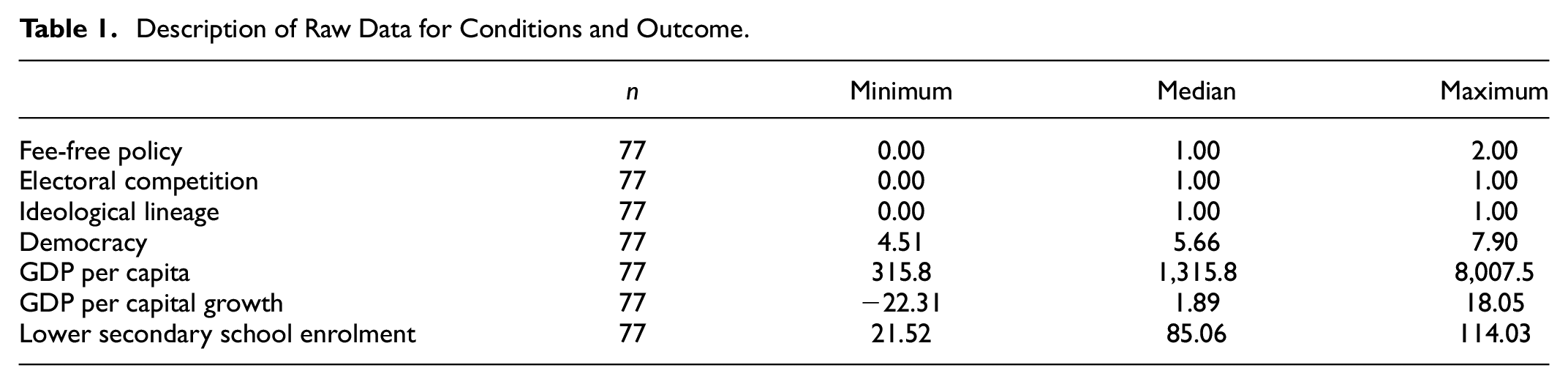
Data on economic conditions used World Bank Development Indicators, including both Gross Domestic Product (GDP) Per Capita in current US Dollars, and Gross Domestic Product (GDP) Per Capita growth (World Bank, 2021). The two matrixes measure national income as well as growth in income, respectively, denoting the wealth of a country. I use data for the proportion of lower secondary school enrolment as a measure of the social context. People attending lower secondary education are the intake for high schools. This means if a country has a large number of people attending lower secondary it is more probable that government will need to consider fee-free education at the high school level. This data is taken from the United Nations Educational Scientific and Cultural Organization (UNESCO) Institute of Statistics (UIS) (UNESCO Institute for Statistics, 2021). I did not use lower secondary school completion rates because this data is not available for some countries. For enrolment, some values are missing for some of the observed years for some countries. As a result, the missing data was input using the linear interpolation method before any other form of calibration. The distribution of the raw dataset is displayed in Table 1.
Description of Raw Data for Conditions and Outcome.
Data Calibration
Calibration of the data was carried out using the “QCA” package version 4.1.0 in the R statistical software environment (Dusa, 2019). Calibration enables cases to be assigned fuzzy-set scores. This means that we consider the conditions within each case, and determine if they are qualitatively high or low (Ragin, 2008). For example, if Namibia has a raw democracy index value (based on the EIU measurement) of 0.64 in 2010, should we consider that case (N10 = Namibia in 2010) as a strong democracy or weak democracy? Here, there is a need to specify three thresholds. Full membership of the set may be specified (with a score of “1”), full exclusion from the set (with a score of “0”), and the crossover point of maximum ambiguity (with a score of “0.5”)—this approach helps specify if a case is classified as inside or outside of the set of cases with that condition.
For the outcomes of interest, I used the indirect calibration method. Holistic fee-free education (with a raw value of “2”) was assigned a fuzzy set score of “1” (i.e., fully within the set for fee-free policy). Partial fee-free education (with a raw value of “1”) was assigned a fuzzy set score of 0.75 (i.e., more within the set of fee-free policy than outside). Calibrating the fuzzy set score of a partial fee-free policy of above 0.5 (i.e., maximum ambiguity) is considered appropriate since partial fee-free policies, even when they do not cover everyone in the country or do not cover all cost items, are considered to be significant factors in increasing the rate of enrolment (Asante, 2022; Bray, 2007). The absence of a fee-free policy was assigned a fuzzy set score of “0.”
Electoral Competition (ELC) was defined in the following qualitative way. Either the political party in power promised fee-free high school education and was considered as “fully in the set” with a score of “1” or did not and was thus “fully out of the set” with a score of “0.” Parties with a left-wing political ideology (LEFT) were considered as “fully in the set” with a score of “1,” while right-wing parties were “fully out of the set” with a score of “0.” There is no degree of membership for these two conditions.
The three thresholds for the other four conditions were determined by knowledge of the qualitative difference about the condition. The calibration of a High Level of Democracy (DEM) using the EIU Democracy Index data was guided by the project threshold for classifying countries. The full inclusion threshold was taken from the democracy index which classifies countries with an index of 10 as being “full democracies.” Countries classified as not being democracies (“authoritarian regimes”) were calibrated as being fully outside the set of a high level of democracy. The crossover point for maximum ambiguity was set at 6.01, thus the beginning of the index for “flawed democracy” status. Countries with “flawed democracies” are considered more “in” than “out” because, according to the EIU democracy index, they have free and fair elections and basic civil liberties are respected. Again, since countries in SSA hardly qualify as being “full democracies,” including “flawed democracy” scores limits the problem of skewness in the calibrated data.
The calibration of Lower Secondary School Enrolment (LSE), gross domestic product per capita (GDP), and gross domestic product per capita growth (GDG) relied on the everyday meaning of “high” or “low” in the context of SSA. Therefore, the procedure for the calibration of fuzzy set scores for these conditions was determined by inspecting the distribution of the data. A breakpoint in the distribution (a value with no observation) that was near the median was chosen as the point of maximum ambiguity. The threshold for full set inclusion and exclusion was set at breakpoints near the maximum and minimum values at each end of the distribution, respectively. For GDG, the exclusion score was set at “0,” which represents no growth for the observed year. In the analysis, Economic Condition (ECO) is denoted by GDP per capita OR GDP per capita growth (that is, the union of the two sets). The chosen calibration thresholds for all conditions are displayed in Table 2. The presumed asymmetrical relations between the conditions and the outcomes of interest are illustrated in Figure 1.
Fuzzy Set Calibration of Conditions.

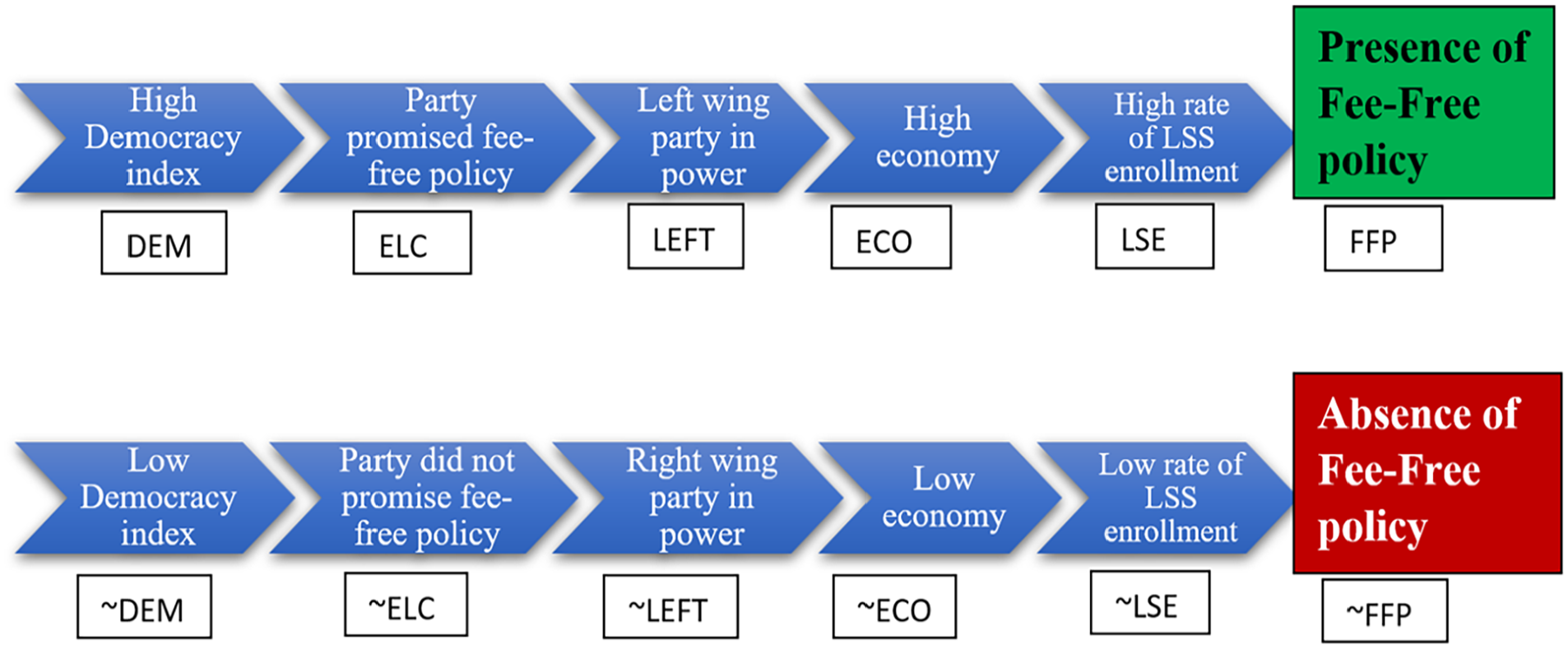
Concept map illustrating conditions and outcomes of interest.
Results
Necessity Analysis
I present the necessary conditions for the two outcomes in Table 3. Theoretically, all conditions are negated using the traditional negation tilde symbol (∼) that precedes the condition in the analysis for the outcome “Absence of fee-free policy” (∼FFP). Since a consistency threshold of at least 0.90 is required for necessary conditions (Schneider & Wagemann, 2012), Table 3 shows that electoral competition (ELC), as represented by a political party in power that promised fee-free policy, is the only set that is a necessary condition for the outcome “Presence of fee-free policy” (FFP). With coverage of 0.71 and relevance of 0.61, the condition may be trivial in producing the outcome. This means it may only be sufficient to produce the outcome in combination with other condition(s). With this insight, we expect to see this condition in solution(s) sufficient for enabling fee-free policies. The negation of electoral competition (∼ELC) has a consistency score of 0.61 but high coverage and a relevance score of “1,” showing that the condition is less trivial in relation to causing the absence of fee-free policy. In summary, the analysis of the necessary conditions indicates the importance of electoral competition in fee-fee policies.
Analysis of Necessary Conditions for the Two Outcomes “Presence of Fee-Free Policy” (FFP) and “Absence of Fee-Free Policy” (~FFP).
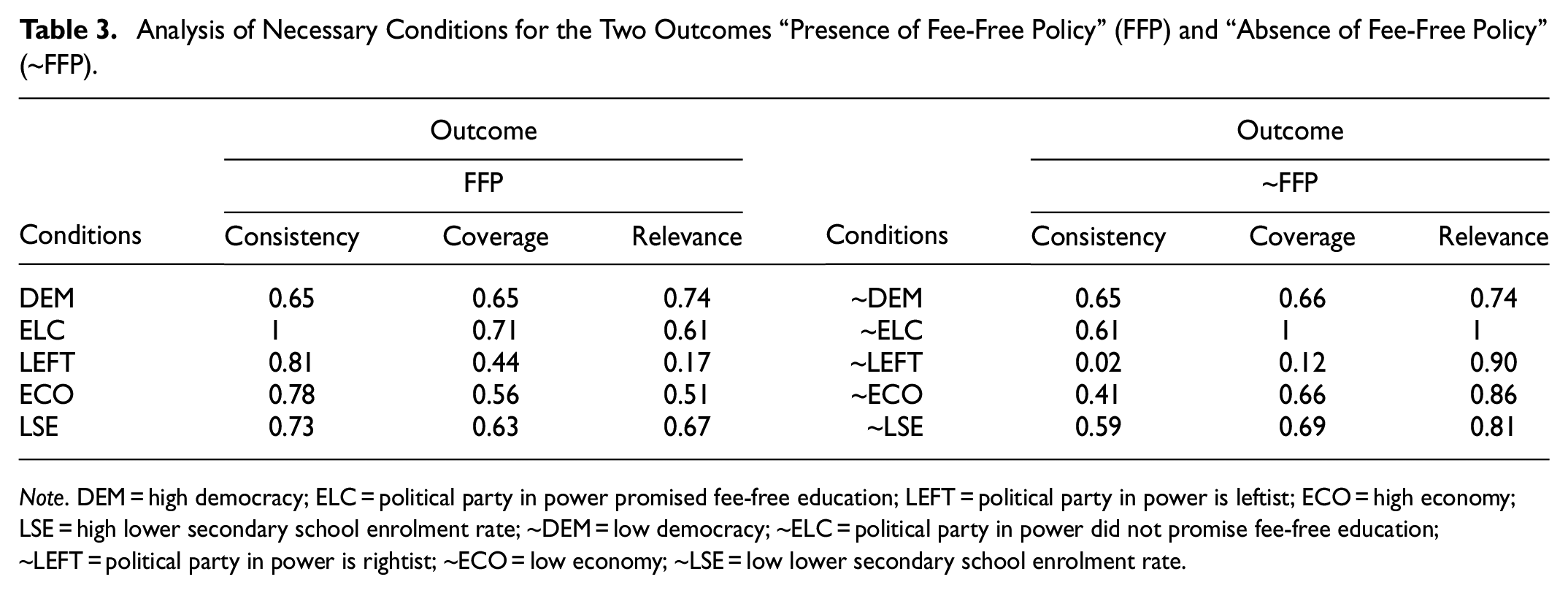
Note. DEM = high democracy; ELC = political party in power promised fee-free education; LEFT = political party in power is leftist; ECO = high economy; LSE = high lower secondary school enrolment rate; ~DEM = low democracy; ~ELC = political party in power did not promise fee-free education; ~LEFT = political party in power is rightist; ~ECO = low economy; ~LSE = low lower secondary school enrolment rate.
Sufficiency Analysis
Regarding the analysis of sufficient conditions, I began by generating the truth table. In creating the truth table, a threshold for the value of consistency scores is defined for the conditions to be examined. In this study, I choose a consistency threshold of sufficiency of 0.76. There are two main methodological and practical reasons for selecting this inclusive score as the parameter of fit. One, following Schneider and Wagemann (2012, p. 127), values below 0.75 (the lower bound of the acceptable consistency level) are problematic as they have consequences for the subsequent analysis. Two, with the simultaneous subset relations (PRI) set at the acceptable level of 0.51, this sufficiency inclusive score ensures that all truth table rows with a case or cases belong to one outcome of interest. To obtain the solution term, the software minimizes the truth table using Boolean algebra and identifies the combinations of conditions that are sufficient to produce one of the two outcomes of interest.
The creation of the truth table allows for an examination of the distribution of the data concerning the potential theoretical configurations across cases vis-à-vis the outcomes in question (Ragin, 2014). Cases identified to have the same profile of causal conditions are grouped for assessment in relation to whether they agree on the outcome. Conditions identified to have a limited empirical impact on the outcome are eliminated to reduce the combination of properties. With five conditions, there are 32 logically possible configurations. Thirteen of the configurations are present in the cases in the sample for the outcomes (eight configurations meet the threshold for the parameters of fit for the presence of fee-free policy, while five configurations meet the threshold for the parameters of fit for the absence of fee-free policy). This means 19 configurations are associated with no empirical observations (i.e., logical reminders). Following Stevens’s (2016) approach, rows that meet the parameters of fit for each of the two outcomes are presented and numbered in Table 4 for ease of reference.
Truth Table for the Analysis of Sufficient Conditions for the Outcomes “Presence of Fee-Free Policy” (FFP) and the “Absence of Fee-Free Policy” (~FFP).

Note. Conditions with tilde (~) notation are the negation of the condition. The numbers attached to the letters are the observed year. DEM = high democracy; ELC = political party in power promised fee-free education; LEFT = political party in power is leftist; ECO = high economy; LSE = high lower secondary school enrolment rate; M = Malawi; S = Sierra Leone; G = Ghana; K = Kenya; N = Namibia; SA = South Africa; U = Uganda; 0 = condition is absent; 1 = condition is present.
From the truth table (Table 4) we can observe the presence of electoral competition in all rows assessed as sufficient to generate fee-free policy (see rows 1–8 in Table 4) and several rows indicate a high lower secondary school enrolment rate (see rows 2–5 and 7 in Table 4). We can find the absence of electoral competition in all rows that are consistent with the absence of a fee-free policy (see rows 9–14 in Table 4). In addition, a low secondary school enrolment rate is present in several consistency rows that are associated with the absence of fee-free policies (see rows 10–14 in Table 4). In row 1, the presence of electoral competition alone is adequate to generate fee-free policy, while its absence may cause the absence of fee-free policy in row 9. The truth table results are consistent with the analysis of the necessary conditions.
To overcome the problem of limited diversity in minimizing the truth table in the analysis of sufficient conditions (i.e., the presence of logical remainders), I use the “standard analysis procedure” strategy suggested by Ragin (2008). This strategy involves producing the complex solution (without assumptions about logical remainders), the intermediate solution (only easy counterfactuals), and the most parsimonious solution (all simplifying assumptions). The “complex solution” uses all configurations that are present in the sampled cases of the two outcomes. It only eliminates redundant conditions. In the “intermediate solution,” logical remainder configurations are treated as if they affect the outcomes, as we would expect them to be based on theoretical expectations (thus enabling the use of previously generated knowledge in the analysis). The incorporation of the “logical reminders” configuration in the Boolean minimization produces the “parsimonious solution” (Ragin, 2008).
In interpreting fsQCA, the intermediate solutions are those most likely to provide valid information about the potential causes of the outcome (Ragin, 2008). In this study, I include all conditions in the theoretical directional expectations of the solution for the analysis of the presence of fee-free policy (FFP). The negation of all conditions is included in the expectation of the absence of fee-free policy (∼FFP). The intermediate solutions for the two outcomes are displayed in Table 5. In line with the suggestion of Schneider and Wagemann (2012), the full formulas for the complex solutions and the parsimonious solution are provided in Supplemental Table B1. Besides the score for consistency, the coverage of the solutions is also provided. The coverage measure provides information regarding the relative importance of each path; that is, the proportion of the outcome covered by the solution (Ragin, 2008).
Intermediate Solution of Sufficient Conditions for the Outcomes “Presence of Fee-Free Policy” (FFP) and “Absence of Fee-Free Policy” (~FFP).
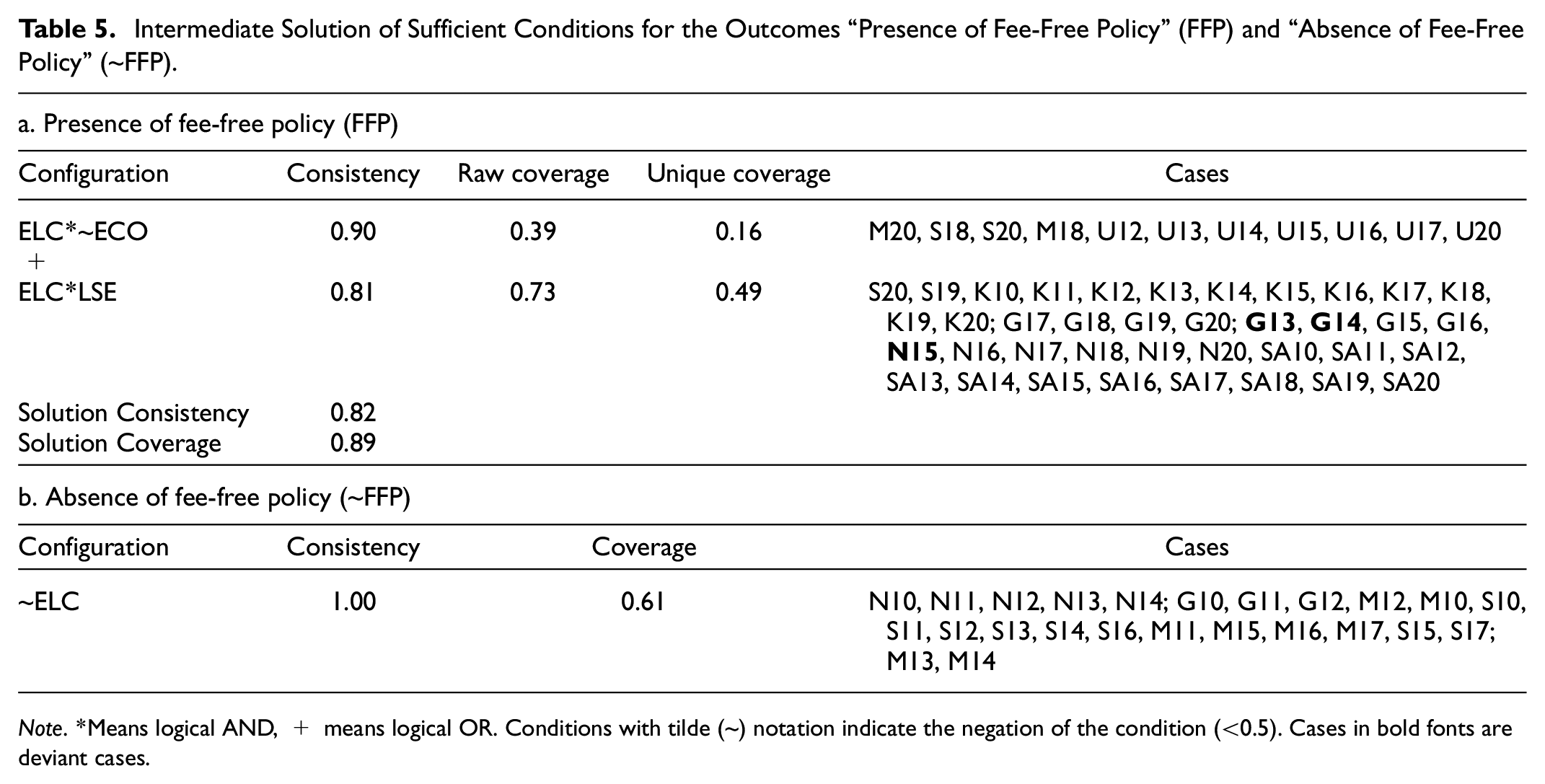
Note. *Means logical AND, + means logical OR. Conditions with tilde (~) notation indicate the negation of the condition (<0.5). Cases in bold fonts are deviant cases.
The intermediate solution in Table 5 suggests that the adoption of a fee-free policy at the high school level is indeed configurational. The configurations uncover some surprises concerning theoretical expectations. The presence of electoral competition (i.e., the political party in power promised fee-free policy during the electoral campaign) (ELC) AND Low level of economy (∼ECO) OR the Presence of electoral competition (ELC) AND High level of lower secondary school enrolment rate (LSE) are sufficient to cause fee-free policy at the high school level. The two configurations—each containing the presence of electoral competition—with total coverage of 89% and a consistency score of 82% are usually sufficient to cause fee-free policy. The unique coverage measure provides information regarding the relative importance exclusive to each path—that is, the proportion of the outcome covered exclusively by the path (Ragin, 2008). Of the total solution coverage of 89%, 16% is due solely to the first path (ELC*∼ECO) while the second path (ELC*LSE) uniquely covers 49%. This means that although all the two paths are important for causing fee-free policy, the second path is more important than the first. Turning to the absence of fee-free policies, the absence of electoral competition (∼ELC) is sufficient to cause the absence of fee-free policy with total coverage of 61%.
Robustness Checks and Discussions
When QCA is applied to a handful of cases, it is always advisable to apply a systematic robustness check in the analysis (Oana et al., 2021). In this study, I used two of the main ways of testing how robust the initial solutions that were obtained are, and their effects on my conclusions. First, I conducted qualitative discussions of the solution terms and applied different cases in this discussion to reveal whether the observed configurations indeed represent the potential causal relationships (Emmenegger et al., 2013). Second, since QCA is a case-based method (i.e., is case sensitive), I conducted a sensitivity test by considering measurement error and changes in the parameter of fit; that is, the consistency inclusion score.
Application of fsQCA Findings to Cases
The analysis helps to explain differences in the presence or absence of fee-free policies between cases in countries in SSA. In Ghana, the idea of a fee-free policy at the high school level was put on the national agenda in the 2008 general elections by the then-presidential candidate of the ruling right party, the New Patriotic Party (NPP), Mr Akuffo-Addo (Ayee, 2016). After the party lost the elections to the then-opposition party, National Democratic Congress (NDC), which is a left-wing party, the idea of fee-free policy at the high school level did not materialize in the country during their administration (2009–2012). NDC did not promise any form of fee-free policy in the 2008 elections. In 2011 the country recorded high GDP per capita growth of 11% and Real GDP growth of 14.0% because of the discovery and mass production of oil (Fosu, 2017), but a fee-free policy was not implemented in 2012 either, although there was economic growth of 6.7%. The country’s democracy index in these periods was “quite satisfactory” at 6.02 (flawed democracy). A plausible explanation for the absence of a fee-free policy in these years may be the lack of promotion of a fee-free policy by the political party in power (albeit left-wing) during the 2008 electoral campaign period.
In the 2012 general elections, both political parties (NDC and NPP) promised fee-free policies at the high school level. NDC, led by Mr John Dramani Mahama, won the elections. During their administration in 2013 (associated with GDP per capita of US$2,361 and growth of 4.8%), a fee-free policy was not implemented, or in 2014. These two cases and the case of Namibia in 2015 are deviant cases (G13, G14, and N15 in Table 5) because a fee-free policy was promised and there was a high level of lower secondary school enrolment, yet the outcome did not materialize. The outcome, however, was observed in subsequent years. In Ghana, the government adopted a partial fee-free policy in 2015 when the country’s economy grew by −0.17%, with a GDP per capita of US$1,706. Electoral competition and the social context may explain the adoption of the partial fee-free policy in 2015, which is reflected in the configurational paths. The campaign promise made in the 2012 general elections needed to be fulfilled since the next general election in 2016 was approaching and fee-free education was high on the national agenda because NPP had maintained their fee-free policy campaign message. As argued by Dragu and Fan (2016), when a party (NDC) envisages that an opponent (NPP) is gaining support for a popular issue during an election, they are incentivized to advertise the same issue. Since the increase in enrolment at the lower secondary school level was increasing the demand for high school education, the ruling party (NDC) needed to act on their promise to show their commitment to fee-free education to build political capital, hence they introduced a partial fee-free policy. According to critics, the outcome of this is reflected in poor pre-policy planning, inadequate stakeholder consultation, and the lack of the timely release of funds for the operationalization of the policy (Ansah, 2019; Opoku & Adogla-Besaa, 2017). These results do not conflict with what has been presented so far in the literature about fee-free policies at the primary level in SSA. In Malawi, Kenya, and Uganda, “the adoption of universal free primary education was triggered by political demand rather than by rational planning processes” (Avenstrup et al., 2004, p. 9).
NPP won the 2016 elections. In 2017, GDP per capita in Ghana (US$2,021) was less than in 2013 (US$2,361). However, after the party assumed power in January 2017, the government immediately introduced a holistic fee-free policy in September 2017, in contrast to the assumptions of the traditional partisan theory of policy outcome and economy. Cases from Sierra Leone further challenge traditional partisan theory concerning policy outcomes. In 2017, Mr Maada Bio, the then-presidential candidate for Sierra Leone Peoples Party (SLPP), a right-wing party, promised to adopt a fee-free policy if voted into power. After winning power in 2018, the government adopted a partial fee-free policy. As argued by Tavits and Letki (2009), right-wing parties often want to appeal to the general populace, broaden their support base, and avoid the claim that they belong to the elite class, hence tend to expand social policies. Left-wing parties, due to their committed support base, may be reluctant to adopt expansionary social policies.
Cases from Uganda are also interesting. The country has a relatively low level of democracy, weak economy, and low level of lower secondary school enrolment, yet there has been a partial fee-free policy at the high school level since 2012. Uganda is one of the pioneers of fee-free primary education in SSA. Since 2001, President Yoweri Mossuveni’s National Resistance Movement has promised fee-free education at all elections (BBC, 2001). Although this policy is not producing the expected higher level of enrolment at the lower secondary school level, the policy was extended to the upper secondary school level in 2012. Apart from the influence of electoral competition in producing fee-free policies, the rationale for extending fee-free policy to the upper secondary level in Uganda requires case-specific explanation. Complicating the explanation is the fact that political opponents have little opportunity to obtain positions of political power as elections are mostly neither free nor fair, and opposition political parties are tyrannically repressed (Economist Intelligence Unit, 2021).
Based on the above analysis, the claim that the presence of high-level democracies is associated with fee-free policies in SSA may be misleading. Fee-free policies were introduced in Kenya, Malawi, and Sierra Leone when the democracy index was assessed at less than 6. A case in Malawi (M12) with the outcome “Absence of fee-free policy” was associated with a democracy index of above 6.01. In addition, six cases from Namibia (N10–N15) with the outcome “Absence of fee-free policy” were associated with an index of above 6.01. Cases from South Africa with the highest democracy index of all cases (average of 7.5) are associated with only a partial fee-free policy. However, since electoral competition is necessary to deliver fee-free policies, strengthening core aspects of democracy such as free and fair elections, which demand accountability from political leaders, can be an important way of increasing the prevalence of fee-free policies in the region to increase enrolment. Promising fee-free policies during elections and getting them implemented incentivizes politicians during electoral campaigns as it assists them to obtain political power.
Measurement Error and Sensitivity Test
Measurement errors are an inevitable part of such analyses. For example, in Kenya, the identification of political parties with ideologies is problematic. Political parties form coalitions to contest national elections. These coalitions are not based on party ideology and political parties are not identified with international ideological groupings. For example, The National Alliance (on which ticket the current president Uhuru Kenyatta won political power in 2013) was merged into the Jubilee Party, on which ticket the same president won power in 2017. The mélange of party ideologies means it is analytically unreasonable to associate a ruling party with the Left or Right. All cases from Kenya have either partial fee-free policy or holistic fee-free policy as the outcome. Although the results presented in the initial analysis define all political parties in Kenya as left-wing parties, the presence of a left party is not necessary and not present in any solution term to cause the presence of fee-free policy. Further analyses which assigned all cases in Kenya to the Right were conducted. The solutions obtained for the presence of a fee-free policy are the same as those presented in the initial solutions. For the absence of fee-free policy, the presence of electoral competition (ELC) OR low level of democracy (∼DEM) AND high level of economy (ECO) AND low level of lower secondary school enrolment (∼LSE) are sufficient to cause the outcome. This further shows the importance of elections and lower secondary school in fee-free policy.
For the sensitivity test, I selected the high consistency inclusive score of 0.9, as recommended by Thiem and Duşa (2013). This meant that I disregarded the idea of making all truth table rows with a case or cases belong to one of the outcomes of interest. I present the intermediate solution for this analysis in Table 6.
Intermediate Solution of Sufficient Conditions for the Outcome “Presence of Fee-Free Policy” (FFP) and “Absence of See-Free Policy” (~FFP) at a Consistency Score of 0.9.

Note. *Means logical AND. Conditions with tilde (~) notation indicate the negation of the condition (<0.5).
The solutions of the robustness analysis associated with a high inclusive score show that the presence of electoral competition (ELC) AND non-left party (∼LEFT) are sufficient for fee-free education. This means that when a rightist party promises to adopt a fee-free policy, they are more likely to deliver this when in power than a left-wing party. The cases in this configuration are consistent since all parties that adopted fee-free policies in their countries in these years are right-wing. Again, a high democracy index and a strong economy do not appear in any solution path. As expected, the absence of electoral competition (∼ELC) is enough to cause the absence of a fee-free policy.
Conclusion
Overall, four main conclusions can be drawn from the analysis.
One, adopting a fee-free policy may increase political capital, thus creating the incentive for political parties to promise this during electoral campaigns. The latter are mindful of the need to implement such a policy immediately or later after winning political power. This is more liable to happen in a social context where many youths want access to high school education. The World Bank (in a report from 2009 on abolishing school fees in SSA) recommended that “to maintain the present growth momentum, it is necessary to have determined political leadership, resulting in targeted assistance to address both demand and supply factors hampering access and school retention for these children” (World Bank, 2009, p. 9). Electoral dynamics and electoral competition have always played a significant role in social policies in SSA and in less well-developed countries (Grebe, 2015; Ha, 2015; Keefer & Khemani, 2005). In relation to fee-free education, politics and political leadership are key. This is not surprising, because personalities, including elected officials, have always played a significant role in the interaction between politics and administration concerning which policies should be implemented and when in the public domain (Young et al., 2020). The effect of politics on the administration of (social) policies cannot be overemphasized.
The presence of a high rate of lower secondary school enrolment and electoral competition as a significant potential cause of fee-free policy at the high school level is not surprising. This is because as the number of people enrolling in lower levels of education increase, the demand for high school education also rises. This increases the political capital associated with promising to adopt fee-free policies. From this conclusion, the next critical question for studies to address is how well are fee-free policies at the high school level delivered when they are implemented? This assessment must be conducted through investigating policy implementation frameworks to identify the quality and the relevance of education that is delivered. This is also an important objective since we can observe the adoption of fee-free policies in configurations involving a declining economy.
Two, in contrast to the suppositions of the traditional partisan theory of policy outcome, expansionary social policy is not necessarily the preserve of leftist parties in SSA. In the observed cases, few identifiable right-wing parties have governed their respective countries. Notwithstanding this, these right-wing parties have either delivered holistic fee-free policy or partial fee-free policy, while some left-wing parties have not. Even in Kenya, where ideologies are less important for political parties and in national elections, we observe the presence of partial and holistic fee-free policy. Although the left-wing governments in developing countries may expand education (Ha, 2015), so may right-wing ones. Although these conclusions suggest that ideological leaning has only a minor role in expansionary social policy (Altman & Castiglioni, 2020), it is also important to consider the role of neoliberalism in SSA countries from the 1990s to the 2000s (during which period there was a transition from dictatorial regimes and state-controlled enterprises to market economies characterized by fiscal austerity and the privatization of public sector services) (Hujo & Bangura, 2020). During this period in SSA, the majority of the ruling political parties were left-wing (see Narsiah, 2002; Pitcher, 2019).
Neoliberal adjustment and institutionalization have impacts on party systems organized around left-wing cleavages (Schneider, 2020). Neoliberal stabilization and structural adjustment policies may curtail left-wing parties—right from their inception—from adopting policies such as fee-free education, although this objective may have already been integrated into the contemporary programs of political parties in power. During the former period of dramatically contracting fiscal space, adopting policies such as fee-free education was not possible. Neoliberal conditions and tendencies may not have permitted political parties to pursue programs that were in line with their ideological orientation. This was also the case in post-communist European countries—as argued by Tavits and Letki (2009). Mass support for left-wing parties afforded them the opportunity to tighten budgets and avoid spending on social policies, whereas right-wing parties had the incentive and were compelled to spend more to alleviate economic hardship during the transition to market economy to garner popular support.
Three, since electoral competition is an important condition of the adoption and implementation of fee-free policies (its absence is sufficient to cause the absence of fee-free policy), there is a need to support and sustain representative democracy to promote access to high school education (to achieve SDG 4.1). Although (competitive) elections are not the only sufficient condition nor an exclusive domain of democracy, they are nevertheless a necessary condition and an intrinsic democratic component of representative democracy (Lindberg, 2004; Mackie, 2009). The quality of democracy can be viewed through the quality of competitive elections, and in SSA it is believed that the quality of democracy tends to improve with continuous (competitive) multiparty elections (Lindberg, 2004, p. 86). Electoral competition may be hampered in an environment where democracy is stifled.
Finally, rather than focusing on thick concepts such as regime type or the ideology of a regime to identify which is associated with a broader range of social policy, there is a need to dissect these broader concepts and focus on narrower ones such as pressure politics, elections, representation, civil society, and population growth to explain social policy delivery.
Limitations of the Study
Although fsQCA is appropriate for analyzing a relatively large number of cases and has the benefit of enabling the evaluation of specific cases within a set of selected cases, it has its limitations. Some of these are common to the mainstream regression approaches used in this field, such as sensitivity to omitted condition/variable bias, and ambiguity about causation. The power of any study is limited if it omits any condition that could change its outcome. In fsQCA it is advised to keep conditions to a minimum. If other concepts that explain social policy are included, such as the strength of civil society, the level of pressure politics, or forms of representation—that is, narrower democratic concepts, for example—this would strengthen the analysis of whether such factors aside from electoral competition may combine to produce fee-free policies. Other studies may investigate this limitation. In addition, the possibility of the spurious conflation of configurations and outcomes remains. While QCA analysis shows which configurations are empirically consistent with being necessary and sufficient to cause outcomes, it does not prove that the latter are the causes of such outcomes. This and the cross-national nature of the analysis are reasons why the present article cannot claim that it definitively identifies the causes of fee-free policies.
Supplemental Material
sj-docx-1-sgo-10.1177_21582440231184970 – Supplemental material for The Politics of Social Policy in Sub-Saharan Africa: A Configurational Approach to Fee-Free Policies at the High School Level
Supplemental material, sj-docx-1-sgo-10.1177_21582440231184970 for The Politics of Social Policy in Sub-Saharan Africa: A Configurational Approach to Fee-Free Policies at the High School Level by Gabriel Asante in SAGE Open
Supplemental Material
sj-docx-2-sgo-10.1177_21582440231184970 – Supplemental material for The Politics of Social Policy in Sub-Saharan Africa: A Configurational Approach to Fee-Free Policies at the High School Level
Supplemental material, sj-docx-2-sgo-10.1177_21582440231184970 for The Politics of Social Policy in Sub-Saharan Africa: A Configurational Approach to Fee-Free Policies at the High School Level by Gabriel Asante in SAGE Open
Footnotes
Declaration of Conflicting Interests
The author declared no potential conflicts of interest with respect to the research, authorship, and/or publication of this article.
Funding
The author(s) disclosed receipt of the following financial support for the research, authorship, and/or publication of this article: The present publication was supported by the following grant: EFOP-3.6.3-VEKOP-16-2017-00007 Young researchers from talented students—Fostering scientific careers in higher education.
Data Availability Statement
The data that supported the findings of this study are cited in-text and in Supplemental Table A1 and referenced appropriately in the reference list. These data were derived from the URLs provided in the reference list. The calibrated data is available in  .
.
Supplemental Material
Supplemental material for this article is available online.
References
Supplementary Material
Please find the following supplemental material available below.
For Open Access articles published under a Creative Commons License, all supplemental material carries the same license as the article it is associated with.
For non-Open Access articles published, all supplemental material carries a non-exclusive license, and permission requests for re-use of supplemental material or any part of supplemental material shall be sent directly to the copyright owner as specified in the copyright notice associated with the article.
