




Abstract
From the perspective of theoretical integration, this paper utilizes the theories of informatization, digitization, intellectualization, and industrial integration to address two theoretical gaps. First, it seeks to elucidate their similarities and differences by comparing the connotations, technical characteristics, and operational mechanisms of informatization, digitization, and intellectualization while uncovering their iterative evolution relationship from lower to higher levels. Second, it evaluates the potential of informatization, digitization, and intellectualization in terms of technical communities, integration capabilities, and system architectures, thereby demonstrating that intelligent integration constitutes the most promising enabling model for strategic emerging industries. This study establishes a theoretical foundation for intelligent integration in strategic emerging industries. At the same time, positioning intellectualization as a higher-order enabler than digitalization helps governments design scientifically guided development plans to mitigate the risks of policy stagnation in the “digital trap.”
Plain language summary
The strategic focus of science and technology in Western developed countries, such as Europe and the United States, has shifted to intellectualization and integration into strategic emerging industries. However, a series of forward-looking insights and policy deployments in China have failed to properly distinguish intellectualization from informatization and digitalization. This study clarifies the concepts and functional mechanisms of informatization, digitalization, and intellectualization, extracting their iterative evolution. We compare the potential of integrating these processes into strategic emerging industries from the technological paradigm, system architecture, and fusion capability dimensions. Therefore, we demonstrate that intellectualization is the mode with the most potential. This study can guide the Chinese government on intellectualization as a higher-level empowerment mode than digitalization to drive the development of strategic emerging industries. This study proposes a new framework for the iterative evolution of informatization, digitization, and intellectualization. This can guide the Chinese government to realize that intellectualization is a higher-level empowerment mode than digitalization and formulate more scientifically informed intellectualization integration plans to drive the development of strategic emerging industries. The precise top-level planning and directional guidance will drive the subsequent industries and enterprises to implement efficiently and promote the strategic emerging industries, allowing them to keep pace with those of developed Western countries.
Keywords
Introduction
The deep integration of artificial intelligence (AI) to expand strategic emerging industries has drawn global attention. Gartner (2018), an internationally renowned research institution, predicted that “by 2022, the global business value driven by AI would be up to $3.9 trillion.”“AI and industrial integration” were core issues at the 2020 World Artificial Intelligence Conference. The United Kingdom, the United States, and Germany have successively unveiled plans to integrate AI with quantum information, biological sciences, and high-performance computing networks. Additionally, AI has been a leading technology industry in China with independent key links. The Central Economic Work Conference focuses on “Enhancing the independent and controllable capabilities of the industrial and supply chains.”
The AI labs of Baidu, Tencent, and Ali, as well as the action plans of Shanghai, Beijing, and Hangzhou all focus on intelligent integration. Xi (2023), the Chinese president, argued that “AI is an important driving force for the new round of technological revolution and industrial transformation” and that it is necessary to “strengthen the integration of AI and industries to provide new momentum for high-quality development.” However, a series of forward-looking policy deployments by China, such as the “National Informatization Development Strategy” and “Made in China 2025,” have failed to distinguish intellectualization from informatization and digitalization. Vague definitions such as “informatization is equivalent to digitalization,”“digitalization includes intellectualization,” and even “digitalization covers everything” have led to cognitive problems.
The successful experiences in Europe and America show that defining the object of a strategic plan and the scope of its contents considerably affects its clarity and effectiveness (Dess & Origer, 1987). Recognizing that “digitalization covers everything” makes it difficult to focus on policies, resulting in inefficient or ineffective implementation between industries and enterprises (Permana, 2017). Moreover, ignoring the iterative evolution of informatization, digitalization, and intellectualization can cause policies to fall into the “digital trap” and lose out on the best opportunity for intelligent integration. This issue has further widened the gap between China’s strategic emerging industries and those of developed countries.
Informatization represents the state in which information technology and resources are highly shared and promotes industrial development through information industrialization and industrial informatization (Bell, 1973; Umesao, 1963). Beyond the single information processing process of converting analog into digital signals, digitalization has a more profound connotation (Menz et al., 2021): Computers store, transmit, and use data resources and digital technologies, driving efficient network connection and data management integration (Lerch & Gotsch, 2015). Artificial intelligence is the core of the intellectualization era, and intellectualization refers to applying the theories, methods, and technologies of artificial intelligence to address information-related problems (Campbell, 2020).
Industrial integration is the process of penetration, intersection, and reconstruction between industries. It originated from the phenomenon of industrial crossover triggered by the emergence of information technology in the 1960s, and the essence of its driving force lies in the integration of existing technological trajectories (Tapscott, 1996). The iterative evolution relationship between informatization, digitalization, and intellectualization serves as a quintessential example. The three complement each other and jointly promote high-quality industrial integration. The basis for developing AI is 5G, the IoT, big data, cloud computing, and other technologies brought about by informatization and digitalization (Sestino et al., 2020). The application of intelligent technologies and systems feeds back information and digital technologies (Matt et al., 2023), giving new momentum to the transformation and upgrading of the entire process and all factors of the original industry, helping to generate new business formats, reshape the value chain, and achieve disruptive innovation (Qi et al., 2022).
The potential of integrating informatization, digitalization, and intellectualization into strategic emerging industries can be compared to technology paradigms, system architecture, and integration capability. A technology paradigm is a collection of process knowledge, technical expectations, existing technology levels, and resource utilization forms based on the natural sciences’ selective principles (Shi, 2020). It is the primary indicator for measuring integration potential due to its permeability in the production process (Breschi et al., 2000) . The heterogeneity of information technology and the diversity of data sets require evaluating the degree of integration from the system architecture dimension (Amorim et al., 2015). In addition, integration capability is the collection of capabilities of industries, which is a reflection and generalization of the integration possibilities and effects (Cheng & Yang, 2019).
This paper utilizes the theories of informatization, digitization, intellectualization, and industrial integration to address two theoretical gaps. First, it seeks to elucidate their similarities and differences by comparing the connotations, technical characteristics, and operational mechanisms of informatization, digitization, and intellectualization while uncovering their iterative evolution relationship from lower to higher levels. Second, it evaluates the potential of informatization, digitization, and intellectualization in terms of technical communities, integration capabilities, and system architectures, thereby aiming to demonstrate that intelligent integration constitutes the most promising enabling model for strategic emerging industries.
In addition to the introduction, the main body of this paper is divided into four parts: the first is the research methodology, which proposes the methodology, data sources, and analysis techniques used in this paper; the second is the results, which includes the connotation, characteristics and relationship of informatization, digitalization, and intellectualization; and a comparison of their potential for integrating strategic emerging industries; the third is the conclusion, which discusses conclusions, contributions and deficiencies and the future direction in this paper; and the fourth is originality, which puts forward the innovation of this paper.
Methodology
To ensure rigor, objectivity, and transparency in the research process, we adopted a systematic literature review approach to obtain replicable and valid results for evaluating and interpreting all available published research studies on a specific question or topic of interest (Booth et al., 2012; Rousseau et al., 2008; Williams et al., 2021). In line with previous studies, the review process started by defining its conceptual boundaries, which were captured by two research questions: (1) How should we distinguish between informatization, digitalization, and intellectualization? (2) How can we prove that intelligent integration has the most potential as an enabling model for strategic emerging industries? We defined a process for searching and screening the literature on this basis.
First, the identification of the data set is defined. The Web of Science database (WoS) was chosen for the literature search because it provided adequate and comprehensive collections of relevant academic literature (Raff et al., 2020). However, as this is an emerging topic, we also considered non-peer-reviewed articles and those published by practitioners.
Second, search criteria were identified. We used keywords such as “Informatization,”“Digitalization,”“Intellectualization,”“Big data,”“AI,”“Strategic emerging industry,” and limited the search results to articles published in 1960 to 2023. The top 50 headings, abstracts, and keywords for each term were independently analyzed to ensure the comprehensiveness and reliability of the review process. When reading titles and abstracts, we used the following criteria to determine the relevance of the study: (1) The definition and role of “informatization,”“digitalization,” and “intellectualization” should be the main topic. (2) The potential of “informatization,”“digitization,” and “intellectualization” to integrate industries is the core of this study; that is to say, we focus on the different characteristics of the integration industry in terms of technology perception, interaction mode, and integration effect. We eliminated the repeated and unfocused papers through this kind of content analysis.
Finally, data integration. We obtained 576 related literature data through the search, including 155 Chinese and 421 English literature. Between these are 115 papers on informatization, 325 papers on digitalization, 77 papers on intellectualization, 31 papers on the mutual relationship between informatization, digitalization, and intellectualization, and 28 papers on the relationship between informatization, digitalization, intellectualization, and strategic emerging industries. After data analysis and collation, this study reports the connotation, characteristics, and relationship of informatization, digitalization, and intellectualization, as well as the different characteristics of informatization, digitalization, and intellectualization in terms of technological paradigm, system architecture, and integration capability when they are integrated into strategic emerging industries.
Results
Concepts of and the Relationship Between Informatization, Digitalization, and Intellectualization
Concept of Informatization
Japanese scholar Tadao Umesao first proposed the concept of informatization in his information industry theory in 1963. Umesao posited that informatization is a dynamic process in which an industrial society dominated by material production evolves into an information society dominated by the information industry. Subsequently, the term “informatization” has been used worldwide. Informatization, in a narrow sense, is a process of promoting information exchange and knowledge-sharing by fully developing information technology and using information resources (Bell, 1973). In a broad sense, as the key factor in comprehensive technological transformation, informatization is the reorganization of a society’s resource platform by fully exerting the role of information resources, thus changing the social and economic structure and resource allocation mode. This reorganization accelerates the quality of economic growth and promotes the historical process of social development transformation (Sazonets, 2012).
Concept of Digitalization
The concept of digitalization first emerged in the 1950s. The early stage of digitalization is called “paperless,” the binary system represented by 0 and 1 codes used to simulate the conversion of information to digital form (Yoo et al., 2010). However, with the gradual integration of cutting-edge technologies such as big data and cloud computing into the industry, digitalization’s scope, scale, and impact are no longer limited to IT. They have begun to be associated with social change, horizontal organization, business development, and new value creation (Buhmann & Fieseler, 2021). Beyond the single information processing process of converting analog into digital signals, digitalization has a more profound connotation (Menz et al., 2021). Computers store, transmit, and use data resources and digital technologies, driving efficient network connection and data management integration (Lerch & Gotsch, 2015). This process also provides new value-creation opportunities for R&D, planning, organization, production, sales, and service innovation activities by quantifying management objects and behaviors (McAfee et al., 2012), improving organizational benefits, or optimizing these benefits. Thus, digitalization triggers the digital transformation of business models and social and socio-economic change (Sjödin et al., 2018).
Concept of Intellectualization
McCarthy first proposed the concept of AI at the Dartmouth Conference in 1956. AI is a comprehensive new technical science that studies and develops theories, methods, technologies, and applications that simulate, extend, and expand human consciousness (Dwivedi et al., 2021; Xiao, 2019). It is one of the current and future development trends of automation technology. Therefore, AI, nanoscience, and genetic engineering are three cutting-edge technologies of this century (Mustak et al., 2021). The associated research fields focus on intelligent robots, natural language processing, machine learning, and so on (Tegmark, 2017). AI is the core of the intelligence era. Intellectualization refers to the process of using AI theories, methods, and technologies to deal with information problems (Campbell, 2020). Its level measures the degree of combining specific fields with modern intelligent technology and is a comprehensive embodiment of an intelligent foundation, technology, and results (Nishant et al., 2020).
The Relationship Between Informatization, Digitization, and Intellectualization
As a product of economic transformation, the Internet economy embodies intellectualization in content and digitalization in form. Informatization is a fundamental analysis and dissemination of the efficient use of digital information resources, and it emphasizes the accurate transmission of information and the reengineering and optimization of business processes (Wang, 2019). Digitization is the process of converting abstract analog signals into digital signals, and it not only performs binary conversion of continuous information but, more importantly, the quantitative storage of digital resources makes internal and external collaborative management possible (Tilson et al., 2010). Intellectualization is a comprehensive upgrade based on the first two processes endowed with attributes that can meet various human needs (H. Lee et al., 2016), and it can simulate thinking for data learning, the psychological simulation of knowledge processing, and the perceptual simulation of human-computer interactions. So, informatization has triggered the rapid development of high technology, such as electronic computing and digital communication, providing an essential theoretical basis and model for digitization and intellectualization (Spanaki et al., 2021); digitalization is the extension of informatization and the prerequisite of intellectualization; intellectualization has pioneered human intellectual activities as productivity, and it is the inevitable evolution of informatization and digitalization (Brock & von Wangenheim, 2019).
In general, informatization, digitalization, and intellectualization have an iterative, evolutionary relationship. On the one hand, the three processes evolve progressively and are involved at different stages of development, from low-level to high-level development. For example, informatization improves labor efficiency through massive data storage and retrieval, while digitalization enables information to be collected, processed, and transmitted (Vrana & Singh, 2021). Finally, intellectualization enables autonomous knowledge learning and deep human-machine interaction (Tang, 2022). On the other hand, the three complement each other and jointly promote high-quality industrial development. The basis for developing AI is 5G, the IoT, big data, cloud computing, and other technologies brought about by informatization and digitalization (Sestino et al., 2020). The application of intelligent technologies and systems feeds back information and digital technologies (Matt et al., 2023), giving new momentum to the transformation and upgrading of the entire process and all factors of the original industry, helping to generate new business formats, reshape the value chain, and achieve disruptive innovation (Qi et al., 2022).
Comparison of the Potential of Integrating Informatization, Digitalization, and Intellectualization Into Strategic Emerging Industries
Potential refers to potential and unrealistic capabilities in continuous improvement activities and competitiveness that may be achieved in the future. Industrial integration potential is the competitive evaluation of the role of penetration, integration, and reconstruction between industries, which affects the industries’ future development and directions (H. Lee et al., 2016). A technology paradigm is a collection of process knowledge, technical expectations, existing technology levels, and resource utilization forms based on the natural science’s selective principles (Shi, 2020). It is pervasive and dominant in technology (Menz et al., 2021), and the turnover of technological paradigms is used as an important measure in both the evolution of civilization and the process of technological development (Wu, 2016). So, technology paradigms are the primary indicator for measuring integration potential due to their permeability in the entire production process (Breschi et al., 2000). The heterogeneity of information technology and the diversity of data sets require evaluating the degree of integration from the system architecture dimension (Amorim et al., 2015). In addition, integration capability is the collection of capabilities of industries to make full use of resource elements such as science and technology, capital and talents to achieve penetration, crossover, and reorganization between different industries or between different industries within an industry, which is a reflection and generalization of the integration possibilities and effects (Cheng & Yang, 2019). In summary, the potential of integrating informatization, digitalization, and intellectualization into strategic emerging industries can be compared in three aspects: technology paradigms, system architecture, and integration capability.
Technology Paradigms Dimension
Concept of Technology Paradigms
A technology paradigm is a collection of process knowledge, technical expectations, existing technology levels, and resource utilization forms based on the natural sciences’ selective principles (Huang & He, 2013). It aims to solve technical and economic problems. These paradigms comprise widely accepted scientific concepts, thinking modes, and action plans (Dosi, 1982). Technology paradigms are undergoing a historic transformation, whether in the evolution of civilization or technological development. This transformation includes all-around changes such as technology cognition, traditions, values, and communities (Wu, 2016). Further, it involves knowledge bases, resource types, and application fields. The technology paradigm of integrating informatization, digitalization, and intellectualization into strategic emerging industries can be analyzed from three levels. These are the technology community, general technology, and technology cognition (Breschi & Malerba, 1997; S. Zhou, 2012) .
Composition of Technology Paradigms
Technology Community
A technology community is a specific social group formed by materializing scientific knowledge in scientific activities and has relatively stable connections (Gaynor, 2014). As a general social form of collective scientific labor, the technology community has special behavioral norms, value structures, technical traditions, ideas, and methods (Wu, 2016).
General Technology
General technology refers to the key core technologies across departments, industries, and fields that stimulate industrial economic growth and benefit society comprehensively (Deng & Liu, 2011). For strategic emerging industries, it is necessary to consider the market dependence and supply-demand balance between industries, the emergence of technological opportunities, and the transformation of production methods caused by the penetration and integration of general technologies involved in industrial development and other industries. Furthermore, the wide application of general technology has created new processes, equipment, and manufacturing capabilities, which have become key nodes in determining the competitiveness of the industrial chain (H. Zhang et al., 2021).
Technological cognition. Technological cognition is a cognitive mechanism and method of obtaining knowledge by processing information through acquisition, storage, calculation, and analysis from the perspective of a technical system, with data resources as the core element (Petrina et al., 2008). It is the technology community’s unified view and value orientation regarding various technical systems at the thinking level. Compared with the cognitive mechanism of the human brain, it focuses on cognitive science, neuroscience, and ergonomics (Wu, 2016). It collects, processes, and transmits information through sensors and somatosensory systems for quantitative analysis and precise control (Sazonets, 2012). According to their different technical foundations, the technical cognition of informatization, digitalization, and intellectualization corresponds to big data, cloud, and human-like thinking.
Comparison of Technology Paradigms
Comparison of Technology Communities
Technology communities are interdisciplinary and interactive social network collectives that include scientists, engineers, and other experts (J. Zhang & Luo, 2019). The community members involved with informatization, digitalization, and intellectualization come from different fields. These fields are roughly divided into network communication, mathematical logic, automation engineering, big data processing, biomedicine, and language ethics (Huang & He, 2013). Table 1 shows the technical community comparison of informatization, digitalization, and intellectualization.
Technical Community Comparison of Informatization, Digitalization, and Intellectualization.
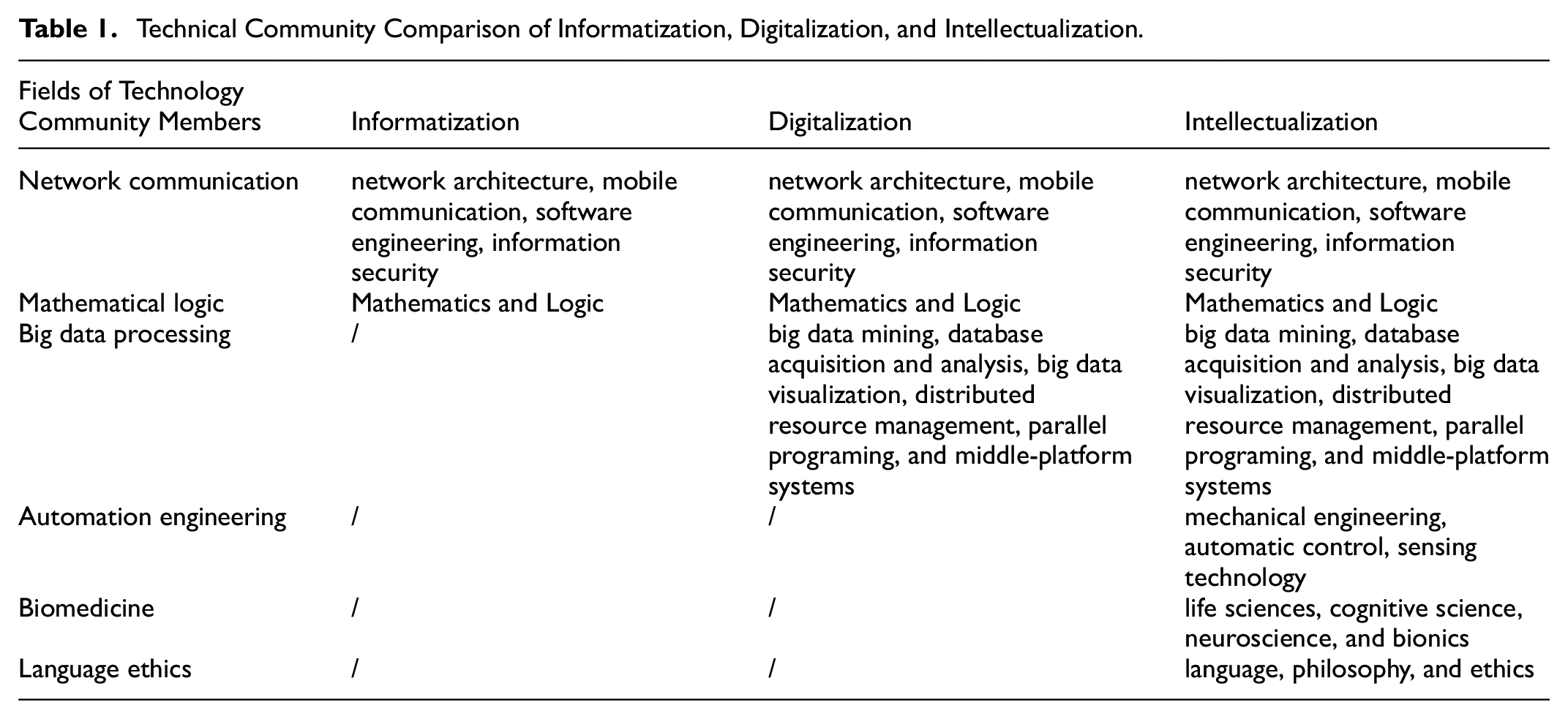
The information technology community comprises experts in network communication and mathematical logic. Mathematics and logic specialists provide quantitative logic and thinking rules for the emerging industries of information integration (Adner et al., 2019). Network communication technicians in network architecture, mobile communication, software engineering, and information security process the relational data in databases by developing resource, information, and customer management systems to improve efficiency without changing processes.
The digital technology community adds experts in big data processing to the information technology community (Liao et al., 2020). Massive unstructured data poses new challenges to traditional database analysis tools for informatization. These experts include big data engineers in big data mining, database acquisition and analysis, big data visualization, and cloud computing engineers in distributed resource management, parallel programing, and middle-platform systems (Qi et al., 2020). They are prominent members of the digital technology community, providing digital technical support to solve big data mining and processing problems. Digital technical experts are also a remarkable feature of this community’s complexity, interactivity, and integration compared with the information technology community (Sestino et al., 2020).
At the highest stage of the triple evolution, the intelligent technology community focuses on automation engineering, biomedicine, and language ethics. Mechanical engineering and automatic control technologies, known to automation engineering experts, ensure the precision of manipulation instructions during production to improve production efficiency and quality (Raisch & Krakowski, 2021). The application of sensor technology also improves the mobility and adaptability of intelligent robots. As AI enters the phase of bio-inspired intelligence, leading experts in life sciences, cognitive science, neuroscience, and bionics provide R&D support for genetic algorithms, machine learning, and bionic simulations (Abusubaih, 2022). At the same time, the penetration of technologies such as speech recognition and natural language processing has also caused experts in language, philosophy, and ethics to discuss intelligence in depth. As a result, AI is a comprehensive and highly cross-cutting composite discipline, and the intelligent technology community focusing on AI is more extensive and complicated to participate in (J. Lee et al., 2019).
Comparison of General Technologies
Informatization, digitalization, and intellectualization represent different forms of general-purpose technology application, and the core technology involved in the three processes is constantly expanding (Figure 1).

The relationship and comparison of general technologies.
The common technologies in informatization include 5G, the Internet, and the IoT. As a new generation of mobile communication technology with millimeter-level transmission delay and 100 billion connectivity, permeability, multiplicity, network, and systemic characteristics, 5G can realize information transmission anytime, anywhere at ultra-high speed and ultra-low latency (Buarque et al., 2020). The Internet, supported by 5G, provides the basic architecture for network interconnection between objects and devices. The information and communication industry has undergone large-scale transformation and reorganization around Internet technology. The IoT, built on the Internet, is the primary source of big data. From human–human to human–object to object–object interconnection, the IoT enables everything to interact with data through the network (Pike et al., 2009).
Compared with information technology, general digital technology includes big data, cloud computing, and edge computing. Big Data is a data collection that is so large that its acquisition, storage, management, and analysis greatly exceed the capabilities of traditional database software tools. Through the analysis and processing of these data collections, specific patterns in the data can be discovered to predict the future. Cloud and edge computing relies on computer storage systems and distributed structures for the deep collection and processing of big data and to quickly access a shared pool of configurable resources, such as networks, servers, storage, and software (Di Vaio et al., 2023). The general digital technology represented by big data, cloud computing, and edge computing promotes the knowledge, platformization, and integration of strategic emerging industries (B. Li et al., 2019). Based on digitalization, AI and digital twins have become the most distinctive general technologies for intelligence. AI uses big data, cloud computing, and edge computing to optimize its algorithm model (Mustak et al., 2021), simulate human thinking processes and intelligent behaviors, and build thinking and operating capabilities similar to or surpass the human brain. As the “genetic gene” of intelligent society, digital twins can predict the feasibility of innovative attempts and decisions in the virtual world by synthesizing and simulating virtual data (Paschen et al., 2020) and continuously optimizing them to reduce the cost of trial and error. These intelligent general technologies led by AI and digital twins have a full-process application foundation from R&D to production to sales (Giacomoni, 2022). They are gradually being invested in all aspects of the industrial chain and supply chain as a new production element and have become a decisive factor in the strategic emerging industry’s structure competition (Raisch & Krakowski, 2021).
Technical Cognition Comparison
The technical cognition of informatization comprises data thinking. Data thinking refers to the logic of using data principles, methods, and technologies to discover, analyze, and solve real-world problems, including quantitative, relevant, and experimental thinking (Alonso-Rorís et al., 2014). Building industrial informatization with data thinking is an important feature of the modern information society. Under data thinking, informatization communication channels replace traditional channels. Moreover, knowledge resources flow and are openly shared on various internet informatization platforms to realize industrial informatization interconnection (Deng & Liu, 2011).
The technological cognition of digitalization is cloud thinking. Data thinking cannot cope with the demand for unlimited, massive, and unstructured data mining and processing in the digital context, as it uses limited data in existing associative databases (Amorim et al., 2015). Thus, cloud thinking was born. Cloud thinking is a paradigm that emerged alongside the rise of cloud computing. On the one hand, it emphasizes the extensive unity and intersectionality of data, asserting that no interpretation or prediction of social and economic phenomena can be divorced from the real-time mining and processing of big data. It represents a borderless mindset that transcends geography, industry, and the interconnectedness of all things. On the other hand, it leverages the distributed systems enabled by cloud technology to facilitate efficient interactive computing of big data, thereby enhancing the development, management, and sharing of knowledge resources. This approach embodies distributed thinking, which simplifies associated complexities. Change, innovation, and accessibility are the fundamental characteristics of cloud thinking (Yoo et al., 2010; S. Zhou, 2012). Therefore, relying on the technical advantages of cloud computing, cloud services are provided through cloud resources and measures to realize collaborative learning based on cloud thinking and help industries transform effectively from low-end to high-end (Adner et al., 2019).
The technology cognition of intellectualization is human-like thinking. Human-like thinking is cognition that applies human brain functions such as learning, perception, recognition, and reasoning to developing AI robots and intelligent systems with intelligence similar to the human brain (Campbell, 2020). It is an extension and expansion of human intelligence based on cloud thinking. With the advent of the advanced AI era, this highly intelligent virtual platform serves as a tool to perform specific tasks. It is complex, with self-adaptive and human-like thinking capabilities that integrate environmental perception and decision analysis (Haefner et al., 2021). AI relies on visual interaction to detect, analyze, decide, and execute user and environment characteristics in organizing, processing, mining, and creating data information, enabling each link to operate with human-like thinking (Basole, 2021). Visual interaction gives full play to AI’s ability to perceive enterprise business processes and reconstruct new momentum for developing strategic emerging industries with human-like thinking.
System Architecture Dimension
Concept of System Architecture
System architecture describes the components of systems, modules, components, and frameworks, as well as their collaborative relationships, constraint specifications, and guiding principles (Mary & Rodrigues, 2012). It is the most rational approach to bring an individual team to a consistent level of thought within the constraints of available resources. System architecture promotes regional economic development and scientific and technological innovation, with functions such as integration and sharing and features that include scalability, security, and extensibility (Haenlein & Kaplan, 2021). The system architecture also effectively facilitates regional industrial upgrading and developing strategic emerging industries. The industrial integration promoted by informatization, digitalization, and intellectualization has led to a historical change in the entire emerging industry system architecture, mainly reflected in the interaction mode and the structural layer (S. Zhou, 2012).
Composition of System Architecture
Interactive Mode
Interaction is the interconnection behavior between two or more parties influencing each other. Human-computer interaction (HCI) is a user-centered design that aims to improve system availability, ease of use, and user-friendliness (H. Zhang et al., 2021). It can also open the knowledge channel of human-machine interaction and establish an interconnected relationship between users and a system (Toorajipour et al., 2021). From touch technology to multimedia technology and virtual reality technology, the development of human-computer interaction involves a process in which humans adapt to computers, and computers constantly adapt to changes in human needs (Guo, 2019; Xiao, 2019).
Structural Layer
A structural layer is a specific nested structure of different functional and interchangeable modules according to different architectures. Under the principle of hierarchy, different layers are connected through interfaces (Rui, 2018). At the same time, the subsystems and connecting layers and the interaction between them constitute the structural hierarchy framework. Rationalization and advancedization are inevitable requirements for optimizing and upgrading the industries’ structure under the joint action of internal and external paths (Liao et al., 2020). It includes the transfer of labor-intensive industries to knowledge and technology-intensive industries, as well as the high value-adding, high-technology, and high intensification of industries.
Comparison of System Architecture
Comparison of Interactive Methods
The development of informatization, digitalization, and intellectualization relies on using data information and human-computer interaction technology to achieve system integration from a qualitative to a quantitative approach. However, the three processes differ regarding human-computer interaction, presenting an evolution process from human–information system interaction (HISI) to human–cloud interaction (HCI) and then to human-AI interaction (HAII).
HISI is the starting point of human-computer interaction. This exchange is supported by information technology and computers as the operating platform. It is a cognitive interaction process in which humans process information, and the system responds to the information input with continuity, complexity, and dynamics (Pike et al., 2009). HISI uses computers and various information systems as tools and resources such as people, tasks, and information systems work together to share data, information, and knowledge. First, the information input from humans is converted into internal language. Then, the information system performs a series of operations, such as “judge intention—execute procedure—change state— output information.” Thereafter, the brain’s perception processor receives the information and makes decisions, leading to a new round of interaction (Alonso-Rorís et al., 2014). Therefore, information technology construction requires internal and external collaboration, technology-enabled enterprise management practices, information interaction and sharing through information platforms, and the reconstruction of organizational practices for the node enterprises in the strategic emerging industry chain.
HCI is a digital interaction method. The application of digital technology has realized value flow optimization, interaction production adjustment, and human-computer interaction upgrading. As a new networked and agile conceptual model, the cloud provides a powerful new vehicle for transforming from informatization to digitalization (Menz et al., 2021). Unlike HISI, HCI involves the integration of cloud platforms and digital systems, giving enterprises data, mobile, and IoT capacities without needing to master the original data technology. Cloud computing is the key to digitalization. Under the design of HCI, cloud data, computing, and storage provide platforms and carriers for data and information exchange as essential support for digital integration in new industries (B. Li et al., 2019). Users share cloud resources and services synchronously or asynchronously through interactive interfaces. A coherent cloud interaction platform can provide more personalized solutions in different digital scenarios and promote the popularization of “going to the cloud” (Demartini et al., 2019).
AI promotes upgrading human-computer collaboration from HCI to human–intelligence interaction. HAII is a human-computer interaction method that uses AI as an algorithm. Intelligent technology integrates the interaction between the user’s operations and the organization by simulating the usage scenario regarding thinking, psychology, and perceptions (Raisch & Krakowski, 2021). The intelligent ecosystem repairs, updates, and evolves itself based on changes in the data and is continuously upgraded (Alonso-Rorís et al., 2014). At the same time, developers integrate various AI capabilities into user-oriented systems. In addition to the original visual graphical interface, the product design also focuses more on the communication medium of light and sound effects, the expression of action and emotion, and the degree of perception of sensor devices (Y. Zhang et al., 2023). The multimodal linkage and organic coordination of light, sound, expression-action, and other multimodal modalities promote the efficient transmission of information in the link (Paschen et al., 2020). This multimodal user experience allows deep communication between humans and intelligent bodies and brings new opportunities for the value chain of strategic emerging industries. The future intelligence era will be a society of human-AI interdependence.
Comparison of Structural Levels
Strategic emerging industries rely on data and information much more than traditional industries. Integrating informatization, digitalization, and intellectualization into new industries promotes the advanced development of their industrial structure, and it presents an evolutionary trend of expanding scale and an increasingly complex structure at the basic, platform, and application layers (Figure 2).

Structure layer comparison of informatization, digitalization, and intellectualization.
Informatization, as the first breakthrough in industrial advancement, has reshaped the original industrial structure and provided real-time and accurate decision support for enterprise management. The basic layer of the information structure comprises the initial data set and hardware and software equipment. The data set includes system software, user, network, and flow meter data (Mahmood et al., 1998). The devices include software architecture, such as mobile terminal APP and user interfaces, and hardware architecture, such as terminal components, equipped with rapid data transfer rates and information processing capabilities through mobile network access. In the platform layer, Much unstructured data is collected, transmitted, and stored, and the traffic and user behavior models are established through algorithms (Sazonets, 2012). The decision information is passed to the server for processing, and the public network access is used to provide domain-wide services and status monitoring for each management system. Security quality assessment, mobile communication, and service information identification queries are performed in the application layer.
The digital structure level is further expanded through informatization. In addition to hardware and software devices such as sensors, the base layer includes unit modules such as data sets, resources, and knowledge (Sestino et al., 2020). The data set comprises network, environmental, equipment, and personnel data obtained after identification, collection, and cleaning. The resource modules are divided into physical resources (memory, servers, and databases) and corresponding virtual resource pools (Rui, 2018). The knowledge module includes user behavior, operations management, and decision-making rules. Technical means such as cloud computing systems and wired and wireless communication networks transmit and process the sensed data information in the platform layer (Vrana & Singh, 2021). At the same time, resource providers and users can access the resource-sharing pool without restriction. It is elastic and on-demand and can locate service modules by scheduling algorithms to quickly identify and match customer needs for the efficient collaboration of cloud service resources (Tilson et al., 2010). Finally, in the application layer, business management and essential services include (but are not limited to) optimizing and balancing complex resources based on platform construction middleware, achieving security deployments such as risk identification and fault detection through multi-source massive information aggregation, using cluster resources to simulate planning and scheduling and other multi-task management functions, and ubiquitous IoT applications and applications in other scenarios (Sjödin et al., 2018).
The structure level of intellectualization is an expansion and extension of digitalization in both content and structure. The new intelligent resources, capabilities, and products, as well as the sensing, access, and communication layers, are important components of its foundation. New intelligent resources include simulation devices, new materials, and new energy. New intelligent products include cloud-based and networked products, and new intelligent technologies include QR codes and sensors (Spanaki et al., 2021). Within the platform layer, the intelligent architecture platform comprises the virtual, service, technology, and user interface layers. New resources, products, and technologies in the foundation layer are virtualized and encapsulated via edge processing and digital twins to form cloud-pool virtualized resources (Agrawal et al., 2023). The intelligent system service contains common foundation parts such as big data engines and embedded simulation. The technology layer covers the underlying framework, algorithm theory, and common technologies. It aims to form effective application technologies by establishing algorithm models. Finally, the user interface layer provides users with pervasive intelligent terminal interaction devices and personalized custom interfaces (Buhmann & Fieseler, 2021). Each hierarchy is independent but functionally connected, following the programing principle of “high cohesion and low coupling” to meet the need for agility and stability while continuously improving the system’s internal extensibility, repairability, and reusability. The application layer at the top of the structure is divided into the scene application and the consumer terminal (Dwivedi et al., 2021). The former includes smart medical, driving, and manufacturing fusion fields, while the latter involves drones, robots, smart hardware, and other fusion products. In summary, the industrial system under the intelligent integration in new industries has structured a “user-centered, flexible, customized, and a service-oriented new model of human ± machine ± object ± environment ± information synergistic integration and a new industry of service sharing and interconnection of all things” (B. Li et al., 2019).
Integration Capability Dimension
Concept of Integration Capability
Integration capability is a collection of capabilities that allow industries to fully utilize resource elements such as technology, capital, and talents to achieve penetration, crossover, and reorganization between different industries or sub-industries within an industry (Cheng & Yang, 2019). The wider the industrial integration foundation, the deeper the application, the stronger the integration capability, the greater the competitive advantage, and the more the newly formed industrial system can achieve functional complementation and extension after being bestowed with new additional functions (Amorim et al., 2015). Industry integration capability, a critical condition for industry integration, is a collection of multiple capabilities divided into three dimensions: systems integration, integrated innovation, and self-evolution capabilities (Kiamehr et al., 2014).
Composition of Integration Capability
Systems Integration Capability
Systems integration capability is the ability to define, coordinate, and unify different subsystems and their interdependence (Hobday et al., 2005). This ability is based on the attributes of the activities and can be divided into the following capabilities. The first is resource system integration capability, which is the ability to optimally allocate and reorganize resource elements, such as knowledge, technology, and human resources, to transform the advantages of resource combinations into market share (Holmqvist & Persson, 2003). The second is project system integration capability, which involves the activities conducted before, during, and after the start of complex product projects (Stadler, 2011). It includes management design, procurement, and installation. The third is functional system integration capability, which involves defining solutions in core technical areas around system engineering, software design, and providing services required for integration (R&D, operation, maintenance, finance).
Integrated Innovation Capability
Integrated innovation capability is a system of capability elements that extends innovation, digestion, and absorption capabilities to the economic market (Hobday et al., 2005). These capabilities can be decomposed into the following. First, strategic integrated innovation capability is a collection of strategic attributes that allow enterprises to determine the status of the industry value chain and their strategic focus in the innovation process to enhance sustainable competitiveness (Kiamehr et al., 2014). Second, knowledge integration innovation capability is an organization’s ability to continuously expand knowledge reserve assets by classifying, processing, and refining its existing knowledge. When it is challenging to adapt the traditional structure to the requirements of the new environment, the enterprise must break some of the rules of the linear organization. Third, people-oriented organizational integration innovation ability is the core of implementing strategic and knowledge integration (Wang, 2019).
Self-Evolution Ability
Self-evolution capability is an organization’s ability to adapt to environmental changes and maintain a sustainable competitive advantage during evolution (Krinkin et al., 2023). This capability can be divided into the following. First, self-adaptive capability involves adapting the characteristics and functions of the system to render its behavior optimal or at least within the tolerance range in the context of the changing environment (H. Zhang et al., 2021). It is the prerequisite and basis for an enterprise’s survival. Second, self-organization capability is an organization’s ability to evolve and self-improve its behavioral structure. Without external instructions, organizations coordinate with each other according to inherent rules to form an orderly structure (Fatima et al., 2020). Third, adaptation is how organizations learn to accumulate and improve knowledge based on experience. Therefore, as one evolutionary capability, self-learning capability automatically improves, designs, and corrects the system structure by assessing the correctness of existing behaviors.
Evolution of Integration Capability
System integration, integrated innovation, and self-evolution abilities represent the composition and evolution of integration ability, presenting a three-stage fusion of “system integration—integrated innovation—self-evolution.” Organizations in the new economy complete the initial innovation of the traditional organizational paradigm by integrating resource, functional, and project systems (Basole & Accenture, 2021). Then, based on limited resources and established paths, they use the technology paradigm of decomposition—collaboration—integration of system modularity in complex product design, manufacturing, and management to adjust organizational practices and continuously overcome the rigidity of core competencies to achieve incremental innovation (Deng & Liu, 2011).
However, relying on system integration capabilities to complete the transition from integrated product architecture to modularity is not enough. Companies must also develop integrated innovation capabilities in strategy, organization, and knowledge to enhance their functional multiplicity, environmental adaptability, and the overall performance of complex products. They must also build and reconfigure their core capabilities in an environment of accelerated change (Stadler, 2011).
Therefore, organizational learning and knowledge innovation require enterprises to improve their self-evolutionary capability and transition from the lower-order capability to higher-order capability to maintain system integration and integrated innovation capabilities to match the leap in enterprise structure (Girod & Whittington, 2017). Evolutionary capabilities help enterprises deepen the absorption and use of their existing capabilities and improve existing technologies and complex product systems. Such capabilities also promote the collaboration of various enterprises in the innovation ecosystem through knowledge co-creation and evolution to adapt to the changing laws of the strategic environment and improve the overall performance of the industrial innovation ecological community (Hobday et al., 2005).
Comparison of Integration Capability
Informatization: The Primary Stage of Integration Capability
In strategic emerging industries, core capacity building for information technology occurs at the primary stage when enterprises have low system integration capacity. Strategic emerging industries use the modularization of technical knowledge systems as a cornerstone, with their system integration capabilities focusing on coordinating and coupling internal and external systems. The resulting sustainable competitive advantages can provide an internal driving impetus for high-speed industrial development (Holmqvist & Persson, 2003). However, in the process of informatization construction, establishing business systems with different purposes isolates systems from one another, resulting in many scattered and independent heterogeneous systems. This “information silo” phenomenon means information and data cannot be shared promptly and effectively. As a result, the organization’s information management, resource development, and utilization are low, and the system integration capability is weak, which causes a significant gap in the restructuring and transformation capability.
Digitalization: The Intermediate Stage of Integration Capability
With the proliferation and extension of digital integration between industries, digitalization is located in the intermediate stage of integration capability. Compared with informatization, enterprises undergoing digitalization have enhanced system integration capabilities and a certain degree of integrated innovation capabilities (Q. Liu & Wang, 2023) . On the one hand, digital technology helps cultivate the integration capabilities of business modules and assists in the efficient flow of data and control over real time. It upgrades resource allocation, project operation, and function construction (Di Vaio et al., 2023). On the other hand, the system integration capability of data resources determines the degree of an enterprise’s digital development, which determines the room for cost reduction and efficiency improvement. The enterprise’s control and knowledge utilization capabilities are strengthened due to the expansion of the technical foundation and the extension of application fields. Additionally, the new generation of information technology, with the IoT, big data, and cloud computing at its core, is integrated into the digital management system (Sestino et al., 2020). As a result, the internal barriers of enterprises are broken down to realize the digital penetration of the whole process in interactive empowerment and innovative synergy, reconstructing the physical and digital space.
Intellectualization: The Advanced Stage of Integration Capability
Compared with digitalization, enterprises undergoing the process of intellectualization achieve a higher degree of synergy between system integration, integrated innovation, and self-evolution capabilities, reaching the advanced stage of integration capability (Qin et al., 2023). First, strategic emerging industries’ production technology and product update speed are much higher than other industries, placing higher requirements on enterprise management. Intelligence is a secondary innovation process in the “introduction—digestion—absorption—re-innovation” transition based on digitalization. Its purpose is human-machine coordination for integrated management, which can efficiently integrate resources (Giacomoni, 2022; Haefner et al., 2021; Qi et al., 2022). Second, as a high-precision technology complex, AI aims to break through industrial commonalities and key technologies (Guo, 2019). It uses “data ± information ± knowledge” in the three levels of data preprocessing, deep network design, and decision-making. Intellectualization accelerates the construction of cross-industry collaboration platforms, realizes the comprehensive penetration of AI in strategic layouts, and creates an integrated innovation organic whole (Toorajipour et al., 2021). Additionally, enterprises have strong self-evolutionary capabilities. They complete the progression to the intelligence level via the three levels of self-adaptation (low-level intelligence), self-organization (intermediate intelligence), and self-learning (high-level intelligence). The intelligent system features anthropomorphic intelligence characteristics such as simulation, extension, coordination, and repair and can automatically perceive, recognize, and adapt to internal and external environments. The system extracts and remembers effective content after perceiving changes and allows the organizational structure to evolve spontaneously by interacting with the environment (Dwivedi et al., 2021). Moreover, through knowledge learning practices, the intelligent system performs complex calculations and error corrections under the guidance of programs to accomplish tasks automatically.
In integrating strategic emerging industries with informatization, digitalization, and intellectualization, the core competence of enterprises follows a three-stage evolution of integration competence. This three-stage evolution involves moving from the initial stage of informatization to the intermediate stage of digitalization and then to the advanced stage of intellectualization (see Figure 3). Finally, the enterprise develops into a new form, an intelligent network ecosystem based on environmental self-adaptation, self-organization, and a self-learning “meta-learning” system. Furthermore, it is based on integrating multiple chains, such as knowledge, technology, and relationship chains, and all enterprises’ joint participation to form a mutually beneficial symbiotic and collaborative evolution (J. Zhang & Luo, 2019).
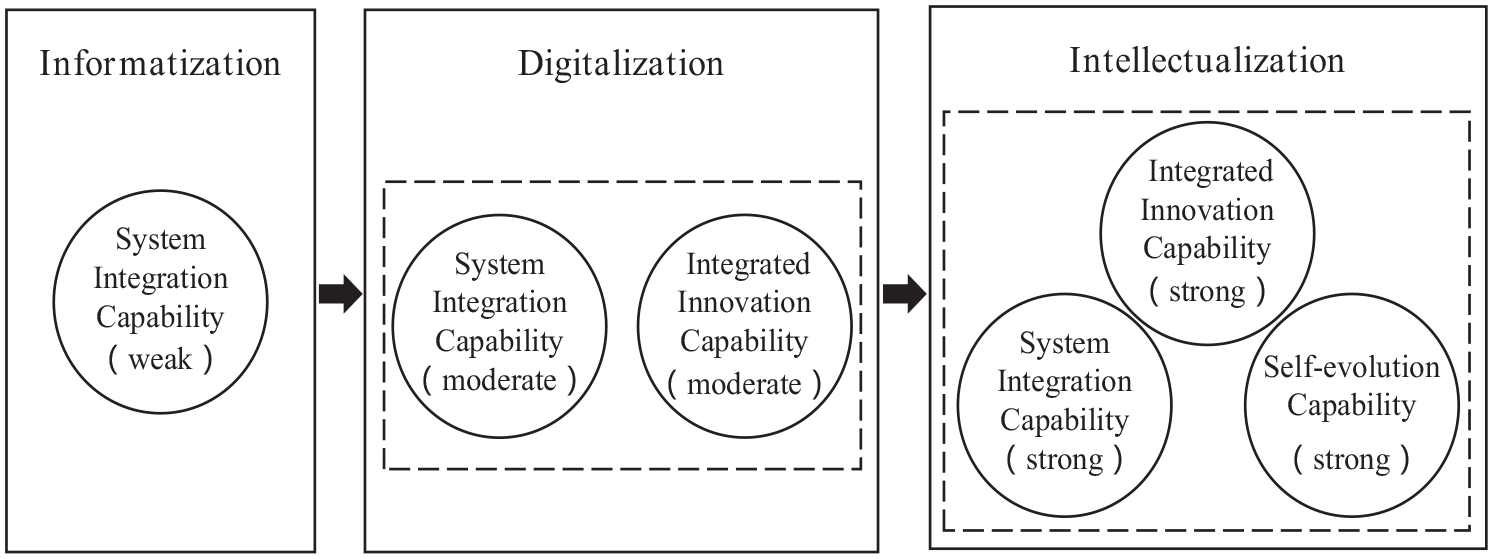
Three-stage model of the evolution of Informatization, Digitalization, and Intellectualization integration capabilities.
Conclusion
Discussions
This study analyzed the characteristics of informatization, digitalization, and intellectualization and proposed the iterative evolution logic of all three. It also compared the potential of the three processes for industries, especially strategic emerging industries, from the three dimensions of technology paradigms, system architecture, and integration capability (Figure 4). Finally, it argued that intelligent integration is the model with the most potential for growing these strategic emerging industries.
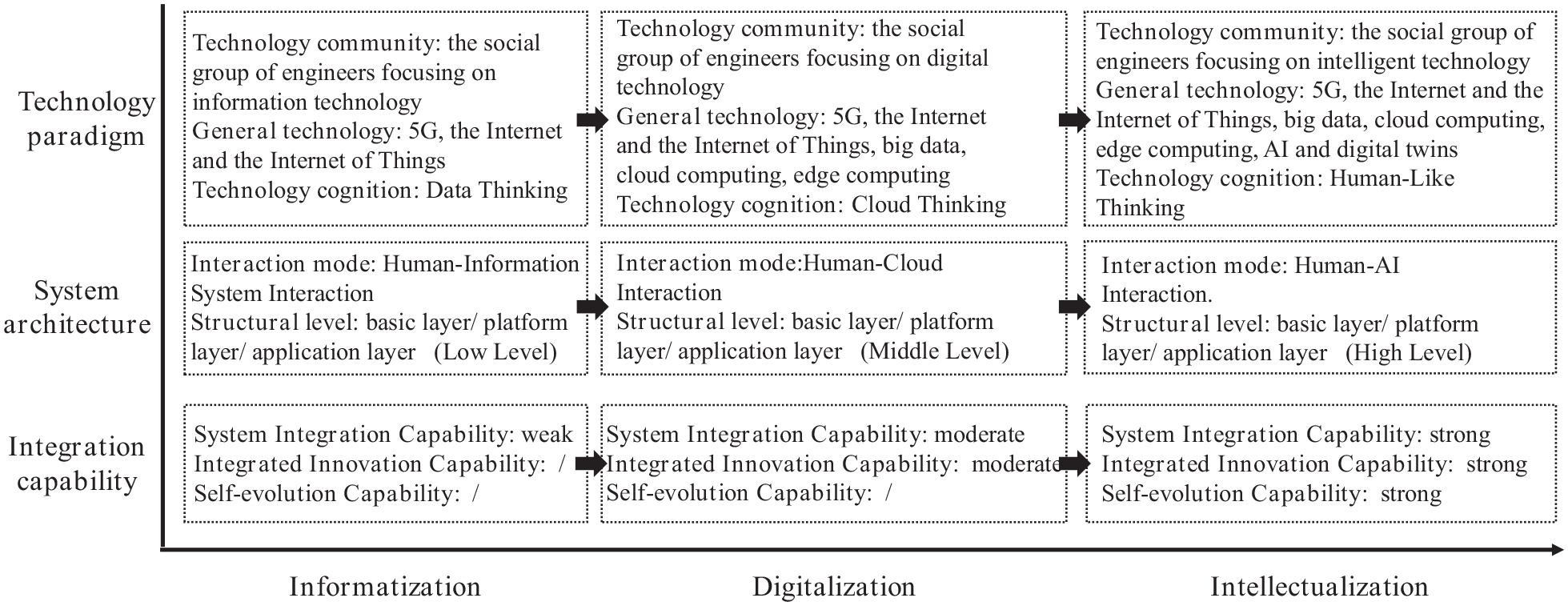
Summary of three-dimensional comparison of integration potential.
The study found that informatization, digitalization, and intellectualization are conceptually different and present an iterative evolution relationship. Existing studies mainly put forward the connotation of informatization, digitalization, and intellectualization from a single perspective, with less comprehensive and integrated results. These studies focused on their connotations and paid less attention to the differences between informatization, digitalization, and intellectualization, leading to confusion, which affected further research. Based on the complete integration of the existing literature results, this paper provides a more precise definition of the connotation of intellectualization from informatization and digitalization and, accordingly, distinguishes their similarities and differences. Informatization represents the state in which information technology and resources are highly shared and promotes industrial development through information industrialization and industrial informatization. Digitalization empowers the data-driven value creation process by functioning through the binary system to simulate information conversion. It gives rise to transforming and upgrading current business models and builds an industrial digital ecosystem. Intellectualization has anthropomorphic intelligence features, such as self-adaptation, self-organization, self-learning, and self-repair. It provides a new optimization model for reconfiguring the industrial value network by applying AI’s data, algorithms, and arithmetic power.
It is also noteworthy that informatization, digitalization, and intellectualization present an iterative evolution relationship. Because there is no clear distinction between informatization, digitalization, and intelligence, existing literature has given rise to cognitive problems such as “informatization is equal to digitalization,”“digitalization includes intelligence,” or even “digitalization covers everything.” This study shows that informatization, digitalization, and intellectualization have an iterative evolutionary relationship. On the one hand, the three processes evolve progressively and are involved at different stages of development, from low-level to high-level development. On the other hand, the three complement each other and jointly promote high-quality industrial development. The basis for developing AI are 5G, the IoT, big data, cloud computing, and other technologies brought about by informatization and digitalization. Further, applying intelligent technologies and systems feeds back into information/digital technologies.
This paper is the idea that intelligent integration is the model with the most potential for the high-quality development of strategic emerging industries. Existing research rarely involves the integration of informatization, digitalization, and intelligence with strategic emerging industries, especially the comparison of the potential of the three to integrate strategic emerging industries, which leads to the fact that the high-quality development of strategic emerging industries has never been able to establish an effective carrier. Through comparative research, this paper demonstrates that intelligence is the most potential enabling model for strategic emerging industries in terms of technological paradigm, system architecture, and fusion capability dimensions. First, the field of composite talents in the technical community is expanding through informatization- digitalization- intellectualization. Furthermore, general technology has developed from 5G, the Internet, and the IoT into big data, cloud computing, AI, and digital twins. The technical system is gradually completed and enriched, corresponding to the technical cognition of big data, cloud, and human-like thinking. Second, there are commonalities between informatization, digitalization, and intellectualization, which all involve human-computer interaction. Therefore, there are differences in human–information systems, human–cloud, and human–intelligence interactions. The three structural levels of the foundation, platform, and application layers show a progressive trend of low, middle, and high order, respectively. Third, the core enterprise capacity building in integrating informatization, digitalization, and intellectualization into strategic emerging industries follows a three-stage evolution of integration capabilities. Informatization integration is the primary stage, and enterprises have weak system integration capabilities. Digital integration is the intermediate stage, and enterprises have a medium level of system integration and integrated innovation capabilities. When they develop to the mature stage of intelligent integration, enterprises reach the synergy of strong system integration, integration, innovation, and self-evolution abilities. Consequently, this study concludes that intellectualization is the most effective choice for developing strategic emerging industries.
In conclusion, this study’s findings have important theoretical, managerial, and policy implications:
Theoretical Implications
First, the fundamental logic and inherent potential of intelligent integration are clarified. This paper extracts the evolutionary linkages between informatization, digitalization, and intellectualization by offering clear definitions and distinct differences. It is a supplement to the original relationship logic and a research attempt to explore and break through the iteratively evolutionary patterns of the three in the context of intellectualization. At the same time, this paper innovatively deconstructs the potential of integrating informatization, digitalization, and intellectualization into emerging industries from technological paradigms, system architectures, and integration capabilities. It demonstrates that intelligent integration is the most promising model for strengthening strategic emerging industries, helping to clarify misconceptions and research challenges in the academic community regarding the relationships between informatization, digitalization, and intellectualization, and establishing a theoretical foundation for empowering the development of strategic emerging industries led by intelligent integration.
Second, it has deepened the study field of intellectualization. This paper proposes a more comprehensive and systematic intelligent integration system from the perspective of industrial integration. It refines the dimensional classification of intelligent integration paths. It clarifies the essential attributes and operation logic of the “AI+” model from the structure, activity, and element levels, which helps construct the theoretical framework for intelligent integration.
Third, it has broadened the scope of interdisciplinary research on strategic emerging industries. Compared to the existing perspectives on informatization and digitization, this paper provides a detailed analysis of the enabling mechanism of strategic emerging industries from the intelligence viewpoint. It extends the boundary scope of strategic emerging industries and industrial integration interdisciplinary research fields, which makes it of crucial academic value.
Managerial Implications
The research results of this paper not only have significant academic implications but also can provide valuable insights for managers. It helps managers clarify the overall positioning and critical tasks of intelligent integration in strategic emerging industries; accelerates the research on fundamental theories and applied technologies of enterprise intelligence; breaks through the vital core technology barriers; focuses on the research and development, production, and promotion of crucial intelligent products; innovates the business model; and facilitates the process of intelligent integration in strategic emerging industries.
This paper emphasizes the necessity for managers to focus more on enterprise intelligent integration. It is crucial to fully recognize the driving value of data resources and digital technology in intelligent integration. Moreover, a thorough analysis of an enterprise’s opportunities, challenges, strengths, and weaknesses is recommended to develop an intelligent integration strategy that aligns with the organization’s unique resources and capabilities.
Managers need to reform the hierarchical organizational structure of information congestion and bureaucratization within the enterprise, create a new organizational structure that is platform-based and atomized, empower the technical team with full autonomy to innovate, break through bottlenecks obstructing internal communication, and enrich the decision-making entities and their sources. Simultaneously, managers need big data to strengthen the adhesion with partners and build a more ecological industrial chain relationship to promote the intelligent integration activities of enterprises.
Policy Implications
This paper focused on the iterative evolution of informatization, digitalization, and intellectualization to offer directions for policy formulation through clear, scientific, and strategic guidance. Precise top-level planning and directional guidance lead to efficient intelligence implementation in industries and enterprises. For instance, the government should strengthen regulation and governance, optimize the mechanism for investment in basic research, accelerate the development of open data platforms, establish an ecosystem for intelligent integration and innovation, promote the balance of supply and demand in intelligent integration, create collaborative models for intelligent industry systems, and enhancing the capability for constructing application scenarios.
Research Limitations
Nevertheless, the study has some limitations. First, by only employing a qualitative, theoretical approach, the study’s conclusions lack the practical verification of quantitative data, which somewhat weakens their persuasiveness. Second, the field of industrial integration involves multidisciplinary content. This study mainly focused on technical characteristics and modes of action, ignoring other factors that may impact the effect of integration, such as industrial evolution processes and types of industrial integration, meaning the research is somewhat one-sided. Third, this study focused on selecting and judging the most effective mode of integration and failed to elaborate further on the operation mechanisms of such integration. Therefore, it is important to clarify the relationship between informatization, digitalization, and intellectualization using various research methods, perspectives, and contents and to explore the inner mechanism of the intelligent integration of strategic emerging industries.
Future Outlook
In terms of research methods, the corresponding scale is designed using the three-dimensional comparison framework of technology paradigm, architecture system, and integration capability as a reference to empirically evaluate the integration potential of informatization, digitalization, and intelligence to support the conclusion. In terms of research perspectives, the differential impact of macro and micro factors such as industry type, integration process, regional characteristics, and industry scale on integration potential is explored. In terms of research contents, they follow the logical line of “theoretical deduction - mechanism analysis - empirical research -policy design” and focus on core issues such as “How to Deconstruct the Integration Path? What are the driving factors of integration? How should the integration promotion effect be assessed? How can integration be promoted?” First, the enterprises, industries, and environment that affect the integration effect are used as internal and external driving factors to examine the integration mechanism; second, the promotion effect of intelligent integration is measured from the two-dimensional indicator of efficiency and efficiency. Last, the evolutionary game is used to explore the optimization paths of each major participant in the integration process, such as the government, consumers, and enterprises, in the context of the dynamic equilibrium of interests and make policy recommendations accordingly.
Originality
The paper innovatively conducts a comparative study on the relationship between informatization, digitalization, and intellectualization, as well as their potential for integrating with strategic emerging industries. The research findings reveal that informatization, digitization, and intelligence exhibit an iterative and evolutionary relationship, indicating that intelligent integration is the best enabling model for strategic emerging industries.
Footnotes

Author Contributions
Author Shenghua Zheng identified the topic, established the theoretical framework, wrote most of the paper, and conducted revisions and improvements; author Haijie Chen performed literature collection, organization, and quantitative analysis.
Funding
The author(s) disclosed receipt of the following financial support for the research, authorship, and/or publication of this article: This paper was supported by China National Social Science Foundation (Research on the mechanism, path, and policy of leading science and technology enterprises in leading the construction of national strategic science and technology forces, 22BGL286)
Declaration of Conflicting Interests
The author(s) declared no potential conflicts of interest concerning the research, authorship, and/or publication of this article.
Data Availability Statement
Data sharing is not applicable to this article as no datasets were generated or analyzed during the current study.