




Abstract
Gender-based disparities in air transport industry have been reported in the literature, while less attention has been given to the gender-wage gap. Meanwhile, Korea constitutes a unique environment for gender-wage disparity. Suspecting the gender-wage gap in the air transport industry of Korea, this study utilizes microdata made available by the Ministry of Employment and Labor between the years 2015 and 2022. Through empirical analysis of data, the current study finds that male workers earn 6.3% more than the female workers working in the industry. Age did not have a significant interactive effect with gender when determining wage, but education had a significant interaction effect with gender on wage determination. In overall, results show support for demand-side explanations rather than supply-side explanations of the gender-wage gap. Theoretical considerations and implications for the practitioners are discussed along with the findings of the study.
Introduction
Background of the Study
Historically, the formidable growth of the air transport industry has been underpinned by diverse workforce employed across the sector: from pilots, mechanics, engineers to flight attendants and ground staff. Such human resource is indispensable in carrying out everyday activities and operations of any airline. Yet, there have been longstanding claims that human resources in the air transport industry are being subjected to various incidences of inequality including gender-based bias, prejudices, and disparities (Singh et al., 2022). For example, women in the industry are expected to deal with various forms of “glass ceilings,” and this may discourage them from working in or maintaining their positions within the industry. In an industry that is already facing difficulties recruiting adequate number of talents, the issue of women’s participation and gender-based disparities should be carefully addressed with the sense of urgency (IATA, 2024a).
Meanwhile, the sense of such urgency seems particularly conspicuous for countries rather more reliant on air transport for passenger traveling and flow of goods. South Korea (hereafter Korea), due to its geopolitical environment, is effectively an island in terms of transport for most practical purposes. As traveling through North Korea is not feasible, connection with the rest of the world is facilitated through the country’s airports and ports only. For this reason, since the opening of the country’s major international airport in Incheon, a constant growth of international passengers has been witnessed with the sole exception of the period plagued by the coronavirus pandemic. Before COVID-19, the total number of inbound passengers reached 17.5 million, and as the pandemic is becoming irrelevant to travel decisions a swift demand recovery to pre-pandemic level is expected (STATISTA, 2024b). In economic terms, it estimated that the air transport industry contributes 3.4% to the gross domestic production (GDP) of the country and employs up to 838,000 people, of which 158,000 people are employed directly and 680,000 are employed indirectly through linkages such as tourism and hospitality sectors (IATA, 2024b).
The formidable industry is led by two major Korean carriers: Korean Air and Asiana Airlines. While the two airlines have received numerous awards for their excellence in customer service, they have also had a history of being under scrutiny for suspicion of practicing gender-based stereotyping and discrimination. For example, the National Human Rights Commission accused Korean Air of discrimination against male applicants because the company’s official policy was to select only female applicants for certain jobs (Korea Joongang Daily, 2024). Policy changes have been implemented since; however, the vast majority of flight attendants are still women. Also noteworthy in this regard is the gender ratio for pilots. While there are 4% to 6% of women pilots globally (CAPA [Center for Aviation], 2024) and in the United States the percentage is approximately 5%, in Korea the percentage is as low as 0.4% (The Dong-a, 2024).
Effect of COVID-19 on Airline Labor
Before COVID-19, the total number of inbound passengers reached 17.5 million, and as the pandemic is becoming irrelevant to travel decisions a swift demand recovery to pre-pandemic level is expected (STATISTA, 2024b). In economic terms, it estimated that the air transport industry contributes 3.4% to the gross domestic production (GDP) of the country and employs up to 838,000 people, of which 158,000 people are employed directly and 680,000 are employed indirectly through linkages such as tourism and hospitality sectors (IATA, 2024b).
The global airline industry experienced rapid and for the most part, uninterrupted growth since the end of World War II with few exceptions, recent one of which was the COVID-19 pandemic that led to devastating consequences for the industry. The total number of passengers, on a global level, declined from 4.5 billion before the pandemic to 1.8 billion after the outbreak (STATISTA, 2024a), causing a chain of airline bankruptcies. Even the airlines that managed to survive undertook workforce reductions ranging from 30% to 60% (Guardian, 2024a). After the end of the pandemic, however, as the industry is experiencing fast recovery in terms of traffic and profitability, staff shortages have become increasingly problematic as the rate of recruitment does not match the resurge in demand.
Despite offering higher wages and more competitive benefits, airlines are facing challenges in recruiting adequate number of skilled staffs, even resulting in some airports suffering from long waiting queues with flights being canceled or rescheduled (Stalnaker et al., 2024), while the situation can be worsened by labor practices deemed unfavorably by potential workers. More specifically, through the above line of reasoning it can be deduced that gender-wage disparity can deter participation of qualified talents in the industry. Therefore, delving into the issue would be timely and meaningful as the accelerated demand recovery from COVID-19 leave the airlines in great demand for competent human resources. However, there has been a lack of empirical studies offering applicable findings. Although relevant studies from the service industries offer some findings and insight on the issue, these cannot be easily generalized for the airline workforce.
Problem Statement and Expected Contribution
Among the various forms of gender-based disparities, wage gaps, in which male and female workers earn different wages for the same job qualifications, demands and performance, can be the most visible and arguably the most critical. The Organization for Economic Co-operation and Development (OECD) reports that Korea has the highest gender-wage gap among its member states at 31.1% and recommends that this gap should be addressed in order to ensure economic and demographic growth (Hankyoreh, 2024; OECD, 2024). In this light, given its socioeconomic importance, a deeper understanding of the potential obstacles to development of the Korean air transport industry is warranted.
For example, C. K. Lee and Kang (1998) found that women in the Korean tourism industry are employed at low-end jobs commanding lower wages. Focusing on gender wage disparity at a more general level, Jung and Cho (2020) find that the education level of Korean women has increased continuously, and, consequently, it increased their labor participation; however, their labor participation resembles “the M-curve.” While it is quite high in their 20s, in their 30s it drops as a result of marriage, childbirth, and childcare, after which it increases again in their 40s. As a result, they tend to work in irregular jobs and earn significantly lower than before. Paik (2014) reveals that Korean women earn only 64% of their male counterparts, while the difference is not explained by personal factors such as educational qualifications, age, or experience (Paik, 2014).
Albeit from different contexts, limited evidences are also available from the global air transport industry. The air transport industry is known for rather strong gender/occupational segregation while these segregated jobs usually command lower wages. This is elaborated by a gendered labor queue. A high portion of females in an occupation devaluates their work, ultimately causing their lower pay (Campos-Soria et al., 2009). The air transport industry, despite providing high-end service, is not exempt of the phenomenon and the existing wage gap may not be explained solely by devaluation. Although women are still concentrated in the occupation of flight attendants Addis et al. (2023) report that male flight attendants earn on an average higher salary and receive more promotion opportunities than their female counterparts.
Accordingly, this study empirically examines the gender-wage disparity in the Korean air transport industry, utilizing the labor statistics data from the Ministry of Employment and Labor of the Republic of Korea between the period of 2015 and 2022. In investigating the gender wage gap, we also explicitly incorporate into the research model potentially interrelated effects of age (Tyrowicz et al., 2018) and education (de la Rica et al., 2008) in order to provide additional insight into the two conspicuous confounding variables. matter. The study is unique in two ways; first, apart from extant studies that empirically analyze gender wage disparity based on job categories (Brick et al., 2023), this study aims to provide a more industry-focused understanding by focusing on the wage differentials of the industry, thereby yielding more applicable findings to the industry practitioners. Second, while a number of studies only consider limited theories in explaining wage disparity, this study applies theoretical and methodological framework using microdata that combines both supply-side and demand-side theories (Magnusson, 2010) to maintain an impartial view. Consequently, it is expected that the findings can contribute to an unbiased and accurate understanding of the phenomenon and in turn, contribute to development of human resource practices attracting talents to the industry.
Consequently, it is expected that the findings can contribute to an unbiased and accurate understanding of the phenomenon and in turn, contribute to development of human resource practices attracting talents to the industry. A better understanding of the problem on hand is of utmost importance as the long-run implications can be far-reaching, including widening of the wage gaps (Bruns, 2019) and hindrances to the growth of the industry (Schober & Winter-Ebmer, 2011)
Literature Review
Current State and Trends of the Air Transport Industry
Since the 1950s, capitalizing on the WWII technological advancement of military aircrafts, commercial aviation witnessed rapid yet continuous growth. The continuity of growth was seldom interrupted, only by major geopolitical risks or economic crises: for example, the 1997 Asian Financial Crisis, the 9/11, or the 2008 Global Financial Crisis (ICAO, 2024). After the shocks from these events, however, the traffic demand recovered in a rather swift fashion, showing the resilience of the industry and its significance in people’s lives and the world economy. The shock from COVID-19 pandemic, despite its unprecedented magnitude, is also to be interpreted in the same vein; air traffic declined to record low numbers in 2020, but is expected to almost fully recover by 2023. According to Airports Council International, the number of passengers would reach 9.4 billion in 2024, surpassing 2019 levels by 2%.
This sharp rise in demand is naturally followed by additional pressure on airlines to secure competent human resources. However, after the massive layoffs during the pandemic, there seems to be an industry-wide difficulty in search and recruitment of qualified workforce leading to extraordinary situations; in the US, for instance, flights are being canceled because of the lack of staff. Such shortage of human resources in the industry ranges from pilots, mechanics, and air traffic controllers to ground crews (U.S. Chamber of Commerce, 2024). The situation is not unique to specific countries, as Lufthansa and Swissport reported to have only 72% and 70% of the workforce they had before the pandemic. Despite the efforts made by airlines to counter the situation, the issue is likely to persist. New hires are required to pass rigorous and lengthy training, while some portion of the experienced staff that was made redundant during the pandemic changed careers already (Sobieralski & Hubbard, 2023).
Meanwhile, the industry is further challenged by strikes and picket protests. Flight attendants in the US have been organizing picket protests requesting higher wages and retirement security (Guardian, 2024b). Lufthansa ground staff recently initiated a strike across Germany, causing major disruptions in European air traffic and harming the whole German economy (Reuters, 2024). These should be resolved by addressing the overall problem of low wages, pensions, and other benefits that continue to drain airline staff internationally. Furthermore, the current spike in labor shortage should be addressed through active measures on recruitment and retention policies. Hidden bias in job posts deterred around 50% of female engineer applicants (Openreach, 2024). Similar findings were also seen in medicine, where female surgeons stressed the lack of support and gender bias as the main deterrents for women in becoming surgeons (CIPD, 2024). Air transport industry is no exception to this phenomenon, with the existence of an “old boys” network and gender-related comments that create psychological and practical obstacles for women (UWE Bristol, 2024).
Gender Disparities in Airline Industry
Gender stereotypes and gender bias in the workplace have been well-documented across diverse professions all over the world. Tang et al. (2017), who examined gender bias in job advertisements, demonstrated its negative influence on the recruitment process. The authors conducted a longitudinal analysis of 17 million online job listings across 140 industries and found the existence of listings with masculine, feminine, and neutral tones. Most applicants assumed that gendered tones correlated with the requirements of the job, even when the actual job requirements did not correlate with any specific gender. Potential applicants were discouraged from applying as they expected the job to be intended for the opposite gender. Females were less likely to apply for jobs with masculine tones, whereas males were reluctant to apply for job listings displaying female tones. Results changed when the tone was a neutral one. Neutral job listings appeared the most attractive to both genders. Neutral tones were attributed to the existence of equal chances and equal rights, showing the employer’s conciseness and effort to ensure an inclusive working environment (Tang et al., 2017).
Negative effect of gender bias on the recruitment of future talents is also evidenced by Ashnai et al. (2020), who demonstrated that men are more preferred for entry positions in B2B sales due to gender stereotypes and prejudices. Men were assumed to be have aggressiveness, assertiveness, and confidence, which are traditionally believed to be desirable traits for salespeople. In reality, the sales records often showed no difference between the performances of men and women, showing no support for such practice. The study also found recruitment bias, through which the recruiters often evaluated male and female candidates with the same qualifications differently. It further revealed that recruitment bias is the main reason behind the industry’s inability to recruit an adequate number of female salesmen. Such practice is to the disadvantage of the companies not only because it results in shortage of workforce and lack of gender representation. Clients are diverse in their demographic nature and needs, and having diversity in the team helps increase the chance of sales (Ashnai et al., 2020).
Gender disparity can plague performance of companies after recruitment. Brands and Fernandez-Mateo (2017), who conducted a study on highly qualified female professionals across industries, discovered that many of them opt out from the competition for senior management positions. These professionals prioritize fairness and transparency in the competing process. Upon perceiving that they may be discriminated against because of their gender, many tend to give up on promotion entirely. Similar behavior can be observed in different contexts as well. Female candidates, compared to their male counterparts, are less likely to re-apply for the position at company that rejected them in the past (Brands & Fernandez-Mateo, 2017). The authors cite the reasons behind as the perceived bias within the recruitment process and potential male-preference. The study concludes that perceived bias and/or unfairness in the company’s recruitment and retention process will be harmful to organizations as highly qualified people will be deterred from advancing their careers in such organizations.
In this regard, the lack of women in higher positions is pronounced in the air transport industry. According to Yusriza (2023), the industry has a serious lack of women in management, pilots, mechanics, engineers, and air controllers. Women are discouraged from pursuing a career in these job categories because it has been traditionally considered a “men’s world” (Octaviani et al., 2023). Even though there are no inherent reasons why women should not be in senior management positions in airlines, they have to cope with traditional boundaries that portray them as not belonging, or not being capable enough for such jobs. Yusriza (2023) elaborated that such phenomenon is especially noted in Asia, where women are deterred by traditional socio-cultural norms, gender stereotypes, lack of education and network opportunities, and lack of female role models. Lutte and Morrison (2022) shared similar findings after examining the American aviation sector: only 20% of women in the sector, while only 4.7% of women hold piloting licenses. Common barriers for women cited were cost of education, perceived existence of the “good old boys network,” and perceived impact on family life. While the study revealed that women highly value female mentors, most participants responded that senior female models were not accessible, contributing to feeling of isolation and more difficulties in their career.
Scarcity of women in senior positions can be interpreted as the evidence for the air transport industry’s need for development of innovative policies in retaining female talents, as unsuccessful retention of female talents would work directly against current needs of the industry. As the industry has been affected by labor shortages, particularly in the jobs of pilots, mechanics, and engineers, these shortages can be resolved by encouraging women’s participation and career advancement in the industry. Nevertheless, women are discouraged from pursuing career in the air transport industry by not only the above-mentioned factors, but arguably the most by gender-wage disparity. According to Sobieralski and Hubbard (2019), five occupations crucial for air transport operations have significant gender-wage gaps. Women aircraft pilots, aircraft mechanics, aerospace engineers, aircraft structure workers, and air traffic controllers only earn 82%, 84%, 83%, 96%, and 71% respectively, compared to their male counterparts.
To this end, we identify the gap in literature. While the limited literature on gender disparity in the global air transport industry and the gender-wage gap in Korea, respectively, suggests the possibility of gender wage gap in the Korean air transport industry, there is no empirical evidence that addresses the issue to date, for which relevant knowledge remains very limited. Meanwhile, the Korean air transport industry has undergone a significant structural change during COVID-19, as Korean Air and Asiana Airlines are going through a merger that should be completed by the end of 2024 (Korea Times, 2024). As many employees were laid off, retired, or changed professions during the overlay between the industry’s structural change and the pandemic, the industry needs to attract even a greater number of talents than before as the demand for air travel gradually recovers. Gender-based disparities, and most importantly the gender-wage gap can be a significant discouragement to these efforts. However, there is still no empirical research that examines the issue to date.
Theoretical Framework
Demand-Side Theories for Gender-Wage Disparity
Explanations of gender inequality in the labor market are often divided into supply-side or demand-side theories (Magnusson, 2010). Demand-side theories of gender-wage disparity focus on structural constraints in the labor market such as discrimination (Glauber, 2007). Petersen and Saporta (2004) identify three types of discrimination related to gender-wage disparity: allocative, within-job wage discrimination, and valuative discrimination. Discrimination in all three terms pertains to situations when people with equal qualifications are treated differently for their gender. The first one, allocative discrimination, refers to a situation when women of comparable qualifications are allocated to lower positions than men. “In a first instance, women are differently allocated to occupations and establishments that differ in the wages they pay. This involves discrimination in the matching process at the point of hire, in subsequent promotions, and through differential dismissal (Petersen & Saporta, 2004).”
Within-job wage discrimination can be theorized as a more direct form of discrimination, as it would pay less women than the men who have equal qualifications and the same job within the same establishment (Petersen & Saporta, 2004). This form of discrimination is no longer a major cause of gender-wage gap in many countries as it was outlawed, for example in the US (EEOC, 2024), most developed countries (Petersen et al., 1997), and Korea (Law Viewer, 2024). Within-job wage discrimination is also the easiest to verify, as the task to do so would reduce to a simple comparison. Proving that people with the same educational background employed in the same positions are given different salary would be an unambiguous case of such discrimination. The situation would be more complex, however, if the wages depend also on additional criteria such as productivity measures.
Valuative discrimination takes place when female-dominated occupations are paid lower wages than male-dominated ones, although skill requirements and other wage-relevant factors are the same (Petersen & Saporta, 2004, p. 853). Key difference between within-job wage disparity and valuative discrimination is that, in the former, the wage variance is intra-occupational where in the latter it is inter-occupational. Such form of discrimination is more difficult to prove as it requires evaluation of the comparative worth of different job categories.
Meanwhile, gender segregation and occupational segregation have been frequently cited by recent studies as potential reasons for gender-wage gap. Female-dominated occupations tend to have lower wage than male-dominated occupations (Bartnik et al., 2022). In addition, the (negative) relationship between earnings and percentage of female workers tend to be the strongest for most highly skilled occupations. (Hegewisch et al., 2010). The segregation of occupation by gender can be elaborated further by theories of queuing and crowding. Women are crowded in low-end positions, and by the economic law of supply, this implies lower pay. However, often employers tend to prefer men for jobs with higher responsibilities and higher pay, which places women at the back of the hiring queue (Brick et al., 2023).
Supply-Side Theories and Social Role Theory for Gender-Wage Disparity
Supply-side theories focus on differences in individual mechanisms such as choices and preferences. The human capital theory attributes gender-wage disparity to a gap in education qualifications leading to wage differences (Greer & Carden, 2021). In some societies, women have greater responsibilities associated with home and family and therefore tend to invest less in education. In a similar line of reasoning, the theory of compensating differentials elaborates that women tend to settle for jobs with fewer responsibilities, allowing them more time to fulfill family duties (Brick et al., 2023).
Country-specific factors that can partially explain gender-wage disparity. C. K. Lee and Kang (1998) examined wages of workers in the labor-intensive tourism industry of Korea, which attracts many low-skilled and semi-skilled workers. Women can find jobs in this sector with ease as there are relatively greater employment opportunities at the low-skill and low-wage level. The authors explain that in oriental societies, where Confucianism prevails as a social philosophy, service jobs are considered as pertaining to rather low status and therefore seen as predominantly female jobs where highly educated and trained candidates would avoid being employed in the industry (Butler et al., 2012).
While not a mutually exclusive explanation, the social role theory, also known as social gender role theory, is also widely used to explain the gender wage differences (Ochsenfeld, 2014). The social role theory is different from the demand-side explanation of valuative discrimination, however, in that it suggests culture as the driver of mediation that sorts employees into certain roles rather than acting on the valuation process itself (Charles & Bradley, 2009). Within the theory, women are “socially” groomed into choosing fields of work that require less quantitative skills (Correll, 2001) but more cultural capital (Hakim, 1999). In such environment, however, the causal relationship between gender and wage gap does not take place as the reason for wage gap would depend on purely economic reasons (van de Werfhorst, 2002).Given the fact that Korea has the greatest gender-wage gap among OECD countries, and the fact that women are underrepresented in high-paying positions, the study contends that similar phenomena is suspected in the Korean air transport industry. Furthermore, as country-specific factors play a significant role in both supply- and demand-side theories of gender-wage disparity, the current study also examines interaction effects of age (Cho & Cho, 2011) and education (J. Lee & Ihm, 2020) when analyzing the gender-wage gaps. Thus the three research questions of the study are:
RQ1: Is there gender-wage gap in the Korean air transport industry?
RQ2: Is the gender-wage gap in the Korean air transport industry conditional on age?
RQ3: Is the gender-wage gap in the Korean air transport industry conditional on education?
Data and Methods
Data Used
The research question was investigated by analyzing data obtained from Labor Statistics Service under the Ministry of Employment and Labor of the Republic of Korea (http://laborstat.moel.go.kr/) on employee wages, jobs, and industries. The survey used to gather data has been administered since 2006 and the aggregate results and statistics published regularly since. Yet, the microdata that allows for a more detailed analysis has first been made available for research purposes starting in 2023, only available upon request on individual-approval basis. The authors submitted application to the relevant government official and after justifying use of the data for the current study, acquired the microdata along with right to use.
The Labor Statistic Service dataset spans from the year 2006. In 2015, however, the survey structure on working hours of the employees, which is expected to influence wage, has changed, significantly limiting continuity of the data for analytic purposes. Therefore, a subset of the data for years between 2015 2022 was taken for further analysis. This yielded total of 42,956 observations, which is allocated to respective years: 4,362 (2015); 5,591 (2016); 5,796(2017); 6,185(2018); 6,316(2019); 4,412(2020); 5,162(2021); and 5,132(2022). As the next step, each employee observation was classified into a job group corresponding to the national classification system.
In 2020, the national job classification system used by the survey has also gone through a minor change 2020. Even though this change does not lead to a qualitative difference in the dataset, two major discrepancies are noted between the codes for service staff in the year 2022 (43: transportation and leisure service occupations) and the rest of the years 2015 to 2021 (431: transport service workers), as well as sales representatives in the year 2022 (510: sales representatives) and the rest of the years 2015 to 2021 (51: sales). These were adjusted by the researchers along with other amendments regarding the specificity of the job groups, such as distinction of telesales (531: telesales workers) and store sales workers (521: store sales workers) in the year 2022, whereas in the previous years the category was broadly reported as simply sales. Job groups were aggregated where deemed appropriate and revised to maintain consistency throughout dataspan. Fewer than 5% of the sample was coded into the “Other” category, consistent with Brick et al.′s approach (2023). Appendix I shows the result of this procedure.
As the last step, the dataset was examined for consistency. Observations were removed where (1) job categories were not consistently observed between 2015 and 2022 and/or (2) wage data for both genders were not available for a significant period because the category is dominated by one gender. For example, pilots were removed from the data as the female observation was made only in 2022 and auto driver and equipment operator were removed because the gender ratios of these job categories were too imbalanced (1:208 and 6:482 respectively). As such, dominance of specific gender seemed pervasive in some job categories, suggesting the possibility of gender segregation and social roles potentially from both demand- and supply-side. After the completion of the above procedure, 41,396 observations were retained, allocated to respective years: 4,278 (2015); 5,501 (2016); 5,689(2017); 6,091(2018); 6,208(2019); 4,333(2020); 5,094(2021); and 4,202(2022).
Tables 1 and 2 show respectively the descriptive statistics of categorical and continuous data in the dataset used for this study. Top three job groups. Mode responses for the categorical data was administrative job worker(30.80%), working for company size of more than 500 employees(66.45%), who is 4-year college graduate(76.83%), accumulated more than 10 years of experience(42.33%) and works regular hours(85.73%), and not a member of the labor union. Mean monthly wage of the workers was 3,590,000 KRW, while the mean age was 38. The average respondent has worked an average of 153.3 hr and did 4.72 of overtime hours.
Descriptive Statistics of Categorical Data (N = 41,396).

Descriptive Statistics of Continuous Data (N = 41,396).

Note.
Model and Estimation
In analysis of wage and investigation of wage differentials, it is a common approach to transform the wage variable by using the natural logarithm due to the distribution characteristics (Blackburn, 2007). After transforming the dependent variable using natural logarithm, linear regression remains to be a valid estimator for the model parameters (Böckerman et al., 2018; Minor & Cameo, 2018). The wage variable in our dataset also displayed a lognormal shape and after using the logarithmic transformation, the distribution became approximately normally distributed, warranting consistent estimates of the proportional impact of wage determinants through linear estimation.
In order to investigate the research question, the following models are estimated:

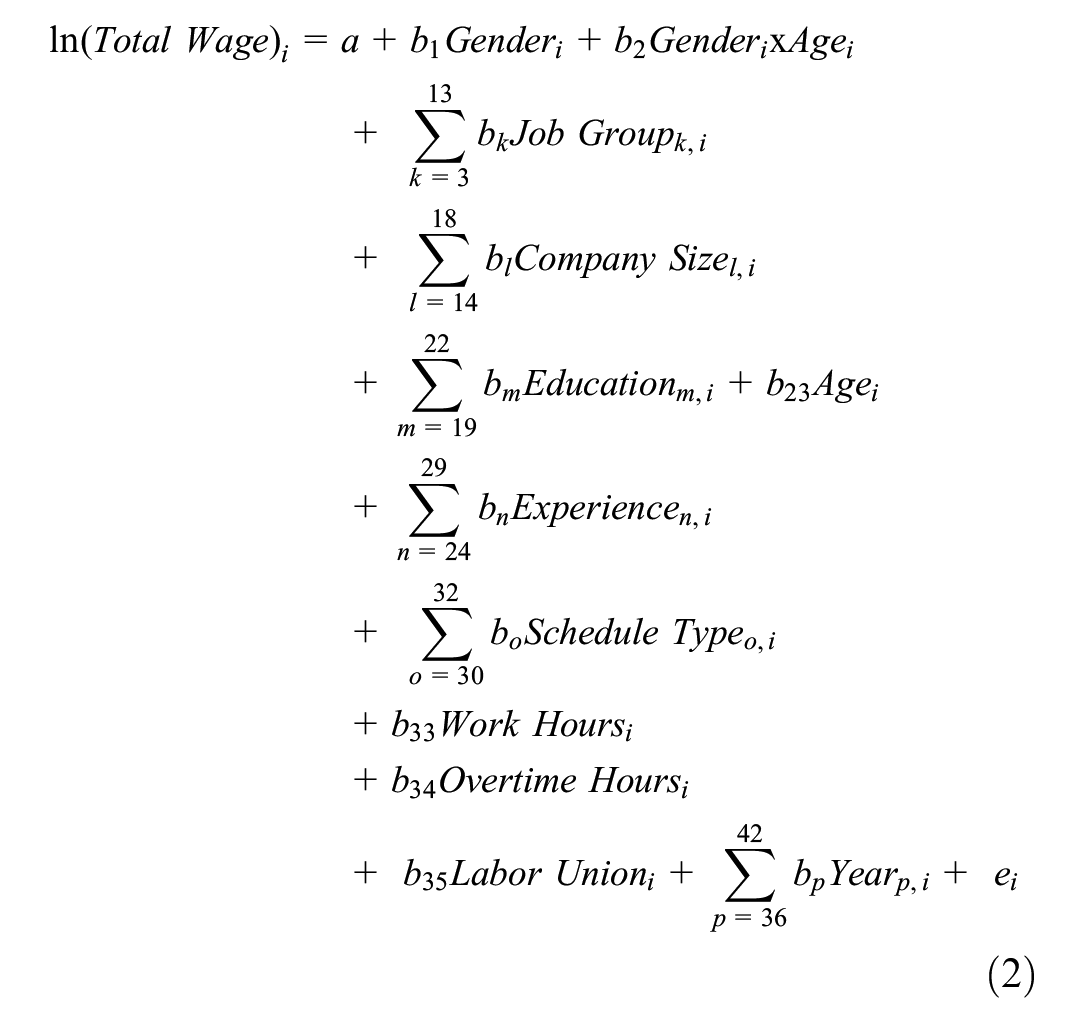
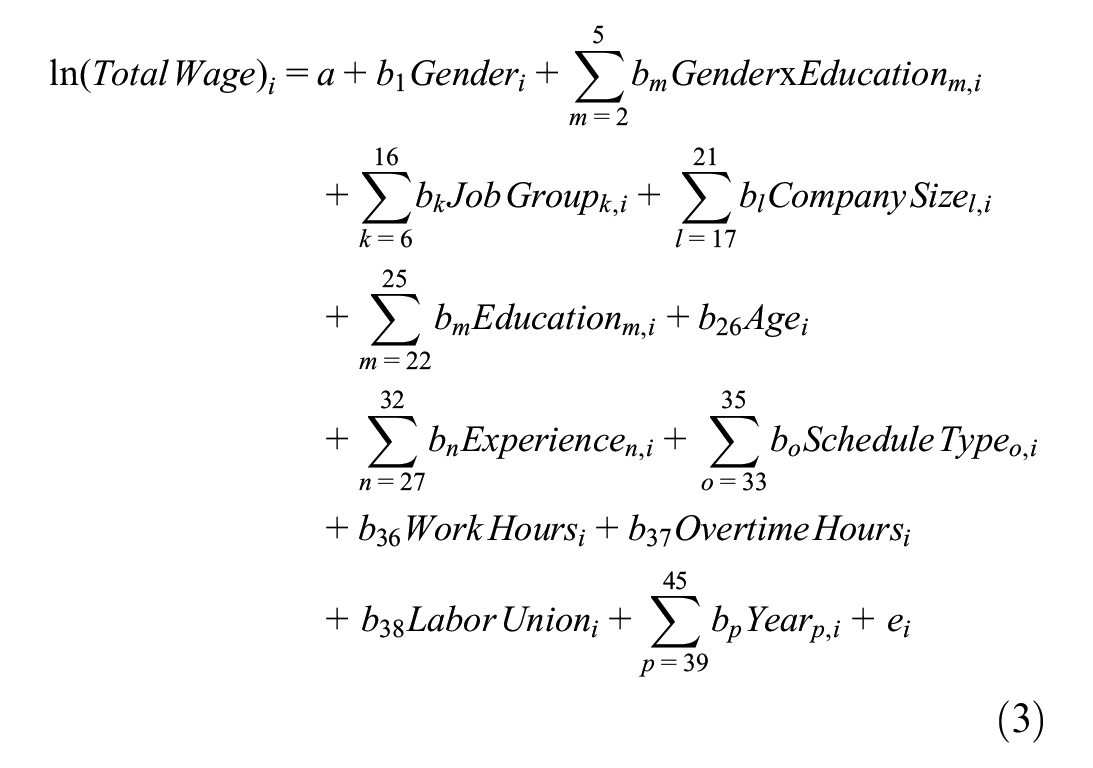
ln(Total Wage) is the natural logarithm of total monthly wage, Gender and Labor Union are binary variables where unity indicates male or labor union member and zero otherwise, Job Group, Company Size, Education, Experience, Schedule Type, and Year are also groups of binary variables that take the value of unity for the category respondents correspond to; therefore, the number of coefficients estimated for each variable is one less than the total number of categories. Age, Work Hours, and Overtime Hours are continuous explanatory variables. a and b’s are the intercept and coefficients to be estimated, and e is the error term. (Equation 1) is the baseline model, whereas the (Equation 2) and (Equation 3) are used to examine the additional research questions on interaction effects with age and education level.
Before estimating the model, the data was checked for multicollinearity and heteroscedasticity. After a preliminary estimation of the baseline model (Equation 1) with ordinary least squares (OLS), variance inflation factor (VIF) and Breusch-Pagan statistic was examined. Multicollinearity did not seem to be an issue as the VIF of all regressors were under two (see Table 3), but the Breusch-Pagan statistic was significant at p < .05. Therefore, White’s (1980) heteroscedasticity-consistent standard errors were used for inference.
Multicollinearity of Regressors.

Results and Discussion
The Gender Wage Gap
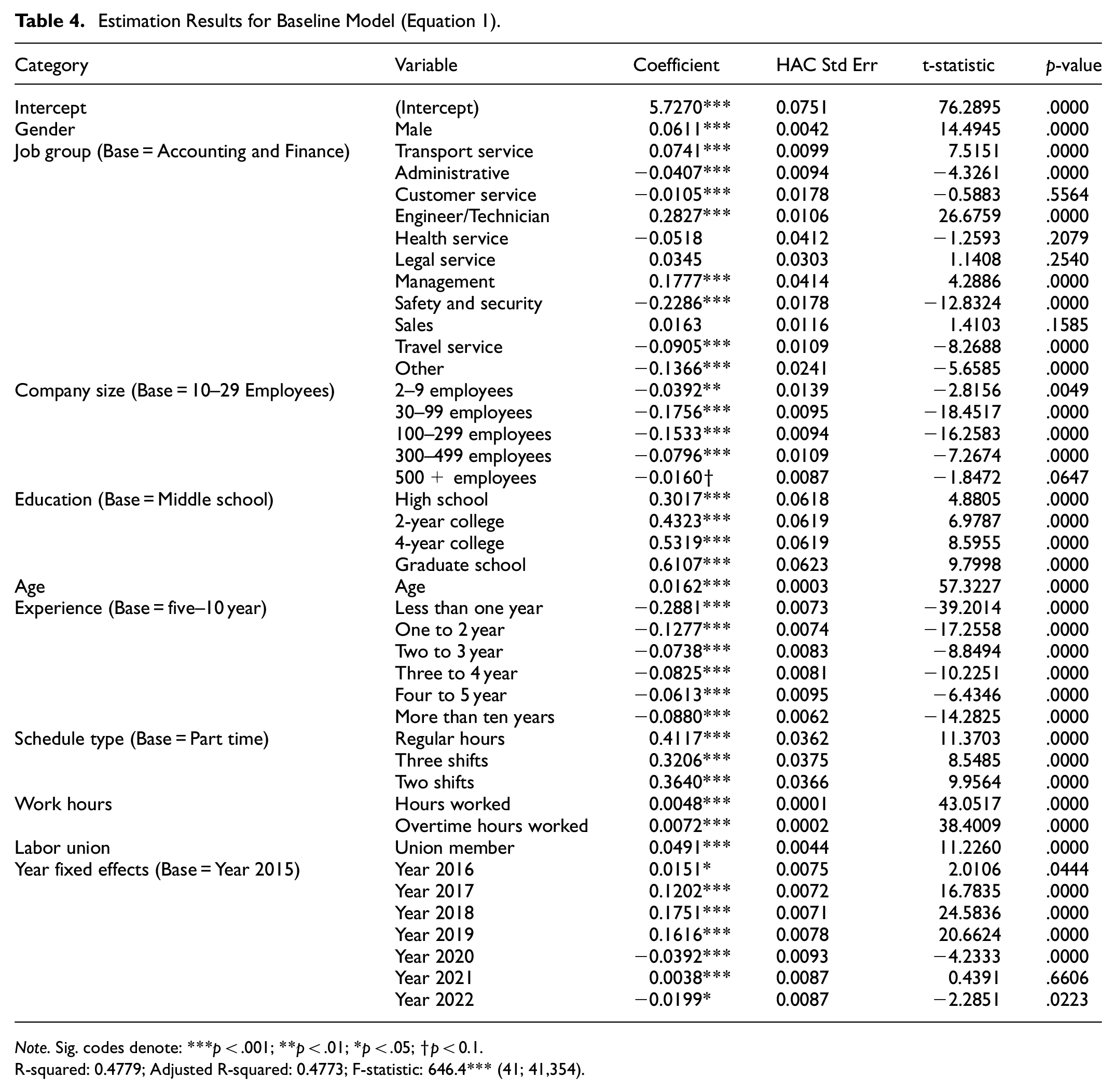
Table 4 reports the result of regression estimation of the baseline model (Equation 1). After controlling the confounding factors: Job Group, Company Size, Education, Age, Experience, Schedule Type, Work Hours, and Labor Union Membership, the dummy variable Male significantly increases the monthly wage of Korean air transport industry workers by [(exp(0.0611) – 1] × 100): 6.3%. When translated into monetary units, this equates to approximately (0.063 × 3,590=) 226,000 KRW. There are two noteworthy aspects about the size of the coefficient. First, the “net” gender wage gap in the Korean airline industry, after controlling for other factors, is not as high as the gender-wage disparity that is often discussed by the media (OECD, 2024). Second, the effect size, when compared to other such major factors as education (0.469) or experience (0.120), which explain much more variance of wage as prior studies do (Carlsen et al., 2016). In general, it is seen that the wage gap is considerably smaller after controlling for confounding factors (Andrews, 2019). Intuitively results are observed for education and experience as they has positive effects on age, while experience showed inverted-U effect after 10 years due to wage peaks in Korea, which is in line with other studies that observe similar outcome. (Choe et al., 2021).
Estimation Results for Baseline Model (Equation 1).
Note. Sig. codes denote: ***p < .001; **p < .01; *p < .05; †p < 0.1.
R-squared: 0.4779; Adjusted R-squared: 0.4773; F-statistic: 646.4*** (41; 41,354).
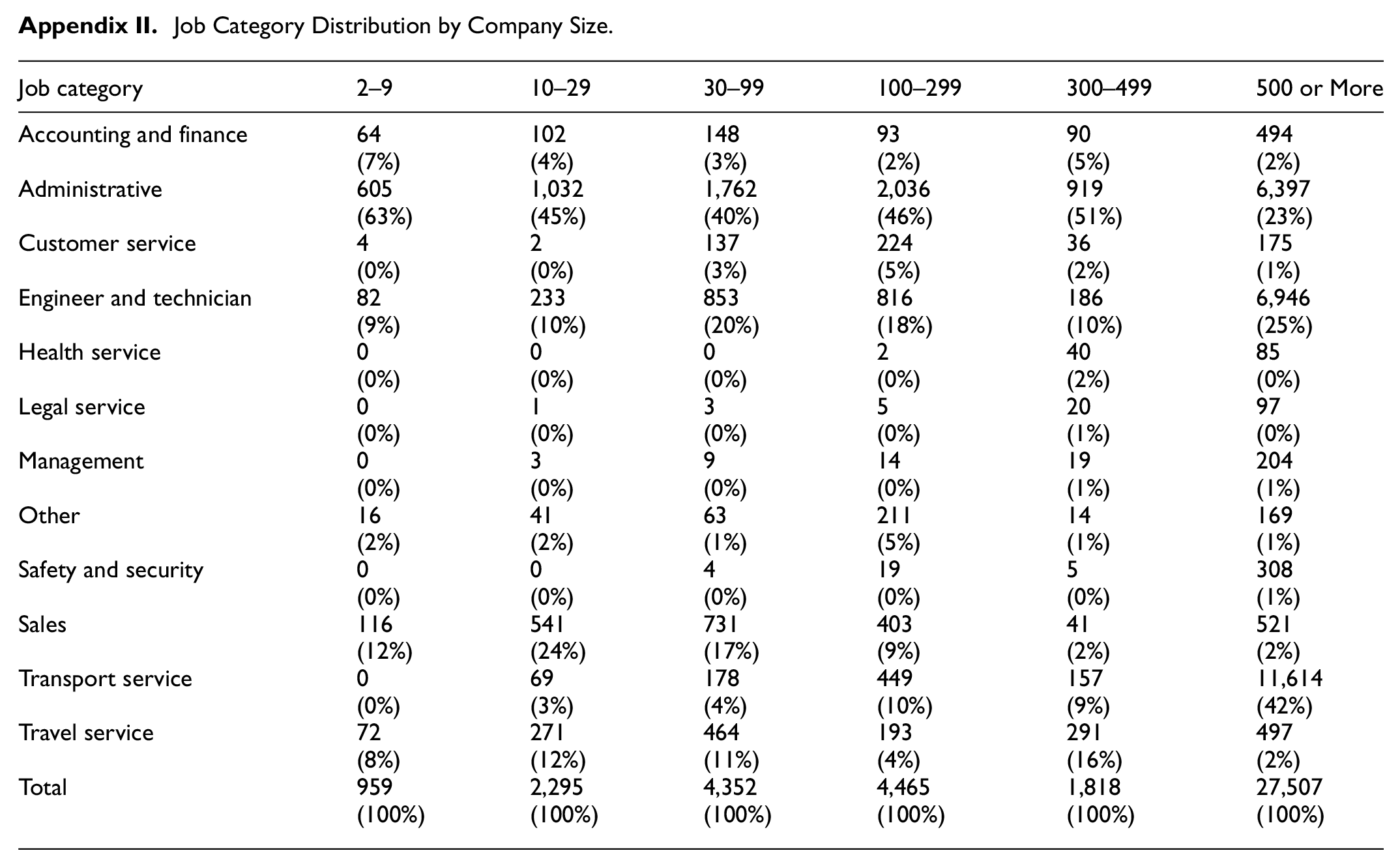
Consistent with theory, other variables also showed intuitive results. There were significant differences among job groups where engineer/technician, management, and transport service (cabin crew) were the top three highest earning job groups. Size of the company was also a significant factor. In general, larger companies pay higher wages, except for the base category (=10–29 employees), consistent with previous findings that attribute comparable wage variance to firm size as much as gender (Oi & Idson, 1999). Appendix 2 shows the job categories reported by size, where the base category has the highest ratio of sales staff (23.57%), whose wage depend more on sales commissions rather than other factors. Such a result can be interpreted along the lines of Theodoropoulos et al. (2022), who found that women are paid more equitably when employees are paid for performance.
Age generally commanded higher wage due to the typical wage structure in Korea (Kim & Song Lee, 2023), and regular hour workers earn the most as expected, followed by two shifts, three shifts, and part timers as standard schedule workers commonly earn more than the nonstandard schedule workers (Maume & Sebastian, 2012). Greater hours worked increases wage, where overtime does so by about 50% more due to premium pay (Hart & Ma, 2010), as well as labor union membership (Choi & Ramos, 2023). Yearly fixed effects show well the industry situation since the COVID-19, as the wage level overall is not as high as 2015 levels. In addition, Oaxaca-Blinder decomposition was conducted to examine the unexplained gaps in mean wage outcomes between the two gender groups (Elder et al., 2010). As can be seen in Figure 1, although composition effect account for majority of the observed differences, while there is still significant structural effect remaining after decomposition.

Comparison between composition and structure effects in mean wage gap.
Interaction Effects Between Gender and Age
Table 5 shows the result of regression analysis for research model (Equation 2) It is seen that there is no significant interaction effect between gender and age. Although age may interact with gender on determination of occupation due to gender segregation or social roles (Cho & Cho, 2011), there is no significant explanatory power gained by introducing the interaction variable between gender and age. In other words, the gender-wage gap is consistent throughout the careers and is not conditionally present at certain age of the employees. To be noted, however, is that the variance of female wage increases more with age than that of male. Such effect is shown in Figure 2. While age-wage curves for male and female are almost parallel, the variance of wage is greater for the female group, implying larger dispersions in female wages. Meanwhile, estimation results for other categories remain qualitatively the same, implying robustness of the mode and estimation technique.
Estimation results for gender and age interaction model (Equation 2).

Note. Sig. codes denote: ***p < .001; **p < .01; *p < .05; †p < 0.1.
R-squared: 0.4779; Adjusted R-squared: 0.4773; F-statistic: 645.2*** (42; 41,353).
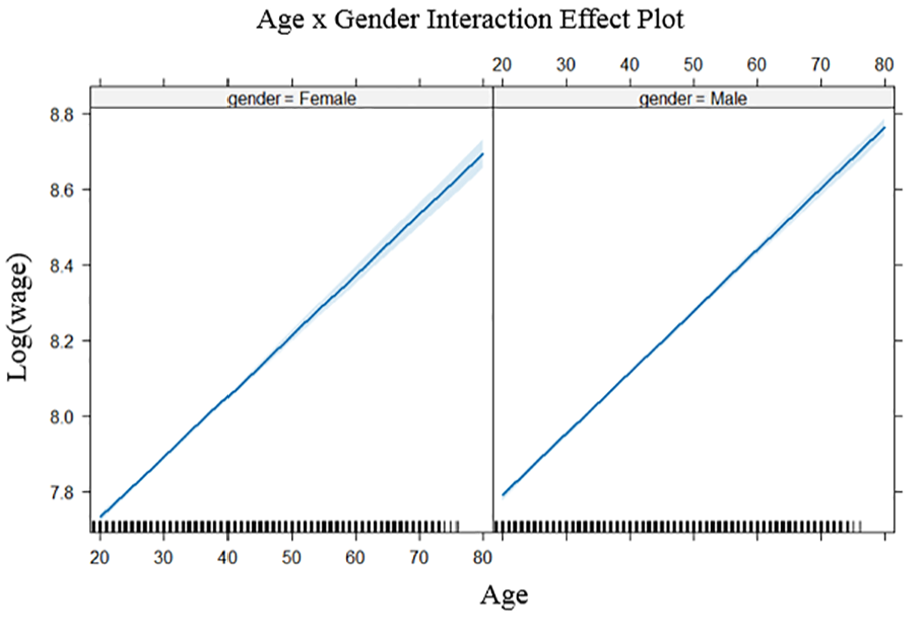
Interaction effects between age and gender on monthly wage.
Interaction Effects Between Gender and Education
Estimation results for research model (Equation 3) are shown in Table 6, including the interaction effects between gender and education. The gender variable, when interacted with education, yields interesting and significant results consistent with J. Lee and Ihm (2020). Female workers earn more for the high school and 2-year college graduates, but for 4-year college, and graduate school graduates, male workers earn more. The formidable gender wage gap for middle school graduates is also noted. (see Figure 3), as mandatory education required for Koreans is up to middle school, and at this level, males earn [(exp(0.6806) –1] x100): 97.51% more than females.
Estimation Results for Gender and Education Interaction Model (Equation 3).

Note. Sig. codes denote: ***p < .001. **p < .01. *p < .05.
R-squared: 0.4833; Adjusted R-squared: 0.4827; F-statistic: 602.5*** (45; 41,350).
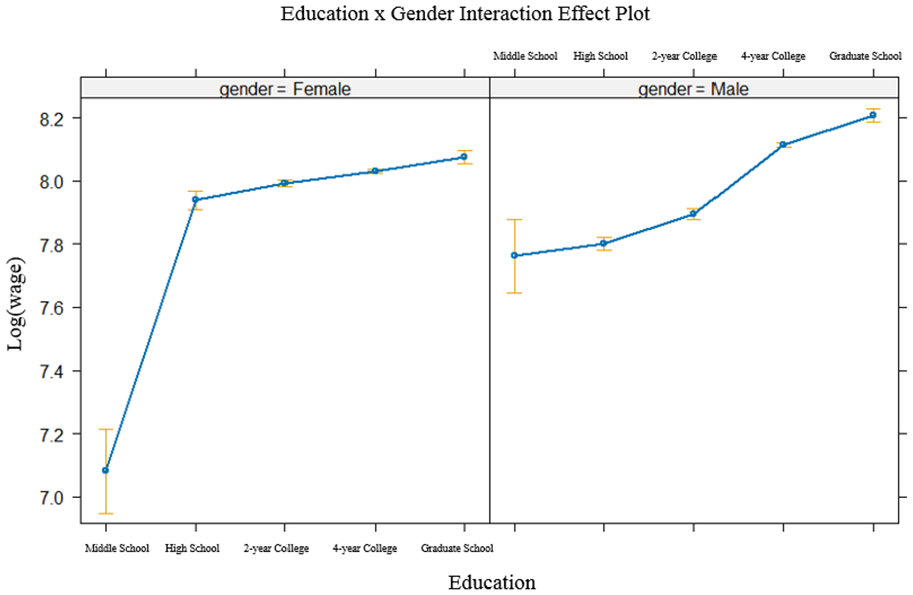
Interaction effects between education and gender on monthly wage.
Interestingly, for high school and 2-year college graduates the female workers earn more. In Korea, more than half of the population between 25 and 64 years of age have completed tertiary education, while 70% aged between 25 and 34 years received their degrees, making the highest percentage among OECD countries (STATISTA, 2024c). This implies that the male workers earn more in the least advantaged, the majority group, and the most advantaged groups, whereas female workers earn more in the somewhat less advantaged groups in terms of education attainment. As such difference in wage is not attributed to within-job discrepancies, this result suggests some possibility of valuative discrimination, from which males can also become subject to in two out of the five categories.
Conclusion
Implications and Recommendations
With labor shortage problems in the airline industry worsening following the aftermath of the COVID-19 pandemic, there is great need to facilitate recruitment and retainment of both genders. Participation of workers in the air transport industry is often hindered, however, by some common obstacles as gender bias and prejudices as literature suggests. The most visible and perhaps the most serious form globally of such gender-based disparity is the gender-wage gap (Airline Technology, 2024; Guardian, 2024b), while Korea is a country heavily dependent on air transportation with an infamous record of having the biggest gender wage gap among OECD countries. Nevertheless, reasons for gender-wage disparities are not straightforward; they involve country- and culture-specific factors. The current study investigated the gender-wage gap in the air transport industry in Korea along with its potentially confounding variables of age and education, as the pointed out by past studies (Cho & Cho, 2011; J. Lee & Ihm, 2020).
By analyzing Korean Labor Statistics Service microdata, three research questions relating to gender-wage gap in the airline industry were examined. Results showed that men earn on average 6.3% more than women after controlling for other prominent factors such as job categories, experience, and education. While age did not significantly interact with gender in determining age, education interacted with gender showed interesting results on the wage gap. In the lowest and the highest educational attainment groups, as well as the majority group, male workers earned significantly more than female workers on average. Contrarily, in the groups of somewhat lower educational attainment, men earned significantly lower wages than women, which suggests some possibility of devaluation working in favor of women.
Some other findings are also noteworthy. Wage gap, while statistically significant, is not as sizable as the OECD (2024) frequently reports after controlling for confounding factors. Job segregation and social role seem to have been present in the data, given that certain job categories have been dominated by one gender. Demand-side theories and specifically, valuative discrimination seem to be a potential explanation for source of gender-wage disparity conditional on educational attainment. On the other hand, supply-side explanations such as the human capital theory or the compensating differentials theory do not seem to have good explanatory power in the Korean context. Wage differences were significant within educational levels, while jobs in the air transport industry are demanding and often require working irregular shifts. Finding of such within-job wage disparity in the Korea is also consistent with a recent study by Penner et al. (2023).
Korean airlines may want to tackle the issue in a more proactive way. For example, in-house examination and follow-up on determination of wage discrepancies would be a desirable practice. They may start by dedicating attention to the recruitment process, to make sure that job placements are equitable and free from potential biases such as the recruitment bias. As discussed by Ashnai et al. (2020), human resources managers can improve the interaction process between recruiters and candidates for such process will affect the probability of recruitment bias. These may include lengthy interviews or interviewing candidates more than once. Airlines may also consider adopting equality policies, ascertaining people that they will not be excluded from promotion or higher positions because of their gender or any other inherit reasons, such as citizenship or minority status. One step further, development of human resources policy that give special attention to female workers (Douglas & Pittenger, 2020), incentives to increase female representation in certain male-dominated job categories (Corazza, 2024), and devising policies to facilitate promotion of female workers into managerial positions (Devi et al., 2024) can all be considered potential strategies.
Limitations and Suggestions for Future Research
Despite the contributions made by the current study in investigating the gender-wage gap in the Korean air transport industry for the first time, it is not without limitations. Data used for the study is secondary in nature and attrition of observations for certain genders across job categories does not allow for direct or paired wage comparisons. Operationalization of the explanatory variables is bounded by the format of original data (i.e., categorical data, lack of information on performance, etc.). More importantly, if the employer data can be matched to the employee data, a more sophisticated analysis of intra-job wage variance can be feasible. In addition, some type of performance measure is also expected to significantly affect wage and integration/use of such data will be of significant help in better understanding the gender-wage gap in air transport industry.
Further research could be done in this regard through employee surveys and studies on wage/fairness perceptions. Testing and examination of different model specifications and estimation methods will help strengthen knowledge on size and conditionality of the gender-wage gap. Analysis of employee surveys and related information on implicit gender bias such as recruitment ads (Hentschel et al., 2021) would also be useful in developing understanding of the potential causes of gender-related biases including wage. With the ongoing global difficulties in recruitment of competent human resources in the air transport industry, continued research efforts should follow on this issue.
Footnotes
Appendix
Job Category Distribution by Company Size.
| Job category | 2–9 | 10–29 | 30–99 | 100–299 | 300–499 | 500 or More |
|---|---|---|---|---|---|---|
| Accounting and finance | 64 | 102 | 148 | 93 | 90 | 494 |
| (7%) | (4%) | (3%) | (2%) | (5%) | (2%) | |
| Administrative | 605 | 1,032 | 1,762 | 2,036 | 919 | 6,397 |
| (63%) | (45%) | (40%) | (46%) | (51%) | (23%) | |
| Customer service | 4 | 2 | 137 | 224 | 36 | 175 |
| (0%) | (0%) | (3%) | (5%) | (2%) | (1%) | |
| Engineer and technician | 82 | 233 | 853 | 816 | 186 | 6,946 |
| (9%) | (10%) | (20%) | (18%) | (10%) | (25%) | |
| Health service | 0 | 0 | 0 | 2 | 40 | 85 |
| (0%) | (0%) | (0%) | (0%) | (2%) | (0%) | |
| Legal service | 0 | 1 | 3 | 5 | 20 | 97 |
| (0%) | (0%) | (0%) | (0%) | (1%) | (0%) | |
| Management | 0 | 3 | 9 | 14 | 19 | 204 |
| (0%) | (0%) | (0%) | (0%) | (1%) | (1%) | |
| Other | 16 | 41 | 63 | 211 | 14 | 169 |
| (2%) | (2%) | (1%) | (5%) | (1%) | (1%) | |
| Safety and security | 0 | 0 | 4 | 19 | 5 | 308 |
| (0%) | (0%) | (0%) | (0%) | (0%) | (1%) | |
| Sales | 116 | 541 | 731 | 403 | 41 | 521 |
| (12%) | (24%) | (17%) | (9%) | (2%) | (2%) | |
| Transport service | 0 | 69 | 178 | 449 | 157 | 11,614 |
| (0%) | (3%) | (4%) | (10%) | (9%) | (42%) | |
| Travel service | 72 | 271 | 464 | 193 | 291 | 497 |
| (8%) | (12%) | (11%) | (4%) | (16%) | (2%) | |
| Total | 959 | 2,295 | 4,352 | 4,465 | 1,818 | 27,507 |
| (100%) | (100%) | (100%) | (100%) | (100%) | (100%) |

Funding
The author(s) received no financial support for the research, authorship, and/or publication of this article.
Declaration of Conflicting Interests
The author(s) declared no potential conflicts of interest with respect to the research, authorship, and/or publication of this article.
Data Availability Statement
Data sharing not applicable to this article as no datasets were generated or analyzed during the current study.