




Abstract
This study explores the link between workload and work performance among junior high school teachers under China’s “Double Reduction” policy. The study employed a quantitative approach, surveying 1,135 junior high school teachers from various regions in China. Utilizing the NASA Task Load Index (NASA-TLX) to measure workload and a binary structure model to assess performance. Post-implementation of the policy, teachers reported a significant increase in workload across all dimensions (mental, physical, temporal demands, effort, and frustration). This increase was negatively correlated with both task and contextual performance. However, while most dimensions of workload negatively impacted contextual performance, mental demand had a positive influence. The findings suggest that despite the policy’s aim to alleviate burdens, it has inadvertently increased workload and impacted teachers’ performance, with the exception of a positive effect on certain performance aspects. The study contributes to the understanding of the complex dynamics between teacher workload and performance, offering insights for educational policymakers and administrators.
Introduction
Previous studies have consistently shown that Chinese schoolteachers spend more time working than the world average (OECD, 2019; Tong, 2017; J. Wang & Ning, 2018). According to a survey of more than 2,000 elementary and junior high schools in China, the average weekly workload of Chinese teachers is 52.54 hr (X. Li, 2021). Under these circumstances, the issue of reducing the workload and hours of teaching has been discussed in Chinese education reform, defining teachers’ hours here as the total amount of time they spend on school-related tasks outside the classroom. The Chinese Central Government released a Policy Statement entitled “Several Opinions on Relieving Elementary and Secondary School Teachers’ Load and Further Create a Good Environment for Educational and Learning,” which calls for all levels of government to recognize the workload of teachers at the root of the problem, remove unnecessary tasks that have nothing to do with teaching/learning, harmonize and strengthen the relations between the administration and the classroom, and mobilize the resources of various sections of the community so that the burden on teachers in elementary and junior high schools can be reduced more efficiently (Xinhua News Agency, 2019). This document is a significant development in the Chinese government’s efforts to alleviate teacher obligations (Long & Zhou, 2022).
However, the “Double Reduction” policy later resulted in an increased workload in China, offsetting previous attempts to cut down on teachers’ non-teaching load (Qin & Li, 2022). The Communist Party General Office of China Central Committee and State Council issued a “Double Reduction” policy in June 2021 (Xinhua News Agency, 2021) to alleviate the load on pupils and teachers. Despite the positive intentions of this policy, its effect on the workload and performance of junior high school teachers has raised significant issues and concerns. Hence, this research explores the implications of workload on teachers’ task effectiveness, contextual performance, and overall performance.
The Double Reduction policy aims to reduce the homework burden and off-campus tutoring for students in compulsory education to alleviate their academic pressure and promote their holistic development. The key policy measures include: Limiting Homework Duration: The policy mandates that homework for students in grades 16 should be completed within 60 min, and for grades 79 within 90 min; Regulating Off-Campus Tutoring: The policy prohibits institutions from providing off-campus subject based tutoring during weekends, national holidays, and winter/summer vacations; Extending After-School Services: Schools are required to provide extended after-school services until 6 PM. These services include homework assistance, extracurricular activities, and interest-based clubs.
Resultantly, the extended after-school services and need for more innovative teaching methods have significantly increased teachers’ workloads. Teachers are now required to spend more time preparing for after-school activities, design interactive and engaging lessons to meet new academic requirements, and participate in professional development workshops (Jin et al., 2023; K. Li et al., 2023). This has led to an increase in both the quantity and complexity of their work.
Workload plays an important role in a teacher’s career, shaping their capacity to provide high-quality teaching, effective interactions with students, and the performance of their administrative duties (Jerrim & Sims, 2020; OECD, 2019). The relationship between workload and teacher well-being is complex, with potential implications for job satisfaction and retention in the profession. Recent research has highlighted the impact of workload on teachers’ emotional engagement and stress levels, which in turn can affect their ability to engage with students and perform administrative tasks effectively (Mantelli, 2021; Smith, 2019). For junior high school teachers, who play an important role in shaping teenagers’ learning and individual growth, workload management is crucial for creating an active learning atmosphere and promoting successful learners. Teachers’ requirements, from curriculum and classification to extra-curricular and administrative work, have far-reaching effects on students’ happiness and work satisfaction.
Research Gap and Rationale of the Study
Workload’s association with performance has been the subject of research in a variety of countries (Gavin et al., 2021; Rose & Sika, 2019; Yuliani et al., 2022). The way other nations think about their workload differs greatly from China’s “Double Reduction” environment. The implications of this increased workload on teachers’ task effectiveness, contextual performance, and overall performance are not yet fully understood. Existing literature has primarily focused on the policy goals and missions at a macro-level, with few studies have been conducted on this subject due to Chinese junior high school’s practical facets. This study aims to bridge that gap by exploring the impact of the “Double Reduction” policy on workload and performance from the perspective of junior high school teachers.
This investigation was developed to probe the potential influence of instructors’ responsibilities on respective performance in their jobs and to establish a correlation between the two. This study can aid administrators in assessing the current workload of teachers and guiding them in making informed decisions regarding appropriate workload allocation.
The Concept of Teacher Workload and Performance
Although workload frequently appears in the field of human factor engineering research, there is no consistent definition (Veltman & Gaillard, 1996). Therefore, it is often defined in multiple ways. For example, mental workload is defined as the ratio of a person’s external workload to their own ability (Kantowitz, 1985). Weiner (1982) defines workload as a measure of the various stresses that affect job performance and job responses. According to Wickens (1992), workload denotes work demand’s association with its capacity. When the gap between work demand load and one’s ability is small, it means the workload is heavy. Therefore, the workload level is based on a worker’s own perception (perceived load). On the contrary, the performance of a junior high school teacher is based on their dedication to the job, the percentage of successful students, teaching and development, active communication between teacher and students, and so on.
In this study, workload (independent variable) was assumed to include mental demands, physical demands, temporal demands, effort, and frustration levels. The two components of performance (dependent variable) were task performance and contextual performance.
Jomuad et al. (2021) demonstrated that if learners are overloaded with tasks that exceed their knowledge, skills, and qualifications, this will negatively affect their performance. Teachers are expected to carry out this responsibility irrespective of their individual differences and perceptions. This is because the work emphasized is a fundamental component of teachers’ job descriptions. However, the frequency of this routine approach causes overload, stress, and teacher burnout.
Using these results, this investigation aims to evaluate the influence of workload on instructors’ performance. To ensure a robust analysis, this study employs methodological strategies that control for various influencing factors. These strategies include applying bootstrapping 5,000 times using Mplus 8.3 to strengthen the reliability of our statistical estimates, incorporating comprehensive control variables, and utilizing granular time-use data. This approach offers a comprehensive understanding of the following elements: (1) determining the profile of the teachers, (2) identifying the status of the workload and performance of the participants, and (3) establishing the significant relationship between the workload and performance of the participants.
Literature Review
The workload of junior high school teachers originates from various sources. Drawing on research conducted in 18 provinces and 35 counties in China, Zhu and Liu (2020) discovered that the workload of rural teachers comprises demanding work tasks, significant psychological pressure, and limited opportunities for career advancement. According to the semi-structured interviews conducted by Jin et al. (2023) with 14 teachers, the workload of teachers in Chinese primary and secondary schools is predominantly composed of preparing lessons, designing and correcting homework, performing services after school, conversing with parents, organizing activities, participating in staff meetings and trainings, and writing reports. Li (2021) conducted an analysis of the structure, level, and nature of the workload of primary and secondary school teachers, offering a foundation for deeper comprehension of the implications and features of their workload. This study also serves as a basis for developing more tailored policies to alleviate the workload. In the same vein, Qin and Li (2022) attributed the increased work intensity of teachers under the double reduction policy to occupational obligations, demands from school, social support, and professional development engagement.
The excessive workload experienced by teachers can profoundly affect their work performance. Yogisutanti et al. (2020) delved into the correlation between workload, work stress, and teacher performance, revealing a connection between work stress, fatigue, and teacher performance. Safi'i et al. (2021) found that the performance of teachers at the Surakarta Batik Education Foundation was influenced by leadership quality, workload, communication, and teacher competence. On the one hand, effective professional development among teachers was impeded by inadequate time, which was a result of rigorous and uncompromising school schedules, teacher responsibilities, and insufficient learning and teaching resources. On the other hand, excessive workload can negatively impact the mental health of individual teachers and lead to burnout (K. Li et al., 2023). Jerrim & Sims, (2021) presented fresh evidence on the association between primary and secondary teacher workloads and well-being across five English-speaking education systems. Nonetheless, previous research may have overlooked certain aspects of the workload-wellbeing relationship by disregarding potential nonlinearities and measurement errors.
In previous studies, researchers have highlighted the influence of demographic variables on teacher performance. A study conducted in Kenyan secondary schools found that gender differences did not impact teachers’ ability to carry out their core functions (Wanakacha et al., 2018). Akinkuade (2021) discovered that school location serves as a determinant of teachers’ job performance in Ibadan Metropolis, Oyo State, Nigeria. In a study in South Korea, it was observed that marital satisfaction among married female secondary school teachers significantly correlated with their job performance (Boon, 2004).
The individual cognitive and ability levels of teachers can also affect their work performance under varying workloads. Ngatimun et al. (2020) investigated the relationship between teacher performance, emotional quotient, and workload in Probolinggo Regency. The findings indicated that emotional intelligence and workload impacted teachers’ effectiveness and the stress they encountered at work. Conversely, Susanto and Abadi (2021) examined the influence of emotional intelligence and teacher workload on teacher performance among 46 respondents, with emotional intelligence showing no significant effect on teacher performance.
Under heavy workloads, the diminished performance of teachers can exacerbate the negative impact on students’ academic achievements. Rose & Sika, 2019 examined the influence of teacher workload on student academic performance, emphasizing the need for intensified efforts to alleviate workload burdens. Additionally, a separate study demonstrated that factors such as class size, teacher workload, teaching methods, and student-teacher ratio significantly influence students’ learning outcomes and academic performance in public universities in Cameroon (Etomes et al., 2020).
The relationship between workload and performance among junior high school teachers can be understood through various theoretical lenses. The Job Adjustment Theory posits that excessive job demands can lead to role strain and decreased performance (Spector, 1998). Additionally, the Job Characteristics Model suggests that job characteristics, including workload, significantly influence work motivation and performance (Hackett & Oldham, 2001). The Job Demands-Resources Model (JD-R) is particularly relevant, highlighting that high job demands coupled with low resources can result in burnout and reduced performance (Demerouti et al., 2001).
Building upon these frameworks, recent research has further elaborated on the nuances of this relationship. For instance, the concept of “compensatory control” in workload management suggests that individuals may maintain performance by allocating additional resources, but this can lead to increased effort and potential physiological costs (Hockey, 1973). Furthermore, the interplay between mental workload, occupational fatigue, and cognitive performance has been explored, indicating that high workloads can lead to fatigue, which in turn can impair cognitive functions such as reaction time and attention (Fan & Smith, 2020).
In the context of China’s Double Reduction policy, these theoretical frameworks gain additional relevance. The policy’s intent to reduce classroom time and non-teaching assignments may have unintended consequences on workload and performance. Teachers may experience increased job demands in terms of the quality and innovation of their teaching methods, which could potentially lead to higher levels of burnout and decreased performance if not adequately supported by resources and professional development opportunities (Zhou & Fu, 2021).
The double reduction policy’s requirements for Chinese teachers, its advantages for professional development, as well as a few of its consequences for the burdens of Chinese teachers have been the subject of prior research. The double reduction policy plays a crucial role in shaping teacher workload and job performance within educational settings. While the policy has shown promise in reducing non-teaching burdens and improving teacher satisfaction, its impact on task performance remains a subject of debate (Teng et al., 2023). Lu et al. (2022) found that the implementation of the double reduction policy led to an escalation in the working hours and burden for over 70% of teacher participants. This conclusion was drawn from data collected from more than a 1000 teachers and parents in primary and secondary schools in Jiangsu Province. Previous studies have some evident constraints, despite the fact that it provides a firm foundation for this investigation. This study will focus on the influence mechanism of workload on teacher performance under double reduction policy.
Methods
Participants and Procedure
The participants in this study were frontline teachers in junior high schools in 17 counties and cities in the Guangdong, Hainan, Guizhou, and Guangxi provinces. With the assistance of educational departments and school management, we were able to access the respondents. Questionnaires were distributed to the sample areas via the Internet, through online links and QR codes that were generated specifically for the questionnaire. The data collection process took place from January to March 2023, spanning a period of 3 months. In total, 1,162 questionnaires were submitted. Based on a comprehensive survey of the accuracy of responses (e.g., whether one number was selected from beginning to end) and the time used to fill in the questionnaire online, 27 invalid samples were deleted, and 1,135 valid questionnaires were obtained. The effective rate of questionnaire recovery was 97.68%. Table 1 presents the basic information on the sample.
Basic Composition of Samples (n = 1,135).

Measurements
Teacher’s Workload Scale
The NASA Task Load Index (TLX) was utilized in this study to assess the workload of teachers. The NASA-TLX denotes a subjective burden assessment instrument that enables users to assess the workloads of operators by utilizing a variety of human-machine interface systems (The Official NASA Task Load Index (TLX), 1986). In the 1980s, Sandra Hart of NASA Ames Research Center (ARC) devised the NASA-TLX as a paper and pencil questionnaire. Since then, it has become the industry norm for assessing subjective burden in a diverse array of applications (Rubio et al., 2004). This scale calculates a total workload score employing a multidimensional rating procedure that is according to a weighted average among ratings from physical demand, mental demand, effort, temporal demands, and level of frustration (Liang et al., 2019). We employed a retrospective design that compared teachers’ workload before and after the implementation of the “Double Reduction” policy. Participants can score each dimension from “very low” to “very high”; the higher they indicate on a particular scale, the more strongly they perceive that dimension. The scale reliability is α = .95.
Teacher’s Performance Scale
Teachers’ work performance was compiled using the binary structure model of work performance formally proposed by Motowidlo and Van Scotter (1996). This scale divides work performance into task performance and contextual performance (also known as peripheral performance), including eight questions on task performance and 15 questions on contextual performance; a 7-point Likert-scale method is adopted. For both task and contextual performance subscales, the scale score is the mean items’ score, whereas the work performance score is the combined mean score of contextual and task performance.The reliability coefficients for the task performance scale and contextual performance scale are 0.78 and 0.86, respectively.
Controlled Variables
Demographic variables were meticulously considered as controlled factors to account for their potential influence on the relationship between workload and performance among junior high school teachers under the “Double Reduction” policy. Demographic data included sex, teaching experience, teaching grade, titles, school ownership, rural school, marital status, and the questions “Have you got kids?,”“Are you an internal teacher?,”“Are you a multidisciplinary teacher?,” and “Are you a main subject teacher?.” These variables were integrated into the analysis to control for variations that could ensure a more nuanced understanding of how workload impacts teacher performance, while mitigating the confounding effects of individual and institutional differences.
Data Analysis
The study utilized a quantitative approach to explore the relationship between teacher workload and performance under double reduction policy in junior high school. A pilot trial was carried out to ensure that the items were clear and accurate, and a reliable and valid test was performed on the scale. The demographic features of the participants were investigated by means of descriptive analysis, while the correlation analysis, path analysis, and bootstrapping were investigated for the relationship between workload and performance under the double reduction policy.
In terms of sample representativeness, we employed a convenience sampling method, which, while not providing a perfect representation of the entire population, allowed us to efficiently gather a substantial dataset. We made a concerted effort to enhance the representativeness of our sample by including junior high schools from a variety of geographical locations, including urban and rural settings, as well as both public and private institutions. This stratified approach within convenience sampling helps to capture a broader spectrum of the educational landscape and the diverse impacts of the double reduction policy.
In the analysis, we applied bootstrapping 5,000 times using Mplus 8.3 to strengthen the reliability of our statistical estimates. The general matching of the model was assessed using CDF, CFI, TLI, and RMSEA. The accepted limit of CFI, TLI, and RMSEA was less than 0.05.
Results
Descriptive Statistics of Variables and Correlations
The average scores of the sub-dimensions of teacher workload ranged from 50.85 to 65.3. Please note that unless otherwise specified, the measurement results for the sub-dimensions of Mental Demands, Physical Demands, Temporal Demands, Effort, and Frustration (which are all components of teacher workload) refer to the workload after the implementation of the dual reduction policy, as shown in Table 2. The results indicated that the workload of junior high school teachers remained high even after the enactment of the double reduction policy. This finding implies that junior high school teachers experience a significant workload due to various work demands, which consequently leads to role overload.
Descriptive Statistics of Variables and Correlations.

Note. Sex is a dummy variable, man = 1, woman = 0; Rural school is a dummy variable, yes = 1, no = 0; “Are you an internal teacher” is a dummy variable, yes = 1, no = 0; Marital status is a dummy variable, married = 1, single = 0; “Have you got kinds” is a dummy variable, yes = 1, no = 0; “Are you a multidisciplinary teacher?” is a dummy variable, yes = 1, nov0; “Are you a main subject teacher?” is a dummy variable, yes = 1, no = 0; “Mental demands, Physical demand, temporal demands, Effort Frustration” refers to “Mental demands, Physical demand, temporal demands, Effort Frustration.”
Correlation is significant at the 0.01 level (2-tailed).
Correlation is significant at p < .01 (two-tailed t-test).
The average value for teacher performance (two sub-dimensions > 3.68) shows that teachers generally had a high evaluation of their performance. Additionally, a significant negative correlation was found between all sub-dimensions in teacher workload and performance. This suggests that the specific relationship paths between the variables must be further explored. Descriptive statistics and correlations among the study variables are presented in Table 2.
The Workload Difference of Junior High School Teachers Before and After the Double Reduction Policy
The results of the paired sample t-test are shown in Table 3. In all five sub-dimensions of workload, there were significant differences before and after the implementation of the double reduction policy. Results indicate a noticeable increase in workload post-policy implementation, despite the policy’s intent to alleviate educational burdens. Teachers reported an increased workload, including mental demands, physical demands, temporal demands, effort, and frustration, all of which contributed to an augmented workload.
The Difference in Workload of Junior High School Teachers Before and After “Double Reduction” Policy (n = 1,135).
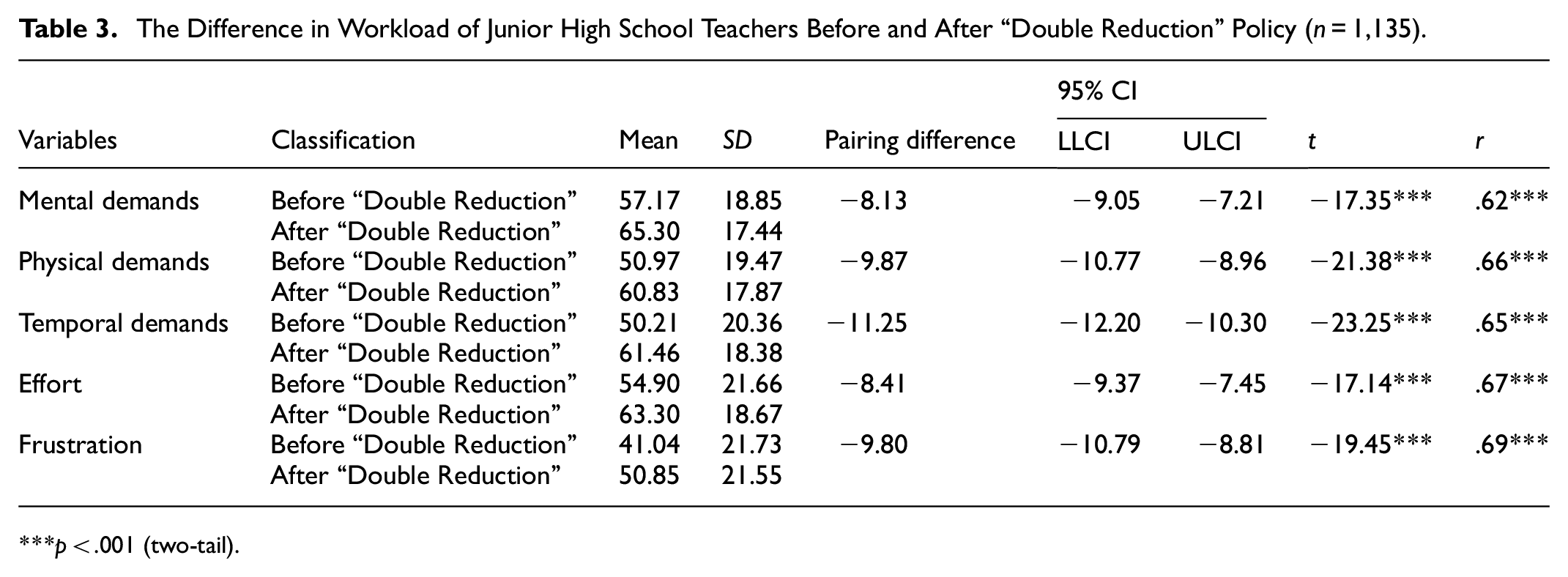
p < .001 (two-tail).
The correlation coefficient of each sub-dimension in teacher workload was greater than 0.6, and p < .001, indicating that the correlation of workloads was very high and significant; that is, the workload trends of junior high school teachers before and after double reduction policy implementation was very close.
Impact of the Workload on Teacher Performance
Path analysis was used, based on the relationship between variables, to analyze the covariance matrix between variables. It may be employed to analyze and investigate intricate research data involving several variables. It is important to note that it is capable of estimating the parameters and variables of a complex prediction model involving independent and dependent variables. This applies to teacher work, which is a complex system involving the actions of multiple subjects and multiple factors.
Using Mplus 8.3, according to the characteristics of small sample size and some variables not conforming to the normal distribution, the maximum likelihood method was selected to establish and evaluate the influence of workload on teacher performance under the double reduction policy. Based on the investigation and analysis in the previous research, the questionnaire of dimensions was set up for observation variables, such as teacher workload (after double reduction) in five sub-dimensions: mental demands, physical demands, temporal demands, effort and frustration, and two work performance elements: task performance and contextual performance. Demographic variables were included as control variables. The analytical path was added between the independent variable and the dependent variables. The overall fitting coefficients of the model are shown in Table 4, and the standard coefficients of each path are shown in Figure 1 and Table 4.

The relationship between workload and work performance of teachers in junior high school.
Model-Fitting Indicators.

According to Table 4, the model fit of path analysis is good, but in the overall fitting coefficient, CMIN/DF is 198.24 > 3, but this value has a great relationship to the sample size. Therefore, according to other parameters, the CFI, and TLI are greater than or close to 0.9, which means that the overall fitting coefficient of this model is good.
The relationship between teacher workload and performance was also examined. Notably, four sub-dimensions of workload—physical demands, temporal demands, effort, and frustration—were found to negatively influence contextual performance. In contrast, mental demand was observed to have a positive impact on contextual performance, suggesting a complex dynamic where cognitive engagement may enhance certain aspects of a teacher’s role. Conversely, all sub-dimensions of workload uniformly detracted from task performance. Teachers subjected to elevated workload levels consistently reported diminished task performance and reduced contextual performance, culminating in an overall decline in their effectiveness. Furthermore, the additional responsibilities imposed by the “Double Reduction” policy were identified as exacerbating these adverse effects, highlighting the policy’s unintended consequences on teacher workload and, by extension, performance.
Regarding the relationship between teachers’ workload and work performance, the model fitting coefficient and load of each path factor were reasonable, and the model was good. The correlations between five sub-dimensions (mental demands, physical demands, temporal demands, effort, and frustration) of teacher workloads (before/after “Double Reduction”) were 0.67 to 0.78; the five sub-dimensions of workload (after “Double Reduction”) negatively impacted task performance and negatively predicted contextual performance, which means that the higher the teacher’s workload, the lower the work performance.
The regression model results reveal several significant relationships between workload and performance outcomes, both before and after the implementation of the double reduction policy (as presented in Table 5). Specifically, frustration, efforts, and temporal demands after the policy implementation had negative impacts on contextual performance, with standardized path coefficients of −0.157, −0.141, and −0.172, respectively. In contrast, mental demands demonstrated a positive impact on contextual performance, with a standardized path coefficient of 0.313. For task performance, frustration, efforts, and temporal demands after the policy implementation also had negative impacts, with standardized path coefficients of −0.222, −0.237, and −0.264, respectively. However, mental demands had a negative impact on task performance, with a standardized path coefficient of −0.306. Additionally, the results showed strong continuity in frustration, efforts, temporal demands, physical demands, and mental demands throughout the process of policy implementation, with standardized path coefficients ranging from 0.662 to 0.699.
Summary of Model Regression Coefficients.
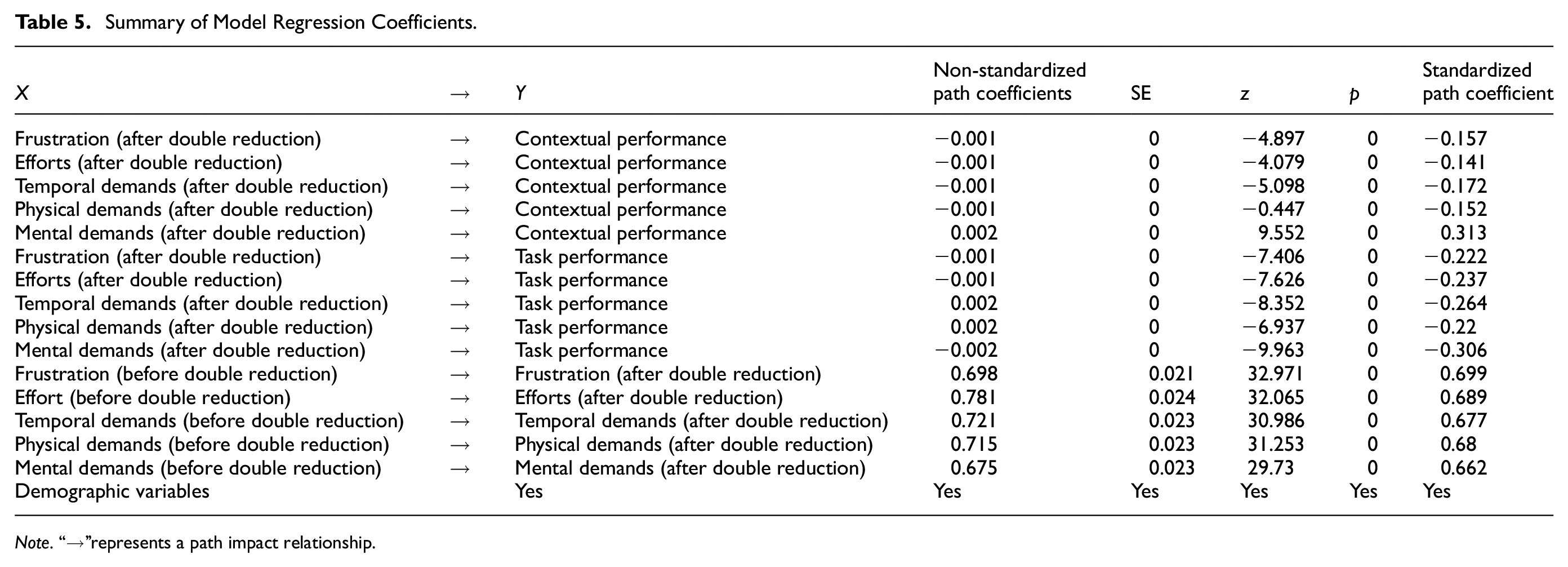
Note.“→”represents a path impact relationship.
Demographic variables were analyzed to understand how they influence teacher performance. The research revealed that the efficacy of teachers’ tasks was not substantially influenced by their sex. Both male and female teachers reported similar levels of task performance; however, female teachers tended to participate more than male teachers in contextual performance.
The location of the institution significantly influenced performance at work. Urban schoolteachers reported higher performance levels. In contrast, rural schoolteachers showed a negative impact of location on task and contextual performance.
Internal teachers exhibited higher performance levels and positively predicted performance. Married teachers and teachers with children experienced a negative impact on contextual performance, but the impact on task performance was not significant.
Being a main subject teacher significantly positively predicted contextual performance, but the effect on task performance was not significant.
Discussion
The objective of this investigation was to investigate workload’s influence on junior high school teachers’ performance in the context of the double reduction policy. While the policy intended to mitigate teachers’ and students’ burdens, it appears to inadvertently increase workload for junior high school teachers, posing significant challenges to their effectiveness and job satisfaction.
Increased Workload Following the Implementation of China’s “Double Reduction” Policy
Our study indicates a substantial increase in teacher workload following the “Double Reduction” policy’s implementation, which contradicts the policy’s aim to reduce educational burdens. Teachers have experienced elevated mental, physical, and temporal demands, along with greater effort and frustration, collectively intensifying their workload. This outcome has significant implications for policymakers and education stakeholders (G. Li et al., 2023). It is crucial to support teachers in navigating curriculum changes, personalized instruction, and professional development to counteract the negative impact on their well-being and teaching quality (Jerrim & Sims, 2021).
The strong continuity in frustration, efforts, temporal demands, physical demands, and mental demands throughout the policy implementation process suggests that these factors are relatively stable over time. This is consistent with research by Y Li et al., (2025), who found that job demands and resources tend to exhibit stability over time due to their structural and organizational nature. The inclusion of demographic variables in the model indicates that these factors may also play a role in shaping teachers’ performance outcomes. Future research should further explore the specific mechanisms through which these variables interact with job demands and resources to influence performance.
While the policy has effectively lessened the academic load for students by reducing assignments and examinations (Teng et al., 2023), it has also led to a notable shift in teachers’ workload. The reduced time spent on grading and exam preparation has allowed teachers to focus more on enhancing teaching methods and student engagement (Yang, 2023). However, the need for curriculum adjustment has been a significant factor in the increased workload, as teachers adapt their strategies and develop new lesson plans to meet the new academic requirements (Jin et al., 2023; K. Li et al., 2023).
Additionally, the policy’s emphasis on continuous professional development and training has expanded teachers’ responsibilities. Participation in workshops, seminars, and collaborative learning communities, while valuable, has increased the time commitment and preparation required, further adding to the workload (Teng et al., 2023).
Understanding the Complex Relationship between Teacher Workload and Performance
The results of the path analysis indicate a correlation between teacher workload and performance, offering a more nuanced understanding of its influence on teachers. The negative influence of physical demands, temporal demands, effort, and frustration on contextual performance suggests that when teachers are burdened with physiological and time-related pressures, their ability to engage in tasks beyond direct instruction, such as student mentoring and curriculum development, is compromised. This finding is particularly concerning as contextual performance is crucial for fostering a holistic educational environment that supports student development.
The findings show that an increase in workload and job demands can lead to a reduction in job performance and satisfaction. This is consistent with research by Hascher and Waber (2021). Teacher workload is a multifaceted concept that encompasses various dimensions, including mental, physical, and time demands, as well as effort and feelings of frustration. The demands placed on teachers by lesson planning, problem-solving, and adapting to student needs, can be mentally taxing (X. Li, 2021). High mental demands may lead to mental fatigue, decreased concentration, and reduced task performance (Yurko et al., 2010). Teachers who experience cognitive overload may struggle to effectively execute their teaching responsibilities, negatively impacting their task performance (Jansen et al., 2016). Those negative impact of frustration and efforts on performance aligns with the job demands-resources (JD-R) model, which posits that high job demands can deplete employees’ resources and lead to burnout and reduced performance (Bakker & Demerouti, 2017).
The positive impact of mental demands on contextual performance may indicate that teachers who experience higher mental demands are more engaged and motivated to perform well in their contextual roles. Interestingly, mental demand was found to positively impact contextual performance. This could imply that cognitive engagement, within a certain threshold, may be a driving factor for teachers to excel in roles that require creativity, problem-solving, and adaptability. It underscores the importance of intellectual stimulation in the teaching profession and suggests that well-designed workloads can enhance, rather than detract from, certain aspects of teacher performance. This finding is supported by Xu and Wang (2024), who argued that mental engagement can enhance job performance by promoting cognitive and emotional investment in work tasks.
However, the detrimental effect of all workload sub-dimensions on task performance paints a consistent picture: excessive workload, regardless of its nature, is detrimental to the core activities that teachers are primarily responsible for. High workload levels lead to decreased effectiveness in carrying out instructional duties, which can have a ripple effect on student learning outcomes. Prior research supports this, noting that high physical demands can lead to fatigue and decreased efficiency in the classroom (Khan et al., 2012; Kim & Nussbaum, 2019). Similarly, excessive time demands and the effort required for student engagement can result in time constraints and emotional exhaustion, negatively influencing task performance (Aucejo et al., 2022; Hunter & Rodriguez, 2021).
The sub-dimensions of teacher workload discussed here collectively influence both task and contextual performance (Rubio et al., 2004). Teachers who are overwhelmed by the demands of their work may struggle to deliver high-quality instruction, provide adequate support to students, and maintain positive relationships with colleagues and parents (Karatepe, 2013). The negative predictive power of the workload dimensions on task and contextual performance underscores the importance of addressing workload challenges to enhance teachers’ overall effectiveness and well-being (Jerrim & Sims, 2021). It is crucial for schools to address these workload challenges to foster supportive environments that bolster teacher performance and job satisfaction.
The “Double Reduction” policy’s unintended exacerbation of workload-related challenges necessitates a critical reassessment. Policymakers must recalibrate the policy to mitigate the increased burdens on teachers, ensuring that the educational landscape is improved without compromising teacher performance or well-being.
Relationship Between Demographic Variables and Work Performance of Junior High School Teachers Under the Double Reduction Policy
This study reveals that demographic factors, including sex, school environment (rural vs. urban), marital status, and the specific roles teachers occupy within the educational system, significantly influence teachers’ perceptions of their workload and their subsequent work performance. Notably, while male and female teachers demonstrated comparable levels of task performance, female teachers were found to be more engaged in contextual performance. This gender discrepancy in work performance may stem from differences in communication styles, leadership approaches, and classroom management techniques, as suggested by previous research (Afolabi et al., 2008; Fjendbo, 2021; Hanif et al., 2011; Kairys, 2018). These gender-based differences can profoundly affect how teachers interact with their tasks and forge relationships within educational settings.
The location of the school emerged as an important influencing factor in work performance, with urban educators reporting higher levels of performance than their rural counterparts. This could be attributed to the higher salaries, improved living conditions, and better working environments available for teaching in urban areas. These factors make it easier to attract educators with superior teaching abilities and incentivize them to excel in their roles. The geographical location of a school is linked to its capacity to offer a favorable teaching and learning environment. When locational factors are favorable, teachers are more likely to enhance their job performance and achieve high levels of achievement (Akinkuade, 2021). This finding underscores the necessity for educational policymakers to consider the unique challenges faced by rural schools when devising workload management strategies (Ghazi & Shahzada, 2012; Ngwenya, 2021). Targeted interventions may be necessary to mitigate workload pressures and enhance the well-being of teachers in rural areas (Kingsford-Smith et al., 2023; H. Wang et al., 2022). By providing adequate resources and support, job satisfaction among rural teachers can be improved, potentially leading to enhanced student outcomes.
The research findings indicate that marriage, a significant life event, exerts multifaceted influences on individuals, notably on their contextual performance in professional settings. Marital status is associated with an escalation in personal responsibilities, encompassing household management, childcare, and fulfilling family obligations (Ahmed & Shabbir, 2019). Educators who are married are often faced with the challenge of reconciling their professional duties with the added responsibilities of spousal and, in many cases, parental roles (Nart & Batur, 2014). The complexity of managing these concurrent roles can prove to be a demanding endeavor, potentially resulting in a divided focus, time scarcity, and diminished attention to work-related tasks. These factors can collectively impair a teacher’s task performance, with implications for the quality of instruction and student outcomes.
The interplay between personal and professional life is a delicate balance that, when disrupted, can have profound effects on job satisfaction and productivity. Married teachers, in particular, may experience a tension between their work commitments and the expectations of their personal life, which can manifest as distractions and constraints on time (Nart & Batur, 2014). This tension can lead to a decrease in the quality and efficiency of work performance, as the individual struggles to allocate adequate attention to both spheres. The study’s findings underscore the importance of recognizing and addressing the unique challenges faced by married teachers to ensure their well-being and maintain a high standard of educational delivery.
Achieving a healthy work-life balance is essential for maintaining job satisfaction and optimal task performance (Kemunto et al., 2018; Yuliani et al., 2022). Marriage can sometimes disrupt this balance, especially if conflicts arise between work commitments and personal life priorities. Teachers who struggle to establish boundaries between their professional and personal lives may experience burnout, fatigue, and reduced task productivity (Ilies et al., 2015). Furthermore, the lack of balance and harmony between work and marriage can hinder teacher performance and overall job satisfaction.
The findings identified internal teachers as a factor exhibiting higher performance levels and positively predicting performance. Tenured teachers, also known as internal teachers, hold a permanent position within an educational institution and have undergone a rigorous evaluation process to attain their status (Goldhaber & Hansen, 2010). Tenured teachers enjoy job security due to their permanent status. Research by Taylor and Tyler (2012) suggests that job security positively impacts job performance, as tenured teachers are more likely to feel a sense of stability and invest in their professional growth, leading to higher performance levels. By recognizing the importance of these factors and implementing strategies to support continuous growth and development, educational institutions can foster an environment that enhances the job performance of tenured teachers, ultimately benefiting student learning outcomes.
In short, demographic variables play a significant role in shaping teacher work performance under the double reduction policy. Understanding how factors influence performance outcomes is crucial for creating supportive work environments for educators. By addressing the specific needs of teachers based on their demographic characteristics, schools and policymakers can foster a positive and productive teaching environment that benefits both teachers and students.
Conclusions and Recommendations
Under China’s double reduction policy, junior high school teachers are grappling with a substantial workload. Despite their exhaustion, they diligently fulfill their responsibilities and receive high evaluations of their work performance.
This research indicates that well-designed workloads can enhance, rather than diminish, specific aspects of teacher performance. Excessive workload, on the other hand, can detrimentally impact teachers’ work performance and efficiency. While the double reduction policy aims to ease the burden on both teachers and students, its implementation has unexpectedly led to a notable increase in teachers’ workload.
Chinese policymakers and education administrators should reassess the specific implementation of this policy, establish reasonable workloads for teachers, and collaborate on additional measures such as increasing subsidies for rural teachers and expanding the number of tenured teachers to boost teachers’ work performance and professional satisfaction. Subsequent research could explore workload issues among diverse teacher groups under the double reduction policy to identify potential approaches for policy reforms. Additionally, effective strategies for teachers to manage their workload and cope with stress from a personal perspective could be further investigated.
Implications
The research findings weave together a tapestry of implications that connect theoretical insights, practical strategies, and policy implications. Theoretically, this study enriches the framework of teacher workload by delineating the complex interplay among its various components and their respective influences on teacher performance. This understanding is pivotal, as it highlights the necessity for a multifaceted approach to addressing teacher stress and performance. Furthermore, the discovery of a positive correlation between mental demand and contextual performance adds depth to our perspective on cognitive engagement in teaching. It indicates that while mental demands can become overwhelming, a moderate level of such demands may actually foster creativity and adaptability, thereby enhancing certain aspects of a teacher’s performance.
The research also sheds light on the social dynamics within educational settings by examining the impact of demographic variables on teacher performance. It emphasizes the significance of gender, marital status, and tenure in determining work experiences and performance outcomes, thereby contributing to the existing literature on the subject.
From a practical standpoint, the findings necessitate a comprehensive approach to workload management in schools, one that takes into account the myriad demands on teachers’ time and energy. Schools should, therefore, implement strategies that are sensitive to the multifaceted nature of teacher workload. This could include job rotation, collaborative planning, and the allocation of adequate resources to manage these demands effectively. Moreover, given the observed relationship between mental demand and contextual performance, professional development programs should be designed to enhance cognitive engagement and provide teachers with strategies to cope with high mental demands. Additionally, the study indicates that married teachers, especially those with children, may require extra support to balance their personal and professional responsibilities.
On the policy front, a reevaluation of the “Double Reduction” policy is warranted to address its unintended impact on teacher workload. Policymakers should strive to adjust the policy in a manner that alleviates the additional burdens on teachers, without compromising its educational goals. Furthermore, considering the lower performance levels reported by rural teachers, it is imperative that policies include targeted interventions to meet the unique challenges of this group. This could involve tailored professional development opportunities and resource allocation specific to rural contexts. Lastly, recognizing the positive impact of job security on teacher performance, policies should aim to support the professional growth and stability of tenured teachers. This could, in turn, enhance their performance and, by extension, the outcomes for students.
Limitations and Future Research Directions
The study, while offering valuable insights into the dynamics of teacher workload and performance under China’s “Double Reduction” policy, has several limitations that should be acknowledged. Firstly, the research is cross-sectional, capturing a snapshot of teacher workload at a specific point in time, which limits the ability to draw conclusions about causality or observe changes over time. Secondly, the cross-sectional survey conducted 3 years after the policy implementation may limit the accuracy of the pre/post comparison. The retrospective nature of the data may introduce biases, and the changes in workload and performance over time may not be fully captured. Additionally, a retrospective methodology was utilized to juxtapose the workload of educators pre- and post-policy enactment. However, it is imperative to acknowledge that the findings are contingent upon the responses gathered through a self-reporting survey instrument. While this method offers a wealth of subjective data, it is not exempt from potential informant bias that could skew the results. Consequently, the conclusions drawn from this study are tempered by the inherent limitations of relying on self-reported data, which may not fully encapsulate the objective reality of the educators’ experiences.
To further enrich and refine the present study, future research directions can be developed from several aspects. Regarding potential mediating factors, the research can be expanded to analyze other psychological variables (such as psychological capital and job burnout) to further reveal their interaction with and effect on the relationship between teachers’ workload and work performance. In terms of research methods, other quantitative and qualitative research methods, such as case studies, can be employed to enrich the data and conclusions of existing studies. Furthermore, longitudinal studies can be conducted to observe the changing trends and interrelationships in the temporal dimensions of teacher workload and performance over time. Longitudinal studies can provide a more accurate assessment of the policy’s impact on teachers’ workloads and performance by tracking changes over multiple time points.
In conclusion, this research on the workload and performance of junior high school teachers has important theoretical and practical significance and is expected to serve as a useful reference for relevant policymaking in the field of education and for teacher professional development.
Footnotes
Acknowledgements
The authors express their gratitude to Editage for the professional editing services.

Ethical Considerations
Approval was obtained from the ethics committee of Shantou University (Approval number: 09400288). The procedures used in this study adhere to the tenets of the Declaration of Helsinki.
Consent to Participate
Informed consent was obtained from all participants and their legal guardians.
Author Contributions
Not applicable.
Funding
The author disclosed receipt of the following financial support for the research, authorship, and/or publication of this article: This study was funded by the National Social Science (Educational Project) Foundation of China, Grant/Award Number: BMA220222. Funding body had no influence on study design, data collection, data analysis, data interpretation or writing the manuscript.
Declaration of Conflicting Interests
The author declared no potential conflicts of interest with respect to the research, authorship, and/or publication of this article.
Data Availability Statement
Data can be made available on request.