



Abstract
Despite private tutoring gaining increasing popularity in many countries, studies of the choice of and rationale for private tutoring among Chinese parents before and after the “double reduction” policy (issued on July 24, 2021) in China are limited. This mixed-methods paper compares parents’ choice of private tutoring before and after the policy and the role of socioeconomic status in influencing their choice. It presents the findings of questionnaires (486) and follow-up interviews (23) from parents of children in a primary and secondary school in Guangzhou, China. The findings showed that family socioeconomic status (measured by parental education and annual household income) affects spending on private tutoring both before and after the “double reduction” policy, with parents from lower socioeconomic backgrounds being more influenced by the policy. The findings have important implications for the more effective application of the “double reduction” policy in China.
Keywords
Introduction
Private tutoring (also referred to as “shadow education” and its definition is given in the literature review), has become a widespread education phenomenon, especially in China (Zhang, 2014; Zhang & Bray, 2016, 2017; Kong et al., 2017; Zhang, Ma, & Wang, 2020). Private tutoring has expanded rapidly in China over the past decade and is a popular option for parents and students wishing to enhance the schools’ curricula or compensate for a deficiency in academic subjects (Xue & Ding, 2009; Tsang et al., 2010; Zhang, 2014; Zhang & Bray, 2016, 2017; Guo et al., 2020; Zhang, Ma, & Wang, 2020; Zhang, Zhuang, & Liu, 2021).
According to a national survey by the Chinese National Assessment of Education Quality, 43.8% of grade four students and 23.4% of grade eight students had private tutoring in mathematics in 2015, and 45% had off-campus private tutoring over 2 hours per week (Zhang et al., 2021). This changed on July 24, 2021, when the General Offices of the Communist Party of China’s Central Committee and the State Council (CCCSC) issued Opinions on Further Reducing the Homework Burden and off-campus training Burden of Students in Compulsory Education (referred to as the “double reduction” policy). This policy, the greatest in reform intensity and coverage of all kinds of burden reduction policies in China’s history set the goal of “…reducing students’ homework burden and off-campus training burden” in primary and secondary schools (Xue & Li, 2023, p. 787). It prohibits non-subject training institutions from engaging in subject training (Xue & Li, 2023).
In addition, off-campus training institutions are not allowed to organize subject training on national holidays, weekends, or during summer and winter vacations. It is a comprehensive education reform strategy in China that goes beyond reducing academic workload. From a social-educational development perspective, the “double reduction” is aimed at addressing inequities and facilitating student healthy development (Qian et al., 2023). It responds to questions about who to educate, how to educate, and for whom education is meant (Xue & Li, 2023). From a demographic change perspective, it is seen as a strategy aiming to reduce parents’ anxiety about the educational cost of raising children, which could contribute to a low birth rate, particularly against the backdrop of the new three-child policy (Qian et al., 2023).
The policy is significant as it is aimed not only at easing the education burden of the students, but also on family incomes, and health causing stress on parents and students (Xue & Li, 2023). However, whether this policy can be successful depends on the cooperation of parents as they could still look for ways to help their children during their free time. Whether such a policy affects their independent choice of private tutoring for their children remains unknown.
Using a mixed method of questionnaires and semi-structured interviews, the paper compares parental choices of private tutoring at a primary and secondary school in Guangzhou, China, before and after the new state policy. The paper asks two research questions. First, what are the changes (in terms of amount, types, subjects, and costs) in demand for private tutoring after the “double reduction” policy? Second, how do such changes relate to family socioeconomic status (measured by parental educational background and annual household income)?
We begin with a review of the literature on the “double-reduction” policy and private tutoring before discussing the implications of China’s educational system for private tutoring. We then review the literature on determinants of private tutoring together with the theoretical concepts of capital explaining the rationale behind the demand for private tutoring. The methods and findings are then presented. We conclude with a discussion of our major findings and suggest policy implications.
Literature Review
The “Double-Reduction” Policy
In China, the concept of alleviating academic pressure on students (jianfu) is not a new one; it has been a recurring theme in national educational policies since the 1950s (Qian et al., 2023). The initial burden-reduction (jianfu) policy was introduced in 1955, identifying “excessive homework and excessive exams for students” as a progressively serious issue (Xiang, 2019). In 2018, the Ministry of Education and eight other government ministries jointly introduced 30 measures to alleviate the burden on students (Ministry of Education, 2018). Despite multiple policy attempts to address the issue of high student expectations, each round of measures aimed at resolving this matter has inadvertently increased the load on students even further (Qian et al., 2023; Xiang, 2019).
Chinese parents’ obsession with pushing their children academically through private tutoring has resulted in increased pressure on students, which can be explained by a combination of cultural, societal, and economic factors. In China, there is a deeply ingrained cultural belief that educational achievement is the pathway to future success and social mobility (Liu & Morgan, 2016). The competitive nature of the Chinese education system, particularly the rigorous entrance examinations for prestigious schools and universities, amplifies the pressure on students to excel academically. Consequently, parents often consider private tutoring as a means of providing their children with additional resources with which to outperform their peers. Additionally, economic growth in China has led to heightened aspirations for upward mobility. Parents see education as a crucial means of improving career prospects and financial rewards for their children.
While earlier policies focused primarily on reducing students’ homework load, the “double-reduction” policy, aimed at students during their compulsory education years from Grades 1 to 9, has two main objectives. The first aims to reduce excessive homework assignments, and the second to curtail subject-specific training outside the school.
The regulations say that homework must keep to national curriculum standards, ensuring appropriate difficulty levels and excluding parents from checking or correcting assignments. The policy also addresses the amount of homework (with its enforcement in practice still in doubt): no written homework for first and second graders, a maximum of 60 minutes per day for third to sixth graders, and a cap of 90 minutes for middle school students. Additionally, schools are encouraged to offer extracurricular activities such as popular science, arts, reading, and student clubs. Notably, tutorial support should be available for students facing learning difficulties, emphasizing an integrated approach to within-school burdens (Ministry of Education, 2021).
The policy regulations stated also that new off-campus training institutions focusing on specific subjects for students in compulsory education would no longer receive approval. After-school tutoring companies are now required to register as non-profit organizations and private education companies are barred from seeking capital investment through the stock market. This aims to curtail the profit-seeking motive in the education sector. Furthermore, after-school tutoring companies are not allowed to conduct academic classes during public holidays, weekends, and school breaks. This aims to provide students with leisure time. The policy enforces time limits by mandating that tutorial session on weekday evenings conclude by 9 p.m. and prohibiting the employment of foreign teachers residing outside mainland China (Ministry of Education, 2021).
What is Private Tutoring?
Although private (supplementary) tutoring is defined in various ways in the literature, a common definition by Lee et al. (2009, p. 901) has three components: privateness, supplementation, and academic subjects. Privateness refers to supplementary tutoring provided for a charge, excluding voluntary tutoring by individuals (e.g., families, friends, or neighbours), and extra tutoring (as part of their professional responsibilities) by teachers free of charge. Supplementation involves tutoring in subjects taught in regular schooling that are beyond the standard duties of the schools and excluding those delivered during the regular school day by a private party. Academic subjects are culturally contextualized, referring to those subjects (such as Chinese, English, and Mathematics) that are required by the public examinations, excluding Music, Art or Sports that are learned primarily for pleasure or to achieve a more rounded form of personal development (Bray et al., 2014).
The definition of private tutoring in the Chinese context is broader, including the two components of supplementation and privateness, and both academic and non-academic subjects. They are also seen by parents as investments, which offer the possibility of credits in important examinations (Liu & Bray, 2017).
China’s Educational System and Its Implications for Private Tutoring
The Chinese school system comprises both compulsory and post-compulsory education. The former consists of 6 years of primary school and 3 years of middle school, and the latter 3 years of high school and 4 years of college and beyond (Zhang & Xie, 2016). Compulsory education is free and aims at providing education to students from different socioeconomic backgrounds. However, the quality of compulsory education varies, in part, because of so-called élite schools that have greater educational resources and usually parents from higher socioeconomic status than non-élite schools (Sun et al., 2020). Although this differentiation between schools is denied by the state, it is popularly accepted that entering an élite middle and an élite high school gives a higher probability of entry to prestigious universities, leading to higher social and economic status (Zhang et al., 2021; Sun et al., 2020).
Post-compulsory education is not free and before 2015 prestigious universities were labelled as “211 Projects” and “985 Projects” and subsequently, as “double world-class universities and disciplines” (Peters & Besley, 2019, p. 1). They receive greater financial support from the state than other universities, although accurate official data are not available. A student needs excellent scores in college entrance examinations to enter a prestigious university. Consequently, many Chinese parents are willing to make a considerable private investment to improve their children’s compulsory education.
This includes buying a house in a district with key schools, a choice restricted in practice to socioeconomically advantaged families, or paying for private tutoring, again more accessible to families of higher socioeconomic status. The aim is to improve their children’s competitiveness in school and important college and university entrance examinations (Sun et al., 2020). For example, it is reported that Chinese students and their parents (especially those in big cities) spend long hours and considerable amounts of money on private tutoring in Mathematics and English at compulsory levels (He et al., 2021; Zhang et al., 2022).
Determinants of Demand for Private Tutoring
The literature discusses the factors shaping the demand for private tutoring in diverse cultural settings. Several studies show that educational and cultural factors influence the demand for private tutoring (Chu, 2009; Xue & Ding, 2009; Bray et al., 2014; Wang et al., 2014; Zhang & Xie, 2016). For example, Bray et al. (2014) pointed out that private tutoring in China is part of the Confucian culture in which education is both respected and rewarded. Wang et al. (2014) say that the fierce competition caused by the dense population is another factor influencing students’ and parents’ demand for private tutoring.
Other studies report gender (Kim & Lee, 2010; Bray et al., 2014), location (urban/rural differences) (Chu, 2009; Kim & Lee, 2010), and ethnicity and race (Tan, 2009; Jelani & Tan, 2012) as determinants of demand for private tutoring. For example, Kim and Lee (2010) used a partial equilibrium model to explore private tutoring and demand for education in South Korea and found that girls were more favored than boys in the household and that there were more urban than rural students receiving private tutoring. Jelani and Tan (2012) applied the censored Tobit model (a statistical regression model that describes the relationship between a censored continuous dependent variable yi and a vector of independent variables xi) to examine the determinants of participation and expenditures on private tutoring among parents of primary school students in Malaysia. Their results indicated that compared with ethnic Malays, Chinese, and Indians were more likely to send their children for private tutoring.
Student characteristics, such as level of education, academic achievements, and educational expectations (including that of parents’) also influence the demand for private tutoring. Unsurprisingly, some studies reported that in China private tutoring tends to be found among students with lower grades (Chen et al., 2012; Xue & Ding, 2009). Such students seek private tutoring for remedial purposes (Baker et al., 2001) while students with higher grades may seek it for enrichment purposes (Dawson, 2010). The aspiration of students (and their parents) to enter higher education is an important motivating factor in the demand for private tutoring (Chu, 2009; Liu, 2012).
In addition, students’ satisfaction or dissatisfaction with their academic achievement is also a factor in the demand for private tutoring. Students who are satisfied with their academic performance may not seek tutoring, while dissatisfied students tend to seek tutoring for improvement (Liu & Bray, 2017). Again, students’ or parents’ satisfaction or dissatisfaction with the quality of school education also influences the demand for private tutoring (Davies, 2004; Matiashvili & Kutateladze, 2006; Kazimzade & Jokić, 2013). For example, Matiashvili and Kutateladze (2006) reported that the perceived low quality of school teaching was the main reason for choosing private tutoring.
Although distinct factors influencing students’ demand for private tutoring have been identified, studies in China, exploring how parents’ socio-economic status influenced their attitude towards private tutoring (amount, types, subjects, and costs) against the background of the “double reduction” policy have yet to be published. This is the potential contribution of this study.
Human and Cultural Capital: The Theoretical Explanation for Undertaking Private Tutoring
The human and cultural capital theories were selected as the theoretical framework for understanding the rationale and choice behind private tutoring because of their relevance to the phenomenon in China. The demand for private tutoring by Chinese families is a practical example of the human capital theory pioneered by Schultz (1961) and Becker (1964). Human capital refers to the knowledge, skills, abilities, and experiences that individuals possess, which contribute to their economic and personal development. According to Becker (1964), training and education are the two main ways of investing in human capital, that improve an individual’s skills or competencies, helping them succeed in a competitive job market.
Private tutoring is an example of such an educational investment. The decision to seek private tutoring services is often driven by the desire to enhance a student’s human capital, particularly in terms of education and academic achievement. Through investing in private tutoring, parents aim to enhance their children’s human capital by increasing their knowledge and skills in various subjects (Xue, 2023). Given the current competition-driven education system, many parents, especially those from higher socioeconomic status backgrounds, are eager to invest in private tutoring to achieve better academic performance (Zhang & Bray, 2017). This helps students accumulate human capital and thereby succeed in a competitive educational system (Hultberg et al., 2021). This benefits their future careers and their economic prospects (Sun et al., 2020; Zhang & Bray, 2018).
Bourdieu (1977, 2011) pioneered the parallel concept of cultural capital and social reproduction that is also relevant for understanding the demand for private tutoring. Cultural capital can be defined as the cultural resources that individuals or households possess, conferring advantages. It encompasses three forms: the embodied state (referring to cultural knowledge, skills, and habits that individuals acquire through their upbringing and educational experiences, such as language proficiency, manners, tastes, etc.), the objectified state (involving material objects embodying cultural value and knowledge, such as books and artworks), and the institutionalized state (referring to the recognition and validation of cultural capital by formal institutions such as credentials, educational degrees, certifications, and associated prestige).
Bian (2002) pointed out that in China education and schooling are widely considered as crucial means to achieve social mobility. Private tutoring serves as an investment method that reinforces cultural capital by augmenting children’s cultural knowledge and skills. Parents’ investment in education and private tutoring (especially extracurricular activities) is considered to cultivate cultural capital for children to advance within the education field (Park et al., 2016) and achieve socioeconomic reproduction (Bourdieu, 1977; Lareau, 2003; Rosenfeld & Wise, 2010; Senior, 2014). This gives advantages to privileged individuals and contributes to social reproduction in which societal inequalities and structures are perpetuated from one generation to the next.
Such investment is often positively related to parents’ economic, human, and cultural capital. Parents endowed with such capital tend to adopt the “concerted cultivation” of their children through organised activities (such as private tutoring in this study) (Lareau, 2017). Studies using these capital theories, therefore, focused on family socioeconomic factors that influence family decision-making about private tutoring, such as total family income and parents’ educational level (e.g., Xue & Ding, 2009; Kim & Park, 2010; Liu, 2012; Bray et al., 2014; Zhang & Xie, 2016). For example, based on empirical analyses of the data from China Family Panel Studies including 8,990 children aged from 0 to 15 in 14,798 households from 635 communities, Zhang and Xie (2016) show that higher parental education, greater family income, and fewer siblings are all associated with a greater probability of private tutoring and more expenditure on it. Similar findings were also reported in other countries, such as South Korea (Kim & Park, 2010) and Vietnam (Dang & Rogers, 2009).
The social reproduction of human and cultural capital is seen in the demand for private tutoring in China. This paper considers changes in demand by Chinese parents for such private tutoring of their children before and after the “double reduction” policy. More importantly, using theories of capital accumulation, it explores how parents’ socio-economic status, signalling this, influenced choices of private tutoring in terms of amount, types, subjects, and costs.
Research Design
Methods for Data Collection
We used a mixed-method research design, with questionnaires and follow-up semi-structured interviews. Bryman (2006, p. 106) classified the rationale for mixed methods research into six categories: credibility, context, illustration, utility, confirm and discover, and diversity of views. Our study used mixed methods mainly for credibility and illustration. From the perspective of credibility, the survey and interviews were used to enhance the integrity of the findings. Additionally, the qualitative data was used to illustrate and complement the quantitative data and its in-depth interpretation (Small, 2011).
Specifically, this study used questionnaires and follow-up semi-structured interviews to explore perceptions of the “double reduction” policy and the amount, types, subjects, and costs of private tutoring, of parents in a joint primary and secondary school in Guangzhou, China. This is a public school serving the residents of the local community, with students from different socio-economic backgrounds. Approximately 1,500 primary school students and 550 secondary school students are enrolled at this school. The research was conducted from February to March 2022, when the “double reduction” policy had been in place for over 6 months.
A questionnaire comprised of two parts based on the literature (e.g., Bray et al., 2014; Liu & Bray, 2017; Sun et al., 2020) was designed. Part one identified parents’ demographic information, including their parental role (father or mother), age, educational level, profession, family annual income, number of children, gender of children, and children’s educational level. Part two consisted of multiple-choice questions asking parents about the amount, types, subjects and costs of private tutoring both before and after the “double reduction” policy.
The Cronbach’s alpha value for all the items in Table 3 is 0.721, indicating acceptable and relatively good reliability. The questionnaire was piloted with 30 parents to identify any ambiguities or issues related to the survey structure. As a result, an adjustment was made to the question related to types of private tutoring. Specifically, an option was added: “Nursing classes, where institutions take care of children after school and help with homework.” This addition was based on feedback from the pilot testing and was deemed contextually relevant for the Chinese setting. This ensured that the questionnaire captured accurately the nuanced educational practices specific to the region, enhancing its validity and aligning it more closely with the realities of the participants’ experiences.
A total of 486 parents completed the questionnaire, with 95 fathers and 391 mothers. The discrepancy suggests that mothers take the chief responsibility for their children’s education, in the context of agreed family roles. Such a role is not exceptional to China and seems to be universal. It is identified in Keizer et al. (2020) and Waters et al. (2022). Most (69%) were aged from 36 to 45. Around 44% of the parents have a bachelor’s educational degree or above. Parents were from different professions. The majority (70.37%) had an annual household income of 350,000 Yuan (1 yuan equals 0.15 US dollars) or below. Around half of the parents (48.15%) had two children, and 40% had only one child. 65.43% of their children were in primary school and 56.17% of the children were in middle school (Table 1).
Descriptive Statistics of Parents’ Sample in the Survey.

Note. It takes 2.5 to 3 years to complete the Zhuanke graduation certificate and is offered by specialist colleges, vocational colleges, and technical colleges in a range of subjects, including education and teaching, nursing, agriculture, construction, drama, engineering, finance, fine art, information technology, management, sports, technology, and tourism. Those who have this certificate can choose to take the Adult College Entrance Examination and finish the required courses could get the bachelor’s degree.
To explore the findings from the questionnaire in greater detail, follow-up interviews were conducted with twenty-three parents (16 mothers and 7 fathers, but from separate families). Parents were asked whether there had been any change in the amount, types, subjects, and costs of private tutoring before and after the “double reduction” policy, and if so, why. Purposive sampling was used to include both parents from different socioeconomic backgrounds. The parents were approached by the first author through her network, and referrals by participants, teachers, and friends. The research was improved by the ethics committee of G University (reference No. XX). Participant informed consent was obtained, and personal information was anonymised.
Thirteen parents had a bachelor’s degree or over, with nine parents (Nos. 1, 5, 8, 13–15, 19–20, and 23) having an annual household income of over 600,000 RMB, which is typical for a middle-class family. Parents were asked about their experience and motivations for seeking private tutoring for their children both before and after the “double reduction” policy. Each interview lasted around 30 to 45 minutes. Parents’ informed consent was obtained, and personal information was anonymized. Parents’ ages ranged from 31 to 45 and over, and with different levels of educational achievement from high school to doctoral degrees. They had also different occupations and various levels of annual household income. Ten of the parents had just one child, with the rest having two. The demographics of the parents interviewed are given in Table 2.
Parents’ Demographics in the Interview (Authors’ Table).

Data Analysis
The quantitative data were analysed using Statistical Package for the Social Sciences (SPSS). A descriptive analysis was used to determine the amount, types, subjects, and costs of private tutoring received by primary and secondary students. The correlation analysis was used to further explore the role of family socioeconomic status (measured by parental education and annual household income) in influencing the students’ private tutoring in terms of amount, types, subjects, and cost. Here we used the educational level of the parent who completed the questionnaire and thus his/her spouse’s educational level was not given. The potential limitation of using the educational level of one parent instead of two parents is discussed in the Conclusion.
Follow-up interviews were analysed following the six-phase coding framework for thematic analysis by Braun and Clarke (2006). First, the interview transcripts were read and coded using Nvivo 1.5. The data were analysed using the inductive method in which the themes identified are derived from the data themselves. To improve the validity and reliability of the interview analysis, the codes assigned to the interview data were double-checked so that they were applied correctly and consistently throughout the analysis process. The preliminary analysis was then shared with the participants to ensure that their perspectives were represented accurately. The data analysed focuses on parents’ experience of and motivations for seeking private tutoring both before and after the “double reduction” policy.
Research Results
Quantitative Findings
Table 3 compares the number, scale, types, and fees of private tutoring before and after the start of the “double reduction” policy. There is an obvious decrease in the percentage of students receiving private tutoring following the “double reduction” policy, from 80.25% to 68.72%. Such a decrease is related to the decrease in private tutoring on academic subjects, such as Chinese, Mathematics, and English, from 44.03% to 19.75%, reflecting the effect of the “double reduction” policy. There is no obvious drop in other types of private tutoring students receive. As for the amount of private tutoring, the percentage receiving no private tutoring increased from 29.01% to 42.18%. Most parents tended to choose one private tutoring opportunity for their children after the “double reduction” policy instead of two private tutoring opportunities before the policy. Consequently, parents were paying fewer fees for private tutoring, with parents paying no fees (meaning parents didn’t choose private tutoring for their children) increasing by 10% after the policy, and the majority paying 1,001 to 2,000 yuan before the policy to 1,000 and below after the policy.
Scale and Types of Private Tutoring Received by Students.
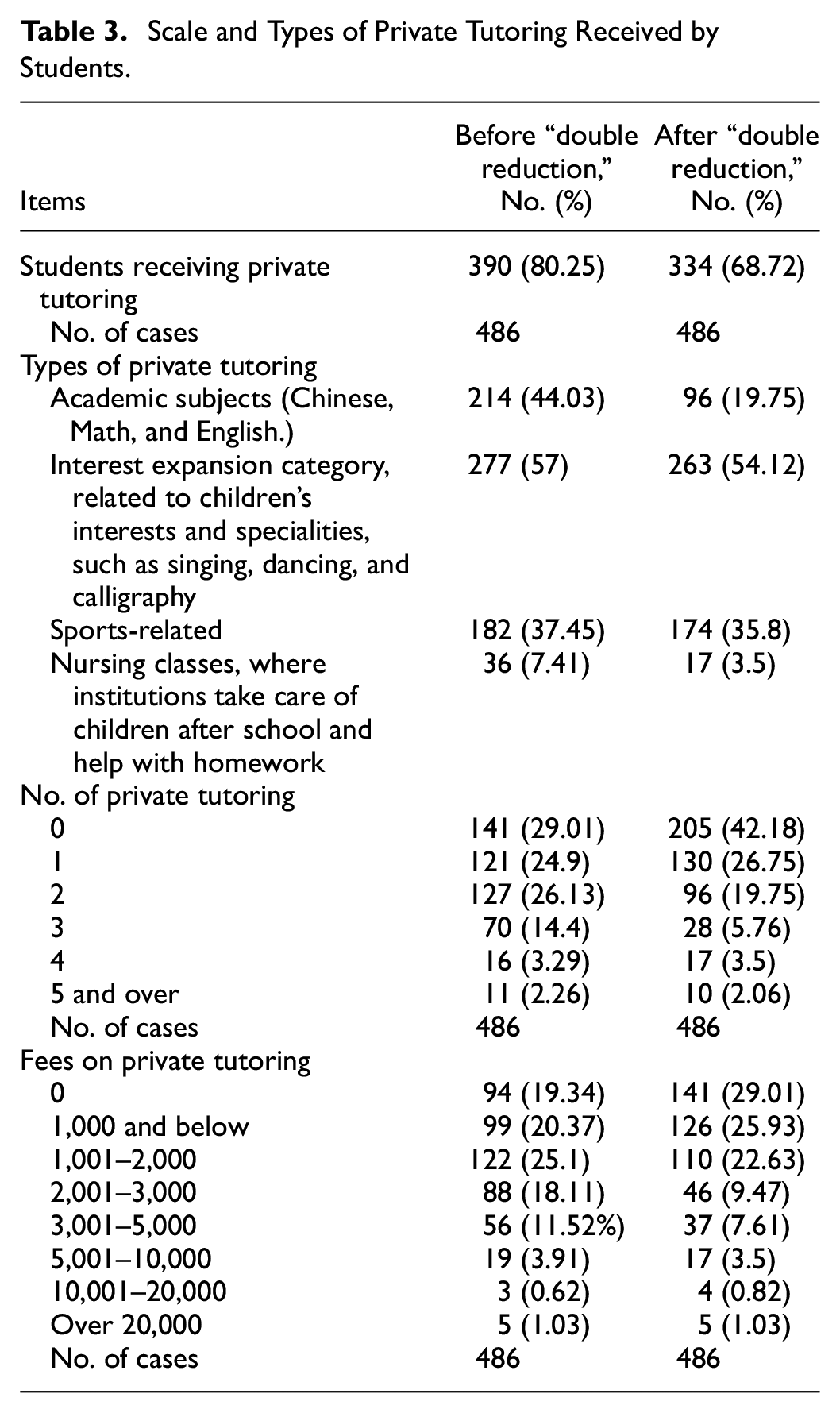
Table 4 compares the correlation between parents’ educational level and types, numbers, and fees for private tutoring before and after the “double reduction” policy. As can be seen from Table 4, both before and after the “double reduction” policy, there is a significant correlation between parents’ educational level and the category of personal cultural development and sports-related private tutoring, as well as the number of fees for private tutoring. The strongest correlation is between the number of private tutoring opportunities and parents’ educational level, which indicates that the higher the parents’ educational level, the greater the amount of private tutoring chosen by parents for their children. It is interesting to note that there is no significant correlation between parents’ educational level and the type of academic subjects (Chinese, Mathematics, and English).
The Correlation Between Parent’s Educational Level and Types, Number, and Fees for Private Tutoring Before and After the “Double Reduction” Policy.

Correlation is significant at the .01 level, significance (2-tailed).
p < .1, **p < .05, ***p < .01.
Table 5 gives the correlation between annual household income and types, numbers, and fees for private tutoring before and after the “double reduction” policy. It shows that both before and after the release of the “double reduction” policy, there is a significantly strong correlation between annual household income and all types of private tutoring (academic subjects, personal cultural development, and sports-related), except the type of nursing classes. The strongest correlation is between the annual household income and fees for private tutoring, followed closely by annual household income and the amount of private tutoring. This means that the greater the annual household income, the greater the expenditure on private tutoring. This is not surprising, as parents with greater disposable income (who themselves may have benefitted from education) can appreciate the value of education.
The Correlation Between Annual Household Income and Types, Number, and Fees on Private Tutoring Before and After the “Double Reduction” Policy.

Correlation is significant at the 0.01 level, Significance (2-tailed).
p < .1, **p < .05, ***p < .01.
Qualitative Findings
The qualitative findings mainly explained parents’ choices of and rationale for private tutoring and how such choices were influenced by the parents’ socioeconomic status.
Parents with a Bachelor’s Degree or Above: Private Academic Tutoring for Improving Academic Grades was not Valued
Thirteen parents said that they did not send their children for private academic tutoring, such as in English, Chinese or Mathematics, either before or after the “double reduction” policy. Nine parents and their spouses both had a bachelor’s degree or above and had a higher annual household income than the national average (over 600,000 yuan). The “double reduction” policy did not influence their choices of private tutoring, as they had not chosen academic private tutoring for their children before the policy. For example, a mother, and her husband, each with a bachelor’s degree, working as managers at an enterprise with an annual household income of 800,000 to 2,000,000 yuan said: Basically, we were not impacted by the “double reduction” policy as we didn’t send our children for private academic tutoring before or after the policy. We didn’t think that our child [a body in grade 8] should only immerse himself in academic learning but ignore the other things. For us, academic grades were not the most important thing. Also, he had good learning behaviour and relatively good academic performance although not the best in his class. That’s why we didn’t seek private academic tutoring. Instead, we took him out on weekends for running or sports, or movies. (No. 19: a mother; age: 41–45; educational background: a bachelor’s degree; profession: head of business organisation; annual household income: 800,001–20,000,000 yuan; children: one boy in grade 8).
Similarly, a mother with a PhD degree in German working as a university teacher didn’t choose academic private tutoring for her son in grade 3 even though his grades were not well-ranked in the class.
To be honest, I didn’t care too much about my boy’s academic performance although he was about 35/45 in his class. This is because my grades were not good when I was in primary school, although not as bad as my son’s. I believe from the long-term perspective in life, academic grades in primary school don’t count for much. (No. 15: a mother; age: 31–35; educational background: a PhD degree; profession: university teacher; annual household income: 600,001–800,000 yuan; children: 1 boy in grade 3).
Parents with a Bachelor’s Degree or Above: Non-Academic Private Tutoring was Valued as a Way of Developing Cultural Capital
These parents also tended to attach more importance to their children’s personal cultural development. They chose non-academic private tutoring for their children, mainly based on their children’s interests. These are means of cultural capital formation. For instance, a mother (and her spouse), with a bachelor’s degree working as a university teacher with an annual household income of over 600,000 yuan, said: My child [in grade 7] has been learning fencing and piano mainly because she likes them. Compared with academic subjects, these lessons are more important in cultivating her perseverance, concentration, and a good mentality for facing frustrations. We believed that her physical and mental health is more important than anything else (No. 1: a mother; age: 46 and over; educational background: a bachelor’s degree; profession: university teacher; annual household income: 350,001–6,000,000 yuan; children: 1 girl in grade 7).
This was echoed in another mother’s views. She had a doctoral degree in English and now worked as a university teacher, with an annual household income of over 800,000 yuan.
My boy is now in grade 4 and I had never sought any academic private tutoring for him. However, I did send him for non-academic private tutoring, such as soccer and badminton, mainly based on his interests. I believe these are more important than academic private tutoring as they could better develop his qualities such as persistence, self-confidence, and teamwork (No. 23, a mother; age: 40–45; educational background: a doctoral degree in English; Profession: university teacher; annual household income: 800,000–2,000,000 yuan; children: 1 boy in grade 4 and 1 girl in kindergarten).
Parents Without a Bachelor’s Degree or Lower: Private Academic Tutoring as a Way of Enhancing or Maintaining Academic Performances
By comparison, ten parents who had sought private tutoring for their children each had an educational qualification below undergraduate (Zhuanke, high school or middle school), and often with lower annual household income compared with those parents with an undergraduate degree and above. These parents attached greater importance to academic private tutoring to enhance or maintain their children’s academic performances, even when the children’s academic performances were at the upper-middle level. As a result, they sent their children for private academic training either to improve or to maintain their academic grades or because of peer pressure.
I sent my child for private tutoring in Chinese, mathematics, and English from grade 4 to grade 8. You know, I have to, as the other students around us were all doing the same. If I didn’t do that, I was afraid that his academic performance would drop and therefore could not attend a good middle/high school or university (No. 18: a mother; age: 41–45; educational background: high school; profession: company financial officer; annual household income: 350,001–600,000 yuan; children: 1 boy in grade 2 and 1 girl in grade 8). I sent my children (in grade 4) for private training in English and Mathematics, although his grades were ranked upper-middle in his class. I wanted to lay a good foundation for his future studies so that he would not feel too tired of his future studies. After all, the competition for entering an elite high school and the university is too intense in China (No. 22: a father; age: 46 and over; educational background: zhuanke educational certificate; profession: journalist; annual household income: 200,001–350,000 yuan; children: 2 boys with 1 in grade 5 and the other a sophomore in the university).
These parents felt even more worried about their children’s academic performance after the “double reduction” policy as they thought private tutoring classes were useful in improving their children’s academic performances. They feared that without such complementary tutoring, their children’s academic performance would deteriorate. Therefore, some chose one-to-one private academic tutoring which was more expensive than private training institutions. This brought an extra financial burden to the family.
I think private academic tutoring is useful to help the children consolidate what they have learnt in class and thus help them to improve. After the “double reduction” policy, we felt more burdened as we had to seek private one-to-one tutoring for our grade 9 boy, which cost around 250–350 yuan per hour and was more expensive than those provided by the private academic institutions. (No. 7: a mother; age: 41–45; educational background: zhuanke educational certificate; profession: homemaker; annual household income: 100,001–200,000 yuan; children: 2 boys with one in grade 1 and the other in grade 9)
Those parents with a lower annual household income could no longer bear the private tutoring charge. They gave up paying for private tutoring, although they were very worried about possible consequences for their children’s academic performance.
Since we stopped the academic private tutoring for our children because of the “double reduction” policy, we were very worried about their academic performance. We were worried that other parents might have one-to-one private tutoring for their children, but we don’t, which could enlarge the gap between our children and theirs. You know we have 1 boy in grade 2 and 1 girl in grade 8 and could not bear private tutoring for them both. Therefore, we set a lot of homework for our children every day hoping that they could consolidate their studies in this way (No. 18: a mother; age: 41–45; educational background: high school; profession: company financial officer; annual household income: 350,001–600,000 yuan; children: 1 boy in grade 2 and 1 girl in grade 8).
Discussion and Conclusion
The paper examined parents’ choices of and rationale for private tutoring both before and after the introduction of the “double reduction” policy, and how such choices were influenced by socioeconomic status.
As for the scale and types of private tutoring received by the students before and after the “double reduction” policy, the quantitative data showed that the number of students receiving private academic tutoring in Chinese, mathematics, and English dropped by around 25% after the policy. It is reasonable to speculate, and this is confirmed by the interview data, that the decline was primarily influenced by parents with limited economic, human, and cultural capital. There was no obvious change in other types of private tutoring that students receive, such as sports, music, and fine arts. This could be attributed to the fact (as revealed in the interview data and discussed in detail later) that such non-private academic tutoring is bought primarily by parents with higher socioeconomic status to acquire more human and cultural capital and thus achieve social reproduction, echoing the findings of Gupta (2023).
This is also understandable as the “double reduction” policy only restricted private academic tutoring, especially in Chinese, Mathematics, and English, which counted heavily in students’ entrance examinations. The number of private tutoring opportunities parents chose for their children also decreased, and the parents thus paid less in fees. This indicates that the “double reduction” policy has helped ease the financial burden of private tutoring. However, parents who continued to believe in private tutoring felt more burdened as they had to opt for the more expensive one-to-one provisions after the policy (see interview data).
Consistent with other empirical studies (Chu, 2009; Bray et al., 2014), the findings showed a significant correlation between parents’ educational level and the types, amounts, and fees for private tutoring, both before and after the “double reduction” policy. The higher the parents’ educational level (signalling more human and cultural capital), the greater the amount of private tutoring chosen by parents for their children, especially in personal cultural development and sports-related private tutoring, conforming to the “concerted cultivation” of their children (Lareau, 2017). Notably, non-academic private tutoring becomes a medium for nurturing cultural capital, particularly among parents endowed with human and cultural capital themselves.
However, there was no significant correlation between parental educational level and private tutoring in academic subjects, such as Chinese, Mathematics, and English. Well-off parents (normally with higher educational degrees and annual household income as indicated in the interview data) attached more importance to non-academic private tutoring that enhanced their children’s personal cultural development and physical and mental health. An explanation is that such parents, themselves endowed with human and cultural capital, could provide educational support for their children in the home, and they attached more importance to the cultivation of cultural capital through extracurricular activities and non-disciplinary private tutoring, as noted by Kimelberg (2014).
By comparison, parents from lower educational backgrounds tended to attach more importance to their children’s academic grades and looked to academic private tutoring to maintain or even improve the grades their children achieved. Such parents were concerned that they, with limited personal human and cultural capital, regarded private tutoring as an essential means of support for their children academically. It shows that education in China remains a crucial instrument for social advancement and for the maintenance of social status, especially among families with lower socioeconomic status who have limited resources for “concerted cultivation” and intensive parenting. This is related to the Chinese expectation that high academic performance at school is followed by a university degree and then a professional or managerial career (Liu & Bray, 2022). Such comparison indicates that parents at higher educational levels have different views from parents at a lower educational level about appropriate styles of education for their children. This was echoed by Bray et al. (2014).
Parents’ decisions to pay for private tutoring are also influenced by family economic conditions. The positive correlation between household income and private tutoring expenses reaffirms the link between economic capital and educational investment. This is consistent with the findings of Chu (2009) and Bray et al. (2014). Families with greater annual household incomes tended to choose more and spend more on private tutoring for their children. Such parents were thus less affected by the “double reduction” policy as they could afford one-to-one private tutoring for their children, even though it was more expensive. By comparison, lower-income families (and usually from lower educational backgrounds) were more affected as they could not afford the expensive one-to-one private tutoring, yet considered private tutoring essential to maintaining and even improving the grades of their children. These parents, therefore, became more burdened as they had to invest more time and energy in their children’s studies. This is evidence of the social reproduction of human and cultural capital. Parents with economic capital (and usually cultural capital) are themselves able to invest in human capital (cognitive and behavioural skills) and cultural capital (skills, habits, and styles) acquisition for their children, as identified by Bourdieu (1977). In this case, through one-to-one private tutoring, as shown in Zhang and Xie (2016). Therefore, the educational gap between these two different groups of students can be expected to widen.
By recognizing the multifaceted impact of socioeconomic status on parents’ choices of private tutoring and understanding the nuanced interplay between capital dimensions in the context of the “double-reduction” policy, an educational policy can be tailored to promote equity and address the diverse needs of students across the spectrum of socioeconomic backgrounds. First, to cater to students’ individual needs, the central or provincial educational government should financially support the schools to provide students with a high-quality and differentiated after-school service system with appropriate academic support and extra-curricular activities including arts and sports. These should be free or at a lower charge for parents from lower socioeconomic backgrounds. Secondly, as parents from lower socioeconomic backgrounds might face an increased financial burden because of choosing more expensive one-to-one private academic tutoring, the national educational department should establish high-quality public service network platform courses to supplement the regular school curriculum so that dependence on private academic and non-academic training outside school is reduced (Oomen, 2021). Schools should also integrate the educational resources of the wider school community to provide students with appropriate extra-curricular activities. For example, the school could invite parents and professionals from social education institutions to give lectures, workshops, and other educational activities and after-school services to the students (Zhang et al., 2020, 2021; Xue & Li, 2023). Finally, the educational department should provide workshops, seminars, or online resources regularly that equip parents with strategies to enhance their abilities and involvement in their children’s studies. This would especially benefit parents from lower socioeconomic backgrounds.
The present study has limitations. First, the findings are derived from a relatively small sample and their generalizability is restricted. Further studies using larger samples across China are recommended as the interpretation and practice of national policy may vary among different provinces and cities. Secondly, the paper did not explore the potential grade differences in students’ use of private tutoring, especially between primary school students (grades 1–6) and middle school students (grades 7–9). These two groups of students may face different degrees of competition for entrance examinations and thus have different needs for private tutoring. Studies comparing the influence of the policy on these two types of students are therefore suggested. Finally, it is recognized that only one parent’s educational degree was considered when exploring the correlation between parents’ educational level and types, amount of, and fees for private tutoring in the survey. Further studies recognising the educational degrees of both parents are recommended as they would permit a more comprehensive view of the correlation analysis.
Footnotes
Declaration of Conflicting Interests
The author(s) declared no potential conflicts of interest with respect to the research, authorship, and/or publication of this article.
Funding
The author(s) disclosed receipt of the following financial support for the research, authorship, and/or publication of this article: The research was funded by Guangdong University of Foreign Studies under Grant number [2023RC061].
Ethics Statement
The research was improved by the ethical committee of G University (No. 299-X5222196). Participant informed consent was obtained, and their personal information was anonymised.

Data Availability Statement
The data will be shared upon reasonable request to the communication author.