




Abstract
Suicide and self-harm crises among high school students are significant public health issues. Previous research has often focused on individual factors in suicide and self-harm crises, neglecting the complex interactions between multiple factors. This study, based on the diathesis-stress model, utilized survey data of 12,472 Chinese high school students and employed machine learning methods to construct a decision tree model. It analyzed the most significant negative life events and coping styles in predicting suicide and self-harm crises, explored the impact of these factors on students, and examined sex differences. The classification tree’s built-in contribution function allowed us to obtain the importance of each variable. Results indicated that the model performed well, with the classification tree demonstrating strong predictive accuracy for self-harm and suicide crises among both male and female students. While the impact of negative life events and coping styles on suicide crises showed cross-sex consistency, sex differences were observed for self-harm crises. Among male students, only interpersonal relationships exceeded the 10% threshold in importance, whereas a wider range of events surpassed this threshold for female students. Coping styles played a critical role for both groups, further underscoring their importance in helping students mitigate crises amid negative events. The decision tree model demonstrated high accuracy in identifying students at risk of suicide and self-harm crises. Through the decision tree model, the study identified several key negative life events and coping styles, offering valuable insights for educators to provide more targeted attention and guidance in intervening in suicide and self-harm crises.
Plain language summary
Study using reports about the relative importance differences of negative life events and coping styles in the classification of self-harm and suicide crisis among Chinese students of different genders. Why was the study conducted? The study aimed to explore the factors contributing to self-harm and suicide crises among Chinese high school students, given the significant psychological challenges they face, especially with societal pressures and college entrance exams. What did the researchers do? The research team created models to classify self-harm and suicide crises in high school students of different genders. They aimed to identify the impact of negative life events and coping styles on these crises. What did the researchers find? With 14,047 participants, over 10% experienced a suicide crisis, and more than 15% faced a self-harm crisis. For males, interpersonal relationships and fantasy and escape were crucial for self-harm, while academic stress and fantasy were vital for suicide crises. Females, on the other hand, prioritized health adaptation, self-regulation for self-harm, and avoidance, interpersonal relationships, and self-regulation for suicide crises. What do the findings mean? The study successfully developed predictive models to identify high school students at risk of self-harm and suicide crises. Detecting and intervening in these cases could potentially reduce the associated risks timely.
Keywords
Introduction
Adolescent suicide is a serious public health concern worldwide. According to data from the World Health Organization, 720,000 people die by suicide each year, equating to one death every 40 s; suicide is also a lifelong issue and the third leading cause of death globally among people aged 15 to 29 years (World Health Organization, 2024). Meanwhile, self-harm is one of the strongest predictors of suicide mortality during adolescence (Favril et al., 2022; Geulayov et al., 2018). Before individuals engage in actual suicidal or self-harming behaviors, they often experience suicide and self-harm crises (e.g., seriously contemplating suicide or having a strong desire to self-harm). These crises configure a state of psychological imbalance that may result in fatal consequences (Folkman et al., 1986).
High school students have always been a high-risk group for mental crises, and it is usual for individuals to commit suicide and self-harm behaviors during high school stage (Gandhi et al., 2018). For one, high school students face great pressure from college entrance examinations; for another, they are subject to pressures and setbacks from various aspects such as society, family, and schools (Campos et al., 2019). Concomitantly, the prefrontal cortex has not yet matured in high school students. This impairs their ability to regulate themselves and control their behavior completely (Vijayakumar et al., 2014), hindering their ability to effectively cope with negative life events or setbacks. This makes them more prone to fatal crises (Miller & Prinstein, 2019).
In recent years, the relationship of life events with self-harm and suicidal behaviors has been confirmed by an increasing number of research, especially as the recognition and evaluation of life events has advanced. Various studies have shown that recent life events can independently predict adolescent self-harm behaviors (O’Connor et al., 2010). Furthermore, negative life events, such as stress and problems in interpersonal relationships, are the main reasons adolescents engage in self-harm or suicidal behaviors (Claes et al., 2014; Madge et al., 2011). It remains that not all individuals who experience negative life events experience psychological crises. According to the diathesis-stress model, psychological crises result from the combined effects of external pressures and personal psychological qualities (Brodsky et al., 1997). In current research, stress (i.e., an external pressure) mainly refers to life events (Chen et al., 2011), and coping style is an important psychological factor that individuals use to deal with psychologically-stressful events (Compas et al., 2001; Y. J. Zhang et al., 2005). Therefore, a comprehensive predictive model of suicide and self-harm crises among high school students should also consider both the external pressure factors of negative life events and the psychological factor of coping style.
Importantly, the characteristics of the physiological and psychological development of men and women differ, implying that the coping styles and potential adverse effects of negative life events that students of different sexes face may differ significantly. Flannery et al. (2018) found the greatest sex difference in seeking support and emotional expression, with women being more likely to seek support and emotional expression. Compared to men, women are more sensitive to factors that may lead to self-harm behaviors and are, therefore, more susceptible to them, rendering this a vulnerable group for self-harm (B. Y. Wang et al., 2015). Niu et al. (2013) confirmed the moderating effect of sex on the relationship between negative life events and coping styles. Therefore, it is necessary to explore the effects of negative life events and coping styles on suicide and self-harm crises among men and women separately. Exploring this issue can not only help us understand sex differences in the mechanisms of suicide and self-harm crises but also provide direct guidance for developing related sex-specific intervention programs for high school students.
Negative life events and coping styles are multidimensional. For instance, Liu et al. (1997) divided negative life events into six types (related to relationships, academic pressure, punishment, loss, health adaptation, and others), while Fang et al. (2018) classified coping styles into three types (self-regulation, fantasy & avoidance, and seeking help & problem-solving). Therefore, multiple variables should be considered when exploring the complex relationships among life events, coping styles, adolescent suicide, and self-harm.
Traditional regression analysis is inadequate for analyzing nonlinear feature sets in complex models. Moreover, currently, research has focused on single factors (e.g., overall negative life events or certain negative life events), resulting in relatively simplistic models. Machine learning algorithms come to the fore here as effective tools for processing large samples and multidimensional data. Among them, classification and regression tree (CART) algorithms use a nonlinear logic structure of if-then to recursively divide data by finding features with the best classification effect as nodes, having strong statistical power (Gradus et al., 2020; Wei et al., 2022). In addition, decision tree (DT) algorithms can simultaneously account for complex multivariate relationships between each variable and the outcome variable in a model, determining the optimal split point for each variable and constructing optimal node branches in a hierarchical order based on the importance of the influencing factors. DT models are based on CART, used to predict categorical variables, tolerant of variable attributes, have been widely used in constructing classification models for self-harm and suicide among adolescents, and are expected to be applicable to constructing a psychological crisis classification model for high school students (Donnelly et al., 2023; Wei et al., 2022).
In fact, the DT model has been widely used to predict suicide and self-harm crises in Chinese populations. For example, Pan et al. (2023) used a DT model to predict self-harm crises based on demographic characteristics and family and emotional factors, while Xue et al. (2024) validated the effectiveness of this model in predicting self-harm. Wei et al. (2022) demonstrated that DTs can effectively classify suicide and self-harm crises, with accuracy rates of 72% and 75%, respectively, among middle school students. Previous studies have thus fully validated the effectiveness of DT in predicting suicide and self-harm crises.
Accordingly, this study intends to use a DT algorithm to construct DT classification models for suicide and self-harm crises among high school students of different sexes. Furthermore, we explore the classification effectiveness and relative importance weights of various negative life events and coping styles on suicide and self-harm crises.
Methods
Data Source and Data Exclusion
The data used in this study were obtained from the Science Database of People Mental Health of the Population Health Data Archive (PHDA; DOI: 10.12213/11.A001U.202204.281.V1.0), which follows psychological industry standards, expert consensus, guidelines, and regulations, and uses widely-accepted international and domestic standard scales suitable for the Chinese “norm.” Data collection involved validity and reliability evaluations, and was performed following standardized procedures for both offline and online data collection (e.g., organization, training, and management) using surveys and assessments in mental health contexts. In 2021, the PHDA received the CoreTrustSeal global certification for trusted data repositories. The dataset used in this study included high school students from 24 provinces in China, and a total of 14,047 students completed the relevant questionnaire. This database was approved by the ethics committee of cancer hospital, Chinese academy of medical sciences and all the participants provided informed consent, with the latest revision date being May 26, 2023.
Because machine learning models do not allow for missing values, and to improve data quality, we filtered the sample. The exclusion criteria were as follows: (1) questionnaires with missing items; (2) questionnaires with clearly-distorted responses, such as selecting the same option for all questions or selecting answers outside the prescribed range. Based on these criteria, 1,575 (11.21%) students were excluded, leading to12,472 high school students (5,507 men, 44.15%; 6,965 women, 55.85%) being included in the analysis.
In this study, four questions were used to investigate whether high school students had experienced a suicide or self-harm crisis in the past 6 months. The questions included “Seriously considered suicide,”“Formulated a suicide plan,”“Attempted suicide,” and “Engaged in self-harm behavior.” Individuals classified as suicide crisis group (834 men and 1,169 women) reported having suicidal ideation, a suicide plan, or a suicide attempt. Individuals classified as self-harm crisis group (880 men and 1,632 women) reported engaging in self-harm behavior without suicidal ideation, suicide plan, or suicide attempt. The remaining individuals without a suicide or self-harm crisis (3,793 men and 4,164 women) were referred to as the control group.
The dataset included data of 14,047 high school students, from 24 provinces in China, who completed the relevant questionnaire. This research was approved by the Ethics Committee, and all participants provided informed consent, with the latest revision date being May 26, 2023.
Measure
Negative Life Events
Negative life events were measured using the 27-item Chinese version of the Adolescent Self-Rating Life Events Checklist (also known as ASLEC; Liu et al., 1997). Various classification methods have been proposed for the dimensions of this construct. After conducting confirmatory factor analysis, this study adopted the six-dimensional classification criteria proposed by Gao (2006), which includes the following dimensions: interpersonal relationships (five items), academic pressure (five items), punishment (five items), loss (four items), health adaptation (five items), and other (three items; e.g., “financial difficulties in the family”). Items were responded on a five-point Likert scale, with higher scores indicating a greater impact of negative life events. Previous research conducted with the Chinese population has demonstrated this scale to have good reliability and validity (Song et al., 2020; Zou et al., 2022).
Coping Style
Coping style was measured using the 20-item Chinese version of the Simplified Coping Style Questionnaire (SCSQ, Xie, 1998). All items were rated on a four-point Likert scale. The original scale was divided into two dimensions, namely positive and negative coping. However, considering the uniqueness of the psychological characteristics of adolescents, we chose the three-dimensional division standard proposed by Fang et al. (2018), which includes self-regulation (eight items), fantasy and avoidance (seven items), and seeking help and problem-solving (five items; e.g., “Talking to people and sharing inner troubles”). The higher the score, the more frequent the use of the coping style. The SCSQ has shown good reliability and validity in Chinese populations (Li et al., 2022; Lin et al., 2020).
Data Analysis
In this study, SPSS version 22.0 was used for the correlation analysis, F-test, internal consistency reliability analysis, and Harman’s single factor test. Amos version 22.0 was used for confirmatory factor analysis. The CART model was constructed using scikit-learn version 1.1.0 in Python version 3.8.
We used the machine learning CART algorithm to construct classification tree models with negative life events and coping styles as predictor variables, and suicide and self-harm crises as outcome variables.
The model selected nine features, as follows: (1) negative life events (interpersonal relationships, academic stress, punishment, loss, health adaptation, and others); (2) coping styles (self-regulation, fantasy and escape, seeking help, and problem solving). Considering sex differences, we constructed prediction models for self-harm and suicide crises separately for male and female students.
The data were randomly divided into training (70%) and test sets (30%). Because both individuals with suicidal ideation and those with self-harm behaviors belonged to the minority in the dataset, which deviated from the assumption of unbiasedness, oversampling techniques were used to balance the data and generate new samples for the minority classes. The balanced data sizes are listed in Table 1.
Data Size of Suicide Crisis and Self-Harm Crisis.

The model was constructed using the training dataset. In the recursion process, the Gini coefficient was used as a measure of heterogeneity. To reduce overfitting, this study used 10-fold cross-validation to evaluate the model, using evaluation metrics of accuracy, precision, recall, and F1 score. The “feature_importances_” function is used to measure the contribution of each feature to model prediction accuracy, and to assess feature importance. The function returns a value between zero and one, with higher values indicating that the corresponding feature contributes more to the prediction results.
Results
Reliability and Validity Test of the Scales
In this study, the Cronbach’s α coefficients for the Adolescent Self-Rating Life Events Checklist scale and the dimensions (interpersonal relationships, academic pressure, punishment, loss, health adaptation, and other) were .97, .85, .83, .94, .89, .84, and .83, respectively. The Cronbach’s α coefficients for the SCSQ scale and its dimensions (self-regulation, fantasy and avoidance, and seeking help and problem-solving) were .93, .92, .89, and .90, respectively. The scale demonstrated good internal consistency and reliability.
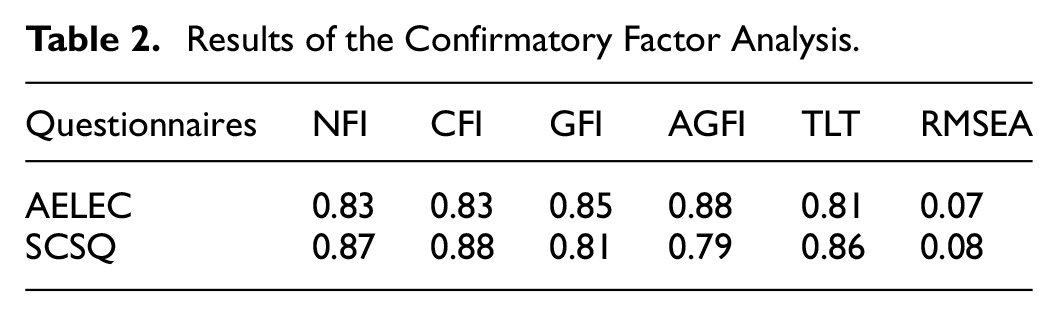
The results of the confirmatory factor analysis are presented in Table 2. For large samples (n ≥ 1,000), the χ2 value tends to be large; however, as long as several other indices are satisfactory, the model can be considered acceptable to a certain extent (Wen et al., 2004). Therefore, both the Adolescent Self-Rating Life Events Checklist and SCSQ ideally reflect the constructs of the overall scale.
Results of the Confirmatory Factor Analysis.
Harman’s single-factor test was used to test for common method bias, and the results showed that there were six factors with eigenvalues greater than one. The explanatory rate of the first factor was 29%, which is below the critical value of 40%, indicating no significant common method bias.
Correlation Analysis
The results showed that suicide and self-harm crises correlated significantly with each dimension of negative life events and of coping styles (p < .001), and Figure 1 shows the correlation heatmap. These results of the correlation analysis provided a reliable foundation for model building, as negative life events and coping styles were highly correlated with suicide and self-harm crises, suggesting that the information contained in these variables may have a strong explanatory power in the predictive model.

Correlation heatmap.
The Results of the Difference Test
The results of χ2 and F tests showed significant differences by sex for all dimensions of negative life events and coping styles among the three groups. Post hoc comparisons using the Student-Newman-Keuls method indicated significant differences in all variables among the three groups. The crisis group (suicidal crisis + self-harm crisis) scored higher than the control group for all six negative life events. Regarding coping styles, the crisis group was more inclined toward fantasy and avoidance (Table 3).
The Results of the Difference Test.

p < .001
Model Performance
According to the CART algorithm, the predictive model for whether male students are in a suicide crisis has an accuracy of 81.26%, precision of 78.13%, recall of 86.35%, and an area under the curve (AUC) is 81.30%. Meanwhile, the predictive model for whether male students are in a self-harm crisis has an accuracy of 78.53%, precision of 73.95%, recall of 88.51%, and an AUC of 78.50%.
The predictive model for whether female students are in a suicide crisis has an accuracy of 79.56%, precision of 76.06%, recall of 86.56%, and an AUC of 79.53%. Meanwhile, the predictive model for whether female students are in a self-harm crisis has an accuracy of 77.10%, precision of 73.80%, recall of 84.10%, and an AUC of 77.10%.
Feature Importance
The importance of each feature in the classification tree with self-harm crisis as the outcome variable is shown in Figure 2.
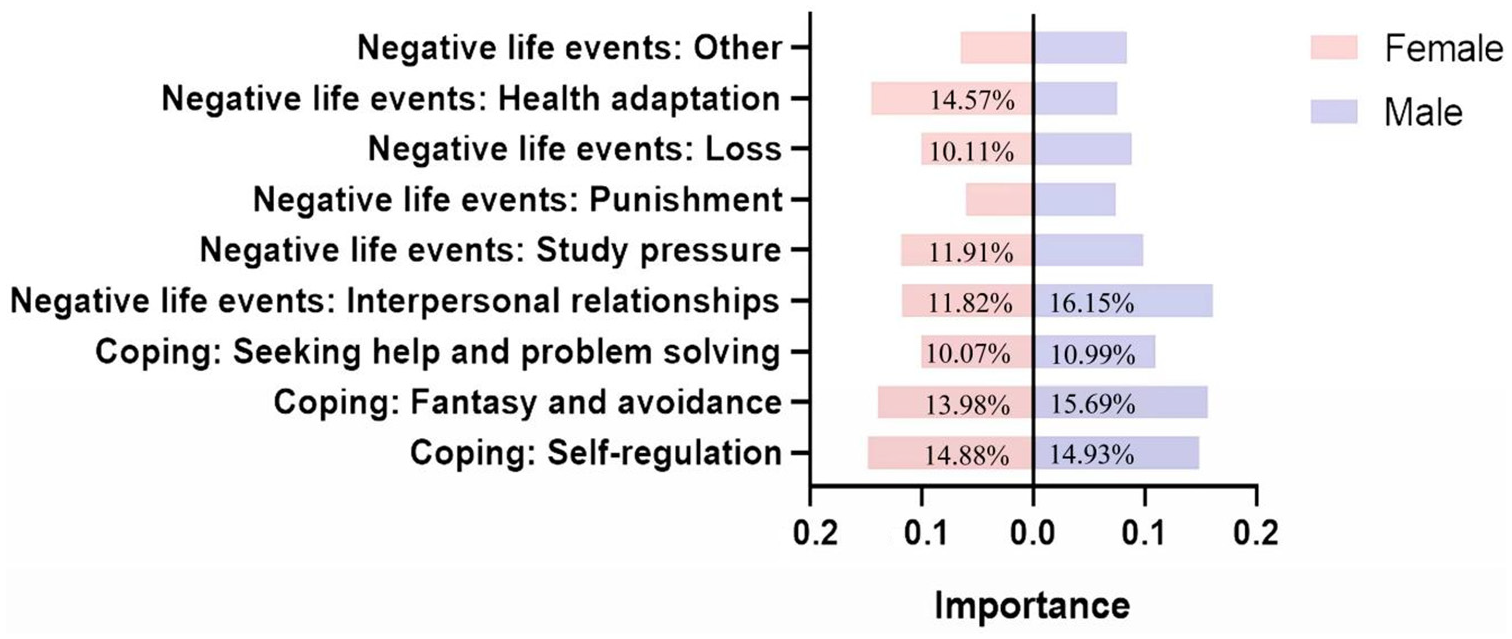
Feature importance for predicting self-harm crisis.
The results showed that, compared to the model for male students, the DT model identified more features with importance greater than 10% among female students. Among male students, the most important negative life event variable was interpersonal relationships, while the most important coping style variable was fantasy and escape. Among female students, the most important negative life event variable was health adaptation, while the most important coping style variable was self-regulation.
The importance of each feature in the classification tree with suicide crisis as the outcome variable, is shown in Figure 3.

Feature importance for predicting suicide crisis.
The results showed that the DT model selected five features with an importance greater than 10% in both male and female students. Among male students, the most important negative life event variable was academic stress, while the most important coping variable was fantasy and avoidance. Among female students, the most important negative life event variable was interpersonal relationships, while the most important coping variable was self-regulation.
Discussion
This study constructed complex classification models for suicide and self-harm crises in male and female high school students using a DT algorithm, and explored the relative importance of negative life events and coping style on such crises. The results showed that the DT effectively classified suicide and self-harm crises.
The Effect of Coping Style in Suicide and Self-Harm Crises
According to the feature importance results obtained from the DT model, regardless of a suicide or a self-harm crisis, the contribution of the three coping styles in both male and female students was greater than 10%. This finding suggests that how individuals cope with negative life events is a significant factor in whether they experience suicide or self-harm crises.
Previous studies support this finding. According to the experiential avoidance model, there is a stronger connection between negative life events and deliberate self-harm among adolescents, as they are unable to self-regulate effectively (Chapman et al., 2006). When faced with setbacks, adjusting one’s goals can effectively reduce suicidal ideation, whereas individuals unable to self-regulate when they cannot achieve their goals are more likely to develop suicidal ideation (O’Connor et al., 2010). Additionally, Zou et al. (2022) found that fantasy and escape significantly increase self-harm risks among adolescents, and these findings are also supported by the experiential avoidance model. This model suggests that provocative life events trigger negative emotions and psychological distress, which then lead to an increase in the tendency to avoid psychological experiences. This avoidance can then help individuals avoid psychological distress. To achieve experiential avoidance, individuals may engage in harmful behaviors, such as suicide and self-harm, as a short-term attention diversion (Chapman et al., 2006).
Additionally, seeking help and problem-solving are critical coping styles that serve as protective factors against self-harm behaviors (Wu & Liu, 2019). Interestingly, seeking help and problem-solving (i.e., a positive coping style) was less important than self-regulation in our sample. We speculate that this may be because the commonly-occurring enhanced self-centeredness during adolescence increases high school students’ independence and self-esteem, making them less likely to ask others for help (C. H. Guo, 2019; Z. Wang & Yang, 2005).
The Effect of Negative Life Events in Self-Harm Crises
Regarding negative life events, interpersonal relationships played a critical role in predicting self-harm crises in both male and female students. Still, the role of interpersonal relationship-related negative life events was higher (vs. other negative life events) among male students. One explanation is that interpersonal conflicts can cause individuals to be dissatisfied with their relationships, leading to feelings of loneliness (Lodder et al., 2017; Mahon et al., 2006). Meanwhile, high levels of loneliness can cause individuals to have more negative expectations of social interactions and to be more sensitive to threats (Cacioppo & Hawkley, 2009). In general, male students are more sensitive to negative information in peer interactions and are more prone to conflicts, which leads to further increases in subsequent friend conflicts (S. Y. Hu et al., 2019).
Unlike male students, the negative life events that triggered self-harm crises in female students were more diverse, and this may be related to sex differences in rumination. Studies show that negative life events correlate positively with an individual’s level of rumination (Xin et al., 2023), and that rumination is an important influencing factor in self-harm (Y. L. Wang et al., 2020). Additionally, female students often adopt rumination as a coping style, making the impact of negative life events on female students more pronounced (S. R. Guo et al., 2011; Han & Yang, 2009).
The Role of Negative Life Events in Suicide Crises
The DT identified two features, namely interpersonal relationships and academic pressure, as having an importance greater than 10% in predicting suicide crises in both male and female students, demonstrating consistency across sexes.
Unlike for self-harm crisis prediction, interpersonal relationships were found to be more important in suicide crisis prediction among female than male students, which is a novel finding. While previous research has established a close relationship between interpersonal relationships and psychological crises (Blum et al., 2024), there has been a lack of systematic comparisons examining how interpersonal relationships differently impact suicide crises and self-harm crises across genders. This study addresses this gap by demonstrating that interpersonal relationships influence suicide crises and self-harm crises differently in male and female students, highlighting significant gender-based differences. Previous studies have found that interpersonal conflict has varying impacts on students of different genders. S. Y. Hu et al. (2019) found that while both male and female students may feel lonely owing to interpersonal conflicts, these conflicts mainly manifest through peer conflict and parent–child conflicts did not have a significant predictive influence on loneliness among male students. In contrast, female students’ feelings of loneliness were more likely to be influenced by parent–child conflicts, and there was no significant predictive relationship between peer conflicts and feelings of loneliness (S. Y. Hu et al., 2019). When faced with parent–child conflicts, female students tend to resist and attack more than male students, which further exacerbates the sense of estrangement between parent and child (Y. Hu et al., 2023). As the correlation between parent–child relationships and suicide crises was much higher than that between such relationships and self-harm crises, interpersonal relationship-related negative interpersonal events may be more significant in predicting suicide crises in female students.
In addition, we found that the importance of academic stress in predicting suicide crises in male students was significantly higher than that of other negative life events, which verifies the significance of academic stress in male students. First, academic problems are the main factor associated with male students experiencing family conflicts (S. Y. Hu et al., 2019). Second, academic stress can lead to a decrease in students’ self-esteem and -efficacy (Tao, 2013), and high school male students have a significantly higher need for self-esteem and self-worth than do female students (Shukla & Kang, 2017). A lack of self-worth can directly lead to suicidal ideation (P. Zhang et al., 2022).
This study also expands upon the diathesis-stress model. Specifically, we used a DT model to compare the impact of negative life events and coping styles across sexes. This enabled us to identify the key negative life events that influence the risk of suicide or self-harm crises, and the most effective coping styles for each sex group. Our contribution lies in analyzing large-scale population data, revealing that specific negative life events play different roles across sexes. For example, health adaptation plays a more significant role in self-harm among female students than male students. There are two main explanations for these sex differences: gender socialization theory (i.e., gender roles are shaped by societal and cultural expectations) and biological sex theory (i.e., sex behavior differences caused by hormonal and physiological differences; Hyde, 2005). Future research should explore the reasons for sex differences to further deepen the diathesis-stress model.
This study also highlights the critical importance of coping styles, as they were highly important across all models. This indicates that selecting appropriate coping styles when facing negative life events is crucial for crisis prevention among adolescents. This study deepens our understanding of the relationship between negative life events and coping styles, and provides a theoretical foundation for designing sex-based suicide and self-harm prevention and intervention strategies, offering significant practical value.
Limitations
Despite the strengths of this study, the results should be interpreted in light of the following limitations. First, it was based on cross-sectional data, implying that the predictive model developed for suicide and self-harm crisis thoughts does not infer causality. Further longitudinal studies are required to address the causal relations of these variables.
Second, we translated suicide and self-injury crisis outcomes into a dichotomous variable because this was expected to increase the simplicity and interpretability of the results and further facilitate discussions with a wider range of stakeholders and practitioners. However, some information may have been lost owing to this methodological choice.
Conclusions
Given the seriousness of adolescent suicide and self-harm, prevention and intervention efforts are crucial. Therefore, this study, based on the diathesis-stress model, explored a complex model of negative life events and coping styles for predicting suicide and self-harm crises among high school students of different sexes, and advances our theoretical foundation of the association between self-harm and suicide.
We found that coping style plays a crucial role in predicting both suicide and self-harm crises, highlighting the significance of students’ subjective agency in mitigating these crises. Moreover, we identified important negative life events that contribute to predicting these crises, emphasizing the need for teachers and parents to pay more attention to and provide guidance when students encounter impactful negative life events. Furthermore, among high school students, the predictive model we developed can effectively identify individuals at risk for suicide and self-harm crises; that is, its use may enable timely detection and intervention in this population, potentially reducing the risks associated with suicide and self-harm crises.
Footnotes
Acknowledgements
Ethical Considerations
The study procedures were approved by Hebei Normal University Human Research Ethics Committee.
Author Contributions
Conceptualization: Shu-Meng Ma and Ning Jia; methodology: Shu-Meng Ma and Ning Jia; software: Shu-Meng Ma; formal analysis, Shu-Meng Ma; investigation: Shu-Meng Ma; resources: Ning Jia; data curation, Shu-Meng Ma; writing—original draft preparation: Shu-Meng Ma; writing—review and editing: Ning Jia, Shu-Meng Ma, and Ping Li; visualization: Shu-Meng Ma and Li-wen, Ren; supervision: Ning Jia; project administration: Ning Jia; funding acquisition: Ning Jia All authors have read and agreed to the published version of the manuscript.
Funding
The author(s) disclosed receipt of the following financial support for the research, authorship, and/or publication of this article: This work was supported by the major project of Humanities and Social Sciences of the Hebei Provincial Department of Education (No. ZD202109).
Declaration of Conflicting Interests
The author(s) declared no potential conflicts of interest with respect to the research, authorship, and/or publication of this article.
Data Availability Statement
The data that support the findings of this study are available from the Population Health Data Archive ( ). However, restrictions apply to the availability of these data, which were used under a license for the current study and are not publicly available. The data will be made available from the authors upon reasonable request and with permission from the Population Health Data Archive