



Abstract
This study introduces a novel pedagogical approach in the translation teaching of Chinese classics: the Ratio of English Words to Chinese Characters (REWCC), which denotes the proportion of English words used in a translation relative to the number of Chinese characters in the source text. Drawing on an empirical study involving junior undergraduate students majoring in translation, our findings suggest that controlling the number of English words within a prescribed REWCC range can contribute to enhancing students’ translation quality compared to traditional instructional methods. Improvements are observed in grammatical accuracy, information richness, and effective transmission of cultural content. By providing novice translators with actionable guidance, the REWCC mode serves as a practical supplement to mainstream translation pedagogy and offers valuable insights into the translation teaching of Chinese classics.
Keywords
Introduction
In response to the growing emphasis on the global promotion of traditional Chinese culture, the teaching of translation for Chinese classics has gained increasing prominence as a pedagogical and scholarly focus (Guo et al., 2019; Z. Li, 2024; Wang, 2012; Wu, 2021). This development reflects the crucial role of translation education in cultivating competent translators capable of mediating classical Chinese texts for international audiences. At numerous Chinese universities, a range of instructional strategies—such as the analysis of existing translations and practical translation exercises—have been adopted to train students majoring in translation and interpreting, who represent the future workforce engaged in the rendering of Chinese classics (Chen, 2011; Z. Huang, 2007). However, these pedagogical approaches often fall short in providing students with concrete and operational strategies for effective translation. More specifically, a notable gap exists in the form of insufficient practical guidance for student translation tasks, while the evaluation and revision processes tend to depend predominantly on instructors’ subjective or impressionistic judgements, thereby limiting the pedagogical efficacy of such instruction.
This study introduces a relatively novel pedagogical approach—based on the Ratio of English Words to Chinese Characters (REWCC)—into the Translation of Chinese Classics course at a university for undergraduate students in mainland China. REWCC is defined as the ratio of English words to Chinese characters in a given translation. For example, the Chinese phrase
The implementation of this mode seeks to provide undergraduate students in China with a practical and operational framework for producing and revising translations. More broadly, this innovative approach is expected to complement existing instructional strategies in the translation of Chinese classics, offering new perspectives and insights for translation pedagogy.
Literature Review
Since the establishment of translation studies as an independent discipline (Holmes, 1972), considerable scholarly attention has been devoted to the teaching and training of translators (e.g., D. Li, 2002; Nord, 2005; Venuti, 2017). In particular, the instruction of translation for Chinese classics plays a pivotal role in laying the groundwork for their potential international reception and recognition by cultivating individuals capable of mediating cultural exchange between China and the wider world (Kroll, 2002; Ma & Ren, 2003; Xu, 2014). In this context, it is imperative to develop a cohort of professional translators and researchers who possess “profound expertise in both Chinese and English languages, as well as in Chinese and Western cultures,” in order to effectively communicate the essence of Chinese civilisation on the global stage (Wang, 2012, p. 14).
Throughout literature, the translation teaching of Chinese classics remains relatively underexplored. In Chinese universities and colleges, two primary approaches are commonly adopted: (1) appreciation and analysis of translations, and (2) translation practice. According to Chen (2011), the first approach can address the “absence of Chinese cultural content in English language instruction” and promote students’ intercultural communicative competence (p. 135). The second method is utilised among universities or colleges with a long history of conducting and teaching translation of Chinese classics. Taking the School of Foreign Languages, Soochow University as an example, postgraduates who took translation courses participated in related translation practices, and some doctoral students even used this as the topic of their thesis (Z. Huang, 2007). The English translations of Essence of Wuge, Essence of Pingtan and Essence of Kunqu Opera have been published successfully, “all of which are highly praised by readers” (ibid., p. 58). This method eschews overly complicated theories and instead places emphasis on cultivating students’ translation competence, thereby enabling them to disseminate Chinese culture worldwide.
The two aforementioned teaching methods have undoubtedly contributed to the advancement of translation pedagogy for Chinese classics while promoting the dissemination of Chinese culture. Through such training, a new generation of translators has positively participated in the construction of global culture (Yu, 2007). As noted above, a substantial number of Chinese classics have been translated and published, further demonstrating the sustained commitment of Chinese translators to ensuring that these works remain an “active presence” within world literature (Y. Liu & Zhu, 2024, p. 32).
However, they also exhibit two notable limitations. First, the method centred on appreciation and analysis tends to emphasise “cultural factors” in translation while often neglecting “linguistic factors.” Influenced by the cultural turn in translation studies, this approach is typically designed to facilitate the dissemination of Chinese culture. However, it may overlook the crucial role of language as the medium through which cultural meaning is conveyed. According to Nida (1993), “both language and culture are collective enterprises, and no one person ever controls completely a language or a culture” (p. 142). It is therefore essential to recognise that language and culture exert mutual influence in translation process, and linguistic considerations should not be marginalised. Second, the practice-based approach often relies heavily on instructors’ subjective judgements, such as personal experiences and comments, which may result in a lack of objective and operational benchmarks for students. Unlike general Chinese–English translation, the translation of Chinese classics involves a dual process of intralingual and interlingual translation (G. Huang, 2012; Sun, 2014), making it more complex. In this context, the provision of a relatively accepted reference model or exemplar could prove beneficial, as it would help clarify the translation objectives and offer students a concrete standard for evaluating and refining their work.
With a deepening understanding and knowledge of the translation of Chinese classics and translation pedagogy, some scholars have begun to introduce innovative instructional methods into the teaching of Chinese classics translation. Zheng (2021) sought to apply the Production-Oriented Approach to English translation instruction in this domain. While the theoretical exposition of the approach was informative, the study may lack a robust experimental design to test its hypothesis and evaluate the method’s validity and practical feasibility. Similarly, Peng (2021) incorporated the Thinking Path Schema into classroom-based translation training, reporting that it enhanced students’ cognitive diversity in translation and led to improved evaluation scores. While this represents a promising and creative development in translation pedagogy, the study’s methodological rigour warrants scrutiny. Specifically, the pre-test procedures were insufficiently detailed, and the sample size was relatively limited, which may compromise both the internal and external validity of the findings.
In light of the aforementioned context, the present study introduces a novel pedagogical approach—the REWCC mode—to evaluate its potential in enhancing the quality of undergraduate students’ English translations, as compared to those produced through the conventional translation practice method. Although initially proposed by Wu (2021), the REWCC mode has yet to receive substantial empirical validation. The traditional translation practice approach is chosen as a point of comparison due to its feasibility, pedagogical maturity, and relatively consistent instructional outcomes. To achieve this objective, the study aims to address the following three research questions:
Can the REWCC mode improve the quality of students’ English translations compared to the traditional translation practice method?
Are there discernible differences in the linguistic features of students’ English translations between the REWCC mode and the traditional translation practice method?
Are there any differences in the dissemination of cultural elements of students’ English translations between the REWCC mode and the traditional translation practice method?
Method
Participants
The study involved 36 junior undergraduate students majoring in translation at a comprehensive university in mainland China. Informed consent was obtained from all participants before the study commenced. The students were engaging with the English translation of classical Chinese texts for the first time and were naturally divided into two classes of the elective course Translation of Chinese Classics. One group received instruction based on the REWCC mode, while the other was taught using the traditional translation practice method. To ensure ethical integrity in instructional research, the content presented to both groups was identical; the sole differentiating factor was the teaching methodology employed.
All participants had successfully passed the Test for English Majors-Band 4 (TEM-4), a standardised national language examination for English majors in mainland China. The average score among participants was 65.81 out of 100, with a standard deviation (SD) of 5.20, indicating a relatively uniform level of English language proficiency. This homogeneity in language skills helped to control the potential confounding variables to some extent. The study was conducted with the approval of the department head, in compliance with research ethics guidelines.
Material
The selected translation material is The New History of the Five Dynasties: Biography of Meng Zhixiang, authored by Ouyang Xiu (1974) during the Northern Song Dynasty (960–1127). This work covers the tumultuous Five Dynasties and Ten Kingdoms period (907–960), characterised by fragmentation and rapid regime changes in China. Meng Zhixiang (874–934) was a military governor who later founded the Later Shu (934–965), one of the Ten Kingdoms during this era. His biography provides insights into his rise to power and governance.
This classical text was selected as translation teaching material for two primary reasons. First, Ouyang Xiu’s distinctive approach to classical prose and historical biography is marked by conciseness and linguistic economy (X. Zhang & Ren, 2012), which facilitates comprehension and translation for students. Second, The New History of the Five Dynasties has received limited attention in English translation, with only one extant version completed by Dai Renzhu and published in 2004. Despite its historical value as a key source on the Five Dynasties and Ten Kingdoms period, the text has been relatively overlooked in both academic and translation contexts (Wang, 2005). In contrast to the extensive attention given to canonical Chinese philosophical works such as The Analects and Tao Te Ching, greater emphasis should be placed on the translation of historical texts to broaden the global understanding and appreciation of Chinese culture. Furthermore, the selection of this work is informed by its applicability to the REWCC mode, which will be elaborated upon in the following section.
Procedure
The study was conducted over a 10-week semester, with both classes receiving the same duration of teaching and learning. During the first two sessions, students were introduced to fundamental theoretical concepts of English translation of Chinese classics, covering topics such as its principles, goals, and reception. From weeks 3 to 9, translation instruction was delivered using two distinct modes, while all other conditions remained constant. At the end of the semester, participants were required to complete an individual translation test within 1 hour during class. The task involved translating a passage of approximately 100 Chinese characters extracted from The New History of the Five Dynasties: Biography of Meng Zhixiang.
Students taught using the traditional translation practice method were allowed to complete their translations based on their acquired knowledge without specific constraints. While students in the REWCC mode group were instructed to control the English words used in their translations, aiming for a REWCC between 1.80 and 2.00. This range is informed by Wu (2021), who based it on Watson’s translation of Selections from the History of the Former Han, which exhibits a REWCC of 1.93 (p. 168). Both texts belong to the genre of historical records in China, sharing similar linguistic and aesthetic features. In addition, Watson’s translation is widely recognised, making it a suitable reference for novice translators (Balcom, 2005; X. Li & Wang, 2011; W. Tao, 2024). The use of a range rather than a specific value accommodates students’ developing translation skills (Wu, 2021). Given the complexity of the translation task, students were permitted to use references such as dictionaries, textbooks, and online resources during the test. To ensure all submitted texts were human translations, the use of machine translation or generative Artificial Intelligence (AI) tools was not permitted during the rendering process.
Following the post-test, two experienced raters independently evaluated the students’ translations using a 100-point scale. To ensure consistency and objectivity, a score deduction system modelled after the standardised China Accreditation Test for Translators and Interpreters (CATTI) was applied (Ko & Li, 2020). In addition, the author manually reviewed all translations to identify salient linguistic and cultural features, which served as the basis for further analysis and discussion.
Rationale for the Application of REWCC in Translation Teaching
REWCC is derived from the concept of lexical density (LD), which has served as an effective index for analysing linguistic features (Halliday, 1987; Ure, 1971). While LD is primarily utilised in monolingual contexts, its applicability in cross-linguistic research—such as translation studies—remains limited (e.g., Johansson, 2008; Laufer & Nation, 1995; C. Y. Liu, 2021). Building on this foundation, REWCC extends the concept of LD to bilingual contexts by quantifying the ratio between the number of English words in a TT and the number of Chinese characters in its corresponding source text (ST). In this way, REWCC transforms a monolingual metric into a tool for analysing translation practices across languages. A higher REWCC indicates a longer English translation, whereas a lower REWCC corresponds to a more concise rendering. Wu (2020, 2021), based on the LD of four English translations of The Analects, found the REWCC of them ranges from 1.29 to 2.05. As such, while LD provides the theoretical underpinning for REWCC, the latter advances the applicability of LD by adapting it for use in cross-linguistic analyses, like translation teaching.
Furthermore, the REWCC mode provides novice translators with a practical and operational framework for developing and revising their translations. By regulating the word count in the TT to fall within a predefined REWCC range (1.80–2.00 in this study), students are guided towards producing translations that meet specific quantitative criteria. In fact, this regulation is closely aligned with Toury’s (2012) textual-linguistic norms, which “govern the selection of linguistic material for the formulation of the target text” at a micro level (p. 83). By offering an explicit and measurable benchmark, the REWCC mode reduces reliance on subjective judgements or instructors’ intuitive experience. The pedagogical objective is to direct students towards compliance with clearly articulated operational norms (ibid.), that is, the preset REWCC value. In this sense, the REWCC mode simplifies the translation task and enhances both accessibility and applicability for undergraduate students, particularly those who are still in the process of developing their translation competence.
Results
General Quality of Translations
According to the preset rubric, two independent instructors evaluated the students’ translations, with their scores presented in Table 1.
Overall Assessment of Students’ Translations.

Table 1 demonstrates the overall assessment of students’ translation performance under two different teaching modes. For the traditional translation practice approach, the mean score is 69.94 (SD = 4.24) according to Rater A, and 69.39 (SD = 4.94) according to Rater B, yielding a combined average of 69.67 (SD = 4.03). In contrast, under the REWCC mode, students achieve a mean score of 72.89 (SD = 5.37) from Rater A and 74.28 (SD = 4.60) from Rater B, with a combined average of 73.58 (SD = 4.50). Inter-rater reliability was assessed separately for the traditional and REWCC groups using Pearson correlation coefficients. In the traditional group, the correlation between Rater A and Rater B is moderate and statistically significant (r = .54, p < .05). In the REWCC group, the correlation is stronger (r = .63, p < .01), indicating a higher level of agreement between raters.
An independent samples t-test was conducted to compare the combined scores between the two teaching modes. The results indicate a statistically significant difference in students’ translation performance (t(34) = 2.75, p < .01), suggesting that students under the REWCC mode significantly outperform those under the traditional mode.
Building on this overall assessment, we further triangulate this finding by examining grammatical correctness, information content, and the incorporation of cultural elements in the students’ translations.
Grammatical Correctness
In assessing translation quality, grammatical correctness is considered a reliable metric due to its function as “an intrinsic meaning maker of a language that governs the arrangement of words to form meanings” (Hancock, 2005, p. 6). For novice translators, grammatical errors are frequently observed in their works (Göpferich, 2010), and addressing these errors can enhance the readability of the translation to some degree. In this study, all grammatical errors were manually identified by the author and subsequently verified by one of the aforementioned instructors, achieving an inter-rater reliability of over 94%. The grammatical errors found in students’ translations are detailed in Table 2.
Grammatical Errors in Students’ Translations.

Note. Error rate was calculated as the number of grammatical errors divided by the total number of clauses.
As shown in Table 2, under the traditional teaching mode, there are a total of 214 English clauses, with 93 grammatical errors identified, resulting in an error rate of 43.46% per clause. In contrast, within the translations made under the REWCC mode, 336 English clauses contain 72 grammatical errors, yielding an error rate of 21.43% per clause, representing a reduction of over 20% in error rate per clause. A two-proportion z-test was conducted to examine whether the REWCC mode could effectively reduce grammatical errors per clause compared to the traditional mode. Results show a significantly lower error rate in the REWCC group than in the traditional group (z = 5.50, p < .001), indicating that the REWCC mode is associated with a significantly improved grammatical performance.
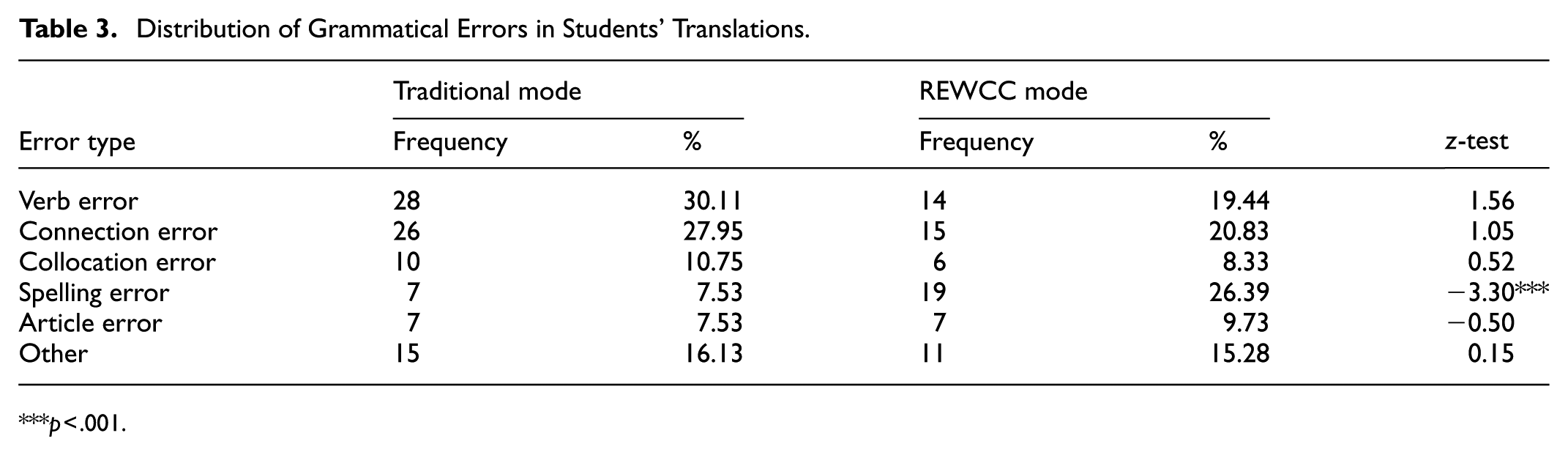
Upon further examination, we find that the types of grammatical errors in the two modes of translation do not differ significantly; however, there appears some differences in the distribution proportions of these errors, as shown in Table 3.
Distribution of Grammatical Errors in Students’ Translations.
p < .001.
Table 3 illustrates that grammatical errors in translations from both groups are predominantly distributed across five categories: verb error, connection error, collocation error, spelling error, and article error. While the overall distribution patterns differ between the two instructional modes, only one error type—spelling error—demonstrates a statistically significant difference. In the group with the traditional method, verb error and connection error occur most frequently and have the highest proportions, with 28 instances (30.11%) and 26 instances (27.95%), respectively. In contrast, in the translation samples produced under the REWCC mode, spelling error is the most frequent, occurring 19 times and accounting for 26.39%. Connection error and verb error rank second and third, with 15 instances (20.83%) and 14 instances (19.44%), respectively. Specific translation examples are presented below, and all examples are reproduced verbatim from students’ translations.
Example 1 ST1: TT1: Zhixiang Example 2 ST2: TT2: Li Renhan Example 3 ST3: TT3: And he Example 4 ST4: TT4: An Chonghui was very frightened and he asked for
As demonstrated in these examples, grammatical errors in translated texts may significantly undermine the quality of the work. In Example 1, the verb “send” should be corrected to its past tense form “sent.” In Example 2, a temporal conjunction, such as “when,” is missing between the two clauses to indicate the connection. Example 3 involves a collocation issue, where the preposition “to” is required before “lead,” aligning with the notion of formulaic language (Jespersen, 2013). Example 4 demonstrates an article error, where “a” should be revised to “an” for grammatical accuracy.
Notably, spelling error appears 19 times in the translations based on the REWCC mode, making it the most frequent type of error and accounting for 26.39%. In contrast, in the group taught with the traditional method, spelling error occurs only 7 times, representing 7.53%. The statistical significance is further confirmed by a two-proportion z-test (z = −3.30, p < .001), which suggests that by controlling the word number in terms of the REWCC mode, students may have concentrated on increasing vocabulary and translation length to meet word-count expectations, inadvertently compromising attention to spelling accuracy.
In summary, the introduction of REWCC in the teaching of English translation of Chinese classical texts can effectively reduce the rate of grammatical errors in students’ renderings. However, the distribution of specific error types does not vary significantly across teaching modes, with the exception of spelling error, which occurs more frequently under the REWCC mode. This finding highlights a potential trade-off between lexical fluency and orthographic accuracy that warrants further pedagogical attention.
Information Content
A complete conveyance of meaning is a fundamental goal and function of translation. In the case of rendering classical texts, the process typically involves two distinct stages: the first entails intralingual translation (e.g., from Classical Chinese to Modern Chinese), followed by a second stage of interlingual rendering (e.g., from Modern Chinese to English; G. Huang, 2015a, p. 3; Sun, 2014, p. 168). In teaching practice, we have observed that compared to the traditional translation practice method, the introduction of the concept of REWCC facilitates a more complete conveyance of the original meaning. In contrast, translations produced under the traditional method—that is, without constraints on word number—often exhibit instances of semantic omission, as indicated in the following examples.
Example 5 ST5: TT5a: Finally, An Chonghui was died of guilty. Mingzong Tang said that it was An Chonghui’s carelessness that caused some people like Meng Zhixiang to revolt the country. TT5b: At last, Chonghui was also condemned to death because of the slanderous talk of some treacherous court officials. Emperor Mingzong said that it was Chonghui’s mistake in making some important decisions that leaded Zhixiang and his attendants’ revolt, which spilt the country.
TT5a is produced through the traditional translation practice approach, whereas TT5b is generated using the REWCC mode. The terms “
Example 6 ST6: TT6a: My descendants were killed. What crime do I thank? TT6b: Only my children and grandchildren were killed, while others’ survived, why do I have to go to Tang’s house to apologize to Tang!
TT6a represents a traditional translation practice sample, whereas TT6b is produced with a controlled number of English words based on the REWCC mode. Actually, TT6a omits some key information from the original text, such as the adversative connector “
In general, translations produced using the traditional method often fail to fully convey the semantic content of the ST, leading to significant information loss. Conversely, translations generated under specific REWCC guidelines tend to more effectively preserve the integrity of the original meaning. This approach may align more closely with the standards of faithful and expressive rendering in the English translation of Chinese classics (An & Jun, 2019).
Dissemination of Cultural Elements
The translation of Chinese classics into English serves a pivotal role in augmenting cultural awareness and facilitating the dissemination of Chinese culture, as highlighted in prior methodologies (e.g., Chen, 2011). In practice, to achieve the target REWCC, student translators frequently engage with pertinent resources and employ explanatory translation for culturally rich expressions, rather than resorting to simple transliteration. This approach not only enhances their own cultural understanding but also aids international readers in comprehending Chinese culture, as demonstrated in the subsequent examples.
Example 7 ST7: TT7a: In January of the following year, Li Renhan conquered Suizhou and killed Xia Luqi. TT7b: In the January of the next year, Li Renhan occupied Suizhou. Unfortunately, Xia luqi died in the battle.
TT7a is derived from a sample produced using the traditional teaching approach, whereas TT7b originates from a sample completed under the constraints of REWCC. In comparison to TT7a, TT7b incorporates two additional elements: “unfortunately” and “in the battle.” These additions actually reflect the student translator’s enhanced understanding of conventional Chinese culture. In The New History of the Five Dynasties, the author Ouyang Xiu compiled the section
Furthermore, from the perspective of reception by foreign readers, these two additions significantly enhance the comprehension of the original text. The evaluative adverb “unfortunately” conveys the translator’s acknowledgement and sympathy for Xia Luqi’s fate, while “in the battle” underscores the spirit of martyrdom inherent in the Chinese concept of “fighting to the death without retreat or surrender” (Hu & Yang, 2022). Collectively, these modifications effectively communicate the traditional Chinese value of “dying with honour” to readers who may be unfamiliar with Chinese culture, thereby contributing, to some extent, to the international dissemination of Chinese cultural heritage.
Example 8 ST8: TT8a: Mingzong had commanded to dismiss Zhixiang from office, and Shi Jingtang, the Jiedushi of the troops called Tianxiong was appointed to be Zhaotaoshi, and Xia Luqi was appointed to help him. TT8b: Mingzong appointed the Army of Tianxiong’s director of Jiedu, which is governor of one or more provinces, Shi Jingtang as the civic director of Zhaotao, which is responsible for quelling uprisings, and appointed Xia Luqi as the deputy civic director of Zhaotao to assist Jingtang to catch Zhixiang.
TT8a is extracted from a translation sample produced with the traditional approach. TT8b, by contrast, comes from a sample generated under the REWCC mode. ST8 includes several Chinese official titles, such as
Generally speaking, from the perspective of cultural dissemination, the REWCC mode appears to facilitate a deeper understanding of Chinese civilisation among overseas readers. By encouraging the inclusion of more explicit and contextually rich cultural information, student translators are not only able to convey cultural elements more effectively but also enhance their own comprehension and appreciation of their native culture.
Discussion and Conclusion
The findings of our study provide empirical support for the pedagogical efficacy of utilising REWCC as a guiding parameter in the English translation of Chinese classics, corroborating Wu’s (2021) argument. The REWCC-based instructional approach leads to a marked improvement in translation quality among student translators compared to the traditional translation practice method, as demonstrated by the enhanced grammatical accuracy, the enriched information content, and the effective integration of cultural elements.
The REWCC mode significantly reduces the frequency of grammatical errors, evidenced by a marked decrease in the error rate per clause. Although the distribution of error types remained relatively consistent across groups, spelling error is notably more prevalent in the REWCC group, which may represent a potential drawback of this approach. This observation suggests that controlling the word count in English translations could enhance grammatical fluency for novice student translators. However, it may also inadvertently reduce orthographic accuracy. It is possible that when a REWCC is established, the translation objective becomes so straightforward and simplified that students may fail to arouse linguistic awareness while focussing on content addition. This trade-off underscores the necessity for pedagogical balance: while the REWCC mode encourages expanded expression, it is imperative to also emphasise surface-level accuracy, including spelling and typographic precision.
In addition, the REWCC mode demonstrably enhances the completeness of semantic content in students’ translations. The comparative analysis of translation pairs demonstrates that translations under REWCC constraints are more likely to preserve the original meaning in its entirety, including causal logic and rhetorical nuance, while also facilitating the transmission of certain culturally specific elements. This outcome aligns with the ultimate objective of previous methods (e.g., Chen, 2011). Actually, it is reasonable to expect that, given the substantial linguistic differences between Chinese and English, the requirement for addition often results in more content appearing in the TTs. The strategy of addition is frequently employed in the English rendering of Chinese classics (Y. Tao, 2018; Tian, 2010), during which semantic information and cultural elements may be conveyed either consciously or subconsciously by translators.
In essence, REWCC tends to serve as an index for the “growth” of TTs (Wu, 2021, p. 176), which means the preset number of English words may not be achieved in a single attempt. Students, according to our observation in the rendering process, may review their translations for multiple times. Ultimately, the target REWCC value contributes to enhancing students’ germane cognitive load within the overall framework of cognitive load theory (Sweller, 1988, 2010). To be more specific, during these revisions, students exert considerable effort to enrich their translations—whether by adding semantic or cultural content—in order to achieve the preset REWCC. In this way, REWCC also plays a distinctive role in guiding student translators through the revision stage of translation (Wu, 2021).
Notably, an overuse of addition may result in redundancy in TTs. By controlling the number of English words, there is a risk that some unnecessary content could undermine the readability of the translated texts. This represents another potential drawback of its application in translation teaching for undergraduate students, warranting further discussion.
In conclusion, this pilot study provides empirical evidence for applying the REWCC mode to the translation teaching of Chinese classics. As a supplement to existing teaching strategies, this approach provides novice student translators with practical and operational guidance for rendering Chinese classics. By controlling the number of English words in target texts, the translation task for students is somewhat simplified, and the REWCC mode serves as a benchmark for the formulation and revision processes of novice translators. However, several limitations are evident in our study. First, certain confounding variables—such as students’ prior domain knowledge and translation self-efficacy—were not measured, which may affect the validity of the findings. Second, the REWCC mode in this study was applied exclusively to the translation of Chinese historical classics. Whether the relatively positive outcomes can be generalised to other genres, such as philosophical or literary texts, requires further investigation. Third, the participants were junior undergraduate students, leaving open the question of whether this method is equally applicable to senior students or postgraduates. Moreover, the study did not address potential negative effects of the REWCC mode, which could yield a more comprehensive and critical understanding of this approach. Notably, with the rapid spread of generative AI, exploring the integration of AI and the REWCC mode is also a promising direction for future research. Notwithstanding these limitations, this pilot study offers insights into the pedagogy of translating Chinese classics and provides a valuable point of reference for more comprehensive analyses.
Footnotes

Ethical Considerations
All procedures performed in studies involving human participants were in accordance with the ethical standards of the institutional and/or national research committee and with the 1964 Helsinki Declaration and its later amendments or comparable ethical standards.
Consent to Participate
Informed consents were obtained from all participants before the study and all participants were informed of its purposes, potential outcomes, and their rights, including the right to withdraw at any point.
Funding
The author received no financial support for the research, authorship, and/or publication of this article.
Declaration of Conflicting Interests
The author declared no potential conflicts of interest with respect to the research, authorship, and/or publication of this article.
Data Availability Statement
All data included in this study are available upon request by contact with the corresponding author.