




Abstract
Community-wide health communication campaigns have been used for over 30 years to increase awareness of the benefits of physical activity. The relationship between raising campaign awareness influencing physical activity behavior directly or through intermediate variables has not been fully explored. The aims of this study were to examine the relationship between campaign awareness and four socio-cognitive variables on changes in physical activity levels among a cohort of adults exposed to a physical activity campaign. Find Thirty every day® was a population-wide, serial mass media campaign delivered in Western Australia. There was a significant association between campaign awareness and higher outcome expectations. The likelihood of higher outcome expectations and higher decisional balance was significantly greater in people who maintained campaign awareness compared with people who had no/relapsed campaign awareness. Those with higher compared with lower outcome expectation, self-efficacy, social support, and decisional balance were more likely to remain sufficiently active. A significant proportion of people who remained insufficiently active were not aware of the campaign. Finally, we found an association between the four individual socio-cognitive variables and levels of change in physical activity that appeared to be independent. The article adds to a small but growing body of literature that reinforces the importance of target audience refinement in physical activity mass media campaigns.
Introduction
Regular moderate-intensity physical activity has well-documented physical, mental, and social health benefits (Armstrong, Bauman, & Davies, 2000; A. E. Bauman, 2004; W. Brown, Burton, & Rowan, 2007; Penedo & Dahn, 2005; Qin, Knol, Corpeleijn, & Stolk, 2010; Teychenne, Ball, & Salmon, 2010; Warburton, Nicol, & Bredin, 2006). Community-wide health communication campaigns have been used for more than 30 years (Craig, Bauman, Gauvin, Robertson, & Murumets, 2009; Craig, Bauman, & Reger-Nash, 2010; Edwards, 2004) to increase community awareness of the health benefits of physical activity and ultimately to influence behavior change (Cavill & Bauman, 2004; Finlay & Faulkner, 2005; Randolph & Viswanath, 2004). The key elements of a health communication campaign include planned and coordinated efforts usually employing combinations of traditional mass media, such as television, radio, print, and billboards, with the goal to inform, persuade, or motivate target populations to consider changing their behavior (A. Bauman, Smith, Maibach, & Reger-Nash, 2006).
Recently, there has been an increase in mass media and social marketing campaigns that target adult populations who are insufficiently physically active (Leavy, Bull, Rosenberg, & Bauman, 2011; Randolph & Viswanath, 2004). The Find Thirty every day® physical activity mass media campaign used a traditional practice of defining the target group based on demographic characteristics and health behavior risk profiles (i.e., level of inactivity). While this approach to audience segmentation has been used extensively in health communication (Flynn et al., 2007; Forthofer & Bryant, 2000; Lee et al., 2012), it does not include the beliefs, attitudes, and social context in which health behavior change may take place (Slater & Flora, 1991). Furthermore, there are very few examples of mass media physical activity campaigns, using a longitudinal cohort evaluation design, that have explored the role of socio-cognitive constructs as a means to promote behavior change. Yet, there is potential to refine and tailor a campaign using socio-cognitive variables together with demographics to further refine the target audience.
Recent systematic reviews have found that mass media and social marketing campaigns targeting adults are usually short term, varying from just a few weeks to 6 months, and involve a combination of paid and unpaid traditional (television, print, and radio). More recently, campaigns have included new media such as the Internet and web-based strategies. Studies mostly report on campaign awareness, and much less frequently on measures of message salience, beliefs, self-efficacy, or behavioral intention (A. Bauman et al., 2008; A. Bauman & Chau, 2009; D. Brown et al., 2012; Cavill & Bauman, 2004; Leavy et al., 2011). An important consideration in the design, implementation, and evaluation of mass media campaigns is the use of theoretical and conceptual frameworks, which can help focus the evaluation on how campaigns work and what mediates campaign effects (A. Bauman et al., 2008). However, there is limited evidence exploring the associations between proximal and intermediate variables and what mediates campaign effects to help explain what may prompt changes in physical activity (A. E. Bauman et al., 2012). This article adds to a small but growing body of literature that argues contemporary mass media campaigns require more explicit profiling of target audience subgroups and assessing the relationship within and between individual awareness and socio-cognitive mediator variables that might bring about changes in physical activity (A. Bauman et al., 2006; Leavy, Rosenberg, Bull, & Bauman, 2014).
Find Thirty every day® was a serial mass media physical activity campaign that targeted 25- to 54-year-old adults in Western Australia, and promoted the physical, mental, and social health benefits of regular physical activity. The campaign theory and development has been described fully elsewhere (Leavy et al., 2013). Briefly, the Find Thirty every day® campaign messages were based upon social cognitive theory (SCT), which posits the determining factors of behavior change as outcome expectation, self-efficacy, and social support (Bandura, 1997, 2004). The use of SCT to underpin the campaign content led to promotional messages about low cost, accessible and everyday physical activities (such as recreational walking) featured in the Find Thirty every day® television commercials (TVCs). The “Find Thirty every day®” messages were framed, for example, Finding better health, and Finding a way to fit into last year’s jeans, which were positive expectations designed to promote physical activity and identify motivators. Self-efficacy was depicted through a range of everyday activities that an individual could easily fit into their day, together with the casting of real people not actors to portray a variety of body shapes and sizes, including those who were overweight. The influence of the social and physical environment was incorporated through TVCs that included middle and older-aged adults depicted in walking groups, and examples of the messages included “finding a great start to the day—swimming at the local pool.”
The aim of this study was threefold: first, to examine the relationship between campaign awareness and four intermediate socio-cognitive variables, namely, outcome expectations, self-efficacy, social support, and decisional balance; second, to examine the potential predictors of these four intermediate variables separately; and third, to describe the extent to which campaign awareness and the intermediate variables were associated with subsequent change in physical activity.
Method
Campaign Characteristics
The Find Thirty every day® campaign was a population-wide mass media campaign delivered in Western Australia and both cross-sectional (Leavy et al., 2013) and cohort evaluation was used (Leavy et al., 2014). Briefly, the campaign included seven waves of TVCs from May 2008 to February 2010. Each media wave was a concentrated 2- to 4-week block and was purposively scheduled to avoid overlap with other lifestyle campaigns and with extended vacation periods. Target Audience Rating Points (TARPs) are a marketing measure representing an estimate of the population reach of the target group within the total audience of a specific TV channel or program reached by an advertisement. TARPs were purchased in the highest performing commercial television shows for the 25 to 54 years age group. The campaign involved a total media purchase of 6030.3 TARPs (Leavy et al., 2013). The TV campaign was supported by multiple communication channels, including radio, print media, billboards, website, and online resources, and activities targeting communities and the workplace. Full details of the campaign materials are described elsewhere (Leavy et al., 2013). The TVCs consisted of three 30-s advertisements and four 15-s advertisements, and were shown on metropolitan and regional commercial stations. The three 30-s advertisements featured a montage of incidental and everyday physical activities, including parents playing with children, adults walking for transport, dancing, cycling, and active domestic tasks such as raking leaves.
Participants and the Survey Instrument
For these analyses, participants were respondents from the population-based evaluation cohort with data collected at Time 1 (T1-April/May 2008), Time 2 (T2-July 2008), and Time 3 (T3-May/June 2009). Details of the sampling method, protocol, and attrition have been published elsewhere (Leavy et al., 2014). Briefly, participants were randomly selected from the 2006 Western Australian electronic telephone directory of residential phone numbers. The sampling protocol also required equal proportions of males and females and a quarter to be from regional Western Australia. At the completion of the first survey, respondents were invited to participate in the cohort survey (T2–T3), of those who agreed their first name was recorded and specifically requested at follow-up T2–T3. The final cohort consisted of n = 566 participants with complete data at T1, T2, and T3, and an overall retention rate of 68%. This sample size was used to ensure adequate power (assume alpha error = 0.05 and power = 0.80) to detect change. It was calculated with an assumed attrition rate of 20% from baseline (T1) to 3-month follow-up (T2), 15% at 12-month follow-up (T3). The assumptions and estimates were similar to one other reported physical activity cohort (Reger-Nash et al., 2005) and were shown in their analysis to be reasonable. The survey consisted of a Computer Assisted Telephone Interview (CATI), collecting data on cognitive impact, campaign diagnostics, physical activity behavior, demographics, and included items from previous evaluations of an earlier iteration of the campaign known as “Find thirty. It’s not a big exercise®” (TNS Social Research, 2005). Full details of the survey are available elsewhere (Leavy et al., 2013; Leavy et al., 2014), and specific details of key measures for this article are reported below. This study was approved by the Human Ethics Research Review Panel at the University of Western Australia.
Measures
Campaign awareness
Participants were asked, “Do you remember seeing any TV ads about physical activity or exercise?” Those who answered yes and who recalled correctly the campaign name were categorized as unprompted recall. Those who could not recall the campaign were read an advert description and, if they had seen the ad they were categorized as prompted recognition. A combination of unprompted recall + prompted recall+ prompted recognition = some recall. Those who recalled a physical activity campaign but gave another name and even after prompting could not recall the campaign, together with those who did not recall seeing a physical activity message and could not recognize the ads even after being prompted, were categorized as no recall. The variables were cross-tabulated across T1 and T3 and dichotomized on the basis of those who had no recall at both time-points and no recall at T3 into None/relapsed awareness; and those who had some recall at both time-points and some recall at T3 into Adopted/maintained awareness. This method was repeated to create the T1-T2 campaign awareness variable.
Outcome expectations
Respondents were asked for each of the following outcomes: “have more energy for family/friends,” “feel embarrassed if people saw me exercising,” “feel less stressed,” “feel uncomfortable in exercise clothes,” and “feel more comfortable with my body”; “I would . . . if I participated regularly in exercise or physical activity.” They were also asked, “Exercise . . .,” “prevents me from spending time with friends,” “puts me in a better mood,” and “there is too much I have to learn.” The response scales were five-point Likert scales, which ranged from “strongly agree” to “strongly disagree.” Responses to negatively worded questions were re-coded to the positive. The Cronbach’s α for the nine-item outcome expectation scale was .71.The items were summed to form a single outcome expectation variable that had embedded change from T1 to T3, which was dichotomized into “lower” and “higher” outcome expectation based on a median split.
Self-efficacy
Respondents were asked how confident they were that they could be physically active in the following situations: You are under a lot of stress, you feel you don’t have the time, you have to exercise alone, you don’t have access to exercise equipment, you are spending time with friends or family who do not exercise, and it’s cold and raining. The response scales were five-point Likert scales, which ranged from “not at all confident” to “completely confident.” The Cronbach’s α value for the self-efficacy scale was .74. The items were summed to form a single self-efficacy variable with embedded change from T1 to T3 and dichotomized into “low” and “high” self-efficacy also based on a median split.
Social support
Respondents were asked about frequency over the last month, with which they walked with someone, or had been physically active with someone in their neighborhood. These items were assessed on a five-point scale, ranging from “never” to “most days.” The two items had a Cronbach’s α value of .71. The two items were summed to form a single social-support variable with embedded change from T1 to T3, which was then dichotomized on the basis of a median split, dividing the variable into “no social support” and “social support.”
Decisional balance
Maintained/higher decisional balance was defined as “strong agreement or agreement” with the single statement: “It’s easy to find 30 minutes of physical activity a day” at both T1 and T3.
The same methods described above were repeated to create the T1-T2 variables for outcome expectations, self-efficacy, social support, and decisional balance. In addition, only those respondents with complete demographic, awareness, and socio-cognitive data for all three time-points were included in the analyses, resulting in a smaller sample than had been initially calculated rendering the data not suitable for sophisticated analysis, such as structural equation modeling. After cross-tabulations of the socio-cognitive variables, together with reviews of other mass media campaigns that had examined socio-cognitive variables and their relationship to proximal effects (A. Bauman et al., 2008; Craig et al., 2010), we used the median split procedure for this article, which created two relatively distinct but homogeneous groups with respect to the outcome being examined (Altman & Royston, 2006).
Physical activity
This was assessed using the Active Australia questions that have demonstrated acceptable reliability and validity (Australian Institute of Health and Welfare, 2003; W. Brown, Trost, Bauman, Mummery, & Owen, 2004) and used in other mass media campaign evaluations (W. Brown, Mummery, Eakin, & Schofield, 2006). These questions measure the frequency and duration (of greater than at least 10 min) of walking, moderate- and vigorous-intensity physical activities. The current Australian national physical activity guidelines for adults are to achieve five sessions totaling 150 min of moderate-intensity activity per week or three sessions and 60 min of vigorous intensity per week (Australian Institute of Health and Welfare, 2003; Department of Health and Aged Care, 1999). In these analyses, two categories were created: (a) sufficient physical activity—achieves ≥150 min of moderate-intensity physical activity over five or more sessions or ≥60 min of vigorous-intensity activity in the previous week and (b) insufficient activity/inactive—insufficient activity to reach the levels required for “sufficient” and/or no walking, moderate-intensity or vigorous-intensity physical activity in the previous week. Usual scoring rules were applied to responses and outlier values (Australian Institute of Health and Welfare, 2003). The physical activity variables were cross-tabulated across T1 and T3, and four groups created to reflect change in physical activity levels: (a) no change—sufficient physical activity at T1 and T3, (b) became sufficiently active at T3, (c) became inactive/insufficient at T3, and (d) no change—inactive/insufficient at T1 and T3.
Demographic variables included gender, age, and education. Body mass index (BMI) was calculated using self-report height and weight. The cut-offs used to create two BMI categories reported in the analyses were as follows: underweight/normal <18.5 to 24.9; overweight/obese 25 to >30.
Statistical Analysis
Two time frames were chosen for the analysis in this study: Change between T1 to T2 is presented representing a 3-month period, which is consistent with the shortest duration of follow-up of other adult mass media physical activity campaigns (D. Brown et al., 2012; Leavy et al., 2011), and change from T1 to T3 is reported representing a 12-month and longer follow-up.
Cross-tabulations and chi-square tests were conducted to compare those respondents who completed all four interviews (cohort group) with those respondents who did not (dropouts) on demographic characteristics. The demographic characteristics of the cohort and all those who dropped out across any time-point were similar except for some differences in age. The cohort had a significantly higher proportion of adults aged 20 to 34 years (21.0% vs. 33.3%, respectively) and 45 to 54 years (39.8% vs. 27.3%, respectively) compared with the dropouts (Table 1).
Demographics for All Cohort (T1-T3) Respondents and Respondents Dropping Out After One or More Repeated Interviews.
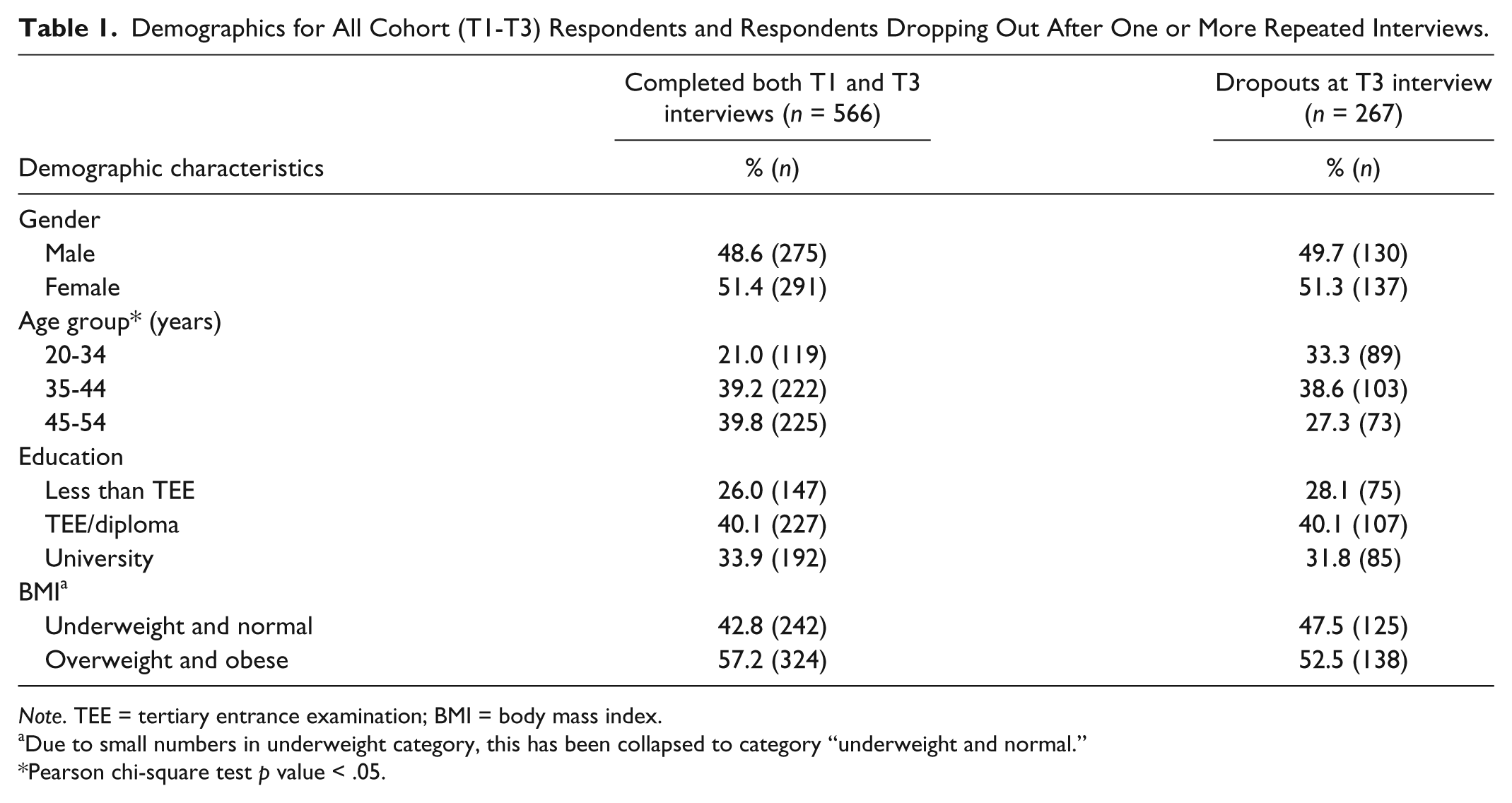
Note. TEE = tertiary entrance examination; BMI = body mass index.
Due to small numbers in underweight category, this has been collapsed to category “underweight and normal.”
Pearson chi-square test p value < .05.
Initially, a set of discrete bivariate analyses using cross-tabulation and a chi-square test was conducted for the proximal variable campaign awareness and with each of the four intermediate socio-cognitive variables together with the demographic variables gender, age, education, and BMI. Second, to examine each of the four intermediate variables, bivariate analyses were then used to explore, first, T1-T2 awareness separately with each of the intermediate variables, then repeated with T1-T3 awareness separately with each of the intermediate variables. Statistical significance was set at .05. Separate forced entry binary logistic regression models were used to examine the associations for each of the intermediate variables with campaign awareness and the demographic variables as potential predictor variables. The dependent variables were adjusted for the covariates gender, age, education, and BMI. Finally, to examine the relationship with physical activity, bivariate analyses were conducted for campaign awareness, and then each of the four intermediate variables with the four physical activity levels T1-T3. Significance levels are reported if p < .05. Analyses were completed in 2012 using SPSS version 19 (SPSS Inc., Chicago).
Results
In total, the cohort sample used in these analyses was 566 people, of which 275 males and 291 females were followed up at T3. Most were aged over 35 years, and the majority had completed secondary education or attended University. Almost 60% of participants were classified as overweight/obese (n = 321). The T1 patterns of distribution for gender, education, and BMI of the respondents were very similar; however, the significantly higher proportion of older-aged respondents at T3 than T1 reflected the loss to follow-up for those in the younger 20-34 years age group. Across all three time-points (T1, T2, T3), 15.5% of respondents maintained their awareness of the campaign, while almost 30% were never aware of the campaign at all three time-points (Table 1).
Initial bivariate frequencies of the awareness and communication effects variables and the demographic variables found over half the participants maintained awareness of the campaign at T2, and more than two thirds reported higher decisional balance. Significantly, more females compared with males (58.4% vs. 46.2%, p = .004), and those with a secondary education compared with university education (56.4% vs. 44.8%, p = .009) were more likely to maintain awareness of the campaign. Males compared with females (54.9% vs. 44.3%, p = .012) and those aged 35 to 54 years had higher self-efficacy compared with the younger age group (57.8% vs. 44.0%, p = .001; not shown).
Table 2 reports the associations between awareness and any subsequent (intermediate) socio-cognitive variables; these analyses were conducted using the awareness change from T1 to T2 and explored the association with change in the intermediate variables between T1 and T3. Across T1-T2, there were no significant associations between the pattern of campaign awareness and the sequence of intermediate variables of interest. However, the relationship was then explored between T1 and T3, and there was one significant association between campaign awareness and subsequent higher outcome expectations.
Bivariate Analyses of the Proposed Cascade of Communication Effects, T1-T2 and T1-T3.

p< 0.05
Table 3 reports the results on the likelihood of having high outcome expectations, high self-efficacy, being socially supported and high decisional balance after adjustment for campaign awareness and demographic characteristics. The likelihood of higher outcome expectations and higher decisional balance was significantly higher in those with maintained campaign awareness compared with those who had no/relapsed campaign awareness (odds ratio [OR] = 1.62, 95% confidence interval [CI] = [1.14, 2.30]; OR = 1.56, 95% CI = [1.06, 2.30], respectively). In addition, high self-efficacy and higher decisional balance were twice as likely in those aged 45 plus compared with the mid age group (OR = 1.97, 95% CI = [1.23, 3.15]; OR = 2.33, 95% CI = [1.40, 3.87], respectively). A similar pattern was found for those with higher outcome expectations, and the socially supported group, namely, they were almost twice as likely to have achieved a university degree compared with a diploma (OR = 1.91, 95% CI = [1.22, 3.02]; OR = 1.80; 95% CI = [1.16, 2.81]). In the high self-efficacy group, those classified as overweight and obese were about half as likely as those classified as normal BMI to be self-efficacious, which was also significant (OR = 0.61, 95% CI = [0.43, 0.87]).
Awareness and Demographic Correlates of Outcome Expectancy, Self-Efficacy, Social Support and Decisional Balance, Individual Logistic Regression Models.

Note. TEE = tertiary entrance Examination; BMI = body mass index; CI = confidence interval; AOR= Adjusted Odds Ratio.
Adjusted for gender, age, education, and BMI.
p< 0.05
Table 4 reports the changes in physical activity level between T1 and T3 by campaign awareness and each of the four socio-cognitive variables. There were four physical activity groups, two with no change in their levels of physical activity between the time-points. First, those who remained sufficiently active between T1 and T3 made up almost half of the total respondents (48.4%). For that group, campaign awareness compared with relapsed or no awareness was also almost evenly split (51.1% vs. 46.6%, respectively). People with higher compared with lower outcome expectation, self-efficacy, social support, and decisional balance were more likely to have remained sufficiently active. For people who became sufficiently active at T3, campaign awareness was of borderline significance (p = .055). Second, a significant proportion (p = .017) of people who remained insufficiently active between T1 and T3 were not aware of the campaign. In addition, the four intermediate socio-cognitive outcomes were significantly more likely to be lower for those who stayed insufficiently active at both time-points. Significantly lower decisional balance and lower self-efficacy compared with higher decisional balance and higher self-efficacy was observed in those who became insufficiently active at T3 (Table 4).
Bivariate Analyses of Awareness T1-T3, the Intermediate Variables T1-T3, and Physical Activity (PA) Levels T1-T3.

Note.
Controlled for awareness.
Discussion
This study examined the impact of a serial physical activity mass media campaign to explore the relationship between campaign awareness and four intermediate socio-cognitive variables—outcome expectation, self-efficacy, social support, and decisional balance. Only one significant association between awareness and outcome expectation was found. Higher outcome expectation and higher decisional balance were associated with campaign awareness. We found an independent association with each of the four socio-cognitive variables and changes in physical activity; however, possible message reinforcement in those who were sufficiently active was detected. The findings have both theoretical and practical implications for future planning of mass media campaigns, including highlighting the importance of the alignment of campaigns with specific population segments and influencing their underlying motivations toward healthy behavior such as being physically active.
In this study, we found that those who remained sufficiently active were the largest group (48%) and they were significantly more likely to report higher outcome expectations, high self-efficacy, higher social support, and high decisional balance. These relationships suggest that the campaign had a possible reinforcing effect on those who remained sufficiently active. By contrast, the campaign’s primary target group of insufficiently active adults was significantly unaware of the Find Thirty every day® campaign and reported no significant changes in the physical activity levels over the intervention period. Unlike the sufficiently active group, insufficiently active adults had significantly lower outcome expectations, were less self-efficacious, had lower social support, and lower decisional balance. Very few physical activity mass media campaigns have tested these relationships over a 12-month period. Of interest, ParticipACTION, a Canadian serial mass media campaign, also found higher levels of outcome expectation and positive attitudes among those already sufficiently active (Craig et al., 2010). While a U.S. physical activity mass media campaign for tweens known as VERB. It’s what you do; found that awareness and understanding of the campaign message led to behavior change, however, initially bypassed attitudes and outcome expectations. However, they also note that this may have been as a result of the nature of the ads in the first 12 months, which focused on engagement versus changing attitudes, or because of differences in cognitive processes among 9- to 13-year-old children (A. Bauman et al., 2008).
The current study found that the likelihood of outcome expectations, decisional balance, self-efficacy, and social support from family and friends was higher in those with maintained campaign awareness, over the intervention period. In part, these findings may add strength to the decision to have used SCT and the constructs of outcome expectation, self-efficacy, and social support to inform the execution of the TV ads and print materials (Ashford, Edmunds, & French, 2010; Rimal, 2001). It has been suggested that those with already high levels of outcome expectation may find messages to overcome barriers and modify elements of decisional balance more applicable to them (Craig et al., 2010). For example, the messages Find time to talk and Finding a way to fit into last year’s jeans portrayed positive expectations (Glanz, Rimer, & Lewis, 2002). Furthermore, Finding a way to have a great chat with my partner and Finding going upstairs reduces my blood-pressure are described in the literature as “strong arguments” and may have resulted in thoughts reinforcing physical activity behavior (Berry & Howe, 2005). In addition, socially supportive role modeling was depicted using walking groups and a community dance. These factors all appear to have had a reinforcing effect on those adults who were already sufficiently active. Although 60% of Western Australians are sufficiently active, it has been argued that there are important public health gains in message reinforcement and preventing a backward slide into inactivity for those who are already active (Bull, 1997; Giles-Corti & Donovan, 2002). Health benefits come from maintaining an active lifestyle, and thus campaigns that can reinforce the positive behavior are valuable in efforts aimed at chronic disease prevention.
By way of explanation for the potential independent nature of the intermediate socio-cognitive variables in the present study, we suggest the following reasons. We found self-efficacy and social support to be congruent with recent reviews of the correlates of adults’ participation in physical activity, both being consistently associated with physical activity participation (A. E. Bauman et al., 2012; Berry & Howe, 2005; Rhodes & Pfaeffli, 2010; Trost, Owen, Bauman, Sallis, & Brown, 2002). This reinforces our finding of reported lower levels of self-efficacy and social support in those insufficiently active for good health, and is consistent with other Australian studies that found social support most strongly associated with physical activity (A. E. Bauman, Bellew, Owen, & Vita, 2001; Booth, Owen, Bauman, Clavisi, & Leslie, 2000). It is also possible that in the Find Thirty every day® cohort, those who were sufficiently active already had a higher level of outcome expectations than those who were inactive and, therefore, the messages served to reinforce existing outcomes rather than shape new ones, and hence left little scope to change (Craig et al., 2010). Almost three quarters stated that they had high decisional balance at T1 and T3, and remained sufficiently active; this has been posited as allowing little capacity for change in physical activity over time (A. Bauman et al., 2008) and may be further evidenced here. Finally, the intermediate socio-cognitive and physical activity measures used in this study were all self-report and they may have lacked the sensitivity and/or precision required to detect change over a 12-month period (Rhodes & Pfaeffli, 2010; Wójcicki, White, & McAuley, 2009).
Our findings are consistent with the literature, which has found that higher socioeconomic status (SES) and higher education are associated with higher self-efficacy and greater social support (Ball, Salmon, Giles-corti, & Crawford, 2006; A. E. Bauman et al., 2012; Giles-Corti & Donovan, 2002). Noteworthy, the Find Thirty every day® campaign did attempt to engage lower SES groups using real people rather than actors to portray positive expectations. They also depicted a range of low cost, everyday activities that an individual could achieve. Furthermore, the people cast in the TV ads and posters included middle and older age adults and a variety of “body shapes and sizes” (Leavy et al., 2013). In our study, people aged 45 plus were more likely to have high self-efficacy and high decisional balance compared with the younger age groups. Our findings are consistent with studies that have found different patterns in age groups for self-efficacy (Booth, Bauman, Owen, & Gore, 1997; Booth et al., 2000; De Bourdeaudhuij & Sallis, 2002), and for gender and decisional balance (Berry & Howe, 2005; De Bourdeaudhuij & Sallis, 2002). Conversely, we found that women and people classified as overweight or obese were significantly less likely to be self-efficacious. Physical activity research has found that women reported lower outcome expectations and lower self-efficacy (Bandura, 2004; Barnett & Spinks, 2007; Im, Lee, Chee, Stuifbergen, & Mapa Research Team, 2011). The results of this study and our previous cohort findings reinforce that gender and other subgroups are an important consideration when framing messages (De Bourdeaudhuij & Sallis, 2002; Leavy et al., 2014). Moreover, we have found that women and those in lower SES may report higher and/or maintained awareness of the campaign message; however, this did not always translate into achieving sufficient levels of physical activity (Leavy et al., 2013; Leavy et al., 2014). These findings add support for further tailoring, framing, and execution of physical activity messages targeted for specific demographic subgroups.
There are a number of possible reasons why we did not detect the intended changes in the target group. Despite careful scheduling and media purchase specifically selected to increase awareness in the target group (Leavy et al., 2013), those who were inactive may have ignored, disengaged, or resisted the messages that required cognitive processing (Berry, Spence, Plotnikoff, & Bauman, 2011). Furthermore, it has been suggested that messages that require examination of salient issues, for example, “finding a way to keep one step ahead of chronic disease” as used in the current Find Thirty every day® campaign may not appeal and generate disinterest (Berry, McCarville, & Rhodes, 2008). However, the TV adverts did appeal to one segment of the population, although in this case it was not the target group. In addition, most individuals pay attention and process messages that match their interest (Berry, 2006); therefore, “finding a great start to the day—swimming at the local pool” could be perceived as a “message mismatch” for the inactive group. These results call for small blocks of TV adverts with unique, differentiated messages, aligned to specific target groups together with short-term rotation, to potentially overcome disinterest and mismatch in the messages.
Another explanation for not detecting the intended changes in the target group includes that this was the second phase of the “Find Thirty” campaign, and individuals may have thought that they had already seen the TV ads that had been to air as recent as 3 months prior to the new campaign (Campbell & Keller, 2003; Leavy et al., 2014). While multi-year interventions are recommended, refreshing the messages is equally important. Furthermore, the volume of advertisements on TV may have caused indifference to the Find Thirty every day® message content or forced inactive people to channel switch to avoid exposure (Berry et al., 2008; Phillips & McQuarrie, 2009) and, last, the distraction of competing messages from commercial advertisers using physical activity images to promote a diverse range of products (Berry et al., 2008; Berry et al., 2011; Maibach, 2007; Phillips & McQuarrie, 2009).
We have previously reported that individuals cycle “in and out” of awareness of the Find Thirty every day® campaign, and that sustained awareness may be attributed to a combination of factors including, but not limited to, execution and scheduling of the advertisements (Leavy et al., 2014). The current study reinforces the need for finite segmentation of the intended primary target audience and messages that align with the specific constructs of the underlying behavioral theory. Combined with the results of this study, we suggest a communication strategy that consists of small blocks of advertisements that rotate over the shorter term, together with advertisements executed with a specific message differentiated for individual subgroups all delivered as part of a media-led, multi-year intervention. In essence, some advertisements will act to engage, some to motivate, while others reinforce, but they should creatively appeal to a specific subgroup. This study reinforces our insights into enhanced profiling and segmentation of the target group to yield greater potential for sustained physical activity behavior change.
Limitations and Strengths
Our study has a number of limitations. First, data were self-reported and subject to recall and social desirability response bias. To account for this physical activity, questions were asked prior to any campaign measures during data collection and followed usual Active Australia recommended analysis procedures (Armstrong et al., 2000; Bull, Milligan, Rosenberg, & MacGowan, 2001). Another weakness of the study was the non-manipulated nature of data preventing any causal inferences being made. The data used were not normally distributed and could not be fitted as path variables. Furthermore, the data collected from the cohort participants were restricted to people who were “aware” of the campaign messages making sophisticated analysis, not possible. Accordingly, the categorical data approach used by Craig et al. was adopted (Craig et al., 2010), which has methodological limitations. The use of a single-item measure for decisional balance may also have been a limitation. Finally, attrition among the study cohorts may have led to a selection bias, but the differences between cohort participants compared with dropouts in this study were minor. The strengths of the study include a cohort of respondents followed over a 12-month period, the application of theory and conceptual frameworks to guide the campaign design, implementation and evaluation. Resources and funding were dedicated for evaluation of the mass media component of the campaign.
Conclusion
Find Thirty every day® is one of few examples of a cohort, serial mass media physical activity campaign with an evaluation design that aimed to explore proximal and intermediate-socio-cognitive variables and physical activity behavior separately for relationships. Our results did not support a clear relationship over time between awareness and intermediate socio-cognitive variables. However, they do reinforce the importance of exploring further the refinement of the target audience by more than just demographics but also by awareness, individual socio-cognitive variables and physical activity behavior, and the importance of individual contributions of each element for the design and execution of future mass media messages. While these factors may be interrelated, they may also be independent of each other, and a careful examination of the contribution of each may lead to improved message delivery to carefully targeted audiences.
Footnotes
Declaration of Conflicting Interests
The author(s) declared no potential conflicts of interest with respect to the research, authorship, and/or publication of this article.
Funding
The author(s) disclosed receipt of the following financial support for the research and/or authorship of this article:The research was supported by a Heart Foundation (WA Division), Department of Health and University of Western Australia Scholarship [PG 51255900].