




Abstract
What determines success in academia? Both researchers and academics have disagreements regarding the notion of success and its determinants in academia. The aim of this paper is to investigate the impact of political skill on employees’ subjective career success and the mediating and moderating role of mentoring and career adaptability in the said relationship respectively. The hypothesized relationships were tested utilizing a representative stratified random sample of 362 faculty members employed in the public sector universities of Pakistan. Results revealed that political skill positively influences subjective career success. The mediation model was supported and as expected: mentoring mediated the link between political skill and career success. The moderated relationship between mentoring and career success was stronger for individuals with higher career adaptability. The study adds to the understanding of underlying mechanisms involved in the political skill-career success nexus. Moderating role of career adaptability in the relationship between political skill and subjective career success was also probed, which further adds to the theoretical contribution of the study. The findings suggest that academics must realize that they need to be politically skilled, should be proactive in seeking mentoring relationships and should better equip themselves to cope with the work uncertainties.
Introduction
Career success has been a substance of interest to researchers, practitioners, and as well as individuals involved in occupational careers. Career researchers have been probing the determinants of career success, practitioners are curious about how to facilitate employees in their career related concerns to enhance desirable organizational outcomes (Abele et al., 2015; Bagdadli & Gianecchini, 2019; Judge et al., 1999), and employees strive for experiencing success in their careers.
The term “success” is used to evaluate desirable outcomes in an individual’s personal and professional life course. Individuals usually evaluate the outcomes against a standard, and the standards may vary from person to person. Thus, success is considered to be an objective as well as a subjective construction (Abele & Spurk, 2009a). The composite term of career success may be defined as “the real or perceived achievements people have accumulated due to their work experiences” (Judge et al., 1999). Career researchers believe that career is more a social construction than objective reality and have emphasized the subjective aspects of career success (Abele et al., 2015; Cohen et al., 2004; Young & Collin, 2004).
Determinants of career success that have been mostly examined in the extant literature include variables like socio-demographic status (Greenhaus et al., 1990; Turban & Dougherty, 1994), human capital (Ng et al., 2005; Wayne et al., 1999), organizational sponsorship (Bimrose & Barnes, 2006; Orpen, 1994), and stable individual differences (Abele & Spurk, 2009b; Boudreau et al., 2001; Gelissen & de Graaf, 2006). Social influence processes and self-regulatory mechanisms have been major lenses for researchers to investigate career success (Abele & Wiese, 2008).
The concept of career success in academia and the factors affecting it have been probed by researchers (Sutherland, 2015) and the competing challenges and expectations that the academics often face in climbing the academic ladder (Meyer & Evans, 2005). Climbing the ladder in academia and reaching the zenith in the form of full professorship is characterized by a host of hurdles including salary scales and tenure committees (Douglas, 2013). It is a known fact that the performance bars in academia are getting high. The predominant indicators like research outputs and citations, h-Index rankings and student evaluation scores bear testimony to the said fact (Archer, 2008). But it is also pertinent to note that, these crude performance measures shed light on only one aspect of academic careers. How academics look into their aspirations and subjective wellbeing is more important than the objective measures and which are seldom given space in the appraisal and promotions systems (Macfarlane, 2007).
The world of work is getting complex and is characterized by continuous changes, due to which organizations are encouraging employees to manage their careers by themselves (Wayne et al., 1999). Careers based on organizational structures are eclipsed, and navigating careers through social structures is getting prominence for successful career outcomes (Arthur & Rousseau, 2001). Thus, individuals’ dependence on their own skills and capabilities to effectively influence their working environment, and their regulation of behavior are considered to be important determinants of successful individual outcomes.
The political viewpoint portrays organizations as political arenas described by bargaining, negotiation, coalition building, exchange of favors, and alliance-building as a means of getting things done (Mintzberg, 1985). Keeping in view the political nature of organizations, one’s ability to survive and prosper depends on a certain set of social effectiveness skills. Besides other social effectiveness constructs, political skill has been considered one of the important social competencies reflected through cognitive, affective and behavioral manifestations, and has implications for both individual and group (Ferris et al., 2007).
The existing studies on the impact of political skill on career success mostly rely on human capital theory (Nafukho et al., 2004), social capital theory (Kreuter & Lezin, 2002) and social exchange theory (Cook et al., 2013). However, empirical evidences have been provided on the basis of these theories, but the underlying influencing mechanisms have not yet been fully explored and confirmed (Blickle et al., 2018; Chaturvedi et al., 2018). Although a few mediating variables like reputation (Blickle et al., 2011) personal power (Liu et al., 2010) and network resources (Wei et al., 2012) in the political skill-career success nexus have been probed, but still there is a dearth of mediational analyses that can add to our comprehension of the said relationship (Bagdadli & Gianecchini, 2019). Another gap identified in the existing literature on political skill is the lack of potential individual level moderators in the political skill-outcomes relationship (Munyon et al., 2015). Though, some empirical studies have focused the contextual and situational moderators of political skill and its outcomes (Kapoutsis et al., 2011; Wilson & Elman, 1990), but individual level moderators have yet to be explored fully (Blickle et al., 2020). To the authors’ best knowledge, so far only perceived career prospects have been studied as individual level moderator between political skill and career success.
The current paper intends to add in the said stream of career success literature by investigating political skill as predictor of subjective career success. To add to the underlying mechanisms through which political skill can positively influence subjective career success, mentoring has been proposed to mediate between political skill and subjective career success in this study. Within a self-regulatory perspective, the study also aims to probe into the moderating role of career adaptability for the mediated relationship of mentoring between political skill and subjective career success. The findings have revealed that that political skill positively influences subjective career success. The mediation model was supported and as expected: mentoring mediated the link between political skill and career success. The moderated relationship between mentoring and career success was stronger for individuals with higher career adaptability. The study adds to the understanding of underlying mechanisms involved in the political skill-career success nexus. Moderating role of career adaptability in the relationship between political skill and subjective career success was also probed, which further adds to the theoretical contribution of the study. The findings suggest that academics must realize that they need to be politically skilled, should be proactive in seeking mentoring relationships and should better equip themselves to cope with the work uncertainties.
Theory and Hypotheses
Political Skill and Career Success
The political nature of organizations has made it necessary for individuals to be politically skilled. Mintzberg (1985) focused the importance of social effectiveness skills for successful career outcomes within organizations which were considered by him as political arenas. The most widely used definition of political skill is “the ability to effectively understand others at work and to use such knowledge to influence others to act in ways that enhance one’s personal and/or organizational objectives” (Ferris et al., 2005, p. 127). Political skill is characterized by four dimensions including social astuteness, interpersonal influence, networking ability and apparent sincerity. These dimensions of the political skill construct make individuals capable to positively influence their career related outcomes (Ferris et al., 2007). The phenomenon of political skill has far reaching and multifaceted effects that it is under investigation for its various implications till date (e.g., Basit, 2020; Mahajan & Templer, 2021).
Politically skilled individuals are socially astute in their interactions with other organizational members. They can understand and interpret their social environment in an apt manner, and respond in a socially desirable way (Blickle et al., 2020). Due to their shrewdness in social interactions they know what to say, and how to say in a particular situation (Treadway et al., 2004). Social exchange theory (Cook et al., 2013) focuses on the reciprocity among social entities, by suggesting that favorable outcomes are received from those to whom favors have been extended in the past. Socially astute employees can portray themselves to be supportive toward their superiors by demonstrating appropriate responses in varying situations. Politically skilled individuals also have a convincing but modest interpersonal style through which they have a tremendous influence over people around them.
Social influence theories have been put forwarded to explain the influencing mechanisms in social settings (Levy et al., 1998). As politically skilled individuals have a strong interpersonal influence, so they are better able to be effective at their influencing tactics as compared to their politically unskilled counterparts (Blickle et al., 2020). The networking ability dimension of political skill construct refers to the ability of building a network of valuable connections in one’s professional life. The theoretical underpinnings of this dimensions lie in social resource theory (Foa & Foa, 1980) social capital theory (Kreuter & Lezin, 2002), and human capital theory (Nafukho et al., 2004). According to Coleman (1988) social capital is any facet of social structure that results in value and facilitation of actions for individuals within that structure. The basic tenet of social capital is the notion that resources entrenched in a social network result in benefits for the actor. Generally, such benefits may include timely access to information, greater visibility, access to financial and material resources, sponsorship within a social group and legitimacy. Access to information and resources is also expected to be positively associated with career satisfaction. Feelings of competence and control increases, when an individual has access to information, materials, funds and space (Gist & Mitchell, 1992). Thus, people having strong social networks within organization feel psychologically empowered (Spreitzer, 1996). Burke, Marlow, and Lento (2010) have reported a positive relationship between participation in formal and informal networks and career satisfaction. The apparent sincerity dimension of the political skill construct refers to the ability to portray oneself as sincere and authentic to others. Different research areas of behavioral sciences like ethical decision making (Fritzsche, 1991), attribution theory (Kelley, 1973), social information processing theory (Crocker et al., 1984), trust and trust worthiness (Kramer & Tyler, 1995) lend theoretical support in highlighting the importance of this dimension of political skill. To be sincere and honest is not just enough, others perception of the person to be honest and sincere is also important. Politically skilled individuals are considered to be trustworthy by others as they can communicate in a non-manipulative and non-coercive manner. Their decisions and actions are taken as pure and honest, as others cannot see any ulterior motives and hidden agenda. Politically skilled people may be reciprocated with the same sincerity and genuineness as they have shown toward others. Thus, they feel satisfied in their working relationships.
Empirical studies have also confirmed the positive impact of political skill on both the objective and subjective indices of career success (Borzaga & Depedri, 2005; Erickson & Rodriguez, 1999; Seibert et al., 2001). Researchers believe that objective success provides a base for subjective career success (Abele et al., 2015) and some of them even assume subjective career success to be a by-product of objective career outcomes (Bagdadli & Gianecchini, 2019; Nicholson & de Waal-Andrews, 2005). In a recent review about sports coaching professionals, Robinson et al. (2020) provided that political skill is a means through which relationships with the major stakeholders are managed, hence, enhancing the probability for a successful career. On the basis of these theoretical arguments and empirical investigations we put forward the following hypothesis.
Mediating Role of Mentoring Between Political Skill and Subjective Career Success
Generally mentoring is characterized by an interpersonal relationship between a veteran senior colleague (mentor) and a novice co-worker (protégé) in which the mentor provides guidance and support to the protégé in his/her career related and psychological matters (Kram & Isabella, 1985). However, in this study mentoring, means any informal relationship between an employee and other influential organizational members for obtaining career related and psychological support. According to Mullen and Klimaitis (2021), mentoring is a personal–professional relationship for certain learning purpose that build human capacity and has career-related and psychosocial implications. Research on mentoring reveals that proactivity in interpersonal relationships is an important determinant of the amount of mentoring received by protégés (Allen et al., 2000; Turban & Dougherty, 1994). Furthermore, the construct of mentoring has established as a potential underlying mechanism connecting various antecedent and outcome variables (e.g., Arora, 2020).
Politically skilled individuals are proactive by nature in building meaningful relationships, and are good at understanding social clues and influencing others (Ferris et al., 2007). They are better able to be part of a mentoring relationship and can maintain and improve that relationship with the passage of time due to their social astuteness, professional and social networks, interpersonal influence and apparent sincerity. The social astuteness dimension of the political skill assists them in getting closer to the influential individuals within organizations who could be potential mentors for them. Socially astute individuals can judge their working environment and people around them and can thus respond in an appropriate manner. Due to their social effectiveness they are spotted by influential organizational members and are likely to be mentored, as Kram and Isabella (1985) have put it that mentoring starts with an attraction just like a romantic relationship. Socially astute individuals can portray themselves similar to their mentors in terms of perspectives, work style and values, hence they are more likely to receive high level of psychological and career related mentoring (Ensher et al., 2002). Politically skilled individuals are able to have a positive and strong influence on people around them. Such individuals can easily approach and influence the powerful decision makers and experts for coming under their tutelage. Initiating mentoring relationship is easy for them as they know how to influence a potential mentor. It has been proved that mentors prefer those protégés who they think are motivated, competent, and having a learning orientation (Olian et al., 1993). People having high level of political skill can portray themselves to be competent and motivated through their interpersonal influence, and are likely to be selected as protégés by mentors. The strong networking ability of politically skilled individuals also makes them capable to initiate and nurture a mentoring relationship. A person who is part of a strong social and professional network is more likely to initiate mentoring relationship as compared to one who is lacking this important ability to connect with significant others in organization. Their social capital accumulated through these networks help them to access the advice and support of the important organizational members (Tsai & Ghoshal, 1998). Getting access to the mentors and initiating a developmental relation is much easier for them, due to their familiarity and acquaintance with organizational members. They know whom to rely on, in a particular situation and whose’ advice is needed (Park & Luo, 2001). Besides this, the politically skilled individuals can present themselves to others as sincere, trustworthy, honest, and genuine (Blickle et al., 2013). Mentors would like to mentor those people who are trustworthy, sincere and have a learning aptitude (Allen, 2004). Mentors who perceive someone to be sincere and honest is more likely to be mentored as compared to someone less sincere and honest. Thus, politically skilled individuals will receive more mentoring as they can project themselves to be honest and sincere. It is assumed that, the political skill of individuals characterized by social astuteness, networking ability and influencing others in sincere and subtle way can result in receiving more mentoring for personal and professional development.
The social exchange theory offers theoretical underpinning in order to comprehend the dynamics and outcomes of mentoring relationships (Olian et al., 1993). Social exchange theory looks at human relationships in terms of perceived costs and benefits involved (Cook et al., 2013). The basic notion of social exchange theory is that, when the rewards in a relationship are greater than the costs, so there will be an inclination toward the development of such a relationship on part of the actor (Cropanzano & Mitchell, 2005). Benefits from social exchanges can be both psychological (affection, esteem, approval, and respect) and material (promotion, salary, growth, and development). Mentoring as an exchange relationship, has been reported to result in career related benefits like coaching, exposure, challenging assignments, sponsorship and protection as well as psychological benefits like counseling, friendship and acceptance (Kram, 1988).
Empirical studies on mentoring have proved job satisfaction, promotion, compensation, recognition and greater career mobility to be positively associated with mentoring received by a protégé (Dreher & Ash, 1990; Fagenson, 1992; Scandura, 1992). Bothe research reviews (Noe et al., 2002; Ragins, 1999; Wanberg et al., 2003) and meta-analyses (Allen et al., 2004; Eby et al., 2008; Kammeyer-Mueller & Judge, 2008) reveal that those involved in mentoring relationship report more positive career related outcomes as compared to those who are not involved in any kind of mentoring relationship. Noe et al. (2002) have concluded in their study on mentoring that, mentored individuals scored higher on job and career satisfaction and lower on turnover intentions and job alienation as compared to their non-mentored counterparts. Lastly, Ghosh et al. (2020) in their investigation of lived experiences of mentoring among faculty members stressed that mentoring is critical for the career advancement.
Based on the aforementioned theoretical discussion and empirical studies, it is assumed that mentoring will mediate the relationship between political skill and subjective career success. The following hypothesis is put forwarded to investigate the mediating role of mentoring.
Moderating Role of Career Adaptability
Successful career management involves adaptability to cope with complex demands of a frequently changing work environment. Empirical studies have confirmed that adaptable employees are more satisfied and engaged (Rossier et al., 2012), are considered to be better performers (Ohme & Zacher, 2015), and are more likely to achieve career advancement (Tolentino et al., 2013). Career adaptability, as a psychological resource, may result in successful work entry and participation (Johnston, 2018). Savickas (1997) has defined career adaptability as “the readiness to cope with the predictable tasks of preparing for and participating in the work role and with the unpredictable adjustments prompted by changes in work and working conditions.” Career adaptability is characterized by a combination of self-regulation resources (e.g., concern, control, curiosity, and confidence) that directs career sense-making and leads to adapting behaviors in order to have a successful fit in one’s job and work environment (Jia et al., 2020; Savickas, 2013). Through career adaptability (CA), one can assess an individual’s readiness and strength to deal with the future occupational changes effectively (Savickas & Porfeli, 2012; Zacher, 2014). Thus, successful fine-tuning to workplace changes depends on one’s ability to adapt. Career satisfaction and likelihood of promotion have been confirmed to be positively associated with higher level of career adaptability (Tolentino et al., 2013; Zacher, 2014). Furthermore, career adaptability inspires individuals to look beyond a patterned career and find success in their professional life (Haibo et al., 2017). Under the purview of career construction model of adaptation, in a recent study, career adaptability has been linked with career decision making difficulties and life satisfaction (Parola & Marcionetti, 2021). Along these lines, we expect that individuals with higher level of career adaptability are more likely to achieve career satisfaction by exhibiting fitting responses that assist them in managing work roles and coping with complex work demands.
Although political skill may enable employees to positively influence their career wellbeing, this could result in enhanced career outcomes if the employees are also in the habit of making adaptive strategies in their careers. Drawing on these lines of argument, we expect the effectiveness of political skill in achieving subjective career success to be enhanced when employees possess high level of career adaptability. Thus, we propose that career adaptability acts as a second-stage moderator in the relationship between political skill, mentoring, and subjective career success, such that the mediated relationship is stronger among employees who report high levels of career adaptability. Hence, we propose the following hypothesis.
Methodology
Participants and Procedure
The respondents of this study were the faculty members of the public-sector universities in Pakistan. Both self-administered and online web survey were used for data collection. A total of 200 questionnaires were personally distributed, out of which 123 were returned. Similarly, the questionnaire was emailed to a total of 875 faculty members, out of which 239 valid responses were recorded. Response rate of online survey was 27.3% while that of self-administered survey was 61.5%. The overall response rate turned out to be 41.3%.
The average age of the respondents was 32.5 years, Majority of them were males (68.8%). Designation wise distribution of the sample was such that, 44.5% were lecturers, followed by assistant professors (32%), associate professors (16.6%) and professors (6.9%).
Measurement Tools
Political skill
Political skill inventory (PSI), an 18 items measure developed by Ferris et al. (2007), was used in this study for measuring the political skill construct. The scale has proven consistent construct validity (Ferris et al., 2005) and has been widely used in political skill associated research (Hochwarter et al., 2007; Perrewe & Nelson, 2004). A six-point scale was used, with item responses ranging from 1 (strongly disagree) to 6 (strongly agree). Sample items are “I understand people very well” and “I am able to communicate effectively and easily with others.”
Career adaptability
Career adaptability (CA) was measured with the 24 items CAAS-international form (Savickas & Porfeli, 2012). Answers were obtained by means of a 6-point Likert scale (1 = strongly disagree; 6 = strongly agree). The CAAS had demonstrated reliability and was tested in 13 countries (Savickas & Porfeli, 2012). A sample item reads as “Making decisions by myself” and had a reported overall reliability of 0.92.
Subjective career success/career satisfaction
Subjective career success was measured through Greenhaus et al. (1990) six items career satisfaction scale. Sample item for measuring subjective career success reads as “I am satisfied with the progress I have made toward meeting my overall career goals.” Reliability coefficient for this scale turned out to be α = .83.
Mentoring
Mentoring was measured with seven items on a six-point response format developed by Dreher and Ash (1990). Participants were asked to consider their career history since the start of their job in the existing organization and indicate the extent to which an influential and expert organizational member (not necessarily one person) had provided a range of mentoring functions for them. Items covered career-related functions as well as socio-emotional functions. Sample item is “given or recommended you for challenging assignments that presented opportunities to learn new skills?.” Reliability coefficient for the present sample was .87.
Results
Measurement Model Assessment
Model fit
Global fit: In order to assess the measurement model validity, we conducted a confirmatory factor analysis using AMOS v.20 (see Table 1). The hypothesized model showed perfect fit (χ²/df = 1.583, CFI = .92, TLI = .90, RMSEA = .05). (Shah & Goldstein, 2006) argued that there may possibly exist alternative plausible factor structures of a measurement model, and an effort should be made to explore the same. Therefore, we tested an alternative model as well, wherein, in comparison to their original second order structure, political skill and career adaptability were converted into first order constructs. The model fit indices were beyond the threshold (χ²/df = 5.982, CFI = .68, TLI = .63 RMSEA = .18) supporting the hypothesized model. The model fit cut off criteria has been used as suggested by Hu and Bentler (1999).
CFA Model Fit.
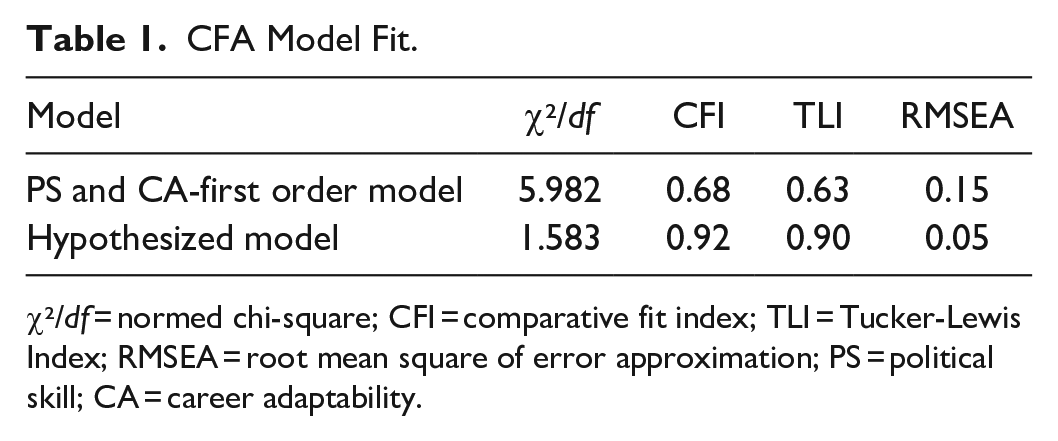
χ²/df = normed chi-square; CFI = comparative fit index; TLI = Tucker-Lewis Index; RMSEA = root mean square of error approximation; PS = political skill; CA = career adaptability.
Local fit: In order to ascertain the local fit of the model, we checked the loadings and their significance. Hair et al. (2010) recommends factor loadings should be at least .50 and above. All the items loaded on to the relevant constructs/dimensions significantly and with a value over the threshold (see Table 2).
Factor Loadings, CR, AVE.

Note. All loadings were significant as p < .05.
Reliability and validity: Hair et al. (2010) recommends that for assessing the reliability of the instrument composite reliability (CR) is an advantageous indictor than Chronbach’s α as the latter is sensitive to the number of items and may provide an underestimation. CR as per the criterion should be above .70. All the constructs in this instrument recorded a value of CR above .70 (see Table 2).
Validity was assessed in two aspects: convergent validity and discriminant validity. The measure of convergent is the average variance extracted (AVE). According to Fornell and Larcker (1981), an AVE of over .50 indicates the establishment of convergent validity. All the constructs established convergent validity. AVEs for political skill, career adaptability, subjective career success, and mentoring were .601, .767, .729, .692 respectively (see Table 2). For discriminant validity, square root of AVE should be compared with inter-construct correlations. The AVE square root should be above inter-construct correlations for a construct to establish discriminant validity (Fornell & Larcker, 1981). All the constructs established discriminant validity (see Table 3).
Descriptive Statistics.

Note. Values in diagonal are square root of AVE. PS = political skill; MNT = mentoring; SCS = subjective career success; CA = career adaptability; AVE = average variance extracted.
Common method bias assessment
Prevalence of bias in data is a common problem in social sciences. Podsakoff et al. (2003) have advised many strategies to deal with the method bias including ex-ante (before data collection) and ex-post, that is, statistical measures. In this study, we adopted the Common Latent Factor (CLF) method as an ex-post statistical technique to assess the method bias. In this method, a common factor is added to the confirmatory factor model, all the item are loaded to the common factor while retaining their original loadings (Podsakoff et al., 2003). After running the model, we assessed two checkpoints. First, there was no considerable difference in the fit indices of the original model and the one with common factor (χ²/df = 1.432, CFI = .891, TLI = .87, RMSEA = .046). Second, item loadings in the original factor model while compared after the addition of latent factor did not yield a difference of above 0.20. Therefore, it can be inferred that the data was free of bias.
Descriptive Results
Table 3 presents a summary of descriptive statistics, mean, SD, and correlations of our study variables. The results show that all the zero order correlations among political skill, mentoring, subjective career success, and career adaptability are significant. The diagonal shows the square root of AVE (see Table 3).
Hypotheses Testing
A series of regression analyses were conducted for hypotheses testing. The results have been reported after controlling for age, gender, qualification, and experience. For mediation, we followed causal step approach (Baron & Kenny, 1986). For moderation, we first mean centered the predictors (mentoring and career adaptability) along with their interaction term in order to avoid any potential multicollinearity issues (Cohen, Cohen et al., 2013) and then applied hierarchical regression.
Table 4 reports the results of hypotheses. H1 states the political skill has positive influence on subjective career success. The results validate our hypotheses (β = .342, p < .001). This model explains 17.9% variance in subjective career success (see Table 4).
Hypotheses Results.

p < .05. **p < .01. ***p < .001.
H2 proposed that mentoring mediates the relationship between political skill and subjective career success, and this tested using causal steps approach (Baron & Kenny, 1986). In the first step, political skill was regressed on mentoring effect was significant (β = .302, p < .001). Second, political skill was regressed over subjective career success. The effect was significant (β = .342, p < .001). In the third step, the effect of mentoring on subjective career success was tested (β = .454, p < .001). In the last step, the fourth assumption was tested by regressing mentoring and political skill together on subjective career success. The results show that effect of political skill decreased (β = .235, p < .001) while it was regressed together with mentoring. However, the effect of political skill remained significant. Hence, it was concluded that mentoring partially mediates the link between political skill and subjective career success.
H3 states the moderated mediation. The interaction term was created by multiplying mentoring and career adaptability. The results (see Table 4) reveal that career adaptability strengthens the relationship mentoring and career success since the direction of effect of interaction is positive (unstandardized β = .197, p < .001). The interaction effects have further been probed in Figure 1. The steep of the bold line shows that those with higher career adaptability intentions are more successful in their career given the effects of mentoring.
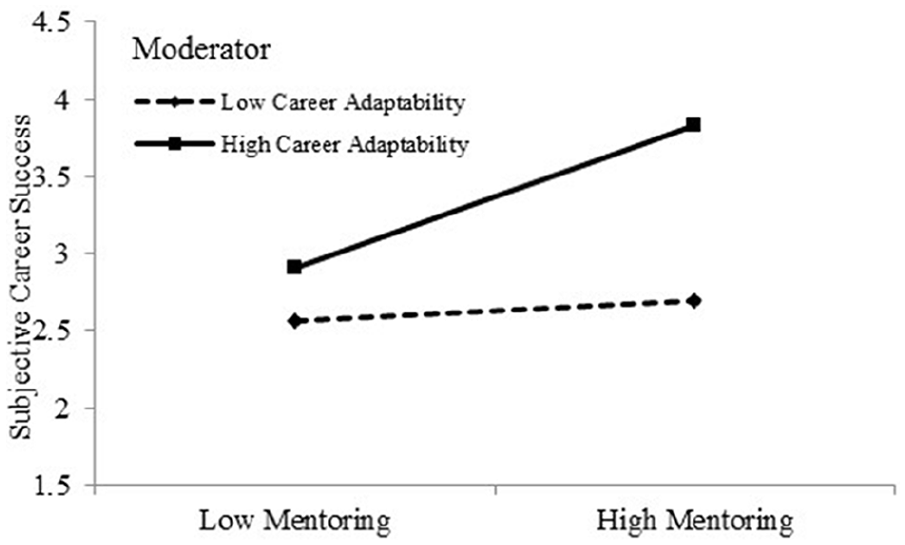
Moderating effect of career adaptability.
Discussion
Results of the study revealed that political skill has a positive impact on individuals’ subjective career success. Mediating role of mentoring between political skill and subjective career success was confirmed and career adaptability proved to be a moderator in the mediated relationship.
Political skill has been related positively with subjective measures of career success like job satisfaction, career satisfaction and life satisfaction (Todd et al., 2009). Politically skilled people can develop and maintain quality relationships with their superiors, peers and subordinates. The quality of relationships one enjoys with others in the organizations has been associated positively with enhanced job and career satisfaction (Stringer, 2006). Due to their strong influence on people around them they can get what they want which in turn may enhance their level of satisfaction with their jobs and careers. Borzaga and Depedri (2005) in their empirical investigation, have proved that those who are good at interpersonal relationships are also highly satisfied in their jobs. The investigation of Burke et al. (2006) on networking activities and career satisfaction is also in line with the results of this study, they have also confirmed that participation in networking activities was strongly associated with career satisfaction.
Results of the mediation hypotheses show that mentoring mediates the relationship between political skill and subjective career success. It is broadly accepted that mentoring results in a number of career benefits to protégés (Allen et al., 2004; Whitely & Coetsier, 1993). However, the pyramid shape of most of the public sector organizations may not provide a level playing field to all of the junior employees to have access to an influential senior member of the organization for mentoring relationship. Different dispositional traits and social effectiveness skills can make it more likely to start and maintain a mentoring partnership. The mediating role of mentoring between political skill and career success relationship bears testimony to the said proposition. The leader-member exchange perspective (Schriesheim et al., 1999) also assists in interpreting these results. Mentoring can be considered as a high quality in-group relationship which is developed when a mentor perceives a protégé to be highly motivated and trusted (Noe et al., 2002). Through their social astuteness, interpersonal influence and genuineness, politically skilled people can give different positive clues to the potential mentors of their capabilities and motivation, and thus easily becomes part of a mentoring association. Mentoring in turn led to enhanced level of subjective career success according to the hypothesized relationship. Empirical studies have reported that mentoring results in intrinsic measures of career success like, job, career and life satisfaction (Noe et al., 2002).
The moderating effect of career adaptability on the mediated relationship between political skill and subjective career success highlights the importance of one’s ability to cope with the job and career related changes. Thus the results lend support to the previous empirical investigations or career adaptability and subjective career wellbeing (Tolentino et al., 2013; Zacher, 2014).
The setting of the existing study can also assist us in explaining the results. The population of the study comprised of the faculty members serving in the public-sector universities of Pakistan. There is a general perception that the working environment of the public-sector organizations in Pakistan is characterized by high level of organizational politics. In such environments, political considerations and informal influence mechanisms are rampant to get things done. Those faculty members, who are good at networking, can understand their environment and influence others in an apparently sincere manner are likely to be satisfied in their careers. The prevailing competitive environment and organizational politics in the higher education sector of Pakistan has led to increased pressure and workload on faculty members. Such a situation demands to be under the guidance of senior influential faculty members. As senior influential faculty members are not in large numbers and are not equally accessible to all of the junior faculty members. Thus, those faculty members who are politically skilled are better able to initiate and develop mentoring relationships. These mentors encourage and support them through difficult times. Proper support and guidance on part of the senior faculty members can result in increased career and job satisfaction. Senior faculty members in the form of mentors can be of immense support during difficult times like career stalemate and other career related setbacks (Quinlan, 1999). The increasing demand for enhanced performance in the form of research productivity and mundane workplace challenges necessitates employees to exhibit greater career adaptability for enhanced career satisfaction.
Implications
Theoretical Implications
The existing study makes several contributions to the organizational behavior literature in general and the determinants of career success in particular. The study confirms the role of political skill in determining subjective career success, thus expanding the literature on the determinants of career success. Calls for studying the underlying mechanisms (Kimura, 2015; Liu et al., 2007) to understand the processes involved in the political skill and career success relationship have been addressed. The study highlights the mediating role of mentoring in explaining the political skill and career success nexus. Probing career adaptability as an individual level second-stage moderator further adds to the theoretical implications of the study.
Practical Implications
The study offers some practical suggestions for management and employees. First and foremost, the management should realize the importance of political skill in enhancing career outcomes. Those organizational members who are excellent performers but cannot make their contributions visible due to political skill deficiency must be found out and trained to enhance their social effectiveness. Management should launch formal mentoring programs and informal mentoring should be encouraged for employees’ enhanced feeling of success at their organization.
Individuals must realize that they need to be politically skilled, should be proactive in seeking mentoring relationships and should better equip themselves to cope with the work uncertainties.
Limitations and Future Research Prospects
Like any other research study in social sciences this study is not without its limitations. First, the study has utilized a sample from academia only, and within academia only public sector universities were part of this study. This may lead to the likelihood of placing boundary conditions on the generalizability of this investigation. Second, data were collected just at one point in time, thus the cross-sectional nature of the study depicts a snapshot of the hypothesized associations. Another limitation of the cross-sectional studies is that, without experimental manipulation the causal ordering of variables is difficult to determine (Pedhazur & Schmelkin, 1991). Third, the study relies on only self-reported measures of the constructs which may result in common method variance. However, researcher suggests that potential problems associated with common method variance are usually exaggerated and may not be that much problematic (Keeping & Levy, 2000).
The study extends our understanding about the importance of political skill in determining career success. However, further investigations need to be carried out in order to address the limitations of this study and, to study the unexplored aspects of the association between political skill and career success. As the study population was confined to the public-sector universities of Pakistan, thus investigations in future should rely on diverse samples from different sectors for improving the generalizability. To address the issue of common method variance, future studies may utilize peer-reported and supervisor-reported measures of the constructs. A mix-method approach of investigation can be adopted in future studies to address the limitations of pure quantitative approaches. Future studies can also look into political skill from a gender specific lens in the context of academia, whether political skill has similar impact for both males and females, and whether the reliance on the four dimensions of political skill varies with gender.
Footnotes
Declaration of Conflicting Interests
The author(s) declared no potential conflicts of interest with respect to the research, authorship, and/or publication of this article.
Funding
The author(s) received no financial support for the research, authorship, and/or publication of this article.
