




Abstract
In agricultural production, the unpredictability of crop yields often places farmers under significant financial strain. Banks, constrained by limited credit guarantees and high production risks, are hesitant to offer loans, which severely limits agricultural development. The application of blockchain technology can reduce fraud, information asymmetry, and default risks, thereby enhancing trust and increasing the willingness of banks to provide loans. This study examines the impact of blockchain technology on supply chain coordination and decision-making among members, focusing on agricultural supply chains under centralized and decentralized decision-making frameworks. A comparative analysis of the optimal decisions for farmers and sellers reveals that decentralized decision-making fails to achieve Pareto optimality. To address this, the study introduces cost-sharing contract and cost-sharing-revenue-sharing contract to achieve supply chain coordination. The results indicate that cost-sharing contract cannot achieve coordination, whereas cost-sharing-revenue-sharing contract can bring the supply chain into a coordinated state within a specific range of revenue-sharing coefficient between farmers and sellers. Therefore, the application of blockchain technology not only addresses farmers’ financial constraints but also facilitates supply chain coordination through the use of cost-sharing-revenue-sharing contract.
Introduction
In China, financial constraints pose significant bottlenecks in the advancement of the agricultural supply chain. The agricultural production is particularly susceptible to the adverse effects of natural calamities, resulting in uncertain output. In addition, the initial phase of agricultural production requires substantial financial investment, compounding the financial constraints faced by farmers. Regrettably, banks have shown some reluctance in providing financial support to these individuals due to the limited credit guarantees available to farmers and the high inherent ambiguities associated with agricultural production (H. Li et al., 2023). As a result, these financial constraints impede the inflow of production inputs and decelerate the overall progress of the agricultural supply chain within China.
The emergence of supply chain finance presents a potential solution to the financial constraints faced by farmers (Belhadi et al., 2021; Liang et al., 2021). These financial constraints may be alleviated by allowing farmers to secure loans from banks that take advantage of core business credit (Leuschner et al., 2023). Nonetheless, this solution introduces vulnerabilities to the agricultural supply chain, particularly with respect to default risk and potential coordination issues among the members of the chain. The uncertainty and asymmetry of information prevalent among members of the agricultural supply chain further exacerbate these risks, leading to financial moral hazards that dissuade banks from extending credit. As a result, addressing these challenges is crucial to establishing a sustainable supply chain finance framework for agricultural production.
The integration of blockchain technology in the agricultural supply chain finance has the potential to address the inherent deficiencies therein by delivering a robust trust structure among multiple parties and facilitating precise monitoring of the information flow (G. Zhang et al., 2023). Due to its immutable, irreversible, and trustworthy attributes, blockchain technology is instrumental in mitigating risks and strengthening post-event supervision (Akram et al., 2024). By enhancing the transparency of on-chain information, blockchain applications can significantly reduce the risk of default among internal stakeholders, deter fraudulent and speculative activities, and prevent financial losses caused by forgery or information asymmetry. Additionally, blockchain’s technical architecture is compatible with deployment in existing network environments, requiring only internet connectivity and basic computing equipment. This makes it highly suitable for widespread adoption in resource-constrained rural areas.
Blockchain technology has been successfully applied across various industries. For instance, IBM’s Food Trust platform has demonstrated the feasibility and value of blockchain in food traceability. Similarly, the Industrial and Commercial Bank of China (ICBC) has developed a platform to provide supply chain financial services for enterprises. By leveraging blockchain technology, the platform integrates real transaction data among enterprises onto the blockchain, enhancing regulatory transparency and enabling traceable and reliable credit issuance by core enterprises. The application of blockchain in agriculture is expanding steadily. Utilizing blockchain technology to enhance the efficiency, transparency, and risk management capabilities of agricultural supply chains has emerged as a practical, cost-effective solution with significant potential.
However, integrating blockchain into agricultural supply chains may disrupt coordination. Because the use of blockchain technology entails certain application costs. Nevertheless, this adoption can drive increased willingness among banks to provide financing, enabling farmers to obtain essential financial support and fostering trust within the agricultural supply chain. Furthermore, it should be noted that the implementation of blockchain technology may lead to fluctuations in the purchase price of agricultural products. Consequently, these price variations can affect the decision-making equilibrium of the key stakeholders involved in the agricultural supply chain, thereby disrupting its coordinated state.
To address these questions, this study considers the financial constraints of farmers and the uncertainty of agricultural product outputs. To enhance banks’ willingness to lend, blockchain technology is introduced into the agricultural supply chain. By fully leveraging the advantages of blockchain, the study incorporates blockchain application costs and value-added parameters to analyze the operational decisions of farmers and retailers within a blockchain-enabled agricultural supply chain. Additionally, contracts are used to coordinate the decisions and profits of supply chain members, promoting coordination within the blockchain-based supply chain. The aim is to maximize the profits of both farmers and retailers, as well as the overall supply chain, under the influence of blockchain technology.
The contributions of this paper are as follows. Most studies focus on financing models and risk management in the financing process of agricultural supply chains, and few studies have examined the operational decision-making and coordination of agricultural supply chains considering capital constraints under blockchain technology. This study examines the financial constraints faced by farmers, analyzes their production decisions along with the acquisition decisions of sellers, and proposes the implementation of cost-sharing and benefit-sharing contracts as an effective means to coordinate and provide operational decisions for the key stakeholders within the agricultural supply chain.
The rest of the paper is organized as follows. In Section 2, we review the related literature. In Section 3, we describe and make assumptions about the model. In Section 4, we introduce the model framework. In Section 5, we coordinate the agricultural supply chain. In Section 6, we analyze the effect of the parameters on decision metrics and returns. In Section 7, conclusions and future research directions are presented.
Literature Review
In this section, we review the relevant literature across three research domains. Our research is related to three streams of research in the literature: supply chain finance and capital constraints, supply chain contractual coordination, and blockchain applications in supply chain finance.
Supply Chain Finance and Capital Constraints
Studies on agricultural supply chain finance and capital constraints have focused on concepts, models, risk management, and financing decisions.
Lam et al. (2019) argued that supply chain finance is about reducing supplier and retailer costs through capital optimization and management, and providing credit and clearing services to supply chain companies. Chakuu et al. (2019) identified fixed assets, inventory, and accounts receivable models as common supply chain finance models. In terms of risk management, Rostamzadeh et al. (2018) used the fuzzy TOPSIS-CRITIC methodology to assess supply chain risks and made recommendations for preventing and monitoring risks. L. Zhang et al. (2015) established a credit risk assessment system based on SVM.
In terms of agricultural supply chain financing decisions, Reindorp et al. (2018) argued that when farmers are constrained by capital and have difficulty in demand forecasting and production, retailers’ commitment to minimum purchasing volume can alleviate farmers’ production difficulties. Zhao and Huchzermeier (2019) compared prepayment discounts and buyer’s purchase order financing models and found that the former financing model is more favorable when the retailer has a certain amount of its funds, and the latter is more favorable to choosing if the value of the marginal cost is higher than the unit discount return. Wang et al. (2016) investigated manufacturers’ optimal production decisions and financing decisions when they are financed through retail advance financing and contractual secured bank loans when manufacturers are financially constrained. In terms of external financing, Reddy and Sasidharan (2021) conducted a study on participation in supply chains under different levels of firms’ financial constraints. Tunca and Zhu (2017) considered the impact of supplier financing models on supply chain performance when large buyers act as intermediaries. Xia et al. (2022) investigated the impact of equity concerns on the optimal production and financing strategies of a closed loop supply chain with financial constraints. An et al. (2023) explore the pricing decisions of financially constrained members of a supply chain under demand uncertainty.
Supply Chain Contractual Coordination
Scholars mostly use contracts to coordinate supply chains. Lee and Rhee (2009) explored a retailer capital constrained supply chain and proposed four supply chain coordination mechanisms, namely price discounts, buybacks, two-step pricing, and revenue sharing, which were calculated and found to be invalidated by the presence of inventory financing costs. Lee and Rhee (2011) further considered inventory financing costs, proposed a supply chain coordination mechanism, and demonstrated the effectiveness of coordination of trade credit in leading to higher overall supply chain revenues and lower inventory financing costs for retailers. Cachon (2004) examined how the allocation of inventory risk under repurchase contracts affects supply chain efficiency. Chen and Chen (2014) analyzed trade credit contracts and repurchased guarantee contracts comparatively and found that repurchased guarantee contracts are more effective for supply chain coordination. B. Li et al. (2016) constructed a value-at-risk model using the Stackelberg game method, explored the impact of retailers’ risk aversion on supply chain revenues, order quantities, etc., and proposed a risk-sharing contract to coordinate the dual-channel supply chain. Freidberg (2017) explored the issue of multi-perspective supply chain coordination from a supply chain perspective. Nie and Du (2017) explored the secondary supply chain equilibrium pricing decision by considering retailers’ fairness preferences and using quantity discount contracts. Huang et al. (2020) investigated the green operation strategies of financially constrained manufacturers under different subsidy models. Tat et al. (2023) analyzed the coordination problem of a green supply chain consisting of a retailer and a manufacturer, and proposed a new combination of consignment and zero-wholesale price contracts, which generates Pareto improvements for both channel members and increases the profitability of the green supply chain.
Blockchain Applications in Supply Chain Finance
For the application of blockchain in agricultural supply chain finance mostly focuses on the empowering effect. Blockchain is a chain structure that utilizes cryptography principles for storage, and is divided into public chain, private chain, and alliance chain. Du et al. (2020) argued that blockchain effectively solves the problem of mistrust between participants in the agricultural supply chain, improves the efficiency of supply chain operations, reduces costs, and provides good financing services for supply chain subjects. Song et al. (2023) suggested that blockchain technology supported the transparency, traceability and verifiability of transmission, which could help to solve the problem of information asymmetry and thus improve financing performance. G. Zhang et al. (2023) suggested that blockchain technology can improve trust among stakeholders because of its secure information-sharing capabilities. Thurner (2018) argued that blockchain can speed up business processes and reduce the cost of financing, bringing significant benefits to the various actors involved. Efanov and Roschin (2018) utilized blockchain technology to innovate the agricultural supply chain financial model so that the information asymmetry can be alleviated. Guo and Liang (2016) pointed out that blockchain can reduce the risk of agricultural supply chain finance. Wu et al. (2023) constructed a green supply chain model consisting of a capital-constrained manufacturer and a retailer, and examined the impact of the application of blockchain technology on the manufacturer’s financing strategy.
One contribution of this paper, this paper examines the integration of blockchain technology in the conventional agricultural supply chain, with a specific focus on addressing the challenges of farmers’ capital constraints. The key parameters considered in this study are the blockchain application cost and value gain. In order to optimize decision-making and maximize benefits, a combination contract involving cost-sharing and benefit-sharing is proposed. The adoption of this approach enables coordination among the members of the agricultural supply chain, facilitating equitable distribution of costs and benefits. This study provides a valuable reference for operational decision-making among supply chain members, enabling them to mitigate the challenges of farmers’ capital constraints and financing.
Model Description and Assumptions
This paper studies a single agricultural supply chain system consisting of a single farmer and a single seller. In supply chains, financially robust and creditworthy retailers typically purchase agricultural products and distribute them to markets. Farmers can leverage the retailer’s status as a core enterprise and the purchase contracts to secure financing from banks, obtaining loans for agricultural production. In blockchain-enabled agricultural supply chains, all stakeholders benefit from transparent information and collective supervision of behaviors via the blockchain. As a result, moral hazard from both farmers and retailers is not considered in this context. Under centralized decision-making, no independent strategic interactions occur between retailers and farmers, as decisions are made collectively. In contrast, under decentralized decision-making, retailers and farmers act independently. Given the retailer’s stronger market position, they assume the role of leader and make decisions first, while farmers, as followers, determine their production input
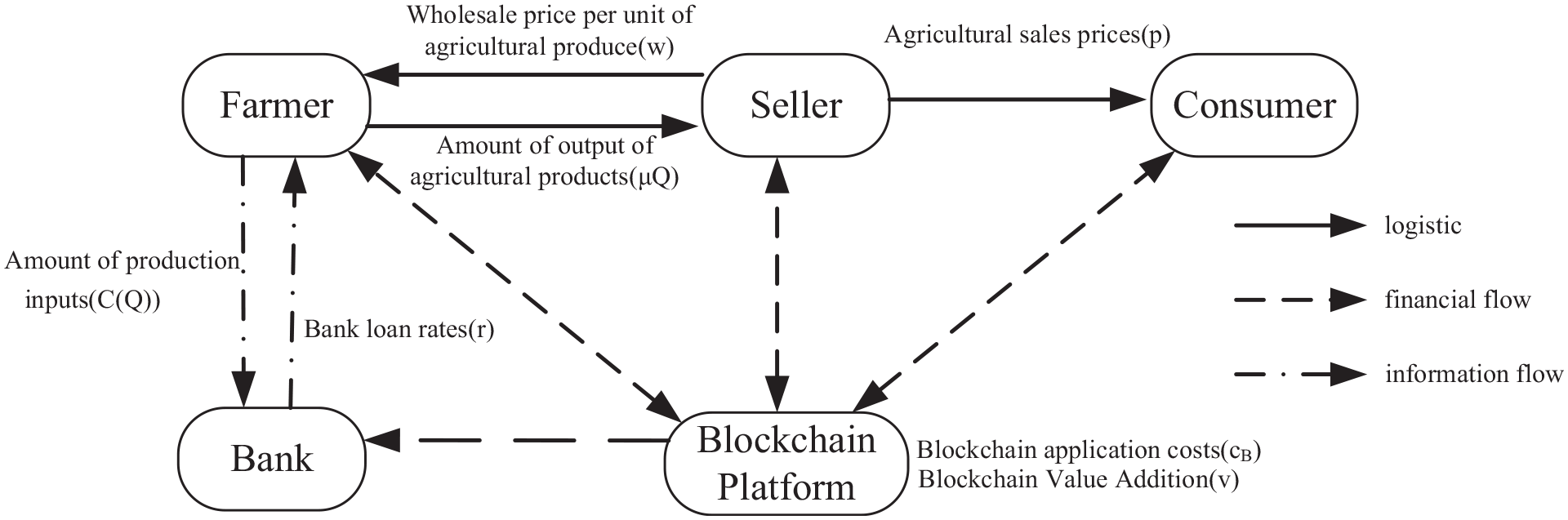
Operational processes in the agricultural supply chain.

Flowchart on the decision-making process.
In order to make the study better, relevant hypotheses are proposed:
(1) The cost of production per unit of agricultural product includes the cost of effort invested by the farmer in terms of time, farm implements, seeds, etc., and is denoted by
(2) The production of agricultural products is subject to output uncertainty, which is not only related to farmers’ production and efforts, but also affected by natural disasters such as droughts and floods, pests and diseases. In this paper, we assume that
(3) After the output of agricultural products, the seller will purchase all the agricultural products produced by the farmer in the season and sell them in the retail market, regardless of the shortage of goods, so the amount of agricultural products purchased is equal to the amount of output, at this time, the seller pays the farmer the purchase cost of
(4) According to the relationship between supply and demand in a market economy, a random level of output affects the supply of agricultural products in the market, which in turn affects their selling prices
(5) Assume that there is no risk of bankruptcy for the farmer.
(6) The application of blockchain technology will generate application costs, the seller is larger and stronger, and the application of blockchain technology can ensure the quality and greenness of agricultural products, so that consumers trust the quality of agricultural products, which in turn increases the purchase volume and brings value gain to the seller, so this paper assumes that the seller bears the cost of blockchain application. Assuming that the blockchain application cost per unit of agricultural products is
(7) The * denotes the optimal value of the solution, and the upper and lower labels 1, 2, 3, and 4 denote the cases of decentralized decision-making, centralized decision-making, cost-sharing contract coordination, and cost-sharing-benefit-sharing contract coordination, respectively.
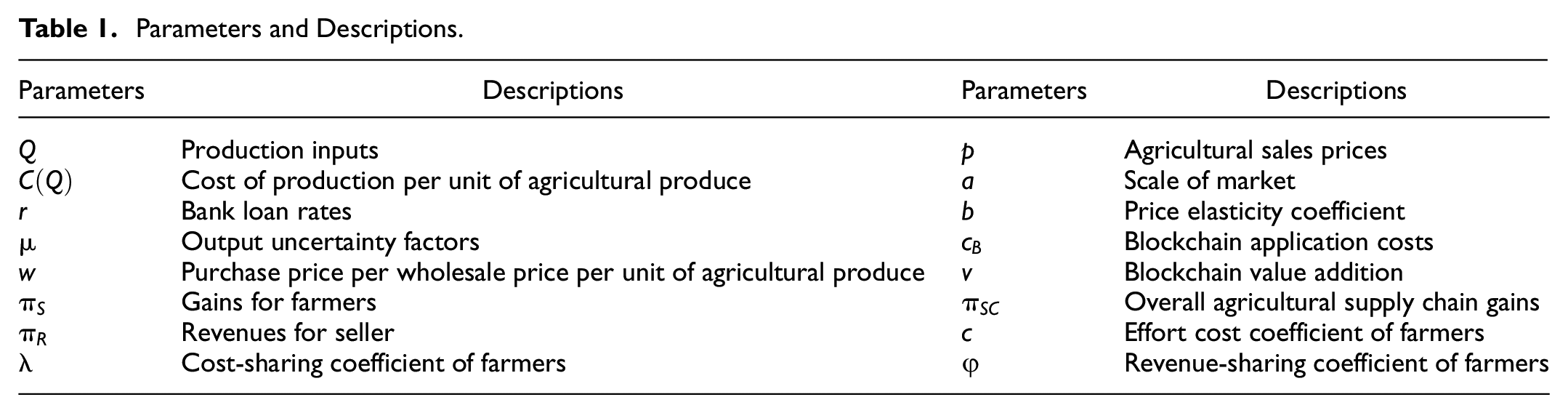
The parameters and descriptions are shown in Table 1.
Parameters and Descriptions.
Model Construction and Analysis
Decentralization Decision-Making Model Construction
(1) Optimal Production Input Volume Decision of Farmers Under Blockchain Technology
The farmer makes production input quantity decisions based on the seller’s purchase price and the bank loan interest rate, and its expected return is:

The first-order derivative of Equation 1 is

(2) Optimal Purchase Price Decision for Sellers with Blockchain Technology
The seller’s revenue under blockchain technology is equal to the market sale revenue minus the farm produce acquisition cost paid to the farmer minus the blockchain application cost plus the value gain from the blockchain, so the seller’s expected revenue is:

Proposition 1: Under decentralized decision making, the seller’s optimal purchase price is:

The optimal amount of production input for the farmer at this point is:

The optimal expected returns for farmers and sellers are:


Proof: Substituting Equation 2 into Equation 3 yields
Centralized Decision-Making Model Construction
Only

Proposition 2: Under centralized decision making, the optimal amount of production inputs for a farmer is:

The overall benefit of the supply chain at this point is:

Proof: The first-order derivative of Equation 8 is
Decision-Making Metrics and Benefit Analysis of Agricultural Supply Chain with Blockchain Technology
Combining Propositions 1 and 2 leads to Conclusion 1:
Conclusion 1: The optimal production and returns of the agricultural supply chain at decentralized decision-making do not reach the Pareto optimum at centralized decision-making.
Proof.
The expected total return of the farmer and the seller at decentralized decision making is:
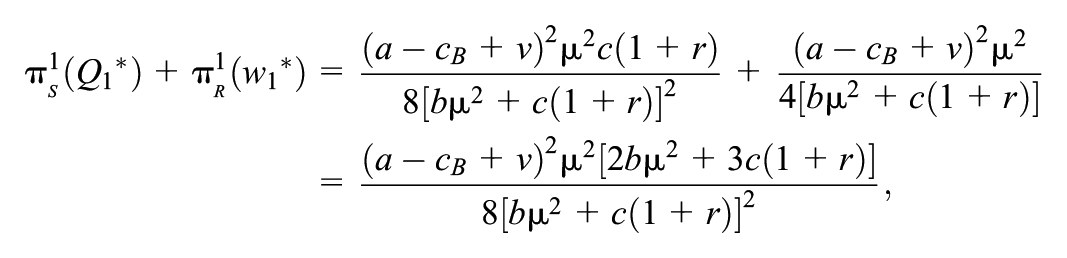

That is, the overall return of the agricultural supply chain in the centralized decision-making is greater than the total return of the decentralized decision-making farmers and sellers. Therefore, the returns and optimal production of the agricultural supply chain in the decentralized decision-making are not Pareto-optimal in the centralized decision-making.
Analysis of Agricultural Supply Chain Coordination Under Blockchain Technology
From Conclusion 1, the optimal production input quantity and the overall supply chain revenue in centralized decision-making are greater than in decentralized decision-making, that is, the revenue and optimal production quantity of the agricultural supply chain in decentralized decision-making are not Pareto-optimal, which may be due to the fact that the cost of blockchain application is borne by the seller, and it is more preferable for the farmers to adopt blockchain technology, which can achieve the transparency of the information and thus help farmers to obtain bank financing, so in order to promote the improvement of production input quantity and supply chain revenue in decentralized decision-making, cost-sharing contract and cost-sharing-revenue contract will be introduced to coordinate the agricultural supply chain under blockchain technology, respectively.
Cost-Sharing Contract Modelling
Let the cost-sharing coefficients for the farmer be
The benefits to the farmer and the seller when coordinated using a cost-sharing contract are respectively:


Proposition 3: The optimal amount of production inputs for the farmer and the optimal purchase price for the seller under the cost-sharing contract are:


Therefore, the returns to the farmer and the seller under the cost-sharing contract are, respectively:


Decision-Making Metrics and Benefit Analysis of Agricultural Supply Chain Under Blockchain Technology
Conclusion 2 can be obtained from Proposition 3:
Conclusion 2: Under the cost-sharing contract, supply chain coordination in the agricultural supply chain cannot be achieved due to the unequal distribution of benefits. Although farmers share part of the blockchain application costs, retailers are forced to raise the purchase price of agricultural products to compensate for the farmers’ losses. This, in turn, compresses the retailers’ profit margins, preventing their earnings from reaching Pareto optimality. The cost-sharing contract, in its simplicity, overlooks the dynamic game relationships within the supply chain and fails to balance the coordination of interests among all parties. It neglects the diminishing marginal returns for retailers, making it difficult to stimulate the maximum synergistic effect of cooperation and ultimately failing to achieve supply chain coordination.
Proof: the sum of the benefits of the farmer and the seller under the cost-sharing contract is:

That is, the total return to decentralized decision-making farmers and sellers is equal to the overall return to the agricultural supply chain when decision-making is centralized.
The difference between the seller’s return under the cost-sharing contract and the seller’s return in the case of decentralized decision-making is:
Therefore, supply chain coordination cannot be achieved in agricultural supply chain under cost sharing contract.
It is found through calculations that:
Cost Sharing-Revenue Sharing Contract Model Construction
As can be seen from the above, the seller will increase the purchase price of agricultural products to a certain extent due to the farmers’ help in sharing the cost of blockchain application, which will motivate the farmers to increase the amount of production inputs, but lead to the reduction of their own profits. In view of the weak position of farmers in the agricultural supply chain, they can no longer share the farmers’ income to compensate for the sellers’ income to achieve supply chain coordination, so we try to share the sellers’ income with farmers to make the purchase price of agricultural products decrease, so that the increased shared income of farmers and the reduced purchase income of agricultural products can reach a balance, and the seller’s income can achieve the Pareto optimal, so as to achieve the coordination of the agricultural products supply chain. After the sale of agricultural products, both parties share the revenue of the seller’s sales
The expected returns of the farmer and the seller under the cost-sharing-revenue-sharing contract are:


Proposition 4: The optimal production inputs and the optimal purchase price for coordinating the supply chain of agricultural products through a cost-sharing-benefit-sharing contract are, respectively:


The expected returns to farmers and sellers under the cost-sharing-revenue-sharing contract are:


Proof: the first-order derivative of Equation 17 is
In order to make the optimal production of the farmer under contractual coordination optimal for centralized decision making, let
Decision-Making Metrics and Benefit Analysis of Agricultural Supply Chain Under Blockchain Technology
Conclusions 3 and 4 can be obtained from Proposition 4:
Conclusion 3: Under the cost-sharing-revenue-sharing contract, effective coordination within the agricultural supply chain is achievable. This is due to the optimization of benefit distribution between the parties, built upon the foundation of cost-sharing. Sellers share a portion of the sales revenue, thereby alleviating some of the farmers’ blockchain application costs. By appropriately lowering the purchase price of agricultural products, sellers increase their own profits while compensating for the reduced direct income of farmers caused by the price reduction. The analysis reveals that the designed contract ensures incentive compatibility between the parties. It not only enhances the farmers’ motivation but also optimizes the distribution of profits, thereby strengthening the stability of cooperation between farmers and retailers. This coordination ultimately leads to the achievement of Pareto optimality for the entire supply chain.

Proof: the optimal production inputs under the cost-sharing-benefit-sharing contract reach the optimum under centralized decision-making. Therefore, it is only necessary to determine whether the returns of the farmer and the seller under the cost-sharing-return-sharing contract are greater than the returns of the farmer and the seller, respectively, under decentralized decision-making.
The difference between the returns of the farmer under the cost-sharing-return-sharing contract and the returns of the farmer under decentralized decision-making is:
The difference between the seller’s return under the cost-sharing-revenue-sharing contract and the seller’s return in the case of decentralized decision-making is:

To make
It can be summarized that the reason why the cost-sharing-revenue-sharing contract can achieve the coordination of the supply chain is that the seller’s purchase price is reduced under this combination contract, which enables the seller to obtain more profits, and does not harm the interests of the farmers, and achieves a balance between the reduction of the farmers’ revenue from the sale of agricultural products and the increase of the revenue of the shared seller. Under the cost-sharing-return-sharing contract, the returns of both farmers and sellers reach the Pareto optimum, so the agricultural supply chain can reach a coordinated state under this combination contract.
Conclusion 4: Under the cost-sharing-revenue-sharing contract, the optimal purchase price
Proof:
The above analysis shows that the supply chain cannot be coordinated when decentralized decision making. Since powerful sellers bear the cost of blockchain application, this paper proposes a cost-sharing contract to coordinate the supply chain. From the analysis, it can be seen that the cost-sharing contract cannot achieve supply chain coordination because the farmers help the sellers to share the cost of blockchain application, and the sellers will give certain benefit compensation to the farmers, which leads to a lower purchase price of the agricultural products, and makes the sellers’ benefits less than those in the case of decentralized decision-making. Therefore, consider introducing a gain-sharing contract, and consider allowing the seller to give a portion of the gain to the supplier, which will result in a lower purchase price and an increase in the shared gain for the farmer that is equal to the reduced gain from the sale of the produce. When the gain-sharing ratio varies within a certain range, the portfolio contract leads to a coordinated state of the agricultural supply chain.
Numerical Discussion and Sensitivity Analysis
Research on agricultural supply chain models incorporating capital constraints under blockchain technology has shown that decentralized decision-making fails to attain an optimal state for farmers, sellers, and the overall profit of the supply chain, compared to centralized decision-making. Furthermore, the implementation of cost-sharing contracts fails to effectively coordinate the agricultural supply chain. However, the introduction of combined cost-sharing-revenue-sharing contracts has proven successful in facilitating coordination within the agricultural supply chain.
In order to verify the correctness of the above conclusions, MATLAB software is used to conduct simulation analysis, and this chapter will combine the current status quo of the agricultural products sales market to explore the impact of the agricultural products output rate, the blockchain application costs, the blockchain value addition, the cost-sharing coefficient, and the revenue-sharing coefficient on the decision-making indicators and returns of the farmers, the sellers, as well as the overall returns of the supply chain. The parameters in the model are set as follows:

Impact of Agricultural Output Rates on Decision-Making Indicators and Returns
Based on the observations derived from Figure 3a, it is evident that, across the four scenarios, an upward trend followed by a gradual decline can be observed in the optimal production inputs of farmers as the agricultural output rate increases. Specifically, farmers are willing to increase the amount of production inputs when the production rate falls below a certain threshold. However, as the agricultural production rate exceeds a certain threshold, farmers tend to gradually reduce their production inputs due to the higher associated production input costs. Moreover, Figure 3a depicts that the amount of production inputs after both centralized and coordinated decision-making is greater than the amount of production inputs when decision-making is decentralized.
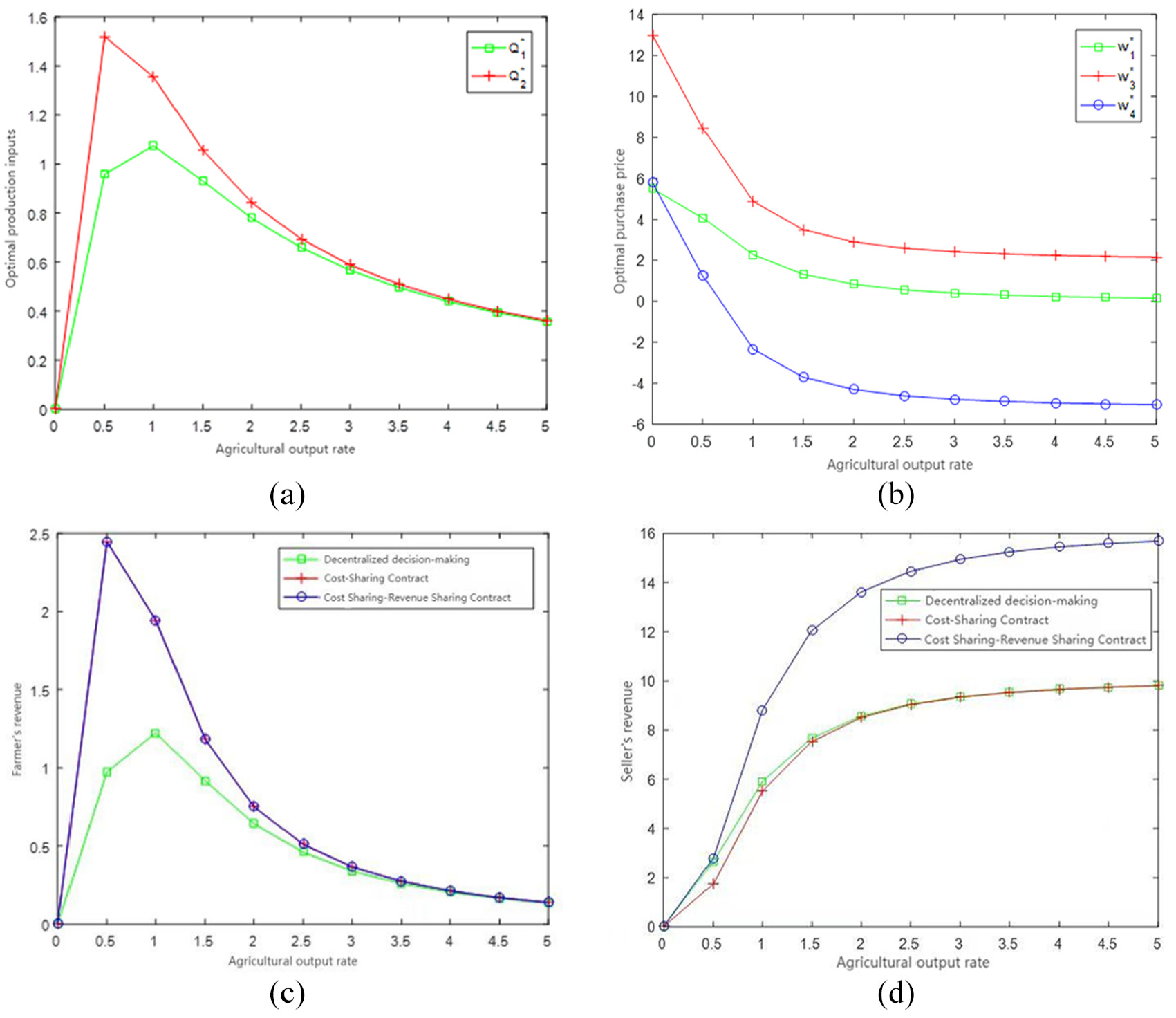
(a) Impact of agricultural output rate on optimal production inputs, (b) impact of agricultural output rate on optimal purchase price, (c) impact of agricultural output rate on farmer’s revenue, and (d) impact of agricultural output rate on seller’s revenue.
Observations from Figure 3b reveal a clear trend across the three scenarios: the seller’s optimal purchase price exhibits a declining pattern as the output rate of agricultural products increases. This can be attributed to the fact that as the output rate rises, there is a corresponding increase in the volume of agricultural products entering the market. Consequently, the seller incurs additional acquisition costs to accommodate this surge in supply. As the supply of agricultural products in the market exceeds the demand, the selling price of agricultural products decreases, prompting the seller to lower the purchase price to protect their profit margin.
This observation also provides further insights into Figure 3a, revealing that farmers, in response to the decrease in purchase price, farmers reduce their production levels. In Figure 3b, the optimal purchase price under the coordination of the cost-sharing-revenue-sharing contract is higher than the optimal purchase price at decentralized decision-making, and the optimal purchase price after coordination of the cost-sharing contract is lower than the optimal purchase price at decentralized decision-making. These findings indicate that sellers reduce the purchase price of agricultural products when the cost-sharing-revenue-sharing contract is coordinated in order to balance the loss of self-interest due to the sharing of sales proceeds with farmers.
According to the observations made in Figure 3c, both the decentralized decision-making and contractual coordination of farmers’ revenue exhibit a similar trend with the increase in the output rate of agricultural products. Initially, there is a rapid increase in both the returns and the optimal amount of production inputs. However, beyond a certain point, this trend reverses, and both returns and the optimal production inputs begin to decline. This indicates that farmers must maintain the output rate of agricultural products within a certain range to ensure the appropriate amount of production inputs, thus maximizing their returns.
Figure 3d illustrates the effects of the seller’s revenue as the output rate of agricultural products increases in three scenarios. The results show that, in all three scenarios, the seller’s revenue increases gradually with the agricultural output rate until it reaches a certain threshold, after which the revenue levels off. This phenomenon occurs because when the output rate of agricultural products is too high, the market becomes flooded with products, and the market for agricultural products is in a state of oversaturation leading to a drop in the selling price and a decrease in the seller’s revenue. Therefore, it is crucial to maintain the output rate of agricultural products within an optimal range. The findings emphasize that too much output rate leads to oversaturation of the market which is detrimental to both parties’ returns and the overall returns of the supply chain. Therefore, it is crucial to maintain the output rate of agricultural products within an optimal range.
Impact of Blockchain Value Addition on Decision-Making Indicators and Returns
Figure 4a to d collectively demonstrate a clear relationship between the blockchain value addition per unit of agricultural products and various key indicators. Specifically, the optimal production input volume of farmers, the optimal purchase price of agricultural products, the revenue of farmers, and the revenue of sellers all exhibit a positive correlation with the blockchain value addition per unit of agricultural products. The findings indicate that a higher blockchain value addition increases the income of both farmers and sellers. Furthermore, it serves as a motivator for farmers and sellers to adopt blockchain technology, leading to an increase in the amount of production inputs and the purchase price of agricultural products.

(a) Impact of blockchain value addition on optimal production inputs, (b) impact of blockchain value addition on optimal purchase price, (c) impact of blockchain value addition on farmer’s revenue, and (d) impact of blockchain value addition on seller’s revenue.
Impact of Blockchain Application Costs on Decision-Making Indicators and Returns
Figure 5a to d collectively demonstrate that the optimal amount of production inputs for the farmer, the optimal purchase price of agricultural products, the farmer’s revenue, and the seller’s revenue are all inversely proportional to the cost of blockchain adoption per unit of agricultural product. Specifically, as the cost of blockchain applications per unit of agricultural product increases, a decrease in the aforementioned variables is evident.

(a) Impact of blockchain application costs on optimal production inputs, (b) impact of blockchain application costs on optimal purchase price, (c) impact of blockchain application costs on farmer’s revenue, and (d) impact of blockchain application costs on seller’s revenue.
Figure 5b illustrates a noticeable trend wherein the purchase price of agricultural products experiences a reduction as the blockchain cost increases within the context of decentralized decision-making. This phenomenon can be attributed to the complete burden of the blockchain application cost on the seller under decentralized decision-making. As the blockchain application cost escalates, sellers, in an endeavor to safeguard their interests, opt to mitigate the impact by lowering the purchase price of agricultural products. However, when examining the coordination facilitated by two contractual agreements, farmers contribute to alleviating a portion of the blockchain application costs borne by the sellers. Therefore, with increasing blockchain application costs, sellers are inclined to adjust the purchase price of agricultural products upwards to offset the expenses shared by the farmers.
According to the observations from Figure 5b, the optimal purchase price under the cost-sharing-revenue-sharing contract is lower than the optimal purchase price under decentralized decision-making. This outcome can be attributed to the dynamic interplay of incentives within the cost-sharing-revenue-sharing contract structure—while farmers assist in defraying the costs associated with blockchain usage, they also partake in the seller’s sales revenue. Consequently, the seller is inclined to reduce the purchase price of agricultural products to safeguard the farmer’s revenue. As depicted in Figure 5d, an intriguing observation emerges when the cost of blockchain application is fixed: despite farmers sharing in the blockchain application costs with the sellers, the seller’s benefits are lower than those under decentralized decision-making within the cost-sharing contract. This outcome signifies that the cost-sharing contract fails to attain the level of supply chain coordination envisioned.
Impact of Cost-Sharing Coefficient on Decision-Making Indicators and Returns
Figure 6a to d collectively demonstrate that the amount of agricultural inputs produced by a farmer, the farmer’s revenue, and the seller’s revenue are independent of the blockchain cost-sharing coefficient. The findings from Figure 6b reveal a notable trend, where the purchase price of agricultural products escalates in conjunction with an increase in the blockchain cost-sharing coefficient. This observation signifies that as the blockchain cost-sharing coefficient grows, reflecting a greater contribution from farmers to defray the blockchain usage costs for sellers, sellers are motivated to raise the purchase price of agricultural products to compensate farmers for their share. Additionally, Figure 6b illustrates that the purchase price of agricultural products under the cost-sharing-revenue-sharing contract is lower than the purchase price under the cost-sharing contract. This discrepancy can be attributed to the sellers allocating a portion of the sales proceeds to the farmers within the cost-sharing-revenue-sharing framework. Consequently, the sellers adjust the purchase price of agricultural products upward to safeguard their own interests, leading to a lower purchase price compared to the cost-sharing contract.

(a) Impact of cost-sharing coefficient on optimal production inputs, (b) impact of cost-sharing coefficient on optimal purchase price, (c) impact of cost-sharing coefficient on farmer’s revenue, and (d) impact of cost-sharing coefficient on seller’s revenue.
Impact of Revenue-Sharing Coefficient on Decision-Making Indicators and Returns
Figure 7 collectively demonstrates that the amount of agricultural inputs produced by a farmer, and the farmer’s revenue are independent of the revenue-sharing coefficient, selling price of agricultural products is inversely proportional to the revenue-sharing coefficient. This suggests that as the coefficient of revenue-sharing increases, signifying a greater proportion of sales income shared by the farmers, the sellers are inclined to adjust the purchase price of agricultural products downward in order to protect their own interests. However, the seller’s return exhibits a positive association with the revenue-sharing coefficient. As the revenue-sharing coefficient increases, the seller’s purchase price of agricultural products allocated to the farmer decreases, leading to an enhancement in the seller’s profitability and, consequently, an increase in their return on investment.
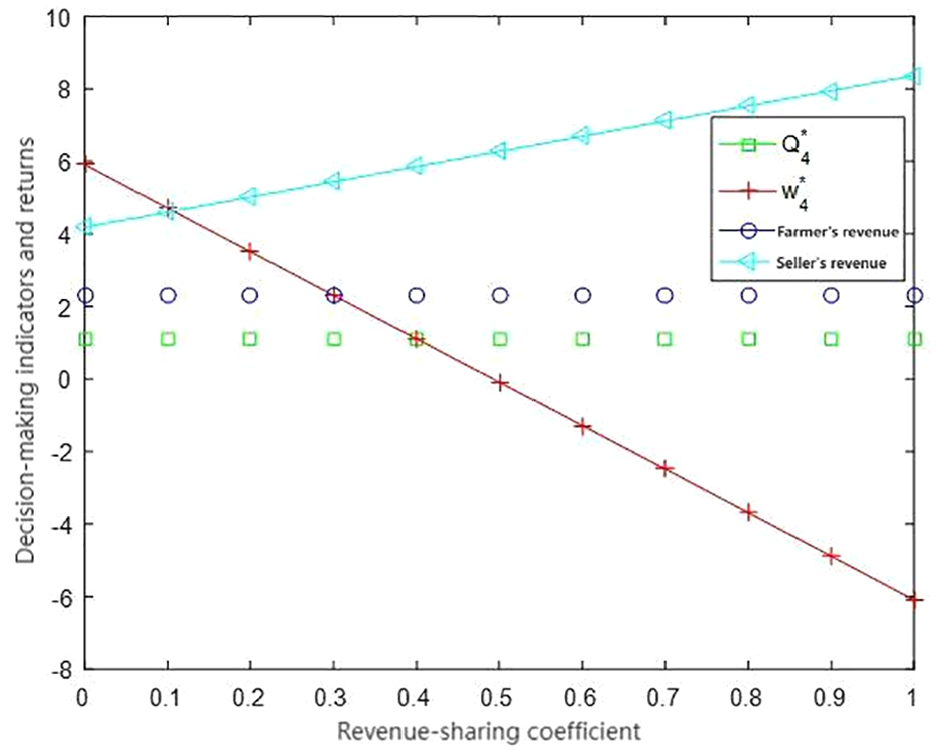
Impact of revenue-sharing coefficient on decision-making indicators and returns.
Conclusions
This study examines decentralized and centralized decision-making models within a single farmer–single seller supply chain framework. It employs cost-sharing contract and cost-sharing-revenue-sharing contract to coordinate the supply chain. Numerical experiment and sensitivity analysis are conducted to exhibit the effectiveness and viability of the proposed coordination schemes. The conclusions obtained from the numerical examples and sensitivity analysis are summarized as follows:
(1) The cost-sharing contract fails to achieve supply chain coordination, as it leads to reduced returns for the seller compared to decentralized decision-making. A cost-sharing-revenue-sharing contract, with a flexibly adjusted revenue-sharing coefficient, effectively coordinates the supply chain, aligning farmers’ production inputs with centralized decision-making. This approach enhances returns for both farmers and sellers, achieving a harmonized and mutually beneficial state within the supply chain.
(2) The agricultural product output rate, blockchain application costs, and other factors also influence the decision-making metrics and profits. Specifically, the optimal production input, farmer profits, and the optimal purchase price decrease as the agricultural product output rate increases, while the retailer’s profits gradually increase with a higher output rate. Additionally, production inputs, farmer profits, and retailer profits all decrease as the blockchain application costs rise. The cost-sharing coefficient affects purchase prices, while the revenue-sharing coefficient enhances seller gains and reduces purchase prices.
This paper has several managerial insights. First, the government should actively encourage the use of digital technologies such as blockchain and big data, and strengthen the monitoring of agricultural production and financing risks. It should introduce relevant subsidy policies that allow farmers to obtain loans from banks at lower interest rates, thereby enhancing their production capacity. Second, farmers should actively improve their creditworthiness to enhance their ability to secure financing from banks. Additionally, they should focus on improving cultivation and breeding techniques to increase agricultural output. By maintaining the output rate within a certain range, farmers can avoid market saturation, which could lead to a decline in supply chain profits. Third, farmers and retailers should strengthen their cooperation and establish reasonable cost-sharing and revenue-sharing coefficients. They should also work toward expanding the agricultural product market, increasing market size, enhancing marketing efforts, and broadening sales channels to boost demand for agricultural products.
This paper only considers the application costs and value-added parameters of blockchain technology, without taking into account factors such as trust levels. Additionally, the research overlooks the potential bankruptcy risk that farmers may face. Since farmers typically rely on limited personal funds for production, their outputs are uncertain, and they need revenue from sales to repay bank loans. If they cannot secure sufficient cash flow or external financial support in a timely manner, farmers may face bankruptcy risks. Future research could explore the impact of trust parameters in blockchain technology and consider the bankruptcy risks faced by farmers, examining how these factors affect the optimal decisions and profits of all stakeholders in the agricultural supply chain.
Footnotes

Funding
The author(s) disclosed receipt of the following financial support for the research, authorship, and/or publication of this article: Funding for Basic Research Operating Expenses Programs of Provincial Undergraduate Colleges and Universities in Heilongjiang Province in FY2024 (2024-KYYWF-0957).
Declaration of Conflicting Interests
The author(s) declared no potential conflicts of interest with respect to the research, authorship, and/or publication of this article.
Data Availability Statement
Data sharing not applicable to this article as no datasets were generated or analyzed during the current study.