




Abstract
In the era of the digital economy (DE), the development paradigm of the tourism industry is facing subversive changes. The DE has become a key factor in promoting the innovation and development of the tourism industry. Under this new environment, studying the mechanism by which DE affects the innovation and development of the tourism industry is of great theoretical value and practical significance. Building on literature research, this paper uses theoretical analysis to construct a theoretical model of the innovation and development mechanism of the tourism industry enabled by DE. Using empirical research methods, we selected panel data from 30 provinces in China for benchmark regression analysis and mediation effect analysis. The results show that DE significantly impacts the innovation and development of the tourism industry. Resource acquisition ability plays a partial intermediary role, and the policy environment (PE) plays a moderating role between DE and tourism industry innovation. Finally, the paper puts forward countermeasures and suggestions from the aspects of developing the DE, improving resource acquisition ability, and optimizing PE to promote the innovation and development of the tourism industry.
Introduction
Entering the era of the digital economy (DE), digital technology—with big data, cloud computing, artificial intelligence (AI), blockchain, meta-universe, 5G, and other new-generation information technology as its core—has pushed the tourism industry from a traditional development mode to a new mode of digitalization. The information technology revolution has disrupted the ecosystem, development paradigm, business model, value creation, and organizational form of the tourism industry, resulting in a traditional industrial development paradigm that is no longer fully applicable to the digital era. The integration between the tourism industry and the DE is a positive initiative that promotes upgrading the tourism industry’s structure and rationalizing its composition (L .J. Ma & Ao, 2023). With the development of China’s Internet information technology, especially big data and cloud computing, the fusion of DE and tourism not only promotes the upgrading and development of the tourism industry but also gives birth to new business forms like “cloud tourism,”“cloud exhibition,”“cloud art appreciation,”“cloud entertainment,”“cloud live broadcasting,” and “cloud cultural creation,” all based on digital technology. The application of digital, networked, and intelligent scientific and technological innovations, such as digital tourism infrastructure, digital technologies, digital services, and regulatory platforms, has promoted the transformation of the tourism industry from resource-driven to innovation-driven (Ye et al., 2022). The digital innovation of the tourism industry (TII) has become a key force to shape the competitive advantages of the industry, promote the transformation and upgrading of the industry and change the competitive pattern of the industry (Yang & Wu, 2022).
Digital TII results from the pull of market consumption demand and innovation and upgrading on the supply side of tourism (S. H. Li, 2018). From the tourism market demand side, with the continuous improvement of economic and social development levels, people’s aspirations for a better life are becoming stronger. Consequently, market demand is gradually becoming diversified and personalized (L. Zhang, 2024). Digital technology can break time and space constraints for value creation, change the traditional, production-determined consumption value creation mode, and promote synergistic value creation on both the demand and supply sides (Han, 2024). Tourism consumers use the mobile Internet and other technical tools to quickly and comprehensively grasp relevant information about tourism products and dominate the tourism transaction process. This, in turn, “pushes” tourism producers to improve product quality and service levels.
From the supply side, the tourism industry uses digital technology to effectively integrate information resources, promote information sharing, encourage the development of multi-industry integration, and realize the innovation and upgrading of tourism services. Faced with current problems in the digital innovation of China’s tourism industry—such as “low-end lock” in the value chain, insufficient depth of digital integration, low efficiency of innovation output, and serious homogenization of regional development—the guiding effect of existing research on reality is limited (Shu, 2024). The research on tourism industry innovation in the era of digital economy is a cutting-edge topic with great innovation and epochal significance, which has important theoretical value and practical significance. The existing studies have expounded the influencing factors of tourism industry innovation from different perspectives, and also analyzed the importance of digital economy to tourism industry innovation from the qualitative level, which provides some theoretical support for the relationship between digital economy and tourism industry innovation and development. However, the existing research lacks a systematic study on the impact mechanism of the digital economy on the tourism industry innovation at the empirical level, and the guiding role of the digital economy on the tourism industry innovation is limited, and new theoretical research is urgently needed to guide the development of the tourism industry innovation. Therefore, based on the panel data of 30 provinces in China, this study aims to explore the mechanism of digital economy empowering the tourism industry innovation, and to deeply understand the internal logic and essential law of the digital economy to promote the tourism industry innovation through the discussion of the intermediary mechanism and the adjustment mechanism. It will help the practice of high-quality development of the tourism industry.
The main research content of this paper is as follows, the second part reviews the literature on digital economy and industrial innovation, and accordingly presents the research hypotheses and conceptual model of this paper; the third part describes the research methodology and variable selection of this paper, and measures the data; the fourth part analyzes the empirical results; and the last part is the conclusions, revelations, limitations, and future research.
Literature Review and Research Hypothesis
Literature Review
A major area of research in industrial economics is industrial innovation (Schumpeter, 1912). The “digital economy” was first introduced by Tapscott in the 1990s. Some scholars have introduced DE into the field of tourism, opening up a new direction for research on industrial innovation and development (N. Chen, 2000; Wang, 2002; H. Xiang et al., 2004). The DE has become an emerging force driving the development of the tourism industry, promoting the optimization and upgrading of the industrial structure. However, the mechanism by which DE enables industrial innovation and development is still unclear, making it an important direction for academic research. This paper draws on the definition of digital economy in China Digital Economy Development Report (2022): digital economy is a new type of economic form that takes digitized knowledge and information as the key factors of production, takes digital technology as the core driving force, uses modern information network as an important carrier, and through the in-depth fusion of digital technology and the real economy, continuously improves the level of digitization, networking, and intelligence of the economy and society, and accelerates the restructuring of economic development and governance mode. It is a new type of economic form that accelerates the reconstruction of economic development and governance mode. Innovation in the tourism industry contains two aspects: first, the improvement and upgrading formed within the industry through technical means and management means; and second, the product innovation, service innovation, business model innovation, business innovation, etc. formed through cross-border integration (D. J. Wang, 2016).
Academics have analyzed the mechanism of tourism industry innovation and development by studying the factors influencing innovation, producing fruitful research results. Information technology innovation is one of the original driving forces of tourism industry innovation. It promotes the innovative development of the tourism industry by facilitating the change of basic elements within the industry, integrating elements between different industries, and changing participating subjects. This, in turn, promotes innovative development in terms of operation methods, product innovation, business processes, organizational relationships, marketing channels, etc. (Sari, 2021; Zrinka et al., 2019).
Digital infrastructure is the foundation of digital innovation (Paresishvili, 2017). Infrastructure, such as digital platforms established by using a new generation of information technology—mobile Internet, big data, cloud computing, blockchain, AI, etc.—facilitates knowledge transfer, diffusion, and spillover across industries. The flow of knowledge and innovation resources promotes cross-border synergistic TII (Marino & Pariso, 2021a; Sun, 2021).
Industrial competition and cooperation in the DE are the main driving forces that promote industrial innovation. Intense market competition is conducive to encouraging tourism enterprises to increase their innovation activities to develop new tourism products and reduce costs (Divisekera & Nguyen, 2018). Innovation is conducive to improving the operational efficiency of tourism enterprises and creating greater flexibility in responding to demand, thereby enabling enterprises to gain a competitive advantage (Pirnar et al., 2012).
The internal collaboration of the tourism industry and the system of division of labor between the tourism industry and supporting industries as well as related industries are conducive to the promotion of industrial innovation and development. With the help of digital network platforms, suppliers, distributors, retailers, agents, and competitors in the tourism industry chain can efficiently establish various types of cooperation, interdependence, and contact networks (Qashou & Saleh, 2018). This is conducive to acquiring innovation resources and forming economies of scale, and it promotes industrial innovation.
Changes in tourism market demand are an important driving force affecting the digital TII. Changes in market demand drive tourism enterprises to develop new products and expand new businesses, thus enhancing their incentive to innovate. Under the new environment, tourists’ experience modes and consumption concepts have undergone significant changes. The growing demand for virtual consumption scenarios, customized consumption products, online tourism, and other business forms in the tourism market has driven product and business innovation. Tourism e-commerce, tourism virtual communities, and AI smart services have helped to improve the sense of experience, convenience, and comfort in tourism consumption (Preko, 2022) and have reshaped the relationship between tourism producers and consumers (Marino & Pariso, 2021b).
The development of tourism industry innovation is the result of the combined effect of multiple macro-environmental factors, industrial factors, and market factors (Nguyen, 2018; Rakhimov, 2022). These include digital infrastructure, information technology innovation, a humanistic environment, industrial competition and cooperation, policy and legal systems, changes in market demand, and many other factors. In addition, the study of the relationship between digital economy and industrial development has become an important direction of academic research. At the micro level, the digital economy improves the quality of enterprise products and services, optimizes enterprise structure, and innovates enterprise management concepts through technological innovation, organizational change, economies of scale, and the long-tail effect (L. Zhao, 2022). At the meso level, the penetration and application of digital technology is conducive to promoting the upgrading of industrial structure, enhancing the ability of cross-border integration of industries, and continuously giving rise to new industrial forms (Yang & Wu, 2022). At the macro level, digital economy optimizes the way of resource allocation, improves industrial production efficiency, and promotes the high-quality development of industries (Chen et al., 2022). In terms of empirical research, scholars have explored the impact of the digital economy on economic growth (Shi & Liu, 2024), high-quality development of industries (S. G. Wang, 2024), and optimization of industrial structure (Lian & Dong, 2024), etc., and the research methods include social network analysis, panel regression model (Wei et al., 2023), PSM- DID model (Y. Jiang et al., 2022), etc.
Although existing studies have systematically studied the influencing factors of tourism industry innovation from different perspectives(J. W. Wang et al., 2024), such as industrial integration, “dual-carbon” goal, regional development, etc., with the development of the times, the digital economy has become a new driving force for industrial development, and the relevant studies on tourism industry innovation have failed to keep pace with the times, and there is a lack of systematic research on the influencing factors of the innovation and development of the tourism industry under the perspective of the digital economy. Secondly, the existing research results of digital economy-enabled tourism industry innovation are mostly qualitative studies(S. Zhang et al., 2024; Zhou et al., 2024), lacking relevant empirical studies to support them. Finally, the specific impact path of digital economy on tourism industry innovation is still unclear, the lag of theoretical research restricts the innovative development of China’s tourism industry, and there is an urgent need to explore the intermediary mechanism and regulatory mechanism to provide guidance for practice. Therefore, this study constructs a theoretical model of the mechanism of innovation development in tourism industry from the perspective of digital economy and empirically tests the model in order to elucidate the mechanism of digital economy’s influence on innovation in tourism industry.
Research Hypotheses
The Impact of the Digital Economy on Resource Accessibility
The sharing economy concept in the digital environment breaks the supply paradigm of the traditional model, where public operating resources primarily come from the government, enterprises, and social organizations. It includes enterprises, government departments, social organizations, consumers, and other diversified subjects with idle resources willing to share them, adding them to the category of supplying subjects (Rakhimov, 2022). This model establishes a comprehensive sharing and allocation mechanism for resource identification, resource acquisition, resource allocation, and resource utilization. This mechanism is based on the market mechanism and enables the transfer of the right to use resources without altering the premise of resource ownership. It thereby breaks the boundaries of resource innovation and promotes the exchange and circulation of public operating resources among different organizations (individuals).
This approach establishes a sharing network platform by relying on mobile Internet technology, big data, cloud computing, and intelligent terminals. This platform facilitates the online and offline sharing and linkage of tourism resources, building an omni-channel model of tourism resource sharing (Q. Chen & Dun, 2019). The sharing network platform allows enterprises within the tourism industry to share public technology platforms, public knowledge, sales channels, labor markets, services, and public facilities (Nie, 2017). This enables enterprises to quickly, economically, and conveniently obtain external resources and realize the sharing and integration of innovative resources (S. S. Li & Xu, 2019), thus improving the industry’s ability to obtain resources. Based on the above analysis, the following hypothesis is proposed:
H1: The DE has a significant positive effect on the resource acquisition capacity (RAC) of the tourism industry.
The Impact of Resource Acquisition Capacity on Industrial Innovation
Resources are fundamental to industrial innovation. Innovation resources, information resources, human resources, material resources, etc. are the resources that tourism industry innovation needs to rely on (Valle, 2009), of which innovation resources are the key elements to promote industrial innovation. Innovation resources can realize the enhancement of technology level and innovation capacity within the tourism industry, and give rise to new tourism business forms (H. H. Jiang & Qi, 2015). Information in the digital economy has become a determinant of the innovative development of the tourism industry. The tourism industry effectively integrates information resources with the help of new-generation information technology, promotes information sharing, facilitates the integration and development of multiple industries, and realizes the innovation and upgrading of the tourism industry (Shash, 2019). Innovative and adventurous entrepreneurs, a well-educated and experienced workforce, and organizations with a culture of innovation are conducive to the promotion of innovative activities in tourism. This makes the tourism industry much more efficient and contributes to the development of TII (Omerzel, 2015; Rega, 2016). Tourism industry innovation also relies on material resources, such as scientific research laboratories, scientific research facilities and equipment, experimental consumables, and funds. Adequate material resources are conducive to guaranteeing the development of tourism innovation activities (Peng, 2011).The quantity and quality of resources acquired by the industry are closely related to the resource acquisition capacity, and a strong resource acquisition capacity can provide a better resource environment for the innovative development of the industry, which is more conducive to promoting the innovative development of the tourism industry. Based on the above analysis, the following hypotheses are proposed:
H2: The RAC of the tourism industry has a significant positive impact on industry innovation.
Impact of the Digital Economy on Industrial Innovation
As a new type of industry driver, DE has become a key factor in promoting tourism innovation and development. At the macro level, the DE provides a new generation of information infrastructure, mature technology, a friendly policy environment (PE), and a fast-growing tourism market for tourism industry innovation (Stankov & Gretzel, 2021). The development of the DE has promoted the construction of a new generation of information infrastructure, such as AI, the industrial Internet, and the Internet of Things. The preferential policies to support the DE and the increase in financial investment are conducive to attracting a large number of scientific research institutes and innovative enterprises (Wen, 2019). This creates a good innovation ecosystem for the tourism industry.
At the micro level, DE promotes the digital transformation of traditional tourism enterprises. Digital technologies play a key role in staff training, knowledge sharing, marketing, and business management (Chayanan, 2021; Frolova, 2019; Stelnik, 2019). The DE reduces the cost of innovation by lowering transaction and administrative costs for businesses and effectively solves the problem of product homogenization. Digital technology and online platforms are able to provide information and booking services to a large number of consumers at relatively low prices; at the same time, it enables connectivity between tourism suppliers, intermediaries and consumers, facilitates interactive exchanges between them, and it strengthens customer communication and promotes customer-centered innovative behavior (Parviz, 2022). Digital-driven innovation has become a new innovation strategy. Based on the above analysis, the following hypothesis is proposed:
H3: The DE has a significant positive impact on TII.
Mediating Effect of Resource Acquisition Ability
According to the combing of literature, there are direct and indirect effects of digital economy on tourism industry innovation. First, the digital economy will directly affect the innovation of tourism industry. At the macro level, DE creates an industrial innovation ecosystem and promotes tourism industry innovation. At the micro level, it facilitates the digital transformation of tourism enterprises, creates a new type of customer-centered consumption and supply relationship, and thereby promotes the development of tourism industry innovation. Second, the digital economy indirectly affects innovation in the tourism industry through the ability to access resources (Pang, 2022). Specifically, DE positively affects resource acquisition ability, positively affecting TII. Based on the above analysis, the following hypothesis is proposed:
H4: Resource acquisition ability acts as a partial mediating variable between DE and TII.
Moderating Effect of a Policy Environment
The innovative development of the tourism industry requires the support of an innovation environment (Hojeghan & Esfangareh, 2011), in China’s cultural and political context, the policy environment is an important influence on innovation in the tourism industry. Macro-control policies issued by the government can influence infrastructure construction, urban planning, and industrial layout, thereby cultivating a favorable industrial ecological environment (Li et al., 2022). The government attracts social capital investment, recruits talented people and promotes infrastructure development through fiscal and other policy instruments. These actions are conducive to providing the resources needed for innovation, thus affecting tourism industry innovation (Carlisle et al., 2013). Based on this analysis, the study proposes the following hypothesis:
H5: The PE plays a moderating role between DE and TII. Specifically, a DE in high PE leads to a greater increase in TII compared to low PE.
Conceptual Model
Based on the above theoretical research and the theoretical assumptions of this paper regarding the relationship between DE and innovation variables in the tourism industry, we construct a mechanism for DE-enabled innovation and development in the tourism industry (Figure 1). In this mechanism, resource acquisition ability serves as a mediating variable, and PE serves as a moderating variable.

The conceptual model of the paper.
Research Methods
Model Building
Since the panel regression model can better identify the influence of explanatory variables in different ranges on the explanatory variables, and can identify the truncation effect, so as to make the data analysis more accurate and reliable, this study uses the panel regression model to verify the impact mechanism of digital economy on tourism industry innovation.
(1) Benchmark Model: In order to verify the direct impact of DE on the innovation of the tourism industry, i.e., hypothesis H3, the model is set up as follows:

Where TII is the explanatory variable, that is, TII, and DE is the digital economy; Z is a series of control variables; ϕ denotes time-fixed effects; ε denotes a random disturbance term.
(2) Mediating Effect Modeling: This study chooses RAC as a mediating factor to explore the mediating effect. That is, to test hypotheses H1, H2, and H4, the specific model is constructed as follows:

(3) Moderating Effect Model: In this study, PE is selected as the moderating variable. Testing for moderating effects requires centering the independent and moderating variables, and then introducing an interaction term between the independent and moderating variables, which leads to a model that tests for moderating effects:

Where CDE and CPC denote the DE and PE after centralization, respectively. If the coefficient of the interaction term η3 is significant, it can be proved that PE can regulate the role of DE in influencing the innovation of the tourism industry.
Variable Selection and Measurement
Variable Selection
In this study, according to the research hypotheses, the appropriate research variables were selected, as described below:
Explanatory Variable
Innovation in the tourism industry (TII): The tourism industry, as a complex system, is affected by many factors when it comes to innovation and development. There has not yet been a unified standard system for its measurement in the existing literature. This study combines the existing relevant concepts, theoretical literature and the background of the development of digital economy to construct a comprehensive evaluation index system of tourism industry innovation and measure the degree of tourism industry innovation.
Core Explanatory Variable
Digital economy (DE): Existing research on measuring the level of digital economic development is mostly done through the construction of a digital economic development-level indicator system. Therefore, this study refers to general practices in the literature, combined with research from previous scholars, to construct a digital economic development-level indicator system for its measurement (Leng et al., 2024; Li et al., 2023).
Intermediary Variable
Resource acquisition capacity (RAC): This refers to the ability of an industry to access key resources in some way. Scholars mostly construct measurement scales of tourism RAC based on the classification of resources (K. H. Ma, 2015). Therefore, this article divides key resources into five categories: knowledge resources, material resources, human resources, financial resources, and innovation resources. These are taken as the target layer to construct a comprehensive evaluation index system for RAC.
Moderator Variable
Policy environment (PE): Existing studies have shown that PE has an important influence on industrial innovation (Z. Q. Li & Li, 2022). Therefore, this study selects PE as a moderating variable. The proportion of science and technology expenditures to local general public budget expenditures is used to measure PE.
Control Variables
The level of economic development lays an important economic foundation for the digital innovation of tourism industry, which is closely related to the development of tourism industry. As a typical tertiary industry (The tertiary sector is defined as industries other than agriculture, forestry, animal husbandry, fisheries, manufacturing, electricity, heat, gas, and construction), the optimization of the structure of the tourism industry will promote its digital innovation. Tourism resources, as the main tourist attraction, are the source of inspiration and the basis for the development of the digital TII (Z. F. Wang & Liang, 2023). Innovation is the leading force for development, and talent is the primary resource to promote it; therefore, the element of people plays a vital role in the digital innovation of the tourism industry (S. Zhang et al., 2022). Consequently, factors affecting digital TII, such as local economic level (Z1), industrial structure optimization (Z2), tourism infrastructure (Z3), human capital stock (Z4), the number of higher education institutions (Z5), and tourism resource endowment (Z6), were selected as control variables in this study.
Variable Measurement and Data Sources
China’s tourism industry occupies an important position in the national economy, and the high-quality development of the tourism industry is crucial to the high-quality development of China’s economy, and the innovation of the tourism industry plays an important role in it. Therefore, China was selected as the research object in this study to provide reference for practice. Based on the principles of data availability and validity, this paper selects statistical data from 30 provinces and cities in China for analysis, spanning the years 2017 to 2022. The data are sourced from the China Statistical Yearbook, Tertiary Industry Statistical Yearbook, China Culture and Tourism Statistical Yearbook, Tourism Statistical Yearbook (copy), and other relevant statistical yearbooks and bulletins (B. B. Ma et al., 2023).
Referring to the existing research results of scholars, we construct a model for the mechanism of innovation and development in the DE-enabled tourism industry. The model adheres to the principles of operability, applicability, comprehensiveness, and data availability to construct the measurement indicators and evaluation system (Table 1). For the DE, we select 12 measurement indicators, such as cell phone penetration rate, Internet broadband access ports, and number of web pages, among others, from the four dimensions of hardware facilities, network resources, digital industrialization, and industrial digitization. Resource accessibility is measured using eight indicators, such as the number of patents granted, the full-time equivalent of R&D personnel, and the number of students enrolled in undergraduate programs, which are derived from the five dimensions of knowledge resources, human resources, material resources, financial resources, and innovation resources. Innovation in the tourism industry is comprehensively measured using indicators such as the transaction scale of the online tourism market, the transaction scale of the online travel market, the transaction scale of the online accommodation market, and the transaction scale of the online vacation market. The PE is assessed based on the share of science and technology expenditures in local general public budget expenditures.
Tourism Industry Innovation Evaluation Index System.

To eliminate the effects arising from differences in scale and order of magnitude, the raw data need to be standardized. The entropy method is used to assign weights to the measurement indexes and to measure the comprehensive evaluation indexes for the variables of DE, resource accessibility, tourism industry innovation, and PE across 30 provinces (cities and districts) from 2017 to 2022. The specific processing steps are as follows:
Data standardization (all selected measurements are positive indicators):

The information entropy Ej of each indicator is calculated as follows:

Calculate the weights of the indicators Wj:

Comprehensive evaluation index of digital innovation in tourism industry using information entropy weighting method:

Empirical Analysis
Smoothness Test
To maintain the smoothness of the data and to eliminate heteroscedasticity, the variables were subjected to natural logarithmic treatment. Using the VIF value detection method to test for multicollinearity between variables, it was found that the VIF values of the explanatory variables are less than 10. Therefore, there is no multicollinearity between the variables. To prevent the generation of “pseudo-regression,” this study utilizes the ADF test for a unit root test to verify the smoothness of the data. The results show that the p-value of each variable after the ADF test is less than 0.01, which rejects the original hypothesis that there is a unit root in the panel data. Each variable is a smooth series and can be modeled directly for regression analysis.
Base Regression Analysis
In order to verify the direct impact of DE on the tourism industry’s innovation, this study uses a panel fixed effects model for regression analysis. The results are shown in Table 2. In Model 1 (without adding control variables), the estimated coefficient of DE is positive and significant at the 1% level. This indicates that DE has a positive impact on tourism industry innovation. With every 1-unit increase in the level of development of the DE, tourism industry innovation directly increases by 0.0681 units. In Models 2 and 3 (OLS), with the addition of control variables, DE still has a significant positive effect on tourism industry innovation. This proves that hypothesis H3 is valid. This is due to the application of digital technologies such as big data and artificial intelligence in the tourism industry to improve industrial efficiency, reduce operating costs, help to provide a broader space for tourism industry innovation, and the digital economy provides a more convenient and efficient means for tourism industry innovation, opening up new ideas for industrial innovation.
Benchmark Regression Results.
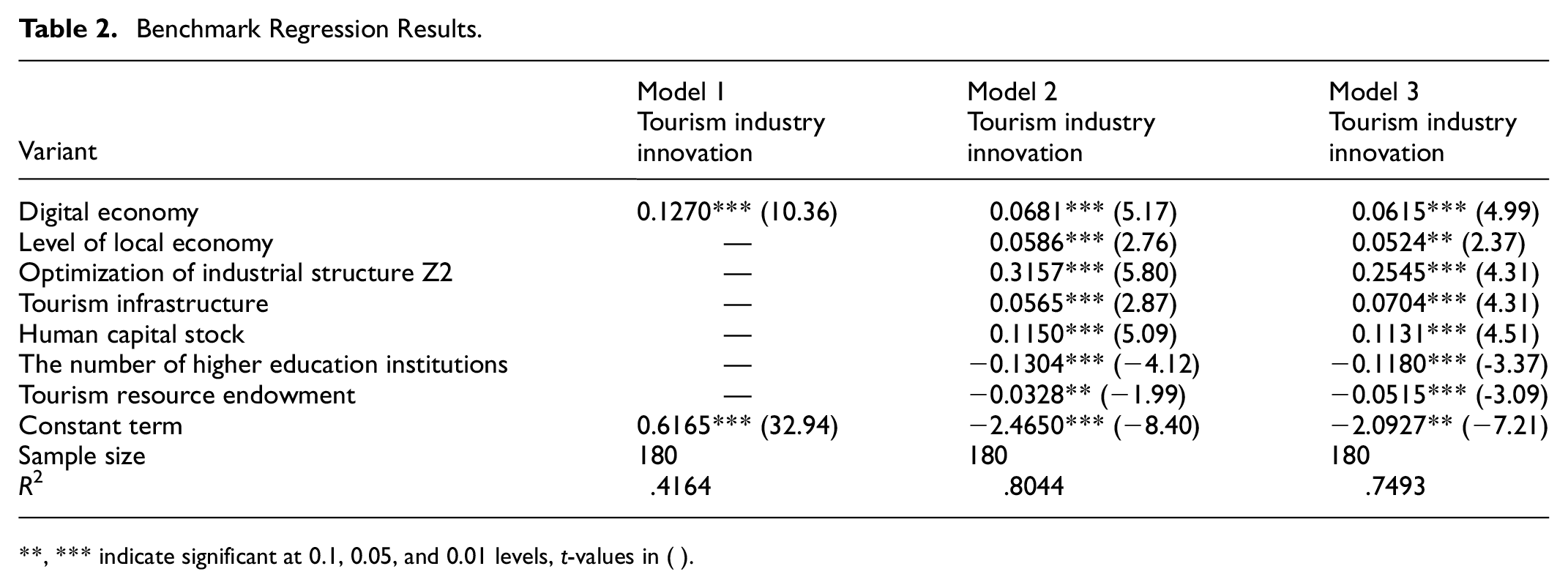
**, *** indicate significant at 0.1, 0.05, and 0.01 levels, t-values in ( ).
Analysis of Intermediation Effects
Previous research has proven that DE significantly and positively impacts TII. The conditions for analyzing the mediation effect are met. The results of the mediation effect analysis are shown in Table 3. As shown in Table 4, the effect of DE on RAC is positive and significant at the 1% level; hypothesis H1 holds. The effect of RAC on tourism industry innovation is also positive and significant at the 1% level; hypothesis H2 holds. The mediating effect results show that after adding the mediating variable of RAC, the impact coefficient of DE on tourism industry innovation is 0.0520. This is decreased compared to that in the baseline model, indicating that RAC is an effective mediating mechanism for DE to promote TII. It plays a partial mediating role; hypothesis H4 holds. Resources are the material basis for the tourism industry innovation. The rapid development of the digital economy has brought about the facilitation of global information exchange, and the digital economy provides a variety of forms of markets for the tourism industry, including the Internet, mobile platforms, etc., which can realize the allocation of resources and market development on a global scale, and greatly improve the ability to obtain resources, which helps to create a high-quality resource environment for the innovation of the tourism industry.
Regression Results of the Mediated Effects Test.

indicates significant at the 0.01 level, t-values within ( ).
Moderated Effects Test Results.

**, ***indicates significant at 0.05 and 0.01 levels, t-values within ( ).
Analysis of Moderating Effects
According to the model used to test the moderating effect of PE, as shown in Table 4, the coefficient of the interaction term between DE and PE is 0.0534 after centering. This is significant at the 1% level, indicating that PE moderates the role of DE in influencing TII. This finding supports Hypothesis H5. The positive coefficient of the interaction term suggests that PE positively influences the marginal effect of DE development. In other words, the better the PE, the stronger the marginal effect of DE on TII. This is due to the good policy environment is conducive to avoiding market barriers and industrial barriers, guiding the concentration of innovative elements to tourism enterprises and innovators, and promoting the transformation of innovation achievements.
Endogeneity test
This study re-analyzes the data to verify the model’s robustness using the instrumental variable method to address potential endogeneity issues among the models. Referring to the studies by T. Zhao (2020) and Qunhui Huang (2019), and Nunn and Qian (2014), this study selects the total amount of postal and telecommunication business for each province in the year 2000. It also includes the number of mobile Internet users from the previous year and the total amount of postal and telecommunication businesses from the year 2000 to construct an interaction term as an instrumental variable for the DE in that year. Table 5 reveals that the impact of DE on TII remains significantly positive at the 1% level, even after accounting for the endogeneity of the variables. Furthermore, based on the results of the Kleibergen-Paap rk LM statistic and the Kleibergen-Paap rk Wald F statistic, the selection of instrumental variables appears to be reasonable.
Results of Endogeneity Test.

Indicates significant at the 0.01 level, z-values in ( ), below, p-values in [ ], and critical values at the 10% level of the weak discrimination test in { }.
In summary, the results of the empirical study show that research hypotheses H1, H2, H3, H4, and H5 were tested and confirmed (Table 6).
Empirical Findings.

Conclusions and Implications
Main Conclusions
This study constructs a conceptual model of DE empowering digital TII through analysis and conducts an empirical study on the panel data of 30 provinces, excluding Hong Kong, Macao, Taiwan, and Tibet, from 2017 to 2022. The research conclusions include three aspects: First, DE has a significant positive impact on the innovation and development of the tourism industry. The high-quality development of DE can provide a favorable atmosphere and strong technical support for the innovation and development of the tourism industry. Second, the results of the mediation effect analysis show that DE has a significant positive impact on the resource acquisition ability of the tourism industry. The resource acquisition ability of the tourism industry has a significant positive impact on industrial innovation. Resource acquisition ability acts as a part of the mediating variable between DE and tourism industry innovation. This demonstrates that resource acquisition ability is the bridge between DE and tourism industry innovation. Third, the results of the moderating effect test show that PE positively moderates the role of DE in influencing the innovation of the tourism industry. This indicates that a superior PE can strengthen the marginal effect of DE on the innovation of the tourism industry.
Theoretical and Practical Implications
Theoretical Implications
With the rise of the “DE” as a global strategy, the development of the tourism industry has ushered in new opportunities but also faces new challenges. Seizing the opportunities for DE development in the new period is conducive to breaking stagnation and lack of TII. This study investigates the mechanism of innovation and development in the tourism industry from the perspective of DE. It enriches and expands the innovation theory of the tourism industry from the perspective of DE.
First, studying the influence mechanism of tourism industry innovation from the perspective of DE provides a new theoretical perspective for the study of tourism industry innovation in a DE environment. This is conducive to enriching and expanding the theory of tourism industry innovation from the perspective of the DE. The research scope of existing results is limited to traditional industrial economic theory, and there is a lack of interdisciplinary perspective research on the innovation and development of the tourism industry by integrating DE theory and industrial economic theory. This study theoretically constructs a mechanism model of DE-enabled tourism industry innovation, expanding the interdisciplinary research on DE and tourism industry innovation.
Second, this study provides a new understanding of the function of resource acquisition capability in the DE environment. In academia, although existing results have confirmed a positive correlation between resource acquisition capability and industrial innovation, there is still debate on the mediating role of resource acquisition capability on industrial innovation in the DE environment (Kang, 2017). This study confirms that resource acquisition capability plays a partially mediating role in the mechanism model of the DE’s impact on tourism industry innovation. This finding differs from some scholars’ view that resource acquisition capability is only an antecedent variable. In the DE environment, tourism industry innovation breaks through traditional resource constraints, and resource acquisition capability plays an important role in promoting the development of tourism industry innovation, reflecting the exogenous characteristics of tourism industry innovation in the DE environment.
Third, the introduction of the PE variable is conducive to quantitatively verifying the extent of the PE’s role in the development of tourism industry innovation under the DE. Most existing studies regard PE as an antecedent variable of industrial innovation and pay less attention to the mediating role played by PE in DE and tourism industry innovation (W. Y. Wang, 2020). This study selects China as the empirical research object, introduces PE as a mediating variable, and empirically verifies that PE acts as a moderating variable between DE and tourism industry innovation. It highlights the Chinese geographical characteristics of the research model and further expands the academic understanding of the nature of the role of PE in industrial innovation.
Practical Implications
First, implement a new model of DE to promote the innovative development of the tourism industry. The country or region should use systematic management means to promote the high-quality development of the DE as a whole, thus driving the innovative development of the tourism industry. First, strengthen the construction of digital tourism infrastructure. Aiming at the frontier of modern digital technology, using policy incentives, special financial subsidies, tax rebate policies, etc., to guide and promote the new generation of communication network infrastructure (e.g., 5G, Internet of Things, Satellite Internet, Industrial Internet), new technology infrastructure (AI, cloud computing, blockchain), and arithmetic infrastructure (data centers, intelligent computing centers). These should be implemented in A-level tourism scenic spots, travel agencies, star-rated hotels, convention and exhibition enterprises, etc., to popularize application and promotion.
Second, actively promote digital industrialization and industrial digitization. In terms of digital industrialization, vigorously develop “digital + tourism” platform enterprises. Take “digital + tourism” platform enterprises as the pivot point to extend forward and backward, radiate the development of the horizontal industry chain and upstream and downstream related industry chains, build a “digital + tourism” industrial innovation ecosystem, and enhance the scale and level of digital TII. In terms of industrial digitization, under the DE, tourism enterprises should use market means, such as mergers, acquisitions, and alliances, to control or unite important value activity links in industry chains. These include the information and communication industry, electronic information manufacturing industry, software service industry, Internet industry, and AI industry, among others. The embedding and application of digital technology are realized in all aspects of the production of the tourism industry, transforming and upgrading digital catering, digital hotels, digital transportation, digital scenic spots, digital shopping, digital entertainment, etc., and comprehensively and deeply promoting the digital transformation of tourism.
Third, enhance the ability to obtain resources to promote TII. Under the DE, the use of mobile Internet technology, big data, cloud computing, intelligent terminals, and other technical means has established a resource-sharing network platform. This platform realizes the online and offline sharing and linkage of tourism resources and builds an online-to-offline (O2O) configuration mode of tourism resources. To improve the institutional guarantee of O2O resource sharing, a systematic system has been formulated at the levels of laws, regulations, and policies. This system includes aspects of information security, credit management, transaction systems, and industry norms. In addition, with the help of digital technology, a cooperation platform that includes government departments, research institutes, financial institutions, and upstream and downstream enterprises has been built. This platform strengthens the connection between the upstream and downstream sectors of the industrial chain, breaks down barriers to information exchange, and efficiently satisfies the financial and technological needs of industrial innovation and development, thereby promoting resource sharing and industrial innovation.
Fourth, optimize the PE to strengthen the role of the DE in influencing the innovation of the tourism industry. In terms of policies and regulations, state and industry regulators should improve and perfect the laws, regulations, industry standards, and policy systems related to the DE. Regulators should strengthen law enforcement to shape a favorable environmental climate and market supervision system for the standardized development of the digital economy. In terms of industrial investment policies, financial support for digital tourism enterprises should be increased. The government should offer more supportive policies to digital tourism enterprises in areas such as investment, approval, taxation, and loans, with a focus on supporting the listing of qualified digital tourism enterprises. In terms of financial and tax policies, the government can make comprehensive use of financial subsidies, interest subsidies, and financial incentives to guide and support tourism enterprises in carrying out informatization, intelligent technology, and facility and equipment upgrading and reconstruction. Flexible use of indirect tax incentives, such as “capital deductions,”“investment loss deductions,”“investment incentives,”“incentives for tourism foreign exchange earnings,” and “tax incentives for technological innovations,” can create a synergy of tax incentives focused on supporting the digital technological innovations and re-investment activities of tourism enterprises.
Limitations and Future Research
The research contribution of this paper lies in constructing a mechanism model of digital economy empowering tourism industry innovation, exploring the mediating role of resource acquisition capability, the moderating role of policy environment, verifying the facilitating role of China’s digital economy development on tourism industry innovation, and providing practical insights into the development of China’s digital economy and tourism industry. But like all research, there are some insufficiencies in this paper that need to be explored in depth by subsequent studies. First, there are some defects in this paper about the measurement of the level of each variable, and the subsequent research can improve the relevant measurement index system by combining the data availability. Secondly, the 2020 epidemic had a great impact on the tourism industry, and the research scope of this paper is 2017 to 2022, which includes the time of the epidemic, so it may affect the accuracy of the research results, and future research can separate the epidemic and non-epidemic period for comparison. Finally, this paper chooses resource acquisition capacity as the mediating variable, and in the future, the level of technological innovation, public service level, etc. can be used as the mediating variable, adding the degree of opening up to the outside world, the level of industrial structure, etc. as the control variables to further explore the role of the digital economy in the promotion of the innovation and development of the tourism industry.
Footnotes

Ethical Considerations
This article does not contain any studies with human participants performed by any of the authors.
Consent to Participate
This article does not contain any studies with human participants performed by any of the authors.
Funding
The author(s) disclosed receipt of the following financial support for the research, authorship, and/or publication of this article: Chongqing Social Science Planning Talent Program “Research on the Innovation and Development of Chongqing Health and Wellness Tourism Industry in the New Era” (2021YC046);
Chongqing Municipal Education Commission’s Humanities and Social Sciences Project “Research on the Collaborative Innovation and Development of the Health and Tourism Industry Ecosystem in Chengdu-Chongqing Area under the Normalization of the Epidemic” (228KGH453).
Declaration of Conflicting Interests
The author(s) declared no potential conflicts of interest with respect to the research, authorship, and/or publication of this article.
Data Availability Statement
The data that support the findings of this study are available from China National Bureau of Statistics but restrictions apply to the availability of these data, which were used under licence for the current study, and so are not publicly available. Data are however available from the authors upon reasonable request and with permission of China National Bureau of Statistics.