



Abstract
Although the integration of culture and tourism led to an increasing interest among scholars, there has been insufficient attention to the scientific evaluation of its quality, and the complex influencing mechanisms at the macrogeographic level remain unclear. To address these issues, this study assesses the integration level of culture and tourism using the entropy weight TOPSIS method based on a newly constructed evaluation index system, and subsequently summarizes its configuration patterns based on the fuzzy-set qualitative comparative analysis method. We identified four high-level integration models emphasizing the critical role of technological innovation and regional economy, namely the technology-led environment supporting model, technology-led multi-synergy model, economy-technology-led talent supporting model, and economy-technology-led comprehensive driving model. We also found five paths leading to low-level integration, which showed a casual asymmetry relationship. Our research can provide policymakers with important guidelines on how to promote the integration of culture and tourism.
Keywords
Introduction
A new trend in global industrial optimization is the convergence of industries. Among various sectors in modern service industry, cultural industry and tourism industry stand out as two highly promising categories. Despite their apparent differences in essence, scope, and functional roles, they are inseparably linked. The natural attributes and intrinsic connections between these two make their integrated development not only logical but also inevitable (Richards, 2007; Santa-Cruz & López-Guzmán, 2017). As a complicated industrial development process, the current integration of culture and tourism grapples with evident imbalances and inadequacies, highlighting a noticeable disparity when compared to the prerequisites for achieving high-quality progress. Consequently, a pressing inquiry emerges: How can we achieve a seamless integration of culture and tourism at a more in-depth level?
Scholars have approached the interactive integration between cultural industry and tourism industry from various aspects, including theoretical foundations (J. Wang et al., 2020), dynamic mechanisms (Zhao et al., 2023), development pathways (Mitchell & Shannon, 2018), integration models (F. H. Huang & Nguyen, 2022), and so on. Existing research predominantly focuses on assessing and evaluating the degree of coordination between cultural industry and tourism through the examination of scenic areas (Esfehani & Albrecht, 2019), urban clusters (Hou et al., 2021) or specific administrative regions (F. Lu et al., 2022). Obviously, we find that the predominant focus lies in small-scale meso-micro case studies. Nevertheless, when examining this topic from a macrogeographic perspective, we identify a noticeable research gap (Su et al., 2019). While this paradigm allows for in-depth discussions on the level of culture-tourism integration and specific enhancement pathways within particular cases, it falls short in evaluating the overall integrated quality at a macro level, such as the country level. This lack of macro-level evaluation may leave decision-makers grappling with uncertainty, as microcosmic research often exhibits strong case dependence and limited universality when applied to broader areas. We also find that most studies are single-case ones and lack comparisons. Additionally, the predominant research approach employed in these studies involves selection of evaluation indicators, collection of secondary data and construction of coupling coordination models. While the evaluation systems draw from diverse sources, it has led to the inclusion of indicators that have limited direct relevance to development quality, such as element-type (Chi et al., 2022), environment-type (Y. Wang et al., 2023), and influencing factor-type ones (Chi et al., 2022). The low correlation and representativeness of these indicators have consequently compromised the persuasiveness of evaluation results. Moreover, the measurement of coupling coordination still fundamentally views culture and tourism as two separate and disjointed systems (Q. Wang et al., 2019), which deviates from the theoretical essence and the original intention of integrated development.
Integration of culture and tourism is considered an immense system comprised of various interrelated subjects, which are characterized by multi-scale, multi-dimensional, and multi-faceted interactions (Jin et al., 2022; Kumar & Dhir, 2020). Consequently, integration quality is enhanced through synergistic interaction among stakeholders in the development process (J. Li, 2020). Extant research has delved into various perspectives on the influencing mechanisms of culture-tourism integration, encompassing basic factors-led, driving factors-led, and supporting factors-led approaches. Some scholars think that resource endowment plays a foundational role in the integration (Connell, 2012; S. Huang & Wen, 2021). Dans and Gonzalez (2018) have shown that culture serves as a competitive resource for regional tourism development, and its role has been increasingly emphasized by local governments (Idajati, 2014). The continuous growth in market demand is one of the significant driving factors behind the integration and interaction of cultural industry and tourism sector (Jovicic, 2016). Another factor cannot be ignored is government regulation (Deng et al., 2019; Haigh, 2020). However, current research on the factors influencing integration tends to focus more on the significance and differences of individual factors, overlooking the combined effects of other factors. As a result, the proposed policy recommendations often lack specificity and effectiveness. Furthermore, in terms of methodological approaches, regression analysis models remain predominant. While this approach holds significant advantages in establishing causal relationships between dependent and independent variables, it tends to overly emphasize the unique contribution of a certain individual variable. As a result, it fails to explain how interdependencies and complex non-linear interactions among factors impact the outcomes.
Concluded on the findings from the above research, we propose the research gaps of this paper: First of all, scholars widely recognize the vital importance of measuring and evaluating the integration quality of culture and tourism. It is imperative to construct a general, outcome-oriented evaluation index system and adopt scientifically rigorous measurement methods to achieve a comprehensive, accurate, and objective assessment. Secondly, though the mechanisms driving culture-tourism integration have received more attention from academia, many studies have still played emphasis solely on the net effect of a single variable instead of considering the configurational effect of condition variables. Lastly, scholars appear to show a greater interest in exploring the positive configurations of conditions that promote the integration of culture and tourism, often neglecting to investigate how combinations may hinder it. It raises a question worth studying: what configurational variables promote and hinder the integration of culture and tourism?
To address the aforementioned research gaps, we have developed a new result-driven evaluation index system for assessing the level of culture-tourism integration. During the process of selecting indicators, our focus has been on incorporating measures that truly reflect the efficiency, scale, and performance of both cultural and tourism industries. Subsequently, we employed the entropy-weighted Technique for Order of Preference by Similarity to Ideal Solution (TOPSIS) method to quantitatively assess the integration level in 31 provincial administrative regions throughout China. The entropy-weighted TOPSIS is a commonly used decision-making technique for analyzing multiple objectives in limited alternatives. By calculating the discrepancies between each index and the “positive ideal solution” and “negative ideal solution,” it progressively approximates the ideal solution (Guo et al., 2024). One of its notable advantages is its ability to mitigate the subjectivity in determining criterion weights. This method is particularly well-suited for cross-sectional data comparison, making it highly applicable for evaluating and comparing the integration level across different regions. To further explore the underlying mechanisms of culture-tourism integration, we attempt to fill this gap from a configurational perspective using a fuzzy set Qualitative Comparative Analysis (fsQCA) approach.
Contributions are as follows: (1) We propose a comprehensive outcome-oriented evaluation index system for culture-tourism integration and conduct an empirical survey at the provincial level, helping to look closely at the integration practices from a macro perspective. (2) We uncover various paths leading to both high-level and low-level integration, challenging the notion of a “one-size-fits-all” integrating model, answering how to promote the integration of culture and tourism. (3) We employ an alternative approach to investigate the complex causal relationships between conditions and outcome: “the entropy-weighted TOPSIS +fsQCA,” which realizes a mixed-methods research.
Literature Review
Connotation of Culture-Tourism Integration
The connotation of culture-tourism integration first originates from discussions about the interrelationship between the two. In the early stages, culture was primarily perceived as an object of the tourist experience. However, as the 20th century progressed, cultural experiences were no longer viewed merely as the purpose of tourism. Gradually, the relationship evolved from a one-side “subject-object” dynamic to a more balanced mutually influential relationship, where culture and tourism interact as equal subjects (Urry, 1990). In the 1970s, Robert Mcintosh firstly introduced the concept of “tourist culture,” successfully integrating culture and tourism in a conceptual framework (McIntosh & Goeldner, 1985). As the boundaries of cultural industry extended further into people’s daily lives, organizations such as the United Nations World Tourism Organization (UNWTO) and the European Association for Tourism and Leisure Education (ATLAS) have been actively promoting cultural tourism, emphasizing, and leveraging the touristic appeal of culture. An ever-growing body of research reveals that culture is a crucial motivation for tourists and an indispensable component of their travel experiences (Kay Smith et al., 2022). Building upon this understanding, countries worldwide have embarked on practical endeavors in the integrated development of culture and tourism. Although an official definition of culture-tourism integration has yet to be universally established, “cultural tourism” has been widely acknowledged internationally as a term that aligns with and signifies the essence of this concept (Richards, 2018). Unlike the Chinese concept of “integration” (Ò), the UNWTO uses the term “synergy” to underscore the significance of the interactive integration between cultural industries and tourism institutions. This notion is explicitly articulated in the publication “Tourism and Culture Synergies,” released by the UNWTO in 2018 (F. Lu et al., 2022).
From an industry perspective, culture-tourism integration is not merely a simple addition of the two but rather an organic integration of resources, products, and industries between culture and tourism. The fundamental reason why they can be integrated is possible lies in their respective industrial characteristics. Specifically, tourism has dual economic and cultural attributes, and its cultural benefits can be realized through the development of industrial economy, while culture can also achieve commercialization through reasonable development and utilization (Guo et al., 2022). Indeed, the cross-border integration of cultural industry and tourism represents a bidirectional, interactive and mutually beneficial relationship. In this process, cultural industry, tourism industry, and their respective constituent elements converge, interpenetrate, and undergo reconfiguration, progressively breaking through their conventional industrial boundaries or domain-specific confines. As a result, industry demarcations may contract, blur, or disappear, leading to the emergence of novel cultural and tourism product formats and an innovative industrial ecosystem.
Evaluation of Culture-Tourism Integration
The current development and evolution of culture and tourism has brought forth new requirements for measuring and evaluating the integration level of culture and tourism. In terms of research methods, most studies focus on constructing coupling coordination models to represent the degree of culture-tourism integration (M. Lu et al., 2023; Xiao et al., 2022). These models often use the “Coupling Coordination Degree” as key indicator. By analyzing the impact of various element indicators or subsystem layers on the development of culture and tourism, these models measure the level of integration between the two sectors. For instance, D. Xu et al. (2024) have measured the degree of cultural and tourism integration by constructing a culture and tourism spatial coupling coordination model. Another evaluation method is efficiency assessment using the DEA model (Fan & Xue, 2020; Parte & Alberca, 2021). F. Lu et al. (2022) have identified that areas of high efficiency of culture-tourism integration mainly concentrated in the Jiaodong Peninsula, Shandong Province. Guccio et al. (2017) offered empirical support to the positive role of cultural participation on tourism destinations’ performance using a condition efficiency approach. The basis of these two methods is the construction of an evaluation index system typically based on available statistical data. Given the complexity of cultural and tourism industries, researchers rarely use single-factor evaluations. Instead, the evaluation index systems are often constructed in a multi-dimensional and multi-level format (C. Li & Ju, 2020; Su et al., 2019). It can be observed that in most of these studies, integration of culture and tourism is still regarded as the interaction between two independent industries rather than as a new industrial form resulting from their integration. Research that considers “culture-tourism integration” as a comprehensive industry for the purpose of indicator construction and evaluation is relatively rare.
Influencing Factors of Culture-Tourism Integration
The variation in the outcome of integration highlights the practical meaning of exploring its influencing factors. Specifically, the availability and richness of cultural tourism resources, including tangible heritage sites and intangible cultural practices, are fundamental to the success of industrial integration (Yao et al., 2023). Integration of culture and tourism, to some extent, signifies a process of cultural innovation at tourism destinations (Lee et al., 2018). According to research by M. Y. Wang et al. (2024), cultural inheritance-based innovation at heritage tourism destinations was influenced by multilevel factors of the environment, government, enterprises and public, encompassing basic innovation management conditions and sociocultural constraints. As the core manifestation of culture-tourism integration, cultural tourism is influenced by multiple factors, including policy, infrastructure, human resources, tourism resources, geographic location, tourism products, and services (C. H. Nguyen, 2022). Besides, marketing and promotional activities (Arumugam et al., 2023), economic environment (Hu et al., 2023), traffic conditions, information technology, openness degree (F. Lu et al., 2022), management investment (Tang et al., 2023), and tourist preferences (Hui-Chen, 2018) are also stand as key factors contributing to the integrated development of culture and tourism. There are numerous factors influencing culture-tourism integration, and scholars have interpreted these factors differently based on varying research objectives and perspectives. In general, linear regression models is mostly used to analyze and understand the underlying mechanisms (C. H. Nguyen, 2022). While these models help determine the significance of the factors and identify the most influential ones, they fail to capture the nonlinear interactions and interdependencies between factors, offering limited explanatory power for the complex underlying mechanisms of culture-tourism integration.
Theoretical Background
Complexity Theory
Complexity theory, derived from chaos theory, is commonly employed to explain complex phenomena characterized by nonlinearity, heterogeneity, and dynamism across various disciplines, including organizational behavior (Fiss, 2011), sociology (Ragin, 2000), and marketing (P. L. Wu et al., 2014). Hoffmann and Riley (2002) emphasize that complexity theory is neither a novel nor the sole approach to scientific inquiry; rather, it is a set of concepts that model the real world in a nonlinear fashion. The theory focuses on patterns of element combinations, providing a deeper understanding of the relationships between causal antecedents and outcomes (Olya & Altinay, 2016). It can be used to demonstrate the interactions between variables in complex systems that cannot be resolved by simple linear methods (Baggio, 2007), thereby aiding in the analysis of complex combinations of indicators (I. O. Pappas et al., 2016).
Building on prior research, Woodside (2014) proposed six key principles of complexity theory: (1) a single condition may be necessary, but it is rarely sufficient to predict an outcome; (2) a complex combination of two or more conditions is sufficient for predicting an outcome; (3) equifinality: multiple combinations of conditions may lead to the same outcome; (4) causal asymmetry: configurations leading to high scores are not simply the reverse of those leading to low scores; (5) the impact of a particular antecedent condition on an outcome, whether positive or negative, depends on the presence or absence of other factors within the combination; (6) when predicting outcome, a given configuration represents only some, not all, cases, meaning that the coverage of any single combination should be less than 1. In our study, it is expected that the level of culture-tourism integration is products of the complex interactions among various factors. Therefore, complexity theory is deemed an appropriate theoretical support for this research.
Research Framework
To explore the different configurational conditions influencing culture-tourism integration, this study constructs a conceptual model based on complexity theory (Figure 1). Integration of culture and tourism involves intricate interactions among various scales, elements, and stakeholders (Arnaboldi & Spiller, 2011). In addition to relying on the industry’s endogenous resources, its development is also influenced by numerous exogenous factors. Examining the combined effects of the most significant factors hold great value in effectively targeting the improvement of integration quality. In light of this, the current study categorizes the driving factors of integrated development into three dimensions. Specifically, the pushing factors encompass cultural and tourism resource endowment and human capital level, constituting the foundational elements and prerequisites that facilitate the high-quality integrated development. The pulling factors refer to the dynamic market demand and technological advancements that promote cultural and tourism integration. This includes the level of market consumption and technological innovation. The supporting factors comprise regional economy and government support, which are regarded as indispensable external conditions underpinning integration.
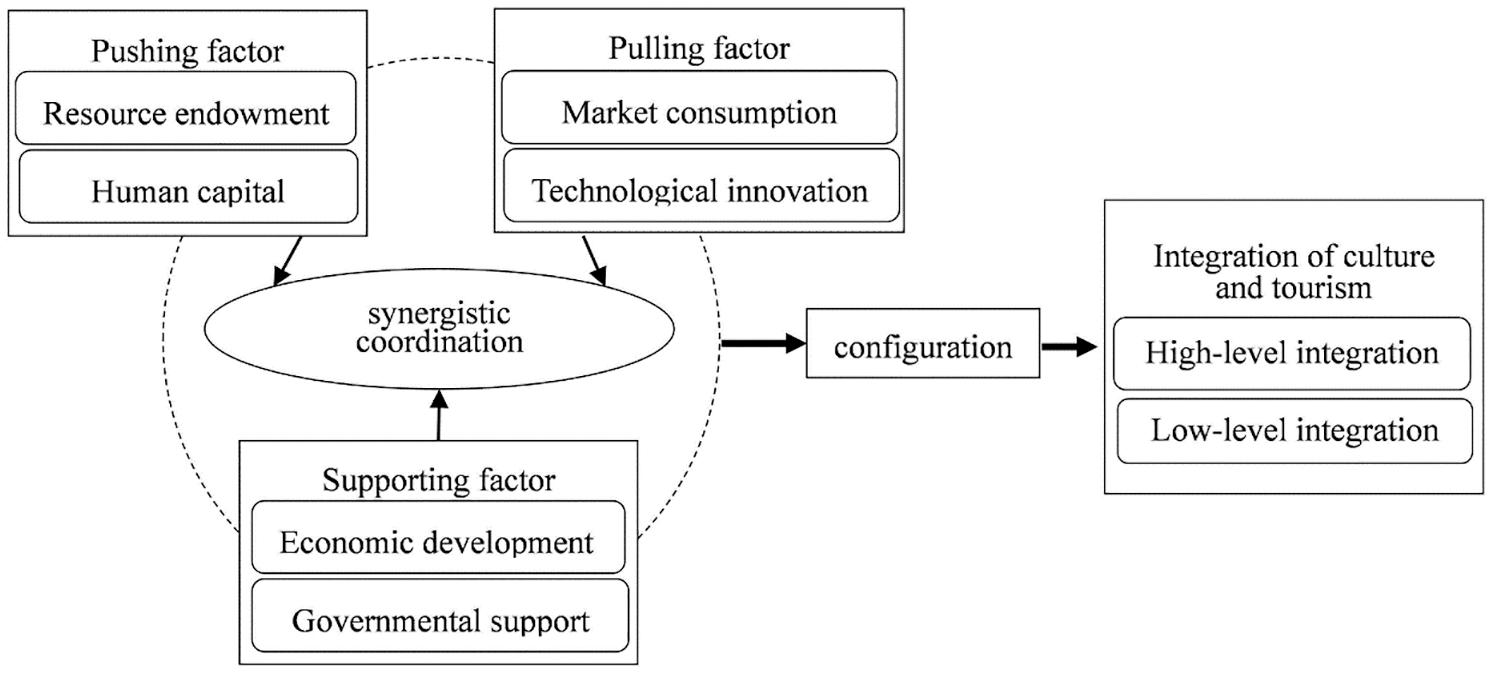
The conceptual framework of integration of culture and tourism.
Method and Materials
The Entropy Weight TOPSIS Method
The entropy weight TOPSIS method entails employing the entropy weight technique to calculate the weight of each indicator. Subsequently, the original data is multiplied by the weight values to obtain new data for TOPSIS computation. Ultimately, this approach facilitates the ranking of the superiority or inferiority of each evaluation object in a rigorous academic manner (P. Chen, 2021). In this study, the entropy weight TOPSIS method is utilized to reflect the comprehensive evaluation score of integration performance. The specific operational steps are as follows:
Step one is to establish the target sequence. Since the metrics of various indicators may differ, it is crucial to normalize them before calculating the comprehensive value. To eliminate differences in dimensions and magnitudes among indicators, distinct algorithms are used to process positive and negative indicators. After standardization, matrix B can be obtained.
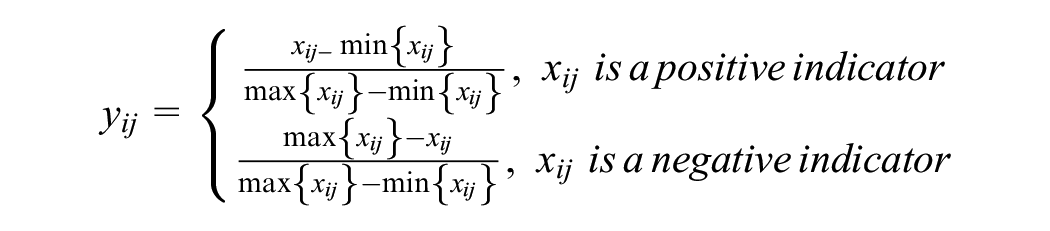

In the above equations,
Step two involves calculating the weights using the entropy weight method. First, normalize matrix B, and then compute the feature weight of each indicator. The feature weight of the i-th province under the j-th indicator is

Secondly, calculate the entropy value for each indicator

Finally, calculate the weight of indicators

Step three is to construct the TOPSIS model. To achieve the objectivity of the evaluation results, create the normalization analysis matrix P based on the indicator weights

Step four is to determine the positive and negative ideal solutions. The positive ideal solution


Step five, calculate the Euclidean distance between each evaluation object and the positive ideal solution and negative ideal solution:

Step six involves calculating the relative closeness of each object to the ideal solution, which is also known as the comprehensive evaluation index

A larger value of
FsQCA Method
Through fsQCA, the relationship between condition variables and outcome variable is conceptualized from a set-theoretical perspective, treating it as a relationship of membership between sets. By employing Boolean algebra algorithms, it abstracts the characteristic data into set membership degrees (Fiss, 2007; Ragin, 2008). Compared to other traditional QCA analytical methods, fsQCA permits the examination of phenomena that exhibit variation in degrees or levels, which may transform the fuzzy membership degrees of different cases in a well-defined specific set into numerical values ranging from 0 to 1 (Kumar et al., 2022). Thus, fsQCA aligns better with the nuanced characteristics of real-world cases. The research process of fsQCA can generally be summarized as “Variable Calibration-Consistency Test-Truth Table Calculation-Path Analysis” (Fiss, 2011). Owing to the prevalence of continuous variables in this study, fsQCA accomplishes the scaling of set scores by utilizing the values derived from membership scores (J. Chen et al., 2022; N. Pappas, 2019). This enables more precise combination paths for predicting the same outcomes, fulfilling the data analysis requirements of this research. Data in this study were analyzed by fsQCA3.0 software.
Cases
In 2018, China officially established the Ministry of Culture and Tourism, marking a significant milestone in the nation’s top-down approach toward the development strategy of integrating culture and tourism. Although the level of integration varies across provinces, but they share a common primary goal, which fulfills the fsQCA requirement of “maximum similarity” and “maximum heterogeneity” of the cases (Ragin, 2008). To mitigate the impact of COVID-19 disruptions, we selected the research period from 2015 to 2019. In summary, our study focused on 31 provincial regions in China (excluding Hong Kong, Macau, and Taiwan) from 2015 to 2019 as cases of cultural tourism integration.
Construction of Evaluation Index System
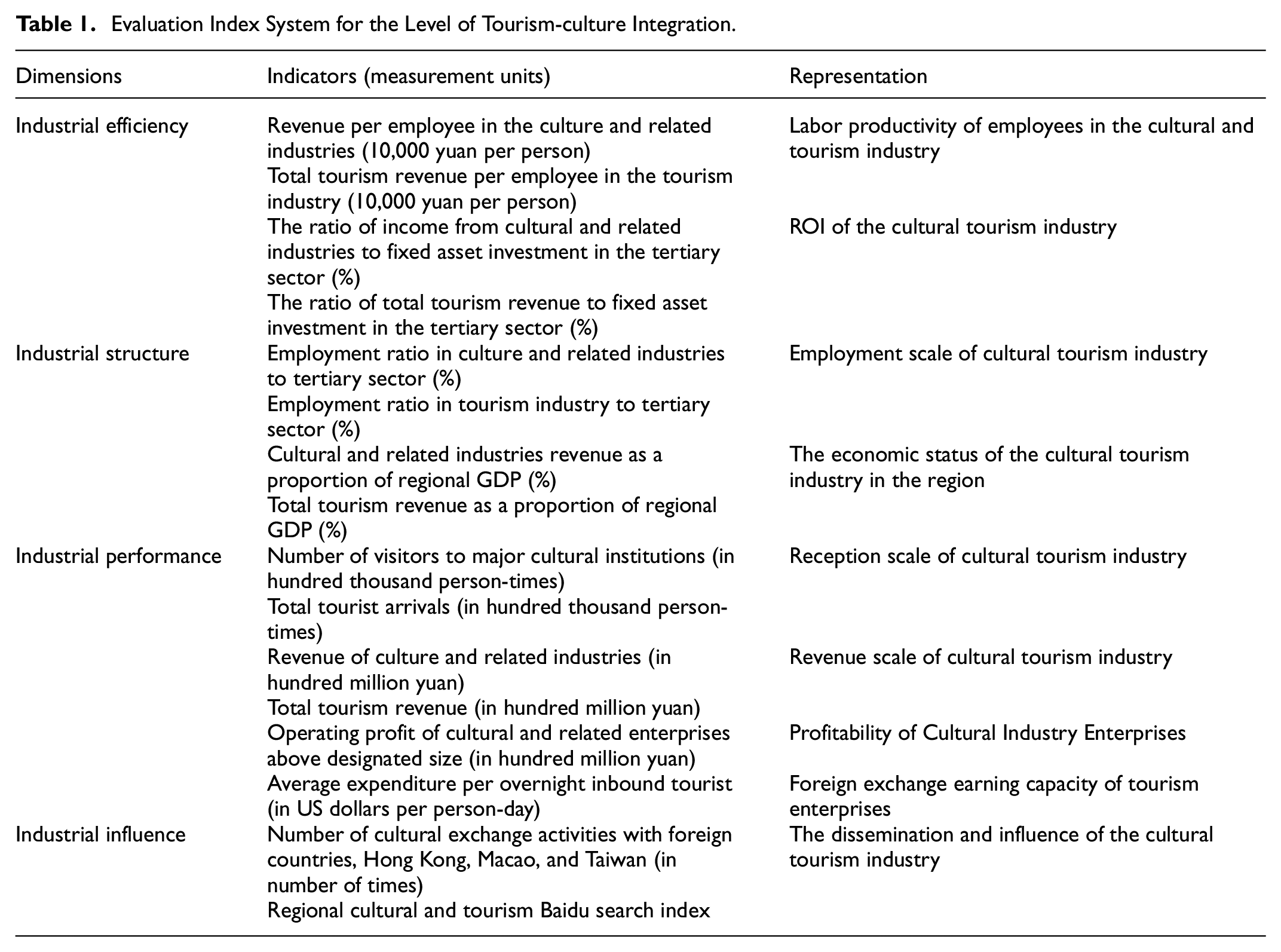
The level of culture-tourism integration refers to the outcome of the transformation and advancement of cultural industry and tourism sector, manifesting as an improvement in integration performance. In this study, the level of integration is defined as the quality and extent of harmonious development, with particular emphasis on the efficiency enhancement, structural optimization, performance improvement, and expanded impact resulting from industrial integration. The research adheres to principles of scientific rigor, representativeness, feasibility, and data availability, ultimately forming an evaluation index system comprised of four primary dimensions: industrial efficiency, industrial structure, industrial performance, and industrial impact, along with 16 indicators (Table 1).
Evaluation Index System for the Level of Tourism-culture Integration.
Before the administrative reform of the management system in 2018, China’s cultural industry and tourism industry were under the purview of separate administrative departments. Consequently, the relevant data were consistently reported separately based on the statistical criteria of each respective department. Even after the merger of institutions in 2018, truly “integrated” annual statistical data remained scarce. Currently, data from cultural industry and tourism are still being separately counted. Considering the coherence and completeness of the data indicators in this study, we have chosen to retain separate statistics for the two industries. Nevertheless, to emphasize the characteristic of “integration,” we have placed equal importance on both cultural and tourism indicators during the selection process, resulting in roughly comparable numbers of indicators pertaining to culture and tourism.
In economics, industrial efficiency mainly pertains to the ratio of industrial input to output, which measures the capability and extent of transforming a certain input element into output (J. Wu et al., 2019). Typically, workforce and fixed assets are regarded as fundamental elements in the production of economic activities in both tourism and cultural industry (Kapelko & Oude Lansink, 2017). Tourism, being labor-intensive, is significantly influenced by the availability and quality of workforce (C. Wang et al., 2022). In accordance with the Chinese Tourism Statistical Yearbook, the most critical components of the tourism industry are A-grade scenic spots, star-rated hotels, and travel agencies, with their employees constituting the primary labor input. As a result, the total number of employees working in these places is selected as the labor input indicator for this research. The number of individuals employed in the cultural industry is the most straightforward criterion for reflecting the labor elements. However, due to the lack of detailed data in the relevant statistical yearbook, we opt for the number of employees in cultural and related corporate entities as a suitable alternative. A well-established, enduring mutual promotion relationship exists between fixed asset investment and economic growth (Z. Wang et al., 2020). It is widely recognized that both cultural industry and tourism industry fall under the tertiary sector. For this study, fixed asset investment in the tertiary sector serves as the capital input index for both industries. Regarding the measurement of output, economic benefits are considered the ideal indicator. Hence, we utilize the total revenue of tourism industry and cultural industry for representation (Zha et al., 2020). Combining input factors with output results, revenue per employee in the culture and tourism industries, and the ratio of total industrial revenue to fixed asset investment in the tertiary sector are respectively selected as the representation for industrial efficiency.
In this study, the structural aspects of cultural and tourism industries are mainly reflected in the employment structure and income structure. Considering the unique attributes of these industries, and drawing upon the work of Gao et al. (2018), we have chosen to represent the employment structure of cultural and tourism industry by calculating the ratio of their respective number of employees to the total number of employees in the tertiary sector. Based on the findings of S. Zhang’s (2021) study, the proportion of industry revenue to GDP is an important indicator of the position and role of an industry in the national economy. Generally, a higher proportion indicates a more developed industry and a greater contribution to the economy. Accordingly, this research has selected two indicators, namely the percentage of cultural and related industry revenue, as well as total tourism revenue to regional GDP.
Revenue mirrors the level of development and its status of a certain industry, while recipients showcase the impact and outreach stemming from industry progress (Uyar et al., 2023). The combination of these two metrics offers a comprehensive portrayal of industrial maturity and stands as the prevailing indicator for evaluating the performance of industrial production endeavors (Y. Wang et al., 2021). Therefore, we separately select the revenue and arrivals for cultural and tourism industries as the main indicators of industrial performance. Furthermore, operating profit of cultural and related enterprises above designated size has been chosen to evaluate the profitability of cultural enterprises (R. Liu et al., 2019). In essence, tourism industry is an export-oriented sector and a significant source of foreign exchange income for our country. The average expenditure of overnight inbound tourists is positively correlated with the economic strength and tourism development of various regions. In this paper, it is considered one of the indicators for measuring industry performance (Saayman & Saayman, 2015). Ultimately, in order to evaluate industrial outward influence, the number of cultural exchange activities with foreign countries, Hong Kong, Macao, and Taiwan, as well as the Baidu search index of regional cultural and tourism are used (X. Huang et al., 2017).
Variable Selection
Outcome Variables
This study employs the comprehensive score of culture-tourism integration of 31 provinces, municipalities and autonomous regions in China from 2015 to 2019 as the outcome variable.
Condition Variables
Given the requirements of QCA on the number of condition variables, 4 to 7 conditions are generally recommended (Ragin, 2008). In this study, we adhere to this guideline and select six condition variables. It is essential to highlight that our focus primarily revolves around studying the integration level of cultural industry and tourism industry at the macro level for the provincial areas. Consequently, we have excluded micro-level indicators.
Culture-Tourism Resources
We draw on existing research (Hu et al., 2023) and combine the main cultural and tourism institution, which referred in this article are include public libraries, mass art galleries, cultural centers, cultural stations, museums, performing arts groups, performing arts venues, travel agencies, star-rated hotels, and A-level scenic spots. These are the main attractions and reception venues.
Human Capital Level
Higher education students represent a highly valuable pool of potential labor for industrial development, determining the quality and quantity of human capital (Kahraman & Demirdelen Alrawadieh, 2021). We use the number of higher education students per 10,000 people in school to present the human capital level.
Market Consumption Level
Due to the unavailability of data at the micro-level, this study does not directly collect specific data of consumer demand. Instead, it utilizes the proxy measure of total retail sales of consumer goods in society as a substitute (L. Li et al., 2022) to analyze and assess the impact of consumer demand on economic performance and industrial development.
Technological Innovation Level
Industrial integration will increase the demand for technology and drive industrial innovation (Wernz et al., 2014), in turn, technological change will lead to positive effect of cultural tourism integration (Bano et al., 2022). Research and development (R&D) investment significantly influences the level of innovation within an industry (Wei et al., 2023). This paper employs R&D investment as a percentage of GDP to show the level of importance placed on innovation.
Economic Development Level
Regional economy directly impacts the level of industrial development. GDP per capita serves as a critical criterion for measuring regional economic development (Yang et al., 2023). In this research, referring to Gomes and Librero-Cano (2018)’s study, GDP per capita is chosen to characterize the level of regional economic development.
Government Support Level
Government support to industry is primarily demonstrated through fiscal expenditure (Wei et al., 2023). In China, to foster the growth of cultural industries, cultural undertakings, and tourism, governments at all levels have allocated certain financial funds every year. Hence, this paper selects cultural and tourism industry expenses as an indicator to signify the extent of government support.
Data Source and Processing
In this study, some indicator data require secondary calculations, with all data sourced from publicly available statistical materials. Data related to the number of visitors, employment, revenue, corporate profits, and foreign cultural exchange activities in the cultural and related industries were obtained from the Statistical Yearbook of Chinese Cultural Relics, the Statistical Yearbook of Chinese Culture and Tourism, the Statistical Yearbook of Chinese Cultural Relics and Tourism, the Statistical Yearbook of Chinese Culture and Related Industries Yearbook. Tourism data such as tourist arrivals, tourism revenue, regional GDP, fixed asset investment in the tertiary industry, and the number of employees in the tertiary industry were sourced from the Statistical Yearbook and the Statistical Bulletins of National Economic and Social Development (per province). The average expenditure per overnight inbound tourist was retrieved from the Tourism Sample Survey Data 2016 to 2020, and the Baidu Index was derived from the official Baidu website. Additionally, in the configuration analysis, except for R&D investment data, which was sourced from the Statistical Bulletins of National Science and Technology Investment, all other indicator data were obtained from the aforementioned publicly available sources. For missing indicator values in a given year, the mean of the values from the preceding and following years is used as a substitute.
Results
Temporal Evolution of Provincial Integration of Culture and Tourism in China
We used the entropy weight TOPSIS method to measure the integration level of culture and tourism in Chinese provinces from 2015 to 2019. By calculating the mean value of the comprehensive scores, we obtained the overall average data for each year. As depicted in Figure 2, during the period from 2015 to 2019, the integrated development of cultural and tourism industries in China exhibited a progressive trend, with the score rising from 0.106 to 0.166, representing a remarkable increase of 56.6%. Specifically, the level of integration initially increased, then slightly decreased, and ultimately increased, forming a small undulating wavy-like pattern. The year 2018 holds special significance as culture-tourism integration was officially elevated to the national strategic level. This elevation involved the coordination between two distinct industries in terms of institutions, resources, products, markets, and other aspects. The level of integration was subject to the impact of administrative system reforms. Surprisingly, after 1 year of adaptation and adjustments, the cultural and tourism integration level reached an unprecedented peak of 0.166 in 2019.
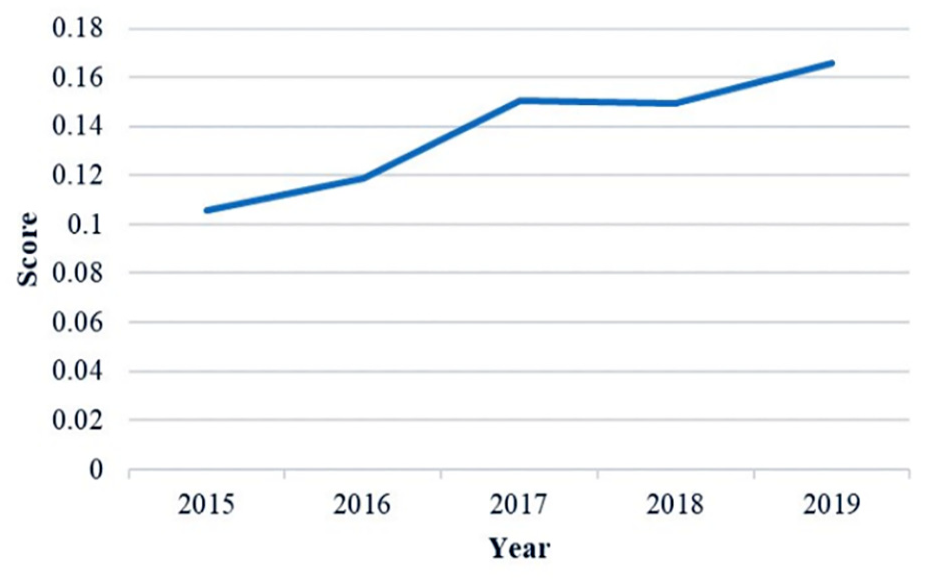
The average value of the integration level of culture and tourism in China from 2015 to 2019.
Spatial Distribution of Provincial Integration of Culture and Tourism in China
From the perspective of spatial and temporal characteristics, the number of provinces with integration scores higher than 0.1 increased from 9 in 2016 to 25 in 2019. This indicates a rapid advancement in the regionalization process of culture-tourism integration, highlighting its increasing effectiveness. Moreover, the disparities between provinces have shown a clear convergence trend, as indicated by the spatial distribution curve of integration changing gradually from being “sharp” to “gentle,” transitioning from a few provinces with outstanding performance to a broader and more evenly distributed progress (Figure 3). However, despite these positive developments, the issue of imbalanced regional integration in China still persists. High-quality integration remains concentrated in a limited number of provinces, characterized by abundant resources and robust economic foundations, and the dispersion of development across provinces is not apparent. Currently, high-level integrated development clusters have emerged, centered around regions such as the Beijing-Tianjin-Hebei region, the Yangtze River Delta, the Pearl River Delta, and the Yunnan-Guizhou region. These clusters will further demonstrate advantages of cultural and tourism development in economically developed urban areas and national central cities.

Spatial Changes in the Integration Level of Culture and Tourism in China From 2015 to 2019.
Configurational Analysis of Factors Influencing the Level of Integration
Variable Calibration
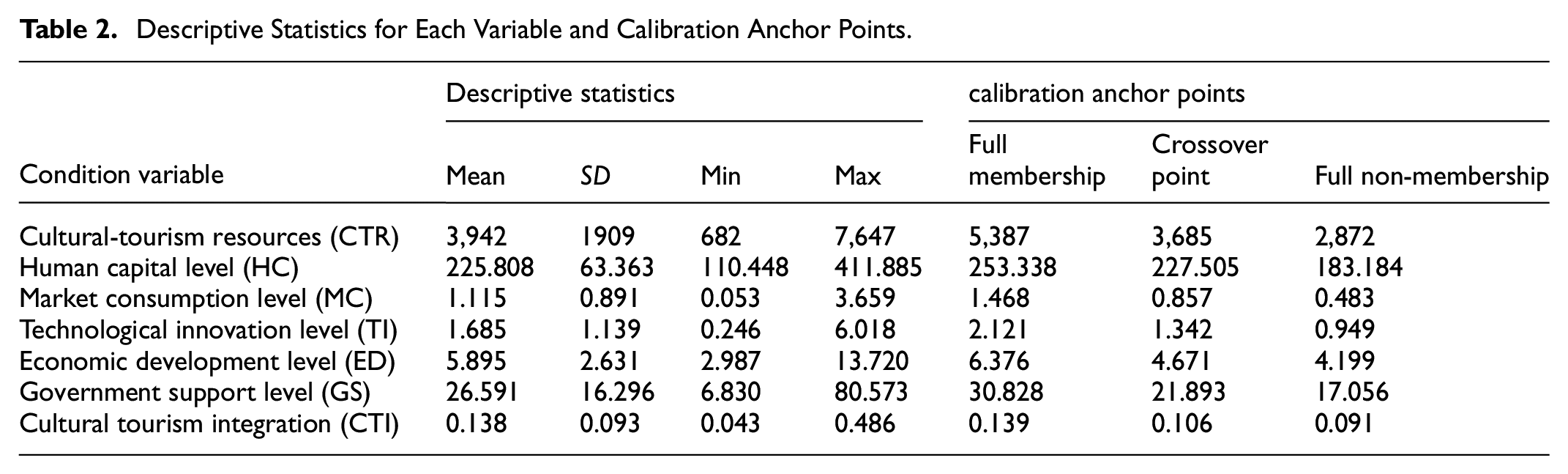
To further analyze the differentiated causal effect mechanisms of various factors on the integration level of culture and tourism, this study employs the fsQCA 3.0 software. Using the direct calibration method (Hartmann et al., 2022; Park & Mithas, 2020), the data is converted into fuzzy set membership scores ranging from 0 to 1. The objective quantile method is utilized to determine three anchor points, with the calibration standard for the crossover point set at the median, the full non-membership set at the lower quartile, and the full membership set at the upper quartile. To include all cases in the analysis, the membership score of samples with a value of 0.5 was adjusted to 0.501 before proceeding with the analysis (Park & Mithas, 2020). The calibration critical values for each variable are presented in Table 2. For the convenience of writing, the subsequent sections will use abbreviations for the seven variables.
Descriptive Statistics for Each Variable and Calibration Anchor Points.
Necessary Conditions Analysis
To simplify the subsequent analysis, some non-necessary conditions may be disregarded. Therefore, it is essential to conduct a consistency test for each condition to ensure its necessity and to determine whether a condition variable is indeed necessary (J. Zhang & Zhang, 2021). Consistency is the key indicator for assessing the necessity of a condition, with a threshold typically set at 0.9 or above to qualify as a necessary condition (Shi et al., 2022; Table 3). The results reveal that the consistency value of each condition is below 0.9, indicating that no single variable independently responsible for high-level and low-level of integration of culture and tourism
Necessary Analysis of Single Conditions.
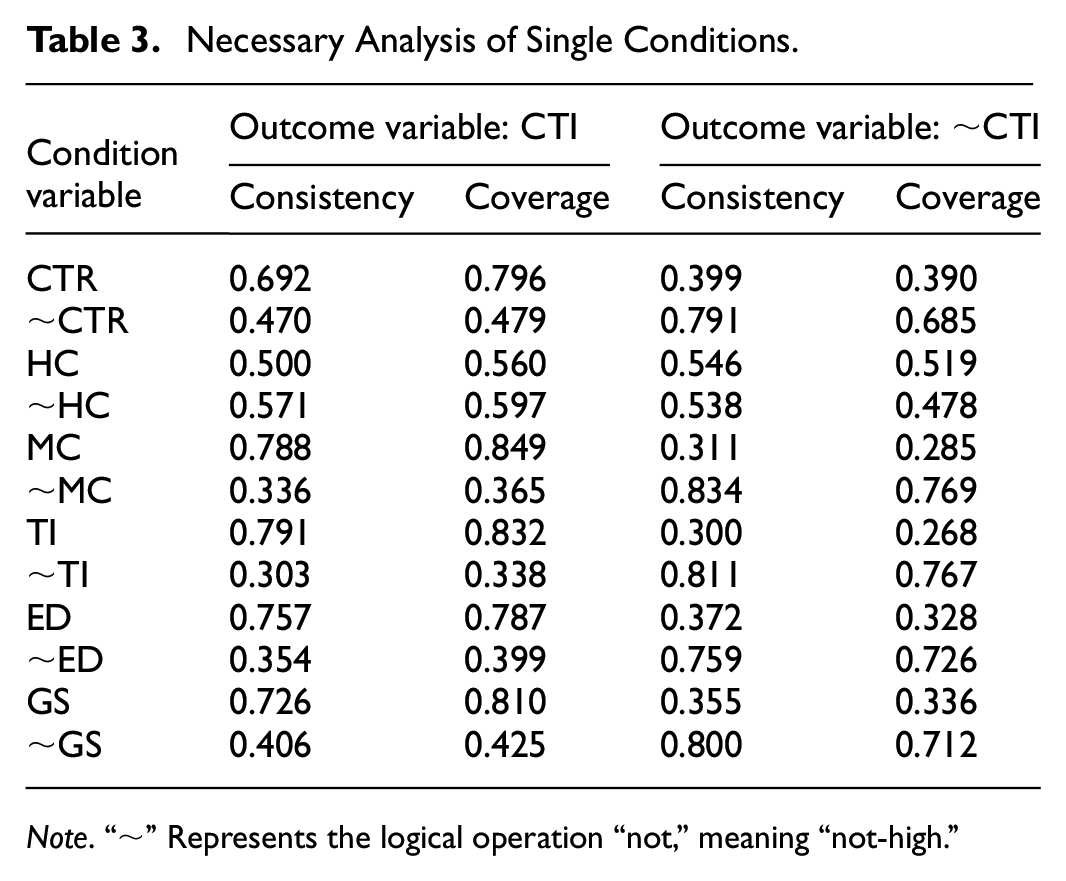
Note. “∼” Represents the logical operation “not,” meaning “not-high.”
Sufficiency Analysis of Condition Configurations
Configurational analysis aims to explore the sufficiency of multiple condition combinations in leading to the outcome. Consistency levels are used to reflect the sufficiency of these condition configurations. Following existing research, this study set the consistency threshold at 0.8 (Ragin, 2008). The frequency threshold of cases is determined based on sample size; given that this study’s sample consists of 31 cases, which is considered a small to medium-sized sample, the case frequency threshold was set at 1 (Shi et al., 2022). At the same time, it was ensured that the Proportional Reduction in Inconsistency (PRI) of the configuration was greater than 0.7 (Greckhamer et al., 2018). The fsQCA software, using a truth table algorithm, generated a parsimonious solution, an intermediate solution, and a complex solution. The complex solution tends to account for too many counterfactual cases, so the general analysis focuses primarily on the intermediate solution, with the parsimonious solution serving as a supplementary analysis (Schneider & Wagemann, 2013). The path combinations derived from the intermediate and parsimonious solutions are presented in Table 4.
Configurations Leading to High-level and Low-level of Culture-tourism Integration.


Note. For solid black circle ( ) denotes the presence of a condition; concentric hollow circle (
 ) indicates its absence. Large circle represents the core condition, small circle suggests the peripheral condition. A blank space means that the condition is unimportant for that configuration.
Each column in Table 4 represents a possible condition configuration. It can be observed that the consistency levels for both individual solutions and the overall solution exceed the acceptable minimum standard of 0.75, implying that there are four configurational paths for high-level integration and five paths for low-level integration.
Robustness Analysis
This study draws on the approach from related research to conduct a robustness check by altering the consistency threshold (M. Zhang & Du, 2019). The PRI consistency threshold was increased from 0.7 to 0.75 (H. Chen & Tian, 2022), and the reanalyzed configurational results remained consistent with those in Table 4. The combinations of antecedent conditions within the configurations were largely unchanged, and there were no significant changes in the consistency and coverage of the individual configurations or the overall solution. These findings indicate that the conclusions of this study demonstrate a high level of robustness.
Configurational Paths for Culture-Tourism Integration
Paths for High-Level Integration of Culture and Tourism
As depicted in Table 5, there are only two paths for high-level integration of culture and tourism based on the same set of core conditions (TI*∼HC and ED*TI, respectively). Configuration 1 with high-level of technological innovation and low-level of human capital is consisted of two sub-configurations with different peripheral condition variables (we name them 1a and 1b, the same below). Configuration 2 could also be differentiated into 2a and 2b, which show both developed regional economy and technological innovation for a high-level integration. As a result of the findings, we conclude four specific driving modes of culture-tourism integration.
Results of Configuration Analysis.

Note. *is the intersection symbol of the variable set, which represents the Boolean logic “and.”
Configuration 1a: TI*∼HC*GS*ED*MC
We define this path as the technology-led environment supporting model. This model indicates that regardless of the endowment of cultural and tourism resources, as long as the pulling factors led by technology can work together with favorable policies and economic environment, high-quality integration can be produced, even if human capital is lacking. Based on the pathway analysis above, it can be deduced that market dynamics and economic policies play a pivotal role, indicating that the integration of culture and tourism is an inevitable outcome of social and economic development reaching a certain stage. This configurational path has the highest consistency at 0.980 and account for 32% of the membership in the high integration performance. The typical case is Guangdong Province. In recent years, the Guangdong provincial government has firmly seized the major national strategic opportunities presented by the “Belt and Road Initiative” and the development of the Greater Bay Area involving Guangdong, Hong Kong, and Macau. It has been proactive in fostering a profound integration of digital technology with the cultural and tourism industry. As a result, the total tourism revenue and the value added by cultural and related industries have consistently ranked at the forefront nationwide over the past decade.
Configuration 1b: TI*∼HC*GS*MC*CTR
We define this path as the technology-led multi-synergy model, indicating that human capital level is limited and regional economic development doesn’t contribute to integration performance. However, desirable results can be achieved with the combination of high technology investment, favorable governmental policies, strong market demand, and rich resource base. This model suggests that technological innovation, especially the utilization of digital technology can reduce information asymmetry between supply side, demand side and government, thus driving the process of value co-creation (B. Zhang et al., 2021). Previous studies have demonstrated that technological innovation is conductive to changing consumer behavior, unlocking potential markets (Dabija et al., 2022), improving efficiency of resource allocation and mobilization. In a word, it acts as an accelerator for the expansion and mutual penetration of industrial boundaries. Besides, government’s efforts can significantly impact industrial performance has always been a consensus (Camilleri, 2016). This configurational type covers 29.7% of the cases, represented by Zhejiang Province. Building on the strengths of its digital economy and cultural tourism resources, Zhejiang Province has been actively implementing the comprehensive integration of culture and tourism. The province is rapidly forging ahead to establish a distinguished “Zhejiang model” of culture-tourism integration, and it has made substantial strides in becoming a prominent cultural and tourism powerhouse. Zhejiang has now become a renowned cultural and tourism destination both domestically and internationally.
Configuration 2a: ED*TI*∼GS*HC*∼CTR
This path can be called economy-technology-led talent supporting model. In this model, culture industry and tourism remain deeply integrated through rapid economic development, increased technological investment and excellent talents, even though without sufficient governmental support and resource endowment. Science and technology are considered the primary productive forces, driving regional economic development and supplementing government financial support. Moreover, technology empowers the cultural and tourism industry by fostering innovation in the presentation of resources and products, thereby reducing reliance on traditional resources. Additionally, talents, especially digital talents, emerge as a pivotal and indispensable supporting element in propelling the transformation, upgrading, and high-quality development of the cultural and tourism industry. This solution has the least coverage at 17.8% with a consistency of 0.946, and the typical case are Tianjin and Chongqing Municipality. Tianjin is located in the Bohai Sea tourism area and, compared to other cities in the region, it may not possess a significant advantage in terms of cultural and tourism attractions. However, Tianjin’s overall economic size ranks second among northern cities. Over the years, the investment intensity in R&D funding has been consistently second only to Beijing and Shanghai, which has significantly enhanced the momentum for the integrated development of culture and tourism.
Configuration 2b: ED*TI*MC*HC*CTR
We define this path as the economy-technology-led comprehensive driving model. This conditional configuration involves pulling, pushing and supporting factors, and is therefore named comprehensive driving type. It constitutes the mainstream path for high-level of integration. Through increasing resources and talents, exerting the role of technology and market, and developing regional economy, no matter what the level of governmental support is, cultural industry and tourism can eventually deeply integrated, which is the work of many provinces who dominate this coverage of 33.3%, implying that such a model is relatively universal in China. Our results reinforce the importance of multiple subjects and various elements in promoting integration of culture and tourism. The representative examples of this path are Jiangsu, Hunan, etc. Taking Jiangsu Province as an example. We find that Jiangsu Province has made substantial progress in advancing the construction of a demonstration zone for the integrated development of the cultural and tourism industries, leveraging information technology and fiscal revenue. It has specifically focused on promoting integration across various aspects, including products, markets, talent, and business formats.
Paths for Low-Level Integration of Culture and Tourism
We further analyze the configurations causing low-level integration performance to probe the influencing mechanism of culture-tourism integration more comprehensively and in-depth. Similar to above, there are two configurational types according to the set of core factors ∼TI*∼CTR and ∼ED*HC. The first one includes three sub-configurations (3a, 3b, and 3c), while the second one can be divided into two sub-configurations, that are 4a and 4b.
Configuration 3a: ∼TI*∼CTR*∼GS*∼ED*∼MC
This solution suggests that regardless of human capital, other critical elements’ absence will result in low-level industrial integration. This outcome is understandable. According to Resource Dependence Theory, industrial development necessitates acquiring essential resources from the external environment (Hillman et al., 2009), the absence of technological innovation, resource endowment, governmental support, developed economy, and market demand may lead to low-level of integration. This configuration forms a synonymous reverse statement for 2b. It has the highest coverage (54.7%) and a total of nine provinces belong to this combination. Most of these cases are located in western and northeastern China, such as Guizhou, Tibet, Gansu, Qinghai, Jilin, Liaoning, etc., and the elements for promoting integration are seriously lacking.
Configuration 3b: ∼TI*∼CTR*∼GS*∼MC*HC
From this combination, we could know that although there is sufficient human capital, other factors are weak, it is still not conductive to integration. While talent is indeed the core support for industrial development, its role in culture-tourism integration can be negligible if there is a lack of exploitable resources, necessary technological and policy support, and a strong market demand. This echoes the view that integration of culture and tourism is complex and successful development cannot be achieved by relying on one element alone. This configuration covers 30% of the case provinces, and the typical provinces include Jilin, Liaoning, Guangxi, and Hainan.
Configuration 3c: ∼TI*∼CTR*GS*ED*∼MC*∼HC
This configuration denotes that despite the strong policy support and economic development level, it will still cause low-level integration performance as the basic industrial elements and developmental driving forces decline. Even if Calero and Turner (2020) place emphasis on the role of economic development as a driver of tourism, we find that such supporting factors do not effectively drive cultural industry and tourism to be deeply integrated. This demonstrates that both the supply and demand sides are necessary conditions for the development of cultural and tourism industry. Only Inner Mongolia can be classified to this solution, which has a smallest coverage at 0.072. Inner Mongolia Autonomous Region, located in the north of China, has shown a high capacity for governmental support due to its great cultural tourism potential. However, cultural tourism industry in Inner Mongolia is still based only on traditional natural resources and do not adequately combine digital technology with industries, causing insufficient experience of tourists.
Configuration 4a: ∼ED*HC*∼TI*∼MC*CTR
This solution demonstrates while providing enough high-quality resources and workforces, decreasing economic capital, technological investment, and market demand, a low-level of integration will occur. The result is inevitable, because the reduction of technological innovation and customers will certainly lead to inefficient development and utilization of cultural and tourism resources. Moreover, weak economic strength makes it impossible to attract excellent workforces. Therefore, just relying on human capital and resources to promote integrated development is unrealistic. Jiangxi and Shanxi are two representative provinces of this solution, which has a 16% of the membership in the low-level convergence. Jiangxi Province boasts a wealth of high-quality cultural and tourism resources. However, the overall integration of culture and tourism falls short. There is a lack of innovative high-tech cultural and tourism products, and the effectiveness of promoting related projects is not adequately evident. These constraints noticeably hinder the profound integration of culture and tourism throughout the province.
Configuration 4b: ∼ED*HC*GS*TI*MC*CTR
From this configuration, we can conclude that the level of regional economic development determines the effectiveness of integration of culture and tourism. In other words, no matter how superior the other factors may be, without an adequately developed economy, it remains unfeasible to achieve high-level integration. The significance of regional economy to industrial development has been affirmed by numerous scholars (F. Xu et al., 2022; Zhou, 2023). The coverage of this solution is 0.115, and this combination exists only in one province, Hebei. In 2019, Hebei Province ranked fourth from the bottom in terms of per capita GDP nationwide. Despite being located in the Beijing-Tianjin-Hebei metropolitan region, the economic development level of Hebei Province does not significantly contribute to the development of the cultural and tourism industry compared to the other two areas.
Discussion
From the analysis of the four pathways that promote high-level integration, technological innovation appears as a core condition in all configurations, indicating the absolutely crucial role of information technology in the integration of culture and tourism in the current era. Consistent with recent studies highlighting the importance of technology in driving industrial development (Erol et al., 2022), our findings confirm that technology exerts its effects through two distinct mechanisms. In configuration 1a and 1b, the absence of human capital is the premise of technology’s promoting integration. That is, we should weaken the role of human capital, especially low-skilled labor in the process of high-quality integration, which correlates with previous views that in the era of artificial intelligence, the advantages of human labor are gradually being lost (Frey & Osborne, 2017). There are two possible reasons: first, those latest technologies can considerably compensate for the low-efficiency of manual work, and to some extent realize the replacement of human labor (Acemoglu & Restrepo, 2020). Second, artificial intelligence and robotics directly improve the efficiency of resource production and allocation (Bhat & Sharma, 2022), which in turn, reduces the motivation for talents’ self-improvement. While in configuration 2a and 2b, the level of economic development and the intensity of technological innovation are mutually complementary in industrial development. On one hand, technology innovation capabilities may increase industrial productivity (V. K. Nguyen et al., 2021), thus boosting regional economic development. On the other hand, the level of economic development serves as a prerequisite and foundation for industrial technological upgrading and R&D innovation. Hence, these two conditions often coexist.
As for the five paths leading to the low-level of culture-tourism integration, configuration 3a, 3b, and 3c emphasize the relationship between technology, resource and industrial integration. As the two key elements, lacking of any one will not contribute to high-quality integration. This, from a negative perspective, highlights the role of technology in the integration of culture and tourism. Additionally, this study emphasizes the importance of cultural and tourism resources, which aligns with the findings of Rosalina et al. (2023) who found the tourism resource management strategies were crucial for sustainable rural tourism. The latter configuration 4a and 4b show that less developed regional economy may offset the effect of human capital in industrial integration. The reason is quite simple: economically underdeveloped regions have limited capacity to provide a conducive environment for the survival and growth of talents, thus exhibiting a weak attraction toward skilled individuals (L. Liu et al., 2023). Consequently, the phenomenon of talent gravitating toward developed areas is becoming increasingly prevalent.
In terms of co-existing factors, we saw the emergence of the level of market consumption in three high-level configurations, and its absence in four low-level paths, which highlight the vital role of market demand in the industrial transformation and upgradation. Government support also suggest a high contribution in some combinations. After comparing the nine configurations, we observed that the conditions for integration performance are asymmetric. The five paths leading to low-level of integration are not exactly the opposite of the four paths leading to high integration performance. It is noteworthy that the configuration 3b and 1b are perfectly symmetrical, which precisely confirms from both positive and negative perspectives that the integrated development of culture and tourism requires the interaction and coordination of multiple elements (Arnaboldi & Spiller, 2011).
Conclusions
This study applied a novel fsQCA approach to test the effect of pulling factors, pushing factors, and supporting factors on the integration performance of culture and tourism in Chinese 31 provincial regions. The level of integration was measured by a newly constructed comprehensive and resulted-oriented evaluation index system. While previous studies have established the causal relationship between the above-mentioned variables and the level of integration, the results from fsQCA indicate that no single variable is a necessary condition for integration. Instead, we discovered a synergistic effect among these condition variables. Our results present four models of high-level integration, namely the technology-led environment supporting model, technology-led multi-synergy model, economy-technology-led talent supporting model, and economy-technology-led comprehensive driving model. We also found five paths that lead to low-level integration.
Theoretical Implications
In conclusion, this study makes a significant theoretical contribution. Firstly, we propose a comprehensive index system to assess the level of culture-tourism integration. It is combed from a variety of existing research. Scholars can use this index system to further examine its effectiveness and expand the application scope of evaluation. Besides, we employ an alternative method of the entropy weight TOPSIS to substitute the commonly used coupling coordination model to achieve a convergency methodologically. Secondly, we propose a conceptual framework, which is comprised of pulling, pushing and supporting factors, for analyzing the integration of culture and tourism. Subsequently, we examine this framework from a configurational perspective. Our study provides an insight into the impact of different variable combinations on integration performance, a perspective that previous studies have not explored. Thirdly, we demonstrate an asymmetric causality, namely the four high-level paths and five low-level configurations are not always symmetrical. This finding implies that the cause of low-level integration should not be simply attributed to the opposite of the causes of high performance.
Managerial Implications
The findings of this study have important implications for management and development in the context of culture-tourism integration. By recognizing the interdependency of industrial development and elements in the study area, policymakers should adopt a systematic and holistic approach to culture-tourism integration. What local governments need to be aware of is that there is no one-size-fits-all solution for all provinces. Each region must adopt targeted integration measures based on its own circumstances and actual development needs. Based on the identified paths of culture-tourism integration, policymakers from each province can find where they stand on the corresponding high-level and low-level paths, enabling them to take measures to leverage strengths and avoid weaknesses. For instance, those provinces lack of human capital could give full play to technological innovation to make up for manpower deficiency.
The main practical implications are as follows: Firstly, this study advocates for enhancement and widespread adoption of information technology. Leveraging the significant opportunities brought by the internet to drive the development of new productive forces and enhance regional economic development. At the same time, utilize information technology to innovate digital cultural tourism products and develop a series of immersive digital experiences with distinctive cultural connotations. Secondly, local governments and tourism developers should adhere to the “content is king” philosophy, deeply explore historical and cultural resources, expand the supply of high-quality content, and continuously upgrade and lead cultural tourism consumption demand. Last but not least, special consideration should be given to human capital and managerial policies. In this study, the overall appearance of these two is relatively limited, and they exist as absent or non-core conditions. But this does not mean they are unimportant. At the current stage, the effectiveness of various core elements is inseparable from the support of high-quality talent and policies.
Limitations and Future Research
This paper still has certain limitations need to be improved. We discuss cultural and tourism integration from a macrogeographic perspective based on China, and 31 provincial administrative units face different development foundations. The evaluation index system constructed in this paper still needs further improvement. In terms of research methodology, owing to the limited number of antecedent conditions of the fsQCA method, other influencing factors also deserve further explored. Additionally, in order to obtain the time-evolving characteristics of conditional configurations, future research can try to incorporate time into the QCA method to make a comparison of multi-period configurations.
Footnotes

Ethical Considerations
This paper primarily focuses on the analysis of secondary data. All the data used in this study were sourced exclusively from the official website of the government.
Author Contributions
Yunyun Tang: Conceptualization; Collected, analyzed, and interpreted the data; Contributed analysis tools; Writing-original draft.
Kaigang Yi: Conceptualization; Validation; Supervision; Writing-review & editing.
Zijian He: Collected the data.
Fang Zhang: Contributed analysis tools.
Funding
The author(s) disclosed receipt of the following financial support for the research, authorship, or publication of this article: This work was supported by the Anhui Office of Philosophy and Social Science through Grant AHSKQ2020D24. The funder had no role in study design, data collection, analysis, decision to publish, and preparation of the manuscript.
Declaration of Conflicting Interests
The author(s) declared no potential conflicts of interest with respect to the research, authorship, and/or publication of this article.
Data Availability Statement
Data will be made available on request and accessed from the authors.