




Abstract
The present study was undertaken to analyze pre-service EFL teachers’ (PSTs) noticing during the practicum process over 14 weeks. In total, 26 PSTs took part in the present study. Data were collected through joint reflection sessions (JRSs). For JRS, PSTs met in their group every week after their practicum days and discussed what they noticed on that day. Basically, the study attempts to explore what salient or noteworthy classroom situation PSTs notice in their practicum as they are observing and whether they could the specifics of classroom situations and the broader principles of teaching and learning they represent. To problematize these, we used Pedagogical Content Knowledge framework. The results indicated that the PSTs mainly focused on communication, environment, and management categories. The study also showed that the PSTs mainly dealt with the order in the teaching process, with relatively superficial noticing regarding content.
Introduction
Teacher noticing (TN) has recently become a significant factor in professional development (Amador et al., 2021; Jackson & Cho, 2016). Given that teachers are bombarded with vast sensory data, TN assumes importance for the professional development of both in-service and pre-service teachers, which requires teachers to make sense of this incoming data, and make immediate decisions based on that (König et al., 2022). Jackson and Cho (2016) suggest that working on TN could produce helpful information for understanding L2 teaching. Likewise, Mason (2002) proposed that every act of instruction is based on noticing: noticing what kids are engaging in, how they react, assessing what is said or done against expectations and criteria, and contemplating what may be said or done next. Furthermore, working on TN could also enhance the reflection process on the part of PSTs, paving the way for “reflection-in-action” (Schön, 1983).
The present case study is based on joint reflections of PSTs, which they conducted periodically every week after participating in their practicum experiences. Now that the teaching practicum represents an essential stage in the development of teachers, understanding PSTs noticing at practicum levels assumes significance. During joint reflection sessions (JRSs), PSTs can generate practical information and have much potential for enhancing PSTs’ constructive information generation (Tiainen & Lutovac, 2022). The present study focuses on PSTs noticing because although it is an essential concept for the professional development of PSTs, there is a scarcity of research focusing on EFL pre-service teachers. Moreover, PSTs need to gain the necessary skills to notice what is happening in a classroom environment (Huang & Li, 2012). The bright side is that TN is a “… learnable practice” (Jacobs & Spangler, 2017, p. 772). To this end, in the present study, the JRSs of PSTs were coded regarding what they noticed and how they noticed them. A secondary aim of the present study is to relate pre-service teachers’ pedagogical content knowledge (PCK) to their noticing process, assuming that pre-service teachers need PCK to identify noticeable events in the classroom context.
Theoretical Framework
The Concept of Teacher Noticing (TN)
M. G. Sherin and van Es (2005) describe teacher noticing as the capacity to detect key occurrences in a teaching environment, relate them to deeper principles and concepts of teaching and learning, and utilize knowledge of one’s unique teaching context to reason about a given scenario. The ability to notice salient classroom events is critical since teachers must quickly make decisions while teaching, attend to students’ thinking, and use student ideas to develop the lesson as it progresses (M. G. Sherin & van Es, 2005). Hence, teacher noticing is a prerequisite for effective teaching (van Es & Sherin, 2021). Pre-service teachers can better understand students’ subject-related cases and classroom management issues through effective teacher noticing.
TN involves identifying and interpreting the significant classroom situations (Seidel & Stürmer, 2014; Sherin, 2007). In the identifying stage, teachers focus on essential classroom events. However, interpreting is how teachers use their knowledge to speculate classroom situations (Gamoran Sherin & van Es, 2009). To interpret salient classroom situations, PSTs need to depend on their knowledge and contextual clues (Scheiner, 2016). As PSTs are engaged in noticing, they resort to their pedagogical content knowledge, which enables them to interpret the salient events (Gamoran Sherin & van Es, 2009). Thus, we attempt to relate pre-service teachers’ pedagogical content knowledge to their noticing process.
TN is a discursive activity as teachers work out their perceptions and interpretations and combine them (M. G. Sherin et al., 2011). Several researchers pointed out that reflection is best realized in the accompaniment of other individuals (Allas et al., 2017; Moore-Russo & Wilsey, 2014). Therefore, the JRSs, the primary data collection method in the present study, suit the discursive nature of teacher noticing as, in JRSs, teacher candidates work in groups and reflect on their teaching and learning process.
TN has been studied concerning a wide range of variables, including professional learning (Jilk, 2016; Sun & van Es, 2015), the relationship between teachers’ knowledge (Hoth et al., 2018; König et al., 2022), and how to develop teacher noticing in particular domains (e.g., Sánchez-Matamoros et al., 2015). The core aspects of TN and their interrelations (Scheiner, 2016), as well as the role of previous experiences of teachers concerning TN, have been studied (Louie, 2018). Most of these studies were conducted in mathematics teaching and used various conceptualizations of teacher noticing. In the present study, we resorted to van Es and Sherin’s (2002) conceptualization, which views TN as extracting significant instances of the teaching process and establishing connections between teaching situations and theoretical knowledge.
Cognitive-Psychological Perspective of Teacher Noticing
According to the cognitive-psychological perspective, TN encompasses several cognitive processes at work as teachers engage in critical incidents in their teaching (B. Sherin & Star, 2011). van Es and Sherin (2002) identified TN in three steps: (1) “identifying what is essential or noteworthy about a classroom situation; (2) making connections between the specifics of classroom interactions and the broader principles of teaching and learning they represent; and (3) using what one knows about the context to reason about classroom interactions” (p. 573). In a sense, according to M. G. Sherin et al. (2011), TN refers to pay attention to specific occurrences in an educational context and making meaning of those experiences. Similarly, Kaiser et al. (2015) identified perception, interpretation, and decision-making as significant dimensions of TN.
To better conceptualize these three components, we applied the Pedagogical Content Knowledge framework (L. Shulman, 1987) in our analysis. There several reasons why we intend to address PCK. First, there is relatively little scholarly attention paid to PCK development during practicum (e.g., Li et al., 2021). The second reason is that most PCK studies were conducted on science of mathematics teachers (e.g., Depaepe et al., 2013) with relatively limited attention paid to EFL PSTs. Second, unlike teachers of other subjects, EFL teachers are expected to make use of methods or strategies that should prompt effective communicative learning environment (Gao & Zhang, 2020). Third, EFL teachers are also expected to integrate a wide range of life skills or knowledge, and more importantly intercultural communication skills into their teaching (Yang, 2021). Overall, the study aims to explore what issues are important for PCTs and facilitate their PCK development because when PSTs start teaching, they have to address a huge number of issues and find it hard to identify the most salient aspects of their teaching (Mason, 2011).
Scholars supporting the cognitive-psychological dimension of TN suggest that teachers are supposed to learn what to pay attention to and how, given that human beings have limited cognitive capacities. In the present study, the participants were expected to identify critical moments in their classrooms, provide links with overarching teaching and learning theories to their specific contexts, and interpret classroom interactions based on their existing knowledge.
Discipline-Specific Perspective of Teacher Noticing
Although the discipline-specific approach to TN was created in mathematics education by Mason (2002), it may offer some insights. Mason (2002) proposed that at the center of all practices is teacher noticing: noticing a chance to respond properly. To recognize a chance to act calls for the following components: being attentive and present in the current situation, having a motive for doing something, and having another potential act arise in your mind. Overall, Mason (2002) suggests that TN takes place in the form of four significant steps, which are (1) systematic reflection, (2) recognizing, (3) preparing and noticing, and (4) validating with others. The present study employs these steps to a certain extent. For example, PSTs in the present study work in groups and reflect on their experiences, which could be the systematic reflection stage. The PSTs try to identify similarities in their experiences, which could be taken as the recognizing stage. Finally, as for the validating with others stage, in the present study, the PSTs worked with their group members to describe their collective perceptions.
The Expertise-Related Perspective of Teachers Noticing
The expertise-related perspective of TN was developed by Berliner (2001, 2004), who proposed that TN patterns may exhibit variation based on teachers’ expertise level and experience. Novice teachers may suffer difficulties as they attempt to make out their classroom observations and interpret these observations. Furthermore, novice teachers may also need help to draw conclusions, make assumptions, or put forward micro-hypothesis as to classroom phenomena. The expertise-related perspective model of TN seems to focus more on teachers’ sense-making strategies or skills based on their expertise and their experience. Since all the participants in the present study are PSTs, the expertise-related model could provide only one-sided data.
Reflection in Initial Teacher Education
Reflection is an indispensable component of knowledge building, especially in the early stages of teaching experience (e.g., Allas et al., 2020; Martinez et al., 2019). It is a cognitive process through which teachers or candidates construct knowledge from their experiences and make sense of these situations (Trevethan & Sandretto, 2017). This way, individuals can find a chance to reconsider their experiences and assign precise meanings to these experiences, which will shape their future actions (Allas et al., 2020). This plays an essential role in how teachers or PSTs notice and draw relations between various kinds of knowledge based on their practice and finally gives them ideas on how to use this knowledge (Allas et al., 2020). Thus, the practicum occupies an essential place for PSTs’ reflection.
Joint Reflection in Pre-service Teacher Education
Joint reflection has been viewed as a viable tool for beginning teachers’ reflective practices (Martinez et al., 2019). Research findings indicate that PSTs learn better from their reflective practice when others assist them (Moore-Russo & Wilsey, 2014). Joint reflection allows PSTs to increase their knowledge through personal and collective reasoning and reflection, making it a platform where PSTs can share, discuss, interpret, and shape their thinking about teaching (Allas et al., 2017; Sheridan & Young, 2017). Hence, JRSs could increase PST awareness through exchanging ideas and joint knowledge construction processes (Sheridan & Young, 2017). The support peers or others provide enables PSTs to assign meaning to experiences.
The Aim and Significance of the Study
The current case study is significant since it is based on JRSs of PSTs, after engaging in practicum activities. It highlights PSTs noticing since, despite being a crucial concept for the professional development of PSTs, there is a lack of research concentrating on EFL pre-service teachers. In addition, studies indicated that joint actions have the potential to benefit PSTs noticing (Amador, 2017; Dobber et al., 2014). Below, we present our research focus and related research questions (Table 1).
Research Focus and Related Research Questions.

Methodology
Participants
The present study was conducted with 26 pre-service EFL teachers. The number of male PSTs is 2, while the number of female PSTs is 24. The study was conducted as the PSTs underwent their practicum process for two semesters. Only one of the participants had 3 years of teaching experience, while others did not have any teaching experience. All the participants in the present study are fourth grade English Language and Literature department students who are also taking pedagogy courses to become teachers. In Türkiye, there are several tracks to become an English teacher. First, graduates of English Language Teaching (ELT) graduates can become teachers provided that they get an appropriate grade from the Public Personnel Selection Examination. Second, graduates of sister departments to ELT such as English Language and Literature, American Language and Literature, Translation and Interpreting are offered pedagogy courses in their third and fourth grades and complete their practicum. Third, graduates of these departments could also become teachers provided that they take Teaching Certificate Program, which lasts for 1 year. The present study was conducted with teacher candidates who are students in English Language and Literature department in the Northern part of Türkiye. They have taken a wide range of pedagogy courses and at the time of the study they were completing their practicum.
Data Collection Tools and the Procedure
To collect data for the present study, we resorted to the joint reflections pre-service EFL teachers conducted after they completed their teaching sessions every week. The PSTs were told to conduct their joint reflections immediately after participating in their practicum on that particular day to avoid data loss.
(a) Joint reflection sessions (JRSs): In the present study, 26 pre-service EFL teachers participated in joint reflection sessions during the 14-week practicum process. In the practicum, pre-service EFL teachers are assigned to placement schools where they are appointed to school-based mentors. The placement schools and the mentors are selected on a random basis. The PSTs could be assigned to schools at any K-16 level randomly. To each school, normally, 12 PSTs are assigned, and each mentor takes around six PSTs. The PSTs are also assigned to university-based supervisors who are supposed to guide PSTs in their practicum and observe them as they teach in the placement schools. The practicum lasts for two semesters (12–13 weeks). In the first 3 or 4 week, PSTs are supposed to observe lessons given by mentor teachers. Four weeks later, they start teaching. Each student is supposed to teach at least four times throughout the term. When they teach their lessons, they are observed by their mentors and other PSTs. However, the common practice involves only superficial feedback given by the mentor teachers, which is mostly insufficient. While some university-based supervisors commit themselves to providing efficient guidance to PSTs, some others do very little in that regard. Therefore, there is a need to augment PSTs reflection practices. This was one of the starting points for our study. Seeing that PSTs could barely engage in effective reflection, we thought that JRSs could be a viable platform where they share their observations with other PSTs. For JRSs, PSTs came together with their practicum groups of 4 to 6 PSTs after each teaching session and discussed what they had learned that week. Each joint reflection session lasted for around 25 to 40 min. The PSTs were not instructed to talk over any aspect so as not to disrupt their flow of ideas and to produce as natural data as possible. There are 25 sessions, comprising nearly 11 hr of joint reflection data.
The Coding Process
In the present study, we adopted the coding scheme proposed by Star and Strickland (2008), which involves five observation categories reporting what PSTs viewed as noteworthy about the mentors’ and peers’ lessons. The classification by Star and Strickland (2008) includes classroom environment, classroom management, tasks, content, and communication. Since the categorization offered by Star and Strickland (2008) is quite clear, the coding process went smoothly. To code the data for this framework, we listened the JRSs several times and identified mini episodes within. For example, when PSTs state “Some of the students were talking at the back when the teacher (mentor or the PSTs) was teaching” we labeled this as an issue of classroom management. In cases of controversy, we negotiated the data. For example, supposing that the PSTs stated “The students kept speaking out of the lesson because they did not understand the content presented by the teacher.” Here, we have two issues, classroom management and the delivery of the content. We would label such cases through negotiation. The reason why we adopted Star and Strickland’s (2008) categorization is that classroom environment, classroom management, tasks, content, and communication are fundamental issues that PSTs need to grapple with and are expected to address during their practicum. JRSs of the pre-service teachers were also coded for PCK categories, given that to interpret salient classroom events, teachers need to relate their noticing to their PCK, which is of utmost importance for PSTs, and in-service alike so that they could learn how to design effective teaching practices (L. Shulman, 1987). In addition, the practicum is a critical platform where PSTs could find chances to improve their PCK repertoire (Li et al., 2021). We resorted to the PCK framework offered by L. S. Shulman (1986). The three authors coded 15% of the data to ensure coherence and consistency. This enables us to reach a broad consensus. As a next step, each author coded the data separately. The interrater reliability level was calculated as 0.83.
Findings
The first research question was about what noteworthy situations PSTs noticed each week. We present the findings concerning PSTs noticing regarding Van Es and Sherin’s model (2002). We used the model suggested by van Es and Sherin (2002) to answer the first research question. Table 2 shows that the total number of noticing instances on the part of PSTs was 1,480. The descriptive statistics make it clear that PSTs were most preoccupied with issues related to communication (f = 206), followed by the environment category (f = 171) and management (f = 164. The categories that received relatively little attention from the PSTs were the content category (f = 119) and tasks category (f = 80).
Descriptive Statistics Regarding PSTs Noticing.
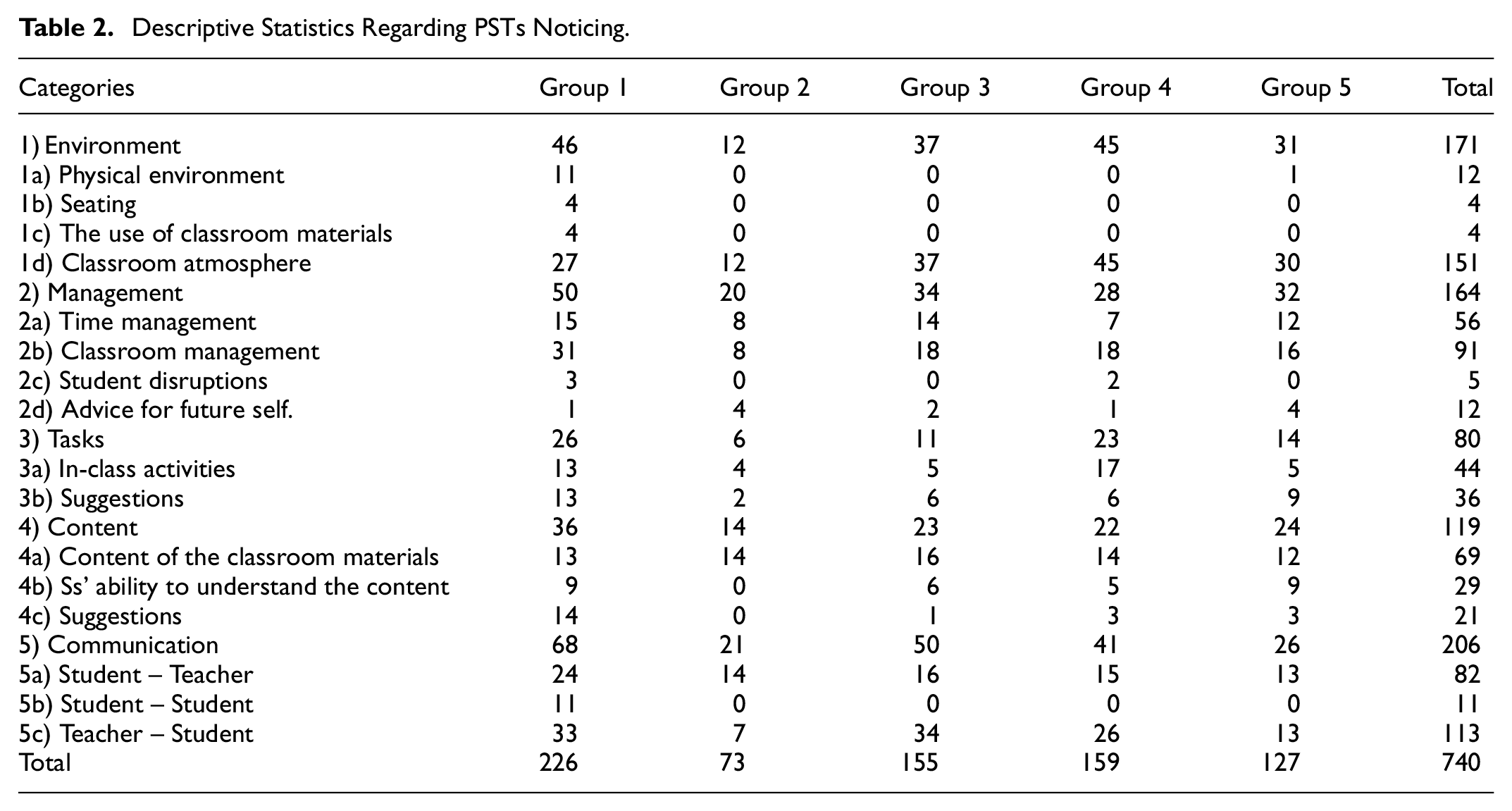
Regarding the environment dimension, the total number of PSTs noticing instances was 171. Regarding the management category, the total number of instances was 164. In this category, classroom management was the most commented category (f = 91), followed by time management (f = 56), advice for future self (f = 12), and student disruptions (f = 5). The total number for the tasks category was 80, much lower than all other categories in PSTs noticing. The number of instances related to in-class activities was 44, and suggestions were 36. Fourth, as for the content category, the total number of PSTs noticing instances was 119. The number of instances of PSTs noticing the content of the classroom materials dimension was 69, followed by students’ ability to understand the content category (f = 29) and suggestions category (f = 21). Finally, the most significant number of PSTs noticing instances was obtained in the communication category (f = 206). The number of PSTs noticing instances for the teacher-student communication category was 113, for the student-teacher category 82, and for the student-student category 11.
Out of the coding process, four main categories were identified in the environment category: physical environment, seating, classroom materials, and classroom atmosphere (Sample quotes are presented in Table 3). Of these, only the classroom management category was mentioned by all the groups. The most frequently mentioned dimension in the classroom atmosphere category was learner participation in the lessons and their interest levels. PSTs also focused on the role of the teacher in establishing the classroom atmosphere and enhancing learner attitudes. Most of them stated that the learners were not highly interested in class material.
Sample Quotes From PSTs’ Noticing.

The management category included four sub-categories: time management, classroom management, student disruptions, and advice for future self. Most of the comments in this category suggest that time management is a very essential skill for teachers. Most groups stated that keeping learners on task and focused was essential for teachers. Some groups believed that classroom management is only a matter of the teacher while others believed that the management of the classroom is also of utmost importance. The PSTs were also highly sensitive to teacher-related issues, including how the lesson was conducted.
The task category was divided into two sections: (1) In-class activities and (2) suggestions. This category was the least mentioned compared to the other categories. All the groups noticed that teachers generally follow the coursebook. The PSTs not only commented on the tasks in the book but also came up with some suggestions. Regarding the in-class activities, the PSTs came up with some superficial observations. For example, they commented that the teacher should do some “Repeat after me” activity or some “translation” activities. With regard to suggestions, PSTs foregrounded the use of visuals, and writing the words on the board.
The content category is divided into three sub-categories: the content of the classroom materials, students’ ability to understand the content and suggestions. Some remarks of the PSTs focused on how the teacher conveyed the content while some others focused on including what to do when teaching four language skills along with pronunciation or vocabulary. They commented that the use of antonyms or synonyms could be a good idea and that making sentences was a good idea. In terms of suggestions, they stated that it would be a good idea to keep a reference book and work on the pronunciation sections with more care.
The communication section included student-teacher, student-student, and teacher-student sub-categories. The noticing practices of the PSTs converged on communication breakdowns and errors. PSTs were able to notice significant occurrences in the communication patterns. Each group complained that the mentor teachers did not use L2 in the lessons. The most noticed instances were recorded under the title of teacher-student communication category. Regarding teacher-student communication, most comments focused on breakdowns that led to classroom management problems or error correction instances.
Pedagogical Content Knowledge
The second research question is about whether PSTs can relate classroom situations to principles of teaching and learning. To identify this, we used the Pedagogical Content Knowledge (PCK) framework, which was defined as “the knowledge about what to teach, how to teach it, how to engage students and how to deal with students’ learning difficulties” by L. S. Shulman (1986, p. 8). The reason for this is that this category, as was suggested by van Es and Sherin (2002), is concerned with the capacity to make connections between specific classroom interactions and the broader principles of teaching and learning they represent. The PCK framework was not initially suggested by van Es and Sherin (2002). We thought that the PCK framework could serve this purpose. According to L. S. Shulman (1986), teachers should have three types of knowledge: (1) content knowledge, (2) pedagogical knowledge (PK), and (3) pedagogical content knowledge (PCK).
Principles of Language Teaching Methodology
One of the significant components of the PCK framework, principles of language learning methodology, received considerable attention from the PSTs, the primary orientation focusing on language teaching methods and approaches (f = 8), motivational strategies (f = 8), or error correction (f = 3). In the language teaching methods and approaches component, most of the noticing on the part of the PSTs focused on how to give instructions, the order of activities, error correction, using daily examples, or motivational strategies. PSTs also stated the role of socialization in the lesson and feel free to participate. Connected to motivation, error correction was also necessary, and the PSTs accentuated the role of correcting gently (sample quotes are presented in Table 4).
Sample Quotes From PSTs’ PCK Noticing.

Teaching and Assessing the Components of the Curriculum (PCK)
Most of the comments on teaching and assessing the components of the curriculum focused on pronunciation and error correction. PSTs noticing regarding error correction was also dealt with in the assessing language development sub-category of PCK. PSTs noticed a few points here. They stated that they realized the importance of reinforcing correct answers. PSTs also commented on assessing language development, reasoning that it is hard to grade papers.
Theories of Language Acquisition
One of the essential sub-categories in PCK is theories of language acquisition. The PSTs commented that revising the taught material is critical. The teaching should not focus on memorization; rather, exposure is important. It could be seen that PSTs failed to come up with satisfactory reflection on theories of acquisition. This is an important finding. In pre-service teacher education, theories of language acquisition should receive more attention.
Almost all groups produced essential observations for the developing and evaluating instructional materials category. Some of the remarks from the PSTs focused on knowledge of materials. PSTs observations include not following the course book word by word and that course book selection is very important.
As a sub-category in developing and evaluating instructional materials, knowledge of lesson plans receives remarkable attention from the PSTs. One of the common points that PSTs noticed was that there are too many things to cover in lesson planning in terms of content. Knowledge of classroom management was also on the agenda of the PSTs. PSTs mostly stated that student profiles are important, thinking that it is hard to control students.
Professional Development
Finally, in the professional development category, it was observed that the PSTs reflected on their and their peers’ teaching practices. They mainly focused on knowledge of fostering reflective teaching in teacher candidates. To make a general evaluation of the practicum process, one of the teacher candidates stated that In the first weeks, we used to do our lesson and go; in a sense, we viewed the practicum process as a personal issue. However, as time passed, we became more involved and closer to students. Now, we can enable students to relate the lesson to their personal experiences.
Furthermore, PSTs are also reflected in future practice. Some of them stated that they would form their repertoire of materials and try to be as energetic as possible. Another thing that the PSTs noticed was that knowing something does not guarantee teaching something.
General Pedagogical Knowledge
Regarding general pedagogical knowledge, the PSTs stressed the role of exposure rather than memorization. Regarding knowledge of teaching techniques, the PSTs’ sample comments included addressing various learning styles like kinesthetic learners. Further PSTs noticing regarding knowledge of teaching techniques include giving students chances for personalization. They thought that their mentors could address students’ expectations.
Moreover, in the knowledge of language and related disciplines category, PSTs mainly noticed things about the knowledge of the philosophy of teaching sub-category. Sample comments include the role of personalization of learning, feeling secure in the class, and discovery learning. Regarding knowledge of classroom teaching routines, the PSTs noticed that the classroom environment is much more different than what they learn in theory.
Finally, in the developing, planning, and managing language teaching category, classroom management received remarkable attention, with most comments focusing on time management. They realized that the attention span of the students is rather short, and it is not easy to fill the lesson, which requires careful preparation. They also noticed that the activities determine whether learners will keep their interest in the lesson. Another realization of PSTs was that teachers should have contingency plans in case things go out of the plan.
Reasons of Teacher and Student Behavior
The third research question is about whether PSTs can make the connection between what they know and what the potential reasons are for teacher and student behavior. The capacity to make connections between what PSTs know and how they view classroom situations through this lens is an essential component of Van Es and Sherin’s model (2002). However, they do not offer a specific coding scheme to indicate this. Hence, having analyzed the data for this aspect, we came up with three main categories that indicate the connections between what PSTs know and the reasons for their noticing (Table 5).
Reasons for Teacher, Student, and Pre-Service Teacher Behavior.

Table 5 shows the PSTs produced 146 noticing instances in the reasons category. The most frequent instances of PSTs noticing were produced in the reasons about the student behavior (f = 66) and reasons for teacher candidate behavior (f = 49). The reasons for the teacher behavior category received 31 comments. Mainly, reasons for teacher behavior focused on lack of teacher motivation and enthusiasm, and shared perceptions regarding lack of teacher motivation or commitment were lack of student motivation, the exam structure, or low level of learner proficiency.
Regarding the reasons for the student behavior category, the PSTs focused on the lack of motivation on the part of the students, and the two most essential reasons were the exam structure and the track selection of the students. In the Turkish education system, learners select tracks in the second year of high school: the social sciences track, mathematical disciplines track, or language track. To enter university, students must take the University Entrance Exam based on their tracks. Hence, students in social or mathematical departments may need more motivation as they mainly study mathematics or social sciences for the exam. Conversely, the PSTs also noticed that when they establish rapport and when learners’ interests are tapped, they respond positively.
Finally, for a reason related to teacher candidate behavior, confusion on the part of PSTs was one of the main PST behaviors. The causes of confusion mainly stemmed from not knowing learners’ levels, anxiety, lack of support from the mentor teacher, or high level of students. Some student groups were English language department students, and they required more expertise. PSTs stated that they had difficulty finding activities for the language department students. Furthermore, PSTs had difficulty deciding whether to use L2, partly because their mentors did not use L2 in their lessons and partly because they thought students would not understand them. PSTs also suffered from indecision owing to a lack of support from mentors.
Discussion
The present study focused on the noticing of PSTs in joint reflection sessions. We dealt with the noticing of PSTs regarding what PSTs noticed (van Es & Sherin, 2002), whether they can relate specific classroom instances to the general principle of teaching (PCK framework). Our analysis showed that the most noteworthy instances were related to communication, the environment category, and management. The categories that received relatively little attention from the PSTs were the content and tasks categories. Management issues also received remarkable attention, including time management, classroom management, student disruptions, and advice for future self-categories. It is good to see that the PSTs saw the importance of time management and the role of the teacher in classroom management. As for tasks, PSTs noticing focused on in-class activities and suggestions related to tasks. Unfortunately, the tasks category received little attention from the PSTs with little depth.
Furthermore, the content category received little attention from the PSTs. They only focused on the course book and the importance of providing extra materials. However, they failed to notice specific characteristics of the content provided and how it could be expanded. This finding assumes significance because a considerable portion of failure in language teaching stems from teachers’ insufficient handling of the content. As supported by findings of Benedict-Chambers and Aram’s (2017) study, PSTs often fail to focus on if the content delivered is learned or if the tasks are appropriate to practice the content, which leads them to observe teaching rather than learning. Finally, the communication category was the most commented one. The PSTs mainly focused on breakdowns in communication and teacher-student category. PSTs attributed most communication breakdown situations to management problems. The fact that students focused on communication is significant as teachers need to be able to observe and critically analyze both spoken and nonverbal classroom interactions as part of their noticing skills (Ding et al., 2022).
The present study found that PSTs mainly focused on management, communication, and teaching in general rather than spotlighting how learners learn. Studies indicate that PSTs and inexperienced teachers are more concerned with student behavior and ensuring order in the teaching process (Wolff et al., 2017).
One fragmentary noticing of PSTs could be their insufficient knowledge of PCK, making it hard to notice what is happening in the teaching process (Wolff et al., 2021). Although teacher PCK develops into a more systematic whole through experience, PSTs should be equipped with a dependable PCK base for effective noticing. The findings in the present study support this position. The PSTs in the present study only focused on specific aspects. For example, very rarely did they talk about the presentation of the content and specific characteristics of the content as part of content knowledge.
Recently, it was suggested that TN should also involve decision-making (Blömeke et al., 2015) and building dimensions (Stockero et al., 2017), with both terms implying that how students think should be one of the foci of teachers. The findings of the present study indicated that PSTs have limited focus in that regard. As was mentioned, the PSTs mainly focused on management or didactics issues, with student thinking receiving little attention, which is supported in the literature by Allas et al. (2020). However, PSTs require opportunities to experience eliciting and responding to student ideas in order to adopt a more responsive approach to instruction (Sun & van Es, 2015). PSTs can focus on promoting student learning by noticing student-related components of teaching sooner in their professional development with the right training.
The PSTs mainly focused on their affective conditions, emphasizing the factors that either helped them overcome emotions or led them to suffer from anxiety. The prominent factors that made them anxious ranged from lack of learner interest, lack of participation, or inability to get feedback from students. They also reported that teaching was challenging and demanding, and they could not live up to their plans in most cases. Their common concerns converged around how to increase participation, sustain learners’ attention, and improve the course book. Their reflection on these matters was found to be efficient and helpful, as this collaboration may lead to a quick increase in their PCK levels (Jiang, 2022).
The most recent conceptualizations view TN as comprising not only identifying but also interpreting and shaping (e.g., van Es & Sherin, 2021). Interpreting whether teachers or PSTs can acquire an attitude toward the teaching issue while shaping refers to acquiring further information about interactions. The noticing offered by PSTs in the present study indicated that they could only focus on identifying components. The awareness of PSTs should be enhanced to allow them to interpret their observations and shape them. By offering a chance for PSTs to freely conduct their joint reflection, the true nature of their interpreting and shaping what they observed in the classroom have been made possible, which concurs with Tiainen and Lutovac’s (2022) study.
Several implications could be drawn from our study. First, the PCK contemplations of PSTs followed a non-linear track with much attention paid to some factors while leaving out others. Most probably, PSTs failed to see significant or critical incidents. Hence, it is suggested that mentor support be integrated into the PCK development process of PSTs. Several authors pointed out the significance of mentors in that regard (e.g., Alemdag & Özdemir-Şimsek, 2017). Similarly, as Allas et al. (2020) pointed out, PST’s tendency to notice challenging and difficult situations may be redirected by the mentor effort to also encompass the empowering moments in the classroom. To this end, students may be equipped with tools that direct them to open their eyes wider, such as checklists or other stimuli. Second, given the superficiality of the reflection and the overfocus on certain issues prompts us to reconsider the ways in which PSTs could be familiarized with more effective ways of PCK development. For example, the “Engage–Explore–Explain Framework” suggested by Benedict-Chambers and Aram (2017) could be transformed for pre-service EFL teachers’ use. As van Es and Sherin (2021) suggests and this study concedes, the lack of focus on student thinking and learning may be enhanced through this framework. PSTs can focus on promoting student learning by noticing student-related components of teaching sooner in their professional development with the right training (Allas et al., 2020). In a similar vein, Gibson and Ross (2016) suggested another framework for literacy teachers that includes PCK as its basis for increased noticing.
Conclusion
The study made it clear that although PSTs engage in noticing, their noticing mainly focuses on superficial aspects. For example, they fail to notice significant aspects of the input or how it should be presented and how student learning happens. These results made it clear that TN practices should become part of teacher education programs, a suggestion also voiced in the literature (e.g., Roth McDuffie et al., 2014).
Despite all the efforts, there are some limitations to the study. First, mentors did not participate in the JRSs due to time constraints. The integration of the school-based mentors could change the picture, as it is seen in previous research (Martinez et al., 2019). With an intervention from a mentor in form of a training, the PSTs noticing may be elevated and deepened (Dick, 2017) Second, the study did not direct PSTs to reflect on particular things and instead left them free in their choice so that more natural data could be collected. Future studies could focus on thematic joint group discussions where PSTs discuss different themes after each weekly practicum session. Third, the present study did not aim to investigate whether the noticing of PSTs develops over time. Future studies should focus on whether interventions develop PSTs’ noticing skills. Another limitation of the present study is that it covers a 3-month period, which could be considered a short time given the slow but incremental nature of teachers’ knowledge base development. Researchers suggest that teachers’ noticing is likely to change as teachers become more experienced (Wolff et al., 2021). Hence, future studies could consider setting up their designs for more extended periods (see Amador et al., 2021). Finally, our study did not take into account the impact of region, nationality, gender, personal educational background, and teaching experience on the final results due to time and contextual limitations. Future studies could consider the impact of these factors on PSTs noticing.
Footnotes
Acknowledgements
This work was not supported by any institutions.

Ethical Considerations
This research was conducted considering ethical issues and following ethical rules. Ethics Committee Approval Certificate Dated 02.12.2022 and numbered 11054619-302.08.02 was obtained from Ankara Hacı Bayram Veli University Ethics Committee.
Consent to Participate
The participants gave informed consent to participate in this study.
Funding
The author(s) received no financial support for the research, authorship, and/or publication of this article.
Declaration of Conflicting Interests
The author(s) declared no potential conflicts of interest with respect to the research, authorship, and/or publication of this article.
Data Availability Statement
Data sharing not applicable to this article as no datasets were generated or analyzed during the current study.
Code Availability
The data that support the findings of this study are available from the corresponding author upon reasonable request.