




Abstract
This study aimed to prepare, implement and evaluate the effectiveness of a professional development program that develops Technological Pedagogical Content Knowledge
Keywords
Introduction
Today’s students can adapt very easily to all kinds of innovations. Students of this technological age can access to the internet as well as all kinds of information, enjoy multitasking, learn new information through social interaction by using a computer, tablet or smart mobile phone, and generally prefer visual elements (such as graphics) to texts (Milutinović, 2022). Transferring these technologies into education programs and using information and communication technologies in the learning process has become an important element (Gill & Dalgarno, 2017). Thus, teachers who educate students of this age should be intertwined with innovations, adopt technology to comply with the requirements of the age, be able to choose technology applications that are suitable for the goals of the course, constantly improve themselves by following new developments, and be able to transfer the changes to their educational programs (Hunter, 2016; Koehler et al., 2013; Valtonen et al., 2021).
Individuals who are experts in their fields can only be trained with a good education that meets the requirements of the age. At this point, teachers play a key role. Teachers, who organize the teaching environment and activities with the skills they have, have an important role as the people who ensure that the teaching activities are carried out effectively. Teachers are expected to use their theoretical and practical knowledge in a functional way while performing this task (Jin & Schmidt-Crawford, 2022). This is much more effective with technology.
Technology is one of the most important elements that facilitate the transfer of pedagogical knowledge to students and make the lesson more effective (Hunter, 2016). Technology infrastructure and equipment have been provided in schools, but the teachers who will use these technologies have not been adequately prepared for the changing learning environments (Başak & Ayvacı, 2017). Although the majority of teachers can use technology in their daily lives, they cannot use it effectively in their lessons. There are many teachers who still do not have the high level of technology knowledge that will facilitate the technology integration required by the technology age and knowledge that will facilitate technology integration rather than the current use of technology in limited ways (Basilotta-Gómez-Pablos et al., 2022; Eyüp, 2022; Jang & Chen, 2010; Keengwe & Georgina, 2012; Liang et al., 2017; Winter et al., 2021).
Even though teachers are provided seminars on developing technologies, they cannot use the new knowledge they have acquired effectively in their classes (Jang & Chen, 2010). Similar problems have been identified in studies conducted in recent years. Teachers had difficulties in using the computer during the Covid 19 pandemic. They had difficulties in creating a distance education environment, carrying out this process and using the computer effectively (Palau et al., 2021).
Having no training on the developing technologies is one of the reasons why teachers cannot use technology in their teaching processes (Çam & Erdamar Koç, 2021). First, teacher educator competencies should be reviewed in order to organize current teacher training programs in accordance with the requirements of the age and to ensure technology integration. Today, some teacher educators train the teachers of the Digital Age. The teacher educators of this age are not very competent in using technology effectively at every stage of the course (Amhag et al., 2019). On the one hand, some students can easily adapt to change, use smart phones to access all kinds of information, meet new people from all over the world through social networks, and expand their information network. On the other hand, some educators/teacher educators can hardly adapt to technology and cannot give up traditional methods (Sánchez-Caballé & Esteve-Mon, 2022). Due to this situation, students cannot receive education of the age (He & Wei, 2021; Palau et al., 2021).
To fill this gap, teacher training programs need to be revised. Regarding the acquisition of teaching professional skills and the development of pedagogical content knowledge, using technology is extremely important to provide training for the preparation of technology-oriented teaching materials in all field courses (Ersoy et al., 2016; Hunter, 2016). This is because teachers’ competencies to use technologies suitable for their own fields and teaching methods are largely dependent on their education in higher education programs and thus on the proficiency of their teacher educators (Tıkman, 2022; Tondeur et al., 2012). In current teacher training programs, teaching models enriched with innovative educational technologies should primarily be used effectively by teacher educators (Jaipal-Jamani et al., 2018; Nsouli & Vlachopoulos, 2021; Tıkman, 2022; Uerz et al., 2018). The International Society for Technology in Education has set some standards for teacher educators. According to these standards, teacher educators should provide authentic learning experiences for teacher candidates with technology support, facilitate the construction of knowledge, and continuously improve themselves by following new developments and as a teacher, they should constantly update their knowledge (ISTE, 2017).
However, instructors adopt the role of “researcher” more in their professional roles, and they leave behind the role of researcher, being a “tutor” and indirectly a role model for the teacher candidates they train (Burak et al., 2022). The same problem is experienced in education faculties in terms of using technology. Even if teacher educators use technology in daily life, they have difficulty in using it in their lessons. Voogt and McKenney (2017) investigated what instructors working in five teacher training institutes do to improve TPACK in preservice teachers. As a result of the study, it was stated that the instructors who train teachers do not actually have enough technology knowledge, there are not some new technological tools in the schools where the teacher candidates will work. In addition although there are enough experts in the field of technology in the institutes where the study takes place, there is not a strong integration between the instructors and these experts. A study showed that teacher educators had difficulty in keeping up with technology, they saw technology as a major source of stress and hence avoided using it in their classes (Nsouli & Vlachopoulos, 2021). In faculties of education, narration is used in most of the lessons (Keengwe & Georgina, 2012). It may not easy for teacher educators, who used traditional methods, to adapt to new technologies (Brinkley-Etzkorn, 2018; Sánchez-Caballé & Esteve-Mon, 2022). In this regard, improving teacher educators’ technology integration competencies is necessary for arranging teacher training programs (Brinkley-Etzkorn, 2018). The experiences that pre-service teachers encounter during teacher training programs are directly dependent on the knowledge and skills of the instructor who trains them to be an efficient technology integration educator. If the instructor provides a successful technology integration, the teachers he/she trains will be skilled in technology integration like himself. These teachers also teach a more effective lesson to the students of the technological age (Jung & Ottenbreit-Leftwich, 2020).
Literature abounds with various technology integration models. TPACK (Technological Pedagogical Content Knowledge), one of the most effective technology integration models, has been preferred by many researchers in recent years and has been used in many studies to increase the quality of education (Brinkley-Etzkorn, 2018; Canbazoğlu Bilici, 2012; Kabakçı Yurdakul, 2013; Karlsson & Nilsson, 2023; Ning et al., 2022). “General Competencies for Teaching Profession” emphasizes that TPACK is a competency that teachers should have (TED, 2009).
Graduate teacher candidates can gain TPACK competencies only if their teacher educators with these skills become role models (Martin, 2015; Voogt & McKenney, 2017). Therefore, the role of teacher educators should be reviewed as well as providing technological infrastructure in teacher training institutions. Teacher educators with TPACK competencies become role models for future teachers and can train teacher candidates of the age (Alsofyani et al., 2012; Çam & Erdamar Koç, 2021). Programs should be organized to provide TPACK competencies, and the professional development of teacher educators should be ensured. This should be done in every subject, first the teacher educators are trained and then the teacher candidates. This is why the professional development of teacher educators is very important (Jerez et al., 2021). However, short-term trainings have been organized within the scope of “Training for Trainers” in a few universities (Brinkley-Etzkorn, 2018; Jaipal-Jamani et al., 2018; Uerz et al., 2018). In Turkey, this situation is almost non-existent (Yavuz-Konokman & Yanpar-Yelken, 2014).
Therefore, the focus of this research is the teacher educators who directly affect the teachers and their professional development. Teacher educators to provide technology integration is very important for new generations of teachers. Therefore, in this research, it is considered important for the teacher educators to improve themselves on TPACK, which is a technology integration model, and to improve themselves in this regard. In this context, it is the center of gravity of the research that the teacher educators develop themselves within the scope of the training of the trainers and develop their TPACK competencies. For this reason, first the training of trainers and then TPACK, which is a technology integration model, are explained in more detail.
Training for trainers can be defined as the systematic teaching activities given to teacher educators to ensure their professional development. Through this program, it is aimed to develop instructional skills about methods and techniques that teacher educators can use to ensure effective and permanent learning. Designing an in-service training program for the qualifications to be developed in the participants is a program development process. Thus, program development steps are followed respectively (Davey, 2013). When developing a program, a needs analysis is performed, a program is designed based on needs analysis, this program is applied, and the outputs are evaluated (Demirel, 2006).
Technological Pedagogical Content Knowledge (TPACK)
Mishra and Koehler’s (2006) TPACK, which is based on Shulman’s (1986) PCK, consists of three basic components: Technological Knowledge (Computer, internet, video, board, book), Pedagogical Knowledge (teaching-learning methods and techniques, strategies), and Content Knowledge (topic knowledge to be learned, scientific knowledge) (Mishra & Koehler, 2006). TPACK requires the combination of technological, pedagogical and content knowledge as seen in Figure 1. It is the ability of a teacher to choose the appropriate pedagogical methods and technologies for the topic to be covered by asking “How can I teach this topic best?” (Harris & Hofer, 2011). In other words, TPACK is the ability of a teacher to use technological skills (computer, tablet and internet applications), pedagogical (teaching skills, selecting appropriate teaching skills for the student) and content knowledge (course content such as mathematics, science, social). Therefore, a TPACK-focused teaching process cannot be carried out by a teacher with only technological knowledge or a technologist who has poor pedagogical knowledge (Mishra & Koehler, 2006).
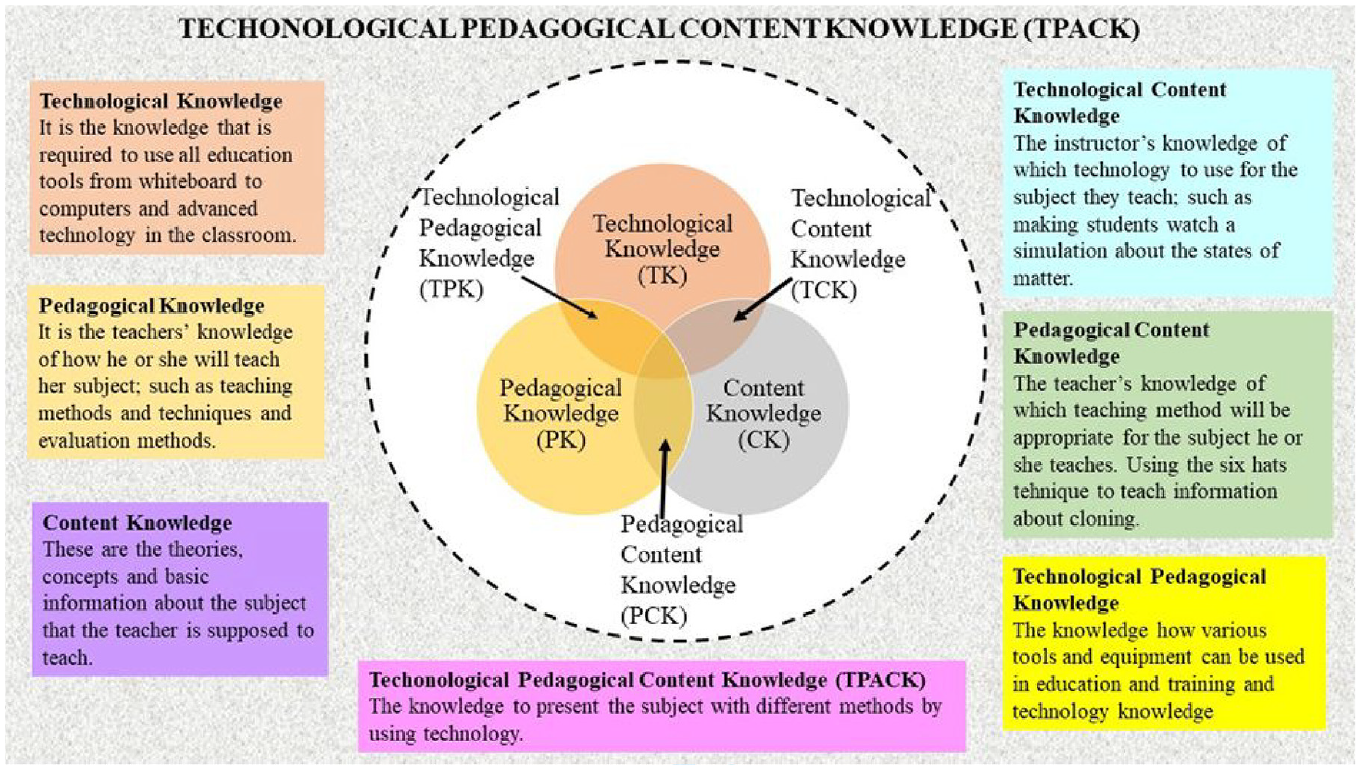
Technological pedagogical content knowledge (Koehler et al., 2013).
A teacher educator should have these three types of knowledge. A teacher educator can use all or some of them, depending on the purpose of lesson. However, he/she must have the knowledge of all seven elements (Koehler et al., 2013).
Although teacher educators should update themselves and rearrange their learning environment to develop teachers’ TPACK (Gill & Dalgarno, 2017), there is a dearth of study examining how to improve teacher educators’ TPACK. There is limited number of studies conducted with teacher educators, and they are survey model studies that display the current situation. In this respect, the current study aimed to prepare, implement and evaluate the effectiveness of a professional development program for the development of teacher educators’ TPACK.
Research Question
How is the effectiveness of the “Professional Development Program for Developing Teacher educators’ TPACK (I-TPACK-PDP)” prepared within the scope of training for trainers? The sub-problems are:
Considering the teacher educators in the I-TPACK-PDP,
What are their satisfaction levels (appreciation, motivation, benefit)?
How do they design their TPACK lessons?
What are the problems encountered during TPACK implementation and what are their suggestions?
Methodology
This part includes research design, research development process, study group, data collection and analysis, validity and reliability.
Research Design
This qualitative study was designed as program implementation case studies. The reason for choosing qualitative methods is to identify the actual thoughts and behaviors of the participants (Creswell, 2007). Program implementation case studies help ensure a comprehensive and longitudinal reporting of changes (Davey, 2013). Thanks to this design, a professional development program was carried out by obtaining longitudinal, broad and in- depth information about the TPACK development of teacher educators. Besides, the study examined whether the goal of the program was achieved.
Study Group
The study group consisted of 10 teacher educators working in a faculty of education. They were volunteers and they all work in the same institute. Although researchers try to develop various formulas by being influenced by quantitative patterns, there is no accepted sample size determination formula recommended for qualitative research (Morgan & Morgan, 2008). A consensus has been reached that the basic sample size for an ideal qualitative research is related to the quality of the data obtained from the sample (Watson et al., 2017). If the cases under study are informative, in-depth information from a small group of people may be more valuable than limited information from a large sample. Satisfaction is important, not the number of samples (Guba & Lincoln, 1982). For this reason, the data from a sample of 10 people for this study was found to be sufficient. Maximum diversity sampling was used to determine the applicability of the I-TPACK-PDP in different departments (Educational Sciences, Primary Education, Social Sciences and Turkish Education, Mathematics and Science Education, Foreign Language Education and Visual Arts Education). Maximum diversity sampling helps create a small study group with maximum participant diversity. The aim is not to generalize but to examine whether there are common phenomena between different situations (Yıldırım & Şimşek, 2008).
Participants were interested in technology, willing to develop themselves, and open to innovations. P4 and P10 were using computers and communication technologies only as a means of communication in their daily lives, not in their teaching processes. They needed to improve their technology knowledge. Other participants could adapt to new technologies more easily. P1, P2 and P3 were able to use social networking, e-mail, Office programs at a good level, but they could not use Web 2.0 tools in their lessons. P5 and P6 could frequently use computers and communication technologies in their daily lives. They could learn new technology applications and put them into their lives. Although P7, P8 and P9 had similar features, they could actively use some of the Web 2.0 tools in their lessons.
Research Development Process
I-TPACK-PDP was developed by using Taba-Tyler and System Approach models. Accordingly, the research process was designed in four stages: planning/needs analysis, design, implementation, and evaluation.
Planning/needs analysis: Literature was reviewed to determine TPACK competencies that a teacher educator should have. Then, Interviews were conducted with the teacher educators according to these competencies. This process was presented in detail by the researcher in another study (Çam & Erdamar Koç, 2021)
Design: Based on the determined needs, the goals of I-TPACK-PDP were developed according to literature and expert opinions. Then, the content of the program was created and the list of topics, materials to be used, and learning environments were determined. Each of the 14 sessions in the program content was considered as a module. Weekly and hourly lesson plans were prepared. Also, the researcher arranged detailed lesson plans for teaching-learning situations. Measurement and evaluation tools were selected to determine the effectiveness of these teaching-learning situations. Both literature and expert opinions were applied while preparing these measurement tools. Eight experts were consulted during design process.
Implementation: First, the program was piloted. Two teacher educators were individually trained for the pilot study. This process lasted for 7 days. Each participant was given one-on-one trainings so that they can practice on the topics. Piloting took 18 hr. Then, the main implementation was carried out.
In each module, participant’s prior knowledge on the topic was taken into consideration, and individual training was provided. First of all, the technology application to be used within the scope of TPACK was introduced, the purposes for which it could be used were explained, and application examples were shown. Next, the use of implementation was run by following all steps together. Then, brainstorming was done to determine which pedagogical methods could be used and how and on which topics the teacher educator could use this application. Finally, the participant was asked to produce a material and design a lesson plan. During the training, the theoretical part was explained in the first 20 min of each lesson. In the last 40 min, a TPACK material was prepared based on the theoretical information explained, and a lesson design was planned by using the TPACK material. This period, stated as 60 min, differed in each module and participant. Finally teacher educators were provided opportunities to transfer the knowledge they have acquired to their own fields and to apply it in a real classroom environment. Teacher educators have reflected the nature of TPACK exactly at this stage.
Evaluation: In this stage, to evaluate the effectiveness of I-TPACK-PDP, the researcher examined whether the determined goals were achieved. The evaluation process started from the moment I-TPACK-PDP was implemented.
Professional Development Program (I-TPACK-PDP)
The program is presented in Figure 2. It has three stages. In the first stage, teacher educators were provided one session of theoretical information for “understanding the nature of TPACK.” The aim was to help the teacher educators have general information about TPACK and understand how to shape their existing pedagogical knowledge. For example, it was emphasized that teaching methods and strategies such as collaboration, problem-based learning, interaction, knowledge sharing should be used together with a learner-centered teaching in a TPACK-focused approach, and application examples were shared. A discussion was made about the usability of technology applications. Although this was considered as one session at the beginning of the training, it was also emphasized during the 16-session process. After each training module, the nature of TPACK was underlined. Thus, Pedagogical Knowledge (PC) and Pedagogical Content Knowledge (PCK) were stressed.
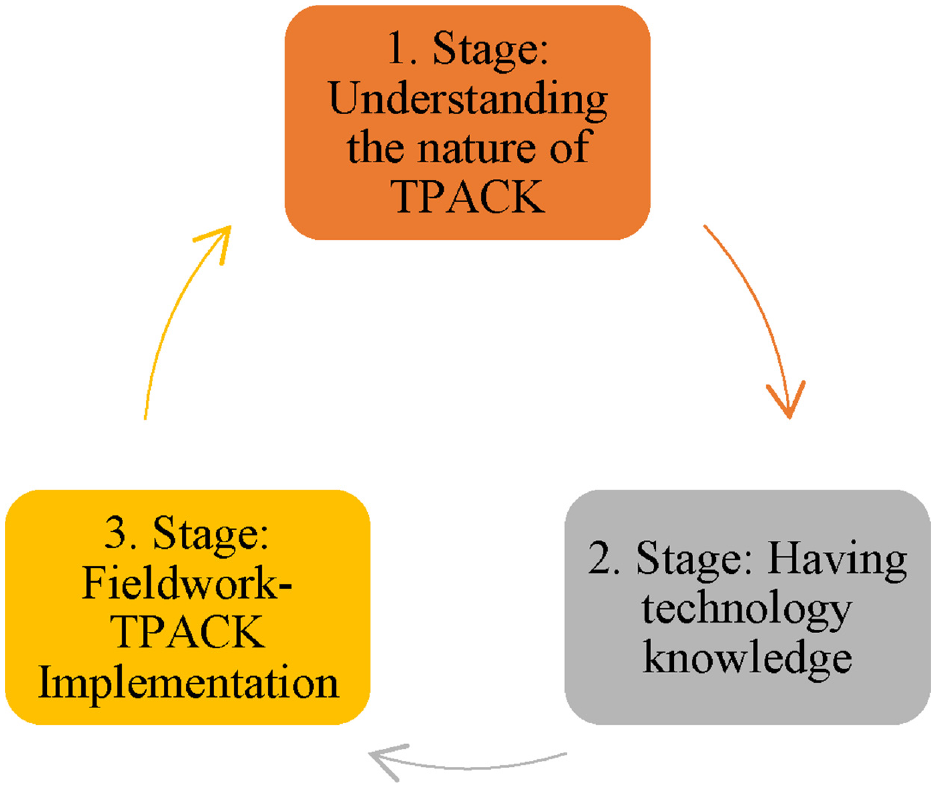
Professional development program for teacher educators TPACK development.
In the second stage, teacher educators were given training about technology knowledge that they should have. This stage lasted 14 sessions. Session durations varied according to the learning speed of each participant and lasted an average of 1 hr. Technology Knowledge (TK), Technological Pedagogical Knowledge (TPK) and Technological Content Knowledge (TCK) were emphasized at this stage. Applications were carried out to ensure the development of TPK and TCK by improving the technology knowledge of the teacher educators.
In each session, teacher educators were informed about a technology application, its benefits, limitations and pedagogical uses. Each teacher educator designed a TPACK material according to his/her field with the technology knowledge given. Demonstration techniques were used for technology knowledge, and then the teacher educators were allowed to design their own materials. In addition, the teacher educators who designed materials suggested ideas about the teaching strategy in which they could use materials. Figure 3 presents the sessions of educational technologies used in the second stage.

Professional development program-content of technology knowledge.
In the 14-session program, the main goal is to produce TPACK materials suitable for each module. The technology knowledge should be combined with appropriate pedagogical methods, and the educational objectives were prioritized while preparing materials.
In the last stage, a field study was done. Research advocates that giving training is not enough to develop TPACK competencies of a teacher educator, so real learning environments should be created (Niess, 2011). Thus, teacher educators were provided opportunities to transfer the knowledge they have acquired to their own fields and to apply it in a real classroom environment. Teacher educators have reflected the nature of TPACK exactly at this stage. No content knowledge (CK) training was given because the participants were already experts. Thanks to the technology knowledge they had gained, they created real learning environments and taught one-session lessons in undergraduate courses. Each participants chose applications suitable for the lesson and prepared a lesson plan.
Data Collection
Semi-structured interviews were used to collect data. Interviews were conducted both before and after the program. Pre-interview questions were about participants’ prior knowledge of TPACK, how they performed their lessons under the current conditions, what they knew about the technology applications in the program, and their expectations from the program. In final interviews, participants were asked questions about their satisfaction with the program, what they learned about TPACK, the lesson plans they designed, and the problems they experienced. Interview form was piloted with two different teacher educators. Interviews were recorded with the permission of the participants, and themes were induced from these codes.
Data Analysis
The data were analyzed through the NVivo 10 program using content analysis technique. The main purpose of content analysis is to reach concepts, relationships and patterns that can explain the collected data (Yıldırım & Şimşek, 2008). Thus, the interviews were transcribed, and data were systematically arranged according to the research questions. Coding was done by reading the answers. The related themes were brought together to reach the main themes. A framework was determined by rearranging all the themes that emerged, and the analysis was repeated according to this framework in the second round of coding to prevent data loss. Overlapping, redundancy and inaccuracies between codes are prevented by repeating the coding processes. The coding made by the researcher was also checked by another researcher according to a coding list determined as a result of the content analysis.
Validity and Reliability of the Study
Attention was paid to the credibility and transferability of the research to ensure the validity (Miles & Huberman, 1994). During the whole process, the trainings were recorded, photos were taken, and all these documents were kept for reference. All interviews were recorded. Another expert was consulted while analyzing data. For credibility, direct quotations were used. To ensure the transferability, the personal characteristics of the teacher educator were introduced. The professional development program was explained in detail from the design stage to the evaluation stage in terms of setting an example for the future studies.
Regarding reliability, attention was paid to whether the results were consistent with the data collected (Merriam & Tisdell, 2015). Data were constantly checked, and analyses were also checked by another researcher so that other researchers could use data and reach same results. While analyzing data, two researchers worked in collaboration and coding was made together. After different codes were identified, code agreement percentage was calculated as 91% using the formula of Miles and Huberman (1994).
Findings
Findings are titled according to research questions; “Teacher educators’ satisfaction with the program”, “Lesson Designs of teacher educators in compliance with TPACK”, and “Problems that teacher educators encountered during their applications and their suggestions.”
Teacher Educators’ Satisfaction With the Program
The views of the teacher educators about the satisfaction with the program were gathered under two themes: “Professional development” and “Structure of the program.”Table 1 was created according to the data obtained.
Teacher Educators’ Opinions About Their Satisfaction With the Program*.
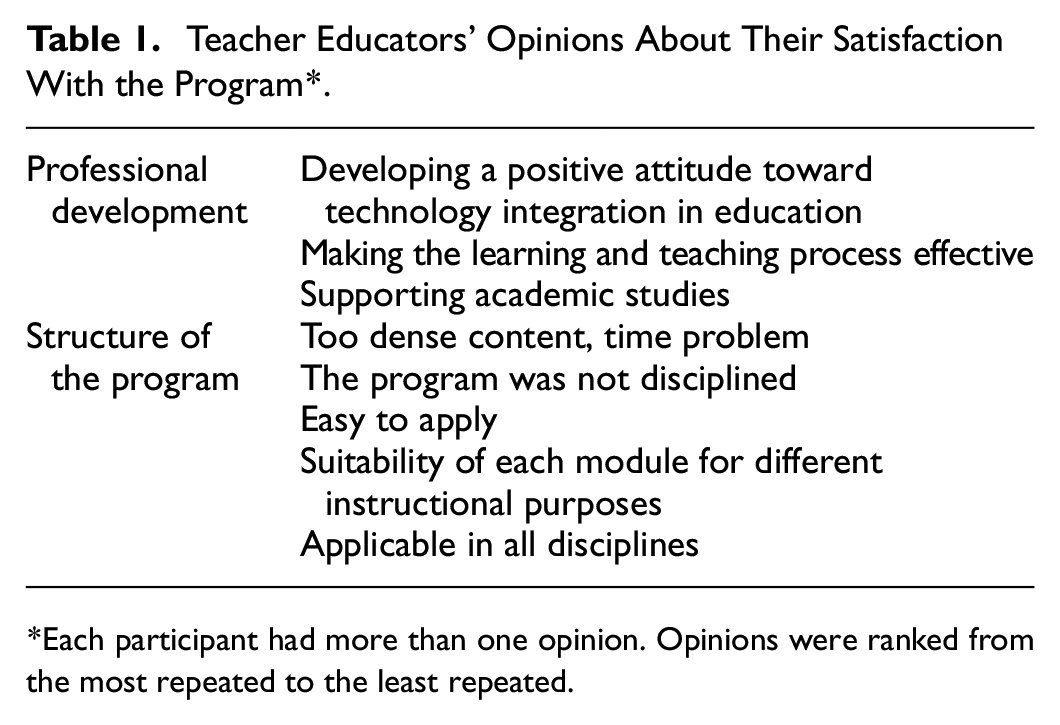
Each participant had more than one opinion. Opinions were ranked from the most repeated to the least repeated.
To identify the problems that faculty members faced during the research process and their suggestions for these problems, such questions were asked: What kind of problems did you experience in professional development training? What would you suggest solving these problems? The problems were lack of infrastructure in classrooms, faculty members having lack of time to practice, students not knowing the technology applications, and long education period (Table 2).
Problems that Teacher educators Faced and Their Suggestions.

Teacher educators were mostly positive about the program. Thanks to this program, they developed a positive attitude toward technology integration in teaching, made the learning-teaching process more effective, and could conduct academic studies. They stated that the technology integration was not so difficult, and they would be open to new technology applications from now on, which means that their motivation to use the knowledge they gained in the future increased.
P5 “I am positive about all modules… If someone tells me about another program that you haven’t mentioned, I will understand it more easily. Because I have some schemes in my mind regarding the general structure and functioning of these applications…”
Participants stated that these trainings met their expectations in terms of making teaching effective. According to them, thanks to TPACK applications, students’ interest increased, interaction was achieved, and the lesson became more enjoyable.
P6 “I have positive opinions. I was angry with myself… Although I am so intertwined with technology, I didn’t know much about it. I teach well, but I can make a difference with these applications. I can draw their attention using technology. My students actually expect new things from me. For this reason, there is no escape, I definitely use these applications in my lessons”.
The opinions of the participants about the academic study plans draw attention to a great extent. Some teacher educators emphasized that they would carry out scientific researches such as papers, articles and theses with the training they received by mentioning TPACK applications and various scientific publication plans.
P9 “Now, my colleagues ask me to share what I have learned. In fact, I plan to prepare a conference paper by applying what I’ve learned in the material course. Thus, I can improve myself more. In this respect, it has contributed to my perceptions. I think, this education was quite successful”.
Data showed that participants found the content of the program intense, they had time problems to participate effectively in the program and needed a sanction for follow-up during the program. Participants stated that their course load was high and therefore they had difficulty in fulfilling the assignments given in the trainings. Throughout the program, assignments were constantly monitored by the researcher. However, it was understood that this was insufficient, and more discipline was required. Despite the negative opinions about the intensity of the program and time problem, there were also positive opinions about the simplicity of the applications and the applicability of the program to every field.
P1 “I think the content was intense… Also, we were busy… I had administrative work and projects to carry out this semester. That’s why I couldn’t do the assignments you gave”. P8 “If I were you, I would come up with a plan every week and I would like everybody to practice and come next week, albeit by force.”
Considering satisfaction of the participants, their opinions were usually positive. Participants emphasized that this program positively affected their professional development, that they had a positive attitude toward technology integration and the use of educational technologies in teaching, and that they wanted to use TPACK applications they had learned. Besides, they stated that their perception of TPACK had improved after participating in this program and that they wanted to do academic studies on this topic from now on.
Lesson Designs of Teacher Educators in Compliance With TPACK
During the research process, teacher educators designed TPACK material and prepared lesson designs in accordance with TPACK with their existing pedagogical knowledge. Before joining the program, half of the teacher educators stated that they had never heard of TPACK. Half of them did but without detailed information. After the program, all of the teacher educators were able to define the TPACK, explain the necessary points, give detailed information about the TPACK objectives, and give TPACK lesson design samples along with the applications they learned during the process.Among the TPACK course samples designed by the participants, those with recurrence frequency are determined and presented under the headings below.
1. Sharing Theoretical Information on a Topic with Narration Using Prezi-Emaze Presentation Tools and Digital Concept/Mind Maps
Narration was used frequently by all teacher educators before as well as after TPACK training. While narration was used for sharing theoretical information through PowerPoint and visual elements before TPACK training, the majority of the participants stated that they could serve this purpose better by using Prezi, Emaze and digital concept maps. Here are some excerpts of participants who think that presentation tools and concept maps are effective in concretizing abstract subjects and enriching theoretical information with visual elements.
P7: Prezi and emaze are very enjoyable. Normally in presentations, slides are thought to be read. Prezi does not provide you such an opportunity. There are lots of visuals, but less writing. I use Prezi to attract students’ attention to the topic and to present the theoretical knowledge of the lesson.
2. Brainstorming with Tagul Word Art About a Concept or Problem
Brainstorming is considered as one of the techniques frequently used before and after TPACK training. Most teacher educators emphasized that they used the brainstorming in their lessons. While using this technique with blackboard, printed materials, and Microsoft word before TPACK training, they were found to prefer using Tagul Word Art, which is one of the keyword applications, in order to reveal different opinions and all known knowledge on a topic, after their TPACK training.
P8: In the first lesson, I asked student to write down what they knew about chemistry. We were talking about the common results. I was telling that chemistry was not just these, but it took a long time. From now on, I can do the same process at the end and beginning of the semester with the help of Tagul Word Art or poll everywhere. Also, I may compare them.
3. Using Kahoot-Socrative-Poll Everywhere for Interactive Evaluation in the Classroom
Evaluation tools were found to be preferred frequently after the application. Some teacher educators stated that they used Kahoot-Socrative-Poll Everywhere applications for the first time, and from now on, they would use these applications to stimulate lessons and assess students. The course designs they prepared were also in this direction. Interactive assessment tools were preferred to enable students to actively participate in the lesson, to interact with each other, and to make the lesson fun.
P9: I didn’t use to make quizzes because it didn’t fit the content of my lesson. Yet, I realized that I could make applications that could entertain and evaluate students in every lesson. The students loved Kahoot. I learned different assessment tools. I will definitely use them.
4. Exchange Ideas on a Subject and Preparing a Research Assignment Related to the Subject of the Course Using the Collaborative Learning Method on Padlet
Regarding teacher educators’ opinions about the methods and approaches they used before TPACK training, almost all of them (9 teacher educators) did not mention the applications for collaborative teaching. After the TPACK training, teacher educators chose various applications to provide collaborative teaching and used them in their classes. With collaborative teaching, group work and activities for creating a common product were held in the classroom. For this, the Padlet application, called digital panels, was preferred. Besides, participans emphasized that there were different opinions in the classroom due to individual differences among the students, and that the Padlet application could be used for the students to share their opinions without hesitation.
P5: We created an activity file with Padlet in one of my graduate courses. Students added their activities to the activity board. We created a joint document from it. We printed and reproducted it in collaboration….I present these videos in class and create a padlet page for each group. Everyone shares their views on each video. The students feel valuable in this way.
5. Sharing Information and Interacting Outside the Classroom with Edmodo and Google Drive
After the TPACK training, attempts to keep students active increased. This was achieved by sharing information outside the lesson and increasing the interaction between students. It is possible to share information through Google Drive and Edmodo outside of the lesson.
P6: I would give the students a topic about Human Geography and create a newspaper column on this topic. Each student creates the headline news and adds it to Edmodo. I asked them to prepare different task. Thus, they interact with each other and do a common job.
Although teacher educators were using e-mail, PowerPoint, Excel, visual elements, Word, ready-made videos, blackboard, and printed materials before TPACK trainings, they started to use Prezi, Emaze, Tagul Word Art, Digital concept/mind maps, Kahoot, Socartive, Poll Everywhere, edited film sections, animation videos, Google Forms, Google Drive, Edmodo, and Padlet applications after their TPAB training. While office programs, ready-made videos and visuals (where one-way communication is provided) were mostly used before TPACK trainings, it was found after TPACK trainings that interactive applications such as Padlet, Edmodo, Kahoot were used to make students be active.
Problems That Teacher Educators Encountered During Their Applications and Their Suggestions
Participants’ problems were gathered four themes “Lack of infrastructure in classrooms,”“Teacher educators’ having lack of time to practice, “Students not knowing the technology applications,” and “Long education period.”
Teacher educators complained that the lack of infrastructure experienced in the classrooms prevented the flow of the learning and teaching process. Teacher educators emphasized the internet access problem in almost all applications. Not having access to the internet, not having a smart phone or computer slow down the flow of lessons. In this regard, it was suggested that the infrastructure problem should be solved, and every student should have easy access to the internet in order to gain 21st century skills.
P7 “Internet connection is very problematic. During the implementation, everyone attended the classes. However, I made the connection with my own means by bringing a port device to the classroom. The internet provided by the university is not good. Therefore, my students were also worried. They were curious about how to use these applications when they become teachers. They said that there is not internet in every school…”
Participants also stated that there are problems due to students not knowing the technology applications used. This situation made it difficult for teacher educators to teach and caused a waste of time. Because teacher educators first explained this application to the students who do not know the technology application used, and then tried to reach the main goals of the course by using this application. For this reason, TPACK trainings should be expanded. It was emphasized that studies should be carried out to increase the TPACK competencies of teacher educators. They also recommended that courses regarding TPACK should be taught to undergraduate students.
P2 “I tried to apply Google Drive to graduate students in my scientific research methods course. There are students who cannot upload files. They should be trained also about this matter. Some of them have never been able to use Google Drive. I cannot explain this application to them due to lack of time… Students also should be trained. Our knowing it is not enough. It should be integrated into undergraduate courses…”
Another important problem is teacher educators’ lack of time to practice. They that they worked one-on-one with the researcher for at least 2 hr a week, but they could not spare time to practice outside. The reasons were work intensity, administrative duties, and course load. Therefore, the participants emphasized that more applications should be included in the trainings. Otherwise, they could not devote additional time and study the topic in detail. Besides, they emphasized that the one-to-one applications made during the trainings were more permanent.
P1 “I did not have time. Since I could not be at a sufficient level of readiness, I could not benefit enough. I could not use it because I did not learn well. Maybe if we had dealt with each application in more detail and if the number of topics had been few with more applications, it could have been more effective.”
As a result, teacher educators had problems with internet connection during the research process. In order to solve this problem, they suggested that internet access should be controlled continuously. Teacher educators who wanted to practice in the classroom had difficulties because the students did not have any knowledge about these applications. For this problem, it was suggested that undergraduate students should also be provided with trainings for their TPACK development. In addition, it was emphasized that the opportunity to practice might increase by increasing the application time in professional development trainings; thus, this would save time in solving potential problems in the classroom.
Discussion
The satisfaction of the participants with the program was first examined. All participants were found to have positive opinions about the program. The program is particularly appreciated for its easy content and suitability for use in different disciplines. Similarly, Hunter (2016) implemented a professional development program for teacher educators’ TPACK development and found that teacher educators from different disciplines who participated in the program found this program useful. Thanks to this program, the participants realized that the integration of technology into learning and teaching process is not as difficult as they thought. Based on this finding, it can be said that they previously found this task difficult, but from now on they will not have difficulty in learning any technology application. This indicates that the technology integration of teacher educators and their self-confidence toward TPACK have increased (Canbazoğlu Bilici, 2012; Hunter, 2016; Jimoyiannis, 2010; Voithofer & Nelson, 2021) also found that the TPACK program they implemented improved participants’ self-confidence.
The program has also been appreciated for its positive effects on the learning and teaching process. Teacher educators advocated that the methods they used affected the learning and teaching process positively and attracted students’ attention while transferring their knowledge to the classroom environment. This confirms the findings of (Brinkley-Etzkorn, 2018; Jaipal-Jamani et al., 2018; Wang & Zhao, 2021) The students’ appreciation of teacher educators’ practices in the classroom and their ability to transfer the learned practices into the learning and teaching processes is an expected result. As mentioned at the beginning of the professional development program, the goal is to increase students’ interest in the lessons. However, this study showed that some teacher educators considered this program mainly for academic studies rather than applying it in undergraduate programs. this may indicate that teacher educators experience a dilemma of teaching and research. Dilemmas may arise in some cases between teaching and research regarding the academic profession (Odabaşı et al., 2010). According to the positive relationship between research and teaching, they affect each other. In other words, a good researcher is also a good trainer. The current study found that some teacher educators could use the roles of the researchers and the teacher educators together and carry out TPACK applications accordingly. However, some teacher educators had a negative harmony between teaching and research and therefore considered the trainings for academic studies. This is because they mainly make research plans on TPACK instead of using TPACK in learning and teaching processes. Studies showed that teacher educators concentrated more on scientific research (Burak et al., 2022; Davey, 2013; Koç et al., 2015). This can be interpreted that the concept of “training for trainers” is very appropriate because it provides a solution to an important issue and thus increase the quality of education. The person who specializes in teaching and research feels more competent and whole as a research teacher educator. The delay in interest in this area can be explained by the fact that scientific activities such as reading research, conducting research and writing require more time, as noted by teacher educators of other nationalities (Jerez et al., 2021). In summary, the findings of our study coincide with the results of international research, suggesting that teacher educators must have an intrinsic motivation (emotional predisposition) to develop professionally.
The effectiveness of the program was determined by examining the TPACK developments of all participants throughout the process. Data displayed that each teacher educator developed regarding his/her readiness. According to the results, it was determined that each participant showed an improvement as to his own readiness. After the implementation, teacher educators with high computer skills found themselves much more competent in TPACK, and those with low computer skills felts less competent in TPACK. The views of the instructors about the applications of TPACK in the real classroom environment have been enriched. While the participants did not have detailed information about the subject before the TPACK training, they were able to explain the definition, objectives and application examples related to TPACK in detail after the training. The participants, who previously explained TPACK as “the use of technology in the lesson,” made rich explanations after the trainings as “the use of appropriate technological tools with pedagogical methods suitable for the content of the course” and gave various application examples. In other words, it has been observed that the awareness and knowledge of the participants about TPACK have been enriched with the trainings given.
In both cases, TPACK development was achieved, but this development changed according to their levels of readiness. Similarly, various studies found positive results (Alsofyani et al., 2012; Brinkley-Etzkorn, 2018; Hunter, 2016; Jaipal-Jamani et al., 2018). In these studies, a professional development program was prepared and applied for the TPACK development of the teacher educators, and an improvement was observed in the TPACK levels of teacher educators as a result of the application.
Teacher educators believed that they can be role models for future teachers by applying TPACK. There has been an increase in research examining the application of technology integration (one of the 21st century teacher competencies) and constructivist approach in teacher training programs (Çam & Erdamar Koç, 2021; Hunter, 2016; Martin, 2015; Voogt & McKenney, 2017). These studies argue that, for radical changes in education, teacher training should be examined, and necessary arrangements should be made in teacher training programs. Therefore, after providing the necessary trainings to the teacher educators based on their “role modeling” feature, changes in teaching processes were examined. According to results, teachers imitated their teacher educators’ teaching. Teacher educators in this study also stated that they were aware of their role modeling characteristics. In other words, they realized that if they improve their TPACK knowledge and skills, they will also improve teacher candidates’ TPACK and thus train teachers in line with the expectations of future generations.
Teacher educators’ opinions about the implementation of TPACK in the real classroom environment have been enriched. Teacher educators, who previously produced examples on basic technology applications and expression methods, produced examples with the harmony of various technology applications and different pedagogical methods after the program. Although they had limited knowledge about TPACK application examples before the program, they could produce various examples in the classroom after the program. While they used to apply narration, they mentioned technological applications such as Edmodo, Google Drive, Kahoot, Socrative after the program, and they stated that these technologies can be used with collaboration, brainstorming, discussion and many other pedagogical methods. Another important finding is their emphasis on pedagogical knowledge such as collaboration, attention to individual differences and active participation. This shows that teacher educators could transfer their knowledge to their lives. This confirms studies stating that TPACK-oriented trainings have a positive effect on individuals’ TPACK (Alsofyani et al., 2012; Brinkley-Etzkorn, 2018; Canbazoğlu Bilici, 2012; Kabakçı Yurdakul, 2013; Koh & Chai, 2014; Mouza et al., 2014). These findings can be interpreted that the development of teacher educators on new topics can be provided to the extent that they devote enough effort and time to adapt to innovations and changes.
Although teacher educators had positive views about the program, they found the content of the program intense and had difficulty in taking time to follow the program. They had trouble keeping up with the responsibilities of the program due to their administrative and academic duties. For this, teacher educators need a stricter follow-up and sanction. Similarly, (Bauer & Kenton, 2005) found a time problem during technology integration trainings. Particularly, teacher educators who used little or no technology in their daily life and learning-teaching processes had difficulties in practicing the trainings they attended for TPACK development in addition to their current course load, academic and administrative duties. Emphasizing that the time problem is one of the most important obstacles to technology integration, studies also draw attention to the need for research on this topic (Chen, 2010; Hill & Uribe-Florez, 2019).
Another important problem is the lack of infrastructure and equipment. In the age of 21st century information and technology, the integration of technology into learning and teaching processes is an expected but difficult situation (Brinkley-Etzkorn, 2018). Not being ready for technology integration of teaching programs, insufficient infrastructure for the use of technology in classrooms, insufficient technology knowledge of teachers or teacher educators, and negative attitudes toward technology make technology integration and development of TPACK difficult (Jimoyiannis, 2010; Parette et al., 2010). Similar problems were encountered in the current study. Participants had difficulties in performing the applications due to the lack of computers, smart phones and internet access in classrooms. Due to the infrastructure problems, teacher educators also had difficulties in classroom management. Similar problems have been found in many studies (Altın & Kalelioğlu, 2015; Canbazoğlu Bilici, 2012). Some studies concluded that technology integration could not be achieved although there were no technology hardware and infrastructure problems (Bauer & Kenton, 2005; Brinkley-Etzkorn, 2018). This shows that the technology integration process is a complex phenomenon that can happen over time.
Suggestions
Based on the study findings, some suggestions were recommended. Teacher educators can organize courses by associating their contents with pedagogy and technology to improve the TPACK of teacher candidates.
Therefore, the curriculum can be reviewed at the beginning of each year and the most appropriate technology and pedagogical methods can be determined in line with the program objectives. During the teaching process, activities can be designed taking into account the harmony of technology-pedagogy-content.
To gain TPACKS, the applications to be used are important. It is not possible to develop TPACK just through trainings. Therefore, teacher educators participating in professional development training should definitely practice in a real classroom environment. They can transform the acquired knowledge into skills only in time.
“Learning and research centers” can be established in universities to ensure teacher educators’ professional development. These centers can employ trainers who will determine the needs of the lecturers in the subjects they are lacking, organize the necessary trainings according to these needs and evaluate the trainings given. Continuous trainings for teacher educators’ professional development can be provided in these centers. Certificates, awards or other motivating elements can be used to encourage teacher educators to trainings.
Considering the new use of computer and communication technologies in higher education institutions and the development needs of teacher educators in this regard, regular trainings can be given to teacher educators to improve their TPACK competencies within the deanships of all universities.
Regarding that technology advances and develops rapidly, the technologies used in classrooms (smart board, projection, computer, etc.) should be checked continuously, and the problems should be overcome. In order to use these technologies more frequently, the infrastructure deficiencies in the classrooms should be eliminated. The collaboration between technical staff employed in the faculty deanships and teacher educators can be increased.
Teacher educators should give importance to improving teaching quality as much as scientific research, namely their identities as teacher educators as well as their identities as researchers. For this, articles can be included in the academic incentive regulation applied by the higher education board in order to increase the quality of education. In addition to the quantity of publications, both the quality of publications and their relationship with education can be considered. Thus, it can be ensured that lecturers integrate their teaching processes with their academic studies. Similarly, different attempts can be made to motivate teacher educators to increase the quality of their teaching.
Footnotes
Declaration of Conflicting Interests
The author(s) declared no potential conflicts of interest with respect to the research, authorship, and/or publication of this article.
Funding
The author(s) received no financial support for the research, authorship, and/or publication of this article.

Data Availability Statement
The data that support the findings of this study are available on request from the corresponding author. The data are not publicly available due to privacy or ethical restrictions.